""
Language skills
required, minimum level of B2
Programme length
2 years.
Study mode
Face-to-face learning
Application status
International students:
Students with Icelandic or Nordic citizenship:
Overview

  • Are you interested in history?
  • Do you want a wide range of graduate career options?
  • Do you want a useful and focused education which will be an asset in many different fields?
  • Do you want to do a graduate degree?

The MA in history teaching is part of the programme in upper secondary school teaching, which allows students to specialise in history teaching. The pedagogy section of the programme is taught at the School of Education while the history is taught at the School of Humanities. 

Programme structure

The programme is 120 ECTS and is organised as two years of full-time study.

The programme is made up of:

  • Mandatory courses, 50 ECTS
  • Student placements, 10 ECTS
  • Elective courses, 20 ECTS
  • Research project, 10 ECTS
  • Master's thesis, 30 ECTS

There are 6 mandatory courses at the School of Education. These courses provide a foundation of pedagogical knowledge, understanding and skills for student teachers. The structure of the programme is designed to link theory and practice. Students complete the mandatory courses during the first year of the programme.

Organisation of teaching

This programme is taught in Icelandic but most textbooks are in English.

Courses in core academic subjects and training placements require physical attendance. Students are expected to attend weekly classes as well as placements, totalling around 30 hours per semester plus meetings at the student’s host school.

Vocational training takes place during the school day at the upper secondary schools where student teachers are allocated places – this is organised in consideration of their timetables. Attendance is compulsory for placements and core courses

Main objectives

The programme aims to educate upper secondary school teachers with specialist knowledge of their subject, promoting good general knowledge among upper secondary school pupils. The programme is designed to comply with current legislation on teacher education and confers the right to apply for a teaching licence.

Learn more about upper secondary school teacher education

Other

Completing this programme qualifies a student to teach in Icelandic schools and use the professional title of teacher.

Completing the programme may allow you to apply for doctoral studies.

Applicants to this course, please note:
On the online application form, select Upper Secondary School Teaching, MA, 120 ECTS, and the specialisation History Teaching.
Students who have completed a BA programme in History with a first class grade from a recognised university may apply for admission to the MA programme in History Teaching. Students must have completed at least 120 ECTS at the BA level in the relevant field.

Applicants for master programmes leading to a teacher certificate who have neither completed upper-secondary school examination nor undergraduate studies at university level in Icelandic must pass a special Icelandic entrance examination at level B2 in accordance with the Common European Framework of Reference for Languages (CEFR).

An MA degree shall require 120 ECTS following completion of a BA degree. There are two components to the programme: courses, including individual projects, and the MA thesis. Students must also participate in a seminar in History. a. In the first semester, students shall take Theories in Humanities (10 ECTS), which is a joint course for other Master's students at the Faculty of History and Philosophy. b. In the second semester, students shall take New Research in History (10 ECTS). c. In the third semester, students shall take Research Project for MA Thesis (10 ECTS). d. In the fourth semester students shall write an MA thesis, generally evaluated for 30 ECTS. The thesis shall generally be 20-30,000 words in length. The format of the MA thesis shall be in accordance with the Regulation on postgraduate study at the Faculty of History and Philosophy. e. All other courses are elective. Individual projects are elective and may be worth 10 or 20 ECTS. Students may not take more than 20 ECTS in individual projects. They may, however, take two 10 ECTS projects.

The following documents must accompany an application for this programme:
  • CV
  • Statement of purpose
  • Reference 1, Name and email
  • Reference 2, Name and email
  • Certified copies of diplomas and transcripts

Further information on supporting documents can be found here

Programme structure

Check below to see how the programme is structured.

This programme does not offer specialisations.

First year | Fall
Pedagogy for Social Studies and practical training 1 (SFG105F)
A mandatory (required) course for the programme
10 ECTS, credits
5 fieldwork credits
Course Description

Students are introduced to different methods of teaching, the making of assignments and different methods of evaluation in social studies and the humanities (except from Icelandic and foreign languages). Students are trained to think critically about their own positionality when it comes to studying and teaching. Assignments in this course are connected to student’s fieldwork. The role of reflection for teachers to be is a focuspoint of the studies. It is important that participants in the course reflect on their work and develop their ideas on studying and teaching social studies. The aim is to help participants to become better teachers and give them the tools needed to continue their professional development.

Within the course students receive training in teaching and interacting with students and an introduction to school culture and working procedures. Each student is allotted a secondary school where they spend an allocated time under supervision during both autumn and spring terms. The training is connected to the course Introduction to Teaching and Learning so these courses should be taken simultaneously.

Language of instruction: Icelandic
Face-to-face learning
Prerequisites
Attendance required in class
First year | Fall
Introduction to Secondary School Teaching (KEN104F)
A mandatory (required) course for the programme
10 ECTS, credits
Course Description

The aim of the course is to give students an insight into main theories and research of learning and teaching (Icelandic and international). Main topics of the course are theories and research on learning and teaching, teachers' professionalism, teaching methods, and assessment.

The main field of work for graduates will be in upper secondary school, and this fact will determine the selection of learning tasks.

Language of instruction: Icelandic
Face-to-face learning
Prerequisites
Attendance required in class
First year | Fall
Theories in Humanities (FOR709F)
A mandatory (required) course for the programme
10 ECTS, credits
Course Description

The aim of the course is to provide students with a more comprehensive and deeper insight into the different theoretical approaches within the humanities. In the course, the main theories that have influenced theoretical discussion in the humanities over the last decades will be presented and discussed, and the students are taught how to apply them in their own research.

Language of instruction: Icelandic/English
Face-to-face learning
First year | Spring 1
Pedagogy for social studies and practical training 2 (SFG206F)
A mandatory (required) course for the programme
10 ECTS, credits
5 fieldwork credits
Course Description

Students are introduced to different methods of teaching, the making of assignments and different methods of evaluation in social studies and the humanities (except from Icelandic and foreign languages). Students are trained to think critically about their own positionality when it comes to studying and teaching. Assignments in this course are connected to student’s fieldwork. The role of reflection for teachers to be is a focuspoint of the studies. It is important that participants in the course reflect on their work and develop their ideas on studying and teaching social studies. The aim is to help participants to become better teachers and give them the tools needed to continue their professional development.

Within the course students receive training in teaching and interacting with students and an introduction to school culture and working procedures. Each student is allotted a secondary school where they spend an allocated time under supervision during both autumn and spring terms.

The training is connected to the course Curriculum and School Development in Secondary Schools and these two courses should be taken simultaneously.

Language of instruction: Icelandic
Face-to-face learning
Prerequisites
Attendance required in class
First year | Spring 1
Curriculum and School Development in Secondary Schools (KEN213F)
A mandatory (required) course for the programme
10 ECTS, credits
Course Description

This course is about curriculum theory and educational policy with emphasis on the curriculum, student body and school development in Icelandic upper secondary schools.

Assignments are designed to enable students to work as professionals on the development of school practice, curricula, and policies.

Language of instruction: Icelandic
Face-to-face learning
Prerequisites
Attendance required in class
First year | Spring 1
New researches in history (SAG201F)
A mandatory (required) course for the programme
10 ECTS, credits
Course Description

In the course, well-known historical studies from Western culture will be read that deal with a variety of topics. An attempt will be made to show how historians, both at the end of the twentieth century and at the beginning of the twenty-first century, struggle with different topics in their research. The discussion will be put into an ideological context and emphasis will be placed on showing the different approaches of historians when the subject has been connected to the aforementioned field of study. An attempt was made to select interesting books that are likely to give us an interesting picture of the state of the arts of history today.

Language of instruction: Icelandic
Face-to-face learning
First year | Spring 1
The End of the Cold War? The East-West Ideological and Geopolitical Struggle, 1979-2022 (SAG415M)
Free elective course within the programme
10 ECTS, credits
Course Description

This course examines the development and transformation of ideological and political conflicts between East and West from 1979—when the Cold War took on a new form—until the full-scale Russian invasion of Ukraine in 2022. Students explore how ideology shaped the interactions, conflicts, and cooperation between the superpowers during the final years of the Cold War and after the collapse of the Soviet Union. Special emphasis is placed on the end of the Cold War, the impact of Gorbachev’s reforms, the fall of the Soviet Union, and how ideological tensions have continued in the relations between Russia, the United States, China, and Europe in the 21st century.

Language of instruction: Icelandic
Face-to-face learning
Prerequisites
First year | Spring 1
The Women’s Movement and Feminism in Historical Perspective (SAG416M)
Free elective course within the programme
10 ECTS, credits
Course Description

In today’s society, where there is backlash in human rights, and in some cases women’s previously secured rights have been challenged, it is essential to understand the history of women´s right sand the women’s movement.  This course explores ideas concerning women’s rights from the eighteenth century (and, where relevant, earlier) to the latter half of the twentieth century, examining who articulated these ideas and in what ways. It addresses the struggles of women (and men) for gender equality, the milestones that were achieved, and the obstacles women encountered along the way. Attention will be given to concepts such as feminism, a term that did not emerge until the late nineteenth century, and its various manifestations. The concept, women’s movement, will also be scrutinised. Scholars in the fields of women’s and gender history have increasingly critiqued dominant definitions and questioned which movements deserve recognition within the grand narrative of women’s history. In this context, the usefulness and limitations of the so-called “wave theory” will be discussed, that is, the tendency to liken women’s movements to tidal cycles of ebb and flow: the first wave of feminism/women’s rights, the second wave, and so forth. Although the focus of the course will primarily be on the Western world, efforts will be made to integrate perspectives from other regions, as well as from Iceland, where appropriate.

Language of instruction: Icelandic
Prerequisites
First year | Spring 1
Handicraft, manufacturing and mentality in the 18th and 19th century – fashion, textiles and clothes making in Iceland (SAG417M)
Free elective course within the programme
10 ECTS, credits
Course Description

The objective of the course is to examine the fashion and clothes making of Icelanders in the 18th and 19th century from various angles. Research on handicraft and manufacturing will be examined in light of a variety of sources on handicraft, manufacturing and mentality in Iceland in relation to corresponding phenomena elsewhere in the realm of Denmark-Norway at the time. The reading material will be both scholarly work and primary sources. New research will be combined with primary sources, both from archives and museums. Field trips will be an important part of the course and research and analysis on clothes that are preserved. In recent years access has become better to published primary sources, both printed and online. The students will become capable of reading, finding, using and evaluating archival material from the 18th and 19th century and defining research questions in the field.

Language of instruction: Icelandic
Face-to-face learning
Second year | Fall
Research Project in History for MA-thesis (SAG704F)
A mandatory (required) course for the programme
10 ECTS, credits
Course Description

Research Project for MA-thesis in collaboration with supervisor.

Language of instruction: Icelandic
Second year | Fall
U.S. Foreign Policy: Hegemony, Ideology, and the International Order, 1945–2026 (SAG511M)
Free elective course within the programme
10 ECTS, credits
Course Description

The course analyzes the formation, articulation, and practice of U.S. foreign policy from World War II to the present. It focuses on the hegemonial position of the United States in the international system, its political values, culture, domestic politics, propaganda, and military power. It also explores representations of the “American Empire” during and after the Cold War and its reception abroad through an analysis of the transmission of American ideologies, unilateralist practices, liberalism, mass culture and consumption patterns, and race and gender images. The history of U.S. foreign policy from the presidency of Franklin D. Roosevelt to that of Donald Trump will be approached by examining how individual presidents shaped America’s global role.  U.S. actions abroad will be analyzed within broader ideological and structural contexts—including the Cold War, capitalism and anti-communism, democracy promotion, imperialism, human rights, international law, and global economic institutions. Special attention will be given to how race, gender, and domestic politics intersect with foreign policy, as well as the evolving role of international organizations and legal norms in shaping American engagement with the world. Attention will be paid to geopolitical and regional approaches, with emphasis on U.S.-European relations, Asia and Africa, and individual states, such as the Soviet Union/Russia, Britain, Germany, France, Vietnam, China, and South Africa during and after the Cold War. Emphasis will also be put on military interventions, including the Korean War, the Vietnam Wars, the wars in the former Yugoslavia, “the war on terror,” and the wars in Afghanistan, Libya, Iraq, Syria, and Ukraine  Finally, ideas about the decline of the “American Empire” will be explored and put within the context of the rise of China. In addition, recent U.S. attempts to challenge the liberal international order it created after World War II and to question the sovereign rights or aspirations (Canada and Greenland) will be analyzed. Various theoretical approaches in History, International Relations, and Cultural Studies, will be used to examine the topic.

Language of instruction: Icelandic
Face-to-face learning
Prerequisites
Second year | Fall
Microhistories about Poverty, Emotion and Disability (SAG512M)
Free elective course within the programme
10 ECTS, credits
Course Description

The course is intended to be, first of all, a very practical overview of the main categories of public sources that are preserved in archives and are accessible in electronic form. All categories have their advantages and disadvantages. The sources were created within some kind of administration and their aim was to gather information about the "population" that is under, preserve it and use the information to strengthen the administration and "create" the facts it needed. to hold to maintain itself. Secondly, the course is an introduction to the development that has taken place in the methodology of solitude in new Icelandic research in history. This is a new perspective on what has been called the unification of history. Thirdly, the course will be an introduction to how the emotions of individuals in the past can be analyzed through public sources and how the ideology of the history of emotions can be used in those analyzes and a new integration of theories about poverty and disability in the past with special emphasis on gender perspectives.

Language of instruction: Icelandic
Face-to-face learning
Second year | Fall
Individual Special Subject A (SAG014FSAG604F)
Free elective course within the programme
20 ECTS, credits
Course Description

Einstaklingsverkefni A

Language of instruction: Icelandic
Self-study
Second year | Fall
Individual Subject C (SAG014FSAG604F)
Free elective course within the programme
20 ECTS, credits
Course Description

.

Language of instruction: Icelandic
Self-study
Second year | Fall
The Medieval North (SAG716M)
Free elective course within the programme
10 ECTS, credits
Course Description

Historical and historiographical survey of major topics in the history of the medieval North, with special emphasis on Iceland and Norway from the Viking Age into the fourteenth century. Topics include: Power, kingship and state; law and feud; kinship, gender and social ties; religious and mental outlook(s); conversion, Christianity and church; economic conditions. Prior knowledge of the “factual” narrative (textbook narrative) is helpful but not necessary.

Language of instruction: English
Face-to-face learning
Prerequisites
Second year | Spring 1
MA thesis in History Teaching (SAG442L)
A mandatory (required) course for the programme
0 ECTS, credits
Course Description

.

Language of instruction: Icelandic
Part of the total project/thesis credits
First year
  • Fall
  • SFG105F
    Pedagogy for Social Studies and practical training 1
    Mandatory (required) course
    10
    A mandatory (required) course for the programme
    10 ECTS, credits
    5 fieldwork credits
    Course Description

    Students are introduced to different methods of teaching, the making of assignments and different methods of evaluation in social studies and the humanities (except from Icelandic and foreign languages). Students are trained to think critically about their own positionality when it comes to studying and teaching. Assignments in this course are connected to student’s fieldwork. The role of reflection for teachers to be is a focuspoint of the studies. It is important that participants in the course reflect on their work and develop their ideas on studying and teaching social studies. The aim is to help participants to become better teachers and give them the tools needed to continue their professional development.

    Within the course students receive training in teaching and interacting with students and an introduction to school culture and working procedures. Each student is allotted a secondary school where they spend an allocated time under supervision during both autumn and spring terms. The training is connected to the course Introduction to Teaching and Learning so these courses should be taken simultaneously.

    Face-to-face learning
    Prerequisites
    Attendance required in class
  • KEN104F
    Introduction to Secondary School Teaching
    Mandatory (required) course
    10
    A mandatory (required) course for the programme
    10 ECTS, credits
    Course Description

    The aim of the course is to give students an insight into main theories and research of learning and teaching (Icelandic and international). Main topics of the course are theories and research on learning and teaching, teachers' professionalism, teaching methods, and assessment.

    The main field of work for graduates will be in upper secondary school, and this fact will determine the selection of learning tasks.

    Face-to-face learning
    Prerequisites
    Attendance required in class
  • FOR709F
    Theories in Humanities
    Mandatory (required) course
    10
    A mandatory (required) course for the programme
    10 ECTS, credits
    Course Description

    The aim of the course is to provide students with a more comprehensive and deeper insight into the different theoretical approaches within the humanities. In the course, the main theories that have influenced theoretical discussion in the humanities over the last decades will be presented and discussed, and the students are taught how to apply them in their own research.

    Face-to-face learning
    Prerequisites
  • Spring 2
  • SFG206F
    Pedagogy for social studies and practical training 2
    Mandatory (required) course
    10
    A mandatory (required) course for the programme
    10 ECTS, credits
    5 fieldwork credits
    Course Description

    Students are introduced to different methods of teaching, the making of assignments and different methods of evaluation in social studies and the humanities (except from Icelandic and foreign languages). Students are trained to think critically about their own positionality when it comes to studying and teaching. Assignments in this course are connected to student’s fieldwork. The role of reflection for teachers to be is a focuspoint of the studies. It is important that participants in the course reflect on their work and develop their ideas on studying and teaching social studies. The aim is to help participants to become better teachers and give them the tools needed to continue their professional development.

    Within the course students receive training in teaching and interacting with students and an introduction to school culture and working procedures. Each student is allotted a secondary school where they spend an allocated time under supervision during both autumn and spring terms.

    The training is connected to the course Curriculum and School Development in Secondary Schools and these two courses should be taken simultaneously.

    Face-to-face learning
    Prerequisites
    Attendance required in class
  • KEN213F
    Curriculum and School Development in Secondary Schools
    Mandatory (required) course
    10
    A mandatory (required) course for the programme
    10 ECTS, credits
    Course Description

    This course is about curriculum theory and educational policy with emphasis on the curriculum, student body and school development in Icelandic upper secondary schools.

    Assignments are designed to enable students to work as professionals on the development of school practice, curricula, and policies.

    Face-to-face learning
    Prerequisites
    Attendance required in class
  • SAG201F
    New researches in history
    Mandatory (required) course
    10
    A mandatory (required) course for the programme
    10 ECTS, credits
    Course Description

    In the course, well-known historical studies from Western culture will be read that deal with a variety of topics. An attempt will be made to show how historians, both at the end of the twentieth century and at the beginning of the twenty-first century, struggle with different topics in their research. The discussion will be put into an ideological context and emphasis will be placed on showing the different approaches of historians when the subject has been connected to the aforementioned field of study. An attempt was made to select interesting books that are likely to give us an interesting picture of the state of the arts of history today.

    Face-to-face learning
    Prerequisites
  • SAG415M
    The End of the Cold War? The East-West Ideological and Geopolitical Struggle, 1979-2022
    Elective course
    10
    Free elective course within the programme
    10 ECTS, credits
    Course Description

    This course examines the development and transformation of ideological and political conflicts between East and West from 1979—when the Cold War took on a new form—until the full-scale Russian invasion of Ukraine in 2022. Students explore how ideology shaped the interactions, conflicts, and cooperation between the superpowers during the final years of the Cold War and after the collapse of the Soviet Union. Special emphasis is placed on the end of the Cold War, the impact of Gorbachev’s reforms, the fall of the Soviet Union, and how ideological tensions have continued in the relations between Russia, the United States, China, and Europe in the 21st century.

    Face-to-face learning
    Prerequisites
  • SAG416M
    The Women’s Movement and Feminism in Historical Perspective
    Elective course
    10
    Free elective course within the programme
    10 ECTS, credits
    Course Description

    In today’s society, where there is backlash in human rights, and in some cases women’s previously secured rights have been challenged, it is essential to understand the history of women´s right sand the women’s movement.  This course explores ideas concerning women’s rights from the eighteenth century (and, where relevant, earlier) to the latter half of the twentieth century, examining who articulated these ideas and in what ways. It addresses the struggles of women (and men) for gender equality, the milestones that were achieved, and the obstacles women encountered along the way. Attention will be given to concepts such as feminism, a term that did not emerge until the late nineteenth century, and its various manifestations. The concept, women’s movement, will also be scrutinised. Scholars in the fields of women’s and gender history have increasingly critiqued dominant definitions and questioned which movements deserve recognition within the grand narrative of women’s history. In this context, the usefulness and limitations of the so-called “wave theory” will be discussed, that is, the tendency to liken women’s movements to tidal cycles of ebb and flow: the first wave of feminism/women’s rights, the second wave, and so forth. Although the focus of the course will primarily be on the Western world, efforts will be made to integrate perspectives from other regions, as well as from Iceland, where appropriate.

    Prerequisites
  • SAG417M
    Handicraft, manufacturing and mentality in the 18th and 19th century – fashion, textiles and clothes making in Iceland
    Elective course
    10
    Free elective course within the programme
    10 ECTS, credits
    Course Description

    The objective of the course is to examine the fashion and clothes making of Icelanders in the 18th and 19th century from various angles. Research on handicraft and manufacturing will be examined in light of a variety of sources on handicraft, manufacturing and mentality in Iceland in relation to corresponding phenomena elsewhere in the realm of Denmark-Norway at the time. The reading material will be both scholarly work and primary sources. New research will be combined with primary sources, both from archives and museums. Field trips will be an important part of the course and research and analysis on clothes that are preserved. In recent years access has become better to published primary sources, both printed and online. The students will become capable of reading, finding, using and evaluating archival material from the 18th and 19th century and defining research questions in the field.

    Face-to-face learning
    Prerequisites
  • Fall
  • SAG704F
    Research Project in History for MA-thesis
    Mandatory (required) course
    10
    A mandatory (required) course for the programme
    10 ECTS, credits
    Course Description

    Research Project for MA-thesis in collaboration with supervisor.

    Prerequisites
  • SAG511M
    U.S. Foreign Policy: Hegemony, Ideology, and the International Order, 1945–2026
    Elective course
    10
    Free elective course within the programme
    10 ECTS, credits
    Course Description

    The course analyzes the formation, articulation, and practice of U.S. foreign policy from World War II to the present. It focuses on the hegemonial position of the United States in the international system, its political values, culture, domestic politics, propaganda, and military power. It also explores representations of the “American Empire” during and after the Cold War and its reception abroad through an analysis of the transmission of American ideologies, unilateralist practices, liberalism, mass culture and consumption patterns, and race and gender images. The history of U.S. foreign policy from the presidency of Franklin D. Roosevelt to that of Donald Trump will be approached by examining how individual presidents shaped America’s global role.  U.S. actions abroad will be analyzed within broader ideological and structural contexts—including the Cold War, capitalism and anti-communism, democracy promotion, imperialism, human rights, international law, and global economic institutions. Special attention will be given to how race, gender, and domestic politics intersect with foreign policy, as well as the evolving role of international organizations and legal norms in shaping American engagement with the world. Attention will be paid to geopolitical and regional approaches, with emphasis on U.S.-European relations, Asia and Africa, and individual states, such as the Soviet Union/Russia, Britain, Germany, France, Vietnam, China, and South Africa during and after the Cold War. Emphasis will also be put on military interventions, including the Korean War, the Vietnam Wars, the wars in the former Yugoslavia, “the war on terror,” and the wars in Afghanistan, Libya, Iraq, Syria, and Ukraine  Finally, ideas about the decline of the “American Empire” will be explored and put within the context of the rise of China. In addition, recent U.S. attempts to challenge the liberal international order it created after World War II and to question the sovereign rights or aspirations (Canada and Greenland) will be analyzed. Various theoretical approaches in History, International Relations, and Cultural Studies, will be used to examine the topic.

    Face-to-face learning
    Prerequisites
  • SAG512M
    Microhistories about Poverty, Emotion and Disability
    Elective course
    10
    Free elective course within the programme
    10 ECTS, credits
    Course Description

    The course is intended to be, first of all, a very practical overview of the main categories of public sources that are preserved in archives and are accessible in electronic form. All categories have their advantages and disadvantages. The sources were created within some kind of administration and their aim was to gather information about the "population" that is under, preserve it and use the information to strengthen the administration and "create" the facts it needed. to hold to maintain itself. Secondly, the course is an introduction to the development that has taken place in the methodology of solitude in new Icelandic research in history. This is a new perspective on what has been called the unification of history. Thirdly, the course will be an introduction to how the emotions of individuals in the past can be analyzed through public sources and how the ideology of the history of emotions can be used in those analyzes and a new integration of theories about poverty and disability in the past with special emphasis on gender perspectives.

    Face-to-face learning
    Prerequisites
  • SAG014FSAG604F
    Individual Special Subject A
    Elective course
    20
    Free elective course within the programme
    20 ECTS, credits
    Course Description

    Einstaklingsverkefni A

    Self-study
    Prerequisites
  • SAG716M
    The Medieval North
    Elective course
    10
    Free elective course within the programme
    10 ECTS, credits
    Course Description

    Historical and historiographical survey of major topics in the history of the medieval North, with special emphasis on Iceland and Norway from the Viking Age into the fourteenth century. Topics include: Power, kingship and state; law and feud; kinship, gender and social ties; religious and mental outlook(s); conversion, Christianity and church; economic conditions. Prior knowledge of the “factual” narrative (textbook narrative) is helpful but not necessary.

    Face-to-face learning
    Prerequisites
  • Spring 2
  • SAG442L
    MA thesis in History Teaching
    Mandatory (required) course
    0
    A mandatory (required) course for the programme
    0 ECTS, credits
    Course Description

    .

    Prerequisites
    Part of the total project/thesis credits
Second year
  • Fall
  • SFG105F
    Pedagogy for Social Studies and practical training 1
    Mandatory (required) course
    10
    A mandatory (required) course for the programme
    10 ECTS, credits
    5 fieldwork credits
    Course Description

    Students are introduced to different methods of teaching, the making of assignments and different methods of evaluation in social studies and the humanities (except from Icelandic and foreign languages). Students are trained to think critically about their own positionality when it comes to studying and teaching. Assignments in this course are connected to student’s fieldwork. The role of reflection for teachers to be is a focuspoint of the studies. It is important that participants in the course reflect on their work and develop their ideas on studying and teaching social studies. The aim is to help participants to become better teachers and give them the tools needed to continue their professional development.

    Within the course students receive training in teaching and interacting with students and an introduction to school culture and working procedures. Each student is allotted a secondary school where they spend an allocated time under supervision during both autumn and spring terms. The training is connected to the course Introduction to Teaching and Learning so these courses should be taken simultaneously.

    Face-to-face learning
    Prerequisites
    Attendance required in class
  • KEN104F
    Introduction to Secondary School Teaching
    Mandatory (required) course
    10
    A mandatory (required) course for the programme
    10 ECTS, credits
    Course Description

    The aim of the course is to give students an insight into main theories and research of learning and teaching (Icelandic and international). Main topics of the course are theories and research on learning and teaching, teachers' professionalism, teaching methods, and assessment.

    The main field of work for graduates will be in upper secondary school, and this fact will determine the selection of learning tasks.

    Face-to-face learning
    Prerequisites
    Attendance required in class
  • FOR709F
    Theories in Humanities
    Mandatory (required) course
    10
    A mandatory (required) course for the programme
    10 ECTS, credits
    Course Description

    The aim of the course is to provide students with a more comprehensive and deeper insight into the different theoretical approaches within the humanities. In the course, the main theories that have influenced theoretical discussion in the humanities over the last decades will be presented and discussed, and the students are taught how to apply them in their own research.

    Face-to-face learning
    Prerequisites
  • Spring 2
  • SFG206F
    Pedagogy for social studies and practical training 2
    Mandatory (required) course
    10
    A mandatory (required) course for the programme
    10 ECTS, credits
    5 fieldwork credits
    Course Description

    Students are introduced to different methods of teaching, the making of assignments and different methods of evaluation in social studies and the humanities (except from Icelandic and foreign languages). Students are trained to think critically about their own positionality when it comes to studying and teaching. Assignments in this course are connected to student’s fieldwork. The role of reflection for teachers to be is a focuspoint of the studies. It is important that participants in the course reflect on their work and develop their ideas on studying and teaching social studies. The aim is to help participants to become better teachers and give them the tools needed to continue their professional development.

    Within the course students receive training in teaching and interacting with students and an introduction to school culture and working procedures. Each student is allotted a secondary school where they spend an allocated time under supervision during both autumn and spring terms.

    The training is connected to the course Curriculum and School Development in Secondary Schools and these two courses should be taken simultaneously.

    Face-to-face learning
    Prerequisites
    Attendance required in class
  • KEN213F
    Curriculum and School Development in Secondary Schools
    Mandatory (required) course
    10
    A mandatory (required) course for the programme
    10 ECTS, credits
    Course Description

    This course is about curriculum theory and educational policy with emphasis on the curriculum, student body and school development in Icelandic upper secondary schools.

    Assignments are designed to enable students to work as professionals on the development of school practice, curricula, and policies.

    Face-to-face learning
    Prerequisites
    Attendance required in class
  • SAG201F
    New researches in history
    Mandatory (required) course
    10
    A mandatory (required) course for the programme
    10 ECTS, credits
    Course Description

    In the course, well-known historical studies from Western culture will be read that deal with a variety of topics. An attempt will be made to show how historians, both at the end of the twentieth century and at the beginning of the twenty-first century, struggle with different topics in their research. The discussion will be put into an ideological context and emphasis will be placed on showing the different approaches of historians when the subject has been connected to the aforementioned field of study. An attempt was made to select interesting books that are likely to give us an interesting picture of the state of the arts of history today.

    Face-to-face learning
    Prerequisites
  • SAG415M
    The End of the Cold War? The East-West Ideological and Geopolitical Struggle, 1979-2022
    Elective course
    10
    Free elective course within the programme
    10 ECTS, credits
    Course Description

    This course examines the development and transformation of ideological and political conflicts between East and West from 1979—when the Cold War took on a new form—until the full-scale Russian invasion of Ukraine in 2022. Students explore how ideology shaped the interactions, conflicts, and cooperation between the superpowers during the final years of the Cold War and after the collapse of the Soviet Union. Special emphasis is placed on the end of the Cold War, the impact of Gorbachev’s reforms, the fall of the Soviet Union, and how ideological tensions have continued in the relations between Russia, the United States, China, and Europe in the 21st century.

    Face-to-face learning
    Prerequisites
  • SAG416M
    The Women’s Movement and Feminism in Historical Perspective
    Elective course
    10
    Free elective course within the programme
    10 ECTS, credits
    Course Description

    In today’s society, where there is backlash in human rights, and in some cases women’s previously secured rights have been challenged, it is essential to understand the history of women´s right sand the women’s movement.  This course explores ideas concerning women’s rights from the eighteenth century (and, where relevant, earlier) to the latter half of the twentieth century, examining who articulated these ideas and in what ways. It addresses the struggles of women (and men) for gender equality, the milestones that were achieved, and the obstacles women encountered along the way. Attention will be given to concepts such as feminism, a term that did not emerge until the late nineteenth century, and its various manifestations. The concept, women’s movement, will also be scrutinised. Scholars in the fields of women’s and gender history have increasingly critiqued dominant definitions and questioned which movements deserve recognition within the grand narrative of women’s history. In this context, the usefulness and limitations of the so-called “wave theory” will be discussed, that is, the tendency to liken women’s movements to tidal cycles of ebb and flow: the first wave of feminism/women’s rights, the second wave, and so forth. Although the focus of the course will primarily be on the Western world, efforts will be made to integrate perspectives from other regions, as well as from Iceland, where appropriate.

    Prerequisites
  • SAG417M
    Handicraft, manufacturing and mentality in the 18th and 19th century – fashion, textiles and clothes making in Iceland
    Elective course
    10
    Free elective course within the programme
    10 ECTS, credits
    Course Description

    The objective of the course is to examine the fashion and clothes making of Icelanders in the 18th and 19th century from various angles. Research on handicraft and manufacturing will be examined in light of a variety of sources on handicraft, manufacturing and mentality in Iceland in relation to corresponding phenomena elsewhere in the realm of Denmark-Norway at the time. The reading material will be both scholarly work and primary sources. New research will be combined with primary sources, both from archives and museums. Field trips will be an important part of the course and research and analysis on clothes that are preserved. In recent years access has become better to published primary sources, both printed and online. The students will become capable of reading, finding, using and evaluating archival material from the 18th and 19th century and defining research questions in the field.

    Face-to-face learning
    Prerequisites
  • Fall
  • SAG704F
    Research Project in History for MA-thesis
    Mandatory (required) course
    10
    A mandatory (required) course for the programme
    10 ECTS, credits
    Course Description

    Research Project for MA-thesis in collaboration with supervisor.

    Prerequisites
  • SAG511M
    U.S. Foreign Policy: Hegemony, Ideology, and the International Order, 1945–2026
    Elective course
    10
    Free elective course within the programme
    10 ECTS, credits
    Course Description

    The course analyzes the formation, articulation, and practice of U.S. foreign policy from World War II to the present. It focuses on the hegemonial position of the United States in the international system, its political values, culture, domestic politics, propaganda, and military power. It also explores representations of the “American Empire” during and after the Cold War and its reception abroad through an analysis of the transmission of American ideologies, unilateralist practices, liberalism, mass culture and consumption patterns, and race and gender images. The history of U.S. foreign policy from the presidency of Franklin D. Roosevelt to that of Donald Trump will be approached by examining how individual presidents shaped America’s global role.  U.S. actions abroad will be analyzed within broader ideological and structural contexts—including the Cold War, capitalism and anti-communism, democracy promotion, imperialism, human rights, international law, and global economic institutions. Special attention will be given to how race, gender, and domestic politics intersect with foreign policy, as well as the evolving role of international organizations and legal norms in shaping American engagement with the world. Attention will be paid to geopolitical and regional approaches, with emphasis on U.S.-European relations, Asia and Africa, and individual states, such as the Soviet Union/Russia, Britain, Germany, France, Vietnam, China, and South Africa during and after the Cold War. Emphasis will also be put on military interventions, including the Korean War, the Vietnam Wars, the wars in the former Yugoslavia, “the war on terror,” and the wars in Afghanistan, Libya, Iraq, Syria, and Ukraine  Finally, ideas about the decline of the “American Empire” will be explored and put within the context of the rise of China. In addition, recent U.S. attempts to challenge the liberal international order it created after World War II and to question the sovereign rights or aspirations (Canada and Greenland) will be analyzed. Various theoretical approaches in History, International Relations, and Cultural Studies, will be used to examine the topic.

    Face-to-face learning
    Prerequisites
  • SAG512M
    Microhistories about Poverty, Emotion and Disability
    Elective course
    10
    Free elective course within the programme
    10 ECTS, credits
    Course Description

    The course is intended to be, first of all, a very practical overview of the main categories of public sources that are preserved in archives and are accessible in electronic form. All categories have their advantages and disadvantages. The sources were created within some kind of administration and their aim was to gather information about the "population" that is under, preserve it and use the information to strengthen the administration and "create" the facts it needed. to hold to maintain itself. Secondly, the course is an introduction to the development that has taken place in the methodology of solitude in new Icelandic research in history. This is a new perspective on what has been called the unification of history. Thirdly, the course will be an introduction to how the emotions of individuals in the past can be analyzed through public sources and how the ideology of the history of emotions can be used in those analyzes and a new integration of theories about poverty and disability in the past with special emphasis on gender perspectives.

    Face-to-face learning
    Prerequisites
  • SAG014FSAG604F
    Individual Special Subject A
    Elective course
    20
    Free elective course within the programme
    20 ECTS, credits
    Course Description

    Einstaklingsverkefni A

    Self-study
    Prerequisites
  • SAG716M
    The Medieval North
    Elective course
    10
    Free elective course within the programme
    10 ECTS, credits
    Course Description

    Historical and historiographical survey of major topics in the history of the medieval North, with special emphasis on Iceland and Norway from the Viking Age into the fourteenth century. Topics include: Power, kingship and state; law and feud; kinship, gender and social ties; religious and mental outlook(s); conversion, Christianity and church; economic conditions. Prior knowledge of the “factual” narrative (textbook narrative) is helpful but not necessary.

    Face-to-face learning
    Prerequisites
  • Spring 2
  • SAG442L
    MA thesis in History Teaching
    Mandatory (required) course
    0
    A mandatory (required) course for the programme
    0 ECTS, credits
    Course Description

    .

    Prerequisites
    Part of the total project/thesis credits

The timetable shown below is for the current academic year and is FOR REFERENCE ONLY.

Changes may occur for the autumn semester in August and September and for the spring semester in December and January. You will find your final timetable in Ugla when the studies start.

Note! This timetable is not suitable for planning your work schedule if you are a part-time employee.


Additional information

The University of Iceland collaborates with over 400 universities worldwide. This provides a unique opportunity to pursue part of your studies at an international university thus gaining added experience and fresh insight into your field of study.

Students generally have the opportunity to join an exchange programme, internship, or summer courses. However, exchanges are always subject to faculty approval.

Students have the opportunity to have courses evaluated as part of their studies at the University of Iceland, so their stay does not have to affect the duration of their studies.

There are diverse career opportunities open to graduates from the programme in history teaching.

An education in this area can open up opportunities in:

  • Teaching
  • Learning materials design
  • Adult education
  • Project management
  • Mentoring

This list is not exhaustive.

There is no specific student organisation for this programme, but students meet frequently in the Student Cellar.

Students' comments
""
Students appreciate the University of Iceland for its strong academic reputation, modern campus facilities, close-knit community, and affordable tuition.
Helpful content
Aurora Cooperation

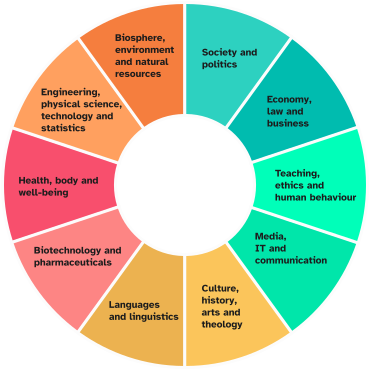
Study wheel

What interests you?

Aurora Cooperation

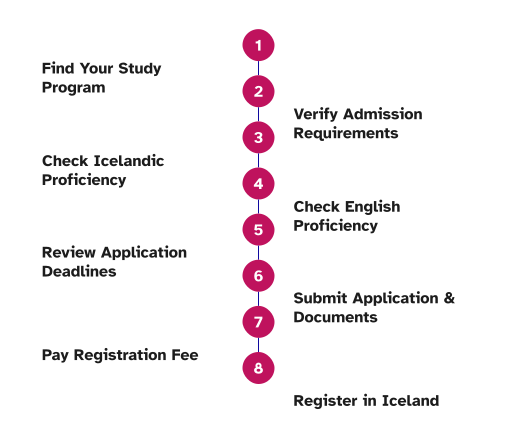
How to apply

Follow the path

Contact us

If you still have questions, feel free to contact us.

School of Humanities
Weekdays: 10-12 am and 1-3 pm
General Service and Social Media

The Service Desk is a point of access for all services. You can drop in at the University Centre or use the WebChat at the bottom right of this page.

Follow the School of Humanities on Instagram,   Youtube
and Facebook

""

Share

Did this help?

Why wasn't this information helpful

Limit to 250 characters.