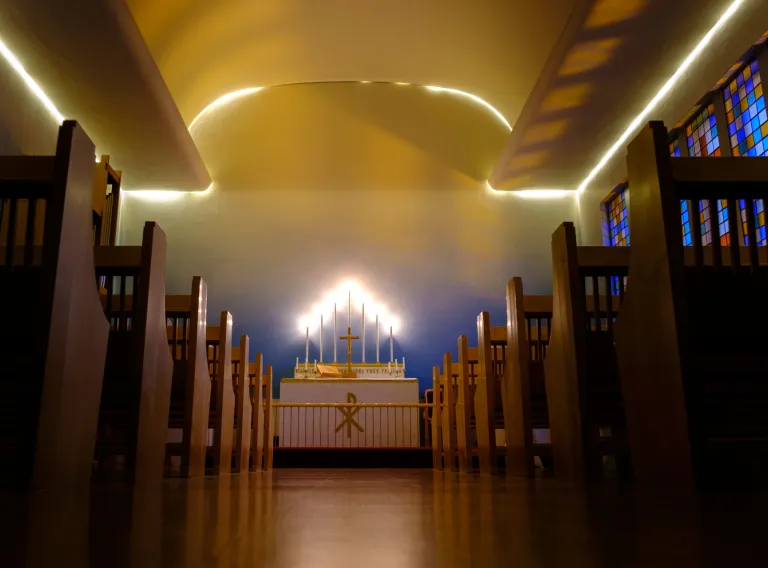
""
Language skills
required, minimum level of B2
Programme length
2 years.
Study mode
Face-to-face learning
Application status
International students:
Students with Icelandic or Nordic citizenship:
Overview

  • Are you interested in working with people?
  • Do you want to better understand Icelandic church history?
  • Do you want to become a pastor?
  • Do you want to acquire a broader and more in-depth knowledge of theories in the humanities?

The MA in theology can be tailored to suit a student’s interests. Students can choose their own courses, reading courses and thesis topic in consultation with teaching staff.

After completing the programme, students should be able to apply their knowledge, understanding and problem-solving skills to new and unfamiliar situations in a broad or interdisciplinary context relevant to theological research, teaching, church work, or other areas. Students will be introduced to research methodology in theology and become literate in research and research findings.

Programme structure

The programme is 120 ECTS and is organised as one or two years of full-time study.

Students who have qualified to be ordained as pastors or completed a cand. theol. or mag. theol. degree may transfer up to 60 ECTS from their previous studies, allowing them to complete the programme in one year.

Organisation of teaching

This programme is taught in Icelandic but most textbooks are in English.

Main objectives

After completing the programme, students should, for example:

  • have acquired clear and precise knowledge of one area of theology or Church work, as well as scientific ethics.
  • be able to take part in academic debate on theological and social challenges and issues and put forward robust arguments to support their case
  • be able to direct Church work in the areas of divine services, evangelism, education, pastoral care and charitable service
  • be able to discuss theological and ethical issues fairly and show respect and understanding for the perspectives of others

Other

To be ordained as a pastor in the Church of Iceland, students must also complete vocational training at the Church of Iceland. The Faculty does not offer this training.

Completing the programme allows a student to apply for doctoral studies.

BA degree in theology with a first class grade (7.25) and a BA thesis in theology worth at least 10 ECTS.

An MA degree shall require at least 120 ECTS. The programme is divided into the following parts: a mandatory course, elective courses, individual projects and the final project. The mandatory course is FOR709F Theories in Humanities (10 ECTS) and students complete this course in the first semester. Elective courses and individual projects are selected in consultation with a supervisor. Students shall complete either a 30 or 60 ECTS Master's thesis. Students planning to go on to do a PhD after the MA may write a thesis on a subject related to the proposed PhD thesis.

Students who have completed a mag. theol. degree or a cand. theol. degree are not required to take FOR709F Theories in Humanities. Students planning to go on to do a PhD in theology must complete at least 10 ECTS in Master's methodology courses in either the humanities or social sciences, in consultation with a supervisor.

The following documents must accompany an application for this programme:
  • CV
  • Statement of purpose
  • Reference 1, Name and email
  • Reference 2, Name and email
  • Certified copies of diplomas and transcripts

Further information on supporting documents can be found here

Programme structure

Check below to see how the programme is structured.

This programme does not offer specialisations.

First year | Fall
Theories in Humanities (FOR709F)
A mandatory (required) course for the programme
10 ECTS, credits
Course Description

The aim of the course is to provide students with a more comprehensive and deeper insight into the different theoretical approaches within the humanities. In the course, the main theories that have influenced theoretical discussion in the humanities over the last decades will be presented and discussed, and the students are taught how to apply them in their own research.

Language of instruction: Icelandic/English
Face-to-face learning
First year | Fall
Individual Special Subject (GFR708F)
Free elective course within the programme
10 ECTS, credits
Course Description

The individual project for 10 credits involves a self-directed project defined in consultation with a supervisor. It should involve c. 240 hours of work.

Language of instruction: Icelandic
Self-study
First year | Fall
Church Denominations (GFR109F)
Free elective course within the programme
5 ECTS, credits
Course Description

This graduate course analyzes culture, history and traditions of the church denominations from academic concepts and methods of ecumenical theology, World Christianity, missiology and sociology of religion. The course addresses dogmas, organization, issues and practices of majority churches and movements in the world. The course discusses the work of church denominations in Iceland and the development of legislation regulating religious communities. Finally, the course discusses the relations between World Christianity, ecumenical bodies and mission in and between church denominations.

Language of instruction: Icelandic
First year | Fall
Worship and liturgical music 1 (GFR305F)
Free elective course within the programme
5 ECTS, credits
Course Description

What are the different roles played out in preparing and conducting a Lutheran worship service? Each service builds on  the complex interaction between church rituals, church music, diakonia and homiletics. In the service, experts and volunteers come together in diverse leadership roles and complex collaboration.  The course is vocational and practical and has two different foci. It focuses on the one hand on singing together and learning about liturgical music, and, on the other, on  the preparation and performance of a worship service. Undergraduate and graduate students are taught side by side in courses, but graduate students take on larger leadership responsibilities and go deeper into hymnological scholarship than the undergraduates. In the singing part of the course, the focus is on singing-along with others, vocal training and training in liturgy and hymnody. The cultural heritage of the hymnody will be introduced.  In the project management part of the course, students learn long time planning of events, and to work together in groups to plan the service, articulation, enunciation and to plan a worship service on the public radio. The course is a restricted elective course for students in vocational training to become pastors or deacons, but a free elective course for other students who want to get a deeper understanding of worship and Church music, such as students in Church music or singing.

Attn: This elective course cannot be taken instead of the compulsory course GFR076F Liturgy and Hymnology.

Language of instruction: Icelandic
Face-to-face learning
Attendance required in class
Course taught second half of the semester
First year | Fall
The New Testament in Modern Society: Impact, Approach, and Application (GFR709F)
Free elective course within the programme
5 ECTS, credits
Course Description

What impact does the New Testament have today? Is it good or bad? How should we approach religious texts like the writings of the New Testament that belong to an entirely different paradigm in terms of knowledge? What value and benefits can and should such texts have today? These are the general core questions that students in this course will address, on the basis of a number of New Testament texts that relate to select contemporary issues. Special attention is paid to social issues and questions of human rights that biblical texts have or have had an impact on, for better or for worse. Various aspects of fundamentalism in biblical interpretation will be addressed in search for appropriate academic responses to such approaches. Students will also address the question of the value and benefits of the New Testament in our society, whether for individuals or in a professional context, for instance, related to social welfare or pastoral care.

Language of instruction: Icelandic
Face-to-face learning
First year | Fall
Baptism at Crossroads (GFR716F)
Free elective course within the programme
5 ECTS, credits
Course Description

How do social changes affect religion and religious traditions?  How can these changes be detected in Nordic countries in the first decades of the 21st century? In the course students will look at baptism from the perspective of these changes and consider qualitative and quantitative surveys.  They will explore how Nordic majority churches have responded to the changes, both when it comes to the ritual itself and the conversation with the larger public including ecotheological and ecumenical challenges.  

Language of instruction: Icelandic
Distance learning
Course taught first half of the semester
First year | Fall
Islam in Past, Present and Future (TRÚ204F)
Free elective course within the programme
10 ECTS, credits
Course Description

Is Islam the biggest threat that the world faces today? Every day, headline news reports on violence in the Muslim World. Is there something in this faith that makes it so newsworthy? And how did it get that way? This course will consider the political and cultural history of Islam and the development of its major institutions and ideas. The emergence of the religion will be explored with special attention to the Prophet Muhammad's life and career. The Qur'an's central message will be considered. What world view does it promote and what is its concept of justice? How does the Qur'an propose to solve contemporary problems? Does it/should it have relevance today? We will also explore the role of Sharia with special attention to the status of women. A major component of this course will be to evaluate Islam in today's world especially the emergence of radical Islamist groups such as al-Qaeda and the experience of Muslim minorities in Western societies. We will explore whether it is possible or feasible to intertwine Islam with our modern societies. Finally, in light of Islam's past, we will speculate about its possible future trajectories.  Students will write a 10-12 page paper and keep an online journal during the semester.

Language of instruction: Icelandic
First year | Fall
Spiritual and Pastoral care (GFR324M)
Free elective course within the programme
10 ECTS, credits
Course Description

The course is mostly designed for ordained ministry in the Lutheran Church of Iceland, but is also suitable as part of other professional studies of care, which use the methods and knowledge of spiritual care, such as social workers and nurses. 

In this course, the roles, methods and tools of pastoral and spiritual care are defined and discussed  how these tools apply to liturgy, discussions, mediation and group work. The importance of interdisciplinary collaboration to pastoral and spiritual care is sketched in relation to theories and practices of other academic fields, such as psychology of religion. Theories of grief and bereavement, challenges of old age, loneliness, trauma and growth are applied to concrete examples. The context and practices of pastoral and spiritual care is analyzed. The group goes to field trips and the course focuses on active engagement through role play and case study.

Language of instruction: Icelandic
Face-to-face learning
Distance learning
Prerequisites
First year | Spring 1
Exegesis of the Old Testament (GFR804F)
Free elective course within the programme
10 ECTS, credits
Course Description

An overview and exploration of the traditions of the Pentateuch. Analysisnof 20 selected passages from Genesis and Exodus. Emphasis onninterpretation in the light of the present. The original Hebrew texts will be consulted.

Language of instruction: Icelandic
Face-to-face learning
First year | Spring 1
Sexuality, Ethics and Society (GFR605F)
Free elective course within the programme
5 ECTS, credits
Course Description

Ethics and Sexuality

Language of instruction: Icelandic
Face-to-face learning
Distance learning
Course taught first half of the semester
First year | Spring 1
Ecumenical Theology, relations and practices. (GFR431F)
Free elective course within the programme
10 ECTS, credits
Course Description

The aim of this course is to give an insight into Ecumenical Theology and to enhance the understanding of methods and practices in the field of interchurch relations.

The main goal of this course is that students gain knowledge and understanding of Ecumenical Theology, relations and practices. Theological factors that form the common ideological foundation of Christian churches are investigated but also those who separate, especially from the perspective of Lutheran theology. A special emphasis is placed on methods of interchurch relations, for example, common religious practice. Theories of relations that may apply to such cooperation are explored. Interfaith cooperation will also be studied to the extent to which such relations overlap with interchurch relations.

Language of instruction: Icelandic
First year | Spring 1
Queer Theologies (GFR812F)
Free elective course within the programme
5 ECTS, credits
Course Description

Liberal theologies of the 20th century often called for more tolerance of LGBTIQ+ people in religious and church contexts. Instead of heteronormative tolerance, queer theologies put the focus on the binary structures that classify and subordinate people into male and female, hetero and homo, cis and trans etc. When queer theories, theology and theological ethics of sexuality are put in dialogue the dialogue presumes full acceptance and inclusion of the experiences, culture and practices of LGBTIQ+ people in theology and the life of the churches. Thus, queer theologies offer critique of heteronormativity and binary structures in practices and institutions of church and academy and and offer constructive approaches to a wider understanding of sexuality and gender expression in the context of theology and religious institutions.

The course content is related to the United Nations Sustainable Development Goals in various ways, especially Goals 3, 5 and 16.

Language of instruction: English
Face-to-face learning
Distance learning
Course taught second half of the semester
Second year | Fall
Individual Special Subject (GFR708F)
Free elective course within the programme
10 ECTS, credits
Course Description

The individual project for 10 credits involves a self-directed project defined in consultation with a supervisor. It should involve c. 240 hours of work.

Language of instruction: Icelandic
Self-study
Second year | Fall
Church Denominations (GFR109F)
Free elective course within the programme
5 ECTS, credits
Course Description

This graduate course analyzes culture, history and traditions of the church denominations from academic concepts and methods of ecumenical theology, World Christianity, missiology and sociology of religion. The course addresses dogmas, organization, issues and practices of majority churches and movements in the world. The course discusses the work of church denominations in Iceland and the development of legislation regulating religious communities. Finally, the course discusses the relations between World Christianity, ecumenical bodies and mission in and between church denominations.

Language of instruction: Icelandic
Second year | Fall
Worship and liturgical music 1 (GFR305F)
Free elective course within the programme
5 ECTS, credits
Course Description

What are the different roles played out in preparing and conducting a Lutheran worship service? Each service builds on  the complex interaction between church rituals, church music, diakonia and homiletics. In the service, experts and volunteers come together in diverse leadership roles and complex collaboration.  The course is vocational and practical and has two different foci. It focuses on the one hand on singing together and learning about liturgical music, and, on the other, on  the preparation and performance of a worship service. Undergraduate and graduate students are taught side by side in courses, but graduate students take on larger leadership responsibilities and go deeper into hymnological scholarship than the undergraduates. In the singing part of the course, the focus is on singing-along with others, vocal training and training in liturgy and hymnody. The cultural heritage of the hymnody will be introduced.  In the project management part of the course, students learn long time planning of events, and to work together in groups to plan the service, articulation, enunciation and to plan a worship service on the public radio. The course is a restricted elective course for students in vocational training to become pastors or deacons, but a free elective course for other students who want to get a deeper understanding of worship and Church music, such as students in Church music or singing.

Attn: This elective course cannot be taken instead of the compulsory course GFR076F Liturgy and Hymnology.

Language of instruction: Icelandic
Face-to-face learning
Attendance required in class
Course taught second half of the semester
Second year | Fall
The New Testament in Modern Society: Impact, Approach, and Application (GFR709F)
Free elective course within the programme
5 ECTS, credits
Course Description

What impact does the New Testament have today? Is it good or bad? How should we approach religious texts like the writings of the New Testament that belong to an entirely different paradigm in terms of knowledge? What value and benefits can and should such texts have today? These are the general core questions that students in this course will address, on the basis of a number of New Testament texts that relate to select contemporary issues. Special attention is paid to social issues and questions of human rights that biblical texts have or have had an impact on, for better or for worse. Various aspects of fundamentalism in biblical interpretation will be addressed in search for appropriate academic responses to such approaches. Students will also address the question of the value and benefits of the New Testament in our society, whether for individuals or in a professional context, for instance, related to social welfare or pastoral care.

Language of instruction: Icelandic
Face-to-face learning
Second year | Fall
Baptism at Crossroads (GFR716F)
Free elective course within the programme
5 ECTS, credits
Course Description

How do social changes affect religion and religious traditions?  How can these changes be detected in Nordic countries in the first decades of the 21st century? In the course students will look at baptism from the perspective of these changes and consider qualitative and quantitative surveys.  They will explore how Nordic majority churches have responded to the changes, both when it comes to the ritual itself and the conversation with the larger public including ecotheological and ecumenical challenges.  

Language of instruction: Icelandic
Distance learning
Course taught first half of the semester
Second year | Fall
Islam in Past, Present and Future (TRÚ204F)
Free elective course within the programme
10 ECTS, credits
Course Description

Is Islam the biggest threat that the world faces today? Every day, headline news reports on violence in the Muslim World. Is there something in this faith that makes it so newsworthy? And how did it get that way? This course will consider the political and cultural history of Islam and the development of its major institutions and ideas. The emergence of the religion will be explored with special attention to the Prophet Muhammad's life and career. The Qur'an's central message will be considered. What world view does it promote and what is its concept of justice? How does the Qur'an propose to solve contemporary problems? Does it/should it have relevance today? We will also explore the role of Sharia with special attention to the status of women. A major component of this course will be to evaluate Islam in today's world especially the emergence of radical Islamist groups such as al-Qaeda and the experience of Muslim minorities in Western societies. We will explore whether it is possible or feasible to intertwine Islam with our modern societies. Finally, in light of Islam's past, we will speculate about its possible future trajectories.  Students will write a 10-12 page paper and keep an online journal during the semester.

Language of instruction: Icelandic
Second year | Fall
Spiritual and Pastoral care (GFR324M)
Free elective course within the programme
10 ECTS, credits
Course Description

The course is mostly designed for ordained ministry in the Lutheran Church of Iceland, but is also suitable as part of other professional studies of care, which use the methods and knowledge of spiritual care, such as social workers and nurses. 

In this course, the roles, methods and tools of pastoral and spiritual care are defined and discussed  how these tools apply to liturgy, discussions, mediation and group work. The importance of interdisciplinary collaboration to pastoral and spiritual care is sketched in relation to theories and practices of other academic fields, such as psychology of religion. Theories of grief and bereavement, challenges of old age, loneliness, trauma and growth are applied to concrete examples. The context and practices of pastoral and spiritual care is analyzed. The group goes to field trips and the course focuses on active engagement through role play and case study.

Language of instruction: Icelandic
Face-to-face learning
Distance learning
Prerequisites
Second year | Spring 1
Exegesis of the Old Testament (GFR804F)
Free elective course within the programme
10 ECTS, credits
Course Description

An overview and exploration of the traditions of the Pentateuch. Analysisnof 20 selected passages from Genesis and Exodus. Emphasis onninterpretation in the light of the present. The original Hebrew texts will be consulted.

Language of instruction: Icelandic
Face-to-face learning
Second year | Spring 1
Sexuality, Ethics and Society (GFR605F)
Free elective course within the programme
5 ECTS, credits
Course Description

Ethics and Sexuality

Language of instruction: Icelandic
Face-to-face learning
Distance learning
Course taught first half of the semester
Second year | Spring 1
Ecumenical Theology, relations and practices. (GFR431F)
Free elective course within the programme
10 ECTS, credits
Course Description

The aim of this course is to give an insight into Ecumenical Theology and to enhance the understanding of methods and practices in the field of interchurch relations.

The main goal of this course is that students gain knowledge and understanding of Ecumenical Theology, relations and practices. Theological factors that form the common ideological foundation of Christian churches are investigated but also those who separate, especially from the perspective of Lutheran theology. A special emphasis is placed on methods of interchurch relations, for example, common religious practice. Theories of relations that may apply to such cooperation are explored. Interfaith cooperation will also be studied to the extent to which such relations overlap with interchurch relations.

Language of instruction: Icelandic
Second year | Spring 1
Queer Theologies (GFR812F)
Free elective course within the programme
5 ECTS, credits
Course Description

Liberal theologies of the 20th century often called for more tolerance of LGBTIQ+ people in religious and church contexts. Instead of heteronormative tolerance, queer theologies put the focus on the binary structures that classify and subordinate people into male and female, hetero and homo, cis and trans etc. When queer theories, theology and theological ethics of sexuality are put in dialogue the dialogue presumes full acceptance and inclusion of the experiences, culture and practices of LGBTIQ+ people in theology and the life of the churches. Thus, queer theologies offer critique of heteronormativity and binary structures in practices and institutions of church and academy and and offer constructive approaches to a wider understanding of sexuality and gender expression in the context of theology and religious institutions.

The course content is related to the United Nations Sustainable Development Goals in various ways, especially Goals 3, 5 and 16.

Language of instruction: English
Face-to-face learning
Distance learning
Course taught second half of the semester
Year unspecified | Year unspecified
MA- thesis in Theology (GFR442L, GFR442L, GFR442L)
A mandatory (required) course for the programme
0/0/0 ECTS, credits
Course Description

The Master´s thesis in Theology shall be 20.000-30.000 words. The thesis focuses on a distinct problem or scope on which the student applies an academic method. The introduction shall include the topic, research questions and method. The conclusions shall be stated in a clear and accessible manner.  A general requirement to master´s theses is that they show accepted academic methodologies and contribute to the knowledge of the field. A Master´s thesis is usually written in Icelandic or English and shall include an abstract in Icelandic and English. More information about the thesis is included in the Regulations for final projects, The School of Humanities. (UGLA - Reglur fyrir ritgerðir/verkefni (hi.is)

Language of instruction: Icelandic
Part of the total project/thesis credits
Year unspecified | Year unspecified
MA- thesis in Theology (GFR442L, GFR442L, GFR442L)
A mandatory (required) course for the programme
0/0/0 ECTS, credits
Course Description

The Master´s thesis in Theology shall be 20.000-30.000 words. The thesis focuses on a distinct problem or scope on which the student applies an academic method. The introduction shall include the topic, research questions and method. The conclusions shall be stated in a clear and accessible manner.  A general requirement to master´s theses is that they show accepted academic methodologies and contribute to the knowledge of the field. A Master´s thesis is usually written in Icelandic or English and shall include an abstract in Icelandic and English. More information about the thesis is included in the Regulations for final projects, The School of Humanities. (UGLA - Reglur fyrir ritgerðir/verkefni (hi.is)

Language of instruction: Icelandic
Part of the total project/thesis credits
Year unspecified | Year unspecified
MA- thesis in Theology (GFR442L, GFR442L, GFR442L)
A mandatory (required) course for the programme
0/0/0 ECTS, credits
Course Description

The Master´s thesis in Theology shall be 20.000-30.000 words. The thesis focuses on a distinct problem or scope on which the student applies an academic method. The introduction shall include the topic, research questions and method. The conclusions shall be stated in a clear and accessible manner.  A general requirement to master´s theses is that they show accepted academic methodologies and contribute to the knowledge of the field. A Master´s thesis is usually written in Icelandic or English and shall include an abstract in Icelandic and English. More information about the thesis is included in the Regulations for final projects, The School of Humanities. (UGLA - Reglur fyrir ritgerðir/verkefni (hi.is)

Language of instruction: Icelandic
Part of the total project/thesis credits
First year
  • Fall
  • FOR709F
    Theories in Humanities
    Mandatory (required) course
    10
    A mandatory (required) course for the programme
    10 ECTS, credits
    Course Description

    The aim of the course is to provide students with a more comprehensive and deeper insight into the different theoretical approaches within the humanities. In the course, the main theories that have influenced theoretical discussion in the humanities over the last decades will be presented and discussed, and the students are taught how to apply them in their own research.

    Face-to-face learning
    Prerequisites
  • GFR708F
    Individual Special Subject
    Elective course
    10
    Free elective course within the programme
    10 ECTS, credits
    Course Description

    The individual project for 10 credits involves a self-directed project defined in consultation with a supervisor. It should involve c. 240 hours of work.

    Self-study
    Prerequisites
  • GFR109F
    Church Denominations
    Elective course
    5
    Free elective course within the programme
    5 ECTS, credits
    Course Description

    This graduate course analyzes culture, history and traditions of the church denominations from academic concepts and methods of ecumenical theology, World Christianity, missiology and sociology of religion. The course addresses dogmas, organization, issues and practices of majority churches and movements in the world. The course discusses the work of church denominations in Iceland and the development of legislation regulating religious communities. Finally, the course discusses the relations between World Christianity, ecumenical bodies and mission in and between church denominations.

    Prerequisites
  • GFR305F
    Worship and liturgical music 1
    Elective course
    5
    Free elective course within the programme
    5 ECTS, credits
    Course Description

    What are the different roles played out in preparing and conducting a Lutheran worship service? Each service builds on  the complex interaction between church rituals, church music, diakonia and homiletics. In the service, experts and volunteers come together in diverse leadership roles and complex collaboration.  The course is vocational and practical and has two different foci. It focuses on the one hand on singing together and learning about liturgical music, and, on the other, on  the preparation and performance of a worship service. Undergraduate and graduate students are taught side by side in courses, but graduate students take on larger leadership responsibilities and go deeper into hymnological scholarship than the undergraduates. In the singing part of the course, the focus is on singing-along with others, vocal training and training in liturgy and hymnody. The cultural heritage of the hymnody will be introduced.  In the project management part of the course, students learn long time planning of events, and to work together in groups to plan the service, articulation, enunciation and to plan a worship service on the public radio. The course is a restricted elective course for students in vocational training to become pastors or deacons, but a free elective course for other students who want to get a deeper understanding of worship and Church music, such as students in Church music or singing.

    Attn: This elective course cannot be taken instead of the compulsory course GFR076F Liturgy and Hymnology.

    Face-to-face learning
    Prerequisites
    Attendance required in class
    Course taught second half of the semester
  • GFR709F
    The New Testament in Modern Society: Impact, Approach, and Application
    Elective course
    5
    Free elective course within the programme
    5 ECTS, credits
    Course Description

    What impact does the New Testament have today? Is it good or bad? How should we approach religious texts like the writings of the New Testament that belong to an entirely different paradigm in terms of knowledge? What value and benefits can and should such texts have today? These are the general core questions that students in this course will address, on the basis of a number of New Testament texts that relate to select contemporary issues. Special attention is paid to social issues and questions of human rights that biblical texts have or have had an impact on, for better or for worse. Various aspects of fundamentalism in biblical interpretation will be addressed in search for appropriate academic responses to such approaches. Students will also address the question of the value and benefits of the New Testament in our society, whether for individuals or in a professional context, for instance, related to social welfare or pastoral care.

    Face-to-face learning
    Prerequisites
  • GFR716F
    Baptism at Crossroads
    Elective course
    5
    Free elective course within the programme
    5 ECTS, credits
    Course Description

    How do social changes affect religion and religious traditions?  How can these changes be detected in Nordic countries in the first decades of the 21st century? In the course students will look at baptism from the perspective of these changes and consider qualitative and quantitative surveys.  They will explore how Nordic majority churches have responded to the changes, both when it comes to the ritual itself and the conversation with the larger public including ecotheological and ecumenical challenges.  

    Distance learning
    Prerequisites
    Course taught first half of the semester
  • TRÚ204F
    Islam in Past, Present and Future
    Elective course
    10
    Free elective course within the programme
    10 ECTS, credits
    Course Description

    Is Islam the biggest threat that the world faces today? Every day, headline news reports on violence in the Muslim World. Is there something in this faith that makes it so newsworthy? And how did it get that way? This course will consider the political and cultural history of Islam and the development of its major institutions and ideas. The emergence of the religion will be explored with special attention to the Prophet Muhammad's life and career. The Qur'an's central message will be considered. What world view does it promote and what is its concept of justice? How does the Qur'an propose to solve contemporary problems? Does it/should it have relevance today? We will also explore the role of Sharia with special attention to the status of women. A major component of this course will be to evaluate Islam in today's world especially the emergence of radical Islamist groups such as al-Qaeda and the experience of Muslim minorities in Western societies. We will explore whether it is possible or feasible to intertwine Islam with our modern societies. Finally, in light of Islam's past, we will speculate about its possible future trajectories.  Students will write a 10-12 page paper and keep an online journal during the semester.

    Prerequisites
  • GFR324M
    Spiritual and Pastoral care
    Elective course
    10
    Free elective course within the programme
    10 ECTS, credits
    Course Description

    The course is mostly designed for ordained ministry in the Lutheran Church of Iceland, but is also suitable as part of other professional studies of care, which use the methods and knowledge of spiritual care, such as social workers and nurses. 

    In this course, the roles, methods and tools of pastoral and spiritual care are defined and discussed  how these tools apply to liturgy, discussions, mediation and group work. The importance of interdisciplinary collaboration to pastoral and spiritual care is sketched in relation to theories and practices of other academic fields, such as psychology of religion. Theories of grief and bereavement, challenges of old age, loneliness, trauma and growth are applied to concrete examples. The context and practices of pastoral and spiritual care is analyzed. The group goes to field trips and the course focuses on active engagement through role play and case study.

    Face-to-face learning
    Distance learning
    Prerequisites
  • Spring 2
  • GFR804F
    Exegesis of the Old Testament
    Elective course
    10
    Free elective course within the programme
    10 ECTS, credits
    Course Description

    An overview and exploration of the traditions of the Pentateuch. Analysisnof 20 selected passages from Genesis and Exodus. Emphasis onninterpretation in the light of the present. The original Hebrew texts will be consulted.

    Face-to-face learning
    Prerequisites
  • GFR605F
    Sexuality, Ethics and Society
    Elective course
    5
    Free elective course within the programme
    5 ECTS, credits
    Course Description

    Ethics and Sexuality

    Face-to-face learning
    Distance learning
    Prerequisites
    Course taught first half of the semester
  • GFR431F
    Ecumenical Theology, relations and practices.
    Elective course
    10
    Free elective course within the programme
    10 ECTS, credits
    Course Description

    The aim of this course is to give an insight into Ecumenical Theology and to enhance the understanding of methods and practices in the field of interchurch relations.

    The main goal of this course is that students gain knowledge and understanding of Ecumenical Theology, relations and practices. Theological factors that form the common ideological foundation of Christian churches are investigated but also those who separate, especially from the perspective of Lutheran theology. A special emphasis is placed on methods of interchurch relations, for example, common religious practice. Theories of relations that may apply to such cooperation are explored. Interfaith cooperation will also be studied to the extent to which such relations overlap with interchurch relations.

    Prerequisites
  • GFR812F
    Queer Theologies
    Elective course
    5
    Free elective course within the programme
    5 ECTS, credits
    Course Description

    Liberal theologies of the 20th century often called for more tolerance of LGBTIQ+ people in religious and church contexts. Instead of heteronormative tolerance, queer theologies put the focus on the binary structures that classify and subordinate people into male and female, hetero and homo, cis and trans etc. When queer theories, theology and theological ethics of sexuality are put in dialogue the dialogue presumes full acceptance and inclusion of the experiences, culture and practices of LGBTIQ+ people in theology and the life of the churches. Thus, queer theologies offer critique of heteronormativity and binary structures in practices and institutions of church and academy and and offer constructive approaches to a wider understanding of sexuality and gender expression in the context of theology and religious institutions.

    The course content is related to the United Nations Sustainable Development Goals in various ways, especially Goals 3, 5 and 16.

    Face-to-face learning
    Distance learning
    Prerequisites
    Course taught second half of the semester
  • Fall
  • GFR708F
    Individual Special Subject
    Elective course
    10
    Free elective course within the programme
    10 ECTS, credits
    Course Description

    The individual project for 10 credits involves a self-directed project defined in consultation with a supervisor. It should involve c. 240 hours of work.

    Self-study
    Prerequisites
  • GFR109F
    Church Denominations
    Elective course
    5
    Free elective course within the programme
    5 ECTS, credits
    Course Description

    This graduate course analyzes culture, history and traditions of the church denominations from academic concepts and methods of ecumenical theology, World Christianity, missiology and sociology of religion. The course addresses dogmas, organization, issues and practices of majority churches and movements in the world. The course discusses the work of church denominations in Iceland and the development of legislation regulating religious communities. Finally, the course discusses the relations between World Christianity, ecumenical bodies and mission in and between church denominations.

    Prerequisites
  • GFR305F
    Worship and liturgical music 1
    Elective course
    5
    Free elective course within the programme
    5 ECTS, credits
    Course Description

    What are the different roles played out in preparing and conducting a Lutheran worship service? Each service builds on  the complex interaction between church rituals, church music, diakonia and homiletics. In the service, experts and volunteers come together in diverse leadership roles and complex collaboration.  The course is vocational and practical and has two different foci. It focuses on the one hand on singing together and learning about liturgical music, and, on the other, on  the preparation and performance of a worship service. Undergraduate and graduate students are taught side by side in courses, but graduate students take on larger leadership responsibilities and go deeper into hymnological scholarship than the undergraduates. In the singing part of the course, the focus is on singing-along with others, vocal training and training in liturgy and hymnody. The cultural heritage of the hymnody will be introduced.  In the project management part of the course, students learn long time planning of events, and to work together in groups to plan the service, articulation, enunciation and to plan a worship service on the public radio. The course is a restricted elective course for students in vocational training to become pastors or deacons, but a free elective course for other students who want to get a deeper understanding of worship and Church music, such as students in Church music or singing.

    Attn: This elective course cannot be taken instead of the compulsory course GFR076F Liturgy and Hymnology.

    Face-to-face learning
    Prerequisites
    Attendance required in class
    Course taught second half of the semester
  • GFR709F
    The New Testament in Modern Society: Impact, Approach, and Application
    Elective course
    5
    Free elective course within the programme
    5 ECTS, credits
    Course Description

    What impact does the New Testament have today? Is it good or bad? How should we approach religious texts like the writings of the New Testament that belong to an entirely different paradigm in terms of knowledge? What value and benefits can and should such texts have today? These are the general core questions that students in this course will address, on the basis of a number of New Testament texts that relate to select contemporary issues. Special attention is paid to social issues and questions of human rights that biblical texts have or have had an impact on, for better or for worse. Various aspects of fundamentalism in biblical interpretation will be addressed in search for appropriate academic responses to such approaches. Students will also address the question of the value and benefits of the New Testament in our society, whether for individuals or in a professional context, for instance, related to social welfare or pastoral care.

    Face-to-face learning
    Prerequisites
  • GFR716F
    Baptism at Crossroads
    Elective course
    5
    Free elective course within the programme
    5 ECTS, credits
    Course Description

    How do social changes affect religion and religious traditions?  How can these changes be detected in Nordic countries in the first decades of the 21st century? In the course students will look at baptism from the perspective of these changes and consider qualitative and quantitative surveys.  They will explore how Nordic majority churches have responded to the changes, both when it comes to the ritual itself and the conversation with the larger public including ecotheological and ecumenical challenges.  

    Distance learning
    Prerequisites
    Course taught first half of the semester
  • TRÚ204F
    Islam in Past, Present and Future
    Elective course
    10
    Free elective course within the programme
    10 ECTS, credits
    Course Description

    Is Islam the biggest threat that the world faces today? Every day, headline news reports on violence in the Muslim World. Is there something in this faith that makes it so newsworthy? And how did it get that way? This course will consider the political and cultural history of Islam and the development of its major institutions and ideas. The emergence of the religion will be explored with special attention to the Prophet Muhammad's life and career. The Qur'an's central message will be considered. What world view does it promote and what is its concept of justice? How does the Qur'an propose to solve contemporary problems? Does it/should it have relevance today? We will also explore the role of Sharia with special attention to the status of women. A major component of this course will be to evaluate Islam in today's world especially the emergence of radical Islamist groups such as al-Qaeda and the experience of Muslim minorities in Western societies. We will explore whether it is possible or feasible to intertwine Islam with our modern societies. Finally, in light of Islam's past, we will speculate about its possible future trajectories.  Students will write a 10-12 page paper and keep an online journal during the semester.

    Prerequisites
  • GFR324M
    Spiritual and Pastoral care
    Elective course
    10
    Free elective course within the programme
    10 ECTS, credits
    Course Description

    The course is mostly designed for ordained ministry in the Lutheran Church of Iceland, but is also suitable as part of other professional studies of care, which use the methods and knowledge of spiritual care, such as social workers and nurses. 

    In this course, the roles, methods and tools of pastoral and spiritual care are defined and discussed  how these tools apply to liturgy, discussions, mediation and group work. The importance of interdisciplinary collaboration to pastoral and spiritual care is sketched in relation to theories and practices of other academic fields, such as psychology of religion. Theories of grief and bereavement, challenges of old age, loneliness, trauma and growth are applied to concrete examples. The context and practices of pastoral and spiritual care is analyzed. The group goes to field trips and the course focuses on active engagement through role play and case study.

    Face-to-face learning
    Distance learning
    Prerequisites
  • Spring 2
  • GFR804F
    Exegesis of the Old Testament
    Elective course
    10
    Free elective course within the programme
    10 ECTS, credits
    Course Description

    An overview and exploration of the traditions of the Pentateuch. Analysisnof 20 selected passages from Genesis and Exodus. Emphasis onninterpretation in the light of the present. The original Hebrew texts will be consulted.

    Face-to-face learning
    Prerequisites
  • GFR605F
    Sexuality, Ethics and Society
    Elective course
    5
    Free elective course within the programme
    5 ECTS, credits
    Course Description

    Ethics and Sexuality

    Face-to-face learning
    Distance learning
    Prerequisites
    Course taught first half of the semester
  • GFR431F
    Ecumenical Theology, relations and practices.
    Elective course
    10
    Free elective course within the programme
    10 ECTS, credits
    Course Description

    The aim of this course is to give an insight into Ecumenical Theology and to enhance the understanding of methods and practices in the field of interchurch relations.

    The main goal of this course is that students gain knowledge and understanding of Ecumenical Theology, relations and practices. Theological factors that form the common ideological foundation of Christian churches are investigated but also those who separate, especially from the perspective of Lutheran theology. A special emphasis is placed on methods of interchurch relations, for example, common religious practice. Theories of relations that may apply to such cooperation are explored. Interfaith cooperation will also be studied to the extent to which such relations overlap with interchurch relations.

    Prerequisites
  • GFR812F
    Queer Theologies
    Elective course
    5
    Free elective course within the programme
    5 ECTS, credits
    Course Description

    Liberal theologies of the 20th century often called for more tolerance of LGBTIQ+ people in religious and church contexts. Instead of heteronormative tolerance, queer theologies put the focus on the binary structures that classify and subordinate people into male and female, hetero and homo, cis and trans etc. When queer theories, theology and theological ethics of sexuality are put in dialogue the dialogue presumes full acceptance and inclusion of the experiences, culture and practices of LGBTIQ+ people in theology and the life of the churches. Thus, queer theologies offer critique of heteronormativity and binary structures in practices and institutions of church and academy and and offer constructive approaches to a wider understanding of sexuality and gender expression in the context of theology and religious institutions.

    The course content is related to the United Nations Sustainable Development Goals in various ways, especially Goals 3, 5 and 16.

    Face-to-face learning
    Distance learning
    Prerequisites
    Course taught second half of the semester
  • Year unspecified
  • GFR442L, GFR442L, GFR442L
    MA- thesis in Theology
    Mandatory (required) course
    0/0/0
    A mandatory (required) course for the programme
    0/0/0 ECTS, credits
    Course Description

    The Master´s thesis in Theology shall be 20.000-30.000 words. The thesis focuses on a distinct problem or scope on which the student applies an academic method. The introduction shall include the topic, research questions and method. The conclusions shall be stated in a clear and accessible manner.  A general requirement to master´s theses is that they show accepted academic methodologies and contribute to the knowledge of the field. A Master´s thesis is usually written in Icelandic or English and shall include an abstract in Icelandic and English. More information about the thesis is included in the Regulations for final projects, The School of Humanities. (UGLA - Reglur fyrir ritgerðir/verkefni (hi.is)

    Prerequisites
    Part of the total project/thesis credits
  • GFR442L, GFR442L, GFR442L
    MA- thesis in Theology
    Mandatory (required) course
    0/0/0
    A mandatory (required) course for the programme
    0/0/0 ECTS, credits
    Course Description

    The Master´s thesis in Theology shall be 20.000-30.000 words. The thesis focuses on a distinct problem or scope on which the student applies an academic method. The introduction shall include the topic, research questions and method. The conclusions shall be stated in a clear and accessible manner.  A general requirement to master´s theses is that they show accepted academic methodologies and contribute to the knowledge of the field. A Master´s thesis is usually written in Icelandic or English and shall include an abstract in Icelandic and English. More information about the thesis is included in the Regulations for final projects, The School of Humanities. (UGLA - Reglur fyrir ritgerðir/verkefni (hi.is)

    Prerequisites
    Part of the total project/thesis credits
  • GFR442L, GFR442L, GFR442L
    MA- thesis in Theology
    Mandatory (required) course
    0/0/0
    A mandatory (required) course for the programme
    0/0/0 ECTS, credits
    Course Description

    The Master´s thesis in Theology shall be 20.000-30.000 words. The thesis focuses on a distinct problem or scope on which the student applies an academic method. The introduction shall include the topic, research questions and method. The conclusions shall be stated in a clear and accessible manner.  A general requirement to master´s theses is that they show accepted academic methodologies and contribute to the knowledge of the field. A Master´s thesis is usually written in Icelandic or English and shall include an abstract in Icelandic and English. More information about the thesis is included in the Regulations for final projects, The School of Humanities. (UGLA - Reglur fyrir ritgerðir/verkefni (hi.is)

    Prerequisites
    Part of the total project/thesis credits
Second year
  • Fall
  • FOR709F
    Theories in Humanities
    Mandatory (required) course
    10
    A mandatory (required) course for the programme
    10 ECTS, credits
    Course Description

    The aim of the course is to provide students with a more comprehensive and deeper insight into the different theoretical approaches within the humanities. In the course, the main theories that have influenced theoretical discussion in the humanities over the last decades will be presented and discussed, and the students are taught how to apply them in their own research.

    Face-to-face learning
    Prerequisites
  • GFR708F
    Individual Special Subject
    Elective course
    10
    Free elective course within the programme
    10 ECTS, credits
    Course Description

    The individual project for 10 credits involves a self-directed project defined in consultation with a supervisor. It should involve c. 240 hours of work.

    Self-study
    Prerequisites
  • GFR109F
    Church Denominations
    Elective course
    5
    Free elective course within the programme
    5 ECTS, credits
    Course Description

    This graduate course analyzes culture, history and traditions of the church denominations from academic concepts and methods of ecumenical theology, World Christianity, missiology and sociology of religion. The course addresses dogmas, organization, issues and practices of majority churches and movements in the world. The course discusses the work of church denominations in Iceland and the development of legislation regulating religious communities. Finally, the course discusses the relations between World Christianity, ecumenical bodies and mission in and between church denominations.

    Prerequisites
  • GFR305F
    Worship and liturgical music 1
    Elective course
    5
    Free elective course within the programme
    5 ECTS, credits
    Course Description

    What are the different roles played out in preparing and conducting a Lutheran worship service? Each service builds on  the complex interaction between church rituals, church music, diakonia and homiletics. In the service, experts and volunteers come together in diverse leadership roles and complex collaboration.  The course is vocational and practical and has two different foci. It focuses on the one hand on singing together and learning about liturgical music, and, on the other, on  the preparation and performance of a worship service. Undergraduate and graduate students are taught side by side in courses, but graduate students take on larger leadership responsibilities and go deeper into hymnological scholarship than the undergraduates. In the singing part of the course, the focus is on singing-along with others, vocal training and training in liturgy and hymnody. The cultural heritage of the hymnody will be introduced.  In the project management part of the course, students learn long time planning of events, and to work together in groups to plan the service, articulation, enunciation and to plan a worship service on the public radio. The course is a restricted elective course for students in vocational training to become pastors or deacons, but a free elective course for other students who want to get a deeper understanding of worship and Church music, such as students in Church music or singing.

    Attn: This elective course cannot be taken instead of the compulsory course GFR076F Liturgy and Hymnology.

    Face-to-face learning
    Prerequisites
    Attendance required in class
    Course taught second half of the semester
  • GFR709F
    The New Testament in Modern Society: Impact, Approach, and Application
    Elective course
    5
    Free elective course within the programme
    5 ECTS, credits
    Course Description

    What impact does the New Testament have today? Is it good or bad? How should we approach religious texts like the writings of the New Testament that belong to an entirely different paradigm in terms of knowledge? What value and benefits can and should such texts have today? These are the general core questions that students in this course will address, on the basis of a number of New Testament texts that relate to select contemporary issues. Special attention is paid to social issues and questions of human rights that biblical texts have or have had an impact on, for better or for worse. Various aspects of fundamentalism in biblical interpretation will be addressed in search for appropriate academic responses to such approaches. Students will also address the question of the value and benefits of the New Testament in our society, whether for individuals or in a professional context, for instance, related to social welfare or pastoral care.

    Face-to-face learning
    Prerequisites
  • GFR716F
    Baptism at Crossroads
    Elective course
    5
    Free elective course within the programme
    5 ECTS, credits
    Course Description

    How do social changes affect religion and religious traditions?  How can these changes be detected in Nordic countries in the first decades of the 21st century? In the course students will look at baptism from the perspective of these changes and consider qualitative and quantitative surveys.  They will explore how Nordic majority churches have responded to the changes, both when it comes to the ritual itself and the conversation with the larger public including ecotheological and ecumenical challenges.  

    Distance learning
    Prerequisites
    Course taught first half of the semester
  • TRÚ204F
    Islam in Past, Present and Future
    Elective course
    10
    Free elective course within the programme
    10 ECTS, credits
    Course Description

    Is Islam the biggest threat that the world faces today? Every day, headline news reports on violence in the Muslim World. Is there something in this faith that makes it so newsworthy? And how did it get that way? This course will consider the political and cultural history of Islam and the development of its major institutions and ideas. The emergence of the religion will be explored with special attention to the Prophet Muhammad's life and career. The Qur'an's central message will be considered. What world view does it promote and what is its concept of justice? How does the Qur'an propose to solve contemporary problems? Does it/should it have relevance today? We will also explore the role of Sharia with special attention to the status of women. A major component of this course will be to evaluate Islam in today's world especially the emergence of radical Islamist groups such as al-Qaeda and the experience of Muslim minorities in Western societies. We will explore whether it is possible or feasible to intertwine Islam with our modern societies. Finally, in light of Islam's past, we will speculate about its possible future trajectories.  Students will write a 10-12 page paper and keep an online journal during the semester.

    Prerequisites
  • GFR324M
    Spiritual and Pastoral care
    Elective course
    10
    Free elective course within the programme
    10 ECTS, credits
    Course Description

    The course is mostly designed for ordained ministry in the Lutheran Church of Iceland, but is also suitable as part of other professional studies of care, which use the methods and knowledge of spiritual care, such as social workers and nurses. 

    In this course, the roles, methods and tools of pastoral and spiritual care are defined and discussed  how these tools apply to liturgy, discussions, mediation and group work. The importance of interdisciplinary collaboration to pastoral and spiritual care is sketched in relation to theories and practices of other academic fields, such as psychology of religion. Theories of grief and bereavement, challenges of old age, loneliness, trauma and growth are applied to concrete examples. The context and practices of pastoral and spiritual care is analyzed. The group goes to field trips and the course focuses on active engagement through role play and case study.

    Face-to-face learning
    Distance learning
    Prerequisites
  • Spring 2
  • GFR804F
    Exegesis of the Old Testament
    Elective course
    10
    Free elective course within the programme
    10 ECTS, credits
    Course Description

    An overview and exploration of the traditions of the Pentateuch. Analysisnof 20 selected passages from Genesis and Exodus. Emphasis onninterpretation in the light of the present. The original Hebrew texts will be consulted.

    Face-to-face learning
    Prerequisites
  • GFR605F
    Sexuality, Ethics and Society
    Elective course
    5
    Free elective course within the programme
    5 ECTS, credits
    Course Description

    Ethics and Sexuality

    Face-to-face learning
    Distance learning
    Prerequisites
    Course taught first half of the semester
  • GFR431F
    Ecumenical Theology, relations and practices.
    Elective course
    10
    Free elective course within the programme
    10 ECTS, credits
    Course Description

    The aim of this course is to give an insight into Ecumenical Theology and to enhance the understanding of methods and practices in the field of interchurch relations.

    The main goal of this course is that students gain knowledge and understanding of Ecumenical Theology, relations and practices. Theological factors that form the common ideological foundation of Christian churches are investigated but also those who separate, especially from the perspective of Lutheran theology. A special emphasis is placed on methods of interchurch relations, for example, common religious practice. Theories of relations that may apply to such cooperation are explored. Interfaith cooperation will also be studied to the extent to which such relations overlap with interchurch relations.

    Prerequisites
  • GFR812F
    Queer Theologies
    Elective course
    5
    Free elective course within the programme
    5 ECTS, credits
    Course Description

    Liberal theologies of the 20th century often called for more tolerance of LGBTIQ+ people in religious and church contexts. Instead of heteronormative tolerance, queer theologies put the focus on the binary structures that classify and subordinate people into male and female, hetero and homo, cis and trans etc. When queer theories, theology and theological ethics of sexuality are put in dialogue the dialogue presumes full acceptance and inclusion of the experiences, culture and practices of LGBTIQ+ people in theology and the life of the churches. Thus, queer theologies offer critique of heteronormativity and binary structures in practices and institutions of church and academy and and offer constructive approaches to a wider understanding of sexuality and gender expression in the context of theology and religious institutions.

    The course content is related to the United Nations Sustainable Development Goals in various ways, especially Goals 3, 5 and 16.

    Face-to-face learning
    Distance learning
    Prerequisites
    Course taught second half of the semester
  • Fall
  • GFR708F
    Individual Special Subject
    Elective course
    10
    Free elective course within the programme
    10 ECTS, credits
    Course Description

    The individual project for 10 credits involves a self-directed project defined in consultation with a supervisor. It should involve c. 240 hours of work.

    Self-study
    Prerequisites
  • GFR109F
    Church Denominations
    Elective course
    5
    Free elective course within the programme
    5 ECTS, credits
    Course Description

    This graduate course analyzes culture, history and traditions of the church denominations from academic concepts and methods of ecumenical theology, World Christianity, missiology and sociology of religion. The course addresses dogmas, organization, issues and practices of majority churches and movements in the world. The course discusses the work of church denominations in Iceland and the development of legislation regulating religious communities. Finally, the course discusses the relations between World Christianity, ecumenical bodies and mission in and between church denominations.

    Prerequisites
  • GFR305F
    Worship and liturgical music 1
    Elective course
    5
    Free elective course within the programme
    5 ECTS, credits
    Course Description

    What are the different roles played out in preparing and conducting a Lutheran worship service? Each service builds on  the complex interaction between church rituals, church music, diakonia and homiletics. In the service, experts and volunteers come together in diverse leadership roles and complex collaboration.  The course is vocational and practical and has two different foci. It focuses on the one hand on singing together and learning about liturgical music, and, on the other, on  the preparation and performance of a worship service. Undergraduate and graduate students are taught side by side in courses, but graduate students take on larger leadership responsibilities and go deeper into hymnological scholarship than the undergraduates. In the singing part of the course, the focus is on singing-along with others, vocal training and training in liturgy and hymnody. The cultural heritage of the hymnody will be introduced.  In the project management part of the course, students learn long time planning of events, and to work together in groups to plan the service, articulation, enunciation and to plan a worship service on the public radio. The course is a restricted elective course for students in vocational training to become pastors or deacons, but a free elective course for other students who want to get a deeper understanding of worship and Church music, such as students in Church music or singing.

    Attn: This elective course cannot be taken instead of the compulsory course GFR076F Liturgy and Hymnology.

    Face-to-face learning
    Prerequisites
    Attendance required in class
    Course taught second half of the semester
  • GFR709F
    The New Testament in Modern Society: Impact, Approach, and Application
    Elective course
    5
    Free elective course within the programme
    5 ECTS, credits
    Course Description

    What impact does the New Testament have today? Is it good or bad? How should we approach religious texts like the writings of the New Testament that belong to an entirely different paradigm in terms of knowledge? What value and benefits can and should such texts have today? These are the general core questions that students in this course will address, on the basis of a number of New Testament texts that relate to select contemporary issues. Special attention is paid to social issues and questions of human rights that biblical texts have or have had an impact on, for better or for worse. Various aspects of fundamentalism in biblical interpretation will be addressed in search for appropriate academic responses to such approaches. Students will also address the question of the value and benefits of the New Testament in our society, whether for individuals or in a professional context, for instance, related to social welfare or pastoral care.

    Face-to-face learning
    Prerequisites
  • GFR716F
    Baptism at Crossroads
    Elective course
    5
    Free elective course within the programme
    5 ECTS, credits
    Course Description

    How do social changes affect religion and religious traditions?  How can these changes be detected in Nordic countries in the first decades of the 21st century? In the course students will look at baptism from the perspective of these changes and consider qualitative and quantitative surveys.  They will explore how Nordic majority churches have responded to the changes, both when it comes to the ritual itself and the conversation with the larger public including ecotheological and ecumenical challenges.  

    Distance learning
    Prerequisites
    Course taught first half of the semester
  • TRÚ204F
    Islam in Past, Present and Future
    Elective course
    10
    Free elective course within the programme
    10 ECTS, credits
    Course Description

    Is Islam the biggest threat that the world faces today? Every day, headline news reports on violence in the Muslim World. Is there something in this faith that makes it so newsworthy? And how did it get that way? This course will consider the political and cultural history of Islam and the development of its major institutions and ideas. The emergence of the religion will be explored with special attention to the Prophet Muhammad's life and career. The Qur'an's central message will be considered. What world view does it promote and what is its concept of justice? How does the Qur'an propose to solve contemporary problems? Does it/should it have relevance today? We will also explore the role of Sharia with special attention to the status of women. A major component of this course will be to evaluate Islam in today's world especially the emergence of radical Islamist groups such as al-Qaeda and the experience of Muslim minorities in Western societies. We will explore whether it is possible or feasible to intertwine Islam with our modern societies. Finally, in light of Islam's past, we will speculate about its possible future trajectories.  Students will write a 10-12 page paper and keep an online journal during the semester.

    Prerequisites
  • GFR324M
    Spiritual and Pastoral care
    Elective course
    10
    Free elective course within the programme
    10 ECTS, credits
    Course Description

    The course is mostly designed for ordained ministry in the Lutheran Church of Iceland, but is also suitable as part of other professional studies of care, which use the methods and knowledge of spiritual care, such as social workers and nurses. 

    In this course, the roles, methods and tools of pastoral and spiritual care are defined and discussed  how these tools apply to liturgy, discussions, mediation and group work. The importance of interdisciplinary collaboration to pastoral and spiritual care is sketched in relation to theories and practices of other academic fields, such as psychology of religion. Theories of grief and bereavement, challenges of old age, loneliness, trauma and growth are applied to concrete examples. The context and practices of pastoral and spiritual care is analyzed. The group goes to field trips and the course focuses on active engagement through role play and case study.

    Face-to-face learning
    Distance learning
    Prerequisites
  • Spring 2
  • GFR804F
    Exegesis of the Old Testament
    Elective course
    10
    Free elective course within the programme
    10 ECTS, credits
    Course Description

    An overview and exploration of the traditions of the Pentateuch. Analysisnof 20 selected passages from Genesis and Exodus. Emphasis onninterpretation in the light of the present. The original Hebrew texts will be consulted.

    Face-to-face learning
    Prerequisites
  • GFR605F
    Sexuality, Ethics and Society
    Elective course
    5
    Free elective course within the programme
    5 ECTS, credits
    Course Description

    Ethics and Sexuality

    Face-to-face learning
    Distance learning
    Prerequisites
    Course taught first half of the semester
  • GFR431F
    Ecumenical Theology, relations and practices.
    Elective course
    10
    Free elective course within the programme
    10 ECTS, credits
    Course Description

    The aim of this course is to give an insight into Ecumenical Theology and to enhance the understanding of methods and practices in the field of interchurch relations.

    The main goal of this course is that students gain knowledge and understanding of Ecumenical Theology, relations and practices. Theological factors that form the common ideological foundation of Christian churches are investigated but also those who separate, especially from the perspective of Lutheran theology. A special emphasis is placed on methods of interchurch relations, for example, common religious practice. Theories of relations that may apply to such cooperation are explored. Interfaith cooperation will also be studied to the extent to which such relations overlap with interchurch relations.

    Prerequisites
  • GFR812F
    Queer Theologies
    Elective course
    5
    Free elective course within the programme
    5 ECTS, credits
    Course Description

    Liberal theologies of the 20th century often called for more tolerance of LGBTIQ+ people in religious and church contexts. Instead of heteronormative tolerance, queer theologies put the focus on the binary structures that classify and subordinate people into male and female, hetero and homo, cis and trans etc. When queer theories, theology and theological ethics of sexuality are put in dialogue the dialogue presumes full acceptance and inclusion of the experiences, culture and practices of LGBTIQ+ people in theology and the life of the churches. Thus, queer theologies offer critique of heteronormativity and binary structures in practices and institutions of church and academy and and offer constructive approaches to a wider understanding of sexuality and gender expression in the context of theology and religious institutions.

    The course content is related to the United Nations Sustainable Development Goals in various ways, especially Goals 3, 5 and 16.

    Face-to-face learning
    Distance learning
    Prerequisites
    Course taught second half of the semester
  • Year unspecified
  • GFR442L, GFR442L, GFR442L
    MA- thesis in Theology
    Mandatory (required) course
    0/0/0
    A mandatory (required) course for the programme
    0/0/0 ECTS, credits
    Course Description

    The Master´s thesis in Theology shall be 20.000-30.000 words. The thesis focuses on a distinct problem or scope on which the student applies an academic method. The introduction shall include the topic, research questions and method. The conclusions shall be stated in a clear and accessible manner.  A general requirement to master´s theses is that they show accepted academic methodologies and contribute to the knowledge of the field. A Master´s thesis is usually written in Icelandic or English and shall include an abstract in Icelandic and English. More information about the thesis is included in the Regulations for final projects, The School of Humanities. (UGLA - Reglur fyrir ritgerðir/verkefni (hi.is)

    Prerequisites
    Part of the total project/thesis credits
  • GFR442L, GFR442L, GFR442L
    MA- thesis in Theology
    Mandatory (required) course
    0/0/0
    A mandatory (required) course for the programme
    0/0/0 ECTS, credits
    Course Description

    The Master´s thesis in Theology shall be 20.000-30.000 words. The thesis focuses on a distinct problem or scope on which the student applies an academic method. The introduction shall include the topic, research questions and method. The conclusions shall be stated in a clear and accessible manner.  A general requirement to master´s theses is that they show accepted academic methodologies and contribute to the knowledge of the field. A Master´s thesis is usually written in Icelandic or English and shall include an abstract in Icelandic and English. More information about the thesis is included in the Regulations for final projects, The School of Humanities. (UGLA - Reglur fyrir ritgerðir/verkefni (hi.is)

    Prerequisites
    Part of the total project/thesis credits
  • GFR442L, GFR442L, GFR442L
    MA- thesis in Theology
    Mandatory (required) course
    0/0/0
    A mandatory (required) course for the programme
    0/0/0 ECTS, credits
    Course Description

    The Master´s thesis in Theology shall be 20.000-30.000 words. The thesis focuses on a distinct problem or scope on which the student applies an academic method. The introduction shall include the topic, research questions and method. The conclusions shall be stated in a clear and accessible manner.  A general requirement to master´s theses is that they show accepted academic methodologies and contribute to the knowledge of the field. A Master´s thesis is usually written in Icelandic or English and shall include an abstract in Icelandic and English. More information about the thesis is included in the Regulations for final projects, The School of Humanities. (UGLA - Reglur fyrir ritgerðir/verkefni (hi.is)

    Prerequisites
    Part of the total project/thesis credits
Year unspecified
  • Fall
  • FOR709F
    Theories in Humanities
    Mandatory (required) course
    10
    A mandatory (required) course for the programme
    10 ECTS, credits
    Course Description

    The aim of the course is to provide students with a more comprehensive and deeper insight into the different theoretical approaches within the humanities. In the course, the main theories that have influenced theoretical discussion in the humanities over the last decades will be presented and discussed, and the students are taught how to apply them in their own research.

    Face-to-face learning
    Prerequisites
  • GFR708F
    Individual Special Subject
    Elective course
    10
    Free elective course within the programme
    10 ECTS, credits
    Course Description

    The individual project for 10 credits involves a self-directed project defined in consultation with a supervisor. It should involve c. 240 hours of work.

    Self-study
    Prerequisites
  • GFR109F
    Church Denominations
    Elective course
    5
    Free elective course within the programme
    5 ECTS, credits
    Course Description

    This graduate course analyzes culture, history and traditions of the church denominations from academic concepts and methods of ecumenical theology, World Christianity, missiology and sociology of religion. The course addresses dogmas, organization, issues and practices of majority churches and movements in the world. The course discusses the work of church denominations in Iceland and the development of legislation regulating religious communities. Finally, the course discusses the relations between World Christianity, ecumenical bodies and mission in and between church denominations.

    Prerequisites
  • GFR305F
    Worship and liturgical music 1
    Elective course
    5
    Free elective course within the programme
    5 ECTS, credits
    Course Description

    What are the different roles played out in preparing and conducting a Lutheran worship service? Each service builds on  the complex interaction between church rituals, church music, diakonia and homiletics. In the service, experts and volunteers come together in diverse leadership roles and complex collaboration.  The course is vocational and practical and has two different foci. It focuses on the one hand on singing together and learning about liturgical music, and, on the other, on  the preparation and performance of a worship service. Undergraduate and graduate students are taught side by side in courses, but graduate students take on larger leadership responsibilities and go deeper into hymnological scholarship than the undergraduates. In the singing part of the course, the focus is on singing-along with others, vocal training and training in liturgy and hymnody. The cultural heritage of the hymnody will be introduced.  In the project management part of the course, students learn long time planning of events, and to work together in groups to plan the service, articulation, enunciation and to plan a worship service on the public radio. The course is a restricted elective course for students in vocational training to become pastors or deacons, but a free elective course for other students who want to get a deeper understanding of worship and Church music, such as students in Church music or singing.

    Attn: This elective course cannot be taken instead of the compulsory course GFR076F Liturgy and Hymnology.

    Face-to-face learning
    Prerequisites
    Attendance required in class
    Course taught second half of the semester
  • GFR709F
    The New Testament in Modern Society: Impact, Approach, and Application
    Elective course
    5
    Free elective course within the programme
    5 ECTS, credits
    Course Description

    What impact does the New Testament have today? Is it good or bad? How should we approach religious texts like the writings of the New Testament that belong to an entirely different paradigm in terms of knowledge? What value and benefits can and should such texts have today? These are the general core questions that students in this course will address, on the basis of a number of New Testament texts that relate to select contemporary issues. Special attention is paid to social issues and questions of human rights that biblical texts have or have had an impact on, for better or for worse. Various aspects of fundamentalism in biblical interpretation will be addressed in search for appropriate academic responses to such approaches. Students will also address the question of the value and benefits of the New Testament in our society, whether for individuals or in a professional context, for instance, related to social welfare or pastoral care.

    Face-to-face learning
    Prerequisites
  • GFR716F
    Baptism at Crossroads
    Elective course
    5
    Free elective course within the programme
    5 ECTS, credits
    Course Description

    How do social changes affect religion and religious traditions?  How can these changes be detected in Nordic countries in the first decades of the 21st century? In the course students will look at baptism from the perspective of these changes and consider qualitative and quantitative surveys.  They will explore how Nordic majority churches have responded to the changes, both when it comes to the ritual itself and the conversation with the larger public including ecotheological and ecumenical challenges.  

    Distance learning
    Prerequisites
    Course taught first half of the semester
  • TRÚ204F
    Islam in Past, Present and Future
    Elective course
    10
    Free elective course within the programme
    10 ECTS, credits
    Course Description

    Is Islam the biggest threat that the world faces today? Every day, headline news reports on violence in the Muslim World. Is there something in this faith that makes it so newsworthy? And how did it get that way? This course will consider the political and cultural history of Islam and the development of its major institutions and ideas. The emergence of the religion will be explored with special attention to the Prophet Muhammad's life and career. The Qur'an's central message will be considered. What world view does it promote and what is its concept of justice? How does the Qur'an propose to solve contemporary problems? Does it/should it have relevance today? We will also explore the role of Sharia with special attention to the status of women. A major component of this course will be to evaluate Islam in today's world especially the emergence of radical Islamist groups such as al-Qaeda and the experience of Muslim minorities in Western societies. We will explore whether it is possible or feasible to intertwine Islam with our modern societies. Finally, in light of Islam's past, we will speculate about its possible future trajectories.  Students will write a 10-12 page paper and keep an online journal during the semester.

    Prerequisites
  • GFR324M
    Spiritual and Pastoral care
    Elective course
    10
    Free elective course within the programme
    10 ECTS, credits
    Course Description

    The course is mostly designed for ordained ministry in the Lutheran Church of Iceland, but is also suitable as part of other professional studies of care, which use the methods and knowledge of spiritual care, such as social workers and nurses. 

    In this course, the roles, methods and tools of pastoral and spiritual care are defined and discussed  how these tools apply to liturgy, discussions, mediation and group work. The importance of interdisciplinary collaboration to pastoral and spiritual care is sketched in relation to theories and practices of other academic fields, such as psychology of religion. Theories of grief and bereavement, challenges of old age, loneliness, trauma and growth are applied to concrete examples. The context and practices of pastoral and spiritual care is analyzed. The group goes to field trips and the course focuses on active engagement through role play and case study.

    Face-to-face learning
    Distance learning
    Prerequisites
  • Spring 2
  • GFR804F
    Exegesis of the Old Testament
    Elective course
    10
    Free elective course within the programme
    10 ECTS, credits
    Course Description

    An overview and exploration of the traditions of the Pentateuch. Analysisnof 20 selected passages from Genesis and Exodus. Emphasis onninterpretation in the light of the present. The original Hebrew texts will be consulted.

    Face-to-face learning
    Prerequisites
  • GFR605F
    Sexuality, Ethics and Society
    Elective course
    5
    Free elective course within the programme
    5 ECTS, credits
    Course Description

    Ethics and Sexuality

    Face-to-face learning
    Distance learning
    Prerequisites
    Course taught first half of the semester
  • GFR431F
    Ecumenical Theology, relations and practices.
    Elective course
    10
    Free elective course within the programme
    10 ECTS, credits
    Course Description

    The aim of this course is to give an insight into Ecumenical Theology and to enhance the understanding of methods and practices in the field of interchurch relations.

    The main goal of this course is that students gain knowledge and understanding of Ecumenical Theology, relations and practices. Theological factors that form the common ideological foundation of Christian churches are investigated but also those who separate, especially from the perspective of Lutheran theology. A special emphasis is placed on methods of interchurch relations, for example, common religious practice. Theories of relations that may apply to such cooperation are explored. Interfaith cooperation will also be studied to the extent to which such relations overlap with interchurch relations.

    Prerequisites
  • GFR812F
    Queer Theologies
    Elective course
    5
    Free elective course within the programme
    5 ECTS, credits
    Course Description

    Liberal theologies of the 20th century often called for more tolerance of LGBTIQ+ people in religious and church contexts. Instead of heteronormative tolerance, queer theologies put the focus on the binary structures that classify and subordinate people into male and female, hetero and homo, cis and trans etc. When queer theories, theology and theological ethics of sexuality are put in dialogue the dialogue presumes full acceptance and inclusion of the experiences, culture and practices of LGBTIQ+ people in theology and the life of the churches. Thus, queer theologies offer critique of heteronormativity and binary structures in practices and institutions of church and academy and and offer constructive approaches to a wider understanding of sexuality and gender expression in the context of theology and religious institutions.

    The course content is related to the United Nations Sustainable Development Goals in various ways, especially Goals 3, 5 and 16.

    Face-to-face learning
    Distance learning
    Prerequisites
    Course taught second half of the semester
  • Fall
  • GFR708F
    Individual Special Subject
    Elective course
    10
    Free elective course within the programme
    10 ECTS, credits
    Course Description

    The individual project for 10 credits involves a self-directed project defined in consultation with a supervisor. It should involve c. 240 hours of work.

    Self-study
    Prerequisites
  • GFR109F
    Church Denominations
    Elective course
    5
    Free elective course within the programme
    5 ECTS, credits
    Course Description

    This graduate course analyzes culture, history and traditions of the church denominations from academic concepts and methods of ecumenical theology, World Christianity, missiology and sociology of religion. The course addresses dogmas, organization, issues and practices of majority churches and movements in the world. The course discusses the work of church denominations in Iceland and the development of legislation regulating religious communities. Finally, the course discusses the relations between World Christianity, ecumenical bodies and mission in and between church denominations.

    Prerequisites
  • GFR305F
    Worship and liturgical music 1
    Elective course
    5
    Free elective course within the programme
    5 ECTS, credits
    Course Description

    What are the different roles played out in preparing and conducting a Lutheran worship service? Each service builds on  the complex interaction between church rituals, church music, diakonia and homiletics. In the service, experts and volunteers come together in diverse leadership roles and complex collaboration.  The course is vocational and practical and has two different foci. It focuses on the one hand on singing together and learning about liturgical music, and, on the other, on  the preparation and performance of a worship service. Undergraduate and graduate students are taught side by side in courses, but graduate students take on larger leadership responsibilities and go deeper into hymnological scholarship than the undergraduates. In the singing part of the course, the focus is on singing-along with others, vocal training and training in liturgy and hymnody. The cultural heritage of the hymnody will be introduced.  In the project management part of the course, students learn long time planning of events, and to work together in groups to plan the service, articulation, enunciation and to plan a worship service on the public radio. The course is a restricted elective course for students in vocational training to become pastors or deacons, but a free elective course for other students who want to get a deeper understanding of worship and Church music, such as students in Church music or singing.

    Attn: This elective course cannot be taken instead of the compulsory course GFR076F Liturgy and Hymnology.

    Face-to-face learning
    Prerequisites
    Attendance required in class
    Course taught second half of the semester
  • GFR709F
    The New Testament in Modern Society: Impact, Approach, and Application
    Elective course
    5
    Free elective course within the programme
    5 ECTS, credits
    Course Description

    What impact does the New Testament have today? Is it good or bad? How should we approach religious texts like the writings of the New Testament that belong to an entirely different paradigm in terms of knowledge? What value and benefits can and should such texts have today? These are the general core questions that students in this course will address, on the basis of a number of New Testament texts that relate to select contemporary issues. Special attention is paid to social issues and questions of human rights that biblical texts have or have had an impact on, for better or for worse. Various aspects of fundamentalism in biblical interpretation will be addressed in search for appropriate academic responses to such approaches. Students will also address the question of the value and benefits of the New Testament in our society, whether for individuals or in a professional context, for instance, related to social welfare or pastoral care.

    Face-to-face learning
    Prerequisites
  • GFR716F
    Baptism at Crossroads
    Elective course
    5
    Free elective course within the programme
    5 ECTS, credits
    Course Description

    How do social changes affect religion and religious traditions?  How can these changes be detected in Nordic countries in the first decades of the 21st century? In the course students will look at baptism from the perspective of these changes and consider qualitative and quantitative surveys.  They will explore how Nordic majority churches have responded to the changes, both when it comes to the ritual itself and the conversation with the larger public including ecotheological and ecumenical challenges.  

    Distance learning
    Prerequisites
    Course taught first half of the semester
  • TRÚ204F
    Islam in Past, Present and Future
    Elective course
    10
    Free elective course within the programme
    10 ECTS, credits
    Course Description

    Is Islam the biggest threat that the world faces today? Every day, headline news reports on violence in the Muslim World. Is there something in this faith that makes it so newsworthy? And how did it get that way? This course will consider the political and cultural history of Islam and the development of its major institutions and ideas. The emergence of the religion will be explored with special attention to the Prophet Muhammad's life and career. The Qur'an's central message will be considered. What world view does it promote and what is its concept of justice? How does the Qur'an propose to solve contemporary problems? Does it/should it have relevance today? We will also explore the role of Sharia with special attention to the status of women. A major component of this course will be to evaluate Islam in today's world especially the emergence of radical Islamist groups such as al-Qaeda and the experience of Muslim minorities in Western societies. We will explore whether it is possible or feasible to intertwine Islam with our modern societies. Finally, in light of Islam's past, we will speculate about its possible future trajectories.  Students will write a 10-12 page paper and keep an online journal during the semester.

    Prerequisites
  • GFR324M
    Spiritual and Pastoral care
    Elective course
    10
    Free elective course within the programme
    10 ECTS, credits
    Course Description

    The course is mostly designed for ordained ministry in the Lutheran Church of Iceland, but is also suitable as part of other professional studies of care, which use the methods and knowledge of spiritual care, such as social workers and nurses. 

    In this course, the roles, methods and tools of pastoral and spiritual care are defined and discussed  how these tools apply to liturgy, discussions, mediation and group work. The importance of interdisciplinary collaboration to pastoral and spiritual care is sketched in relation to theories and practices of other academic fields, such as psychology of religion. Theories of grief and bereavement, challenges of old age, loneliness, trauma and growth are applied to concrete examples. The context and practices of pastoral and spiritual care is analyzed. The group goes to field trips and the course focuses on active engagement through role play and case study.

    Face-to-face learning
    Distance learning
    Prerequisites
  • Spring 2
  • GFR804F
    Exegesis of the Old Testament
    Elective course
    10
    Free elective course within the programme
    10 ECTS, credits
    Course Description

    An overview and exploration of the traditions of the Pentateuch. Analysisnof 20 selected passages from Genesis and Exodus. Emphasis onninterpretation in the light of the present. The original Hebrew texts will be consulted.

    Face-to-face learning
    Prerequisites
  • GFR605F
    Sexuality, Ethics and Society
    Elective course
    5
    Free elective course within the programme
    5 ECTS, credits
    Course Description

    Ethics and Sexuality

    Face-to-face learning
    Distance learning
    Prerequisites
    Course taught first half of the semester
  • GFR431F
    Ecumenical Theology, relations and practices.
    Elective course
    10
    Free elective course within the programme
    10 ECTS, credits
    Course Description

    The aim of this course is to give an insight into Ecumenical Theology and to enhance the understanding of methods and practices in the field of interchurch relations.

    The main goal of this course is that students gain knowledge and understanding of Ecumenical Theology, relations and practices. Theological factors that form the common ideological foundation of Christian churches are investigated but also those who separate, especially from the perspective of Lutheran theology. A special emphasis is placed on methods of interchurch relations, for example, common religious practice. Theories of relations that may apply to such cooperation are explored. Interfaith cooperation will also be studied to the extent to which such relations overlap with interchurch relations.

    Prerequisites
  • GFR812F
    Queer Theologies
    Elective course
    5
    Free elective course within the programme
    5 ECTS, credits
    Course Description

    Liberal theologies of the 20th century often called for more tolerance of LGBTIQ+ people in religious and church contexts. Instead of heteronormative tolerance, queer theologies put the focus on the binary structures that classify and subordinate people into male and female, hetero and homo, cis and trans etc. When queer theories, theology and theological ethics of sexuality are put in dialogue the dialogue presumes full acceptance and inclusion of the experiences, culture and practices of LGBTIQ+ people in theology and the life of the churches. Thus, queer theologies offer critique of heteronormativity and binary structures in practices and institutions of church and academy and and offer constructive approaches to a wider understanding of sexuality and gender expression in the context of theology and religious institutions.

    The course content is related to the United Nations Sustainable Development Goals in various ways, especially Goals 3, 5 and 16.

    Face-to-face learning
    Distance learning
    Prerequisites
    Course taught second half of the semester
  • Year unspecified
  • GFR442L, GFR442L, GFR442L
    MA- thesis in Theology
    Mandatory (required) course
    0/0/0
    A mandatory (required) course for the programme
    0/0/0 ECTS, credits
    Course Description

    The Master´s thesis in Theology shall be 20.000-30.000 words. The thesis focuses on a distinct problem or scope on which the student applies an academic method. The introduction shall include the topic, research questions and method. The conclusions shall be stated in a clear and accessible manner.  A general requirement to master´s theses is that they show accepted academic methodologies and contribute to the knowledge of the field. A Master´s thesis is usually written in Icelandic or English and shall include an abstract in Icelandic and English. More information about the thesis is included in the Regulations for final projects, The School of Humanities. (UGLA - Reglur fyrir ritgerðir/verkefni (hi.is)

    Prerequisites
    Part of the total project/thesis credits
  • GFR442L, GFR442L, GFR442L
    MA- thesis in Theology
    Mandatory (required) course
    0/0/0
    A mandatory (required) course for the programme
    0/0/0 ECTS, credits
    Course Description

    The Master´s thesis in Theology shall be 20.000-30.000 words. The thesis focuses on a distinct problem or scope on which the student applies an academic method. The introduction shall include the topic, research questions and method. The conclusions shall be stated in a clear and accessible manner.  A general requirement to master´s theses is that they show accepted academic methodologies and contribute to the knowledge of the field. A Master´s thesis is usually written in Icelandic or English and shall include an abstract in Icelandic and English. More information about the thesis is included in the Regulations for final projects, The School of Humanities. (UGLA - Reglur fyrir ritgerðir/verkefni (hi.is)

    Prerequisites
    Part of the total project/thesis credits
  • GFR442L, GFR442L, GFR442L
    MA- thesis in Theology
    Mandatory (required) course
    0/0/0
    A mandatory (required) course for the programme
    0/0/0 ECTS, credits
    Course Description

    The Master´s thesis in Theology shall be 20.000-30.000 words. The thesis focuses on a distinct problem or scope on which the student applies an academic method. The introduction shall include the topic, research questions and method. The conclusions shall be stated in a clear and accessible manner.  A general requirement to master´s theses is that they show accepted academic methodologies and contribute to the knowledge of the field. A Master´s thesis is usually written in Icelandic or English and shall include an abstract in Icelandic and English. More information about the thesis is included in the Regulations for final projects, The School of Humanities. (UGLA - Reglur fyrir ritgerðir/verkefni (hi.is)

    Prerequisites
    Part of the total project/thesis credits

The timetable shown below is for the current academic year and is FOR REFERENCE ONLY.

Changes may occur for the autumn semester in August and September and for the spring semester in December and January. You will find your final timetable in Ugla when the studies start.

Note! This timetable is not suitable for planning your work schedule if you are a part-time employee.

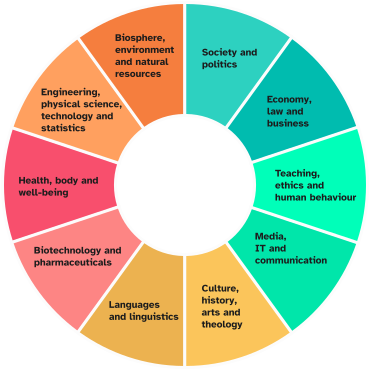
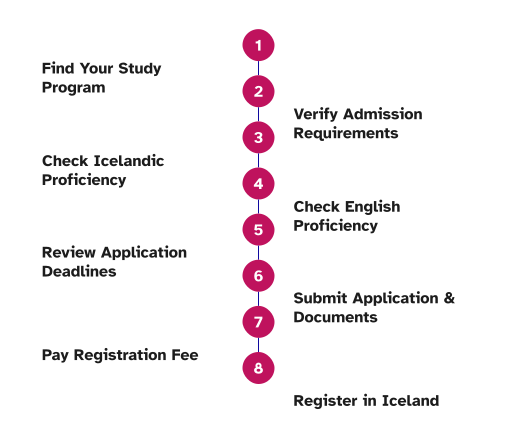

Additional information

The University of Iceland collaborates with over 400 universities worldwide. This provides a unique opportunity to pursue part of your studies at an international university thus gaining added experience and fresh insight into your field of study.

Students generally have the opportunity to join an exchange programme, internship, or summer courses. However, exchanges are always subject to faculty approval.

Students have the opportunity to have courses evaluated as part of their studies at the University of Iceland, so their stay does not have to affect the duration of their studies.

An education in this area can open up opportunities in:

  • The Church of Iceland
  • Media
  • Teaching and academia
  • Social services

This list is not exhaustive.

The organisation for theology students is called Fiskurinn. Fiskurinn advocates for students at the University of Iceland Faculty of Theology and Religious Studies.

Students' comments
""
Students appreciate the University of Iceland for its strong academic reputation, modern campus facilities, close-knit community, and affordable tuition.
Helpful content
Aurora Cooperation

Study wheel

What interests you?

Aurora Cooperation

How to apply

Follow the path

Contact us

If you still have questions, feel free to contact us.

School of Humanities
Weekdays: 10-12 am and 1-3 pm
General Service and Social Media

The Service Desk is a point of access for all services. You can drop in at the University Centre or use the WebChat at the bottom right of this page.

Follow the School of Humanities on Instagram,   Youtube
and Facebook

""

Share

Did this help?

Why wasn't this information helpful

Limit to 250 characters.