""
Language skills
required, minimum level of B2
Programme length
2 years.
Study mode
Face-to-face learning Distance learning
Application status
International students:
Students with Icelandic or Nordic citizenship:
Overview

  • Do you have a BA, BS or BEd degree in another subject and want to become a teacher?
  • Do you want the opportunity to do a paid student placement?
  • Are you interested in teaching in compulsory schools?
  • Are you interested in completing a graduate degree?

This is a theoretical and vocational Master's programme for students aiming to become teachers who have not completed a BEd degree in general teacher education.

The programme focuses on education and child development, curriculum design, organisation of the learning environment and diverse teaching and assessment methods.

Student placements in compulsory schools make up a significant part of the programme.

Programme structure

The programme is 120 ECTS and is organised as two years of full-time study. It can also be completed by studying part time for three or four years.

  • Mandatory courses, 85 ECTS
  • Restricted electives, 35 ECTS

Organisation of teaching

Teaching and examinations are in Icelandic.

Many courses offer real-time distance teaching, though requirements may vary and students are encouraged to check carefully how each course is taught.

Main objectives

After completing the programme, students will be equipped to work independently within the education system in a variety of positions involving the education of primary age children.

Other

All students graduate with a licence to teach at three levels of the education system, from preschools to upper secondary schools.

Completing the programme may allow a student to apply for an M.Ed. programme.

Bachelor's degree (BA/BS) in a discipline or subject related to primary school teaching for younger children, with a first grade (7.25) or higher. 

The programme is based on Act No. 95/2019 and Regulation (1355/2022) on the qualification framework for general and specialised teacher competencies. According to the regulation, a teacher specialising at the primary school level should have completed at least 90 standardised credits in the subject areas of the National Curriculum Guide for Primary School. If the applicant's previous studies are neither in a discipline nor subject related to primary school teaching for younger children, they may need to complete additional undergraduate courses to meet the minimum credit requirements upon programme completion. This is evaluated in light of prior studies. 

Applicants for a master's programme leading to a teacher certificate who have neither completed an upper-secondary school examination nor undertaken undergraduate studies at the university level in Icelandic must pass a special Icelandic entrance examination at level B2 in accordance with the Common European Framework of Reference for Languages (CEFR).

For the final exam, students must complete 120 ECTS credits.
After completing a 
teacher education program at an Icelandic university, a teacher should have reached a level of competence in Icelandic corresponding to at least C1 on the Common European Framework of Reference for Languages (CEFR).

The following documents must accompany an application for this programme:
  • CV
  • Statement of purpose
  • Reference 1, Name and email
  • Reference 2, Name and email
  • Certified copies of diplomas and transcripts

Further information on supporting documents can be found here

Programme structure

Check below to see how the programme is structured.

This programme does not offer specialisations.

First year | Fall
Teaching and Learning in Compulsory Schools (KME102F)
A mandatory (required) course for the programme
10 ECTS, credits
2 fieldwork credits
Course Description

This course focuses on theories and research related to learning, teaching and the teacher profession. Relations with on-site activities are emphasised, and participants become familiar with the working environment of compulsory school teachers, the Compulsory School Act, and regulations.

Learning and teaching are discussed from multiple perspectives and in relation to various learning theories. Participants organise their own teaching processes by setting aims, organising teaching and learning, and organising interaction and collaboration. All this work is related to the conceptions of professionalism and practice theories.

In field practice, student teachers familiarise themselves with professional practices in a specific area of study or subject in which they intend to specialise. During field practice, the student is expected to show initiative and active participation and to take part in all daily activities as much as possible. Defined teaching hours depend on the number of field practice credits.

Course design and procedure: Lectures, reflective studies, seminars, individual and group work, projects, interactive lectures, field work and training

Language of instruction: Icelandic
Face-to-face learning
Distance learning
Prerequisites
Attendance required in class
First year | Fall
Language development (KME104F)
A mandatory (required) course for the programme
10 ECTS, credits
Course Description

The main goal of this course is for students to acquire a solid understanding of children's language development from infancy through adolescence, along with the fundamental influencing factors. The main emphasis is on increasing students’ proficiency in providing children with high-quality language intervention as a foundation for education and reading. Further, the students are encouraged to link together science and practice and to connect the topics with their prior experience. The emphasis is on the students getting to know Icelandic and international research in the field, and what teachers can learn from the research results on what experience, education, communication, and intervention, both at home and in school, provide the best practice for good language development


Central topics of the course: Development of language with a historical perspective, living conditions, motivation, and natural competence of newborns. Development of language from birth: phonemic development, vocabulary, grammar, and communication skills. The importance of quality language input, at home and at school. The relation between language proficiency and cognitive and social skills, and literacy. The primary disorders of language and speech include developmental language disorder (DLD), speech-sound disorder, and stuttering. Language development of multi/bilingual children. The importance of early intervention and general language stimulation. Informal language assessment on individual children's language skills, as well as design and plan teaching, whose central aim is to support and provide children with opportunities to develop their language skills to become active language users.

Language of instruction: Icelandic
Distance learning
Attendance required in class
First year | Fall
Research on early childhood education (KME109F)
A mandatory (required) course for the programme
10 ECTS, credits
Course Description

The primary focus of the course is on early childhood education and research within the field. Various topics and controversial issues will be discussed. Special emphasis will be placed on different views of children and childhood, cooperation between the playschool and the primary school, teachers' pedagogical beliefs, and collaboration between the school and the family.

Language of instruction: Icelandic
Face-to-face learning
Distance learning
Attendance required in class
First year | Spring 1
Introduction to quantitative Research (MVS213F, MVS212F, KME211F)
Restricted elective course, conditions apply
5 ECTS, credits
Course Description

Students in this course are expected to deepen their knowledge and skills in quantitative research methodology. Students will use a computer program for data analysis, with emphasis on interpretation and writing about research results. Students are expected to develop positive attitudes toward research and the value of research in educational and social settings.

Language of instruction: Icelandic
Distance learning
Prerequisites
Attendance required in class
First year | Spring 1
Introduction to qualitative research (MVS213F, MVS212F, KME211F)
Restricted elective course, conditions apply
5 ECTS, credits
Course Description

This course focuses on qualitative research methods. It looks at different movements and traditions in research methodology and their relationship to the structure and execution of research. The course also touches on the ethics of research, validity and different views of these concepts. Students will conduct a small research project, which provides training in a literature review, data collection, data analysis, and presentation of research findings. Students work as a team throughout the semester.

Readings, lectures, in-class discussion and group work. Sessions for distance students are held twice during the semester and participation is mandatory

Language of instruction: Icelandic
Distance learning
Prerequisites
Attendance required in class
First year | Spring 1
School practices and research (MVS213F, MVS212F, KME211F)
Restricted elective course, conditions apply
5 ECTS, credits
Course Description

Topic
The course focuses on research on learning, teaching, and other aspects of educational practice in schools. Students will learn about different research methods, and the value of research for educational practices in schools will be explored, as will how research can support the development of teaching and learning in schools. Students will also learn about standardised tests commonly used in Icelandic preschools and compulsory schools, as well as international comparative research such as PISA and TALIS. The course's emphasis is on practice and on ensuring its use by teachers in their day-to-day work.

Work process
Lectures, seminars, and discussion sessions will be held. Students will participate in observations and practice interpreting research results that may be useful in supporting them as teachers.

Who is the course for?
The course is for students in preschool and compulsory school teachers' education who have chosen the MT study paths.

Language of instruction: Icelandic
Distance learning
Prerequisites
Attendance required in class
First year | Spring 1
Main components of reading instruction (GKY202F)
A mandatory (required) course for the programme
10 ECTS, credits
4 fieldwork credits
Course Description

The main components of learning to read—phonological and phonemic awareness, decoding, reading fluency, vocabulary, reading comprehension, and writing—will be discussed, along with how these elements intertwine to strengthen young children's literacy. The course will address prerequisites for learning to read, evidence-based teaching methods, early intervention and support for reading difficulties, and the impact of multilingualism on literacy.

Students will gain insight into the theoretical foundations of reading comprehension and writing, explore diverse teaching methods, learn how to select appropriate reading materials, and choose suitable instructional resources.

Emphasis is placed on creating a reading-friendly learning environment and finding varied ways to spark curiosity, interest, and joy in reading among children.

The course will also cover collaboration between home and school regarding children's reading development and the importance of parental support. Assessment tools for reading instruction will be introduced, and the essential link between teaching and assessment will be explained. The focus will be on the teacher's responsibility and role in diverse student groups, as well as strategies for accommodating individual differences.

The field component (4Ve) takes place in partner schools of the School of Education and corresponds to two weeks in the field, with six hours of instruction per day.

Language of instruction: Icelandic
Face-to-face learning
Distance learning
First year | Spring 1
Comprehensive primary teaching (GKY201F)
A mandatory (required) course for the programme
5 ECTS, credits
Course Description

In the course, there will be an emphasis on the development of primary children's learning, learning materials, and planning. Emphasis will be on reading research on the teaching and learning of primary children in school subjects, as well as on the social aspects of education. The focus will be on integrating subjects, particularly social studies and natural sciences, along with creative work using diverse materials and technological solutions. Students will choose a field of study for assignments to develop their knowledge of primary teaching.

Language of instruction: Icelandic
Face-to-face learning
Distance learning
Attendance required in class
First year | Spring 1
Assessment and Curriculum in Compulsory Schools (KME006F)
A mandatory (required) course for the programme
10 ECTS, credits
Course Description

The course aims to expose students to perspectives on curriculum and assessment in compulsory education, from theory to practice. Students discuss and learn about basic concepts and issues related to curriculum theory as they appear in public schools. Issues and ideologies reflected in official curricula, laws, directives, and other policy briefings are discussed both theoretically and in practice. Special focus is placed on the roles of teachers and administrators in curriculum development and assessment, and, alternatively, on their professional roles in developing learning programs for groups of pupils and for individual pupils with special needs. Nature, purpose, and strategies for assessment and curriculum are addressed (including formative and summative assessment, writing test items and other test instruments, and marking and reporting). Students discuss and learn about controversial issues and different ideological currents concerning the purpose and aims of compulsory education.

The working process of the course consists of lectures and critical discussion through seminars and group assignments

Language of instruction: Icelandic
Face-to-face learning
Distance learning
Second year | Fall
Working in inclusive practices (KME115F, MAL102F)
Restricted elective course, conditions apply
10 ECTS, credits
Course Description

The course aims to prepare participants to draw on their resources in their work with diverse student groups. In the course, we draw on inclusive education theories and research, emphasising a holistic and creative approach to preparation and teaching at the forefront. Furthermore, a focus is placed on teaching strategies and educational assessment that work for diverse groups of students, and on adapting teaching and learning to students with special needs.

Content
The course focuses on inclusive practices. How to create a learning environment that cares for all students' learning is introduced. The focus is also on collaboration with parents, colleagues, professionals, and paraprofessionals. 

Work process
The course is a blended course, online and on campus. It is divided into four main themes. All the themes connect to teaching in inclusive educational settings. The focus on each theme is three or four weeks.

The teaching is through lectures, projects, collaboration, in-class discussions, on Canvas, and in formal assignments. The course is grounded in students' independence, responsibility, and participation.

Language of instruction: Icelandic
Face-to-face learning
Distance learning
Second year | Fall
Learning and teaching: Supporting children with special needs (KME115F, MAL102F)
Restricted elective course, conditions apply
10 ECTS, credits
Course Description

In this course, students explore the teaching of diverse groups in inclusive settings, emphasising strategies to address students' diverse educational and sociological needs, guided by human values, democracy, and social justice. The emphasis is on evidence-based approaches to address the most common students´ special needs related to reading difficulties, behavioural difficulties, attention deficit, hyperactivity, and autism spectrum disorder. At the same time, the use of respectful, person-first language, putting the strengths and talents of students in the foreground, is stressed. Multicultural teaching and teaching of students learning Icelandic as a second language will be addressed. Students will be introduced to classroom management strategies, individualised behaviour support, multi-disciplinary and parent collaboration. The course focuses on inclusive, evidence-based practices that aim to provide students with special needs with opportunities equal to those of their classmates.

Language of instruction: Icelandic
Face-to-face learning
Distance learning
Second year | Fall
Teaching and Learning – becoming a Professional (KME301F)
A mandatory (required) course for the programme
20 ECTS, credits
12 fieldwork credits
Course Description

This course focuses on providing the student teachers with competencies for becoming professionals in their field, with a focus on their subject area, and supporting them in laying the foundation for their own professional working theory. This will be achieved by building knowledge and understanding of the responsibilities inherent in teaching, as well as the skills needed for self-evaluation in various situations in the field. An emphasis is also placed on providing student teachers with skills in the role of the classroom teacher and classroom management; team-teaching and co-operative skills; how to deal with traumatic experiences and children's welfare; and working with parents. Furthermore, research on school development, school evaluation, and school ethos will be examined alongside research on teachers. Finally, this will be linked with the practicum.

Emphasis is on interactive lectures, inquiry and reflective studies, seminars, group work, projects, portfolios, field studies and fieldwork.

Language of instruction: Icelandic
Face-to-face learning
Distance learning
Prerequisites
Second year | Spring 1
Learning and teaching - field practice II d Teaching and Learning - field (GKY401F)
A mandatory (required) course for the programme
15 ECTS, credits
12 fieldwork credits
Course Description

The main task of this course is fieldwork at the primary level of compulsory school. The emphasis is on actual teaching practice and giving the students opportunities to discuss, evaluate, reflect, and develop their teaching. Students will develop a teaching plan based on the national curriculum guide and the school curricula. They will analyse incidents from their practice to learn from and improve their teaching. A range of teaching methods will be explored and applied in field teaching.

Students are in the field the whole semester in both courses (KME301F Teaching and Learning – becoming a Professional and GKY401F Learning and Teaching - field practice II d Teaching and Learning - field) and attend regular classes at the university. Emphasis is on interactive lectures, self-study, group work, and projects. The course of study is directly related to field practice. Various issues will be explored with concrete examples from school practice. Students read chosen materials and research on school practice, both provided by lecturers and chosen by students.

Language of instruction: Icelandic
Face-to-face learning
Distance learning
Prerequisites
Attendance required in class
Second year | Spring 1
Collaboration between pre- and primary school. (KME004F)
A mandatory (required) course for the programme
5 ECTS, credits
Course Description

The course subject discusses ideology and research on continuity in children’s learning when they transition from preschool to primary school and leisure time centers. The transition process is examined from the perspectives of children, teachers, and parents, exploring their collaboration in times of transition. Continuity in children's learning will be addressed with an emphasis on diverse teaching approaches that involve children's participation, such as play, Project approach, play with unit blocks, and philosophical discussion with children.   

Language of instruction: Icelandic
Face-to-face learning
Distance learning
Prerequisites
Attendance required in class
Second year | Spring 1
Mathematics education for primary school (GKY402F)
A mandatory (required) course for the programme
10 ECTS, credits
Course Description

The course is intended for students in the Teaching Studies for Primary Grades, MT/M.Ed. The course integrates field studies in GKY401F Learning and teaching - field practice II, where the emphasis is on students applying what they learn in the field and evaluating their own education and their students' learning. Among the things discussed in the course that students will deal with are:

  • Mathematics study and teaching in grades 1-7. 
  • Reading and reflecting on research on mathematics education with regard to one's own learning and teaching
  • Ways that promote children's conceptual understanding and creativity
  • Guided assessment in mathematics learning
  • Project work and collective reflection in lessons
  • The use of information technology in mathematics education
Language of instruction: Icelandic
Face-to-face learning
Distance learning
Prerequisites
First year
  • Fall
  • KME102F
    Teaching and Learning in Compulsory Schools
    Mandatory (required) course
    10
    A mandatory (required) course for the programme
    10 ECTS, credits
    2 fieldwork credits
    Course Description

    This course focuses on theories and research related to learning, teaching and the teacher profession. Relations with on-site activities are emphasised, and participants become familiar with the working environment of compulsory school teachers, the Compulsory School Act, and regulations.

    Learning and teaching are discussed from multiple perspectives and in relation to various learning theories. Participants organise their own teaching processes by setting aims, organising teaching and learning, and organising interaction and collaboration. All this work is related to the conceptions of professionalism and practice theories.

    In field practice, student teachers familiarise themselves with professional practices in a specific area of study or subject in which they intend to specialise. During field practice, the student is expected to show initiative and active participation and to take part in all daily activities as much as possible. Defined teaching hours depend on the number of field practice credits.

    Course design and procedure: Lectures, reflective studies, seminars, individual and group work, projects, interactive lectures, field work and training

    Face-to-face learning
    Distance learning
    Prerequisites
    Attendance required in class
  • KME104F
    Language development
    Mandatory (required) course
    10
    A mandatory (required) course for the programme
    10 ECTS, credits
    Course Description

    The main goal of this course is for students to acquire a solid understanding of children's language development from infancy through adolescence, along with the fundamental influencing factors. The main emphasis is on increasing students’ proficiency in providing children with high-quality language intervention as a foundation for education and reading. Further, the students are encouraged to link together science and practice and to connect the topics with their prior experience. The emphasis is on the students getting to know Icelandic and international research in the field, and what teachers can learn from the research results on what experience, education, communication, and intervention, both at home and in school, provide the best practice for good language development


    Central topics of the course: Development of language with a historical perspective, living conditions, motivation, and natural competence of newborns. Development of language from birth: phonemic development, vocabulary, grammar, and communication skills. The importance of quality language input, at home and at school. The relation between language proficiency and cognitive and social skills, and literacy. The primary disorders of language and speech include developmental language disorder (DLD), speech-sound disorder, and stuttering. Language development of multi/bilingual children. The importance of early intervention and general language stimulation. Informal language assessment on individual children's language skills, as well as design and plan teaching, whose central aim is to support and provide children with opportunities to develop their language skills to become active language users.

    Distance learning
    Prerequisites
    Attendance required in class
  • KME109F
    Research on early childhood education
    Mandatory (required) course
    10
    A mandatory (required) course for the programme
    10 ECTS, credits
    Course Description

    The primary focus of the course is on early childhood education and research within the field. Various topics and controversial issues will be discussed. Special emphasis will be placed on different views of children and childhood, cooperation between the playschool and the primary school, teachers' pedagogical beliefs, and collaboration between the school and the family.

    Face-to-face learning
    Distance learning
    Prerequisites
    Attendance required in class
  • Spring 2
  • MVS213F, MVS212F, KME211F
    Introduction to quantitative Research
    Restricted elective course
    5
    Restricted elective course, conditions apply
    5 ECTS, credits
    Course Description

    Students in this course are expected to deepen their knowledge and skills in quantitative research methodology. Students will use a computer program for data analysis, with emphasis on interpretation and writing about research results. Students are expected to develop positive attitudes toward research and the value of research in educational and social settings.

    Distance learning
    Prerequisites
    Attendance required in class
  • MVS213F, MVS212F, KME211F
    Introduction to qualitative research
    Restricted elective course
    5
    Restricted elective course, conditions apply
    5 ECTS, credits
    Course Description

    This course focuses on qualitative research methods. It looks at different movements and traditions in research methodology and their relationship to the structure and execution of research. The course also touches on the ethics of research, validity and different views of these concepts. Students will conduct a small research project, which provides training in a literature review, data collection, data analysis, and presentation of research findings. Students work as a team throughout the semester.

    Readings, lectures, in-class discussion and group work. Sessions for distance students are held twice during the semester and participation is mandatory

    Distance learning
    Prerequisites
    Attendance required in class
  • MVS213F, MVS212F, KME211F
    School practices and research
    Restricted elective course
    5
    Restricted elective course, conditions apply
    5 ECTS, credits
    Course Description

    Topic
    The course focuses on research on learning, teaching, and other aspects of educational practice in schools. Students will learn about different research methods, and the value of research for educational practices in schools will be explored, as will how research can support the development of teaching and learning in schools. Students will also learn about standardised tests commonly used in Icelandic preschools and compulsory schools, as well as international comparative research such as PISA and TALIS. The course's emphasis is on practice and on ensuring its use by teachers in their day-to-day work.

    Work process
    Lectures, seminars, and discussion sessions will be held. Students will participate in observations and practice interpreting research results that may be useful in supporting them as teachers.

    Who is the course for?
    The course is for students in preschool and compulsory school teachers' education who have chosen the MT study paths.

    Distance learning
    Prerequisites
    Attendance required in class
  • GKY202F
    Main components of reading instruction
    Mandatory (required) course
    10
    A mandatory (required) course for the programme
    10 ECTS, credits
    4 fieldwork credits
    Course Description

    The main components of learning to read—phonological and phonemic awareness, decoding, reading fluency, vocabulary, reading comprehension, and writing—will be discussed, along with how these elements intertwine to strengthen young children's literacy. The course will address prerequisites for learning to read, evidence-based teaching methods, early intervention and support for reading difficulties, and the impact of multilingualism on literacy.

    Students will gain insight into the theoretical foundations of reading comprehension and writing, explore diverse teaching methods, learn how to select appropriate reading materials, and choose suitable instructional resources.

    Emphasis is placed on creating a reading-friendly learning environment and finding varied ways to spark curiosity, interest, and joy in reading among children.

    The course will also cover collaboration between home and school regarding children's reading development and the importance of parental support. Assessment tools for reading instruction will be introduced, and the essential link between teaching and assessment will be explained. The focus will be on the teacher's responsibility and role in diverse student groups, as well as strategies for accommodating individual differences.

    The field component (4Ve) takes place in partner schools of the School of Education and corresponds to two weeks in the field, with six hours of instruction per day.

    Face-to-face learning
    Distance learning
    Prerequisites
  • GKY201F
    Comprehensive primary teaching
    Mandatory (required) course
    5
    A mandatory (required) course for the programme
    5 ECTS, credits
    Course Description

    In the course, there will be an emphasis on the development of primary children's learning, learning materials, and planning. Emphasis will be on reading research on the teaching and learning of primary children in school subjects, as well as on the social aspects of education. The focus will be on integrating subjects, particularly social studies and natural sciences, along with creative work using diverse materials and technological solutions. Students will choose a field of study for assignments to develop their knowledge of primary teaching.

    Face-to-face learning
    Distance learning
    Prerequisites
    Attendance required in class
  • KME006F
    Assessment and Curriculum in Compulsory Schools
    Mandatory (required) course
    10
    A mandatory (required) course for the programme
    10 ECTS, credits
    Course Description

    The course aims to expose students to perspectives on curriculum and assessment in compulsory education, from theory to practice. Students discuss and learn about basic concepts and issues related to curriculum theory as they appear in public schools. Issues and ideologies reflected in official curricula, laws, directives, and other policy briefings are discussed both theoretically and in practice. Special focus is placed on the roles of teachers and administrators in curriculum development and assessment, and, alternatively, on their professional roles in developing learning programs for groups of pupils and for individual pupils with special needs. Nature, purpose, and strategies for assessment and curriculum are addressed (including formative and summative assessment, writing test items and other test instruments, and marking and reporting). Students discuss and learn about controversial issues and different ideological currents concerning the purpose and aims of compulsory education.

    The working process of the course consists of lectures and critical discussion through seminars and group assignments

    Face-to-face learning
    Distance learning
    Prerequisites
  • Fall
  • KME115F, MAL102F
    Working in inclusive practices
    Restricted elective course
    10
    Restricted elective course, conditions apply
    10 ECTS, credits
    Course Description

    The course aims to prepare participants to draw on their resources in their work with diverse student groups. In the course, we draw on inclusive education theories and research, emphasising a holistic and creative approach to preparation and teaching at the forefront. Furthermore, a focus is placed on teaching strategies and educational assessment that work for diverse groups of students, and on adapting teaching and learning to students with special needs.

    Content
    The course focuses on inclusive practices. How to create a learning environment that cares for all students' learning is introduced. The focus is also on collaboration with parents, colleagues, professionals, and paraprofessionals. 

    Work process
    The course is a blended course, online and on campus. It is divided into four main themes. All the themes connect to teaching in inclusive educational settings. The focus on each theme is three or four weeks.

    The teaching is through lectures, projects, collaboration, in-class discussions, on Canvas, and in formal assignments. The course is grounded in students' independence, responsibility, and participation.

    Face-to-face learning
    Distance learning
    Prerequisites
  • KME115F, MAL102F
    Learning and teaching: Supporting children with special needs
    Restricted elective course
    10
    Restricted elective course, conditions apply
    10 ECTS, credits
    Course Description

    In this course, students explore the teaching of diverse groups in inclusive settings, emphasising strategies to address students' diverse educational and sociological needs, guided by human values, democracy, and social justice. The emphasis is on evidence-based approaches to address the most common students´ special needs related to reading difficulties, behavioural difficulties, attention deficit, hyperactivity, and autism spectrum disorder. At the same time, the use of respectful, person-first language, putting the strengths and talents of students in the foreground, is stressed. Multicultural teaching and teaching of students learning Icelandic as a second language will be addressed. Students will be introduced to classroom management strategies, individualised behaviour support, multi-disciplinary and parent collaboration. The course focuses on inclusive, evidence-based practices that aim to provide students with special needs with opportunities equal to those of their classmates.

    Face-to-face learning
    Distance learning
    Prerequisites
  • KME301F
    Teaching and Learning – becoming a Professional
    Mandatory (required) course
    20
    A mandatory (required) course for the programme
    20 ECTS, credits
    12 fieldwork credits
    Course Description

    This course focuses on providing the student teachers with competencies for becoming professionals in their field, with a focus on their subject area, and supporting them in laying the foundation for their own professional working theory. This will be achieved by building knowledge and understanding of the responsibilities inherent in teaching, as well as the skills needed for self-evaluation in various situations in the field. An emphasis is also placed on providing student teachers with skills in the role of the classroom teacher and classroom management; team-teaching and co-operative skills; how to deal with traumatic experiences and children's welfare; and working with parents. Furthermore, research on school development, school evaluation, and school ethos will be examined alongside research on teachers. Finally, this will be linked with the practicum.

    Emphasis is on interactive lectures, inquiry and reflective studies, seminars, group work, projects, portfolios, field studies and fieldwork.

    Face-to-face learning
    Distance learning
    Prerequisites
  • Spring 2
  • GKY401F
    Learning and teaching - field practice II d Teaching and Learning - field
    Mandatory (required) course
    15
    A mandatory (required) course for the programme
    15 ECTS, credits
    12 fieldwork credits
    Course Description

    The main task of this course is fieldwork at the primary level of compulsory school. The emphasis is on actual teaching practice and giving the students opportunities to discuss, evaluate, reflect, and develop their teaching. Students will develop a teaching plan based on the national curriculum guide and the school curricula. They will analyse incidents from their practice to learn from and improve their teaching. A range of teaching methods will be explored and applied in field teaching.

    Students are in the field the whole semester in both courses (KME301F Teaching and Learning – becoming a Professional and GKY401F Learning and Teaching - field practice II d Teaching and Learning - field) and attend regular classes at the university. Emphasis is on interactive lectures, self-study, group work, and projects. The course of study is directly related to field practice. Various issues will be explored with concrete examples from school practice. Students read chosen materials and research on school practice, both provided by lecturers and chosen by students.

    Face-to-face learning
    Distance learning
    Prerequisites
    Attendance required in class
  • KME004F
    Collaboration between pre- and primary school.
    Mandatory (required) course
    5
    A mandatory (required) course for the programme
    5 ECTS, credits
    Course Description

    The course subject discusses ideology and research on continuity in children’s learning when they transition from preschool to primary school and leisure time centers. The transition process is examined from the perspectives of children, teachers, and parents, exploring their collaboration in times of transition. Continuity in children's learning will be addressed with an emphasis on diverse teaching approaches that involve children's participation, such as play, Project approach, play with unit blocks, and philosophical discussion with children.   

    Face-to-face learning
    Distance learning
    Prerequisites
    Attendance required in class
  • GKY402F
    Mathematics education for primary school
    Mandatory (required) course
    10
    A mandatory (required) course for the programme
    10 ECTS, credits
    Course Description

    The course is intended for students in the Teaching Studies for Primary Grades, MT/M.Ed. The course integrates field studies in GKY401F Learning and teaching - field practice II, where the emphasis is on students applying what they learn in the field and evaluating their own education and their students' learning. Among the things discussed in the course that students will deal with are:

    • Mathematics study and teaching in grades 1-7. 
    • Reading and reflecting on research on mathematics education with regard to one's own learning and teaching
    • Ways that promote children's conceptual understanding and creativity
    • Guided assessment in mathematics learning
    • Project work and collective reflection in lessons
    • The use of information technology in mathematics education
    Face-to-face learning
    Distance learning
    Prerequisites
Second year
  • Fall
  • KME102F
    Teaching and Learning in Compulsory Schools
    Mandatory (required) course
    10
    A mandatory (required) course for the programme
    10 ECTS, credits
    2 fieldwork credits
    Course Description

    This course focuses on theories and research related to learning, teaching and the teacher profession. Relations with on-site activities are emphasised, and participants become familiar with the working environment of compulsory school teachers, the Compulsory School Act, and regulations.

    Learning and teaching are discussed from multiple perspectives and in relation to various learning theories. Participants organise their own teaching processes by setting aims, organising teaching and learning, and organising interaction and collaboration. All this work is related to the conceptions of professionalism and practice theories.

    In field practice, student teachers familiarise themselves with professional practices in a specific area of study or subject in which they intend to specialise. During field practice, the student is expected to show initiative and active participation and to take part in all daily activities as much as possible. Defined teaching hours depend on the number of field practice credits.

    Course design and procedure: Lectures, reflective studies, seminars, individual and group work, projects, interactive lectures, field work and training

    Face-to-face learning
    Distance learning
    Prerequisites
    Attendance required in class
  • KME104F
    Language development
    Mandatory (required) course
    10
    A mandatory (required) course for the programme
    10 ECTS, credits
    Course Description

    The main goal of this course is for students to acquire a solid understanding of children's language development from infancy through adolescence, along with the fundamental influencing factors. The main emphasis is on increasing students’ proficiency in providing children with high-quality language intervention as a foundation for education and reading. Further, the students are encouraged to link together science and practice and to connect the topics with their prior experience. The emphasis is on the students getting to know Icelandic and international research in the field, and what teachers can learn from the research results on what experience, education, communication, and intervention, both at home and in school, provide the best practice for good language development


    Central topics of the course: Development of language with a historical perspective, living conditions, motivation, and natural competence of newborns. Development of language from birth: phonemic development, vocabulary, grammar, and communication skills. The importance of quality language input, at home and at school. The relation between language proficiency and cognitive and social skills, and literacy. The primary disorders of language and speech include developmental language disorder (DLD), speech-sound disorder, and stuttering. Language development of multi/bilingual children. The importance of early intervention and general language stimulation. Informal language assessment on individual children's language skills, as well as design and plan teaching, whose central aim is to support and provide children with opportunities to develop their language skills to become active language users.

    Distance learning
    Prerequisites
    Attendance required in class
  • KME109F
    Research on early childhood education
    Mandatory (required) course
    10
    A mandatory (required) course for the programme
    10 ECTS, credits
    Course Description

    The primary focus of the course is on early childhood education and research within the field. Various topics and controversial issues will be discussed. Special emphasis will be placed on different views of children and childhood, cooperation between the playschool and the primary school, teachers' pedagogical beliefs, and collaboration between the school and the family.

    Face-to-face learning
    Distance learning
    Prerequisites
    Attendance required in class
  • Spring 2
  • MVS213F, MVS212F, KME211F
    Introduction to quantitative Research
    Restricted elective course
    5
    Restricted elective course, conditions apply
    5 ECTS, credits
    Course Description

    Students in this course are expected to deepen their knowledge and skills in quantitative research methodology. Students will use a computer program for data analysis, with emphasis on interpretation and writing about research results. Students are expected to develop positive attitudes toward research and the value of research in educational and social settings.

    Distance learning
    Prerequisites
    Attendance required in class
  • MVS213F, MVS212F, KME211F
    Introduction to qualitative research
    Restricted elective course
    5
    Restricted elective course, conditions apply
    5 ECTS, credits
    Course Description

    This course focuses on qualitative research methods. It looks at different movements and traditions in research methodology and their relationship to the structure and execution of research. The course also touches on the ethics of research, validity and different views of these concepts. Students will conduct a small research project, which provides training in a literature review, data collection, data analysis, and presentation of research findings. Students work as a team throughout the semester.

    Readings, lectures, in-class discussion and group work. Sessions for distance students are held twice during the semester and participation is mandatory

    Distance learning
    Prerequisites
    Attendance required in class
  • MVS213F, MVS212F, KME211F
    School practices and research
    Restricted elective course
    5
    Restricted elective course, conditions apply
    5 ECTS, credits
    Course Description

    Topic
    The course focuses on research on learning, teaching, and other aspects of educational practice in schools. Students will learn about different research methods, and the value of research for educational practices in schools will be explored, as will how research can support the development of teaching and learning in schools. Students will also learn about standardised tests commonly used in Icelandic preschools and compulsory schools, as well as international comparative research such as PISA and TALIS. The course's emphasis is on practice and on ensuring its use by teachers in their day-to-day work.

    Work process
    Lectures, seminars, and discussion sessions will be held. Students will participate in observations and practice interpreting research results that may be useful in supporting them as teachers.

    Who is the course for?
    The course is for students in preschool and compulsory school teachers' education who have chosen the MT study paths.

    Distance learning
    Prerequisites
    Attendance required in class
  • GKY202F
    Main components of reading instruction
    Mandatory (required) course
    10
    A mandatory (required) course for the programme
    10 ECTS, credits
    4 fieldwork credits
    Course Description

    The main components of learning to read—phonological and phonemic awareness, decoding, reading fluency, vocabulary, reading comprehension, and writing—will be discussed, along with how these elements intertwine to strengthen young children's literacy. The course will address prerequisites for learning to read, evidence-based teaching methods, early intervention and support for reading difficulties, and the impact of multilingualism on literacy.

    Students will gain insight into the theoretical foundations of reading comprehension and writing, explore diverse teaching methods, learn how to select appropriate reading materials, and choose suitable instructional resources.

    Emphasis is placed on creating a reading-friendly learning environment and finding varied ways to spark curiosity, interest, and joy in reading among children.

    The course will also cover collaboration between home and school regarding children's reading development and the importance of parental support. Assessment tools for reading instruction will be introduced, and the essential link between teaching and assessment will be explained. The focus will be on the teacher's responsibility and role in diverse student groups, as well as strategies for accommodating individual differences.

    The field component (4Ve) takes place in partner schools of the School of Education and corresponds to two weeks in the field, with six hours of instruction per day.

    Face-to-face learning
    Distance learning
    Prerequisites
  • GKY201F
    Comprehensive primary teaching
    Mandatory (required) course
    5
    A mandatory (required) course for the programme
    5 ECTS, credits
    Course Description

    In the course, there will be an emphasis on the development of primary children's learning, learning materials, and planning. Emphasis will be on reading research on the teaching and learning of primary children in school subjects, as well as on the social aspects of education. The focus will be on integrating subjects, particularly social studies and natural sciences, along with creative work using diverse materials and technological solutions. Students will choose a field of study for assignments to develop their knowledge of primary teaching.

    Face-to-face learning
    Distance learning
    Prerequisites
    Attendance required in class
  • KME006F
    Assessment and Curriculum in Compulsory Schools
    Mandatory (required) course
    10
    A mandatory (required) course for the programme
    10 ECTS, credits
    Course Description

    The course aims to expose students to perspectives on curriculum and assessment in compulsory education, from theory to practice. Students discuss and learn about basic concepts and issues related to curriculum theory as they appear in public schools. Issues and ideologies reflected in official curricula, laws, directives, and other policy briefings are discussed both theoretically and in practice. Special focus is placed on the roles of teachers and administrators in curriculum development and assessment, and, alternatively, on their professional roles in developing learning programs for groups of pupils and for individual pupils with special needs. Nature, purpose, and strategies for assessment and curriculum are addressed (including formative and summative assessment, writing test items and other test instruments, and marking and reporting). Students discuss and learn about controversial issues and different ideological currents concerning the purpose and aims of compulsory education.

    The working process of the course consists of lectures and critical discussion through seminars and group assignments

    Face-to-face learning
    Distance learning
    Prerequisites
  • Fall
  • KME115F, MAL102F
    Working in inclusive practices
    Restricted elective course
    10
    Restricted elective course, conditions apply
    10 ECTS, credits
    Course Description

    The course aims to prepare participants to draw on their resources in their work with diverse student groups. In the course, we draw on inclusive education theories and research, emphasising a holistic and creative approach to preparation and teaching at the forefront. Furthermore, a focus is placed on teaching strategies and educational assessment that work for diverse groups of students, and on adapting teaching and learning to students with special needs.

    Content
    The course focuses on inclusive practices. How to create a learning environment that cares for all students' learning is introduced. The focus is also on collaboration with parents, colleagues, professionals, and paraprofessionals. 

    Work process
    The course is a blended course, online and on campus. It is divided into four main themes. All the themes connect to teaching in inclusive educational settings. The focus on each theme is three or four weeks.

    The teaching is through lectures, projects, collaboration, in-class discussions, on Canvas, and in formal assignments. The course is grounded in students' independence, responsibility, and participation.

    Face-to-face learning
    Distance learning
    Prerequisites
  • KME115F, MAL102F
    Learning and teaching: Supporting children with special needs
    Restricted elective course
    10
    Restricted elective course, conditions apply
    10 ECTS, credits
    Course Description

    In this course, students explore the teaching of diverse groups in inclusive settings, emphasising strategies to address students' diverse educational and sociological needs, guided by human values, democracy, and social justice. The emphasis is on evidence-based approaches to address the most common students´ special needs related to reading difficulties, behavioural difficulties, attention deficit, hyperactivity, and autism spectrum disorder. At the same time, the use of respectful, person-first language, putting the strengths and talents of students in the foreground, is stressed. Multicultural teaching and teaching of students learning Icelandic as a second language will be addressed. Students will be introduced to classroom management strategies, individualised behaviour support, multi-disciplinary and parent collaboration. The course focuses on inclusive, evidence-based practices that aim to provide students with special needs with opportunities equal to those of their classmates.

    Face-to-face learning
    Distance learning
    Prerequisites
  • KME301F
    Teaching and Learning – becoming a Professional
    Mandatory (required) course
    20
    A mandatory (required) course for the programme
    20 ECTS, credits
    12 fieldwork credits
    Course Description

    This course focuses on providing the student teachers with competencies for becoming professionals in their field, with a focus on their subject area, and supporting them in laying the foundation for their own professional working theory. This will be achieved by building knowledge and understanding of the responsibilities inherent in teaching, as well as the skills needed for self-evaluation in various situations in the field. An emphasis is also placed on providing student teachers with skills in the role of the classroom teacher and classroom management; team-teaching and co-operative skills; how to deal with traumatic experiences and children's welfare; and working with parents. Furthermore, research on school development, school evaluation, and school ethos will be examined alongside research on teachers. Finally, this will be linked with the practicum.

    Emphasis is on interactive lectures, inquiry and reflective studies, seminars, group work, projects, portfolios, field studies and fieldwork.

    Face-to-face learning
    Distance learning
    Prerequisites
  • Spring 2
  • GKY401F
    Learning and teaching - field practice II d Teaching and Learning - field
    Mandatory (required) course
    15
    A mandatory (required) course for the programme
    15 ECTS, credits
    12 fieldwork credits
    Course Description

    The main task of this course is fieldwork at the primary level of compulsory school. The emphasis is on actual teaching practice and giving the students opportunities to discuss, evaluate, reflect, and develop their teaching. Students will develop a teaching plan based on the national curriculum guide and the school curricula. They will analyse incidents from their practice to learn from and improve their teaching. A range of teaching methods will be explored and applied in field teaching.

    Students are in the field the whole semester in both courses (KME301F Teaching and Learning – becoming a Professional and GKY401F Learning and Teaching - field practice II d Teaching and Learning - field) and attend regular classes at the university. Emphasis is on interactive lectures, self-study, group work, and projects. The course of study is directly related to field practice. Various issues will be explored with concrete examples from school practice. Students read chosen materials and research on school practice, both provided by lecturers and chosen by students.

    Face-to-face learning
    Distance learning
    Prerequisites
    Attendance required in class
  • KME004F
    Collaboration between pre- and primary school.
    Mandatory (required) course
    5
    A mandatory (required) course for the programme
    5 ECTS, credits
    Course Description

    The course subject discusses ideology and research on continuity in children’s learning when they transition from preschool to primary school and leisure time centers. The transition process is examined from the perspectives of children, teachers, and parents, exploring their collaboration in times of transition. Continuity in children's learning will be addressed with an emphasis on diverse teaching approaches that involve children's participation, such as play, Project approach, play with unit blocks, and philosophical discussion with children.   

    Face-to-face learning
    Distance learning
    Prerequisites
    Attendance required in class
  • GKY402F
    Mathematics education for primary school
    Mandatory (required) course
    10
    A mandatory (required) course for the programme
    10 ECTS, credits
    Course Description

    The course is intended for students in the Teaching Studies for Primary Grades, MT/M.Ed. The course integrates field studies in GKY401F Learning and teaching - field practice II, where the emphasis is on students applying what they learn in the field and evaluating their own education and their students' learning. Among the things discussed in the course that students will deal with are:

    • Mathematics study and teaching in grades 1-7. 
    • Reading and reflecting on research on mathematics education with regard to one's own learning and teaching
    • Ways that promote children's conceptual understanding and creativity
    • Guided assessment in mathematics learning
    • Project work and collective reflection in lessons
    • The use of information technology in mathematics education
    Face-to-face learning
    Distance learning
    Prerequisites

The timetable shown below is for the current academic year and is FOR REFERENCE ONLY.

Changes may occur for the autumn semester in August and September and for the spring semester in December and January. You will find your final timetable in Ugla when the studies start.

Note! This timetable is not suitable for planning your work schedule if you are a part-time employee.


Additional information

The University of Iceland collaborates with over 400 universities worldwide. This provides a unique opportunity to pursue part of your studies at an international university thus gaining added experience and fresh insight into your field of study.

Students generally have the opportunity to join an exchange programme, internship, or summer courses. However, exchanges are always subject to faculty approval.

Students have the opportunity to have courses evaluated as part of their studies at the University of Iceland, so their stay does not have to affect the duration of their studies.

Most of those who complete a degree in teacher education go on to become teachers, but people with a background in this subject can also find careers in other professions, either within the education system or elsewhere. Teacher education is internationally recognised and opens up a wide range of career opportunities.

An education in this area can open up opportunities in:

  • Teaching in compulsory schools
  • Teaching in preschools
  • Specialist positions within the education system

This list is not exhaustive.

Kennó is the organisation for student teachers at the University of Iceland. Kennó organises events such as socials for new students, annual galas and workplace tours. Kennó has also organised the Come and Teach project, which is aimed at publicising teaching degrees.

Students' comments
""
Students appreciate the University of Iceland for its strong academic reputation, modern campus facilities, close-knit community, and affordable tuition.
Helpful content
Aurora Cooperation

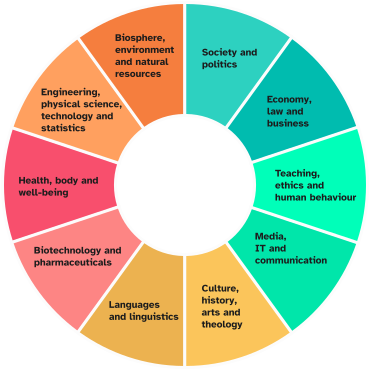
Study wheel

What interests you?

Aurora Cooperation

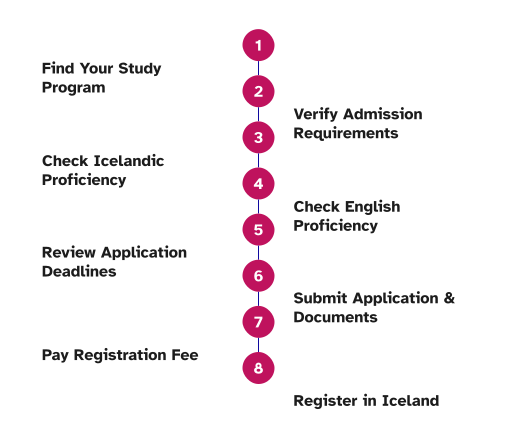
How to apply

Follow the path

Contact us

If you still have questions, feel free to contact us.

School of Education
9:00 am - 3:00 pm
General Service and social media

The Service Desk is a point of access for all services. You can drop in at the University Centre or use the WebChat at the bottom right of this page.

Follow the School of Education on Instagram,   Youtube
and Facebook

University of Iceland, Saga (Building)

Share

Did this help?

Why wasn't this information helpful

Limit to 250 characters.