""
Language skills
required, minimum level of B2
Programme length
2 years.
Study mode
Face-to-face learning
Application status
International students:
Students with Icelandic or Nordic citizenship:
Overview

  • Do you want to learn more about how adults acquire a second language?
  • Would you like to work in foreign language teaching for adults?
  • Do you want to learn more about the state of knowledge in second language studies?
  • Do you want to learn how to apply research methodology and develop independent working practices?

The MA in second language studies is designed for those planning a research career in the field or as preparation for doctoral studies, those planning a career in language teaching for adults, and those wishing to expand their knowledge of language teaching for adults.

The programme is offered as a collaboration between the Faculty of Icelandic and Comparative Cultural Studies and the Faculty of Languages and Cultures.

In Iceland and abroad, interest in second language studies is steadily growing, with the subject focusing on the nature of second language acquisition and improved teaching and learning techniques.

Programme structure

The programme is 120 ECTS and is organised as two years of full-time study.

The programme is made up of:

  • Mandatory courses, 20 ECTS
  • Restricted elective courses, 10 ECTS
  • Elective courses, 60 ECTS
  • Master's thesis, 30 ECTS

Students must complete at least 60 ECTS in MA courses within the subject. Students may take up to 30 ECTS in related subjects, having consulted with the head of subject.

Organisation of teaching

This programme is taught in Icelandic but textbooks are mainly in Icelandic, English or other Nordic languages.

Main objectives

Students should:

  • develop a comprehensive overview of the state of knowledge in second language studies and the pedagogy of second languages.
  • be trained in the application of research methodology and practice independent working practices.

Other

Completing an MA at the Faculty of Languages and Cultures allows you to apply for doctoral studies in your chosen subject.

Admission to the Master‘s program requires a BA degree in a relevant field with a first class grade and a final project worth at least 10 ECTS.


This is a 120 credit programme which consists of 20 ECTS in required courses, 10 ECTS in restricted elective courses, 60 ECTS in elective courses and a 30 ECTS MA thesis.

Students can take a part of their course requirement in graduate programmes in other disciplines or at foreign universities, but must complete at least 60 ECTS in graduate courses within the Second Language Studies programme and an MA thesis.

The following documents must accompany an application for this programme:
  • Statement of purpose
  • Certified copies of diplomas and transcripts

Further information on supporting documents can be found here

Programme structure

Check below to see how the programme is structured.

This programme does not offer specialisations.

First year | Fall
Second Language Theories and Pedagogy (ENS034F)
A mandatory (required) course for the programme
10 ECTS, credits
Course Description

This is an overview course that introduces major theories of second language acquisition and how they influence language instruction. We will examine research on the cognitive, linguistic, individual, social and educational factors that affect the language learning process and language attainment. The role of input on language learning will be examined as well as the development of reading and writing skills in a second language. 

Language of instruction: English
Face-to-face learning
Online learning
First year | Fall
Directed Study A (AMF006F)
Free elective course within the programme
10 ECTS, credits
Course Description

A project is selected in consultation with a teacher, and that teacher must approve the student's research plans before she or he is permitted to register for a study of this kind.

Language of instruction: Icelandic
First year | Fall
Directed Study B (AMF007F)
Free elective course within the programme
10 ECTS, credits
Course Description

A project is selected in consultation with a teacher, and that teacher must approve the student's research plans before she or he is permitted to register for a study of this kind.

Language of instruction: Icelandic
First year | Fall
Vocabulary Acquisition: Research and Theory (ENS344M)
Free elective course within the programme
10 ECTS, credits
Course Description

This course covers the nature of vocabulary acquisition: how vocabulary develops, is learned and taught. Various factors will be analyzed in detail, including, the role of pronunciation, word frequency, various learning strategies for vocabulary growth and considerable attention will be drawn to current research methodology in Vocabulary Acquisition. Students will review research as well as conduct a mini study.

Taught on Tuesdays and Thursdays at 10 am (2. and 3. year students only)

Language of instruction: English
Face-to-face learning
Distance learning
Online learning
Prerequisites
First year | Fall
Writing and Editing (ÍSL101F)
Free elective course within the programme
10 ECTS, credits
Course Description

Training in various aspects of the writing and editing of scientific texts. Various kinds of texts (non-fiction) examined and evaluated. Training in reviewing and commenting on scientific texts and in other aspects of editorial work. The main emphasis will be on the writing of articles, but other kinds of texts will also be considered, both shorter (conference abstracts, reviews) and longer (theses, books), as well as research proposals. Discussion of guidelines for the preparation of manuscripts. Types of plagiarism and how to avoid them and find them. Texts on different subjects will be used as examples, especially writings in linguistics, literature and history. The book Skrifaðu bæði skýrt og rétt will be used as a textbook (Höskuldur Þráinsson 2015).

This course is open to students of many MA programmes in the School of Humanities, cf. the regulations of the individual subjects. Students in the MA programmes in Icelandic literature, Icelandic linguistics, Icelandic studies and Icelandic teaching can take the course as part of the MA course requirements in Icelandic literature or Icelandic linguistics. Students in the MA programme in Icelandic teaching can, however, not have this course as the only linguistics or literature course in their MA.

Language of instruction: Icelandic
Face-to-face learning
First year | Spring 1
Language and Society (ÍSL004M)
Free elective course within the programme
10 ECTS, credits
Course Description

In this course we concern ourselves with how language and society interact by examining sociolinguistic methods and concepts with regard to international and domestic research in the field.

Among the topics discussed are language attitudes, language contact, dialects, language style and language management. We take a look at different manifestations of language use and language variation as well as contemplating on how factors such as environment, context and background of a language user potentially influence language use and choice of style.

We provide an overview of principal research methods, both quantitative and qualitative, discuss recent trends in sociolinguistics and evaluate methods and methodologies with respect to the particular research topic.

Besides presenting research on attitudes towards language and language use, considering both attitudes towards one’s own language and that of others, we consider possible outcomes of unconventional language use. Special emphasis will be put on considering the language use of those who speak Icelandic as a foreign language as well as the status of immigrants in Iceland.


Additionally, we address the current status of the Icelandic language, particularly in relation to English and other languages. Principles of language management are discussed along with people’s ideas and believes about language through time. In that respect, we have a look at Icelandic language policy, language management, language standardization and linguistic purism from different perspectives, e.g. a synchronic and diachronic angle as well as with regard to other speech communities. 

We will discuss language use of particular social groups (e.g. teenagers) in terms of its social meaning for the group on the one hand and for the speech community as a whole on the other hand.

Students are expected to complete group or individual tasks on questions and problems originating from topics and discussions in the class room.

Language of instruction: Icelandic
Prerequisites
First year | Spring 1
Directed Study A (AMF006F)
Free elective course within the programme
10 ECTS, credits
Course Description

A project is selected in consultation with a teacher, and that teacher must approve the student's research plans before she or he is permitted to register for a study of this kind.

Language of instruction: Icelandic
First year | Spring 1
Directed Study B (AMF007F)
Free elective course within the programme
10 ECTS, credits
Course Description

A project is selected in consultation with a teacher, and that teacher must approve the student's research plans before she or he is permitted to register for a study of this kind.

Language of instruction: Icelandic
Not taught this semester
First year | Spring 1
Data collection and statistical analysis in the humanities and language technology (ÍSL612M)
Free elective course within the programme
10 ECTS, credits
Course Description

Recent years have seen an increased focus on data collection and statistical analysis within the humanities. This is particularly apparent in growing branches such as psycholinguistics, cognitive literary studies and experimental philosophy, to name a few. The push towards quantitative methods occurs at a time where the validity and reliability of well-established statistical methods are called into question in other fields, with increased demands of replicability and open access as well as data protection and responsibility. In this course, students explore the value of quantitative methods in their field while getting training in the collection and analysis of data. A diverse set of research methods will be introduced, ranging from surveys to corpus analysis and experiments in which participants’ response to stimuli (such as words, texts or audio-visual materials) is quantified. Basic concepts in statistics will be reviewed, enabling students to know the difference between descriptive and inferential statistics, understand statistical significance and interpret visual representations of data in graphs. The course will be largely practical and students are expected to apply their knowledge of data collection and analysis under the instructor’s guidance. Students will work on a project within their own discipline but will also explore the possibility of cross-disciplinary work. Open source tools such as R Studio will be used for all assignments but no prior knowledge of the software or statistics in general is required. The course is suitable for all students within the humanities who want to collect quantitative data to answer interesting questions and could therefore be a useful preparation for a BA or MA project.

Language of instruction: Icelandic
Prerequisites
First year | Spring 1
Language and Society (ÍSL004M)
Free elective course within the programme
10 ECTS, credits
Course Description

In this course we concern ourselves with how language and society interact by examining sociolinguistic methods and concepts with regard to international and domestic research in the field.

Among the topics discussed are language attitudes, language contact, dialects, language style and language management. We take a look at different manifestations of language use and language variation as well as contemplating on how factors such as environment, context and background of a language user potentially influence language use and choice of style.

We provide an overview of principal research methods, both quantitative and qualitative, discuss recent trends in sociolinguistics and evaluate methods and methodologies with respect to the particular research topic.

Besides presenting research on attitudes towards language and language use, considering both attitudes towards one’s own language and that of others, we consider possible outcomes of unconventional language use. Special emphasis will be put on considering the language use of those who speak Icelandic as a foreign language as well as the status of immigrants in Iceland.


Additionally, we address the current status of the Icelandic language, particularly in relation to English and other languages. Principles of language management are discussed along with people’s ideas and believes about language through time. In that respect, we have a look at Icelandic language policy, language management, language standardization and linguistic purism from different perspectives, e.g. a synchronic and diachronic angle as well as with regard to other speech communities. 

We will discuss language use of particular social groups (e.g. teenagers) in terms of its social meaning for the group on the one hand and for the speech community as a whole on the other hand.

Students are expected to complete group or individual tasks on questions and problems originating from topics and discussions in the class room.

Language of instruction: Icelandic
Prerequisites
Second year | Fall
Directed Study A (AMF006F)
Free elective course within the programme
10 ECTS, credits
Course Description

A project is selected in consultation with a teacher, and that teacher must approve the student's research plans before she or he is permitted to register for a study of this kind.

Language of instruction: Icelandic
Second year | Fall
Directed Study B (AMF007F)
Free elective course within the programme
10 ECTS, credits
Course Description

A project is selected in consultation with a teacher, and that teacher must approve the student's research plans before she or he is permitted to register for a study of this kind.

Language of instruction: Icelandic
Second year | Fall
Vocabulary Acquisition: Research and Theory (ENS344M)
Free elective course within the programme
10 ECTS, credits
Course Description

This course covers the nature of vocabulary acquisition: how vocabulary develops, is learned and taught. Various factors will be analyzed in detail, including, the role of pronunciation, word frequency, various learning strategies for vocabulary growth and considerable attention will be drawn to current research methodology in Vocabulary Acquisition. Students will review research as well as conduct a mini study.

Taught on Tuesdays and Thursdays at 10 am (2. and 3. year students only)

Language of instruction: English
Face-to-face learning
Distance learning
Online learning
Prerequisites
Second year | Fall
Writing and Editing (ÍSL101F)
Free elective course within the programme
10 ECTS, credits
Course Description

Training in various aspects of the writing and editing of scientific texts. Various kinds of texts (non-fiction) examined and evaluated. Training in reviewing and commenting on scientific texts and in other aspects of editorial work. The main emphasis will be on the writing of articles, but other kinds of texts will also be considered, both shorter (conference abstracts, reviews) and longer (theses, books), as well as research proposals. Discussion of guidelines for the preparation of manuscripts. Types of plagiarism and how to avoid them and find them. Texts on different subjects will be used as examples, especially writings in linguistics, literature and history. The book Skrifaðu bæði skýrt og rétt will be used as a textbook (Höskuldur Þráinsson 2015).

This course is open to students of many MA programmes in the School of Humanities, cf. the regulations of the individual subjects. Students in the MA programmes in Icelandic literature, Icelandic linguistics, Icelandic studies and Icelandic teaching can take the course as part of the MA course requirements in Icelandic literature or Icelandic linguistics. Students in the MA programme in Icelandic teaching can, however, not have this course as the only linguistics or literature course in their MA.

Language of instruction: Icelandic
Face-to-face learning
Second year | Fall
MA-thesis in Second Language Studies (AMF401L)
A mandatory (required) course for the programme
30 ECTS, credits
Course Description

.MA-thesis in Second Language Studies

Language of instruction: Icelandic
Part of the total project/thesis credits
Second year | Spring 1
Language and Society (ÍSL004M)
Free elective course within the programme
10 ECTS, credits
Course Description

In this course we concern ourselves with how language and society interact by examining sociolinguistic methods and concepts with regard to international and domestic research in the field.

Among the topics discussed are language attitudes, language contact, dialects, language style and language management. We take a look at different manifestations of language use and language variation as well as contemplating on how factors such as environment, context and background of a language user potentially influence language use and choice of style.

We provide an overview of principal research methods, both quantitative and qualitative, discuss recent trends in sociolinguistics and evaluate methods and methodologies with respect to the particular research topic.

Besides presenting research on attitudes towards language and language use, considering both attitudes towards one’s own language and that of others, we consider possible outcomes of unconventional language use. Special emphasis will be put on considering the language use of those who speak Icelandic as a foreign language as well as the status of immigrants in Iceland.


Additionally, we address the current status of the Icelandic language, particularly in relation to English and other languages. Principles of language management are discussed along with people’s ideas and believes about language through time. In that respect, we have a look at Icelandic language policy, language management, language standardization and linguistic purism from different perspectives, e.g. a synchronic and diachronic angle as well as with regard to other speech communities. 

We will discuss language use of particular social groups (e.g. teenagers) in terms of its social meaning for the group on the one hand and for the speech community as a whole on the other hand.

Students are expected to complete group or individual tasks on questions and problems originating from topics and discussions in the class room.

Language of instruction: Icelandic
Prerequisites
Second year | Spring 1
Directed Study A (AMF006F)
Free elective course within the programme
10 ECTS, credits
Course Description

A project is selected in consultation with a teacher, and that teacher must approve the student's research plans before she or he is permitted to register for a study of this kind.

Language of instruction: Icelandic
Second year | Spring 1
Directed Study B (AMF007F)
Free elective course within the programme
10 ECTS, credits
Course Description

A project is selected in consultation with a teacher, and that teacher must approve the student's research plans before she or he is permitted to register for a study of this kind.

Language of instruction: Icelandic
Not taught this semester
Second year | Spring 1
Data collection and statistical analysis in the humanities and language technology (ÍSL612M)
Free elective course within the programme
10 ECTS, credits
Course Description

Recent years have seen an increased focus on data collection and statistical analysis within the humanities. This is particularly apparent in growing branches such as psycholinguistics, cognitive literary studies and experimental philosophy, to name a few. The push towards quantitative methods occurs at a time where the validity and reliability of well-established statistical methods are called into question in other fields, with increased demands of replicability and open access as well as data protection and responsibility. In this course, students explore the value of quantitative methods in their field while getting training in the collection and analysis of data. A diverse set of research methods will be introduced, ranging from surveys to corpus analysis and experiments in which participants’ response to stimuli (such as words, texts or audio-visual materials) is quantified. Basic concepts in statistics will be reviewed, enabling students to know the difference between descriptive and inferential statistics, understand statistical significance and interpret visual representations of data in graphs. The course will be largely practical and students are expected to apply their knowledge of data collection and analysis under the instructor’s guidance. Students will work on a project within their own discipline but will also explore the possibility of cross-disciplinary work. Open source tools such as R Studio will be used for all assignments but no prior knowledge of the software or statistics in general is required. The course is suitable for all students within the humanities who want to collect quantitative data to answer interesting questions and could therefore be a useful preparation for a BA or MA project.

Language of instruction: Icelandic
Prerequisites
Second year | Spring 1
Language and Society (ÍSL004M)
Free elective course within the programme
10 ECTS, credits
Course Description

In this course we concern ourselves with how language and society interact by examining sociolinguistic methods and concepts with regard to international and domestic research in the field.

Among the topics discussed are language attitudes, language contact, dialects, language style and language management. We take a look at different manifestations of language use and language variation as well as contemplating on how factors such as environment, context and background of a language user potentially influence language use and choice of style.

We provide an overview of principal research methods, both quantitative and qualitative, discuss recent trends in sociolinguistics and evaluate methods and methodologies with respect to the particular research topic.

Besides presenting research on attitudes towards language and language use, considering both attitudes towards one’s own language and that of others, we consider possible outcomes of unconventional language use. Special emphasis will be put on considering the language use of those who speak Icelandic as a foreign language as well as the status of immigrants in Iceland.


Additionally, we address the current status of the Icelandic language, particularly in relation to English and other languages. Principles of language management are discussed along with people’s ideas and believes about language through time. In that respect, we have a look at Icelandic language policy, language management, language standardization and linguistic purism from different perspectives, e.g. a synchronic and diachronic angle as well as with regard to other speech communities. 

We will discuss language use of particular social groups (e.g. teenagers) in terms of its social meaning for the group on the one hand and for the speech community as a whole on the other hand.

Students are expected to complete group or individual tasks on questions and problems originating from topics and discussions in the class room.

Language of instruction: Icelandic
Prerequisites
Second year | Spring 1
MA-thesis in Second Language Studies (AMF401L)
A mandatory (required) course for the programme
30 ECTS, credits
Course Description

.MA-thesis in Second Language Studies

Language of instruction: Icelandic
Part of the total project/thesis credits
First year
  • Fall
  • ENS034F
    Second Language Theories and Pedagogy
    Mandatory (required) course
    10
    A mandatory (required) course for the programme
    10 ECTS, credits
    Course Description

    This is an overview course that introduces major theories of second language acquisition and how they influence language instruction. We will examine research on the cognitive, linguistic, individual, social and educational factors that affect the language learning process and language attainment. The role of input on language learning will be examined as well as the development of reading and writing skills in a second language. 

    Face-to-face learning
    Online learning
    Prerequisites
  • AMF006F
    Directed Study A
    Elective course
    10
    Free elective course within the programme
    10 ECTS, credits
    Course Description

    A project is selected in consultation with a teacher, and that teacher must approve the student's research plans before she or he is permitted to register for a study of this kind.

    Prerequisites
  • AMF007F
    Directed Study B
    Elective course
    10
    Free elective course within the programme
    10 ECTS, credits
    Course Description

    A project is selected in consultation with a teacher, and that teacher must approve the student's research plans before she or he is permitted to register for a study of this kind.

    Prerequisites
  • ENS344M
    Vocabulary Acquisition: Research and Theory
    Elective course
    10
    Free elective course within the programme
    10 ECTS, credits
    Course Description

    This course covers the nature of vocabulary acquisition: how vocabulary develops, is learned and taught. Various factors will be analyzed in detail, including, the role of pronunciation, word frequency, various learning strategies for vocabulary growth and considerable attention will be drawn to current research methodology in Vocabulary Acquisition. Students will review research as well as conduct a mini study.

    Taught on Tuesdays and Thursdays at 10 am (2. and 3. year students only)

    Face-to-face learning
    Distance learning
    Online learning
    Prerequisites
  • ÍSL101F
    Writing and Editing
    Elective course
    10
    Free elective course within the programme
    10 ECTS, credits
    Course Description

    Training in various aspects of the writing and editing of scientific texts. Various kinds of texts (non-fiction) examined and evaluated. Training in reviewing and commenting on scientific texts and in other aspects of editorial work. The main emphasis will be on the writing of articles, but other kinds of texts will also be considered, both shorter (conference abstracts, reviews) and longer (theses, books), as well as research proposals. Discussion of guidelines for the preparation of manuscripts. Types of plagiarism and how to avoid them and find them. Texts on different subjects will be used as examples, especially writings in linguistics, literature and history. The book Skrifaðu bæði skýrt og rétt will be used as a textbook (Höskuldur Þráinsson 2015).

    This course is open to students of many MA programmes in the School of Humanities, cf. the regulations of the individual subjects. Students in the MA programmes in Icelandic literature, Icelandic linguistics, Icelandic studies and Icelandic teaching can take the course as part of the MA course requirements in Icelandic literature or Icelandic linguistics. Students in the MA programme in Icelandic teaching can, however, not have this course as the only linguistics or literature course in their MA.

    Face-to-face learning
    Prerequisites
  • Spring 2
  • ÍSL004M
    Language and Society
    Elective course
    10
    Free elective course within the programme
    10 ECTS, credits
    Course Description

    In this course we concern ourselves with how language and society interact by examining sociolinguistic methods and concepts with regard to international and domestic research in the field.

    Among the topics discussed are language attitudes, language contact, dialects, language style and language management. We take a look at different manifestations of language use and language variation as well as contemplating on how factors such as environment, context and background of a language user potentially influence language use and choice of style.

    We provide an overview of principal research methods, both quantitative and qualitative, discuss recent trends in sociolinguistics and evaluate methods and methodologies with respect to the particular research topic.

    Besides presenting research on attitudes towards language and language use, considering both attitudes towards one’s own language and that of others, we consider possible outcomes of unconventional language use. Special emphasis will be put on considering the language use of those who speak Icelandic as a foreign language as well as the status of immigrants in Iceland.


    Additionally, we address the current status of the Icelandic language, particularly in relation to English and other languages. Principles of language management are discussed along with people’s ideas and believes about language through time. In that respect, we have a look at Icelandic language policy, language management, language standardization and linguistic purism from different perspectives, e.g. a synchronic and diachronic angle as well as with regard to other speech communities. 

    We will discuss language use of particular social groups (e.g. teenagers) in terms of its social meaning for the group on the one hand and for the speech community as a whole on the other hand.

    Students are expected to complete group or individual tasks on questions and problems originating from topics and discussions in the class room.

    Prerequisites
  • AMF006F
    Directed Study A
    Elective course
    10
    Free elective course within the programme
    10 ECTS, credits
    Course Description

    A project is selected in consultation with a teacher, and that teacher must approve the student's research plans before she or he is permitted to register for a study of this kind.

    Prerequisites
  • AMF007F
    Directed Study B
    Elective course
    10
    Free elective course within the programme
    10 ECTS, credits
    Course Description

    A project is selected in consultation with a teacher, and that teacher must approve the student's research plans before she or he is permitted to register for a study of this kind.

    Prerequisites
  • Not taught this semester
    ÍSL612M
    Data collection and statistical analysis in the humanities and language technology
    Elective course
    10
    Free elective course within the programme
    10 ECTS, credits
    Course Description

    Recent years have seen an increased focus on data collection and statistical analysis within the humanities. This is particularly apparent in growing branches such as psycholinguistics, cognitive literary studies and experimental philosophy, to name a few. The push towards quantitative methods occurs at a time where the validity and reliability of well-established statistical methods are called into question in other fields, with increased demands of replicability and open access as well as data protection and responsibility. In this course, students explore the value of quantitative methods in their field while getting training in the collection and analysis of data. A diverse set of research methods will be introduced, ranging from surveys to corpus analysis and experiments in which participants’ response to stimuli (such as words, texts or audio-visual materials) is quantified. Basic concepts in statistics will be reviewed, enabling students to know the difference between descriptive and inferential statistics, understand statistical significance and interpret visual representations of data in graphs. The course will be largely practical and students are expected to apply their knowledge of data collection and analysis under the instructor’s guidance. Students will work on a project within their own discipline but will also explore the possibility of cross-disciplinary work. Open source tools such as R Studio will be used for all assignments but no prior knowledge of the software or statistics in general is required. The course is suitable for all students within the humanities who want to collect quantitative data to answer interesting questions and could therefore be a useful preparation for a BA or MA project.

    Prerequisites
  • ÍSL004M
    Language and Society
    Elective course
    10
    Free elective course within the programme
    10 ECTS, credits
    Course Description

    In this course we concern ourselves with how language and society interact by examining sociolinguistic methods and concepts with regard to international and domestic research in the field.

    Among the topics discussed are language attitudes, language contact, dialects, language style and language management. We take a look at different manifestations of language use and language variation as well as contemplating on how factors such as environment, context and background of a language user potentially influence language use and choice of style.

    We provide an overview of principal research methods, both quantitative and qualitative, discuss recent trends in sociolinguistics and evaluate methods and methodologies with respect to the particular research topic.

    Besides presenting research on attitudes towards language and language use, considering both attitudes towards one’s own language and that of others, we consider possible outcomes of unconventional language use. Special emphasis will be put on considering the language use of those who speak Icelandic as a foreign language as well as the status of immigrants in Iceland.


    Additionally, we address the current status of the Icelandic language, particularly in relation to English and other languages. Principles of language management are discussed along with people’s ideas and believes about language through time. In that respect, we have a look at Icelandic language policy, language management, language standardization and linguistic purism from different perspectives, e.g. a synchronic and diachronic angle as well as with regard to other speech communities. 

    We will discuss language use of particular social groups (e.g. teenagers) in terms of its social meaning for the group on the one hand and for the speech community as a whole on the other hand.

    Students are expected to complete group or individual tasks on questions and problems originating from topics and discussions in the class room.

    Prerequisites
  • Fall
  • AMF006F
    Directed Study A
    Elective course
    10
    Free elective course within the programme
    10 ECTS, credits
    Course Description

    A project is selected in consultation with a teacher, and that teacher must approve the student's research plans before she or he is permitted to register for a study of this kind.

    Prerequisites
  • AMF007F
    Directed Study B
    Elective course
    10
    Free elective course within the programme
    10 ECTS, credits
    Course Description

    A project is selected in consultation with a teacher, and that teacher must approve the student's research plans before she or he is permitted to register for a study of this kind.

    Prerequisites
  • ENS344M
    Vocabulary Acquisition: Research and Theory
    Elective course
    10
    Free elective course within the programme
    10 ECTS, credits
    Course Description

    This course covers the nature of vocabulary acquisition: how vocabulary develops, is learned and taught. Various factors will be analyzed in detail, including, the role of pronunciation, word frequency, various learning strategies for vocabulary growth and considerable attention will be drawn to current research methodology in Vocabulary Acquisition. Students will review research as well as conduct a mini study.

    Taught on Tuesdays and Thursdays at 10 am (2. and 3. year students only)

    Face-to-face learning
    Distance learning
    Online learning
    Prerequisites
  • ÍSL101F
    Writing and Editing
    Elective course
    10
    Free elective course within the programme
    10 ECTS, credits
    Course Description

    Training in various aspects of the writing and editing of scientific texts. Various kinds of texts (non-fiction) examined and evaluated. Training in reviewing and commenting on scientific texts and in other aspects of editorial work. The main emphasis will be on the writing of articles, but other kinds of texts will also be considered, both shorter (conference abstracts, reviews) and longer (theses, books), as well as research proposals. Discussion of guidelines for the preparation of manuscripts. Types of plagiarism and how to avoid them and find them. Texts on different subjects will be used as examples, especially writings in linguistics, literature and history. The book Skrifaðu bæði skýrt og rétt will be used as a textbook (Höskuldur Þráinsson 2015).

    This course is open to students of many MA programmes in the School of Humanities, cf. the regulations of the individual subjects. Students in the MA programmes in Icelandic literature, Icelandic linguistics, Icelandic studies and Icelandic teaching can take the course as part of the MA course requirements in Icelandic literature or Icelandic linguistics. Students in the MA programme in Icelandic teaching can, however, not have this course as the only linguistics or literature course in their MA.

    Face-to-face learning
    Prerequisites
  • AMF401L
    MA-thesis in Second Language Studies
    Mandatory (required) course
    30
    A mandatory (required) course for the programme
    30 ECTS, credits
    Course Description

    .MA-thesis in Second Language Studies

    Prerequisites
    Part of the total project/thesis credits
  • Spring 2
  • ÍSL004M
    Language and Society
    Elective course
    10
    Free elective course within the programme
    10 ECTS, credits
    Course Description

    In this course we concern ourselves with how language and society interact by examining sociolinguistic methods and concepts with regard to international and domestic research in the field.

    Among the topics discussed are language attitudes, language contact, dialects, language style and language management. We take a look at different manifestations of language use and language variation as well as contemplating on how factors such as environment, context and background of a language user potentially influence language use and choice of style.

    We provide an overview of principal research methods, both quantitative and qualitative, discuss recent trends in sociolinguistics and evaluate methods and methodologies with respect to the particular research topic.

    Besides presenting research on attitudes towards language and language use, considering both attitudes towards one’s own language and that of others, we consider possible outcomes of unconventional language use. Special emphasis will be put on considering the language use of those who speak Icelandic as a foreign language as well as the status of immigrants in Iceland.


    Additionally, we address the current status of the Icelandic language, particularly in relation to English and other languages. Principles of language management are discussed along with people’s ideas and believes about language through time. In that respect, we have a look at Icelandic language policy, language management, language standardization and linguistic purism from different perspectives, e.g. a synchronic and diachronic angle as well as with regard to other speech communities. 

    We will discuss language use of particular social groups (e.g. teenagers) in terms of its social meaning for the group on the one hand and for the speech community as a whole on the other hand.

    Students are expected to complete group or individual tasks on questions and problems originating from topics and discussions in the class room.

    Prerequisites
  • AMF006F
    Directed Study A
    Elective course
    10
    Free elective course within the programme
    10 ECTS, credits
    Course Description

    A project is selected in consultation with a teacher, and that teacher must approve the student's research plans before she or he is permitted to register for a study of this kind.

    Prerequisites
  • AMF007F
    Directed Study B
    Elective course
    10
    Free elective course within the programme
    10 ECTS, credits
    Course Description

    A project is selected in consultation with a teacher, and that teacher must approve the student's research plans before she or he is permitted to register for a study of this kind.

    Prerequisites
  • Not taught this semester
    ÍSL612M
    Data collection and statistical analysis in the humanities and language technology
    Elective course
    10
    Free elective course within the programme
    10 ECTS, credits
    Course Description

    Recent years have seen an increased focus on data collection and statistical analysis within the humanities. This is particularly apparent in growing branches such as psycholinguistics, cognitive literary studies and experimental philosophy, to name a few. The push towards quantitative methods occurs at a time where the validity and reliability of well-established statistical methods are called into question in other fields, with increased demands of replicability and open access as well as data protection and responsibility. In this course, students explore the value of quantitative methods in their field while getting training in the collection and analysis of data. A diverse set of research methods will be introduced, ranging from surveys to corpus analysis and experiments in which participants’ response to stimuli (such as words, texts or audio-visual materials) is quantified. Basic concepts in statistics will be reviewed, enabling students to know the difference between descriptive and inferential statistics, understand statistical significance and interpret visual representations of data in graphs. The course will be largely practical and students are expected to apply their knowledge of data collection and analysis under the instructor’s guidance. Students will work on a project within their own discipline but will also explore the possibility of cross-disciplinary work. Open source tools such as R Studio will be used for all assignments but no prior knowledge of the software or statistics in general is required. The course is suitable for all students within the humanities who want to collect quantitative data to answer interesting questions and could therefore be a useful preparation for a BA or MA project.

    Prerequisites
  • ÍSL004M
    Language and Society
    Elective course
    10
    Free elective course within the programme
    10 ECTS, credits
    Course Description

    In this course we concern ourselves with how language and society interact by examining sociolinguistic methods and concepts with regard to international and domestic research in the field.

    Among the topics discussed are language attitudes, language contact, dialects, language style and language management. We take a look at different manifestations of language use and language variation as well as contemplating on how factors such as environment, context and background of a language user potentially influence language use and choice of style.

    We provide an overview of principal research methods, both quantitative and qualitative, discuss recent trends in sociolinguistics and evaluate methods and methodologies with respect to the particular research topic.

    Besides presenting research on attitudes towards language and language use, considering both attitudes towards one’s own language and that of others, we consider possible outcomes of unconventional language use. Special emphasis will be put on considering the language use of those who speak Icelandic as a foreign language as well as the status of immigrants in Iceland.


    Additionally, we address the current status of the Icelandic language, particularly in relation to English and other languages. Principles of language management are discussed along with people’s ideas and believes about language through time. In that respect, we have a look at Icelandic language policy, language management, language standardization and linguistic purism from different perspectives, e.g. a synchronic and diachronic angle as well as with regard to other speech communities. 

    We will discuss language use of particular social groups (e.g. teenagers) in terms of its social meaning for the group on the one hand and for the speech community as a whole on the other hand.

    Students are expected to complete group or individual tasks on questions and problems originating from topics and discussions in the class room.

    Prerequisites
  • AMF401L
    MA-thesis in Second Language Studies
    Mandatory (required) course
    30
    A mandatory (required) course for the programme
    30 ECTS, credits
    Course Description

    .MA-thesis in Second Language Studies

    Prerequisites
    Part of the total project/thesis credits
Second year
  • Fall
  • ENS034F
    Second Language Theories and Pedagogy
    Mandatory (required) course
    10
    A mandatory (required) course for the programme
    10 ECTS, credits
    Course Description

    This is an overview course that introduces major theories of second language acquisition and how they influence language instruction. We will examine research on the cognitive, linguistic, individual, social and educational factors that affect the language learning process and language attainment. The role of input on language learning will be examined as well as the development of reading and writing skills in a second language. 

    Face-to-face learning
    Online learning
    Prerequisites
  • AMF006F
    Directed Study A
    Elective course
    10
    Free elective course within the programme
    10 ECTS, credits
    Course Description

    A project is selected in consultation with a teacher, and that teacher must approve the student's research plans before she or he is permitted to register for a study of this kind.

    Prerequisites
  • AMF007F
    Directed Study B
    Elective course
    10
    Free elective course within the programme
    10 ECTS, credits
    Course Description

    A project is selected in consultation with a teacher, and that teacher must approve the student's research plans before she or he is permitted to register for a study of this kind.

    Prerequisites
  • ENS344M
    Vocabulary Acquisition: Research and Theory
    Elective course
    10
    Free elective course within the programme
    10 ECTS, credits
    Course Description

    This course covers the nature of vocabulary acquisition: how vocabulary develops, is learned and taught. Various factors will be analyzed in detail, including, the role of pronunciation, word frequency, various learning strategies for vocabulary growth and considerable attention will be drawn to current research methodology in Vocabulary Acquisition. Students will review research as well as conduct a mini study.

    Taught on Tuesdays and Thursdays at 10 am (2. and 3. year students only)

    Face-to-face learning
    Distance learning
    Online learning
    Prerequisites
  • ÍSL101F
    Writing and Editing
    Elective course
    10
    Free elective course within the programme
    10 ECTS, credits
    Course Description

    Training in various aspects of the writing and editing of scientific texts. Various kinds of texts (non-fiction) examined and evaluated. Training in reviewing and commenting on scientific texts and in other aspects of editorial work. The main emphasis will be on the writing of articles, but other kinds of texts will also be considered, both shorter (conference abstracts, reviews) and longer (theses, books), as well as research proposals. Discussion of guidelines for the preparation of manuscripts. Types of plagiarism and how to avoid them and find them. Texts on different subjects will be used as examples, especially writings in linguistics, literature and history. The book Skrifaðu bæði skýrt og rétt will be used as a textbook (Höskuldur Þráinsson 2015).

    This course is open to students of many MA programmes in the School of Humanities, cf. the regulations of the individual subjects. Students in the MA programmes in Icelandic literature, Icelandic linguistics, Icelandic studies and Icelandic teaching can take the course as part of the MA course requirements in Icelandic literature or Icelandic linguistics. Students in the MA programme in Icelandic teaching can, however, not have this course as the only linguistics or literature course in their MA.

    Face-to-face learning
    Prerequisites
  • Spring 2
  • ÍSL004M
    Language and Society
    Elective course
    10
    Free elective course within the programme
    10 ECTS, credits
    Course Description

    In this course we concern ourselves with how language and society interact by examining sociolinguistic methods and concepts with regard to international and domestic research in the field.

    Among the topics discussed are language attitudes, language contact, dialects, language style and language management. We take a look at different manifestations of language use and language variation as well as contemplating on how factors such as environment, context and background of a language user potentially influence language use and choice of style.

    We provide an overview of principal research methods, both quantitative and qualitative, discuss recent trends in sociolinguistics and evaluate methods and methodologies with respect to the particular research topic.

    Besides presenting research on attitudes towards language and language use, considering both attitudes towards one’s own language and that of others, we consider possible outcomes of unconventional language use. Special emphasis will be put on considering the language use of those who speak Icelandic as a foreign language as well as the status of immigrants in Iceland.


    Additionally, we address the current status of the Icelandic language, particularly in relation to English and other languages. Principles of language management are discussed along with people’s ideas and believes about language through time. In that respect, we have a look at Icelandic language policy, language management, language standardization and linguistic purism from different perspectives, e.g. a synchronic and diachronic angle as well as with regard to other speech communities. 

    We will discuss language use of particular social groups (e.g. teenagers) in terms of its social meaning for the group on the one hand and for the speech community as a whole on the other hand.

    Students are expected to complete group or individual tasks on questions and problems originating from topics and discussions in the class room.

    Prerequisites
  • AMF006F
    Directed Study A
    Elective course
    10
    Free elective course within the programme
    10 ECTS, credits
    Course Description

    A project is selected in consultation with a teacher, and that teacher must approve the student's research plans before she or he is permitted to register for a study of this kind.

    Prerequisites
  • AMF007F
    Directed Study B
    Elective course
    10
    Free elective course within the programme
    10 ECTS, credits
    Course Description

    A project is selected in consultation with a teacher, and that teacher must approve the student's research plans before she or he is permitted to register for a study of this kind.

    Prerequisites
  • Not taught this semester
    ÍSL612M
    Data collection and statistical analysis in the humanities and language technology
    Elective course
    10
    Free elective course within the programme
    10 ECTS, credits
    Course Description

    Recent years have seen an increased focus on data collection and statistical analysis within the humanities. This is particularly apparent in growing branches such as psycholinguistics, cognitive literary studies and experimental philosophy, to name a few. The push towards quantitative methods occurs at a time where the validity and reliability of well-established statistical methods are called into question in other fields, with increased demands of replicability and open access as well as data protection and responsibility. In this course, students explore the value of quantitative methods in their field while getting training in the collection and analysis of data. A diverse set of research methods will be introduced, ranging from surveys to corpus analysis and experiments in which participants’ response to stimuli (such as words, texts or audio-visual materials) is quantified. Basic concepts in statistics will be reviewed, enabling students to know the difference between descriptive and inferential statistics, understand statistical significance and interpret visual representations of data in graphs. The course will be largely practical and students are expected to apply their knowledge of data collection and analysis under the instructor’s guidance. Students will work on a project within their own discipline but will also explore the possibility of cross-disciplinary work. Open source tools such as R Studio will be used for all assignments but no prior knowledge of the software or statistics in general is required. The course is suitable for all students within the humanities who want to collect quantitative data to answer interesting questions and could therefore be a useful preparation for a BA or MA project.

    Prerequisites
  • ÍSL004M
    Language and Society
    Elective course
    10
    Free elective course within the programme
    10 ECTS, credits
    Course Description

    In this course we concern ourselves with how language and society interact by examining sociolinguistic methods and concepts with regard to international and domestic research in the field.

    Among the topics discussed are language attitudes, language contact, dialects, language style and language management. We take a look at different manifestations of language use and language variation as well as contemplating on how factors such as environment, context and background of a language user potentially influence language use and choice of style.

    We provide an overview of principal research methods, both quantitative and qualitative, discuss recent trends in sociolinguistics and evaluate methods and methodologies with respect to the particular research topic.

    Besides presenting research on attitudes towards language and language use, considering both attitudes towards one’s own language and that of others, we consider possible outcomes of unconventional language use. Special emphasis will be put on considering the language use of those who speak Icelandic as a foreign language as well as the status of immigrants in Iceland.


    Additionally, we address the current status of the Icelandic language, particularly in relation to English and other languages. Principles of language management are discussed along with people’s ideas and believes about language through time. In that respect, we have a look at Icelandic language policy, language management, language standardization and linguistic purism from different perspectives, e.g. a synchronic and diachronic angle as well as with regard to other speech communities. 

    We will discuss language use of particular social groups (e.g. teenagers) in terms of its social meaning for the group on the one hand and for the speech community as a whole on the other hand.

    Students are expected to complete group or individual tasks on questions and problems originating from topics and discussions in the class room.

    Prerequisites
  • Fall
  • AMF006F
    Directed Study A
    Elective course
    10
    Free elective course within the programme
    10 ECTS, credits
    Course Description

    A project is selected in consultation with a teacher, and that teacher must approve the student's research plans before she or he is permitted to register for a study of this kind.

    Prerequisites
  • AMF007F
    Directed Study B
    Elective course
    10
    Free elective course within the programme
    10 ECTS, credits
    Course Description

    A project is selected in consultation with a teacher, and that teacher must approve the student's research plans before she or he is permitted to register for a study of this kind.

    Prerequisites
  • ENS344M
    Vocabulary Acquisition: Research and Theory
    Elective course
    10
    Free elective course within the programme
    10 ECTS, credits
    Course Description

    This course covers the nature of vocabulary acquisition: how vocabulary develops, is learned and taught. Various factors will be analyzed in detail, including, the role of pronunciation, word frequency, various learning strategies for vocabulary growth and considerable attention will be drawn to current research methodology in Vocabulary Acquisition. Students will review research as well as conduct a mini study.

    Taught on Tuesdays and Thursdays at 10 am (2. and 3. year students only)

    Face-to-face learning
    Distance learning
    Online learning
    Prerequisites
  • ÍSL101F
    Writing and Editing
    Elective course
    10
    Free elective course within the programme
    10 ECTS, credits
    Course Description

    Training in various aspects of the writing and editing of scientific texts. Various kinds of texts (non-fiction) examined and evaluated. Training in reviewing and commenting on scientific texts and in other aspects of editorial work. The main emphasis will be on the writing of articles, but other kinds of texts will also be considered, both shorter (conference abstracts, reviews) and longer (theses, books), as well as research proposals. Discussion of guidelines for the preparation of manuscripts. Types of plagiarism and how to avoid them and find them. Texts on different subjects will be used as examples, especially writings in linguistics, literature and history. The book Skrifaðu bæði skýrt og rétt will be used as a textbook (Höskuldur Þráinsson 2015).

    This course is open to students of many MA programmes in the School of Humanities, cf. the regulations of the individual subjects. Students in the MA programmes in Icelandic literature, Icelandic linguistics, Icelandic studies and Icelandic teaching can take the course as part of the MA course requirements in Icelandic literature or Icelandic linguistics. Students in the MA programme in Icelandic teaching can, however, not have this course as the only linguistics or literature course in their MA.

    Face-to-face learning
    Prerequisites
  • AMF401L
    MA-thesis in Second Language Studies
    Mandatory (required) course
    30
    A mandatory (required) course for the programme
    30 ECTS, credits
    Course Description

    .MA-thesis in Second Language Studies

    Prerequisites
    Part of the total project/thesis credits
  • Spring 2
  • ÍSL004M
    Language and Society
    Elective course
    10
    Free elective course within the programme
    10 ECTS, credits
    Course Description

    In this course we concern ourselves with how language and society interact by examining sociolinguistic methods and concepts with regard to international and domestic research in the field.

    Among the topics discussed are language attitudes, language contact, dialects, language style and language management. We take a look at different manifestations of language use and language variation as well as contemplating on how factors such as environment, context and background of a language user potentially influence language use and choice of style.

    We provide an overview of principal research methods, both quantitative and qualitative, discuss recent trends in sociolinguistics and evaluate methods and methodologies with respect to the particular research topic.

    Besides presenting research on attitudes towards language and language use, considering both attitudes towards one’s own language and that of others, we consider possible outcomes of unconventional language use. Special emphasis will be put on considering the language use of those who speak Icelandic as a foreign language as well as the status of immigrants in Iceland.


    Additionally, we address the current status of the Icelandic language, particularly in relation to English and other languages. Principles of language management are discussed along with people’s ideas and believes about language through time. In that respect, we have a look at Icelandic language policy, language management, language standardization and linguistic purism from different perspectives, e.g. a synchronic and diachronic angle as well as with regard to other speech communities. 

    We will discuss language use of particular social groups (e.g. teenagers) in terms of its social meaning for the group on the one hand and for the speech community as a whole on the other hand.

    Students are expected to complete group or individual tasks on questions and problems originating from topics and discussions in the class room.

    Prerequisites
  • AMF006F
    Directed Study A
    Elective course
    10
    Free elective course within the programme
    10 ECTS, credits
    Course Description

    A project is selected in consultation with a teacher, and that teacher must approve the student's research plans before she or he is permitted to register for a study of this kind.

    Prerequisites
  • AMF007F
    Directed Study B
    Elective course
    10
    Free elective course within the programme
    10 ECTS, credits
    Course Description

    A project is selected in consultation with a teacher, and that teacher must approve the student's research plans before she or he is permitted to register for a study of this kind.

    Prerequisites
  • Not taught this semester
    ÍSL612M
    Data collection and statistical analysis in the humanities and language technology
    Elective course
    10
    Free elective course within the programme
    10 ECTS, credits
    Course Description

    Recent years have seen an increased focus on data collection and statistical analysis within the humanities. This is particularly apparent in growing branches such as psycholinguistics, cognitive literary studies and experimental philosophy, to name a few. The push towards quantitative methods occurs at a time where the validity and reliability of well-established statistical methods are called into question in other fields, with increased demands of replicability and open access as well as data protection and responsibility. In this course, students explore the value of quantitative methods in their field while getting training in the collection and analysis of data. A diverse set of research methods will be introduced, ranging from surveys to corpus analysis and experiments in which participants’ response to stimuli (such as words, texts or audio-visual materials) is quantified. Basic concepts in statistics will be reviewed, enabling students to know the difference between descriptive and inferential statistics, understand statistical significance and interpret visual representations of data in graphs. The course will be largely practical and students are expected to apply their knowledge of data collection and analysis under the instructor’s guidance. Students will work on a project within their own discipline but will also explore the possibility of cross-disciplinary work. Open source tools such as R Studio will be used for all assignments but no prior knowledge of the software or statistics in general is required. The course is suitable for all students within the humanities who want to collect quantitative data to answer interesting questions and could therefore be a useful preparation for a BA or MA project.

    Prerequisites
  • ÍSL004M
    Language and Society
    Elective course
    10
    Free elective course within the programme
    10 ECTS, credits
    Course Description

    In this course we concern ourselves with how language and society interact by examining sociolinguistic methods and concepts with regard to international and domestic research in the field.

    Among the topics discussed are language attitudes, language contact, dialects, language style and language management. We take a look at different manifestations of language use and language variation as well as contemplating on how factors such as environment, context and background of a language user potentially influence language use and choice of style.

    We provide an overview of principal research methods, both quantitative and qualitative, discuss recent trends in sociolinguistics and evaluate methods and methodologies with respect to the particular research topic.

    Besides presenting research on attitudes towards language and language use, considering both attitudes towards one’s own language and that of others, we consider possible outcomes of unconventional language use. Special emphasis will be put on considering the language use of those who speak Icelandic as a foreign language as well as the status of immigrants in Iceland.


    Additionally, we address the current status of the Icelandic language, particularly in relation to English and other languages. Principles of language management are discussed along with people’s ideas and believes about language through time. In that respect, we have a look at Icelandic language policy, language management, language standardization and linguistic purism from different perspectives, e.g. a synchronic and diachronic angle as well as with regard to other speech communities. 

    We will discuss language use of particular social groups (e.g. teenagers) in terms of its social meaning for the group on the one hand and for the speech community as a whole on the other hand.

    Students are expected to complete group or individual tasks on questions and problems originating from topics and discussions in the class room.

    Prerequisites
  • AMF401L
    MA-thesis in Second Language Studies
    Mandatory (required) course
    30
    A mandatory (required) course for the programme
    30 ECTS, credits
    Course Description

    .MA-thesis in Second Language Studies

    Prerequisites
    Part of the total project/thesis credits

The timetable shown below is for the current academic year and is FOR REFERENCE ONLY.

Changes may occur for the autumn semester in August and September and for the spring semester in December and January. You will find your final timetable in Ugla when the studies start.

Note! This timetable is not suitable for planning your work schedule if you are a part-time employee.


Additional information

The University of Iceland collaborates with over 400 universities worldwide. This provides a unique opportunity to pursue part of your studies at an international university thus gaining added experience and fresh insight into your field of study.

Students generally have the opportunity to join an exchange programme, internship, or summer courses. However, exchanges are always subject to faculty approval.

Students have the opportunity to have courses evaluated as part of their studies at the University of Iceland, so their stay does not have to affect the duration of their studies.

This qualification can open up opportunities in:

  • Nordic cooperation
  • Foreign service
  • Tourism
  • Media
  • Culture and communication
  • Trade and business
  • International affairs
  • Translation
  • Teaching

This list is not exhaustive.

Linguae is the organisation for foreign languages students at UI.

Linguae was founded in 2015 by students at the Faculty of Languages and Cultures with the aim of improving social cohesion at the Faculty. All students at the Faculty of Languages and Cultures are welcome to join.

Students' comments
""
Students appreciate the University of Iceland for its strong academic reputation, modern campus facilities, close-knit community, and affordable tuition.
Helpful content
Aurora Cooperation

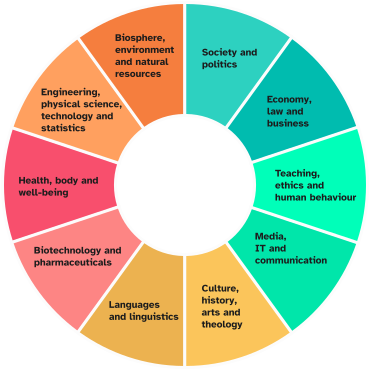
Study wheel

What interests you?

Aurora Cooperation

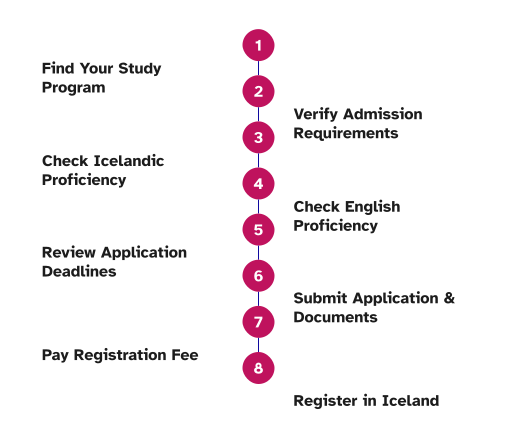
How to apply

Follow the path

Contact us

If you still have questions, feel free to contact us.

School of Humanities
Weekdays: 10-12 am and 1-3 pm
General Service and Social Media

The Service Desk is a point of access for all services. You can drop in at the University Centre or use the WebChat at the bottom right of this page.

Follow the School of Humanities on Instagram,   Youtube
and Facebook

""

Share

Did this help?

Why wasn't this information helpful

Limit to 250 characters.