- Do you want to specialise in parenting and child development?
- Are you interested in the parent-child relationship?
- Would you like to support parents in developing their parenting skills?
- Are you able to respect the fact that families are diverse, with differing circumstances and needs?
- Are you looking for a short graduate programme?
The graduate diploma in parent education helps students to develop their professional skills in the field of parent education and child guidance.
The programme is offered in cooperation with the University of Minnesota College of Education and Human Development, which has been at the forefront of parent education and child guidance in the United States.
Programme structure
The programme is 60 ECTS and is organised as one year of part-time study.
The programme is made up of:
- Courses in a chosen specialisation, 45 ECTS
- Restricted electives, 5 ECTS
- Free electives, 10 ECTS
Organisation of teaching
Teaching and examinations are in Icelandic.
Courses may be taught face-to-face or through distance learning with regular lectures and discussion periods, meaning that the programme is accessible to students living outside the capital area.
Main objectives
The programme aims to equip professionals to work with parents of all children, with a focus on diverse families, to help people become more confident in their parenting skills through education, discussions and advice on child development and parenting in a broad sense.
Other
Students who complete the diploma with a first-class grade may apply for the Master's programme in the same subject.
Applicants are required to have completed a MA, M.Ed. or MS degree in the field of educational, sociological, humanistic or completed 120 ECTS degree at level 6.1 (for example an MT degree).
Required base for the programme:
A foundation course in psychology at university level focusing on the development of children and youths (10 ECTS). In the event that a student needs to add this course, it will not be assessed as part of the diploma study.
The 60 ECTS study programme is divided as follows: Mandatory courses (55 ECTS) and electives (5 ECTS).
- CV
- Statement of purpose
- Reference 1, Name and email
- Reference 2, Name and email
- Certified copies of diplomas and transcripts
Further information on supporting documents can be found here
Programme structure
Check below to see how the programme is structured.
This programme does not offer specialisations.
- First year
- Fall
- The competent parent? Discourses on parenting
- Introduction to Parenting and Counseling for Parents
- Parent education: Supporting parents in their role
- Not taught this semesterMarketing and adult education
- Not taught this semesterLife Skills - The Self
- Parenting in a global context
- Not taught this semesterJournalism 1
- Analysis of education needs
- Spring 1
- Parent-child interaction
- Instructional design and learning processes with adult learners
- Reflective dialogue in parent education
- Summer
- Radio programming and broadcasting
- Year unspecified
- Not taught this semesterInteractive and empowering education I
The competent parent? Discourses on parenting (FFU102M)
In this course, discourses about the parental role will be examined. The focus will be on the societal context of the demands placed on parents, including individualization of parenting and intensive mothering. The requirements placed on parents today, such as managing school choices, after-school activities, communication between home and school/after-school programs, homework assistance, nutrition, screen time management, breastfeeding, and the demand to be an informed and conscious parent, will be explored. The origins of these requirements, their impact on parents, and their connection to contemporary ideologies such as neoliberalism, commodification, and expert discourses will be examined in a critical light. Dominant educational trends maintain that parents should act as consumers in the "education market," making school choice and participation in educational settings growing areas of research in educational and parenting studies. International and Icelandic research on parenting and how privileges and marginalization shape parents' ability to meet these demands will be discussed. Emphasis will be placed on examining specific groups of people who have been classified as "privileged" and "disadvantaged" parents, connecting to theories about gender, class, origin, disability, sexual orientation, and gender identity. Students will gain insight into parental research in the fields of critical sociology, social psychology, educational science, and theories of power and marginalization.
Introduction to Parenting and Counseling for Parents (FFU101M)
The aim of this course is to introduce students to major theories on parenting and to help them prepare for parenting education. The course will have a broad theoretical basis, in order to help students to have a wide focus on the parenting role and best practices.
Parent education: Supporting parents in their role (FFU301F)
Students will examine adult, adolescent, and parent learning and development from the perspective of their relevance for parent education. Research information and variety of theoretical perspectives will be presented and critiqued. Personal professional development will be facilitated through challenging assumptions and examining knowledge and competencies required for parent educators.
NB The course is taught both in Icelandic and English.
Marketing and adult education (NAF005F)
Adult educators can profit from ideas and tools both from the disciplin of Marketing as well as Andragogy in order to plan and promote learning opportunities: programs and courses, for adult learners.
In this course participants will learn how to combine ideas developed within the field of marketing with similar ideas developed within the field of andragogy, when planning and implementing courses and programmes for adult learners
Life Skills - The Self (SFG104F)
Content: The course focuses on the theory and practice of those elements of life skills education that have to do with the self and personal skills. The course is in accordance with the Icelandic national curriculum, working towards mental health, healthy self-image and strong moral character in students. Topics include character education, experiments in living and mindfulness.
Methods: Most weeks there will be lectures and discussions. Lectures will usually be recorded before sessions and uploaded to the course website on Canvas. Students should view them before taking part in sessions. Discussions will not be recorded, but students who are not able to attend can participate by posting a blog on the course website. Students submit four assignments.
Parenting in a global context (INT505M)
This course explores parenting roles and experiences across diverse and international contexts. Students will expand their awareness of a range of parenting roles, values, and perspectives and consider multiple cultural, social, political and ecological factors which may influence parenting. Such factors include cultural traditions and expectations of parents, children, and the parent-child relationship. Students will also reflect on how their own experiences with and perspectives on parenting and family life may influence their lens for viewing parental practices and connecting with children and families.
Journalism 1 (BLF110F)
The aim of course is to introduce to students the journalistic profession with an emphasis on reporting and producing news for different media. Main concepts and methods in newswriting are discussed, such as news values, news gathering and news construction. Students will be trained in writing in a focused, accurate and articulate manner. Students will get a basic training in using social media to gather and distribute content.
Assignments. Students write news stories and articles for the study program´s online news site, and at times for other news media.
Analysis of education needs (NAF201F)
One of the first steps in designing learning activities for adults is to analyse and assess learning needs the potential learners might have. Recently the task of analysing and assessing learning needs has become a task adult educators have to take on in cooperation with their or their organisations clients. Companies which contact so called "learning providers" more and more expect their partners to enter into cooperation with them in order to talormake learning interventions aimed at raising the competencies of their staff.
Form of instruction:
Blended learning: A mix of contact sessions and collaborative online learning.
Parent-child interaction (FFU201F)
Students will analyze and critique parent-child interaction theory and research, consider implications for parent-child relationships and parents’ and children’s development, and apply this course material to professional work with families.
Instructional design and learning processes with adult learners (NAF002F)
In this course participants learn how to design learning interventions for adults. Its main objectives are that participants can individually or with a group, design courses or other learning events for adults.
During the course participants deal with most aspects of designing, organizing and implementing learning events organized for adults, ranging from learning needs assessment through design to teaching and evaluation. However with the main focus being on the design and implementation of the learning intervention.
The course is carried out in a blended form, a mix of face to face sessions and collaborative online work.
Reflective dialogue in parent education (FFU101F)
The aim of this course is to deepen knowledge of reflective dialogue in parent education (RDPED) and support students in using the approach with parents, in group settings or individual counseling. Students are indroduced to the theoretical background of the RDPED approach and the hourglass method of reflective questioning. Students will have the opportunity to use the method with a parent group and/or in an individual interview, with or without videos. Students plan a teaching practice with a group or individul parents using the reflective dialogue approach.
Radio programming and broadcasting (BLF201M)
The goal of this course is to give students an opportunity to present their theoretical knowledge and research to listeners of the Icelandic Public Broadcasting Service (Ríkisútvarpið). Students will be introduced to public radio as a medium and trained in radio programming and in presenting theoretical material in simple manners suitable for broadcasting in public radio.
Interactive and empowering education I (UME001M)
The course Interactive and empowering education offers an opportunity to learn practical aspects of teaching, presentation and creative work with groups. The course is open to all students of the University of Iceland – and through Endurmenntun Háskóla Íslands – also others. It is offered both in the autumn and spring term. The course organisation is such that participants take three short practical courses, each one aimed at training a specific competence within the field of teaching, presentation and facilitation (see list below) to finish this course students finish at least three such courses.
The practical, competence courses fall into four categories and the student can take courses from all the categories or focus on one of them.
Interactive and empowering education
- Professional communication in learning and collaboration
- Activating methods for groups
- The teacher or leader as a facilitator
Presentation of learning materials
- Effective presentation
- Visual presentation for meetings and education
Democratic and creative methods with groups
- Open Space Technology
- The Pin Point method / Moderation
- World Café
- Creative Problem Solving
Information technology for learning and interactivity
- Actual technologies and methods for learning and teachng
- Effective video conferencing
- Creating learning materials with sound and image / video
- Fall
- FFU102MThe competent parent? Discourses on parentingMandatory (required) course5A mandatory (required) course for the programme5 ECTS, creditsCourse Description
In this course, discourses about the parental role will be examined. The focus will be on the societal context of the demands placed on parents, including individualization of parenting and intensive mothering. The requirements placed on parents today, such as managing school choices, after-school activities, communication between home and school/after-school programs, homework assistance, nutrition, screen time management, breastfeeding, and the demand to be an informed and conscious parent, will be explored. The origins of these requirements, their impact on parents, and their connection to contemporary ideologies such as neoliberalism, commodification, and expert discourses will be examined in a critical light. Dominant educational trends maintain that parents should act as consumers in the "education market," making school choice and participation in educational settings growing areas of research in educational and parenting studies. International and Icelandic research on parenting and how privileges and marginalization shape parents' ability to meet these demands will be discussed. Emphasis will be placed on examining specific groups of people who have been classified as "privileged" and "disadvantaged" parents, connecting to theories about gender, class, origin, disability, sexual orientation, and gender identity. Students will gain insight into parental research in the fields of critical sociology, social psychology, educational science, and theories of power and marginalization.
Face-to-face learningDistance learningPrerequisitesFFU101MIntroduction to Parenting and Counseling for ParentsMandatory (required) course10A mandatory (required) course for the programme10 ECTS, creditsCourse DescriptionThe aim of this course is to introduce students to major theories on parenting and to help them prepare for parenting education. The course will have a broad theoretical basis, in order to help students to have a wide focus on the parenting role and best practices.
Face-to-face learningDistance learningPrerequisitesFFU301FParent education: Supporting parents in their roleMandatory (required) course10A mandatory (required) course for the programme10 ECTS, creditsCourse DescriptionStudents will examine adult, adolescent, and parent learning and development from the perspective of their relevance for parent education. Research information and variety of theoretical perspectives will be presented and critiqued. Personal professional development will be facilitated through challenging assumptions and examining knowledge and competencies required for parent educators.
NB The course is taught both in Icelandic and English.
Face-to-face learningDistance learningPrerequisitesAttendance required in classNot taught this semesterNAF005FMarketing and adult educationElective course5Free elective course within the programme5 ECTS, creditsCourse DescriptionAdult educators can profit from ideas and tools both from the disciplin of Marketing as well as Andragogy in order to plan and promote learning opportunities: programs and courses, for adult learners.
In this course participants will learn how to combine ideas developed within the field of marketing with similar ideas developed within the field of andragogy, when planning and implementing courses and programmes for adult learners
Face-to-face learningDistance learningPrerequisitesNot taught this semesterSFG104FLife Skills - The SelfElective course5Free elective course within the programme5 ECTS, creditsCourse DescriptionContent: The course focuses on the theory and practice of those elements of life skills education that have to do with the self and personal skills. The course is in accordance with the Icelandic national curriculum, working towards mental health, healthy self-image and strong moral character in students. Topics include character education, experiments in living and mindfulness.
Methods: Most weeks there will be lectures and discussions. Lectures will usually be recorded before sessions and uploaded to the course website on Canvas. Students should view them before taking part in sessions. Discussions will not be recorded, but students who are not able to attend can participate by posting a blog on the course website. Students submit four assignments.
Distance learningPrerequisitesINT505MParenting in a global contextElective course10Free elective course within the programme10 ECTS, creditsCourse DescriptionThis course explores parenting roles and experiences across diverse and international contexts. Students will expand their awareness of a range of parenting roles, values, and perspectives and consider multiple cultural, social, political and ecological factors which may influence parenting. Such factors include cultural traditions and expectations of parents, children, and the parent-child relationship. Students will also reflect on how their own experiences with and perspectives on parenting and family life may influence their lens for viewing parental practices and connecting with children and families.
Face-to-face learningPrerequisitesAttendance required in classNot taught this semesterBLF110FJournalism 1Elective course8Free elective course within the programme8 ECTS, creditsCourse DescriptionThe aim of course is to introduce to students the journalistic profession with an emphasis on reporting and producing news for different media. Main concepts and methods in newswriting are discussed, such as news values, news gathering and news construction. Students will be trained in writing in a focused, accurate and articulate manner. Students will get a basic training in using social media to gather and distribute content.
Assignments. Students write news stories and articles for the study program´s online news site, and at times for other news media.
Face-to-face learningPrerequisitesNAF201FAnalysis of education needsElective course5Free elective course within the programme5 ECTS, creditsCourse DescriptionOne of the first steps in designing learning activities for adults is to analyse and assess learning needs the potential learners might have. Recently the task of analysing and assessing learning needs has become a task adult educators have to take on in cooperation with their or their organisations clients. Companies which contact so called "learning providers" more and more expect their partners to enter into cooperation with them in order to talormake learning interventions aimed at raising the competencies of their staff.
Form of instruction:
Blended learning: A mix of contact sessions and collaborative online learning.Face-to-face learningDistance learningPrerequisites- Spring 2
FFU201FParent-child interactionMandatory (required) course15A mandatory (required) course for the programme15 ECTS, creditsCourse DescriptionStudents will analyze and critique parent-child interaction theory and research, consider implications for parent-child relationships and parents’ and children’s development, and apply this course material to professional work with families.
Face-to-face learningDistance learningPrerequisitesAttendance required in classNAF002FInstructional design and learning processes with adult learnersMandatory (required) course10A mandatory (required) course for the programme10 ECTS, creditsCourse DescriptionIn this course participants learn how to design learning interventions for adults. Its main objectives are that participants can individually or with a group, design courses or other learning events for adults.
During the course participants deal with most aspects of designing, organizing and implementing learning events organized for adults, ranging from learning needs assessment through design to teaching and evaluation. However with the main focus being on the design and implementation of the learning intervention.
The course is carried out in a blended form, a mix of face to face sessions and collaborative online work.
Face-to-face learningDistance learningPrerequisitesFFU101FReflective dialogue in parent educationMandatory (required) course5A mandatory (required) course for the programme5 ECTS, creditsCourse DescriptionThe aim of this course is to deepen knowledge of reflective dialogue in parent education (RDPED) and support students in using the approach with parents, in group settings or individual counseling. Students are indroduced to the theoretical background of the RDPED approach and the hourglass method of reflective questioning. Students will have the opportunity to use the method with a parent group and/or in an individual interview, with or without videos. Students plan a teaching practice with a group or individul parents using the reflective dialogue approach.
Face-to-face learningDistance learningPrerequisitesAttendance required in class- Summer
BLF201MRadio programming and broadcastingElective course6Free elective course within the programme6 ECTS, creditsCourse DescriptionThe goal of this course is to give students an opportunity to present their theoretical knowledge and research to listeners of the Icelandic Public Broadcasting Service (Ríkisútvarpið). Students will be introduced to public radio as a medium and trained in radio programming and in presenting theoretical material in simple manners suitable for broadcasting in public radio.
Face-to-face learningPrerequisitesAttendance required in class- Year unspecified
Not taught this semesterUME001MInteractive and empowering education IElective course5Free elective course within the programme5 ECTS, creditsCourse DescriptionThe course Interactive and empowering education offers an opportunity to learn practical aspects of teaching, presentation and creative work with groups. The course is open to all students of the University of Iceland – and through Endurmenntun Háskóla Íslands – also others. It is offered both in the autumn and spring term. The course organisation is such that participants take three short practical courses, each one aimed at training a specific competence within the field of teaching, presentation and facilitation (see list below) to finish this course students finish at least three such courses.
The practical, competence courses fall into four categories and the student can take courses from all the categories or focus on one of them.
Interactive and empowering education
- Professional communication in learning and collaboration
- Activating methods for groups
- The teacher or leader as a facilitator
Presentation of learning materials
- Effective presentation
- Visual presentation for meetings and education
Democratic and creative methods with groups
- Open Space Technology
- The Pin Point method / Moderation
- World Café
- Creative Problem Solving
Information technology for learning and interactivity
- Actual technologies and methods for learning and teachng
- Effective video conferencing
- Creating learning materials with sound and image / video
Face-to-face learningPrerequisitesAttendance required in classAdditional information The University of Iceland collaborates with over 400 universities worldwide. This provides a unique opportunity to pursue part of your studies at an international university thus gaining added experience and fresh insight into your field of study.
Students generally have the opportunity to join an exchange programme, internship, or summer courses. However, exchanges are always subject to faculty approval.
Students have the opportunity to have courses evaluated as part of their studies at the University of Iceland, so their stay does not have to affect the duration of their studies.
This qualification may open up opportunities in:
- Preschools
- Compulsory schools
- Upper secondary schools
- Healthcare institutions
- Social institutions
- Religious institutions
This list is not exhaustive
The organisation for students of pedagogy and education studies at UI is called Tumi. Tumi organises workplace tours, annual galas, pub quizzes and end-of-exams parties. Tumi works with other student organisations at the School to put on several joint events. Tumi also advocates for members and is there to advise students.
Students' comments
Students appreciate the University of Iceland for its strong academic reputation, modern campus facilities, close-knit community, and affordable tuition.Helpful content Study wheel
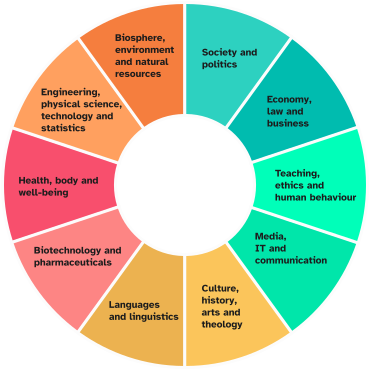
What interests you?
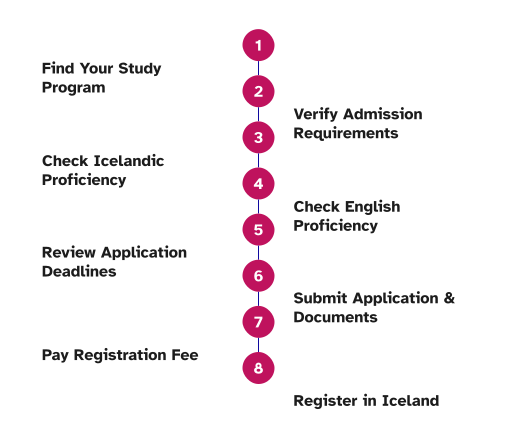
How to apply
Follow the path
Contact us If you still have questions, feel free to contact us.
School of Education9:00 am - 3:00 pmGeneral Service and social mediaThe Service Desk is a point of access for all services. You can drop in at the University Centre or use the WebChat at the bottom right of this page.
Follow the School of Education on Instagram, Youtube
and Facebook
Share