Student's bookstore
Language skills
required, minimum level of B2
Programme length
2 years.
Study mode
Face-to-face learning
Application status
International students:
Students with Icelandic or Nordic citizenship:
Overview

  • Are you interested in Icelandic literature, from the medieval period to the present day?
  • Do you want training in independent working practices and research skills?
  • Do you want to improve your knowledge and gain a better understanding of the methods and theories used in literary research?
  • Do you want to be able to apply your knowledge and skills to new and previously unfamiliar challenges in the field of literature?

The MA in Icelandic literature is designed for students who have completed an undergraduate degree in Icelandic comparative literature.

There are no mandatory courses on the programme, meaning that students are able to tailor it to suit their own interests.

Students may choose to focus on:

  • the methods and theories applied in literary research.
  • Icelandic literature, from the medieval period to the present day.
  • selected periods and areas of literature.
  • a range of methods for communicating on the subjects of literature and literary materials in contemporary society.
  • general academic skills.

Programme structure

The programme is 120 ECTS and is organised as two years of full-time study.

The programme is made up of:

  • Courses in Icelandic literature, 60 ECTS
  • Elective courses, max 30 ECTS.
  • Master's thesis, 30 - 60 ECTS

Students may take up to 30 ECTS in related subjects, having consulted with the head of subject.

Students select the thesis topic in consultation with their teachers. The process of writing the thesis should train students in academic working practices. Higher standards are expected for an MA thesis than a BA thesis when it comes to academic presentation, originality and the student’s independent contribution.

Organisation of teaching

The programme is taught in Icelandic. Most textbooks are in Icelandic, English or Nordic languages.

Courses are taught through lectures, discussion periods and various assignments and essays. Assessment is usually through essays and/or presentations.

Emphasis is placed on students' active participation. Since this is a research-based programme, students are expected to show considerable initiative and independence in selecting topics, finding and interpreting sources and so forth.

Main objectives

The programme is designed to provide students with academic training, equipping them for further studies and work, including upper secondary school teaching, academic careers and doctoral studies.

Other

Completing an MA at the Faculty of Icelandic and Comparative Cultural Studies allows you to apply for doctoral studies.

A BA degree with a first class grade in Icelandic or comparative literature as a major, or a BA degree with a first class grade in Icelandic as a minor with a focus on literature (students must have taken all core courses in Icelandic literature as part of an Icelandic major). Applicants must have completed a final project for at least 10 ECTS.

At the beginning of the first semester, the head of subject assigns each MA student a supervisor who guides the student on the program composition, the choice of courses and any issues and rules related to the programme. The supervising teacher must always be an academic employee at the Faculty of Icelandic. The programme is divided into 90 ECTS in courses and a 30 ECTS Master's thesis. Students may apply to write a 60 ECTS thesis and take 60 ECTS in courses. There are no particular mandatory courses in the MA programme, but certain rules apply to course selection. Students must take at least 60 ECTS in MA courses in Icelandic literature. Students may take a maximum of 30 ECTS in M-courses. MA students who have taken a certain M-course as part of their BA studies may not take it again as part of their MA studies, should the course be taught again. Students may take up to 30 ECTS in related subjects, having consulted with the head of subject. By the end of the third semester, every MA student must have settled on a thesis topic and found a supervisor in consultation with the head of subject.

The following documents must accompany an application for this programme:
  • Statement of purpose
  • Certified copies of diplomas and transcripts

Further information on supporting documents can be found here

Programme structure

Check below to see how the programme is structured.

This programme does not offer specialisations.

First year | Fall
Völsunga saga: art and entertainment (ÍSB819F)
Free elective course within the programme
10 ECTS, credits
Course Description

In this course, Völsunga saga will be read and analyzed from different perspectives, in close connection to the heroic lays of the Eddic tradition. After an in-depth reading, the focus will be set on individual episodes, such as about Sigurðr Fáfnisbani and his ancestry, the Gjúkungar, Atli, and Jörmunrekr. Some European analogues will be examined, whether in historiography, poetry or art. Then, we will turn our attention to the dissemination of the material throughout the ages and its representations in different forms of art and textual media, as for example opera, film and other visual arts, folktales, folk songs and traditional ballads. The objective is to demonstrate the multifunctional and diverse strands that lie between the literature and the older as well as younger manifestations of the subject matter.

Language of instruction: Icelandic
First year | Fall
The Cold War: Art, culture and literature (LIS710F)
Free elective course within the programme
10 ECTS, credits
Course Description

The course explores the relationship between political and aesthetic discourse in Iceland during the era of the cultural Cold War, a global ideological struggle waged by the two superpowers, the United States and the Soviet Union, for the hearts and minds of populations around the world in the latter half of the 20th century. The course draws on interdisciplinary research on the Cold War, with a focus on the interplay between global influences and local conditions. This glocal approach allows for an examination of Icelandic agents in the Cold War not only as representatives of the two empires, the United States and the Soviet Union, but also based on their own cultural values and interests. A mixed methodology will be employed, incorporating theories and methods from the social sciences, as well as from art history, literary studies, and historiography. Special emphasis will be placed on the analysis of literary texts and artworks, while attention will also be given to the participation of Icelandic intellectuals and artists in international cultural activities. Students will explore how the Cold War has been addressed in recent years, both in academic contexts and in public dissemination through exhibitions, podcasts, and graphic novels.

Language of instruction: Icelandic
First year | Fall
Workshop: Research on Icelandic modern literature in the 21st century (ÍSB722F)
Free elective course within the programme
10 ECTS, credits
Course Description

This workshop focuses on 21st-century research on Icelandic modern literature. All students participate actively in discussions and projects and share responsibility with the teachers for the transfer of knowledge and the progress of the work. The teachers are professional leaders, supervisors and discussion moderators but do not give formal lectures. Emphasis will be placed on research-based learning, which involves students defining research questions, finding older research, reviewing it, having an opinion on it and expressing themselves about it in a group of peers in a research group, collecting their own data, analyzing it and describing it, receiving feedback, giving feedback to others and writing an academic text (research thesis).

More information on workshops can be found here.

Language of instruction: Icelandic
Face-to-face learning
Self-study
Prerequisites
First year | Fall
Research project B (ÍSL804F)
Free elective course within the programme
10 ECTS, credits
Course Description

The student chooses a subject in consultation with a teacher, who takes on the role of a supervisor. Together they draw up a reading list and define the project output.

Language of instruction: Icelandic
Self-study
First year | Fall
Directed Study A (ÍSL440F)
Free elective course within the programme
10 ECTS, credits
Course Description

The student chooses a subject in consultation with a teacher, who takes on the role of a supervisor. Together they draw up a reading list and define the project output.

Language of instruction: Icelandic
First year | Fall
Writing and Editing (ÍSL101F)
Free elective course within the programme
10 ECTS, credits
Course Description

Training in various aspects of the writing and editing of scientific texts. Various kinds of texts (non-fiction) examined and evaluated. Training in reviewing and commenting on scientific texts and in other aspects of editorial work. The main emphasis will be on the writing of articles, but other kinds of texts will also be considered, both shorter (conference abstracts, reviews) and longer (theses, books), as well as research proposals. Discussion of guidelines for the preparation of manuscripts. Types of plagiarism and how to avoid them and find them. Texts on different subjects will be used as examples, especially writings in linguistics, literature and history. The book Skrifaðu bæði skýrt og rétt will be used as a textbook (Höskuldur Þráinsson 2015).

This course is open to students of many MA programmes in the School of Humanities, cf. the regulations of the individual subjects. Students in the MA programmes in Icelandic literature, Icelandic linguistics, Icelandic studies and Icelandic teaching can take the course as part of the MA course requirements in Icelandic literature or Icelandic linguistics. Students in the MA programme in Icelandic teaching can, however, not have this course as the only linguistics or literature course in their MA.

Language of instruction: Icelandic
Face-to-face learning
First year | Spring 1
Research project B (ÍSL804F)
Free elective course within the programme
10 ECTS, credits
Course Description

The student chooses a subject in consultation with a teacher, who takes on the role of a supervisor. Together they draw up a reading list and define the project output.

Language of instruction: Icelandic
Self-study
First year | Spring 1
Directed Study A (ÍSL440F)
Free elective course within the programme
10 ECTS, credits
Course Description

The student chooses a subject in consultation with a teacher, who takes on the role of a supervisor. Together they draw up a reading list and define the project output.

Language of instruction: Icelandic
First year | Spring 1
Workshop: 21st-Century Research on Medieval Iceland Literature (ÍSB827F)
Free elective course within the programme
10 ECTS, credits
Course Description

This workshop covers important international research conducted on Icelandic medieval literature in the 21st century. Students will actively participate in discussions and projects and share responsibility with the instructor for the dissemination of knowledge and the progress of the course. The instructor serves as a professional leader and discussion facilitator but does not give formal lectures. The emphasis will be on research-based learning, which involves students defining research questions, finding research publications, analyzing them, forming opinions about them, and expressing them in a peer group setting. They will collect their own data, analyze and describe it, receive feedback, provide feedback to others, and write a research thesis.

More information on workshops can be found here.

Language of instruction: Icelandic
Face-to-face learning
Prerequisites
First year | Spring 1
Icelandic and Faroese Contemporary Literature (ÍSB826F)
Free elective course within the programme
10 ECTS, credits
Course Description

In this course, Faroese and Icelandic literary works from the 20th and 21st centuries will be read and placed in the context of the literary and cultural history of these two island nations. The course topics include, among other things, the questions that have preoccupied the authors, how the nations’ identities are reflected in the works, and the connections between the Faroese and Icelandic literary fields, such as through translations.

The course is taught in collaboration with Guðrún í Jákupsstovu, a lecturer at the University of the Faroe Islands, who teaches a comparable course there during the same semester. Part of the course will therefore be taught online, but classroom teaching and student participation in person are also expected. The aim is for a study trip to Tórshavn to be part of the course, and likewise, the Faroese group will visit Reykjavík

Language of instruction: Icelandic
Face-to-face learning
First year | Spring 1
Pastoral and consolation poetry (ÍSB720F)
Free elective course within the programme
10 ECTS, credits
Course Description

Close reading of poetry, both religious and secular, from the 17th and 18th centuries. The concept baroque and the main characteristics of socalled baroque-texts will be analysed, in order to answer the question wether literary genres used by Icelandic poets can be identified as baroque texts and whether there are comparisons in contemporary foreign (European) literature. Texts will be read by the poets Hallgrímur Pétursson, Stefán Ólafsson, Bjarni Gissurarson, Steinunn Finnsdóttir, Sigga skálda og Látra-Björg.

Language of instruction: Icelandic
First year | Spring 1
Nature stories: the (super)natural in legends and literature (ÍSB814M)
Free elective course within the programme
10 ECTS, credits
Course Description

By focusing on folk tales, literature and other relevant sources, the course discusses the manifestations of nature and the supernatural in Icelandic narrative culture throughout the centuries. Students will learn about the significance, interface, and unclear boundaries of these phenomena and how they have shaped society and the environment as well. Students will thus get to know different ideas about the position of people and (other) animals within, above or "outside" of nature. Through diverse lectures and assignments, topics such as humanity vs. animality, the known world vs. other worlds, and the materiality vs. the supernatural, will be discussed from critical points of view. The roles and forms of landscape, organisms, bodies, weather, and natural phenomena in the narrative culture will be explored. The latest research in this broad field will be presented, such as on the representation of earthquakes and celestial bodies, bears, whales, seals, and domestic animals, and on the supernatural creatures of nature and other mythological creatures such as fairies, ghosts, trolls, and berserks. Students will learn how story worlds and folklore have left their mark on the perception of nature, folk traditions, folk customs, and social spaces such as enchanted spots, sacred places and hunted places. We also ask how these narratives appear in folk art and visual art, from previous centuries to the present. Finally, we will explore the significance of nature narratives and the supernatural in the context of the Anthropocene, human perspectives, climate change, and the different status of social groups and species.

Language of instruction: Icelandic
Face-to-face learning
Distance learning
Prerequisites
First year | Spring 1
Medieval Icelandic Manuscripts (ÍSL416M)
Free elective course within the programme
10 ECTS, credits
Course Description

This course provides an overview of Icelandic manuscript culture. Students will get practical training in reading Icelandic manuscripts from different periods, from the earliest extant Icelandic vellums dating to the twelfth and thirteenth centuries down to the paper manuscripts of the seventeenth and eighteenth centuries. The origins of the Icelandic script will be discussed as well as its development over time, and students will get practical training in reading different types of script from different periods. The orthography of medieval manuscripts differs considerably from the modern orthography. It includes a system of abbreviations that is partly inherited from a much earlier Latin tradition. Students will get practical training in interpreting these abbreviations. The Icelandic language has also changed over time, and different manifestations of these language changes appear when reading and examining Icelandic texts from different periods. A selection of these changes will be discussed. Changes in script, orthography, and language provide valuable indications of the date of the manuscript, and students will get practical training in dating medieval Icelandic manuscripts based on script, orthography, and language.

Various aspects of medieval book production will be discussed, including the making of parchment and ink, and book binding. Scribes and scribal schools will be discussed as well as probable centres of book production in medieval Iceland. The works of some prolific scribes in the fourteenth century will be examined. What did they write? How did they write? Did they change their practice over a long scribal career? The texts contained by the manuscripts will also be examined and the basics of textual criticism introduced. Njáls saga, for instance, has survived in over sixty manuscripts with considerable textual variation. Which manuscript should then constitute the basis for a printed edition of Njáls saga? Different types of printed editions will be discussed, and students try their hand at editing a medieval text. The electronic editing of pre-modern texts will be introduced, and students will get practical training in mark-up with XML according to the guidelines of the Medieval Nordic Text Archive (MENOTA) and the Medieval Unicode Font Initiative (MUFI).

The course is taught through a combination of lectures and workshops with considerable student engagement. Many of the lectures will be pre-recorded allowing more time in the classroom for discussion and student contributions.

The course is run in cooperation with the Árni Magnússon Institute for Icelandic Studies which has the custody of the largest single collection of Icelandic medieval manuscripts. Students will visit the institute to learn about its collections and facilities and to examine manuscripts.


Course synopsis

Week 1
(1) Introduction
The course: format, readings, requirements and assessment.
The subject matter: Medieval Icelandic manuscripts.

(2) The earliest Icelandic manuscripts
A sketch of the history of the Latin script and the earliest writings in Icelandic. Where did Icelanders learn to use the Latin alphabet? Which orthography did they employ? Some main characteristics of medieval orthography and the use of abbreviations.

Week 2
(3) Electronic editing of medieval texts
How can medieval texts be presented electronically? The XML mark-up language, TEI, MENOTA, MUFI, and related matters. We will try our hand at electronic editing.

(4) The earliest Icelandic orthography and the First Grammatical Treatise
The use of the Latin alphabet for writing Icelandic: challenges — and the solutions proposed by the author of the First Grammatical Treatise in the middle of the twelfth century.

Week 3
(5) Icelandic script and orthography in the thirteenth century
The difference between Icelandic and Norwegian orthography in the twelfth century. What changed in the course of the thirteenth century?

(6) Different types of print editions: scholarly editions
How accurate should printed editions be? Should every little detail in the manuscript be reproduced? What is “Classical Old Icelandic Normalized Orthography”? What are the needs of the readers? What is the role of the editor?

Week 4
(7) Norwegian influence on script, orthography, and language in Icelandic manuscripts
What is the manifestation of this Norwegian influence? How deep-rooted was it? How long did it last?

(8) The dating of manuscripts: script, orthography, and language
How can medieval Icelandic manuscripts be dated? Features of script, orthography, and language that can be helpful for dating.

Week 5
(9) Icelandic script and orthography in the fourteenth century
Main characteristics and their development.

(10) One scribal hand or many?
Distinguishing different scribal hands: some criteria. The Icelandic Homily Book from around 1200: One scribe or fourteen?

Week 6
(11) Book production: parchment, ink, binding — and conservation
From animal skin to parchment. How was the ink produced? Book design and book binding. The care and conservation of medieval manuscripts.

(12) Book production: parchment, ink, binding — and conservation
A visit to the Árni Magnússon Institute for Icelandic Studies.

— STUDY WEEK —

Week 7
(13) Scribes, scribal milieus, the export of books
On prolific scribes, scribal collaboration, and extensive production of books. Were books produced in Iceland for export in the thirteenth and fourteenth centuries?

(14) Icelandic script and orthography in the fifteenth and sixteenth centuries
Main characteristics and their development.

Week 8
(15) Textual criticism
On the transmission of texts through copying. Textual variation, manuscript classification, and stemmatology.

(16) Textual criticism
Comparing manuscripts and collecting variants.

Week 9
(17) Manuscript illumination
On illuminated manuscripts, historiated initials, artists and their models.

(18) Manuscript catalogues and cataloguing
We will familiarize ourselves with the most important manuscript catalogues and learn about the principles of manuscript cataloguing.

Week 10
(19) Icelandic script and orthography in the seventeenth and eighteenth centuries
Main characteristics and their development.

(20) The transmission of the text: a relic or a living text?
How did the language change when a scribe copied from an old exemplar? Njáls saga is believed to have been written towards the end of the thirteenth century. What is the language of Njáls saga in seventeenth- and eighteenth-century manuscripts?

Week 11
(21) Antiquarianism, manuscript collectors, and copyists
The sixteenth century saw the rise of interest in antiquities, old manuscripts were collected and copied.

(22) Different types of print editions: popular editions
How is a pre-modern text best presented to the modern reader? Should archaic features of language and orthography be retained or should they be updated? On the allegiance to the manuscript and allegiance to the reader.

Week 12
(23) Manuscript collections and manuscript collectors
The life and work of Árni Magnússon.

(24) The manuscript dispute and the return of the manuscripts to Iceland
The search for Codex Scardensis and a nerve-racking auction in London. The custody dispute with Denmark and the return of the manuscripts to Iceland 1971–1997.

— This synopsis may be subject to change. —

Readings

The reading list is on the course website on Canvas. It consists of readings in several languages, including English, Icelandic, Danish, Norwegian, German, and French. The reading list is (often) divided into three main sections:

(a) Required readings: Texts that everyone is required to read. These are all in English.

(b) Optional supplementary readings: These are optional readings for those who want a more in-depth discussion. Most of these readings are in English, but not all.

(c) For those who still want more: A variety of optional readings in several languages, not least in Icelandic, for those who still want more. This section is mostly for reference purposes and as a tool for further research.

Many of the required readings (and some of the optional readings) are found on the Canvas course website. Other reading materials are available in the institute library in the Árni Magnússon Institute in Edda and the University Library (Háskólabókasafn) in the Þjóðarbókhlaða.

Prerequisites
Some skills in Icelandic are essential to fully benefit from the course, as emphasis will be placed on practical training in reading and transcribing text from medieval Icelandic manuscripts. MIS105F Old Icelandic 1 or equivalent study of Old Icelandic is sufficient or some skills in Modern Icelandic. Please, consult the instructor if in doubt.

Course format
The course is taught through a combination of lectures and workshops with considerable student engagement. Many of the lectures will be prerecorded allowing more time in the classroom for discussion and student contributions (flipped classroom).

Working language: This course is open to students with different linguistic backgrounds, and there are two working languages, English and Icelandic. Pre-recorded lectures are in both English and Icelandic (except for guest lecturers who will present in English), written assignments are in both English and Icelandic, and reading materials are in English, Icelandic and the Scandinavian languages, but for those who cannot read Icelandic or the Scan-dinavian languages, all required readings are in English. English is the main working language in the classroom, but questions and contributions to class discussion may also be in Icelandic. — See a separate note on the working languages and the classroom arrangement.

Course requirements and assessment
The final grade for the course will be based on:

(1) Transcription assignments: 30%
(2) Manuscript catalogue assignment: 10%
(3) Manuscript dating assignment: 10%
(4) Presentation: manuscript of the day: 10%
(5) Research paper: 30%
(6) Class participation: 10%

All written assignments will be submitted through Canvas. More detailed instructions and information on deadlines is found on Canvas.

Language of instruction: Icelandic/English
Face-to-face learning
Prerequisites
First year | Spring 1
A workshop in cultural journalism (ÍSB707F)
Free elective course within the programme
10 ECTS, credits
Course Description

Many students, who finish their studies in the School of Humanities, in particular students from the Department of Icelandic and Comparative Cultural Studies, are likely to be employed in the future by media-companies, publishing houses and cultural institutions and asked to write criticism or news about books and art-events. The course focuses on the role and characteristics of cultural journalism in Iceland. Students will get acquainted with most of the genres of cultural journalism, such as interviews, criticism, news-releases and blog. They will work on practical assignments that will be related to specific cultural events in Iceland in the spring of 2018.

Language of instruction: Icelandic
Not taught this semester
First year | Spring 1
Nature stories: the (super)natural in legends and literature (ÞJÓ614M)
Free elective course within the programme
10 ECTS, credits
Course Description

By focusing on folk tales, literature and other relevant sources, the course discusses the manifestations of nature and the supernatural in Icelandic narrative culture throughout the centuries. Students will learn about the significance, interface, and unclear boundaries of these phenomena and how they have shaped society and the environment as well. Students will thus get to know different ideas about the position of people and (other) animals within, above or "outside" of nature. Through diverse lectures and assignments, topics such as humanity vs. animality, the known world vs. other worlds, and materiality vs. the supernatural, will be discussed from critical points of view. The roles and forms of landscape, organisms, bodies, weather, and natural phenomena in the narrative culture will be explored. The latest research in this broad field will be presented, such as on the representation of earthquakes and celestial bodies, bears, whales, seals, and domestic animals, and on the supernatural creatures of nature and other mythological creatures such as fairies, ghosts, trolls, and berserks. Students will learn how story worlds and folklore have left their mark on the perception of nature, folk traditions, folk customs, and social spaces such as enchanted spots, sacred places and hunted places. We also ask how these narratives appear in folk art and visual art, from previous centuries to the present. Finally, we will explore the significance of nature narratives and the supernatural in the context of the Anthropocene, human perspectives, climate change, and the different statuses of social groups and species

Language of instruction: Icelandic
First year | Spring 1
Icelandic in the educational system (ÍSF801F)
Free elective course within the programme
10 ECTS, credits
Course Description

The main purpose of the course is twofold. First, to shed light on how Icelandic is taught in upper primary and secondary schools. Second, to explore ways of developing Icelandic as a school subject, with respect to practical and theoretical research. What ability should be emphasized in the use and practice of the language? What skills should students have obtained by the end of each school level and how should they be trained? Which aspects of language and literature are most important for the students to know and understand? What are the most used teaching methods? What kind of teaching material is most commonly used in schools and to what extent does it reflect recent knowledge and developments in the fields of language and literature? In the course assignments the students will be trained in defining and implementing their own teaching ideas, with an emphasis on recent knowledge.

Language of instruction: Icelandic
Prerequisites
First year | Spring 1
Old Nordic Religion and Belief (ÞJÓ203F)
Free elective course within the programme
10 ECTS, credits
Course Description

An examination will be made of the religious beliefs and practices of people in Scandinavia from the earliest of times until the conversion, material ranging from burial practices to rock carvings, to the written evidence given in the works of Tacitus, Adam of Bremen and Saxo Grammaticus, as well as in early Icelandic works like the Eddic poems and the Kings' sagas. Alongside this discussion of the development and key features of Old Norse religion, some attention will be paid to the concepts of seid and shamanism, especially in connection to their role in early religions. Finally, an examination will be made of the conversion of Scandinavia and how Christian concepts and practices both fitted and contrasted with the previously dominant Old Norse worldview.

Teaching format

  • The teaching takes place in the form of lectures and discussion on the material of the lectures.
Language of instruction: English
Face-to-face learning
Online learning
First year | Spring 1
Narrative, cinema and culture in Sjón’s fiction (ABF846F)
Free elective course within the programme
10 ECTS, credits
Course Description

The course focuses on the fiction of Sjón, with emphasis on novels, poetry and cinema, based on the study Sjónsbók: Ævintýrið um höfundinn, súrrealisma og sýnir (2016) by Úlfhildur Dagsdóttir, and the essay collection Critical Approaches to Sjón : North of the Sun (2025). Theories of surrealism and the avant garde, narrative and cultural studies will be discussed.

Language of instruction: Icelandic
Face-to-face learning
Second year | Fall
Völsunga saga: art and entertainment (ÍSB819F)
Free elective course within the programme
10 ECTS, credits
Course Description

In this course, Völsunga saga will be read and analyzed from different perspectives, in close connection to the heroic lays of the Eddic tradition. After an in-depth reading, the focus will be set on individual episodes, such as about Sigurðr Fáfnisbani and his ancestry, the Gjúkungar, Atli, and Jörmunrekr. Some European analogues will be examined, whether in historiography, poetry or art. Then, we will turn our attention to the dissemination of the material throughout the ages and its representations in different forms of art and textual media, as for example opera, film and other visual arts, folktales, folk songs and traditional ballads. The objective is to demonstrate the multifunctional and diverse strands that lie between the literature and the older as well as younger manifestations of the subject matter.

Language of instruction: Icelandic
Second year | Fall
The Cold War: Art, culture and literature (LIS710F)
Free elective course within the programme
10 ECTS, credits
Course Description

The course explores the relationship between political and aesthetic discourse in Iceland during the era of the cultural Cold War, a global ideological struggle waged by the two superpowers, the United States and the Soviet Union, for the hearts and minds of populations around the world in the latter half of the 20th century. The course draws on interdisciplinary research on the Cold War, with a focus on the interplay between global influences and local conditions. This glocal approach allows for an examination of Icelandic agents in the Cold War not only as representatives of the two empires, the United States and the Soviet Union, but also based on their own cultural values and interests. A mixed methodology will be employed, incorporating theories and methods from the social sciences, as well as from art history, literary studies, and historiography. Special emphasis will be placed on the analysis of literary texts and artworks, while attention will also be given to the participation of Icelandic intellectuals and artists in international cultural activities. Students will explore how the Cold War has been addressed in recent years, both in academic contexts and in public dissemination through exhibitions, podcasts, and graphic novels.

Language of instruction: Icelandic
Second year | Fall
Workshop: Research on Icelandic modern literature in the 21st century (ÍSB722F)
Free elective course within the programme
10 ECTS, credits
Course Description

This workshop focuses on 21st-century research on Icelandic modern literature. All students participate actively in discussions and projects and share responsibility with the teachers for the transfer of knowledge and the progress of the work. The teachers are professional leaders, supervisors and discussion moderators but do not give formal lectures. Emphasis will be placed on research-based learning, which involves students defining research questions, finding older research, reviewing it, having an opinion on it and expressing themselves about it in a group of peers in a research group, collecting their own data, analyzing it and describing it, receiving feedback, giving feedback to others and writing an academic text (research thesis).

More information on workshops can be found here.

Language of instruction: Icelandic
Face-to-face learning
Self-study
Prerequisites
Second year | Fall
Research project B (ÍSL804F)
Free elective course within the programme
10 ECTS, credits
Course Description

The student chooses a subject in consultation with a teacher, who takes on the role of a supervisor. Together they draw up a reading list and define the project output.

Language of instruction: Icelandic
Self-study
Second year | Fall
Directed Study A (ÍSL440F)
Free elective course within the programme
10 ECTS, credits
Course Description

The student chooses a subject in consultation with a teacher, who takes on the role of a supervisor. Together they draw up a reading list and define the project output.

Language of instruction: Icelandic
Second year | Fall
Writing and Editing (ÍSL101F)
Free elective course within the programme
10 ECTS, credits
Course Description

Training in various aspects of the writing and editing of scientific texts. Various kinds of texts (non-fiction) examined and evaluated. Training in reviewing and commenting on scientific texts and in other aspects of editorial work. The main emphasis will be on the writing of articles, but other kinds of texts will also be considered, both shorter (conference abstracts, reviews) and longer (theses, books), as well as research proposals. Discussion of guidelines for the preparation of manuscripts. Types of plagiarism and how to avoid them and find them. Texts on different subjects will be used as examples, especially writings in linguistics, literature and history. The book Skrifaðu bæði skýrt og rétt will be used as a textbook (Höskuldur Þráinsson 2015).

This course is open to students of many MA programmes in the School of Humanities, cf. the regulations of the individual subjects. Students in the MA programmes in Icelandic literature, Icelandic linguistics, Icelandic studies and Icelandic teaching can take the course as part of the MA course requirements in Icelandic literature or Icelandic linguistics. Students in the MA programme in Icelandic teaching can, however, not have this course as the only linguistics or literature course in their MA.

Language of instruction: Icelandic
Face-to-face learning
Second year | Fall
MA-thesis in Icelandic Literature (ÍSB443L)
A mandatory (required) course for the programme
0 ECTS, credits
Course Description

Students wishing to write a MA thesis shall contact the head of department regarding the choice of supervisor. Requests for a specific supervisor are honoured where possible, but otherwise a supervisor is selected based on the topic of the thesis and the specialist knowledge of teaching staff in Icelandic.

Language of instruction: Icelandic
Part of the total project/thesis credits
Second year | Spring 1
Research project B (ÍSL804F)
Free elective course within the programme
10 ECTS, credits
Course Description

The student chooses a subject in consultation with a teacher, who takes on the role of a supervisor. Together they draw up a reading list and define the project output.

Language of instruction: Icelandic
Self-study
Second year | Spring 1
Directed Study A (ÍSL440F)
Free elective course within the programme
10 ECTS, credits
Course Description

The student chooses a subject in consultation with a teacher, who takes on the role of a supervisor. Together they draw up a reading list and define the project output.

Language of instruction: Icelandic
Second year | Spring 1
Workshop: 21st-Century Research on Medieval Iceland Literature (ÍSB827F)
Free elective course within the programme
10 ECTS, credits
Course Description

This workshop covers important international research conducted on Icelandic medieval literature in the 21st century. Students will actively participate in discussions and projects and share responsibility with the instructor for the dissemination of knowledge and the progress of the course. The instructor serves as a professional leader and discussion facilitator but does not give formal lectures. The emphasis will be on research-based learning, which involves students defining research questions, finding research publications, analyzing them, forming opinions about them, and expressing them in a peer group setting. They will collect their own data, analyze and describe it, receive feedback, provide feedback to others, and write a research thesis.

More information on workshops can be found here.

Language of instruction: Icelandic
Face-to-face learning
Prerequisites
Second year | Spring 1
Icelandic and Faroese Contemporary Literature (ÍSB826F)
Free elective course within the programme
10 ECTS, credits
Course Description

In this course, Faroese and Icelandic literary works from the 20th and 21st centuries will be read and placed in the context of the literary and cultural history of these two island nations. The course topics include, among other things, the questions that have preoccupied the authors, how the nations’ identities are reflected in the works, and the connections between the Faroese and Icelandic literary fields, such as through translations.

The course is taught in collaboration with Guðrún í Jákupsstovu, a lecturer at the University of the Faroe Islands, who teaches a comparable course there during the same semester. Part of the course will therefore be taught online, but classroom teaching and student participation in person are also expected. The aim is for a study trip to Tórshavn to be part of the course, and likewise, the Faroese group will visit Reykjavík

Language of instruction: Icelandic
Face-to-face learning
Second year | Spring 1
Pastoral and consolation poetry (ÍSB720F)
Free elective course within the programme
10 ECTS, credits
Course Description

Close reading of poetry, both religious and secular, from the 17th and 18th centuries. The concept baroque and the main characteristics of socalled baroque-texts will be analysed, in order to answer the question wether literary genres used by Icelandic poets can be identified as baroque texts and whether there are comparisons in contemporary foreign (European) literature. Texts will be read by the poets Hallgrímur Pétursson, Stefán Ólafsson, Bjarni Gissurarson, Steinunn Finnsdóttir, Sigga skálda og Látra-Björg.

Language of instruction: Icelandic
Second year | Spring 1
Nature stories: the (super)natural in legends and literature (ÍSB814M)
Free elective course within the programme
10 ECTS, credits
Course Description

By focusing on folk tales, literature and other relevant sources, the course discusses the manifestations of nature and the supernatural in Icelandic narrative culture throughout the centuries. Students will learn about the significance, interface, and unclear boundaries of these phenomena and how they have shaped society and the environment as well. Students will thus get to know different ideas about the position of people and (other) animals within, above or "outside" of nature. Through diverse lectures and assignments, topics such as humanity vs. animality, the known world vs. other worlds, and the materiality vs. the supernatural, will be discussed from critical points of view. The roles and forms of landscape, organisms, bodies, weather, and natural phenomena in the narrative culture will be explored. The latest research in this broad field will be presented, such as on the representation of earthquakes and celestial bodies, bears, whales, seals, and domestic animals, and on the supernatural creatures of nature and other mythological creatures such as fairies, ghosts, trolls, and berserks. Students will learn how story worlds and folklore have left their mark on the perception of nature, folk traditions, folk customs, and social spaces such as enchanted spots, sacred places and hunted places. We also ask how these narratives appear in folk art and visual art, from previous centuries to the present. Finally, we will explore the significance of nature narratives and the supernatural in the context of the Anthropocene, human perspectives, climate change, and the different status of social groups and species.

Language of instruction: Icelandic
Face-to-face learning
Distance learning
Prerequisites
Second year | Spring 1
Medieval Icelandic Manuscripts (ÍSL416M)
Free elective course within the programme
10 ECTS, credits
Course Description

This course provides an overview of Icelandic manuscript culture. Students will get practical training in reading Icelandic manuscripts from different periods, from the earliest extant Icelandic vellums dating to the twelfth and thirteenth centuries down to the paper manuscripts of the seventeenth and eighteenth centuries. The origins of the Icelandic script will be discussed as well as its development over time, and students will get practical training in reading different types of script from different periods. The orthography of medieval manuscripts differs considerably from the modern orthography. It includes a system of abbreviations that is partly inherited from a much earlier Latin tradition. Students will get practical training in interpreting these abbreviations. The Icelandic language has also changed over time, and different manifestations of these language changes appear when reading and examining Icelandic texts from different periods. A selection of these changes will be discussed. Changes in script, orthography, and language provide valuable indications of the date of the manuscript, and students will get practical training in dating medieval Icelandic manuscripts based on script, orthography, and language.

Various aspects of medieval book production will be discussed, including the making of parchment and ink, and book binding. Scribes and scribal schools will be discussed as well as probable centres of book production in medieval Iceland. The works of some prolific scribes in the fourteenth century will be examined. What did they write? How did they write? Did they change their practice over a long scribal career? The texts contained by the manuscripts will also be examined and the basics of textual criticism introduced. Njáls saga, for instance, has survived in over sixty manuscripts with considerable textual variation. Which manuscript should then constitute the basis for a printed edition of Njáls saga? Different types of printed editions will be discussed, and students try their hand at editing a medieval text. The electronic editing of pre-modern texts will be introduced, and students will get practical training in mark-up with XML according to the guidelines of the Medieval Nordic Text Archive (MENOTA) and the Medieval Unicode Font Initiative (MUFI).

The course is taught through a combination of lectures and workshops with considerable student engagement. Many of the lectures will be pre-recorded allowing more time in the classroom for discussion and student contributions.

The course is run in cooperation with the Árni Magnússon Institute for Icelandic Studies which has the custody of the largest single collection of Icelandic medieval manuscripts. Students will visit the institute to learn about its collections and facilities and to examine manuscripts.


Course synopsis

Week 1
(1) Introduction
The course: format, readings, requirements and assessment.
The subject matter: Medieval Icelandic manuscripts.

(2) The earliest Icelandic manuscripts
A sketch of the history of the Latin script and the earliest writings in Icelandic. Where did Icelanders learn to use the Latin alphabet? Which orthography did they employ? Some main characteristics of medieval orthography and the use of abbreviations.

Week 2
(3) Electronic editing of medieval texts
How can medieval texts be presented electronically? The XML mark-up language, TEI, MENOTA, MUFI, and related matters. We will try our hand at electronic editing.

(4) The earliest Icelandic orthography and the First Grammatical Treatise
The use of the Latin alphabet for writing Icelandic: challenges — and the solutions proposed by the author of the First Grammatical Treatise in the middle of the twelfth century.

Week 3
(5) Icelandic script and orthography in the thirteenth century
The difference between Icelandic and Norwegian orthography in the twelfth century. What changed in the course of the thirteenth century?

(6) Different types of print editions: scholarly editions
How accurate should printed editions be? Should every little detail in the manuscript be reproduced? What is “Classical Old Icelandic Normalized Orthography”? What are the needs of the readers? What is the role of the editor?

Week 4
(7) Norwegian influence on script, orthography, and language in Icelandic manuscripts
What is the manifestation of this Norwegian influence? How deep-rooted was it? How long did it last?

(8) The dating of manuscripts: script, orthography, and language
How can medieval Icelandic manuscripts be dated? Features of script, orthography, and language that can be helpful for dating.

Week 5
(9) Icelandic script and orthography in the fourteenth century
Main characteristics and their development.

(10) One scribal hand or many?
Distinguishing different scribal hands: some criteria. The Icelandic Homily Book from around 1200: One scribe or fourteen?

Week 6
(11) Book production: parchment, ink, binding — and conservation
From animal skin to parchment. How was the ink produced? Book design and book binding. The care and conservation of medieval manuscripts.

(12) Book production: parchment, ink, binding — and conservation
A visit to the Árni Magnússon Institute for Icelandic Studies.

— STUDY WEEK —

Week 7
(13) Scribes, scribal milieus, the export of books
On prolific scribes, scribal collaboration, and extensive production of books. Were books produced in Iceland for export in the thirteenth and fourteenth centuries?

(14) Icelandic script and orthography in the fifteenth and sixteenth centuries
Main characteristics and their development.

Week 8
(15) Textual criticism
On the transmission of texts through copying. Textual variation, manuscript classification, and stemmatology.

(16) Textual criticism
Comparing manuscripts and collecting variants.

Week 9
(17) Manuscript illumination
On illuminated manuscripts, historiated initials, artists and their models.

(18) Manuscript catalogues and cataloguing
We will familiarize ourselves with the most important manuscript catalogues and learn about the principles of manuscript cataloguing.

Week 10
(19) Icelandic script and orthography in the seventeenth and eighteenth centuries
Main characteristics and their development.

(20) The transmission of the text: a relic or a living text?
How did the language change when a scribe copied from an old exemplar? Njáls saga is believed to have been written towards the end of the thirteenth century. What is the language of Njáls saga in seventeenth- and eighteenth-century manuscripts?

Week 11
(21) Antiquarianism, manuscript collectors, and copyists
The sixteenth century saw the rise of interest in antiquities, old manuscripts were collected and copied.

(22) Different types of print editions: popular editions
How is a pre-modern text best presented to the modern reader? Should archaic features of language and orthography be retained or should they be updated? On the allegiance to the manuscript and allegiance to the reader.

Week 12
(23) Manuscript collections and manuscript collectors
The life and work of Árni Magnússon.

(24) The manuscript dispute and the return of the manuscripts to Iceland
The search for Codex Scardensis and a nerve-racking auction in London. The custody dispute with Denmark and the return of the manuscripts to Iceland 1971–1997.

— This synopsis may be subject to change. —

Readings

The reading list is on the course website on Canvas. It consists of readings in several languages, including English, Icelandic, Danish, Norwegian, German, and French. The reading list is (often) divided into three main sections:

(a) Required readings: Texts that everyone is required to read. These are all in English.

(b) Optional supplementary readings: These are optional readings for those who want a more in-depth discussion. Most of these readings are in English, but not all.

(c) For those who still want more: A variety of optional readings in several languages, not least in Icelandic, for those who still want more. This section is mostly for reference purposes and as a tool for further research.

Many of the required readings (and some of the optional readings) are found on the Canvas course website. Other reading materials are available in the institute library in the Árni Magnússon Institute in Edda and the University Library (Háskólabókasafn) in the Þjóðarbókhlaða.

Prerequisites
Some skills in Icelandic are essential to fully benefit from the course, as emphasis will be placed on practical training in reading and transcribing text from medieval Icelandic manuscripts. MIS105F Old Icelandic 1 or equivalent study of Old Icelandic is sufficient or some skills in Modern Icelandic. Please, consult the instructor if in doubt.

Course format
The course is taught through a combination of lectures and workshops with considerable student engagement. Many of the lectures will be prerecorded allowing more time in the classroom for discussion and student contributions (flipped classroom).

Working language: This course is open to students with different linguistic backgrounds, and there are two working languages, English and Icelandic. Pre-recorded lectures are in both English and Icelandic (except for guest lecturers who will present in English), written assignments are in both English and Icelandic, and reading materials are in English, Icelandic and the Scandinavian languages, but for those who cannot read Icelandic or the Scan-dinavian languages, all required readings are in English. English is the main working language in the classroom, but questions and contributions to class discussion may also be in Icelandic. — See a separate note on the working languages and the classroom arrangement.

Course requirements and assessment
The final grade for the course will be based on:

(1) Transcription assignments: 30%
(2) Manuscript catalogue assignment: 10%
(3) Manuscript dating assignment: 10%
(4) Presentation: manuscript of the day: 10%
(5) Research paper: 30%
(6) Class participation: 10%

All written assignments will be submitted through Canvas. More detailed instructions and information on deadlines is found on Canvas.

Language of instruction: Icelandic/English
Face-to-face learning
Prerequisites
Second year | Spring 1
A workshop in cultural journalism (ÍSB707F)
Free elective course within the programme
10 ECTS, credits
Course Description

Many students, who finish their studies in the School of Humanities, in particular students from the Department of Icelandic and Comparative Cultural Studies, are likely to be employed in the future by media-companies, publishing houses and cultural institutions and asked to write criticism or news about books and art-events. The course focuses on the role and characteristics of cultural journalism in Iceland. Students will get acquainted with most of the genres of cultural journalism, such as interviews, criticism, news-releases and blog. They will work on practical assignments that will be related to specific cultural events in Iceland in the spring of 2018.

Language of instruction: Icelandic
Not taught this semester
Second year | Spring 1
Nature stories: the (super)natural in legends and literature (ÞJÓ614M)
Free elective course within the programme
10 ECTS, credits
Course Description

By focusing on folk tales, literature and other relevant sources, the course discusses the manifestations of nature and the supernatural in Icelandic narrative culture throughout the centuries. Students will learn about the significance, interface, and unclear boundaries of these phenomena and how they have shaped society and the environment as well. Students will thus get to know different ideas about the position of people and (other) animals within, above or "outside" of nature. Through diverse lectures and assignments, topics such as humanity vs. animality, the known world vs. other worlds, and materiality vs. the supernatural, will be discussed from critical points of view. The roles and forms of landscape, organisms, bodies, weather, and natural phenomena in the narrative culture will be explored. The latest research in this broad field will be presented, such as on the representation of earthquakes and celestial bodies, bears, whales, seals, and domestic animals, and on the supernatural creatures of nature and other mythological creatures such as fairies, ghosts, trolls, and berserks. Students will learn how story worlds and folklore have left their mark on the perception of nature, folk traditions, folk customs, and social spaces such as enchanted spots, sacred places and hunted places. We also ask how these narratives appear in folk art and visual art, from previous centuries to the present. Finally, we will explore the significance of nature narratives and the supernatural in the context of the Anthropocene, human perspectives, climate change, and the different statuses of social groups and species

Language of instruction: Icelandic
Second year | Spring 1
Icelandic in the educational system (ÍSF801F)
Free elective course within the programme
10 ECTS, credits
Course Description

The main purpose of the course is twofold. First, to shed light on how Icelandic is taught in upper primary and secondary schools. Second, to explore ways of developing Icelandic as a school subject, with respect to practical and theoretical research. What ability should be emphasized in the use and practice of the language? What skills should students have obtained by the end of each school level and how should they be trained? Which aspects of language and literature are most important for the students to know and understand? What are the most used teaching methods? What kind of teaching material is most commonly used in schools and to what extent does it reflect recent knowledge and developments in the fields of language and literature? In the course assignments the students will be trained in defining and implementing their own teaching ideas, with an emphasis on recent knowledge.

Language of instruction: Icelandic
Prerequisites
Second year | Spring 1
Old Nordic Religion and Belief (ÞJÓ203F)
Free elective course within the programme
10 ECTS, credits
Course Description

An examination will be made of the religious beliefs and practices of people in Scandinavia from the earliest of times until the conversion, material ranging from burial practices to rock carvings, to the written evidence given in the works of Tacitus, Adam of Bremen and Saxo Grammaticus, as well as in early Icelandic works like the Eddic poems and the Kings' sagas. Alongside this discussion of the development and key features of Old Norse religion, some attention will be paid to the concepts of seid and shamanism, especially in connection to their role in early religions. Finally, an examination will be made of the conversion of Scandinavia and how Christian concepts and practices both fitted and contrasted with the previously dominant Old Norse worldview.

Teaching format

  • The teaching takes place in the form of lectures and discussion on the material of the lectures.
Language of instruction: English
Face-to-face learning
Online learning
Second year | Spring 1
Narrative, cinema and culture in Sjón’s fiction (ABF846F)
Free elective course within the programme
10 ECTS, credits
Course Description

The course focuses on the fiction of Sjón, with emphasis on novels, poetry and cinema, based on the study Sjónsbók: Ævintýrið um höfundinn, súrrealisma og sýnir (2016) by Úlfhildur Dagsdóttir, and the essay collection Critical Approaches to Sjón : North of the Sun (2025). Theories of surrealism and the avant garde, narrative and cultural studies will be discussed.

Language of instruction: Icelandic
Face-to-face learning
Second year | Spring 1
MA-thesis in Icelandic Literature (ÍSB443L)
A mandatory (required) course for the programme
0 ECTS, credits
Course Description

Students wishing to write a MA thesis shall contact the head of department regarding the choice of supervisor. Requests for a specific supervisor are honoured where possible, but otherwise a supervisor is selected based on the topic of the thesis and the specialist knowledge of teaching staff in Icelandic.

Language of instruction: Icelandic
Part of the total project/thesis credits
First year
  • Fall
  • ÍSB819F
    Völsunga saga: art and entertainment
    Elective course
    10
    Free elective course within the programme
    10 ECTS, credits
    Course Description

    In this course, Völsunga saga will be read and analyzed from different perspectives, in close connection to the heroic lays of the Eddic tradition. After an in-depth reading, the focus will be set on individual episodes, such as about Sigurðr Fáfnisbani and his ancestry, the Gjúkungar, Atli, and Jörmunrekr. Some European analogues will be examined, whether in historiography, poetry or art. Then, we will turn our attention to the dissemination of the material throughout the ages and its representations in different forms of art and textual media, as for example opera, film and other visual arts, folktales, folk songs and traditional ballads. The objective is to demonstrate the multifunctional and diverse strands that lie between the literature and the older as well as younger manifestations of the subject matter.

    Prerequisites
  • LIS710F
    The Cold War: Art, culture and literature
    Elective course
    10
    Free elective course within the programme
    10 ECTS, credits
    Course Description

    The course explores the relationship between political and aesthetic discourse in Iceland during the era of the cultural Cold War, a global ideological struggle waged by the two superpowers, the United States and the Soviet Union, for the hearts and minds of populations around the world in the latter half of the 20th century. The course draws on interdisciplinary research on the Cold War, with a focus on the interplay between global influences and local conditions. This glocal approach allows for an examination of Icelandic agents in the Cold War not only as representatives of the two empires, the United States and the Soviet Union, but also based on their own cultural values and interests. A mixed methodology will be employed, incorporating theories and methods from the social sciences, as well as from art history, literary studies, and historiography. Special emphasis will be placed on the analysis of literary texts and artworks, while attention will also be given to the participation of Icelandic intellectuals and artists in international cultural activities. Students will explore how the Cold War has been addressed in recent years, both in academic contexts and in public dissemination through exhibitions, podcasts, and graphic novels.

    Prerequisites
  • ÍSB722F
    Workshop: Research on Icelandic modern literature in the 21st century
    Elective course
    10
    Free elective course within the programme
    10 ECTS, credits
    Course Description

    This workshop focuses on 21st-century research on Icelandic modern literature. All students participate actively in discussions and projects and share responsibility with the teachers for the transfer of knowledge and the progress of the work. The teachers are professional leaders, supervisors and discussion moderators but do not give formal lectures. Emphasis will be placed on research-based learning, which involves students defining research questions, finding older research, reviewing it, having an opinion on it and expressing themselves about it in a group of peers in a research group, collecting their own data, analyzing it and describing it, receiving feedback, giving feedback to others and writing an academic text (research thesis).

    More information on workshops can be found here.

    Face-to-face learning
    Self-study
    Prerequisites
  • ÍSL804F
    Research project B
    Elective course
    10
    Free elective course within the programme
    10 ECTS, credits
    Course Description

    The student chooses a subject in consultation with a teacher, who takes on the role of a supervisor. Together they draw up a reading list and define the project output.

    Self-study
    Prerequisites
  • ÍSL440F
    Directed Study A
    Elective course
    10
    Free elective course within the programme
    10 ECTS, credits
    Course Description

    The student chooses a subject in consultation with a teacher, who takes on the role of a supervisor. Together they draw up a reading list and define the project output.

    Prerequisites
  • ÍSL101F
    Writing and Editing
    Elective course
    10
    Free elective course within the programme
    10 ECTS, credits
    Course Description

    Training in various aspects of the writing and editing of scientific texts. Various kinds of texts (non-fiction) examined and evaluated. Training in reviewing and commenting on scientific texts and in other aspects of editorial work. The main emphasis will be on the writing of articles, but other kinds of texts will also be considered, both shorter (conference abstracts, reviews) and longer (theses, books), as well as research proposals. Discussion of guidelines for the preparation of manuscripts. Types of plagiarism and how to avoid them and find them. Texts on different subjects will be used as examples, especially writings in linguistics, literature and history. The book Skrifaðu bæði skýrt og rétt will be used as a textbook (Höskuldur Þráinsson 2015).

    This course is open to students of many MA programmes in the School of Humanities, cf. the regulations of the individual subjects. Students in the MA programmes in Icelandic literature, Icelandic linguistics, Icelandic studies and Icelandic teaching can take the course as part of the MA course requirements in Icelandic literature or Icelandic linguistics. Students in the MA programme in Icelandic teaching can, however, not have this course as the only linguistics or literature course in their MA.

    Face-to-face learning
    Prerequisites
  • Spring 2
  • ÍSL804F
    Research project B
    Elective course
    10
    Free elective course within the programme
    10 ECTS, credits
    Course Description

    The student chooses a subject in consultation with a teacher, who takes on the role of a supervisor. Together they draw up a reading list and define the project output.

    Self-study
    Prerequisites
  • ÍSL440F
    Directed Study A
    Elective course
    10
    Free elective course within the programme
    10 ECTS, credits
    Course Description

    The student chooses a subject in consultation with a teacher, who takes on the role of a supervisor. Together they draw up a reading list and define the project output.

    Prerequisites
  • ÍSB827F
    Workshop: 21st-Century Research on Medieval Iceland Literature
    Elective course
    10
    Free elective course within the programme
    10 ECTS, credits
    Course Description

    This workshop covers important international research conducted on Icelandic medieval literature in the 21st century. Students will actively participate in discussions and projects and share responsibility with the instructor for the dissemination of knowledge and the progress of the course. The instructor serves as a professional leader and discussion facilitator but does not give formal lectures. The emphasis will be on research-based learning, which involves students defining research questions, finding research publications, analyzing them, forming opinions about them, and expressing them in a peer group setting. They will collect their own data, analyze and describe it, receive feedback, provide feedback to others, and write a research thesis.

    More information on workshops can be found here.

    Face-to-face learning
    Prerequisites
  • ÍSB826F
    Icelandic and Faroese Contemporary Literature
    Elective course
    10
    Free elective course within the programme
    10 ECTS, credits
    Course Description

    In this course, Faroese and Icelandic literary works from the 20th and 21st centuries will be read and placed in the context of the literary and cultural history of these two island nations. The course topics include, among other things, the questions that have preoccupied the authors, how the nations’ identities are reflected in the works, and the connections between the Faroese and Icelandic literary fields, such as through translations.

    The course is taught in collaboration with Guðrún í Jákupsstovu, a lecturer at the University of the Faroe Islands, who teaches a comparable course there during the same semester. Part of the course will therefore be taught online, but classroom teaching and student participation in person are also expected. The aim is for a study trip to Tórshavn to be part of the course, and likewise, the Faroese group will visit Reykjavík

    Face-to-face learning
    Prerequisites
  • ÍSB720F
    Pastoral and consolation poetry
    Elective course
    10
    Free elective course within the programme
    10 ECTS, credits
    Course Description

    Close reading of poetry, both religious and secular, from the 17th and 18th centuries. The concept baroque and the main characteristics of socalled baroque-texts will be analysed, in order to answer the question wether literary genres used by Icelandic poets can be identified as baroque texts and whether there are comparisons in contemporary foreign (European) literature. Texts will be read by the poets Hallgrímur Pétursson, Stefán Ólafsson, Bjarni Gissurarson, Steinunn Finnsdóttir, Sigga skálda og Látra-Björg.

    Prerequisites
  • ÍSB814M
    Nature stories: the (super)natural in legends and literature
    Elective course
    10
    Free elective course within the programme
    10 ECTS, credits
    Course Description

    By focusing on folk tales, literature and other relevant sources, the course discusses the manifestations of nature and the supernatural in Icelandic narrative culture throughout the centuries. Students will learn about the significance, interface, and unclear boundaries of these phenomena and how they have shaped society and the environment as well. Students will thus get to know different ideas about the position of people and (other) animals within, above or "outside" of nature. Through diverse lectures and assignments, topics such as humanity vs. animality, the known world vs. other worlds, and the materiality vs. the supernatural, will be discussed from critical points of view. The roles and forms of landscape, organisms, bodies, weather, and natural phenomena in the narrative culture will be explored. The latest research in this broad field will be presented, such as on the representation of earthquakes and celestial bodies, bears, whales, seals, and domestic animals, and on the supernatural creatures of nature and other mythological creatures such as fairies, ghosts, trolls, and berserks. Students will learn how story worlds and folklore have left their mark on the perception of nature, folk traditions, folk customs, and social spaces such as enchanted spots, sacred places and hunted places. We also ask how these narratives appear in folk art and visual art, from previous centuries to the present. Finally, we will explore the significance of nature narratives and the supernatural in the context of the Anthropocene, human perspectives, climate change, and the different status of social groups and species.

    Face-to-face learning
    Distance learning
    Prerequisites
  • ÍSL416M
    Medieval Icelandic Manuscripts
    Elective course
    10
    Free elective course within the programme
    10 ECTS, credits
    Course Description

    This course provides an overview of Icelandic manuscript culture. Students will get practical training in reading Icelandic manuscripts from different periods, from the earliest extant Icelandic vellums dating to the twelfth and thirteenth centuries down to the paper manuscripts of the seventeenth and eighteenth centuries. The origins of the Icelandic script will be discussed as well as its development over time, and students will get practical training in reading different types of script from different periods. The orthography of medieval manuscripts differs considerably from the modern orthography. It includes a system of abbreviations that is partly inherited from a much earlier Latin tradition. Students will get practical training in interpreting these abbreviations. The Icelandic language has also changed over time, and different manifestations of these language changes appear when reading and examining Icelandic texts from different periods. A selection of these changes will be discussed. Changes in script, orthography, and language provide valuable indications of the date of the manuscript, and students will get practical training in dating medieval Icelandic manuscripts based on script, orthography, and language.

    Various aspects of medieval book production will be discussed, including the making of parchment and ink, and book binding. Scribes and scribal schools will be discussed as well as probable centres of book production in medieval Iceland. The works of some prolific scribes in the fourteenth century will be examined. What did they write? How did they write? Did they change their practice over a long scribal career? The texts contained by the manuscripts will also be examined and the basics of textual criticism introduced. Njáls saga, for instance, has survived in over sixty manuscripts with considerable textual variation. Which manuscript should then constitute the basis for a printed edition of Njáls saga? Different types of printed editions will be discussed, and students try their hand at editing a medieval text. The electronic editing of pre-modern texts will be introduced, and students will get practical training in mark-up with XML according to the guidelines of the Medieval Nordic Text Archive (MENOTA) and the Medieval Unicode Font Initiative (MUFI).

    The course is taught through a combination of lectures and workshops with considerable student engagement. Many of the lectures will be pre-recorded allowing more time in the classroom for discussion and student contributions.

    The course is run in cooperation with the Árni Magnússon Institute for Icelandic Studies which has the custody of the largest single collection of Icelandic medieval manuscripts. Students will visit the institute to learn about its collections and facilities and to examine manuscripts.


    Course synopsis

    Week 1
    (1) Introduction
    The course: format, readings, requirements and assessment.
    The subject matter: Medieval Icelandic manuscripts.

    (2) The earliest Icelandic manuscripts
    A sketch of the history of the Latin script and the earliest writings in Icelandic. Where did Icelanders learn to use the Latin alphabet? Which orthography did they employ? Some main characteristics of medieval orthography and the use of abbreviations.

    Week 2
    (3) Electronic editing of medieval texts
    How can medieval texts be presented electronically? The XML mark-up language, TEI, MENOTA, MUFI, and related matters. We will try our hand at electronic editing.

    (4) The earliest Icelandic orthography and the First Grammatical Treatise
    The use of the Latin alphabet for writing Icelandic: challenges — and the solutions proposed by the author of the First Grammatical Treatise in the middle of the twelfth century.

    Week 3
    (5) Icelandic script and orthography in the thirteenth century
    The difference between Icelandic and Norwegian orthography in the twelfth century. What changed in the course of the thirteenth century?

    (6) Different types of print editions: scholarly editions
    How accurate should printed editions be? Should every little detail in the manuscript be reproduced? What is “Classical Old Icelandic Normalized Orthography”? What are the needs of the readers? What is the role of the editor?

    Week 4
    (7) Norwegian influence on script, orthography, and language in Icelandic manuscripts
    What is the manifestation of this Norwegian influence? How deep-rooted was it? How long did it last?

    (8) The dating of manuscripts: script, orthography, and language
    How can medieval Icelandic manuscripts be dated? Features of script, orthography, and language that can be helpful for dating.

    Week 5
    (9) Icelandic script and orthography in the fourteenth century
    Main characteristics and their development.

    (10) One scribal hand or many?
    Distinguishing different scribal hands: some criteria. The Icelandic Homily Book from around 1200: One scribe or fourteen?

    Week 6
    (11) Book production: parchment, ink, binding — and conservation
    From animal skin to parchment. How was the ink produced? Book design and book binding. The care and conservation of medieval manuscripts.

    (12) Book production: parchment, ink, binding — and conservation
    A visit to the Árni Magnússon Institute for Icelandic Studies.

    — STUDY WEEK —

    Week 7
    (13) Scribes, scribal milieus, the export of books
    On prolific scribes, scribal collaboration, and extensive production of books. Were books produced in Iceland for export in the thirteenth and fourteenth centuries?

    (14) Icelandic script and orthography in the fifteenth and sixteenth centuries
    Main characteristics and their development.

    Week 8
    (15) Textual criticism
    On the transmission of texts through copying. Textual variation, manuscript classification, and stemmatology.

    (16) Textual criticism
    Comparing manuscripts and collecting variants.

    Week 9
    (17) Manuscript illumination
    On illuminated manuscripts, historiated initials, artists and their models.

    (18) Manuscript catalogues and cataloguing
    We will familiarize ourselves with the most important manuscript catalogues and learn about the principles of manuscript cataloguing.

    Week 10
    (19) Icelandic script and orthography in the seventeenth and eighteenth centuries
    Main characteristics and their development.

    (20) The transmission of the text: a relic or a living text?
    How did the language change when a scribe copied from an old exemplar? Njáls saga is believed to have been written towards the end of the thirteenth century. What is the language of Njáls saga in seventeenth- and eighteenth-century manuscripts?

    Week 11
    (21) Antiquarianism, manuscript collectors, and copyists
    The sixteenth century saw the rise of interest in antiquities, old manuscripts were collected and copied.

    (22) Different types of print editions: popular editions
    How is a pre-modern text best presented to the modern reader? Should archaic features of language and orthography be retained or should they be updated? On the allegiance to the manuscript and allegiance to the reader.

    Week 12
    (23) Manuscript collections and manuscript collectors
    The life and work of Árni Magnússon.

    (24) The manuscript dispute and the return of the manuscripts to Iceland
    The search for Codex Scardensis and a nerve-racking auction in London. The custody dispute with Denmark and the return of the manuscripts to Iceland 1971–1997.

    — This synopsis may be subject to change. —

    Readings

    The reading list is on the course website on Canvas. It consists of readings in several languages, including English, Icelandic, Danish, Norwegian, German, and French. The reading list is (often) divided into three main sections:

    (a) Required readings: Texts that everyone is required to read. These are all in English.

    (b) Optional supplementary readings: These are optional readings for those who want a more in-depth discussion. Most of these readings are in English, but not all.

    (c) For those who still want more: A variety of optional readings in several languages, not least in Icelandic, for those who still want more. This section is mostly for reference purposes and as a tool for further research.

    Many of the required readings (and some of the optional readings) are found on the Canvas course website. Other reading materials are available in the institute library in the Árni Magnússon Institute in Edda and the University Library (Háskólabókasafn) in the Þjóðarbókhlaða.

    Prerequisites
    Some skills in Icelandic are essential to fully benefit from the course, as emphasis will be placed on practical training in reading and transcribing text from medieval Icelandic manuscripts. MIS105F Old Icelandic 1 or equivalent study of Old Icelandic is sufficient or some skills in Modern Icelandic. Please, consult the instructor if in doubt.

    Course format
    The course is taught through a combination of lectures and workshops with considerable student engagement. Many of the lectures will be prerecorded allowing more time in the classroom for discussion and student contributions (flipped classroom).

    Working language: This course is open to students with different linguistic backgrounds, and there are two working languages, English and Icelandic. Pre-recorded lectures are in both English and Icelandic (except for guest lecturers who will present in English), written assignments are in both English and Icelandic, and reading materials are in English, Icelandic and the Scandinavian languages, but for those who cannot read Icelandic or the Scan-dinavian languages, all required readings are in English. English is the main working language in the classroom, but questions and contributions to class discussion may also be in Icelandic. — See a separate note on the working languages and the classroom arrangement.

    Course requirements and assessment
    The final grade for the course will be based on:

    (1) Transcription assignments: 30%
    (2) Manuscript catalogue assignment: 10%
    (3) Manuscript dating assignment: 10%
    (4) Presentation: manuscript of the day: 10%
    (5) Research paper: 30%
    (6) Class participation: 10%

    All written assignments will be submitted through Canvas. More detailed instructions and information on deadlines is found on Canvas.

    Face-to-face learning
    Prerequisites
  • ÍSB707F
    A workshop in cultural journalism
    Elective course
    10
    Free elective course within the programme
    10 ECTS, credits
    Course Description

    Many students, who finish their studies in the School of Humanities, in particular students from the Department of Icelandic and Comparative Cultural Studies, are likely to be employed in the future by media-companies, publishing houses and cultural institutions and asked to write criticism or news about books and art-events. The course focuses on the role and characteristics of cultural journalism in Iceland. Students will get acquainted with most of the genres of cultural journalism, such as interviews, criticism, news-releases and blog. They will work on practical assignments that will be related to specific cultural events in Iceland in the spring of 2018.

    Prerequisites
  • Not taught this semester
    ÞJÓ614M
    Nature stories: the (super)natural in legends and literature
    Elective course
    10
    Free elective course within the programme
    10 ECTS, credits
    Course Description

    By focusing on folk tales, literature and other relevant sources, the course discusses the manifestations of nature and the supernatural in Icelandic narrative culture throughout the centuries. Students will learn about the significance, interface, and unclear boundaries of these phenomena and how they have shaped society and the environment as well. Students will thus get to know different ideas about the position of people and (other) animals within, above or "outside" of nature. Through diverse lectures and assignments, topics such as humanity vs. animality, the known world vs. other worlds, and materiality vs. the supernatural, will be discussed from critical points of view. The roles and forms of landscape, organisms, bodies, weather, and natural phenomena in the narrative culture will be explored. The latest research in this broad field will be presented, such as on the representation of earthquakes and celestial bodies, bears, whales, seals, and domestic animals, and on the supernatural creatures of nature and other mythological creatures such as fairies, ghosts, trolls, and berserks. Students will learn how story worlds and folklore have left their mark on the perception of nature, folk traditions, folk customs, and social spaces such as enchanted spots, sacred places and hunted places. We also ask how these narratives appear in folk art and visual art, from previous centuries to the present. Finally, we will explore the significance of nature narratives and the supernatural in the context of the Anthropocene, human perspectives, climate change, and the different statuses of social groups and species

    Prerequisites
  • ÍSF801F
    Icelandic in the educational system
    Elective course
    10
    Free elective course within the programme
    10 ECTS, credits
    Course Description

    The main purpose of the course is twofold. First, to shed light on how Icelandic is taught in upper primary and secondary schools. Second, to explore ways of developing Icelandic as a school subject, with respect to practical and theoretical research. What ability should be emphasized in the use and practice of the language? What skills should students have obtained by the end of each school level and how should they be trained? Which aspects of language and literature are most important for the students to know and understand? What are the most used teaching methods? What kind of teaching material is most commonly used in schools and to what extent does it reflect recent knowledge and developments in the fields of language and literature? In the course assignments the students will be trained in defining and implementing their own teaching ideas, with an emphasis on recent knowledge.

    Prerequisites
  • ÞJÓ203F
    Old Nordic Religion and Belief
    Elective course
    10
    Free elective course within the programme
    10 ECTS, credits
    Course Description

    An examination will be made of the religious beliefs and practices of people in Scandinavia from the earliest of times until the conversion, material ranging from burial practices to rock carvings, to the written evidence given in the works of Tacitus, Adam of Bremen and Saxo Grammaticus, as well as in early Icelandic works like the Eddic poems and the Kings' sagas. Alongside this discussion of the development and key features of Old Norse religion, some attention will be paid to the concepts of seid and shamanism, especially in connection to their role in early religions. Finally, an examination will be made of the conversion of Scandinavia and how Christian concepts and practices both fitted and contrasted with the previously dominant Old Norse worldview.

    Teaching format

    • The teaching takes place in the form of lectures and discussion on the material of the lectures.
    Face-to-face learning
    Online learning
    Prerequisites
  • ABF846F
    Narrative, cinema and culture in Sjón’s fiction
    Elective course
    10
    Free elective course within the programme
    10 ECTS, credits
    Course Description

    The course focuses on the fiction of Sjón, with emphasis on novels, poetry and cinema, based on the study Sjónsbók: Ævintýrið um höfundinn, súrrealisma og sýnir (2016) by Úlfhildur Dagsdóttir, and the essay collection Critical Approaches to Sjón : North of the Sun (2025). Theories of surrealism and the avant garde, narrative and cultural studies will be discussed.

    Face-to-face learning
    Prerequisites
  • Fall
  • ÍSB819F
    Völsunga saga: art and entertainment
    Elective course
    10
    Free elective course within the programme
    10 ECTS, credits
    Course Description

    In this course, Völsunga saga will be read and analyzed from different perspectives, in close connection to the heroic lays of the Eddic tradition. After an in-depth reading, the focus will be set on individual episodes, such as about Sigurðr Fáfnisbani and his ancestry, the Gjúkungar, Atli, and Jörmunrekr. Some European analogues will be examined, whether in historiography, poetry or art. Then, we will turn our attention to the dissemination of the material throughout the ages and its representations in different forms of art and textual media, as for example opera, film and other visual arts, folktales, folk songs and traditional ballads. The objective is to demonstrate the multifunctional and diverse strands that lie between the literature and the older as well as younger manifestations of the subject matter.

    Prerequisites
  • LIS710F
    The Cold War: Art, culture and literature
    Elective course
    10
    Free elective course within the programme
    10 ECTS, credits
    Course Description

    The course explores the relationship between political and aesthetic discourse in Iceland during the era of the cultural Cold War, a global ideological struggle waged by the two superpowers, the United States and the Soviet Union, for the hearts and minds of populations around the world in the latter half of the 20th century. The course draws on interdisciplinary research on the Cold War, with a focus on the interplay between global influences and local conditions. This glocal approach allows for an examination of Icelandic agents in the Cold War not only as representatives of the two empires, the United States and the Soviet Union, but also based on their own cultural values and interests. A mixed methodology will be employed, incorporating theories and methods from the social sciences, as well as from art history, literary studies, and historiography. Special emphasis will be placed on the analysis of literary texts and artworks, while attention will also be given to the participation of Icelandic intellectuals and artists in international cultural activities. Students will explore how the Cold War has been addressed in recent years, both in academic contexts and in public dissemination through exhibitions, podcasts, and graphic novels.

    Prerequisites
  • ÍSB722F
    Workshop: Research on Icelandic modern literature in the 21st century
    Elective course
    10
    Free elective course within the programme
    10 ECTS, credits
    Course Description

    This workshop focuses on 21st-century research on Icelandic modern literature. All students participate actively in discussions and projects and share responsibility with the teachers for the transfer of knowledge and the progress of the work. The teachers are professional leaders, supervisors and discussion moderators but do not give formal lectures. Emphasis will be placed on research-based learning, which involves students defining research questions, finding older research, reviewing it, having an opinion on it and expressing themselves about it in a group of peers in a research group, collecting their own data, analyzing it and describing it, receiving feedback, giving feedback to others and writing an academic text (research thesis).

    More information on workshops can be found here.

    Face-to-face learning
    Self-study
    Prerequisites
  • ÍSL804F
    Research project B
    Elective course
    10
    Free elective course within the programme
    10 ECTS, credits
    Course Description

    The student chooses a subject in consultation with a teacher, who takes on the role of a supervisor. Together they draw up a reading list and define the project output.

    Self-study
    Prerequisites
  • ÍSL440F
    Directed Study A
    Elective course
    10
    Free elective course within the programme
    10 ECTS, credits
    Course Description

    The student chooses a subject in consultation with a teacher, who takes on the role of a supervisor. Together they draw up a reading list and define the project output.

    Prerequisites
  • ÍSL101F
    Writing and Editing
    Elective course
    10
    Free elective course within the programme
    10 ECTS, credits
    Course Description

    Training in various aspects of the writing and editing of scientific texts. Various kinds of texts (non-fiction) examined and evaluated. Training in reviewing and commenting on scientific texts and in other aspects of editorial work. The main emphasis will be on the writing of articles, but other kinds of texts will also be considered, both shorter (conference abstracts, reviews) and longer (theses, books), as well as research proposals. Discussion of guidelines for the preparation of manuscripts. Types of plagiarism and how to avoid them and find them. Texts on different subjects will be used as examples, especially writings in linguistics, literature and history. The book Skrifaðu bæði skýrt og rétt will be used as a textbook (Höskuldur Þráinsson 2015).

    This course is open to students of many MA programmes in the School of Humanities, cf. the regulations of the individual subjects. Students in the MA programmes in Icelandic literature, Icelandic linguistics, Icelandic studies and Icelandic teaching can take the course as part of the MA course requirements in Icelandic literature or Icelandic linguistics. Students in the MA programme in Icelandic teaching can, however, not have this course as the only linguistics or literature course in their MA.

    Face-to-face learning
    Prerequisites
  • ÍSB443L
    MA-thesis in Icelandic Literature
    Mandatory (required) course
    0
    A mandatory (required) course for the programme
    0 ECTS, credits
    Course Description

    Students wishing to write a MA thesis shall contact the head of department regarding the choice of supervisor. Requests for a specific supervisor are honoured where possible, but otherwise a supervisor is selected based on the topic of the thesis and the specialist knowledge of teaching staff in Icelandic.

    Prerequisites
    Part of the total project/thesis credits
  • Spring 2
  • ÍSL804F
    Research project B
    Elective course
    10
    Free elective course within the programme
    10 ECTS, credits
    Course Description

    The student chooses a subject in consultation with a teacher, who takes on the role of a supervisor. Together they draw up a reading list and define the project output.

    Self-study
    Prerequisites
  • ÍSL440F
    Directed Study A
    Elective course
    10
    Free elective course within the programme
    10 ECTS, credits
    Course Description

    The student chooses a subject in consultation with a teacher, who takes on the role of a supervisor. Together they draw up a reading list and define the project output.

    Prerequisites
  • ÍSB827F
    Workshop: 21st-Century Research on Medieval Iceland Literature
    Elective course
    10
    Free elective course within the programme
    10 ECTS, credits
    Course Description

    This workshop covers important international research conducted on Icelandic medieval literature in the 21st century. Students will actively participate in discussions and projects and share responsibility with the instructor for the dissemination of knowledge and the progress of the course. The instructor serves as a professional leader and discussion facilitator but does not give formal lectures. The emphasis will be on research-based learning, which involves students defining research questions, finding research publications, analyzing them, forming opinions about them, and expressing them in a peer group setting. They will collect their own data, analyze and describe it, receive feedback, provide feedback to others, and write a research thesis.

    More information on workshops can be found here.

    Face-to-face learning
    Prerequisites
  • ÍSB826F
    Icelandic and Faroese Contemporary Literature
    Elective course
    10
    Free elective course within the programme
    10 ECTS, credits
    Course Description

    In this course, Faroese and Icelandic literary works from the 20th and 21st centuries will be read and placed in the context of the literary and cultural history of these two island nations. The course topics include, among other things, the questions that have preoccupied the authors, how the nations’ identities are reflected in the works, and the connections between the Faroese and Icelandic literary fields, such as through translations.

    The course is taught in collaboration with Guðrún í Jákupsstovu, a lecturer at the University of the Faroe Islands, who teaches a comparable course there during the same semester. Part of the course will therefore be taught online, but classroom teaching and student participation in person are also expected. The aim is for a study trip to Tórshavn to be part of the course, and likewise, the Faroese group will visit Reykjavík

    Face-to-face learning
    Prerequisites
  • ÍSB720F
    Pastoral and consolation poetry
    Elective course
    10
    Free elective course within the programme
    10 ECTS, credits
    Course Description

    Close reading of poetry, both religious and secular, from the 17th and 18th centuries. The concept baroque and the main characteristics of socalled baroque-texts will be analysed, in order to answer the question wether literary genres used by Icelandic poets can be identified as baroque texts and whether there are comparisons in contemporary foreign (European) literature. Texts will be read by the poets Hallgrímur Pétursson, Stefán Ólafsson, Bjarni Gissurarson, Steinunn Finnsdóttir, Sigga skálda og Látra-Björg.

    Prerequisites
  • ÍSB814M
    Nature stories: the (super)natural in legends and literature
    Elective course
    10
    Free elective course within the programme
    10 ECTS, credits
    Course Description

    By focusing on folk tales, literature and other relevant sources, the course discusses the manifestations of nature and the supernatural in Icelandic narrative culture throughout the centuries. Students will learn about the significance, interface, and unclear boundaries of these phenomena and how they have shaped society and the environment as well. Students will thus get to know different ideas about the position of people and (other) animals within, above or "outside" of nature. Through diverse lectures and assignments, topics such as humanity vs. animality, the known world vs. other worlds, and the materiality vs. the supernatural, will be discussed from critical points of view. The roles and forms of landscape, organisms, bodies, weather, and natural phenomena in the narrative culture will be explored. The latest research in this broad field will be presented, such as on the representation of earthquakes and celestial bodies, bears, whales, seals, and domestic animals, and on the supernatural creatures of nature and other mythological creatures such as fairies, ghosts, trolls, and berserks. Students will learn how story worlds and folklore have left their mark on the perception of nature, folk traditions, folk customs, and social spaces such as enchanted spots, sacred places and hunted places. We also ask how these narratives appear in folk art and visual art, from previous centuries to the present. Finally, we will explore the significance of nature narratives and the supernatural in the context of the Anthropocene, human perspectives, climate change, and the different status of social groups and species.

    Face-to-face learning
    Distance learning
    Prerequisites
  • ÍSL416M
    Medieval Icelandic Manuscripts
    Elective course
    10
    Free elective course within the programme
    10 ECTS, credits
    Course Description

    This course provides an overview of Icelandic manuscript culture. Students will get practical training in reading Icelandic manuscripts from different periods, from the earliest extant Icelandic vellums dating to the twelfth and thirteenth centuries down to the paper manuscripts of the seventeenth and eighteenth centuries. The origins of the Icelandic script will be discussed as well as its development over time, and students will get practical training in reading different types of script from different periods. The orthography of medieval manuscripts differs considerably from the modern orthography. It includes a system of abbreviations that is partly inherited from a much earlier Latin tradition. Students will get practical training in interpreting these abbreviations. The Icelandic language has also changed over time, and different manifestations of these language changes appear when reading and examining Icelandic texts from different periods. A selection of these changes will be discussed. Changes in script, orthography, and language provide valuable indications of the date of the manuscript, and students will get practical training in dating medieval Icelandic manuscripts based on script, orthography, and language.

    Various aspects of medieval book production will be discussed, including the making of parchment and ink, and book binding. Scribes and scribal schools will be discussed as well as probable centres of book production in medieval Iceland. The works of some prolific scribes in the fourteenth century will be examined. What did they write? How did they write? Did they change their practice over a long scribal career? The texts contained by the manuscripts will also be examined and the basics of textual criticism introduced. Njáls saga, for instance, has survived in over sixty manuscripts with considerable textual variation. Which manuscript should then constitute the basis for a printed edition of Njáls saga? Different types of printed editions will be discussed, and students try their hand at editing a medieval text. The electronic editing of pre-modern texts will be introduced, and students will get practical training in mark-up with XML according to the guidelines of the Medieval Nordic Text Archive (MENOTA) and the Medieval Unicode Font Initiative (MUFI).

    The course is taught through a combination of lectures and workshops with considerable student engagement. Many of the lectures will be pre-recorded allowing more time in the classroom for discussion and student contributions.

    The course is run in cooperation with the Árni Magnússon Institute for Icelandic Studies which has the custody of the largest single collection of Icelandic medieval manuscripts. Students will visit the institute to learn about its collections and facilities and to examine manuscripts.


    Course synopsis

    Week 1
    (1) Introduction
    The course: format, readings, requirements and assessment.
    The subject matter: Medieval Icelandic manuscripts.

    (2) The earliest Icelandic manuscripts
    A sketch of the history of the Latin script and the earliest writings in Icelandic. Where did Icelanders learn to use the Latin alphabet? Which orthography did they employ? Some main characteristics of medieval orthography and the use of abbreviations.

    Week 2
    (3) Electronic editing of medieval texts
    How can medieval texts be presented electronically? The XML mark-up language, TEI, MENOTA, MUFI, and related matters. We will try our hand at electronic editing.

    (4) The earliest Icelandic orthography and the First Grammatical Treatise
    The use of the Latin alphabet for writing Icelandic: challenges — and the solutions proposed by the author of the First Grammatical Treatise in the middle of the twelfth century.

    Week 3
    (5) Icelandic script and orthography in the thirteenth century
    The difference between Icelandic and Norwegian orthography in the twelfth century. What changed in the course of the thirteenth century?

    (6) Different types of print editions: scholarly editions
    How accurate should printed editions be? Should every little detail in the manuscript be reproduced? What is “Classical Old Icelandic Normalized Orthography”? What are the needs of the readers? What is the role of the editor?

    Week 4
    (7) Norwegian influence on script, orthography, and language in Icelandic manuscripts
    What is the manifestation of this Norwegian influence? How deep-rooted was it? How long did it last?

    (8) The dating of manuscripts: script, orthography, and language
    How can medieval Icelandic manuscripts be dated? Features of script, orthography, and language that can be helpful for dating.

    Week 5
    (9) Icelandic script and orthography in the fourteenth century
    Main characteristics and their development.

    (10) One scribal hand or many?
    Distinguishing different scribal hands: some criteria. The Icelandic Homily Book from around 1200: One scribe or fourteen?

    Week 6
    (11) Book production: parchment, ink, binding — and conservation
    From animal skin to parchment. How was the ink produced? Book design and book binding. The care and conservation of medieval manuscripts.

    (12) Book production: parchment, ink, binding — and conservation
    A visit to the Árni Magnússon Institute for Icelandic Studies.

    — STUDY WEEK —

    Week 7
    (13) Scribes, scribal milieus, the export of books
    On prolific scribes, scribal collaboration, and extensive production of books. Were books produced in Iceland for export in the thirteenth and fourteenth centuries?

    (14) Icelandic script and orthography in the fifteenth and sixteenth centuries
    Main characteristics and their development.

    Week 8
    (15) Textual criticism
    On the transmission of texts through copying. Textual variation, manuscript classification, and stemmatology.

    (16) Textual criticism
    Comparing manuscripts and collecting variants.

    Week 9
    (17) Manuscript illumination
    On illuminated manuscripts, historiated initials, artists and their models.

    (18) Manuscript catalogues and cataloguing
    We will familiarize ourselves with the most important manuscript catalogues and learn about the principles of manuscript cataloguing.

    Week 10
    (19) Icelandic script and orthography in the seventeenth and eighteenth centuries
    Main characteristics and their development.

    (20) The transmission of the text: a relic or a living text?
    How did the language change when a scribe copied from an old exemplar? Njáls saga is believed to have been written towards the end of the thirteenth century. What is the language of Njáls saga in seventeenth- and eighteenth-century manuscripts?

    Week 11
    (21) Antiquarianism, manuscript collectors, and copyists
    The sixteenth century saw the rise of interest in antiquities, old manuscripts were collected and copied.

    (22) Different types of print editions: popular editions
    How is a pre-modern text best presented to the modern reader? Should archaic features of language and orthography be retained or should they be updated? On the allegiance to the manuscript and allegiance to the reader.

    Week 12
    (23) Manuscript collections and manuscript collectors
    The life and work of Árni Magnússon.

    (24) The manuscript dispute and the return of the manuscripts to Iceland
    The search for Codex Scardensis and a nerve-racking auction in London. The custody dispute with Denmark and the return of the manuscripts to Iceland 1971–1997.

    — This synopsis may be subject to change. —

    Readings

    The reading list is on the course website on Canvas. It consists of readings in several languages, including English, Icelandic, Danish, Norwegian, German, and French. The reading list is (often) divided into three main sections:

    (a) Required readings: Texts that everyone is required to read. These are all in English.

    (b) Optional supplementary readings: These are optional readings for those who want a more in-depth discussion. Most of these readings are in English, but not all.

    (c) For those who still want more: A variety of optional readings in several languages, not least in Icelandic, for those who still want more. This section is mostly for reference purposes and as a tool for further research.

    Many of the required readings (and some of the optional readings) are found on the Canvas course website. Other reading materials are available in the institute library in the Árni Magnússon Institute in Edda and the University Library (Háskólabókasafn) in the Þjóðarbókhlaða.

    Prerequisites
    Some skills in Icelandic are essential to fully benefit from the course, as emphasis will be placed on practical training in reading and transcribing text from medieval Icelandic manuscripts. MIS105F Old Icelandic 1 or equivalent study of Old Icelandic is sufficient or some skills in Modern Icelandic. Please, consult the instructor if in doubt.

    Course format
    The course is taught through a combination of lectures and workshops with considerable student engagement. Many of the lectures will be prerecorded allowing more time in the classroom for discussion and student contributions (flipped classroom).

    Working language: This course is open to students with different linguistic backgrounds, and there are two working languages, English and Icelandic. Pre-recorded lectures are in both English and Icelandic (except for guest lecturers who will present in English), written assignments are in both English and Icelandic, and reading materials are in English, Icelandic and the Scandinavian languages, but for those who cannot read Icelandic or the Scan-dinavian languages, all required readings are in English. English is the main working language in the classroom, but questions and contributions to class discussion may also be in Icelandic. — See a separate note on the working languages and the classroom arrangement.

    Course requirements and assessment
    The final grade for the course will be based on:

    (1) Transcription assignments: 30%
    (2) Manuscript catalogue assignment: 10%
    (3) Manuscript dating assignment: 10%
    (4) Presentation: manuscript of the day: 10%
    (5) Research paper: 30%
    (6) Class participation: 10%

    All written assignments will be submitted through Canvas. More detailed instructions and information on deadlines is found on Canvas.

    Face-to-face learning
    Prerequisites
  • ÍSB707F
    A workshop in cultural journalism
    Elective course
    10
    Free elective course within the programme
    10 ECTS, credits
    Course Description

    Many students, who finish their studies in the School of Humanities, in particular students from the Department of Icelandic and Comparative Cultural Studies, are likely to be employed in the future by media-companies, publishing houses and cultural institutions and asked to write criticism or news about books and art-events. The course focuses on the role and characteristics of cultural journalism in Iceland. Students will get acquainted with most of the genres of cultural journalism, such as interviews, criticism, news-releases and blog. They will work on practical assignments that will be related to specific cultural events in Iceland in the spring of 2018.

    Prerequisites
  • Not taught this semester
    ÞJÓ614M
    Nature stories: the (super)natural in legends and literature
    Elective course
    10
    Free elective course within the programme
    10 ECTS, credits
    Course Description

    By focusing on folk tales, literature and other relevant sources, the course discusses the manifestations of nature and the supernatural in Icelandic narrative culture throughout the centuries. Students will learn about the significance, interface, and unclear boundaries of these phenomena and how they have shaped society and the environment as well. Students will thus get to know different ideas about the position of people and (other) animals within, above or "outside" of nature. Through diverse lectures and assignments, topics such as humanity vs. animality, the known world vs. other worlds, and materiality vs. the supernatural, will be discussed from critical points of view. The roles and forms of landscape, organisms, bodies, weather, and natural phenomena in the narrative culture will be explored. The latest research in this broad field will be presented, such as on the representation of earthquakes and celestial bodies, bears, whales, seals, and domestic animals, and on the supernatural creatures of nature and other mythological creatures such as fairies, ghosts, trolls, and berserks. Students will learn how story worlds and folklore have left their mark on the perception of nature, folk traditions, folk customs, and social spaces such as enchanted spots, sacred places and hunted places. We also ask how these narratives appear in folk art and visual art, from previous centuries to the present. Finally, we will explore the significance of nature narratives and the supernatural in the context of the Anthropocene, human perspectives, climate change, and the different statuses of social groups and species

    Prerequisites
  • ÍSF801F
    Icelandic in the educational system
    Elective course
    10
    Free elective course within the programme
    10 ECTS, credits
    Course Description

    The main purpose of the course is twofold. First, to shed light on how Icelandic is taught in upper primary and secondary schools. Second, to explore ways of developing Icelandic as a school subject, with respect to practical and theoretical research. What ability should be emphasized in the use and practice of the language? What skills should students have obtained by the end of each school level and how should they be trained? Which aspects of language and literature are most important for the students to know and understand? What are the most used teaching methods? What kind of teaching material is most commonly used in schools and to what extent does it reflect recent knowledge and developments in the fields of language and literature? In the course assignments the students will be trained in defining and implementing their own teaching ideas, with an emphasis on recent knowledge.

    Prerequisites
  • ÞJÓ203F
    Old Nordic Religion and Belief
    Elective course
    10
    Free elective course within the programme
    10 ECTS, credits
    Course Description

    An examination will be made of the religious beliefs and practices of people in Scandinavia from the earliest of times until the conversion, material ranging from burial practices to rock carvings, to the written evidence given in the works of Tacitus, Adam of Bremen and Saxo Grammaticus, as well as in early Icelandic works like the Eddic poems and the Kings' sagas. Alongside this discussion of the development and key features of Old Norse religion, some attention will be paid to the concepts of seid and shamanism, especially in connection to their role in early religions. Finally, an examination will be made of the conversion of Scandinavia and how Christian concepts and practices both fitted and contrasted with the previously dominant Old Norse worldview.

    Teaching format

    • The teaching takes place in the form of lectures and discussion on the material of the lectures.
    Face-to-face learning
    Online learning
    Prerequisites
  • ABF846F
    Narrative, cinema and culture in Sjón’s fiction
    Elective course
    10
    Free elective course within the programme
    10 ECTS, credits
    Course Description

    The course focuses on the fiction of Sjón, with emphasis on novels, poetry and cinema, based on the study Sjónsbók: Ævintýrið um höfundinn, súrrealisma og sýnir (2016) by Úlfhildur Dagsdóttir, and the essay collection Critical Approaches to Sjón : North of the Sun (2025). Theories of surrealism and the avant garde, narrative and cultural studies will be discussed.

    Face-to-face learning
    Prerequisites
  • ÍSB443L
    MA-thesis in Icelandic Literature
    Mandatory (required) course
    0
    A mandatory (required) course for the programme
    0 ECTS, credits
    Course Description

    Students wishing to write a MA thesis shall contact the head of department regarding the choice of supervisor. Requests for a specific supervisor are honoured where possible, but otherwise a supervisor is selected based on the topic of the thesis and the specialist knowledge of teaching staff in Icelandic.

    Prerequisites
    Part of the total project/thesis credits
Second year
  • Fall
  • ÍSB819F
    Völsunga saga: art and entertainment
    Elective course
    10
    Free elective course within the programme
    10 ECTS, credits
    Course Description

    In this course, Völsunga saga will be read and analyzed from different perspectives, in close connection to the heroic lays of the Eddic tradition. After an in-depth reading, the focus will be set on individual episodes, such as about Sigurðr Fáfnisbani and his ancestry, the Gjúkungar, Atli, and Jörmunrekr. Some European analogues will be examined, whether in historiography, poetry or art. Then, we will turn our attention to the dissemination of the material throughout the ages and its representations in different forms of art and textual media, as for example opera, film and other visual arts, folktales, folk songs and traditional ballads. The objective is to demonstrate the multifunctional and diverse strands that lie between the literature and the older as well as younger manifestations of the subject matter.

    Prerequisites
  • LIS710F
    The Cold War: Art, culture and literature
    Elective course
    10
    Free elective course within the programme
    10 ECTS, credits
    Course Description

    The course explores the relationship between political and aesthetic discourse in Iceland during the era of the cultural Cold War, a global ideological struggle waged by the two superpowers, the United States and the Soviet Union, for the hearts and minds of populations around the world in the latter half of the 20th century. The course draws on interdisciplinary research on the Cold War, with a focus on the interplay between global influences and local conditions. This glocal approach allows for an examination of Icelandic agents in the Cold War not only as representatives of the two empires, the United States and the Soviet Union, but also based on their own cultural values and interests. A mixed methodology will be employed, incorporating theories and methods from the social sciences, as well as from art history, literary studies, and historiography. Special emphasis will be placed on the analysis of literary texts and artworks, while attention will also be given to the participation of Icelandic intellectuals and artists in international cultural activities. Students will explore how the Cold War has been addressed in recent years, both in academic contexts and in public dissemination through exhibitions, podcasts, and graphic novels.

    Prerequisites
  • ÍSB722F
    Workshop: Research on Icelandic modern literature in the 21st century
    Elective course
    10
    Free elective course within the programme
    10 ECTS, credits
    Course Description

    This workshop focuses on 21st-century research on Icelandic modern literature. All students participate actively in discussions and projects and share responsibility with the teachers for the transfer of knowledge and the progress of the work. The teachers are professional leaders, supervisors and discussion moderators but do not give formal lectures. Emphasis will be placed on research-based learning, which involves students defining research questions, finding older research, reviewing it, having an opinion on it and expressing themselves about it in a group of peers in a research group, collecting their own data, analyzing it and describing it, receiving feedback, giving feedback to others and writing an academic text (research thesis).

    More information on workshops can be found here.

    Face-to-face learning
    Self-study
    Prerequisites
  • ÍSL804F
    Research project B
    Elective course
    10
    Free elective course within the programme
    10 ECTS, credits
    Course Description

    The student chooses a subject in consultation with a teacher, who takes on the role of a supervisor. Together they draw up a reading list and define the project output.

    Self-study
    Prerequisites
  • ÍSL440F
    Directed Study A
    Elective course
    10
    Free elective course within the programme
    10 ECTS, credits
    Course Description

    The student chooses a subject in consultation with a teacher, who takes on the role of a supervisor. Together they draw up a reading list and define the project output.

    Prerequisites
  • ÍSL101F
    Writing and Editing
    Elective course
    10
    Free elective course within the programme
    10 ECTS, credits
    Course Description

    Training in various aspects of the writing and editing of scientific texts. Various kinds of texts (non-fiction) examined and evaluated. Training in reviewing and commenting on scientific texts and in other aspects of editorial work. The main emphasis will be on the writing of articles, but other kinds of texts will also be considered, both shorter (conference abstracts, reviews) and longer (theses, books), as well as research proposals. Discussion of guidelines for the preparation of manuscripts. Types of plagiarism and how to avoid them and find them. Texts on different subjects will be used as examples, especially writings in linguistics, literature and history. The book Skrifaðu bæði skýrt og rétt will be used as a textbook (Höskuldur Þráinsson 2015).

    This course is open to students of many MA programmes in the School of Humanities, cf. the regulations of the individual subjects. Students in the MA programmes in Icelandic literature, Icelandic linguistics, Icelandic studies and Icelandic teaching can take the course as part of the MA course requirements in Icelandic literature or Icelandic linguistics. Students in the MA programme in Icelandic teaching can, however, not have this course as the only linguistics or literature course in their MA.

    Face-to-face learning
    Prerequisites
  • Spring 2
  • ÍSL804F
    Research project B
    Elective course
    10
    Free elective course within the programme
    10 ECTS, credits
    Course Description

    The student chooses a subject in consultation with a teacher, who takes on the role of a supervisor. Together they draw up a reading list and define the project output.

    Self-study
    Prerequisites
  • ÍSL440F
    Directed Study A
    Elective course
    10
    Free elective course within the programme
    10 ECTS, credits
    Course Description

    The student chooses a subject in consultation with a teacher, who takes on the role of a supervisor. Together they draw up a reading list and define the project output.

    Prerequisites
  • ÍSB827F
    Workshop: 21st-Century Research on Medieval Iceland Literature
    Elective course
    10
    Free elective course within the programme
    10 ECTS, credits
    Course Description

    This workshop covers important international research conducted on Icelandic medieval literature in the 21st century. Students will actively participate in discussions and projects and share responsibility with the instructor for the dissemination of knowledge and the progress of the course. The instructor serves as a professional leader and discussion facilitator but does not give formal lectures. The emphasis will be on research-based learning, which involves students defining research questions, finding research publications, analyzing them, forming opinions about them, and expressing them in a peer group setting. They will collect their own data, analyze and describe it, receive feedback, provide feedback to others, and write a research thesis.

    More information on workshops can be found here.

    Face-to-face learning
    Prerequisites
  • ÍSB826F
    Icelandic and Faroese Contemporary Literature
    Elective course
    10
    Free elective course within the programme
    10 ECTS, credits
    Course Description

    In this course, Faroese and Icelandic literary works from the 20th and 21st centuries will be read and placed in the context of the literary and cultural history of these two island nations. The course topics include, among other things, the questions that have preoccupied the authors, how the nations’ identities are reflected in the works, and the connections between the Faroese and Icelandic literary fields, such as through translations.

    The course is taught in collaboration with Guðrún í Jákupsstovu, a lecturer at the University of the Faroe Islands, who teaches a comparable course there during the same semester. Part of the course will therefore be taught online, but classroom teaching and student participation in person are also expected. The aim is for a study trip to Tórshavn to be part of the course, and likewise, the Faroese group will visit Reykjavík

    Face-to-face learning
    Prerequisites
  • ÍSB720F
    Pastoral and consolation poetry
    Elective course
    10
    Free elective course within the programme
    10 ECTS, credits
    Course Description

    Close reading of poetry, both religious and secular, from the 17th and 18th centuries. The concept baroque and the main characteristics of socalled baroque-texts will be analysed, in order to answer the question wether literary genres used by Icelandic poets can be identified as baroque texts and whether there are comparisons in contemporary foreign (European) literature. Texts will be read by the poets Hallgrímur Pétursson, Stefán Ólafsson, Bjarni Gissurarson, Steinunn Finnsdóttir, Sigga skálda og Látra-Björg.

    Prerequisites
  • ÍSB814M
    Nature stories: the (super)natural in legends and literature
    Elective course
    10
    Free elective course within the programme
    10 ECTS, credits
    Course Description

    By focusing on folk tales, literature and other relevant sources, the course discusses the manifestations of nature and the supernatural in Icelandic narrative culture throughout the centuries. Students will learn about the significance, interface, and unclear boundaries of these phenomena and how they have shaped society and the environment as well. Students will thus get to know different ideas about the position of people and (other) animals within, above or "outside" of nature. Through diverse lectures and assignments, topics such as humanity vs. animality, the known world vs. other worlds, and the materiality vs. the supernatural, will be discussed from critical points of view. The roles and forms of landscape, organisms, bodies, weather, and natural phenomena in the narrative culture will be explored. The latest research in this broad field will be presented, such as on the representation of earthquakes and celestial bodies, bears, whales, seals, and domestic animals, and on the supernatural creatures of nature and other mythological creatures such as fairies, ghosts, trolls, and berserks. Students will learn how story worlds and folklore have left their mark on the perception of nature, folk traditions, folk customs, and social spaces such as enchanted spots, sacred places and hunted places. We also ask how these narratives appear in folk art and visual art, from previous centuries to the present. Finally, we will explore the significance of nature narratives and the supernatural in the context of the Anthropocene, human perspectives, climate change, and the different status of social groups and species.

    Face-to-face learning
    Distance learning
    Prerequisites
  • ÍSL416M
    Medieval Icelandic Manuscripts
    Elective course
    10
    Free elective course within the programme
    10 ECTS, credits
    Course Description

    This course provides an overview of Icelandic manuscript culture. Students will get practical training in reading Icelandic manuscripts from different periods, from the earliest extant Icelandic vellums dating to the twelfth and thirteenth centuries down to the paper manuscripts of the seventeenth and eighteenth centuries. The origins of the Icelandic script will be discussed as well as its development over time, and students will get practical training in reading different types of script from different periods. The orthography of medieval manuscripts differs considerably from the modern orthography. It includes a system of abbreviations that is partly inherited from a much earlier Latin tradition. Students will get practical training in interpreting these abbreviations. The Icelandic language has also changed over time, and different manifestations of these language changes appear when reading and examining Icelandic texts from different periods. A selection of these changes will be discussed. Changes in script, orthography, and language provide valuable indications of the date of the manuscript, and students will get practical training in dating medieval Icelandic manuscripts based on script, orthography, and language.

    Various aspects of medieval book production will be discussed, including the making of parchment and ink, and book binding. Scribes and scribal schools will be discussed as well as probable centres of book production in medieval Iceland. The works of some prolific scribes in the fourteenth century will be examined. What did they write? How did they write? Did they change their practice over a long scribal career? The texts contained by the manuscripts will also be examined and the basics of textual criticism introduced. Njáls saga, for instance, has survived in over sixty manuscripts with considerable textual variation. Which manuscript should then constitute the basis for a printed edition of Njáls saga? Different types of printed editions will be discussed, and students try their hand at editing a medieval text. The electronic editing of pre-modern texts will be introduced, and students will get practical training in mark-up with XML according to the guidelines of the Medieval Nordic Text Archive (MENOTA) and the Medieval Unicode Font Initiative (MUFI).

    The course is taught through a combination of lectures and workshops with considerable student engagement. Many of the lectures will be pre-recorded allowing more time in the classroom for discussion and student contributions.

    The course is run in cooperation with the Árni Magnússon Institute for Icelandic Studies which has the custody of the largest single collection of Icelandic medieval manuscripts. Students will visit the institute to learn about its collections and facilities and to examine manuscripts.


    Course synopsis

    Week 1
    (1) Introduction
    The course: format, readings, requirements and assessment.
    The subject matter: Medieval Icelandic manuscripts.

    (2) The earliest Icelandic manuscripts
    A sketch of the history of the Latin script and the earliest writings in Icelandic. Where did Icelanders learn to use the Latin alphabet? Which orthography did they employ? Some main characteristics of medieval orthography and the use of abbreviations.

    Week 2
    (3) Electronic editing of medieval texts
    How can medieval texts be presented electronically? The XML mark-up language, TEI, MENOTA, MUFI, and related matters. We will try our hand at electronic editing.

    (4) The earliest Icelandic orthography and the First Grammatical Treatise
    The use of the Latin alphabet for writing Icelandic: challenges — and the solutions proposed by the author of the First Grammatical Treatise in the middle of the twelfth century.

    Week 3
    (5) Icelandic script and orthography in the thirteenth century
    The difference between Icelandic and Norwegian orthography in the twelfth century. What changed in the course of the thirteenth century?

    (6) Different types of print editions: scholarly editions
    How accurate should printed editions be? Should every little detail in the manuscript be reproduced? What is “Classical Old Icelandic Normalized Orthography”? What are the needs of the readers? What is the role of the editor?

    Week 4
    (7) Norwegian influence on script, orthography, and language in Icelandic manuscripts
    What is the manifestation of this Norwegian influence? How deep-rooted was it? How long did it last?

    (8) The dating of manuscripts: script, orthography, and language
    How can medieval Icelandic manuscripts be dated? Features of script, orthography, and language that can be helpful for dating.

    Week 5
    (9) Icelandic script and orthography in the fourteenth century
    Main characteristics and their development.

    (10) One scribal hand or many?
    Distinguishing different scribal hands: some criteria. The Icelandic Homily Book from around 1200: One scribe or fourteen?

    Week 6
    (11) Book production: parchment, ink, binding — and conservation
    From animal skin to parchment. How was the ink produced? Book design and book binding. The care and conservation of medieval manuscripts.

    (12) Book production: parchment, ink, binding — and conservation
    A visit to the Árni Magnússon Institute for Icelandic Studies.

    — STUDY WEEK —

    Week 7
    (13) Scribes, scribal milieus, the export of books
    On prolific scribes, scribal collaboration, and extensive production of books. Were books produced in Iceland for export in the thirteenth and fourteenth centuries?

    (14) Icelandic script and orthography in the fifteenth and sixteenth centuries
    Main characteristics and their development.

    Week 8
    (15) Textual criticism
    On the transmission of texts through copying. Textual variation, manuscript classification, and stemmatology.

    (16) Textual criticism
    Comparing manuscripts and collecting variants.

    Week 9
    (17) Manuscript illumination
    On illuminated manuscripts, historiated initials, artists and their models.

    (18) Manuscript catalogues and cataloguing
    We will familiarize ourselves with the most important manuscript catalogues and learn about the principles of manuscript cataloguing.

    Week 10
    (19) Icelandic script and orthography in the seventeenth and eighteenth centuries
    Main characteristics and their development.

    (20) The transmission of the text: a relic or a living text?
    How did the language change when a scribe copied from an old exemplar? Njáls saga is believed to have been written towards the end of the thirteenth century. What is the language of Njáls saga in seventeenth- and eighteenth-century manuscripts?

    Week 11
    (21) Antiquarianism, manuscript collectors, and copyists
    The sixteenth century saw the rise of interest in antiquities, old manuscripts were collected and copied.

    (22) Different types of print editions: popular editions
    How is a pre-modern text best presented to the modern reader? Should archaic features of language and orthography be retained or should they be updated? On the allegiance to the manuscript and allegiance to the reader.

    Week 12
    (23) Manuscript collections and manuscript collectors
    The life and work of Árni Magnússon.

    (24) The manuscript dispute and the return of the manuscripts to Iceland
    The search for Codex Scardensis and a nerve-racking auction in London. The custody dispute with Denmark and the return of the manuscripts to Iceland 1971–1997.

    — This synopsis may be subject to change. —

    Readings

    The reading list is on the course website on Canvas. It consists of readings in several languages, including English, Icelandic, Danish, Norwegian, German, and French. The reading list is (often) divided into three main sections:

    (a) Required readings: Texts that everyone is required to read. These are all in English.

    (b) Optional supplementary readings: These are optional readings for those who want a more in-depth discussion. Most of these readings are in English, but not all.

    (c) For those who still want more: A variety of optional readings in several languages, not least in Icelandic, for those who still want more. This section is mostly for reference purposes and as a tool for further research.

    Many of the required readings (and some of the optional readings) are found on the Canvas course website. Other reading materials are available in the institute library in the Árni Magnússon Institute in Edda and the University Library (Háskólabókasafn) in the Þjóðarbókhlaða.

    Prerequisites
    Some skills in Icelandic are essential to fully benefit from the course, as emphasis will be placed on practical training in reading and transcribing text from medieval Icelandic manuscripts. MIS105F Old Icelandic 1 or equivalent study of Old Icelandic is sufficient or some skills in Modern Icelandic. Please, consult the instructor if in doubt.

    Course format
    The course is taught through a combination of lectures and workshops with considerable student engagement. Many of the lectures will be prerecorded allowing more time in the classroom for discussion and student contributions (flipped classroom).

    Working language: This course is open to students with different linguistic backgrounds, and there are two working languages, English and Icelandic. Pre-recorded lectures are in both English and Icelandic (except for guest lecturers who will present in English), written assignments are in both English and Icelandic, and reading materials are in English, Icelandic and the Scandinavian languages, but for those who cannot read Icelandic or the Scan-dinavian languages, all required readings are in English. English is the main working language in the classroom, but questions and contributions to class discussion may also be in Icelandic. — See a separate note on the working languages and the classroom arrangement.

    Course requirements and assessment
    The final grade for the course will be based on:

    (1) Transcription assignments: 30%
    (2) Manuscript catalogue assignment: 10%
    (3) Manuscript dating assignment: 10%
    (4) Presentation: manuscript of the day: 10%
    (5) Research paper: 30%
    (6) Class participation: 10%

    All written assignments will be submitted through Canvas. More detailed instructions and information on deadlines is found on Canvas.

    Face-to-face learning
    Prerequisites
  • ÍSB707F
    A workshop in cultural journalism
    Elective course
    10
    Free elective course within the programme
    10 ECTS, credits
    Course Description

    Many students, who finish their studies in the School of Humanities, in particular students from the Department of Icelandic and Comparative Cultural Studies, are likely to be employed in the future by media-companies, publishing houses and cultural institutions and asked to write criticism or news about books and art-events. The course focuses on the role and characteristics of cultural journalism in Iceland. Students will get acquainted with most of the genres of cultural journalism, such as interviews, criticism, news-releases and blog. They will work on practical assignments that will be related to specific cultural events in Iceland in the spring of 2018.

    Prerequisites
  • Not taught this semester
    ÞJÓ614M
    Nature stories: the (super)natural in legends and literature
    Elective course
    10
    Free elective course within the programme
    10 ECTS, credits
    Course Description

    By focusing on folk tales, literature and other relevant sources, the course discusses the manifestations of nature and the supernatural in Icelandic narrative culture throughout the centuries. Students will learn about the significance, interface, and unclear boundaries of these phenomena and how they have shaped society and the environment as well. Students will thus get to know different ideas about the position of people and (other) animals within, above or "outside" of nature. Through diverse lectures and assignments, topics such as humanity vs. animality, the known world vs. other worlds, and materiality vs. the supernatural, will be discussed from critical points of view. The roles and forms of landscape, organisms, bodies, weather, and natural phenomena in the narrative culture will be explored. The latest research in this broad field will be presented, such as on the representation of earthquakes and celestial bodies, bears, whales, seals, and domestic animals, and on the supernatural creatures of nature and other mythological creatures such as fairies, ghosts, trolls, and berserks. Students will learn how story worlds and folklore have left their mark on the perception of nature, folk traditions, folk customs, and social spaces such as enchanted spots, sacred places and hunted places. We also ask how these narratives appear in folk art and visual art, from previous centuries to the present. Finally, we will explore the significance of nature narratives and the supernatural in the context of the Anthropocene, human perspectives, climate change, and the different statuses of social groups and species

    Prerequisites
  • ÍSF801F
    Icelandic in the educational system
    Elective course
    10
    Free elective course within the programme
    10 ECTS, credits
    Course Description

    The main purpose of the course is twofold. First, to shed light on how Icelandic is taught in upper primary and secondary schools. Second, to explore ways of developing Icelandic as a school subject, with respect to practical and theoretical research. What ability should be emphasized in the use and practice of the language? What skills should students have obtained by the end of each school level and how should they be trained? Which aspects of language and literature are most important for the students to know and understand? What are the most used teaching methods? What kind of teaching material is most commonly used in schools and to what extent does it reflect recent knowledge and developments in the fields of language and literature? In the course assignments the students will be trained in defining and implementing their own teaching ideas, with an emphasis on recent knowledge.

    Prerequisites
  • ÞJÓ203F
    Old Nordic Religion and Belief
    Elective course
    10
    Free elective course within the programme
    10 ECTS, credits
    Course Description

    An examination will be made of the religious beliefs and practices of people in Scandinavia from the earliest of times until the conversion, material ranging from burial practices to rock carvings, to the written evidence given in the works of Tacitus, Adam of Bremen and Saxo Grammaticus, as well as in early Icelandic works like the Eddic poems and the Kings' sagas. Alongside this discussion of the development and key features of Old Norse religion, some attention will be paid to the concepts of seid and shamanism, especially in connection to their role in early religions. Finally, an examination will be made of the conversion of Scandinavia and how Christian concepts and practices both fitted and contrasted with the previously dominant Old Norse worldview.

    Teaching format

    • The teaching takes place in the form of lectures and discussion on the material of the lectures.
    Face-to-face learning
    Online learning
    Prerequisites
  • ABF846F
    Narrative, cinema and culture in Sjón’s fiction
    Elective course
    10
    Free elective course within the programme
    10 ECTS, credits
    Course Description

    The course focuses on the fiction of Sjón, with emphasis on novels, poetry and cinema, based on the study Sjónsbók: Ævintýrið um höfundinn, súrrealisma og sýnir (2016) by Úlfhildur Dagsdóttir, and the essay collection Critical Approaches to Sjón : North of the Sun (2025). Theories of surrealism and the avant garde, narrative and cultural studies will be discussed.

    Face-to-face learning
    Prerequisites
  • Fall
  • ÍSB819F
    Völsunga saga: art and entertainment
    Elective course
    10
    Free elective course within the programme
    10 ECTS, credits
    Course Description

    In this course, Völsunga saga will be read and analyzed from different perspectives, in close connection to the heroic lays of the Eddic tradition. After an in-depth reading, the focus will be set on individual episodes, such as about Sigurðr Fáfnisbani and his ancestry, the Gjúkungar, Atli, and Jörmunrekr. Some European analogues will be examined, whether in historiography, poetry or art. Then, we will turn our attention to the dissemination of the material throughout the ages and its representations in different forms of art and textual media, as for example opera, film and other visual arts, folktales, folk songs and traditional ballads. The objective is to demonstrate the multifunctional and diverse strands that lie between the literature and the older as well as younger manifestations of the subject matter.

    Prerequisites
  • LIS710F
    The Cold War: Art, culture and literature
    Elective course
    10
    Free elective course within the programme
    10 ECTS, credits
    Course Description

    The course explores the relationship between political and aesthetic discourse in Iceland during the era of the cultural Cold War, a global ideological struggle waged by the two superpowers, the United States and the Soviet Union, for the hearts and minds of populations around the world in the latter half of the 20th century. The course draws on interdisciplinary research on the Cold War, with a focus on the interplay between global influences and local conditions. This glocal approach allows for an examination of Icelandic agents in the Cold War not only as representatives of the two empires, the United States and the Soviet Union, but also based on their own cultural values and interests. A mixed methodology will be employed, incorporating theories and methods from the social sciences, as well as from art history, literary studies, and historiography. Special emphasis will be placed on the analysis of literary texts and artworks, while attention will also be given to the participation of Icelandic intellectuals and artists in international cultural activities. Students will explore how the Cold War has been addressed in recent years, both in academic contexts and in public dissemination through exhibitions, podcasts, and graphic novels.

    Prerequisites
  • ÍSB722F
    Workshop: Research on Icelandic modern literature in the 21st century
    Elective course
    10
    Free elective course within the programme
    10 ECTS, credits
    Course Description

    This workshop focuses on 21st-century research on Icelandic modern literature. All students participate actively in discussions and projects and share responsibility with the teachers for the transfer of knowledge and the progress of the work. The teachers are professional leaders, supervisors and discussion moderators but do not give formal lectures. Emphasis will be placed on research-based learning, which involves students defining research questions, finding older research, reviewing it, having an opinion on it and expressing themselves about it in a group of peers in a research group, collecting their own data, analyzing it and describing it, receiving feedback, giving feedback to others and writing an academic text (research thesis).

    More information on workshops can be found here.

    Face-to-face learning
    Self-study
    Prerequisites
  • ÍSL804F
    Research project B
    Elective course
    10
    Free elective course within the programme
    10 ECTS, credits
    Course Description

    The student chooses a subject in consultation with a teacher, who takes on the role of a supervisor. Together they draw up a reading list and define the project output.

    Self-study
    Prerequisites
  • ÍSL440F
    Directed Study A
    Elective course
    10
    Free elective course within the programme
    10 ECTS, credits
    Course Description

    The student chooses a subject in consultation with a teacher, who takes on the role of a supervisor. Together they draw up a reading list and define the project output.

    Prerequisites
  • ÍSL101F
    Writing and Editing
    Elective course
    10
    Free elective course within the programme
    10 ECTS, credits
    Course Description

    Training in various aspects of the writing and editing of scientific texts. Various kinds of texts (non-fiction) examined and evaluated. Training in reviewing and commenting on scientific texts and in other aspects of editorial work. The main emphasis will be on the writing of articles, but other kinds of texts will also be considered, both shorter (conference abstracts, reviews) and longer (theses, books), as well as research proposals. Discussion of guidelines for the preparation of manuscripts. Types of plagiarism and how to avoid them and find them. Texts on different subjects will be used as examples, especially writings in linguistics, literature and history. The book Skrifaðu bæði skýrt og rétt will be used as a textbook (Höskuldur Þráinsson 2015).

    This course is open to students of many MA programmes in the School of Humanities, cf. the regulations of the individual subjects. Students in the MA programmes in Icelandic literature, Icelandic linguistics, Icelandic studies and Icelandic teaching can take the course as part of the MA course requirements in Icelandic literature or Icelandic linguistics. Students in the MA programme in Icelandic teaching can, however, not have this course as the only linguistics or literature course in their MA.

    Face-to-face learning
    Prerequisites
  • ÍSB443L
    MA-thesis in Icelandic Literature
    Mandatory (required) course
    0
    A mandatory (required) course for the programme
    0 ECTS, credits
    Course Description

    Students wishing to write a MA thesis shall contact the head of department regarding the choice of supervisor. Requests for a specific supervisor are honoured where possible, but otherwise a supervisor is selected based on the topic of the thesis and the specialist knowledge of teaching staff in Icelandic.

    Prerequisites
    Part of the total project/thesis credits
  • Spring 2
  • ÍSL804F
    Research project B
    Elective course
    10
    Free elective course within the programme
    10 ECTS, credits
    Course Description

    The student chooses a subject in consultation with a teacher, who takes on the role of a supervisor. Together they draw up a reading list and define the project output.

    Self-study
    Prerequisites
  • ÍSL440F
    Directed Study A
    Elective course
    10
    Free elective course within the programme
    10 ECTS, credits
    Course Description

    The student chooses a subject in consultation with a teacher, who takes on the role of a supervisor. Together they draw up a reading list and define the project output.

    Prerequisites
  • ÍSB827F
    Workshop: 21st-Century Research on Medieval Iceland Literature
    Elective course
    10
    Free elective course within the programme
    10 ECTS, credits
    Course Description

    This workshop covers important international research conducted on Icelandic medieval literature in the 21st century. Students will actively participate in discussions and projects and share responsibility with the instructor for the dissemination of knowledge and the progress of the course. The instructor serves as a professional leader and discussion facilitator but does not give formal lectures. The emphasis will be on research-based learning, which involves students defining research questions, finding research publications, analyzing them, forming opinions about them, and expressing them in a peer group setting. They will collect their own data, analyze and describe it, receive feedback, provide feedback to others, and write a research thesis.

    More information on workshops can be found here.

    Face-to-face learning
    Prerequisites
  • ÍSB826F
    Icelandic and Faroese Contemporary Literature
    Elective course
    10
    Free elective course within the programme
    10 ECTS, credits
    Course Description

    In this course, Faroese and Icelandic literary works from the 20th and 21st centuries will be read and placed in the context of the literary and cultural history of these two island nations. The course topics include, among other things, the questions that have preoccupied the authors, how the nations’ identities are reflected in the works, and the connections between the Faroese and Icelandic literary fields, such as through translations.

    The course is taught in collaboration with Guðrún í Jákupsstovu, a lecturer at the University of the Faroe Islands, who teaches a comparable course there during the same semester. Part of the course will therefore be taught online, but classroom teaching and student participation in person are also expected. The aim is for a study trip to Tórshavn to be part of the course, and likewise, the Faroese group will visit Reykjavík

    Face-to-face learning
    Prerequisites
  • ÍSB720F
    Pastoral and consolation poetry
    Elective course
    10
    Free elective course within the programme
    10 ECTS, credits
    Course Description

    Close reading of poetry, both religious and secular, from the 17th and 18th centuries. The concept baroque and the main characteristics of socalled baroque-texts will be analysed, in order to answer the question wether literary genres used by Icelandic poets can be identified as baroque texts and whether there are comparisons in contemporary foreign (European) literature. Texts will be read by the poets Hallgrímur Pétursson, Stefán Ólafsson, Bjarni Gissurarson, Steinunn Finnsdóttir, Sigga skálda og Látra-Björg.

    Prerequisites
  • ÍSB814M
    Nature stories: the (super)natural in legends and literature
    Elective course
    10
    Free elective course within the programme
    10 ECTS, credits
    Course Description

    By focusing on folk tales, literature and other relevant sources, the course discusses the manifestations of nature and the supernatural in Icelandic narrative culture throughout the centuries. Students will learn about the significance, interface, and unclear boundaries of these phenomena and how they have shaped society and the environment as well. Students will thus get to know different ideas about the position of people and (other) animals within, above or "outside" of nature. Through diverse lectures and assignments, topics such as humanity vs. animality, the known world vs. other worlds, and the materiality vs. the supernatural, will be discussed from critical points of view. The roles and forms of landscape, organisms, bodies, weather, and natural phenomena in the narrative culture will be explored. The latest research in this broad field will be presented, such as on the representation of earthquakes and celestial bodies, bears, whales, seals, and domestic animals, and on the supernatural creatures of nature and other mythological creatures such as fairies, ghosts, trolls, and berserks. Students will learn how story worlds and folklore have left their mark on the perception of nature, folk traditions, folk customs, and social spaces such as enchanted spots, sacred places and hunted places. We also ask how these narratives appear in folk art and visual art, from previous centuries to the present. Finally, we will explore the significance of nature narratives and the supernatural in the context of the Anthropocene, human perspectives, climate change, and the different status of social groups and species.

    Face-to-face learning
    Distance learning
    Prerequisites
  • ÍSL416M
    Medieval Icelandic Manuscripts
    Elective course
    10
    Free elective course within the programme
    10 ECTS, credits
    Course Description

    This course provides an overview of Icelandic manuscript culture. Students will get practical training in reading Icelandic manuscripts from different periods, from the earliest extant Icelandic vellums dating to the twelfth and thirteenth centuries down to the paper manuscripts of the seventeenth and eighteenth centuries. The origins of the Icelandic script will be discussed as well as its development over time, and students will get practical training in reading different types of script from different periods. The orthography of medieval manuscripts differs considerably from the modern orthography. It includes a system of abbreviations that is partly inherited from a much earlier Latin tradition. Students will get practical training in interpreting these abbreviations. The Icelandic language has also changed over time, and different manifestations of these language changes appear when reading and examining Icelandic texts from different periods. A selection of these changes will be discussed. Changes in script, orthography, and language provide valuable indications of the date of the manuscript, and students will get practical training in dating medieval Icelandic manuscripts based on script, orthography, and language.

    Various aspects of medieval book production will be discussed, including the making of parchment and ink, and book binding. Scribes and scribal schools will be discussed as well as probable centres of book production in medieval Iceland. The works of some prolific scribes in the fourteenth century will be examined. What did they write? How did they write? Did they change their practice over a long scribal career? The texts contained by the manuscripts will also be examined and the basics of textual criticism introduced. Njáls saga, for instance, has survived in over sixty manuscripts with considerable textual variation. Which manuscript should then constitute the basis for a printed edition of Njáls saga? Different types of printed editions will be discussed, and students try their hand at editing a medieval text. The electronic editing of pre-modern texts will be introduced, and students will get practical training in mark-up with XML according to the guidelines of the Medieval Nordic Text Archive (MENOTA) and the Medieval Unicode Font Initiative (MUFI).

    The course is taught through a combination of lectures and workshops with considerable student engagement. Many of the lectures will be pre-recorded allowing more time in the classroom for discussion and student contributions.

    The course is run in cooperation with the Árni Magnússon Institute for Icelandic Studies which has the custody of the largest single collection of Icelandic medieval manuscripts. Students will visit the institute to learn about its collections and facilities and to examine manuscripts.


    Course synopsis

    Week 1
    (1) Introduction
    The course: format, readings, requirements and assessment.
    The subject matter: Medieval Icelandic manuscripts.

    (2) The earliest Icelandic manuscripts
    A sketch of the history of the Latin script and the earliest writings in Icelandic. Where did Icelanders learn to use the Latin alphabet? Which orthography did they employ? Some main characteristics of medieval orthography and the use of abbreviations.

    Week 2
    (3) Electronic editing of medieval texts
    How can medieval texts be presented electronically? The XML mark-up language, TEI, MENOTA, MUFI, and related matters. We will try our hand at electronic editing.

    (4) The earliest Icelandic orthography and the First Grammatical Treatise
    The use of the Latin alphabet for writing Icelandic: challenges — and the solutions proposed by the author of the First Grammatical Treatise in the middle of the twelfth century.

    Week 3
    (5) Icelandic script and orthography in the thirteenth century
    The difference between Icelandic and Norwegian orthography in the twelfth century. What changed in the course of the thirteenth century?

    (6) Different types of print editions: scholarly editions
    How accurate should printed editions be? Should every little detail in the manuscript be reproduced? What is “Classical Old Icelandic Normalized Orthography”? What are the needs of the readers? What is the role of the editor?

    Week 4
    (7) Norwegian influence on script, orthography, and language in Icelandic manuscripts
    What is the manifestation of this Norwegian influence? How deep-rooted was it? How long did it last?

    (8) The dating of manuscripts: script, orthography, and language
    How can medieval Icelandic manuscripts be dated? Features of script, orthography, and language that can be helpful for dating.

    Week 5
    (9) Icelandic script and orthography in the fourteenth century
    Main characteristics and their development.

    (10) One scribal hand or many?
    Distinguishing different scribal hands: some criteria. The Icelandic Homily Book from around 1200: One scribe or fourteen?

    Week 6
    (11) Book production: parchment, ink, binding — and conservation
    From animal skin to parchment. How was the ink produced? Book design and book binding. The care and conservation of medieval manuscripts.

    (12) Book production: parchment, ink, binding — and conservation
    A visit to the Árni Magnússon Institute for Icelandic Studies.

    — STUDY WEEK —

    Week 7
    (13) Scribes, scribal milieus, the export of books
    On prolific scribes, scribal collaboration, and extensive production of books. Were books produced in Iceland for export in the thirteenth and fourteenth centuries?

    (14) Icelandic script and orthography in the fifteenth and sixteenth centuries
    Main characteristics and their development.

    Week 8
    (15) Textual criticism
    On the transmission of texts through copying. Textual variation, manuscript classification, and stemmatology.

    (16) Textual criticism
    Comparing manuscripts and collecting variants.

    Week 9
    (17) Manuscript illumination
    On illuminated manuscripts, historiated initials, artists and their models.

    (18) Manuscript catalogues and cataloguing
    We will familiarize ourselves with the most important manuscript catalogues and learn about the principles of manuscript cataloguing.

    Week 10
    (19) Icelandic script and orthography in the seventeenth and eighteenth centuries
    Main characteristics and their development.

    (20) The transmission of the text: a relic or a living text?
    How did the language change when a scribe copied from an old exemplar? Njáls saga is believed to have been written towards the end of the thirteenth century. What is the language of Njáls saga in seventeenth- and eighteenth-century manuscripts?

    Week 11
    (21) Antiquarianism, manuscript collectors, and copyists
    The sixteenth century saw the rise of interest in antiquities, old manuscripts were collected and copied.

    (22) Different types of print editions: popular editions
    How is a pre-modern text best presented to the modern reader? Should archaic features of language and orthography be retained or should they be updated? On the allegiance to the manuscript and allegiance to the reader.

    Week 12
    (23) Manuscript collections and manuscript collectors
    The life and work of Árni Magnússon.

    (24) The manuscript dispute and the return of the manuscripts to Iceland
    The search for Codex Scardensis and a nerve-racking auction in London. The custody dispute with Denmark and the return of the manuscripts to Iceland 1971–1997.

    — This synopsis may be subject to change. —

    Readings

    The reading list is on the course website on Canvas. It consists of readings in several languages, including English, Icelandic, Danish, Norwegian, German, and French. The reading list is (often) divided into three main sections:

    (a) Required readings: Texts that everyone is required to read. These are all in English.

    (b) Optional supplementary readings: These are optional readings for those who want a more in-depth discussion. Most of these readings are in English, but not all.

    (c) For those who still want more: A variety of optional readings in several languages, not least in Icelandic, for those who still want more. This section is mostly for reference purposes and as a tool for further research.

    Many of the required readings (and some of the optional readings) are found on the Canvas course website. Other reading materials are available in the institute library in the Árni Magnússon Institute in Edda and the University Library (Háskólabókasafn) in the Þjóðarbókhlaða.

    Prerequisites
    Some skills in Icelandic are essential to fully benefit from the course, as emphasis will be placed on practical training in reading and transcribing text from medieval Icelandic manuscripts. MIS105F Old Icelandic 1 or equivalent study of Old Icelandic is sufficient or some skills in Modern Icelandic. Please, consult the instructor if in doubt.

    Course format
    The course is taught through a combination of lectures and workshops with considerable student engagement. Many of the lectures will be prerecorded allowing more time in the classroom for discussion and student contributions (flipped classroom).

    Working language: This course is open to students with different linguistic backgrounds, and there are two working languages, English and Icelandic. Pre-recorded lectures are in both English and Icelandic (except for guest lecturers who will present in English), written assignments are in both English and Icelandic, and reading materials are in English, Icelandic and the Scandinavian languages, but for those who cannot read Icelandic or the Scan-dinavian languages, all required readings are in English. English is the main working language in the classroom, but questions and contributions to class discussion may also be in Icelandic. — See a separate note on the working languages and the classroom arrangement.

    Course requirements and assessment
    The final grade for the course will be based on:

    (1) Transcription assignments: 30%
    (2) Manuscript catalogue assignment: 10%
    (3) Manuscript dating assignment: 10%
    (4) Presentation: manuscript of the day: 10%
    (5) Research paper: 30%
    (6) Class participation: 10%

    All written assignments will be submitted through Canvas. More detailed instructions and information on deadlines is found on Canvas.

    Face-to-face learning
    Prerequisites
  • ÍSB707F
    A workshop in cultural journalism
    Elective course
    10
    Free elective course within the programme
    10 ECTS, credits
    Course Description

    Many students, who finish their studies in the School of Humanities, in particular students from the Department of Icelandic and Comparative Cultural Studies, are likely to be employed in the future by media-companies, publishing houses and cultural institutions and asked to write criticism or news about books and art-events. The course focuses on the role and characteristics of cultural journalism in Iceland. Students will get acquainted with most of the genres of cultural journalism, such as interviews, criticism, news-releases and blog. They will work on practical assignments that will be related to specific cultural events in Iceland in the spring of 2018.

    Prerequisites
  • Not taught this semester
    ÞJÓ614M
    Nature stories: the (super)natural in legends and literature
    Elective course
    10
    Free elective course within the programme
    10 ECTS, credits
    Course Description

    By focusing on folk tales, literature and other relevant sources, the course discusses the manifestations of nature and the supernatural in Icelandic narrative culture throughout the centuries. Students will learn about the significance, interface, and unclear boundaries of these phenomena and how they have shaped society and the environment as well. Students will thus get to know different ideas about the position of people and (other) animals within, above or "outside" of nature. Through diverse lectures and assignments, topics such as humanity vs. animality, the known world vs. other worlds, and materiality vs. the supernatural, will be discussed from critical points of view. The roles and forms of landscape, organisms, bodies, weather, and natural phenomena in the narrative culture will be explored. The latest research in this broad field will be presented, such as on the representation of earthquakes and celestial bodies, bears, whales, seals, and domestic animals, and on the supernatural creatures of nature and other mythological creatures such as fairies, ghosts, trolls, and berserks. Students will learn how story worlds and folklore have left their mark on the perception of nature, folk traditions, folk customs, and social spaces such as enchanted spots, sacred places and hunted places. We also ask how these narratives appear in folk art and visual art, from previous centuries to the present. Finally, we will explore the significance of nature narratives and the supernatural in the context of the Anthropocene, human perspectives, climate change, and the different statuses of social groups and species

    Prerequisites
  • ÍSF801F
    Icelandic in the educational system
    Elective course
    10
    Free elective course within the programme
    10 ECTS, credits
    Course Description

    The main purpose of the course is twofold. First, to shed light on how Icelandic is taught in upper primary and secondary schools. Second, to explore ways of developing Icelandic as a school subject, with respect to practical and theoretical research. What ability should be emphasized in the use and practice of the language? What skills should students have obtained by the end of each school level and how should they be trained? Which aspects of language and literature are most important for the students to know and understand? What are the most used teaching methods? What kind of teaching material is most commonly used in schools and to what extent does it reflect recent knowledge and developments in the fields of language and literature? In the course assignments the students will be trained in defining and implementing their own teaching ideas, with an emphasis on recent knowledge.

    Prerequisites
  • ÞJÓ203F
    Old Nordic Religion and Belief
    Elective course
    10
    Free elective course within the programme
    10 ECTS, credits
    Course Description

    An examination will be made of the religious beliefs and practices of people in Scandinavia from the earliest of times until the conversion, material ranging from burial practices to rock carvings, to the written evidence given in the works of Tacitus, Adam of Bremen and Saxo Grammaticus, as well as in early Icelandic works like the Eddic poems and the Kings' sagas. Alongside this discussion of the development and key features of Old Norse religion, some attention will be paid to the concepts of seid and shamanism, especially in connection to their role in early religions. Finally, an examination will be made of the conversion of Scandinavia and how Christian concepts and practices both fitted and contrasted with the previously dominant Old Norse worldview.

    Teaching format

    • The teaching takes place in the form of lectures and discussion on the material of the lectures.
    Face-to-face learning
    Online learning
    Prerequisites
  • ABF846F
    Narrative, cinema and culture in Sjón’s fiction
    Elective course
    10
    Free elective course within the programme
    10 ECTS, credits
    Course Description

    The course focuses on the fiction of Sjón, with emphasis on novels, poetry and cinema, based on the study Sjónsbók: Ævintýrið um höfundinn, súrrealisma og sýnir (2016) by Úlfhildur Dagsdóttir, and the essay collection Critical Approaches to Sjón : North of the Sun (2025). Theories of surrealism and the avant garde, narrative and cultural studies will be discussed.

    Face-to-face learning
    Prerequisites
  • ÍSB443L
    MA-thesis in Icelandic Literature
    Mandatory (required) course
    0
    A mandatory (required) course for the programme
    0 ECTS, credits
    Course Description

    Students wishing to write a MA thesis shall contact the head of department regarding the choice of supervisor. Requests for a specific supervisor are honoured where possible, but otherwise a supervisor is selected based on the topic of the thesis and the specialist knowledge of teaching staff in Icelandic.

    Prerequisites
    Part of the total project/thesis credits

The timetable shown below is for the current academic year and is FOR REFERENCE ONLY.

Changes may occur for the autumn semester in August and September and for the spring semester in December and January. You will find your final timetable in Ugla when the studies start.

Note! This timetable is not suitable for planning your work schedule if you are a part-time employee.

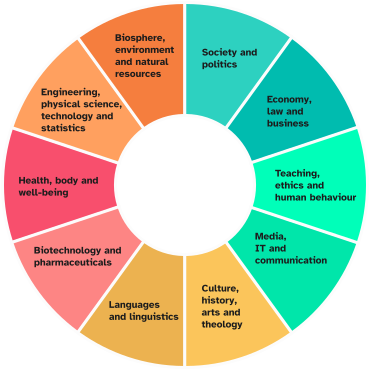
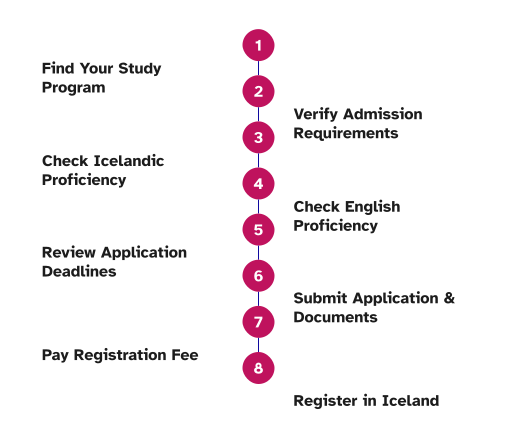

Additional information

The University of Iceland collaborates with over 400 universities worldwide. This provides a unique opportunity to pursue part of your studies at an international university thus gaining added experience and fresh insight into your field of study.

Students generally have the opportunity to join an exchange programme, internship, or summer courses. However, exchanges are always subject to faculty approval.

Students have the opportunity to have courses evaluated as part of their studies at the University of Iceland, so their stay does not have to affect the duration of their studies.

Completing this programme can open up opportunities in:

  • Upper secondary school teaching
  • A range of academic careers
  • Doctoral studies

This list is not exhaustive.

Mímir is the organisation for students in Icelandic, general linguistics and sign language studies at the University of Iceland. Mímir page on Facebook.

    Students' comments
    Ösp Vilberg Baldursdóttir
    Just before graduating, my Icelandic teacher suggested I consider the Faculty of Humanities at the University of Iceland. Initially dismissive, I was eventually intrigued by the programme's diversity and enrolled. Icelandic studies turned out to be the university's best-kept secret.
    Helpful content
    Aurora Cooperation

    Study wheel

    What interests you?

    Aurora Cooperation

    How to apply

    Follow the path

    Contact us

    If you still have questions, feel free to contact us.

    School of Humanities
    Weekdays: 10-12 am and 1-3 pm
    General Service and Social Media

    The Service Desk is a point of access for all services. You can drop in at the University Centre or use the WebChat at the bottom right of this page.

    Follow the School of Humanities on Instagram,   Youtube
    and Facebook

    ""

    Share

    Did this help?

    Why wasn't this information helpful

    Limit to 250 characters.