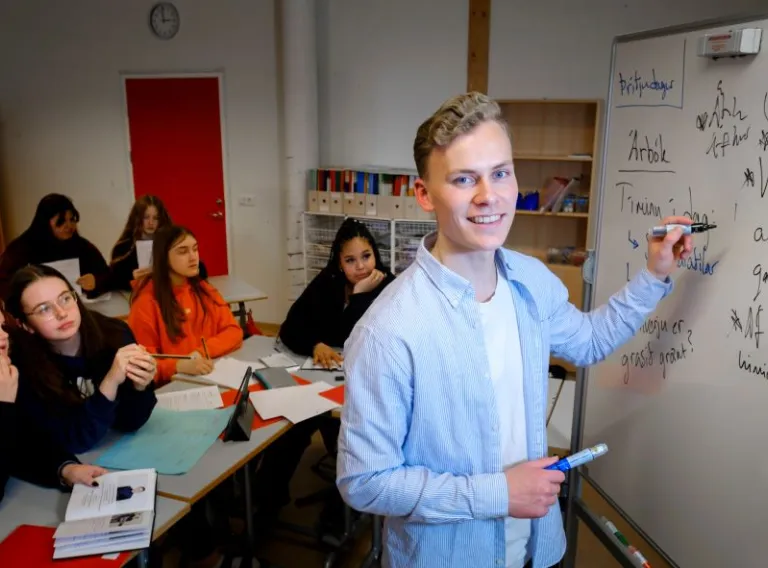
""
Language skills
required, minimum level of B2
Programme length
2 years.
Study mode
Face-to-face learning Distance learning
Application status
International students:
Students with Icelandic or Nordic citizenship:
Overview

  • Are you a qualified teacher?
  • Are you interested in childhood language development?
  • Do you want to learn more about potential interventions for children with language and literacy delays?
  • Would you like to write a final thesis, allowing you to pursue further study?
  • Are you interested in completing a graduate degree?

This programme focuses on language development, multilingualism and Icelandic as a second language. Abilities in language, expression and literacy form an integral whole, which is also closely linked to child development in other areas. These abilities are an essential foundation for learning in other subjects and key to academic performance and engagement in society.

The programme, therefore, emphasizes the development of reading, reading comprehension and writing skills. Also, early interventions and specific action to help children with language and literacy delays, individual plans, support and advice.

Programme structure

The programme is 120 ECTS and is organised as two years of full-time study. It can also be completed by studying part time for three or four years. The M.Ed. programme includes a 30-credit research thesis that must be related to the focus areas of the study program.

Organisation of teaching

Teaching and exams are in Icelandic.

Many courses offer real-time distance teaching, though requirements may vary and students are encouraged to check carefully how each course is taught.

Other

Completing the programme may allow you to apply for doctoral studies.

A Bachelor's degree with a first-class grade (7.25) or above, and a license to teach in preschool, compulsory school, or secondary school. 

For the final exam, students must complete 120 ECTS credits.

The following documents must accompany an application for this programme:
  • CV
  • Statement of purpose
  • Reference 1, Name and email
  • Reference 2, Name and email
  • Certified copies of diplomas and transcripts
  • License

Further information on supporting documents can be found here

Programme structure

Check below to see how the programme is structured.

This programme does not offer specialisations.

First year | Fall
Multilingualism and literacy (KME116F)
A mandatory (required) course for the programme
10 ECTS, credits
Course Description

The aim of this course is to increase students' knowledge and understanding of the influence that bi- and multilingualism may have on literacy development. Reading development in multilingual children will be discussed, based on the orthographic systems of their languages; effective instruction in Icelandic as a second language for newly arrived children at various ages; and children with long residence who need effective support for their educational achievement. 

New teaching materialIcelandic Academic Vocabulary: Effective instruction with multilingual learners, which received the University of Iceland Innovation and Science award in 2023 in the Society Category, will be presented. The project was funded by the University of Iceland Research Fund, the Icelandic Language Technology Fund, the Icelandic Language Fund, and the Educational Research Fund.

Participants in the course are encouraged to consider high-quality research findings, think critically about each topic based on their own experience, and relate it to their specific field and interests. The purpose of the course is also to encourage students to continually seek new knowledge, grounded in literacy research, to develop their skills in teaching multilingual children.

Teaching will take place both at meetings and on the course's website. Presentations will be available on the website, and students will participate in discussions during meetings and on the website. Twice during the semester, students will present their projects at Saga.

Language of instruction: Icelandic
Face-to-face learning
Distance learning
Prerequisites
First year | Fall
Language development (KME104F)
A mandatory (required) course for the programme
10 ECTS, credits
Course Description

The main goal of this course is for students to acquire a solid understanding of children's language development from infancy through adolescence, along with the fundamental influencing factors. The main emphasis is on increasing students’ proficiency in providing children with high-quality language intervention as a foundation for education and reading. Further, the students are encouraged to link together science and practice and to connect the topics with their prior experience. The emphasis is on the students getting to know Icelandic and international research in the field, and what teachers can learn from the research results on what experience, education, communication, and intervention, both at home and in school, provide the best practice for good language development


Central topics of the course: Development of language with a historical perspective, living conditions, motivation, and natural competence of newborns. Development of language from birth: phonemic development, vocabulary, grammar, and communication skills. The importance of quality language input, at home and at school. The relation between language proficiency and cognitive and social skills, and literacy. The primary disorders of language and speech include developmental language disorder (DLD), speech-sound disorder, and stuttering. Language development of multi/bilingual children. The importance of early intervention and general language stimulation. Informal language assessment on individual children's language skills, as well as design and plan teaching, whose central aim is to support and provide children with opportunities to develop their language skills to become active language users.

Language of instruction: Icelandic
Distance learning
Attendance required in class
First year | Spring 1
Language Development and Literacy (KME204F)
A mandatory (required) course for the programme
10 ECTS, credits
Course Description

The main aims of the course are to increase students' understanding of the relationships between language development and literacy, and to enable them to strengthen their ability to employ a practical teaching approach. Students are encouraged to focus on the age that refers to their specific field of interest and/or study.

The main topics will be:

- Basic underlying factors of reading: phonological and morphological awareness, reading fluency, and early intervention

- Language development from birth and throughout the lifespan – how this relates to the development of literacy: Listening and reading comprehension - productive language skills in speech and writing. How early language input strongly predicts progress over the years, and how language support and stimulation can enhance children with poor language skills.

- Active participation in school activities and active language use: How to take into account and support children's interest in their learning. Progress in language and literacy skills will be most successful when learners engage with current, interesting affairs; they are more likely to take an active part in discussions and make good progress in writing.

- Effective approach to increase children's interest in reading

- Assessing language understanding and productive language proficiency. Regular and systematic evaluation enables the provision of the support each learner needs to make steady progress.

Teaching will include presentations available on the course website, discussions both during meetings and on the website, and assignments.

Language of instruction: Icelandic
Face-to-face learning
Distance learning
First year | Spring 1
Introduction to quantitative Research (MVS213F)
A mandatory (required) course for the programme
5 ECTS, credits
Course Description

Students in this course are expected to deepen their knowledge and skills in quantitative research methodology. Students will use a computer program for data analysis, with emphasis on interpretation and writing about research results. Students are expected to develop positive attitudes toward research and the value of research in educational and social settings.

Language of instruction: Icelandic
Distance learning
Prerequisites
Attendance required in class
First year | Spring 1
Introduction to qualitative research (MVS212F)
A mandatory (required) course for the programme
5 ECTS, credits
Course Description

This course focuses on qualitative research methods. It looks at different movements and traditions in research methodology and their relationship to the structure and execution of research. The course also touches on the ethics of research, validity and different views of these concepts. Students will conduct a small research project, which provides training in a literature review, data collection, data analysis, and presentation of research findings. Students work as a team throughout the semester.

Readings, lectures, in-class discussion and group work. Sessions for distance students are held twice during the semester and participation is mandatory

Language of instruction: Icelandic
Face-to-face learning
Distance learning
Prerequisites
Attendance required in class
First year | Year unspecified
Theories in Sociology and Philosophy of Education (MVS101F, MVS009F)
Restricted elective course, conditions apply
10 ECTS, credits
Course Description

The content of the course will be centred around contemporary themes in the sociology and philosophy of education. We will discuss the sociological or philosophical aspects of current issues in society such as equality, multiculturalism, social class, pedagogy, democracy and inclusive education. 

During the first half of the semester theoretical approaches are presented and discussed.

During the second half students work in groups on self-chosen topics and are guided through developing a research plan or development projects using the theories presented before mid-semester.

Language of instruction: Icelandic
Face-to-face learning
Distance learning
Attendance required in class
First year | Year unspecified
Learning theories: Application and research (MVS101F, MVS009F)
Restricted elective course, conditions apply
10 ECTS, credits
Course Description

Objectives
The objectives of the course are threefold. First, to provide insight into selected learning theories. Second, to enable  students to gain understanding of how these theories can be applied to upbringing, teaching, and the organization of learning for people of all ages. Third, to increase knowledge of research on the effects of different approaches to teaching and evidence-based practices to reach a variety of learning objectives.   

Content

  • Among the main learning theories covered in the course are those from the cognitive, behavioural, and motivational domains.
  • Main concepts related to the learning theories will be introduced and discussed in relation to how learning can be defined in different ways.
  • Students will read research articles where these learning theories are studied and applied in practice.
  • Emphasis will be placed on understanding what constitutes evidence-based practice. 
  • Students will design a learning plan for a student or a group of students, based upon one of the learning theories approaches discussed in the course. Through this assignment the students will deepen their understanding of the learning theory in question and how to apply it in practice. 
Language of instruction: Icelandic
Face-to-face learning
Distance learning
Attendance required in class
First year | Year unspecified
Language and Reading Disabilities (KME108F, KME206F)
Restricted elective course, conditions apply
10 ECTS, credits
Course Description

The aim of this course is for students to consider and critically evaluate the main theories and research findings on reading difficulties. Emphasis is placed on the relationship between language and literacy, as well as on neuropsychological issues and individual differences in literacy development. The aim of this course is for students to consider and critically evaluate the main theories and research findings on reading difficulties. Emphasis is placed on the relationship between language and literacy, as well as on neuropsychological issues and individual differences in literacy development.

Course organisation: Lectures, discussions, case studies, short investigations, group work, and individual work.

Language of instruction: Icelandic
Face-to-face learning
Distance learning
Attendance required in class
First year | Year unspecified
Reading and teaching to read: emphases and development (KME108F, KME206F)
Restricted elective course, conditions apply
10 ECTS, credits
Course Description

The main topics of the course include teaching reading in the five main areas of reading instruction: phonological and phonemic awareness, decoding, fluency, vocabulary, and reading/listening comprehension, along with writing, at the beginner and intermediate levels. Emphasis is placed on defining effective, evidence-based reading methods that best enhance students' skills in the above-mentioned sections, and these methods are evaluated in light of research findings and theories on reading. Assessment methods and tests of reading, reading fluency and reading comprehension will be examined. Various influences on the development of reading, reading comprehension, and writing will be taken into account in the design of teaching, educational materials, the educational environment, and teachers and pedagogists.

Language of instruction: Icelandic
Face-to-face learning
Distance learning
Attendance required in class
Second year | Spring 1
Final project (NOK444L)
A mandatory (required) course for the programme
0 ECTS, credits
Course Description

The M.Ed. final project is an individual project. Students work on the project independently under the guidance of a project supervisor/supervisors chosen from among the academic staff at the School of Education. Students should consult the chair of their department on the choice of a project supervisor. The project can be 30 or 40 ECTS credits.

The thesis/project topic and the size of the project in credits are chosen by the student in collaboration with their project supervisor and the department chair. The project topic should fall within the student's area of study, i.e., the programme of study and chosen specialisation.

Various types of projects are permitted, for example, research essays, independent research projects, the development of new curricula or study materials.

Students sign up for the final project/thesis during annual registration via the Ugla Intraweb, and should register based on estimated progress in the fall and spring semesters. In general, preparation for and work on the project takes at least two semesters. In specific programmes at the Faculty of Teacher Education, the thesis is expected to span three semesters; see the programme structure in the Course Catalogue for each programme.

Master's projects are not awarded numerical grades but are marked pass or fail. Project evaluation is in accordance with the School of Education's rules.

Students should follow the more detailed instructions and rules for M.Ed. projects set by the School of Education. See the School of Education intraweb, Ugla: Schools >> School of Education >> Master´s projects

Language of instruction: Icelandic
Prerequisites
Part of the total project/thesis credits
Second year | Year unspecified
Quantitative Methods I (MVS302F, MVS301F, MVS011F)
Restricted elective course, conditions apply
10 ECTS, credits
Course Description

Objective

Students should understand and be able to apply the most common statistical methods for data analysis and be capable of evaluating statistical results. The student should possess the skills and knowledge to analyze and communicate numerical information according to the APA-7 publication standard (e.g., in a scientific journal article or thesis) and be able to take initiative in statistical data processing. Additionally, students will be introduced to the main research designs in quantitative methodology.

Content and Topics

The course will cover quantitative research methods and various research designs. In the statistics portion, the main emphasis will be on the structure and interpretation of the general linear model, which encompasses a range of classical statistical methods such as correlation, regression analysis, and analysis of variance (ANOVA). Students will also learn to apply exploratory and confirmatory factor analysis methods. Finally, students will be introduced to single-case designs, the basic principles of Bayesian statistics, and total survey error assessment. Students will learn to perform analyses using statistical software. Strong emphasis will be placed on clear interpretation and communication of quantitative results according to the APA-7 publication standard.

Teaching Method

The course is taught weekly via online meetings, except for two in-person sessions (see weekly schedule), where students and instructors are expected to attend physically. Students may apply for an exemption from attending in person if they live very far away (e.g., residing abroad). Such students will participate in the in-person sessions via remote connection. Students must have the latest stable version of Jamovi (see jamovi.org) installed on their laptops, which they should bring to class.

Language of instruction: Icelandic
Distance learning
Prerequisites
Attendance required in class
Second year | Year unspecified
Qualitative Research Methods I (MVS302F, MVS301F, MVS011F)
Restricted elective course, conditions apply
10 ECTS, credits
Course Description

Aims: The course aims to deepen and broaden students' knowledge base in qualitative research methodology. Main approaches to and characteristics of qualitative research are explored as well as various methods of data collection such as interviews and collection of pre-existing data both visual and textual. In the course students will be introduced to various approaches to data analysis such as thematic analysis, narrative analysis, semiotic analysis and discourse analysis. Students will also learn how to present their findings in an organised and responsible manner.

Teaching and learning methods: This course uses flipped learning methods. Videos with lectures for each week are discussed in weekly workshops. Students work together on assignments that are handed in weekly. They also have to work individually on assignments.

Language of instruction: Icelandic
Distance learning
Prerequisites
Attendance required in class
Second year | Year unspecified
Action research (MVS302F, MVS301F, MVS011F)
Restricted elective course, conditions apply
10 ECTS, credits
Course Description

This is an introductory course that addresses theoretical, philosophical, and practical issues related to action research. The history and development of action research worldwide will be outlined. We will examine ideologies and issues that divide action researchers into different camps. Special attention will be on action research in Icelandic schools and other educational forums, how it has developed until now and how it might be taken further. The main emphasis in the course is on learning in action: participants will learn about action research through the process of conducting their own research project.

Language of instruction: Icelandic
Distance learning
Prerequisites
Attendance required in class
Year unspecified | Fall
Plurilingual Approaches in Teaching (MAL103F)
Free elective course within the programme
10 ECTS, credits
Course Description

Language is a necessary tool for expression and communication and opens the door to knowledge and understanding of societies. Knowledge of languages increases open-mindedness and promotes intellectual development and a better understanding of own culture. Plurilingualism is linked to education, achievement, and student well-being. The course aims are for participants to become familiar with ways to evaluate and use students' linguistic and cultural resources and apply teaching methods based on the linguistic resources of multilingual students to promote their learning.

Language of instruction: Icelandic
Face-to-face learning
Distance learning
Prerequisites
Year unspecified | Fall
Learning and teaching: Supporting children with special needs (MAL102F)
Free elective course within the programme
10 ECTS, credits
Course Description

In this course, students explore the teaching of diverse groups in inclusive settings, emphasising strategies to address students' diverse educational and sociological needs, guided by human values, democracy, and social justice. The emphasis is on evidence-based approaches to address the most common students´ special needs related to reading difficulties, behavioural difficulties, attention deficit, hyperactivity, and autism spectrum disorder. At the same time, the use of respectful, person-first language, putting the strengths and talents of students in the foreground, is stressed. Multicultural teaching and teaching of students learning Icelandic as a second language will be addressed. Students will be introduced to classroom management strategies, individualised behaviour support, multi-disciplinary and parent collaboration. The course focuses on inclusive, evidence-based practices that aim to provide students with special needs with opportunities equal to those of their classmates.

Language of instruction: Icelandic
Face-to-face learning
Distance learning
Attendance required in class
Year unspecified | Fall
Teaching Icelandic as a second language (ÍET102F)
Free elective course within the programme
10 ECTS, credits
Course Description

Course description

This course is primarily intended for teachers specializing in the instruction of Icelandic as a second language but is also suitable for preschool teachers, classroom and subject teachers, special education teachers, and school administrators. The course aims to enhance participants' knowledge and understanding of Icelandic language acquisition among children and students with foreign backgrounds. It introduces practical approaches and methods for teaching speaking, listening, reading, writing, vocabulary, and grammar. Topics covered include plurilingualism, language acquisition, and learning; teacher competence and professional development in Icelandic as a second language; planning, teaching materials, teaching methods, and theories in the instruction of Icelandic as a second language. All course activities aim to increase participants' ability to apply targeted and professional teaching methods in Icelandic as a second language instruction and to support Icelandic at all educational levels. Additionally, the course encourages critical thinking about the application of teaching methods and the ability to justify pedagogical decisions with reference to Icelandic language policies and both Icelandic and international research on second language learning. Furthermore, the course is designed to inspire continuous knowledge-seeking and foster the creation of a learning community in the workplace.

Language of instruction: Icelandic
Face-to-face learning
Distance learning
Year unspecified | Fall
Introduction to Parenting and Counseling for Parents (FFU101M)
Free elective course within the programme
10 ECTS, credits
Course Description

The aim of this course is to introduce students to major theories on parenting and to help them prepare for parenting education. The course will have a broad theoretical basis, in order to help students to have a wide focus on the parenting role and best practices.

Language of instruction: Icelandic
Face-to-face learning
Distance learning
Prerequisites
Year unspecified | Fall
Parent education: Supporting parents in their role (FFU301F)
Free elective course within the programme
10 ECTS, credits
Course Description

Students will examine adult, adolescent, and parent learning and development from the perspective of their relevance for parent education. Research information and variety of theoretical perspectives will be presented and critiqued. Personal professional development will be facilitated through challenging assumptions and examining knowledge and competencies required for parent educators.

NB The course is taught both in Icelandic and English.

Language of instruction: Icelandic
Face-to-face learning
Distance learning
Attendance required in class
Year unspecified | Spring 1
The joy of language: Successful preschool and primary school work (KME002F)
Free elective course within the programme
10 ECTS, credits
Course Description

The course aims to increase participants' knowledge about the importance of language stimulation in various activities with children. They learn to apply effective approaches, based on play and creativity, whose main aim is to support children's language development and active language use.

The central topics are: a) encouraging language environment that enhances children's language use in daily activities b) rich interactive language use in both free and structured play c) together time and reading activities used to encourage vocabulary learning and active discussions, for the benefit of all children d) music and song as a source for language development e) drama as a means for active language use.

Work process
The course is taught in local sessions and distance learning. Presentations are available on the course website, and students participate in discussions both during meetings and on the website.

The course is focused on practice and collaboration, and the aim is for participants to develop learning communities within and across schools, which they can further develop after completing the course. Thus, participants will have the opportunity to learn together and support each other as they develop their activities with children. The basic idea is that it is the responsibility of every teacher and every school employee to support and encourage children's language development and their active language use.

Participants write a report diary in which they discuss each topic, reflect on their work with children, and explain how they implement the approach introduced in the course. Additionally, they participate in discussions with fellow participants and teachers during local and online sessions.

Who the course is for
The course is intended for all those who work with 1-7-year-old children, including kindergarten and primary school teachers, parents, and others interested in children’s language development and stimulation. The course will allow participants to increase their basic knowledge about language acquisition and effective ways to support children in developing their language skills. Thus, the course will give a solid foundation for constant progress in language activities with children.

Language of instruction: Icelandic
Distance learning
The course is taught if the specified conditions are met
Year unspecified | Spring 1
Icelandic and the education of multilingual students (ÍET206F)
Free elective course within the programme
10 ECTS, credits
Course Description

In this course the focus is on Icelandic as a second language and the education of multilingual students in Icelandic compulsory schools. Language acquisition and language upbringing will be examined and the difference between acquiring skills in a first and a second language. The emphases will be on what it is that teachers in general need to know about the Icelandic language to be able to help their students make progress in the subject being taught.

The structure of the Icelandic language system, pronunciation, word formation, inflections, sentence structure, meaning of words and phrases, the three layers of the vocabulary, and various things related to language use will be studied. The purpose is to figure out what is most likely to be demanding for multilingual students in preschools who are acquiring the language, both in general but also due to personal differences, such as different first languages.

Based on this special attention will be paid to the teaching of different subjects and how they can be planned, taking in account students’ different level of Icelandic. Important aspect of that is how subject texts can be simplified to fit the needs of multilingual students.

Language of instruction: Icelandic
Face-to-face learning
Distance learning
Attendance required in class
Not taught this semester
Year unspecified | Spring 1
Design history (LVG005M)
Free elective course within the programme
10 ECTS, credits
Course Description

Students will work with ideas and design in connection with clothing and textiles, patterns, colors and shapes, fashion design, look and format. They also experiments with textile methods and textile materials. Special emphasis is placed on the work process from the idea of implementation and registration of information. Students will work on organized research and development work. Experiments in various methods in textile and clothing will be linked to historical and contemporary trends. Emphasis is also placed on the preparation and presentation of projects.


Language of instruction: Icelandic
Face-to-face learning
Distance learning
Prerequisites
Not taught this semester
Year unspecified | Year unspecified
Curriculum Integration, Creative Learning and Team Teaching (KME009F)
Free elective course within the programme
10 ECTS, credits
Course Description

It is crucial to remember that students in today's compulsory schools will be active citizens well into the 21st century. Many of them will have jobs and use technology that has not yet been invented. With regard to this, teaching and learning should encourage students' willingness to take positive risks and be able to both criticise and be criticised. Curriculum integration encompasses numerous opportunities for teacher collaboration and team teaching across most subjects and issues, and offers students multiple opportunities to learn different working methods.

The course will cover ideas for integrating various subjects and for creative learning, where students have the opportunity to actively participate in the preparation and shaping of holistic projects. The ideology and the organisation of integration using different methods and models will be introduced and worked with. Additionally, students will learn about the teaching of drama and will take part in creating drama assignments using their ideas and creativity. Examples from schools will be introduced. Participants will have opportunities to plan projects for their own teaching. Moreover, importance is placed on the participants' sharing of ideas and experiences.

Coursework
Lectures, discussions, cooperation, assignments, workshops, and guidance. The importance is placed on conversations and the exchange of views as well as opportunities to plan projects to try out in teaching.

Language of instruction: Icelandic
Attendance required in class
Year unspecified | Year unspecified
Artificial Literacy: Artificial Intelligence in Schooling (SNU505M)
Free elective course within the programme
10 ECTS, credits
Course Description

Students learn about AI literacy as a key competence in modern society and the creative use of AI in education and teaching. AI literacy is about understanding the basic ideas of AI, recognizing its possibilities and limitations, analyzing its impact on society and daily life, and using it responsibly and critically. During the course, students gain insight into how AI tools and technologies can simplify and improve learning and teaching, increase efficiency, and promote creative solutions. They learn to use technology in the creation and organization of course materials, for data processing and as a tool to promote student participation and interest. Furthermore, it is emphasized how AI literacy can help students become aware and critical users of AI. Ethical issues, the impact of AI on the labour market and society, and how teachers can share this knowledge with their students are discussed.

In the course, students take an active part in discussions and project work where they examine their own experiences and connect them to the theoretical topics of the course. The projects will be tailored to the needs and interests of students where AI is used in a variety of ways, whether in art, sports, media or other aspects of daily life. Students gather experience of experiments and tests with artificial intelligence in a digital CV portfolio throughout the teaching semester. Students familiarize themselves with the theoretical aspects of AI literacy and the use of AI in education and teaching and submit a reference essay. Each student presents a plan for and submits a personal final project, e.g. in the form of an app, research or educational project, which connects AI to real challenges in their life or work.

Key elements of the course:

  • Active participation in discussions on AI and AI literacy.
  • Project work where students connect AI to their own interests and jobs.
  • Critical discussions on the impact of AI in education and society.
  • Independent research and development of projects.

The course provides students with the tools to address the challenges and opportunities associated with the rapidly growing use of AI in today's society in education, work, and daily life.

New objectives of the course:

Students should acquire skills in ...

  • using the basic concepts of artificial intelligence and how the technology can be used in learning and teaching.
  • analyzing the impact of artificial intelligence on daily life, society, and the labor market.
  • developing critical thinking towards the use of AI and participate in discussions about its ethical and social implications.
  • using AI responsibly, whether in connection with studies, teaching or other work.
Language of instruction: Icelandic
Distance learning
Prerequisites
First year
  • Fall
  • KME116F
    Multilingualism and literacy
    Mandatory (required) course
    10
    A mandatory (required) course for the programme
    10 ECTS, credits
    Course Description

    The aim of this course is to increase students' knowledge and understanding of the influence that bi- and multilingualism may have on literacy development. Reading development in multilingual children will be discussed, based on the orthographic systems of their languages; effective instruction in Icelandic as a second language for newly arrived children at various ages; and children with long residence who need effective support for their educational achievement. 

    New teaching materialIcelandic Academic Vocabulary: Effective instruction with multilingual learners, which received the University of Iceland Innovation and Science award in 2023 in the Society Category, will be presented. The project was funded by the University of Iceland Research Fund, the Icelandic Language Technology Fund, the Icelandic Language Fund, and the Educational Research Fund.

    Participants in the course are encouraged to consider high-quality research findings, think critically about each topic based on their own experience, and relate it to their specific field and interests. The purpose of the course is also to encourage students to continually seek new knowledge, grounded in literacy research, to develop their skills in teaching multilingual children.

    Teaching will take place both at meetings and on the course's website. Presentations will be available on the website, and students will participate in discussions during meetings and on the website. Twice during the semester, students will present their projects at Saga.

    Face-to-face learning
    Distance learning
    Prerequisites
  • KME104F
    Language development
    Mandatory (required) course
    10
    A mandatory (required) course for the programme
    10 ECTS, credits
    Course Description

    The main goal of this course is for students to acquire a solid understanding of children's language development from infancy through adolescence, along with the fundamental influencing factors. The main emphasis is on increasing students’ proficiency in providing children with high-quality language intervention as a foundation for education and reading. Further, the students are encouraged to link together science and practice and to connect the topics with their prior experience. The emphasis is on the students getting to know Icelandic and international research in the field, and what teachers can learn from the research results on what experience, education, communication, and intervention, both at home and in school, provide the best practice for good language development


    Central topics of the course: Development of language with a historical perspective, living conditions, motivation, and natural competence of newborns. Development of language from birth: phonemic development, vocabulary, grammar, and communication skills. The importance of quality language input, at home and at school. The relation between language proficiency and cognitive and social skills, and literacy. The primary disorders of language and speech include developmental language disorder (DLD), speech-sound disorder, and stuttering. Language development of multi/bilingual children. The importance of early intervention and general language stimulation. Informal language assessment on individual children's language skills, as well as design and plan teaching, whose central aim is to support and provide children with opportunities to develop their language skills to become active language users.

    Distance learning
    Prerequisites
    Attendance required in class
  • Spring 2
  • KME204F
    Language Development and Literacy
    Mandatory (required) course
    10
    A mandatory (required) course for the programme
    10 ECTS, credits
    Course Description

    The main aims of the course are to increase students' understanding of the relationships between language development and literacy, and to enable them to strengthen their ability to employ a practical teaching approach. Students are encouraged to focus on the age that refers to their specific field of interest and/or study.

    The main topics will be:

    - Basic underlying factors of reading: phonological and morphological awareness, reading fluency, and early intervention

    - Language development from birth and throughout the lifespan – how this relates to the development of literacy: Listening and reading comprehension - productive language skills in speech and writing. How early language input strongly predicts progress over the years, and how language support and stimulation can enhance children with poor language skills.

    - Active participation in school activities and active language use: How to take into account and support children's interest in their learning. Progress in language and literacy skills will be most successful when learners engage with current, interesting affairs; they are more likely to take an active part in discussions and make good progress in writing.

    - Effective approach to increase children's interest in reading

    - Assessing language understanding and productive language proficiency. Regular and systematic evaluation enables the provision of the support each learner needs to make steady progress.

    Teaching will include presentations available on the course website, discussions both during meetings and on the website, and assignments.

    Face-to-face learning
    Distance learning
    Prerequisites
  • MVS213F
    Introduction to quantitative Research
    Mandatory (required) course
    5
    A mandatory (required) course for the programme
    5 ECTS, credits
    Course Description

    Students in this course are expected to deepen their knowledge and skills in quantitative research methodology. Students will use a computer program for data analysis, with emphasis on interpretation and writing about research results. Students are expected to develop positive attitudes toward research and the value of research in educational and social settings.

    Distance learning
    Prerequisites
    Attendance required in class
  • MVS212F
    Introduction to qualitative research
    Mandatory (required) course
    5
    A mandatory (required) course for the programme
    5 ECTS, credits
    Course Description

    This course focuses on qualitative research methods. It looks at different movements and traditions in research methodology and their relationship to the structure and execution of research. The course also touches on the ethics of research, validity and different views of these concepts. Students will conduct a small research project, which provides training in a literature review, data collection, data analysis, and presentation of research findings. Students work as a team throughout the semester.

    Readings, lectures, in-class discussion and group work. Sessions for distance students are held twice during the semester and participation is mandatory

    Face-to-face learning
    Distance learning
    Prerequisites
    Attendance required in class
  • Year unspecified
  • MVS101F, MVS009F
    Theories in Sociology and Philosophy of Education
    Restricted elective course
    10
    Restricted elective course, conditions apply
    10 ECTS, credits
    Course Description

    The content of the course will be centred around contemporary themes in the sociology and philosophy of education. We will discuss the sociological or philosophical aspects of current issues in society such as equality, multiculturalism, social class, pedagogy, democracy and inclusive education. 

    During the first half of the semester theoretical approaches are presented and discussed.

    During the second half students work in groups on self-chosen topics and are guided through developing a research plan or development projects using the theories presented before mid-semester.

    Face-to-face learning
    Distance learning
    Prerequisites
    Attendance required in class
  • MVS101F, MVS009F
    Learning theories: Application and research
    Restricted elective course
    10
    Restricted elective course, conditions apply
    10 ECTS, credits
    Course Description

    Objectives
    The objectives of the course are threefold. First, to provide insight into selected learning theories. Second, to enable  students to gain understanding of how these theories can be applied to upbringing, teaching, and the organization of learning for people of all ages. Third, to increase knowledge of research on the effects of different approaches to teaching and evidence-based practices to reach a variety of learning objectives.   

    Content

    • Among the main learning theories covered in the course are those from the cognitive, behavioural, and motivational domains.
    • Main concepts related to the learning theories will be introduced and discussed in relation to how learning can be defined in different ways.
    • Students will read research articles where these learning theories are studied and applied in practice.
    • Emphasis will be placed on understanding what constitutes evidence-based practice. 
    • Students will design a learning plan for a student or a group of students, based upon one of the learning theories approaches discussed in the course. Through this assignment the students will deepen their understanding of the learning theory in question and how to apply it in practice. 
    Face-to-face learning
    Distance learning
    Prerequisites
    Attendance required in class
  • KME108F, KME206F
    Language and Reading Disabilities
    Restricted elective course
    10
    Restricted elective course, conditions apply
    10 ECTS, credits
    Course Description

    The aim of this course is for students to consider and critically evaluate the main theories and research findings on reading difficulties. Emphasis is placed on the relationship between language and literacy, as well as on neuropsychological issues and individual differences in literacy development. The aim of this course is for students to consider and critically evaluate the main theories and research findings on reading difficulties. Emphasis is placed on the relationship between language and literacy, as well as on neuropsychological issues and individual differences in literacy development.

    Course organisation: Lectures, discussions, case studies, short investigations, group work, and individual work.

    Face-to-face learning
    Distance learning
    Prerequisites
    Attendance required in class
  • KME108F, KME206F
    Reading and teaching to read: emphases and development
    Restricted elective course
    10
    Restricted elective course, conditions apply
    10 ECTS, credits
    Course Description

    The main topics of the course include teaching reading in the five main areas of reading instruction: phonological and phonemic awareness, decoding, fluency, vocabulary, and reading/listening comprehension, along with writing, at the beginner and intermediate levels. Emphasis is placed on defining effective, evidence-based reading methods that best enhance students' skills in the above-mentioned sections, and these methods are evaluated in light of research findings and theories on reading. Assessment methods and tests of reading, reading fluency and reading comprehension will be examined. Various influences on the development of reading, reading comprehension, and writing will be taken into account in the design of teaching, educational materials, the educational environment, and teachers and pedagogists.

    Face-to-face learning
    Distance learning
    Prerequisites
    Attendance required in class
  • Spring 2
  • NOK444L
    Final project
    Mandatory (required) course
    0
    A mandatory (required) course for the programme
    0 ECTS, credits
    Course Description

    The M.Ed. final project is an individual project. Students work on the project independently under the guidance of a project supervisor/supervisors chosen from among the academic staff at the School of Education. Students should consult the chair of their department on the choice of a project supervisor. The project can be 30 or 40 ECTS credits.

    The thesis/project topic and the size of the project in credits are chosen by the student in collaboration with their project supervisor and the department chair. The project topic should fall within the student's area of study, i.e., the programme of study and chosen specialisation.

    Various types of projects are permitted, for example, research essays, independent research projects, the development of new curricula or study materials.

    Students sign up for the final project/thesis during annual registration via the Ugla Intraweb, and should register based on estimated progress in the fall and spring semesters. In general, preparation for and work on the project takes at least two semesters. In specific programmes at the Faculty of Teacher Education, the thesis is expected to span three semesters; see the programme structure in the Course Catalogue for each programme.

    Master's projects are not awarded numerical grades but are marked pass or fail. Project evaluation is in accordance with the School of Education's rules.

    Students should follow the more detailed instructions and rules for M.Ed. projects set by the School of Education. See the School of Education intraweb, Ugla: Schools >> School of Education >> Master´s projects

    Prerequisites
    Part of the total project/thesis credits
  • Year unspecified
  • MVS302F, MVS301F, MVS011F
    Quantitative Methods I
    Restricted elective course
    10
    Restricted elective course, conditions apply
    10 ECTS, credits
    Course Description

    Objective

    Students should understand and be able to apply the most common statistical methods for data analysis and be capable of evaluating statistical results. The student should possess the skills and knowledge to analyze and communicate numerical information according to the APA-7 publication standard (e.g., in a scientific journal article or thesis) and be able to take initiative in statistical data processing. Additionally, students will be introduced to the main research designs in quantitative methodology.

    Content and Topics

    The course will cover quantitative research methods and various research designs. In the statistics portion, the main emphasis will be on the structure and interpretation of the general linear model, which encompasses a range of classical statistical methods such as correlation, regression analysis, and analysis of variance (ANOVA). Students will also learn to apply exploratory and confirmatory factor analysis methods. Finally, students will be introduced to single-case designs, the basic principles of Bayesian statistics, and total survey error assessment. Students will learn to perform analyses using statistical software. Strong emphasis will be placed on clear interpretation and communication of quantitative results according to the APA-7 publication standard.

    Teaching Method

    The course is taught weekly via online meetings, except for two in-person sessions (see weekly schedule), where students and instructors are expected to attend physically. Students may apply for an exemption from attending in person if they live very far away (e.g., residing abroad). Such students will participate in the in-person sessions via remote connection. Students must have the latest stable version of Jamovi (see jamovi.org) installed on their laptops, which they should bring to class.

    Distance learning
    Prerequisites
    Attendance required in class
  • MVS302F, MVS301F, MVS011F
    Qualitative Research Methods I
    Restricted elective course
    10
    Restricted elective course, conditions apply
    10 ECTS, credits
    Course Description

    Aims: The course aims to deepen and broaden students' knowledge base in qualitative research methodology. Main approaches to and characteristics of qualitative research are explored as well as various methods of data collection such as interviews and collection of pre-existing data both visual and textual. In the course students will be introduced to various approaches to data analysis such as thematic analysis, narrative analysis, semiotic analysis and discourse analysis. Students will also learn how to present their findings in an organised and responsible manner.

    Teaching and learning methods: This course uses flipped learning methods. Videos with lectures for each week are discussed in weekly workshops. Students work together on assignments that are handed in weekly. They also have to work individually on assignments.

    Distance learning
    Prerequisites
    Attendance required in class
  • MVS302F, MVS301F, MVS011F
    Action research
    Restricted elective course
    10
    Restricted elective course, conditions apply
    10 ECTS, credits
    Course Description

    This is an introductory course that addresses theoretical, philosophical, and practical issues related to action research. The history and development of action research worldwide will be outlined. We will examine ideologies and issues that divide action researchers into different camps. Special attention will be on action research in Icelandic schools and other educational forums, how it has developed until now and how it might be taken further. The main emphasis in the course is on learning in action: participants will learn about action research through the process of conducting their own research project.

    Distance learning
    Prerequisites
    Attendance required in class
  • Fall
  • MAL103F
    Plurilingual Approaches in Teaching
    Elective course
    10
    Free elective course within the programme
    10 ECTS, credits
    Course Description

    Language is a necessary tool for expression and communication and opens the door to knowledge and understanding of societies. Knowledge of languages increases open-mindedness and promotes intellectual development and a better understanding of own culture. Plurilingualism is linked to education, achievement, and student well-being. The course aims are for participants to become familiar with ways to evaluate and use students' linguistic and cultural resources and apply teaching methods based on the linguistic resources of multilingual students to promote their learning.

    Face-to-face learning
    Distance learning
    Prerequisites
  • MAL102F
    Learning and teaching: Supporting children with special needs
    Elective course
    10
    Free elective course within the programme
    10 ECTS, credits
    Course Description

    In this course, students explore the teaching of diverse groups in inclusive settings, emphasising strategies to address students' diverse educational and sociological needs, guided by human values, democracy, and social justice. The emphasis is on evidence-based approaches to address the most common students´ special needs related to reading difficulties, behavioural difficulties, attention deficit, hyperactivity, and autism spectrum disorder. At the same time, the use of respectful, person-first language, putting the strengths and talents of students in the foreground, is stressed. Multicultural teaching and teaching of students learning Icelandic as a second language will be addressed. Students will be introduced to classroom management strategies, individualised behaviour support, multi-disciplinary and parent collaboration. The course focuses on inclusive, evidence-based practices that aim to provide students with special needs with opportunities equal to those of their classmates.

    Face-to-face learning
    Distance learning
    Prerequisites
    Attendance required in class
  • ÍET102F
    Teaching Icelandic as a second language
    Elective course
    10
    Free elective course within the programme
    10 ECTS, credits
    Course Description

    Course description

    This course is primarily intended for teachers specializing in the instruction of Icelandic as a second language but is also suitable for preschool teachers, classroom and subject teachers, special education teachers, and school administrators. The course aims to enhance participants' knowledge and understanding of Icelandic language acquisition among children and students with foreign backgrounds. It introduces practical approaches and methods for teaching speaking, listening, reading, writing, vocabulary, and grammar. Topics covered include plurilingualism, language acquisition, and learning; teacher competence and professional development in Icelandic as a second language; planning, teaching materials, teaching methods, and theories in the instruction of Icelandic as a second language. All course activities aim to increase participants' ability to apply targeted and professional teaching methods in Icelandic as a second language instruction and to support Icelandic at all educational levels. Additionally, the course encourages critical thinking about the application of teaching methods and the ability to justify pedagogical decisions with reference to Icelandic language policies and both Icelandic and international research on second language learning. Furthermore, the course is designed to inspire continuous knowledge-seeking and foster the creation of a learning community in the workplace.

    Face-to-face learning
    Distance learning
    Prerequisites
  • FFU101M
    Introduction to Parenting and Counseling for Parents
    Elective course
    10
    Free elective course within the programme
    10 ECTS, credits
    Course Description

    The aim of this course is to introduce students to major theories on parenting and to help them prepare for parenting education. The course will have a broad theoretical basis, in order to help students to have a wide focus on the parenting role and best practices.

    Face-to-face learning
    Distance learning
    Prerequisites
  • FFU301F
    Parent education: Supporting parents in their role
    Elective course
    10
    Free elective course within the programme
    10 ECTS, credits
    Course Description

    Students will examine adult, adolescent, and parent learning and development from the perspective of their relevance for parent education. Research information and variety of theoretical perspectives will be presented and critiqued. Personal professional development will be facilitated through challenging assumptions and examining knowledge and competencies required for parent educators.

    NB The course is taught both in Icelandic and English.

    Face-to-face learning
    Distance learning
    Prerequisites
    Attendance required in class
  • Spring 2
  • KME002F
    The joy of language: Successful preschool and primary school work
    Elective course
    10
    Free elective course within the programme
    10 ECTS, credits
    Course Description

    The course aims to increase participants' knowledge about the importance of language stimulation in various activities with children. They learn to apply effective approaches, based on play and creativity, whose main aim is to support children's language development and active language use.

    The central topics are: a) encouraging language environment that enhances children's language use in daily activities b) rich interactive language use in both free and structured play c) together time and reading activities used to encourage vocabulary learning and active discussions, for the benefit of all children d) music and song as a source for language development e) drama as a means for active language use.

    Work process
    The course is taught in local sessions and distance learning. Presentations are available on the course website, and students participate in discussions both during meetings and on the website.

    The course is focused on practice and collaboration, and the aim is for participants to develop learning communities within and across schools, which they can further develop after completing the course. Thus, participants will have the opportunity to learn together and support each other as they develop their activities with children. The basic idea is that it is the responsibility of every teacher and every school employee to support and encourage children's language development and their active language use.

    Participants write a report diary in which they discuss each topic, reflect on their work with children, and explain how they implement the approach introduced in the course. Additionally, they participate in discussions with fellow participants and teachers during local and online sessions.

    Who the course is for
    The course is intended for all those who work with 1-7-year-old children, including kindergarten and primary school teachers, parents, and others interested in children’s language development and stimulation. The course will allow participants to increase their basic knowledge about language acquisition and effective ways to support children in developing their language skills. Thus, the course will give a solid foundation for constant progress in language activities with children.

    Distance learning
    The course is taught if the specified conditions are met
    Prerequisites
  • ÍET206F
    Icelandic and the education of multilingual students
    Elective course
    10
    Free elective course within the programme
    10 ECTS, credits
    Course Description

    In this course the focus is on Icelandic as a second language and the education of multilingual students in Icelandic compulsory schools. Language acquisition and language upbringing will be examined and the difference between acquiring skills in a first and a second language. The emphases will be on what it is that teachers in general need to know about the Icelandic language to be able to help their students make progress in the subject being taught.

    The structure of the Icelandic language system, pronunciation, word formation, inflections, sentence structure, meaning of words and phrases, the three layers of the vocabulary, and various things related to language use will be studied. The purpose is to figure out what is most likely to be demanding for multilingual students in preschools who are acquiring the language, both in general but also due to personal differences, such as different first languages.

    Based on this special attention will be paid to the teaching of different subjects and how they can be planned, taking in account students’ different level of Icelandic. Important aspect of that is how subject texts can be simplified to fit the needs of multilingual students.

    Face-to-face learning
    Distance learning
    Prerequisites
    Attendance required in class
  • Not taught this semester
    LVG005M
    Design history
    Elective course
    10
    Free elective course within the programme
    10 ECTS, credits
    Course Description

    Students will work with ideas and design in connection with clothing and textiles, patterns, colors and shapes, fashion design, look and format. They also experiments with textile methods and textile materials. Special emphasis is placed on the work process from the idea of implementation and registration of information. Students will work on organized research and development work. Experiments in various methods in textile and clothing will be linked to historical and contemporary trends. Emphasis is also placed on the preparation and presentation of projects.


    Face-to-face learning
    Distance learning
    Prerequisites
  • Year unspecified
  • Not taught this semester
    KME009F
    Curriculum Integration, Creative Learning and Team Teaching
    Elective course
    10
    Free elective course within the programme
    10 ECTS, credits
    Course Description

    It is crucial to remember that students in today's compulsory schools will be active citizens well into the 21st century. Many of them will have jobs and use technology that has not yet been invented. With regard to this, teaching and learning should encourage students' willingness to take positive risks and be able to both criticise and be criticised. Curriculum integration encompasses numerous opportunities for teacher collaboration and team teaching across most subjects and issues, and offers students multiple opportunities to learn different working methods.

    The course will cover ideas for integrating various subjects and for creative learning, where students have the opportunity to actively participate in the preparation and shaping of holistic projects. The ideology and the organisation of integration using different methods and models will be introduced and worked with. Additionally, students will learn about the teaching of drama and will take part in creating drama assignments using their ideas and creativity. Examples from schools will be introduced. Participants will have opportunities to plan projects for their own teaching. Moreover, importance is placed on the participants' sharing of ideas and experiences.

    Coursework
    Lectures, discussions, cooperation, assignments, workshops, and guidance. The importance is placed on conversations and the exchange of views as well as opportunities to plan projects to try out in teaching.

    Prerequisites
    Attendance required in class
  • SNU505M
    Artificial Literacy: Artificial Intelligence in Schooling
    Elective course
    10
    Free elective course within the programme
    10 ECTS, credits
    Course Description

    Students learn about AI literacy as a key competence in modern society and the creative use of AI in education and teaching. AI literacy is about understanding the basic ideas of AI, recognizing its possibilities and limitations, analyzing its impact on society and daily life, and using it responsibly and critically. During the course, students gain insight into how AI tools and technologies can simplify and improve learning and teaching, increase efficiency, and promote creative solutions. They learn to use technology in the creation and organization of course materials, for data processing and as a tool to promote student participation and interest. Furthermore, it is emphasized how AI literacy can help students become aware and critical users of AI. Ethical issues, the impact of AI on the labour market and society, and how teachers can share this knowledge with their students are discussed.

    In the course, students take an active part in discussions and project work where they examine their own experiences and connect them to the theoretical topics of the course. The projects will be tailored to the needs and interests of students where AI is used in a variety of ways, whether in art, sports, media or other aspects of daily life. Students gather experience of experiments and tests with artificial intelligence in a digital CV portfolio throughout the teaching semester. Students familiarize themselves with the theoretical aspects of AI literacy and the use of AI in education and teaching and submit a reference essay. Each student presents a plan for and submits a personal final project, e.g. in the form of an app, research or educational project, which connects AI to real challenges in their life or work.

    Key elements of the course:

    • Active participation in discussions on AI and AI literacy.
    • Project work where students connect AI to their own interests and jobs.
    • Critical discussions on the impact of AI in education and society.
    • Independent research and development of projects.

    The course provides students with the tools to address the challenges and opportunities associated with the rapidly growing use of AI in today's society in education, work, and daily life.

    New objectives of the course:

    Students should acquire skills in ...

    • using the basic concepts of artificial intelligence and how the technology can be used in learning and teaching.
    • analyzing the impact of artificial intelligence on daily life, society, and the labor market.
    • developing critical thinking towards the use of AI and participate in discussions about its ethical and social implications.
    • using AI responsibly, whether in connection with studies, teaching or other work.
    Distance learning
    Prerequisites
Second year
  • Fall
  • KME116F
    Multilingualism and literacy
    Mandatory (required) course
    10
    A mandatory (required) course for the programme
    10 ECTS, credits
    Course Description

    The aim of this course is to increase students' knowledge and understanding of the influence that bi- and multilingualism may have on literacy development. Reading development in multilingual children will be discussed, based on the orthographic systems of their languages; effective instruction in Icelandic as a second language for newly arrived children at various ages; and children with long residence who need effective support for their educational achievement. 

    New teaching materialIcelandic Academic Vocabulary: Effective instruction with multilingual learners, which received the University of Iceland Innovation and Science award in 2023 in the Society Category, will be presented. The project was funded by the University of Iceland Research Fund, the Icelandic Language Technology Fund, the Icelandic Language Fund, and the Educational Research Fund.

    Participants in the course are encouraged to consider high-quality research findings, think critically about each topic based on their own experience, and relate it to their specific field and interests. The purpose of the course is also to encourage students to continually seek new knowledge, grounded in literacy research, to develop their skills in teaching multilingual children.

    Teaching will take place both at meetings and on the course's website. Presentations will be available on the website, and students will participate in discussions during meetings and on the website. Twice during the semester, students will present their projects at Saga.

    Face-to-face learning
    Distance learning
    Prerequisites
  • KME104F
    Language development
    Mandatory (required) course
    10
    A mandatory (required) course for the programme
    10 ECTS, credits
    Course Description

    The main goal of this course is for students to acquire a solid understanding of children's language development from infancy through adolescence, along with the fundamental influencing factors. The main emphasis is on increasing students’ proficiency in providing children with high-quality language intervention as a foundation for education and reading. Further, the students are encouraged to link together science and practice and to connect the topics with their prior experience. The emphasis is on the students getting to know Icelandic and international research in the field, and what teachers can learn from the research results on what experience, education, communication, and intervention, both at home and in school, provide the best practice for good language development


    Central topics of the course: Development of language with a historical perspective, living conditions, motivation, and natural competence of newborns. Development of language from birth: phonemic development, vocabulary, grammar, and communication skills. The importance of quality language input, at home and at school. The relation between language proficiency and cognitive and social skills, and literacy. The primary disorders of language and speech include developmental language disorder (DLD), speech-sound disorder, and stuttering. Language development of multi/bilingual children. The importance of early intervention and general language stimulation. Informal language assessment on individual children's language skills, as well as design and plan teaching, whose central aim is to support and provide children with opportunities to develop their language skills to become active language users.

    Distance learning
    Prerequisites
    Attendance required in class
  • Spring 2
  • KME204F
    Language Development and Literacy
    Mandatory (required) course
    10
    A mandatory (required) course for the programme
    10 ECTS, credits
    Course Description

    The main aims of the course are to increase students' understanding of the relationships between language development and literacy, and to enable them to strengthen their ability to employ a practical teaching approach. Students are encouraged to focus on the age that refers to their specific field of interest and/or study.

    The main topics will be:

    - Basic underlying factors of reading: phonological and morphological awareness, reading fluency, and early intervention

    - Language development from birth and throughout the lifespan – how this relates to the development of literacy: Listening and reading comprehension - productive language skills in speech and writing. How early language input strongly predicts progress over the years, and how language support and stimulation can enhance children with poor language skills.

    - Active participation in school activities and active language use: How to take into account and support children's interest in their learning. Progress in language and literacy skills will be most successful when learners engage with current, interesting affairs; they are more likely to take an active part in discussions and make good progress in writing.

    - Effective approach to increase children's interest in reading

    - Assessing language understanding and productive language proficiency. Regular and systematic evaluation enables the provision of the support each learner needs to make steady progress.

    Teaching will include presentations available on the course website, discussions both during meetings and on the website, and assignments.

    Face-to-face learning
    Distance learning
    Prerequisites
  • MVS213F
    Introduction to quantitative Research
    Mandatory (required) course
    5
    A mandatory (required) course for the programme
    5 ECTS, credits
    Course Description

    Students in this course are expected to deepen their knowledge and skills in quantitative research methodology. Students will use a computer program for data analysis, with emphasis on interpretation and writing about research results. Students are expected to develop positive attitudes toward research and the value of research in educational and social settings.

    Distance learning
    Prerequisites
    Attendance required in class
  • MVS212F
    Introduction to qualitative research
    Mandatory (required) course
    5
    A mandatory (required) course for the programme
    5 ECTS, credits
    Course Description

    This course focuses on qualitative research methods. It looks at different movements and traditions in research methodology and their relationship to the structure and execution of research. The course also touches on the ethics of research, validity and different views of these concepts. Students will conduct a small research project, which provides training in a literature review, data collection, data analysis, and presentation of research findings. Students work as a team throughout the semester.

    Readings, lectures, in-class discussion and group work. Sessions for distance students are held twice during the semester and participation is mandatory

    Face-to-face learning
    Distance learning
    Prerequisites
    Attendance required in class
  • Year unspecified
  • MVS101F, MVS009F
    Theories in Sociology and Philosophy of Education
    Restricted elective course
    10
    Restricted elective course, conditions apply
    10 ECTS, credits
    Course Description

    The content of the course will be centred around contemporary themes in the sociology and philosophy of education. We will discuss the sociological or philosophical aspects of current issues in society such as equality, multiculturalism, social class, pedagogy, democracy and inclusive education. 

    During the first half of the semester theoretical approaches are presented and discussed.

    During the second half students work in groups on self-chosen topics and are guided through developing a research plan or development projects using the theories presented before mid-semester.

    Face-to-face learning
    Distance learning
    Prerequisites
    Attendance required in class
  • MVS101F, MVS009F
    Learning theories: Application and research
    Restricted elective course
    10
    Restricted elective course, conditions apply
    10 ECTS, credits
    Course Description

    Objectives
    The objectives of the course are threefold. First, to provide insight into selected learning theories. Second, to enable  students to gain understanding of how these theories can be applied to upbringing, teaching, and the organization of learning for people of all ages. Third, to increase knowledge of research on the effects of different approaches to teaching and evidence-based practices to reach a variety of learning objectives.   

    Content

    • Among the main learning theories covered in the course are those from the cognitive, behavioural, and motivational domains.
    • Main concepts related to the learning theories will be introduced and discussed in relation to how learning can be defined in different ways.
    • Students will read research articles where these learning theories are studied and applied in practice.
    • Emphasis will be placed on understanding what constitutes evidence-based practice. 
    • Students will design a learning plan for a student or a group of students, based upon one of the learning theories approaches discussed in the course. Through this assignment the students will deepen their understanding of the learning theory in question and how to apply it in practice. 
    Face-to-face learning
    Distance learning
    Prerequisites
    Attendance required in class
  • KME108F, KME206F
    Language and Reading Disabilities
    Restricted elective course
    10
    Restricted elective course, conditions apply
    10 ECTS, credits
    Course Description

    The aim of this course is for students to consider and critically evaluate the main theories and research findings on reading difficulties. Emphasis is placed on the relationship between language and literacy, as well as on neuropsychological issues and individual differences in literacy development. The aim of this course is for students to consider and critically evaluate the main theories and research findings on reading difficulties. Emphasis is placed on the relationship between language and literacy, as well as on neuropsychological issues and individual differences in literacy development.

    Course organisation: Lectures, discussions, case studies, short investigations, group work, and individual work.

    Face-to-face learning
    Distance learning
    Prerequisites
    Attendance required in class
  • KME108F, KME206F
    Reading and teaching to read: emphases and development
    Restricted elective course
    10
    Restricted elective course, conditions apply
    10 ECTS, credits
    Course Description

    The main topics of the course include teaching reading in the five main areas of reading instruction: phonological and phonemic awareness, decoding, fluency, vocabulary, and reading/listening comprehension, along with writing, at the beginner and intermediate levels. Emphasis is placed on defining effective, evidence-based reading methods that best enhance students' skills in the above-mentioned sections, and these methods are evaluated in light of research findings and theories on reading. Assessment methods and tests of reading, reading fluency and reading comprehension will be examined. Various influences on the development of reading, reading comprehension, and writing will be taken into account in the design of teaching, educational materials, the educational environment, and teachers and pedagogists.

    Face-to-face learning
    Distance learning
    Prerequisites
    Attendance required in class
  • Spring 2
  • NOK444L
    Final project
    Mandatory (required) course
    0
    A mandatory (required) course for the programme
    0 ECTS, credits
    Course Description

    The M.Ed. final project is an individual project. Students work on the project independently under the guidance of a project supervisor/supervisors chosen from among the academic staff at the School of Education. Students should consult the chair of their department on the choice of a project supervisor. The project can be 30 or 40 ECTS credits.

    The thesis/project topic and the size of the project in credits are chosen by the student in collaboration with their project supervisor and the department chair. The project topic should fall within the student's area of study, i.e., the programme of study and chosen specialisation.

    Various types of projects are permitted, for example, research essays, independent research projects, the development of new curricula or study materials.

    Students sign up for the final project/thesis during annual registration via the Ugla Intraweb, and should register based on estimated progress in the fall and spring semesters. In general, preparation for and work on the project takes at least two semesters. In specific programmes at the Faculty of Teacher Education, the thesis is expected to span three semesters; see the programme structure in the Course Catalogue for each programme.

    Master's projects are not awarded numerical grades but are marked pass or fail. Project evaluation is in accordance with the School of Education's rules.

    Students should follow the more detailed instructions and rules for M.Ed. projects set by the School of Education. See the School of Education intraweb, Ugla: Schools >> School of Education >> Master´s projects

    Prerequisites
    Part of the total project/thesis credits
  • Year unspecified
  • MVS302F, MVS301F, MVS011F
    Quantitative Methods I
    Restricted elective course
    10
    Restricted elective course, conditions apply
    10 ECTS, credits
    Course Description

    Objective

    Students should understand and be able to apply the most common statistical methods for data analysis and be capable of evaluating statistical results. The student should possess the skills and knowledge to analyze and communicate numerical information according to the APA-7 publication standard (e.g., in a scientific journal article or thesis) and be able to take initiative in statistical data processing. Additionally, students will be introduced to the main research designs in quantitative methodology.

    Content and Topics

    The course will cover quantitative research methods and various research designs. In the statistics portion, the main emphasis will be on the structure and interpretation of the general linear model, which encompasses a range of classical statistical methods such as correlation, regression analysis, and analysis of variance (ANOVA). Students will also learn to apply exploratory and confirmatory factor analysis methods. Finally, students will be introduced to single-case designs, the basic principles of Bayesian statistics, and total survey error assessment. Students will learn to perform analyses using statistical software. Strong emphasis will be placed on clear interpretation and communication of quantitative results according to the APA-7 publication standard.

    Teaching Method

    The course is taught weekly via online meetings, except for two in-person sessions (see weekly schedule), where students and instructors are expected to attend physically. Students may apply for an exemption from attending in person if they live very far away (e.g., residing abroad). Such students will participate in the in-person sessions via remote connection. Students must have the latest stable version of Jamovi (see jamovi.org) installed on their laptops, which they should bring to class.

    Distance learning
    Prerequisites
    Attendance required in class
  • MVS302F, MVS301F, MVS011F
    Qualitative Research Methods I
    Restricted elective course
    10
    Restricted elective course, conditions apply
    10 ECTS, credits
    Course Description

    Aims: The course aims to deepen and broaden students' knowledge base in qualitative research methodology. Main approaches to and characteristics of qualitative research are explored as well as various methods of data collection such as interviews and collection of pre-existing data both visual and textual. In the course students will be introduced to various approaches to data analysis such as thematic analysis, narrative analysis, semiotic analysis and discourse analysis. Students will also learn how to present their findings in an organised and responsible manner.

    Teaching and learning methods: This course uses flipped learning methods. Videos with lectures for each week are discussed in weekly workshops. Students work together on assignments that are handed in weekly. They also have to work individually on assignments.

    Distance learning
    Prerequisites
    Attendance required in class
  • MVS302F, MVS301F, MVS011F
    Action research
    Restricted elective course
    10
    Restricted elective course, conditions apply
    10 ECTS, credits
    Course Description

    This is an introductory course that addresses theoretical, philosophical, and practical issues related to action research. The history and development of action research worldwide will be outlined. We will examine ideologies and issues that divide action researchers into different camps. Special attention will be on action research in Icelandic schools and other educational forums, how it has developed until now and how it might be taken further. The main emphasis in the course is on learning in action: participants will learn about action research through the process of conducting their own research project.

    Distance learning
    Prerequisites
    Attendance required in class
  • Fall
  • MAL103F
    Plurilingual Approaches in Teaching
    Elective course
    10
    Free elective course within the programme
    10 ECTS, credits
    Course Description

    Language is a necessary tool for expression and communication and opens the door to knowledge and understanding of societies. Knowledge of languages increases open-mindedness and promotes intellectual development and a better understanding of own culture. Plurilingualism is linked to education, achievement, and student well-being. The course aims are for participants to become familiar with ways to evaluate and use students' linguistic and cultural resources and apply teaching methods based on the linguistic resources of multilingual students to promote their learning.

    Face-to-face learning
    Distance learning
    Prerequisites
  • MAL102F
    Learning and teaching: Supporting children with special needs
    Elective course
    10
    Free elective course within the programme
    10 ECTS, credits
    Course Description

    In this course, students explore the teaching of diverse groups in inclusive settings, emphasising strategies to address students' diverse educational and sociological needs, guided by human values, democracy, and social justice. The emphasis is on evidence-based approaches to address the most common students´ special needs related to reading difficulties, behavioural difficulties, attention deficit, hyperactivity, and autism spectrum disorder. At the same time, the use of respectful, person-first language, putting the strengths and talents of students in the foreground, is stressed. Multicultural teaching and teaching of students learning Icelandic as a second language will be addressed. Students will be introduced to classroom management strategies, individualised behaviour support, multi-disciplinary and parent collaboration. The course focuses on inclusive, evidence-based practices that aim to provide students with special needs with opportunities equal to those of their classmates.

    Face-to-face learning
    Distance learning
    Prerequisites
    Attendance required in class
  • ÍET102F
    Teaching Icelandic as a second language
    Elective course
    10
    Free elective course within the programme
    10 ECTS, credits
    Course Description

    Course description

    This course is primarily intended for teachers specializing in the instruction of Icelandic as a second language but is also suitable for preschool teachers, classroom and subject teachers, special education teachers, and school administrators. The course aims to enhance participants' knowledge and understanding of Icelandic language acquisition among children and students with foreign backgrounds. It introduces practical approaches and methods for teaching speaking, listening, reading, writing, vocabulary, and grammar. Topics covered include plurilingualism, language acquisition, and learning; teacher competence and professional development in Icelandic as a second language; planning, teaching materials, teaching methods, and theories in the instruction of Icelandic as a second language. All course activities aim to increase participants' ability to apply targeted and professional teaching methods in Icelandic as a second language instruction and to support Icelandic at all educational levels. Additionally, the course encourages critical thinking about the application of teaching methods and the ability to justify pedagogical decisions with reference to Icelandic language policies and both Icelandic and international research on second language learning. Furthermore, the course is designed to inspire continuous knowledge-seeking and foster the creation of a learning community in the workplace.

    Face-to-face learning
    Distance learning
    Prerequisites
  • FFU101M
    Introduction to Parenting and Counseling for Parents
    Elective course
    10
    Free elective course within the programme
    10 ECTS, credits
    Course Description

    The aim of this course is to introduce students to major theories on parenting and to help them prepare for parenting education. The course will have a broad theoretical basis, in order to help students to have a wide focus on the parenting role and best practices.

    Face-to-face learning
    Distance learning
    Prerequisites
  • FFU301F
    Parent education: Supporting parents in their role
    Elective course
    10
    Free elective course within the programme
    10 ECTS, credits
    Course Description

    Students will examine adult, adolescent, and parent learning and development from the perspective of their relevance for parent education. Research information and variety of theoretical perspectives will be presented and critiqued. Personal professional development will be facilitated through challenging assumptions and examining knowledge and competencies required for parent educators.

    NB The course is taught both in Icelandic and English.

    Face-to-face learning
    Distance learning
    Prerequisites
    Attendance required in class
  • Spring 2
  • KME002F
    The joy of language: Successful preschool and primary school work
    Elective course
    10
    Free elective course within the programme
    10 ECTS, credits
    Course Description

    The course aims to increase participants' knowledge about the importance of language stimulation in various activities with children. They learn to apply effective approaches, based on play and creativity, whose main aim is to support children's language development and active language use.

    The central topics are: a) encouraging language environment that enhances children's language use in daily activities b) rich interactive language use in both free and structured play c) together time and reading activities used to encourage vocabulary learning and active discussions, for the benefit of all children d) music and song as a source for language development e) drama as a means for active language use.

    Work process
    The course is taught in local sessions and distance learning. Presentations are available on the course website, and students participate in discussions both during meetings and on the website.

    The course is focused on practice and collaboration, and the aim is for participants to develop learning communities within and across schools, which they can further develop after completing the course. Thus, participants will have the opportunity to learn together and support each other as they develop their activities with children. The basic idea is that it is the responsibility of every teacher and every school employee to support and encourage children's language development and their active language use.

    Participants write a report diary in which they discuss each topic, reflect on their work with children, and explain how they implement the approach introduced in the course. Additionally, they participate in discussions with fellow participants and teachers during local and online sessions.

    Who the course is for
    The course is intended for all those who work with 1-7-year-old children, including kindergarten and primary school teachers, parents, and others interested in children’s language development and stimulation. The course will allow participants to increase their basic knowledge about language acquisition and effective ways to support children in developing their language skills. Thus, the course will give a solid foundation for constant progress in language activities with children.

    Distance learning
    The course is taught if the specified conditions are met
    Prerequisites
  • ÍET206F
    Icelandic and the education of multilingual students
    Elective course
    10
    Free elective course within the programme
    10 ECTS, credits
    Course Description

    In this course the focus is on Icelandic as a second language and the education of multilingual students in Icelandic compulsory schools. Language acquisition and language upbringing will be examined and the difference between acquiring skills in a first and a second language. The emphases will be on what it is that teachers in general need to know about the Icelandic language to be able to help their students make progress in the subject being taught.

    The structure of the Icelandic language system, pronunciation, word formation, inflections, sentence structure, meaning of words and phrases, the three layers of the vocabulary, and various things related to language use will be studied. The purpose is to figure out what is most likely to be demanding for multilingual students in preschools who are acquiring the language, both in general but also due to personal differences, such as different first languages.

    Based on this special attention will be paid to the teaching of different subjects and how they can be planned, taking in account students’ different level of Icelandic. Important aspect of that is how subject texts can be simplified to fit the needs of multilingual students.

    Face-to-face learning
    Distance learning
    Prerequisites
    Attendance required in class
  • Not taught this semester
    LVG005M
    Design history
    Elective course
    10
    Free elective course within the programme
    10 ECTS, credits
    Course Description

    Students will work with ideas and design in connection with clothing and textiles, patterns, colors and shapes, fashion design, look and format. They also experiments with textile methods and textile materials. Special emphasis is placed on the work process from the idea of implementation and registration of information. Students will work on organized research and development work. Experiments in various methods in textile and clothing will be linked to historical and contemporary trends. Emphasis is also placed on the preparation and presentation of projects.


    Face-to-face learning
    Distance learning
    Prerequisites
  • Year unspecified
  • Not taught this semester
    KME009F
    Curriculum Integration, Creative Learning and Team Teaching
    Elective course
    10
    Free elective course within the programme
    10 ECTS, credits
    Course Description

    It is crucial to remember that students in today's compulsory schools will be active citizens well into the 21st century. Many of them will have jobs and use technology that has not yet been invented. With regard to this, teaching and learning should encourage students' willingness to take positive risks and be able to both criticise and be criticised. Curriculum integration encompasses numerous opportunities for teacher collaboration and team teaching across most subjects and issues, and offers students multiple opportunities to learn different working methods.

    The course will cover ideas for integrating various subjects and for creative learning, where students have the opportunity to actively participate in the preparation and shaping of holistic projects. The ideology and the organisation of integration using different methods and models will be introduced and worked with. Additionally, students will learn about the teaching of drama and will take part in creating drama assignments using their ideas and creativity. Examples from schools will be introduced. Participants will have opportunities to plan projects for their own teaching. Moreover, importance is placed on the participants' sharing of ideas and experiences.

    Coursework
    Lectures, discussions, cooperation, assignments, workshops, and guidance. The importance is placed on conversations and the exchange of views as well as opportunities to plan projects to try out in teaching.

    Prerequisites
    Attendance required in class
  • SNU505M
    Artificial Literacy: Artificial Intelligence in Schooling
    Elective course
    10
    Free elective course within the programme
    10 ECTS, credits
    Course Description

    Students learn about AI literacy as a key competence in modern society and the creative use of AI in education and teaching. AI literacy is about understanding the basic ideas of AI, recognizing its possibilities and limitations, analyzing its impact on society and daily life, and using it responsibly and critically. During the course, students gain insight into how AI tools and technologies can simplify and improve learning and teaching, increase efficiency, and promote creative solutions. They learn to use technology in the creation and organization of course materials, for data processing and as a tool to promote student participation and interest. Furthermore, it is emphasized how AI literacy can help students become aware and critical users of AI. Ethical issues, the impact of AI on the labour market and society, and how teachers can share this knowledge with their students are discussed.

    In the course, students take an active part in discussions and project work where they examine their own experiences and connect them to the theoretical topics of the course. The projects will be tailored to the needs and interests of students where AI is used in a variety of ways, whether in art, sports, media or other aspects of daily life. Students gather experience of experiments and tests with artificial intelligence in a digital CV portfolio throughout the teaching semester. Students familiarize themselves with the theoretical aspects of AI literacy and the use of AI in education and teaching and submit a reference essay. Each student presents a plan for and submits a personal final project, e.g. in the form of an app, research or educational project, which connects AI to real challenges in their life or work.

    Key elements of the course:

    • Active participation in discussions on AI and AI literacy.
    • Project work where students connect AI to their own interests and jobs.
    • Critical discussions on the impact of AI in education and society.
    • Independent research and development of projects.

    The course provides students with the tools to address the challenges and opportunities associated with the rapidly growing use of AI in today's society in education, work, and daily life.

    New objectives of the course:

    Students should acquire skills in ...

    • using the basic concepts of artificial intelligence and how the technology can be used in learning and teaching.
    • analyzing the impact of artificial intelligence on daily life, society, and the labor market.
    • developing critical thinking towards the use of AI and participate in discussions about its ethical and social implications.
    • using AI responsibly, whether in connection with studies, teaching or other work.
    Distance learning
    Prerequisites
Year unspecified
  • Fall
  • KME116F
    Multilingualism and literacy
    Mandatory (required) course
    10
    A mandatory (required) course for the programme
    10 ECTS, credits
    Course Description

    The aim of this course is to increase students' knowledge and understanding of the influence that bi- and multilingualism may have on literacy development. Reading development in multilingual children will be discussed, based on the orthographic systems of their languages; effective instruction in Icelandic as a second language for newly arrived children at various ages; and children with long residence who need effective support for their educational achievement. 

    New teaching materialIcelandic Academic Vocabulary: Effective instruction with multilingual learners, which received the University of Iceland Innovation and Science award in 2023 in the Society Category, will be presented. The project was funded by the University of Iceland Research Fund, the Icelandic Language Technology Fund, the Icelandic Language Fund, and the Educational Research Fund.

    Participants in the course are encouraged to consider high-quality research findings, think critically about each topic based on their own experience, and relate it to their specific field and interests. The purpose of the course is also to encourage students to continually seek new knowledge, grounded in literacy research, to develop their skills in teaching multilingual children.

    Teaching will take place both at meetings and on the course's website. Presentations will be available on the website, and students will participate in discussions during meetings and on the website. Twice during the semester, students will present their projects at Saga.

    Face-to-face learning
    Distance learning
    Prerequisites
  • KME104F
    Language development
    Mandatory (required) course
    10
    A mandatory (required) course for the programme
    10 ECTS, credits
    Course Description

    The main goal of this course is for students to acquire a solid understanding of children's language development from infancy through adolescence, along with the fundamental influencing factors. The main emphasis is on increasing students’ proficiency in providing children with high-quality language intervention as a foundation for education and reading. Further, the students are encouraged to link together science and practice and to connect the topics with their prior experience. The emphasis is on the students getting to know Icelandic and international research in the field, and what teachers can learn from the research results on what experience, education, communication, and intervention, both at home and in school, provide the best practice for good language development


    Central topics of the course: Development of language with a historical perspective, living conditions, motivation, and natural competence of newborns. Development of language from birth: phonemic development, vocabulary, grammar, and communication skills. The importance of quality language input, at home and at school. The relation between language proficiency and cognitive and social skills, and literacy. The primary disorders of language and speech include developmental language disorder (DLD), speech-sound disorder, and stuttering. Language development of multi/bilingual children. The importance of early intervention and general language stimulation. Informal language assessment on individual children's language skills, as well as design and plan teaching, whose central aim is to support and provide children with opportunities to develop their language skills to become active language users.

    Distance learning
    Prerequisites
    Attendance required in class
  • Spring 2
  • KME204F
    Language Development and Literacy
    Mandatory (required) course
    10
    A mandatory (required) course for the programme
    10 ECTS, credits
    Course Description

    The main aims of the course are to increase students' understanding of the relationships between language development and literacy, and to enable them to strengthen their ability to employ a practical teaching approach. Students are encouraged to focus on the age that refers to their specific field of interest and/or study.

    The main topics will be:

    - Basic underlying factors of reading: phonological and morphological awareness, reading fluency, and early intervention

    - Language development from birth and throughout the lifespan – how this relates to the development of literacy: Listening and reading comprehension - productive language skills in speech and writing. How early language input strongly predicts progress over the years, and how language support and stimulation can enhance children with poor language skills.

    - Active participation in school activities and active language use: How to take into account and support children's interest in their learning. Progress in language and literacy skills will be most successful when learners engage with current, interesting affairs; they are more likely to take an active part in discussions and make good progress in writing.

    - Effective approach to increase children's interest in reading

    - Assessing language understanding and productive language proficiency. Regular and systematic evaluation enables the provision of the support each learner needs to make steady progress.

    Teaching will include presentations available on the course website, discussions both during meetings and on the website, and assignments.

    Face-to-face learning
    Distance learning
    Prerequisites
  • MVS213F
    Introduction to quantitative Research
    Mandatory (required) course
    5
    A mandatory (required) course for the programme
    5 ECTS, credits
    Course Description

    Students in this course are expected to deepen their knowledge and skills in quantitative research methodology. Students will use a computer program for data analysis, with emphasis on interpretation and writing about research results. Students are expected to develop positive attitudes toward research and the value of research in educational and social settings.

    Distance learning
    Prerequisites
    Attendance required in class
  • MVS212F
    Introduction to qualitative research
    Mandatory (required) course
    5
    A mandatory (required) course for the programme
    5 ECTS, credits
    Course Description

    This course focuses on qualitative research methods. It looks at different movements and traditions in research methodology and their relationship to the structure and execution of research. The course also touches on the ethics of research, validity and different views of these concepts. Students will conduct a small research project, which provides training in a literature review, data collection, data analysis, and presentation of research findings. Students work as a team throughout the semester.

    Readings, lectures, in-class discussion and group work. Sessions for distance students are held twice during the semester and participation is mandatory

    Face-to-face learning
    Distance learning
    Prerequisites
    Attendance required in class
  • Year unspecified
  • MVS101F, MVS009F
    Theories in Sociology and Philosophy of Education
    Restricted elective course
    10
    Restricted elective course, conditions apply
    10 ECTS, credits
    Course Description

    The content of the course will be centred around contemporary themes in the sociology and philosophy of education. We will discuss the sociological or philosophical aspects of current issues in society such as equality, multiculturalism, social class, pedagogy, democracy and inclusive education. 

    During the first half of the semester theoretical approaches are presented and discussed.

    During the second half students work in groups on self-chosen topics and are guided through developing a research plan or development projects using the theories presented before mid-semester.

    Face-to-face learning
    Distance learning
    Prerequisites
    Attendance required in class
  • MVS101F, MVS009F
    Learning theories: Application and research
    Restricted elective course
    10
    Restricted elective course, conditions apply
    10 ECTS, credits
    Course Description

    Objectives
    The objectives of the course are threefold. First, to provide insight into selected learning theories. Second, to enable  students to gain understanding of how these theories can be applied to upbringing, teaching, and the organization of learning for people of all ages. Third, to increase knowledge of research on the effects of different approaches to teaching and evidence-based practices to reach a variety of learning objectives.   

    Content

    • Among the main learning theories covered in the course are those from the cognitive, behavioural, and motivational domains.
    • Main concepts related to the learning theories will be introduced and discussed in relation to how learning can be defined in different ways.
    • Students will read research articles where these learning theories are studied and applied in practice.
    • Emphasis will be placed on understanding what constitutes evidence-based practice. 
    • Students will design a learning plan for a student or a group of students, based upon one of the learning theories approaches discussed in the course. Through this assignment the students will deepen their understanding of the learning theory in question and how to apply it in practice. 
    Face-to-face learning
    Distance learning
    Prerequisites
    Attendance required in class
  • KME108F, KME206F
    Language and Reading Disabilities
    Restricted elective course
    10
    Restricted elective course, conditions apply
    10 ECTS, credits
    Course Description

    The aim of this course is for students to consider and critically evaluate the main theories and research findings on reading difficulties. Emphasis is placed on the relationship between language and literacy, as well as on neuropsychological issues and individual differences in literacy development. The aim of this course is for students to consider and critically evaluate the main theories and research findings on reading difficulties. Emphasis is placed on the relationship between language and literacy, as well as on neuropsychological issues and individual differences in literacy development.

    Course organisation: Lectures, discussions, case studies, short investigations, group work, and individual work.

    Face-to-face learning
    Distance learning
    Prerequisites
    Attendance required in class
  • KME108F, KME206F
    Reading and teaching to read: emphases and development
    Restricted elective course
    10
    Restricted elective course, conditions apply
    10 ECTS, credits
    Course Description

    The main topics of the course include teaching reading in the five main areas of reading instruction: phonological and phonemic awareness, decoding, fluency, vocabulary, and reading/listening comprehension, along with writing, at the beginner and intermediate levels. Emphasis is placed on defining effective, evidence-based reading methods that best enhance students' skills in the above-mentioned sections, and these methods are evaluated in light of research findings and theories on reading. Assessment methods and tests of reading, reading fluency and reading comprehension will be examined. Various influences on the development of reading, reading comprehension, and writing will be taken into account in the design of teaching, educational materials, the educational environment, and teachers and pedagogists.

    Face-to-face learning
    Distance learning
    Prerequisites
    Attendance required in class
  • Spring 2
  • NOK444L
    Final project
    Mandatory (required) course
    0
    A mandatory (required) course for the programme
    0 ECTS, credits
    Course Description

    The M.Ed. final project is an individual project. Students work on the project independently under the guidance of a project supervisor/supervisors chosen from among the academic staff at the School of Education. Students should consult the chair of their department on the choice of a project supervisor. The project can be 30 or 40 ECTS credits.

    The thesis/project topic and the size of the project in credits are chosen by the student in collaboration with their project supervisor and the department chair. The project topic should fall within the student's area of study, i.e., the programme of study and chosen specialisation.

    Various types of projects are permitted, for example, research essays, independent research projects, the development of new curricula or study materials.

    Students sign up for the final project/thesis during annual registration via the Ugla Intraweb, and should register based on estimated progress in the fall and spring semesters. In general, preparation for and work on the project takes at least two semesters. In specific programmes at the Faculty of Teacher Education, the thesis is expected to span three semesters; see the programme structure in the Course Catalogue for each programme.

    Master's projects are not awarded numerical grades but are marked pass or fail. Project evaluation is in accordance with the School of Education's rules.

    Students should follow the more detailed instructions and rules for M.Ed. projects set by the School of Education. See the School of Education intraweb, Ugla: Schools >> School of Education >> Master´s projects

    Prerequisites
    Part of the total project/thesis credits
  • Year unspecified
  • MVS302F, MVS301F, MVS011F
    Quantitative Methods I
    Restricted elective course
    10
    Restricted elective course, conditions apply
    10 ECTS, credits
    Course Description

    Objective

    Students should understand and be able to apply the most common statistical methods for data analysis and be capable of evaluating statistical results. The student should possess the skills and knowledge to analyze and communicate numerical information according to the APA-7 publication standard (e.g., in a scientific journal article or thesis) and be able to take initiative in statistical data processing. Additionally, students will be introduced to the main research designs in quantitative methodology.

    Content and Topics

    The course will cover quantitative research methods and various research designs. In the statistics portion, the main emphasis will be on the structure and interpretation of the general linear model, which encompasses a range of classical statistical methods such as correlation, regression analysis, and analysis of variance (ANOVA). Students will also learn to apply exploratory and confirmatory factor analysis methods. Finally, students will be introduced to single-case designs, the basic principles of Bayesian statistics, and total survey error assessment. Students will learn to perform analyses using statistical software. Strong emphasis will be placed on clear interpretation and communication of quantitative results according to the APA-7 publication standard.

    Teaching Method

    The course is taught weekly via online meetings, except for two in-person sessions (see weekly schedule), where students and instructors are expected to attend physically. Students may apply for an exemption from attending in person if they live very far away (e.g., residing abroad). Such students will participate in the in-person sessions via remote connection. Students must have the latest stable version of Jamovi (see jamovi.org) installed on their laptops, which they should bring to class.

    Distance learning
    Prerequisites
    Attendance required in class
  • MVS302F, MVS301F, MVS011F
    Qualitative Research Methods I
    Restricted elective course
    10
    Restricted elective course, conditions apply
    10 ECTS, credits
    Course Description

    Aims: The course aims to deepen and broaden students' knowledge base in qualitative research methodology. Main approaches to and characteristics of qualitative research are explored as well as various methods of data collection such as interviews and collection of pre-existing data both visual and textual. In the course students will be introduced to various approaches to data analysis such as thematic analysis, narrative analysis, semiotic analysis and discourse analysis. Students will also learn how to present their findings in an organised and responsible manner.

    Teaching and learning methods: This course uses flipped learning methods. Videos with lectures for each week are discussed in weekly workshops. Students work together on assignments that are handed in weekly. They also have to work individually on assignments.

    Distance learning
    Prerequisites
    Attendance required in class
  • MVS302F, MVS301F, MVS011F
    Action research
    Restricted elective course
    10
    Restricted elective course, conditions apply
    10 ECTS, credits
    Course Description

    This is an introductory course that addresses theoretical, philosophical, and practical issues related to action research. The history and development of action research worldwide will be outlined. We will examine ideologies and issues that divide action researchers into different camps. Special attention will be on action research in Icelandic schools and other educational forums, how it has developed until now and how it might be taken further. The main emphasis in the course is on learning in action: participants will learn about action research through the process of conducting their own research project.

    Distance learning
    Prerequisites
    Attendance required in class
  • Fall
  • MAL103F
    Plurilingual Approaches in Teaching
    Elective course
    10
    Free elective course within the programme
    10 ECTS, credits
    Course Description

    Language is a necessary tool for expression and communication and opens the door to knowledge and understanding of societies. Knowledge of languages increases open-mindedness and promotes intellectual development and a better understanding of own culture. Plurilingualism is linked to education, achievement, and student well-being. The course aims are for participants to become familiar with ways to evaluate and use students' linguistic and cultural resources and apply teaching methods based on the linguistic resources of multilingual students to promote their learning.

    Face-to-face learning
    Distance learning
    Prerequisites
  • MAL102F
    Learning and teaching: Supporting children with special needs
    Elective course
    10
    Free elective course within the programme
    10 ECTS, credits
    Course Description

    In this course, students explore the teaching of diverse groups in inclusive settings, emphasising strategies to address students' diverse educational and sociological needs, guided by human values, democracy, and social justice. The emphasis is on evidence-based approaches to address the most common students´ special needs related to reading difficulties, behavioural difficulties, attention deficit, hyperactivity, and autism spectrum disorder. At the same time, the use of respectful, person-first language, putting the strengths and talents of students in the foreground, is stressed. Multicultural teaching and teaching of students learning Icelandic as a second language will be addressed. Students will be introduced to classroom management strategies, individualised behaviour support, multi-disciplinary and parent collaboration. The course focuses on inclusive, evidence-based practices that aim to provide students with special needs with opportunities equal to those of their classmates.

    Face-to-face learning
    Distance learning
    Prerequisites
    Attendance required in class
  • ÍET102F
    Teaching Icelandic as a second language
    Elective course
    10
    Free elective course within the programme
    10 ECTS, credits
    Course Description

    Course description

    This course is primarily intended for teachers specializing in the instruction of Icelandic as a second language but is also suitable for preschool teachers, classroom and subject teachers, special education teachers, and school administrators. The course aims to enhance participants' knowledge and understanding of Icelandic language acquisition among children and students with foreign backgrounds. It introduces practical approaches and methods for teaching speaking, listening, reading, writing, vocabulary, and grammar. Topics covered include plurilingualism, language acquisition, and learning; teacher competence and professional development in Icelandic as a second language; planning, teaching materials, teaching methods, and theories in the instruction of Icelandic as a second language. All course activities aim to increase participants' ability to apply targeted and professional teaching methods in Icelandic as a second language instruction and to support Icelandic at all educational levels. Additionally, the course encourages critical thinking about the application of teaching methods and the ability to justify pedagogical decisions with reference to Icelandic language policies and both Icelandic and international research on second language learning. Furthermore, the course is designed to inspire continuous knowledge-seeking and foster the creation of a learning community in the workplace.

    Face-to-face learning
    Distance learning
    Prerequisites
  • FFU101M
    Introduction to Parenting and Counseling for Parents
    Elective course
    10
    Free elective course within the programme
    10 ECTS, credits
    Course Description

    The aim of this course is to introduce students to major theories on parenting and to help them prepare for parenting education. The course will have a broad theoretical basis, in order to help students to have a wide focus on the parenting role and best practices.

    Face-to-face learning
    Distance learning
    Prerequisites
  • FFU301F
    Parent education: Supporting parents in their role
    Elective course
    10
    Free elective course within the programme
    10 ECTS, credits
    Course Description

    Students will examine adult, adolescent, and parent learning and development from the perspective of their relevance for parent education. Research information and variety of theoretical perspectives will be presented and critiqued. Personal professional development will be facilitated through challenging assumptions and examining knowledge and competencies required for parent educators.

    NB The course is taught both in Icelandic and English.

    Face-to-face learning
    Distance learning
    Prerequisites
    Attendance required in class
  • Spring 2
  • KME002F
    The joy of language: Successful preschool and primary school work
    Elective course
    10
    Free elective course within the programme
    10 ECTS, credits
    Course Description

    The course aims to increase participants' knowledge about the importance of language stimulation in various activities with children. They learn to apply effective approaches, based on play and creativity, whose main aim is to support children's language development and active language use.

    The central topics are: a) encouraging language environment that enhances children's language use in daily activities b) rich interactive language use in both free and structured play c) together time and reading activities used to encourage vocabulary learning and active discussions, for the benefit of all children d) music and song as a source for language development e) drama as a means for active language use.

    Work process
    The course is taught in local sessions and distance learning. Presentations are available on the course website, and students participate in discussions both during meetings and on the website.

    The course is focused on practice and collaboration, and the aim is for participants to develop learning communities within and across schools, which they can further develop after completing the course. Thus, participants will have the opportunity to learn together and support each other as they develop their activities with children. The basic idea is that it is the responsibility of every teacher and every school employee to support and encourage children's language development and their active language use.

    Participants write a report diary in which they discuss each topic, reflect on their work with children, and explain how they implement the approach introduced in the course. Additionally, they participate in discussions with fellow participants and teachers during local and online sessions.

    Who the course is for
    The course is intended for all those who work with 1-7-year-old children, including kindergarten and primary school teachers, parents, and others interested in children’s language development and stimulation. The course will allow participants to increase their basic knowledge about language acquisition and effective ways to support children in developing their language skills. Thus, the course will give a solid foundation for constant progress in language activities with children.

    Distance learning
    The course is taught if the specified conditions are met
    Prerequisites
  • ÍET206F
    Icelandic and the education of multilingual students
    Elective course
    10
    Free elective course within the programme
    10 ECTS, credits
    Course Description

    In this course the focus is on Icelandic as a second language and the education of multilingual students in Icelandic compulsory schools. Language acquisition and language upbringing will be examined and the difference between acquiring skills in a first and a second language. The emphases will be on what it is that teachers in general need to know about the Icelandic language to be able to help their students make progress in the subject being taught.

    The structure of the Icelandic language system, pronunciation, word formation, inflections, sentence structure, meaning of words and phrases, the three layers of the vocabulary, and various things related to language use will be studied. The purpose is to figure out what is most likely to be demanding for multilingual students in preschools who are acquiring the language, both in general but also due to personal differences, such as different first languages.

    Based on this special attention will be paid to the teaching of different subjects and how they can be planned, taking in account students’ different level of Icelandic. Important aspect of that is how subject texts can be simplified to fit the needs of multilingual students.

    Face-to-face learning
    Distance learning
    Prerequisites
    Attendance required in class
  • Not taught this semester
    LVG005M
    Design history
    Elective course
    10
    Free elective course within the programme
    10 ECTS, credits
    Course Description

    Students will work with ideas and design in connection with clothing and textiles, patterns, colors and shapes, fashion design, look and format. They also experiments with textile methods and textile materials. Special emphasis is placed on the work process from the idea of implementation and registration of information. Students will work on organized research and development work. Experiments in various methods in textile and clothing will be linked to historical and contemporary trends. Emphasis is also placed on the preparation and presentation of projects.


    Face-to-face learning
    Distance learning
    Prerequisites
  • Year unspecified
  • Not taught this semester
    KME009F
    Curriculum Integration, Creative Learning and Team Teaching
    Elective course
    10
    Free elective course within the programme
    10 ECTS, credits
    Course Description

    It is crucial to remember that students in today's compulsory schools will be active citizens well into the 21st century. Many of them will have jobs and use technology that has not yet been invented. With regard to this, teaching and learning should encourage students' willingness to take positive risks and be able to both criticise and be criticised. Curriculum integration encompasses numerous opportunities for teacher collaboration and team teaching across most subjects and issues, and offers students multiple opportunities to learn different working methods.

    The course will cover ideas for integrating various subjects and for creative learning, where students have the opportunity to actively participate in the preparation and shaping of holistic projects. The ideology and the organisation of integration using different methods and models will be introduced and worked with. Additionally, students will learn about the teaching of drama and will take part in creating drama assignments using their ideas and creativity. Examples from schools will be introduced. Participants will have opportunities to plan projects for their own teaching. Moreover, importance is placed on the participants' sharing of ideas and experiences.

    Coursework
    Lectures, discussions, cooperation, assignments, workshops, and guidance. The importance is placed on conversations and the exchange of views as well as opportunities to plan projects to try out in teaching.

    Prerequisites
    Attendance required in class
  • SNU505M
    Artificial Literacy: Artificial Intelligence in Schooling
    Elective course
    10
    Free elective course within the programme
    10 ECTS, credits
    Course Description

    Students learn about AI literacy as a key competence in modern society and the creative use of AI in education and teaching. AI literacy is about understanding the basic ideas of AI, recognizing its possibilities and limitations, analyzing its impact on society and daily life, and using it responsibly and critically. During the course, students gain insight into how AI tools and technologies can simplify and improve learning and teaching, increase efficiency, and promote creative solutions. They learn to use technology in the creation and organization of course materials, for data processing and as a tool to promote student participation and interest. Furthermore, it is emphasized how AI literacy can help students become aware and critical users of AI. Ethical issues, the impact of AI on the labour market and society, and how teachers can share this knowledge with their students are discussed.

    In the course, students take an active part in discussions and project work where they examine their own experiences and connect them to the theoretical topics of the course. The projects will be tailored to the needs and interests of students where AI is used in a variety of ways, whether in art, sports, media or other aspects of daily life. Students gather experience of experiments and tests with artificial intelligence in a digital CV portfolio throughout the teaching semester. Students familiarize themselves with the theoretical aspects of AI literacy and the use of AI in education and teaching and submit a reference essay. Each student presents a plan for and submits a personal final project, e.g. in the form of an app, research or educational project, which connects AI to real challenges in their life or work.

    Key elements of the course:

    • Active participation in discussions on AI and AI literacy.
    • Project work where students connect AI to their own interests and jobs.
    • Critical discussions on the impact of AI in education and society.
    • Independent research and development of projects.

    The course provides students with the tools to address the challenges and opportunities associated with the rapidly growing use of AI in today's society in education, work, and daily life.

    New objectives of the course:

    Students should acquire skills in ...

    • using the basic concepts of artificial intelligence and how the technology can be used in learning and teaching.
    • analyzing the impact of artificial intelligence on daily life, society, and the labor market.
    • developing critical thinking towards the use of AI and participate in discussions about its ethical and social implications.
    • using AI responsibly, whether in connection with studies, teaching or other work.
    Distance learning
    Prerequisites

The timetable shown below is for the current academic year and is FOR REFERENCE ONLY.

Changes may occur for the autumn semester in August and September and for the spring semester in December and January. You will find your final timetable in Ugla when the studies start.

Note! This timetable is not suitable for planning your work schedule if you are a part-time employee.

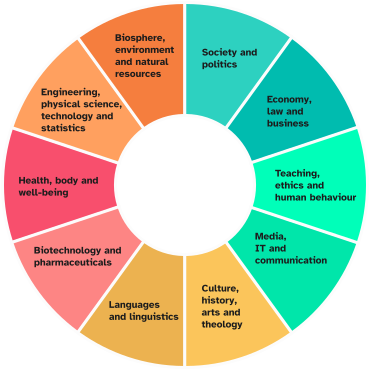
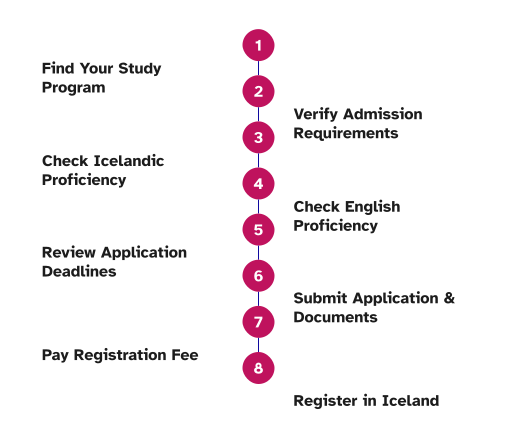

Additional information

The University of Iceland collaborates with over 400 universities worldwide. This provides a unique opportunity to pursue part of your studies at an international university thus gaining added experience and fresh insight into your field of study.

Students generally have the opportunity to join an exchange programme, internship, or summer courses. However, exchanges are always subject to faculty approval.

Students have the opportunity to have courses evaluated as part of their studies at the University of Iceland, so their stay does not have to affect the duration of their studies.

An education in this area can open up opportunities in:

  • Language and literacy teaching
  • Reading support
  • Research and academia
  • Teaching in preschools and compulsory schools
  • Special education
  • Developmental therapy
  • Support within schools and educational institutions

This list is not exhaustive.

Kennó is the organisation for student teachers at the University of Iceland. Kennó organises events such as socials for new students, annual galas and workplace tours. Kennó has also organised the Come and Teach project, which is aimed at publicising teaching degrees.

Students' comments
""
Students appreciate the University of Iceland for its strong academic reputation, modern campus facilities, close-knit community, and affordable tuition.
Helpful content
Aurora Cooperation

Study wheel

What interests you?

Aurora Cooperation

How to apply

Follow the path

Contact us

If you still have questions, feel free to contact us.

School of Education
9:00 am - 3:00 pm
General Service and social media

The Service Desk is a point of access for all services. You can drop in at the University Centre or use the WebChat at the bottom right of this page.

Follow the School of Education on Instagram,   Youtube
and Facebook

University of Iceland, Saga (Building)

Share

Did this help?

Why wasn't this information helpful

Limit to 250 characters.