
""
Language skills
required, minimum level of B2
Programme length
Two years.
Study mode
Face-to-face learning Distance learning
Application status
International students:
Students with Icelandic or Nordic citizenship:
Overview

  • Have you completed an undergraduate degree in the educational sciences, social sciences, humanities or health sciences?
  • Do you have at least two years’ experience working in the education system?
  • Are you interested in policy making and curriculum design?
  • Do you want to enhance your leadership skills?

This programme focuses on analysing priorities and connections between educational policy, curricula, implementation and evaluation.

Icelandic educational policy is examined in the context of international trends and policies.

Programme structure

The programme is 120 ECTS and is organised as two years of full-time study. It can also be completed by studying part time for three or four years.

The programme is made up of:

  • Mandatory courses, 25 ECTS
  • Restricted electives, 35-40 ECTS
  • Final thesis, 30-40 ECTS
  • Elective courses, 15-30 ECTS

Specialisations

Students choose between the following specialisations:

  • Educational policy and curriculum studies

In the field of Curriculum Studies, participants gain knowledge and understanding of priorities in education policies and how they appear in curricula and other policy documents. Emphasis is placed on analysing the main issues and connections between educational policy, curriculum, implementation, and assessment.

  • Evaluation studies

In the field of Evaluation, participants gain knowledge and understanding of evaluation and approaches that can be used in schools, education, and healthcare. Emphasis is placed on both theoretical understanding and practical skills in the preparation and implementation of assessments.

Organisation of teaching

Teaching and exams are in Icelandic.

Courses are either taught face-to-face with regular attendance or through blended learning, with distance learning and face-to-face blocks.

The study programme can be completed entirely or primarily through distance learning. Courses are generally organised so that learning takes place online, but students are expected to participate in real time at online meetings and/or on-site sessions. Although the programme can be completed entirely through distance learning, some elective courses may be offered only through face-to-face learning.

Main objectives

After completing the programme, students should, for example:

be able to use concepts, models and research methods appropriate for the topic.

be able to lead policy making and evaluation at different levels of the education system

Other

Completing the programme allows a student to apply for doctoral studies

Applicants must have completed an undergraduate degree with a first-class grade (7.25). Work experience in the field of education or educational systems is an advantage.

120 ECTS credits must be completed for M.Ed. degree

The following documents must accompany an application for this programme:
  • CV
  • Statement of purpose
  • Reference 1, Name and email
  • Reference 2, Name and email
  • Certified copies of diplomas and transcripts

Further information on supporting documents can be found here

Programme structure

Check below to see how the programme is structured.

This programme does not offer specialisations.

First year | Fall
Educational Development and Professional Growth (STM110F)
A mandatory (required) course for the programme
10 ECTS, credits
Course Description

The purpose of this course is to assist students in understanding some major concepts, theories, and models of  development in educational settings with a focus on the enhancment of cultural conditions in order to encourage improvement. Students are expected to become competent in organising, planning and leading institutional development projects. The course is based on theories about schools and other related institutions as learning communities.

Ways of working
The course is structured in eight parts in distance learning. Two days are on campus during the term. Beside that students read and discuss online. They are also invited to participate in workshops on campus. Assignments are practical and linked with daily work. Student collaboration and discussions is emphases.

Language of instruction: Icelandic
Distance learning
Prerequisites
Attendance required in class
First year | Fall
Evaluation within the field of education (STM106F)
A mandatory (required) course for the programme
10 ECTS, credits
Course Description

The main objectives of evaluation will be discussed, various approaches self- evaluation will be introduced, as well as evaluation standards. Data collection, data analysis and presentation of data will be discussed. Emphasis will be on the relevance of evaluation for developmental purposes in educational settings. Ethical issues pertinent to evaluation will be discussed. Research on program evaluation will be explored.

Emphasis will be on practical assignments concerning students' interests. The course is organised in on-campus sessions and discussions on Zoom. Participants discuss selected topics and literature, work on assignments and organise self-evaluation projects within the field of their own choice. Classes are online (using Zoom), obligatory to attend 2-3 on-campus sessions (decided in consultations with students).

Language of instruction: Icelandic
Distance learning
Prerequisites
Attendance required in class
First year | Spring 1
Introduction to qualitative research (MVS212F)
A mandatory (required) course for the programme
5 ECTS, credits
Course Description

This course focuses on qualitative research methods. It looks at different movements and traditions in research methodology and their relationship to the structure and execution of research. The course also touches on the ethics of research, validity and different views of these concepts. Students will conduct a small research project, which provides training in a literature review, data collection, data analysis, and presentation of research findings. Students work as a team throughout the semester.

Readings, lectures, in-class discussion and group work. Sessions for distance students are held twice during the semester and participation is mandatory

Language of instruction: Icelandic
Face-to-face learning
Distance learning
Prerequisites
Attendance required in class
First year | Spring 1
Introduction to quantitative Research (MVS213F)
A mandatory (required) course for the programme
5 ECTS, credits
Course Description

Students in this course are expected to deepen their knowledge and skills in quantitative research methodology. Students will use a computer program for data analysis, with emphasis on interpretation and writing about research results. Students are expected to develop positive attitudes toward research and the value of research in educational and social settings.

Language of instruction: Icelandic
Distance learning
Prerequisites
Attendance required in class
First year | Spring 1
Education and education policies in a local and global context (STM207F)
A mandatory (required) course for the programme
10 ECTS, credits
Course Description

The main aim of the course is to enable students to recognize the importance of current global social, political and economic changes to gain understanding of contemporary education policies. The aim is to explore, from different angles based on critical theories, the complex relationships between developments in policy at global, national, local and institutional levels. The emphasis is on the understanding of different forms of marketization in education, both externally through private sector participation in education and internally through the changes of the education system and governance towards business models.

Subject:
Education systems and –policies and their relationship with the social context in society and institutions will be discussed with the intersecting lenses of students‘ gender, social class, residence, (dis-)ability, and ethnicity. Important concepts as quality, choices, effectiveness and governance will be of discussion.

Work process:
Lectures and discussions in weekly-sessions. Students co-operate to put theories and concepts into practice for particular issues. Student assessment comprices of written assignments and a shorter research projects. Further details and guidance will be available during the course.

Language of instruction: Icelandic
Distance learning
Attendance required in class
First year | Year unspecified
Inclusion, Social Justice, and Leadership (STM015F, STM212F)
Restricted elective course, conditions apply
10 ECTS, credits
Course Description

The purpose of the course is to prepare participants to develop and discuss education policy initiatives and implemenations based on a theoretical vision of inclusion and well-being in multicultural educational settings. The basic themes of the course are leadership, democracy, human rights, cooperation and recognition of different resources (i.e. knowledge and experiences) of all. Emphasis is placed on development of leadership based on cooperation where voices of children and young people, educators and parents are listened to.

The course objective is for participants to gain an understanding of national and global education policies that promote inclusion and prosperity and their interactions. Also to acquire skills in analyzing and evaluating the state of affairs in their own work environment and to be able to respond to the needs of society with democracy and human rights as a guiding principle. It will examine the implementation and development of these areas and how the emphasis on inclusion and inclusive education has taken on different forms. Participants will also analyze their own work environment and develop an action plan that includes building a more inclusive and equitable educational setting.

The course will be conducted through lectures, discussions, collaboration and independent work by participants. Emphasis is placed on participants reflecting upon their own attitudes and opinions while learning about the ideas of others.

Language of instruction: Icelandic
Distance learning
Prerequisites
Attendance required in class
First year | Year unspecified
Theories of Educational Management, Institutions, and Organizations (STM015F, STM212F)
Restricted elective course, conditions apply
10 ECTS, credits
Course Description

The purpose of this course is to enhance students understanding of some major concepts and thories of schools and other eductional institutions as organizations. An emphasis is put on assisting students in applying these concepts and theories to relevant organizational issues and problems.

Outline of content is as follows: A short overview of history and thought in educational administration; conflicts and dilemmas in administration; the school as an open system; the school as an organizational type; bureaucracy and the school; structure, power and politics; the school and its environment; motivation, human resources, equality, goals and goal setting; organizational climate and culture; organizational effectiveness, decision making and conflicts in organizations.

Language of instruction: Icelandic
Distance learning
Prerequisites
Attendance required in class
Second year | Fall
Curriculum Studies: Context and the Role of Leaders (STM034F)
A mandatory (required) course for the programme
10 ECTS, credits
Course Description

The main aim of the course is for the participants to gain knowledge and competencies in curriculum studies and to be able to apply their knowledge in the field of education. Key concepts of curriculum studies will be discussed. The historical development of the curriculum development in Iceland will be reviewed and it will be placed in the context of international trends. Leadership styles that actively engage practitioners (teachers, school leaders, and other stakeholders), students, and parents in curriculum development and curriculum implementation will be examined. There will be a critical discussion of curriculum development concerning the implementation and enactment of national policy. Possible effects on different student groups will also be considered. Participants will be able to design and implement school curricula based on current policies, trends, and local context. In that regard, they need to be able to analyse and work with curricula from different perspectives based on critical theory and research. The course will also discuss the assumptions, purpose, and methods when evaluating school curricula and the discussion will be related to the prevailing evaluation policies, international influence, and discussion about the aim and purpose of education.

The course is organized in sessions, real-time presence online and on-site.

The course is structured around lectures, discussions, group work, reading, and project work. Participants work on diverse and practical projects that are useful to them in their work.

Language of instruction: Icelandic
Distance learning
Attendance required in class
Second year | Spring 1
Final project (STM441L)
A mandatory (required) course for the programme
0 ECTS, credits
Course Description

The M.Ed. final project is an individual project. Students work on the project independently under the guidance of a project supervisor/supervisors chosen from among the academic staff at the School of Education. Students should consult the chair of their department on the choice of a project supervisor.

The choice of topic is primarily the responsibility of the student in collaboration with his or her project supervisor. The topic of the project should fall within the student's area of study, i.e. course of study and chosen specialisation.

Various types of projects are permitted, for example, research essays, independent research projects, the development of new curricula or study materials, and more.

In most cases preparation for and work on the project takes at least two semesters. Students should follow the more detailed instructions and rules for the M.Ed. projects which are published on the Ugla (Owl) intranet: Schools >> School of Education >> Master's projects.

Language of instruction: Icelandic
Self-study
Prerequisites
Part of the total project/thesis credits
Second year | Year unspecified
Qualitative Research Methods I (MVS301F, MVS302F, MVS011F)
Restricted elective course, conditions apply
10 ECTS, credits
Course Description

Aims: The course aims to deepen and broaden students' knowledge base in qualitative research methodology. Main approaches to and characteristics of qualitative research are explored as well as various methods of data collection such as interviews and collection of pre-existing data both visual and textual. In the course students will be introduced to various approaches to data analysis such as thematic analysis, narrative analysis, semiotic analysis and discourse analysis. Students will also learn how to present their findings in an organised and responsible manner.

Teaching and learning methods: This course uses flipped learning methods. Videos with lectures for each week are discussed in weekly workshops. Students work together on assignments that are handed in weekly. They also have to work individually on assignments.

Language of instruction: Icelandic
Face-to-face learning
Distance learning
Attendance required in class
Second year | Year unspecified
Quantitative Methods I (MVS301F, MVS302F, MVS011F)
Restricted elective course, conditions apply
10 ECTS, credits
Course Description

Objective

Students should understand and be able to apply the most common statistical methods for data analysis and be capable of evaluating statistical results. The student should possess the skills and knowledge to analyze and communicate numerical information according to the APA-7 publication standard (e.g., in a scientific journal article or thesis) and be able to take initiative in statistical data processing. Additionally, students will be introduced to the main research designs in quantitative methodology.

Content and Topics

The course will cover quantitative research methods and various research designs. In the statistics portion, the main emphasis will be on the structure and interpretation of the general linear model, which encompasses a range of classical statistical methods such as correlation, regression analysis, and analysis of variance (ANOVA). Students will also learn to apply exploratory and confirmatory factor analysis methods. Finally, students will be introduced to single-case designs, the basic principles of Bayesian statistics, and total survey error assessment. Students will learn to perform analyses using statistical software. Strong emphasis will be placed on clear interpretation and communication of quantitative results according to the APA-7 publication standard.

Teaching Method

The course is taught weekly via online meetings, except for two in-person sessions (see weekly schedule), where students and instructors are expected to attend physically. Students may apply for an exemption from attending in person if they live very far away (e.g., residing abroad). Such students will participate in the in-person sessions via remote connection. Students must have the latest stable version of Jamovi (see jamovi.org) installed on their laptops, which they should bring to class.

Language of instruction: Icelandic
Face-to-face learning
Distance learning
Attendance required in class
Second year | Year unspecified
Action research (MVS301F, MVS302F, MVS011F)
Restricted elective course, conditions apply
10 ECTS, credits
Course Description

This is an introductory course that addresses theoretical, philosophical, and practical issues related to action research. The history and development of action research worldwide will be outlined. We will examine ideologies and issues that divide action researchers into different camps. Special attention will be on action research in Icelandic schools and other educational forums, how it has developed until now and how it might be taken further. The main emphasis in the course is on learning in action: participants will learn about action research through the process of conducting their own research project.

Language of instruction: Icelandic
Face-to-face learning
Distance learning
Attendance required in class
Year unspecified | Fall
Volunteering: Projects aimed at education and welfare. (UME005M)
Free elective course within the programme
5 ECTS, credits
Course Description

The course discusses volunteering and the social, educational and psychological theories that have been associated with this type of civic participation. It also discusses the motivations for such participation and gender differences in this regard. Finally, it discusses important aspects of the organization and structure of volunteering that are conducive to participants experiencing a sense of purpose in participating and are more likely to volunteer in the future. Students will also have the opportunity to experience volunteering firsthand and participate in work at institutions and non-governmental organizations that provide assistance to people with social equality and welfare as their guiding principles.

Language of instruction: Icelandic/English
Face-to-face learning
Distance learning
Prerequisites
Attendance required in class
Year unspecified | Spring 1
Educational Law (STM218F)
Free elective course within the programme
5 ECTS, credits
Course Description

This course provides students with insight into the legal framework of educational practice and how laws, regulations, and ethical standards shape the operation of educational institutions. Emphasis is placed on the relationship between legal, pedagogical, and administrative aspects and their relevance to professional leadership and policy-making, with the aim of strengthening school leaders in their role as responsible actors within the public system.

Participants work with real-life cases from school settings where legal, professional, and ethical perspectives intersect. By connecting theoretical concepts to their own experiences and analysing complex issues, students gain tools and confidence to make informed and professional decisions. The course is based on active participation, discussion, and reflection. The goal is for students to become aware of the key considerations involved in resolving issues in educational contexts.

Language of instruction: Icelandic
Distance learning
Attendance required in class
Not taught this semester
Year unspecified | Spring 1
Multicultural Social Work (FRG008F)
Free elective course within the programme
10 ECTS, credits
Course Description

The aim of the course is to increase specialized knowledge and skills in the field of work with diverse groups of refugees and immigrants in the field of social work. The situation of immigrants and refugees is discussed, as well as in the context of welfare services, education and employment. The course will focus on deepening students' knowledge, understanding and competence in cultural competence at work (cultural competence). Emphasis will also be placed on deepening students' knowledge of prevailing currents and policies in academic discussion, research and policy-making in refugee and immigration issues from a critical perspective.

Language of instruction: Icelandic
Face-to-face learning
Year unspecified | Spring 1
Global Citizenship Education – from policy to practice.  (UME002F)
Free elective course within the programme
10 ECTS, credits
Course Description

The course discusses factors that underpin and support global citizenship education. We will discuss the importance of citizens realizing that they have certain rights in society, as well as shared responsibilities and duties. Emphasis is placed on academic and policy related discussion of concepts such as globalization, citizenship, civic engagement, democracy, human rights, education and sustainability. Different approaches and definitions of global citizenship will be discussed, with an emphasis on critical approaches providing examples from international and national education, such as the United Nations' global goals and the fundamental pillars of Icelandic education. The spotlight will also be directed to the current situation of children and young people and how we learn and teach in the spirit of global citizenship.

Language of instruction: Icelandic
Distance learning
Attendance required in class
Year unspecified | Spring 1
Evaluation project – prerequisites and priorities for improvement (STM201F)
Free elective course within the programme
10 ECTS, credits
Course Description

In the course, the evaluation theory will be shortly introduced. The main emphasis will be on doing an evaluation project in a professional field of students' own choice.
The course is organised around an evaluation project that includes defining research questions, building an argument for the selected evaluation approach and data collection method, analysing the data, and writing and presenting a final report.

Language of instruction: Icelandic
Distance learning
Year unspecified | Spring 1
Following the path of leadership in practice (STM029F)
Free elective course within the programme
5 ECTS, credits
2 fieldwork credits
Course Description

The goal of this course is that students will develop understanding, knowledge, and skills in key areas related to practical aspects of leadership and management (concerning the role of principals, assistant principals, and middle managers) in pre-schools, compulsory schools, upper secondary schools, and after school foundations. Furthermore, the goal is that they will encounter the influence of laws, regulations, and curriculum guides on the operation of schools and related institutes and the respective administrative roles.

The course will cover aspects of daily management in schools – aspects concerning issues of planning, budgeting, staffing, leading, developing, and evaluating. Students follow an administrator on-site for 2-3 weeks. Details concerning tasks and assignments will be given in the beginning of the course.

At the start of the term, students must contact the coordinator of the course in order to plan school placements. The course begins with a campus-based seminar where assignments are introduced. There is also a campus-based seminar at the end of the course where students share their field experiences.

Language of instruction: Icelandic
Distance learning
Prerequisites
Attendance required in class
Year unspecified | Spring 1
Interdisciplinary Collaboration within Leisure- and School Systems (TÓS202F)
Free elective course within the programme
5 ECTS, credits
Course Description

This course focuses on collaboration across practices between professionals within leisure and education. The aim is to enhance student knowledge of the boundaries between professional practices, the benefits of inter-professional collaboration and the challenges that may arise when professionals with different expertise work together with children within education and leisure. Theories on different approaches in collaboration and communities of practice will be explored as well as research on relational trust and expertise. New legislation on integrated service to ensure the well-being of children will be introduced with a focus on the benefits for collaboration across practices that may follow. Students will get the opportunity to use their critical thinking by looking into different concepts and collaboration and draw a conclusion where more collaboration is needed. 

The course suits students that aim to work with children and youth within formal or informal educational institutions. The course is also practical for those who already work within schools, leisure centres or in the sport sector. 

Work style and expectations
Flipped teaching will be supported and lessons will be used for discussions and processing. Students are expected to take an active part in the discussion or submit a reflection if they cannot make it to the discussion time.

All study components must be passed with a minimum grade of 5.0.

Language of instruction: Icelandic
Face-to-face learning
Distance learning
Prerequisites
Attendance required in class
Course taught second half of the semester
Year unspecified | Spring 1
Educational management and leadership (STM109F)
Free elective course within the programme
10 ECTS, credits
Course Description

Aim of the course: To assist students in understanding some major processes of school management and educational leadership in schools and other educational institutions. An emphasis is put on the development of their role as educational leaders.

Main content: Theories about leadership and management in educational institutions. The multiple roles and responsibilities of educational leaders are discussed as well as the impact of gender and values on leadership. The supervisory role of leaders is addressed as well as their role in leading change and innovation. Research on leadership in educational institutions will be explored with particular emphasis on recent Icelandic research.

Organisation: The course is organised as a combination of distance learning and on-site sessions. Students finish three assignments. One short paper (15%), one longer paper or essay (40%), and an exam (35%). Students also discuss academic journals on-line in small groups and submit a report (10%).

Language of instruction: Icelandic
Distance learning
Prerequisites
Attendance required in class
First year
  • Fall
  • STM110F
    Educational Development and Professional Growth
    Mandatory (required) course
    10
    A mandatory (required) course for the programme
    10 ECTS, credits
    Course Description

    The purpose of this course is to assist students in understanding some major concepts, theories, and models of  development in educational settings with a focus on the enhancment of cultural conditions in order to encourage improvement. Students are expected to become competent in organising, planning and leading institutional development projects. The course is based on theories about schools and other related institutions as learning communities.

    Ways of working
    The course is structured in eight parts in distance learning. Two days are on campus during the term. Beside that students read and discuss online. They are also invited to participate in workshops on campus. Assignments are practical and linked with daily work. Student collaboration and discussions is emphases.

    Distance learning
    Prerequisites
    Attendance required in class
  • STM106F
    Evaluation within the field of education
    Mandatory (required) course
    10
    A mandatory (required) course for the programme
    10 ECTS, credits
    Course Description

    The main objectives of evaluation will be discussed, various approaches self- evaluation will be introduced, as well as evaluation standards. Data collection, data analysis and presentation of data will be discussed. Emphasis will be on the relevance of evaluation for developmental purposes in educational settings. Ethical issues pertinent to evaluation will be discussed. Research on program evaluation will be explored.

    Emphasis will be on practical assignments concerning students' interests. The course is organised in on-campus sessions and discussions on Zoom. Participants discuss selected topics and literature, work on assignments and organise self-evaluation projects within the field of their own choice. Classes are online (using Zoom), obligatory to attend 2-3 on-campus sessions (decided in consultations with students).

    Distance learning
    Prerequisites
    Attendance required in class
  • Spring 2
  • MVS212F
    Introduction to qualitative research
    Mandatory (required) course
    5
    A mandatory (required) course for the programme
    5 ECTS, credits
    Course Description

    This course focuses on qualitative research methods. It looks at different movements and traditions in research methodology and their relationship to the structure and execution of research. The course also touches on the ethics of research, validity and different views of these concepts. Students will conduct a small research project, which provides training in a literature review, data collection, data analysis, and presentation of research findings. Students work as a team throughout the semester.

    Readings, lectures, in-class discussion and group work. Sessions for distance students are held twice during the semester and participation is mandatory

    Face-to-face learning
    Distance learning
    Prerequisites
    Attendance required in class
  • MVS213F
    Introduction to quantitative Research
    Mandatory (required) course
    5
    A mandatory (required) course for the programme
    5 ECTS, credits
    Course Description

    Students in this course are expected to deepen their knowledge and skills in quantitative research methodology. Students will use a computer program for data analysis, with emphasis on interpretation and writing about research results. Students are expected to develop positive attitudes toward research and the value of research in educational and social settings.

    Distance learning
    Prerequisites
    Attendance required in class
  • STM207F
    Education and education policies in a local and global context
    Mandatory (required) course
    10
    A mandatory (required) course for the programme
    10 ECTS, credits
    Course Description

    The main aim of the course is to enable students to recognize the importance of current global social, political and economic changes to gain understanding of contemporary education policies. The aim is to explore, from different angles based on critical theories, the complex relationships between developments in policy at global, national, local and institutional levels. The emphasis is on the understanding of different forms of marketization in education, both externally through private sector participation in education and internally through the changes of the education system and governance towards business models.

    Subject:
    Education systems and –policies and their relationship with the social context in society and institutions will be discussed with the intersecting lenses of students‘ gender, social class, residence, (dis-)ability, and ethnicity. Important concepts as quality, choices, effectiveness and governance will be of discussion.

    Work process:
    Lectures and discussions in weekly-sessions. Students co-operate to put theories and concepts into practice for particular issues. Student assessment comprices of written assignments and a shorter research projects. Further details and guidance will be available during the course.

    Distance learning
    Prerequisites
    Attendance required in class
  • Year unspecified
  • STM015F, STM212F
    Inclusion, Social Justice, and Leadership
    Restricted elective course
    10
    Restricted elective course, conditions apply
    10 ECTS, credits
    Course Description

    The purpose of the course is to prepare participants to develop and discuss education policy initiatives and implemenations based on a theoretical vision of inclusion and well-being in multicultural educational settings. The basic themes of the course are leadership, democracy, human rights, cooperation and recognition of different resources (i.e. knowledge and experiences) of all. Emphasis is placed on development of leadership based on cooperation where voices of children and young people, educators and parents are listened to.

    The course objective is for participants to gain an understanding of national and global education policies that promote inclusion and prosperity and their interactions. Also to acquire skills in analyzing and evaluating the state of affairs in their own work environment and to be able to respond to the needs of society with democracy and human rights as a guiding principle. It will examine the implementation and development of these areas and how the emphasis on inclusion and inclusive education has taken on different forms. Participants will also analyze their own work environment and develop an action plan that includes building a more inclusive and equitable educational setting.

    The course will be conducted through lectures, discussions, collaboration and independent work by participants. Emphasis is placed on participants reflecting upon their own attitudes and opinions while learning about the ideas of others.

    Distance learning
    Prerequisites
    Attendance required in class
  • STM015F, STM212F
    Theories of Educational Management, Institutions, and Organizations
    Restricted elective course
    10
    Restricted elective course, conditions apply
    10 ECTS, credits
    Course Description

    The purpose of this course is to enhance students understanding of some major concepts and thories of schools and other eductional institutions as organizations. An emphasis is put on assisting students in applying these concepts and theories to relevant organizational issues and problems.

    Outline of content is as follows: A short overview of history and thought in educational administration; conflicts and dilemmas in administration; the school as an open system; the school as an organizational type; bureaucracy and the school; structure, power and politics; the school and its environment; motivation, human resources, equality, goals and goal setting; organizational climate and culture; organizational effectiveness, decision making and conflicts in organizations.

    Distance learning
    Prerequisites
    Attendance required in class
  • Fall
  • STM034F
    Curriculum Studies: Context and the Role of Leaders
    Mandatory (required) course
    10
    A mandatory (required) course for the programme
    10 ECTS, credits
    Course Description

    The main aim of the course is for the participants to gain knowledge and competencies in curriculum studies and to be able to apply their knowledge in the field of education. Key concepts of curriculum studies will be discussed. The historical development of the curriculum development in Iceland will be reviewed and it will be placed in the context of international trends. Leadership styles that actively engage practitioners (teachers, school leaders, and other stakeholders), students, and parents in curriculum development and curriculum implementation will be examined. There will be a critical discussion of curriculum development concerning the implementation and enactment of national policy. Possible effects on different student groups will also be considered. Participants will be able to design and implement school curricula based on current policies, trends, and local context. In that regard, they need to be able to analyse and work with curricula from different perspectives based on critical theory and research. The course will also discuss the assumptions, purpose, and methods when evaluating school curricula and the discussion will be related to the prevailing evaluation policies, international influence, and discussion about the aim and purpose of education.

    The course is organized in sessions, real-time presence online and on-site.

    The course is structured around lectures, discussions, group work, reading, and project work. Participants work on diverse and practical projects that are useful to them in their work.

    Distance learning
    Prerequisites
    Attendance required in class
  • Spring 2
  • STM441L
    Final project
    Mandatory (required) course
    0
    A mandatory (required) course for the programme
    0 ECTS, credits
    Course Description

    The M.Ed. final project is an individual project. Students work on the project independently under the guidance of a project supervisor/supervisors chosen from among the academic staff at the School of Education. Students should consult the chair of their department on the choice of a project supervisor.

    The choice of topic is primarily the responsibility of the student in collaboration with his or her project supervisor. The topic of the project should fall within the student's area of study, i.e. course of study and chosen specialisation.

    Various types of projects are permitted, for example, research essays, independent research projects, the development of new curricula or study materials, and more.

    In most cases preparation for and work on the project takes at least two semesters. Students should follow the more detailed instructions and rules for the M.Ed. projects which are published on the Ugla (Owl) intranet: Schools >> School of Education >> Master's projects.

    Self-study
    Prerequisites
    Part of the total project/thesis credits
  • Year unspecified
  • MVS301F, MVS302F, MVS011F
    Qualitative Research Methods I
    Restricted elective course
    10
    Restricted elective course, conditions apply
    10 ECTS, credits
    Course Description

    Aims: The course aims to deepen and broaden students' knowledge base in qualitative research methodology. Main approaches to and characteristics of qualitative research are explored as well as various methods of data collection such as interviews and collection of pre-existing data both visual and textual. In the course students will be introduced to various approaches to data analysis such as thematic analysis, narrative analysis, semiotic analysis and discourse analysis. Students will also learn how to present their findings in an organised and responsible manner.

    Teaching and learning methods: This course uses flipped learning methods. Videos with lectures for each week are discussed in weekly workshops. Students work together on assignments that are handed in weekly. They also have to work individually on assignments.

    Face-to-face learning
    Distance learning
    Prerequisites
    Attendance required in class
  • MVS301F, MVS302F, MVS011F
    Quantitative Methods I
    Restricted elective course
    10
    Restricted elective course, conditions apply
    10 ECTS, credits
    Course Description

    Objective

    Students should understand and be able to apply the most common statistical methods for data analysis and be capable of evaluating statistical results. The student should possess the skills and knowledge to analyze and communicate numerical information according to the APA-7 publication standard (e.g., in a scientific journal article or thesis) and be able to take initiative in statistical data processing. Additionally, students will be introduced to the main research designs in quantitative methodology.

    Content and Topics

    The course will cover quantitative research methods and various research designs. In the statistics portion, the main emphasis will be on the structure and interpretation of the general linear model, which encompasses a range of classical statistical methods such as correlation, regression analysis, and analysis of variance (ANOVA). Students will also learn to apply exploratory and confirmatory factor analysis methods. Finally, students will be introduced to single-case designs, the basic principles of Bayesian statistics, and total survey error assessment. Students will learn to perform analyses using statistical software. Strong emphasis will be placed on clear interpretation and communication of quantitative results according to the APA-7 publication standard.

    Teaching Method

    The course is taught weekly via online meetings, except for two in-person sessions (see weekly schedule), where students and instructors are expected to attend physically. Students may apply for an exemption from attending in person if they live very far away (e.g., residing abroad). Such students will participate in the in-person sessions via remote connection. Students must have the latest stable version of Jamovi (see jamovi.org) installed on their laptops, which they should bring to class.

    Face-to-face learning
    Distance learning
    Prerequisites
    Attendance required in class
  • MVS301F, MVS302F, MVS011F
    Action research
    Restricted elective course
    10
    Restricted elective course, conditions apply
    10 ECTS, credits
    Course Description

    This is an introductory course that addresses theoretical, philosophical, and practical issues related to action research. The history and development of action research worldwide will be outlined. We will examine ideologies and issues that divide action researchers into different camps. Special attention will be on action research in Icelandic schools and other educational forums, how it has developed until now and how it might be taken further. The main emphasis in the course is on learning in action: participants will learn about action research through the process of conducting their own research project.

    Face-to-face learning
    Distance learning
    Prerequisites
    Attendance required in class
  • Fall
  • UME005M
    Volunteering: Projects aimed at education and welfare.
    Elective course
    5
    Free elective course within the programme
    5 ECTS, credits
    Course Description

    The course discusses volunteering and the social, educational and psychological theories that have been associated with this type of civic participation. It also discusses the motivations for such participation and gender differences in this regard. Finally, it discusses important aspects of the organization and structure of volunteering that are conducive to participants experiencing a sense of purpose in participating and are more likely to volunteer in the future. Students will also have the opportunity to experience volunteering firsthand and participate in work at institutions and non-governmental organizations that provide assistance to people with social equality and welfare as their guiding principles.

    Face-to-face learning
    Distance learning
    Prerequisites
    Attendance required in class
  • Spring 2
  • STM218F
    Educational Law
    Elective course
    5
    Free elective course within the programme
    5 ECTS, credits
    Course Description

    This course provides students with insight into the legal framework of educational practice and how laws, regulations, and ethical standards shape the operation of educational institutions. Emphasis is placed on the relationship between legal, pedagogical, and administrative aspects and their relevance to professional leadership and policy-making, with the aim of strengthening school leaders in their role as responsible actors within the public system.

    Participants work with real-life cases from school settings where legal, professional, and ethical perspectives intersect. By connecting theoretical concepts to their own experiences and analysing complex issues, students gain tools and confidence to make informed and professional decisions. The course is based on active participation, discussion, and reflection. The goal is for students to become aware of the key considerations involved in resolving issues in educational contexts.

    Distance learning
    Prerequisites
    Attendance required in class
  • Not taught this semester
    FRG008F
    Multicultural Social Work
    Elective course
    10
    Free elective course within the programme
    10 ECTS, credits
    Course Description

    The aim of the course is to increase specialized knowledge and skills in the field of work with diverse groups of refugees and immigrants in the field of social work. The situation of immigrants and refugees is discussed, as well as in the context of welfare services, education and employment. The course will focus on deepening students' knowledge, understanding and competence in cultural competence at work (cultural competence). Emphasis will also be placed on deepening students' knowledge of prevailing currents and policies in academic discussion, research and policy-making in refugee and immigration issues from a critical perspective.

    Face-to-face learning
    Prerequisites
  • UME002F
    Global Citizenship Education – from policy to practice. 
    Elective course
    10
    Free elective course within the programme
    10 ECTS, credits
    Course Description

    The course discusses factors that underpin and support global citizenship education. We will discuss the importance of citizens realizing that they have certain rights in society, as well as shared responsibilities and duties. Emphasis is placed on academic and policy related discussion of concepts such as globalization, citizenship, civic engagement, democracy, human rights, education and sustainability. Different approaches and definitions of global citizenship will be discussed, with an emphasis on critical approaches providing examples from international and national education, such as the United Nations' global goals and the fundamental pillars of Icelandic education. The spotlight will also be directed to the current situation of children and young people and how we learn and teach in the spirit of global citizenship.

    Distance learning
    Prerequisites
    Attendance required in class
  • STM201F
    Evaluation project – prerequisites and priorities for improvement
    Elective course
    10
    Free elective course within the programme
    10 ECTS, credits
    Course Description

    In the course, the evaluation theory will be shortly introduced. The main emphasis will be on doing an evaluation project in a professional field of students' own choice.
    The course is organised around an evaluation project that includes defining research questions, building an argument for the selected evaluation approach and data collection method, analysing the data, and writing and presenting a final report.

    Distance learning
    Prerequisites
  • STM029F
    Following the path of leadership in practice
    Elective course
    5
    Free elective course within the programme
    5 ECTS, credits
    2 fieldwork credits
    Course Description

    The goal of this course is that students will develop understanding, knowledge, and skills in key areas related to practical aspects of leadership and management (concerning the role of principals, assistant principals, and middle managers) in pre-schools, compulsory schools, upper secondary schools, and after school foundations. Furthermore, the goal is that they will encounter the influence of laws, regulations, and curriculum guides on the operation of schools and related institutes and the respective administrative roles.

    The course will cover aspects of daily management in schools – aspects concerning issues of planning, budgeting, staffing, leading, developing, and evaluating. Students follow an administrator on-site for 2-3 weeks. Details concerning tasks and assignments will be given in the beginning of the course.

    At the start of the term, students must contact the coordinator of the course in order to plan school placements. The course begins with a campus-based seminar where assignments are introduced. There is also a campus-based seminar at the end of the course where students share their field experiences.

    Distance learning
    Prerequisites
    Attendance required in class
  • TÓS202F
    Interdisciplinary Collaboration within Leisure- and School Systems
    Elective course
    5
    Free elective course within the programme
    5 ECTS, credits
    Course Description

    This course focuses on collaboration across practices between professionals within leisure and education. The aim is to enhance student knowledge of the boundaries between professional practices, the benefits of inter-professional collaboration and the challenges that may arise when professionals with different expertise work together with children within education and leisure. Theories on different approaches in collaboration and communities of practice will be explored as well as research on relational trust and expertise. New legislation on integrated service to ensure the well-being of children will be introduced with a focus on the benefits for collaboration across practices that may follow. Students will get the opportunity to use their critical thinking by looking into different concepts and collaboration and draw a conclusion where more collaboration is needed. 

    The course suits students that aim to work with children and youth within formal or informal educational institutions. The course is also practical for those who already work within schools, leisure centres or in the sport sector. 

    Work style and expectations
    Flipped teaching will be supported and lessons will be used for discussions and processing. Students are expected to take an active part in the discussion or submit a reflection if they cannot make it to the discussion time.

    All study components must be passed with a minimum grade of 5.0.

    Face-to-face learning
    Distance learning
    Prerequisites
    Attendance required in class
    Course taught second half of the semester
  • STM109F
    Educational management and leadership
    Elective course
    10
    Free elective course within the programme
    10 ECTS, credits
    Course Description

    Aim of the course: To assist students in understanding some major processes of school management and educational leadership in schools and other educational institutions. An emphasis is put on the development of their role as educational leaders.

    Main content: Theories about leadership and management in educational institutions. The multiple roles and responsibilities of educational leaders are discussed as well as the impact of gender and values on leadership. The supervisory role of leaders is addressed as well as their role in leading change and innovation. Research on leadership in educational institutions will be explored with particular emphasis on recent Icelandic research.

    Organisation: The course is organised as a combination of distance learning and on-site sessions. Students finish three assignments. One short paper (15%), one longer paper or essay (40%), and an exam (35%). Students also discuss academic journals on-line in small groups and submit a report (10%).

    Distance learning
    Prerequisites
    Attendance required in class
Second year
  • Fall
  • STM110F
    Educational Development and Professional Growth
    Mandatory (required) course
    10
    A mandatory (required) course for the programme
    10 ECTS, credits
    Course Description

    The purpose of this course is to assist students in understanding some major concepts, theories, and models of  development in educational settings with a focus on the enhancment of cultural conditions in order to encourage improvement. Students are expected to become competent in organising, planning and leading institutional development projects. The course is based on theories about schools and other related institutions as learning communities.

    Ways of working
    The course is structured in eight parts in distance learning. Two days are on campus during the term. Beside that students read and discuss online. They are also invited to participate in workshops on campus. Assignments are practical and linked with daily work. Student collaboration and discussions is emphases.

    Distance learning
    Prerequisites
    Attendance required in class
  • STM106F
    Evaluation within the field of education
    Mandatory (required) course
    10
    A mandatory (required) course for the programme
    10 ECTS, credits
    Course Description

    The main objectives of evaluation will be discussed, various approaches self- evaluation will be introduced, as well as evaluation standards. Data collection, data analysis and presentation of data will be discussed. Emphasis will be on the relevance of evaluation for developmental purposes in educational settings. Ethical issues pertinent to evaluation will be discussed. Research on program evaluation will be explored.

    Emphasis will be on practical assignments concerning students' interests. The course is organised in on-campus sessions and discussions on Zoom. Participants discuss selected topics and literature, work on assignments and organise self-evaluation projects within the field of their own choice. Classes are online (using Zoom), obligatory to attend 2-3 on-campus sessions (decided in consultations with students).

    Distance learning
    Prerequisites
    Attendance required in class
  • Spring 2
  • MVS212F
    Introduction to qualitative research
    Mandatory (required) course
    5
    A mandatory (required) course for the programme
    5 ECTS, credits
    Course Description

    This course focuses on qualitative research methods. It looks at different movements and traditions in research methodology and their relationship to the structure and execution of research. The course also touches on the ethics of research, validity and different views of these concepts. Students will conduct a small research project, which provides training in a literature review, data collection, data analysis, and presentation of research findings. Students work as a team throughout the semester.

    Readings, lectures, in-class discussion and group work. Sessions for distance students are held twice during the semester and participation is mandatory

    Face-to-face learning
    Distance learning
    Prerequisites
    Attendance required in class
  • MVS213F
    Introduction to quantitative Research
    Mandatory (required) course
    5
    A mandatory (required) course for the programme
    5 ECTS, credits
    Course Description

    Students in this course are expected to deepen their knowledge and skills in quantitative research methodology. Students will use a computer program for data analysis, with emphasis on interpretation and writing about research results. Students are expected to develop positive attitudes toward research and the value of research in educational and social settings.

    Distance learning
    Prerequisites
    Attendance required in class
  • STM207F
    Education and education policies in a local and global context
    Mandatory (required) course
    10
    A mandatory (required) course for the programme
    10 ECTS, credits
    Course Description

    The main aim of the course is to enable students to recognize the importance of current global social, political and economic changes to gain understanding of contemporary education policies. The aim is to explore, from different angles based on critical theories, the complex relationships between developments in policy at global, national, local and institutional levels. The emphasis is on the understanding of different forms of marketization in education, both externally through private sector participation in education and internally through the changes of the education system and governance towards business models.

    Subject:
    Education systems and –policies and their relationship with the social context in society and institutions will be discussed with the intersecting lenses of students‘ gender, social class, residence, (dis-)ability, and ethnicity. Important concepts as quality, choices, effectiveness and governance will be of discussion.

    Work process:
    Lectures and discussions in weekly-sessions. Students co-operate to put theories and concepts into practice for particular issues. Student assessment comprices of written assignments and a shorter research projects. Further details and guidance will be available during the course.

    Distance learning
    Prerequisites
    Attendance required in class
  • Year unspecified
  • STM015F, STM212F
    Inclusion, Social Justice, and Leadership
    Restricted elective course
    10
    Restricted elective course, conditions apply
    10 ECTS, credits
    Course Description

    The purpose of the course is to prepare participants to develop and discuss education policy initiatives and implemenations based on a theoretical vision of inclusion and well-being in multicultural educational settings. The basic themes of the course are leadership, democracy, human rights, cooperation and recognition of different resources (i.e. knowledge and experiences) of all. Emphasis is placed on development of leadership based on cooperation where voices of children and young people, educators and parents are listened to.

    The course objective is for participants to gain an understanding of national and global education policies that promote inclusion and prosperity and their interactions. Also to acquire skills in analyzing and evaluating the state of affairs in their own work environment and to be able to respond to the needs of society with democracy and human rights as a guiding principle. It will examine the implementation and development of these areas and how the emphasis on inclusion and inclusive education has taken on different forms. Participants will also analyze their own work environment and develop an action plan that includes building a more inclusive and equitable educational setting.

    The course will be conducted through lectures, discussions, collaboration and independent work by participants. Emphasis is placed on participants reflecting upon their own attitudes and opinions while learning about the ideas of others.

    Distance learning
    Prerequisites
    Attendance required in class
  • STM015F, STM212F
    Theories of Educational Management, Institutions, and Organizations
    Restricted elective course
    10
    Restricted elective course, conditions apply
    10 ECTS, credits
    Course Description

    The purpose of this course is to enhance students understanding of some major concepts and thories of schools and other eductional institutions as organizations. An emphasis is put on assisting students in applying these concepts and theories to relevant organizational issues and problems.

    Outline of content is as follows: A short overview of history and thought in educational administration; conflicts and dilemmas in administration; the school as an open system; the school as an organizational type; bureaucracy and the school; structure, power and politics; the school and its environment; motivation, human resources, equality, goals and goal setting; organizational climate and culture; organizational effectiveness, decision making and conflicts in organizations.

    Distance learning
    Prerequisites
    Attendance required in class
  • Fall
  • STM034F
    Curriculum Studies: Context and the Role of Leaders
    Mandatory (required) course
    10
    A mandatory (required) course for the programme
    10 ECTS, credits
    Course Description

    The main aim of the course is for the participants to gain knowledge and competencies in curriculum studies and to be able to apply their knowledge in the field of education. Key concepts of curriculum studies will be discussed. The historical development of the curriculum development in Iceland will be reviewed and it will be placed in the context of international trends. Leadership styles that actively engage practitioners (teachers, school leaders, and other stakeholders), students, and parents in curriculum development and curriculum implementation will be examined. There will be a critical discussion of curriculum development concerning the implementation and enactment of national policy. Possible effects on different student groups will also be considered. Participants will be able to design and implement school curricula based on current policies, trends, and local context. In that regard, they need to be able to analyse and work with curricula from different perspectives based on critical theory and research. The course will also discuss the assumptions, purpose, and methods when evaluating school curricula and the discussion will be related to the prevailing evaluation policies, international influence, and discussion about the aim and purpose of education.

    The course is organized in sessions, real-time presence online and on-site.

    The course is structured around lectures, discussions, group work, reading, and project work. Participants work on diverse and practical projects that are useful to them in their work.

    Distance learning
    Prerequisites
    Attendance required in class
  • Spring 2
  • STM441L
    Final project
    Mandatory (required) course
    0
    A mandatory (required) course for the programme
    0 ECTS, credits
    Course Description

    The M.Ed. final project is an individual project. Students work on the project independently under the guidance of a project supervisor/supervisors chosen from among the academic staff at the School of Education. Students should consult the chair of their department on the choice of a project supervisor.

    The choice of topic is primarily the responsibility of the student in collaboration with his or her project supervisor. The topic of the project should fall within the student's area of study, i.e. course of study and chosen specialisation.

    Various types of projects are permitted, for example, research essays, independent research projects, the development of new curricula or study materials, and more.

    In most cases preparation for and work on the project takes at least two semesters. Students should follow the more detailed instructions and rules for the M.Ed. projects which are published on the Ugla (Owl) intranet: Schools >> School of Education >> Master's projects.

    Self-study
    Prerequisites
    Part of the total project/thesis credits
  • Year unspecified
  • MVS301F, MVS302F, MVS011F
    Qualitative Research Methods I
    Restricted elective course
    10
    Restricted elective course, conditions apply
    10 ECTS, credits
    Course Description

    Aims: The course aims to deepen and broaden students' knowledge base in qualitative research methodology. Main approaches to and characteristics of qualitative research are explored as well as various methods of data collection such as interviews and collection of pre-existing data both visual and textual. In the course students will be introduced to various approaches to data analysis such as thematic analysis, narrative analysis, semiotic analysis and discourse analysis. Students will also learn how to present their findings in an organised and responsible manner.

    Teaching and learning methods: This course uses flipped learning methods. Videos with lectures for each week are discussed in weekly workshops. Students work together on assignments that are handed in weekly. They also have to work individually on assignments.

    Face-to-face learning
    Distance learning
    Prerequisites
    Attendance required in class
  • MVS301F, MVS302F, MVS011F
    Quantitative Methods I
    Restricted elective course
    10
    Restricted elective course, conditions apply
    10 ECTS, credits
    Course Description

    Objective

    Students should understand and be able to apply the most common statistical methods for data analysis and be capable of evaluating statistical results. The student should possess the skills and knowledge to analyze and communicate numerical information according to the APA-7 publication standard (e.g., in a scientific journal article or thesis) and be able to take initiative in statistical data processing. Additionally, students will be introduced to the main research designs in quantitative methodology.

    Content and Topics

    The course will cover quantitative research methods and various research designs. In the statistics portion, the main emphasis will be on the structure and interpretation of the general linear model, which encompasses a range of classical statistical methods such as correlation, regression analysis, and analysis of variance (ANOVA). Students will also learn to apply exploratory and confirmatory factor analysis methods. Finally, students will be introduced to single-case designs, the basic principles of Bayesian statistics, and total survey error assessment. Students will learn to perform analyses using statistical software. Strong emphasis will be placed on clear interpretation and communication of quantitative results according to the APA-7 publication standard.

    Teaching Method

    The course is taught weekly via online meetings, except for two in-person sessions (see weekly schedule), where students and instructors are expected to attend physically. Students may apply for an exemption from attending in person if they live very far away (e.g., residing abroad). Such students will participate in the in-person sessions via remote connection. Students must have the latest stable version of Jamovi (see jamovi.org) installed on their laptops, which they should bring to class.

    Face-to-face learning
    Distance learning
    Prerequisites
    Attendance required in class
  • MVS301F, MVS302F, MVS011F
    Action research
    Restricted elective course
    10
    Restricted elective course, conditions apply
    10 ECTS, credits
    Course Description

    This is an introductory course that addresses theoretical, philosophical, and practical issues related to action research. The history and development of action research worldwide will be outlined. We will examine ideologies and issues that divide action researchers into different camps. Special attention will be on action research in Icelandic schools and other educational forums, how it has developed until now and how it might be taken further. The main emphasis in the course is on learning in action: participants will learn about action research through the process of conducting their own research project.

    Face-to-face learning
    Distance learning
    Prerequisites
    Attendance required in class
  • Fall
  • UME005M
    Volunteering: Projects aimed at education and welfare.
    Elective course
    5
    Free elective course within the programme
    5 ECTS, credits
    Course Description

    The course discusses volunteering and the social, educational and psychological theories that have been associated with this type of civic participation. It also discusses the motivations for such participation and gender differences in this regard. Finally, it discusses important aspects of the organization and structure of volunteering that are conducive to participants experiencing a sense of purpose in participating and are more likely to volunteer in the future. Students will also have the opportunity to experience volunteering firsthand and participate in work at institutions and non-governmental organizations that provide assistance to people with social equality and welfare as their guiding principles.

    Face-to-face learning
    Distance learning
    Prerequisites
    Attendance required in class
  • Spring 2
  • STM218F
    Educational Law
    Elective course
    5
    Free elective course within the programme
    5 ECTS, credits
    Course Description

    This course provides students with insight into the legal framework of educational practice and how laws, regulations, and ethical standards shape the operation of educational institutions. Emphasis is placed on the relationship between legal, pedagogical, and administrative aspects and their relevance to professional leadership and policy-making, with the aim of strengthening school leaders in their role as responsible actors within the public system.

    Participants work with real-life cases from school settings where legal, professional, and ethical perspectives intersect. By connecting theoretical concepts to their own experiences and analysing complex issues, students gain tools and confidence to make informed and professional decisions. The course is based on active participation, discussion, and reflection. The goal is for students to become aware of the key considerations involved in resolving issues in educational contexts.

    Distance learning
    Prerequisites
    Attendance required in class
  • Not taught this semester
    FRG008F
    Multicultural Social Work
    Elective course
    10
    Free elective course within the programme
    10 ECTS, credits
    Course Description

    The aim of the course is to increase specialized knowledge and skills in the field of work with diverse groups of refugees and immigrants in the field of social work. The situation of immigrants and refugees is discussed, as well as in the context of welfare services, education and employment. The course will focus on deepening students' knowledge, understanding and competence in cultural competence at work (cultural competence). Emphasis will also be placed on deepening students' knowledge of prevailing currents and policies in academic discussion, research and policy-making in refugee and immigration issues from a critical perspective.

    Face-to-face learning
    Prerequisites
  • UME002F
    Global Citizenship Education – from policy to practice. 
    Elective course
    10
    Free elective course within the programme
    10 ECTS, credits
    Course Description

    The course discusses factors that underpin and support global citizenship education. We will discuss the importance of citizens realizing that they have certain rights in society, as well as shared responsibilities and duties. Emphasis is placed on academic and policy related discussion of concepts such as globalization, citizenship, civic engagement, democracy, human rights, education and sustainability. Different approaches and definitions of global citizenship will be discussed, with an emphasis on critical approaches providing examples from international and national education, such as the United Nations' global goals and the fundamental pillars of Icelandic education. The spotlight will also be directed to the current situation of children and young people and how we learn and teach in the spirit of global citizenship.

    Distance learning
    Prerequisites
    Attendance required in class
  • STM201F
    Evaluation project – prerequisites and priorities for improvement
    Elective course
    10
    Free elective course within the programme
    10 ECTS, credits
    Course Description

    In the course, the evaluation theory will be shortly introduced. The main emphasis will be on doing an evaluation project in a professional field of students' own choice.
    The course is organised around an evaluation project that includes defining research questions, building an argument for the selected evaluation approach and data collection method, analysing the data, and writing and presenting a final report.

    Distance learning
    Prerequisites
  • STM029F
    Following the path of leadership in practice
    Elective course
    5
    Free elective course within the programme
    5 ECTS, credits
    2 fieldwork credits
    Course Description

    The goal of this course is that students will develop understanding, knowledge, and skills in key areas related to practical aspects of leadership and management (concerning the role of principals, assistant principals, and middle managers) in pre-schools, compulsory schools, upper secondary schools, and after school foundations. Furthermore, the goal is that they will encounter the influence of laws, regulations, and curriculum guides on the operation of schools and related institutes and the respective administrative roles.

    The course will cover aspects of daily management in schools – aspects concerning issues of planning, budgeting, staffing, leading, developing, and evaluating. Students follow an administrator on-site for 2-3 weeks. Details concerning tasks and assignments will be given in the beginning of the course.

    At the start of the term, students must contact the coordinator of the course in order to plan school placements. The course begins with a campus-based seminar where assignments are introduced. There is also a campus-based seminar at the end of the course where students share their field experiences.

    Distance learning
    Prerequisites
    Attendance required in class
  • TÓS202F
    Interdisciplinary Collaboration within Leisure- and School Systems
    Elective course
    5
    Free elective course within the programme
    5 ECTS, credits
    Course Description

    This course focuses on collaboration across practices between professionals within leisure and education. The aim is to enhance student knowledge of the boundaries between professional practices, the benefits of inter-professional collaboration and the challenges that may arise when professionals with different expertise work together with children within education and leisure. Theories on different approaches in collaboration and communities of practice will be explored as well as research on relational trust and expertise. New legislation on integrated service to ensure the well-being of children will be introduced with a focus on the benefits for collaboration across practices that may follow. Students will get the opportunity to use their critical thinking by looking into different concepts and collaboration and draw a conclusion where more collaboration is needed. 

    The course suits students that aim to work with children and youth within formal or informal educational institutions. The course is also practical for those who already work within schools, leisure centres or in the sport sector. 

    Work style and expectations
    Flipped teaching will be supported and lessons will be used for discussions and processing. Students are expected to take an active part in the discussion or submit a reflection if they cannot make it to the discussion time.

    All study components must be passed with a minimum grade of 5.0.

    Face-to-face learning
    Distance learning
    Prerequisites
    Attendance required in class
    Course taught second half of the semester
  • STM109F
    Educational management and leadership
    Elective course
    10
    Free elective course within the programme
    10 ECTS, credits
    Course Description

    Aim of the course: To assist students in understanding some major processes of school management and educational leadership in schools and other educational institutions. An emphasis is put on the development of their role as educational leaders.

    Main content: Theories about leadership and management in educational institutions. The multiple roles and responsibilities of educational leaders are discussed as well as the impact of gender and values on leadership. The supervisory role of leaders is addressed as well as their role in leading change and innovation. Research on leadership in educational institutions will be explored with particular emphasis on recent Icelandic research.

    Organisation: The course is organised as a combination of distance learning and on-site sessions. Students finish three assignments. One short paper (15%), one longer paper or essay (40%), and an exam (35%). Students also discuss academic journals on-line in small groups and submit a report (10%).

    Distance learning
    Prerequisites
    Attendance required in class
Year unspecified
  • Fall
  • STM110F
    Educational Development and Professional Growth
    Mandatory (required) course
    10
    A mandatory (required) course for the programme
    10 ECTS, credits
    Course Description

    The purpose of this course is to assist students in understanding some major concepts, theories, and models of  development in educational settings with a focus on the enhancment of cultural conditions in order to encourage improvement. Students are expected to become competent in organising, planning and leading institutional development projects. The course is based on theories about schools and other related institutions as learning communities.

    Ways of working
    The course is structured in eight parts in distance learning. Two days are on campus during the term. Beside that students read and discuss online. They are also invited to participate in workshops on campus. Assignments are practical and linked with daily work. Student collaboration and discussions is emphases.

    Distance learning
    Prerequisites
    Attendance required in class
  • STM106F
    Evaluation within the field of education
    Mandatory (required) course
    10
    A mandatory (required) course for the programme
    10 ECTS, credits
    Course Description

    The main objectives of evaluation will be discussed, various approaches self- evaluation will be introduced, as well as evaluation standards. Data collection, data analysis and presentation of data will be discussed. Emphasis will be on the relevance of evaluation for developmental purposes in educational settings. Ethical issues pertinent to evaluation will be discussed. Research on program evaluation will be explored.

    Emphasis will be on practical assignments concerning students' interests. The course is organised in on-campus sessions and discussions on Zoom. Participants discuss selected topics and literature, work on assignments and organise self-evaluation projects within the field of their own choice. Classes are online (using Zoom), obligatory to attend 2-3 on-campus sessions (decided in consultations with students).

    Distance learning
    Prerequisites
    Attendance required in class
  • Spring 2
  • MVS212F
    Introduction to qualitative research
    Mandatory (required) course
    5
    A mandatory (required) course for the programme
    5 ECTS, credits
    Course Description

    This course focuses on qualitative research methods. It looks at different movements and traditions in research methodology and their relationship to the structure and execution of research. The course also touches on the ethics of research, validity and different views of these concepts. Students will conduct a small research project, which provides training in a literature review, data collection, data analysis, and presentation of research findings. Students work as a team throughout the semester.

    Readings, lectures, in-class discussion and group work. Sessions for distance students are held twice during the semester and participation is mandatory

    Face-to-face learning
    Distance learning
    Prerequisites
    Attendance required in class
  • MVS213F
    Introduction to quantitative Research
    Mandatory (required) course
    5
    A mandatory (required) course for the programme
    5 ECTS, credits
    Course Description

    Students in this course are expected to deepen their knowledge and skills in quantitative research methodology. Students will use a computer program for data analysis, with emphasis on interpretation and writing about research results. Students are expected to develop positive attitudes toward research and the value of research in educational and social settings.

    Distance learning
    Prerequisites
    Attendance required in class
  • STM207F
    Education and education policies in a local and global context
    Mandatory (required) course
    10
    A mandatory (required) course for the programme
    10 ECTS, credits
    Course Description

    The main aim of the course is to enable students to recognize the importance of current global social, political and economic changes to gain understanding of contemporary education policies. The aim is to explore, from different angles based on critical theories, the complex relationships between developments in policy at global, national, local and institutional levels. The emphasis is on the understanding of different forms of marketization in education, both externally through private sector participation in education and internally through the changes of the education system and governance towards business models.

    Subject:
    Education systems and –policies and their relationship with the social context in society and institutions will be discussed with the intersecting lenses of students‘ gender, social class, residence, (dis-)ability, and ethnicity. Important concepts as quality, choices, effectiveness and governance will be of discussion.

    Work process:
    Lectures and discussions in weekly-sessions. Students co-operate to put theories and concepts into practice for particular issues. Student assessment comprices of written assignments and a shorter research projects. Further details and guidance will be available during the course.

    Distance learning
    Prerequisites
    Attendance required in class
  • Year unspecified
  • STM015F, STM212F
    Inclusion, Social Justice, and Leadership
    Restricted elective course
    10
    Restricted elective course, conditions apply
    10 ECTS, credits
    Course Description

    The purpose of the course is to prepare participants to develop and discuss education policy initiatives and implemenations based on a theoretical vision of inclusion and well-being in multicultural educational settings. The basic themes of the course are leadership, democracy, human rights, cooperation and recognition of different resources (i.e. knowledge and experiences) of all. Emphasis is placed on development of leadership based on cooperation where voices of children and young people, educators and parents are listened to.

    The course objective is for participants to gain an understanding of national and global education policies that promote inclusion and prosperity and their interactions. Also to acquire skills in analyzing and evaluating the state of affairs in their own work environment and to be able to respond to the needs of society with democracy and human rights as a guiding principle. It will examine the implementation and development of these areas and how the emphasis on inclusion and inclusive education has taken on different forms. Participants will also analyze their own work environment and develop an action plan that includes building a more inclusive and equitable educational setting.

    The course will be conducted through lectures, discussions, collaboration and independent work by participants. Emphasis is placed on participants reflecting upon their own attitudes and opinions while learning about the ideas of others.

    Distance learning
    Prerequisites
    Attendance required in class
  • STM015F, STM212F
    Theories of Educational Management, Institutions, and Organizations
    Restricted elective course
    10
    Restricted elective course, conditions apply
    10 ECTS, credits
    Course Description

    The purpose of this course is to enhance students understanding of some major concepts and thories of schools and other eductional institutions as organizations. An emphasis is put on assisting students in applying these concepts and theories to relevant organizational issues and problems.

    Outline of content is as follows: A short overview of history and thought in educational administration; conflicts and dilemmas in administration; the school as an open system; the school as an organizational type; bureaucracy and the school; structure, power and politics; the school and its environment; motivation, human resources, equality, goals and goal setting; organizational climate and culture; organizational effectiveness, decision making and conflicts in organizations.

    Distance learning
    Prerequisites
    Attendance required in class
  • Fall
  • STM034F
    Curriculum Studies: Context and the Role of Leaders
    Mandatory (required) course
    10
    A mandatory (required) course for the programme
    10 ECTS, credits
    Course Description

    The main aim of the course is for the participants to gain knowledge and competencies in curriculum studies and to be able to apply their knowledge in the field of education. Key concepts of curriculum studies will be discussed. The historical development of the curriculum development in Iceland will be reviewed and it will be placed in the context of international trends. Leadership styles that actively engage practitioners (teachers, school leaders, and other stakeholders), students, and parents in curriculum development and curriculum implementation will be examined. There will be a critical discussion of curriculum development concerning the implementation and enactment of national policy. Possible effects on different student groups will also be considered. Participants will be able to design and implement school curricula based on current policies, trends, and local context. In that regard, they need to be able to analyse and work with curricula from different perspectives based on critical theory and research. The course will also discuss the assumptions, purpose, and methods when evaluating school curricula and the discussion will be related to the prevailing evaluation policies, international influence, and discussion about the aim and purpose of education.

    The course is organized in sessions, real-time presence online and on-site.

    The course is structured around lectures, discussions, group work, reading, and project work. Participants work on diverse and practical projects that are useful to them in their work.

    Distance learning
    Prerequisites
    Attendance required in class
  • Spring 2
  • STM441L
    Final project
    Mandatory (required) course
    0
    A mandatory (required) course for the programme
    0 ECTS, credits
    Course Description

    The M.Ed. final project is an individual project. Students work on the project independently under the guidance of a project supervisor/supervisors chosen from among the academic staff at the School of Education. Students should consult the chair of their department on the choice of a project supervisor.

    The choice of topic is primarily the responsibility of the student in collaboration with his or her project supervisor. The topic of the project should fall within the student's area of study, i.e. course of study and chosen specialisation.

    Various types of projects are permitted, for example, research essays, independent research projects, the development of new curricula or study materials, and more.

    In most cases preparation for and work on the project takes at least two semesters. Students should follow the more detailed instructions and rules for the M.Ed. projects which are published on the Ugla (Owl) intranet: Schools >> School of Education >> Master's projects.

    Self-study
    Prerequisites
    Part of the total project/thesis credits
  • Year unspecified
  • MVS301F, MVS302F, MVS011F
    Qualitative Research Methods I
    Restricted elective course
    10
    Restricted elective course, conditions apply
    10 ECTS, credits
    Course Description

    Aims: The course aims to deepen and broaden students' knowledge base in qualitative research methodology. Main approaches to and characteristics of qualitative research are explored as well as various methods of data collection such as interviews and collection of pre-existing data both visual and textual. In the course students will be introduced to various approaches to data analysis such as thematic analysis, narrative analysis, semiotic analysis and discourse analysis. Students will also learn how to present their findings in an organised and responsible manner.

    Teaching and learning methods: This course uses flipped learning methods. Videos with lectures for each week are discussed in weekly workshops. Students work together on assignments that are handed in weekly. They also have to work individually on assignments.

    Face-to-face learning
    Distance learning
    Prerequisites
    Attendance required in class
  • MVS301F, MVS302F, MVS011F
    Quantitative Methods I
    Restricted elective course
    10
    Restricted elective course, conditions apply
    10 ECTS, credits
    Course Description

    Objective

    Students should understand and be able to apply the most common statistical methods for data analysis and be capable of evaluating statistical results. The student should possess the skills and knowledge to analyze and communicate numerical information according to the APA-7 publication standard (e.g., in a scientific journal article or thesis) and be able to take initiative in statistical data processing. Additionally, students will be introduced to the main research designs in quantitative methodology.

    Content and Topics

    The course will cover quantitative research methods and various research designs. In the statistics portion, the main emphasis will be on the structure and interpretation of the general linear model, which encompasses a range of classical statistical methods such as correlation, regression analysis, and analysis of variance (ANOVA). Students will also learn to apply exploratory and confirmatory factor analysis methods. Finally, students will be introduced to single-case designs, the basic principles of Bayesian statistics, and total survey error assessment. Students will learn to perform analyses using statistical software. Strong emphasis will be placed on clear interpretation and communication of quantitative results according to the APA-7 publication standard.

    Teaching Method

    The course is taught weekly via online meetings, except for two in-person sessions (see weekly schedule), where students and instructors are expected to attend physically. Students may apply for an exemption from attending in person if they live very far away (e.g., residing abroad). Such students will participate in the in-person sessions via remote connection. Students must have the latest stable version of Jamovi (see jamovi.org) installed on their laptops, which they should bring to class.

    Face-to-face learning
    Distance learning
    Prerequisites
    Attendance required in class
  • MVS301F, MVS302F, MVS011F
    Action research
    Restricted elective course
    10
    Restricted elective course, conditions apply
    10 ECTS, credits
    Course Description

    This is an introductory course that addresses theoretical, philosophical, and practical issues related to action research. The history and development of action research worldwide will be outlined. We will examine ideologies and issues that divide action researchers into different camps. Special attention will be on action research in Icelandic schools and other educational forums, how it has developed until now and how it might be taken further. The main emphasis in the course is on learning in action: participants will learn about action research through the process of conducting their own research project.

    Face-to-face learning
    Distance learning
    Prerequisites
    Attendance required in class
  • Fall
  • UME005M
    Volunteering: Projects aimed at education and welfare.
    Elective course
    5
    Free elective course within the programme
    5 ECTS, credits
    Course Description

    The course discusses volunteering and the social, educational and psychological theories that have been associated with this type of civic participation. It also discusses the motivations for such participation and gender differences in this regard. Finally, it discusses important aspects of the organization and structure of volunteering that are conducive to participants experiencing a sense of purpose in participating and are more likely to volunteer in the future. Students will also have the opportunity to experience volunteering firsthand and participate in work at institutions and non-governmental organizations that provide assistance to people with social equality and welfare as their guiding principles.

    Face-to-face learning
    Distance learning
    Prerequisites
    Attendance required in class
  • Spring 2
  • STM218F
    Educational Law
    Elective course
    5
    Free elective course within the programme
    5 ECTS, credits
    Course Description

    This course provides students with insight into the legal framework of educational practice and how laws, regulations, and ethical standards shape the operation of educational institutions. Emphasis is placed on the relationship between legal, pedagogical, and administrative aspects and their relevance to professional leadership and policy-making, with the aim of strengthening school leaders in their role as responsible actors within the public system.

    Participants work with real-life cases from school settings where legal, professional, and ethical perspectives intersect. By connecting theoretical concepts to their own experiences and analysing complex issues, students gain tools and confidence to make informed and professional decisions. The course is based on active participation, discussion, and reflection. The goal is for students to become aware of the key considerations involved in resolving issues in educational contexts.

    Distance learning
    Prerequisites
    Attendance required in class
  • Not taught this semester
    FRG008F
    Multicultural Social Work
    Elective course
    10
    Free elective course within the programme
    10 ECTS, credits
    Course Description

    The aim of the course is to increase specialized knowledge and skills in the field of work with diverse groups of refugees and immigrants in the field of social work. The situation of immigrants and refugees is discussed, as well as in the context of welfare services, education and employment. The course will focus on deepening students' knowledge, understanding and competence in cultural competence at work (cultural competence). Emphasis will also be placed on deepening students' knowledge of prevailing currents and policies in academic discussion, research and policy-making in refugee and immigration issues from a critical perspective.

    Face-to-face learning
    Prerequisites
  • UME002F
    Global Citizenship Education – from policy to practice. 
    Elective course
    10
    Free elective course within the programme
    10 ECTS, credits
    Course Description

    The course discusses factors that underpin and support global citizenship education. We will discuss the importance of citizens realizing that they have certain rights in society, as well as shared responsibilities and duties. Emphasis is placed on academic and policy related discussion of concepts such as globalization, citizenship, civic engagement, democracy, human rights, education and sustainability. Different approaches and definitions of global citizenship will be discussed, with an emphasis on critical approaches providing examples from international and national education, such as the United Nations' global goals and the fundamental pillars of Icelandic education. The spotlight will also be directed to the current situation of children and young people and how we learn and teach in the spirit of global citizenship.

    Distance learning
    Prerequisites
    Attendance required in class
  • STM201F
    Evaluation project – prerequisites and priorities for improvement
    Elective course
    10
    Free elective course within the programme
    10 ECTS, credits
    Course Description

    In the course, the evaluation theory will be shortly introduced. The main emphasis will be on doing an evaluation project in a professional field of students' own choice.
    The course is organised around an evaluation project that includes defining research questions, building an argument for the selected evaluation approach and data collection method, analysing the data, and writing and presenting a final report.

    Distance learning
    Prerequisites
  • STM029F
    Following the path of leadership in practice
    Elective course
    5
    Free elective course within the programme
    5 ECTS, credits
    2 fieldwork credits
    Course Description

    The goal of this course is that students will develop understanding, knowledge, and skills in key areas related to practical aspects of leadership and management (concerning the role of principals, assistant principals, and middle managers) in pre-schools, compulsory schools, upper secondary schools, and after school foundations. Furthermore, the goal is that they will encounter the influence of laws, regulations, and curriculum guides on the operation of schools and related institutes and the respective administrative roles.

    The course will cover aspects of daily management in schools – aspects concerning issues of planning, budgeting, staffing, leading, developing, and evaluating. Students follow an administrator on-site for 2-3 weeks. Details concerning tasks and assignments will be given in the beginning of the course.

    At the start of the term, students must contact the coordinator of the course in order to plan school placements. The course begins with a campus-based seminar where assignments are introduced. There is also a campus-based seminar at the end of the course where students share their field experiences.

    Distance learning
    Prerequisites
    Attendance required in class
  • TÓS202F
    Interdisciplinary Collaboration within Leisure- and School Systems
    Elective course
    5
    Free elective course within the programme
    5 ECTS, credits
    Course Description

    This course focuses on collaboration across practices between professionals within leisure and education. The aim is to enhance student knowledge of the boundaries between professional practices, the benefits of inter-professional collaboration and the challenges that may arise when professionals with different expertise work together with children within education and leisure. Theories on different approaches in collaboration and communities of practice will be explored as well as research on relational trust and expertise. New legislation on integrated service to ensure the well-being of children will be introduced with a focus on the benefits for collaboration across practices that may follow. Students will get the opportunity to use their critical thinking by looking into different concepts and collaboration and draw a conclusion where more collaboration is needed. 

    The course suits students that aim to work with children and youth within formal or informal educational institutions. The course is also practical for those who already work within schools, leisure centres or in the sport sector. 

    Work style and expectations
    Flipped teaching will be supported and lessons will be used for discussions and processing. Students are expected to take an active part in the discussion or submit a reflection if they cannot make it to the discussion time.

    All study components must be passed with a minimum grade of 5.0.

    Face-to-face learning
    Distance learning
    Prerequisites
    Attendance required in class
    Course taught second half of the semester
  • STM109F
    Educational management and leadership
    Elective course
    10
    Free elective course within the programme
    10 ECTS, credits
    Course Description

    Aim of the course: To assist students in understanding some major processes of school management and educational leadership in schools and other educational institutions. An emphasis is put on the development of their role as educational leaders.

    Main content: Theories about leadership and management in educational institutions. The multiple roles and responsibilities of educational leaders are discussed as well as the impact of gender and values on leadership. The supervisory role of leaders is addressed as well as their role in leading change and innovation. Research on leadership in educational institutions will be explored with particular emphasis on recent Icelandic research.

    Organisation: The course is organised as a combination of distance learning and on-site sessions. Students finish three assignments. One short paper (15%), one longer paper or essay (40%), and an exam (35%). Students also discuss academic journals on-line in small groups and submit a report (10%).

    Distance learning
    Prerequisites
    Attendance required in class

The timetable shown below is for the current academic year and is FOR REFERENCE ONLY.

Changes may occur for the autumn semester in August and September and for the spring semester in December and January. You will find your final timetable in Ugla when the studies start.

Note! This timetable is not suitable for planning your work schedule if you are a part-time employee.

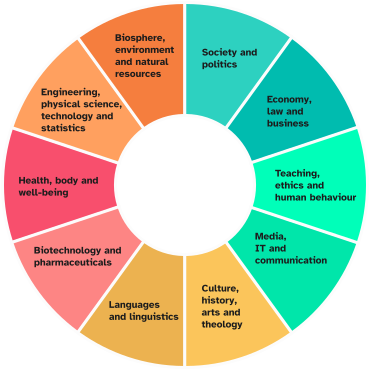
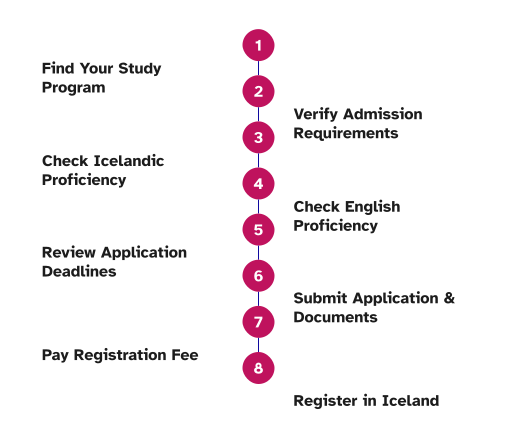

Additional information

The University of Iceland collaborates with over 400 universities worldwide. This provides a unique opportunity to pursue part of your studies at an international university thus gaining added experience and fresh insight into your field of study.

Students generally have the opportunity to join an exchange programme, internship, or summer courses. However, exchanges are always subject to faculty approval.

Students have the opportunity to have courses evaluated as part of their studies at the University of Iceland, so their stay does not have to affect the duration of their studies.

An education in this area can open up opportunities in:

  • Policy making
  • Curriculum design
  • Various positions overseeing the education system

This list is not exhaustive.

Kennó is the organisation for student teachers at the University of Iceland. Kennó organises events such as socials for new students, annual galas and workplace tours. Kennó has also organised the Come and Teach project, which is aimed at publicising teaching degrees.

Students' comments
""
Students appreciate the University of Iceland for its strong academic reputation, modern campus facilities, close-knit community, and affordable tuition.
Helpful content
Aurora Cooperation

Study wheel

What interests you?

Aurora Cooperation

How to apply

Follow the path

Contact us

If you still have questions, feel free to contact us.

School of Education
9:00 am - 3:00 pm
General Service and social media

The Service Desk is a point of access for all services. You can drop in at the University Centre or use the WebChat at the bottom right of this page.

Follow the School of Education on Instagram,   Youtube
and Facebook

University of Iceland, Saga (Building)

Share

Did this help?

Why wasn't this information helpful

Limit to 250 characters.