""
Language skills
required, minimum level of B2
Programme length
One year.
Study mode
Face-to-face learning
Application status
International students:
Students with Icelandic or Nordic citizenship:
Overview

  • Are you interested in web design?
  • Do you want to learn more about digital communication?
  • Do you want to study a creative subject?
  • Are you looking for a practical programme?

This programme is designed for people working in careers that require knowledge of digital communication, including websites, podcasts or videos.

Students will develop a good foundation in the subject, preparing them to work in digital media. Emphasis is also placed on innovation and entrepreneurship, as well as practical methods for executing ideas. Students will explore how entrepreneurs manage ideas and how creative organisations are run.

The programme is designed for students who have completed an undergraduate degree.

Programme structure

The programme is 60 ECTS and can be completed in one year of full-time study or a longer period of part-time study.

The programme is made up of:

  • Mandatory courses, 30 ECTS
  • Elective courses, 30 ECTS

Students can take a maximum of 10 ECTS in vocational training.

Main objectives

Recent technological developments have revolutionised the world, and future developments will drive further change. The world of communication is no exception. This means there is growing demand for people with the skills and abilities to lead innovation in the field of digital development in the business community, companies, institutions and NGOs. This programme is designed to meet that demand.

Organisation of teaching

The programme is taught in Icelandic.

Other

Students who have completed this programme may apply to transfer up to 45 ECTS to the MA in Applied Studies in Culture and Communication or the MA in Cultural Communication.

BA or equivalent with a first class grade (7,25)  is a general requirement. Work experience may be taken into consideration should the GPA be below 7.25.

A diploma in digital communication and innovation requires 60 ECTS. The programme is divided into the following parts: Mandatory courses 30 ECTS and 30 ECTS for elective courses. It is permitted to complete maximum 10 ECTS in internship

The following documents must accompany an application for this programme:
  • CV
  • Statement of purpose
  • Reference 1, Name and email
  • Reference 2, Name and email
  • Certified copies of diplomas and transcripts

Further information on supporting documents can be found here

Programme structure

Check below to see how the programme is structured.

This programme does not offer specialisations.

First year | Fall
The Cold War: Art, culture and literature (HMM703F)
Restricted elective course, conditions apply
10 ECTS, credits
Course Description

The course explores the relationship between political and aesthetic discourse in Iceland during the era of the cultural Cold War, a global ideological struggle waged by the two superpowers, the United States and the Soviet Union, for the hearts and minds of populations around the world in the latter half of the 20th century. The course draws on interdisciplinary research on the Cold War, with a focus on the interplay between global influences and local conditions. This glocal approach allows for an examination of Icelandic agents in the Cold War not only as representatives of the two empires, the United States and the Soviet Union, but also based on their own cultural values and interests. A mixed methodology will be employed, incorporating theories and methods from the social sciences, as well as from art history, literary studies, and historiography. Special emphasis will be placed on the analysis of literary texts and artworks, while attention will also be given to the participation of Icelandic intellectuals and artists in international cultural activities. Students will explore how the Cold War has been addressed in recent years, both in academic contexts and in public dissemination through exhibitions, podcasts, and graphic novels.

Language of instruction: Icelandic
Face-to-face learning
First year | Fall
Communication channels I, documentaries, texts, images (HMM122F)
Restricted elective course, conditions apply
10 ECTS, credits
Course Description

In the courses Communication channels I and Communication channels II, the basics of methods for the dissemination of cultural material in the humanities and social sciences are presented. Communication channels I is in the fall semester, while Communication channels II is in the spring semester. 

In Communication channels I, the students are working with a) text and images in the first half of the semester and b) short documentaries in the second half of the course. Each subject weighs 50% in the course. Concerning a) Students will receive training in article writing and discourse analysis on the one hand and use of images and image analysis on the other.  Concerning b) Students work on making short documentaries. It includes basic training in screenwriting, shooting and editing, and students work in groups on a documentary, according to a specific theme. 

There are no exams in the course. Instead, students work on projects, individual and group projects. They are the following:

  1. Analysis of texts and images
  2. An article with an image on a specific theme for publication, about 800 words.
  3. A group project where students work on a short documentary that is shown at the end of the course. Emphasis is placed on common themes and group work in the course. The course is not taught remotely.
Language of instruction: Icelandic
Face-to-face learning
First year | Fall
Radio production and podcasting (HMM235F)
Restricted elective course, conditions apply
10 ECTS, credits
Course Description

The course is run in cooperation with the state radio station: RÚV - Rás 1. Discussion will take place into the presentation of radio/audio material, various examples being examined. Attention will be given to the nature of audio communication and the possibilities of audio communication in the present media environment. Attention is also paid to concept development, interview techniques, recording techniques, dramaturgy and editing, accentuating sustainability and self-reliance. All students will complete a final project involving the making of radio programmes.

Language of instruction: Icelandic
Face-to-face learning
First year | Fall
Internship (HMM013F)
Restricted elective course, conditions apply
5 ECTS, credits
Course Description

Internships on institutions/ organization, are available for students in Applied Studies of Culture and Communications. Students who wish to go on an internship are to contact the supervisor of the study program about the possibility of an internship. It should be noted that there is a limited supply of internships.

Language of instruction: Icelandic
First year | Fall
Internship (HMM014F)
Restricted elective course, conditions apply
10 ECTS, credits
Course Description

Internships on institutions/ organization, are available for students in Applied Studies of Culture and Communications. Students who wish to go on an internship are to contact the supervisor of the study program about the possibility of an internship. It should be noted that there is a limited supply of internships.

Language of instruction: Icelandic
First year | Fall
Innovation and Venture Development (HMM123F)
A mandatory (required) course for the programme
10 ECTS, credits
Course Description

In the course, students develop venture projects from ideation to product. Emphasis is placed on practical work on real-world issues where students apply user-centered methods, work with business models, and conduct diverse analyses and plans.

The first part of the course will introduce design thinking and the basics of project management. The second part will be taught in collaboration with industrial engineering and business administration.

The course is based on workshops and collaboration between students with different academic backgrounds. Emphasis is placed on critical analysis of opportunities for innovation and entrepreneurship, creative solution-seeking, and the development of ideas based on user needs. Students will be introduced to methods for testing and communicating ideas and solutions and will become familiar with the practical and societal impacts of innovation on a broad basis. The course is suitable for students who want to strengthen entrepreneurial thinking and learn to apply innovation methods, whether within organizations, operating companies, or as independent entrepreneurs.

Language of instruction: Icelandic
Face-to-face learning
First year | Fall
Fundamentals in Web Communications (HMM120F)
A mandatory (required) course for the programme
10 ECTS, credits
Course Description

Constant technological development and emphasis on digital solutions has brought about frequent and numerous changes in the role of the webmaster. In this course, Efforts will be made to provide students with good insight into the main aspects of the webmaster's work. The writings of experts and scholars will be examined, and students will be introduced to the necessary tools and equipment. Professionals in the field will visit and share their experience with students.

The job of a web editor is often integrated with general web management. Students get a good insight into web editing and writing for digital media. The main aspects that a webmaster / web editor needs to be able to master will be discussed, such as information architecture, writing for the web, presentation of images, fundamentals in web design, accessibility, usability, security, analytics, content management systems (CMS), and basic web interface technology.

Students set up their own websites and use a CMS of their choice, e.g., WordPress or Wix, which are both available in free versions, and some of the assignments are submitted on there. In this way, students gain training in setting up a simple website. Particular attention is drawn to the fact that instruction in the use of the CMS is not part of the course. Those who have no or limited experience, in the use of CMS, are advised that YouTube has numerous videos where you can learn about the systems, from the basics to much more complex aspects that are expected in this course.

Language of instruction: Icelandic
Face-to-face learning
First year | Fall
Theory of Creative AI: Analysing the Impact of AI on Creative Work (MFR715M)
Free elective course within the programme
10 ECTS, credits
Course Description

This course explores the evolving relationship between artificial intelligence and creative practices, focusing on the artistic, philosophical, ethical, and socio-cultural dimensions of AI-driven creativity. Grounded in the humanities, with emphasis on creativity studies, the course will enable students to critically assess how generative AI is reshaping traditional notions of creativity, authorship, and artistic production. Having explored key definitions of creativity itself, the course covers key issues such as the automation of creative work, the implications of AI-generated content for intellectual property and copyright, and the ethical dilemmas surrounding cultural appropriation in the digital age. Students will engage with debates on the tension between industrial AI big-data-driven systems versus small-data approaches, examining the consequences for artistic innovation and originality. Through hands-on exercises and real-world case studies, students will explore a variety of creative works, study production platforms where AI technologies are used, and gain practical experience in the application of AI for creative purposes. The course integrates modern theories of creativity with critical analysis of AI, and it will challenge students to rethink the boundaries of human and machine creativity. Course assessment will be based on creative work diaries that students will keep during the course, active participation in class, as well as an oral presentation of a short, written piece.

Language of instruction: English
Face-to-face learning
Distance learning
Prerequisites
Not taught this semester
First year | Fall
Drama and theatre laboratory in the digital world (LVG205M)
Free elective course within the programme
10 ECTS, credits
Course Description

The course is a mixture of academic and practical creative projects. The essence of the course is training students to work independently, professionally and creatively with drama. In addition, students are trained in the use of equipment and technology in doing short films and cinema, radio theater and social media for the future of the subject. Emphasis is placed on students acquiring understanding and knowledge of the work of drama teachers both theoretically and professionally. The latest research are introduced and projects prepared in connection with the research.

Language of instruction: Icelandic
Face-to-face learning
Distance learning
Prerequisites
Attendance required in class
First year | Fall
Human Computer Interaction (TÖL502M)
Free elective course within the programme
6 ECTS, credits
Course Description

Usually taught every second year.

The objective of the course is to allow students to examine more closely than is done in the introductory course Graphical User Interface Programming  HBV201G specific factors of HCI. The factors covered are user interface design using prototyping, programming of smart devices and users‘ acceptability of the software. There will be emphasis on different techniques and tools to develop prototypes. Also, on the design of user interfaces and native programming for smart phones or pads. The development process will be aimed at ensuring accessibility and acceptability of users. Students work on small projects individually, or on larger projects in groups. 

Language of instruction: Icelandic
Face-to-face learning
The course is taught if the specified conditions are met
Prerequisites
Not taught this semester
First year | Fall
Journalism 1 (BLF110F)
Free elective course within the programme
8 ECTS, credits
Course Description

The aim of course is to introduce to students the journalistic profession with an emphasis on reporting and producing news for different media.  Main concepts and methods in newswriting are discussed, such as news values, news gathering and news construction. Students will be trained in writing in a focused, accurate and articulate manner.  Students will get a basic training in using social media to gather and distribute content.

Assignments. Students write news stories and articles for the study program´s online news site, and at times for other news media.

Language of instruction: Icelandic
Face-to-face learning
Not taught this semester
First year | Fall
Digital Media (BLF314F)
Free elective course within the programme
6 ECTS, credits
Course Description

This course focuses on digital media from multiple perspectives, with an emphasis on social media. It looks at digital and social media in an historical context and how it has influenced professional media, consumers and users. In the first half main theories will be discussed and explained. In the latter examples of the main features of digital and social media will be explored. It´s relation to traditional media, it´s business model, rules and regulation regarding social media, as well as influences on public debate and peoples private life.

Language of instruction: Icelandic
Face-to-face learning
Distance learning
First year | Fall
Introduction to quantitative research (FMÞ001F)
Free elective course within the programme
10 ECTS, credits
Course Description

The main subject of the course is quantitative methods and statistics used in social sciences. The focus will be on research design, sample methods and designing questionnaires. The statistical part will cover descriptive and inferential statistics. Special emphasis will be on factorial ANOVA and multiple regression. Students will get practical training in data analysis using jamovi. Students can use their own data.

Language of instruction: Icelandic
Face-to-face learning
First year | Fall
Introduction to Qualitative Research (FMÞ103F)
Free elective course within the programme
10 ECTS, credits
Course Description

The course’s objective is to introduce students to the diverse, academic criteria of qualitative research in social sciences and secondly that student’s gain experience in using qualitative methods. Furthermore, the course is practical in nature where each student works on an independent research assignment, which consists of designing and preparing a research project, collecting and analyzing data, and writing the main findings with guidance from the teacher. Research preparation, the creation of a research plan, data collection and analysis along with academic writing will be extensively covered during the course.

Language of instruction: Icelandic
Face-to-face learning
Distance learning
First year | Fall
Information Retrieval and Digital dissemination (UPP215F)
Free elective course within the programme
10 ECTS, credits
Course Description

The course is built on two interwoven pillars: information retrieval and digital dissemination. On the one hand, it addresses how to access, evaluate, and utilize information in a dynamic environment, with special emphasis on using artificial intelligence to refine searches and process text. On the other hand, the focus is on digital communication and strategy, where the use of social media for knowledge dissemination is at the forefront. The objective is for students to acquire comprehensive skills in finding reliable information and communicating it to diverse groups in a clear and responsible manner.

Language of instruction: Icelandic
Distance learning
First year | Fall
E Business and Digital marketing (VIÐ195F)
Free elective course within the programme
7,5 ECTS, credits
Course Description

The digital environment is radically changing the possibilities of marketing communication and how business is conducted. Digital technology has opened countless possibilities in marketing, business implementation has undergone tremendous changes and significant innovation and business model development has taken place.

The course will cover the development and impact of digital technology on  marketing measures and business practices, how digital technology can be used to support other ways of marketing and how it will shape future marketing policies within a global environment. Special emphasis is placed on new opportunities in direct marketing and to increase customer loyalty. Furthermore, the opportunities offered by digital technology to improve work processes as well as to increase efficiency and effectiveness in operations are discussed.

strategy, value chain impact, digital marketing, business relationship management, customer experience, service design and business transformation will be discussed.

Students will gain an understanding of the role and importance of digital marketing in various type of operations, such as private companies, public activities, and voluntary organizations. The course will furthermore cover contemporary issues such as security, website design, globalization, analysis of return on investment and changing consumer lifestyles.

Great emphasis is placed on active participation of students in the course. This is not a technical course, but the emphasis is on students gaining insight into choosing the most suitable digital technology and media to increase competitiveness.

Language of instruction: Icelandic
Face-to-face learning
Course taught in period II
First year | Spring 1
Communication channels II. Oral presentations, exhibitions, digital communication (HMM242F)
Restricted elective course, conditions apply
10 ECTS, credits
Course Description

In the course Communication channels II during the spring semester the students work with the following communication methods: a) oral presentation and b) exhibitions of cultural and historical material. Digital communication will be integrated into both aspects.

The students will work with the basics of oral presentation and practice in smaller and larger groups. Basic issues regarding the organization of conferences and seminars and their management will also be reviewed and a conference is held where all students present their projects. Digital communication will also be integrated into this section. Following is a section about exhibitions with connection to digital communication. The basics of exhibitions and different ways of presentation will be discussed.  The basics of digital communication will be covered, what are the main channels, advantages and disadvantages, and what rules apply to the presentation of texts on the web.

There are no exams in the course. Instead, students work on projects, individual and group projects. They are the following:

  1. Lecture at a conference and other projects in that context
  2. Exhibition analysis and a practical project in connection with exhibitions organized by the City History Museum (Borgarsögusafn)
  3. Digital communication will be integrated into both aspects. Emphasis is placed on common themes and group work in the course.

The course is not taught remotely.

Language of instruction: Icelandic
First year | Spring 1
Creative Documentary (HMM220F)
Restricted elective course, conditions apply
10 ECTS, credits
Course Description

The basic types of documentaries will be discussed as well as methods of documentary making, editing and cinematography. Emphasis will be put on practical projects and students will be required to make at least one documentary during the course.

Language of instruction: Icelandic
Face-to-face learning
First year | Spring 1
Culture and Cultural Communication (HMM240F)
Restricted elective course, conditions apply
10 ECTS, credits
Course Description

The course critically engages with the concept of culture, addressing predominant conceptualizations while simultaneously exploring the role, conditions and influence of culture in the present. The objective is to generate a disciplined discussion on cultural heritage, cultural politics and policy, and cultural sustainability in conjunction with questions on the practicality of presenting and communicating expressions of culture. Attention is paid to the relationship between the cultural field and other social, political and economic aspects of society and how these enable and limit the communication and dissemination of cultural resources. Questions on how cultural heritage, traditions, collective memory, ideas on authenticity and identity generate the formation and reproduction of cultural constellations are dealt with as well as how conceptualizations such as ‘cultural capital’, ‘cultural hegemony’ and ‘authorized discourse on heritage’ can be employed to understand and analyze manifestations of culture.

Language of instruction: Icelandic
Face-to-face learning
First year | Spring 1
Internship (HMM013F)
Restricted elective course, conditions apply
5 ECTS, credits
Course Description

Internships on institutions/ organization, are available for students in Applied Studies of Culture and Communications. Students who wish to go on an internship are to contact the supervisor of the study program about the possibility of an internship. It should be noted that there is a limited supply of internships.

Language of instruction: Icelandic
First year | Spring 1
Internship (HMM014F)
Restricted elective course, conditions apply
10 ECTS, credits
Course Description

Internships on institutions/ organization, are available for students in Applied Studies of Culture and Communications. Students who wish to go on an internship are to contact the supervisor of the study program about the possibility of an internship. It should be noted that there is a limited supply of internships.

Language of instruction: Icelandic
First year | Spring 1
Cultural and Digital Innovation (HMM241F)
A mandatory (required) course for the programme
10 ECTS, credits
Course Description

The course explores diverse manifestations of cultural innovation within the fields of culture and mediation, with a special emphasis on the impact and potential of digital technologies. Attention is given to the management and operation of organizations working in the cultural and creative sectors, and to how innovation can support cultural value, sustainability, and the development of new modes of mediation.

Students are introduced to key theories and methods related to cultural management, creative thinking, and entrepreneurship in cultural contexts. The course examines the interrelations between culture, economy, and technology, and how cultural innovation can foster participation, new business models, and emerging forms of cultural communication and experience.

Language of instruction: Icelandic
Face-to-face learning
First year | Spring 1
Editing and design of printing tools (RÚT803F)
Free elective course within the programme
10 ECTS, credits
Course Description

An introduction to the collaboration and division of work between an editor and a graphic designer in the creation of printed work with emphasis on the importance of typography. Students will gain insight into the basis of typography and preparation for print as well as learning about the graphic designer's tools in context with principal kinds of print. The course will include readings and discourse on the influence of graphic design on legibility and understanding, as well as discourse on quality, usefulness, aesthetics and practicality in graphic design.

The student will present and hand in a written analysis on a printed good of their own choice and are also encouraged to actively participate in discussions in class. The final project consists of creating your own publishing project and communicating ideas on its editing graphically and in writing.

Language of instruction: Icelandic
Face-to-face learning
Distance learning
First year | Spring 1
Web Management and Information Architecture (UPP110F)
Free elective course within the programme
10 ECTS, credits
Course Description

The course aims to provide insight into information architecture and the fundamentals of web management. Emphasis is placed on information architecture, including site structure, navigation systems, naming systems, labeling, and user information behavior. Methodologies for organizing information on websites are discussed, along with considerations for meeting user needs. The course also addresses other aspects of web management, such as needs analysis, user testing, and accessibility.

Language of instruction: Icelandic
Distance learning
Not taught this semester
First year | Spring 1
Applied folklore (ÞJÓ445M)
Free elective course within the programme
10 ECTS, credits
Course Description

This course introduces the ways in which the fields and methods of folklore/ethnology are and may be put to use, how their application may help broaden and deepen public debates and positively affect society's self-understanding and self-fashioning. We discuss how folklore/ethnology may be put to use in tourism, museums, arts and various media. One area of focus is also the accessibility and uses of folklore collections. We explore, moreover, various scholarly and popular genres in which the conclusions of ethnological research (based on historical sources, interviews and other fieldwork methods) may be disseminated: exhibitions, festivals, events, articles, books, websites, radioshows or documentaries. Different means of reaching different groups of people will be discussed and moral, financial and political issues will be addressed.

The course will partly be taught in intensive workshops, 3 days at the beginning of the semester in Reykjavík and 4 days during project week in Hólmavík in the Westfjords. Students will work on projects in applied ethnology/public folklore. There will be no final exam.

Language of instruction: Icelandic
Distance learning
First year
  • Fall
  • HMM703F
    The Cold War: Art, culture and literature
    Restricted elective course
    10
    Restricted elective course, conditions apply
    10 ECTS, credits
    Course Description

    The course explores the relationship between political and aesthetic discourse in Iceland during the era of the cultural Cold War, a global ideological struggle waged by the two superpowers, the United States and the Soviet Union, for the hearts and minds of populations around the world in the latter half of the 20th century. The course draws on interdisciplinary research on the Cold War, with a focus on the interplay between global influences and local conditions. This glocal approach allows for an examination of Icelandic agents in the Cold War not only as representatives of the two empires, the United States and the Soviet Union, but also based on their own cultural values and interests. A mixed methodology will be employed, incorporating theories and methods from the social sciences, as well as from art history, literary studies, and historiography. Special emphasis will be placed on the analysis of literary texts and artworks, while attention will also be given to the participation of Icelandic intellectuals and artists in international cultural activities. Students will explore how the Cold War has been addressed in recent years, both in academic contexts and in public dissemination through exhibitions, podcasts, and graphic novels.

    Face-to-face learning
    Prerequisites
  • HMM122F
    Communication channels I, documentaries, texts, images
    Restricted elective course
    10
    Restricted elective course, conditions apply
    10 ECTS, credits
    Course Description

    In the courses Communication channels I and Communication channels II, the basics of methods for the dissemination of cultural material in the humanities and social sciences are presented. Communication channels I is in the fall semester, while Communication channels II is in the spring semester. 

    In Communication channels I, the students are working with a) text and images in the first half of the semester and b) short documentaries in the second half of the course. Each subject weighs 50% in the course. Concerning a) Students will receive training in article writing and discourse analysis on the one hand and use of images and image analysis on the other.  Concerning b) Students work on making short documentaries. It includes basic training in screenwriting, shooting and editing, and students work in groups on a documentary, according to a specific theme. 

    There are no exams in the course. Instead, students work on projects, individual and group projects. They are the following:

    1. Analysis of texts and images
    2. An article with an image on a specific theme for publication, about 800 words.
    3. A group project where students work on a short documentary that is shown at the end of the course. Emphasis is placed on common themes and group work in the course. The course is not taught remotely.
    Face-to-face learning
    Prerequisites
  • HMM235F
    Radio production and podcasting
    Restricted elective course
    10
    Restricted elective course, conditions apply
    10 ECTS, credits
    Course Description

    The course is run in cooperation with the state radio station: RÚV - Rás 1. Discussion will take place into the presentation of radio/audio material, various examples being examined. Attention will be given to the nature of audio communication and the possibilities of audio communication in the present media environment. Attention is also paid to concept development, interview techniques, recording techniques, dramaturgy and editing, accentuating sustainability and self-reliance. All students will complete a final project involving the making of radio programmes.

    Face-to-face learning
    Prerequisites
  • HMM013F
    Internship
    Restricted elective course
    5
    Restricted elective course, conditions apply
    5 ECTS, credits
    Course Description

    Internships on institutions/ organization, are available for students in Applied Studies of Culture and Communications. Students who wish to go on an internship are to contact the supervisor of the study program about the possibility of an internship. It should be noted that there is a limited supply of internships.

    Prerequisites
  • HMM014F
    Internship
    Restricted elective course
    10
    Restricted elective course, conditions apply
    10 ECTS, credits
    Course Description

    Internships on institutions/ organization, are available for students in Applied Studies of Culture and Communications. Students who wish to go on an internship are to contact the supervisor of the study program about the possibility of an internship. It should be noted that there is a limited supply of internships.

    Prerequisites
  • HMM123F
    Innovation and Venture Development
    Mandatory (required) course
    10
    A mandatory (required) course for the programme
    10 ECTS, credits
    Course Description

    In the course, students develop venture projects from ideation to product. Emphasis is placed on practical work on real-world issues where students apply user-centered methods, work with business models, and conduct diverse analyses and plans.

    The first part of the course will introduce design thinking and the basics of project management. The second part will be taught in collaboration with industrial engineering and business administration.

    The course is based on workshops and collaboration between students with different academic backgrounds. Emphasis is placed on critical analysis of opportunities for innovation and entrepreneurship, creative solution-seeking, and the development of ideas based on user needs. Students will be introduced to methods for testing and communicating ideas and solutions and will become familiar with the practical and societal impacts of innovation on a broad basis. The course is suitable for students who want to strengthen entrepreneurial thinking and learn to apply innovation methods, whether within organizations, operating companies, or as independent entrepreneurs.

    Face-to-face learning
    Prerequisites
  • HMM120F
    Fundamentals in Web Communications
    Mandatory (required) course
    10
    A mandatory (required) course for the programme
    10 ECTS, credits
    Course Description

    Constant technological development and emphasis on digital solutions has brought about frequent and numerous changes in the role of the webmaster. In this course, Efforts will be made to provide students with good insight into the main aspects of the webmaster's work. The writings of experts and scholars will be examined, and students will be introduced to the necessary tools and equipment. Professionals in the field will visit and share their experience with students.

    The job of a web editor is often integrated with general web management. Students get a good insight into web editing and writing for digital media. The main aspects that a webmaster / web editor needs to be able to master will be discussed, such as information architecture, writing for the web, presentation of images, fundamentals in web design, accessibility, usability, security, analytics, content management systems (CMS), and basic web interface technology.

    Students set up their own websites and use a CMS of their choice, e.g., WordPress or Wix, which are both available in free versions, and some of the assignments are submitted on there. In this way, students gain training in setting up a simple website. Particular attention is drawn to the fact that instruction in the use of the CMS is not part of the course. Those who have no or limited experience, in the use of CMS, are advised that YouTube has numerous videos where you can learn about the systems, from the basics to much more complex aspects that are expected in this course.

    Face-to-face learning
    Prerequisites
  • MFR715M
    Theory of Creative AI: Analysing the Impact of AI on Creative Work
    Elective course
    10
    Free elective course within the programme
    10 ECTS, credits
    Course Description

    This course explores the evolving relationship between artificial intelligence and creative practices, focusing on the artistic, philosophical, ethical, and socio-cultural dimensions of AI-driven creativity. Grounded in the humanities, with emphasis on creativity studies, the course will enable students to critically assess how generative AI is reshaping traditional notions of creativity, authorship, and artistic production. Having explored key definitions of creativity itself, the course covers key issues such as the automation of creative work, the implications of AI-generated content for intellectual property and copyright, and the ethical dilemmas surrounding cultural appropriation in the digital age. Students will engage with debates on the tension between industrial AI big-data-driven systems versus small-data approaches, examining the consequences for artistic innovation and originality. Through hands-on exercises and real-world case studies, students will explore a variety of creative works, study production platforms where AI technologies are used, and gain practical experience in the application of AI for creative purposes. The course integrates modern theories of creativity with critical analysis of AI, and it will challenge students to rethink the boundaries of human and machine creativity. Course assessment will be based on creative work diaries that students will keep during the course, active participation in class, as well as an oral presentation of a short, written piece.

    Face-to-face learning
    Distance learning
    Prerequisites
  • Not taught this semester
    LVG205M
    Drama and theatre laboratory in the digital world
    Elective course
    10
    Free elective course within the programme
    10 ECTS, credits
    Course Description

    The course is a mixture of academic and practical creative projects. The essence of the course is training students to work independently, professionally and creatively with drama. In addition, students are trained in the use of equipment and technology in doing short films and cinema, radio theater and social media for the future of the subject. Emphasis is placed on students acquiring understanding and knowledge of the work of drama teachers both theoretically and professionally. The latest research are introduced and projects prepared in connection with the research.

    Face-to-face learning
    Distance learning
    Prerequisites
    Attendance required in class
  • TÖL502M
    Human Computer Interaction
    Elective course
    6
    Free elective course within the programme
    6 ECTS, credits
    Course Description

    Usually taught every second year.

    The objective of the course is to allow students to examine more closely than is done in the introductory course Graphical User Interface Programming  HBV201G specific factors of HCI. The factors covered are user interface design using prototyping, programming of smart devices and users‘ acceptability of the software. There will be emphasis on different techniques and tools to develop prototypes. Also, on the design of user interfaces and native programming for smart phones or pads. The development process will be aimed at ensuring accessibility and acceptability of users. Students work on small projects individually, or on larger projects in groups. 

    Face-to-face learning
    The course is taught if the specified conditions are met
    Prerequisites
  • Not taught this semester
    BLF110F
    Journalism 1
    Elective course
    8
    Free elective course within the programme
    8 ECTS, credits
    Course Description

    The aim of course is to introduce to students the journalistic profession with an emphasis on reporting and producing news for different media.  Main concepts and methods in newswriting are discussed, such as news values, news gathering and news construction. Students will be trained in writing in a focused, accurate and articulate manner.  Students will get a basic training in using social media to gather and distribute content.

    Assignments. Students write news stories and articles for the study program´s online news site, and at times for other news media.

    Face-to-face learning
    Prerequisites
  • Not taught this semester
    BLF314F
    Digital Media
    Elective course
    6
    Free elective course within the programme
    6 ECTS, credits
    Course Description

    This course focuses on digital media from multiple perspectives, with an emphasis on social media. It looks at digital and social media in an historical context and how it has influenced professional media, consumers and users. In the first half main theories will be discussed and explained. In the latter examples of the main features of digital and social media will be explored. It´s relation to traditional media, it´s business model, rules and regulation regarding social media, as well as influences on public debate and peoples private life.

    Face-to-face learning
    Distance learning
    Prerequisites
  • FMÞ001F
    Introduction to quantitative research
    Elective course
    10
    Free elective course within the programme
    10 ECTS, credits
    Course Description

    The main subject of the course is quantitative methods and statistics used in social sciences. The focus will be on research design, sample methods and designing questionnaires. The statistical part will cover descriptive and inferential statistics. Special emphasis will be on factorial ANOVA and multiple regression. Students will get practical training in data analysis using jamovi. Students can use their own data.

    Face-to-face learning
    Prerequisites
  • FMÞ103F
    Introduction to Qualitative Research
    Elective course
    10
    Free elective course within the programme
    10 ECTS, credits
    Course Description

    The course’s objective is to introduce students to the diverse, academic criteria of qualitative research in social sciences and secondly that student’s gain experience in using qualitative methods. Furthermore, the course is practical in nature where each student works on an independent research assignment, which consists of designing and preparing a research project, collecting and analyzing data, and writing the main findings with guidance from the teacher. Research preparation, the creation of a research plan, data collection and analysis along with academic writing will be extensively covered during the course.

    Face-to-face learning
    Distance learning
    Prerequisites
  • UPP215F
    Information Retrieval and Digital dissemination
    Elective course
    10
    Free elective course within the programme
    10 ECTS, credits
    Course Description

    The course is built on two interwoven pillars: information retrieval and digital dissemination. On the one hand, it addresses how to access, evaluate, and utilize information in a dynamic environment, with special emphasis on using artificial intelligence to refine searches and process text. On the other hand, the focus is on digital communication and strategy, where the use of social media for knowledge dissemination is at the forefront. The objective is for students to acquire comprehensive skills in finding reliable information and communicating it to diverse groups in a clear and responsible manner.

    Distance learning
    Prerequisites
  • VIÐ195F
    E Business and Digital marketing
    Elective course
    7,5
    Free elective course within the programme
    7,5 ECTS, credits
    Course Description

    The digital environment is radically changing the possibilities of marketing communication and how business is conducted. Digital technology has opened countless possibilities in marketing, business implementation has undergone tremendous changes and significant innovation and business model development has taken place.

    The course will cover the development and impact of digital technology on  marketing measures and business practices, how digital technology can be used to support other ways of marketing and how it will shape future marketing policies within a global environment. Special emphasis is placed on new opportunities in direct marketing and to increase customer loyalty. Furthermore, the opportunities offered by digital technology to improve work processes as well as to increase efficiency and effectiveness in operations are discussed.

    strategy, value chain impact, digital marketing, business relationship management, customer experience, service design and business transformation will be discussed.

    Students will gain an understanding of the role and importance of digital marketing in various type of operations, such as private companies, public activities, and voluntary organizations. The course will furthermore cover contemporary issues such as security, website design, globalization, analysis of return on investment and changing consumer lifestyles.

    Great emphasis is placed on active participation of students in the course. This is not a technical course, but the emphasis is on students gaining insight into choosing the most suitable digital technology and media to increase competitiveness.

    Face-to-face learning
    Prerequisites
    Course taught in period II
  • Spring 2
  • HMM242F
    Communication channels II. Oral presentations, exhibitions, digital communication
    Restricted elective course
    10
    Restricted elective course, conditions apply
    10 ECTS, credits
    Course Description

    In the course Communication channels II during the spring semester the students work with the following communication methods: a) oral presentation and b) exhibitions of cultural and historical material. Digital communication will be integrated into both aspects.

    The students will work with the basics of oral presentation and practice in smaller and larger groups. Basic issues regarding the organization of conferences and seminars and their management will also be reviewed and a conference is held where all students present their projects. Digital communication will also be integrated into this section. Following is a section about exhibitions with connection to digital communication. The basics of exhibitions and different ways of presentation will be discussed.  The basics of digital communication will be covered, what are the main channels, advantages and disadvantages, and what rules apply to the presentation of texts on the web.

    There are no exams in the course. Instead, students work on projects, individual and group projects. They are the following:

    1. Lecture at a conference and other projects in that context
    2. Exhibition analysis and a practical project in connection with exhibitions organized by the City History Museum (Borgarsögusafn)
    3. Digital communication will be integrated into both aspects. Emphasis is placed on common themes and group work in the course.

    The course is not taught remotely.

    Prerequisites
  • HMM220F
    Creative Documentary
    Restricted elective course
    10
    Restricted elective course, conditions apply
    10 ECTS, credits
    Course Description

    The basic types of documentaries will be discussed as well as methods of documentary making, editing and cinematography. Emphasis will be put on practical projects and students will be required to make at least one documentary during the course.

    Face-to-face learning
    Prerequisites
  • HMM240F
    Culture and Cultural Communication
    Restricted elective course
    10
    Restricted elective course, conditions apply
    10 ECTS, credits
    Course Description

    The course critically engages with the concept of culture, addressing predominant conceptualizations while simultaneously exploring the role, conditions and influence of culture in the present. The objective is to generate a disciplined discussion on cultural heritage, cultural politics and policy, and cultural sustainability in conjunction with questions on the practicality of presenting and communicating expressions of culture. Attention is paid to the relationship between the cultural field and other social, political and economic aspects of society and how these enable and limit the communication and dissemination of cultural resources. Questions on how cultural heritage, traditions, collective memory, ideas on authenticity and identity generate the formation and reproduction of cultural constellations are dealt with as well as how conceptualizations such as ‘cultural capital’, ‘cultural hegemony’ and ‘authorized discourse on heritage’ can be employed to understand and analyze manifestations of culture.

    Face-to-face learning
    Prerequisites
  • HMM013F
    Internship
    Restricted elective course
    5
    Restricted elective course, conditions apply
    5 ECTS, credits
    Course Description

    Internships on institutions/ organization, are available for students in Applied Studies of Culture and Communications. Students who wish to go on an internship are to contact the supervisor of the study program about the possibility of an internship. It should be noted that there is a limited supply of internships.

    Prerequisites
  • HMM014F
    Internship
    Restricted elective course
    10
    Restricted elective course, conditions apply
    10 ECTS, credits
    Course Description

    Internships on institutions/ organization, are available for students in Applied Studies of Culture and Communications. Students who wish to go on an internship are to contact the supervisor of the study program about the possibility of an internship. It should be noted that there is a limited supply of internships.

    Prerequisites
  • HMM241F
    Cultural and Digital Innovation
    Mandatory (required) course
    10
    A mandatory (required) course for the programme
    10 ECTS, credits
    Course Description

    The course explores diverse manifestations of cultural innovation within the fields of culture and mediation, with a special emphasis on the impact and potential of digital technologies. Attention is given to the management and operation of organizations working in the cultural and creative sectors, and to how innovation can support cultural value, sustainability, and the development of new modes of mediation.

    Students are introduced to key theories and methods related to cultural management, creative thinking, and entrepreneurship in cultural contexts. The course examines the interrelations between culture, economy, and technology, and how cultural innovation can foster participation, new business models, and emerging forms of cultural communication and experience.

    Face-to-face learning
    Prerequisites
  • RÚT803F
    Editing and design of printing tools
    Elective course
    10
    Free elective course within the programme
    10 ECTS, credits
    Course Description

    An introduction to the collaboration and division of work between an editor and a graphic designer in the creation of printed work with emphasis on the importance of typography. Students will gain insight into the basis of typography and preparation for print as well as learning about the graphic designer's tools in context with principal kinds of print. The course will include readings and discourse on the influence of graphic design on legibility and understanding, as well as discourse on quality, usefulness, aesthetics and practicality in graphic design.

    The student will present and hand in a written analysis on a printed good of their own choice and are also encouraged to actively participate in discussions in class. The final project consists of creating your own publishing project and communicating ideas on its editing graphically and in writing.

    Face-to-face learning
    Distance learning
    Prerequisites
  • UPP110F
    Web Management and Information Architecture
    Elective course
    10
    Free elective course within the programme
    10 ECTS, credits
    Course Description

    The course aims to provide insight into information architecture and the fundamentals of web management. Emphasis is placed on information architecture, including site structure, navigation systems, naming systems, labeling, and user information behavior. Methodologies for organizing information on websites are discussed, along with considerations for meeting user needs. The course also addresses other aspects of web management, such as needs analysis, user testing, and accessibility.

    Distance learning
    Prerequisites
  • Not taught this semester
    ÞJÓ445M
    Applied folklore
    Elective course
    10
    Free elective course within the programme
    10 ECTS, credits
    Course Description

    This course introduces the ways in which the fields and methods of folklore/ethnology are and may be put to use, how their application may help broaden and deepen public debates and positively affect society's self-understanding and self-fashioning. We discuss how folklore/ethnology may be put to use in tourism, museums, arts and various media. One area of focus is also the accessibility and uses of folklore collections. We explore, moreover, various scholarly and popular genres in which the conclusions of ethnological research (based on historical sources, interviews and other fieldwork methods) may be disseminated: exhibitions, festivals, events, articles, books, websites, radioshows or documentaries. Different means of reaching different groups of people will be discussed and moral, financial and political issues will be addressed.

    The course will partly be taught in intensive workshops, 3 days at the beginning of the semester in Reykjavík and 4 days during project week in Hólmavík in the Westfjords. Students will work on projects in applied ethnology/public folklore. There will be no final exam.

    Distance learning
    Prerequisites

The timetable shown below is for the current academic year and is FOR REFERENCE ONLY.

Changes may occur for the autumn semester in August and September and for the spring semester in December and January. You will find your final timetable in Ugla when the studies start.

Note! This timetable is not suitable for planning your work schedule if you are a part-time employee.


Additional information

The University of Iceland collaborates with over 400 universities worldwide. This provides a unique opportunity to pursue part of your studies at an international university thus gaining added experience and fresh insight into your field of study.

Students generally have the opportunity to join an exchange programme, internship, or summer courses. However, exchanges are always subject to faculty approval.

Students have the opportunity to have courses evaluated as part of their studies at the University of Iceland, so their stay does not have to affect the duration of their studies.

An education in this area can open up opportunities in:

  • Web management
  • Project management
  • Needs assessments
  • Research
  • Teaching
  • Producing
  • Events management

This list is not exhaustive.

There is no specific student organisation for this programme, but students meet frequently in the Student Cellar.

Students' comments
Portrait photo of Gígja Hólmgeirsdóttir
I pursued web media alongside practical cultural communication and don't regret it. The programme revealed the extensive work behind successful web communication. I focused on web editing, user experience, and web strategy, selecting from diverse courses. The professional and personalised teaching, combined with real-world projects, provided valuable tools for tackling web media challenges.
Atli Týr Ægisson
Having worked on web management and updates for years, I learned valuable new skills in web media courses. These included tools and methods for preparing, maintaining, and presenting web content. I recommend web media studies for those new to web development and those looking to enhance their skills.
Bylgja Valtýsdóttir
I highly recommend the diploma programme in web media at the University of Iceland. It is practical yet academically rigorous, interdisciplinary, and allows taking courses from business, political science, and information science to build a diverse knowledge base. The hands-on projects are demanding but realistic, providing valuable experience in preparing web projects. The programme's comprehensive toolset has given me invaluable skills for my career.
Helpful content
Aurora Cooperation

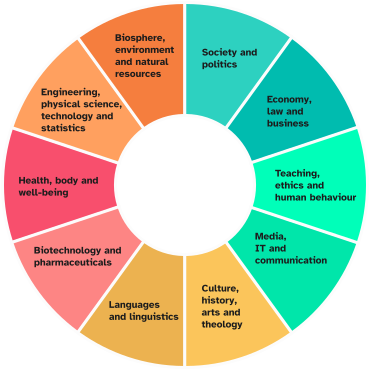
Study wheel

What interests you?

Aurora Cooperation

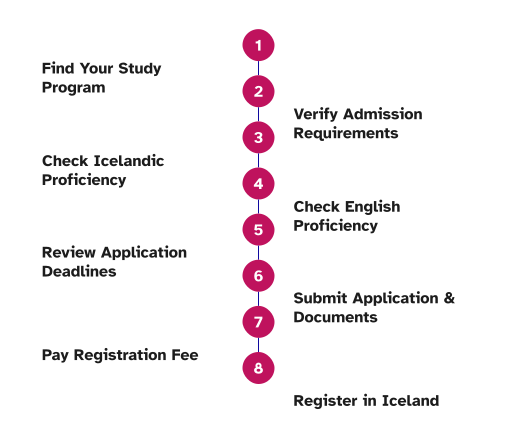
How to apply

Follow the path

Contact us

If you still have questions, feel free to contact us.

School of Humanities
Weekdays: 10-12 am and 1-3 pm
General Service and Social Media

The Service Desk is a point of access for all services. You can drop in at the University Centre or use the WebChat at the bottom right of this page.

Follow the School of Humanities on Instagram,   Youtube
and Facebook

""

Share

Did this help?

Why wasn't this information helpful

Limit to 250 characters.