- Do you want a diverse graduate programme?
- Do you want to support people and help them in times of joy and grief?
- Do you want a programme that allows you to specialise in a range of different areas?
- Are you interested in working with people?
- Do you want an interdisciplinary programme?
The programme is interdisciplinary and focuses on sustainability, diversity and human rights in line with increased emphasis on these issues in teaching and research in international diaconia studies.
Students may specialise in a specific area, for example, by taking:
- graduate courses in pastoral care at the UI Continuing Education Institute
- another graduate programme at the School of Education
- another graduate programme at the School of Social Sciences
Programme structure
The programme is 120 ECTS and is organised as two years of full-time study.
Organisation of teaching
This programme is taught in Icelandic and most textbooks are in English.
Main objectives
The programme aims to provide students with a thorough knowledge of diaconia studies and the fundamental principles of theology. It also aims to prepare students for various careers in all areas of charitable service within the Church of Iceland or various service institutes.
Other
After completing the programme and vocational training at the Church of Iceland, a candidate may apply to be ordained as a deacon.
BA degree, BS degree, BEd degree or equivalent qualification with a first class grade (at least 7.25) or equivalent.
- 50-60 ECTS in diaconia studies / practical theology at the Faculty of Theology and Religious Studies. There are six or seven mandatory courses. This includes an introduction to theology and diaconia studies for students with undergraduate backgrounds in other subjects. Students with a BA in theology are not required to take the introductory course, but may take it as an elective course if they choose. Students who have already completed equivalent mandatory courses at the undergraduate level in practical theology can apply for an exemption, allowing them to take other theology courses instead, in consultation with the programme coordinator.
- 10 ECTS in restricted electives in theological ethics. Students can choose between several courses in theological ethics. The courses offered vary from year to year. These courses are labelled as restricted electives in the course catalogue.
- 10-30 ECTS in graduate level elective courses at the Faculty of Theology and Religious Studies.
- Students can choose between:
- 30 ECTS in interdisciplinary elective courses or a Master’s level micro-credential from another UI faculty. Courses or micro-credentials must be chosen in consultation with the programme coordinator.
- 40 ECTS Master’s level studies in pastoral care at the UI Continuing Education Institute.
- 10 ECTS thesis or final project in diaconia studies.
List of mandatory courses in diaconia studies (see item 1):
- GFR108F Introduction to Theology and Diaconia Studies (10ECTS, taught annually)
- GFR324M Pastoral Care (10ECTS, taught biannually)
- GFR058M Professionalism, leadership and teaching in Ministry (10 ECTS, taught biannually)
- GFRF Liturgy and Hymnology for diaconia student (10 ECTS, taught biannually)
- GFR613F Homiletics for diaconia students (10 ECTS, taught biannually)
- GFR709F The New Testament in Modern Society: Impact, Approach, and Application (5 ECTS, taught biannually)
- GFR109F Church Denominations (5 ECTS, taught biannually)
- CV
- Statement of purpose
- Reference 1, Name and email
- Reference 2, Name and email
Further information on supporting documents can be found here
Programme structure
Check below to see how the programme is structured.
This programme does not offer specialisations.
- First year
- Fall
- Introduction to Theology and Diaconia Studies
- Spiritual and Pastoral care
- The New Testament in Modern Society: Impact, Approach, and Application
- Church Denominations
- Baptism at Crossroads
- Worship and liturgical music 1
- Islam in Past, Present and Future
- Spring 1
- Sexuality, Ethics and Society
- Queer Theologies
- Liturgy and Hymnology for mag.diac. students
- World Christianity: Histories and Futures of a Global Religion
- Exegesis of the Old Testament
- Ecumenical Theology, relations and practices.
Introduction to Theology and Diaconia Studies (GFR108F)
What is diaconia and how do Diaconia Studies relate to Theology? This course provides an introduction to diaconal and theological methods, and to the main theories and concepts of these academic fields. The course discusses the biblical and theological foundations of Diaconia Studies. The course traces the development of the diaconate and discusses contemporary tasks of diaconia in light of Theology.
Spiritual and Pastoral care (GFR324M)
The course is mostly designed for ordained ministry in the Lutheran Church of Iceland, but is also suitable as part of other professional studies of care, which use the methods and knowledge of spiritual care, such as social workers and nurses.
In this course, the roles, methods and tools of pastoral and spiritual care are defined and discussed how these tools apply to liturgy, discussions, mediation and group work. The importance of interdisciplinary collaboration to pastoral and spiritual care is sketched in relation to theories and practices of other academic fields, such as psychology of religion. Theories of grief and bereavement, challenges of old age, loneliness, trauma and growth are applied to concrete examples. The context and practices of pastoral and spiritual care is analyzed. The group goes to field trips and the course focuses on active engagement through role play and case study.
The New Testament in Modern Society: Impact, Approach, and Application (GFR709F)
What impact does the New Testament have today? Is it good or bad? How should we approach religious texts like the writings of the New Testament that belong to an entirely different paradigm in terms of knowledge? What value and benefits can and should such texts have today? These are the general core questions that students in this course will address, on the basis of a number of New Testament texts that relate to select contemporary issues. Special attention is paid to social issues and questions of human rights that biblical texts have or have had an impact on, for better or for worse. Various aspects of fundamentalism in biblical interpretation will be addressed in search for appropriate academic responses to such approaches. Students will also address the question of the value and benefits of the New Testament in our society, whether for individuals or in a professional context, for instance, related to social welfare or pastoral care.
Church Denominations (GFR109F)
This graduate course analyzes culture, history and traditions of the church denominations from academic concepts and methods of ecumenical theology, World Christianity, missiology and sociology of religion. The course addresses dogmas, organization, issues and practices of majority churches and movements in the world. The course discusses the work of church denominations in Iceland and the development of legislation regulating religious communities. Finally, the course discusses the relations between World Christianity, ecumenical bodies and mission in and between church denominations.
Baptism at Crossroads (GFR716F)
How do social changes affect religion and religious traditions? How can these changes be detected in Nordic countries in the first decades of the 21st century? In the course students will look at baptism from the perspective of these changes and consider qualitative and quantitative surveys. They will explore how Nordic majority churches have responded to the changes, both when it comes to the ritual itself and the conversation with the larger public including ecotheological and ecumenical challenges.
Worship and liturgical music 1 (GFR305F)
What are the different roles played out in preparing and conducting a Lutheran worship service? Each service builds on the complex interaction between church rituals, church music, diakonia and homiletics. In the service, experts and volunteers come together in diverse leadership roles and complex collaboration. The course is vocational and practical and has two different foci. It focuses on the one hand on singing together and learning about liturgical music, and, on the other, on the preparation and performance of a worship service. Undergraduate and graduate students are taught side by side in courses, but graduate students take on larger leadership responsibilities and go deeper into hymnological scholarship than the undergraduates. In the singing part of the course, the focus is on singing-along with others, vocal training and training in liturgy and hymnody. The cultural heritage of the hymnody will be introduced. In the project management part of the course, students learn long time planning of events, and to work together in groups to plan the service, articulation, enunciation and to plan a worship service on the public radio. The course is a restricted elective course for students in vocational training to become pastors or deacons, but a free elective course for other students who want to get a deeper understanding of worship and Church music, such as students in Church music or singing.
Attn: This elective course cannot be taken instead of the compulsory course GFR076F Liturgy and Hymnology.
Islam in Past, Present and Future (TRÚ204F)
Is Islam the biggest threat that the world faces today? Every day, headline news reports on violence in the Muslim World. Is there something in this faith that makes it so newsworthy? And how did it get that way? This course will consider the political and cultural history of Islam and the development of its major institutions and ideas. The emergence of the religion will be explored with special attention to the Prophet Muhammad's life and career. The Qur'an's central message will be considered. What world view does it promote and what is its concept of justice? How does the Qur'an propose to solve contemporary problems? Does it/should it have relevance today? We will also explore the role of Sharia with special attention to the status of women. A major component of this course will be to evaluate Islam in today's world especially the emergence of radical Islamist groups such as al-Qaeda and the experience of Muslim minorities in Western societies. We will explore whether it is possible or feasible to intertwine Islam with our modern societies. Finally, in light of Islam's past, we will speculate about its possible future trajectories. Students will write a 10-12 page paper and keep an online journal during the semester.
Sexuality, Ethics and Society (GFR605F)
Ethics and Sexuality
Queer Theologies (GFR812F)
Liberal theologies of the 20th century often called for more tolerance of LGBTIQ+ people in religious and church contexts. Instead of heteronormative tolerance, queer theologies put the focus on the binary structures that classify and subordinate people into male and female, hetero and homo, cis and trans etc. When queer theories, theology and theological ethics of sexuality are put in dialogue the dialogue presumes full acceptance and inclusion of the experiences, culture and practices of LGBTIQ+ people in theology and the life of the churches. Thus, queer theologies offer critique of heteronormativity and binary structures in practices and institutions of church and academy and and offer constructive approaches to a wider understanding of sexuality and gender expression in the context of theology and religious institutions.
The course content is related to the United Nations Sustainable Development Goals in various ways, especially Goals 3, 5 and 16.
Liturgy and Hymnology for mag.diac. students (GFR811F)
Deacons undertake many tasks that need a good understanding of hymns and rituals, for example in care and counselling and Christian education. They attend to the specific diaconal aspects of the Sunday liturgy and often supervise the volunteers that take part. The two main objects of the course are liturgy and hymnology. Liturgy is the field that explores the theology of Christian rituals, the history of the service and the rituals of transition. The second is hymnology, which is the field that explores the hymnal tradition , the history of hymns, theology and role in Christian religious life and rituals. The course gives base exercises in articulation, singing the liturgy and liturgical movements, as well as discussing collaboration and organization of liturgical work. The course is aimed at students planning to work as deacons in the Lutheran church of Iceland, but given certain requirements also fit other denominations and congregations. The course is mandatory for mag. diac. studies students.
World Christianity: Histories and Futures of a Global Religion (GFR813F)
In 1900, nearly 80% of the world’s Christians were located in Europe and North America. By 2013, this number had dropped to less than 35% as church membership declined in Europe and the United States and grew dramatically in Latin America, Africa, and Asia. In the course, students explore the historical events and trends behind this dramatic shift and consider their implications for the global church today and in the future.
Teacher: Leah Rumsey
Exegesis of the Old Testament (GFR804F)
An overview and exploration of the traditions of the Pentateuch. Analysisnof 20 selected passages from Genesis and Exodus. Emphasis onninterpretation in the light of the present. The original Hebrew texts will be consulted.
Ecumenical Theology, relations and practices. (GFR431F)
The aim of this course is to give an insight into Ecumenical Theology and to enhance the understanding of methods and practices in the field of interchurch relations.
The main goal of this course is that students gain knowledge and understanding of Ecumenical Theology, relations and practices. Theological factors that form the common ideological foundation of Christian churches are investigated but also those who separate, especially from the perspective of Lutheran theology. A special emphasis is placed on methods of interchurch relations, for example, common religious practice. Theories of relations that may apply to such cooperation are explored. Interfaith cooperation will also be studied to the extent to which such relations overlap with interchurch relations.
- Second year
- Fall
- Spiritual and Pastoral care
- The New Testament in Modern Society: Impact, Approach, and Application
- Church Denominations
- Baptism at Crossroads
- Worship and liturgical music 1
- Islam in Past, Present and Future
- Spring 1
- Sexuality, Ethics and Society
- Queer Theologies
- Liturgy and Hymnology for mag.diac. students
- World Christianity: Histories and Futures of a Global Religion
- Exegesis of the Old Testament
- Ecumenical Theology, relations and practices.
- Fina project for mag. diac. degree
- Final thesis for mag. theol. degree
Spiritual and Pastoral care (GFR324M)
The course is mostly designed for ordained ministry in the Lutheran Church of Iceland, but is also suitable as part of other professional studies of care, which use the methods and knowledge of spiritual care, such as social workers and nurses.
In this course, the roles, methods and tools of pastoral and spiritual care are defined and discussed how these tools apply to liturgy, discussions, mediation and group work. The importance of interdisciplinary collaboration to pastoral and spiritual care is sketched in relation to theories and practices of other academic fields, such as psychology of religion. Theories of grief and bereavement, challenges of old age, loneliness, trauma and growth are applied to concrete examples. The context and practices of pastoral and spiritual care is analyzed. The group goes to field trips and the course focuses on active engagement through role play and case study.
The New Testament in Modern Society: Impact, Approach, and Application (GFR709F)
What impact does the New Testament have today? Is it good or bad? How should we approach religious texts like the writings of the New Testament that belong to an entirely different paradigm in terms of knowledge? What value and benefits can and should such texts have today? These are the general core questions that students in this course will address, on the basis of a number of New Testament texts that relate to select contemporary issues. Special attention is paid to social issues and questions of human rights that biblical texts have or have had an impact on, for better or for worse. Various aspects of fundamentalism in biblical interpretation will be addressed in search for appropriate academic responses to such approaches. Students will also address the question of the value and benefits of the New Testament in our society, whether for individuals or in a professional context, for instance, related to social welfare or pastoral care.
Church Denominations (GFR109F)
This graduate course analyzes culture, history and traditions of the church denominations from academic concepts and methods of ecumenical theology, World Christianity, missiology and sociology of religion. The course addresses dogmas, organization, issues and practices of majority churches and movements in the world. The course discusses the work of church denominations in Iceland and the development of legislation regulating religious communities. Finally, the course discusses the relations between World Christianity, ecumenical bodies and mission in and between church denominations.
Baptism at Crossroads (GFR716F)
How do social changes affect religion and religious traditions? How can these changes be detected in Nordic countries in the first decades of the 21st century? In the course students will look at baptism from the perspective of these changes and consider qualitative and quantitative surveys. They will explore how Nordic majority churches have responded to the changes, both when it comes to the ritual itself and the conversation with the larger public including ecotheological and ecumenical challenges.
Worship and liturgical music 1 (GFR305F)
What are the different roles played out in preparing and conducting a Lutheran worship service? Each service builds on the complex interaction between church rituals, church music, diakonia and homiletics. In the service, experts and volunteers come together in diverse leadership roles and complex collaboration. The course is vocational and practical and has two different foci. It focuses on the one hand on singing together and learning about liturgical music, and, on the other, on the preparation and performance of a worship service. Undergraduate and graduate students are taught side by side in courses, but graduate students take on larger leadership responsibilities and go deeper into hymnological scholarship than the undergraduates. In the singing part of the course, the focus is on singing-along with others, vocal training and training in liturgy and hymnody. The cultural heritage of the hymnody will be introduced. In the project management part of the course, students learn long time planning of events, and to work together in groups to plan the service, articulation, enunciation and to plan a worship service on the public radio. The course is a restricted elective course for students in vocational training to become pastors or deacons, but a free elective course for other students who want to get a deeper understanding of worship and Church music, such as students in Church music or singing.
Attn: This elective course cannot be taken instead of the compulsory course GFR076F Liturgy and Hymnology.
Islam in Past, Present and Future (TRÚ204F)
Is Islam the biggest threat that the world faces today? Every day, headline news reports on violence in the Muslim World. Is there something in this faith that makes it so newsworthy? And how did it get that way? This course will consider the political and cultural history of Islam and the development of its major institutions and ideas. The emergence of the religion will be explored with special attention to the Prophet Muhammad's life and career. The Qur'an's central message will be considered. What world view does it promote and what is its concept of justice? How does the Qur'an propose to solve contemporary problems? Does it/should it have relevance today? We will also explore the role of Sharia with special attention to the status of women. A major component of this course will be to evaluate Islam in today's world especially the emergence of radical Islamist groups such as al-Qaeda and the experience of Muslim minorities in Western societies. We will explore whether it is possible or feasible to intertwine Islam with our modern societies. Finally, in light of Islam's past, we will speculate about its possible future trajectories. Students will write a 10-12 page paper and keep an online journal during the semester.
Sexuality, Ethics and Society (GFR605F)
Ethics and Sexuality
Queer Theologies (GFR812F)
Liberal theologies of the 20th century often called for more tolerance of LGBTIQ+ people in religious and church contexts. Instead of heteronormative tolerance, queer theologies put the focus on the binary structures that classify and subordinate people into male and female, hetero and homo, cis and trans etc. When queer theories, theology and theological ethics of sexuality are put in dialogue the dialogue presumes full acceptance and inclusion of the experiences, culture and practices of LGBTIQ+ people in theology and the life of the churches. Thus, queer theologies offer critique of heteronormativity and binary structures in practices and institutions of church and academy and and offer constructive approaches to a wider understanding of sexuality and gender expression in the context of theology and religious institutions.
The course content is related to the United Nations Sustainable Development Goals in various ways, especially Goals 3, 5 and 16.
Liturgy and Hymnology for mag.diac. students (GFR811F)
Deacons undertake many tasks that need a good understanding of hymns and rituals, for example in care and counselling and Christian education. They attend to the specific diaconal aspects of the Sunday liturgy and often supervise the volunteers that take part. The two main objects of the course are liturgy and hymnology. Liturgy is the field that explores the theology of Christian rituals, the history of the service and the rituals of transition. The second is hymnology, which is the field that explores the hymnal tradition , the history of hymns, theology and role in Christian religious life and rituals. The course gives base exercises in articulation, singing the liturgy and liturgical movements, as well as discussing collaboration and organization of liturgical work. The course is aimed at students planning to work as deacons in the Lutheran church of Iceland, but given certain requirements also fit other denominations and congregations. The course is mandatory for mag. diac. studies students.
World Christianity: Histories and Futures of a Global Religion (GFR813F)
In 1900, nearly 80% of the world’s Christians were located in Europe and North America. By 2013, this number had dropped to less than 35% as church membership declined in Europe and the United States and grew dramatically in Latin America, Africa, and Asia. In the course, students explore the historical events and trends behind this dramatic shift and consider their implications for the global church today and in the future.
Teacher: Leah Rumsey
Exegesis of the Old Testament (GFR804F)
An overview and exploration of the traditions of the Pentateuch. Analysisnof 20 selected passages from Genesis and Exodus. Emphasis onninterpretation in the light of the present. The original Hebrew texts will be consulted.
Ecumenical Theology, relations and practices. (GFR431F)
The aim of this course is to give an insight into Ecumenical Theology and to enhance the understanding of methods and practices in the field of interchurch relations.
The main goal of this course is that students gain knowledge and understanding of Ecumenical Theology, relations and practices. Theological factors that form the common ideological foundation of Christian churches are investigated but also those who separate, especially from the perspective of Lutheran theology. A special emphasis is placed on methods of interchurch relations, for example, common religious practice. Theories of relations that may apply to such cooperation are explored. Interfaith cooperation will also be studied to the extent to which such relations overlap with interchurch relations.
Fina project for mag. diac. degree (GFR448L)
The course is an option for those mag.theol. students who wish to complete a master’s project instead of the final thesis for mag.theol. exam. The option is between two kinds of projects, on the one hand a practical evaluation project or developmental project, and, on the other hand, educational material relevant to the respecitve discipline/field. The aim of the course is to enhance and show the skills of the student to work independently, to organize and explain the subject in question, and to apply academic resources in a scientifically respected manner. The final project for the mag.diac. degree must be 10,000–15,000 words.
Final thesis for mag. theol. degree (GFR447L)
The final thesis for mag.diac. exam is an individual study that the student carries out independently under the guidance of a supervisor. The supervisor is usually chosen from among permanent teachers of the Faculty of Theology and Religious Studies. The student is responsible for the choice of subject, but the decision is made in consultation with the supervisor. The final thesis for the mag.diac. degree must be 10,000–15,000 words.
- Fall
- GFR108FIntroduction to Theology and Diaconia StudiesMandatory (required) course10A mandatory (required) course for the programme10 ECTS, creditsCourse Description
What is diaconia and how do Diaconia Studies relate to Theology? This course provides an introduction to diaconal and theological methods, and to the main theories and concepts of these academic fields. The course discusses the biblical and theological foundations of Diaconia Studies. The course traces the development of the diaconate and discusses contemporary tasks of diaconia in light of Theology.
Distance learningPrerequisitesGFR324MSpiritual and Pastoral careMandatory (required) course10A mandatory (required) course for the programme10 ECTS, creditsCourse DescriptionThe course is mostly designed for ordained ministry in the Lutheran Church of Iceland, but is also suitable as part of other professional studies of care, which use the methods and knowledge of spiritual care, such as social workers and nurses.
In this course, the roles, methods and tools of pastoral and spiritual care are defined and discussed how these tools apply to liturgy, discussions, mediation and group work. The importance of interdisciplinary collaboration to pastoral and spiritual care is sketched in relation to theories and practices of other academic fields, such as psychology of religion. Theories of grief and bereavement, challenges of old age, loneliness, trauma and growth are applied to concrete examples. The context and practices of pastoral and spiritual care is analyzed. The group goes to field trips and the course focuses on active engagement through role play and case study.
Face-to-face learningDistance learningPrerequisitesGFR709FThe New Testament in Modern Society: Impact, Approach, and ApplicationMandatory (required) course5A mandatory (required) course for the programme5 ECTS, creditsCourse DescriptionWhat impact does the New Testament have today? Is it good or bad? How should we approach religious texts like the writings of the New Testament that belong to an entirely different paradigm in terms of knowledge? What value and benefits can and should such texts have today? These are the general core questions that students in this course will address, on the basis of a number of New Testament texts that relate to select contemporary issues. Special attention is paid to social issues and questions of human rights that biblical texts have or have had an impact on, for better or for worse. Various aspects of fundamentalism in biblical interpretation will be addressed in search for appropriate academic responses to such approaches. Students will also address the question of the value and benefits of the New Testament in our society, whether for individuals or in a professional context, for instance, related to social welfare or pastoral care.
Face-to-face learningPrerequisitesGFR109FChurch DenominationsMandatory (required) course5A mandatory (required) course for the programme5 ECTS, creditsCourse DescriptionThis graduate course analyzes culture, history and traditions of the church denominations from academic concepts and methods of ecumenical theology, World Christianity, missiology and sociology of religion. The course addresses dogmas, organization, issues and practices of majority churches and movements in the world. The course discusses the work of church denominations in Iceland and the development of legislation regulating religious communities. Finally, the course discusses the relations between World Christianity, ecumenical bodies and mission in and between church denominations.
PrerequisitesGFR716FBaptism at CrossroadsElective course5Free elective course within the programme5 ECTS, creditsCourse DescriptionHow do social changes affect religion and religious traditions? How can these changes be detected in Nordic countries in the first decades of the 21st century? In the course students will look at baptism from the perspective of these changes and consider qualitative and quantitative surveys. They will explore how Nordic majority churches have responded to the changes, both when it comes to the ritual itself and the conversation with the larger public including ecotheological and ecumenical challenges.
Distance learningPrerequisitesCourse taught first half of the semesterGFR305FWorship and liturgical music 1Elective course5Free elective course within the programme5 ECTS, creditsCourse DescriptionWhat are the different roles played out in preparing and conducting a Lutheran worship service? Each service builds on the complex interaction between church rituals, church music, diakonia and homiletics. In the service, experts and volunteers come together in diverse leadership roles and complex collaboration. The course is vocational and practical and has two different foci. It focuses on the one hand on singing together and learning about liturgical music, and, on the other, on the preparation and performance of a worship service. Undergraduate and graduate students are taught side by side in courses, but graduate students take on larger leadership responsibilities and go deeper into hymnological scholarship than the undergraduates. In the singing part of the course, the focus is on singing-along with others, vocal training and training in liturgy and hymnody. The cultural heritage of the hymnody will be introduced. In the project management part of the course, students learn long time planning of events, and to work together in groups to plan the service, articulation, enunciation and to plan a worship service on the public radio. The course is a restricted elective course for students in vocational training to become pastors or deacons, but a free elective course for other students who want to get a deeper understanding of worship and Church music, such as students in Church music or singing.
Attn: This elective course cannot be taken instead of the compulsory course GFR076F Liturgy and Hymnology.Face-to-face learningPrerequisitesAttendance required in classCourse taught second half of the semesterTRÚ204FIslam in Past, Present and FutureElective course10Free elective course within the programme10 ECTS, creditsCourse DescriptionIs Islam the biggest threat that the world faces today? Every day, headline news reports on violence in the Muslim World. Is there something in this faith that makes it so newsworthy? And how did it get that way? This course will consider the political and cultural history of Islam and the development of its major institutions and ideas. The emergence of the religion will be explored with special attention to the Prophet Muhammad's life and career. The Qur'an's central message will be considered. What world view does it promote and what is its concept of justice? How does the Qur'an propose to solve contemporary problems? Does it/should it have relevance today? We will also explore the role of Sharia with special attention to the status of women. A major component of this course will be to evaluate Islam in today's world especially the emergence of radical Islamist groups such as al-Qaeda and the experience of Muslim minorities in Western societies. We will explore whether it is possible or feasible to intertwine Islam with our modern societies. Finally, in light of Islam's past, we will speculate about its possible future trajectories. Students will write a 10-12 page paper and keep an online journal during the semester.
Prerequisites- Spring 2
GFR605FSexuality, Ethics and SocietyRestricted elective course5Restricted elective course, conditions apply5 ECTS, creditsCourse DescriptionEthics and Sexuality
Face-to-face learningDistance learningPrerequisitesCourse taught first half of the semesterGFR812FQueer TheologiesRestricted elective course5Restricted elective course, conditions apply5 ECTS, creditsCourse DescriptionLiberal theologies of the 20th century often called for more tolerance of LGBTIQ+ people in religious and church contexts. Instead of heteronormative tolerance, queer theologies put the focus on the binary structures that classify and subordinate people into male and female, hetero and homo, cis and trans etc. When queer theories, theology and theological ethics of sexuality are put in dialogue the dialogue presumes full acceptance and inclusion of the experiences, culture and practices of LGBTIQ+ people in theology and the life of the churches. Thus, queer theologies offer critique of heteronormativity and binary structures in practices and institutions of church and academy and and offer constructive approaches to a wider understanding of sexuality and gender expression in the context of theology and religious institutions.
The course content is related to the United Nations Sustainable Development Goals in various ways, especially Goals 3, 5 and 16.
Face-to-face learningDistance learningPrerequisitesCourse taught second half of the semesterGFR811FLiturgy and Hymnology for mag.diac. studentsMandatory (required) course5A mandatory (required) course for the programme5 ECTS, creditsCourse DescriptionDeacons undertake many tasks that need a good understanding of hymns and rituals, for example in care and counselling and Christian education. They attend to the specific diaconal aspects of the Sunday liturgy and often supervise the volunteers that take part. The two main objects of the course are liturgy and hymnology. Liturgy is the field that explores the theology of Christian rituals, the history of the service and the rituals of transition. The second is hymnology, which is the field that explores the hymnal tradition , the history of hymns, theology and role in Christian religious life and rituals. The course gives base exercises in articulation, singing the liturgy and liturgical movements, as well as discussing collaboration and organization of liturgical work. The course is aimed at students planning to work as deacons in the Lutheran church of Iceland, but given certain requirements also fit other denominations and congregations. The course is mandatory for mag. diac. studies students.
Face-to-face learningPrerequisitesGFR813FWorld Christianity: Histories and Futures of a Global ReligionElective course10Free elective course within the programme10 ECTS, creditsCourse DescriptionIn 1900, nearly 80% of the world’s Christians were located in Europe and North America. By 2013, this number had dropped to less than 35% as church membership declined in Europe and the United States and grew dramatically in Latin America, Africa, and Asia. In the course, students explore the historical events and trends behind this dramatic shift and consider their implications for the global church today and in the future.
Teacher: Leah RumseyFace-to-face learningPrerequisitesGFR804FExegesis of the Old TestamentElective course10Free elective course within the programme10 ECTS, creditsCourse DescriptionAn overview and exploration of the traditions of the Pentateuch. Analysisnof 20 selected passages from Genesis and Exodus. Emphasis onninterpretation in the light of the present. The original Hebrew texts will be consulted.
Face-to-face learningPrerequisitesGFR431FEcumenical Theology, relations and practices.Elective course10Free elective course within the programme10 ECTS, creditsCourse DescriptionThe aim of this course is to give an insight into Ecumenical Theology and to enhance the understanding of methods and practices in the field of interchurch relations.
The main goal of this course is that students gain knowledge and understanding of Ecumenical Theology, relations and practices. Theological factors that form the common ideological foundation of Christian churches are investigated but also those who separate, especially from the perspective of Lutheran theology. A special emphasis is placed on methods of interchurch relations, for example, common religious practice. Theories of relations that may apply to such cooperation are explored. Interfaith cooperation will also be studied to the extent to which such relations overlap with interchurch relations.
Prerequisites- Fall
- GFR324MSpiritual and Pastoral careMandatory (required) course10A mandatory (required) course for the programme10 ECTS, creditsCourse Description
The course is mostly designed for ordained ministry in the Lutheran Church of Iceland, but is also suitable as part of other professional studies of care, which use the methods and knowledge of spiritual care, such as social workers and nurses.
In this course, the roles, methods and tools of pastoral and spiritual care are defined and discussed how these tools apply to liturgy, discussions, mediation and group work. The importance of interdisciplinary collaboration to pastoral and spiritual care is sketched in relation to theories and practices of other academic fields, such as psychology of religion. Theories of grief and bereavement, challenges of old age, loneliness, trauma and growth are applied to concrete examples. The context and practices of pastoral and spiritual care is analyzed. The group goes to field trips and the course focuses on active engagement through role play and case study.
Face-to-face learningDistance learningPrerequisitesGFR709FThe New Testament in Modern Society: Impact, Approach, and ApplicationMandatory (required) course5A mandatory (required) course for the programme5 ECTS, creditsCourse DescriptionWhat impact does the New Testament have today? Is it good or bad? How should we approach religious texts like the writings of the New Testament that belong to an entirely different paradigm in terms of knowledge? What value and benefits can and should such texts have today? These are the general core questions that students in this course will address, on the basis of a number of New Testament texts that relate to select contemporary issues. Special attention is paid to social issues and questions of human rights that biblical texts have or have had an impact on, for better or for worse. Various aspects of fundamentalism in biblical interpretation will be addressed in search for appropriate academic responses to such approaches. Students will also address the question of the value and benefits of the New Testament in our society, whether for individuals or in a professional context, for instance, related to social welfare or pastoral care.
Face-to-face learningPrerequisitesGFR109FChurch DenominationsMandatory (required) course5A mandatory (required) course for the programme5 ECTS, creditsCourse DescriptionThis graduate course analyzes culture, history and traditions of the church denominations from academic concepts and methods of ecumenical theology, World Christianity, missiology and sociology of religion. The course addresses dogmas, organization, issues and practices of majority churches and movements in the world. The course discusses the work of church denominations in Iceland and the development of legislation regulating religious communities. Finally, the course discusses the relations between World Christianity, ecumenical bodies and mission in and between church denominations.
PrerequisitesGFR716FBaptism at CrossroadsElective course5Free elective course within the programme5 ECTS, creditsCourse DescriptionHow do social changes affect religion and religious traditions? How can these changes be detected in Nordic countries in the first decades of the 21st century? In the course students will look at baptism from the perspective of these changes and consider qualitative and quantitative surveys. They will explore how Nordic majority churches have responded to the changes, both when it comes to the ritual itself and the conversation with the larger public including ecotheological and ecumenical challenges.
Distance learningPrerequisitesCourse taught first half of the semesterGFR305FWorship and liturgical music 1Elective course5Free elective course within the programme5 ECTS, creditsCourse DescriptionWhat are the different roles played out in preparing and conducting a Lutheran worship service? Each service builds on the complex interaction between church rituals, church music, diakonia and homiletics. In the service, experts and volunteers come together in diverse leadership roles and complex collaboration. The course is vocational and practical and has two different foci. It focuses on the one hand on singing together and learning about liturgical music, and, on the other, on the preparation and performance of a worship service. Undergraduate and graduate students are taught side by side in courses, but graduate students take on larger leadership responsibilities and go deeper into hymnological scholarship than the undergraduates. In the singing part of the course, the focus is on singing-along with others, vocal training and training in liturgy and hymnody. The cultural heritage of the hymnody will be introduced. In the project management part of the course, students learn long time planning of events, and to work together in groups to plan the service, articulation, enunciation and to plan a worship service on the public radio. The course is a restricted elective course for students in vocational training to become pastors or deacons, but a free elective course for other students who want to get a deeper understanding of worship and Church music, such as students in Church music or singing.
Attn: This elective course cannot be taken instead of the compulsory course GFR076F Liturgy and Hymnology.Face-to-face learningPrerequisitesAttendance required in classCourse taught second half of the semesterTRÚ204FIslam in Past, Present and FutureElective course10Free elective course within the programme10 ECTS, creditsCourse DescriptionIs Islam the biggest threat that the world faces today? Every day, headline news reports on violence in the Muslim World. Is there something in this faith that makes it so newsworthy? And how did it get that way? This course will consider the political and cultural history of Islam and the development of its major institutions and ideas. The emergence of the religion will be explored with special attention to the Prophet Muhammad's life and career. The Qur'an's central message will be considered. What world view does it promote and what is its concept of justice? How does the Qur'an propose to solve contemporary problems? Does it/should it have relevance today? We will also explore the role of Sharia with special attention to the status of women. A major component of this course will be to evaluate Islam in today's world especially the emergence of radical Islamist groups such as al-Qaeda and the experience of Muslim minorities in Western societies. We will explore whether it is possible or feasible to intertwine Islam with our modern societies. Finally, in light of Islam's past, we will speculate about its possible future trajectories. Students will write a 10-12 page paper and keep an online journal during the semester.
Prerequisites- Spring 2
GFR605FSexuality, Ethics and SocietyRestricted elective course5Restricted elective course, conditions apply5 ECTS, creditsCourse DescriptionEthics and Sexuality
Face-to-face learningDistance learningPrerequisitesCourse taught first half of the semesterGFR812FQueer TheologiesRestricted elective course5Restricted elective course, conditions apply5 ECTS, creditsCourse DescriptionLiberal theologies of the 20th century often called for more tolerance of LGBTIQ+ people in religious and church contexts. Instead of heteronormative tolerance, queer theologies put the focus on the binary structures that classify and subordinate people into male and female, hetero and homo, cis and trans etc. When queer theories, theology and theological ethics of sexuality are put in dialogue the dialogue presumes full acceptance and inclusion of the experiences, culture and practices of LGBTIQ+ people in theology and the life of the churches. Thus, queer theologies offer critique of heteronormativity and binary structures in practices and institutions of church and academy and and offer constructive approaches to a wider understanding of sexuality and gender expression in the context of theology and religious institutions.
The course content is related to the United Nations Sustainable Development Goals in various ways, especially Goals 3, 5 and 16.
Face-to-face learningDistance learningPrerequisitesCourse taught second half of the semesterGFR811FLiturgy and Hymnology for mag.diac. studentsMandatory (required) course5A mandatory (required) course for the programme5 ECTS, creditsCourse DescriptionDeacons undertake many tasks that need a good understanding of hymns and rituals, for example in care and counselling and Christian education. They attend to the specific diaconal aspects of the Sunday liturgy and often supervise the volunteers that take part. The two main objects of the course are liturgy and hymnology. Liturgy is the field that explores the theology of Christian rituals, the history of the service and the rituals of transition. The second is hymnology, which is the field that explores the hymnal tradition , the history of hymns, theology and role in Christian religious life and rituals. The course gives base exercises in articulation, singing the liturgy and liturgical movements, as well as discussing collaboration and organization of liturgical work. The course is aimed at students planning to work as deacons in the Lutheran church of Iceland, but given certain requirements also fit other denominations and congregations. The course is mandatory for mag. diac. studies students.
Face-to-face learningPrerequisitesGFR813FWorld Christianity: Histories and Futures of a Global ReligionElective course10Free elective course within the programme10 ECTS, creditsCourse DescriptionIn 1900, nearly 80% of the world’s Christians were located in Europe and North America. By 2013, this number had dropped to less than 35% as church membership declined in Europe and the United States and grew dramatically in Latin America, Africa, and Asia. In the course, students explore the historical events and trends behind this dramatic shift and consider their implications for the global church today and in the future.
Teacher: Leah RumseyFace-to-face learningPrerequisitesGFR804FExegesis of the Old TestamentElective course10Free elective course within the programme10 ECTS, creditsCourse DescriptionAn overview and exploration of the traditions of the Pentateuch. Analysisnof 20 selected passages from Genesis and Exodus. Emphasis onninterpretation in the light of the present. The original Hebrew texts will be consulted.
Face-to-face learningPrerequisitesGFR431FEcumenical Theology, relations and practices.Elective course10Free elective course within the programme10 ECTS, creditsCourse DescriptionThe aim of this course is to give an insight into Ecumenical Theology and to enhance the understanding of methods and practices in the field of interchurch relations.
The main goal of this course is that students gain knowledge and understanding of Ecumenical Theology, relations and practices. Theological factors that form the common ideological foundation of Christian churches are investigated but also those who separate, especially from the perspective of Lutheran theology. A special emphasis is placed on methods of interchurch relations, for example, common religious practice. Theories of relations that may apply to such cooperation are explored. Interfaith cooperation will also be studied to the extent to which such relations overlap with interchurch relations.
PrerequisitesGFR448LFina project for mag. diac. degreeRestricted elective course10Restricted elective course, conditions apply10 ECTS, creditsCourse DescriptionThe course is an option for those mag.theol. students who wish to complete a master’s project instead of the final thesis for mag.theol. exam. The option is between two kinds of projects, on the one hand a practical evaluation project or developmental project, and, on the other hand, educational material relevant to the respecitve discipline/field. The aim of the course is to enhance and show the skills of the student to work independently, to organize and explain the subject in question, and to apply academic resources in a scientifically respected manner. The final project for the mag.diac. degree must be 10,000–15,000 words.
PrerequisitesPart of the total project/thesis creditsGFR447LFinal thesis for mag. theol. degreeRestricted elective course10Restricted elective course, conditions apply10 ECTS, creditsCourse DescriptionThe final thesis for mag.diac. exam is an individual study that the student carries out independently under the guidance of a supervisor. The supervisor is usually chosen from among permanent teachers of the Faculty of Theology and Religious Studies. The student is responsible for the choice of subject, but the decision is made in consultation with the supervisor. The final thesis for the mag.diac. degree must be 10,000–15,000 words.
Self-studyPrerequisitesPart of the total project/thesis creditsSecond year- Fall
- GFR108FIntroduction to Theology and Diaconia StudiesMandatory (required) course10A mandatory (required) course for the programme10 ECTS, creditsCourse Description
What is diaconia and how do Diaconia Studies relate to Theology? This course provides an introduction to diaconal and theological methods, and to the main theories and concepts of these academic fields. The course discusses the biblical and theological foundations of Diaconia Studies. The course traces the development of the diaconate and discusses contemporary tasks of diaconia in light of Theology.
Distance learningPrerequisitesGFR324MSpiritual and Pastoral careMandatory (required) course10A mandatory (required) course for the programme10 ECTS, creditsCourse DescriptionThe course is mostly designed for ordained ministry in the Lutheran Church of Iceland, but is also suitable as part of other professional studies of care, which use the methods and knowledge of spiritual care, such as social workers and nurses.
In this course, the roles, methods and tools of pastoral and spiritual care are defined and discussed how these tools apply to liturgy, discussions, mediation and group work. The importance of interdisciplinary collaboration to pastoral and spiritual care is sketched in relation to theories and practices of other academic fields, such as psychology of religion. Theories of grief and bereavement, challenges of old age, loneliness, trauma and growth are applied to concrete examples. The context and practices of pastoral and spiritual care is analyzed. The group goes to field trips and the course focuses on active engagement through role play and case study.
Face-to-face learningDistance learningPrerequisitesGFR709FThe New Testament in Modern Society: Impact, Approach, and ApplicationMandatory (required) course5A mandatory (required) course for the programme5 ECTS, creditsCourse DescriptionWhat impact does the New Testament have today? Is it good or bad? How should we approach religious texts like the writings of the New Testament that belong to an entirely different paradigm in terms of knowledge? What value and benefits can and should such texts have today? These are the general core questions that students in this course will address, on the basis of a number of New Testament texts that relate to select contemporary issues. Special attention is paid to social issues and questions of human rights that biblical texts have or have had an impact on, for better or for worse. Various aspects of fundamentalism in biblical interpretation will be addressed in search for appropriate academic responses to such approaches. Students will also address the question of the value and benefits of the New Testament in our society, whether for individuals or in a professional context, for instance, related to social welfare or pastoral care.
Face-to-face learningPrerequisitesGFR109FChurch DenominationsMandatory (required) course5A mandatory (required) course for the programme5 ECTS, creditsCourse DescriptionThis graduate course analyzes culture, history and traditions of the church denominations from academic concepts and methods of ecumenical theology, World Christianity, missiology and sociology of religion. The course addresses dogmas, organization, issues and practices of majority churches and movements in the world. The course discusses the work of church denominations in Iceland and the development of legislation regulating religious communities. Finally, the course discusses the relations between World Christianity, ecumenical bodies and mission in and between church denominations.
PrerequisitesGFR716FBaptism at CrossroadsElective course5Free elective course within the programme5 ECTS, creditsCourse DescriptionHow do social changes affect religion and religious traditions? How can these changes be detected in Nordic countries in the first decades of the 21st century? In the course students will look at baptism from the perspective of these changes and consider qualitative and quantitative surveys. They will explore how Nordic majority churches have responded to the changes, both when it comes to the ritual itself and the conversation with the larger public including ecotheological and ecumenical challenges.
Distance learningPrerequisitesCourse taught first half of the semesterGFR305FWorship and liturgical music 1Elective course5Free elective course within the programme5 ECTS, creditsCourse DescriptionWhat are the different roles played out in preparing and conducting a Lutheran worship service? Each service builds on the complex interaction between church rituals, church music, diakonia and homiletics. In the service, experts and volunteers come together in diverse leadership roles and complex collaboration. The course is vocational and practical and has two different foci. It focuses on the one hand on singing together and learning about liturgical music, and, on the other, on the preparation and performance of a worship service. Undergraduate and graduate students are taught side by side in courses, but graduate students take on larger leadership responsibilities and go deeper into hymnological scholarship than the undergraduates. In the singing part of the course, the focus is on singing-along with others, vocal training and training in liturgy and hymnody. The cultural heritage of the hymnody will be introduced. In the project management part of the course, students learn long time planning of events, and to work together in groups to plan the service, articulation, enunciation and to plan a worship service on the public radio. The course is a restricted elective course for students in vocational training to become pastors or deacons, but a free elective course for other students who want to get a deeper understanding of worship and Church music, such as students in Church music or singing.
Attn: This elective course cannot be taken instead of the compulsory course GFR076F Liturgy and Hymnology.Face-to-face learningPrerequisitesAttendance required in classCourse taught second half of the semesterTRÚ204FIslam in Past, Present and FutureElective course10Free elective course within the programme10 ECTS, creditsCourse DescriptionIs Islam the biggest threat that the world faces today? Every day, headline news reports on violence in the Muslim World. Is there something in this faith that makes it so newsworthy? And how did it get that way? This course will consider the political and cultural history of Islam and the development of its major institutions and ideas. The emergence of the religion will be explored with special attention to the Prophet Muhammad's life and career. The Qur'an's central message will be considered. What world view does it promote and what is its concept of justice? How does the Qur'an propose to solve contemporary problems? Does it/should it have relevance today? We will also explore the role of Sharia with special attention to the status of women. A major component of this course will be to evaluate Islam in today's world especially the emergence of radical Islamist groups such as al-Qaeda and the experience of Muslim minorities in Western societies. We will explore whether it is possible or feasible to intertwine Islam with our modern societies. Finally, in light of Islam's past, we will speculate about its possible future trajectories. Students will write a 10-12 page paper and keep an online journal during the semester.
Prerequisites- Spring 2
GFR605FSexuality, Ethics and SocietyRestricted elective course5Restricted elective course, conditions apply5 ECTS, creditsCourse DescriptionEthics and Sexuality
Face-to-face learningDistance learningPrerequisitesCourse taught first half of the semesterGFR812FQueer TheologiesRestricted elective course5Restricted elective course, conditions apply5 ECTS, creditsCourse DescriptionLiberal theologies of the 20th century often called for more tolerance of LGBTIQ+ people in religious and church contexts. Instead of heteronormative tolerance, queer theologies put the focus on the binary structures that classify and subordinate people into male and female, hetero and homo, cis and trans etc. When queer theories, theology and theological ethics of sexuality are put in dialogue the dialogue presumes full acceptance and inclusion of the experiences, culture and practices of LGBTIQ+ people in theology and the life of the churches. Thus, queer theologies offer critique of heteronormativity and binary structures in practices and institutions of church and academy and and offer constructive approaches to a wider understanding of sexuality and gender expression in the context of theology and religious institutions.
The course content is related to the United Nations Sustainable Development Goals in various ways, especially Goals 3, 5 and 16.
Face-to-face learningDistance learningPrerequisitesCourse taught second half of the semesterGFR811FLiturgy and Hymnology for mag.diac. studentsMandatory (required) course5A mandatory (required) course for the programme5 ECTS, creditsCourse DescriptionDeacons undertake many tasks that need a good understanding of hymns and rituals, for example in care and counselling and Christian education. They attend to the specific diaconal aspects of the Sunday liturgy and often supervise the volunteers that take part. The two main objects of the course are liturgy and hymnology. Liturgy is the field that explores the theology of Christian rituals, the history of the service and the rituals of transition. The second is hymnology, which is the field that explores the hymnal tradition , the history of hymns, theology and role in Christian religious life and rituals. The course gives base exercises in articulation, singing the liturgy and liturgical movements, as well as discussing collaboration and organization of liturgical work. The course is aimed at students planning to work as deacons in the Lutheran church of Iceland, but given certain requirements also fit other denominations and congregations. The course is mandatory for mag. diac. studies students.
Face-to-face learningPrerequisitesGFR813FWorld Christianity: Histories and Futures of a Global ReligionElective course10Free elective course within the programme10 ECTS, creditsCourse DescriptionIn 1900, nearly 80% of the world’s Christians were located in Europe and North America. By 2013, this number had dropped to less than 35% as church membership declined in Europe and the United States and grew dramatically in Latin America, Africa, and Asia. In the course, students explore the historical events and trends behind this dramatic shift and consider their implications for the global church today and in the future.
Teacher: Leah RumseyFace-to-face learningPrerequisitesGFR804FExegesis of the Old TestamentElective course10Free elective course within the programme10 ECTS, creditsCourse DescriptionAn overview and exploration of the traditions of the Pentateuch. Analysisnof 20 selected passages from Genesis and Exodus. Emphasis onninterpretation in the light of the present. The original Hebrew texts will be consulted.
Face-to-face learningPrerequisitesGFR431FEcumenical Theology, relations and practices.Elective course10Free elective course within the programme10 ECTS, creditsCourse DescriptionThe aim of this course is to give an insight into Ecumenical Theology and to enhance the understanding of methods and practices in the field of interchurch relations.
The main goal of this course is that students gain knowledge and understanding of Ecumenical Theology, relations and practices. Theological factors that form the common ideological foundation of Christian churches are investigated but also those who separate, especially from the perspective of Lutheran theology. A special emphasis is placed on methods of interchurch relations, for example, common religious practice. Theories of relations that may apply to such cooperation are explored. Interfaith cooperation will also be studied to the extent to which such relations overlap with interchurch relations.
Prerequisites- Fall
- GFR324MSpiritual and Pastoral careMandatory (required) course10A mandatory (required) course for the programme10 ECTS, creditsCourse Description
The course is mostly designed for ordained ministry in the Lutheran Church of Iceland, but is also suitable as part of other professional studies of care, which use the methods and knowledge of spiritual care, such as social workers and nurses.
In this course, the roles, methods and tools of pastoral and spiritual care are defined and discussed how these tools apply to liturgy, discussions, mediation and group work. The importance of interdisciplinary collaboration to pastoral and spiritual care is sketched in relation to theories and practices of other academic fields, such as psychology of religion. Theories of grief and bereavement, challenges of old age, loneliness, trauma and growth are applied to concrete examples. The context and practices of pastoral and spiritual care is analyzed. The group goes to field trips and the course focuses on active engagement through role play and case study.
Face-to-face learningDistance learningPrerequisitesGFR709FThe New Testament in Modern Society: Impact, Approach, and ApplicationMandatory (required) course5A mandatory (required) course for the programme5 ECTS, creditsCourse DescriptionWhat impact does the New Testament have today? Is it good or bad? How should we approach religious texts like the writings of the New Testament that belong to an entirely different paradigm in terms of knowledge? What value and benefits can and should such texts have today? These are the general core questions that students in this course will address, on the basis of a number of New Testament texts that relate to select contemporary issues. Special attention is paid to social issues and questions of human rights that biblical texts have or have had an impact on, for better or for worse. Various aspects of fundamentalism in biblical interpretation will be addressed in search for appropriate academic responses to such approaches. Students will also address the question of the value and benefits of the New Testament in our society, whether for individuals or in a professional context, for instance, related to social welfare or pastoral care.
Face-to-face learningPrerequisitesGFR109FChurch DenominationsMandatory (required) course5A mandatory (required) course for the programme5 ECTS, creditsCourse DescriptionThis graduate course analyzes culture, history and traditions of the church denominations from academic concepts and methods of ecumenical theology, World Christianity, missiology and sociology of religion. The course addresses dogmas, organization, issues and practices of majority churches and movements in the world. The course discusses the work of church denominations in Iceland and the development of legislation regulating religious communities. Finally, the course discusses the relations between World Christianity, ecumenical bodies and mission in and between church denominations.
PrerequisitesGFR716FBaptism at CrossroadsElective course5Free elective course within the programme5 ECTS, creditsCourse DescriptionHow do social changes affect religion and religious traditions? How can these changes be detected in Nordic countries in the first decades of the 21st century? In the course students will look at baptism from the perspective of these changes and consider qualitative and quantitative surveys. They will explore how Nordic majority churches have responded to the changes, both when it comes to the ritual itself and the conversation with the larger public including ecotheological and ecumenical challenges.
Distance learningPrerequisitesCourse taught first half of the semesterGFR305FWorship and liturgical music 1Elective course5Free elective course within the programme5 ECTS, creditsCourse DescriptionWhat are the different roles played out in preparing and conducting a Lutheran worship service? Each service builds on the complex interaction between church rituals, church music, diakonia and homiletics. In the service, experts and volunteers come together in diverse leadership roles and complex collaboration. The course is vocational and practical and has two different foci. It focuses on the one hand on singing together and learning about liturgical music, and, on the other, on the preparation and performance of a worship service. Undergraduate and graduate students are taught side by side in courses, but graduate students take on larger leadership responsibilities and go deeper into hymnological scholarship than the undergraduates. In the singing part of the course, the focus is on singing-along with others, vocal training and training in liturgy and hymnody. The cultural heritage of the hymnody will be introduced. In the project management part of the course, students learn long time planning of events, and to work together in groups to plan the service, articulation, enunciation and to plan a worship service on the public radio. The course is a restricted elective course for students in vocational training to become pastors or deacons, but a free elective course for other students who want to get a deeper understanding of worship and Church music, such as students in Church music or singing.
Attn: This elective course cannot be taken instead of the compulsory course GFR076F Liturgy and Hymnology.Face-to-face learningPrerequisitesAttendance required in classCourse taught second half of the semesterTRÚ204FIslam in Past, Present and FutureElective course10Free elective course within the programme10 ECTS, creditsCourse DescriptionIs Islam the biggest threat that the world faces today? Every day, headline news reports on violence in the Muslim World. Is there something in this faith that makes it so newsworthy? And how did it get that way? This course will consider the political and cultural history of Islam and the development of its major institutions and ideas. The emergence of the religion will be explored with special attention to the Prophet Muhammad's life and career. The Qur'an's central message will be considered. What world view does it promote and what is its concept of justice? How does the Qur'an propose to solve contemporary problems? Does it/should it have relevance today? We will also explore the role of Sharia with special attention to the status of women. A major component of this course will be to evaluate Islam in today's world especially the emergence of radical Islamist groups such as al-Qaeda and the experience of Muslim minorities in Western societies. We will explore whether it is possible or feasible to intertwine Islam with our modern societies. Finally, in light of Islam's past, we will speculate about its possible future trajectories. Students will write a 10-12 page paper and keep an online journal during the semester.
Prerequisites- Spring 2
GFR605FSexuality, Ethics and SocietyRestricted elective course5Restricted elective course, conditions apply5 ECTS, creditsCourse DescriptionEthics and Sexuality
Face-to-face learningDistance learningPrerequisitesCourse taught first half of the semesterGFR812FQueer TheologiesRestricted elective course5Restricted elective course, conditions apply5 ECTS, creditsCourse DescriptionLiberal theologies of the 20th century often called for more tolerance of LGBTIQ+ people in religious and church contexts. Instead of heteronormative tolerance, queer theologies put the focus on the binary structures that classify and subordinate people into male and female, hetero and homo, cis and trans etc. When queer theories, theology and theological ethics of sexuality are put in dialogue the dialogue presumes full acceptance and inclusion of the experiences, culture and practices of LGBTIQ+ people in theology and the life of the churches. Thus, queer theologies offer critique of heteronormativity and binary structures in practices and institutions of church and academy and and offer constructive approaches to a wider understanding of sexuality and gender expression in the context of theology and religious institutions.
The course content is related to the United Nations Sustainable Development Goals in various ways, especially Goals 3, 5 and 16.
Face-to-face learningDistance learningPrerequisitesCourse taught second half of the semesterGFR811FLiturgy and Hymnology for mag.diac. studentsMandatory (required) course5A mandatory (required) course for the programme5 ECTS, creditsCourse DescriptionDeacons undertake many tasks that need a good understanding of hymns and rituals, for example in care and counselling and Christian education. They attend to the specific diaconal aspects of the Sunday liturgy and often supervise the volunteers that take part. The two main objects of the course are liturgy and hymnology. Liturgy is the field that explores the theology of Christian rituals, the history of the service and the rituals of transition. The second is hymnology, which is the field that explores the hymnal tradition , the history of hymns, theology and role in Christian religious life and rituals. The course gives base exercises in articulation, singing the liturgy and liturgical movements, as well as discussing collaboration and organization of liturgical work. The course is aimed at students planning to work as deacons in the Lutheran church of Iceland, but given certain requirements also fit other denominations and congregations. The course is mandatory for mag. diac. studies students.
Face-to-face learningPrerequisitesGFR813FWorld Christianity: Histories and Futures of a Global ReligionElective course10Free elective course within the programme10 ECTS, creditsCourse DescriptionIn 1900, nearly 80% of the world’s Christians were located in Europe and North America. By 2013, this number had dropped to less than 35% as church membership declined in Europe and the United States and grew dramatically in Latin America, Africa, and Asia. In the course, students explore the historical events and trends behind this dramatic shift and consider their implications for the global church today and in the future.
Teacher: Leah RumseyFace-to-face learningPrerequisitesGFR804FExegesis of the Old TestamentElective course10Free elective course within the programme10 ECTS, creditsCourse DescriptionAn overview and exploration of the traditions of the Pentateuch. Analysisnof 20 selected passages from Genesis and Exodus. Emphasis onninterpretation in the light of the present. The original Hebrew texts will be consulted.
Face-to-face learningPrerequisitesGFR431FEcumenical Theology, relations and practices.Elective course10Free elective course within the programme10 ECTS, creditsCourse DescriptionThe aim of this course is to give an insight into Ecumenical Theology and to enhance the understanding of methods and practices in the field of interchurch relations.
The main goal of this course is that students gain knowledge and understanding of Ecumenical Theology, relations and practices. Theological factors that form the common ideological foundation of Christian churches are investigated but also those who separate, especially from the perspective of Lutheran theology. A special emphasis is placed on methods of interchurch relations, for example, common religious practice. Theories of relations that may apply to such cooperation are explored. Interfaith cooperation will also be studied to the extent to which such relations overlap with interchurch relations.
PrerequisitesGFR448LFina project for mag. diac. degreeRestricted elective course10Restricted elective course, conditions apply10 ECTS, creditsCourse DescriptionThe course is an option for those mag.theol. students who wish to complete a master’s project instead of the final thesis for mag.theol. exam. The option is between two kinds of projects, on the one hand a practical evaluation project or developmental project, and, on the other hand, educational material relevant to the respecitve discipline/field. The aim of the course is to enhance and show the skills of the student to work independently, to organize and explain the subject in question, and to apply academic resources in a scientifically respected manner. The final project for the mag.diac. degree must be 10,000–15,000 words.
PrerequisitesPart of the total project/thesis creditsGFR447LFinal thesis for mag. theol. degreeRestricted elective course10Restricted elective course, conditions apply10 ECTS, creditsCourse DescriptionThe final thesis for mag.diac. exam is an individual study that the student carries out independently under the guidance of a supervisor. The supervisor is usually chosen from among permanent teachers of the Faculty of Theology and Religious Studies. The student is responsible for the choice of subject, but the decision is made in consultation with the supervisor. The final thesis for the mag.diac. degree must be 10,000–15,000 words.
Self-studyPrerequisitesPart of the total project/thesis creditsAdditional information The University of Iceland collaborates with over 400 universities worldwide. This provides a unique opportunity for UI students to pursue a part of their studies abroad, gain valuable international experience, and strengthen their position in the job market.
Opportunities
Study abroad is always subject to faculty approval.
Requirements
Students can only apply for study abroad if their study programme is at least:
- 90 ECTS credits for undergraduate programmes
- 60 ECTS credits for graduate programmes
Recognition
Students can get courses taken abroad recognised towards their degree at UI so the mobility does not have to prolong the studies at UI. Students must agree with their faculty on the recognition of courses before the start of the mobility by signing a learning agreement.
The programme in diaconia studies is designed to educate deacons and equip them for charitable and educational work alongside pastors.
An education in this area can open up opportunities in:
- Churches
- Charities
- Education
- Hospitals
- Social services
- Retirement homes
This list is not exhaustive
The organisation for theology students is called Fiskurinn. Fiskurinn advocates for students at the University of Iceland Faculty of Theology and Religious Studies.
Students' comments
Students appreciate the University of Iceland for its strong academic reputation, modern campus facilities, close-knit community, and affordable tuition.Helpful content Study wheel
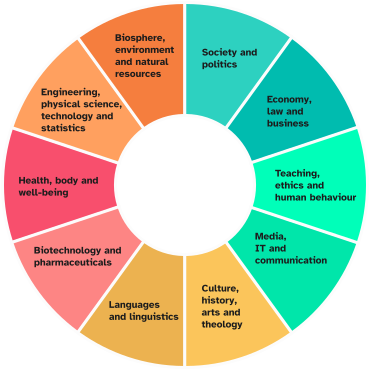
What interests you?
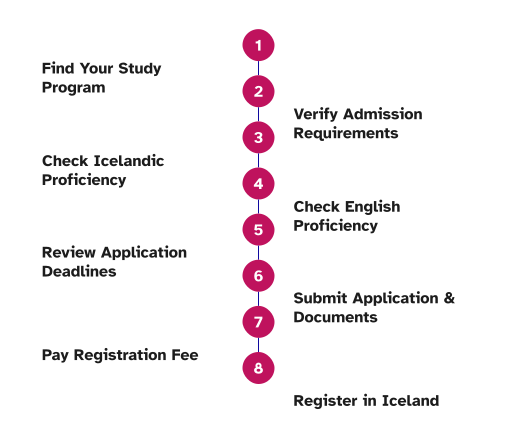
How to apply
Follow the path
Contact us If you still have questions, feel free to contact us.
School of HumanitiesWeekdays: 10-12 am and 1-3 pmGeneral Service and Social MediaThe Service Desk is a point of access for all services. You can drop in at the University Centre or use the WebChat at the bottom right of this page.
Follow the School of Humanities on Instagram, Youtube
and Facebook
Share