- Are you interested in writing?
- Do you enjoy working with words?
- Do you enjoy stories, poems and plays?
- Do you want training in practical writing skills?
- Do you want to open up future opportunities in challenging careers?
This is a 60 ECTS minor that complements a major in any other subject.
The programme aims to help students develop their talents and prepare them for graduate studies in various fields, e.g. in creative writing. Writing talents are highly valued in most areas of our society.
Course topics include:
- Writing skills
- Language use
- Theory of literature
- Online writing
- Translation
The programme focuses on the communication of creative ideas through various written genres, e.g. poems, short stories, novels, literary translations, plays, articles and any other forms that students can find or invent.
The programme is both practical and artistic in nature. Students receive guidance in the basic principles of creative writing, e.g. working methods, creative thinking, structure, perspective, register and style.
Objectives
The programme aims to help students develop their talents and prepare them for graduate studies in various fields, e.g. in creative writing. Writing talents are highly valued in most areas of our society.
Icelandic matriculation examination (stúdentspróf) or equivalent qualification. Further information can be found in article 17, regulation on admission requirements for undergraduate study no. 331/2022.
Applicants with qualifications from a school abroad who plan to enrol in an undergraduate programme taught in Icelandic at the Faculty of Icelandic and Comparative Cultural Studies must also pass a special entrance exam in Icelandic, in accordance with Article 1.
Students taking creative writing as a 60 ECTS minor are required to complete 40 ECTS in workshops and the course ÍSL111G Theory of Literature (or ABF104G Literary Methods & Concepts). Students shall complete 10 ECTS in courses other than workshops.
Workshops: Students shall complete at least 40 ECTS in creative writing workshops. There are two pathways when it comes to creative writing workshops. On one hand, there are conventional workshops (marked in the course catalogue as RITxxxG Workshop: Course Title or ÍSRxxxG Writing Skills: Course Title), i.e. practical courses where students produce their own material and receive guidance. Students may also complete 10 workshop ECTS through literature courses where creative writing students complete assignments fully or partially in the form of creative compositions rather than academic papers. Students must ask the instructor to approve this arrangement at the beginning of the semester.
Theory of Literature: All creative writing students should complete the course ÍSL111G Theory of Literature, or a comparable course in comparative literature (ABF104G Literary Methods & Concepts). Students will learn various concepts that will be used in the workshops.
Elective courses: Courses other than workshops and Theory of Literature. Students may take courses from any faculty at the School of Humanities, or even from outside the School. Students are therefore free to pursue their own special interests.
If the student has completed ABF104G Literary Methods & Concepts or ÍSL111G Theory of Literature in his/her major, the study requirements in writing as a minor are as follows: The student must take 40 credits in workshops and 20 credits in electives. No less than 10 credits of elective courses must be in the form of a theoretical course (not a workshop).
Programme structure
Check below to see how the programme is structured.
This programme does not offer specialisations.
- Year unspecified
- Fall
- The World is a Stage
- Translation
- Writing skills: Academic Writing
- Theory of Literature
- Spring 1
- Workshop: Truth Be Told
- Writing skill: Creative Science Communication
- Workshop: Writing Poetry
The World is a Stage (RIT401G)
Fjallað er um leikritun í víðus samhengi og samband leikbókmennta við hefðir og veruleika. Kenningar um byggingu, áferð og fagurfræði kyntar og valdir leiktextar skoðaðir útfrá þeim. Nemendur gera skriflegar æfingar, bæði á eigin spýtur og í hóp. Í lok námskeiðs vinna nemendur að stuttu leikverki sem verður leiklesið í tíma eða tekið til skoðunar með öðrum hætti ef við á. Ætlast er til mætingar og virkrar þátttöku í tímum. Takmarkaður sætafjöldi.
Translation (ÍSE502G)
The course in an introduction to translation, the history of translation and translation theory. Students will become acquainted with the main concepts and theories in the field. The basics of interpretation will also be dealt with. The course consists of two parts: The theoretical and historical part is in the form of lectures and discussions. The teacher also provides a reading list. Assessment is in the form of an exam or an essay, based on the reading material. The practical part is based on seminars where students gain practice in translating (both literary translation and applied translation) as well as translation criticism. Assessment is based on written assignment(s). Students of Icelandic as a Second Language must have completed all courses of the first and second year.
Writing skills: Academic Writing (ÍSR301G)
This is a basic composition course. Writing skills will be honed through regular assignments, lectures, class discussions and workshops.Approaches to writing research papers will be addressed, such as choosing and narrowing a topic, structure, and sources. Register, style, spelling, punctuation, and resources for writers will be discussed. Students write essays and papers of various kinds and get regular feedback from peers and teachers. Course assessment is based on written assignments and class participation. The course can only be passed if all assignments are turned in.
Theory of Literature (ÍSL111G)
This course is an introduction to literary theory, its terms and methods. Students are trained in analysing literary texts, poems, prose and drama.
Workshop: Truth Be Told (RIT206G)
In this workshop, participants write about factual subject matter using the techniques of narrative art—for example, texts based on sources, real events, or personal experiences of various kinds. Students will develop a narrative voice and apply storytelling methods to convey their material effectively. We will also address questions and concerns that arise when presenting factual content in literary form.
Student work will be discussed in class. Alongside our own writing, we will read a range of nonfiction narratives as well as critical texts about them. Students are expected to attend all sessions and participate actively.
Writing skill: Creative Science Communication (ÍSR401G)
The class is taught in Icelandic. In this course, students get a chance to hone their writing skills. Students will hand in regular writing assignments where they practise different ways of presenting scholarly work in a creative manner, such as op-eds and creative nonfiction. Students will also write creative texts, such as short stories. Students can use material from their field of study but will also have to face new challenges. Classes will be in the form of lectures, discussions, and workshops. Assessment will be based on regular assignments, self-assessment, a midterm assignment, a final assignment, a portfolio, and attendance and participation. Attendance and participation make up 15% of the grade and is partly mandatory (8 out of 12 workshops). The course is open to all undergraduate students at the University of Iceland but students must themselves make sure that the course can be used for credit in their particular studies.
Online learning:
The course is organized as face-to-face learning but all lectures from teachers will be recorded. This is done to assure better access to the course. Students who do not attend class will listen to the lectures and write short reports. They also turn in assignments otherwise done in class.
Workshop: Writing Poetry (RIT404G)
The workshop is an introductory course in poetry writing. Students will read selected poems, with an emphasis on contemporary Polish poetry, and examine their characteristics with the aim of becoming more attentive and skilled readers of poetry. In addition, students will experiment with writing poems and creating poetic performances. Student work will be discussed in class. Regular attendance and active participation are required.
- Fall
- RIT401GThe World is a StageRestricted elective course10Restricted elective course, conditions apply10 ECTS, creditsCourse Description
Fjallað er um leikritun í víðus samhengi og samband leikbókmennta við hefðir og veruleika. Kenningar um byggingu, áferð og fagurfræði kyntar og valdir leiktextar skoðaðir útfrá þeim. Nemendur gera skriflegar æfingar, bæði á eigin spýtur og í hóp. Í lok námskeiðs vinna nemendur að stuttu leikverki sem verður leiklesið í tíma eða tekið til skoðunar með öðrum hætti ef við á. Ætlast er til mætingar og virkrar þátttöku í tímum. Takmarkaður sætafjöldi.
Face-to-face learningPrerequisitesÍSE502GTranslationRestricted elective course10Restricted elective course, conditions apply10 ECTS, creditsCourse DescriptionThe course in an introduction to translation, the history of translation and translation theory. Students will become acquainted with the main concepts and theories in the field. The basics of interpretation will also be dealt with. The course consists of two parts: The theoretical and historical part is in the form of lectures and discussions. The teacher also provides a reading list. Assessment is in the form of an exam or an essay, based on the reading material. The practical part is based on seminars where students gain practice in translating (both literary translation and applied translation) as well as translation criticism. Assessment is based on written assignment(s). Students of Icelandic as a Second Language must have completed all courses of the first and second year.
Face-to-face learningPrerequisitesÍSR301GWriting skills: Academic WritingRestricted elective course10Restricted elective course, conditions apply10 ECTS, creditsCourse DescriptionThis is a basic composition course. Writing skills will be honed through regular assignments, lectures, class discussions and workshops.Approaches to writing research papers will be addressed, such as choosing and narrowing a topic, structure, and sources. Register, style, spelling, punctuation, and resources for writers will be discussed. Students write essays and papers of various kinds and get regular feedback from peers and teachers. Course assessment is based on written assignments and class participation. The course can only be passed if all assignments are turned in.
Face-to-face learningOnline learningPrerequisitesÍSL111GTheory of LiteratureMandatory (required) course10A mandatory (required) course for the programme10 ECTS, creditsCourse DescriptionThis course is an introduction to literary theory, its terms and methods. Students are trained in analysing literary texts, poems, prose and drama.
Face-to-face learningPrerequisites- Spring 2
RIT206GWorkshop: Truth Be ToldRestricted elective course10Restricted elective course, conditions apply10 ECTS, creditsCourse DescriptionIn this workshop, participants write about factual subject matter using the techniques of narrative art—for example, texts based on sources, real events, or personal experiences of various kinds. Students will develop a narrative voice and apply storytelling methods to convey their material effectively. We will also address questions and concerns that arise when presenting factual content in literary form.
Student work will be discussed in class. Alongside our own writing, we will read a range of nonfiction narratives as well as critical texts about them. Students are expected to attend all sessions and participate actively.
Face-to-face learningPrerequisitesÍSR401GWriting skill: Creative Science CommunicationRestricted elective course10Restricted elective course, conditions apply10 ECTS, creditsCourse DescriptionThe class is taught in Icelandic. In this course, students get a chance to hone their writing skills. Students will hand in regular writing assignments where they practise different ways of presenting scholarly work in a creative manner, such as op-eds and creative nonfiction. Students will also write creative texts, such as short stories. Students can use material from their field of study but will also have to face new challenges. Classes will be in the form of lectures, discussions, and workshops. Assessment will be based on regular assignments, self-assessment, a midterm assignment, a final assignment, a portfolio, and attendance and participation. Attendance and participation make up 15% of the grade and is partly mandatory (8 out of 12 workshops). The course is open to all undergraduate students at the University of Iceland but students must themselves make sure that the course can be used for credit in their particular studies.
Online learning:
The course is organized as face-to-face learning but all lectures from teachers will be recorded. This is done to assure better access to the course. Students who do not attend class will listen to the lectures and write short reports. They also turn in assignments otherwise done in class.
Face-to-face learningOnline learningPrerequisitesRIT404GWorkshop: Writing PoetryRestricted elective course10Restricted elective course, conditions apply10 ECTS, creditsCourse DescriptionThe workshop is an introductory course in poetry writing. Students will read selected poems, with an emphasis on contemporary Polish poetry, and examine their characteristics with the aim of becoming more attentive and skilled readers of poetry. In addition, students will experiment with writing poems and creating poetic performances. Student work will be discussed in class. Regular attendance and active participation are required.
Prerequisites
The University of Iceland collaborates with over 400 universities worldwide. This provides a unique opportunity to pursue part of your studies at an international university thus gaining added experience and fresh insight into your field of study.
Students generally have the opportunity to join an exchange programme, internship, or summer courses. However, exchanges are always subject to faculty approval.
Students have the opportunity to have courses evaluated as part of their studies at the University of Iceland, so their stay does not have to affect the duration of their studies.
Writing skills are highly valued in our society and good writers are attractive to employers for jobs that require delivery of clear, presentable text.
An education in this area can open up opportunities in:
- Copywriting
- Media
- Publishing
- Academia
- Other writing
This list is not exhaustive.
The student organisation for Icelandic and general linguistics is called Mímir.
- Mímir organises an active social calendar and advocates for members
- For example, Mímir organises an annual gala and workplace tours.
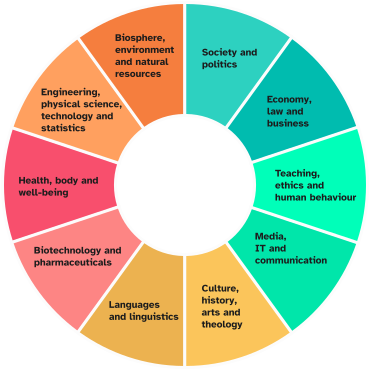
Study wheel
What interests you?
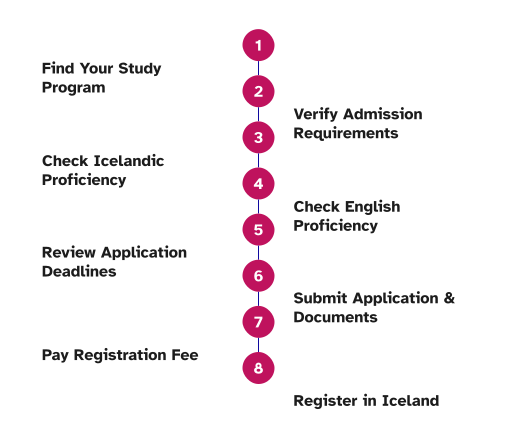
How to apply
Follow the path
If you still have questions, feel free to contact us.
The Service Desk is a point of access for all services. You can drop in at the University Centre or use the WebChat at the bottom right of this page.
Follow the School of Humanities on Instagram, Youtube
and Facebook