- Are you interesting in account, finance or internal auditing?
- Do you want a graduate programme that leads to good career opportunities?
- Are you interested in gaining practical professional knowledge?
This is a highly practical programme conferring an MS degree in accounting and auditing.
The programme is designed to prepare students for challenging and complex careers in accounting and auditing. Employers are increasingly looking for people with expertise in this area, especially in companies with shares and/or bonds on the securities market. The programme will suit students aiming at careers in internal auditing, planning, risk management, internal monitoring and other areas.
Programme structure
The programme is 120 ECTS and is organised as two years of full-time study.
The programme is made up of:
90 ECTS in mandatory courses, a total of 12 courses covering:
- auditing
- accounting
- legal environment
30 ECTS final project, completed in pairs.
Course topics include:
- Automation and artificial intelligence in auditing
- Auditing and the environment
- Auditing procedures
- Fair value accounting
- Company and liquidation law
- Management auditing and public finances
- Valuation techniques, financial position and going concern
Organisation of teaching
Courses are taught in blocks of seven weeks. Two courses are taught during each block. Final exams are held in the eighth week.
This programme is taught in Icelandic but most textbooks are in English.
The programme is designed to be completed through face-to-face learning, but students living outside the capital area can apply to attend lectures through Zoom.
Main objectives
The programme aims to increase students’ knowledge and skills in accounting and auditing in order to meet the high demand for expertise in this area.
Other
A 90 ECTS programme, which does not require students to write a thesis, is also available. Students on the 90 ECTS programme graduate with an M.Acc degree.
Completing the programme qualifies you to work as an audit trainee at an audit office. After you have a Master’s degree in accounting and auditing, as well as the required work experience, you can sit the exam to become a certified auditor. The exam is organised by the Audit Council (Endurskoðendaráð).
Completing the programme allows you to apply for doctoral studies.
To be admitted to the programme, applicants must have completed a BS degree in Business Administration with a first-class grade (7.25) and completed specific BS‑level courses in the discipline.
The Master’s programme in Accounting and Auditing is based on the assumption that applicants have completed the Accounting track in the BS programme, thereby having acquired the necessary foundation in the field and a basis for further specialisation, or possess extensive professional experience in accounting, tax compliance, and finance, which must be documented in the application.
Applicants holding a BS degree in Business Administration are themselves responsible for ensuring that the required foundational knowledge is in place at the start of the programme but must have completed VIÐ401G Financial Accounting at minimum.
Applicants with a university degree from other disciplines may apply to the programme, but they are required to have completed the following BS‑level courses in Business Administration in addition:
- VIÐ103G Introduction to Financial Accounting
- VIÐ302G Business Law A
- VIÐ301G Finance I
Applicants who have not completed VIÐ505M Financial Reporting A, VIÐ604M Financial Reporting B, or VIÐ403M Corporate Tax Law during their undergraduate studies must take these courses as restricted electives.
A selection of elective courses is available, enabling students to choose master‑level courses based on their interests, either within the School of Business or in other faculties of the University with the approval of the programme coordinator.
Students aiming for professional certification in auditing are specifically advised to choose the following electives: Public Administration Auditing and Public Finance, Performance measurement and managementt, and Corporate and investment valuation.
120 ECTS credits have to be completed for the qualification. To complete the programme students must pass 12 courses that are 7.5 ECTS credits each as well as complete a 30 ECTS credit master's thesis. The programme lasts two years or four semesters.
- CV
- Statement of purpose
- Reference 1, Name and email
- Reference 2, Name and email
- Certified copies of diplomas and transcripts
- Letter of motivation
- Proof of English proficiency
Further information on supporting documents can be found here
Programme structure
Check below to see how the programme is structured.
This programme does not offer specialisations.
- First year
- Fall
- Financial Statements A
- Corporate law and Bankruptcy Proceedings and Administration
- Auditing processes I
- Auditing and review of information systems
- Spring 1
- Business Taxation
- Financial Statements B
- International Taxation and Transfer-Pricing Methods
- Automation, finance tech. and auditing
Financial Statements A (VIÐ505M)
This course is designed for students on the F- and R-line (finance and accounting). The purpose with the course is that the students obtains knowledge and understanding on matters that management of companies needs to have to prepare financial statements in accordance with generally accepted accounting principles. In the course students, will learn about generally accepted accounting principles according to international accountings standards (IFRS) and icelandic GAAP. Among topics: Financial accounting and accounting standards, income statement, balance sheet and cash flow. Revenue recognition and cost accounting, inventories, accounts receivables, PPE, intangible assets, income tax, impairment test, accounting for financial instruments, liabilities and equity. Students will need to solve assignments during the course.
Corporate law and Bankruptcy Proceedings and Administration (VIÐ121F)
The issues and legal sources of company law will be discussed. Different categories of companies and different points of view will be covered when resolving issues. The characteristics of the main types of financial companies will be explained. For discussion will be e.g. their financial basis and rules relating to the status of their counterparts, governance, the responsibilities of management and auditors and the legal status of members. The main topic of the course concerns private limited companies and public limited companies and the fundamentals that result from the limited liability of their owners, ie. on the protection of the funds of these companies. These are rules on the payment of share capital, registration of share capital, increase and decrease of share capital, own shares and rules on disbursement of capital with dividends or on dissolution of companies. The merger and division of public limited companies and the rules that must be met in that connection will be discussed. The moratorium, composition agreements and bankruptcy proceedings of companies will also be discussed. The role of auditors in connection with their work for companies will also be discussed.
Auditing processes I (VIÐ1A4F)
Methods for auditing data collection and how auditing takes into account risk analysis and efficiency will be introduced. The use of computer systems in auditing will be discussed in particular. In reviewing the study material, international auditing standards will be taken into account, and their value for the Icelandic environment will be discussed. The study material will be the book Auditing & Assurance Services by the author Aasmund Eilifsen et al., International standards for auditing, articles and other documents that will be presented during the course.
Auditing and review of information systems (VIÐ1A3F)
The course will take place in the basic concepts of financial information systems (AIS). Review the business processes, structures, and roles of financial information systems. System development and documentation methods will be accessed. Computer fraud and misuse of information systems will be discussed. Information security, labour regulations and international standards, accessibility, controls and measures will be reviewed to help increase the security of sensitive information. The nature of the review will be reviewed and an audit system will be introduced. Major corporate processes, such as revenue, charges, and manufacturing processes, will be reviewed and shown in a data flow shortage. The system development process and system development methods will be reviewed. Audits using IT audits have increased significantly over the last decade and many computer systems have seen the light of day, for example. Standadfusion and Adaptive GRC. The way information systems use affects procedures will be reviewed and will discuss how the use of artificial intelligence can affect risk assessment and assessment of the effectiveness of contemporary surveillance operations. Finally, system design, implementation and operation of information systems will be discussed. One group assignment. Efforts will be made to introduce to students the main financial information systems in use in the market. The project is based on both teaching materials and therefore material is presented in the lectures.
The basic concepts and theories regarding ADA (Audit Data Analytics) are covered. Audit Data Standards (ADA) will also be introduced. Explore how data analytics can be used to perform automated audit procedures that are usually performed manually. Introducing the ISO PC 295 Audit Data Collection m.t.t. audit.
Engage in the theoretical structure of companies related to Management Systems and Control Systems. Different types of units of responsibility (departments, divisions, business units.)
Business Taxation (VIÐ403M)
The course is intended as an introduction to tax law and tax practice applicable to business operations in Iceland and to offer some practice in solving simpler problems in this field. The term business operations refers on the one hand to various forms of legal persons and on the other hand to individual engaged in business operations or independent services in their own name. At the end of the course the student will be familiar with the taxes and duties levied on business operations in Iceland, the basic provisions of Icelandic law and other provisions on which the levy of the duty is based and certain procedures in solving tax problems.
Financial Statements B (VIÐ604M)
This course is a continuation of Financial Statements A, which is taught in the fall semester. It is expected that students of this course are fully familiar with the content of the course Financial Statements A.
The course will cover the principles in accounting under both IFRS and Icelandic law. Topics: cash flow, income tax, earnings per share, financial instruments, finance leases, assets held for sale and discontinued operations, investment properties, provision, information in the financial statements and related parties.
Assignments are part of the course, and students will need submit them.
Reserved the righttochangethecoursedescription.
International Taxation and Transfer-Pricing Methods (VIÐ296F)
The course will cover in detail the rules of national law and international agreements on the conclusion and interpretation of double taxation agreements. The full tax liability of individuals and companies due to domicile in a state and its termination in one of the member states of a double taxation agreement will be discussed if a person or company is domiciled in two or more countries at the same time. Rules on limited tax liability and the division of taxing rights between member states of a double taxation treaty will be explained. Methods for mitigating double taxation under national law and a double taxation treaty will be discussed when income is taxed in two or more countries. It will be discussed how double taxation agreements can be used in tax planning with the establishment of companies in different countries. The impact of the EEC or ESS Convention on the tax laws of individual states, harmful tax competition and what has been done to eradicate it will be disclosed. Students will be trained in the use of double taxation agreements with problem solving solutions and realistic tasks. At the end of the course, it is assumed that the student has a good insight into the complex system that national law and double taxation agreements can spin on the financial measures of individuals and companies in modern society.
Transfer-Pricing Methods (TPM) often predict where profits and costs fall. TPM is an important factor in globalization, but TPM is governed by the rules of the home country and also the published rules of the OECD. TPM is closely related to tax law in the country in question. TPM rules are examined and their effects analyzed.
Automation, finance tech. and auditing (VIÐ293F)
The basic concepts and theories of automation and RPA (Robotic Process Automation Projects) is covered, and special attention is paid to how to identify processes / projects in operations, accounting and auditing that can be automated with RPA
Concepts and basics of financial technology (Fin. Tech.) is covered. Developments and market conditions presented as well as electronic currencies. Audit risk and financial technology is specifically covered.
Concepts related to Management Cost Accounting will be covered. The importance of management accounting has increased due to the increased complexity of cost allocation and the reliability of costs. Financial reports are based on cost accounting and are therefore the basis for reliable accounting, e.g. annual accounts. At the same time, management and control systems are examined in the context of management cost accounting.
- Second year
- Fall
- Sustainability and Auditing Standards
- Consolidated Financial Statements
- Auditing processes II
- Fair Value Accounting
- Spring 1
- MS Thesis
Sustainability and Auditing Standards (VIÐ303F)
The course deals with accounting, methodology and ethics.
Accounting theory, will i.a. discusses: 1) standardization in the preparation of annual accounts, 2) conceptual systems for accounting, 3) development of accounting, 4) accounting concepts, 5) international accounting, and 6) various special problems in the preparation of accounts.
Methodology, will i.a. discusses: qualitative methodology, main methodology, population, data collection, quay square, presentation and structure of essays, etc.
Ethics and honesty related to work on a dissertation and its basic concepts.
Consolidated Financial Statements (VIÐ177F)
This course primarily deals with the preparation of consolidated financial statements and the accounting aspects of mergers and acquisitions. In addition, the following accounting issues are discussed: settlement of partnerships, inventories, trade receivables, goodwill, booking of agency transactions, booking of foreign transactions and conversion of annual accounts from one currency to another, bankruptcy settlement, and financial statements of municipalities and other non-profit entities.
Auditing processes II (VIÐ305F)
The course is a direct continuation of Auditing processes I. The use of computer systems in auditing will be discussed in particular. When reviewing cases, International Standards Auditing, will be in focus and their purpose and the Icelandic auditing environment will be discussed. Methods for auditing data collection, auditing risk analysis will be discussed. The use of computer systems in auditing will be discussed in particular. International Standards Auditing will have a special focus and audit process. The role of auditors and their work in accordance with the provisions of law and international auditing standards will be discussed, as well as the importance of auditing for the society.
Fair Value Accounting (VIÐ304F)
The aim of the course is for students to acquire a better knowledge and understanding of the main issues concerning the analysis of annual accounts that are prepared in accordance with international accounting standards. Special emphasis will be placed on fair value accounting and preferably the entry of financial instruments, e.g. equities, bonds and derivatives. The rules on impairment of financial assets and other assets will also be reviewed. The main requirements of IFRS standards regarding the recognition of fixed assets at fair value will also be explained, e.g. property, plant and equipment and investment assets, as well as reference to the recalculation of lease obligations in the annual accounts.
Special emphasis on following accounting standards,
IFRS 9: Financial Instruments,
IFRS 7: Financial Instruments: Disclosures
IFRS 13: Fair value measurement
IFRS 16: Leases
IFRS 2: Share-based Payment
IAS 32: Financial Instruments: Presentation
IAS 40: Investment Property
MS Thesis (RES442L)
The topic of the master's thesis must be chosen after consulting the thesis advisor(s), who must be full-time faculty at the School of Business. The thesis must equal at 30 credits to fulfill the requirements for applying to the research study fund (Rannsóknanámssjóður). The thesis must be presented at a departmental seminar. A digital copy must be submitted online no later than the specified dates before each graduation. Grades for a master's thesis are awarded by the thesis advisor(s) and an outside reader.
- Fall
- VIÐ505MFinancial Statements ARestricted elective course6Restricted elective course, conditions apply6 ECTS, creditsCourse Description
This course is designed for students on the F- and R-line (finance and accounting). The purpose with the course is that the students obtains knowledge and understanding on matters that management of companies needs to have to prepare financial statements in accordance with generally accepted accounting principles. In the course students, will learn about generally accepted accounting principles according to international accountings standards (IFRS) and icelandic GAAP. Among topics: Financial accounting and accounting standards, income statement, balance sheet and cash flow. Revenue recognition and cost accounting, inventories, accounts receivables, PPE, intangible assets, income tax, impairment test, accounting for financial instruments, liabilities and equity. Students will need to solve assignments during the course.
Face-to-face learningPrerequisitesVIÐ121FCorporate law and Bankruptcy Proceedings and AdministrationMandatory (required) course7,5A mandatory (required) course for the programme7,5 ECTS, creditsCourse DescriptionThe issues and legal sources of company law will be discussed. Different categories of companies and different points of view will be covered when resolving issues. The characteristics of the main types of financial companies will be explained. For discussion will be e.g. their financial basis and rules relating to the status of their counterparts, governance, the responsibilities of management and auditors and the legal status of members. The main topic of the course concerns private limited companies and public limited companies and the fundamentals that result from the limited liability of their owners, ie. on the protection of the funds of these companies. These are rules on the payment of share capital, registration of share capital, increase and decrease of share capital, own shares and rules on disbursement of capital with dividends or on dissolution of companies. The merger and division of public limited companies and the rules that must be met in that connection will be discussed. The moratorium, composition agreements and bankruptcy proceedings of companies will also be discussed. The role of auditors in connection with their work for companies will also be discussed.
Face-to-face learningPrerequisitesCourse taught in period IVIÐ1A4FAuditing processes IMandatory (required) course7,5A mandatory (required) course for the programme7,5 ECTS, creditsCourse DescriptionMethods for auditing data collection and how auditing takes into account risk analysis and efficiency will be introduced. The use of computer systems in auditing will be discussed in particular. In reviewing the study material, international auditing standards will be taken into account, and their value for the Icelandic environment will be discussed. The study material will be the book Auditing & Assurance Services by the author Aasmund Eilifsen et al., International standards for auditing, articles and other documents that will be presented during the course.
Face-to-face learningPrerequisitesCourse taught in period IIVIÐ1A3FAuditing and review of information systemsMandatory (required) course7,5A mandatory (required) course for the programme7,5 ECTS, creditsCourse DescriptionThe course will take place in the basic concepts of financial information systems (AIS). Review the business processes, structures, and roles of financial information systems. System development and documentation methods will be accessed. Computer fraud and misuse of information systems will be discussed. Information security, labour regulations and international standards, accessibility, controls and measures will be reviewed to help increase the security of sensitive information. The nature of the review will be reviewed and an audit system will be introduced. Major corporate processes, such as revenue, charges, and manufacturing processes, will be reviewed and shown in a data flow shortage. The system development process and system development methods will be reviewed. Audits using IT audits have increased significantly over the last decade and many computer systems have seen the light of day, for example. Standadfusion and Adaptive GRC. The way information systems use affects procedures will be reviewed and will discuss how the use of artificial intelligence can affect risk assessment and assessment of the effectiveness of contemporary surveillance operations. Finally, system design, implementation and operation of information systems will be discussed. One group assignment. Efforts will be made to introduce to students the main financial information systems in use in the market. The project is based on both teaching materials and therefore material is presented in the lectures.
The basic concepts and theories regarding ADA (Audit Data Analytics) are covered. Audit Data Standards (ADA) will also be introduced. Explore how data analytics can be used to perform automated audit procedures that are usually performed manually. Introducing the ISO PC 295 Audit Data Collection m.t.t. audit.
Engage in the theoretical structure of companies related to Management Systems and Control Systems. Different types of units of responsibility (departments, divisions, business units.)
Face-to-face learningPrerequisitesCourse taught in period I- Spring 2
VIÐ403MBusiness TaxationRestricted elective course6Restricted elective course, conditions apply6 ECTS, creditsCourse DescriptionThe course is intended as an introduction to tax law and tax practice applicable to business operations in Iceland and to offer some practice in solving simpler problems in this field. The term business operations refers on the one hand to various forms of legal persons and on the other hand to individual engaged in business operations or independent services in their own name. At the end of the course the student will be familiar with the taxes and duties levied on business operations in Iceland, the basic provisions of Icelandic law and other provisions on which the levy of the duty is based and certain procedures in solving tax problems.
Face-to-face learningPrerequisitesVIÐ604MFinancial Statements BRestricted elective course6Restricted elective course, conditions apply6 ECTS, creditsCourse DescriptionThis course is a continuation of Financial Statements A, which is taught in the fall semester. It is expected that students of this course are fully familiar with the content of the course Financial Statements A.
The course will cover the principles in accounting under both IFRS and Icelandic law. Topics: cash flow, income tax, earnings per share, financial instruments, finance leases, assets held for sale and discontinued operations, investment properties, provision, information in the financial statements and related parties.
Assignments are part of the course, and students will need submit them.Reserved the righttochangethecoursedescription.
Face-to-face learningPrerequisitesVIÐ296FInternational Taxation and Transfer-Pricing MethodsMandatory (required) course7,5A mandatory (required) course for the programme7,5 ECTS, creditsCourse DescriptionThe course will cover in detail the rules of national law and international agreements on the conclusion and interpretation of double taxation agreements. The full tax liability of individuals and companies due to domicile in a state and its termination in one of the member states of a double taxation agreement will be discussed if a person or company is domiciled in two or more countries at the same time. Rules on limited tax liability and the division of taxing rights between member states of a double taxation treaty will be explained. Methods for mitigating double taxation under national law and a double taxation treaty will be discussed when income is taxed in two or more countries. It will be discussed how double taxation agreements can be used in tax planning with the establishment of companies in different countries. The impact of the EEC or ESS Convention on the tax laws of individual states, harmful tax competition and what has been done to eradicate it will be disclosed. Students will be trained in the use of double taxation agreements with problem solving solutions and realistic tasks. At the end of the course, it is assumed that the student has a good insight into the complex system that national law and double taxation agreements can spin on the financial measures of individuals and companies in modern society.
Transfer-Pricing Methods (TPM) often predict where profits and costs fall. TPM is an important factor in globalization, but TPM is governed by the rules of the home country and also the published rules of the OECD. TPM is closely related to tax law in the country in question. TPM rules are examined and their effects analyzed.
Face-to-face learningPrerequisitesCourse taught in period IIIVIÐ293FAutomation, finance tech. and auditingMandatory (required) course7,5A mandatory (required) course for the programme7,5 ECTS, creditsCourse DescriptionThe basic concepts and theories of automation and RPA (Robotic Process Automation Projects) is covered, and special attention is paid to how to identify processes / projects in operations, accounting and auditing that can be automated with RPA
Concepts and basics of financial technology (Fin. Tech.) is covered. Developments and market conditions presented as well as electronic currencies. Audit risk and financial technology is specifically covered.
Concepts related to Management Cost Accounting will be covered. The importance of management accounting has increased due to the increased complexity of cost allocation and the reliability of costs. Financial reports are based on cost accounting and are therefore the basis for reliable accounting, e.g. annual accounts. At the same time, management and control systems are examined in the context of management cost accounting.
Face-to-face learningPrerequisitesCourse taught in period IV- Fall
- VIÐ303FSustainability and Auditing StandardsMandatory (required) course7,5A mandatory (required) course for the programme7,5 ECTS, creditsCourse Description
The course deals with accounting, methodology and ethics.
Accounting theory, will i.a. discusses: 1) standardization in the preparation of annual accounts, 2) conceptual systems for accounting, 3) development of accounting, 4) accounting concepts, 5) international accounting, and 6) various special problems in the preparation of accounts.
Methodology, will i.a. discusses: qualitative methodology, main methodology, population, data collection, quay square, presentation and structure of essays, etc.
Ethics and honesty related to work on a dissertation and its basic concepts.Face-to-face learningPrerequisitesCourse taught in period IVIÐ177FConsolidated Financial StatementsMandatory (required) course7,5A mandatory (required) course for the programme7,5 ECTS, creditsCourse DescriptionThis course primarily deals with the preparation of consolidated financial statements and the accounting aspects of mergers and acquisitions. In addition, the following accounting issues are discussed: settlement of partnerships, inventories, trade receivables, goodwill, booking of agency transactions, booking of foreign transactions and conversion of annual accounts from one currency to another, bankruptcy settlement, and financial statements of municipalities and other non-profit entities.
Face-to-face learningPrerequisitesCourse taught in period IIVIÐ305FAuditing processes IIMandatory (required) course7,5A mandatory (required) course for the programme7,5 ECTS, creditsCourse DescriptionThe course is a direct continuation of Auditing processes I. The use of computer systems in auditing will be discussed in particular. When reviewing cases, International Standards Auditing, will be in focus and their purpose and the Icelandic auditing environment will be discussed. Methods for auditing data collection, auditing risk analysis will be discussed. The use of computer systems in auditing will be discussed in particular. International Standards Auditing will have a special focus and audit process. The role of auditors and their work in accordance with the provisions of law and international auditing standards will be discussed, as well as the importance of auditing for the society.
Face-to-face learningPrerequisitesCourse taught in period IVIÐ304FFair Value AccountingMandatory (required) course7,5A mandatory (required) course for the programme7,5 ECTS, creditsCourse DescriptionThe aim of the course is for students to acquire a better knowledge and understanding of the main issues concerning the analysis of annual accounts that are prepared in accordance with international accounting standards. Special emphasis will be placed on fair value accounting and preferably the entry of financial instruments, e.g. equities, bonds and derivatives. The rules on impairment of financial assets and other assets will also be reviewed. The main requirements of IFRS standards regarding the recognition of fixed assets at fair value will also be explained, e.g. property, plant and equipment and investment assets, as well as reference to the recalculation of lease obligations in the annual accounts.
Special emphasis on following accounting standards,
IFRS 9: Financial Instruments,
IFRS 7: Financial Instruments: Disclosures
IFRS 13: Fair value measurement
IFRS 16: Leases
IFRS 2: Share-based Payment
IAS 32: Financial Instruments: Presentation
IAS 40: Investment PropertyFace-to-face learningPrerequisitesCourse taught in period II- Spring 2
RES442LMS ThesisMandatory (required) course30A mandatory (required) course for the programme30 ECTS, creditsCourse DescriptionThe topic of the master's thesis must be chosen after consulting the thesis advisor(s), who must be full-time faculty at the School of Business. The thesis must equal at 30 credits to fulfill the requirements for applying to the research study fund (Rannsóknanámssjóður). The thesis must be presented at a departmental seminar. A digital copy must be submitted online no later than the specified dates before each graduation. Grades for a master's thesis are awarded by the thesis advisor(s) and an outside reader.
Self-studyPrerequisitesPart of the total project/thesis creditsSecond year- Fall
- VIÐ505MFinancial Statements ARestricted elective course6Restricted elective course, conditions apply6 ECTS, creditsCourse Description
This course is designed for students on the F- and R-line (finance and accounting). The purpose with the course is that the students obtains knowledge and understanding on matters that management of companies needs to have to prepare financial statements in accordance with generally accepted accounting principles. In the course students, will learn about generally accepted accounting principles according to international accountings standards (IFRS) and icelandic GAAP. Among topics: Financial accounting and accounting standards, income statement, balance sheet and cash flow. Revenue recognition and cost accounting, inventories, accounts receivables, PPE, intangible assets, income tax, impairment test, accounting for financial instruments, liabilities and equity. Students will need to solve assignments during the course.
Face-to-face learningPrerequisitesVIÐ121FCorporate law and Bankruptcy Proceedings and AdministrationMandatory (required) course7,5A mandatory (required) course for the programme7,5 ECTS, creditsCourse DescriptionThe issues and legal sources of company law will be discussed. Different categories of companies and different points of view will be covered when resolving issues. The characteristics of the main types of financial companies will be explained. For discussion will be e.g. their financial basis and rules relating to the status of their counterparts, governance, the responsibilities of management and auditors and the legal status of members. The main topic of the course concerns private limited companies and public limited companies and the fundamentals that result from the limited liability of their owners, ie. on the protection of the funds of these companies. These are rules on the payment of share capital, registration of share capital, increase and decrease of share capital, own shares and rules on disbursement of capital with dividends or on dissolution of companies. The merger and division of public limited companies and the rules that must be met in that connection will be discussed. The moratorium, composition agreements and bankruptcy proceedings of companies will also be discussed. The role of auditors in connection with their work for companies will also be discussed.
Face-to-face learningPrerequisitesCourse taught in period IVIÐ1A4FAuditing processes IMandatory (required) course7,5A mandatory (required) course for the programme7,5 ECTS, creditsCourse DescriptionMethods for auditing data collection and how auditing takes into account risk analysis and efficiency will be introduced. The use of computer systems in auditing will be discussed in particular. In reviewing the study material, international auditing standards will be taken into account, and their value for the Icelandic environment will be discussed. The study material will be the book Auditing & Assurance Services by the author Aasmund Eilifsen et al., International standards for auditing, articles and other documents that will be presented during the course.
Face-to-face learningPrerequisitesCourse taught in period IIVIÐ1A3FAuditing and review of information systemsMandatory (required) course7,5A mandatory (required) course for the programme7,5 ECTS, creditsCourse DescriptionThe course will take place in the basic concepts of financial information systems (AIS). Review the business processes, structures, and roles of financial information systems. System development and documentation methods will be accessed. Computer fraud and misuse of information systems will be discussed. Information security, labour regulations and international standards, accessibility, controls and measures will be reviewed to help increase the security of sensitive information. The nature of the review will be reviewed and an audit system will be introduced. Major corporate processes, such as revenue, charges, and manufacturing processes, will be reviewed and shown in a data flow shortage. The system development process and system development methods will be reviewed. Audits using IT audits have increased significantly over the last decade and many computer systems have seen the light of day, for example. Standadfusion and Adaptive GRC. The way information systems use affects procedures will be reviewed and will discuss how the use of artificial intelligence can affect risk assessment and assessment of the effectiveness of contemporary surveillance operations. Finally, system design, implementation and operation of information systems will be discussed. One group assignment. Efforts will be made to introduce to students the main financial information systems in use in the market. The project is based on both teaching materials and therefore material is presented in the lectures.
The basic concepts and theories regarding ADA (Audit Data Analytics) are covered. Audit Data Standards (ADA) will also be introduced. Explore how data analytics can be used to perform automated audit procedures that are usually performed manually. Introducing the ISO PC 295 Audit Data Collection m.t.t. audit.
Engage in the theoretical structure of companies related to Management Systems and Control Systems. Different types of units of responsibility (departments, divisions, business units.)
Face-to-face learningPrerequisitesCourse taught in period I- Spring 2
VIÐ403MBusiness TaxationRestricted elective course6Restricted elective course, conditions apply6 ECTS, creditsCourse DescriptionThe course is intended as an introduction to tax law and tax practice applicable to business operations in Iceland and to offer some practice in solving simpler problems in this field. The term business operations refers on the one hand to various forms of legal persons and on the other hand to individual engaged in business operations or independent services in their own name. At the end of the course the student will be familiar with the taxes and duties levied on business operations in Iceland, the basic provisions of Icelandic law and other provisions on which the levy of the duty is based and certain procedures in solving tax problems.
Face-to-face learningPrerequisitesVIÐ604MFinancial Statements BRestricted elective course6Restricted elective course, conditions apply6 ECTS, creditsCourse DescriptionThis course is a continuation of Financial Statements A, which is taught in the fall semester. It is expected that students of this course are fully familiar with the content of the course Financial Statements A.
The course will cover the principles in accounting under both IFRS and Icelandic law. Topics: cash flow, income tax, earnings per share, financial instruments, finance leases, assets held for sale and discontinued operations, investment properties, provision, information in the financial statements and related parties.
Assignments are part of the course, and students will need submit them.Reserved the righttochangethecoursedescription.
Face-to-face learningPrerequisitesVIÐ296FInternational Taxation and Transfer-Pricing MethodsMandatory (required) course7,5A mandatory (required) course for the programme7,5 ECTS, creditsCourse DescriptionThe course will cover in detail the rules of national law and international agreements on the conclusion and interpretation of double taxation agreements. The full tax liability of individuals and companies due to domicile in a state and its termination in one of the member states of a double taxation agreement will be discussed if a person or company is domiciled in two or more countries at the same time. Rules on limited tax liability and the division of taxing rights between member states of a double taxation treaty will be explained. Methods for mitigating double taxation under national law and a double taxation treaty will be discussed when income is taxed in two or more countries. It will be discussed how double taxation agreements can be used in tax planning with the establishment of companies in different countries. The impact of the EEC or ESS Convention on the tax laws of individual states, harmful tax competition and what has been done to eradicate it will be disclosed. Students will be trained in the use of double taxation agreements with problem solving solutions and realistic tasks. At the end of the course, it is assumed that the student has a good insight into the complex system that national law and double taxation agreements can spin on the financial measures of individuals and companies in modern society.
Transfer-Pricing Methods (TPM) often predict where profits and costs fall. TPM is an important factor in globalization, but TPM is governed by the rules of the home country and also the published rules of the OECD. TPM is closely related to tax law in the country in question. TPM rules are examined and their effects analyzed.
Face-to-face learningPrerequisitesCourse taught in period IIIVIÐ293FAutomation, finance tech. and auditingMandatory (required) course7,5A mandatory (required) course for the programme7,5 ECTS, creditsCourse DescriptionThe basic concepts and theories of automation and RPA (Robotic Process Automation Projects) is covered, and special attention is paid to how to identify processes / projects in operations, accounting and auditing that can be automated with RPA
Concepts and basics of financial technology (Fin. Tech.) is covered. Developments and market conditions presented as well as electronic currencies. Audit risk and financial technology is specifically covered.
Concepts related to Management Cost Accounting will be covered. The importance of management accounting has increased due to the increased complexity of cost allocation and the reliability of costs. Financial reports are based on cost accounting and are therefore the basis for reliable accounting, e.g. annual accounts. At the same time, management and control systems are examined in the context of management cost accounting.
Face-to-face learningPrerequisitesCourse taught in period IV- Fall
- VIÐ303FSustainability and Auditing StandardsMandatory (required) course7,5A mandatory (required) course for the programme7,5 ECTS, creditsCourse Description
The course deals with accounting, methodology and ethics.
Accounting theory, will i.a. discusses: 1) standardization in the preparation of annual accounts, 2) conceptual systems for accounting, 3) development of accounting, 4) accounting concepts, 5) international accounting, and 6) various special problems in the preparation of accounts.
Methodology, will i.a. discusses: qualitative methodology, main methodology, population, data collection, quay square, presentation and structure of essays, etc.
Ethics and honesty related to work on a dissertation and its basic concepts.Face-to-face learningPrerequisitesCourse taught in period IVIÐ177FConsolidated Financial StatementsMandatory (required) course7,5A mandatory (required) course for the programme7,5 ECTS, creditsCourse DescriptionThis course primarily deals with the preparation of consolidated financial statements and the accounting aspects of mergers and acquisitions. In addition, the following accounting issues are discussed: settlement of partnerships, inventories, trade receivables, goodwill, booking of agency transactions, booking of foreign transactions and conversion of annual accounts from one currency to another, bankruptcy settlement, and financial statements of municipalities and other non-profit entities.
Face-to-face learningPrerequisitesCourse taught in period IIVIÐ305FAuditing processes IIMandatory (required) course7,5A mandatory (required) course for the programme7,5 ECTS, creditsCourse DescriptionThe course is a direct continuation of Auditing processes I. The use of computer systems in auditing will be discussed in particular. When reviewing cases, International Standards Auditing, will be in focus and their purpose and the Icelandic auditing environment will be discussed. Methods for auditing data collection, auditing risk analysis will be discussed. The use of computer systems in auditing will be discussed in particular. International Standards Auditing will have a special focus and audit process. The role of auditors and their work in accordance with the provisions of law and international auditing standards will be discussed, as well as the importance of auditing for the society.
Face-to-face learningPrerequisitesCourse taught in period IVIÐ304FFair Value AccountingMandatory (required) course7,5A mandatory (required) course for the programme7,5 ECTS, creditsCourse DescriptionThe aim of the course is for students to acquire a better knowledge and understanding of the main issues concerning the analysis of annual accounts that are prepared in accordance with international accounting standards. Special emphasis will be placed on fair value accounting and preferably the entry of financial instruments, e.g. equities, bonds and derivatives. The rules on impairment of financial assets and other assets will also be reviewed. The main requirements of IFRS standards regarding the recognition of fixed assets at fair value will also be explained, e.g. property, plant and equipment and investment assets, as well as reference to the recalculation of lease obligations in the annual accounts.
Special emphasis on following accounting standards,
IFRS 9: Financial Instruments,
IFRS 7: Financial Instruments: Disclosures
IFRS 13: Fair value measurement
IFRS 16: Leases
IFRS 2: Share-based Payment
IAS 32: Financial Instruments: Presentation
IAS 40: Investment PropertyFace-to-face learningPrerequisitesCourse taught in period II- Spring 2
RES442LMS ThesisMandatory (required) course30A mandatory (required) course for the programme30 ECTS, creditsCourse DescriptionThe topic of the master's thesis must be chosen after consulting the thesis advisor(s), who must be full-time faculty at the School of Business. The thesis must equal at 30 credits to fulfill the requirements for applying to the research study fund (Rannsóknanámssjóður). The thesis must be presented at a departmental seminar. A digital copy must be submitted online no later than the specified dates before each graduation. Grades for a master's thesis are awarded by the thesis advisor(s) and an outside reader.
Self-studyPrerequisitesPart of the total project/thesis credits
Additional information The University of Iceland collaborates with over 400 universities worldwide. This provides a unique opportunity to pursue part of your studies at an international university thus gaining added experience and fresh insight into your field of study.
Students generally have the opportunity to join an exchange programme, internship, or summer courses. However, exchanges are always subject to faculty approval.
Students have the opportunity to have courses evaluated as part of their studies at the University of Iceland, so their stay does not have to affect the duration of their studies.
This qualification may open up opportunities in:
- Auditing
- Internal auditing
- Accounting
- Internal monitoring
- Finance
This list is not exhaustive.
MAESTRO is the organisation for Master's students at the University of Iceland Faculty of Business Administration and Faculty of Economics.
The role and purpose of MAESTRO is to advocate for members' interests and make their time at UI more enjoyable and productive. MAESTRO provides students with useful information, maintains a good working relationship with the University and faculties, as well as encouraging students to socialise together and build connections.
Student´s comments
Graduating from the Finance and Accounting programme at the University of Iceland, I joined the Master's in Accounting and Auditing while working at an audit firm. The programme's blend of theory and practice, evening classes, and close-knit cohort foster strong connections and diverse career paths.Helpful content Study wheel
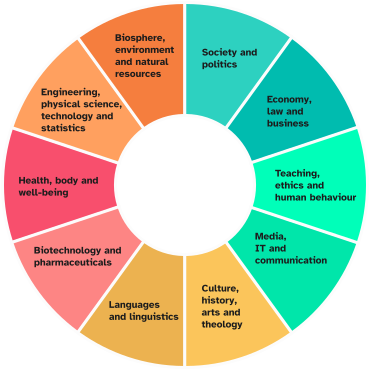
What interests you?
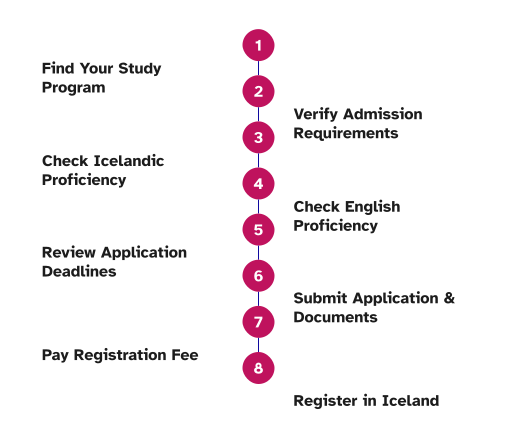
How to apply
Follow the path
Contact us If you still have questions, feel free to contact us.
School of Social SciencesWeekdays 9 am - 3 pmStudent and Teaching ServiceThe School office offers support to students and lecturers, providing guidance, counselling, and assistance with various matters.
You are welcome to drop by at the office in Gimli or you can book an online meeting in Teams with the staff.
Share