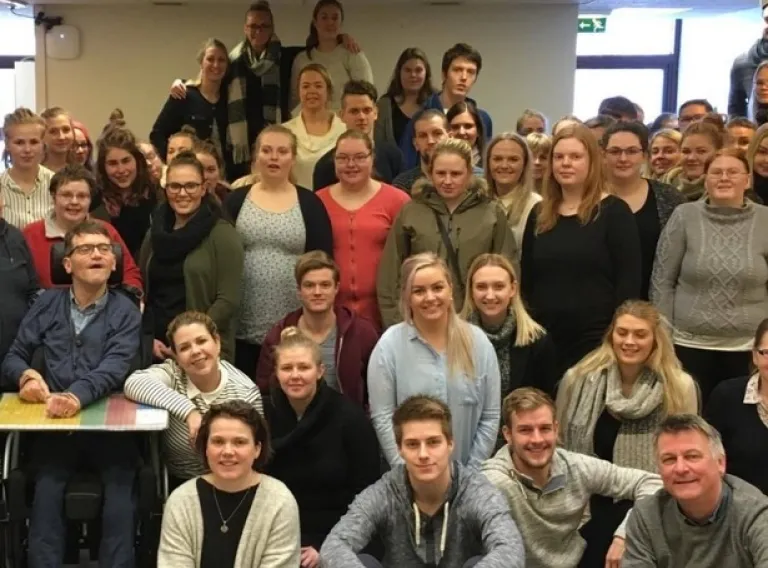
- Would you like to improve your knowledge?
- Do you want to build your academic and professional skills?
- Do you want to feel more confident at work?
- Do you want an inclusive programme?
- Are you passionate about fighting for disability rights?
The vocational diploma for people with developmental disabilities is a two-year programme.
The programme aims to prepare students for work, for example in schools, preschools, community centres and in settings where disabled people access services.
Students study alongside other UI students, taking the same courses, and the programme is therefore inclusive. The programme is tailored to meet the needs and interests of each individual student. After graduating, students will receive a certificate confirming that they have completed certain courses and training placements. Completing this diploma does not allow a student to apply for further study at the University of Iceland. Students do not earn ECTS credits.
Particular emphasis is placed on helping students access the general labour market and increasing their opportunities to engage with society.
The programme also includes a special focus on campaigns for disability rights and human rights.
Course topics include:
- Communication and cooperation
- Leisure studies
- Social education
- Vocational training
At the start of the programme:
- Students choose an area to specialise in – working in preschools, recreation and community work, or disability rights campaigning.
- Efforts are made to make the programme relevant to the student’s selected area of work through courses and training placements.
- The programme is tailored to meet the needs and interests of each individual student.
- The programme is based on the principles of universal education, the UN Convention on the Rights of Persons with Disabilities and UI strategy.
Teaching and support
Classes and assignments are, to a large extent, based on cooperation between all students. This means that students support one another through the programme. Project managers for the programme are also involved in supporting students as required.
UI cannot provide assistance with normal day-to-day activities, but students who require such assistance may attend classes with their user-controlled personal assistant or advocate.
Teaching is organised like any other teaching at UI. There are certain times when workloads are higher, around assignment deadlines and towards the end of the semester.
Timetables for each semester are issued just before the semester starts.
Students are expected to attend classes for around 10 hours a week, with additional time required for completing assignments. Students complete two training placements, each lasting 4-6 weeks. During a placement, attendance requirements are higher.
Timetables can be flexible in universities and changes may be made at short notice.
Who is the programme for?
There are a limited number of places available on the programme and admission is mainly based on the following:
- Interest in the programme and working in the relevant area
- Upper secondary school education and/or continuing education
- Work experience
Buildings and facilities
Teaching mostly takes place at the School of Education in Saga (as of autumn 2025) In the past, students have formed a friendly community and there has been a lot of interaction between the different subjects and a busy social side to the programme. There are good places to read and study available in Saga.
More information about the programme
The programme helps students prepare for work in the field of educational sciences, which includes work in preschools, recreation and community work, and work involving the empowerment, rights and interests, and social engagement of disabled people.
Particular emphasis is placed on helping students access the general labour market and giving them more opportunities to engage with society.
The programme also includes a special focus on campaigns for disability rights and human rights.
Programme structure
Check below to see how the programme is structured.
This programme does not offer specialisations.
- First year
- Fall
- Study skills in university work
- Effective Communication
- Peer to peer support (spring)
- Spring 1
- Sociology and equality
- Training I
- Peer to peer support (spring)
Study skills in university work (HÍT101G)
This course aims at ensure basic skills in research work and prepare students for their studies. Students gain insight in the basic skills of academic writing. Important issues in organizing essays and reports will be discussed. Emphasis will be placed on training students in writing professionally, using proper language. Students will for example turn in an assignment where they practice finding references with search engines, use them and report them correctly.
The course evaluation is built on weekly assignments and a short written essay is submitted at the end of the course.
Effective Communication (TÓS104G)
The course focuses on practical professional communication, especially as it relates to prospective work in the fields of social pedagogy and youth work.
The students use several methods and media in their work, including drama, speech and digital media, analysing their own and others' ways of interacting in order to increase their communicative competence.
Peer to peer support (spring) (TÓS106G)
The subjects of the course is social interaction, co-operation and learning assistance for students who may need assistance and / or support in their studies at School of Education.
This course will focus on new emphases and innovations in education with a focus on inclusive education and universal design. Coaching, equality, inclusive society and human rights will also be discussed in a broad context. Ways will be introduced to enhance the educational and social participation of students in the university in a variety of ways. At the end of the course, students receive confirmation that they have completed the course which they can, for example, use in their CV.
The Collaboration with fellow students usually take three lessons a week. The collaboration may include educational assistance, for example in project work or spending time together at the library or Háma and participation in social events on behalf of student associations. There will be five meetings with teachers in the first half off the semester as well as one working day where students receive support and training. In addition, students can book meetings as needed with the course teachers.
Students do a journal and submit a final report on their experience.
Sociology and equality (TÓS207G)
The objective of this course is to equip students with the ability to connect their community, professional field, and academic discipline to theoretical frameworks addressing discrimination and privilege. The course introduces a range of theories that provide insights into understanding contemporary society. Topics include social discrimination and privilege, with a particular emphasis on social class, gender, race, disability and sexuality, specifically within the context of the professional practice of leisure and youth workers.
Training I (TÓS209G)
Students prepare for the job training at school and then they go to a workplace for 4-6 weeks on the field of work that falls within the School of Education's, for example, kindergarten work, leisure activities and social activities, and work related to empowerment, interests and participation of disabled people.
Preparation is in lectures, group work and project work. Students will also create a cv, keep a diary and give presentations about their own work study.
Students will work under guidance in their job training. Lectures, discussion groups, individual assignments, group work and research work will all be part of the course. Attendance is compulsory.
Peer to peer support (spring) (TÓS213G)
The subjects of the course is social interaction, co-operation and learning assistance for students who may need assistance and / or support in their studies at School of Education.
This course will focus on new emphases and innovations in education with a focus on inclusive education and universal design. Equality, inclusive society and human rights will also be discussed in a broad context. Ways will be introduced to enhance the educational and social participation of students in the university in a variety of ways. Emphasis on collaboration with students regarding the structure of the course.
Students do a journal and submit a final report on their experience.
- Second year
- Fall
- Training II
- Training II
- Inclusive research I
- History and disability
- Outdoor teaching, outdoor learning and health
- Outdoor Recreation and Outdoor Learning in Life and Work
- Introduction to social education
- The local environment as a source for learning
- Spring 1
- Final Project – Vocational diploma program
- Not taught this semesterInclusive research II
- Movement and dramatic expression, inside and outside
- Leisure and children
- Power and marginalisation: utilisation of sociological theories
- Year unspecified
- Leisure and teenagers
- Life skills
- Disability and the life course
- Creativity and play: Art, drama and music
- Events and Project Management
Training II (TÓS406G)
The course is divided into two parts and is organized like prior courses, there is attendance in schools and the job training itself is in kindergartens, recreational centers, libraries and in the field of disability. Students should gain more independence in their work and more responsibility is given to students at the job training location as well as receiving more and more complex assignments. Students will also complete a final assignment at the job training location, which they prepare and work on all semester. Students will keep on working on the projects, prepare and seek out teachers during interview hoursThe students will also create a presentation about their workplace and a final assignment that they will present in an open seminar of diploma students in May. Special emphasis will be placed on students taking extra responsibility and setting goals that they will complete at their job training location.
Topic: Before students go out to the workplace, their duties are discussed as well as setting forth goals and the responsibility the students have in their job training. The final assignment that students present will be discussed especially. At the end of January students will have begun working on ideas of what they wish to tackle. During the job training period in March/april students will meet the teacher during interview meetings when necessary. The teacher will also meet students during individual meetings and in smaller groups when students commence their presentations which their present in an open seminar of diploma students in May. In April most of the preparation work is done as well as exercises for the seminar. Students should also update their cvs that did during the second semester. Students will write a diary as before.
Working methods: Students will work under the guidance of a mentor at the job training location, there will be lectures, discussions, individual assignments, group work, research work, individual teaching. Attendance is compulsory in the course.
Training II (TÓS311G)
Students prepare for the job training at school and then they go to a workplace for 4-6 weeks on the field of work that falls within the School of Education's, for example, kindergarten work, leisure activities and social activities, and work related to empowerment, interests and participation of disabled people.
Preparation is in lectures, group work and project work. Students will also work at their cv, keep a diary and give presentations about their own work study.
Students will work under guidance in their job training. Lectures, discussion groups, individual assignments, group work and research work will all be part of the course. Attendance is compulsory.
Inclusive research I (TÓS312G)
The topic of this course is inclusive research methods which involve people with intellectual disabilities as instigators of ideas, research designers, interviewers, data analysts, authors, disseminators, and users. Students will be introduced to different aspects of the research process from an idea to dissemination. Students will learn about how to seek permission to conduct research and trained in interview technique. Various methods of dissemination will be introduced such as photo essays and academic papers. Inclusive research is directly linked to legal and international (CRPD) obligations to involve disabled people in development and implementation of legislation, policies and decision-making process concerning issues relation to disabled people. This course is a good preparation for those who will be involved in such collaboration in the future.
History and disability (ÞRS119G)
The main goal of this course is to shed light on the historical development of theories and perspectives on disability and how they have influenced and shaped the lives and circumstances of disabled people. An emphasis will be placed on the period from the beginning of the twentieth century to today. A particular focus will be placed on topics such as institutionalization, de-institutionalization, disability and eugenics, the medical understanding of disability, the ideology of normalization and disabled people‘s rights to education and parenting. In addition, the disability rights movement and the UN Convention on the Rights of Persons with Disabilities will be discussed. The course draws on the social understanding of disability and highlights the interconnection of the various social and cultural factors that impact and influence how disability is understood and interpreted. The course places a special emphasis on connecting historical ideas and theories with the daily lives and experiences of disabled people.
Outdoor teaching, outdoor learning and health (ÍÞH325G)
In this course the aim is to teach the students how they, as teachers, can increase physical activity in a class by moving the teaching outside. The students will learn how to plan one day of outdoor teaching as well as longer period for example a semester. The students will get the opportunity to teach and build up teaching facilities in the outdoors. In the end of the course the students should have acquired general understanding and insight into main theories and concepts in outdoor learning, rationalise their decisions and have acquired an open-minded and innovative way of thinking in connection to teaching in the outdoor.
Outdoor Recreation and Outdoor Learning in Life and Work (TÓS301G)
Students will become competent in organizing outdoor education and outdoor activities for people of all ages in both summer and winter. The focus is on the one hand, enjoy nature, and to identify how nature can be a platform for upbringing and education (such as the focus on plants, animals or landscapes).
Emphasis is on the value of outdoor and adventure education and how it can be used as an important and successful tool in working with people, theories about outdoor education and experiential learning, group processes, personal and social growth and development. Focus is on connection to nature, group work and cooperation, team building and improving self-esteem and self-image. Also on practical matters, such as clothing, finding your way in the outdoors and environmental and safety issues.
Students are encouraged to use a reflective journal in the course for reflection, notes and ideas.
Students take one two-night journey 6.10.-8.10. and one overnight stay 11.11.-12.11, 2025.
Students have to pay all travel costs.
Course Assessment
To finish the course students need to:
- Plan, prepare and carrie out an outdoor learning project with peer-students.
- Write a chapter about defined subject in "a student book" on Outdoor Education.
- Reflection and self evaluation about the mutual trips / journeys and the course.
- Go on the mutual trips / journeys and attend classes.
- Distance students have to write summaries from lectures and participate in a class and/or web discussions.
- Reading exames.
5.0 is the minimum grade for each assignment.
Minimum attendanse is 80%
Introduction to social education (ÞRS118G)
This course provides a foundation for studies in Social Education (Þroskaþjálfafræði) and offers an overview of the professional field and role of the social educator (þroskaþjálfi). Emphasis is placed on human rights perspectives and the importance of professional support for social participation and advocacy of the rights of disabled people and others who use social educator services.
The course covers the following topics:
-
Key concepts in the field of Social Education
-
Competencies and roles of the social educator
-
Teamwork and group collaboration
-
History and development of the social educator profession in Iceland
-
Human rights and international human rights conventions
-
Laws and regulations relevant to the profession
-
Ethical guidelines and professional values of social educators
-
Service models and professional approaches
-
The role of social educators in a diverse and inclusive society
-
Recent research in the field
Students will also become familiar with professional practices and service models in the field.
Teaching Methods
The course uses a flipped classroom approach and collaborative learning. Lectures and study materials are accessible on Canvas. Students are expected to come well prepared to weekly teaching sessions and intensive in-person sessions (so-called staðlotur), whether these take place in the classroom or live online. The schedule is available on the course website.
Collaboration in student workgroups and active participation in discussions and assignments during class are important components of the course.
Attendance and participation are mandatory. Attendance and active participation account for 20% of the final grade. Students must achieve a minimum grade of 5 (out of 10) in this part of the course assessment to pass the course (further details are provided in the course syllabus).
On-site teaching (Staðkennsla): On-site students attend weekly classes and intensive sessions in the classroom.
Distance learning (Fjarkennsla): Distance students attend weekly live online classes and intensive sessions.
There are two intensive sessions (staðlotur) during the semester.
The local environment as a source for learning (LSS105G)
The emphasis is on students realising how they can use their local environment as a source for learning about science and mathematics. The importance of children's outdoor learning and movement for their health and development is stressed, along with how teachers can integrate these into children's education. Students will investigate different approaches to scaffold children's learning of mammals, small animals, plants, water, air, forms, numbers, and volume in their local environment.
Final Project – Vocational diploma program (TÓS407G)
The module’s aims at enhancing the students’ ability to plan and prepare a final project. Emphasis is on collaboration and group projects as well as individualized work. The module focus is on student’s interest, talent and contribution. Upon completion of the course, students do a presentation or organize an event about their final project.
The module is mandatory and is only for students in the Vocational diploma programme.
Inclusive research II (TÓS412G)
This is a continuation of the course Inclusive Research I. The topic of this course is inclusive research methods which involve people with intellectual disabilities as instigators of ideas, research designers, interviewers, data analysts, authors, disseminators, and users. Students will get further introduction of the different aspects of the research process - from an idea to dissemination. The main emphasis will be on methods of dissemination both in speech and writing. Inclusive research is directly linked to legal and international (CRPD) obligations to involve disabled people in development and implementation of legislation, policies and decision-making process concerning issues relation to disabled people. This course is a good preparation for those who will be involved in such collaboration in the future.
Movement and dramatic expression, inside and outside (LSS202G)
This course introduces methods of dramatic expression related to caring, trust and feelings of security in children, as a mechanism to bolster tolerance, friendship and expression.
Leisure and children (TÓS202G)
Megin viðfangsefni námskeiðsins eru tómstundir barna á aldrinum 6-12 ára í víðum skilningi. Fjallað er um helstu uppeldisfræðislegu sjónarhornin með þennan aldurshóp í huga, sem og margvíslegar áskoranir sem börn á þessum aldri standa frammi fyrir.
Viðfangsefni námskeiðsins snúa meðal annars að lýðræðislegum starfsháttum í starfi með börnum, viðmiðum um gæði í frístundastarfi og öryggis- og velferðarmálum í æskulýðs- og tómstundastarfi. Þá er einnig fjallað um mikilvægi frjálsa leiksins, fjölmenningu og inngildingu, samskipti og gagnrýna hugsun, listir, barnamenningu og skapandi starf og tómstundastarf með margbreytilegum barnahópum.
Markmiðið með námskeiðinu er að nemendur öðlist skilning og innsæi í helstu kenningar um þroska, nám og félagsfærni 6 – 12 ára barna, þekki til umgjörðar og laga um starfsemi stofnana á vettvangi frístunda- og æskulýðsstarfs og skilji möguleika og hindranir fyrir þátttöku barna í tómstundastarfi. Þá er einnig fjallað um samspils stöðu barna við umhverfi sitt og náttúru, listir og menningu, lýðræðisleg vinnubrögð í frístundastarfi með börnum, í fjölmenningarsamfélagi. Einnig er lögð áhersla á að nemendur fái tækifæri til að ígrunda eigin reynslu og reynsluheim af tómstundum sem börn.
Á námskeiðinu er litið til viðmiða um virðingu og skilning, eins og fram kemur í gátlista Háskóla Íslands um jafnrétti í kennslu.
Power and marginalisation: utilisation of sociological theories (ÞRS214G)
The aim of the course is that students learn to know and use different sociological theories related to physical and mental attainment. Concept related to power, such as stigma, power, microaggression, and ableism, will be explored and students can use to analyse how norms are maintained and how societal definitions of norms come about. The theories that will be taught should be useful to students to understand how the marginalization of groups is maintained in the community and how discipline of the body takes place.
Leisure and teenagers (TÓS211G)
The course focus on leisure activities for teenagers in Iceland, the meaning of leisure, roles of leaders, leisure studies, how to help troubled youth and visits to various organisations. Students will get training in how to organizise and evaluate leisure activities for this age group.
Life skills (TÓS404G)
In this course, the aim is that students will gain knowledge about life skills. Life skills are a subject that gives students the opportunity to engage in self-reflection, emotional intelligence and self-esteem. Life skills is a platform for working with students as individuals, preparing them for the diversity of life and teaching them self-nurturing. In that context, the concepts happiness, participation, well-being, mindfulness and democracy will be discussed. Also, students will learn about the main core of life skills and how to use life skills methods in leisure and school work.
Disability and the life course (ÞRS212G)
In this course, the lived experience of disabled people throughout the life course, from childhood to old age, will be explored, along with the societal and structural barriers that they face along the way. Critical theories on the life course will be employed to discuss the multiple and intersecting forms of discrimination and biases that disabled people experience in different stages of their lives, and how they undermine their ability to fully participate in society, including in education, employment, culture, recreation, politics and family life. A special focus will be directed at the criticism voiced by representative organizations of disabled people with regard to the first and final stages of the life course, i.e. fetal ultrasounds and assisted suicide. In addition, the course will examine the teenage years as a distinct life stage, and access of disabled people to the digital world, in the context of the right to full and active participation in adulthood. The course will also discuss how the prevailing discourse around the different stages of the life course, that is childhood, teenage years, adulthood and senior year, can be both be oppressive and liberating for disabled people and the development of their self-identity. Policymaking in matters pertaining to disabled people and international human rights treaties will be examined from the perspective of the human rights approach to disability.
Methods of work: Lectures, working in groups and class discussion. An emphasis will be placed on active participation of students in discussions and that they follow public coverage of disability in the media and politics with the life course in mind. Students will need to adopt academic methods of work in their writing and documentation.
Creativity and play: Art, drama and music (KME205G)
Students will learn about the importance of the arts in the education of children and adolescents. The focus will be on expression through drama, visual arts, and music. One common theme will be chosen as a pivot point for the three genres of artistic expression.
Events and Project Management (TÓS411G)
The course aims at enhancing students ability to plan and prepare event with tools of project management. Emphasis is on collaboration and group projects so students should be more prepared for further studies, future jobs and diverse organisational participations. The course is mandatory for students in leisure studies and social education and aims at meeting the demand for skills in event and project management in the field of leisure, recreation and youth work. It´s also available for other students within the University of Iceland at their choice.
The course requires students active participation in discussions and assignments for building a good and supportive learning environment and success for all. We also focus on positive interactions and communications and responsibility of all students for their actions and study.
Subject matter
During the course, issues of organising event projects will be discussed. A main focus is on preparation, analysing, planning, performing and evaluationg events, fx. in the field of leisure, recreation and culture. Cases such as meetings, conferences, concerts, festivals, sports events, annual dates and festivals will be discussed and looked into. Discussion about law environment, regulations and safety issues and the role of events for leisure, recreation and travel along with educational and social meaning and influence of events.
How?
Lectures, discussions, assignments and field trips. In the course students work on their own event in groups, planning, preparing, performing and evaluating it, and also peer reviewing co-students plans and events and on line "reading-exams".
The course is for both distant students and on field students. Attendance is mandatory to 80% for on field students and for distance students in on field sessions.
Mininum grade og 5.0 is required for every assignment.
- Fall
- HÍT101GStudy skills in university workMandatory (required) course5A mandatory (required) course for the programme5 ECTS, creditsCourse Description
This course aims at ensure basic skills in research work and prepare students for their studies. Students gain insight in the basic skills of academic writing. Important issues in organizing essays and reports will be discussed. Emphasis will be placed on training students in writing professionally, using proper language. Students will for example turn in an assignment where they practice finding references with search engines, use them and report them correctly.
The course evaluation is built on weekly assignments and a short written essay is submitted at the end of the course.
Face-to-face learningPrerequisitesAttendance required in classTÓS104GEffective CommunicationMandatory (required) course5A mandatory (required) course for the programme5 ECTS, creditsCourse DescriptionThe course focuses on practical professional communication, especially as it relates to prospective work in the fields of social pedagogy and youth work.
The students use several methods and media in their work, including drama, speech and digital media, analysing their own and others' ways of interacting in order to increase their communicative competence.
Face-to-face learningPrerequisitesAttendance required in classTÓS106GPeer to peer support (spring)Mandatory (required) course5A mandatory (required) course for the programme5 ECTS, creditsCourse DescriptionThe subjects of the course is social interaction, co-operation and learning assistance for students who may need assistance and / or support in their studies at School of Education.
This course will focus on new emphases and innovations in education with a focus on inclusive education and universal design. Coaching, equality, inclusive society and human rights will also be discussed in a broad context. Ways will be introduced to enhance the educational and social participation of students in the university in a variety of ways. At the end of the course, students receive confirmation that they have completed the course which they can, for example, use in their CV.
The Collaboration with fellow students usually take three lessons a week. The collaboration may include educational assistance, for example in project work or spending time together at the library or Háma and participation in social events on behalf of student associations. There will be five meetings with teachers in the first half off the semester as well as one working day where students receive support and training. In addition, students can book meetings as needed with the course teachers.
Students do a journal and submit a final report on their experience.
Face-to-face learningDistance learningPrerequisitesAttendance required in class- Spring 2
TÓS207GSociology and equalityMandatory (required) course10A mandatory (required) course for the programme10 ECTS, creditsCourse DescriptionThe objective of this course is to equip students with the ability to connect their community, professional field, and academic discipline to theoretical frameworks addressing discrimination and privilege. The course introduces a range of theories that provide insights into understanding contemporary society. Topics include social discrimination and privilege, with a particular emphasis on social class, gender, race, disability and sexuality, specifically within the context of the professional practice of leisure and youth workers.
Face-to-face learningPrerequisitesAttendance required in classTÓS209GTraining IMandatory (required) course5A mandatory (required) course for the programme5 ECTS, credits5 fieldwork creditsCourse DescriptionStudents prepare for the job training at school and then they go to a workplace for 4-6 weeks on the field of work that falls within the School of Education's, for example, kindergarten work, leisure activities and social activities, and work related to empowerment, interests and participation of disabled people.
Preparation is in lectures, group work and project work. Students will also create a cv, keep a diary and give presentations about their own work study.
Students will work under guidance in their job training. Lectures, discussion groups, individual assignments, group work and research work will all be part of the course. Attendance is compulsory.
Face-to-face learningPrerequisitesAttendance required in classTÓS213GPeer to peer support (spring)Mandatory (required) course5A mandatory (required) course for the programme5 ECTS, creditsCourse DescriptionThe subjects of the course is social interaction, co-operation and learning assistance for students who may need assistance and / or support in their studies at School of Education.
This course will focus on new emphases and innovations in education with a focus on inclusive education and universal design. Equality, inclusive society and human rights will also be discussed in a broad context. Ways will be introduced to enhance the educational and social participation of students in the university in a variety of ways. Emphasis on collaboration with students regarding the structure of the course.
Students do a journal and submit a final report on their experience.
Face-to-face learningDistance learningPrerequisitesAttendance required in class- Fall
- TÓS406GTraining IIRestricted elective course5Restricted elective course, conditions apply5 ECTS, credits5 fieldwork creditsCourse Description
The course is divided into two parts and is organized like prior courses, there is attendance in schools and the job training itself is in kindergartens, recreational centers, libraries and in the field of disability. Students should gain more independence in their work and more responsibility is given to students at the job training location as well as receiving more and more complex assignments. Students will also complete a final assignment at the job training location, which they prepare and work on all semester. Students will keep on working on the projects, prepare and seek out teachers during interview hoursThe students will also create a presentation about their workplace and a final assignment that they will present in an open seminar of diploma students in May. Special emphasis will be placed on students taking extra responsibility and setting goals that they will complete at their job training location.
Topic: Before students go out to the workplace, their duties are discussed as well as setting forth goals and the responsibility the students have in their job training. The final assignment that students present will be discussed especially. At the end of January students will have begun working on ideas of what they wish to tackle. During the job training period in March/april students will meet the teacher during interview meetings when necessary. The teacher will also meet students during individual meetings and in smaller groups when students commence their presentations which their present in an open seminar of diploma students in May. In April most of the preparation work is done as well as exercises for the seminar. Students should also update their cvs that did during the second semester. Students will write a diary as before.
Working methods: Students will work under the guidance of a mentor at the job training location, there will be lectures, discussions, individual assignments, group work, research work, individual teaching. Attendance is compulsory in the course.
Face-to-face learningPrerequisitesAttendance required in classTÓS311GTraining IIRestricted elective course10Restricted elective course, conditions apply10 ECTS, credits10 fieldwork creditsCourse DescriptionStudents prepare for the job training at school and then they go to a workplace for 4-6 weeks on the field of work that falls within the School of Education's, for example, kindergarten work, leisure activities and social activities, and work related to empowerment, interests and participation of disabled people.
Preparation is in lectures, group work and project work. Students will also work at their cv, keep a diary and give presentations about their own work study.
Students will work under guidance in their job training. Lectures, discussion groups, individual assignments, group work and research work will all be part of the course. Attendance is compulsory.
Face-to-face learningPrerequisitesAttendance required in classCourse DescriptionThe topic of this course is inclusive research methods which involve people with intellectual disabilities as instigators of ideas, research designers, interviewers, data analysts, authors, disseminators, and users. Students will be introduced to different aspects of the research process from an idea to dissemination. Students will learn about how to seek permission to conduct research and trained in interview technique. Various methods of dissemination will be introduced such as photo essays and academic papers. Inclusive research is directly linked to legal and international (CRPD) obligations to involve disabled people in development and implementation of legislation, policies and decision-making process concerning issues relation to disabled people. This course is a good preparation for those who will be involved in such collaboration in the future.
Face-to-face learningPrerequisitesAttendance required in classÞRS119GHistory and disabilityElective course10Free elective course within the programme10 ECTS, creditsCourse DescriptionThe main goal of this course is to shed light on the historical development of theories and perspectives on disability and how they have influenced and shaped the lives and circumstances of disabled people. An emphasis will be placed on the period from the beginning of the twentieth century to today. A particular focus will be placed on topics such as institutionalization, de-institutionalization, disability and eugenics, the medical understanding of disability, the ideology of normalization and disabled people‘s rights to education and parenting. In addition, the disability rights movement and the UN Convention on the Rights of Persons with Disabilities will be discussed. The course draws on the social understanding of disability and highlights the interconnection of the various social and cultural factors that impact and influence how disability is understood and interpreted. The course places a special emphasis on connecting historical ideas and theories with the daily lives and experiences of disabled people.
Face-to-face learningDistance learningPrerequisitesAttendance required in classÍÞH325GOutdoor teaching, outdoor learning and healthElective course5Free elective course within the programme5 ECTS, creditsCourse DescriptionIn this course the aim is to teach the students how they, as teachers, can increase physical activity in a class by moving the teaching outside. The students will learn how to plan one day of outdoor teaching as well as longer period for example a semester. The students will get the opportunity to teach and build up teaching facilities in the outdoors. In the end of the course the students should have acquired general understanding and insight into main theories and concepts in outdoor learning, rationalise their decisions and have acquired an open-minded and innovative way of thinking in connection to teaching in the outdoor.
Face-to-face learningPrerequisitesAttendance required in classTÓS301GOutdoor Recreation and Outdoor Learning in Life and WorkElective course10Free elective course within the programme10 ECTS, creditsCourse DescriptionStudents will become competent in organizing outdoor education and outdoor activities for people of all ages in both summer and winter. The focus is on the one hand, enjoy nature, and to identify how nature can be a platform for upbringing and education (such as the focus on plants, animals or landscapes).
Emphasis is on the value of outdoor and adventure education and how it can be used as an important and successful tool in working with people, theories about outdoor education and experiential learning, group processes, personal and social growth and development. Focus is on connection to nature, group work and cooperation, team building and improving self-esteem and self-image. Also on practical matters, such as clothing, finding your way in the outdoors and environmental and safety issues.
Students are encouraged to use a reflective journal in the course for reflection, notes and ideas.
Students take one two-night journey 6.10.-8.10. and one overnight stay 11.11.-12.11, 2025.
Students have to pay all travel costs.
Course Assessment
To finish the course students need to:
- Plan, prepare and carrie out an outdoor learning project with peer-students.
- Write a chapter about defined subject in "a student book" on Outdoor Education.
- Reflection and self evaluation about the mutual trips / journeys and the course.
- Go on the mutual trips / journeys and attend classes.
- Distance students have to write summaries from lectures and participate in a class and/or web discussions.
- Reading exames.
5.0 is the minimum grade for each assignment.
Minimum attendanse is 80%Face-to-face learningDistance learningPrerequisitesAttendance required in classÞRS118GIntroduction to social educationElective course10Free elective course within the programme10 ECTS, creditsCourse DescriptionThis course provides a foundation for studies in Social Education (Þroskaþjálfafræði) and offers an overview of the professional field and role of the social educator (þroskaþjálfi). Emphasis is placed on human rights perspectives and the importance of professional support for social participation and advocacy of the rights of disabled people and others who use social educator services.
The course covers the following topics:
-
Key concepts in the field of Social Education
-
Competencies and roles of the social educator
-
Teamwork and group collaboration
-
History and development of the social educator profession in Iceland
-
Human rights and international human rights conventions
-
Laws and regulations relevant to the profession
-
Ethical guidelines and professional values of social educators
-
Service models and professional approaches
-
The role of social educators in a diverse and inclusive society
-
Recent research in the field
Students will also become familiar with professional practices and service models in the field.
Teaching Methods
The course uses a flipped classroom approach and collaborative learning. Lectures and study materials are accessible on Canvas. Students are expected to come well prepared to weekly teaching sessions and intensive in-person sessions (so-called staðlotur), whether these take place in the classroom or live online. The schedule is available on the course website.Collaboration in student workgroups and active participation in discussions and assignments during class are important components of the course.
Attendance and participation are mandatory. Attendance and active participation account for 20% of the final grade. Students must achieve a minimum grade of 5 (out of 10) in this part of the course assessment to pass the course (further details are provided in the course syllabus).
On-site teaching (Staðkennsla): On-site students attend weekly classes and intensive sessions in the classroom.
Distance learning (Fjarkennsla): Distance students attend weekly live online classes and intensive sessions.There are two intensive sessions (staðlotur) during the semester.
Face-to-face learningDistance learningPrerequisitesAttendance required in classLSS105GThe local environment as a source for learningElective course10Free elective course within the programme10 ECTS, creditsCourse DescriptionThe emphasis is on students realising how they can use their local environment as a source for learning about science and mathematics. The importance of children's outdoor learning and movement for their health and development is stressed, along with how teachers can integrate these into children's education. Students will investigate different approaches to scaffold children's learning of mammals, small animals, plants, water, air, forms, numbers, and volume in their local environment.
Face-to-face learningPrerequisitesAttendance required in class- Spring 2
TÓS407GFinal Project – Vocational diploma programMandatory (required) course5A mandatory (required) course for the programme5 ECTS, creditsCourse DescriptionThe module’s aims at enhancing the students’ ability to plan and prepare a final project. Emphasis is on collaboration and group projects as well as individualized work. The module focus is on student’s interest, talent and contribution. Upon completion of the course, students do a presentation or organize an event about their final project.
The module is mandatory and is only for students in the Vocational diploma programme.
Face-to-face learningPrerequisitesAttendance required in classNot taught this semesterTÓS412GInclusive research IIElective course5Free elective course within the programme5 ECTS, creditsCourse DescriptionThis is a continuation of the course Inclusive Research I. The topic of this course is inclusive research methods which involve people with intellectual disabilities as instigators of ideas, research designers, interviewers, data analysts, authors, disseminators, and users. Students will get further introduction of the different aspects of the research process - from an idea to dissemination. The main emphasis will be on methods of dissemination both in speech and writing. Inclusive research is directly linked to legal and international (CRPD) obligations to involve disabled people in development and implementation of legislation, policies and decision-making process concerning issues relation to disabled people. This course is a good preparation for those who will be involved in such collaboration in the future.
Face-to-face learningPrerequisitesLSS202GMovement and dramatic expression, inside and outsideElective course10Free elective course within the programme10 ECTS, credits2 fieldwork creditsCourse DescriptionThis course introduces methods of dramatic expression related to caring, trust and feelings of security in children, as a mechanism to bolster tolerance, friendship and expression.
Face-to-face learningPrerequisitesAttendance required in classTÓS202GLeisure and childrenElective course10Free elective course within the programme10 ECTS, creditsCourse DescriptionMegin viðfangsefni námskeiðsins eru tómstundir barna á aldrinum 6-12 ára í víðum skilningi. Fjallað er um helstu uppeldisfræðislegu sjónarhornin með þennan aldurshóp í huga, sem og margvíslegar áskoranir sem börn á þessum aldri standa frammi fyrir.
Viðfangsefni námskeiðsins snúa meðal annars að lýðræðislegum starfsháttum í starfi með börnum, viðmiðum um gæði í frístundastarfi og öryggis- og velferðarmálum í æskulýðs- og tómstundastarfi. Þá er einnig fjallað um mikilvægi frjálsa leiksins, fjölmenningu og inngildingu, samskipti og gagnrýna hugsun, listir, barnamenningu og skapandi starf og tómstundastarf með margbreytilegum barnahópum.
Markmiðið með námskeiðinu er að nemendur öðlist skilning og innsæi í helstu kenningar um þroska, nám og félagsfærni 6 – 12 ára barna, þekki til umgjörðar og laga um starfsemi stofnana á vettvangi frístunda- og æskulýðsstarfs og skilji möguleika og hindranir fyrir þátttöku barna í tómstundastarfi. Þá er einnig fjallað um samspils stöðu barna við umhverfi sitt og náttúru, listir og menningu, lýðræðisleg vinnubrögð í frístundastarfi með börnum, í fjölmenningarsamfélagi. Einnig er lögð áhersla á að nemendur fái tækifæri til að ígrunda eigin reynslu og reynsluheim af tómstundum sem börn.
Á námskeiðinu er litið til viðmiða um virðingu og skilning, eins og fram kemur í gátlista Háskóla Íslands um jafnrétti í kennslu.
Face-to-face learningPrerequisitesAttendance required in classÞRS214GPower and marginalisation: utilisation of sociological theoriesElective course10Free elective course within the programme10 ECTS, creditsCourse DescriptionThe aim of the course is that students learn to know and use different sociological theories related to physical and mental attainment. Concept related to power, such as stigma, power, microaggression, and ableism, will be explored and students can use to analyse how norms are maintained and how societal definitions of norms come about. The theories that will be taught should be useful to students to understand how the marginalization of groups is maintained in the community and how discipline of the body takes place.
Face-to-face learningDistance learningPrerequisitesAttendance required in class- Year unspecified
TÓS211GLeisure and teenagersElective course10Free elective course within the programme10 ECTS, creditsCourse DescriptionThe course focus on leisure activities for teenagers in Iceland, the meaning of leisure, roles of leaders, leisure studies, how to help troubled youth and visits to various organisations. Students will get training in how to organizise and evaluate leisure activities for this age group.
Face-to-face learningPrerequisitesAttendance required in classCourse DescriptionIn this course, the aim is that students will gain knowledge about life skills. Life skills are a subject that gives students the opportunity to engage in self-reflection, emotional intelligence and self-esteem. Life skills is a platform for working with students as individuals, preparing them for the diversity of life and teaching them self-nurturing. In that context, the concepts happiness, participation, well-being, mindfulness and democracy will be discussed. Also, students will learn about the main core of life skills and how to use life skills methods in leisure and school work.
Face-to-face learningDistance learningPrerequisitesAttendance required in classÞRS212GDisability and the life courseElective course10Free elective course within the programme10 ECTS, creditsCourse DescriptionIn this course, the lived experience of disabled people throughout the life course, from childhood to old age, will be explored, along with the societal and structural barriers that they face along the way. Critical theories on the life course will be employed to discuss the multiple and intersecting forms of discrimination and biases that disabled people experience in different stages of their lives, and how they undermine their ability to fully participate in society, including in education, employment, culture, recreation, politics and family life. A special focus will be directed at the criticism voiced by representative organizations of disabled people with regard to the first and final stages of the life course, i.e. fetal ultrasounds and assisted suicide. In addition, the course will examine the teenage years as a distinct life stage, and access of disabled people to the digital world, in the context of the right to full and active participation in adulthood. The course will also discuss how the prevailing discourse around the different stages of the life course, that is childhood, teenage years, adulthood and senior year, can be both be oppressive and liberating for disabled people and the development of their self-identity. Policymaking in matters pertaining to disabled people and international human rights treaties will be examined from the perspective of the human rights approach to disability.
Methods of work: Lectures, working in groups and class discussion. An emphasis will be placed on active participation of students in discussions and that they follow public coverage of disability in the media and politics with the life course in mind. Students will need to adopt academic methods of work in their writing and documentation.
Face-to-face learningDistance learningPrerequisitesAttendance required in classKME205GCreativity and play: Art, drama and musicElective course5Free elective course within the programme5 ECTS, creditsCourse DescriptionStudents will learn about the importance of the arts in the education of children and adolescents. The focus will be on expression through drama, visual arts, and music. One common theme will be chosen as a pivot point for the three genres of artistic expression.
Face-to-face learningPrerequisitesAttendance required in classTÓS411GEvents and Project ManagementElective course5Free elective course within the programme5 ECTS, creditsCourse DescriptionThe course aims at enhancing students ability to plan and prepare event with tools of project management. Emphasis is on collaboration and group projects so students should be more prepared for further studies, future jobs and diverse organisational participations. The course is mandatory for students in leisure studies and social education and aims at meeting the demand for skills in event and project management in the field of leisure, recreation and youth work. It´s also available for other students within the University of Iceland at their choice.
The course requires students active participation in discussions and assignments for building a good and supportive learning environment and success for all. We also focus on positive interactions and communications and responsibility of all students for their actions and study.
Subject matter
During the course, issues of organising event projects will be discussed. A main focus is on preparation, analysing, planning, performing and evaluationg events, fx. in the field of leisure, recreation and culture. Cases such as meetings, conferences, concerts, festivals, sports events, annual dates and festivals will be discussed and looked into. Discussion about law environment, regulations and safety issues and the role of events for leisure, recreation and travel along with educational and social meaning and influence of events.How?
Lectures, discussions, assignments and field trips. In the course students work on their own event in groups, planning, preparing, performing and evaluating it, and also peer reviewing co-students plans and events and on line "reading-exams".The course is for both distant students and on field students. Attendance is mandatory to 80% for on field students and for distance students in on field sessions.
Mininum grade og 5.0 is required for every assignment.
Face-to-face learningDistance learningPrerequisitesAttendance required in classSecond year- Fall
- HÍT101GStudy skills in university workMandatory (required) course5A mandatory (required) course for the programme5 ECTS, creditsCourse Description
This course aims at ensure basic skills in research work and prepare students for their studies. Students gain insight in the basic skills of academic writing. Important issues in organizing essays and reports will be discussed. Emphasis will be placed on training students in writing professionally, using proper language. Students will for example turn in an assignment where they practice finding references with search engines, use them and report them correctly.
The course evaluation is built on weekly assignments and a short written essay is submitted at the end of the course.
Face-to-face learningPrerequisitesAttendance required in classTÓS104GEffective CommunicationMandatory (required) course5A mandatory (required) course for the programme5 ECTS, creditsCourse DescriptionThe course focuses on practical professional communication, especially as it relates to prospective work in the fields of social pedagogy and youth work.
The students use several methods and media in their work, including drama, speech and digital media, analysing their own and others' ways of interacting in order to increase their communicative competence.
Face-to-face learningPrerequisitesAttendance required in classTÓS106GPeer to peer support (spring)Mandatory (required) course5A mandatory (required) course for the programme5 ECTS, creditsCourse DescriptionThe subjects of the course is social interaction, co-operation and learning assistance for students who may need assistance and / or support in their studies at School of Education.
This course will focus on new emphases and innovations in education with a focus on inclusive education and universal design. Coaching, equality, inclusive society and human rights will also be discussed in a broad context. Ways will be introduced to enhance the educational and social participation of students in the university in a variety of ways. At the end of the course, students receive confirmation that they have completed the course which they can, for example, use in their CV.
The Collaboration with fellow students usually take three lessons a week. The collaboration may include educational assistance, for example in project work or spending time together at the library or Háma and participation in social events on behalf of student associations. There will be five meetings with teachers in the first half off the semester as well as one working day where students receive support and training. In addition, students can book meetings as needed with the course teachers.
Students do a journal and submit a final report on their experience.
Face-to-face learningDistance learningPrerequisitesAttendance required in class- Spring 2
TÓS207GSociology and equalityMandatory (required) course10A mandatory (required) course for the programme10 ECTS, creditsCourse DescriptionThe objective of this course is to equip students with the ability to connect their community, professional field, and academic discipline to theoretical frameworks addressing discrimination and privilege. The course introduces a range of theories that provide insights into understanding contemporary society. Topics include social discrimination and privilege, with a particular emphasis on social class, gender, race, disability and sexuality, specifically within the context of the professional practice of leisure and youth workers.
Face-to-face learningPrerequisitesAttendance required in classTÓS209GTraining IMandatory (required) course5A mandatory (required) course for the programme5 ECTS, credits5 fieldwork creditsCourse DescriptionStudents prepare for the job training at school and then they go to a workplace for 4-6 weeks on the field of work that falls within the School of Education's, for example, kindergarten work, leisure activities and social activities, and work related to empowerment, interests and participation of disabled people.
Preparation is in lectures, group work and project work. Students will also create a cv, keep a diary and give presentations about their own work study.
Students will work under guidance in their job training. Lectures, discussion groups, individual assignments, group work and research work will all be part of the course. Attendance is compulsory.
Face-to-face learningPrerequisitesAttendance required in classTÓS213GPeer to peer support (spring)Mandatory (required) course5A mandatory (required) course for the programme5 ECTS, creditsCourse DescriptionThe subjects of the course is social interaction, co-operation and learning assistance for students who may need assistance and / or support in their studies at School of Education.
This course will focus on new emphases and innovations in education with a focus on inclusive education and universal design. Equality, inclusive society and human rights will also be discussed in a broad context. Ways will be introduced to enhance the educational and social participation of students in the university in a variety of ways. Emphasis on collaboration with students regarding the structure of the course.
Students do a journal and submit a final report on their experience.
Face-to-face learningDistance learningPrerequisitesAttendance required in class- Fall
- TÓS406GTraining IIRestricted elective course5Restricted elective course, conditions apply5 ECTS, credits5 fieldwork creditsCourse Description
The course is divided into two parts and is organized like prior courses, there is attendance in schools and the job training itself is in kindergartens, recreational centers, libraries and in the field of disability. Students should gain more independence in their work and more responsibility is given to students at the job training location as well as receiving more and more complex assignments. Students will also complete a final assignment at the job training location, which they prepare and work on all semester. Students will keep on working on the projects, prepare and seek out teachers during interview hoursThe students will also create a presentation about their workplace and a final assignment that they will present in an open seminar of diploma students in May. Special emphasis will be placed on students taking extra responsibility and setting goals that they will complete at their job training location.
Topic: Before students go out to the workplace, their duties are discussed as well as setting forth goals and the responsibility the students have in their job training. The final assignment that students present will be discussed especially. At the end of January students will have begun working on ideas of what they wish to tackle. During the job training period in March/april students will meet the teacher during interview meetings when necessary. The teacher will also meet students during individual meetings and in smaller groups when students commence their presentations which their present in an open seminar of diploma students in May. In April most of the preparation work is done as well as exercises for the seminar. Students should also update their cvs that did during the second semester. Students will write a diary as before.
Working methods: Students will work under the guidance of a mentor at the job training location, there will be lectures, discussions, individual assignments, group work, research work, individual teaching. Attendance is compulsory in the course.
Face-to-face learningPrerequisitesAttendance required in classTÓS311GTraining IIRestricted elective course10Restricted elective course, conditions apply10 ECTS, credits10 fieldwork creditsCourse DescriptionStudents prepare for the job training at school and then they go to a workplace for 4-6 weeks on the field of work that falls within the School of Education's, for example, kindergarten work, leisure activities and social activities, and work related to empowerment, interests and participation of disabled people.
Preparation is in lectures, group work and project work. Students will also work at their cv, keep a diary and give presentations about their own work study.
Students will work under guidance in their job training. Lectures, discussion groups, individual assignments, group work and research work will all be part of the course. Attendance is compulsory.
Face-to-face learningPrerequisitesAttendance required in classCourse DescriptionThe topic of this course is inclusive research methods which involve people with intellectual disabilities as instigators of ideas, research designers, interviewers, data analysts, authors, disseminators, and users. Students will be introduced to different aspects of the research process from an idea to dissemination. Students will learn about how to seek permission to conduct research and trained in interview technique. Various methods of dissemination will be introduced such as photo essays and academic papers. Inclusive research is directly linked to legal and international (CRPD) obligations to involve disabled people in development and implementation of legislation, policies and decision-making process concerning issues relation to disabled people. This course is a good preparation for those who will be involved in such collaboration in the future.
Face-to-face learningPrerequisitesAttendance required in classÞRS119GHistory and disabilityElective course10Free elective course within the programme10 ECTS, creditsCourse DescriptionThe main goal of this course is to shed light on the historical development of theories and perspectives on disability and how they have influenced and shaped the lives and circumstances of disabled people. An emphasis will be placed on the period from the beginning of the twentieth century to today. A particular focus will be placed on topics such as institutionalization, de-institutionalization, disability and eugenics, the medical understanding of disability, the ideology of normalization and disabled people‘s rights to education and parenting. In addition, the disability rights movement and the UN Convention on the Rights of Persons with Disabilities will be discussed. The course draws on the social understanding of disability and highlights the interconnection of the various social and cultural factors that impact and influence how disability is understood and interpreted. The course places a special emphasis on connecting historical ideas and theories with the daily lives and experiences of disabled people.
Face-to-face learningDistance learningPrerequisitesAttendance required in classÍÞH325GOutdoor teaching, outdoor learning and healthElective course5Free elective course within the programme5 ECTS, creditsCourse DescriptionIn this course the aim is to teach the students how they, as teachers, can increase physical activity in a class by moving the teaching outside. The students will learn how to plan one day of outdoor teaching as well as longer period for example a semester. The students will get the opportunity to teach and build up teaching facilities in the outdoors. In the end of the course the students should have acquired general understanding and insight into main theories and concepts in outdoor learning, rationalise their decisions and have acquired an open-minded and innovative way of thinking in connection to teaching in the outdoor.
Face-to-face learningPrerequisitesAttendance required in classTÓS301GOutdoor Recreation and Outdoor Learning in Life and WorkElective course10Free elective course within the programme10 ECTS, creditsCourse DescriptionStudents will become competent in organizing outdoor education and outdoor activities for people of all ages in both summer and winter. The focus is on the one hand, enjoy nature, and to identify how nature can be a platform for upbringing and education (such as the focus on plants, animals or landscapes).
Emphasis is on the value of outdoor and adventure education and how it can be used as an important and successful tool in working with people, theories about outdoor education and experiential learning, group processes, personal and social growth and development. Focus is on connection to nature, group work and cooperation, team building and improving self-esteem and self-image. Also on practical matters, such as clothing, finding your way in the outdoors and environmental and safety issues.
Students are encouraged to use a reflective journal in the course for reflection, notes and ideas.
Students take one two-night journey 6.10.-8.10. and one overnight stay 11.11.-12.11, 2025.
Students have to pay all travel costs.
Course Assessment
To finish the course students need to:
- Plan, prepare and carrie out an outdoor learning project with peer-students.
- Write a chapter about defined subject in "a student book" on Outdoor Education.
- Reflection and self evaluation about the mutual trips / journeys and the course.
- Go on the mutual trips / journeys and attend classes.
- Distance students have to write summaries from lectures and participate in a class and/or web discussions.
- Reading exames.
5.0 is the minimum grade for each assignment.
Minimum attendanse is 80%Face-to-face learningDistance learningPrerequisitesAttendance required in classÞRS118GIntroduction to social educationElective course10Free elective course within the programme10 ECTS, creditsCourse DescriptionThis course provides a foundation for studies in Social Education (Þroskaþjálfafræði) and offers an overview of the professional field and role of the social educator (þroskaþjálfi). Emphasis is placed on human rights perspectives and the importance of professional support for social participation and advocacy of the rights of disabled people and others who use social educator services.
The course covers the following topics:
-
Key concepts in the field of Social Education
-
Competencies and roles of the social educator
-
Teamwork and group collaboration
-
History and development of the social educator profession in Iceland
-
Human rights and international human rights conventions
-
Laws and regulations relevant to the profession
-
Ethical guidelines and professional values of social educators
-
Service models and professional approaches
-
The role of social educators in a diverse and inclusive society
-
Recent research in the field
Students will also become familiar with professional practices and service models in the field.
Teaching Methods
The course uses a flipped classroom approach and collaborative learning. Lectures and study materials are accessible on Canvas. Students are expected to come well prepared to weekly teaching sessions and intensive in-person sessions (so-called staðlotur), whether these take place in the classroom or live online. The schedule is available on the course website.Collaboration in student workgroups and active participation in discussions and assignments during class are important components of the course.
Attendance and participation are mandatory. Attendance and active participation account for 20% of the final grade. Students must achieve a minimum grade of 5 (out of 10) in this part of the course assessment to pass the course (further details are provided in the course syllabus).
On-site teaching (Staðkennsla): On-site students attend weekly classes and intensive sessions in the classroom.
Distance learning (Fjarkennsla): Distance students attend weekly live online classes and intensive sessions.There are two intensive sessions (staðlotur) during the semester.
Face-to-face learningDistance learningPrerequisitesAttendance required in classLSS105GThe local environment as a source for learningElective course10Free elective course within the programme10 ECTS, creditsCourse DescriptionThe emphasis is on students realising how they can use their local environment as a source for learning about science and mathematics. The importance of children's outdoor learning and movement for their health and development is stressed, along with how teachers can integrate these into children's education. Students will investigate different approaches to scaffold children's learning of mammals, small animals, plants, water, air, forms, numbers, and volume in their local environment.
Face-to-face learningPrerequisitesAttendance required in class- Spring 2
TÓS407GFinal Project – Vocational diploma programMandatory (required) course5A mandatory (required) course for the programme5 ECTS, creditsCourse DescriptionThe module’s aims at enhancing the students’ ability to plan and prepare a final project. Emphasis is on collaboration and group projects as well as individualized work. The module focus is on student’s interest, talent and contribution. Upon completion of the course, students do a presentation or organize an event about their final project.
The module is mandatory and is only for students in the Vocational diploma programme.
Face-to-face learningPrerequisitesAttendance required in classNot taught this semesterTÓS412GInclusive research IIElective course5Free elective course within the programme5 ECTS, creditsCourse DescriptionThis is a continuation of the course Inclusive Research I. The topic of this course is inclusive research methods which involve people with intellectual disabilities as instigators of ideas, research designers, interviewers, data analysts, authors, disseminators, and users. Students will get further introduction of the different aspects of the research process - from an idea to dissemination. The main emphasis will be on methods of dissemination both in speech and writing. Inclusive research is directly linked to legal and international (CRPD) obligations to involve disabled people in development and implementation of legislation, policies and decision-making process concerning issues relation to disabled people. This course is a good preparation for those who will be involved in such collaboration in the future.
Face-to-face learningPrerequisitesLSS202GMovement and dramatic expression, inside and outsideElective course10Free elective course within the programme10 ECTS, credits2 fieldwork creditsCourse DescriptionThis course introduces methods of dramatic expression related to caring, trust and feelings of security in children, as a mechanism to bolster tolerance, friendship and expression.
Face-to-face learningPrerequisitesAttendance required in classTÓS202GLeisure and childrenElective course10Free elective course within the programme10 ECTS, creditsCourse DescriptionMegin viðfangsefni námskeiðsins eru tómstundir barna á aldrinum 6-12 ára í víðum skilningi. Fjallað er um helstu uppeldisfræðislegu sjónarhornin með þennan aldurshóp í huga, sem og margvíslegar áskoranir sem börn á þessum aldri standa frammi fyrir.
Viðfangsefni námskeiðsins snúa meðal annars að lýðræðislegum starfsháttum í starfi með börnum, viðmiðum um gæði í frístundastarfi og öryggis- og velferðarmálum í æskulýðs- og tómstundastarfi. Þá er einnig fjallað um mikilvægi frjálsa leiksins, fjölmenningu og inngildingu, samskipti og gagnrýna hugsun, listir, barnamenningu og skapandi starf og tómstundastarf með margbreytilegum barnahópum.
Markmiðið með námskeiðinu er að nemendur öðlist skilning og innsæi í helstu kenningar um þroska, nám og félagsfærni 6 – 12 ára barna, þekki til umgjörðar og laga um starfsemi stofnana á vettvangi frístunda- og æskulýðsstarfs og skilji möguleika og hindranir fyrir þátttöku barna í tómstundastarfi. Þá er einnig fjallað um samspils stöðu barna við umhverfi sitt og náttúru, listir og menningu, lýðræðisleg vinnubrögð í frístundastarfi með börnum, í fjölmenningarsamfélagi. Einnig er lögð áhersla á að nemendur fái tækifæri til að ígrunda eigin reynslu og reynsluheim af tómstundum sem börn.
Á námskeiðinu er litið til viðmiða um virðingu og skilning, eins og fram kemur í gátlista Háskóla Íslands um jafnrétti í kennslu.
Face-to-face learningPrerequisitesAttendance required in classÞRS214GPower and marginalisation: utilisation of sociological theoriesElective course10Free elective course within the programme10 ECTS, creditsCourse DescriptionThe aim of the course is that students learn to know and use different sociological theories related to physical and mental attainment. Concept related to power, such as stigma, power, microaggression, and ableism, will be explored and students can use to analyse how norms are maintained and how societal definitions of norms come about. The theories that will be taught should be useful to students to understand how the marginalization of groups is maintained in the community and how discipline of the body takes place.
Face-to-face learningDistance learningPrerequisitesAttendance required in class- Year unspecified
TÓS211GLeisure and teenagersElective course10Free elective course within the programme10 ECTS, creditsCourse DescriptionThe course focus on leisure activities for teenagers in Iceland, the meaning of leisure, roles of leaders, leisure studies, how to help troubled youth and visits to various organisations. Students will get training in how to organizise and evaluate leisure activities for this age group.
Face-to-face learningPrerequisitesAttendance required in classCourse DescriptionIn this course, the aim is that students will gain knowledge about life skills. Life skills are a subject that gives students the opportunity to engage in self-reflection, emotional intelligence and self-esteem. Life skills is a platform for working with students as individuals, preparing them for the diversity of life and teaching them self-nurturing. In that context, the concepts happiness, participation, well-being, mindfulness and democracy will be discussed. Also, students will learn about the main core of life skills and how to use life skills methods in leisure and school work.
Face-to-face learningDistance learningPrerequisitesAttendance required in classÞRS212GDisability and the life courseElective course10Free elective course within the programme10 ECTS, creditsCourse DescriptionIn this course, the lived experience of disabled people throughout the life course, from childhood to old age, will be explored, along with the societal and structural barriers that they face along the way. Critical theories on the life course will be employed to discuss the multiple and intersecting forms of discrimination and biases that disabled people experience in different stages of their lives, and how they undermine their ability to fully participate in society, including in education, employment, culture, recreation, politics and family life. A special focus will be directed at the criticism voiced by representative organizations of disabled people with regard to the first and final stages of the life course, i.e. fetal ultrasounds and assisted suicide. In addition, the course will examine the teenage years as a distinct life stage, and access of disabled people to the digital world, in the context of the right to full and active participation in adulthood. The course will also discuss how the prevailing discourse around the different stages of the life course, that is childhood, teenage years, adulthood and senior year, can be both be oppressive and liberating for disabled people and the development of their self-identity. Policymaking in matters pertaining to disabled people and international human rights treaties will be examined from the perspective of the human rights approach to disability.
Methods of work: Lectures, working in groups and class discussion. An emphasis will be placed on active participation of students in discussions and that they follow public coverage of disability in the media and politics with the life course in mind. Students will need to adopt academic methods of work in their writing and documentation.
Face-to-face learningDistance learningPrerequisitesAttendance required in classKME205GCreativity and play: Art, drama and musicElective course5Free elective course within the programme5 ECTS, creditsCourse DescriptionStudents will learn about the importance of the arts in the education of children and adolescents. The focus will be on expression through drama, visual arts, and music. One common theme will be chosen as a pivot point for the three genres of artistic expression.
Face-to-face learningPrerequisitesAttendance required in classTÓS411GEvents and Project ManagementElective course5Free elective course within the programme5 ECTS, creditsCourse DescriptionThe course aims at enhancing students ability to plan and prepare event with tools of project management. Emphasis is on collaboration and group projects so students should be more prepared for further studies, future jobs and diverse organisational participations. The course is mandatory for students in leisure studies and social education and aims at meeting the demand for skills in event and project management in the field of leisure, recreation and youth work. It´s also available for other students within the University of Iceland at their choice.
The course requires students active participation in discussions and assignments for building a good and supportive learning environment and success for all. We also focus on positive interactions and communications and responsibility of all students for their actions and study.
Subject matter
During the course, issues of organising event projects will be discussed. A main focus is on preparation, analysing, planning, performing and evaluationg events, fx. in the field of leisure, recreation and culture. Cases such as meetings, conferences, concerts, festivals, sports events, annual dates and festivals will be discussed and looked into. Discussion about law environment, regulations and safety issues and the role of events for leisure, recreation and travel along with educational and social meaning and influence of events.How?
Lectures, discussions, assignments and field trips. In the course students work on their own event in groups, planning, preparing, performing and evaluating it, and also peer reviewing co-students plans and events and on line "reading-exams".The course is for both distant students and on field students. Attendance is mandatory to 80% for on field students and for distance students in on field sessions.
Mininum grade og 5.0 is required for every assignment.
Face-to-face learningDistance learningPrerequisitesAttendance required in classAdditional information The University of Iceland collaborates with over 400 universities worldwide. This provides a unique opportunity to pursue part of your studies at an international university thus gaining added experience and fresh insight into your field of study.
Students generally have the opportunity to join an exchange programme, internship, or summer courses. However, exchanges are always subject to faculty approval.
Students have the opportunity to have courses evaluated as part of their studies at the University of Iceland, so their stay does not have to affect the duration of their studies.
You will choose an area to specialise in – working in preschools, recreation and community work, or disability rights campaigning.
After completing this programme, you could work in:
- After-school care
- Community centres
- Preschools
- Organisations
- Disability rights
- Youth organisations and volunteering
- Various other settings
This list is not exhaustive.
- The organisation for students of pedagogy and education studies at UI is called Tumi.
- Tumi organises workplace tours, annual galas, pub quizzes and end-of-exams parties. Tumi works with other student organisations at the School to put on several joint events.
- Tumi also advocates for members and is there to advise students.
- Here you can find Tumi on Facebook and Instagram
Students' comments
I applied for the programme because what I heard about it was exciting to me. The programme is great. It has increased my confidence, and I’ve met new people. I was in the preschool programme and learned many new things I can take advantage of in my work with preschool children. When I graduate, I want to work in a preschool. I urge everyone who is interested to to apply because of the great opportunities it gives.
I pursued further education to expand my knowledge. Studying at the university has been enjoyable, especially interacting with students from different fields. I secured a job at my internship site, a youth centre, and plan to continue working there post-graduation. Highly recommend it.Helpful content Study wheel
What interests you?
How to apply
Follow the path
Contact us If you still have questions, feel free to contact us.
School of Education9:00 am - 3:00 pmGeneral Service and social mediaThe Service Desk is a point of access for all services. You can drop in at the University Centre or use the WebChat at the bottom right of this page.
Follow the School of Education on Instagram, Youtube
and Facebook
Share