""
Language skills
required, minimum level of B2
Programme length
1 years.
Study mode
Face-to-face learning Distance learning
Application status
International students:
Students with Icelandic or Nordic citizenship:
Overview

  • Do you want to learn more about inclusive education?
  • Do you work with multilingual children?
  • Do you want to improve your ability to support a diverse student group?

This is a 20 ECTS micro-credential designed to support teachers and other professionals who work with diverse student groups. The programme focuses on language development, literacy skills and teaching multilingual children.

Students will learn to understand Icelandic acquisition in children with different first languages and cultural backgrounds. They will gain the ability to evaluate and adapt teaching methods to meet the individual linguistic and pedagogical needs of multilingual children.

Programme structure

The programme is 20 ECTS and is organised as one year of part-time study.

Students take the following courses:

  • Multilingualism and literacy, 10 ECTS
  • Language development and literacy, 10 ECTS

Organisation of teaching

Teaching and exams are in Icelandic.

Other

Credits from the micro-credential can be transferred to a Master's programme, depending on the requirements for that programme.

The applicant has completed teacher training, developmental therapist training, pedagogy and education studies, leisure and social studies, or similar studies.

Students must meet the program´s requirements to receive a certificate of completion.

The following documents must accompany an application for this programme:

    Further information on supporting documents can be found here

    Programme structure

    Check below to see how the programme is structured.

    This programme does not offer specialisations.

    First year | Fall
    Multilingualism and literacy (KME116F)
    A mandatory (required) course for the programme
    10 ECTS, credits
    Course Description

    The aim of this course is to increase students' knowledge and understanding of the influence that bi- and multilingualism may have on literacy development. Reading development in multilingual children will be discussed, based on the orthographic systems of their languages; effective instruction in Icelandic as a second language for newly arrived children at various ages; and children with long residence who need effective support for their educational achievement. 

    New teaching materialIcelandic Academic Vocabulary: Effective instruction with multilingual learners, which received the University of Iceland Innovation and Science award in 2023 in the Society Category, will be presented. The project was funded by the University of Iceland Research Fund, the Icelandic Language Technology Fund, the Icelandic Language Fund, and the Educational Research Fund.

    Participants in the course are encouraged to consider high-quality research findings, think critically about each topic based on their own experience, and relate it to their specific field and interests. The purpose of the course is also to encourage students to continually seek new knowledge, grounded in literacy research, to develop their skills in teaching multilingual children.

    Teaching will take place both at meetings and on the course's website. Presentations will be available on the website, and students will participate in discussions during meetings and on the website. Twice during the semester, students will present their projects at Saga.

    Language of instruction: Icelandic
    Face-to-face learning
    Distance learning
    Prerequisites
    First year | Spring 1
    Language Development and Literacy (KME204F)
    A mandatory (required) course for the programme
    10 ECTS, credits
    Course Description

    The main aims of the course are to increase students' understanding of the relationships between language development and literacy, and to enable them to strengthen their ability to employ a practical teaching approach. Students are encouraged to focus on the age that refers to their specific field of interest and/or study.

    The main topics will be:

    - Basic underlying factors of reading: phonological and morphological awareness, reading fluency, and early intervention

    - Language development from birth and throughout the lifespan – how this relates to the development of literacy: Listening and reading comprehension - productive language skills in speech and writing. How early language input strongly predicts progress over the years, and how language support and stimulation can enhance children with poor language skills.

    - Active participation in school activities and active language use: How to take into account and support children's interest in their learning. Progress in language and literacy skills will be most successful when learners engage with current, interesting affairs; they are more likely to take an active part in discussions and make good progress in writing.

    - Effective approach to increase children's interest in reading

    - Assessing language understanding and productive language proficiency. Regular and systematic evaluation enables the provision of the support each learner needs to make steady progress.

    Teaching will include presentations available on the course website, discussions both during meetings and on the website, and assignments.

    Language of instruction: Icelandic
    Face-to-face learning
    Distance learning
    First year
    • Fall
    • KME116F
      Multilingualism and literacy
      Mandatory (required) course
      10
      A mandatory (required) course for the programme
      10 ECTS, credits
      Course Description

      The aim of this course is to increase students' knowledge and understanding of the influence that bi- and multilingualism may have on literacy development. Reading development in multilingual children will be discussed, based on the orthographic systems of their languages; effective instruction in Icelandic as a second language for newly arrived children at various ages; and children with long residence who need effective support for their educational achievement. 

      New teaching materialIcelandic Academic Vocabulary: Effective instruction with multilingual learners, which received the University of Iceland Innovation and Science award in 2023 in the Society Category, will be presented. The project was funded by the University of Iceland Research Fund, the Icelandic Language Technology Fund, the Icelandic Language Fund, and the Educational Research Fund.

      Participants in the course are encouraged to consider high-quality research findings, think critically about each topic based on their own experience, and relate it to their specific field and interests. The purpose of the course is also to encourage students to continually seek new knowledge, grounded in literacy research, to develop their skills in teaching multilingual children.

      Teaching will take place both at meetings and on the course's website. Presentations will be available on the website, and students will participate in discussions during meetings and on the website. Twice during the semester, students will present their projects at Saga.

      Face-to-face learning
      Distance learning
      Prerequisites
    • Spring 2
    • KME204F
      Language Development and Literacy
      Mandatory (required) course
      10
      A mandatory (required) course for the programme
      10 ECTS, credits
      Course Description

      The main aims of the course are to increase students' understanding of the relationships between language development and literacy, and to enable them to strengthen their ability to employ a practical teaching approach. Students are encouraged to focus on the age that refers to their specific field of interest and/or study.

      The main topics will be:

      - Basic underlying factors of reading: phonological and morphological awareness, reading fluency, and early intervention

      - Language development from birth and throughout the lifespan – how this relates to the development of literacy: Listening and reading comprehension - productive language skills in speech and writing. How early language input strongly predicts progress over the years, and how language support and stimulation can enhance children with poor language skills.

      - Active participation in school activities and active language use: How to take into account and support children's interest in their learning. Progress in language and literacy skills will be most successful when learners engage with current, interesting affairs; they are more likely to take an active part in discussions and make good progress in writing.

      - Effective approach to increase children's interest in reading

      - Assessing language understanding and productive language proficiency. Regular and systematic evaluation enables the provision of the support each learner needs to make steady progress.

      Teaching will include presentations available on the course website, discussions both during meetings and on the website, and assignments.

      Face-to-face learning
      Distance learning
      Prerequisites
    Additional information

    The University of Iceland collaborates with over 400 universities worldwide. This provides a unique opportunity to pursue part of your studies at an international university thus gaining added experience and fresh insight into your field of study.

    Students generally have the opportunity to join an exchange programme, internship, or summer courses. However, exchanges are always subject to faculty approval.

    Students have the opportunity to have courses evaluated as part of their studies at the University of Iceland, so their stay does not have to affect the duration of their studies.

    People with an education in this area may work:

    • with multilingual children
    • in preschools
    • in compulsory schools
    • Icelandic upper secondary schools
    • in other educational institutions

    This list is not exhaustive

    Kennó is the organisation for student teachers at the University of Iceland. Kennó organises events such as socials for new students, annual galas and workplace tours. Kennó has also organised the Come and Teach project, which is aimed at publicising teaching degrees.

    Students' comments
    ""
    Students appreciate the University of Iceland for its strong academic reputation, modern campus facilities, close-knit community, and affordable tuition.
    Helpful content
    Aurora Cooperation

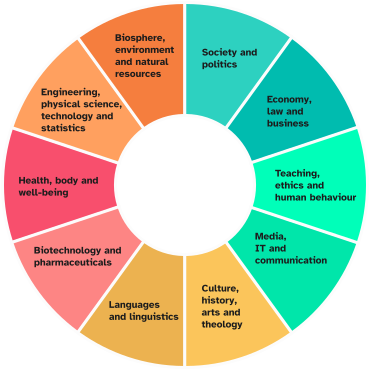
    Study wheel

    What interests you?

    Aurora Cooperation

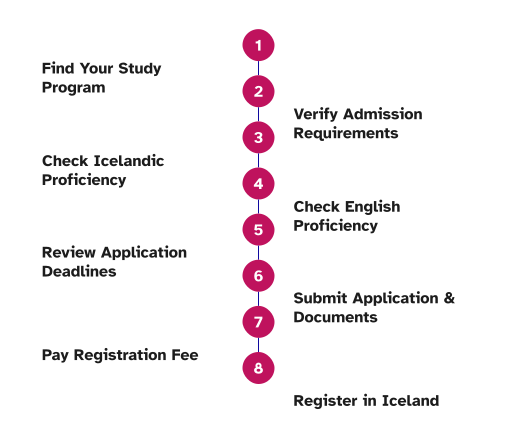
    How to apply

    Follow the path

    Contact us

    If you still have questions, feel free to contact us.

    Skrifstofa
    Sæmundargata 2
    12:00 - 16:00
    Starfsmenn titill
    Starfsmaður
    ""

    Share

    Did this help?

    Why wasn't this information helpful

    Limit to 250 characters.