- Have you completed a 120 ECTS major toward a BA/BS/BEd degree?
- Do you plan to apply for the Master's programme in speech pathology?
- Do you need foundation studies to meet the requirements?
- Do you want to open up future opportunities in challenging careers?
This programme is designed for students who plan to apply for the Master's programme in speech pathology.
Completing the foundation programme does not mean you will automatically be admitted to the Master's programme. A maximum of 15 students are admitted to the Master's programme every other year.
Completing the foundation programme means you are eligible to apply to the Master's programme.
Course topics include:
- Childhood language acquisition
- Grammar
- Speech and language pathology
- Developmental psychology
- Statistics and metrics
Access to further study:
Students must have completed the following courses or comparable courses before starting the MS programme in speech pathology. Comparable courses will be judged on a case-by-case basis.
- Grammar (Icelandic / general linguistics) - 40 ECTS
- Psychology- 35 ECTS
- Other comparable undergraduate courses completed before starting the programme will be evaluated on a case-by-case basis, e.g. if a student has completed undergraduate studies in speech pathology at a foreign university.
At least 120 ECTS towards a BA/BS/BEd degree. The courses in the preparatory programme may count towards a BA/BS/BEd degree, fully or to some extent, in accordance with the rules at the relevant faculty.
Applicants with qualifications from a school abroad who plan to enrol in an undergraduate programme taught in Icelandic at the Faculty of Icelandic and Comparative Cultural Studies must also pass a special entrance exam in Icelandic, in accordance with Article 1.
Programme structure
Check below to see how the programme is structured.
This programme does not offer specialisations.
- First year
- Fall
- Not taught this semesterSpeech and Language Disorders: Introduction
- Introduction to Linguistics
- Statistics I
- Spring 1
- The Acquisition of Language
- The Linguistic System - Sounds and Words
- Statistics II
- Developmental psychology
- Psychometrics/Measurement theory
Speech and Language Disorders: Introduction (AMV415G)
The course provides students with an overview of speech pathologists' main subject areas within an Icelandic setting. This is a vast and diverse domain, ranging from the diagnosis and treatment of dysphagia and aphasia in adults, to language impairment and speech sound disorders in children. The course will intertwine essential terms and knowledge with more practical approaches to the material. Furthermore, students should gain the skills necessary to acquaint themselves with relevant research and peer-reviewed articles within the field of speech-language pathology.
Introduction to Linguistics (ÍSL110G)
The course gives an introduction to linguistics and methods of linguistic analyses. The goal is to acquaint students with the nature of human languages and the main features of Icelandic grammar.
Statistics I (SÁL102G)
The main topics of this course are descriptive statistics and exploratory data analysis. Measures of central tendency and spread will be covered as well as Pearson's correlation and simple linear regression. The use of graphs to display distributions and relationships is emphasised. Sampling designs, probability theory and sampling distributions are also addressed.
Distance learning is not an option for this course. Students are expected to attend all lectures.
The Acquisition of Language (ÍSL508G)
This course is a survey of linguistic research on first language acquisition, in particular, although we will also look at bilingualism and the acquisition of second and foreign languages. We will be concerned with the question of how young children acquire their native language. The primary focus is on (1) the biological foundations of language and the effects of the language environment on young children's language acquisition, and (2) grammatical development in language acquisition, i.e. how children develop the system of rules - syntactic, semantic, morphological, phonological - which comprise the grammar of their language, and acquire its vocabulary. In the course, we will concentrate on Icelandic language development, although we also look at language development in English and other languages.
The number of student in this course is limited to 70.
The Linguistic System - Sounds and Words (ÍSL209G)
An introductory course in Icelandic phonetics, phonology, and morphology. The basics of acoustic phonetics and Icelandic articulatory phonetics will be introduced, accompanied by training in phonetic transcription. The main concepts of phonology will be presented, followed by an overview of sound alternations in Icelandic and their conditions. Basic concepts in morphology will be presented and the main word formation processes in Icelandic and their productivity will be dealt with. Grammatical categories in Icelandic will be outlined, the inflection of the main parts of speech will be described, and an overview given of inflectional classes and variations.
Statistics II (SÁL203G)
The main subject of the course is inferential statistics. The course will cover, for example, estimation based on sample information, confidence intervals, sample distribution, hypothesis tests, t-tests and chisquare-tests. Students work on assignments in parallel with lectures.
Developmental psychology (SÁL414G)
This course provides an overview of developmental literature, theory and research. Topics include cognitive, social and physical development from birth to adolescence, described in the context of developmental theory and research. Students complete individual empirical research projects and submit a research report, as well as sitting multiple choice examinations.
Psychometrics/Measurement theory (SÁL418G)
Overview of psychometrics and measurement theory, test construction and interpretation of psychological tests. Exercises and classroom demonstrations emphasize conventional item analysis, reliability and exploratory factor analysis.
- Fall
- Not taught this semesterAMV415GSpeech and Language Disorders: IntroductionMandatory (required) course10A mandatory (required) course for the programme10 ECTS, creditsCourse Description
The course provides students with an overview of speech pathologists' main subject areas within an Icelandic setting. This is a vast and diverse domain, ranging from the diagnosis and treatment of dysphagia and aphasia in adults, to language impairment and speech sound disorders in children. The course will intertwine essential terms and knowledge with more practical approaches to the material. Furthermore, students should gain the skills necessary to acquaint themselves with relevant research and peer-reviewed articles within the field of speech-language pathology.
Face-to-face learningPrerequisitesÍSL110GIntroduction to LinguisticsMandatory (required) course10A mandatory (required) course for the programme10 ECTS, creditsCourse DescriptionThe course gives an introduction to linguistics and methods of linguistic analyses. The goal is to acquaint students with the nature of human languages and the main features of Icelandic grammar.
Face-to-face learningPrerequisitesSÁL102GStatistics IMandatory (required) course10A mandatory (required) course for the programme10 ECTS, creditsCourse DescriptionThe main topics of this course are descriptive statistics and exploratory data analysis. Measures of central tendency and spread will be covered as well as Pearson's correlation and simple linear regression. The use of graphs to display distributions and relationships is emphasised. Sampling designs, probability theory and sampling distributions are also addressed.
Distance learning is not an option for this course. Students are expected to attend all lectures.
Face-to-face learningPrerequisites- Spring 2
ÍSL508GThe Acquisition of LanguageMandatory (required) course10A mandatory (required) course for the programme10 ECTS, creditsCourse DescriptionThis course is a survey of linguistic research on first language acquisition, in particular, although we will also look at bilingualism and the acquisition of second and foreign languages. We will be concerned with the question of how young children acquire their native language. The primary focus is on (1) the biological foundations of language and the effects of the language environment on young children's language acquisition, and (2) grammatical development in language acquisition, i.e. how children develop the system of rules - syntactic, semantic, morphological, phonological - which comprise the grammar of their language, and acquire its vocabulary. In the course, we will concentrate on Icelandic language development, although we also look at language development in English and other languages.
The number of student in this course is limited to 70.
Face-to-face learningPrerequisitesÍSL209GThe Linguistic System - Sounds and WordsMandatory (required) course10A mandatory (required) course for the programme10 ECTS, creditsCourse DescriptionAn introductory course in Icelandic phonetics, phonology, and morphology. The basics of acoustic phonetics and Icelandic articulatory phonetics will be introduced, accompanied by training in phonetic transcription. The main concepts of phonology will be presented, followed by an overview of sound alternations in Icelandic and their conditions. Basic concepts in morphology will be presented and the main word formation processes in Icelandic and their productivity will be dealt with. Grammatical categories in Icelandic will be outlined, the inflection of the main parts of speech will be described, and an overview given of inflectional classes and variations.
Face-to-face learningPrerequisitesSÁL203GStatistics IIMandatory (required) course5A mandatory (required) course for the programme5 ECTS, creditsCourse DescriptionThe main subject of the course is inferential statistics. The course will cover, for example, estimation based on sample information, confidence intervals, sample distribution, hypothesis tests, t-tests and chisquare-tests. Students work on assignments in parallel with lectures.
Face-to-face learningPrerequisitesSÁL414GDevelopmental psychologyMandatory (required) course10A mandatory (required) course for the programme10 ECTS, creditsCourse DescriptionThis course provides an overview of developmental literature, theory and research. Topics include cognitive, social and physical development from birth to adolescence, described in the context of developmental theory and research. Students complete individual empirical research projects and submit a research report, as well as sitting multiple choice examinations.
Face-to-face learningPrerequisitesSÁL418GPsychometrics/Measurement theoryMandatory (required) course10A mandatory (required) course for the programme10 ECTS, creditsCourse DescriptionOverview of psychometrics and measurement theory, test construction and interpretation of psychological tests. Exercises and classroom demonstrations emphasize conventional item analysis, reliability and exploratory factor analysis.
Face-to-face learningPrerequisites
The University of Iceland collaborates with over 400 universities worldwide. This provides a unique opportunity to pursue part of your studies at an international university thus gaining added experience and fresh insight into your field of study.
Students generally have the opportunity to join an exchange programme, internship, or summer courses. However, exchanges are always subject to faculty approval.
Students have the opportunity to have courses evaluated as part of their studies at the University of Iceland, so their stay does not have to affect the duration of their studies.
The foundation programme does not confer any specific professional recognition. After completing the MS in speech pathology and a 6-month traineeship with a certified speech therapist, you can apply to the Directorate of Health to become a certified speech therapist.
Speech therapists work in:
- Healthcare institutions
- Rehabilitation centres
- Service centres
- Primary care clinics
- Preschools and compulsory schools
- Private speech therapy clinics
This list is not exhaustive.
The student organisation for Icelandic and general linguistics is called Mímir.
- Mímir organises an active social calendar and advocates for members
- For example, Mímir organises an annual gala and workplace tours.
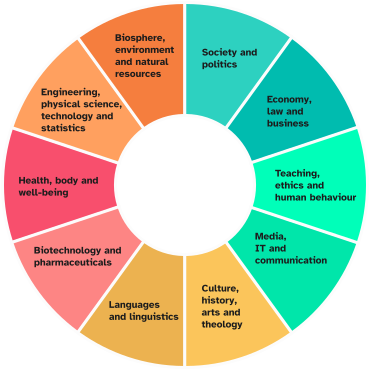
Study wheel
What interests you?
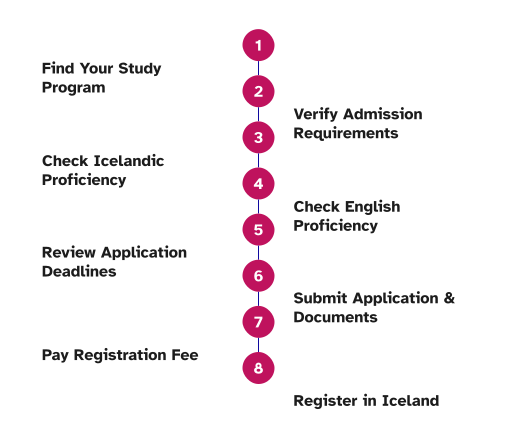
How to apply
Follow the path
If you still have questions, feel free to contact us.
The Service Desk is a point of access for all services. You can drop in at the University Centre or use the WebChat at the bottom right of this page.
Follow the School of Humanities on Instagram, Youtube
and Facebook