
Students in front of Main Building
Language skills
required, minimum level of B2
Programme length
1 years.
Study mode
Face-to-face learning
Application status
International students:
Students with Icelandic or Nordic citizenship:
Overview

  • Are you interested in working with people?
  • Do you want to better understand Icelandic church history?
  • Do you want to become a pastor?
  • Do you want to acquire a broader and more in-depth knowledge of theories in the humanities?

A BA programme totals 180 ECTS. The minor in religious studies is 60 ECTS. You must also take a 120 ECTS major in another subject. You can choose a minor after the first year of your major.

This programme is interdisciplinary and made up of courses within and outside the Faculty of Theology and Religious Studies. The programme is designed to be completed through face-to-face learning but individual elective courses may be available through distance learning.

Learning focuses

This programme is about the complex realities of religion and other world views in the past and the present.

It deals with the historical development of religions and their place in societies and cultures in different regions and periods, using different approaches and perspectives.

Students explore religious world views, theories about humanity and social attitudes, especially with regard to religious ideas about power and quality of life.

The programme deals with theories and methods in religious studies and how the subject is connected to other fields of study.

Objectives

The programme aims to provide students with a foundational understanding of religious studies, including theories, concepts, research methods and the distinctive features of different religions.

The UI Faculty of Theology and Religious Studies focuses particularly on the Abrahamic religions: Judaism, Christianity and Islam – but students will have opportunities to learn about other religions through elective courses at other faculties.

Other

A BA made up of a major and a minor is equivalent to a 180 ECTS BA in a single subject. Find out more about majors and minors in undergraduate studies under Helpful content below.

Completing this programme grants you access to a range of graduate programmes.

Icelandic matriculation examination or the equivalent. Further information to be found in article 18 in regulations about admission requirements for undergraduate studies no. 331-2022. 

An MA degree shall require at least 120 ECTS. The programme is divided into the following parts: a mandatory course, elective courses, individual projects and the final project. The mandatory course is FOR709F Theories in Humanities (10 ECTS) and students complete this course in the first semester. Elective courses and individual projects are selected in consultation with a supervisor. Students shall complete either a 30 or 60 ECTS Master's thesis. Students planning to go on to do a PhD after the MA may write a thesis on a subject related to the proposed PhD thesis.

Students who have completed a mag. theol. degree or a cand. theol. degree are not required to take FOR709F Theories in Humanities. Students planning to go on to do a PhD in theology must complete at least 10 ECTS in Master's methodology courses in either the humanities or social sciences, in consultation with a supervisor.

The following documents must accompany an application for this programme:
  • CV
  • Statement of purpose
  • Reference 1, Name and email
  • Reference 2, Name and email
  • Certified copies of diplomas and transcripts

Further information on supporting documents can be found here

Programme structure

Check below to see how the programme is structured.

This programme does not offer specialisations.

Year unspecified | Fall
Introduction to the Old Testament (GFR104G)
Restricted elective course, conditions apply
10 ECTS, credits
Course Description

A Survey of the History of Israel in Old Testament times. The Faith of the OT depicted in terms of historical development, but also in relation to the social, politacal and religious situation in the contemporary peoples and cultures of the Ancient Near East. The origin and the main characteristics of the individual books of the OT discussed. The afterlife of some OT texts also discussed.

Language of instruction: Icelandic
Face-to-face learning
Year unspecified | Fall
Introduction to Christian Theology (GFR204G)
Restricted elective course, conditions apply
10 ECTS, credits
Course Description

The aim of this course is to provide a historical overview of Christian thought. A special emphasis will be on the formation of creedal texts as well as the history and characteristics of various denominations.

Language of instruction: Icelandic
Face-to-face learning
Year unspecified | Fall
Introduction: History of Christianity (GFR117G)
Restricted elective course, conditions apply
10 ECTS, credits
Course Description

The topic of this course is the history of the Christian religion from the beginning to our times. The course is an introductory and overview course and will, on the basis of recent research, discuss the most significant characteristics of the main periods in the history of the Christian religion. In its survey, it will proceed chronologically, i.e. moving from the early Christian period through history to the modern era. The course will also explore particular themes appearing in different historical and cultural contexts. The themes are 1) orthodoxy and heresy, 2) the Christian religion and violence, 3) the formation of historical secularities, 4) monastic movements. Although the course will center on the dispersion and development of the Christianity in Europe, its spread will be discussed from a global perspective as well. Theoretically and methodologically, the course belongs to the discipline of the history of religon.

Language of instruction: Icelandic
Distance learning
Year unspecified | Fall
Sociology of Religion (TRÚ303G)
Restricted elective course, conditions apply
5 ECTS, credits
Course Description

What kind of phenomenon is religion and what is the relationship between religion and social developments? In this course, students will be introduced to how such questions have been answered from a sociological point of view. The course is an introductory course and will discuss the most important theories, methods, and concepts in the field of sociology of religion. Prominent topics will be modernization and the formation of secularities.  In the course, students explore the role of religion in intercultural society and how theories, methods, and concepts of sociology religion can be employed to analyse the lived reality of religion in light of Icelandic circumstances.

Language of instruction: Icelandic
Distance learning
Year unspecified | Fall
Introduction to Asian Philosophy (HSP418G)
Free elective course within the programme
10 ECTS, credits
Course Description

Providing an overview of the main streams of thought in classical Indian, Chinese and Japanese philosophy, this course starts off with the philosophical ideas originating in ancient India that laid a foundation for Hinduism, Jainism and Buddhism. We shall then move to the East Asian cultural sphere and discuss Confucianism and Daoism as well as the unusual versions of Buddhism emerging from their influence. The primary aim is to explicate the main ideas and notions making up these traditions, in part by making comparisons with Western philosophy, but also by taking note of their religious manifestations.

Instructor: Geir Sigurðsson, Professor of Chinese Studies and Transcultural Philosophy

Language of instruction: English
Year unspecified | Fall
Greek and Roman Mythology and Religion (KLM104G)
Free elective course within the programme
10 ECTS, credits
Course Description

Adultery and murder, cannibalism and incest, fate, responsibility, man and divinity: the subject matter of this course is Greek and Roman mythology and religion. We shall acquaint ourselves with the variety classical myths by reading from primary sources in translation. Knowledge of the classical languages is not assumed. We will discuss the nature of classical myths, their purpose, and connection to Greek and Roman religion, philosophy, literature and arts, historiography and politics. Modern interpretative frameworks will also be considered.

Language of instruction: Icelandic
Face-to-face learning
Year unspecified | Fall
Indian Culture and Society I (HIN201G)
Free elective course within the programme
5 ECTS, credits
Course Description

The primary aim is to familiarize the students with India’s physical and cultural heritage. Given the diversity of the country, this paper would only be giving an overview. For this course, extensive use of Audio-Visuals shall be made, and the approach will be primarily interactive. Learners shall be provided with a vast reservoir of reading material and notes specific to every topic.

Topics to be covered:

  1. India´s physical profile and the landmark destinations
  2. Temple architecture
  3. Festivals of India
  4. Ayurveda Part I
  5. Ayurveda Part II
  6. Spices of India

The course is held over a 6-week session in the first half of the autumn semester, twice a week for 80 minutes, 4:40 – 6:10 PM.

Language of instruction: English
Course taught first half of the semester
Year unspecified | Fall
Korean Society and Culture (KOR103G)
Free elective course within the programme
10 ECTS, credits
Course Description

This course explores the dynamic interplay between Korea’s deep historical roots and its rapid emergence as a global technological and cultural influence. Guided by the theme “Rooted in History, Wired for the Future,” students will examine how Korea’s historical legacy, colonial and postwar experiences, and distinctive drive for transformation have shaped its present-day society and culture – including politics, gender and family relations, generational divides, the Korean Wave, and more – within an increasingly globalized world.

Language of instruction: English
Face-to-face learning
Year unspecified | Fall
John Milton’s Paradise Lost (ENS615G)
Free elective course within the programme
10 ECTS, credits
Course Description

The course offers an in-depth study of John Milton’s great epic Paradise Lost (1667-1674) in its poetic, intellectual, historical, and theological complexity. Our conversations about the poem will be guided by three interrelated concerns. We will pay nuanced attention to the form of Milton’s text: his experimentation with prosody, the artistry of his language, the intricacy of his rhetorical designs, his dazzling structures of imagery, the interweaving of narrative voices and modes. We will also be interested in Milton’s radical intervention in the genre of epic poetry and his ongoing dialogue with Homer, Virgil, Tasso, Ariosto, Spenser, and others. Finally, to facilitate our interpretation of Paradise Lost we will consider the text’s engagements with multifarious cultural, political, social, and religious contexts of seventeenth-century England. We will engage with a host of issues, from book history and Renaissance theories of the imagination to economy and warfare, from law and gender to colonialism and empire, from sexuality and theology to new science and philosophy.

Language of instruction: English
Year unspecified | Fall
History of the Middle East I (MAF101G)
Free elective course within the programme
10 ECTS, credits
Course Description

This course surveys the history of the Middle East from ancient times to the medieval period. Topics include the emergence of Egypt and Sumerians and other peoples of the so-called 'cradle of civilization'. Special emphasis will be on the emergence of Islam in the seventh century, and ascent of the Islamic empire in the following centuries. Among the subjects discussed are the prophet Muhammad and his successors, the creation of the Quran, the Caliphates of the Ummayyads and the Abassids and the 'golden age' of Islam. Teaching language is Icelandic but reading materials are mostly in English.

Language of instruction: Icelandic
Face-to-face learning
Year unspecified | Fall
Japanese Society and Culture I (JAP105G)
Free elective course within the programme
5 ECTS, credits
Course Description

The aim of the course is to provide the students with an insight into various aspects of Japanese society and culture, both in the past and in the present. The course covers themes such as identity, education, religion, rituals and arts in Japan.

Language of instruction: English
Face-to-face learning
Year unspecified | Fall
Ingmar Bergman - Rebelling against the Father Image (SÆN105G)
Free elective course within the programme
5 ECTS, credits
Course Description

The course will discuss Ingmar Bergman's films, primarily the earliest films from the period 1950-60, where rebelling against patriarchy forms a sort of psychological core. Emphasis will be placed on the development of the theme of the religious man's need for some sort of sign from God in Sjunde inseglet (1956) in order to agree to believe in this cruel God in Jungfrukällan (1960) and onwards to a confrontation with the negative image of God in Såsom i spegel (1961), Nattvardsgästerna (1962) and Tystnaden (1963). Students will watch five films that will be discussed in class.

Language of instruction: Swedish
Face-to-face learning
Distance learning
Online learning
Not taught this semester
Year unspecified | Fall
Areas of conflict - challenges of multiculturalism (SFG001G)
Free elective course within the programme
5 ECTS, credits
Course Description

The main purpose of this course is conflict and conflict zones in the world with regard to opportunities and challenges which such topics provide in teaching. Participants will be introduced to ideas and issues of conflicts and relate these to geogarphical situations, history, culture and religion. Two or three areas will be selected for analysis. These could be Ireland and the Irish democacy, Israel and Palestine, Mexico, Myanmar, Nigeria and Turkey, together with areas that geogarphically can be difficult to define. The selection of topics will be made in consultance with participants which will, depending on circumstances, be related to Icelandic history and situation.

The course assignments will cover systematic search for information, suitable exposition of historical and geographical results and explanation of complex and delicate issues.

Final exam counts as 40%, but assignments and partial exams count as 60%. Participants have to attend 80% of classes. 
Further information is on CANVAS.

Language of instruction: Icelandic
Distance learning
Attendance required in class
Year unspecified | Spring 1
History of Christianity and the Arts (GFR416G)
Restricted elective course, conditions apply
10 ECTS, credits
Course Description

The history of Christianity and art history are interconnected and overlap. This course will explore the relationship between Christianity and various kinds of artistic creation with examples from literature, visual arts, music, and film. Although the course will geographically center on Christianity in Europe, it will also include, for contrast and comparison, examples from other regions and religions. Source work will concentrate on primary sources from Northern Europe but also include sources from other regions. The course will furthermore contain a particular focus on the visual arts and literature. With regards to the visual arts, it will discuss differing ideas about their significance in different denominations and religious movements. Particular attention will be given to notions of iconoclasm and aniconism. In regard to literature, the course will focus on the concept of literature, the distinction between secular and religious literature, and the application of literary theory and methods in the analysis of Christian religious texts.

Language of instruction: Icelandic
Distance learning
Year unspecified | Spring 1
Introduction to Theological Ethics (GFR201G)
Restricted elective course, conditions apply
10 ECTS, credits
Course Description

This course discusses both theological and philosophical ethics. In the first half of the course the emphasis is on introducing dominant theories and concepts of western ethics. In the second half of the course special attention is given to the question: „What is life worth living?“ from diverse theoretical standpoints and worldviews.

Language of instruction: Icelandic
Face-to-face learning
Year unspecified | Spring 1
The History of Early Christianity (GFR211G)
Restricted elective course, conditions apply
10 ECTS, credits
Course Description

The course contains a discussion of the beginnings of Early Christianity as well as of its historical and ideological background. Special emphasis will be given to the roots of Christianity in early Judaism. Attention will also be paid to the ideological roots of Christianity in Hellenistic thought. Early Christian literature will be discussed with emphasis on a historical approach to the sources. Included is a general discussion of the nature and form of writings of this sort. In this way, a basis will be laid for a qualified interpretation of and research into Early Christian literature.

Language of instruction: Icelandic
Distance learning
Not taught this semester
Year unspecified | Spring 1
History of China I: From Mythological Origins to Late Ming (KÍN102G)
Free elective course within the programme
10 ECTS, credits
Course Description

This course explores the history of China from the mythical Xia dynasty in the third millenium BCE to the beginning of the nineteenth century. It seeks to illuminate the most important factors in the formation of Chinese culture as well as to explain individual events in the political and social development of the Chinese nation. An overview will be provided of the origin and development of the most important Chinese religious and philosophical streams of thought, notably Confucianism, Daoism and Buddhism. Influential individuals will be introduced. The interaction and mutual influence between non-Chinese groups and the Chinese nation in the course of history will be emphasised.

Language of instruction: English
Face-to-face learning
Year unspecified | Spring 1
The History of Rome (SAG271G)
Free elective course within the programme
10 ECTS, credits
Course Description

Introductory course on the history of Rome. Taught in Icelandic; please see full course description in Icelandic.

Language of instruction: Icelandic
Year unspecified | Spring 1
Indian Culture and Society II (HIN202G)
Free elective course within the programme
5 ECTS, credits
Course Description

The primary aim is to familiarize the students with India’s social and cultural heritage. Given the diversity of the country, this paper would only be giving an overview of the popular learnings from the Vedas, Upanishads, and popular Itihasa. This paper shall also introduce the learner to the philosophy behind Yoga and chanting, and how they serve as tools for self-realization, self-empowerment, and their neurological benefits. For this course, extensive use of Audio-Visuals shall be made, and the approach will be primarily interactive. Learners shall be provided with a vast reservoir of reading material and notes specific to every topic.

Topics to be covered:

  1. Learnings from the Vedas
  2. Learnings from the Bhagavad Gita
  3. Learnings from the Ramayana
  4. Yog as a tool for self-realization and self-empowerment
  5. Power of chanting
  6. Spirituality and empowerment

The course is held over a 6-week session in the second half of the spring semester, twice a week for 80 minutes, 4:40 PM – 6:10 PM.

Language of instruction: English
Course taught second half of the semester
Not taught this semester
Year unspecified | Spring 1
Religion and Magic (MAN329G)
Free elective course within the programme
10 ECTS, credits
Course Description

In the course theories on religion in anthropology are examined and discussed as are different religious beliefs and practices. Topical focus is on the reading of symbols, the understanding of religious action and the historical dynamics of religion, as well as the intersection of religion, magic, and witchcraft.

Language of instruction: Icelandic
Face-to-face learning
Online learning
Year unspecified | Spring 1
Old Nordic Religion and Belief (ÞJÓ437G)
Free elective course within the programme
10 ECTS, credits
Course Description

An examination will be made of the religious beliefs and practices of people in Scandinavia from the earliest of times until the conversion, material ranging from burial practices to rock carvings, to the written evidence given in the works of Tacitus, Adam of Bremen and Saxo Grammaticus, as well as in early Icelandic works like the Eddic poems and the Kings' sagas. Alongside this discussion of the development and key features of Old Norse religion, some attention will be paid to the concepts of seid and shamanism, especially in connection to their role in early religions. Finally, an examination will be made of the conversion of Scandinavia and how Christian concepts and practices both fitted and contrasted with the previously dominant Old Norse worldview.

Teaching form:
The teaching takes place in the form of lectures and discussion on the material of the lectures.

Language of instruction: English
Face-to-face learning
Online learning
Year unspecified | Spring 1
Religious education and diversity (SFG003G)
Free elective course within the programme
5 ECTS, credits
Course Description

The course is about religion and religious education in a multicultural society. The students will get basic knowledge about the major religions of the world and how to prepare teaching and learning in religious education in the elementary school. They are also trained in discussing issues and questions about religion and view of life.

The content of the course is religion, religious experience, the search for meaning and the main concepts of religious studies. The value of religions for individuals and societies will be discussed and their impact on the shaping of identities, values and understanding of life. The major religions of the world will be explored, i.e. Judaism, Christianity, Islam, Hinduism, Buddhism, and some other religions and secular worldviews. Also the role of religion nowadays, new religious movements, multiculturalism and pluralism, prejudice and tolerance.

Teaching methods: Lectures, discussion groups, field study and papers on religion and teaching and learning in religious studies. The course is planned for both regular and distance students.

Language of instruction: Icelandic
Distance learning
Attendance required in class
Year unspecified | Spring 1
History of the Middle East II (MAF203G)
Free elective course within the programme
10 ECTS, credits
Course Description

This course is a continuation of the course History of the Middle East I, which is however not a prerequisite for this course. It is possible to take both courses or either one. Here we will address the development of the Middle East since 1300, especially its relationship with the West. Among subjects discussed will be the rise of the Ottomans and the Safavids, European colonialism and its effects on Middle Eastern culture and politics, the rise of nationalism and the emergence of modern states, and several conflicts that have shaped and continue shaping the region until this day. Teaching language is Icelandic but reading materials are mostly in English.

Language of instruction: Icelandic
Year unspecified | Spring 1
The Bible as Literature (ABF221G)
Free elective course within the programme
10 ECTS, credits
Course Description

We will read a selection from the Pentateuch and other ancient Hebrew texts, along with most of the New Testament. For comparison we will have ancient Egyptian, Mesopotamian, Greek and Latin works. The Bible is read as ancient literature and world literature, and there will be a focus on the reception of these texts through the ages, the importance of translations for the reception, and various literary theories related to the Bible, for instance about textual and interpretive societies.

Language of instruction: Icelandic
Prerequisites
Year unspecified
  • Fall
  • GFR104G
    Introduction to the Old Testament
    Restricted elective course
    10
    Restricted elective course, conditions apply
    10 ECTS, credits
    Course Description

    A Survey of the History of Israel in Old Testament times. The Faith of the OT depicted in terms of historical development, but also in relation to the social, politacal and religious situation in the contemporary peoples and cultures of the Ancient Near East. The origin and the main characteristics of the individual books of the OT discussed. The afterlife of some OT texts also discussed.

    Face-to-face learning
    Prerequisites
  • GFR204G
    Introduction to Christian Theology
    Restricted elective course
    10
    Restricted elective course, conditions apply
    10 ECTS, credits
    Course Description

    The aim of this course is to provide a historical overview of Christian thought. A special emphasis will be on the formation of creedal texts as well as the history and characteristics of various denominations.

    Face-to-face learning
    Prerequisites
  • GFR117G
    Introduction: History of Christianity
    Restricted elective course
    10
    Restricted elective course, conditions apply
    10 ECTS, credits
    Course Description

    The topic of this course is the history of the Christian religion from the beginning to our times. The course is an introductory and overview course and will, on the basis of recent research, discuss the most significant characteristics of the main periods in the history of the Christian religion. In its survey, it will proceed chronologically, i.e. moving from the early Christian period through history to the modern era. The course will also explore particular themes appearing in different historical and cultural contexts. The themes are 1) orthodoxy and heresy, 2) the Christian religion and violence, 3) the formation of historical secularities, 4) monastic movements. Although the course will center on the dispersion and development of the Christianity in Europe, its spread will be discussed from a global perspective as well. Theoretically and methodologically, the course belongs to the discipline of the history of religon.

    Distance learning
    Prerequisites
  • TRÚ303G
    Sociology of Religion
    Restricted elective course
    5
    Restricted elective course, conditions apply
    5 ECTS, credits
    Course Description

    What kind of phenomenon is religion and what is the relationship between religion and social developments? In this course, students will be introduced to how such questions have been answered from a sociological point of view. The course is an introductory course and will discuss the most important theories, methods, and concepts in the field of sociology of religion. Prominent topics will be modernization and the formation of secularities.  In the course, students explore the role of religion in intercultural society and how theories, methods, and concepts of sociology religion can be employed to analyse the lived reality of religion in light of Icelandic circumstances.

    Distance learning
    Prerequisites
  • HSP418G
    Introduction to Asian Philosophy
    Elective course
    10
    Free elective course within the programme
    10 ECTS, credits
    Course Description

    Providing an overview of the main streams of thought in classical Indian, Chinese and Japanese philosophy, this course starts off with the philosophical ideas originating in ancient India that laid a foundation for Hinduism, Jainism and Buddhism. We shall then move to the East Asian cultural sphere and discuss Confucianism and Daoism as well as the unusual versions of Buddhism emerging from their influence. The primary aim is to explicate the main ideas and notions making up these traditions, in part by making comparisons with Western philosophy, but also by taking note of their religious manifestations.

    Instructor: Geir Sigurðsson, Professor of Chinese Studies and Transcultural Philosophy

    Prerequisites
  • KLM104G
    Greek and Roman Mythology and Religion
    Elective course
    10
    Free elective course within the programme
    10 ECTS, credits
    Course Description

    Adultery and murder, cannibalism and incest, fate, responsibility, man and divinity: the subject matter of this course is Greek and Roman mythology and religion. We shall acquaint ourselves with the variety classical myths by reading from primary sources in translation. Knowledge of the classical languages is not assumed. We will discuss the nature of classical myths, their purpose, and connection to Greek and Roman religion, philosophy, literature and arts, historiography and politics. Modern interpretative frameworks will also be considered.

    Face-to-face learning
    Prerequisites
  • HIN201G
    Indian Culture and Society I
    Elective course
    5
    Free elective course within the programme
    5 ECTS, credits
    Course Description

    The primary aim is to familiarize the students with India’s physical and cultural heritage. Given the diversity of the country, this paper would only be giving an overview. For this course, extensive use of Audio-Visuals shall be made, and the approach will be primarily interactive. Learners shall be provided with a vast reservoir of reading material and notes specific to every topic.

    Topics to be covered:

    1. India´s physical profile and the landmark destinations
    2. Temple architecture
    3. Festivals of India
    4. Ayurveda Part I
    5. Ayurveda Part II
    6. Spices of India

    The course is held over a 6-week session in the first half of the autumn semester, twice a week for 80 minutes, 4:40 – 6:10 PM.

    Prerequisites
    Course taught first half of the semester
  • KOR103G
    Korean Society and Culture
    Elective course
    10
    Free elective course within the programme
    10 ECTS, credits
    Course Description

    This course explores the dynamic interplay between Korea’s deep historical roots and its rapid emergence as a global technological and cultural influence. Guided by the theme “Rooted in History, Wired for the Future,” students will examine how Korea’s historical legacy, colonial and postwar experiences, and distinctive drive for transformation have shaped its present-day society and culture – including politics, gender and family relations, generational divides, the Korean Wave, and more – within an increasingly globalized world.

    Face-to-face learning
    Prerequisites
  • ENS615G
    John Milton’s Paradise Lost
    Elective course
    10
    Free elective course within the programme
    10 ECTS, credits
    Course Description

    The course offers an in-depth study of John Milton’s great epic Paradise Lost (1667-1674) in its poetic, intellectual, historical, and theological complexity. Our conversations about the poem will be guided by three interrelated concerns. We will pay nuanced attention to the form of Milton’s text: his experimentation with prosody, the artistry of his language, the intricacy of his rhetorical designs, his dazzling structures of imagery, the interweaving of narrative voices and modes. We will also be interested in Milton’s radical intervention in the genre of epic poetry and his ongoing dialogue with Homer, Virgil, Tasso, Ariosto, Spenser, and others. Finally, to facilitate our interpretation of Paradise Lost we will consider the text’s engagements with multifarious cultural, political, social, and religious contexts of seventeenth-century England. We will engage with a host of issues, from book history and Renaissance theories of the imagination to economy and warfare, from law and gender to colonialism and empire, from sexuality and theology to new science and philosophy.

    Prerequisites
  • MAF101G
    History of the Middle East I
    Elective course
    10
    Free elective course within the programme
    10 ECTS, credits
    Course Description

    This course surveys the history of the Middle East from ancient times to the medieval period. Topics include the emergence of Egypt and Sumerians and other peoples of the so-called 'cradle of civilization'. Special emphasis will be on the emergence of Islam in the seventh century, and ascent of the Islamic empire in the following centuries. Among the subjects discussed are the prophet Muhammad and his successors, the creation of the Quran, the Caliphates of the Ummayyads and the Abassids and the 'golden age' of Islam. Teaching language is Icelandic but reading materials are mostly in English.

    Face-to-face learning
    Prerequisites
  • JAP105G
    Japanese Society and Culture I
    Elective course
    5
    Free elective course within the programme
    5 ECTS, credits
    Course Description

    The aim of the course is to provide the students with an insight into various aspects of Japanese society and culture, both in the past and in the present. The course covers themes such as identity, education, religion, rituals and arts in Japan.

    Face-to-face learning
    Prerequisites
  • SÆN105G
    Ingmar Bergman - Rebelling against the Father Image
    Elective course
    5
    Free elective course within the programme
    5 ECTS, credits
    Course Description

    The course will discuss Ingmar Bergman's films, primarily the earliest films from the period 1950-60, where rebelling against patriarchy forms a sort of psychological core. Emphasis will be placed on the development of the theme of the religious man's need for some sort of sign from God in Sjunde inseglet (1956) in order to agree to believe in this cruel God in Jungfrukällan (1960) and onwards to a confrontation with the negative image of God in Såsom i spegel (1961), Nattvardsgästerna (1962) and Tystnaden (1963). Students will watch five films that will be discussed in class.

    Face-to-face learning
    Distance learning
    Online learning
    Prerequisites
  • Not taught this semester
    SFG001G
    Areas of conflict - challenges of multiculturalism
    Elective course
    5
    Free elective course within the programme
    5 ECTS, credits
    Course Description

    The main purpose of this course is conflict and conflict zones in the world with regard to opportunities and challenges which such topics provide in teaching. Participants will be introduced to ideas and issues of conflicts and relate these to geogarphical situations, history, culture and religion. Two or three areas will be selected for analysis. These could be Ireland and the Irish democacy, Israel and Palestine, Mexico, Myanmar, Nigeria and Turkey, together with areas that geogarphically can be difficult to define. The selection of topics will be made in consultance with participants which will, depending on circumstances, be related to Icelandic history and situation.

    The course assignments will cover systematic search for information, suitable exposition of historical and geographical results and explanation of complex and delicate issues.

    Final exam counts as 40%, but assignments and partial exams count as 60%. Participants have to attend 80% of classes. 
    Further information is on CANVAS.

    Distance learning
    Prerequisites
    Attendance required in class
  • Spring 2
  • GFR416G
    History of Christianity and the Arts
    Restricted elective course
    10
    Restricted elective course, conditions apply
    10 ECTS, credits
    Course Description

    The history of Christianity and art history are interconnected and overlap. This course will explore the relationship between Christianity and various kinds of artistic creation with examples from literature, visual arts, music, and film. Although the course will geographically center on Christianity in Europe, it will also include, for contrast and comparison, examples from other regions and religions. Source work will concentrate on primary sources from Northern Europe but also include sources from other regions. The course will furthermore contain a particular focus on the visual arts and literature. With regards to the visual arts, it will discuss differing ideas about their significance in different denominations and religious movements. Particular attention will be given to notions of iconoclasm and aniconism. In regard to literature, the course will focus on the concept of literature, the distinction between secular and religious literature, and the application of literary theory and methods in the analysis of Christian religious texts.

    Distance learning
    Prerequisites
  • GFR201G
    Introduction to Theological Ethics
    Restricted elective course
    10
    Restricted elective course, conditions apply
    10 ECTS, credits
    Course Description

    This course discusses both theological and philosophical ethics. In the first half of the course the emphasis is on introducing dominant theories and concepts of western ethics. In the second half of the course special attention is given to the question: „What is life worth living?“ from diverse theoretical standpoints and worldviews.

    Face-to-face learning
    Prerequisites
  • GFR211G
    The History of Early Christianity
    Restricted elective course
    10
    Restricted elective course, conditions apply
    10 ECTS, credits
    Course Description

    The course contains a discussion of the beginnings of Early Christianity as well as of its historical and ideological background. Special emphasis will be given to the roots of Christianity in early Judaism. Attention will also be paid to the ideological roots of Christianity in Hellenistic thought. Early Christian literature will be discussed with emphasis on a historical approach to the sources. Included is a general discussion of the nature and form of writings of this sort. In this way, a basis will be laid for a qualified interpretation of and research into Early Christian literature.

    Distance learning
    Prerequisites
  • Not taught this semester
    KÍN102G
    History of China I: From Mythological Origins to Late Ming
    Elective course
    10
    Free elective course within the programme
    10 ECTS, credits
    Course Description

    This course explores the history of China from the mythical Xia dynasty in the third millenium BCE to the beginning of the nineteenth century. It seeks to illuminate the most important factors in the formation of Chinese culture as well as to explain individual events in the political and social development of the Chinese nation. An overview will be provided of the origin and development of the most important Chinese religious and philosophical streams of thought, notably Confucianism, Daoism and Buddhism. Influential individuals will be introduced. The interaction and mutual influence between non-Chinese groups and the Chinese nation in the course of history will be emphasised.

    Face-to-face learning
    Prerequisites
  • SAG271G
    The History of Rome
    Elective course
    10
    Free elective course within the programme
    10 ECTS, credits
    Course Description

    Introductory course on the history of Rome. Taught in Icelandic; please see full course description in Icelandic.

    Prerequisites
  • HIN202G
    Indian Culture and Society II
    Elective course
    5
    Free elective course within the programme
    5 ECTS, credits
    Course Description

    The primary aim is to familiarize the students with India’s social and cultural heritage. Given the diversity of the country, this paper would only be giving an overview of the popular learnings from the Vedas, Upanishads, and popular Itihasa. This paper shall also introduce the learner to the philosophy behind Yoga and chanting, and how they serve as tools for self-realization, self-empowerment, and their neurological benefits. For this course, extensive use of Audio-Visuals shall be made, and the approach will be primarily interactive. Learners shall be provided with a vast reservoir of reading material and notes specific to every topic.

    Topics to be covered:

    1. Learnings from the Vedas
    2. Learnings from the Bhagavad Gita
    3. Learnings from the Ramayana
    4. Yog as a tool for self-realization and self-empowerment
    5. Power of chanting
    6. Spirituality and empowerment

    The course is held over a 6-week session in the second half of the spring semester, twice a week for 80 minutes, 4:40 PM – 6:10 PM.

    Prerequisites
    Course taught second half of the semester
  • Not taught this semester
    MAN329G
    Religion and Magic
    Elective course
    10
    Free elective course within the programme
    10 ECTS, credits
    Course Description

    In the course theories on religion in anthropology are examined and discussed as are different religious beliefs and practices. Topical focus is on the reading of symbols, the understanding of religious action and the historical dynamics of religion, as well as the intersection of religion, magic, and witchcraft.

    Face-to-face learning
    Online learning
    Prerequisites
  • ÞJÓ437G
    Old Nordic Religion and Belief
    Elective course
    10
    Free elective course within the programme
    10 ECTS, credits
    Course Description

    An examination will be made of the religious beliefs and practices of people in Scandinavia from the earliest of times until the conversion, material ranging from burial practices to rock carvings, to the written evidence given in the works of Tacitus, Adam of Bremen and Saxo Grammaticus, as well as in early Icelandic works like the Eddic poems and the Kings' sagas. Alongside this discussion of the development and key features of Old Norse religion, some attention will be paid to the concepts of seid and shamanism, especially in connection to their role in early religions. Finally, an examination will be made of the conversion of Scandinavia and how Christian concepts and practices both fitted and contrasted with the previously dominant Old Norse worldview.

    Teaching form:
    The teaching takes place in the form of lectures and discussion on the material of the lectures.

    Face-to-face learning
    Online learning
    Prerequisites
  • SFG003G
    Religious education and diversity
    Elective course
    5
    Free elective course within the programme
    5 ECTS, credits
    Course Description

    The course is about religion and religious education in a multicultural society. The students will get basic knowledge about the major religions of the world and how to prepare teaching and learning in religious education in the elementary school. They are also trained in discussing issues and questions about religion and view of life.

    The content of the course is religion, religious experience, the search for meaning and the main concepts of religious studies. The value of religions for individuals and societies will be discussed and their impact on the shaping of identities, values and understanding of life. The major religions of the world will be explored, i.e. Judaism, Christianity, Islam, Hinduism, Buddhism, and some other religions and secular worldviews. Also the role of religion nowadays, new religious movements, multiculturalism and pluralism, prejudice and tolerance.

    Teaching methods: Lectures, discussion groups, field study and papers on religion and teaching and learning in religious studies. The course is planned for both regular and distance students.

    Distance learning
    Prerequisites
    Attendance required in class
  • MAF203G
    History of the Middle East II
    Elective course
    10
    Free elective course within the programme
    10 ECTS, credits
    Course Description

    This course is a continuation of the course History of the Middle East I, which is however not a prerequisite for this course. It is possible to take both courses or either one. Here we will address the development of the Middle East since 1300, especially its relationship with the West. Among subjects discussed will be the rise of the Ottomans and the Safavids, European colonialism and its effects on Middle Eastern culture and politics, the rise of nationalism and the emergence of modern states, and several conflicts that have shaped and continue shaping the region until this day. Teaching language is Icelandic but reading materials are mostly in English.

    Prerequisites
  • ABF221G
    The Bible as Literature
    Elective course
    10
    Free elective course within the programme
    10 ECTS, credits
    Course Description

    We will read a selection from the Pentateuch and other ancient Hebrew texts, along with most of the New Testament. For comparison we will have ancient Egyptian, Mesopotamian, Greek and Latin works. The Bible is read as ancient literature and world literature, and there will be a focus on the reception of these texts through the ages, the importance of translations for the reception, and various literary theories related to the Bible, for instance about textual and interpretive societies.

    Prerequisites

The timetable shown below is for the current academic year and is FOR REFERENCE ONLY.

Changes may occur for the autumn semester in August and September and for the spring semester in December and January. You will find your final timetable in Ugla when the studies start.

Note! This timetable is not suitable for planning your work schedule if you are a part-time employee.


Additional information

The University of Iceland collaborates with over 400 universities worldwide. This provides a unique opportunity to pursue part of your studies at an international university thus gaining added experience and fresh insight into your field of study.

Students generally have the opportunity to join an exchange programme, internship, or summer courses. However, exchanges are always subject to faculty approval.

Students have the opportunity to have courses evaluated as part of their studies at the University of Iceland, so their stay does not have to affect the duration of their studies.

Students with joint honours degrees will have a range of career options based on either their major or minor.

A degree in religious studies can open up opportunities in:

  • NGOs
  • Media
  • Teaching and academia
  • International institutions
  • Consulting

This list is not exhaustive.

The organisation for theology students is called Fiskurinn. Fiskurinn advocates for students at the University of Iceland Faculty of Theology and Religious Studies.

Students' comments
""
Students appreciate the University of Iceland for its strong academic reputation, modern campus facilities, close-knit community, and affordable tuition.
Helpful content
Aurora Cooperation

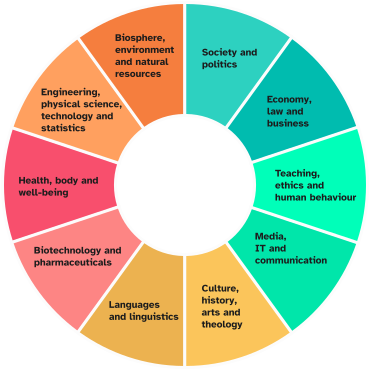
Study wheel

What interests you?

Aurora Cooperation

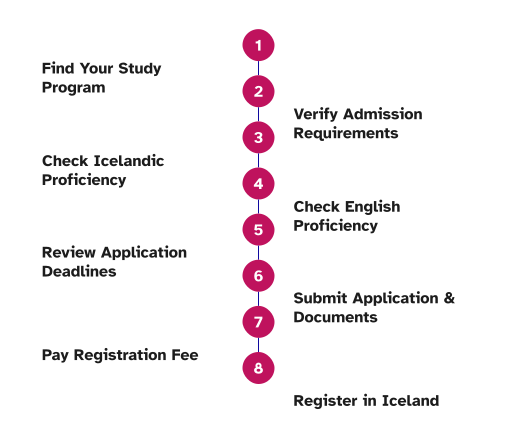
How to apply

Follow the path

Contact us

If you still have questions, feel free to contact us.

School of Humanities
Weekdays: 10-12 am and 1-3 pm
General Service and Social Media

The Service Desk is a point of access for all services. You can drop in at the University Centre or use the WebChat at the bottom right of this page.

Follow the School of Humanities on Instagram,   Youtube
and Facebook

""

Share

Did this help?

Why wasn't this information helpful

Limit to 250 characters.