- Do you want to work on archaeological digs?
- Do you want to learn how to plan and implement archaeological research?
- Are you interested in the analysis and dissemination of archaeological research?
- Do you want a graduate programme that involves field work?
Archaeology is about analysing, interpreting and drawing conclusions about past societies based on fragmented sources. The subject often requires strong critical thinking and disciplined working methods.
The MA in practical archaeology provides students with systematic theoretical and practical training in the implementation and management of licensed archaeological research, with an emphasis on methodology, but also ethics and scientific approaches.
Programme structure
The programme is 90 ECTS and is organised as one and a half years of full-time study.
The programme is made up of:
- Mandatory courses, 50 ECTS
- Elective courses, 10 ECTS
- Final project, 30 ECTS
Organisation of teaching
This programme is primarily taught in Icelandic, but some courses or sections of courses are taught in English. All examinations are in Icelandic.
Practical training takes place in the field at archaeological sites and in class. Theoretical learning takes place through lectures, discussions and seminars. It is important to attend class, but students will only benefit if they have read the reading material.
Main objectives
Students should:
- be able to plan, implement and conclude small to medium-sized archaeological digs in Iceland.
- acquire a solid understanding and knowledge of archaeological methods and the techniques used in archaeological surveying, including remote sensing, excavation and post-excavation analysis.
- be able to demonstrate a broad understanding of the role of archaeology in heritage conservation, especially in Iceland.
Other
Completing the programme does not allow a student to apply for doctoral studies.
BA degree or equivalent qualification in Archaeology with a first class grade (minimum of 7.25). 20 weeks of supervised work experience in archaeological field research (of which at least 75% in excavation). The 10 weeks of work experience required for the BA programme in Archaeology at the University of Iceland may count towards this total.
The programme totals 90 ECTS and comprises joint mandatory courses in Archaeology at the postgraduate level (10 ECTS), mandatory courses (35 ECTS), elective courses (15 ECTS) and a final project (30 ECTS). The programme is three semesters and generally begins in the summer semester with participation in the departmental field school.
- CV
- Statement of purpose
- Reference 1, Name and email
- Reference 2, Name and email
- Certified copies of diplomas and transcripts
Further information on supporting documents can be found here
Programme structure
Check below to see how the programme is structured.
This programme does not offer specialisations.
- First year
- Fall
- Archaeological Survey
- Excavation 1
- Post-excavation 2
- Reseach Design
- Theories in Humanities
- Entangled Worlds: Medieval People and Nature
- Workshop: Current Research in Icelandic Archaeology
- Spring 1
- Excavation 2
- Post-excavation 2
- Presentation
- Workshop: Materiality and Embodiment in Medieval Archaeology
- Viking Age Archaeology
- Landscape archaeology
- Postmedieval archaeology
- Medieval Archaeology
- Summer
- Final project
- Archaeological Field School at Hofstaðir
Archaeological Survey (FOR702F)
The student will undertake an independent project relating to landscape archaeology involving i.a. field survey.
Excavation 1 (FOR703F)
The student will read an approved list of texts relating to the theory and method of excavation and carry out assignments involving the application of theoretical understanding to practical problems.
Post-excavation 2 (FOR704F)
The student will read an approved list of texts relating to the theory and method of post-excavation and analysis, and carry out assignments involving the application of theoretical understanding to practical problems.
Reseach Design (FOR706F)
The student will develop a detailed research design around a proposed project. This could be connected to their final project.
Theories in Humanities (FOR709F)
The aim of the course is to provide students with a more comprehensive and deeper insight into the different theoretical approaches within the humanities. In the course, the main theories that have influenced theoretical discussion in the humanities over the last decades will be presented and discussed, and the students are taught how to apply them in their own research.
Entangled Worlds: Medieval People and Nature (FOR501M)
To many, the Middle Ages (approx. 1000 to 1550) in Europe are known as “the Dark Ages,” a period of intellectual and social stagnation amid plague and religious conflict. Materials from this time do not support this myth; Moreso, illuminated manuscripts, embroidered textiles, and architecture demonstrate the opposite viewpoint. These examples show particularly well the relationship between people and nature, as much of the material used in these artworks and structures utilized plants, animal products, and the landscape itself very effectively. Environmental events like the Medieval Climatic Optimum (MCO) and the “little ice age” of the 14th century caused people to respond to the changing environment. In addition, as Christianity becomes the dominant religion of Western Europe, the meaning of nature changes, and there is interesting evidence of hybrid approaches to maintaining and changing landscape as religious traditions blend. Nature is not just a resource for medieval people, but a means of conveying identity, belonging, gender, class, and spirituality.
This class will cover in detail the theoretical ways of understanding medieval human relationships with nature and present case studies of medieval people and societies living in and distinguishing themselves from the natural order. Theoretical frames like phenomenology, entanglement, more-than-human, and sense of place will be discussed and explained through stories of artifacts and archaeological sites. Likewise, the methods for understanding past relationships with nature including hydrogeomorphology, paleontology, forensic archaeology, and more will be explored through readings. Class structure will be 40 minutes of lecture, 10-minute break, and 40 minutes of discussion of reading with lecturer and other students. One lecture will be a walk through a space with practical and social uses of nature (i.e. a graveyard).
Workshop: Current Research in Icelandic Archaeology (FOR712F)
The course is arranged around weekly readings and meetings. Each week, a different student will select a number of readings for the rest of the class to read and discuss. These readings should relate to the student’s research and the class will provide a forum for in-depth discussion of the readings. Depending on the number of students enrolled, it is anticipated that students will have a chance to select readings twice during the course. Meetings will be chaired on rotation by one of the teachers who may also select readings one week.
A description of the course format, i.e. workshop, can be found here.
Excavation 2 (FOR804F)
The student will participate in the departmental training excavations for undergraduates.
Post-excavation 2 (FOR808F)
The student receives training in working with different types of post-fieldwork projects and creates a portfolio of small reports.
Presentation (FOR810F)
The student receives training in working with image production (maps, plans, etc.) and in the different media available for the dissemination of archaeological results.
Workshop: Materiality and Embodiment in Medieval Archaeology (FOR302M)
How did people in the Middle Ages understand the world around them?
This workshop introduces students to key methods and theoretical frameworks for exploring medieval worldviews and lived experiences through material culture. Central to this approach is the concept of materiality, which examines how the physical properties of objects shape human perception and interaction with the world. It has been argued that the medieval period was marked by an especially heightened awareness of the power of material things; matter was often understood as alive, with objects functioning as conduits for holy intervention or as protections against illness and disaster. In addition to materiality, the workshop examines medieval ideas about the body and the senses, granting students a deeper understanding of how people experienced their environment.
A description of the course format, i.e. workshop, can be found here.
Viking Age Archaeology (FOR102F)
Overview of the history of the Viking age and history of Viking research. Emphasis is placed on the archaeological evidence, the sites and the objects, and discussing how archaeological data has contributed to our understanding of this period. Particular attention is given to economic patterns, issues of ethnicity and state formation.
Landscape archaeology (FOR405M)
The course is about landscape and its archaeological study. The theoretical background of landscape archeology is outlined, methods of landscape analysis and characterization are introduced but the main emphasis is placed on training students in archaeological field survey.
Postmedieval archaeology (FOR702M)
Living in the contemporary world it is easy to think of the past as something remote and separate from everyday life - whether it is a trip to a museum or even studying archaeology at university, history seems to always be placed at one remove from our everyday life. Something we encounter for fun or interest. The aim of this course is to look at our modern world through an archaeological and historical lens: how are the patterns of our lives today the product of things that happened in the past? This course will show how the past is alive in the present – not as a heritage site or archaeology textbook but as something which still shapes our daily routines and the material world around us. Although the roots of this go back to our biological evolution, arguably most of these effects emerged in the last 500 years.
Medieval Archaeology (FOR812F)
During the last decades, medieval archaeology has experienced significant growth as a discipline concerned with material culture. Initially, the use of material culture was marginalized to the role of confirming or refuting historical knowledge about this period but today it is understood as having equal historical importance to the archived material. The course is thus intended to improve student’s understanding of Medieval Europe during the period 800–1600 AD through the study of material culture. It deals with general themes in medieval archaeology, such as identity, social status, rural and urban landscapes, religion, life and death, rather than the historical development of the Middle Ages in chronological order. The aim is to give students insight into the different fields of theory and method of medieval archaeology through both material and documentary evidences in accordance with the current state of research. A special emphasis will be put on medieval Iceland, as a part of European culture and society, but even on how medieval archaeologists gather their sources, analyse them and reach conclusions of historical importance.
Final project (FOR431L)
The Master’s project for 30 credits will include as a core part, a practical project involving fieldwork, archival analysis or lab work which will have been defined through a prior project design. The project design is expected to have a clearly defined question, methodology and work plan. The student is expected to execute the practical work independently. The results of the project are to be written up in a report of no less than 10,000 words and no more than 30,000 words. The report will be written in a clear and accessible manner. The report will be written either in Icelandic or English and will include an abstract in both English and Icelandic.
Archaeological Field School at Hofstaðir (FOR004M)
This course is taught in the field at Hofstaðir in Mývatnssveit, northern Iceland. Students are introduced to Icelandic archaeology and take part in fieldwork which can involve surveying, remote sensing, coring and excavation. Students receive training in all stages of archaeological fieldwork, from project design to post-excavation and outreach to academia, the public and tourists. Students learn about dating methods, site formation processes and the material culture of the North Atlantic. Emphasis is placed on considering localised fieldwork in its broader academic context and introducing students to academic debate within the archaeology of the North Atlantic. Emphasis is also placed on introducing the methods of heritage management and giving students insight into the challenges and opportunities of cultural heritage tourism.
- Fall
- FOR702FArchaeological SurveyMandatory (required) course5A mandatory (required) course for the programme5 ECTS, creditsCourse Description
The student will undertake an independent project relating to landscape archaeology involving i.a. field survey.
Face-to-face learningPrerequisitesFOR703FExcavation 1Mandatory (required) course5A mandatory (required) course for the programme5 ECTS, creditsCourse DescriptionThe student will read an approved list of texts relating to the theory and method of excavation and carry out assignments involving the application of theoretical understanding to practical problems.
PrerequisitesFOR704FPost-excavation 2Mandatory (required) course5A mandatory (required) course for the programme5 ECTS, creditsCourse DescriptionThe student will read an approved list of texts relating to the theory and method of post-excavation and analysis, and carry out assignments involving the application of theoretical understanding to practical problems.
PrerequisitesFOR706FReseach DesignMandatory (required) course5A mandatory (required) course for the programme5 ECTS, creditsCourse DescriptionThe student will develop a detailed research design around a proposed project. This could be connected to their final project.
PrerequisitesFOR709FTheories in HumanitiesMandatory (required) course10A mandatory (required) course for the programme10 ECTS, creditsCourse DescriptionThe aim of the course is to provide students with a more comprehensive and deeper insight into the different theoretical approaches within the humanities. In the course, the main theories that have influenced theoretical discussion in the humanities over the last decades will be presented and discussed, and the students are taught how to apply them in their own research.
Face-to-face learningPrerequisitesFOR501MEntangled Worlds: Medieval People and NatureElective course5Free elective course within the programme5 ECTS, creditsCourse DescriptionTo many, the Middle Ages (approx. 1000 to 1550) in Europe are known as “the Dark Ages,” a period of intellectual and social stagnation amid plague and religious conflict. Materials from this time do not support this myth; Moreso, illuminated manuscripts, embroidered textiles, and architecture demonstrate the opposite viewpoint. These examples show particularly well the relationship between people and nature, as much of the material used in these artworks and structures utilized plants, animal products, and the landscape itself very effectively. Environmental events like the Medieval Climatic Optimum (MCO) and the “little ice age” of the 14th century caused people to respond to the changing environment. In addition, as Christianity becomes the dominant religion of Western Europe, the meaning of nature changes, and there is interesting evidence of hybrid approaches to maintaining and changing landscape as religious traditions blend. Nature is not just a resource for medieval people, but a means of conveying identity, belonging, gender, class, and spirituality.
This class will cover in detail the theoretical ways of understanding medieval human relationships with nature and present case studies of medieval people and societies living in and distinguishing themselves from the natural order. Theoretical frames like phenomenology, entanglement, more-than-human, and sense of place will be discussed and explained through stories of artifacts and archaeological sites. Likewise, the methods for understanding past relationships with nature including hydrogeomorphology, paleontology, forensic archaeology, and more will be explored through readings. Class structure will be 40 minutes of lecture, 10-minute break, and 40 minutes of discussion of reading with lecturer and other students. One lecture will be a walk through a space with practical and social uses of nature (i.e. a graveyard).
Face-to-face learningPrerequisitesFOR712FWorkshop: Current Research in Icelandic ArchaeologyElective course10Free elective course within the programme10 ECTS, creditsCourse DescriptionThe course is arranged around weekly readings and meetings. Each week, a different student will select a number of readings for the rest of the class to read and discuss. These readings should relate to the student’s research and the class will provide a forum for in-depth discussion of the readings. Depending on the number of students enrolled, it is anticipated that students will have a chance to select readings twice during the course. Meetings will be chaired on rotation by one of the teachers who may also select readings one week.
A description of the course format, i.e. workshop, can be found here.Face-to-face learningPrerequisites- Spring 2
FOR804FExcavation 2Mandatory (required) course5A mandatory (required) course for the programme5 ECTS, credits5 fieldwork creditsCourse DescriptionThe student will participate in the departmental training excavations for undergraduates.
PrerequisitesFOR808FPost-excavation 2Mandatory (required) course5A mandatory (required) course for the programme5 ECTS, creditsCourse DescriptionThe student receives training in working with different types of post-fieldwork projects and creates a portfolio of small reports.
PrerequisitesFOR810FPresentationMandatory (required) course5A mandatory (required) course for the programme5 ECTS, creditsCourse DescriptionThe student receives training in working with image production (maps, plans, etc.) and in the different media available for the dissemination of archaeological results.
PrerequisitesFOR302MWorkshop: Materiality and Embodiment in Medieval ArchaeologyElective course5Free elective course within the programme5 ECTS, creditsCourse DescriptionHow did people in the Middle Ages understand the world around them?
This workshop introduces students to key methods and theoretical frameworks for exploring medieval worldviews and lived experiences through material culture. Central to this approach is the concept of materiality, which examines how the physical properties of objects shape human perception and interaction with the world. It has been argued that the medieval period was marked by an especially heightened awareness of the power of material things; matter was often understood as alive, with objects functioning as conduits for holy intervention or as protections against illness and disaster. In addition to materiality, the workshop examines medieval ideas about the body and the senses, granting students a deeper understanding of how people experienced their environment.
A description of the course format, i.e. workshop, can be found here.Face-to-face learningPrerequisitesFOR102FViking Age ArchaeologyElective course10Free elective course within the programme10 ECTS, creditsCourse DescriptionOverview of the history of the Viking age and history of Viking research. Emphasis is placed on the archaeological evidence, the sites and the objects, and discussing how archaeological data has contributed to our understanding of this period. Particular attention is given to economic patterns, issues of ethnicity and state formation.
Face-to-face learningPrerequisitesFOR405MLandscape archaeologyElective course10Free elective course within the programme10 ECTS, creditsCourse DescriptionThe course is about landscape and its archaeological study. The theoretical background of landscape archeology is outlined, methods of landscape analysis and characterization are introduced but the main emphasis is placed on training students in archaeological field survey.
PrerequisitesFOR702MPostmedieval archaeologyElective course5Free elective course within the programme5 ECTS, creditsCourse DescriptionLiving in the contemporary world it is easy to think of the past as something remote and separate from everyday life - whether it is a trip to a museum or even studying archaeology at university, history seems to always be placed at one remove from our everyday life. Something we encounter for fun or interest. The aim of this course is to look at our modern world through an archaeological and historical lens: how are the patterns of our lives today the product of things that happened in the past? This course will show how the past is alive in the present – not as a heritage site or archaeology textbook but as something which still shapes our daily routines and the material world around us. Although the roots of this go back to our biological evolution, arguably most of these effects emerged in the last 500 years.
Face-to-face learningPrerequisitesFOR812FMedieval ArchaeologyElective course10Free elective course within the programme10 ECTS, creditsCourse DescriptionDuring the last decades, medieval archaeology has experienced significant growth as a discipline concerned with material culture. Initially, the use of material culture was marginalized to the role of confirming or refuting historical knowledge about this period but today it is understood as having equal historical importance to the archived material. The course is thus intended to improve student’s understanding of Medieval Europe during the period 800–1600 AD through the study of material culture. It deals with general themes in medieval archaeology, such as identity, social status, rural and urban landscapes, religion, life and death, rather than the historical development of the Middle Ages in chronological order. The aim is to give students insight into the different fields of theory and method of medieval archaeology through both material and documentary evidences in accordance with the current state of research. A special emphasis will be put on medieval Iceland, as a part of European culture and society, but even on how medieval archaeologists gather their sources, analyse them and reach conclusions of historical importance.
Face-to-face learningPrerequisites- Summer
FOR431LFinal projectMandatory (required) course0A mandatory (required) course for the programme0 ECTS, creditsCourse DescriptionThe Master’s project for 30 credits will include as a core part, a practical project involving fieldwork, archival analysis or lab work which will have been defined through a prior project design. The project design is expected to have a clearly defined question, methodology and work plan. The student is expected to execute the practical work independently. The results of the project are to be written up in a report of no less than 10,000 words and no more than 30,000 words. The report will be written in a clear and accessible manner. The report will be written either in Icelandic or English and will include an abstract in both English and Icelandic.
PrerequisitesPart of the total project/thesis creditsFOR004MArchaeological Field School at HofstaðirElective course10Free elective course within the programme10 ECTS, creditsCourse DescriptionThis course is taught in the field at Hofstaðir in Mývatnssveit, northern Iceland. Students are introduced to Icelandic archaeology and take part in fieldwork which can involve surveying, remote sensing, coring and excavation. Students receive training in all stages of archaeological fieldwork, from project design to post-excavation and outreach to academia, the public and tourists. Students learn about dating methods, site formation processes and the material culture of the North Atlantic. Emphasis is placed on considering localised fieldwork in its broader academic context and introducing students to academic debate within the archaeology of the North Atlantic. Emphasis is also placed on introducing the methods of heritage management and giving students insight into the challenges and opportunities of cultural heritage tourism.
Face-to-face learningPrerequisitesAdditional information The University of Iceland collaborates with over 400 universities worldwide. This provides a unique opportunity to pursue part of your studies at an international university thus gaining added experience and fresh insight into your field of study.
Students generally have the opportunity to join an exchange programme, internship, or summer courses. However, exchanges are always subject to faculty approval.
Students have the opportunity to have courses evaluated as part of their studies at the University of Iceland, so their stay does not have to affect the duration of their studies.
After graduation, students generally find careers in archaeological excavation and other fieldwork.
KUML is the organisation for archaeology students at the University of Iceland. KUML advocates for members and organises social events.
Students' comments
Students appreciate the University of Iceland for its strong academic reputation, modern campus facilities, close-knit community, and affordable tuition.Helpful content Study wheel
What interests you?
How to apply
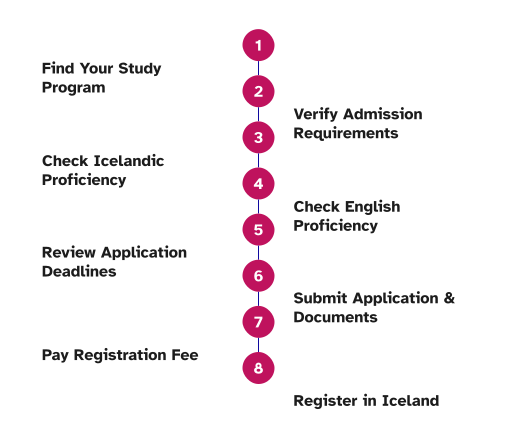
Follow the path
Contact us If you still have questions, feel free to contact us.
School of HumanitiesWeekdays: 10-12 am and 1-3 pmGeneral Service and Social MediaThe Service Desk is a point of access for all services. You can drop in at the University Centre or use the WebChat at the bottom right of this page.
Follow the School of Humanities on Instagram, Youtube
and Facebook
Share