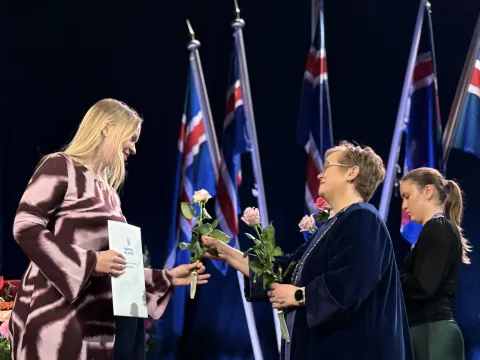
The role of universities has rarely been as important as it is now in defending democracy, critical thinking and the free pursuit of knowledge. This was the key message of the address delivered by Silja Bára R. Ómarsdóttir, the Rector of the University of Iceland, at the graduation ceremonies in Laugardalshöll on June 13. A total of 2,639 undergraduate and graduate candidates graduated from the University of Iceland this year. The largest number of candidates came from the School of Social Sciences, totalling 738, followed by 654 from the School of Education, 566 from the School of Health Sciences, 401 from the School of Humanities, and 280 from the School of Engineering and Natural Sciences.
In her address, Silja Bára, the Rector of UI, spoke about the great changes characterising the present, the effects of information technology, artificial intelligence, and social media on public discourse, and the challenges democracies face as our shared foundation of knowledge and truth is increasingly called into question.
Further, Silja Bára emphasised that, despite this, the future wasn’t predetermined but shaped by people's and communities’ decisions.
“The future is in your hands,” the Rector said, urging candidates to use their knowledge, be courageous, and take responsibility as they face the complex tasks ahead.
The Rector referenced the ideas of political scientist Parag Khanna on how the world is moving from the unipolar world order that has prevailed since the end of the Cold War to a more complex power structure in which influence and power are increasingly dispersed. Based on that perspective, it is not only sovereign states that shape the development of societies, but also cities, multinational corporations, tech giants, religious groups, and influential individuals working across borders. Khanna pointed out that there are similarities between the present and the Middle Ages, when borders were unclear, power lay in the hands of actors beyond the state, and it was not always clear who was in charge or shaping the development of societies.
Silja Bára pointed out that this development also affected public discussions and trust in knowledge. She said that in recent years, people appeared to be increasingly in disagreement about the basis of common discussion – what is true, what is false, and how to distinguish between the two. In that regard, she referenced the research project Reclaim at the University of Iceland, which examines post-truth politics and how common knowledge and understanding of the truth are now being subverted.
Important to defend truth and common ground
In Silja Bára’s view, one of the biggest challenges of our time is to defend the idea of a shared foundation of truth.
“When each group – or even each individual – has their own version of what is true and false, without shared criteria to inform those views, the dialogue on which democracy depends breaks down.”
In her address, the Rector also spoke about research conducted by Sigrún Aðalbjarnardóttir, professor emerita at the University of Iceland, on the development of civic awareness in young people. In her research, Sigrún has convincingly argued that active participation in society is grounded in social development and communication skills, a sense of morality, and a positive self-image.
The primary duty of universities to safeguard democracy
Silja Bára also emphasised the role of universities as forums for freedom of thought, debate and the pursuit of knowledge. She quoted Páll Skúlason, a former Rector of the University of Iceland, who emphasised that universities are communities of students and teachers that must be carefully nurtured.
Silja Bára said this might seem like simple facts. But on closer inspection, Páll’s words have a profound meaning that is highly relevant today.
“Because when divisions in our society become critical, when people stop having conversations or respecting each other’s opinions – the role of universities becomes more vital than ever.”
She said that universities had a primary duty to strengthen critical thinking and democratic discourse in times when polarisation and extremism are increasingly gaining ground in society.
“Because their mission and primary duty is to defend democracy, critical thinking and the free pursuit of knowledge and to foster dialogue based on reason, research and facts.”
New university consortium on the University of Iceland’s 115th anniversary
In the address, the Rector highlighted that next week will mark 115 years since the University of Iceland was founded. There’s little need to elaborate on the significant impact the University has had during this time as a driver for knowledge, innovation and progress in Iceland. Silja Bára mentioned that in just over a century, the university had evolved from a training school for public officials into a leading international research university.
Further, she pointed out that ahead lay a new chapter in the university’s history, with the establishment of the first university consortium in Iceland under the name of the University of Iceland, with Hólar University as a member. According to the Rector, the consortium will strengthen interdisciplinary collaboration and help the University to better serve people across Iceland.
Notably, teaching began at Hólar in Hjaltadalur 920 years ago, in 1106.
Interdisciplinarity is important
In her address, the Rector of UI emphasised that the biggest challenges of our time could not be solved within the confines of specific academic disciplines. Climate change, pandemics, and artificial intelligence demand interdisciplinary collaboration in which diverse knowledge and perspectives are combined to find solutions. Furthermore, she encouraged candidates to remain optimistic and reminded them that even in times of uncertainty, there were many opportunities for progress.
“But the enormous difficulties before us also present opportunities – opportunities for new knowledge, new ideas, new solutions and paths open to people like you, who have what it takes to meet challenges head on with courage and sincerity.”
At the end of her address, the Rector thanked the candidates for their participation in the University of Iceland community and urged them to remain a part of the community that had shaped them during their student years.
“Please do come back – come home.”