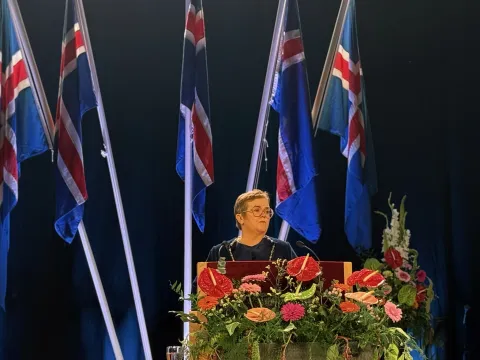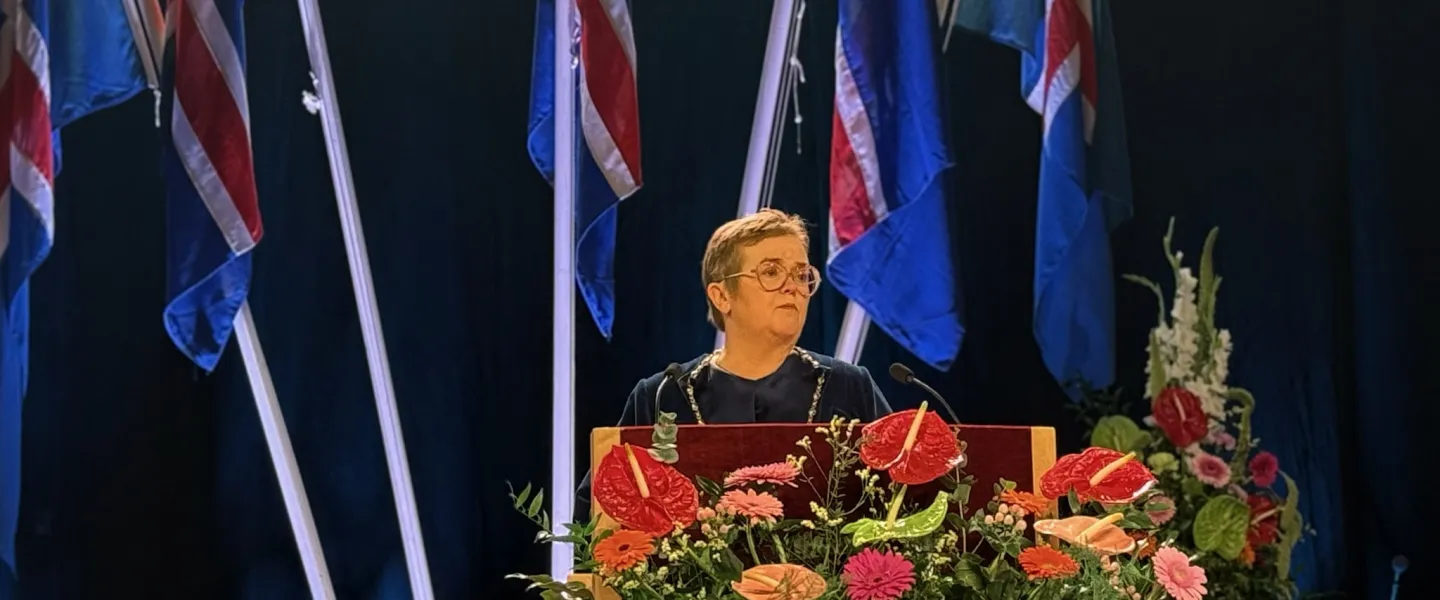
Dr Silja Bára R. Ómarsdóttir, the Rector of the University of Iceland, delivered an address at the graduation ceremonies in Laugardalshöll, June 13, 2026:
"Former rectors, pro-rectors, school deans, faculty heads, staff of the University of Iceland, distinguished guests near and far – but above all: our wonderful graduates! Congratulations!
It is an honour to celebrate your achievement with you here today. Choosing a degree subject at the end of secondary school can be a daunting decision. It seems so critical to determining the course of your future. A decision like that is complicated enough in normal circumstances – if there even is such a thing – but it is even more complicated in the turbulent state of the world today. But the enormous difficulties before us also present opportunities – opportunities for new knowledge, new ideas, new solutions and paths open to people like you, who have what it takes to meet challenges head on with courage and sincerity. Universities also have a key role to play here as the wellsprings of knowledge and free thinking.
The political scientist Parag Khanna has suggested that today’s world is more like the Middle Ages than the twentieth century. The unipolar world order of the post Cold War era is over, but there is no guarantee that any single great power will be able to fill the void. Instead, different power centres have emerged: states, cities, multinational corporations, religious groups, tech giants and billionaires operating across borders and competing for influence. Khanna bases his historical interpretation on earlier ideas in which he described how state authority has gradually lost its monopoly and the world has increasingly come to resemble conditions in the twelfth century.
In the Middle Ages, borders between states were often unclear and ordinary people had to pay allegiance to multiple actors – feudal lords, kings, the Church, guilds, and cities. This meant they often did not know who determined their fate. Scientific knowledge was dispersed and fragmented, truth was contested and there was widespread fear of plagues and unpredictable violence. This description is, in many respects, redolent of our own time, with our pandemics, climate disasters, wars, information disorder, dwindling trust in institutions and even democracy – which nevertheless remains the political system that best protects freedom of expression and the right to elect representatives who uphold the values we hold most dear.
Khanna’s theories are cause for concern, because this is not the future most of us would choose. But he also points out that we are not merely the puppets of fate. Each and every one of us has a voice and the future of the world is in our hands. And this is where you come in, dear graduates! The future is in your hands! People never have and surely never will agree on all the details of how society should be ordered. In recent years, however, we seem increasingly to disagree about the very foundations of shared discourse: what is true, what is false and how we know what we think we know.
The research project Reclaim, led by Maximilian Conrad, professor of political science at the University of Iceland, suggests that these disagreements are no coincidence in our ‘post-truth’ era. The Reclaim project defines the discourse of post-truth politics as false narratives that seek to undermine established knowledge and truth.
According to the project, one of the main characteristics of post-truth politics is a tendency to question all forms of authority, including the foundational institutions of society. For all of us, schools are among the first institutions to introduce us to the fundamental values of our society: democracy, human rights, freedom of expression and respect for the views of others.
Universities play a key role here, so it is no surprise that in many parts of the world they now face political pressure and even direct attacks on established and evidence-based scientific knowledge. This is emblematic of a broader shift in attitudes that threatens to undermine social cohesion, democracy and peace.
Dear graduates. The challenge here is twofold. On the one hand, there is the technical challenge posed by social media, deep-fakes and artificial intelligence, with information spreading faster than ever before under conditions that few of us fully understand. On the other hand, there is the epistemological challenge of defending the very idea of a shared foundation for truth. When people disagree about the truth, society ceases to share a single reality. When each group – or even each individual – has their own version of what is true and false, without shared criteria to inform those views, the dialogue on which democracy depends breaks down.
But how can universities help in times like these? Páll Skúlason, former Rector of the University of Iceland and one of the most distinguished philosophers this country has produced, once said: "A university is and should be a community of students and teachers, and this community must be carefully nurtured."
These may seem like simple facts. But on closer inspection, Páll’s words have a profound meaning that is highly relevant today. Because when divisions in our society become critical, when people stop having conversations or respecting each other’s opinions – the role of universities becomes more vital than ever. Because their mission and primary duty is to defend democracy, critical thinking and the free pursuit of knowledge and to foster dialogue based on reason, research and facts.
Vilhjálmur Árnason, another former UI philosophy professor, clearly and convincingly argues for the democratic role of universities as an arena for deliberative democracy – a space where our abilities are systematically cultivated through dialogue, reasoned argument, listening to alternative perspectives, and ultimately striving to reach understanding.
We must uphold this fundamental ideal of higher education. In a time when algorithms and artificial intelligence reward extremes and social media amplifies those who shout the loudest, the practice of sincere and honest deliberation is an urgent civic duty for us all. The American philosopher Martha Nussbaum has pointed out that societies endanger democracy when they treat education first and foremost as a tool to serve the labour market. The role of a university is not only to transmit knowledge, but equally to educate independent citizens who can distinguish between facts, interests and opinions, and thereby resist division and mistrust.
Similar arguments have been put forward by Sigrún Aðalbjarnardóttir, professor emerita at the UI School of Education, who has spent decades researching the development of civic awareness in young people in democratic societies. She has convincingly reasoned that mature civic awareness is grounded in social development and communication skills, a sense of morality and a positive self-image. We who have taught and guided you at the University of Iceland trust that after your time here, you now have a true sense of civic awareness and will go on to apply it with responsibility and sound judgement throughout your lives.
Dear graduates, the challenges of our time are so complex and far-reaching that no single academic discipline can address them alone. Climate change is not only a matter of physics; it equally demands the involvement of economists, biologists, psychologists, ethicists and political scientists. Pandemics are not solely medical problems; they also require consideration of trust, communication and complex social structures. Artificial intelligence is not merely a challenge for computer scientists; it equally affects law, the labour market, our understanding of humanity, and democracy itself. Over the last few decades, research on how universities can address complex, multifaceted challenges has largely pointed in the same direction: the question must come first, and the discipline thereafter.
This new way of thinking requires changes that are not always easy to implement. For example, it requires that teaching and learning are organised in a way that facilitates interdisciplinary collaboration, enabling students to take more courses in different fields. And it requires us to cultivate what Sigrún Aðalbjarnardóttir calls respect and care – not just between individuals, but also between academic disciplines and their different methodologies. These are attitudes that we must take with us out into the world. Let us see the humanity in those who are close to us – and also those who are further away. It is easy to be overwhelmed by pessimism when the news is dominated by wars and disasters, but at the same time we are witnessing remarkable scientific progress which should be shared with all of humanity and give us grounds for optimism.
And though the outlook may seem bleak when our time is compared to the Middle Ages, every risk presents an opportunity. Societies with robust institutions, effective education systems, lively public discourse and strong social networks can make an impact far out of proportion to their size. This is true of Iceland And it is certainly true of the UI community.
We are a small nation, but we have a wealth of resources and qualities that make a real difference in a world adrift and searching for an anchor. The social fabric in Iceland is still tight-knit and it is our duty to keep it strong by welcoming people who want to educate themselves and contribute to society. And we also have something that few other nations can boast: a national university, small enough that we know people beyond our own programme or faculty. This creates a golden opportunity to boost interdisciplinary collaboration. At the same time, UI is strong enough that our research and knowledge creation has a genuine impact far beyond the borders of Iceland. Our influence is thanks not least to the growing numbers of international students who complete their degrees and head out into the world as ambassadors for the University of Iceland. And I would like to extend my particular thanks to our international students for choosing the University of Iceland – in such a small country it would be difficult to maintain strong teaching and research in many disciplines without you.
Dear graduates, this is a milestone for the University as well as you, as next week marks 115 years since the University of Iceland was founded, in the time between home rule and full sovereignty. It has evolved from a training school for public officials into what it is today: a leading international research university that attracts outstanding staff and students. And the year ahead will mark yet another new chapter in the University’s history, as the country’s first university consortium is established and the University of Iceland at Hólar becomes its first member. These are exciting times, creating new opportunities for interdisciplinary collaboration, and helping UI better serve people all over Iceland.
But of course, this is your day first and foremost, dear graduates. The world that awaits you is most certainly more complex than the world your parents grew up in, not to mention your grandparents. But all challenges bring opportunities, demanding new ideas and creating potential for you to make a difference. If power is not concentrated in a single source, then many smaller decisions – which I encourage each of you to make in your daily lives – can have a real impact on the kind of world that is emerging, and on the future as a whole.
The University of Iceland has been your home and your creative community for a time. It will continue to be there for you as you make your way in life – as a guardian of democracy, as a vibrant community where a plurality of views can flourish, as an idea, as a reality. Please do come back – come home. Continue to be a part of the University community, even after you’ve handed in your final assignment.
Congratulations on your graduation, congratulations on this milestone, congratulations on life and the power that you have! Use that power for the good of us all, and the world will become a better place the moment you step out into the sunlight."