""
Language skills
required, minimum level of B2
Programme length
1 years.
Study mode
Face-to-face learning
Application status
International students:
Students with Icelandic or Nordic citizenship:
Overview

  • Are you interested in languages?
  • Do you enjoy working with words?
  • Do you want to work with people from different cultural backgrounds?
  • Are you proficient in Icelandic and at least one other language?
  • Do you want to work with language and communication?
  • Do you want to open up future opportunities in challenging careers?

Translation studies is a 60 ECTS minor that can be taken alongside a 120 ECTS major in another subject. You must complete 180 ECTS to graduate with a BA degree.

This discipline will prepare you for the task of transferring information between different cultures, which involves tackling a range of subjects.

You will learn to evaluate information and process it with a view to translating it into a different culture or linguistic system.

The programme is taught through lectures and practical exercises, in language centres and computer labs. Students are trained to translate and interpret.

The programme is roughly divided into three main areas: theory, your source language, and your target language. You can select courses to suit your own interests.

The programme addresses both the historical roots of the profession, going back to antiquity, and the latest translation technology with translation memories and other software.

Course topics include:

  • Translation
  • Textual analysis
  • Translation technology

Objectives

  • to introduce you to the main methods and approaches used in translation and interpreting
  • to teach you about the latest technology in computer-aided translation
  • to teach you the concepts and main theories of translation studies
  • to enable you to evaluate translation projects
  • to prepare you for Master’s studies in translation studies, practical translation or conference interpreting

Classes are taught in the Main Building and various other UI buildings, computer labs and the Language Centre.

Please contact the Faculty of Languages and Cultures for more information about the programme or the International Division for more information about exchange studies.

Icelandic matriculation examination (stúdentspróf) or equivalent qualification. Further information can be found in article 17, regulation on admission requirements for undergraduate study no. 331/2022.

Translation studies, as a 60 ECTS minor towards a BA degree, is intended exclusively for students who have completed a 120 ECTS major in a language. The programme is interdisciplinary and generally divided into 20 ECTS in translation studies, 20 ECTS in Icelandic and 20 ECTS in another language. Students should select Icelandic and foreign language courses that are related to translation.

Programme structure

Check below to see how the programme is structured.

This programme does not offer specialisations.

Year unspecified | Fall
Translation (ÍSE502G)
A mandatory (required) course for the programme
10 ECTS, credits
Course Description

The course in an introduction to translation, the history of translation and translation theory. Students will become acquainted with the main concepts and theories in the field. The basics of interpretation will also be dealt with. The course consists of two parts: The theoretical and historical part is in the form of lectures and discussions. The teacher also provides a reading list. Assessment is in the form of an exam or an essay, based on the reading material. The practical part is based on seminars where students gain practice in translating (both literary translation and applied translation) as well as translation criticism. Assessment is based on written assignment(s). Students of Icelandic as a Second Language must have completed all courses of the first and second year.

Language of instruction: Icelandic
Face-to-face learning
Prerequisites
Year unspecified | Spring 1
Translation criticism and translation technology (ÞÝÐ201G)
A mandatory (required) course for the programme
10 ECTS, credits
Course Description

Most common methods and aids in translation will be covered in this course. Students will gain insight into the translators work and gain practise in translation. They learn how to analyze texts before translating them.

Language of instruction: Icelandic
Face-to-face learning
Year unspecified
  • Fall
  • ÍSE502G
    Translation
    Mandatory (required) course
    10
    A mandatory (required) course for the programme
    10 ECTS, credits
    Course Description

    The course in an introduction to translation, the history of translation and translation theory. Students will become acquainted with the main concepts and theories in the field. The basics of interpretation will also be dealt with. The course consists of two parts: The theoretical and historical part is in the form of lectures and discussions. The teacher also provides a reading list. Assessment is in the form of an exam or an essay, based on the reading material. The practical part is based on seminars where students gain practice in translating (both literary translation and applied translation) as well as translation criticism. Assessment is based on written assignment(s). Students of Icelandic as a Second Language must have completed all courses of the first and second year.

    Face-to-face learning
    Prerequisites
  • Spring 2
  • ÞÝÐ201G
    Translation criticism and translation technology
    Mandatory (required) course
    10
    A mandatory (required) course for the programme
    10 ECTS, credits
    Course Description

    Most common methods and aids in translation will be covered in this course. Students will gain insight into the translators work and gain practise in translation. They learn how to analyze texts before translating them.

    Face-to-face learning
    Prerequisites

The timetable shown below is for the current academic year and is FOR REFERENCE ONLY.

Changes may occur for the autumn semester in August and September and for the spring semester in December and January. You will find your final timetable in Ugla when the studies start.

Note! This timetable is not suitable for planning your work schedule if you are a part-time employee.


Additional information

The University of Iceland collaborates with over 400 universities worldwide. This provides a unique opportunity to pursue part of your studies at an international university, thus gaining added experience and fresh insight into your field of study.

Students generally have the opportunity to join an exchange programme, internship, or summer courses. However, exchanges are always subject to faculty approval.

Students have the opportunity to have courses evaluated as part of their studies at the University of Iceland, so their stay does not have to affect the duration of their studies.

People with degrees in Icelandic can be found teaching at all levels of the education system and in academic positions, e.g. at research institutes in the field of Icelandic studies.

Many pursue careers in writing or other professions related to culture and the arts, various media and publishing (as reporters, journalists, editors, language consultants, translators, literary critics, etc.).

A degree in this area is an asset in any job that requires good Icelandic skills and/or knowledge of Icelandic literature and grammar.

An education in this area can open up opportunities in:

  • Teaching at all levels of the education system
  • Academia
  • Media
  • Publishing
  • Web communication

This list is not exhaustive.

Mímir is the organisation for students in Icelandic, general linguistics and sign language studies at the University of Iceland. Mímir page on Facebook.

Students' comments
Portrait photo of Rebekka Lind Ívarsdóttir Wiium
Challenging but rewarding, small classes facilitate discussions, enhancing understanding. Translation studies reveal languages as cultural expressions, strengthening my grasp of both the new language and my native one.
Helpful content
Aurora Cooperation

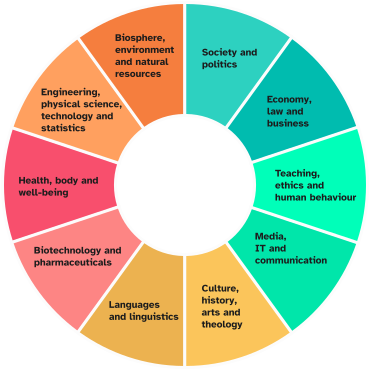
Study wheel

What interests you?

Aurora Cooperation

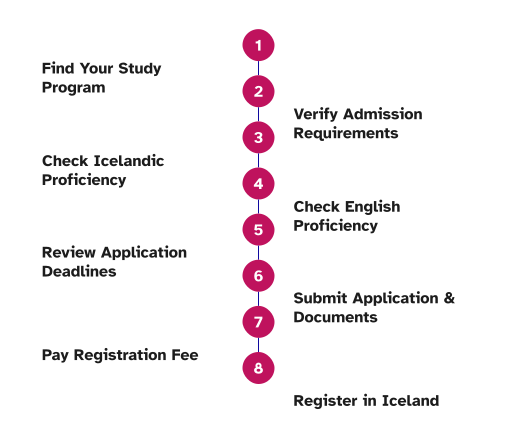
How to apply

Follow the path

Contact us

If you still have questions, feel free to contact us.

School of Humanities
Weekdays: 10-12 am and 1-3 pm
General Service and Social Media

The Service Desk is a point of access for all services. You can drop in at the University Centre or use the WebChat at the bottom right of this page.

Follow the School of Humanities on Instagram,   Youtube
and Facebook

""

Share

Did this help?

Why wasn't this information helpful

Limit to 250 characters.