
""
Language skills
required, minimum level of B2
Programme length
3 years.
Study mode
Face-to-face learning
Application status
International students:
Students with Icelandic or Nordic citizenship:
Overview

  • Do you want to learn Icelandic sign language?
  • Do you want to explore a new culture and a new way of communicating?
  • Are you interested in linguistics or comparisons between different languages?
  • Do you enjoy communicating with other people?
  • Do you want a diverse selection of courses that suit your interests?
  • Do you want to open up future opportunities in challenging careers?

The primary aim of the programme is to teach students Icelandic Sign Language (ÍTM) and provide them with insight into Deaf culture. Students learn to communicate in ÍTM and explore the culture and history of the Deaf community.

Course topics include:

  • Practical ÍTM
  • Sign language linguistics
  • Culture and history of sign language speaking communities
  • Deaf Gain and sign language literature
  • Cultural spheres
  • Translation
  • Sign language interpreting
  • Different communication methods
  • Spoken Icelandic and diction

For the first two years, students focus on learning ÍTM, but also gain theoretical knowledge of the subject and adopt academic working practices.

In the third year, the focus is on interpreting between ÍTM and Icelandic, in both academic and practical contexts. Students spend time shadowing professional interpreters at work. They also consider the ethics of interpreting and different communication methods based on sign language.

Students must complete all 180 ECTS in sign language studies and interpreting to complete the BA programme.

In order to begin studying sign language interpreting, a student must have completed all first and second-year courses and achieved a first class average grade from proficiency courses I-IV.

Please note: Sign language interpreting courses are generally offered every three years. Second year courses are generally not taught during the academic year in which students learn sign language interpreting.

Objectives

The programme aims to teach students about Icelandic Sign Language and Deaf culture and provide them with the skills needed to interpret between ÍTM and Icelandic.

Teaching methods

Sign language studies is taught through lectures, discussions and group work. Students are expected to participate in class, especially classes that involve language and interpreting skills. Since there is no written form of sign language, it is difficult to study it independently. This means that several courses have a mandatory attendance of 80%.

Check the course description to see whether attendance is mandatory. Students who do not meet minimum attendance requirements will not be permitted to take the exam. Courses with mandatory attendance generally require less independent reading, with much more focus on active learning and engagement in class.

For theoretical courses, it is important for students to do the required reading and prepare thoroughly for class. Another important aspect of independent study is completing assignments and essays. The majority of reading material is in English, but some texts are in Icelandic and other Nordic languages.

Teaching is either in Icelandic or Icelandic Sign Language. Exams may be either written or oral and students are usually expected to submit assignments completed at home. In some cases, assessment is wholly based on assignments completed at home.

Sign language interpreting students need to devote a lot of time to in-class learning and practical training in the field. Students should therefore be aware that the programme requires high levels of attendance, including beyond the timetable.

Sign language interpreting courses are generally offered every three years. To take this part of the programme, students must have completed 120 ECTS in sign language studies and achieved a first class average grade for proficiency courses I-IV.

Teaching is generally in the Main Building, but some courses are taught partially or fully in other buildings, including the Language Centre in Nýji Garður.

Programme options

Sign language studies is offered as a 120 ECTS major.

  • Students must complete a 60 ECTS minor in another subject.
  • All first-year courses are mandatory: Proficiency course I and II, Introduction to sign language studies, Sign language linguistics I, Study methods in Icelandic and Cultural spheres.
  • In the second year, students must take Proficiency course III and IV and Sign language linguistics II, as well as the BA thesis, an additional 10 ECTS in sign language studies and 10 ECTS from an elective course (this may be a sign language studies course).

Please note that second-year courses are not taught every year.

Sign language studies can also be taken as 60 ECTS minor

  • Students must complete a 120 ECTS major in another subject.
  • Students must take Proficiency course I and II, Introduction to sign language studies, Sign language linguistics I, and Study methods in Icelandic, unless they have completed a comparable course.
  • Students select other courses from sign language studies in consultation with the programme coordinator.

Deaf interpreter training is offered as a 60 ECTS undergraduate diploma. Deaf interpreter training is only for students who speak Icelandic Sign Language as a first language. Please note that this programme is not always offered.

Practical value

Teaching is based on Icelandic Sign Language and its linguistic community and compares these to foreign sign languages and Deaf history in an international context. The undergraduate programme in sign language studies delivers a broad, multicultural education that is an asset in various professions as well as a strong foundation for postgraduate study.

Completing the full 180 ECTS programme qualifies you to work as a sign language interpreter. Completing a BA with a first class grade allows you access to the second cycle of higher education. A degree in sign language studies is therefore highly valuable for anyone who wants to explore different cultures and new languages. It can also open up new career opportunities for people from different academic backgrounds.

Icelandic matriculation examination (stúdentspróf) or equivalent qualification. Further information can be found in article 17, regulation on admission requirements for undergraduate study no. 331/2022.

A BA degree shall require at least 180 ECTS and full-time study is considered to be 60 ECTS per academic year. All courses are mandatory. Students must have completed all first and second-year courses to advance to the third year.

Programme structure

Check below to see how the programme is structured.

This programme does not offer specialisations.

First year | Fall
Study Methods in Icelandic (ÍSL109G)
A mandatory (required) course for the programme
10 ECTS, credits
Course Description

This is a joint course for students in Icelandic, General Linguistics and Sign Language Linguistics. It falls into two parts. On the one hand, in Thursday classes, the students receive training in critical thinking, scientific methods and academic writing. Topics include the use of handbooks and other sources, the style and structure of academic papers, research methods in linguistics and literature, conventions regarding citations and bibliographies, etc.

In the second part of the course, taught on Tuesdays, the students are introduced to the various sub-disciplines of Icelandic, General Linguistics and Sign Language Linguistics as academic subjects and their connection to other subject areas. Different teachers and other guests introduce their sub-disciplines and areas of specialization.

Language of instruction: Icelandic
Face-to-face learning
First year | Fall
Proficiency Course I (TÁK102G)
A mandatory (required) course for the programme
10 ECTS, credits
Course Description

Aim: To teach students the basic language functions found in Icelandic Sign Language. The main focus will be on language used in daily life and social uses of Icelandic Sign Language. Both expressive and comprehension skills will be emphasized throughout the course. Topics will include grammatical non-manual features with signs and classifier predicates and their importance in sign language. Students use video recordings to study the language.

Methods: Lectures, sign language text examinations and practical group- and individual practices during the lessons which students take active part in. 80% attendance in the course is obligatory and is a prerequisite for the final examination.

Assessment: Different assignments, mostly video assignments spread over the semester. Students have to pass all parts of the assesement with minimum grade (5,0) and fulfil the 80% attendance.

Face-to-face learning
Attendance required in class
First year | Fall
Introduction to Sign Language Studies (TÁK108G)
A mandatory (required) course for the programme
10 ECTS, credits
Course Description

In this course the main theme are sign language communities, in particular the community of the Icelandic Sign Language. Deaf culture and the history of Icelandic Sign Language will be discussed as well as language ideology and the status and viability of Icelandic Sign Language. Approaches from Deaf studies, anthropology and sociolinguistics will be applied.


Language of instruction: Icelandic
Face-to-face learning
Prerequisites
First year | Spring 1
Profiency Course II (TÁK201G)
A mandatory (required) course for the programme
10 ECTS, credits
Course Description

Aim: That students can express themselves in simple language and participate in conversations in Icelandic Sign Language. Both expressive and comprehension skills will be emphasized throughout the course.

Course subject: A continuation of Proficiency Course I which is a required prerequisite. Students will learn and exercise more complex language functions found in Icelandic Sign Language. Grammatical non-manual features and their importance in sign language will continue to be a topic. 

Methods: Lectures, sign language text examinations and practical group- and individual practises during the lessons which students take active part in. 80% attendance in the course is obligatory.

Assessment: Video assignments. Students have to pass all parts of the assessment with minimum grade (5,0) and 80% attendance.

Face-to-face learning
Attendance required in class
First year | Spring 1
Cultural Spheres (TÁK204G)
A mandatory (required) course for the programme
10 ECTS, credits
Course Description

An interdisciplinary and introductory course entailing a dialogue between the academic fields of the department, i.e. comparative literature, film studies, gender studies, art studies, linguistics, cultural studies, sign language and interpreting studies and translation studies. The latest international developments in the field of humanities will be examined and questions asked about the relationship of academic studies and our world view(s). We will analyse the semiotic system of language, inquiring whether it can serve as the basis for our understanding of other semiotic systems. We will ask about the connection and relationship between different languages and linguistic worlds. What is "multiculture"? How are spoken language, written language and visual language interconnected within society? What constitutes cultural literacy? Literature, art, film and other visual material will be examined in both a national and international context, with a view to how these semiotic systems influence the borderlines of gender, race, class, nation, and different world cultures. The study materials include theoretical and critical writings, literary works, visual art and images, and films, as well as some current media coverage. Evaluation is based on four assignments and a written exam.

Language of instruction: Icelandic
Face-to-face learning
First year | Spring 1
Sign Language Linguistics I (TÁK207G)
A mandatory (required) course for the programme
10 ECTS, credits
Course Description

A survey of the major features of the linguistic structure off Icelandic Sign Language and sign languages in general. The aim is that students understand the basic elements and structure of sign languages in general.

Language of instruction: Icelandic
Face-to-face learning
Prerequisites
Second year | Fall
Final project (TÁK261L)
A mandatory (required) course for the programme
0 ECTS, credits
Course Description

Final project

Language of instruction: Icelandic
Part of the total project/thesis credits
Second year | Fall
Profiency Course III (TÁK302G)
A mandatory (required) course for the programme
10 ECTS, credits
Course Description

Aim: That students understand conversations in Icelandic Sign Language and can express themselves in the language. Students will rehears correct use of grammatical and emotional non-manual features with signs. 

Course subject: A continuation of Proficiency Course II which is a required prerequisite. An emphasis on expressive skills will continue and comprehension skills will get more value. New vocabulary will be practiced. Students will practice in 'reading' sign language and work with sign language texts. 

Methods: Lectures, sign language text examinations and practical group- and individual practises during the lessons which students take active part in. 80% attendance in the course is obligatory and is a prerequisite for finishing the course.

Assessment: Video assignments and field trips. Students have to pass all parts of the assessment with minimum grade (5,0).

Face-to-face learning
Second year | Fall
Sign Language Linguistics II (TÁK303G)
A mandatory (required) course for the programme
10 ECTS, credits
Course Description

Aim: That students understand the grammatical elements of non-manual features in Icelandic Sign Language. The course will aim on developing skills for collecting data, analysing them and draw conclusions.

Course subject: A continuation of Sign Language Linguistics I which is a required prerequisites. An emphasis on analysis and transcription of sign language. The grammatical elements of non-manual features will be discussed and students will be trained in using grammatical concepts on their own data. Methodology in sign language research will be discussed.

Methods: Lectures where examples from Icelandic Sign Language are introduced. Students work on assignments during the whole semester.

Assessment: Assignments during the semester.

Language of instruction: Icelandic
Face-to-face learning
Second year | Fall
Deaf gain, culture and power (TÁK305G)
A mandatory (required) course for the programme
10 ECTS, credits
Course Description

Aim: To increase students' understanding and knowledge of Deaf culture and history. Deaf Gain will be discussed from different perspectives.

Method: Lectures of the teacher form a great part of the course but students take actively part in class, talk about their assignments and give lectures. 80% attendance in the course is obligatory.

Face-to-face learning
Attendance required in class
Second year | Spring 1
Final project (TÁK261L)
A mandatory (required) course for the programme
0 ECTS, credits
Course Description

The BA thesis is primarily intended to train students in researching a chosen topic within their field of study and presenting their findings in a well-structured academic text. Students write a BA thesis on a research topic of their own choice in consultation with their supervisor. The course coordinator assists students in selecting a supervisor if needed. Students are encouraged to meet with their supervisor and prepare an initial outline of the research project before the thesis semester begins.

The final thesis should demonstrate the student’s ability to work independently and academically, present material logically and systematically, analyse sources, and make use of scholarly resources (e.g., handbooks, dictionaries, or comparable online resources).

Students are encouraged to use the services of the University of Iceland Centre for Writing [link: https://ritver.hi.is/is], which offers support for academic writing. At the Centre for Writing, students can book consultations and receive advice on any issues related to academic essays, reports, and other written assignments.

Students are also advised to familiarise themselves with the University of Iceland guidelines on the use of artificial intelligence: https://gervigreind.hi.is/

See detailed rules regarding BA theses at the School of Humanities (in Icelandic only): https://ugla.hi.is/kerfi/view/page.php?sid=3544

Language of instruction: Icelandic
Part of the total project/thesis credits
Second year | Spring 1
Profiency Course IV (TÁK403G)
A mandatory (required) course for the programme
10 ECTS, credits
Course Description

Visual vernacular is a literature form that tests creation from culture, art, and linguistics of sign languages. Visual vernacular is a form of art that expresses at the same time the aesthetics of sign languages as well as the cultural values of deaf communities. In this course students work independently on creating their own VV-stories but at the the same time learn about other disciplines of sign language literature. Grammatical elements such as depicting verbs, non-manuals and constructed action will be worked on within the field of cognitive linguistics and combined to the work on the VV-stories. Students build on the knowledge they have from the courses on sign language proficency and linguistics.

Assessment is built on study on student’s own work and comparison to other literature work. Students deliver their assignments in a written form and in a video recording of their story that will be published. Students must finish all parts of the assessment with minimum grade (5,0). 80% attendance in the course is obligatory and is a prerequisite for finishing the course.

Face-to-face learning
Attendance required in class
Second year | Spring 1
Sign Language Linguistics III (TÁK404G)
A mandatory (required) course for the programme
5 ECTS, credits
Course Description

In this course students will deal with special grammatical features in the Icelandic Sign Language that will be determined according to interest and pre-knowledge of the group of students each time. Students receive training in the collection and analysis of data and do independent research on a specific grammatical issue in the Icelandic sign language. The aim of the course is for students to acquire skills in preparing, substantiating, and carrying out research on Icelandic sign language. Students work on the research evenly throughout the semester, all aspects of the assessment must be passed to complete the course.

Language of instruction: Icelandic
Face-to-face learning
Course taught first half of the semester
Not taught this semester
Second year | Spring 1
Icelandic Sign Language: Literature, culture, and linguistics (TÁK410G)
A mandatory (required) course for the programme
5 ECTS, credits
Course Description

Visual vernacular is a literature form that tests creation from culture, art, and linguistics of sign languages. Visual vernacular is a form of art that expresses at the same time the aesthetics of sign languages as well as the cultural values of deaf communities. In this course students work independently on creating their own VV-stories but at the the same time learn about other disciplines of sign language literature. Grammatical elements such as depicting verbs, non-manuals and role shift will be worked on within the field of cognitive linguistics and combined to the work on the VV-stories. Students build on the knowledge they have on non-manuals from the course TÁK303G Sign Language Linguistics II. Individualized feedback from the teacher of the course. Assessment is built on study on student’s own work and comparison to other literature work. Students deliver their assignments in a written form and in a video recording of their story that will be published. Students must finish all parts of the assessment with minimum grade (5,0).

Face-to-face learning
Second year | Spring 1
Space in Sign Language Grammar (TÁK411G)
Free elective course within the programme
5 ECTS, credits
Course Description

Space plays an important role in the grammar of sign languages, which are visual languages formed three dimensionally. The course will discuss the linguistic role of space in sign language, especially Icelandic sign language. Emphasis will be placed on references and descriptive vocabulary in Icelandic sign language, especially pointing, indicating verbs, depicting verbs and constructed action. These elements will be examined in the context of non-manuals, based on the knowledge that the students acquired in the course TÁK303G Sign Language Linguistics II. Students read academic literature in the field, collect data, and analyse in specialized projects. The aim of the course is for students to become aware of the role of space in the grammar and vocabulary of Icelandic sign language, to gain an understanding of different references and the characteristics of indicating verbs, depicting verbs and constructed action. Students work on two projects during the semester and must finish both parts of the assessment with minimum grade (5,0). Taught in the first half of the semester.

Language of instruction: Icelandic
Face-to-face learning
Course taught second half of the semester
Not taught this semester
Third year | Fall
Theories of Interpreting (TÁK501G)
A mandatory (required) course for the programme
5 ECTS, credits
Course Description

Aim: That students learn the basics in interpreting theories and theories on the role of the interpreter

Course subject: Theories of the process of interpretation and different theories about the role of the interpreter will be discussed. Cultural and linguistic problems that occur in interpreting situations will be discussed as well as the role of the interpreter as connecting two different cultures. Different areas in interpreting and different situations will be analysed as well as conflicts of interest.

Methods: Lectures by the teacher but students are supposed to be active in discussions. There will be assignments during the semester, both group assignments and individual.

Assessment: Written exam and a project.

Litterature: To be announced

Language of instruction: Icelandic
Face-to-face learning
Course taught first half of the semester
Not taught this semester
Third year | Fall
Sign Language Interpreting I (TÁK502G)
A mandatory (required) course for the programme
20 ECTS, credits
Course Description

Aim: To train students in interpreting between Icelandic and Icelandic Sign Language. The main focus will at first be on consecutive interpreting and to increase students vocabulary. Then simulataneous interpreting will be taught.

Course subject: The main focus will be on assessment and feedback, from assessing yourself to take assessments from others and give feedback to others. There will worked on issues as analysing of interpreting, cooperation of interpreters, fidelity to the profession, yourself and colleges. Practical exercises is part of the course.

Methods: First eight weeks of teaching the focus will be in consecutive interpreting og there will be final exam in that part in week nine. After that simultaneous interpreting will be taught. Great part of the course is built on practical exercises in the classroom and later out in the field. Students will receive a lot of personal teaching and practice. There will be lectures on theoretical issues a few times during the semester and assignments and reading material related to the lectures. Students use their own computers in language lab. Practical exercises in the field are not within timetable of the course.

Assessment: Assignments during the semester (in the language lab), final exam in consecutive interpreting in week nine of teaching, assignments from the theoretical part and final assignment in interpreting at the end of the semester. Final exam in consecutive interpreting is in to parts, sign language interpreting and voice interpreting. Beside that each student has to finish 20 hours with a interpreter out in the field. 80% attendance in the course is insisted and is a prerequisite for the final examination. Students have to finish all parts of the assessment with minimum grade (5,0).

Face-to-face learning
Prerequisites
Attendance required in class
Not taught this semester
Third year | Fall
Spoken Icelandic and Diction (TÁK503G)
A mandatory (required) course for the programme
5 ECTS, credits
Course Description

Aim: Students to be competent in communicating in good spoken Icelandic. Students practice how to speak (as in voice interpreting) in formal and informal settings with emphasis on the use of the voice, correct language, rich vocabulary etc.
Lectures, assignments in class and practice. 80% attendance in the course is obligatory.

80% attendance in the course is obligatory.

Language of instruction: Icelandic
Face-to-face learning
Attendance required in class
Not taught this semester
Third year | Spring 1
Ethics of Interpretation (TÁK601G)
A mandatory (required) course for the programme
5 ECTS, credits
Course Description

The aim of this course is to increase the student's ability to deal in a thoughtful manner with ethical problems related to professionalism and the role of the interpretor. Main theories in ethics will be introduced. Important ethical concepts like Justice, Human rights, Autonomy and Welfare will be studied along with professionalism and privacy. Special emphasise is placed on getting aqainted with the ideology of the interpretor and how to respond to ethical problems in their work. In class there will be both lectures and discussions.

Language of instruction: Icelandic
Face-to-face learning
Not taught this semester
Third year | Spring 1
Sign Language Interpreting II (TÁK602G)
A mandatory (required) course for the programme
20 ECTS, credits
Course Description

Aim and course subject: To train students in interpreting between Icelandic and Icelandic Sign Language. The main focus will be on simultaneous interpreting. The course is a continuation of Sign Language Interpreting I. The main focus will be on more specific areas in interpreting as, interpreting on stage, interpreting in Educational, Medical or Legal Settings etc. Students get practical exercises out in the field with working interpreters.

Methods and assessment: Great part of the course is built on practical exercises in the classroom and later out in the field. Students will receive a lot of personal teaching and practice. There will be lectures on theoretical issues a few times during the semester and assignments and reading material related to the lectures. Practical exercises in the field are not within timetable of the course. Assessment consist of different assignments through the semester, performance in field work and final exam which is in three parts. Students have to have mininum grade (5,0) in each part. Beside that each student has to finish 40 hours with a interpreter out in the field and gets assessment for that work. 80% attendance in the course is insisted and is a prerequisite for the final examination. Students have to finish all parts of the assessment with minimum grade (5,0).

Face-to-face learning
Prerequisites
Attendance required in class
Not taught this semester
Third year | Spring 1
Variation in ways of communication and interpretation (TÁK603G)
A mandatory (required) course for the programme
5 ECTS, credits
Course Description

The purpose of daily communication is to understand and be understood. If communication is not to be interrupted communication partners have to accommodate to each other's need of communication. This course gives a summary of different ways in interpretation and communication from the individual‘s perspective. It will cover theoretical discussion on what it means to know a language, what are the needs of different groups when it comes to ways of communication, in interpretation among other things, and linguistic features of tactile language. As future sign language interpreters the students will gain knowledge of different ways of communication that are different from spoken and signed languages.

Students will get both theoretical concepts in the field and personal experience from individuals of variation in ways of communication in daily life. The course is mainly built up of guest presentations and visits, students are meant to discuss all of them afterwards. Active participation is required from students in class. The course prepares students for interpretation in the field.

The course has three main aims:

1. Students learn what it means to know a language.
2. Students gain knowledge of variation in ways of communication of different groups.
3. Students gain theoretical knowledge in the field.

Language of instruction: Icelandic
Face-to-face learning
First year
  • Fall
  • ÍSL109G
    Study Methods in Icelandic
    Mandatory (required) course
    10
    A mandatory (required) course for the programme
    10 ECTS, credits
    Course Description

    This is a joint course for students in Icelandic, General Linguistics and Sign Language Linguistics. It falls into two parts. On the one hand, in Thursday classes, the students receive training in critical thinking, scientific methods and academic writing. Topics include the use of handbooks and other sources, the style and structure of academic papers, research methods in linguistics and literature, conventions regarding citations and bibliographies, etc.

    In the second part of the course, taught on Tuesdays, the students are introduced to the various sub-disciplines of Icelandic, General Linguistics and Sign Language Linguistics as academic subjects and their connection to other subject areas. Different teachers and other guests introduce their sub-disciplines and areas of specialization.

    Face-to-face learning
    Prerequisites
  • TÁK102G
    Proficiency Course I
    Mandatory (required) course
    10
    A mandatory (required) course for the programme
    10 ECTS, credits
    Course Description

    Aim: To teach students the basic language functions found in Icelandic Sign Language. The main focus will be on language used in daily life and social uses of Icelandic Sign Language. Both expressive and comprehension skills will be emphasized throughout the course. Topics will include grammatical non-manual features with signs and classifier predicates and their importance in sign language. Students use video recordings to study the language.

    Methods: Lectures, sign language text examinations and practical group- and individual practices during the lessons which students take active part in. 80% attendance in the course is obligatory and is a prerequisite for the final examination.

    Assessment: Different assignments, mostly video assignments spread over the semester. Students have to pass all parts of the assesement with minimum grade (5,0) and fulfil the 80% attendance.

    Face-to-face learning
    Prerequisites
    Attendance required in class
  • TÁK108G
    Introduction to Sign Language Studies
    Mandatory (required) course
    10
    A mandatory (required) course for the programme
    10 ECTS, credits
    Course Description

    In this course the main theme are sign language communities, in particular the community of the Icelandic Sign Language. Deaf culture and the history of Icelandic Sign Language will be discussed as well as language ideology and the status and viability of Icelandic Sign Language. Approaches from Deaf studies, anthropology and sociolinguistics will be applied.


    Face-to-face learning
    Prerequisites
  • Spring 2
  • TÁK201G
    Profiency Course II
    Mandatory (required) course
    10
    A mandatory (required) course for the programme
    10 ECTS, credits
    Course Description

    Aim: That students can express themselves in simple language and participate in conversations in Icelandic Sign Language. Both expressive and comprehension skills will be emphasized throughout the course.

    Course subject: A continuation of Proficiency Course I which is a required prerequisite. Students will learn and exercise more complex language functions found in Icelandic Sign Language. Grammatical non-manual features and their importance in sign language will continue to be a topic. 

    Methods: Lectures, sign language text examinations and practical group- and individual practises during the lessons which students take active part in. 80% attendance in the course is obligatory.

    Assessment: Video assignments. Students have to pass all parts of the assessment with minimum grade (5,0) and 80% attendance.

    Face-to-face learning
    Prerequisites
    Attendance required in class
  • TÁK204G
    Cultural Spheres
    Mandatory (required) course
    10
    A mandatory (required) course for the programme
    10 ECTS, credits
    Course Description

    An interdisciplinary and introductory course entailing a dialogue between the academic fields of the department, i.e. comparative literature, film studies, gender studies, art studies, linguistics, cultural studies, sign language and interpreting studies and translation studies. The latest international developments in the field of humanities will be examined and questions asked about the relationship of academic studies and our world view(s). We will analyse the semiotic system of language, inquiring whether it can serve as the basis for our understanding of other semiotic systems. We will ask about the connection and relationship between different languages and linguistic worlds. What is "multiculture"? How are spoken language, written language and visual language interconnected within society? What constitutes cultural literacy? Literature, art, film and other visual material will be examined in both a national and international context, with a view to how these semiotic systems influence the borderlines of gender, race, class, nation, and different world cultures. The study materials include theoretical and critical writings, literary works, visual art and images, and films, as well as some current media coverage. Evaluation is based on four assignments and a written exam.

    Face-to-face learning
    Prerequisites
  • TÁK207G
    Sign Language Linguistics I
    Mandatory (required) course
    10
    A mandatory (required) course for the programme
    10 ECTS, credits
    Course Description

    A survey of the major features of the linguistic structure off Icelandic Sign Language and sign languages in general. The aim is that students understand the basic elements and structure of sign languages in general.

    Face-to-face learning
    Prerequisites
  • Fall
  • TÁK261L
    Final project
    Mandatory (required) course
    0
    A mandatory (required) course for the programme
    0 ECTS, credits
    Course Description

    Final project

    Prerequisites
    Part of the total project/thesis credits
  • TÁK302G
    Profiency Course III
    Mandatory (required) course
    10
    A mandatory (required) course for the programme
    10 ECTS, credits
    Course Description

    Aim: That students understand conversations in Icelandic Sign Language and can express themselves in the language. Students will rehears correct use of grammatical and emotional non-manual features with signs. 

    Course subject: A continuation of Proficiency Course II which is a required prerequisite. An emphasis on expressive skills will continue and comprehension skills will get more value. New vocabulary will be practiced. Students will practice in 'reading' sign language and work with sign language texts. 

    Methods: Lectures, sign language text examinations and practical group- and individual practises during the lessons which students take active part in. 80% attendance in the course is obligatory and is a prerequisite for finishing the course.

    Assessment: Video assignments and field trips. Students have to pass all parts of the assessment with minimum grade (5,0).

    Face-to-face learning
    Prerequisites
  • TÁK303G
    Sign Language Linguistics II
    Mandatory (required) course
    10
    A mandatory (required) course for the programme
    10 ECTS, credits
    Course Description

    Aim: That students understand the grammatical elements of non-manual features in Icelandic Sign Language. The course will aim on developing skills for collecting data, analysing them and draw conclusions.

    Course subject: A continuation of Sign Language Linguistics I which is a required prerequisites. An emphasis on analysis and transcription of sign language. The grammatical elements of non-manual features will be discussed and students will be trained in using grammatical concepts on their own data. Methodology in sign language research will be discussed.

    Methods: Lectures where examples from Icelandic Sign Language are introduced. Students work on assignments during the whole semester.

    Assessment: Assignments during the semester.

    Face-to-face learning
    Prerequisites
  • TÁK305G
    Deaf gain, culture and power
    Mandatory (required) course
    10
    A mandatory (required) course for the programme
    10 ECTS, credits
    Course Description

    Aim: To increase students' understanding and knowledge of Deaf culture and history. Deaf Gain will be discussed from different perspectives.

    Method: Lectures of the teacher form a great part of the course but students take actively part in class, talk about their assignments and give lectures. 80% attendance in the course is obligatory.

    Face-to-face learning
    Prerequisites
    Attendance required in class
  • Spring 2
  • TÁK261L
    Final project
    Mandatory (required) course
    0
    A mandatory (required) course for the programme
    0 ECTS, credits
    Course Description

    The BA thesis is primarily intended to train students in researching a chosen topic within their field of study and presenting their findings in a well-structured academic text. Students write a BA thesis on a research topic of their own choice in consultation with their supervisor. The course coordinator assists students in selecting a supervisor if needed. Students are encouraged to meet with their supervisor and prepare an initial outline of the research project before the thesis semester begins.

    The final thesis should demonstrate the student’s ability to work independently and academically, present material logically and systematically, analyse sources, and make use of scholarly resources (e.g., handbooks, dictionaries, or comparable online resources).

    Students are encouraged to use the services of the University of Iceland Centre for Writing [link: https://ritver.hi.is/is], which offers support for academic writing. At the Centre for Writing, students can book consultations and receive advice on any issues related to academic essays, reports, and other written assignments.

    Students are also advised to familiarise themselves with the University of Iceland guidelines on the use of artificial intelligence: https://gervigreind.hi.is/

    See detailed rules regarding BA theses at the School of Humanities (in Icelandic only): https://ugla.hi.is/kerfi/view/page.php?sid=3544

    Prerequisites
    Part of the total project/thesis credits
  • TÁK403G
    Profiency Course IV
    Mandatory (required) course
    10
    A mandatory (required) course for the programme
    10 ECTS, credits
    Course Description

    Visual vernacular is a literature form that tests creation from culture, art, and linguistics of sign languages. Visual vernacular is a form of art that expresses at the same time the aesthetics of sign languages as well as the cultural values of deaf communities. In this course students work independently on creating their own VV-stories but at the the same time learn about other disciplines of sign language literature. Grammatical elements such as depicting verbs, non-manuals and constructed action will be worked on within the field of cognitive linguistics and combined to the work on the VV-stories. Students build on the knowledge they have from the courses on sign language proficency and linguistics.

    Assessment is built on study on student’s own work and comparison to other literature work. Students deliver their assignments in a written form and in a video recording of their story that will be published. Students must finish all parts of the assessment with minimum grade (5,0). 80% attendance in the course is obligatory and is a prerequisite for finishing the course.

    Face-to-face learning
    Prerequisites
    Attendance required in class
  • TÁK404G
    Sign Language Linguistics III
    Mandatory (required) course
    5
    A mandatory (required) course for the programme
    5 ECTS, credits
    Course Description

    In this course students will deal with special grammatical features in the Icelandic Sign Language that will be determined according to interest and pre-knowledge of the group of students each time. Students receive training in the collection and analysis of data and do independent research on a specific grammatical issue in the Icelandic sign language. The aim of the course is for students to acquire skills in preparing, substantiating, and carrying out research on Icelandic sign language. Students work on the research evenly throughout the semester, all aspects of the assessment must be passed to complete the course.

    Face-to-face learning
    Prerequisites
    Course taught first half of the semester
  • Not taught this semester
    TÁK410G
    Icelandic Sign Language: Literature, culture, and linguistics
    Mandatory (required) course
    5
    A mandatory (required) course for the programme
    5 ECTS, credits
    Course Description

    Visual vernacular is a literature form that tests creation from culture, art, and linguistics of sign languages. Visual vernacular is a form of art that expresses at the same time the aesthetics of sign languages as well as the cultural values of deaf communities. In this course students work independently on creating their own VV-stories but at the the same time learn about other disciplines of sign language literature. Grammatical elements such as depicting verbs, non-manuals and role shift will be worked on within the field of cognitive linguistics and combined to the work on the VV-stories. Students build on the knowledge they have on non-manuals from the course TÁK303G Sign Language Linguistics II. Individualized feedback from the teacher of the course. Assessment is built on study on student’s own work and comparison to other literature work. Students deliver their assignments in a written form and in a video recording of their story that will be published. Students must finish all parts of the assessment with minimum grade (5,0).

    Face-to-face learning
    Prerequisites
  • TÁK411G
    Space in Sign Language Grammar
    Elective course
    5
    Free elective course within the programme
    5 ECTS, credits
    Course Description

    Space plays an important role in the grammar of sign languages, which are visual languages formed three dimensionally. The course will discuss the linguistic role of space in sign language, especially Icelandic sign language. Emphasis will be placed on references and descriptive vocabulary in Icelandic sign language, especially pointing, indicating verbs, depicting verbs and constructed action. These elements will be examined in the context of non-manuals, based on the knowledge that the students acquired in the course TÁK303G Sign Language Linguistics II. Students read academic literature in the field, collect data, and analyse in specialized projects. The aim of the course is for students to become aware of the role of space in the grammar and vocabulary of Icelandic sign language, to gain an understanding of different references and the characteristics of indicating verbs, depicting verbs and constructed action. Students work on two projects during the semester and must finish both parts of the assessment with minimum grade (5,0). Taught in the first half of the semester.

    Face-to-face learning
    Prerequisites
    Course taught second half of the semester
  • Fall
  • Not taught this semester
    TÁK501G
    Theories of Interpreting
    Mandatory (required) course
    5
    A mandatory (required) course for the programme
    5 ECTS, credits
    Course Description

    Aim: That students learn the basics in interpreting theories and theories on the role of the interpreter

    Course subject: Theories of the process of interpretation and different theories about the role of the interpreter will be discussed. Cultural and linguistic problems that occur in interpreting situations will be discussed as well as the role of the interpreter as connecting two different cultures. Different areas in interpreting and different situations will be analysed as well as conflicts of interest.

    Methods: Lectures by the teacher but students are supposed to be active in discussions. There will be assignments during the semester, both group assignments and individual.

    Assessment: Written exam and a project.

    Litterature: To be announced

    Face-to-face learning
    Prerequisites
    Course taught first half of the semester
  • Not taught this semester
    TÁK502G
    Sign Language Interpreting I
    Mandatory (required) course
    20
    A mandatory (required) course for the programme
    20 ECTS, credits
    Course Description

    Aim: To train students in interpreting between Icelandic and Icelandic Sign Language. The main focus will at first be on consecutive interpreting and to increase students vocabulary. Then simulataneous interpreting will be taught.

    Course subject: The main focus will be on assessment and feedback, from assessing yourself to take assessments from others and give feedback to others. There will worked on issues as analysing of interpreting, cooperation of interpreters, fidelity to the profession, yourself and colleges. Practical exercises is part of the course.

    Methods: First eight weeks of teaching the focus will be in consecutive interpreting og there will be final exam in that part in week nine. After that simultaneous interpreting will be taught. Great part of the course is built on practical exercises in the classroom and later out in the field. Students will receive a lot of personal teaching and practice. There will be lectures on theoretical issues a few times during the semester and assignments and reading material related to the lectures. Students use their own computers in language lab. Practical exercises in the field are not within timetable of the course.

    Assessment: Assignments during the semester (in the language lab), final exam in consecutive interpreting in week nine of teaching, assignments from the theoretical part and final assignment in interpreting at the end of the semester. Final exam in consecutive interpreting is in to parts, sign language interpreting and voice interpreting. Beside that each student has to finish 20 hours with a interpreter out in the field. 80% attendance in the course is insisted and is a prerequisite for the final examination. Students have to finish all parts of the assessment with minimum grade (5,0).

    Face-to-face learning
    Prerequisites
    Attendance required in class
  • Not taught this semester
    TÁK503G
    Spoken Icelandic and Diction
    Mandatory (required) course
    5
    A mandatory (required) course for the programme
    5 ECTS, credits
    Course Description

    Aim: Students to be competent in communicating in good spoken Icelandic. Students practice how to speak (as in voice interpreting) in formal and informal settings with emphasis on the use of the voice, correct language, rich vocabulary etc.
    Lectures, assignments in class and practice. 80% attendance in the course is obligatory.

    80% attendance in the course is obligatory.

    Face-to-face learning
    Prerequisites
    Attendance required in class
  • Spring 2
  • Not taught this semester
    TÁK601G
    Ethics of Interpretation
    Mandatory (required) course
    5
    A mandatory (required) course for the programme
    5 ECTS, credits
    Course Description

    The aim of this course is to increase the student's ability to deal in a thoughtful manner with ethical problems related to professionalism and the role of the interpretor. Main theories in ethics will be introduced. Important ethical concepts like Justice, Human rights, Autonomy and Welfare will be studied along with professionalism and privacy. Special emphasise is placed on getting aqainted with the ideology of the interpretor and how to respond to ethical problems in their work. In class there will be both lectures and discussions.

    Face-to-face learning
    Prerequisites
  • Not taught this semester
    TÁK602G
    Sign Language Interpreting II
    Mandatory (required) course
    20
    A mandatory (required) course for the programme
    20 ECTS, credits
    Course Description

    Aim and course subject: To train students in interpreting between Icelandic and Icelandic Sign Language. The main focus will be on simultaneous interpreting. The course is a continuation of Sign Language Interpreting I. The main focus will be on more specific areas in interpreting as, interpreting on stage, interpreting in Educational, Medical or Legal Settings etc. Students get practical exercises out in the field with working interpreters.

    Methods and assessment: Great part of the course is built on practical exercises in the classroom and later out in the field. Students will receive a lot of personal teaching and practice. There will be lectures on theoretical issues a few times during the semester and assignments and reading material related to the lectures. Practical exercises in the field are not within timetable of the course. Assessment consist of different assignments through the semester, performance in field work and final exam which is in three parts. Students have to have mininum grade (5,0) in each part. Beside that each student has to finish 40 hours with a interpreter out in the field and gets assessment for that work. 80% attendance in the course is insisted and is a prerequisite for the final examination. Students have to finish all parts of the assessment with minimum grade (5,0).

    Face-to-face learning
    Prerequisites
    Attendance required in class
  • Not taught this semester
    TÁK603G
    Variation in ways of communication and interpretation
    Mandatory (required) course
    5
    A mandatory (required) course for the programme
    5 ECTS, credits
    Course Description

    The purpose of daily communication is to understand and be understood. If communication is not to be interrupted communication partners have to accommodate to each other's need of communication. This course gives a summary of different ways in interpretation and communication from the individual‘s perspective. It will cover theoretical discussion on what it means to know a language, what are the needs of different groups when it comes to ways of communication, in interpretation among other things, and linguistic features of tactile language. As future sign language interpreters the students will gain knowledge of different ways of communication that are different from spoken and signed languages.

    Students will get both theoretical concepts in the field and personal experience from individuals of variation in ways of communication in daily life. The course is mainly built up of guest presentations and visits, students are meant to discuss all of them afterwards. Active participation is required from students in class. The course prepares students for interpretation in the field.

    The course has three main aims:

    1. Students learn what it means to know a language.
    2. Students gain knowledge of variation in ways of communication of different groups.
    3. Students gain theoretical knowledge in the field.

    Face-to-face learning
    Prerequisites
Second year
  • Fall
  • ÍSL109G
    Study Methods in Icelandic
    Mandatory (required) course
    10
    A mandatory (required) course for the programme
    10 ECTS, credits
    Course Description

    This is a joint course for students in Icelandic, General Linguistics and Sign Language Linguistics. It falls into two parts. On the one hand, in Thursday classes, the students receive training in critical thinking, scientific methods and academic writing. Topics include the use of handbooks and other sources, the style and structure of academic papers, research methods in linguistics and literature, conventions regarding citations and bibliographies, etc.

    In the second part of the course, taught on Tuesdays, the students are introduced to the various sub-disciplines of Icelandic, General Linguistics and Sign Language Linguistics as academic subjects and their connection to other subject areas. Different teachers and other guests introduce their sub-disciplines and areas of specialization.

    Face-to-face learning
    Prerequisites
  • TÁK102G
    Proficiency Course I
    Mandatory (required) course
    10
    A mandatory (required) course for the programme
    10 ECTS, credits
    Course Description

    Aim: To teach students the basic language functions found in Icelandic Sign Language. The main focus will be on language used in daily life and social uses of Icelandic Sign Language. Both expressive and comprehension skills will be emphasized throughout the course. Topics will include grammatical non-manual features with signs and classifier predicates and their importance in sign language. Students use video recordings to study the language.

    Methods: Lectures, sign language text examinations and practical group- and individual practices during the lessons which students take active part in. 80% attendance in the course is obligatory and is a prerequisite for the final examination.

    Assessment: Different assignments, mostly video assignments spread over the semester. Students have to pass all parts of the assesement with minimum grade (5,0) and fulfil the 80% attendance.

    Face-to-face learning
    Prerequisites
    Attendance required in class
  • TÁK108G
    Introduction to Sign Language Studies
    Mandatory (required) course
    10
    A mandatory (required) course for the programme
    10 ECTS, credits
    Course Description

    In this course the main theme are sign language communities, in particular the community of the Icelandic Sign Language. Deaf culture and the history of Icelandic Sign Language will be discussed as well as language ideology and the status and viability of Icelandic Sign Language. Approaches from Deaf studies, anthropology and sociolinguistics will be applied.


    Face-to-face learning
    Prerequisites
  • Spring 2
  • TÁK201G
    Profiency Course II
    Mandatory (required) course
    10
    A mandatory (required) course for the programme
    10 ECTS, credits
    Course Description

    Aim: That students can express themselves in simple language and participate in conversations in Icelandic Sign Language. Both expressive and comprehension skills will be emphasized throughout the course.

    Course subject: A continuation of Proficiency Course I which is a required prerequisite. Students will learn and exercise more complex language functions found in Icelandic Sign Language. Grammatical non-manual features and their importance in sign language will continue to be a topic. 

    Methods: Lectures, sign language text examinations and practical group- and individual practises during the lessons which students take active part in. 80% attendance in the course is obligatory.

    Assessment: Video assignments. Students have to pass all parts of the assessment with minimum grade (5,0) and 80% attendance.

    Face-to-face learning
    Prerequisites
    Attendance required in class
  • TÁK204G
    Cultural Spheres
    Mandatory (required) course
    10
    A mandatory (required) course for the programme
    10 ECTS, credits
    Course Description

    An interdisciplinary and introductory course entailing a dialogue between the academic fields of the department, i.e. comparative literature, film studies, gender studies, art studies, linguistics, cultural studies, sign language and interpreting studies and translation studies. The latest international developments in the field of humanities will be examined and questions asked about the relationship of academic studies and our world view(s). We will analyse the semiotic system of language, inquiring whether it can serve as the basis for our understanding of other semiotic systems. We will ask about the connection and relationship between different languages and linguistic worlds. What is "multiculture"? How are spoken language, written language and visual language interconnected within society? What constitutes cultural literacy? Literature, art, film and other visual material will be examined in both a national and international context, with a view to how these semiotic systems influence the borderlines of gender, race, class, nation, and different world cultures. The study materials include theoretical and critical writings, literary works, visual art and images, and films, as well as some current media coverage. Evaluation is based on four assignments and a written exam.

    Face-to-face learning
    Prerequisites
  • TÁK207G
    Sign Language Linguistics I
    Mandatory (required) course
    10
    A mandatory (required) course for the programme
    10 ECTS, credits
    Course Description

    A survey of the major features of the linguistic structure off Icelandic Sign Language and sign languages in general. The aim is that students understand the basic elements and structure of sign languages in general.

    Face-to-face learning
    Prerequisites
  • Fall
  • TÁK261L
    Final project
    Mandatory (required) course
    0
    A mandatory (required) course for the programme
    0 ECTS, credits
    Course Description

    Final project

    Prerequisites
    Part of the total project/thesis credits
  • TÁK302G
    Profiency Course III
    Mandatory (required) course
    10
    A mandatory (required) course for the programme
    10 ECTS, credits
    Course Description

    Aim: That students understand conversations in Icelandic Sign Language and can express themselves in the language. Students will rehears correct use of grammatical and emotional non-manual features with signs. 

    Course subject: A continuation of Proficiency Course II which is a required prerequisite. An emphasis on expressive skills will continue and comprehension skills will get more value. New vocabulary will be practiced. Students will practice in 'reading' sign language and work with sign language texts. 

    Methods: Lectures, sign language text examinations and practical group- and individual practises during the lessons which students take active part in. 80% attendance in the course is obligatory and is a prerequisite for finishing the course.

    Assessment: Video assignments and field trips. Students have to pass all parts of the assessment with minimum grade (5,0).

    Face-to-face learning
    Prerequisites
  • TÁK303G
    Sign Language Linguistics II
    Mandatory (required) course
    10
    A mandatory (required) course for the programme
    10 ECTS, credits
    Course Description

    Aim: That students understand the grammatical elements of non-manual features in Icelandic Sign Language. The course will aim on developing skills for collecting data, analysing them and draw conclusions.

    Course subject: A continuation of Sign Language Linguistics I which is a required prerequisites. An emphasis on analysis and transcription of sign language. The grammatical elements of non-manual features will be discussed and students will be trained in using grammatical concepts on their own data. Methodology in sign language research will be discussed.

    Methods: Lectures where examples from Icelandic Sign Language are introduced. Students work on assignments during the whole semester.

    Assessment: Assignments during the semester.

    Face-to-face learning
    Prerequisites
  • TÁK305G
    Deaf gain, culture and power
    Mandatory (required) course
    10
    A mandatory (required) course for the programme
    10 ECTS, credits
    Course Description

    Aim: To increase students' understanding and knowledge of Deaf culture and history. Deaf Gain will be discussed from different perspectives.

    Method: Lectures of the teacher form a great part of the course but students take actively part in class, talk about their assignments and give lectures. 80% attendance in the course is obligatory.

    Face-to-face learning
    Prerequisites
    Attendance required in class
  • Spring 2
  • TÁK261L
    Final project
    Mandatory (required) course
    0
    A mandatory (required) course for the programme
    0 ECTS, credits
    Course Description

    The BA thesis is primarily intended to train students in researching a chosen topic within their field of study and presenting their findings in a well-structured academic text. Students write a BA thesis on a research topic of their own choice in consultation with their supervisor. The course coordinator assists students in selecting a supervisor if needed. Students are encouraged to meet with their supervisor and prepare an initial outline of the research project before the thesis semester begins.

    The final thesis should demonstrate the student’s ability to work independently and academically, present material logically and systematically, analyse sources, and make use of scholarly resources (e.g., handbooks, dictionaries, or comparable online resources).

    Students are encouraged to use the services of the University of Iceland Centre for Writing [link: https://ritver.hi.is/is], which offers support for academic writing. At the Centre for Writing, students can book consultations and receive advice on any issues related to academic essays, reports, and other written assignments.

    Students are also advised to familiarise themselves with the University of Iceland guidelines on the use of artificial intelligence: https://gervigreind.hi.is/

    See detailed rules regarding BA theses at the School of Humanities (in Icelandic only): https://ugla.hi.is/kerfi/view/page.php?sid=3544

    Prerequisites
    Part of the total project/thesis credits
  • TÁK403G
    Profiency Course IV
    Mandatory (required) course
    10
    A mandatory (required) course for the programme
    10 ECTS, credits
    Course Description

    Visual vernacular is a literature form that tests creation from culture, art, and linguistics of sign languages. Visual vernacular is a form of art that expresses at the same time the aesthetics of sign languages as well as the cultural values of deaf communities. In this course students work independently on creating their own VV-stories but at the the same time learn about other disciplines of sign language literature. Grammatical elements such as depicting verbs, non-manuals and constructed action will be worked on within the field of cognitive linguistics and combined to the work on the VV-stories. Students build on the knowledge they have from the courses on sign language proficency and linguistics.

    Assessment is built on study on student’s own work and comparison to other literature work. Students deliver their assignments in a written form and in a video recording of their story that will be published. Students must finish all parts of the assessment with minimum grade (5,0). 80% attendance in the course is obligatory and is a prerequisite for finishing the course.

    Face-to-face learning
    Prerequisites
    Attendance required in class
  • TÁK404G
    Sign Language Linguistics III
    Mandatory (required) course
    5
    A mandatory (required) course for the programme
    5 ECTS, credits
    Course Description

    In this course students will deal with special grammatical features in the Icelandic Sign Language that will be determined according to interest and pre-knowledge of the group of students each time. Students receive training in the collection and analysis of data and do independent research on a specific grammatical issue in the Icelandic sign language. The aim of the course is for students to acquire skills in preparing, substantiating, and carrying out research on Icelandic sign language. Students work on the research evenly throughout the semester, all aspects of the assessment must be passed to complete the course.

    Face-to-face learning
    Prerequisites
    Course taught first half of the semester
  • Not taught this semester
    TÁK410G
    Icelandic Sign Language: Literature, culture, and linguistics
    Mandatory (required) course
    5
    A mandatory (required) course for the programme
    5 ECTS, credits
    Course Description

    Visual vernacular is a literature form that tests creation from culture, art, and linguistics of sign languages. Visual vernacular is a form of art that expresses at the same time the aesthetics of sign languages as well as the cultural values of deaf communities. In this course students work independently on creating their own VV-stories but at the the same time learn about other disciplines of sign language literature. Grammatical elements such as depicting verbs, non-manuals and role shift will be worked on within the field of cognitive linguistics and combined to the work on the VV-stories. Students build on the knowledge they have on non-manuals from the course TÁK303G Sign Language Linguistics II. Individualized feedback from the teacher of the course. Assessment is built on study on student’s own work and comparison to other literature work. Students deliver their assignments in a written form and in a video recording of their story that will be published. Students must finish all parts of the assessment with minimum grade (5,0).

    Face-to-face learning
    Prerequisites
  • TÁK411G
    Space in Sign Language Grammar
    Elective course
    5
    Free elective course within the programme
    5 ECTS, credits
    Course Description

    Space plays an important role in the grammar of sign languages, which are visual languages formed three dimensionally. The course will discuss the linguistic role of space in sign language, especially Icelandic sign language. Emphasis will be placed on references and descriptive vocabulary in Icelandic sign language, especially pointing, indicating verbs, depicting verbs and constructed action. These elements will be examined in the context of non-manuals, based on the knowledge that the students acquired in the course TÁK303G Sign Language Linguistics II. Students read academic literature in the field, collect data, and analyse in specialized projects. The aim of the course is for students to become aware of the role of space in the grammar and vocabulary of Icelandic sign language, to gain an understanding of different references and the characteristics of indicating verbs, depicting verbs and constructed action. Students work on two projects during the semester and must finish both parts of the assessment with minimum grade (5,0). Taught in the first half of the semester.

    Face-to-face learning
    Prerequisites
    Course taught second half of the semester
  • Fall
  • Not taught this semester
    TÁK501G
    Theories of Interpreting
    Mandatory (required) course
    5
    A mandatory (required) course for the programme
    5 ECTS, credits
    Course Description

    Aim: That students learn the basics in interpreting theories and theories on the role of the interpreter

    Course subject: Theories of the process of interpretation and different theories about the role of the interpreter will be discussed. Cultural and linguistic problems that occur in interpreting situations will be discussed as well as the role of the interpreter as connecting two different cultures. Different areas in interpreting and different situations will be analysed as well as conflicts of interest.

    Methods: Lectures by the teacher but students are supposed to be active in discussions. There will be assignments during the semester, both group assignments and individual.

    Assessment: Written exam and a project.

    Litterature: To be announced

    Face-to-face learning
    Prerequisites
    Course taught first half of the semester
  • Not taught this semester
    TÁK502G
    Sign Language Interpreting I
    Mandatory (required) course
    20
    A mandatory (required) course for the programme
    20 ECTS, credits
    Course Description

    Aim: To train students in interpreting between Icelandic and Icelandic Sign Language. The main focus will at first be on consecutive interpreting and to increase students vocabulary. Then simulataneous interpreting will be taught.

    Course subject: The main focus will be on assessment and feedback, from assessing yourself to take assessments from others and give feedback to others. There will worked on issues as analysing of interpreting, cooperation of interpreters, fidelity to the profession, yourself and colleges. Practical exercises is part of the course.

    Methods: First eight weeks of teaching the focus will be in consecutive interpreting og there will be final exam in that part in week nine. After that simultaneous interpreting will be taught. Great part of the course is built on practical exercises in the classroom and later out in the field. Students will receive a lot of personal teaching and practice. There will be lectures on theoretical issues a few times during the semester and assignments and reading material related to the lectures. Students use their own computers in language lab. Practical exercises in the field are not within timetable of the course.

    Assessment: Assignments during the semester (in the language lab), final exam in consecutive interpreting in week nine of teaching, assignments from the theoretical part and final assignment in interpreting at the end of the semester. Final exam in consecutive interpreting is in to parts, sign language interpreting and voice interpreting. Beside that each student has to finish 20 hours with a interpreter out in the field. 80% attendance in the course is insisted and is a prerequisite for the final examination. Students have to finish all parts of the assessment with minimum grade (5,0).

    Face-to-face learning
    Prerequisites
    Attendance required in class
  • Not taught this semester
    TÁK503G
    Spoken Icelandic and Diction
    Mandatory (required) course
    5
    A mandatory (required) course for the programme
    5 ECTS, credits
    Course Description

    Aim: Students to be competent in communicating in good spoken Icelandic. Students practice how to speak (as in voice interpreting) in formal and informal settings with emphasis on the use of the voice, correct language, rich vocabulary etc.
    Lectures, assignments in class and practice. 80% attendance in the course is obligatory.

    80% attendance in the course is obligatory.

    Face-to-face learning
    Prerequisites
    Attendance required in class
  • Spring 2
  • Not taught this semester
    TÁK601G
    Ethics of Interpretation
    Mandatory (required) course
    5
    A mandatory (required) course for the programme
    5 ECTS, credits
    Course Description

    The aim of this course is to increase the student's ability to deal in a thoughtful manner with ethical problems related to professionalism and the role of the interpretor. Main theories in ethics will be introduced. Important ethical concepts like Justice, Human rights, Autonomy and Welfare will be studied along with professionalism and privacy. Special emphasise is placed on getting aqainted with the ideology of the interpretor and how to respond to ethical problems in their work. In class there will be both lectures and discussions.

    Face-to-face learning
    Prerequisites
  • Not taught this semester
    TÁK602G
    Sign Language Interpreting II
    Mandatory (required) course
    20
    A mandatory (required) course for the programme
    20 ECTS, credits
    Course Description

    Aim and course subject: To train students in interpreting between Icelandic and Icelandic Sign Language. The main focus will be on simultaneous interpreting. The course is a continuation of Sign Language Interpreting I. The main focus will be on more specific areas in interpreting as, interpreting on stage, interpreting in Educational, Medical or Legal Settings etc. Students get practical exercises out in the field with working interpreters.

    Methods and assessment: Great part of the course is built on practical exercises in the classroom and later out in the field. Students will receive a lot of personal teaching and practice. There will be lectures on theoretical issues a few times during the semester and assignments and reading material related to the lectures. Practical exercises in the field are not within timetable of the course. Assessment consist of different assignments through the semester, performance in field work and final exam which is in three parts. Students have to have mininum grade (5,0) in each part. Beside that each student has to finish 40 hours with a interpreter out in the field and gets assessment for that work. 80% attendance in the course is insisted and is a prerequisite for the final examination. Students have to finish all parts of the assessment with minimum grade (5,0).

    Face-to-face learning
    Prerequisites
    Attendance required in class
  • Not taught this semester
    TÁK603G
    Variation in ways of communication and interpretation
    Mandatory (required) course
    5
    A mandatory (required) course for the programme
    5 ECTS, credits
    Course Description

    The purpose of daily communication is to understand and be understood. If communication is not to be interrupted communication partners have to accommodate to each other's need of communication. This course gives a summary of different ways in interpretation and communication from the individual‘s perspective. It will cover theoretical discussion on what it means to know a language, what are the needs of different groups when it comes to ways of communication, in interpretation among other things, and linguistic features of tactile language. As future sign language interpreters the students will gain knowledge of different ways of communication that are different from spoken and signed languages.

    Students will get both theoretical concepts in the field and personal experience from individuals of variation in ways of communication in daily life. The course is mainly built up of guest presentations and visits, students are meant to discuss all of them afterwards. Active participation is required from students in class. The course prepares students for interpretation in the field.

    The course has three main aims:

    1. Students learn what it means to know a language.
    2. Students gain knowledge of variation in ways of communication of different groups.
    3. Students gain theoretical knowledge in the field.

    Face-to-face learning
    Prerequisites
Third year
  • Fall
  • ÍSL109G
    Study Methods in Icelandic
    Mandatory (required) course
    10
    A mandatory (required) course for the programme
    10 ECTS, credits
    Course Description

    This is a joint course for students in Icelandic, General Linguistics and Sign Language Linguistics. It falls into two parts. On the one hand, in Thursday classes, the students receive training in critical thinking, scientific methods and academic writing. Topics include the use of handbooks and other sources, the style and structure of academic papers, research methods in linguistics and literature, conventions regarding citations and bibliographies, etc.

    In the second part of the course, taught on Tuesdays, the students are introduced to the various sub-disciplines of Icelandic, General Linguistics and Sign Language Linguistics as academic subjects and their connection to other subject areas. Different teachers and other guests introduce their sub-disciplines and areas of specialization.

    Face-to-face learning
    Prerequisites
  • TÁK102G
    Proficiency Course I
    Mandatory (required) course
    10
    A mandatory (required) course for the programme
    10 ECTS, credits
    Course Description

    Aim: To teach students the basic language functions found in Icelandic Sign Language. The main focus will be on language used in daily life and social uses of Icelandic Sign Language. Both expressive and comprehension skills will be emphasized throughout the course. Topics will include grammatical non-manual features with signs and classifier predicates and their importance in sign language. Students use video recordings to study the language.

    Methods: Lectures, sign language text examinations and practical group- and individual practices during the lessons which students take active part in. 80% attendance in the course is obligatory and is a prerequisite for the final examination.

    Assessment: Different assignments, mostly video assignments spread over the semester. Students have to pass all parts of the assesement with minimum grade (5,0) and fulfil the 80% attendance.

    Face-to-face learning
    Prerequisites
    Attendance required in class
  • TÁK108G
    Introduction to Sign Language Studies
    Mandatory (required) course
    10
    A mandatory (required) course for the programme
    10 ECTS, credits
    Course Description

    In this course the main theme are sign language communities, in particular the community of the Icelandic Sign Language. Deaf culture and the history of Icelandic Sign Language will be discussed as well as language ideology and the status and viability of Icelandic Sign Language. Approaches from Deaf studies, anthropology and sociolinguistics will be applied.


    Face-to-face learning
    Prerequisites
  • Spring 2
  • TÁK201G
    Profiency Course II
    Mandatory (required) course
    10
    A mandatory (required) course for the programme
    10 ECTS, credits
    Course Description

    Aim: That students can express themselves in simple language and participate in conversations in Icelandic Sign Language. Both expressive and comprehension skills will be emphasized throughout the course.

    Course subject: A continuation of Proficiency Course I which is a required prerequisite. Students will learn and exercise more complex language functions found in Icelandic Sign Language. Grammatical non-manual features and their importance in sign language will continue to be a topic. 

    Methods: Lectures, sign language text examinations and practical group- and individual practises during the lessons which students take active part in. 80% attendance in the course is obligatory.

    Assessment: Video assignments. Students have to pass all parts of the assessment with minimum grade (5,0) and 80% attendance.

    Face-to-face learning
    Prerequisites
    Attendance required in class
  • TÁK204G
    Cultural Spheres
    Mandatory (required) course
    10
    A mandatory (required) course for the programme
    10 ECTS, credits
    Course Description

    An interdisciplinary and introductory course entailing a dialogue between the academic fields of the department, i.e. comparative literature, film studies, gender studies, art studies, linguistics, cultural studies, sign language and interpreting studies and translation studies. The latest international developments in the field of humanities will be examined and questions asked about the relationship of academic studies and our world view(s). We will analyse the semiotic system of language, inquiring whether it can serve as the basis for our understanding of other semiotic systems. We will ask about the connection and relationship between different languages and linguistic worlds. What is "multiculture"? How are spoken language, written language and visual language interconnected within society? What constitutes cultural literacy? Literature, art, film and other visual material will be examined in both a national and international context, with a view to how these semiotic systems influence the borderlines of gender, race, class, nation, and different world cultures. The study materials include theoretical and critical writings, literary works, visual art and images, and films, as well as some current media coverage. Evaluation is based on four assignments and a written exam.

    Face-to-face learning
    Prerequisites
  • TÁK207G
    Sign Language Linguistics I
    Mandatory (required) course
    10
    A mandatory (required) course for the programme
    10 ECTS, credits
    Course Description

    A survey of the major features of the linguistic structure off Icelandic Sign Language and sign languages in general. The aim is that students understand the basic elements and structure of sign languages in general.

    Face-to-face learning
    Prerequisites
  • Fall
  • TÁK261L
    Final project
    Mandatory (required) course
    0
    A mandatory (required) course for the programme
    0 ECTS, credits
    Course Description

    Final project

    Prerequisites
    Part of the total project/thesis credits
  • TÁK302G
    Profiency Course III
    Mandatory (required) course
    10
    A mandatory (required) course for the programme
    10 ECTS, credits
    Course Description

    Aim: That students understand conversations in Icelandic Sign Language and can express themselves in the language. Students will rehears correct use of grammatical and emotional non-manual features with signs. 

    Course subject: A continuation of Proficiency Course II which is a required prerequisite. An emphasis on expressive skills will continue and comprehension skills will get more value. New vocabulary will be practiced. Students will practice in 'reading' sign language and work with sign language texts. 

    Methods: Lectures, sign language text examinations and practical group- and individual practises during the lessons which students take active part in. 80% attendance in the course is obligatory and is a prerequisite for finishing the course.

    Assessment: Video assignments and field trips. Students have to pass all parts of the assessment with minimum grade (5,0).

    Face-to-face learning
    Prerequisites
  • TÁK303G
    Sign Language Linguistics II
    Mandatory (required) course
    10
    A mandatory (required) course for the programme
    10 ECTS, credits
    Course Description

    Aim: That students understand the grammatical elements of non-manual features in Icelandic Sign Language. The course will aim on developing skills for collecting data, analysing them and draw conclusions.

    Course subject: A continuation of Sign Language Linguistics I which is a required prerequisites. An emphasis on analysis and transcription of sign language. The grammatical elements of non-manual features will be discussed and students will be trained in using grammatical concepts on their own data. Methodology in sign language research will be discussed.

    Methods: Lectures where examples from Icelandic Sign Language are introduced. Students work on assignments during the whole semester.

    Assessment: Assignments during the semester.

    Face-to-face learning
    Prerequisites
  • TÁK305G
    Deaf gain, culture and power
    Mandatory (required) course
    10
    A mandatory (required) course for the programme
    10 ECTS, credits
    Course Description

    Aim: To increase students' understanding and knowledge of Deaf culture and history. Deaf Gain will be discussed from different perspectives.

    Method: Lectures of the teacher form a great part of the course but students take actively part in class, talk about their assignments and give lectures. 80% attendance in the course is obligatory.

    Face-to-face learning
    Prerequisites
    Attendance required in class
  • Spring 2
  • TÁK261L
    Final project
    Mandatory (required) course
    0
    A mandatory (required) course for the programme
    0 ECTS, credits
    Course Description

    The BA thesis is primarily intended to train students in researching a chosen topic within their field of study and presenting their findings in a well-structured academic text. Students write a BA thesis on a research topic of their own choice in consultation with their supervisor. The course coordinator assists students in selecting a supervisor if needed. Students are encouraged to meet with their supervisor and prepare an initial outline of the research project before the thesis semester begins.

    The final thesis should demonstrate the student’s ability to work independently and academically, present material logically and systematically, analyse sources, and make use of scholarly resources (e.g., handbooks, dictionaries, or comparable online resources).

    Students are encouraged to use the services of the University of Iceland Centre for Writing [link: https://ritver.hi.is/is], which offers support for academic writing. At the Centre for Writing, students can book consultations and receive advice on any issues related to academic essays, reports, and other written assignments.

    Students are also advised to familiarise themselves with the University of Iceland guidelines on the use of artificial intelligence: https://gervigreind.hi.is/

    See detailed rules regarding BA theses at the School of Humanities (in Icelandic only): https://ugla.hi.is/kerfi/view/page.php?sid=3544

    Prerequisites
    Part of the total project/thesis credits
  • TÁK403G
    Profiency Course IV
    Mandatory (required) course
    10
    A mandatory (required) course for the programme
    10 ECTS, credits
    Course Description

    Visual vernacular is a literature form that tests creation from culture, art, and linguistics of sign languages. Visual vernacular is a form of art that expresses at the same time the aesthetics of sign languages as well as the cultural values of deaf communities. In this course students work independently on creating their own VV-stories but at the the same time learn about other disciplines of sign language literature. Grammatical elements such as depicting verbs, non-manuals and constructed action will be worked on within the field of cognitive linguistics and combined to the work on the VV-stories. Students build on the knowledge they have from the courses on sign language proficency and linguistics.

    Assessment is built on study on student’s own work and comparison to other literature work. Students deliver their assignments in a written form and in a video recording of their story that will be published. Students must finish all parts of the assessment with minimum grade (5,0). 80% attendance in the course is obligatory and is a prerequisite for finishing the course.

    Face-to-face learning
    Prerequisites
    Attendance required in class
  • TÁK404G
    Sign Language Linguistics III
    Mandatory (required) course
    5
    A mandatory (required) course for the programme
    5 ECTS, credits
    Course Description

    In this course students will deal with special grammatical features in the Icelandic Sign Language that will be determined according to interest and pre-knowledge of the group of students each time. Students receive training in the collection and analysis of data and do independent research on a specific grammatical issue in the Icelandic sign language. The aim of the course is for students to acquire skills in preparing, substantiating, and carrying out research on Icelandic sign language. Students work on the research evenly throughout the semester, all aspects of the assessment must be passed to complete the course.

    Face-to-face learning
    Prerequisites
    Course taught first half of the semester
  • Not taught this semester
    TÁK410G
    Icelandic Sign Language: Literature, culture, and linguistics
    Mandatory (required) course
    5
    A mandatory (required) course for the programme
    5 ECTS, credits
    Course Description

    Visual vernacular is a literature form that tests creation from culture, art, and linguistics of sign languages. Visual vernacular is a form of art that expresses at the same time the aesthetics of sign languages as well as the cultural values of deaf communities. In this course students work independently on creating their own VV-stories but at the the same time learn about other disciplines of sign language literature. Grammatical elements such as depicting verbs, non-manuals and role shift will be worked on within the field of cognitive linguistics and combined to the work on the VV-stories. Students build on the knowledge they have on non-manuals from the course TÁK303G Sign Language Linguistics II. Individualized feedback from the teacher of the course. Assessment is built on study on student’s own work and comparison to other literature work. Students deliver their assignments in a written form and in a video recording of their story that will be published. Students must finish all parts of the assessment with minimum grade (5,0).

    Face-to-face learning
    Prerequisites
  • TÁK411G
    Space in Sign Language Grammar
    Elective course
    5
    Free elective course within the programme
    5 ECTS, credits
    Course Description

    Space plays an important role in the grammar of sign languages, which are visual languages formed three dimensionally. The course will discuss the linguistic role of space in sign language, especially Icelandic sign language. Emphasis will be placed on references and descriptive vocabulary in Icelandic sign language, especially pointing, indicating verbs, depicting verbs and constructed action. These elements will be examined in the context of non-manuals, based on the knowledge that the students acquired in the course TÁK303G Sign Language Linguistics II. Students read academic literature in the field, collect data, and analyse in specialized projects. The aim of the course is for students to become aware of the role of space in the grammar and vocabulary of Icelandic sign language, to gain an understanding of different references and the characteristics of indicating verbs, depicting verbs and constructed action. Students work on two projects during the semester and must finish both parts of the assessment with minimum grade (5,0). Taught in the first half of the semester.

    Face-to-face learning
    Prerequisites
    Course taught second half of the semester
  • Fall
  • Not taught this semester
    TÁK501G
    Theories of Interpreting
    Mandatory (required) course
    5
    A mandatory (required) course for the programme
    5 ECTS, credits
    Course Description

    Aim: That students learn the basics in interpreting theories and theories on the role of the interpreter

    Course subject: Theories of the process of interpretation and different theories about the role of the interpreter will be discussed. Cultural and linguistic problems that occur in interpreting situations will be discussed as well as the role of the interpreter as connecting two different cultures. Different areas in interpreting and different situations will be analysed as well as conflicts of interest.

    Methods: Lectures by the teacher but students are supposed to be active in discussions. There will be assignments during the semester, both group assignments and individual.

    Assessment: Written exam and a project.

    Litterature: To be announced

    Face-to-face learning
    Prerequisites
    Course taught first half of the semester
  • Not taught this semester
    TÁK502G
    Sign Language Interpreting I
    Mandatory (required) course
    20
    A mandatory (required) course for the programme
    20 ECTS, credits
    Course Description

    Aim: To train students in interpreting between Icelandic and Icelandic Sign Language. The main focus will at first be on consecutive interpreting and to increase students vocabulary. Then simulataneous interpreting will be taught.

    Course subject: The main focus will be on assessment and feedback, from assessing yourself to take assessments from others and give feedback to others. There will worked on issues as analysing of interpreting, cooperation of interpreters, fidelity to the profession, yourself and colleges. Practical exercises is part of the course.

    Methods: First eight weeks of teaching the focus will be in consecutive interpreting og there will be final exam in that part in week nine. After that simultaneous interpreting will be taught. Great part of the course is built on practical exercises in the classroom and later out in the field. Students will receive a lot of personal teaching and practice. There will be lectures on theoretical issues a few times during the semester and assignments and reading material related to the lectures. Students use their own computers in language lab. Practical exercises in the field are not within timetable of the course.

    Assessment: Assignments during the semester (in the language lab), final exam in consecutive interpreting in week nine of teaching, assignments from the theoretical part and final assignment in interpreting at the end of the semester. Final exam in consecutive interpreting is in to parts, sign language interpreting and voice interpreting. Beside that each student has to finish 20 hours with a interpreter out in the field. 80% attendance in the course is insisted and is a prerequisite for the final examination. Students have to finish all parts of the assessment with minimum grade (5,0).

    Face-to-face learning
    Prerequisites
    Attendance required in class
  • Not taught this semester
    TÁK503G
    Spoken Icelandic and Diction
    Mandatory (required) course
    5
    A mandatory (required) course for the programme
    5 ECTS, credits
    Course Description

    Aim: Students to be competent in communicating in good spoken Icelandic. Students practice how to speak (as in voice interpreting) in formal and informal settings with emphasis on the use of the voice, correct language, rich vocabulary etc.
    Lectures, assignments in class and practice. 80% attendance in the course is obligatory.

    80% attendance in the course is obligatory.

    Face-to-face learning
    Prerequisites
    Attendance required in class
  • Spring 2
  • Not taught this semester
    TÁK601G
    Ethics of Interpretation
    Mandatory (required) course
    5
    A mandatory (required) course for the programme
    5 ECTS, credits
    Course Description

    The aim of this course is to increase the student's ability to deal in a thoughtful manner with ethical problems related to professionalism and the role of the interpretor. Main theories in ethics will be introduced. Important ethical concepts like Justice, Human rights, Autonomy and Welfare will be studied along with professionalism and privacy. Special emphasise is placed on getting aqainted with the ideology of the interpretor and how to respond to ethical problems in their work. In class there will be both lectures and discussions.

    Face-to-face learning
    Prerequisites
  • Not taught this semester
    TÁK602G
    Sign Language Interpreting II
    Mandatory (required) course
    20
    A mandatory (required) course for the programme
    20 ECTS, credits
    Course Description

    Aim and course subject: To train students in interpreting between Icelandic and Icelandic Sign Language. The main focus will be on simultaneous interpreting. The course is a continuation of Sign Language Interpreting I. The main focus will be on more specific areas in interpreting as, interpreting on stage, interpreting in Educational, Medical or Legal Settings etc. Students get practical exercises out in the field with working interpreters.

    Methods and assessment: Great part of the course is built on practical exercises in the classroom and later out in the field. Students will receive a lot of personal teaching and practice. There will be lectures on theoretical issues a few times during the semester and assignments and reading material related to the lectures. Practical exercises in the field are not within timetable of the course. Assessment consist of different assignments through the semester, performance in field work and final exam which is in three parts. Students have to have mininum grade (5,0) in each part. Beside that each student has to finish 40 hours with a interpreter out in the field and gets assessment for that work. 80% attendance in the course is insisted and is a prerequisite for the final examination. Students have to finish all parts of the assessment with minimum grade (5,0).

    Face-to-face learning
    Prerequisites
    Attendance required in class
  • Not taught this semester
    TÁK603G
    Variation in ways of communication and interpretation
    Mandatory (required) course
    5
    A mandatory (required) course for the programme
    5 ECTS, credits
    Course Description

    The purpose of daily communication is to understand and be understood. If communication is not to be interrupted communication partners have to accommodate to each other's need of communication. This course gives a summary of different ways in interpretation and communication from the individual‘s perspective. It will cover theoretical discussion on what it means to know a language, what are the needs of different groups when it comes to ways of communication, in interpretation among other things, and linguistic features of tactile language. As future sign language interpreters the students will gain knowledge of different ways of communication that are different from spoken and signed languages.

    Students will get both theoretical concepts in the field and personal experience from individuals of variation in ways of communication in daily life. The course is mainly built up of guest presentations and visits, students are meant to discuss all of them afterwards. Active participation is required from students in class. The course prepares students for interpretation in the field.

    The course has three main aims:

    1. Students learn what it means to know a language.
    2. Students gain knowledge of variation in ways of communication of different groups.
    3. Students gain theoretical knowledge in the field.

    Face-to-face learning
    Prerequisites

The timetable shown below is for the current academic year and is FOR REFERENCE ONLY.

Changes may occur for the autumn semester in August and September and for the spring semester in December and January. You will find your final timetable in Ugla when the studies start.

Note! This timetable is not suitable for planning your work schedule if you are a part-time employee.


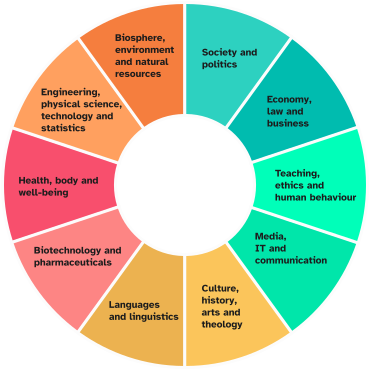
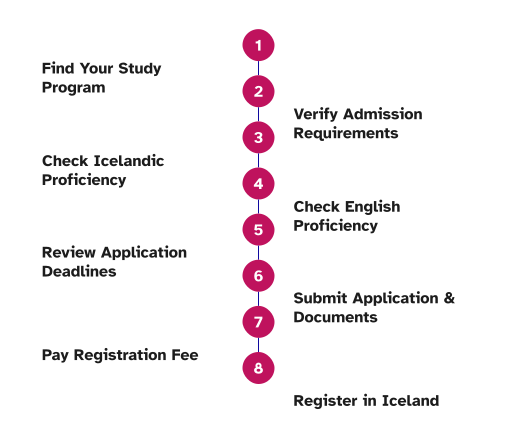
Additional information

The University of Iceland collaborates with over 400 universities all over the world. This means UI students have unique opportunities to take part of their programme at a university abroad, acquire international experience and carve out a niche for themselves.

UI students are generally able to take exchange studies, traineeships or summer courses. Study abroad must, however, always be approved by the faculty.

Students can transfer credits completed abroad to their programme at UI, meaning that going on exchange does not extend the duration of the programme.

Good sign language interpreters improve quality of life and are invaluable to the people who rely on them.

People with a knowledge of sign language interpreting work in a wide range of settings, including:

  • Civil protection authorities
  • The police
  • Healthcare institutions
  • Diagnostic centres
  • As freelance sign language interpreters
  • Preschools and compulsory schools

This list is not exhaustive.

The organisation for students in sign language studies is called Hending

Members elect students to represent the subject on various committees.

Students' comments
Portrait photo of Tinna Hrönn Óskarsdóttir
After a brief introduction to sign language in high school, I pursued it further. The programme is challenging and enjoyable, offering insight into a minority language. The excellent teachers help students master the language.
Portrait photo of Eva Engilráð Thoroddsen
I initially aimed to become a sign language interpreter, but I later became a speech therapist. My background in sign language has been invaluable, providing a unique advantage in my field.
Helpful content
Aurora Cooperation

Study wheel

What interests you?

Aurora Cooperation

How to apply

Follow the path

Contact us

If you still have questions, feel free to contact us.

School of Humanities
Weekdays: 10-12 am and 1-3 pm
General Service and Social Media

The Service Desk is a point of access for all services. You can drop in at the University Centre or use the WebChat at the bottom right of this page.

Follow the School of Humanities on Instagram,   Youtube
and Facebook

""

Share

Did this help?

Why wasn't this information helpful

Limit to 250 characters.