
Language skills
Programme length
1 years.
Study mode
Face-to-face learning
Application status
International students:
Students with Icelandic or Nordic citizenship:
- Are you interested in multiculturalism?
- Do you want to help people adapt to Icelandic society?
- Are you interested in the cultures and traditions of people from different backgrounds?
- Do you enjoy working with people?
- Are you proficient in at least one foreign language?
- Do you want to open up future opportunities in challenging careers?
The diploma in public service interpreting is designed first and foremost for current and future interpreters working with languages not taught at the University of Iceland. The programme is at the undergraduate level and can be taken independently or to complement other studies.
The programme is taught every two years and can be completed in two academic years, making it suitable for employed students who want to improve their professional knowledge.
Course topics include:
- Interpreting studies
- Ethics
- Translation
Programme structure
Just over half of the programme (35 ECTS) is made up of academic courses in which students improve their theoretical knowledge of interpreting, translation, culture and languages and learn to apply that knowledge in real-world situations.
The rest of the programme (25 ECTS) comprises training in interpreting and spoken communication. Students work in groups based on the languages they work with. Practical training is therefore a major component.
Objective and prerequisites
The objective of this programme is to train foreign nationals who have achieved a good level of Icelandic and are sufficiently familiar with Icelandic society and infrastructure to share this knowledge with other speakers of their first language and handle communications with Icelandic speakers as required. This has become an extremely urgent project due to the numbers of foreign nationals living in Iceland, as well as the visitors who now considerably outnumber the resident population.
To be admitted to the programme, you must have passed the equivalent of the Icelandic matriculation exam or have considerable experience of providing interpreting services in Iceland. You must have good Icelandic skills and also be highly proficient in your first language.
Study programmes
Public service interpreting is a 60 ECTS undergraduate programme aimed at training students to interpret between Icelandic and a foreign language.
- Students can take public service interpreting as a minor with a major in another subject, or as a diploma.
Experience of public service interpreting is an advantage. Students can complete the programme in one academic year or two. The programme will only run if enough people apply.
To be admitted to the programme, you must have passed the equivalent of the Icelandic matriculation exam or have considerable experience in providing interpreting services in Iceland. You must have good Icelandic skills and also be highly proficient in your first language.
Icelandic matriculation examination (stúdentspróf) or equivalent qualification. Further information can be found in article 17, regulation on admission requirements for undergraduate study no. 331/2022. Students must have Icelandic as a native language and high proficiency in a foreign language or another native language and high proficiency in Icelandic. It is important that students be able to write papers and pass examinations in Icelandic, as well as reading English at an academic level. If necessary, applicants will be asked to do an interview or oral/written evaluation of their language proficiency and intended ability to work as an interpreter. Experience of public service interpreting is also desirable, but not required.
Applicants with qualifications from a school abroad who plan to enrol in an undergraduate programme taught in Icelandic at the Faculty of Icelandic and Comparative Cultural Studies must also pass a special entrance exam in Icelandic, in accordance with Article 1.
Students can complete the programme in two years; however, the programme is offered subject to sufficient student enrolment. Some of the courses are shared with study programmes in Sign language interpreting or Icelandic as a second language. Sign language interpreting courses are not taught annually, which may affect course availability.
Programme structure
Check below to see how the programme is structured.
This programme does not offer specialisations.
- First year
- Fall
- Community Interpreting I
- Not taught this semesterSpoken Icelandic and Diction
- Spring 1
- Language in the Media
- Community Interpreting II
First year | Fall
Community Interpreting I (TÁK006G)
A mandatory (required) course for the programme
10 ECTS, credits
Course Description
Aim: For students to become acquainted with the profession of public service interpreting.
Course subject: The course covers the fundamental aspects of public service interpreting from various perspectives and through a range of methods. Students learn and practise consecutive interpreting under teacher supervision. An introduction into non-literary translation studies will be given, students will work with textual analysis, meaning transfer and the creation of shared understanding. Interpreting- and note-taking techniques will be introduced, as well as interpreter ethics, professional presentation and conduct. Further subjects are interpreter rights and responsibilities, administrative procedures, and the basics of freelance work and one-person operations.
Methods: The teaching format is diverse: consisting of theoretical readings, classroom lectures and recorded lectures, as well as discussions in class and in online meetings based on lecture content. Students complete individual and group assignments, practise interpreting, and work independently, including with recordings. Students initiate work on a portfolio that provides an overview of their activities throughout their studies. Emphasis is placed on collaboration, independent work habits, flexibility and adaptability, self‑assessment, and reflection on one’s own practice, as well as the skill of providing and receiving criticism, feedback, and peer assessment. Students are expected to arrive prepared for class in order to participate actively in practical exercises and discussions. Independent home study is an essential component of the course and includes structured, self‑directed interpreting exercises and systematic efforts to improve one’s interpreting skills.
Assessment: Continuous assessment through smaller assignments throughout the semester. A final project requires students to submit a recording of their interpretation of a dialogue or dialogues, accompanied by a report. A minimum attendance of 80% is required in order to be eligible for the final examination. All assessment components must be passed to complete the course.
Language of instruction: Icelandic
Face-to-face learning
Prerequisites
Attendance required in class
Not taught this semester
First year | Fall
Spoken Icelandic and Diction (TÁK503G)
A mandatory (required) course for the programme
5 ECTS, credits
Course Description
Aim: Students to be competent in communicating in good spoken Icelandic. Students practice how to speak (as in voice interpreting) in formal and informal settings with emphasis on the use of the voice, correct language, rich vocabulary etc.
Lectures, assignments in class and practice. 80% attendance in the course is obligatory.
80% attendance in the course is obligatory.
Language of instruction: Icelandic
Face-to-face learning
Attendance required in class
First year | Spring 1
Language in the Media (ÍSE601G)
A mandatory (required) course for the programme
5 ECTS, credits
Course Description
This course provides an in-depth examination of Icelandic language policy and linguistic usage in the media, particularly in newspapers but also in broadcast media. Various types of newspaper articles will be analyzed, including editorials, columns, obituaries, and news reports, with a special focus on elements that often pose challenges for second-language learners, such as idiomatic expressions and cultural references. Additional topics include different registers of language, distinctions between spoken and written language, text composition and translation in television, word renewal, headlines, and the influence of English in the media.
Language of instruction: Icelandic
Face-to-face learning
Distance learning
Prerequisites
First year | Spring 1
Community Interpreting II (TÁK007G)
A mandatory (required) course for the programme
10 ECTS, credits
Course Description
Aim: For students to become acquainted with the profession of public service interpreting, with particular emphasis on interpreting within social services and the education system.
Course subject: This course builds on a foundation laid in the course TÁK006G.
The study of public service interpreting continues, various perspectives and a range of methods. Students learn and practise consecutive interpreting under teacher supervision, specifically within the fields of social services and the education system. The course examines the interpreter’s position in interpreting situations and introduces processes for interpreter decision‑making and intervention.
Further attention is given to interpreting techniques and note‑taking, and preparation for interpreting assignments, including vocabulary work.
Preventive resources for self‑care and strategies for processing after demanding assignments are introduced.
Teaching Methods
The teaching format is diverse: consisting of theoretical readings, classroom lectures and recorded lectures, as well as discussions in class and in online meetings based on lecture content. Students complete individual and group assignments, practise interpreting, and work independently, including with recordings. Guest speakers will be invited to class, and field visits will be organised. Students continue working with a portfolio that provides an overview of their activities throughout their studies.
Emphasis is placed on collaboration, independent work habits, flexibility and adaptability, self‑assessment, and reflection on one’s own practice, as well as the skill of providing and receiving criticism, feedback, and peer assessment. Students are expected to arrive prepared for class in order to participate actively in practical exercises and discussions. Independent home study is an essential component of the course and includes structured, self‑directed interpreting exercises and systematic efforts to improve one’s interpreting skills.
Assessment: Continuous assessment through smaller assignments throughout the semester. A final project requires students to submit a recording of their interpretation of a dialogue or dialogues within the course’s discourse domains, accompanied by a report. A minimum attendance of 80% is required in order to be eligible for the final examination. All assessment components must be passed to complete the course.
Language of instruction: Icelandic
Face-to-face learning
Attendance required in class
- Second year
- Fall
- Public Service Interpreting III
- Not taught this semesterTheories of Interpreting
- Spring 1
- Public Service Interpreting IV
- Not taught this semesterEthics of Interpretation
Second year | Fall
Public Service Interpreting III (TÁK008G)
A mandatory (required) course for the programme
10 ECTS, credits
Course Description
Mode of study: The course is conducted on-campus, alternating between in‑person classroom/field-based sessions, and real‑time participation in online meetings in between.
Aim: For students to become acquainted with the profession of public service interpreting, with particular emphasis on interpreting in healthcare, the labour market, and religious settings.
Course subject: This course builds on a foundation laid in the courses TÁK006G and TÁK007G. The study of public service interpreting continues, various perspectives and a range of methods. Students learn and practise consecutive interpreting under teacher supervision, including in healthcare contexts and in relation to the labour market and religious life. The course covers different interpreting modes, such as remote interpreting and sight translation. Further attention is given to interpreting techniques and note‑taking, including collaboration with teams of professionals. The role of the interpreter is examined with regard to cultural mediation, cultural sensitivity, communication skills, and lifelong learning of the working languages.
Methods: The teaching format is diverse: consisting of theoretical readings, classroom lectures and recorded lectures, as well as discussions in class and in online meetings based on lecture content. Students complete individual and group assignments, practise interpreting, and work independently, including with recordings. Guest speakers will be invited to class, and field visits will be organised. Students continue working with a portfolio that provides an overview of their activities throughout their studies. Emphasis is placed on collaboration, independent work habits, flexibility and adaptability, self‑assessment, and reflection on one’s own practice, as well as the skill of providing and receiving criticism, feedback, and peer assessment. Students are expected to arrive prepared for class in order to participate actively in practical exercises and discussions. Independent home study is an essential component of the course and includes structured, self‑directed interpreting exercises and systematic efforts to improve one’s interpreting skills.
Assessment: Continuous assessment through smaller assignments throughout the semester. At the end of the course, an oral final examination is held in the presence of external examiners. The student must demonstrate the ability to consecutively interpret between Icelandic and a foreign language one or two dialogues of 5–10 minutes between a specialist/service provider and an immigrant/service user, either a conversation on a general topic or in the specific discourse contexts covered in the course. The interpretation of all examination tasks must convey all main points of the conversation and the main relevant secondary information. A minimum attendance of 80% is required in order to be eligible for the final examination. All assessment components must be passed to complete the course.
Language of instruction: Icelandic
Face-to-face learning
Not taught this semester
Second year | Fall
Theories of Interpreting (TÁK501G)
A mandatory (required) course for the programme
5 ECTS, credits
Course Description
Aim: That students learn the basics in interpreting theories and theories on the role of the interpreter
Course subject: Theories of the process of interpretation and different theories about the role of the interpreter will be discussed. Cultural and linguistic problems that occur in interpreting situations will be discussed as well as the role of the interpreter as connecting two different cultures. Different areas in interpreting and different situations will be analysed as well as conflicts of interest.
Methods: Lectures by the teacher but students are supposed to be active in discussions. There will be assignments during the semester, both group assignments and individual.
Assessment: Written exam and a project.
Litterature: To be announced
Language of instruction: Icelandic
Face-to-face learning
Course taught first half of the semester
Second year | Spring 1
Public Service Interpreting IV (TÁK009G)
A mandatory (required) course for the programme
10 ECTS, credits
Course Description
Mode of study: The course is conducted on-campus, alternating between in‑person classroom/field-based sessions, and real‑time participation in online meetings in between.
Aim: For students to become acquainted with the profession of public service interpreting, with particular emphasis on interpreting in the justice system, at borders, and in reception services for immigrants.
Course subject: This course builds on a foundation laid in the courses TÁK006G, TÁK007G, and TÁK008G. The study of public service interpreting continues, various perspectives and a range of methods. Students learn and practise consecutive interpreting under teacher supervision, including interpreting in the justice system, at borders, and in reception services for immigrants. Note that the course does not confer authorisation as a court interpreter. The course covers different interpreting modes, such as chuchotage and simultaneous interpreting. Further attention is given to interpreting techniques and note‑taking, including collaboration between interpreters. A review and summary of the entire material since students began their studies of public service interpreting, as well as a reflection on future developments within the profession.
Methods: The teaching format is diverse: consisting of theoretical readings, classroom lectures and recorded lectures, as well as discussions in class and in online meetings based on lecture content. Students complete individual and group assignments, practise interpreting, and work independently, including with recordings. Guest speakers will be invited to class, field visits will be organised, and students will observe interpreters at work. It is essential that students ensure they have the flexibility to attend practical field training sessions outside the regular timetable. Students complete working with their portfolio that provides an overview of their activities since beginning their studies. Emphasis is placed on collaboration, independent work habits, flexibility and adaptability, self‑assessment, and reflection on one’s own practice, as well as the skill of providing and receiving criticism, feedback, and peer assessment. Students are expected to arrive prepared for class in order to participate actively in practical exercises and discussions. Independent home study is an essential component of the course and includes structured, self‑directed interpreting exercises and systematic efforts to improve one’s interpreting skills.
Assessment: Continuous assessment through smaller assignments throughout the semester. At the end of the course, an oral final examination is held in the presence of external examiners. The student must demonstrate the ability to consecutively interpret between Icelandic and a foreign language one or two dialogues of 5–10 minutes between a specialist/service provider and an immigrant/service user, either a conversation on a general topic or in the specific discourse contexts covered in the course. With effective note‑taking, the student is expected to manage segments of up to 5–8 sentences at a time. Furthermore, the student must demonstrate proficiency in sight interpreting and be able to perform whispered interpreting or simultaneous interpreting into their mother tongue of a continuous speech, in a specified discourse domain, of up to 5 minutes in length. The interpretation of all examination tasks must convey all main points of the conversation/speech and the main relevant secondary information. A minimum attendance of 80% is required in order to be eligible for the final examination. All assessment components must be passed to complete the course.
Language of instruction: Icelandic
Face-to-face learning
Not taught this semester
Second year | Spring 1
Ethics of Interpretation (TÁK601G)
A mandatory (required) course for the programme
5 ECTS, credits
Course Description
The aim of this course is to increase the student's ability to deal in a thoughtful manner with ethical problems related to professionalism and the role of the interpretor. Main theories in ethics will be introduced. Important ethical concepts like Justice, Human rights, Autonomy and Welfare will be studied along with professionalism and privacy. Special emphasise is placed on getting aqainted with the ideology of the interpretor and how to respond to ethical problems in their work. In class there will be both lectures and discussions.
Language of instruction: Icelandic
Face-to-face learning
- Year unspecified
- Fall
- Translation
- Spring 1
- Translation criticism and translation technology
Year unspecified | Fall
Translation (ÍSE502G)
Free elective course within the programme
10 ECTS, credits
Course Description
The course in an introduction to translation, the history of translation and translation theory. Students will become acquainted with the main concepts and theories in the field. The basics of interpretation will also be dealt with. The course consists of two parts: The theoretical and historical part is in the form of lectures and discussions. The teacher also provides a reading list. Assessment is in the form of an exam or an essay, based on the reading material. The practical part is based on seminars where students gain practice in translating (both literary translation and applied translation) as well as translation criticism. Assessment is based on written assignment(s). Students of Icelandic as a Second Language must have completed all courses of the first and second year.
Language of instruction: Icelandic
Face-to-face learning
Prerequisites
Year unspecified | Spring 1
Translation criticism and translation technology (ÞÝÐ201G)
Free elective course within the programme
10 ECTS, credits
Course Description
Most common methods and aids in translation will be covered in this course. Students will gain insight into the translators work and gain practise in translation. They learn how to analyze texts before translating them.
Language of instruction: Icelandic
Face-to-face learning
First year
- Fall
- TÁK006GCommunity Interpreting IMandatory (required) course10A mandatory (required) course for the programme10 ECTS, creditsCourse Description
Aim: For students to become acquainted with the profession of public service interpreting.
Course subject: The course covers the fundamental aspects of public service interpreting from various perspectives and through a range of methods. Students learn and practise consecutive interpreting under teacher supervision. An introduction into non-literary translation studies will be given, students will work with textual analysis, meaning transfer and the creation of shared understanding. Interpreting- and note-taking techniques will be introduced, as well as interpreter ethics, professional presentation and conduct. Further subjects are interpreter rights and responsibilities, administrative procedures, and the basics of freelance work and one-person operations.
Methods: The teaching format is diverse: consisting of theoretical readings, classroom lectures and recorded lectures, as well as discussions in class and in online meetings based on lecture content. Students complete individual and group assignments, practise interpreting, and work independently, including with recordings. Students initiate work on a portfolio that provides an overview of their activities throughout their studies. Emphasis is placed on collaboration, independent work habits, flexibility and adaptability, self‑assessment, and reflection on one’s own practice, as well as the skill of providing and receiving criticism, feedback, and peer assessment. Students are expected to arrive prepared for class in order to participate actively in practical exercises and discussions. Independent home study is an essential component of the course and includes structured, self‑directed interpreting exercises and systematic efforts to improve one’s interpreting skills.
Assessment: Continuous assessment through smaller assignments throughout the semester. A final project requires students to submit a recording of their interpretation of a dialogue or dialogues, accompanied by a report. A minimum attendance of 80% is required in order to be eligible for the final examination. All assessment components must be passed to complete the course.
Face-to-face learningPrerequisitesAttendance required in classNot taught this semesterTÁK503GSpoken Icelandic and DictionMandatory (required) course5A mandatory (required) course for the programme5 ECTS, creditsCourse DescriptionAim: Students to be competent in communicating in good spoken Icelandic. Students practice how to speak (as in voice interpreting) in formal and informal settings with emphasis on the use of the voice, correct language, rich vocabulary etc.
Lectures, assignments in class and practice. 80% attendance in the course is obligatory.80% attendance in the course is obligatory.
Face-to-face learningPrerequisitesAttendance required in class- Spring 2
ÍSE601GLanguage in the MediaMandatory (required) course5A mandatory (required) course for the programme5 ECTS, creditsCourse DescriptionThis course provides an in-depth examination of Icelandic language policy and linguistic usage in the media, particularly in newspapers but also in broadcast media. Various types of newspaper articles will be analyzed, including editorials, columns, obituaries, and news reports, with a special focus on elements that often pose challenges for second-language learners, such as idiomatic expressions and cultural references. Additional topics include different registers of language, distinctions between spoken and written language, text composition and translation in television, word renewal, headlines, and the influence of English in the media.
Face-to-face learningDistance learningPrerequisitesTÁK007GCommunity Interpreting IIMandatory (required) course10A mandatory (required) course for the programme10 ECTS, creditsCourse DescriptionAim: For students to become acquainted with the profession of public service interpreting, with particular emphasis on interpreting within social services and the education system.
Course subject: This course builds on a foundation laid in the course TÁK006G.
The study of public service interpreting continues, various perspectives and a range of methods. Students learn and practise consecutive interpreting under teacher supervision, specifically within the fields of social services and the education system. The course examines the interpreter’s position in interpreting situations and introduces processes for interpreter decision‑making and intervention.
Further attention is given to interpreting techniques and note‑taking, and preparation for interpreting assignments, including vocabulary work.
Preventive resources for self‑care and strategies for processing after demanding assignments are introduced.
Teaching Methods
The teaching format is diverse: consisting of theoretical readings, classroom lectures and recorded lectures, as well as discussions in class and in online meetings based on lecture content. Students complete individual and group assignments, practise interpreting, and work independently, including with recordings. Guest speakers will be invited to class, and field visits will be organised. Students continue working with a portfolio that provides an overview of their activities throughout their studies.
Emphasis is placed on collaboration, independent work habits, flexibility and adaptability, self‑assessment, and reflection on one’s own practice, as well as the skill of providing and receiving criticism, feedback, and peer assessment. Students are expected to arrive prepared for class in order to participate actively in practical exercises and discussions. Independent home study is an essential component of the course and includes structured, self‑directed interpreting exercises and systematic efforts to improve one’s interpreting skills.
Assessment: Continuous assessment through smaller assignments throughout the semester. A final project requires students to submit a recording of their interpretation of a dialogue or dialogues within the course’s discourse domains, accompanied by a report. A minimum attendance of 80% is required in order to be eligible for the final examination. All assessment components must be passed to complete the course.
Face-to-face learningPrerequisitesAttendance required in class- Fall
- TÁK008GPublic Service Interpreting IIIMandatory (required) course10A mandatory (required) course for the programme10 ECTS, creditsCourse Description
Mode of study: The course is conducted on-campus, alternating between in‑person classroom/field-based sessions, and real‑time participation in online meetings in between.
Aim: For students to become acquainted with the profession of public service interpreting, with particular emphasis on interpreting in healthcare, the labour market, and religious settings.
Course subject: This course builds on a foundation laid in the courses TÁK006G and TÁK007G. The study of public service interpreting continues, various perspectives and a range of methods. Students learn and practise consecutive interpreting under teacher supervision, including in healthcare contexts and in relation to the labour market and religious life. The course covers different interpreting modes, such as remote interpreting and sight translation. Further attention is given to interpreting techniques and note‑taking, including collaboration with teams of professionals. The role of the interpreter is examined with regard to cultural mediation, cultural sensitivity, communication skills, and lifelong learning of the working languages.
Methods: The teaching format is diverse: consisting of theoretical readings, classroom lectures and recorded lectures, as well as discussions in class and in online meetings based on lecture content. Students complete individual and group assignments, practise interpreting, and work independently, including with recordings. Guest speakers will be invited to class, and field visits will be organised. Students continue working with a portfolio that provides an overview of their activities throughout their studies. Emphasis is placed on collaboration, independent work habits, flexibility and adaptability, self‑assessment, and reflection on one’s own practice, as well as the skill of providing and receiving criticism, feedback, and peer assessment. Students are expected to arrive prepared for class in order to participate actively in practical exercises and discussions. Independent home study is an essential component of the course and includes structured, self‑directed interpreting exercises and systematic efforts to improve one’s interpreting skills.
Assessment: Continuous assessment through smaller assignments throughout the semester. At the end of the course, an oral final examination is held in the presence of external examiners. The student must demonstrate the ability to consecutively interpret between Icelandic and a foreign language one or two dialogues of 5–10 minutes between a specialist/service provider and an immigrant/service user, either a conversation on a general topic or in the specific discourse contexts covered in the course. The interpretation of all examination tasks must convey all main points of the conversation and the main relevant secondary information. A minimum attendance of 80% is required in order to be eligible for the final examination. All assessment components must be passed to complete the course.Face-to-face learningPrerequisitesNot taught this semesterTÁK501GTheories of InterpretingMandatory (required) course5A mandatory (required) course for the programme5 ECTS, creditsCourse DescriptionAim: That students learn the basics in interpreting theories and theories on the role of the interpreter
Course subject: Theories of the process of interpretation and different theories about the role of the interpreter will be discussed. Cultural and linguistic problems that occur in interpreting situations will be discussed as well as the role of the interpreter as connecting two different cultures. Different areas in interpreting and different situations will be analysed as well as conflicts of interest.
Methods: Lectures by the teacher but students are supposed to be active in discussions. There will be assignments during the semester, both group assignments and individual.
Assessment: Written exam and a project.
Litterature: To be announced
Face-to-face learningPrerequisitesCourse taught first half of the semester- Spring 2
TÁK009GPublic Service Interpreting IVMandatory (required) course10A mandatory (required) course for the programme10 ECTS, creditsCourse DescriptionMode of study: The course is conducted on-campus, alternating between in‑person classroom/field-based sessions, and real‑time participation in online meetings in between.
Aim: For students to become acquainted with the profession of public service interpreting, with particular emphasis on interpreting in the justice system, at borders, and in reception services for immigrants.
Course subject: This course builds on a foundation laid in the courses TÁK006G, TÁK007G, and TÁK008G. The study of public service interpreting continues, various perspectives and a range of methods. Students learn and practise consecutive interpreting under teacher supervision, including interpreting in the justice system, at borders, and in reception services for immigrants. Note that the course does not confer authorisation as a court interpreter. The course covers different interpreting modes, such as chuchotage and simultaneous interpreting. Further attention is given to interpreting techniques and note‑taking, including collaboration between interpreters. A review and summary of the entire material since students began their studies of public service interpreting, as well as a reflection on future developments within the profession.
Methods: The teaching format is diverse: consisting of theoretical readings, classroom lectures and recorded lectures, as well as discussions in class and in online meetings based on lecture content. Students complete individual and group assignments, practise interpreting, and work independently, including with recordings. Guest speakers will be invited to class, field visits will be organised, and students will observe interpreters at work. It is essential that students ensure they have the flexibility to attend practical field training sessions outside the regular timetable. Students complete working with their portfolio that provides an overview of their activities since beginning their studies. Emphasis is placed on collaboration, independent work habits, flexibility and adaptability, self‑assessment, and reflection on one’s own practice, as well as the skill of providing and receiving criticism, feedback, and peer assessment. Students are expected to arrive prepared for class in order to participate actively in practical exercises and discussions. Independent home study is an essential component of the course and includes structured, self‑directed interpreting exercises and systematic efforts to improve one’s interpreting skills.
Assessment: Continuous assessment through smaller assignments throughout the semester. At the end of the course, an oral final examination is held in the presence of external examiners. The student must demonstrate the ability to consecutively interpret between Icelandic and a foreign language one or two dialogues of 5–10 minutes between a specialist/service provider and an immigrant/service user, either a conversation on a general topic or in the specific discourse contexts covered in the course. With effective note‑taking, the student is expected to manage segments of up to 5–8 sentences at a time. Furthermore, the student must demonstrate proficiency in sight interpreting and be able to perform whispered interpreting or simultaneous interpreting into their mother tongue of a continuous speech, in a specified discourse domain, of up to 5 minutes in length. The interpretation of all examination tasks must convey all main points of the conversation/speech and the main relevant secondary information. A minimum attendance of 80% is required in order to be eligible for the final examination. All assessment components must be passed to complete the course.Face-to-face learningPrerequisitesNot taught this semesterTÁK601GEthics of InterpretationMandatory (required) course5A mandatory (required) course for the programme5 ECTS, creditsCourse DescriptionThe aim of this course is to increase the student's ability to deal in a thoughtful manner with ethical problems related to professionalism and the role of the interpretor. Main theories in ethics will be introduced. Important ethical concepts like Justice, Human rights, Autonomy and Welfare will be studied along with professionalism and privacy. Special emphasise is placed on getting aqainted with the ideology of the interpretor and how to respond to ethical problems in their work. In class there will be both lectures and discussions.
Face-to-face learningPrerequisites- Fall
- Course Description
The course in an introduction to translation, the history of translation and translation theory. Students will become acquainted with the main concepts and theories in the field. The basics of interpretation will also be dealt with. The course consists of two parts: The theoretical and historical part is in the form of lectures and discussions. The teacher also provides a reading list. Assessment is in the form of an exam or an essay, based on the reading material. The practical part is based on seminars where students gain practice in translating (both literary translation and applied translation) as well as translation criticism. Assessment is based on written assignment(s). Students of Icelandic as a Second Language must have completed all courses of the first and second year.
Face-to-face learningPrerequisites- Spring 2
ÞÝÐ201GTranslation criticism and translation technologyElective course10Free elective course within the programme10 ECTS, creditsCourse DescriptionMost common methods and aids in translation will be covered in this course. Students will gain insight into the translators work and gain practise in translation. They learn how to analyze texts before translating them.
Face-to-face learningPrerequisites
Second year- Fall
- TÁK006GCommunity Interpreting IMandatory (required) course10A mandatory (required) course for the programme10 ECTS, creditsCourse Description
Aim: For students to become acquainted with the profession of public service interpreting.
Course subject: The course covers the fundamental aspects of public service interpreting from various perspectives and through a range of methods. Students learn and practise consecutive interpreting under teacher supervision. An introduction into non-literary translation studies will be given, students will work with textual analysis, meaning transfer and the creation of shared understanding. Interpreting- and note-taking techniques will be introduced, as well as interpreter ethics, professional presentation and conduct. Further subjects are interpreter rights and responsibilities, administrative procedures, and the basics of freelance work and one-person operations.
Methods: The teaching format is diverse: consisting of theoretical readings, classroom lectures and recorded lectures, as well as discussions in class and in online meetings based on lecture content. Students complete individual and group assignments, practise interpreting, and work independently, including with recordings. Students initiate work on a portfolio that provides an overview of their activities throughout their studies. Emphasis is placed on collaboration, independent work habits, flexibility and adaptability, self‑assessment, and reflection on one’s own practice, as well as the skill of providing and receiving criticism, feedback, and peer assessment. Students are expected to arrive prepared for class in order to participate actively in practical exercises and discussions. Independent home study is an essential component of the course and includes structured, self‑directed interpreting exercises and systematic efforts to improve one’s interpreting skills.
Assessment: Continuous assessment through smaller assignments throughout the semester. A final project requires students to submit a recording of their interpretation of a dialogue or dialogues, accompanied by a report. A minimum attendance of 80% is required in order to be eligible for the final examination. All assessment components must be passed to complete the course.
Face-to-face learningPrerequisitesAttendance required in classNot taught this semesterTÁK503GSpoken Icelandic and DictionMandatory (required) course5A mandatory (required) course for the programme5 ECTS, creditsCourse DescriptionAim: Students to be competent in communicating in good spoken Icelandic. Students practice how to speak (as in voice interpreting) in formal and informal settings with emphasis on the use of the voice, correct language, rich vocabulary etc.
Lectures, assignments in class and practice. 80% attendance in the course is obligatory.80% attendance in the course is obligatory.
Face-to-face learningPrerequisitesAttendance required in class- Spring 2
ÍSE601GLanguage in the MediaMandatory (required) course5A mandatory (required) course for the programme5 ECTS, creditsCourse DescriptionThis course provides an in-depth examination of Icelandic language policy and linguistic usage in the media, particularly in newspapers but also in broadcast media. Various types of newspaper articles will be analyzed, including editorials, columns, obituaries, and news reports, with a special focus on elements that often pose challenges for second-language learners, such as idiomatic expressions and cultural references. Additional topics include different registers of language, distinctions between spoken and written language, text composition and translation in television, word renewal, headlines, and the influence of English in the media.
Face-to-face learningDistance learningPrerequisitesTÁK007GCommunity Interpreting IIMandatory (required) course10A mandatory (required) course for the programme10 ECTS, creditsCourse DescriptionAim: For students to become acquainted with the profession of public service interpreting, with particular emphasis on interpreting within social services and the education system.
Course subject: This course builds on a foundation laid in the course TÁK006G.
The study of public service interpreting continues, various perspectives and a range of methods. Students learn and practise consecutive interpreting under teacher supervision, specifically within the fields of social services and the education system. The course examines the interpreter’s position in interpreting situations and introduces processes for interpreter decision‑making and intervention.
Further attention is given to interpreting techniques and note‑taking, and preparation for interpreting assignments, including vocabulary work.
Preventive resources for self‑care and strategies for processing after demanding assignments are introduced.
Teaching Methods
The teaching format is diverse: consisting of theoretical readings, classroom lectures and recorded lectures, as well as discussions in class and in online meetings based on lecture content. Students complete individual and group assignments, practise interpreting, and work independently, including with recordings. Guest speakers will be invited to class, and field visits will be organised. Students continue working with a portfolio that provides an overview of their activities throughout their studies.
Emphasis is placed on collaboration, independent work habits, flexibility and adaptability, self‑assessment, and reflection on one’s own practice, as well as the skill of providing and receiving criticism, feedback, and peer assessment. Students are expected to arrive prepared for class in order to participate actively in practical exercises and discussions. Independent home study is an essential component of the course and includes structured, self‑directed interpreting exercises and systematic efforts to improve one’s interpreting skills.
Assessment: Continuous assessment through smaller assignments throughout the semester. A final project requires students to submit a recording of their interpretation of a dialogue or dialogues within the course’s discourse domains, accompanied by a report. A minimum attendance of 80% is required in order to be eligible for the final examination. All assessment components must be passed to complete the course.
Face-to-face learningPrerequisitesAttendance required in class- Fall
- TÁK008GPublic Service Interpreting IIIMandatory (required) course10A mandatory (required) course for the programme10 ECTS, creditsCourse Description
Mode of study: The course is conducted on-campus, alternating between in‑person classroom/field-based sessions, and real‑time participation in online meetings in between.
Aim: For students to become acquainted with the profession of public service interpreting, with particular emphasis on interpreting in healthcare, the labour market, and religious settings.
Course subject: This course builds on a foundation laid in the courses TÁK006G and TÁK007G. The study of public service interpreting continues, various perspectives and a range of methods. Students learn and practise consecutive interpreting under teacher supervision, including in healthcare contexts and in relation to the labour market and religious life. The course covers different interpreting modes, such as remote interpreting and sight translation. Further attention is given to interpreting techniques and note‑taking, including collaboration with teams of professionals. The role of the interpreter is examined with regard to cultural mediation, cultural sensitivity, communication skills, and lifelong learning of the working languages.
Methods: The teaching format is diverse: consisting of theoretical readings, classroom lectures and recorded lectures, as well as discussions in class and in online meetings based on lecture content. Students complete individual and group assignments, practise interpreting, and work independently, including with recordings. Guest speakers will be invited to class, and field visits will be organised. Students continue working with a portfolio that provides an overview of their activities throughout their studies. Emphasis is placed on collaboration, independent work habits, flexibility and adaptability, self‑assessment, and reflection on one’s own practice, as well as the skill of providing and receiving criticism, feedback, and peer assessment. Students are expected to arrive prepared for class in order to participate actively in practical exercises and discussions. Independent home study is an essential component of the course and includes structured, self‑directed interpreting exercises and systematic efforts to improve one’s interpreting skills.
Assessment: Continuous assessment through smaller assignments throughout the semester. At the end of the course, an oral final examination is held in the presence of external examiners. The student must demonstrate the ability to consecutively interpret between Icelandic and a foreign language one or two dialogues of 5–10 minutes between a specialist/service provider and an immigrant/service user, either a conversation on a general topic or in the specific discourse contexts covered in the course. The interpretation of all examination tasks must convey all main points of the conversation and the main relevant secondary information. A minimum attendance of 80% is required in order to be eligible for the final examination. All assessment components must be passed to complete the course.Face-to-face learningPrerequisitesNot taught this semesterTÁK501GTheories of InterpretingMandatory (required) course5A mandatory (required) course for the programme5 ECTS, creditsCourse DescriptionAim: That students learn the basics in interpreting theories and theories on the role of the interpreter
Course subject: Theories of the process of interpretation and different theories about the role of the interpreter will be discussed. Cultural and linguistic problems that occur in interpreting situations will be discussed as well as the role of the interpreter as connecting two different cultures. Different areas in interpreting and different situations will be analysed as well as conflicts of interest.
Methods: Lectures by the teacher but students are supposed to be active in discussions. There will be assignments during the semester, both group assignments and individual.
Assessment: Written exam and a project.
Litterature: To be announced
Face-to-face learningPrerequisitesCourse taught first half of the semester- Spring 2
TÁK009GPublic Service Interpreting IVMandatory (required) course10A mandatory (required) course for the programme10 ECTS, creditsCourse DescriptionMode of study: The course is conducted on-campus, alternating between in‑person classroom/field-based sessions, and real‑time participation in online meetings in between.
Aim: For students to become acquainted with the profession of public service interpreting, with particular emphasis on interpreting in the justice system, at borders, and in reception services for immigrants.
Course subject: This course builds on a foundation laid in the courses TÁK006G, TÁK007G, and TÁK008G. The study of public service interpreting continues, various perspectives and a range of methods. Students learn and practise consecutive interpreting under teacher supervision, including interpreting in the justice system, at borders, and in reception services for immigrants. Note that the course does not confer authorisation as a court interpreter. The course covers different interpreting modes, such as chuchotage and simultaneous interpreting. Further attention is given to interpreting techniques and note‑taking, including collaboration between interpreters. A review and summary of the entire material since students began their studies of public service interpreting, as well as a reflection on future developments within the profession.
Methods: The teaching format is diverse: consisting of theoretical readings, classroom lectures and recorded lectures, as well as discussions in class and in online meetings based on lecture content. Students complete individual and group assignments, practise interpreting, and work independently, including with recordings. Guest speakers will be invited to class, field visits will be organised, and students will observe interpreters at work. It is essential that students ensure they have the flexibility to attend practical field training sessions outside the regular timetable. Students complete working with their portfolio that provides an overview of their activities since beginning their studies. Emphasis is placed on collaboration, independent work habits, flexibility and adaptability, self‑assessment, and reflection on one’s own practice, as well as the skill of providing and receiving criticism, feedback, and peer assessment. Students are expected to arrive prepared for class in order to participate actively in practical exercises and discussions. Independent home study is an essential component of the course and includes structured, self‑directed interpreting exercises and systematic efforts to improve one’s interpreting skills.
Assessment: Continuous assessment through smaller assignments throughout the semester. At the end of the course, an oral final examination is held in the presence of external examiners. The student must demonstrate the ability to consecutively interpret between Icelandic and a foreign language one or two dialogues of 5–10 minutes between a specialist/service provider and an immigrant/service user, either a conversation on a general topic or in the specific discourse contexts covered in the course. With effective note‑taking, the student is expected to manage segments of up to 5–8 sentences at a time. Furthermore, the student must demonstrate proficiency in sight interpreting and be able to perform whispered interpreting or simultaneous interpreting into their mother tongue of a continuous speech, in a specified discourse domain, of up to 5 minutes in length. The interpretation of all examination tasks must convey all main points of the conversation/speech and the main relevant secondary information. A minimum attendance of 80% is required in order to be eligible for the final examination. All assessment components must be passed to complete the course.Face-to-face learningPrerequisitesNot taught this semesterTÁK601GEthics of InterpretationMandatory (required) course5A mandatory (required) course for the programme5 ECTS, creditsCourse DescriptionThe aim of this course is to increase the student's ability to deal in a thoughtful manner with ethical problems related to professionalism and the role of the interpretor. Main theories in ethics will be introduced. Important ethical concepts like Justice, Human rights, Autonomy and Welfare will be studied along with professionalism and privacy. Special emphasise is placed on getting aqainted with the ideology of the interpretor and how to respond to ethical problems in their work. In class there will be both lectures and discussions.
Face-to-face learningPrerequisites- Fall
- Course Description
The course in an introduction to translation, the history of translation and translation theory. Students will become acquainted with the main concepts and theories in the field. The basics of interpretation will also be dealt with. The course consists of two parts: The theoretical and historical part is in the form of lectures and discussions. The teacher also provides a reading list. Assessment is in the form of an exam or an essay, based on the reading material. The practical part is based on seminars where students gain practice in translating (both literary translation and applied translation) as well as translation criticism. Assessment is based on written assignment(s). Students of Icelandic as a Second Language must have completed all courses of the first and second year.
Face-to-face learningPrerequisites- Spring 2
ÞÝÐ201GTranslation criticism and translation technologyElective course10Free elective course within the programme10 ECTS, creditsCourse DescriptionMost common methods and aids in translation will be covered in this course. Students will gain insight into the translators work and gain practise in translation. They learn how to analyze texts before translating them.
Face-to-face learningPrerequisites
Year unspecified- Fall
- TÁK006GCommunity Interpreting IMandatory (required) course10A mandatory (required) course for the programme10 ECTS, creditsCourse Description
Aim: For students to become acquainted with the profession of public service interpreting.
Course subject: The course covers the fundamental aspects of public service interpreting from various perspectives and through a range of methods. Students learn and practise consecutive interpreting under teacher supervision. An introduction into non-literary translation studies will be given, students will work with textual analysis, meaning transfer and the creation of shared understanding. Interpreting- and note-taking techniques will be introduced, as well as interpreter ethics, professional presentation and conduct. Further subjects are interpreter rights and responsibilities, administrative procedures, and the basics of freelance work and one-person operations.
Methods: The teaching format is diverse: consisting of theoretical readings, classroom lectures and recorded lectures, as well as discussions in class and in online meetings based on lecture content. Students complete individual and group assignments, practise interpreting, and work independently, including with recordings. Students initiate work on a portfolio that provides an overview of their activities throughout their studies. Emphasis is placed on collaboration, independent work habits, flexibility and adaptability, self‑assessment, and reflection on one’s own practice, as well as the skill of providing and receiving criticism, feedback, and peer assessment. Students are expected to arrive prepared for class in order to participate actively in practical exercises and discussions. Independent home study is an essential component of the course and includes structured, self‑directed interpreting exercises and systematic efforts to improve one’s interpreting skills.
Assessment: Continuous assessment through smaller assignments throughout the semester. A final project requires students to submit a recording of their interpretation of a dialogue or dialogues, accompanied by a report. A minimum attendance of 80% is required in order to be eligible for the final examination. All assessment components must be passed to complete the course.
Face-to-face learningPrerequisitesAttendance required in classNot taught this semesterTÁK503GSpoken Icelandic and DictionMandatory (required) course5A mandatory (required) course for the programme5 ECTS, creditsCourse DescriptionAim: Students to be competent in communicating in good spoken Icelandic. Students practice how to speak (as in voice interpreting) in formal and informal settings with emphasis on the use of the voice, correct language, rich vocabulary etc.
Lectures, assignments in class and practice. 80% attendance in the course is obligatory.80% attendance in the course is obligatory.
Face-to-face learningPrerequisitesAttendance required in class- Spring 2
ÍSE601GLanguage in the MediaMandatory (required) course5A mandatory (required) course for the programme5 ECTS, creditsCourse DescriptionThis course provides an in-depth examination of Icelandic language policy and linguistic usage in the media, particularly in newspapers but also in broadcast media. Various types of newspaper articles will be analyzed, including editorials, columns, obituaries, and news reports, with a special focus on elements that often pose challenges for second-language learners, such as idiomatic expressions and cultural references. Additional topics include different registers of language, distinctions between spoken and written language, text composition and translation in television, word renewal, headlines, and the influence of English in the media.
Face-to-face learningDistance learningPrerequisitesTÁK007GCommunity Interpreting IIMandatory (required) course10A mandatory (required) course for the programme10 ECTS, creditsCourse DescriptionAim: For students to become acquainted with the profession of public service interpreting, with particular emphasis on interpreting within social services and the education system.
Course subject: This course builds on a foundation laid in the course TÁK006G.
The study of public service interpreting continues, various perspectives and a range of methods. Students learn and practise consecutive interpreting under teacher supervision, specifically within the fields of social services and the education system. The course examines the interpreter’s position in interpreting situations and introduces processes for interpreter decision‑making and intervention.
Further attention is given to interpreting techniques and note‑taking, and preparation for interpreting assignments, including vocabulary work.
Preventive resources for self‑care and strategies for processing after demanding assignments are introduced.
Teaching Methods
The teaching format is diverse: consisting of theoretical readings, classroom lectures and recorded lectures, as well as discussions in class and in online meetings based on lecture content. Students complete individual and group assignments, practise interpreting, and work independently, including with recordings. Guest speakers will be invited to class, and field visits will be organised. Students continue working with a portfolio that provides an overview of their activities throughout their studies.
Emphasis is placed on collaboration, independent work habits, flexibility and adaptability, self‑assessment, and reflection on one’s own practice, as well as the skill of providing and receiving criticism, feedback, and peer assessment. Students are expected to arrive prepared for class in order to participate actively in practical exercises and discussions. Independent home study is an essential component of the course and includes structured, self‑directed interpreting exercises and systematic efforts to improve one’s interpreting skills.
Assessment: Continuous assessment through smaller assignments throughout the semester. A final project requires students to submit a recording of their interpretation of a dialogue or dialogues within the course’s discourse domains, accompanied by a report. A minimum attendance of 80% is required in order to be eligible for the final examination. All assessment components must be passed to complete the course.
Face-to-face learningPrerequisitesAttendance required in class- Fall
- TÁK008GPublic Service Interpreting IIIMandatory (required) course10A mandatory (required) course for the programme10 ECTS, creditsCourse Description
Mode of study: The course is conducted on-campus, alternating between in‑person classroom/field-based sessions, and real‑time participation in online meetings in between.
Aim: For students to become acquainted with the profession of public service interpreting, with particular emphasis on interpreting in healthcare, the labour market, and religious settings.
Course subject: This course builds on a foundation laid in the courses TÁK006G and TÁK007G. The study of public service interpreting continues, various perspectives and a range of methods. Students learn and practise consecutive interpreting under teacher supervision, including in healthcare contexts and in relation to the labour market and religious life. The course covers different interpreting modes, such as remote interpreting and sight translation. Further attention is given to interpreting techniques and note‑taking, including collaboration with teams of professionals. The role of the interpreter is examined with regard to cultural mediation, cultural sensitivity, communication skills, and lifelong learning of the working languages.
Methods: The teaching format is diverse: consisting of theoretical readings, classroom lectures and recorded lectures, as well as discussions in class and in online meetings based on lecture content. Students complete individual and group assignments, practise interpreting, and work independently, including with recordings. Guest speakers will be invited to class, and field visits will be organised. Students continue working with a portfolio that provides an overview of their activities throughout their studies. Emphasis is placed on collaboration, independent work habits, flexibility and adaptability, self‑assessment, and reflection on one’s own practice, as well as the skill of providing and receiving criticism, feedback, and peer assessment. Students are expected to arrive prepared for class in order to participate actively in practical exercises and discussions. Independent home study is an essential component of the course and includes structured, self‑directed interpreting exercises and systematic efforts to improve one’s interpreting skills.
Assessment: Continuous assessment through smaller assignments throughout the semester. At the end of the course, an oral final examination is held in the presence of external examiners. The student must demonstrate the ability to consecutively interpret between Icelandic and a foreign language one or two dialogues of 5–10 minutes between a specialist/service provider and an immigrant/service user, either a conversation on a general topic or in the specific discourse contexts covered in the course. The interpretation of all examination tasks must convey all main points of the conversation and the main relevant secondary information. A minimum attendance of 80% is required in order to be eligible for the final examination. All assessment components must be passed to complete the course.Face-to-face learningPrerequisitesNot taught this semesterTÁK501GTheories of InterpretingMandatory (required) course5A mandatory (required) course for the programme5 ECTS, creditsCourse DescriptionAim: That students learn the basics in interpreting theories and theories on the role of the interpreter
Course subject: Theories of the process of interpretation and different theories about the role of the interpreter will be discussed. Cultural and linguistic problems that occur in interpreting situations will be discussed as well as the role of the interpreter as connecting two different cultures. Different areas in interpreting and different situations will be analysed as well as conflicts of interest.
Methods: Lectures by the teacher but students are supposed to be active in discussions. There will be assignments during the semester, both group assignments and individual.
Assessment: Written exam and a project.
Litterature: To be announced
Face-to-face learningPrerequisitesCourse taught first half of the semester- Spring 2
TÁK009GPublic Service Interpreting IVMandatory (required) course10A mandatory (required) course for the programme10 ECTS, creditsCourse DescriptionMode of study: The course is conducted on-campus, alternating between in‑person classroom/field-based sessions, and real‑time participation in online meetings in between.
Aim: For students to become acquainted with the profession of public service interpreting, with particular emphasis on interpreting in the justice system, at borders, and in reception services for immigrants.
Course subject: This course builds on a foundation laid in the courses TÁK006G, TÁK007G, and TÁK008G. The study of public service interpreting continues, various perspectives and a range of methods. Students learn and practise consecutive interpreting under teacher supervision, including interpreting in the justice system, at borders, and in reception services for immigrants. Note that the course does not confer authorisation as a court interpreter. The course covers different interpreting modes, such as chuchotage and simultaneous interpreting. Further attention is given to interpreting techniques and note‑taking, including collaboration between interpreters. A review and summary of the entire material since students began their studies of public service interpreting, as well as a reflection on future developments within the profession.
Methods: The teaching format is diverse: consisting of theoretical readings, classroom lectures and recorded lectures, as well as discussions in class and in online meetings based on lecture content. Students complete individual and group assignments, practise interpreting, and work independently, including with recordings. Guest speakers will be invited to class, field visits will be organised, and students will observe interpreters at work. It is essential that students ensure they have the flexibility to attend practical field training sessions outside the regular timetable. Students complete working with their portfolio that provides an overview of their activities since beginning their studies. Emphasis is placed on collaboration, independent work habits, flexibility and adaptability, self‑assessment, and reflection on one’s own practice, as well as the skill of providing and receiving criticism, feedback, and peer assessment. Students are expected to arrive prepared for class in order to participate actively in practical exercises and discussions. Independent home study is an essential component of the course and includes structured, self‑directed interpreting exercises and systematic efforts to improve one’s interpreting skills.
Assessment: Continuous assessment through smaller assignments throughout the semester. At the end of the course, an oral final examination is held in the presence of external examiners. The student must demonstrate the ability to consecutively interpret between Icelandic and a foreign language one or two dialogues of 5–10 minutes between a specialist/service provider and an immigrant/service user, either a conversation on a general topic or in the specific discourse contexts covered in the course. With effective note‑taking, the student is expected to manage segments of up to 5–8 sentences at a time. Furthermore, the student must demonstrate proficiency in sight interpreting and be able to perform whispered interpreting or simultaneous interpreting into their mother tongue of a continuous speech, in a specified discourse domain, of up to 5 minutes in length. The interpretation of all examination tasks must convey all main points of the conversation/speech and the main relevant secondary information. A minimum attendance of 80% is required in order to be eligible for the final examination. All assessment components must be passed to complete the course.Face-to-face learningPrerequisitesNot taught this semesterTÁK601GEthics of InterpretationMandatory (required) course5A mandatory (required) course for the programme5 ECTS, creditsCourse DescriptionThe aim of this course is to increase the student's ability to deal in a thoughtful manner with ethical problems related to professionalism and the role of the interpretor. Main theories in ethics will be introduced. Important ethical concepts like Justice, Human rights, Autonomy and Welfare will be studied along with professionalism and privacy. Special emphasise is placed on getting aqainted with the ideology of the interpretor and how to respond to ethical problems in their work. In class there will be both lectures and discussions.
Face-to-face learningPrerequisites- Fall
- Course Description
The course in an introduction to translation, the history of translation and translation theory. Students will become acquainted with the main concepts and theories in the field. The basics of interpretation will also be dealt with. The course consists of two parts: The theoretical and historical part is in the form of lectures and discussions. The teacher also provides a reading list. Assessment is in the form of an exam or an essay, based on the reading material. The practical part is based on seminars where students gain practice in translating (both literary translation and applied translation) as well as translation criticism. Assessment is based on written assignment(s). Students of Icelandic as a Second Language must have completed all courses of the first and second year.
Face-to-face learningPrerequisites- Spring 2
ÞÝÐ201GTranslation criticism and translation technologyElective course10Free elective course within the programme10 ECTS, creditsCourse DescriptionMost common methods and aids in translation will be covered in this course. Students will gain insight into the translators work and gain practise in translation. They learn how to analyze texts before translating them.
Face-to-face learningPrerequisites
Additional information The University of Iceland collaborates with over 400 universities worldwide. This provides a unique opportunity to pursue part of your studies at an international university thus gaining added experience and fresh insight into your field of study.
Students generally have the opportunity to join an exchange programme, internship, or summer courses. However, exchanges are always subject to faculty approval.
Students have the opportunity to have courses evaluated as part of their studies at the University of Iceland, so their stay does not have to affect the duration of their studies.
The diploma does not confer any specific professional recognition, but trained interpreters are always in demand.
Public service interpreters work in places where foreign nationals need to communicate with the authorities or service providers. Many of these foreign nationals are guaranteed the right to a public service interpreter through international treaties and the laws of the European Economic Area. For example, there are legal provisions regarding the right to interpreting services in the legal system and the health system.
Public service interpreters often work in highly important areas of people's private lives - with doctors, with district commissioners regarding marriage and divorce, at parent-teacher meetings at school and so forth.
It is therefore vital to obtain people with relevant knowledge and training.
People with an education in this area may work for:
- Individuals
- State institutions
- Local governments
- Schools
- Primary care clinics and private practice clinics
This list is not exhaustive.
There is no specific student organisation for this programme, but students meet frequently in the Student Cellar.
Students' comments  This programme is excellent and practical. I completed it in 2016 and highly recommend it to anyone interested in interpreting. The programme covers various interpretation modes and the rights and responsibilities of interpreters, which are crucial in this field. Interpretation services are vital in a multicultural society, and well-trained interpreters are highly valued.
Helpful content 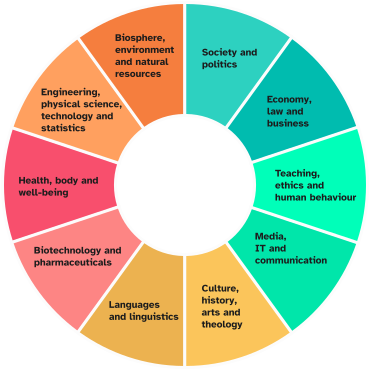
Study wheel
What interests you?
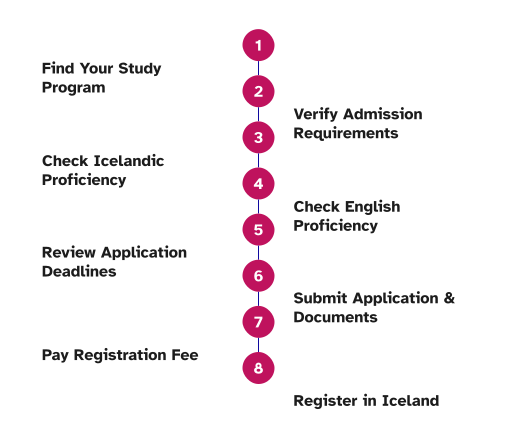
How to apply
Follow the path
Contact us If you still have questions, feel free to contact us.
School of HumanitiesWeekdays: 10-12 am and 1-3 pmGeneral Service and Social MediaThe Service Desk is a point of access for all services. You can drop in at the University Centre or use the WebChat at the bottom right of this page.
Follow the School of Humanities on Instagram, Youtube
and Facebook
Share