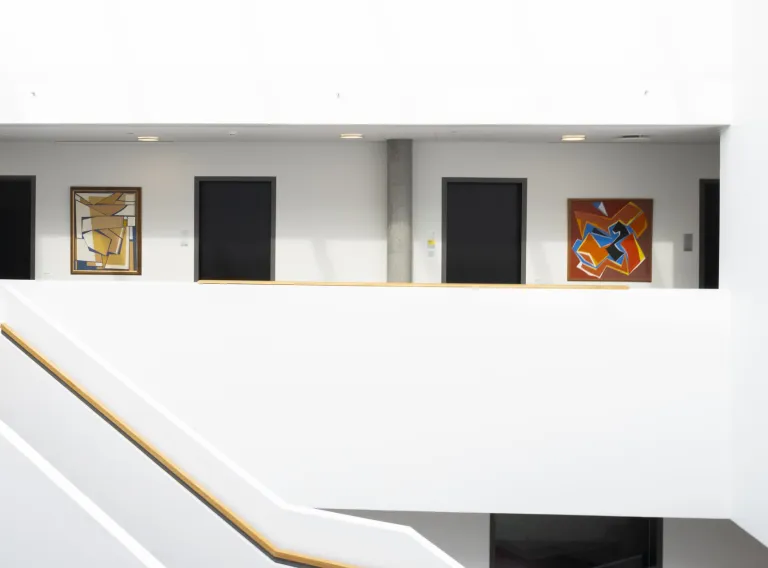
Few paintings on a wall
Language skills
required, minimum level of B2
Programme length
Full time study for three academic years (minor included).
Study mode
Face-to-face learning
Application status
International students:
Students with Icelandic or Nordic citizenship:
Overview

  • Are you interested in art history and theory?
  • Do you want to improve your understanding of art theory?
  • Do you want to be able to analyse and interpret art from different periods and regions?
  • Are you interested in history and culture?
  • Do you want a diverse selection of courses that suit your interests?
  • Do you want to open up future opportunities in challenging careers?

This is a 120 ECTS major, meaning that you will also need to complete a 60 ECTS minor in another subject to graduate with a BA degree.

The subject is also offered as a 60 ECTS minor alongside a 120 ECTS major in another subject.

Course topics include:

  • International art history
  • Methodology and concepts in art history and theory
  • Icelandic art history
  • Cultural spheres
  • Spatial and context art
  • Philosophy of art
  • Modern art
  • The Venice Biennale
  • Metaphors for love in the history of art
  • Exhibition making and curating
  • History of film
  • Methods for historical writing and research

The art history and theory programme trains students in visual literacy, enabling them to ‘read’ imagery as one would read a text. Students are also introduced to the main concepts and analytical methods within the field. Students explore art from various perspectives, including form, iconography, sociohistorical background and feminist theory.

The programme also covers different kinds of art, including:

  • painting
  • sculpture / 3D art
  • graphic art
  • multimedia art
  • installations
  • performance art
  • audio and digital media
  • architecture
  • design

and visual culture in a broader context, including cinema, graphic novels, advertisements and photography.

Main components

Teaching is divided into two main components: firstly, the aesthetic aspects of a work of art and secondly, the social context, such as the circumstances surrounding the work or the artist but also how the work relates to science, politics, religion and various philosophies.

Students are also trained in the philosophy of art / aesthetics, museum studies, exhibition design and art criticism.

Teaching takes place both on the UI campus and at the IUA Department of Fine Art in Laugarnes.

About art history and theory

Foreign universities began teaching art history and theory almost 200 years ago. This subject is not always given the same name in languages other than Icelandic, depending on the traditions of each country and different focuses.

It is either called art history (konsthistoria, Kunstgeschichte) or art theory (konstvetenskap, Kunstwissenschaft).

Icelandic matriculation examination (stúdentspróf) or equivalent qualification. Further information can be found in article 17, regulation on admission requirements for undergraduate study no. 331/2022.  The art history courses taught by the Iceland University of the Arts are only open to art history students, not other UI students

120 credits must be completed, with 60 credits in an academic year counting as full-time study. A major of 120 credits and a minor of 60 credits grants a BA degree. The program is developed in collaboration with the Faculty of Humanities at the University of Iceland and the Department of Fine Arts at the Iceland Academy of the Arts. A total of 80 credits is mandatory, including 70 credits of required courses and a 10-credit BA thesis. The required courses cover methodology and the history of art history, providing an overview of domestic and international art history in the past and present. Ten credits are designated electives, where students choose between SAG101G, Historical Methods, and ÍSR301G, Writing Skills I. Students can take 30 credits in elective subjects, with a maximum of 20 credits in disciplines other than art history, selected from the list below. If a student wishes to take different courses as electives, approval from the program chair is required.

Programme structure

Check below to see how the programme is structured.

This programme does not offer specialisations.

First year | Fall
Making History (SAG101G)
Restricted elective course, conditions apply
10 ECTS, credits
Course Description

This course introduces students to some of the basic skills that they will use in the study of history. The special character of history and its relationship with other fields of study will be discussed. The students will be introduced to the sources and methods used in historical research and the writing and presenting of historical work. - Students must register for the course in the beginning of their history study (first or second semester, depending on whether they start in January or September).

Language of instruction: Icelandic
Face-to-face learning
First year | Fall
Writing skills: Academic Writing (ÍSR301G)
Restricted elective course, conditions apply
10 ECTS, credits
Course Description

This is a basic composition course. Writing skills will be honed through regular assignments, lectures, class discussions and workshops.Approaches to writing research papers will be addressed, such as choosing and narrowing a topic, structure, and sources. Register, style, spelling, punctuation, and resources for writers will be discussed. Students write essays and papers of various kinds and get regular feedback from peers and teachers. Course assessment is based on written assignments and class participation. The course can only be passed if all assignments are turned in.

Language of instruction: Icelandic
Face-to-face learning
Online learning
First year | Fall
Western art from 1348–1848 (LIS004G)
A mandatory (required) course for the programme
10 ECTS, credits
Course Description

In the course the main works of Western art from the early renaissance to the early 19. century. Geographically, the focus is on works of art from Italy and Spain, France, the Netherlands, Germany and England. Main methods and schools, academies and manifestations of art in religious, political and social contexts will be discussed. Painting, sculpture, architecture, the artisanal works and printmaking will be discussed. Efforts will be made to examine the extent to which art reflects society, how imagery reflects the life and worldview of people in different periods. Different approaches to time and space at any given time will be discussed, changes in the symbolic image of the body, the status and social role of the artist, and the interactions of art and institutions of power. In connection with these issues, key works of each period will be taken for detailed interpretation and their distribution history discussed.

Language of instruction: Icelandic
Face-to-face learning
First year | Fall
Methodology and Theory of Art History (LIS101G)
A mandatory (required) course for the programme
10 ECTS, credits
Course Description

Methodology and Theory of Art History (LIS101G) is an introductory methods course. The concept of art will be discussed and students will be introduced to the historical foundation and development of art history, the theoretical grounds of art history as an independent subject, and its relation to other academic subjects. Key concepts, methodologies of art historical research and analysis, and some of the major theories that have shaped the practice of art history will be introduced. Students receive training in visual analysis and are introduced to some of the most important methodologies of art historical analysis, including formalism, iconography, and Marxist analysis. Emphasis is placed on the development of critical thinking and student's ability to analyse texts and images in a critical manner. 

Language of instruction: Icelandic
Face-to-face learning
First year | Fall
Icelandic Visual Art 1870-1970 (LIS102G)
A mandatory (required) course for the programme
10 ECTS, credits
Course Description

A survey of Icelandic art from 1860 to 1970. The course will look at the origins of Icelandic modern art, selected Icelandic artists and factors influencing the Icelandic art scene, influence from foreign art ideas and movements, attempts at definging "national" Icelandic art, government support and influence on the development of visual art, the tension between proponents of "national" art and "non-national" art as well as between "expressive"art and " conceptual" forms of art presentation, local art education and the characteristics of art critic as it appeared in the printed media. An attempt will be made to evaluate characteristics of Icelandic visual art in relation to foreign developments and changes in Icelandic society and history.

Language of instruction: Icelandic
Face-to-face learning
First year | Spring 1
Icelandic Contemporary Art (LIS201G)
A mandatory (required) course for the programme
5 ECTS, credits
Course Description

The main characteristics and historical development of Icelandic art in the last decades of the 20th century and the first decade of the 21st century will be examined in the light of Icelandic society and the context of foreign art development. Topics include SÚM's legacy in the seventies, the establishment of Gallerí Suðurgata 7 and the Living Art Museum, the characteristics of the Icelandic conceptual art and developmeent of contemporary media, such as photography, installation art, and performance art, the establishment of the Sculptors' Association in Reykjavík and the rise of three-dimensional art, media and more recently the overlap of art, film, and music. Emphasis will be made on approach of emerging artists to visual arts heritage at any given time, e.g. to natural heritage and “national” representation in art. The characteristics of critical art discussion, art education, participation in the Venice Biennale, the operation of galleries, and the establishment of contemporary exhibition groups will also be reviewed

Language of instruction: Icelandic
Face-to-face learning
First year | Spring 1
International Modern Art History from 1850 to 1960 (LIS243G)
A mandatory (required) course for the programme
10 ECTS, credits
Course Description

A survey of the development of visual art from the upheaval of Modernism at the beginning of the 20th Century and through the major 20th century progressive movements up to 1960. The main principles, politics and characteristics of Modern art and its impact on later times will be clarified. The relationship between art and politics, philosophy, and societal development will be discussed and thought will be given to the radical reevaluation of the concept of aesthetics in art of the 20th century. How are changed perceptions of time and space reflected in art? How do the above-mentioned art movements disturb the people's general perceptions of the environment and reality? What is "inner" reality? Must art be visible? What is the deifference between visual language, the language we speak, and other forms of sign languege? 

Language of instruction: Icelandic
Face-to-face learning
First year | Spring 1
International fine arts from 1960 (LIS248G)
A mandatory (required) course for the programme
10 ECTS, credits
Course Description

In the course, the development of international contemporary visual art from 1970 and up until our times is reviewed. Using thematic premises contemporary art processes, main directions, movements, individuals and ideas which have characterised the period will be scrutinized. New modes of practice will be examined, with special focus on new modes of practice, environmental art and installation art, performance art; interactive digital media; experimental cineme and video art; conceptual art and photography as an artform. Visual art practice is also examined in the context og local and global issues, in terms of politics, economy and society.

Language of instruction: Icelandic
Face-to-face learning
Second year | Fall
Icelandic Visual Art 1870-1970 (LIS102G)
A mandatory (required) course for the programme
10 ECTS, credits
Course Description

A survey of Icelandic art from 1860 to 1970. The course will look at the origins of Icelandic modern art, selected Icelandic artists and factors influencing the Icelandic art scene, influence from foreign art ideas and movements, attempts at definging "national" Icelandic art, government support and influence on the development of visual art, the tension between proponents of "national" art and "non-national" art as well as between "expressive"art and " conceptual" forms of art presentation, local art education and the characteristics of art critic as it appeared in the printed media. An attempt will be made to evaluate characteristics of Icelandic visual art in relation to foreign developments and changes in Icelandic society and history.

Language of instruction: Icelandic
Face-to-face learning
Second year | Fall
BA-thesis in Art History (LIS241L)
A mandatory (required) course for the programme
0 ECTS, credits
Course Description

BA-thesis in Art History

Language of instruction: Icelandic
Part of the total project/thesis credits
Second year | Fall
Philosophy of Art (HSP310G)
A mandatory (required) course for the programme
5 ECTS, credits
Course Description

The course aims to give a brief survey of selected topics in the philosophy of art; to introduce students to particular discussions, questions, theories and arguments in the philosophy of art through selected readings, both historical and contemporary; and to enable students to discuss topics related to aesthetics.

Language of instruction: Icelandic
Face-to-face learning
Second year | Fall
The olfactory and the gustatory: the sensory hierarchy and new theories in art theory and aesthetics (LIS430M)
Free elective course within the programme
5 ECTS, credits
Course Description

The sensations of smell and taste are crucial dimensions of the work of several contemporary artists and serve a variety of purposes in artistic practice. In this course we will consider the foundations of art history on the basis of a sensory hierarchy, in which vision and hearing has traditionally been prioritized over the sensations of touch, smell and taste. We will discuss how this hierarchy converges with the distinction of humans from animals and with the hierarchical classification of the human sexes and races within the western philosophical tradition. Students will be introduced to new theories within aesthetics and art theory that seek to reveal and analyse the historical, political and philosophical basis of this hierarchy and its continued effect in the present. In this context, we will examine the work of artists who directly or indirectly mobilize the sensations of smell and taste in their practice and consider the role of the olfactory and the gustatory in artistic practice from the 20th century to the present moment.

Language of instruction: Icelandic/English
Face-to-face learning
Prerequisites
Second year | Fall
Installation Art and the Ontology of the Selfvona (LIS323G)
Free elective course within the programme
5 ECTS, credits
Course Description

In the course we will explore one of the fundamental questions of Western Art and History of ideas: the origin of the Individual and the definition of the Self. What is it to be a person? To be yourself? What does Art have to say about Me? We will explore these ideas through Design, Installation Art and Radical Philosophical Inquiry. Questions about gender, body, mind and mental health are reframed in the context of Self and Identity, and how these concepts evolved from the ancient Greek imperative of Gnothi Seauton - Know thyself! We will assume a critical position towards this history in order to analyse current trends in Arts, Neuroscience and Philosophy. In the course, students will be taught to think philosophically by dealing with installation art and interactive design. The course is a laboratory of ideas and artistic practice -- where students will be required to present a proposal for an installation piece or design project.

Language of instruction: Icelandic
Face-to-face learning
Prerequisites
Second year | Fall
Experimental Film and Fine Art (LIS508M)
Free elective course within the programme
5 ECTS, credits
Course Description

The course provides an introduction to experimental film and film theory within the context of fine art. Various epochs and the critical responses that they provoked are defined and analysed. We look at different theoretical frameworks, such as Modernism, Humanism, Structuralism, Postmodernism, and the Anti-Aesthetic and make use of works by authors such as Kant, Nietzsche, Marx, Lacan, Bazin, Baudrillard, McLuhan and Jameson in order to analyse these. This theoretical framework provides a lens to interpret avant-garde cinema and fine art movements beginning with the emergence of expressionism. The course seeks to interpret the role of individualism via mass media as we explore various artists and filmmakers whose works are relevant in the context of this theoretical framework. Emphasis is placed on the viewing of time-based media that illustrate the various theories presented during the course, with a focus being on artists and filmmakers who have embraced these ideologies within their practice.

Language of instruction: English
Face-to-face learning
Prerequisites
Second year | Fall
Religion in fine art (LIS101M)
Free elective course within the programme
5 ECTS, credits
Course Description

We will discuss religious motives in European fine art from early christianity up to the present. The importance of the christian churches for art history will be our subject matter, both in terms of the Orthodox Church and the Roman Catholic Church. Special focus will be on the changes that occurred with the renaissance, the reformation, and the age of enlightenment. The we will examine the effects of the secularisation of art and the origins of modern art in late 19thcentury and early 20th century. We will also deal with the various art movements that appeared in the late 20th century and their relationship with christianity as wells as other religions, such as japanese and chinese.

Language of instruction: Icelandic
Second year | Spring 1
BA-thesis in Art History (LIS241L)
A mandatory (required) course for the programme
0 ECTS, credits
Course Description

BA-thesis in Art History

Language of instruction: Icelandic
Part of the total project/thesis credits
Second year | Spring 1
The art market and art entrepreneurship. (LIS428G)
Free elective course within the programme
5 ECTS, credits
Course Description

The course will discuss the art market and art as a commodity. Students will gain knowledge of the rules, written and unwritten, that apply in the primary art market and the secondary art market. Students will gain an insight into the leading figures and players in the art market and get to know the galleries and auction houses, domestic and foreign, that are the most active in the field. Students will understand how value is built up in the art market and which artists are considered the most valuable today. Students will also become familiar with art commissions in an institutional context. Finally, the main trends in the art market, new global interest in contemporary art, and economic consequences due to financial crises and wars will be discussed.

Language of instruction: Icelandic
Face-to-face learning
Second year | Spring 1
Contemporary socially and politically engaged art (LIS431M)
Free elective course within the programme
5 ECTS, credits
Course Description

This course focuses on socially and politically engaged art in the current condition of warfare and environmental crisis, polarisation, crumbling welfare states, European disintegration, artificial scarcity of resources and job opportunities, resurgent nationalism and the rise of neo-fascism as a convincing socio-political discourse. Of particular interest in the course is the importance of infrastructure as a contemporary political category and the attempts of artists to affect and change existing infrastructures — and create new ones. This focus includes theoretical attention to Marina Vishmidt‘s formulation of infrastructural critique and ruangrupa‘s curation of Documenta 15 in 2022.

Language of instruction: Icelandic/English
Face-to-face learning
Course taught first half of the semester
Second year | Spring 1
Upheaval on the two-dimensional surface (LIS031G)
Free elective course within the programme
5 ECTS, credits
Course Description

This course engages with the upheaval and the changes that have characterised our ideas about the role and the characteristics of visual presentation on a two-dimensional surface since the birth of Modernism. The painting as a medium has during this time gone through death and resurrection and the photograph has found its place as one of the most significant part of contemporary art. There is a particular focus on the possibilities of these mediums in exploring reality and the ideological premises on which such an exploration rests. Theories on how we perceive two-dimensional visual art have dominated art theory in the last century and in this course, these theories are explored in depth.

Language of instruction: English
Prerequisites
Second year | Spring 1
Post-digital Aesthetics (LIS428M)
Free elective course within the programme
5 ECTS, credits
Course Description

The beginning of the 21st century has seen profound changes to the social and economic organization of societies that are to a large extent based on technological advances. Yet, in opposition to the early 20th century's avant-garde, the 21st does not show the same tendency for grandiose statements about revolutionary movements within art. There are however a few artistic tendencies that have been articulated as aesthetic movements of the 21st century, among them the Post-digital aesthetic that addresses the prevalence of digital culture and how it has altered the production and perception of works even of those artists who do not directly relate their works to the influence of contemporary technology. To address this shift in the conditions of art production, we will contemplate the Post-digital aesthetic and compare it with the associated or even competing terms of Post-internet art and the New Aesthetic. We will also compare manifestos such the "Accelerationist Manifesto" and the "Cyberspace Manifesto" with traditional avant-garde manifestos of Futurism. This will help students to formulate a critical stance towards possible continuities within avant-garde traditions and the complexities involved in addressing an evolving aesthetic of the 21st century.

Language of instruction: English
Prerequisites
Second year | Spring 1
Introduction to Exhibition Making (LIS427G)
Free elective course within the programme
5 ECTS, credits
Course Description

Exhibition making is a complex process that affects and influences multiple aspects of artworks and representation. In the course students will get to know exhibition making from different points of view with a special emphasis on current methods and approaches. Different aspects of exhibition making will be addressed, students will work in groups as well as on individual assignments and though these get to know varied aspects of the process. In the course students are introduced to the concepts of curator and curation, theories on, and different kinds of, collaboration with artists and the context of space and theory in regards to exhibition making.
Research and practical know how in relation to exhibition making will be the main focus of the course. Students will contribute to an exhibition in public space, though research, conceptual work, selection of works, writing, making of a exhibition catalog, installing works to name a few aspect.

Language of instruction: Icelandic
Face-to-face learning
Prerequisites
Second year | Spring 1
Cultural Spheres (TÁK204G)
Free elective course within the programme
10 ECTS, credits
Course Description

An interdisciplinary and introductory course entailing a dialogue between the academic fields of the department, i.e. comparative literature, film studies, gender studies, art studies, linguistics, cultural studies, sign language and interpreting studies and translation studies. The latest international developments in the field of humanities will be examined and questions asked about the relationship of academic studies and our world view(s). We will analyse the semiotic system of language, inquiring whether it can serve as the basis for our understanding of other semiotic systems. We will ask about the connection and relationship between different languages and linguistic worlds. What is "multiculture"? How are spoken language, written language and visual language interconnected within society? What constitutes cultural literacy? Literature, art, film and other visual material will be examined in both a national and international context, with a view to how these semiotic systems influence the borderlines of gender, race, class, nation, and different world cultures. The study materials include theoretical and critical writings, literary works, visual art and images, and films, as well as some current media coverage. Evaluation is based on four assignments and a written exam.

Language of instruction: Icelandic
Face-to-face learning
Not taught this semester
Year unspecified | Fall
Melting Clocks and Filmstock: Surrealism in Narrative Cinema (KVI313G)
Free elective course within the programme
10 ECTS, credits
Course Description

Surrealism developed in the existential vacuum of the 1920s as a reaction to the destruction of World War I. As a defiance to “reason” and “rationality” that led to such violence and chaos, surrealists defied reason and sought to reunite the conscious and unconscious, or rather the everyday reality with the dream world. Drawing from Freud and other forms of experimental psychology, spiritualism and meditation in the pursuit of access to an untapped well of creativity, surrealism of the European avant-garde has evolved throughout the continued history of film, reaching the contemporary Hollywood of today. From André Breton and Salvador Dalí to David Lynch and Lady Gaga, this course aims to analyze the surrealist approach through the lens of different artists and auteurs over time, tracing the history of surrealism and its influence on narrative cinema. Directors and artists featured in this class include: Luis Buñuel, Jean Cocteau, Maya Derren, Federico Felini, Jan Svankmajer, the Quay Brothers, Alejandro Jodorowsy, David Lynch, Michel Gondry, Charlie Kaufman and more.

Language of instruction: Icelandic
Face-to-face learning
Year unspecified | Fall
Performance Studies (ÞJÓ506G)
Free elective course within the programme
10 ECTS, credits
Course Description

Performance Studies is the study of how humans create meaning and identity through shared activities ranging from traditional ritual and religion to storytelling and the arts as well as sports, stand-up comedy, festivals, masking traditions, civic ceremonies, political action and protest, dinner parties, and the virtual world. The course introduces students to theories about the wide range of semiotics involved in performance, from spoken text, to costume and appearance, expression and gesture, gender, social contexts, timing and use of space, as well as audience reception.

Language of instruction: English
Face-to-face learning
Distance learning
Prerequisites
Not taught this semester
Year unspecified | Fall
Cultural Heritage (ÞJÓ506M)
Free elective course within the programme
10 ECTS, credits
Course Description

What is cultural heritage and what purpose does it serve? Why does it always seem to be endangered? How does it tie together the past and the present? What's it got to do with the nation and the state? Historical consciousness? Globalization? Capitalism? Politics? The course will seek to answer these questions with reference to new research in folklore, ethnology, anthropology, art history, sociology, museology, history and archaeology and with a view to understanding what is going on in this expanding field of study.

Language of instruction: English
Face-to-face learning
Distance learning
Prerequisites
Year unspecified | Fall
19th & 20th Century History of Ideas (HSP321G)
Free elective course within the programme
10 ECTS, credits
Course Description

In this course, 19th and 20th century ideas that had fundamental effects on Western philosophy and intellectual history, will be examined. These are socially transformative ideas such as freedom, secularism, equality, resistance, the relation between the individual and society, ideas concerning existence and the soul, oppression, injustice, the national state and capitalism. Perhaps last but not least ideas about history, time and evolution of humanity and the planet. 


Each week a new thinker or idea that transformed Western intellectual history is introduced and engaged with. Thinkers such as G.W.F. Hegel, Karl Marx, Sigmund Freud, Rosa Luxembourg and Emma Goldman are analysed and influential isms such as phenomenology, neoliberalism or postructuralism. The aim is to read these thinkers and isms in accordance with the zeitgeist of the historical period they belong to (to the extent that we, people in the 21st century can “read” zeitgeists of older periods). At the same time the aim is to dig deep into original texts and to acquire multi-dimensional understanding of the ideas. Important part of the course is also to look at these themes in relation to the present times and the issues happening at the moment in Western societies and all around the globe. 

Language of instruction: Icelandic
Face-to-face learning
Year unspecified | Fall
Making History (SAG101G)
Free elective course within the programme
10 ECTS, credits
Course Description

This course introduces students to some of the basic skills that they will use in the study of history. The special character of history and its relationship with other fields of study will be discussed. The students will be introduced to the sources and methods used in historical research and the writing and presenting of historical work. - Students must register for the course in the beginning of their history study (first or second semester, depending on whether they start in January or September).

Language of instruction: Icelandic
Face-to-face learning
Year unspecified | Spring 1
History of Film (KVI201G)
Free elective course within the programme
10 ECTS, credits
Course Description

A historical overview of cinema from its emergence in the late 19th century to it contemporary role. The course will introduce students to influential film movements and styles from around the world, including Soviet Montage, French Impressionism, German Expressionism, classical Hollywood cinema, Italian Neorealism, Japanese Minimalism, the French New Wave, New German cinema, Third cinema, and Hong Kong action cinema. Diverse readings will provide a comprehensive overview supplementing screenings of key films. Particular emphasis will be placed on the aesthetic development of the film medium and its social and cultural relevance.

Language of instruction: Icelandic
Face-to-face learning
Not taught this semester
Year unspecified | Spring 1
Nature stories: the (super)natural in legends and literature (ÞJÓ614M)
Free elective course within the programme
10 ECTS, credits
Course Description

By focusing on folk tales, literature and other relevant sources, the course discusses the manifestations of nature and the supernatural in Icelandic narrative culture throughout the centuries. Students will learn about the significance, interface, and unclear boundaries of these phenomena and how they have shaped society and the environment as well. Students will thus get to know different ideas about the position of people and (other) animals within, above or "outside" of nature. Through diverse lectures and assignments, topics such as humanity vs. animality, the known world vs. other worlds, and materiality vs. the supernatural, will be discussed from critical points of view. The roles and forms of landscape, organisms, bodies, weather, and natural phenomena in the narrative culture will be explored. The latest research in this broad field will be presented, such as on the representation of earthquakes and celestial bodies, bears, whales, seals, and domestic animals, and on the supernatural creatures of nature and other mythological creatures such as fairies, ghosts, trolls, and berserks. Students will learn how story worlds and folklore have left their mark on the perception of nature, folk traditions, folk customs, and social spaces such as enchanted spots, sacred places and hunted places. We also ask how these narratives appear in folk art and visual art, from previous centuries to the present. Finally, we will explore the significance of nature narratives and the supernatural in the context of the Anthropocene, human perspectives, climate change, and the different statuses of social groups and species

Language of instruction: Icelandic
Face-to-face learning
Not taught this semester
Year unspecified | Spring 1
Imagined Communities and Folk Culture: Nations, Images and Traditions (ÞJÓ439G)
Free elective course within the programme
10 ECTS, credits
Course Description

The course looks at how identities and images of Icelanders and other nations have been shaped and they use traditions in each case. We examine Icelandic experiences and images in relation to neighbouring countries and how narratives, traditions and material culture shape nations, from national museums to midwinter festivals in London, from a wee dram of whiskey (in Scotland) to Viking sagas (in Scandinavia), with a quick stop at Up Helly Aa (in the Shetland Islands) and Olavsvaka (in the Faroe Islands); we look at a fashion show in Nuuk Center (Greenland), Nordic settlements in the New World and then we’ll post it all on social media.

We explore films and music, festivals, games and political spectacles. In particular we will analyse how national images unite and divide different groups of people. In that context we look at men and women, rural and urban communities, mobile people, racism and gender. We’ll study these images as dynamics and ideals, resources and matters of dispute, that are used for various purposes by different people in different places, by demagogues and greens, government institutions and banks, scholars and students.

Language of instruction: Icelandic
Face-to-face learning
Distance learning
Online learning
Year unspecified | Spring 1
Film Theory (KVI401G)
Free elective course within the programme
10 ECTS, credits
Course Description

The course provides a historical overview of film theory, with students reading a wide range of texts by important theorists and philosophers of cinema, and watching historically relevant films. It will cover the work of such pioneers as Sergei Eisenstein, Rudolf Arnheim, Siegfried Kracauer and André Bazin, before addressing major theoretical shifts beginning with structuralism in the 1960s, while also including Althusserian Marxism, psychoanalysis, feminism, postcolonial theory and cultural studies. Screened films will emphasize the heterogeneity of film theory and provide fruitful ground for further discussions.

Language of instruction: Icelandic
Face-to-face learning
Prerequisites
Not taught this semester
Year unspecified | Spring 1
Material Culture and Society: Objects, homes and bodies (ÞJÓ205G)
Free elective course within the programme
10 ECTS, credits
Course Description

This course is an introduction to the study of the material culture of everyday life. Students will be get a good glimpse of this multidisciplinary field, with examples drawn from the past as well as the present, and with equal emphasis on the material culture of Iceland and that of other countries. The topics of study will range from clothes and fashion to foodways, from the objects in our daily surroundings to trash and hygiene, from crafts and consumer goods to houses, gardens and the home, and from urban landscapes to museums and exhibits. Along the way, students will gain familiarity with various theoretical concepts and approaches emphasizing for example the human body, gender, consumption, place and space.

Language of instruction: Icelandic
Face-to-face learning
Prerequisites
Year unspecified | Spring 1
Old Nordic Religion and Belief (ÞJÓ437G)
Free elective course within the programme
10 ECTS, credits
Course Description

An examination will be made of the religious beliefs and practices of people in Scandinavia from the earliest of times until the conversion, material ranging from burial practices to rock carvings, to the written evidence given in the works of Tacitus, Adam of Bremen and Saxo Grammaticus, as well as in early Icelandic works like the Eddic poems and the Kings' sagas. Alongside this discussion of the development and key features of Old Norse religion, some attention will be paid to the concepts of seid and shamanism, especially in connection to their role in early religions. Finally, an examination will be made of the conversion of Scandinavia and how Christian concepts and practices both fitted and contrasted with the previously dominant Old Norse worldview.

Teaching form:
The teaching takes place in the form of lectures and discussion on the material of the lectures.

Language of instruction: English
Face-to-face learning
Online learning
First year
  • Fall
  • SAG101G
    Making History
    Restricted elective course
    10
    Restricted elective course, conditions apply
    10 ECTS, credits
    Course Description

    This course introduces students to some of the basic skills that they will use in the study of history. The special character of history and its relationship with other fields of study will be discussed. The students will be introduced to the sources and methods used in historical research and the writing and presenting of historical work. - Students must register for the course in the beginning of their history study (first or second semester, depending on whether they start in January or September).

    Face-to-face learning
    Prerequisites
  • ÍSR301G
    Writing skills: Academic Writing
    Restricted elective course
    10
    Restricted elective course, conditions apply
    10 ECTS, credits
    Course Description

    This is a basic composition course. Writing skills will be honed through regular assignments, lectures, class discussions and workshops.Approaches to writing research papers will be addressed, such as choosing and narrowing a topic, structure, and sources. Register, style, spelling, punctuation, and resources for writers will be discussed. Students write essays and papers of various kinds and get regular feedback from peers and teachers. Course assessment is based on written assignments and class participation. The course can only be passed if all assignments are turned in.

    Face-to-face learning
    Online learning
    Prerequisites
  • LIS004G
    Western art from 1348–1848
    Mandatory (required) course
    10
    A mandatory (required) course for the programme
    10 ECTS, credits
    Course Description

    In the course the main works of Western art from the early renaissance to the early 19. century. Geographically, the focus is on works of art from Italy and Spain, France, the Netherlands, Germany and England. Main methods and schools, academies and manifestations of art in religious, political and social contexts will be discussed. Painting, sculpture, architecture, the artisanal works and printmaking will be discussed. Efforts will be made to examine the extent to which art reflects society, how imagery reflects the life and worldview of people in different periods. Different approaches to time and space at any given time will be discussed, changes in the symbolic image of the body, the status and social role of the artist, and the interactions of art and institutions of power. In connection with these issues, key works of each period will be taken for detailed interpretation and their distribution history discussed.

    Face-to-face learning
    Prerequisites
  • LIS101G
    Methodology and Theory of Art History
    Mandatory (required) course
    10
    A mandatory (required) course for the programme
    10 ECTS, credits
    Course Description

    Methodology and Theory of Art History (LIS101G) is an introductory methods course. The concept of art will be discussed and students will be introduced to the historical foundation and development of art history, the theoretical grounds of art history as an independent subject, and its relation to other academic subjects. Key concepts, methodologies of art historical research and analysis, and some of the major theories that have shaped the practice of art history will be introduced. Students receive training in visual analysis and are introduced to some of the most important methodologies of art historical analysis, including formalism, iconography, and Marxist analysis. Emphasis is placed on the development of critical thinking and student's ability to analyse texts and images in a critical manner. 

    Face-to-face learning
    Prerequisites
  • LIS102G
    Icelandic Visual Art 1870-1970
    Mandatory (required) course
    10
    A mandatory (required) course for the programme
    10 ECTS, credits
    Course Description

    A survey of Icelandic art from 1860 to 1970. The course will look at the origins of Icelandic modern art, selected Icelandic artists and factors influencing the Icelandic art scene, influence from foreign art ideas and movements, attempts at definging "national" Icelandic art, government support and influence on the development of visual art, the tension between proponents of "national" art and "non-national" art as well as between "expressive"art and " conceptual" forms of art presentation, local art education and the characteristics of art critic as it appeared in the printed media. An attempt will be made to evaluate characteristics of Icelandic visual art in relation to foreign developments and changes in Icelandic society and history.

    Face-to-face learning
    Prerequisites
  • Spring 2
  • LIS201G
    Icelandic Contemporary Art
    Mandatory (required) course
    5
    A mandatory (required) course for the programme
    5 ECTS, credits
    Course Description

    The main characteristics and historical development of Icelandic art in the last decades of the 20th century and the first decade of the 21st century will be examined in the light of Icelandic society and the context of foreign art development. Topics include SÚM's legacy in the seventies, the establishment of Gallerí Suðurgata 7 and the Living Art Museum, the characteristics of the Icelandic conceptual art and developmeent of contemporary media, such as photography, installation art, and performance art, the establishment of the Sculptors' Association in Reykjavík and the rise of three-dimensional art, media and more recently the overlap of art, film, and music. Emphasis will be made on approach of emerging artists to visual arts heritage at any given time, e.g. to natural heritage and “national” representation in art. The characteristics of critical art discussion, art education, participation in the Venice Biennale, the operation of galleries, and the establishment of contemporary exhibition groups will also be reviewed

    Face-to-face learning
    Prerequisites
  • LIS243G
    International Modern Art History from 1850 to 1960
    Mandatory (required) course
    10
    A mandatory (required) course for the programme
    10 ECTS, credits
    Course Description

    A survey of the development of visual art from the upheaval of Modernism at the beginning of the 20th Century and through the major 20th century progressive movements up to 1960. The main principles, politics and characteristics of Modern art and its impact on later times will be clarified. The relationship between art and politics, philosophy, and societal development will be discussed and thought will be given to the radical reevaluation of the concept of aesthetics in art of the 20th century. How are changed perceptions of time and space reflected in art? How do the above-mentioned art movements disturb the people's general perceptions of the environment and reality? What is "inner" reality? Must art be visible? What is the deifference between visual language, the language we speak, and other forms of sign languege? 

    Face-to-face learning
    Prerequisites
  • LIS248G
    International fine arts from 1960
    Mandatory (required) course
    10
    A mandatory (required) course for the programme
    10 ECTS, credits
    Course Description

    In the course, the development of international contemporary visual art from 1970 and up until our times is reviewed. Using thematic premises contemporary art processes, main directions, movements, individuals and ideas which have characterised the period will be scrutinized. New modes of practice will be examined, with special focus on new modes of practice, environmental art and installation art, performance art; interactive digital media; experimental cineme and video art; conceptual art and photography as an artform. Visual art practice is also examined in the context og local and global issues, in terms of politics, economy and society.

    Face-to-face learning
    Prerequisites
  • Fall
  • LIS102G
    Icelandic Visual Art 1870-1970
    Mandatory (required) course
    10
    A mandatory (required) course for the programme
    10 ECTS, credits
    Course Description

    A survey of Icelandic art from 1860 to 1970. The course will look at the origins of Icelandic modern art, selected Icelandic artists and factors influencing the Icelandic art scene, influence from foreign art ideas and movements, attempts at definging "national" Icelandic art, government support and influence on the development of visual art, the tension between proponents of "national" art and "non-national" art as well as between "expressive"art and " conceptual" forms of art presentation, local art education and the characteristics of art critic as it appeared in the printed media. An attempt will be made to evaluate characteristics of Icelandic visual art in relation to foreign developments and changes in Icelandic society and history.

    Face-to-face learning
    Prerequisites
  • LIS241L
    BA-thesis in Art History
    Mandatory (required) course
    0
    A mandatory (required) course for the programme
    0 ECTS, credits
    Course Description

    BA-thesis in Art History

    Prerequisites
    Part of the total project/thesis credits
  • HSP310G
    Philosophy of Art
    Mandatory (required) course
    5
    A mandatory (required) course for the programme
    5 ECTS, credits
    Course Description

    The course aims to give a brief survey of selected topics in the philosophy of art; to introduce students to particular discussions, questions, theories and arguments in the philosophy of art through selected readings, both historical and contemporary; and to enable students to discuss topics related to aesthetics.

    Face-to-face learning
    Prerequisites
  • LIS430M
    The olfactory and the gustatory: the sensory hierarchy and new theories in art theory and aesthetics
    Elective course
    5
    Free elective course within the programme
    5 ECTS, credits
    Course Description

    The sensations of smell and taste are crucial dimensions of the work of several contemporary artists and serve a variety of purposes in artistic practice. In this course we will consider the foundations of art history on the basis of a sensory hierarchy, in which vision and hearing has traditionally been prioritized over the sensations of touch, smell and taste. We will discuss how this hierarchy converges with the distinction of humans from animals and with the hierarchical classification of the human sexes and races within the western philosophical tradition. Students will be introduced to new theories within aesthetics and art theory that seek to reveal and analyse the historical, political and philosophical basis of this hierarchy and its continued effect in the present. In this context, we will examine the work of artists who directly or indirectly mobilize the sensations of smell and taste in their practice and consider the role of the olfactory and the gustatory in artistic practice from the 20th century to the present moment.

    Face-to-face learning
    Prerequisites
  • LIS323G
    Installation Art and the Ontology of the Selfvona
    Elective course
    5
    Free elective course within the programme
    5 ECTS, credits
    Course Description

    In the course we will explore one of the fundamental questions of Western Art and History of ideas: the origin of the Individual and the definition of the Self. What is it to be a person? To be yourself? What does Art have to say about Me? We will explore these ideas through Design, Installation Art and Radical Philosophical Inquiry. Questions about gender, body, mind and mental health are reframed in the context of Self and Identity, and how these concepts evolved from the ancient Greek imperative of Gnothi Seauton - Know thyself! We will assume a critical position towards this history in order to analyse current trends in Arts, Neuroscience and Philosophy. In the course, students will be taught to think philosophically by dealing with installation art and interactive design. The course is a laboratory of ideas and artistic practice -- where students will be required to present a proposal for an installation piece or design project.

    Face-to-face learning
    Prerequisites
  • LIS508M
    Experimental Film and Fine Art
    Elective course
    5
    Free elective course within the programme
    5 ECTS, credits
    Course Description

    The course provides an introduction to experimental film and film theory within the context of fine art. Various epochs and the critical responses that they provoked are defined and analysed. We look at different theoretical frameworks, such as Modernism, Humanism, Structuralism, Postmodernism, and the Anti-Aesthetic and make use of works by authors such as Kant, Nietzsche, Marx, Lacan, Bazin, Baudrillard, McLuhan and Jameson in order to analyse these. This theoretical framework provides a lens to interpret avant-garde cinema and fine art movements beginning with the emergence of expressionism. The course seeks to interpret the role of individualism via mass media as we explore various artists and filmmakers whose works are relevant in the context of this theoretical framework. Emphasis is placed on the viewing of time-based media that illustrate the various theories presented during the course, with a focus being on artists and filmmakers who have embraced these ideologies within their practice.

    Face-to-face learning
    Prerequisites
  • LIS101M
    Religion in fine art
    Elective course
    5
    Free elective course within the programme
    5 ECTS, credits
    Course Description

    We will discuss religious motives in European fine art from early christianity up to the present. The importance of the christian churches for art history will be our subject matter, both in terms of the Orthodox Church and the Roman Catholic Church. Special focus will be on the changes that occurred with the renaissance, the reformation, and the age of enlightenment. The we will examine the effects of the secularisation of art and the origins of modern art in late 19thcentury and early 20th century. We will also deal with the various art movements that appeared in the late 20th century and their relationship with christianity as wells as other religions, such as japanese and chinese.

    Prerequisites
  • Spring 2
  • LIS241L
    BA-thesis in Art History
    Mandatory (required) course
    0
    A mandatory (required) course for the programme
    0 ECTS, credits
    Course Description

    BA-thesis in Art History

    Prerequisites
    Part of the total project/thesis credits
  • LIS428G
    The art market and art entrepreneurship.
    Elective course
    5
    Free elective course within the programme
    5 ECTS, credits
    Course Description

    The course will discuss the art market and art as a commodity. Students will gain knowledge of the rules, written and unwritten, that apply in the primary art market and the secondary art market. Students will gain an insight into the leading figures and players in the art market and get to know the galleries and auction houses, domestic and foreign, that are the most active in the field. Students will understand how value is built up in the art market and which artists are considered the most valuable today. Students will also become familiar with art commissions in an institutional context. Finally, the main trends in the art market, new global interest in contemporary art, and economic consequences due to financial crises and wars will be discussed.

    Face-to-face learning
    Prerequisites
  • LIS431M
    Contemporary socially and politically engaged art
    Elective course
    5
    Free elective course within the programme
    5 ECTS, credits
    Course Description

    This course focuses on socially and politically engaged art in the current condition of warfare and environmental crisis, polarisation, crumbling welfare states, European disintegration, artificial scarcity of resources and job opportunities, resurgent nationalism and the rise of neo-fascism as a convincing socio-political discourse. Of particular interest in the course is the importance of infrastructure as a contemporary political category and the attempts of artists to affect and change existing infrastructures — and create new ones. This focus includes theoretical attention to Marina Vishmidt‘s formulation of infrastructural critique and ruangrupa‘s curation of Documenta 15 in 2022.

    Face-to-face learning
    Prerequisites
    Course taught first half of the semester
  • LIS031G
    Upheaval on the two-dimensional surface
    Elective course
    5
    Free elective course within the programme
    5 ECTS, credits
    Course Description

    This course engages with the upheaval and the changes that have characterised our ideas about the role and the characteristics of visual presentation on a two-dimensional surface since the birth of Modernism. The painting as a medium has during this time gone through death and resurrection and the photograph has found its place as one of the most significant part of contemporary art. There is a particular focus on the possibilities of these mediums in exploring reality and the ideological premises on which such an exploration rests. Theories on how we perceive two-dimensional visual art have dominated art theory in the last century and in this course, these theories are explored in depth.

    Prerequisites
  • LIS428M
    Post-digital Aesthetics
    Elective course
    5
    Free elective course within the programme
    5 ECTS, credits
    Course Description

    The beginning of the 21st century has seen profound changes to the social and economic organization of societies that are to a large extent based on technological advances. Yet, in opposition to the early 20th century's avant-garde, the 21st does not show the same tendency for grandiose statements about revolutionary movements within art. There are however a few artistic tendencies that have been articulated as aesthetic movements of the 21st century, among them the Post-digital aesthetic that addresses the prevalence of digital culture and how it has altered the production and perception of works even of those artists who do not directly relate their works to the influence of contemporary technology. To address this shift in the conditions of art production, we will contemplate the Post-digital aesthetic and compare it with the associated or even competing terms of Post-internet art and the New Aesthetic. We will also compare manifestos such the "Accelerationist Manifesto" and the "Cyberspace Manifesto" with traditional avant-garde manifestos of Futurism. This will help students to formulate a critical stance towards possible continuities within avant-garde traditions and the complexities involved in addressing an evolving aesthetic of the 21st century.

    Prerequisites
  • LIS427G
    Introduction to Exhibition Making
    Elective course
    5
    Free elective course within the programme
    5 ECTS, credits
    Course Description

    Exhibition making is a complex process that affects and influences multiple aspects of artworks and representation. In the course students will get to know exhibition making from different points of view with a special emphasis on current methods and approaches. Different aspects of exhibition making will be addressed, students will work in groups as well as on individual assignments and though these get to know varied aspects of the process. In the course students are introduced to the concepts of curator and curation, theories on, and different kinds of, collaboration with artists and the context of space and theory in regards to exhibition making.
    Research and practical know how in relation to exhibition making will be the main focus of the course. Students will contribute to an exhibition in public space, though research, conceptual work, selection of works, writing, making of a exhibition catalog, installing works to name a few aspect.

    Face-to-face learning
    Prerequisites
  • TÁK204G
    Cultural Spheres
    Elective course
    10
    Free elective course within the programme
    10 ECTS, credits
    Course Description

    An interdisciplinary and introductory course entailing a dialogue between the academic fields of the department, i.e. comparative literature, film studies, gender studies, art studies, linguistics, cultural studies, sign language and interpreting studies and translation studies. The latest international developments in the field of humanities will be examined and questions asked about the relationship of academic studies and our world view(s). We will analyse the semiotic system of language, inquiring whether it can serve as the basis for our understanding of other semiotic systems. We will ask about the connection and relationship between different languages and linguistic worlds. What is "multiculture"? How are spoken language, written language and visual language interconnected within society? What constitutes cultural literacy? Literature, art, film and other visual material will be examined in both a national and international context, with a view to how these semiotic systems influence the borderlines of gender, race, class, nation, and different world cultures. The study materials include theoretical and critical writings, literary works, visual art and images, and films, as well as some current media coverage. Evaluation is based on four assignments and a written exam.

    Face-to-face learning
    Prerequisites
  • Fall
  • Not taught this semester
    KVI313G
    Melting Clocks and Filmstock: Surrealism in Narrative Cinema
    Elective course
    10
    Free elective course within the programme
    10 ECTS, credits
    Course Description

    Surrealism developed in the existential vacuum of the 1920s as a reaction to the destruction of World War I. As a defiance to “reason” and “rationality” that led to such violence and chaos, surrealists defied reason and sought to reunite the conscious and unconscious, or rather the everyday reality with the dream world. Drawing from Freud and other forms of experimental psychology, spiritualism and meditation in the pursuit of access to an untapped well of creativity, surrealism of the European avant-garde has evolved throughout the continued history of film, reaching the contemporary Hollywood of today. From André Breton and Salvador Dalí to David Lynch and Lady Gaga, this course aims to analyze the surrealist approach through the lens of different artists and auteurs over time, tracing the history of surrealism and its influence on narrative cinema. Directors and artists featured in this class include: Luis Buñuel, Jean Cocteau, Maya Derren, Federico Felini, Jan Svankmajer, the Quay Brothers, Alejandro Jodorowsy, David Lynch, Michel Gondry, Charlie Kaufman and more.

    Face-to-face learning
    Prerequisites
  • ÞJÓ506G
    Performance Studies
    Elective course
    10
    Free elective course within the programme
    10 ECTS, credits
    Course Description

    Performance Studies is the study of how humans create meaning and identity through shared activities ranging from traditional ritual and religion to storytelling and the arts as well as sports, stand-up comedy, festivals, masking traditions, civic ceremonies, political action and protest, dinner parties, and the virtual world. The course introduces students to theories about the wide range of semiotics involved in performance, from spoken text, to costume and appearance, expression and gesture, gender, social contexts, timing and use of space, as well as audience reception.

    Face-to-face learning
    Distance learning
    Prerequisites
  • Not taught this semester
    ÞJÓ506M
    Cultural Heritage
    Elective course
    10
    Free elective course within the programme
    10 ECTS, credits
    Course Description

    What is cultural heritage and what purpose does it serve? Why does it always seem to be endangered? How does it tie together the past and the present? What's it got to do with the nation and the state? Historical consciousness? Globalization? Capitalism? Politics? The course will seek to answer these questions with reference to new research in folklore, ethnology, anthropology, art history, sociology, museology, history and archaeology and with a view to understanding what is going on in this expanding field of study.

    Face-to-face learning
    Distance learning
    Prerequisites
  • HSP321G
    19th & 20th Century History of Ideas
    Elective course
    10
    Free elective course within the programme
    10 ECTS, credits
    Course Description

    In this course, 19th and 20th century ideas that had fundamental effects on Western philosophy and intellectual history, will be examined. These are socially transformative ideas such as freedom, secularism, equality, resistance, the relation between the individual and society, ideas concerning existence and the soul, oppression, injustice, the national state and capitalism. Perhaps last but not least ideas about history, time and evolution of humanity and the planet. 


    Each week a new thinker or idea that transformed Western intellectual history is introduced and engaged with. Thinkers such as G.W.F. Hegel, Karl Marx, Sigmund Freud, Rosa Luxembourg and Emma Goldman are analysed and influential isms such as phenomenology, neoliberalism or postructuralism. The aim is to read these thinkers and isms in accordance with the zeitgeist of the historical period they belong to (to the extent that we, people in the 21st century can “read” zeitgeists of older periods). At the same time the aim is to dig deep into original texts and to acquire multi-dimensional understanding of the ideas. Important part of the course is also to look at these themes in relation to the present times and the issues happening at the moment in Western societies and all around the globe. 

    Face-to-face learning
    Prerequisites
  • SAG101G
    Making History
    Elective course
    10
    Free elective course within the programme
    10 ECTS, credits
    Course Description

    This course introduces students to some of the basic skills that they will use in the study of history. The special character of history and its relationship with other fields of study will be discussed. The students will be introduced to the sources and methods used in historical research and the writing and presenting of historical work. - Students must register for the course in the beginning of their history study (first or second semester, depending on whether they start in January or September).

    Face-to-face learning
    Prerequisites
  • Spring 2
  • KVI201G
    History of Film
    Elective course
    10
    Free elective course within the programme
    10 ECTS, credits
    Course Description

    A historical overview of cinema from its emergence in the late 19th century to it contemporary role. The course will introduce students to influential film movements and styles from around the world, including Soviet Montage, French Impressionism, German Expressionism, classical Hollywood cinema, Italian Neorealism, Japanese Minimalism, the French New Wave, New German cinema, Third cinema, and Hong Kong action cinema. Diverse readings will provide a comprehensive overview supplementing screenings of key films. Particular emphasis will be placed on the aesthetic development of the film medium and its social and cultural relevance.

    Face-to-face learning
    Prerequisites
  • Not taught this semester
    ÞJÓ614M
    Nature stories: the (super)natural in legends and literature
    Elective course
    10
    Free elective course within the programme
    10 ECTS, credits
    Course Description

    By focusing on folk tales, literature and other relevant sources, the course discusses the manifestations of nature and the supernatural in Icelandic narrative culture throughout the centuries. Students will learn about the significance, interface, and unclear boundaries of these phenomena and how they have shaped society and the environment as well. Students will thus get to know different ideas about the position of people and (other) animals within, above or "outside" of nature. Through diverse lectures and assignments, topics such as humanity vs. animality, the known world vs. other worlds, and materiality vs. the supernatural, will be discussed from critical points of view. The roles and forms of landscape, organisms, bodies, weather, and natural phenomena in the narrative culture will be explored. The latest research in this broad field will be presented, such as on the representation of earthquakes and celestial bodies, bears, whales, seals, and domestic animals, and on the supernatural creatures of nature and other mythological creatures such as fairies, ghosts, trolls, and berserks. Students will learn how story worlds and folklore have left their mark on the perception of nature, folk traditions, folk customs, and social spaces such as enchanted spots, sacred places and hunted places. We also ask how these narratives appear in folk art and visual art, from previous centuries to the present. Finally, we will explore the significance of nature narratives and the supernatural in the context of the Anthropocene, human perspectives, climate change, and the different statuses of social groups and species

    Face-to-face learning
    Prerequisites
  • Not taught this semester
    ÞJÓ439G
    Imagined Communities and Folk Culture: Nations, Images and Traditions
    Elective course
    10
    Free elective course within the programme
    10 ECTS, credits
    Course Description

    The course looks at how identities and images of Icelanders and other nations have been shaped and they use traditions in each case. We examine Icelandic experiences and images in relation to neighbouring countries and how narratives, traditions and material culture shape nations, from national museums to midwinter festivals in London, from a wee dram of whiskey (in Scotland) to Viking sagas (in Scandinavia), with a quick stop at Up Helly Aa (in the Shetland Islands) and Olavsvaka (in the Faroe Islands); we look at a fashion show in Nuuk Center (Greenland), Nordic settlements in the New World and then we’ll post it all on social media.

    We explore films and music, festivals, games and political spectacles. In particular we will analyse how national images unite and divide different groups of people. In that context we look at men and women, rural and urban communities, mobile people, racism and gender. We’ll study these images as dynamics and ideals, resources and matters of dispute, that are used for various purposes by different people in different places, by demagogues and greens, government institutions and banks, scholars and students.

    Face-to-face learning
    Distance learning
    Online learning
    Prerequisites
  • KVI401G
    Film Theory
    Elective course
    10
    Free elective course within the programme
    10 ECTS, credits
    Course Description

    The course provides a historical overview of film theory, with students reading a wide range of texts by important theorists and philosophers of cinema, and watching historically relevant films. It will cover the work of such pioneers as Sergei Eisenstein, Rudolf Arnheim, Siegfried Kracauer and André Bazin, before addressing major theoretical shifts beginning with structuralism in the 1960s, while also including Althusserian Marxism, psychoanalysis, feminism, postcolonial theory and cultural studies. Screened films will emphasize the heterogeneity of film theory and provide fruitful ground for further discussions.

    Face-to-face learning
    Prerequisites
  • Not taught this semester
    ÞJÓ205G
    Material Culture and Society: Objects, homes and bodies
    Elective course
    10
    Free elective course within the programme
    10 ECTS, credits
    Course Description

    This course is an introduction to the study of the material culture of everyday life. Students will be get a good glimpse of this multidisciplinary field, with examples drawn from the past as well as the present, and with equal emphasis on the material culture of Iceland and that of other countries. The topics of study will range from clothes and fashion to foodways, from the objects in our daily surroundings to trash and hygiene, from crafts and consumer goods to houses, gardens and the home, and from urban landscapes to museums and exhibits. Along the way, students will gain familiarity with various theoretical concepts and approaches emphasizing for example the human body, gender, consumption, place and space.

    Face-to-face learning
    Prerequisites
  • ÞJÓ437G
    Old Nordic Religion and Belief
    Elective course
    10
    Free elective course within the programme
    10 ECTS, credits
    Course Description

    An examination will be made of the religious beliefs and practices of people in Scandinavia from the earliest of times until the conversion, material ranging from burial practices to rock carvings, to the written evidence given in the works of Tacitus, Adam of Bremen and Saxo Grammaticus, as well as in early Icelandic works like the Eddic poems and the Kings' sagas. Alongside this discussion of the development and key features of Old Norse religion, some attention will be paid to the concepts of seid and shamanism, especially in connection to their role in early religions. Finally, an examination will be made of the conversion of Scandinavia and how Christian concepts and practices both fitted and contrasted with the previously dominant Old Norse worldview.

    Teaching form:
    The teaching takes place in the form of lectures and discussion on the material of the lectures.

    Face-to-face learning
    Online learning
    Prerequisites
Second year
  • Fall
  • SAG101G
    Making History
    Restricted elective course
    10
    Restricted elective course, conditions apply
    10 ECTS, credits
    Course Description

    This course introduces students to some of the basic skills that they will use in the study of history. The special character of history and its relationship with other fields of study will be discussed. The students will be introduced to the sources and methods used in historical research and the writing and presenting of historical work. - Students must register for the course in the beginning of their history study (first or second semester, depending on whether they start in January or September).

    Face-to-face learning
    Prerequisites
  • ÍSR301G
    Writing skills: Academic Writing
    Restricted elective course
    10
    Restricted elective course, conditions apply
    10 ECTS, credits
    Course Description

    This is a basic composition course. Writing skills will be honed through regular assignments, lectures, class discussions and workshops.Approaches to writing research papers will be addressed, such as choosing and narrowing a topic, structure, and sources. Register, style, spelling, punctuation, and resources for writers will be discussed. Students write essays and papers of various kinds and get regular feedback from peers and teachers. Course assessment is based on written assignments and class participation. The course can only be passed if all assignments are turned in.

    Face-to-face learning
    Online learning
    Prerequisites
  • LIS004G
    Western art from 1348–1848
    Mandatory (required) course
    10
    A mandatory (required) course for the programme
    10 ECTS, credits
    Course Description

    In the course the main works of Western art from the early renaissance to the early 19. century. Geographically, the focus is on works of art from Italy and Spain, France, the Netherlands, Germany and England. Main methods and schools, academies and manifestations of art in religious, political and social contexts will be discussed. Painting, sculpture, architecture, the artisanal works and printmaking will be discussed. Efforts will be made to examine the extent to which art reflects society, how imagery reflects the life and worldview of people in different periods. Different approaches to time and space at any given time will be discussed, changes in the symbolic image of the body, the status and social role of the artist, and the interactions of art and institutions of power. In connection with these issues, key works of each period will be taken for detailed interpretation and their distribution history discussed.

    Face-to-face learning
    Prerequisites
  • LIS101G
    Methodology and Theory of Art History
    Mandatory (required) course
    10
    A mandatory (required) course for the programme
    10 ECTS, credits
    Course Description

    Methodology and Theory of Art History (LIS101G) is an introductory methods course. The concept of art will be discussed and students will be introduced to the historical foundation and development of art history, the theoretical grounds of art history as an independent subject, and its relation to other academic subjects. Key concepts, methodologies of art historical research and analysis, and some of the major theories that have shaped the practice of art history will be introduced. Students receive training in visual analysis and are introduced to some of the most important methodologies of art historical analysis, including formalism, iconography, and Marxist analysis. Emphasis is placed on the development of critical thinking and student's ability to analyse texts and images in a critical manner. 

    Face-to-face learning
    Prerequisites
  • LIS102G
    Icelandic Visual Art 1870-1970
    Mandatory (required) course
    10
    A mandatory (required) course for the programme
    10 ECTS, credits
    Course Description

    A survey of Icelandic art from 1860 to 1970. The course will look at the origins of Icelandic modern art, selected Icelandic artists and factors influencing the Icelandic art scene, influence from foreign art ideas and movements, attempts at definging "national" Icelandic art, government support and influence on the development of visual art, the tension between proponents of "national" art and "non-national" art as well as between "expressive"art and " conceptual" forms of art presentation, local art education and the characteristics of art critic as it appeared in the printed media. An attempt will be made to evaluate characteristics of Icelandic visual art in relation to foreign developments and changes in Icelandic society and history.

    Face-to-face learning
    Prerequisites
  • Spring 2
  • LIS201G
    Icelandic Contemporary Art
    Mandatory (required) course
    5
    A mandatory (required) course for the programme
    5 ECTS, credits
    Course Description

    The main characteristics and historical development of Icelandic art in the last decades of the 20th century and the first decade of the 21st century will be examined in the light of Icelandic society and the context of foreign art development. Topics include SÚM's legacy in the seventies, the establishment of Gallerí Suðurgata 7 and the Living Art Museum, the characteristics of the Icelandic conceptual art and developmeent of contemporary media, such as photography, installation art, and performance art, the establishment of the Sculptors' Association in Reykjavík and the rise of three-dimensional art, media and more recently the overlap of art, film, and music. Emphasis will be made on approach of emerging artists to visual arts heritage at any given time, e.g. to natural heritage and “national” representation in art. The characteristics of critical art discussion, art education, participation in the Venice Biennale, the operation of galleries, and the establishment of contemporary exhibition groups will also be reviewed

    Face-to-face learning
    Prerequisites
  • LIS243G
    International Modern Art History from 1850 to 1960
    Mandatory (required) course
    10
    A mandatory (required) course for the programme
    10 ECTS, credits
    Course Description

    A survey of the development of visual art from the upheaval of Modernism at the beginning of the 20th Century and through the major 20th century progressive movements up to 1960. The main principles, politics and characteristics of Modern art and its impact on later times will be clarified. The relationship between art and politics, philosophy, and societal development will be discussed and thought will be given to the radical reevaluation of the concept of aesthetics in art of the 20th century. How are changed perceptions of time and space reflected in art? How do the above-mentioned art movements disturb the people's general perceptions of the environment and reality? What is "inner" reality? Must art be visible? What is the deifference between visual language, the language we speak, and other forms of sign languege? 

    Face-to-face learning
    Prerequisites
  • LIS248G
    International fine arts from 1960
    Mandatory (required) course
    10
    A mandatory (required) course for the programme
    10 ECTS, credits
    Course Description

    In the course, the development of international contemporary visual art from 1970 and up until our times is reviewed. Using thematic premises contemporary art processes, main directions, movements, individuals and ideas which have characterised the period will be scrutinized. New modes of practice will be examined, with special focus on new modes of practice, environmental art and installation art, performance art; interactive digital media; experimental cineme and video art; conceptual art and photography as an artform. Visual art practice is also examined in the context og local and global issues, in terms of politics, economy and society.

    Face-to-face learning
    Prerequisites
  • Fall
  • LIS102G
    Icelandic Visual Art 1870-1970
    Mandatory (required) course
    10
    A mandatory (required) course for the programme
    10 ECTS, credits
    Course Description

    A survey of Icelandic art from 1860 to 1970. The course will look at the origins of Icelandic modern art, selected Icelandic artists and factors influencing the Icelandic art scene, influence from foreign art ideas and movements, attempts at definging "national" Icelandic art, government support and influence on the development of visual art, the tension between proponents of "national" art and "non-national" art as well as between "expressive"art and " conceptual" forms of art presentation, local art education and the characteristics of art critic as it appeared in the printed media. An attempt will be made to evaluate characteristics of Icelandic visual art in relation to foreign developments and changes in Icelandic society and history.

    Face-to-face learning
    Prerequisites
  • LIS241L
    BA-thesis in Art History
    Mandatory (required) course
    0
    A mandatory (required) course for the programme
    0 ECTS, credits
    Course Description

    BA-thesis in Art History

    Prerequisites
    Part of the total project/thesis credits
  • HSP310G
    Philosophy of Art
    Mandatory (required) course
    5
    A mandatory (required) course for the programme
    5 ECTS, credits
    Course Description

    The course aims to give a brief survey of selected topics in the philosophy of art; to introduce students to particular discussions, questions, theories and arguments in the philosophy of art through selected readings, both historical and contemporary; and to enable students to discuss topics related to aesthetics.

    Face-to-face learning
    Prerequisites
  • LIS430M
    The olfactory and the gustatory: the sensory hierarchy and new theories in art theory and aesthetics
    Elective course
    5
    Free elective course within the programme
    5 ECTS, credits
    Course Description

    The sensations of smell and taste are crucial dimensions of the work of several contemporary artists and serve a variety of purposes in artistic practice. In this course we will consider the foundations of art history on the basis of a sensory hierarchy, in which vision and hearing has traditionally been prioritized over the sensations of touch, smell and taste. We will discuss how this hierarchy converges with the distinction of humans from animals and with the hierarchical classification of the human sexes and races within the western philosophical tradition. Students will be introduced to new theories within aesthetics and art theory that seek to reveal and analyse the historical, political and philosophical basis of this hierarchy and its continued effect in the present. In this context, we will examine the work of artists who directly or indirectly mobilize the sensations of smell and taste in their practice and consider the role of the olfactory and the gustatory in artistic practice from the 20th century to the present moment.

    Face-to-face learning
    Prerequisites
  • LIS323G
    Installation Art and the Ontology of the Selfvona
    Elective course
    5
    Free elective course within the programme
    5 ECTS, credits
    Course Description

    In the course we will explore one of the fundamental questions of Western Art and History of ideas: the origin of the Individual and the definition of the Self. What is it to be a person? To be yourself? What does Art have to say about Me? We will explore these ideas through Design, Installation Art and Radical Philosophical Inquiry. Questions about gender, body, mind and mental health are reframed in the context of Self and Identity, and how these concepts evolved from the ancient Greek imperative of Gnothi Seauton - Know thyself! We will assume a critical position towards this history in order to analyse current trends in Arts, Neuroscience and Philosophy. In the course, students will be taught to think philosophically by dealing with installation art and interactive design. The course is a laboratory of ideas and artistic practice -- where students will be required to present a proposal for an installation piece or design project.

    Face-to-face learning
    Prerequisites
  • LIS508M
    Experimental Film and Fine Art
    Elective course
    5
    Free elective course within the programme
    5 ECTS, credits
    Course Description

    The course provides an introduction to experimental film and film theory within the context of fine art. Various epochs and the critical responses that they provoked are defined and analysed. We look at different theoretical frameworks, such as Modernism, Humanism, Structuralism, Postmodernism, and the Anti-Aesthetic and make use of works by authors such as Kant, Nietzsche, Marx, Lacan, Bazin, Baudrillard, McLuhan and Jameson in order to analyse these. This theoretical framework provides a lens to interpret avant-garde cinema and fine art movements beginning with the emergence of expressionism. The course seeks to interpret the role of individualism via mass media as we explore various artists and filmmakers whose works are relevant in the context of this theoretical framework. Emphasis is placed on the viewing of time-based media that illustrate the various theories presented during the course, with a focus being on artists and filmmakers who have embraced these ideologies within their practice.

    Face-to-face learning
    Prerequisites
  • LIS101M
    Religion in fine art
    Elective course
    5
    Free elective course within the programme
    5 ECTS, credits
    Course Description

    We will discuss religious motives in European fine art from early christianity up to the present. The importance of the christian churches for art history will be our subject matter, both in terms of the Orthodox Church and the Roman Catholic Church. Special focus will be on the changes that occurred with the renaissance, the reformation, and the age of enlightenment. The we will examine the effects of the secularisation of art and the origins of modern art in late 19thcentury and early 20th century. We will also deal with the various art movements that appeared in the late 20th century and their relationship with christianity as wells as other religions, such as japanese and chinese.

    Prerequisites
  • Spring 2
  • LIS241L
    BA-thesis in Art History
    Mandatory (required) course
    0
    A mandatory (required) course for the programme
    0 ECTS, credits
    Course Description

    BA-thesis in Art History

    Prerequisites
    Part of the total project/thesis credits
  • LIS428G
    The art market and art entrepreneurship.
    Elective course
    5
    Free elective course within the programme
    5 ECTS, credits
    Course Description

    The course will discuss the art market and art as a commodity. Students will gain knowledge of the rules, written and unwritten, that apply in the primary art market and the secondary art market. Students will gain an insight into the leading figures and players in the art market and get to know the galleries and auction houses, domestic and foreign, that are the most active in the field. Students will understand how value is built up in the art market and which artists are considered the most valuable today. Students will also become familiar with art commissions in an institutional context. Finally, the main trends in the art market, new global interest in contemporary art, and economic consequences due to financial crises and wars will be discussed.

    Face-to-face learning
    Prerequisites
  • LIS431M
    Contemporary socially and politically engaged art
    Elective course
    5
    Free elective course within the programme
    5 ECTS, credits
    Course Description

    This course focuses on socially and politically engaged art in the current condition of warfare and environmental crisis, polarisation, crumbling welfare states, European disintegration, artificial scarcity of resources and job opportunities, resurgent nationalism and the rise of neo-fascism as a convincing socio-political discourse. Of particular interest in the course is the importance of infrastructure as a contemporary political category and the attempts of artists to affect and change existing infrastructures — and create new ones. This focus includes theoretical attention to Marina Vishmidt‘s formulation of infrastructural critique and ruangrupa‘s curation of Documenta 15 in 2022.

    Face-to-face learning
    Prerequisites
    Course taught first half of the semester
  • LIS031G
    Upheaval on the two-dimensional surface
    Elective course
    5
    Free elective course within the programme
    5 ECTS, credits
    Course Description

    This course engages with the upheaval and the changes that have characterised our ideas about the role and the characteristics of visual presentation on a two-dimensional surface since the birth of Modernism. The painting as a medium has during this time gone through death and resurrection and the photograph has found its place as one of the most significant part of contemporary art. There is a particular focus on the possibilities of these mediums in exploring reality and the ideological premises on which such an exploration rests. Theories on how we perceive two-dimensional visual art have dominated art theory in the last century and in this course, these theories are explored in depth.

    Prerequisites
  • LIS428M
    Post-digital Aesthetics
    Elective course
    5
    Free elective course within the programme
    5 ECTS, credits
    Course Description

    The beginning of the 21st century has seen profound changes to the social and economic organization of societies that are to a large extent based on technological advances. Yet, in opposition to the early 20th century's avant-garde, the 21st does not show the same tendency for grandiose statements about revolutionary movements within art. There are however a few artistic tendencies that have been articulated as aesthetic movements of the 21st century, among them the Post-digital aesthetic that addresses the prevalence of digital culture and how it has altered the production and perception of works even of those artists who do not directly relate their works to the influence of contemporary technology. To address this shift in the conditions of art production, we will contemplate the Post-digital aesthetic and compare it with the associated or even competing terms of Post-internet art and the New Aesthetic. We will also compare manifestos such the "Accelerationist Manifesto" and the "Cyberspace Manifesto" with traditional avant-garde manifestos of Futurism. This will help students to formulate a critical stance towards possible continuities within avant-garde traditions and the complexities involved in addressing an evolving aesthetic of the 21st century.

    Prerequisites
  • LIS427G
    Introduction to Exhibition Making
    Elective course
    5
    Free elective course within the programme
    5 ECTS, credits
    Course Description

    Exhibition making is a complex process that affects and influences multiple aspects of artworks and representation. In the course students will get to know exhibition making from different points of view with a special emphasis on current methods and approaches. Different aspects of exhibition making will be addressed, students will work in groups as well as on individual assignments and though these get to know varied aspects of the process. In the course students are introduced to the concepts of curator and curation, theories on, and different kinds of, collaboration with artists and the context of space and theory in regards to exhibition making.
    Research and practical know how in relation to exhibition making will be the main focus of the course. Students will contribute to an exhibition in public space, though research, conceptual work, selection of works, writing, making of a exhibition catalog, installing works to name a few aspect.

    Face-to-face learning
    Prerequisites
  • TÁK204G
    Cultural Spheres
    Elective course
    10
    Free elective course within the programme
    10 ECTS, credits
    Course Description

    An interdisciplinary and introductory course entailing a dialogue between the academic fields of the department, i.e. comparative literature, film studies, gender studies, art studies, linguistics, cultural studies, sign language and interpreting studies and translation studies. The latest international developments in the field of humanities will be examined and questions asked about the relationship of academic studies and our world view(s). We will analyse the semiotic system of language, inquiring whether it can serve as the basis for our understanding of other semiotic systems. We will ask about the connection and relationship between different languages and linguistic worlds. What is "multiculture"? How are spoken language, written language and visual language interconnected within society? What constitutes cultural literacy? Literature, art, film and other visual material will be examined in both a national and international context, with a view to how these semiotic systems influence the borderlines of gender, race, class, nation, and different world cultures. The study materials include theoretical and critical writings, literary works, visual art and images, and films, as well as some current media coverage. Evaluation is based on four assignments and a written exam.

    Face-to-face learning
    Prerequisites
  • Fall
  • Not taught this semester
    KVI313G
    Melting Clocks and Filmstock: Surrealism in Narrative Cinema
    Elective course
    10
    Free elective course within the programme
    10 ECTS, credits
    Course Description

    Surrealism developed in the existential vacuum of the 1920s as a reaction to the destruction of World War I. As a defiance to “reason” and “rationality” that led to such violence and chaos, surrealists defied reason and sought to reunite the conscious and unconscious, or rather the everyday reality with the dream world. Drawing from Freud and other forms of experimental psychology, spiritualism and meditation in the pursuit of access to an untapped well of creativity, surrealism of the European avant-garde has evolved throughout the continued history of film, reaching the contemporary Hollywood of today. From André Breton and Salvador Dalí to David Lynch and Lady Gaga, this course aims to analyze the surrealist approach through the lens of different artists and auteurs over time, tracing the history of surrealism and its influence on narrative cinema. Directors and artists featured in this class include: Luis Buñuel, Jean Cocteau, Maya Derren, Federico Felini, Jan Svankmajer, the Quay Brothers, Alejandro Jodorowsy, David Lynch, Michel Gondry, Charlie Kaufman and more.

    Face-to-face learning
    Prerequisites
  • ÞJÓ506G
    Performance Studies
    Elective course
    10
    Free elective course within the programme
    10 ECTS, credits
    Course Description

    Performance Studies is the study of how humans create meaning and identity through shared activities ranging from traditional ritual and religion to storytelling and the arts as well as sports, stand-up comedy, festivals, masking traditions, civic ceremonies, political action and protest, dinner parties, and the virtual world. The course introduces students to theories about the wide range of semiotics involved in performance, from spoken text, to costume and appearance, expression and gesture, gender, social contexts, timing and use of space, as well as audience reception.

    Face-to-face learning
    Distance learning
    Prerequisites
  • Not taught this semester
    ÞJÓ506M
    Cultural Heritage
    Elective course
    10
    Free elective course within the programme
    10 ECTS, credits
    Course Description

    What is cultural heritage and what purpose does it serve? Why does it always seem to be endangered? How does it tie together the past and the present? What's it got to do with the nation and the state? Historical consciousness? Globalization? Capitalism? Politics? The course will seek to answer these questions with reference to new research in folklore, ethnology, anthropology, art history, sociology, museology, history and archaeology and with a view to understanding what is going on in this expanding field of study.

    Face-to-face learning
    Distance learning
    Prerequisites
  • HSP321G
    19th & 20th Century History of Ideas
    Elective course
    10
    Free elective course within the programme
    10 ECTS, credits
    Course Description

    In this course, 19th and 20th century ideas that had fundamental effects on Western philosophy and intellectual history, will be examined. These are socially transformative ideas such as freedom, secularism, equality, resistance, the relation between the individual and society, ideas concerning existence and the soul, oppression, injustice, the national state and capitalism. Perhaps last but not least ideas about history, time and evolution of humanity and the planet. 


    Each week a new thinker or idea that transformed Western intellectual history is introduced and engaged with. Thinkers such as G.W.F. Hegel, Karl Marx, Sigmund Freud, Rosa Luxembourg and Emma Goldman are analysed and influential isms such as phenomenology, neoliberalism or postructuralism. The aim is to read these thinkers and isms in accordance with the zeitgeist of the historical period they belong to (to the extent that we, people in the 21st century can “read” zeitgeists of older periods). At the same time the aim is to dig deep into original texts and to acquire multi-dimensional understanding of the ideas. Important part of the course is also to look at these themes in relation to the present times and the issues happening at the moment in Western societies and all around the globe. 

    Face-to-face learning
    Prerequisites
  • SAG101G
    Making History
    Elective course
    10
    Free elective course within the programme
    10 ECTS, credits
    Course Description

    This course introduces students to some of the basic skills that they will use in the study of history. The special character of history and its relationship with other fields of study will be discussed. The students will be introduced to the sources and methods used in historical research and the writing and presenting of historical work. - Students must register for the course in the beginning of their history study (first or second semester, depending on whether they start in January or September).

    Face-to-face learning
    Prerequisites
  • Spring 2
  • KVI201G
    History of Film
    Elective course
    10
    Free elective course within the programme
    10 ECTS, credits
    Course Description

    A historical overview of cinema from its emergence in the late 19th century to it contemporary role. The course will introduce students to influential film movements and styles from around the world, including Soviet Montage, French Impressionism, German Expressionism, classical Hollywood cinema, Italian Neorealism, Japanese Minimalism, the French New Wave, New German cinema, Third cinema, and Hong Kong action cinema. Diverse readings will provide a comprehensive overview supplementing screenings of key films. Particular emphasis will be placed on the aesthetic development of the film medium and its social and cultural relevance.

    Face-to-face learning
    Prerequisites
  • Not taught this semester
    ÞJÓ614M
    Nature stories: the (super)natural in legends and literature
    Elective course
    10
    Free elective course within the programme
    10 ECTS, credits
    Course Description

    By focusing on folk tales, literature and other relevant sources, the course discusses the manifestations of nature and the supernatural in Icelandic narrative culture throughout the centuries. Students will learn about the significance, interface, and unclear boundaries of these phenomena and how they have shaped society and the environment as well. Students will thus get to know different ideas about the position of people and (other) animals within, above or "outside" of nature. Through diverse lectures and assignments, topics such as humanity vs. animality, the known world vs. other worlds, and materiality vs. the supernatural, will be discussed from critical points of view. The roles and forms of landscape, organisms, bodies, weather, and natural phenomena in the narrative culture will be explored. The latest research in this broad field will be presented, such as on the representation of earthquakes and celestial bodies, bears, whales, seals, and domestic animals, and on the supernatural creatures of nature and other mythological creatures such as fairies, ghosts, trolls, and berserks. Students will learn how story worlds and folklore have left their mark on the perception of nature, folk traditions, folk customs, and social spaces such as enchanted spots, sacred places and hunted places. We also ask how these narratives appear in folk art and visual art, from previous centuries to the present. Finally, we will explore the significance of nature narratives and the supernatural in the context of the Anthropocene, human perspectives, climate change, and the different statuses of social groups and species

    Face-to-face learning
    Prerequisites
  • Not taught this semester
    ÞJÓ439G
    Imagined Communities and Folk Culture: Nations, Images and Traditions
    Elective course
    10
    Free elective course within the programme
    10 ECTS, credits
    Course Description

    The course looks at how identities and images of Icelanders and other nations have been shaped and they use traditions in each case. We examine Icelandic experiences and images in relation to neighbouring countries and how narratives, traditions and material culture shape nations, from national museums to midwinter festivals in London, from a wee dram of whiskey (in Scotland) to Viking sagas (in Scandinavia), with a quick stop at Up Helly Aa (in the Shetland Islands) and Olavsvaka (in the Faroe Islands); we look at a fashion show in Nuuk Center (Greenland), Nordic settlements in the New World and then we’ll post it all on social media.

    We explore films and music, festivals, games and political spectacles. In particular we will analyse how national images unite and divide different groups of people. In that context we look at men and women, rural and urban communities, mobile people, racism and gender. We’ll study these images as dynamics and ideals, resources and matters of dispute, that are used for various purposes by different people in different places, by demagogues and greens, government institutions and banks, scholars and students.

    Face-to-face learning
    Distance learning
    Online learning
    Prerequisites
  • KVI401G
    Film Theory
    Elective course
    10
    Free elective course within the programme
    10 ECTS, credits
    Course Description

    The course provides a historical overview of film theory, with students reading a wide range of texts by important theorists and philosophers of cinema, and watching historically relevant films. It will cover the work of such pioneers as Sergei Eisenstein, Rudolf Arnheim, Siegfried Kracauer and André Bazin, before addressing major theoretical shifts beginning with structuralism in the 1960s, while also including Althusserian Marxism, psychoanalysis, feminism, postcolonial theory and cultural studies. Screened films will emphasize the heterogeneity of film theory and provide fruitful ground for further discussions.

    Face-to-face learning
    Prerequisites
  • Not taught this semester
    ÞJÓ205G
    Material Culture and Society: Objects, homes and bodies
    Elective course
    10
    Free elective course within the programme
    10 ECTS, credits
    Course Description

    This course is an introduction to the study of the material culture of everyday life. Students will be get a good glimpse of this multidisciplinary field, with examples drawn from the past as well as the present, and with equal emphasis on the material culture of Iceland and that of other countries. The topics of study will range from clothes and fashion to foodways, from the objects in our daily surroundings to trash and hygiene, from crafts and consumer goods to houses, gardens and the home, and from urban landscapes to museums and exhibits. Along the way, students will gain familiarity with various theoretical concepts and approaches emphasizing for example the human body, gender, consumption, place and space.

    Face-to-face learning
    Prerequisites
  • ÞJÓ437G
    Old Nordic Religion and Belief
    Elective course
    10
    Free elective course within the programme
    10 ECTS, credits
    Course Description

    An examination will be made of the religious beliefs and practices of people in Scandinavia from the earliest of times until the conversion, material ranging from burial practices to rock carvings, to the written evidence given in the works of Tacitus, Adam of Bremen and Saxo Grammaticus, as well as in early Icelandic works like the Eddic poems and the Kings' sagas. Alongside this discussion of the development and key features of Old Norse religion, some attention will be paid to the concepts of seid and shamanism, especially in connection to their role in early religions. Finally, an examination will be made of the conversion of Scandinavia and how Christian concepts and practices both fitted and contrasted with the previously dominant Old Norse worldview.

    Teaching form:
    The teaching takes place in the form of lectures and discussion on the material of the lectures.

    Face-to-face learning
    Online learning
    Prerequisites
Year unspecified
  • Fall
  • SAG101G
    Making History
    Restricted elective course
    10
    Restricted elective course, conditions apply
    10 ECTS, credits
    Course Description

    This course introduces students to some of the basic skills that they will use in the study of history. The special character of history and its relationship with other fields of study will be discussed. The students will be introduced to the sources and methods used in historical research and the writing and presenting of historical work. - Students must register for the course in the beginning of their history study (first or second semester, depending on whether they start in January or September).

    Face-to-face learning
    Prerequisites
  • ÍSR301G
    Writing skills: Academic Writing
    Restricted elective course
    10
    Restricted elective course, conditions apply
    10 ECTS, credits
    Course Description

    This is a basic composition course. Writing skills will be honed through regular assignments, lectures, class discussions and workshops.Approaches to writing research papers will be addressed, such as choosing and narrowing a topic, structure, and sources. Register, style, spelling, punctuation, and resources for writers will be discussed. Students write essays and papers of various kinds and get regular feedback from peers and teachers. Course assessment is based on written assignments and class participation. The course can only be passed if all assignments are turned in.

    Face-to-face learning
    Online learning
    Prerequisites
  • LIS004G
    Western art from 1348–1848
    Mandatory (required) course
    10
    A mandatory (required) course for the programme
    10 ECTS, credits
    Course Description

    In the course the main works of Western art from the early renaissance to the early 19. century. Geographically, the focus is on works of art from Italy and Spain, France, the Netherlands, Germany and England. Main methods and schools, academies and manifestations of art in religious, political and social contexts will be discussed. Painting, sculpture, architecture, the artisanal works and printmaking will be discussed. Efforts will be made to examine the extent to which art reflects society, how imagery reflects the life and worldview of people in different periods. Different approaches to time and space at any given time will be discussed, changes in the symbolic image of the body, the status and social role of the artist, and the interactions of art and institutions of power. In connection with these issues, key works of each period will be taken for detailed interpretation and their distribution history discussed.

    Face-to-face learning
    Prerequisites
  • LIS101G
    Methodology and Theory of Art History
    Mandatory (required) course
    10
    A mandatory (required) course for the programme
    10 ECTS, credits
    Course Description

    Methodology and Theory of Art History (LIS101G) is an introductory methods course. The concept of art will be discussed and students will be introduced to the historical foundation and development of art history, the theoretical grounds of art history as an independent subject, and its relation to other academic subjects. Key concepts, methodologies of art historical research and analysis, and some of the major theories that have shaped the practice of art history will be introduced. Students receive training in visual analysis and are introduced to some of the most important methodologies of art historical analysis, including formalism, iconography, and Marxist analysis. Emphasis is placed on the development of critical thinking and student's ability to analyse texts and images in a critical manner. 

    Face-to-face learning
    Prerequisites
  • LIS102G
    Icelandic Visual Art 1870-1970
    Mandatory (required) course
    10
    A mandatory (required) course for the programme
    10 ECTS, credits
    Course Description

    A survey of Icelandic art from 1860 to 1970. The course will look at the origins of Icelandic modern art, selected Icelandic artists and factors influencing the Icelandic art scene, influence from foreign art ideas and movements, attempts at definging "national" Icelandic art, government support and influence on the development of visual art, the tension between proponents of "national" art and "non-national" art as well as between "expressive"art and " conceptual" forms of art presentation, local art education and the characteristics of art critic as it appeared in the printed media. An attempt will be made to evaluate characteristics of Icelandic visual art in relation to foreign developments and changes in Icelandic society and history.

    Face-to-face learning
    Prerequisites
  • Spring 2
  • LIS201G
    Icelandic Contemporary Art
    Mandatory (required) course
    5
    A mandatory (required) course for the programme
    5 ECTS, credits
    Course Description

    The main characteristics and historical development of Icelandic art in the last decades of the 20th century and the first decade of the 21st century will be examined in the light of Icelandic society and the context of foreign art development. Topics include SÚM's legacy in the seventies, the establishment of Gallerí Suðurgata 7 and the Living Art Museum, the characteristics of the Icelandic conceptual art and developmeent of contemporary media, such as photography, installation art, and performance art, the establishment of the Sculptors' Association in Reykjavík and the rise of three-dimensional art, media and more recently the overlap of art, film, and music. Emphasis will be made on approach of emerging artists to visual arts heritage at any given time, e.g. to natural heritage and “national” representation in art. The characteristics of critical art discussion, art education, participation in the Venice Biennale, the operation of galleries, and the establishment of contemporary exhibition groups will also be reviewed

    Face-to-face learning
    Prerequisites
  • LIS243G
    International Modern Art History from 1850 to 1960
    Mandatory (required) course
    10
    A mandatory (required) course for the programme
    10 ECTS, credits
    Course Description

    A survey of the development of visual art from the upheaval of Modernism at the beginning of the 20th Century and through the major 20th century progressive movements up to 1960. The main principles, politics and characteristics of Modern art and its impact on later times will be clarified. The relationship between art and politics, philosophy, and societal development will be discussed and thought will be given to the radical reevaluation of the concept of aesthetics in art of the 20th century. How are changed perceptions of time and space reflected in art? How do the above-mentioned art movements disturb the people's general perceptions of the environment and reality? What is "inner" reality? Must art be visible? What is the deifference between visual language, the language we speak, and other forms of sign languege? 

    Face-to-face learning
    Prerequisites
  • LIS248G
    International fine arts from 1960
    Mandatory (required) course
    10
    A mandatory (required) course for the programme
    10 ECTS, credits
    Course Description

    In the course, the development of international contemporary visual art from 1970 and up until our times is reviewed. Using thematic premises contemporary art processes, main directions, movements, individuals and ideas which have characterised the period will be scrutinized. New modes of practice will be examined, with special focus on new modes of practice, environmental art and installation art, performance art; interactive digital media; experimental cineme and video art; conceptual art and photography as an artform. Visual art practice is also examined in the context og local and global issues, in terms of politics, economy and society.

    Face-to-face learning
    Prerequisites
  • Fall
  • LIS102G
    Icelandic Visual Art 1870-1970
    Mandatory (required) course
    10
    A mandatory (required) course for the programme
    10 ECTS, credits
    Course Description

    A survey of Icelandic art from 1860 to 1970. The course will look at the origins of Icelandic modern art, selected Icelandic artists and factors influencing the Icelandic art scene, influence from foreign art ideas and movements, attempts at definging "national" Icelandic art, government support and influence on the development of visual art, the tension between proponents of "national" art and "non-national" art as well as between "expressive"art and " conceptual" forms of art presentation, local art education and the characteristics of art critic as it appeared in the printed media. An attempt will be made to evaluate characteristics of Icelandic visual art in relation to foreign developments and changes in Icelandic society and history.

    Face-to-face learning
    Prerequisites
  • LIS241L
    BA-thesis in Art History
    Mandatory (required) course
    0
    A mandatory (required) course for the programme
    0 ECTS, credits
    Course Description

    BA-thesis in Art History

    Prerequisites
    Part of the total project/thesis credits
  • HSP310G
    Philosophy of Art
    Mandatory (required) course
    5
    A mandatory (required) course for the programme
    5 ECTS, credits
    Course Description

    The course aims to give a brief survey of selected topics in the philosophy of art; to introduce students to particular discussions, questions, theories and arguments in the philosophy of art through selected readings, both historical and contemporary; and to enable students to discuss topics related to aesthetics.

    Face-to-face learning
    Prerequisites
  • LIS430M
    The olfactory and the gustatory: the sensory hierarchy and new theories in art theory and aesthetics
    Elective course
    5
    Free elective course within the programme
    5 ECTS, credits
    Course Description

    The sensations of smell and taste are crucial dimensions of the work of several contemporary artists and serve a variety of purposes in artistic practice. In this course we will consider the foundations of art history on the basis of a sensory hierarchy, in which vision and hearing has traditionally been prioritized over the sensations of touch, smell and taste. We will discuss how this hierarchy converges with the distinction of humans from animals and with the hierarchical classification of the human sexes and races within the western philosophical tradition. Students will be introduced to new theories within aesthetics and art theory that seek to reveal and analyse the historical, political and philosophical basis of this hierarchy and its continued effect in the present. In this context, we will examine the work of artists who directly or indirectly mobilize the sensations of smell and taste in their practice and consider the role of the olfactory and the gustatory in artistic practice from the 20th century to the present moment.

    Face-to-face learning
    Prerequisites
  • LIS323G
    Installation Art and the Ontology of the Selfvona
    Elective course
    5
    Free elective course within the programme
    5 ECTS, credits
    Course Description

    In the course we will explore one of the fundamental questions of Western Art and History of ideas: the origin of the Individual and the definition of the Self. What is it to be a person? To be yourself? What does Art have to say about Me? We will explore these ideas through Design, Installation Art and Radical Philosophical Inquiry. Questions about gender, body, mind and mental health are reframed in the context of Self and Identity, and how these concepts evolved from the ancient Greek imperative of Gnothi Seauton - Know thyself! We will assume a critical position towards this history in order to analyse current trends in Arts, Neuroscience and Philosophy. In the course, students will be taught to think philosophically by dealing with installation art and interactive design. The course is a laboratory of ideas and artistic practice -- where students will be required to present a proposal for an installation piece or design project.

    Face-to-face learning
    Prerequisites
  • LIS508M
    Experimental Film and Fine Art
    Elective course
    5
    Free elective course within the programme
    5 ECTS, credits
    Course Description

    The course provides an introduction to experimental film and film theory within the context of fine art. Various epochs and the critical responses that they provoked are defined and analysed. We look at different theoretical frameworks, such as Modernism, Humanism, Structuralism, Postmodernism, and the Anti-Aesthetic and make use of works by authors such as Kant, Nietzsche, Marx, Lacan, Bazin, Baudrillard, McLuhan and Jameson in order to analyse these. This theoretical framework provides a lens to interpret avant-garde cinema and fine art movements beginning with the emergence of expressionism. The course seeks to interpret the role of individualism via mass media as we explore various artists and filmmakers whose works are relevant in the context of this theoretical framework. Emphasis is placed on the viewing of time-based media that illustrate the various theories presented during the course, with a focus being on artists and filmmakers who have embraced these ideologies within their practice.

    Face-to-face learning
    Prerequisites
  • LIS101M
    Religion in fine art
    Elective course
    5
    Free elective course within the programme
    5 ECTS, credits
    Course Description

    We will discuss religious motives in European fine art from early christianity up to the present. The importance of the christian churches for art history will be our subject matter, both in terms of the Orthodox Church and the Roman Catholic Church. Special focus will be on the changes that occurred with the renaissance, the reformation, and the age of enlightenment. The we will examine the effects of the secularisation of art and the origins of modern art in late 19thcentury and early 20th century. We will also deal with the various art movements that appeared in the late 20th century and their relationship with christianity as wells as other religions, such as japanese and chinese.

    Prerequisites
  • Spring 2
  • LIS241L
    BA-thesis in Art History
    Mandatory (required) course
    0
    A mandatory (required) course for the programme
    0 ECTS, credits
    Course Description

    BA-thesis in Art History

    Prerequisites
    Part of the total project/thesis credits
  • LIS428G
    The art market and art entrepreneurship.
    Elective course
    5
    Free elective course within the programme
    5 ECTS, credits
    Course Description

    The course will discuss the art market and art as a commodity. Students will gain knowledge of the rules, written and unwritten, that apply in the primary art market and the secondary art market. Students will gain an insight into the leading figures and players in the art market and get to know the galleries and auction houses, domestic and foreign, that are the most active in the field. Students will understand how value is built up in the art market and which artists are considered the most valuable today. Students will also become familiar with art commissions in an institutional context. Finally, the main trends in the art market, new global interest in contemporary art, and economic consequences due to financial crises and wars will be discussed.

    Face-to-face learning
    Prerequisites
  • LIS431M
    Contemporary socially and politically engaged art
    Elective course
    5
    Free elective course within the programme
    5 ECTS, credits
    Course Description

    This course focuses on socially and politically engaged art in the current condition of warfare and environmental crisis, polarisation, crumbling welfare states, European disintegration, artificial scarcity of resources and job opportunities, resurgent nationalism and the rise of neo-fascism as a convincing socio-political discourse. Of particular interest in the course is the importance of infrastructure as a contemporary political category and the attempts of artists to affect and change existing infrastructures — and create new ones. This focus includes theoretical attention to Marina Vishmidt‘s formulation of infrastructural critique and ruangrupa‘s curation of Documenta 15 in 2022.

    Face-to-face learning
    Prerequisites
    Course taught first half of the semester
  • LIS031G
    Upheaval on the two-dimensional surface
    Elective course
    5
    Free elective course within the programme
    5 ECTS, credits
    Course Description

    This course engages with the upheaval and the changes that have characterised our ideas about the role and the characteristics of visual presentation on a two-dimensional surface since the birth of Modernism. The painting as a medium has during this time gone through death and resurrection and the photograph has found its place as one of the most significant part of contemporary art. There is a particular focus on the possibilities of these mediums in exploring reality and the ideological premises on which such an exploration rests. Theories on how we perceive two-dimensional visual art have dominated art theory in the last century and in this course, these theories are explored in depth.

    Prerequisites
  • LIS428M
    Post-digital Aesthetics
    Elective course
    5
    Free elective course within the programme
    5 ECTS, credits
    Course Description

    The beginning of the 21st century has seen profound changes to the social and economic organization of societies that are to a large extent based on technological advances. Yet, in opposition to the early 20th century's avant-garde, the 21st does not show the same tendency for grandiose statements about revolutionary movements within art. There are however a few artistic tendencies that have been articulated as aesthetic movements of the 21st century, among them the Post-digital aesthetic that addresses the prevalence of digital culture and how it has altered the production and perception of works even of those artists who do not directly relate their works to the influence of contemporary technology. To address this shift in the conditions of art production, we will contemplate the Post-digital aesthetic and compare it with the associated or even competing terms of Post-internet art and the New Aesthetic. We will also compare manifestos such the "Accelerationist Manifesto" and the "Cyberspace Manifesto" with traditional avant-garde manifestos of Futurism. This will help students to formulate a critical stance towards possible continuities within avant-garde traditions and the complexities involved in addressing an evolving aesthetic of the 21st century.

    Prerequisites
  • LIS427G
    Introduction to Exhibition Making
    Elective course
    5
    Free elective course within the programme
    5 ECTS, credits
    Course Description

    Exhibition making is a complex process that affects and influences multiple aspects of artworks and representation. In the course students will get to know exhibition making from different points of view with a special emphasis on current methods and approaches. Different aspects of exhibition making will be addressed, students will work in groups as well as on individual assignments and though these get to know varied aspects of the process. In the course students are introduced to the concepts of curator and curation, theories on, and different kinds of, collaboration with artists and the context of space and theory in regards to exhibition making.
    Research and practical know how in relation to exhibition making will be the main focus of the course. Students will contribute to an exhibition in public space, though research, conceptual work, selection of works, writing, making of a exhibition catalog, installing works to name a few aspect.

    Face-to-face learning
    Prerequisites
  • TÁK204G
    Cultural Spheres
    Elective course
    10
    Free elective course within the programme
    10 ECTS, credits
    Course Description

    An interdisciplinary and introductory course entailing a dialogue between the academic fields of the department, i.e. comparative literature, film studies, gender studies, art studies, linguistics, cultural studies, sign language and interpreting studies and translation studies. The latest international developments in the field of humanities will be examined and questions asked about the relationship of academic studies and our world view(s). We will analyse the semiotic system of language, inquiring whether it can serve as the basis for our understanding of other semiotic systems. We will ask about the connection and relationship between different languages and linguistic worlds. What is "multiculture"? How are spoken language, written language and visual language interconnected within society? What constitutes cultural literacy? Literature, art, film and other visual material will be examined in both a national and international context, with a view to how these semiotic systems influence the borderlines of gender, race, class, nation, and different world cultures. The study materials include theoretical and critical writings, literary works, visual art and images, and films, as well as some current media coverage. Evaluation is based on four assignments and a written exam.

    Face-to-face learning
    Prerequisites
  • Fall
  • Not taught this semester
    KVI313G
    Melting Clocks and Filmstock: Surrealism in Narrative Cinema
    Elective course
    10
    Free elective course within the programme
    10 ECTS, credits
    Course Description

    Surrealism developed in the existential vacuum of the 1920s as a reaction to the destruction of World War I. As a defiance to “reason” and “rationality” that led to such violence and chaos, surrealists defied reason and sought to reunite the conscious and unconscious, or rather the everyday reality with the dream world. Drawing from Freud and other forms of experimental psychology, spiritualism and meditation in the pursuit of access to an untapped well of creativity, surrealism of the European avant-garde has evolved throughout the continued history of film, reaching the contemporary Hollywood of today. From André Breton and Salvador Dalí to David Lynch and Lady Gaga, this course aims to analyze the surrealist approach through the lens of different artists and auteurs over time, tracing the history of surrealism and its influence on narrative cinema. Directors and artists featured in this class include: Luis Buñuel, Jean Cocteau, Maya Derren, Federico Felini, Jan Svankmajer, the Quay Brothers, Alejandro Jodorowsy, David Lynch, Michel Gondry, Charlie Kaufman and more.

    Face-to-face learning
    Prerequisites
  • ÞJÓ506G
    Performance Studies
    Elective course
    10
    Free elective course within the programme
    10 ECTS, credits
    Course Description

    Performance Studies is the study of how humans create meaning and identity through shared activities ranging from traditional ritual and religion to storytelling and the arts as well as sports, stand-up comedy, festivals, masking traditions, civic ceremonies, political action and protest, dinner parties, and the virtual world. The course introduces students to theories about the wide range of semiotics involved in performance, from spoken text, to costume and appearance, expression and gesture, gender, social contexts, timing and use of space, as well as audience reception.

    Face-to-face learning
    Distance learning
    Prerequisites
  • Not taught this semester
    ÞJÓ506M
    Cultural Heritage
    Elective course
    10
    Free elective course within the programme
    10 ECTS, credits
    Course Description

    What is cultural heritage and what purpose does it serve? Why does it always seem to be endangered? How does it tie together the past and the present? What's it got to do with the nation and the state? Historical consciousness? Globalization? Capitalism? Politics? The course will seek to answer these questions with reference to new research in folklore, ethnology, anthropology, art history, sociology, museology, history and archaeology and with a view to understanding what is going on in this expanding field of study.

    Face-to-face learning
    Distance learning
    Prerequisites
  • HSP321G
    19th & 20th Century History of Ideas
    Elective course
    10
    Free elective course within the programme
    10 ECTS, credits
    Course Description

    In this course, 19th and 20th century ideas that had fundamental effects on Western philosophy and intellectual history, will be examined. These are socially transformative ideas such as freedom, secularism, equality, resistance, the relation between the individual and society, ideas concerning existence and the soul, oppression, injustice, the national state and capitalism. Perhaps last but not least ideas about history, time and evolution of humanity and the planet. 


    Each week a new thinker or idea that transformed Western intellectual history is introduced and engaged with. Thinkers such as G.W.F. Hegel, Karl Marx, Sigmund Freud, Rosa Luxembourg and Emma Goldman are analysed and influential isms such as phenomenology, neoliberalism or postructuralism. The aim is to read these thinkers and isms in accordance with the zeitgeist of the historical period they belong to (to the extent that we, people in the 21st century can “read” zeitgeists of older periods). At the same time the aim is to dig deep into original texts and to acquire multi-dimensional understanding of the ideas. Important part of the course is also to look at these themes in relation to the present times and the issues happening at the moment in Western societies and all around the globe. 

    Face-to-face learning
    Prerequisites
  • SAG101G
    Making History
    Elective course
    10
    Free elective course within the programme
    10 ECTS, credits
    Course Description

    This course introduces students to some of the basic skills that they will use in the study of history. The special character of history and its relationship with other fields of study will be discussed. The students will be introduced to the sources and methods used in historical research and the writing and presenting of historical work. - Students must register for the course in the beginning of their history study (first or second semester, depending on whether they start in January or September).

    Face-to-face learning
    Prerequisites
  • Spring 2
  • KVI201G
    History of Film
    Elective course
    10
    Free elective course within the programme
    10 ECTS, credits
    Course Description

    A historical overview of cinema from its emergence in the late 19th century to it contemporary role. The course will introduce students to influential film movements and styles from around the world, including Soviet Montage, French Impressionism, German Expressionism, classical Hollywood cinema, Italian Neorealism, Japanese Minimalism, the French New Wave, New German cinema, Third cinema, and Hong Kong action cinema. Diverse readings will provide a comprehensive overview supplementing screenings of key films. Particular emphasis will be placed on the aesthetic development of the film medium and its social and cultural relevance.

    Face-to-face learning
    Prerequisites
  • Not taught this semester
    ÞJÓ614M
    Nature stories: the (super)natural in legends and literature
    Elective course
    10
    Free elective course within the programme
    10 ECTS, credits
    Course Description

    By focusing on folk tales, literature and other relevant sources, the course discusses the manifestations of nature and the supernatural in Icelandic narrative culture throughout the centuries. Students will learn about the significance, interface, and unclear boundaries of these phenomena and how they have shaped society and the environment as well. Students will thus get to know different ideas about the position of people and (other) animals within, above or "outside" of nature. Through diverse lectures and assignments, topics such as humanity vs. animality, the known world vs. other worlds, and materiality vs. the supernatural, will be discussed from critical points of view. The roles and forms of landscape, organisms, bodies, weather, and natural phenomena in the narrative culture will be explored. The latest research in this broad field will be presented, such as on the representation of earthquakes and celestial bodies, bears, whales, seals, and domestic animals, and on the supernatural creatures of nature and other mythological creatures such as fairies, ghosts, trolls, and berserks. Students will learn how story worlds and folklore have left their mark on the perception of nature, folk traditions, folk customs, and social spaces such as enchanted spots, sacred places and hunted places. We also ask how these narratives appear in folk art and visual art, from previous centuries to the present. Finally, we will explore the significance of nature narratives and the supernatural in the context of the Anthropocene, human perspectives, climate change, and the different statuses of social groups and species

    Face-to-face learning
    Prerequisites
  • Not taught this semester
    ÞJÓ439G
    Imagined Communities and Folk Culture: Nations, Images and Traditions
    Elective course
    10
    Free elective course within the programme
    10 ECTS, credits
    Course Description

    The course looks at how identities and images of Icelanders and other nations have been shaped and they use traditions in each case. We examine Icelandic experiences and images in relation to neighbouring countries and how narratives, traditions and material culture shape nations, from national museums to midwinter festivals in London, from a wee dram of whiskey (in Scotland) to Viking sagas (in Scandinavia), with a quick stop at Up Helly Aa (in the Shetland Islands) and Olavsvaka (in the Faroe Islands); we look at a fashion show in Nuuk Center (Greenland), Nordic settlements in the New World and then we’ll post it all on social media.

    We explore films and music, festivals, games and political spectacles. In particular we will analyse how national images unite and divide different groups of people. In that context we look at men and women, rural and urban communities, mobile people, racism and gender. We’ll study these images as dynamics and ideals, resources and matters of dispute, that are used for various purposes by different people in different places, by demagogues and greens, government institutions and banks, scholars and students.

    Face-to-face learning
    Distance learning
    Online learning
    Prerequisites
  • KVI401G
    Film Theory
    Elective course
    10
    Free elective course within the programme
    10 ECTS, credits
    Course Description

    The course provides a historical overview of film theory, with students reading a wide range of texts by important theorists and philosophers of cinema, and watching historically relevant films. It will cover the work of such pioneers as Sergei Eisenstein, Rudolf Arnheim, Siegfried Kracauer and André Bazin, before addressing major theoretical shifts beginning with structuralism in the 1960s, while also including Althusserian Marxism, psychoanalysis, feminism, postcolonial theory and cultural studies. Screened films will emphasize the heterogeneity of film theory and provide fruitful ground for further discussions.

    Face-to-face learning
    Prerequisites
  • Not taught this semester
    ÞJÓ205G
    Material Culture and Society: Objects, homes and bodies
    Elective course
    10
    Free elective course within the programme
    10 ECTS, credits
    Course Description

    This course is an introduction to the study of the material culture of everyday life. Students will be get a good glimpse of this multidisciplinary field, with examples drawn from the past as well as the present, and with equal emphasis on the material culture of Iceland and that of other countries. The topics of study will range from clothes and fashion to foodways, from the objects in our daily surroundings to trash and hygiene, from crafts and consumer goods to houses, gardens and the home, and from urban landscapes to museums and exhibits. Along the way, students will gain familiarity with various theoretical concepts and approaches emphasizing for example the human body, gender, consumption, place and space.

    Face-to-face learning
    Prerequisites
  • ÞJÓ437G
    Old Nordic Religion and Belief
    Elective course
    10
    Free elective course within the programme
    10 ECTS, credits
    Course Description

    An examination will be made of the religious beliefs and practices of people in Scandinavia from the earliest of times until the conversion, material ranging from burial practices to rock carvings, to the written evidence given in the works of Tacitus, Adam of Bremen and Saxo Grammaticus, as well as in early Icelandic works like the Eddic poems and the Kings' sagas. Alongside this discussion of the development and key features of Old Norse religion, some attention will be paid to the concepts of seid and shamanism, especially in connection to their role in early religions. Finally, an examination will be made of the conversion of Scandinavia and how Christian concepts and practices both fitted and contrasted with the previously dominant Old Norse worldview.

    Teaching form:
    The teaching takes place in the form of lectures and discussion on the material of the lectures.

    Face-to-face learning
    Online learning
    Prerequisites

The timetable shown below is for the current academic year and is FOR REFERENCE ONLY.

Changes may occur for the autumn semester in August and September and for the spring semester in December and January. You will find your final timetable in Ugla when the studies start.

Note! This timetable is not suitable for planning your work schedule if you are a part-time employee.


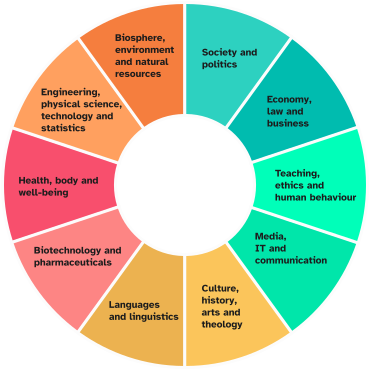
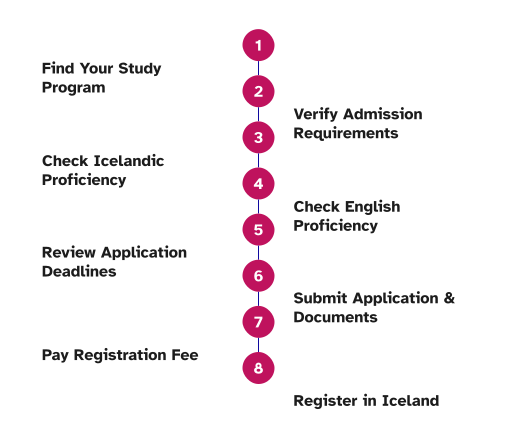
Additional information

The University of Iceland collaborates with over 400 universities worldwide. This provides a unique opportunity to pursue part of your studies at an international university thus gaining added experience and fresh insight into your field of study.

Students generally have the opportunity to join an exchange programme, internship, or summer courses. However, exchanges are always subject to faculty approval.

Students have the opportunity to have courses evaluated as part of their studies at the University of Iceland, so their stay does not have to affect the duration of their studies.

A degree in art history and theory is especially valuable if you want to work in the arts, e.g. in museums, galleries and cultural institutions.

It would also be an asset if you want to work in cultural media (journalism, art criticism, programme making), i.e. producing specialised content on the arts for the media.

Graduates could also teach art history in compulsory or upper secondary schools and/or work in research in the field. Careers in international affairs also increasingly demand knowledge of the art and culture in different countries.

For those who aspire to a career in research or academia, the programme provides a solid foundation for graduate studies abroad.

To use the professional title of art historian, students should have completed at least an MA degree in art history and theory.

An education in this area can open up opportunities in:

  • Museums and other cultural institutions
  • Cultural journalism
  • Art history teaching
  • Research
  • Web communication
  • This list is not exhaustive.

The organisation for art history students is called Artíma and plans a variety of social events, and also publishes an art magazine called Artímarit.

Most course are taken by a mixed group from UI and IUA and many events are organised jointly between the two universities

Students' comments
Portrait photo of Silja Pálmarsdóttir
After a BA in Art History, I pursued an MA in Visual Arts in Bologna, excelling in my studies. My career has included museum work and assisting in artist-run spaces. I now intern at Arts Santa Mònica, helping with curatorial tasks and exhibition preparation.
Aldís Arnardóttir
My master's degree in art history from the University of Iceland has been highly beneficial for various projects, including curating exhibitions, teaching, writing exhibition texts for artists, and publishing critiques in newspapers.
Edda Halldórsdóttir
In my role, knowledge of art history is crucial to understanding contemporary art. My studies in art history have given me this knowledge, covering both Icelandic and international art and cultural heritage.
Helpful content
Aurora Cooperation

Study wheel

What interests you?

Aurora Cooperation

How to apply

Follow the path

Contact us

If you still have questions, feel free to contact us.

School of Humanities
Weekdays: 10-12 am and 1-3 pm
General Service and Social Media

The Service Desk is a point of access for all services. You can drop in at the University Centre or use the WebChat at the bottom right of this page.

Follow the School of Humanities on Instagram,   Youtube
and Facebook

""

Share

Did this help?

Why wasn't this information helpful

Limit to 250 characters.