
""
Language skills
required, minimum level of B2
Programme length
One and a half year.
Study mode
Face-to-face learning
Application status
International students:
Students with Icelandic or Nordic citizenship:
Overview

  • Would you like to learn the basic principles of project management?
  • Would you like a programme with strong connections to the business community?
  • Would you like to work in project management or other management positions?
  • Do you want a programme that is both theoretical and practical?

Students will learn the basic principles of project management. The programme is designed to meet the growing demand for people who have the expertise required to manage major projects.

Students will acquire the skills needed to take on various positions with responsibility for project management, in the private and public sectors. Graduates will have a broad base of knowledge that can be applied in many different areas of work and research.

Programme structure

The programme is 90 ECTS and is organised as one and a half years of full-time study.

The programme is made up of:

  • Courses, 60 ECTS
  • Final project, 30 ECTS

The programme is designed to prepare students to manage challenging and complex projects.

Topics

Course topics include:

  • Decision making
  • Planning
  • Implementation
  • Follow up

Organisation of teaching

Students are expected to work independently from the start of the programme, to manage their own work and time and to meet all set deadlines.

Courses are taught in blocks of seven weeks. Two courses are taught during each block. Final exams are held in the eighth week.

This programme is taught in Icelandic but most textbooks are in English.

Main objectives

The programme aims to provide students with a thorough understanding of project management and both practical and research skills.

Other

Completing the programme allows you to apply for doctoral studies.

The requirements for admission are a BA, B.Ed or BS degree from university. As a general rule, applicants shall have completed their undergraduate studies with a first-class GPA (7.25 or above). Students are admitted to the programme based on their previous studies and work experience. Students who have not completed at least 36 ECTS in business administration or related field in their undergraduate studies shall, at the beginning of their studies, complete the preparatory course, VIÐ155M Introduction to Microeconomics and Corporate Finance, that course is not credited in the MS programme. Of the 36 ECTS no less than 24 ECTS shall be in the following subjects or comparable: Finance, Introduction to Financial Accounting, Microeconomics, Methodology, Introduction to Human Resource Management, Introduction to Management, Introduction to Project Management, Computer Use and Spreadsheet, Business Law.

90 ECTS credits have to be completed for the qualification including a thesis of at least 30 ECTS.


The following documents must accompany an application for this programme:
  • CV
  • Statement of purpose
  • Reference 1, Name and email
  • Reference 2, Name and email
  • Certified copies of diplomas and transcripts
  • Proof of English proficiency

Further information on supporting documents can be found here

Programme structure

Check below to see how the programme is structured.

This programme does not offer specialisations.

First year | Fall
Applied Statistics (VIÐ1ADF)
Restricted elective course, conditions apply
7,5 ECTS, credits
Course Description

The goal of this course is to strengthen the statistics and methodology knowledge of the students to enable them to better understand research methods and research findings. State-of-the-art research will be reviewed and the statistics and methodology required to conduct this research will be discussed. Students will also conduct their own research project in preparation for analytical work in their professional life and their Master’s thesis.

Language of instruction: Icelandic
Face-to-face learning
Course taught in period II
First year | Fall
Performance measurement and management (VIÐ1AGF)
A mandatory (required) course for the programme
7,5 ECTS, credits
Course Description

Performance management is a central part of every organisation and project. It helps to ensure our actions are aligned with our strategic priorities. This course will help students to connect the dots between strategic and operational levels in work settings, and how performance management philosophies and frameworks can be used by leaders and managers to ensure the achievement of our strategic objectives.

This course relies on case studies and in-class activities to take students as close as it is possible in a classroom setting to real-life scenarios where performance management can be used to support decision making towards achieving success.

 This course follows a hybrid structure. Half of the course is delivered online—students are provided flexibility and can watch pre-recorded lecture videos at their convenience. However, no later than indicated in the teaching plan.
The rest of the course material will be delivered in workshops that will be held on-campus, and must be attended in-person by the enrolled students. These workshops account for up to 70% of the grade (course assessments).

Language of instruction: English
Face-to-face learning
Course taught in period II
First year | Fall
Introduction to Microeconomics and Corporate Finance (VIÐ155M)
A mandatory (required) course for the programme
6 ECTS, credits
Course Description

This course provides an introduction at a master's level to the theory and practice of bussines. The aim is to prepare students for a variety of management tasks, both in the private and public sectors.

The course consists of five introductory modules:
Finance
Business law
Accounting
Macro economics
Micro economics 

Organisation

The course is offered twice a year, in August and in January and students should complete the course in the first year of their master studies. Students who start the programme in the autumn should sit the course in August, but can postpone doing so until January. Those beginning in January should preferably take the course in January, but may postpone doing so until August.

The course opens on the 1st of each month and closes on the 31st. All course material will be available on the course website on Canvas on the 1st.

The course cannot be used for credits in the master's programmes.

Language of instruction: Icelandic
Online learning
Prerequisites
First year | Fall
Project Management (VIÐ172F)
A mandatory (required) course for the programme
7,5 ECTS, credits
Course Description

The course covers both the management of individual projects and the management of projects in an organization. Both theoretical and practical aspects will be covered. Students will gain a good understanding of the elements of project work and project management in business operations and the ability to manage individual projects. Students will learn the structure of the program, progress, and termination of projects. Students will also learn to use software and technology for project management. Students are introduced to projects in an international environment and Agile ideology. The student will be an emphasis on putting on project management in Icelandic business environment and use of information technology.

Please note, students must log in and purchase the book Project Management, The Managerial Process on the McGraw-Hill website. Further information can be found on the course's Canvas page.

Language of instruction: Icelandic
Face-to-face learning
Course taught in period I
First year | Spring 1
Qualitative research methods (VIÐ2A4F)
Restricted elective course, conditions apply
7,5 ECTS, credits
Course Description

The goal of the course is to give students insight into qualitative research methods, and their use in gathering and analysing data on the individual and organizational level. Students will be trained in defining a research problems and presenting them in a research question. Students will further plan and execute data gathering and analysing, as well as presenting the findings in a written report. Students will learn about the strengths and weaknesses of qualitative research so as to be able to choose the best method to study a given problem.

Language of instruction: Icelandic
Face-to-face learning
Prerequisites
Course taught in period III
First year | Spring 1
Introduction to Microeconomics and Corporate Finance (VIÐ155M)
A mandatory (required) course for the programme
6 ECTS, credits
Course Description

This course provides an introduction at a master's level to the theory and practice of bussines. The aim is to prepare students for a variety of management tasks, both in the private and public sectors.

The course consists of five introductory modules:
Finance
Business law
Accounting
Macro economics
Micro economics 

Organisation

The course is offered twice a year, in August and in January and students should complete the coure in the first year of their master studies. Students that start the programme in the autumn should sit the course in August, but can postpone doing so until January. Those beginning in January should preferably take the course in January, but may postpone doing so until August.

The course opens on the 1st of each month and closes on the 31st. All course material will be available on the course website on Canvas on the 1st.

The course cannot be used for credits in the master's programmes.

Language of instruction: Icelandic
Online learning
Prerequisites
First year | Spring 1
Lean and Agile principles (VIÐ2A8F)
A mandatory (required) course for the programme
7,5 ECTS, credits
Course Description

This course provides students a practical guide towards Lean and Agile principles, and the application of the tools and techniques within these improvement philosophies.

This course follows a hybrid structure. Half of the course is delivered online—students are provided flexibility and can watch pre-recorded lecture videos at their convenience. However, no later than indicated in the teaching plan.
The rest of the course material will be delivered in workshops that will be held on-campus, and must be attended in-person by the enrolled students. These workshops account for up to 70% of the grade (course assessments).

Language of instruction: English
Face-to-face learning
Course taught in period III
First year | Spring 1
Organizational project management and international projects (VIÐ277F)
A mandatory (required) course for the programme
7,5 ECTS, credits
Course Description

The course emphasizes international projects and the management of project portfolios. Issues covered in Project management I/Project Management Methodology are covered in more depth and in relation to international projects and project portfolios. First, emphasis is put on the management of many projects at the same time, including project portfolio management, program management and the project management office. Second, emphasis is put on the management of international projects or project portfolios in international companies. The course emphasizes that students work together on projects and get to know project management in the Icelandic economy.

This course follows a hybrid structure. Half of the course is delivered online—students are provided flexibility and can watch pre-recorded lecture videos at their convenience. However, no later than indicated in the teaching plan.
The rest of the course material will be delivered in workshops that will be held on-campus, and must be attended in-person by the enrolled students. 

Language of instruction: English
Face-to-face learning
Course taught in period IV
Second year | Year unspecified
MS Thesis (VST101L, VST101L, VST101L)
A mandatory (required) course for the programme
30/30/30 ECTS, credits
Course Description

The topic of the master's thesis must be chosen after consulting the thesis advisor(s), who must be full-time faculty at the School of Business.

The thesis amounts to 30 credits and must be presented at a departmental seminar.

The thesis must be submitted online no later than the specified dates that are announced before each graduation. Grades for a master's thesis are awarded by the thesis advisor(s) and an outside reader.

Language of instruction: Icelandic
Self-study
Part of the total project/thesis credits
Second year | Year unspecified
MS Thesis (VST101L, VST101L, VST101L)
A mandatory (required) course for the programme
30/30/30 ECTS, credits
Course Description

The topic of the master's thesis must be chosen after consulting the thesis advisor(s), who must be full-time faculty at the School of Business.
The thesis amounts to 30 credits and must be presented at a departmental seminar.
The thesis must be submitted online no later than the specified dates that are announced before each graduation. Grades for a master's thesis are awarded by the thesis advisor(s) and an outside reader.

Language of instruction: Icelandic
Self-study
Part of the total project/thesis credits
Second year | Year unspecified
MS Thesis (VST101L, VST101L, VST101L)
A mandatory (required) course for the programme
30/30/30 ECTS, credits
Course Description

The topic of the master's thesis must be chosen after consulting the thesis advisor(s), who must be full-time faculty at the School of Business.

The thesis amounts to 30 credits and must be presented at a departmental seminar.

The thesis must be submitted online no later than the specified dates that are announced before each graduation. Grades for a master's thesis are awarded by the thesis advisor(s) and an outside reader.

Language of instruction: Icelandic
Self-study
Part of the total project/thesis credits
First year
  • Fall
  • VIÐ1ADF
    Applied Statistics
    Restricted elective course
    7,5
    Restricted elective course, conditions apply
    7,5 ECTS, credits
    Course Description

    The goal of this course is to strengthen the statistics and methodology knowledge of the students to enable them to better understand research methods and research findings. State-of-the-art research will be reviewed and the statistics and methodology required to conduct this research will be discussed. Students will also conduct their own research project in preparation for analytical work in their professional life and their Master’s thesis.

    Face-to-face learning
    Prerequisites
    Course taught in period II
  • VIÐ1AGF
    Performance measurement and management
    Mandatory (required) course
    7,5
    A mandatory (required) course for the programme
    7,5 ECTS, credits
    Course Description

    Performance management is a central part of every organisation and project. It helps to ensure our actions are aligned with our strategic priorities. This course will help students to connect the dots between strategic and operational levels in work settings, and how performance management philosophies and frameworks can be used by leaders and managers to ensure the achievement of our strategic objectives.

    This course relies on case studies and in-class activities to take students as close as it is possible in a classroom setting to real-life scenarios where performance management can be used to support decision making towards achieving success.

     This course follows a hybrid structure. Half of the course is delivered online—students are provided flexibility and can watch pre-recorded lecture videos at their convenience. However, no later than indicated in the teaching plan.
    The rest of the course material will be delivered in workshops that will be held on-campus, and must be attended in-person by the enrolled students. These workshops account for up to 70% of the grade (course assessments).

    Face-to-face learning
    Prerequisites
    Course taught in period II
  • VIÐ155M
    Introduction to Microeconomics and Corporate Finance
    Mandatory (required) course
    6
    A mandatory (required) course for the programme
    6 ECTS, credits
    Course Description

    This course provides an introduction at a master's level to the theory and practice of bussines. The aim is to prepare students for a variety of management tasks, both in the private and public sectors.

    The course consists of five introductory modules:
    Finance
    Business law
    Accounting
    Macro economics
    Micro economics 

    Organisation

    The course is offered twice a year, in August and in January and students should complete the course in the first year of their master studies. Students who start the programme in the autumn should sit the course in August, but can postpone doing so until January. Those beginning in January should preferably take the course in January, but may postpone doing so until August.

    The course opens on the 1st of each month and closes on the 31st. All course material will be available on the course website on Canvas on the 1st.

    The course cannot be used for credits in the master's programmes.

    Online learning
    Prerequisites
  • VIÐ172F
    Project Management
    Mandatory (required) course
    7,5
    A mandatory (required) course for the programme
    7,5 ECTS, credits
    Course Description

    The course covers both the management of individual projects and the management of projects in an organization. Both theoretical and practical aspects will be covered. Students will gain a good understanding of the elements of project work and project management in business operations and the ability to manage individual projects. Students will learn the structure of the program, progress, and termination of projects. Students will also learn to use software and technology for project management. Students are introduced to projects in an international environment and Agile ideology. The student will be an emphasis on putting on project management in Icelandic business environment and use of information technology.

    Please note, students must log in and purchase the book Project Management, The Managerial Process on the McGraw-Hill website. Further information can be found on the course's Canvas page.

    Face-to-face learning
    Prerequisites
    Course taught in period I
  • Spring 2
  • VIÐ2A4F
    Qualitative research methods
    Restricted elective course
    7,5
    Restricted elective course, conditions apply
    7,5 ECTS, credits
    Course Description

    The goal of the course is to give students insight into qualitative research methods, and their use in gathering and analysing data on the individual and organizational level. Students will be trained in defining a research problems and presenting them in a research question. Students will further plan and execute data gathering and analysing, as well as presenting the findings in a written report. Students will learn about the strengths and weaknesses of qualitative research so as to be able to choose the best method to study a given problem.

    Face-to-face learning
    Prerequisites
    Course taught in period III
  • VIÐ155M
    Introduction to Microeconomics and Corporate Finance
    Mandatory (required) course
    6
    A mandatory (required) course for the programme
    6 ECTS, credits
    Course Description

    This course provides an introduction at a master's level to the theory and practice of bussines. The aim is to prepare students for a variety of management tasks, both in the private and public sectors.

    The course consists of five introductory modules:
    Finance
    Business law
    Accounting
    Macro economics
    Micro economics 

    Organisation

    The course is offered twice a year, in August and in January and students should complete the coure in the first year of their master studies. Students that start the programme in the autumn should sit the course in August, but can postpone doing so until January. Those beginning in January should preferably take the course in January, but may postpone doing so until August.

    The course opens on the 1st of each month and closes on the 31st. All course material will be available on the course website on Canvas on the 1st.

    The course cannot be used for credits in the master's programmes.

    Online learning
    Prerequisites
  • VIÐ2A8F
    Lean and Agile principles
    Mandatory (required) course
    7,5
    A mandatory (required) course for the programme
    7,5 ECTS, credits
    Course Description

    This course provides students a practical guide towards Lean and Agile principles, and the application of the tools and techniques within these improvement philosophies.

    This course follows a hybrid structure. Half of the course is delivered online—students are provided flexibility and can watch pre-recorded lecture videos at their convenience. However, no later than indicated in the teaching plan.
    The rest of the course material will be delivered in workshops that will be held on-campus, and must be attended in-person by the enrolled students. These workshops account for up to 70% of the grade (course assessments).

    Face-to-face learning
    Prerequisites
    Course taught in period III
  • VIÐ277F
    Organizational project management and international projects
    Mandatory (required) course
    7,5
    A mandatory (required) course for the programme
    7,5 ECTS, credits
    Course Description

    The course emphasizes international projects and the management of project portfolios. Issues covered in Project management I/Project Management Methodology are covered in more depth and in relation to international projects and project portfolios. First, emphasis is put on the management of many projects at the same time, including project portfolio management, program management and the project management office. Second, emphasis is put on the management of international projects or project portfolios in international companies. The course emphasizes that students work together on projects and get to know project management in the Icelandic economy.

    This course follows a hybrid structure. Half of the course is delivered online—students are provided flexibility and can watch pre-recorded lecture videos at their convenience. However, no later than indicated in the teaching plan.
    The rest of the course material will be delivered in workshops that will be held on-campus, and must be attended in-person by the enrolled students. 

    Face-to-face learning
    Prerequisites
    Course taught in period IV
  • Year unspecified
  • VST101L, VST101L, VST101L
    MS Thesis
    Mandatory (required) course
    30/30/30
    A mandatory (required) course for the programme
    30/30/30 ECTS, credits
    Course Description

    The topic of the master's thesis must be chosen after consulting the thesis advisor(s), who must be full-time faculty at the School of Business.

    The thesis amounts to 30 credits and must be presented at a departmental seminar.

    The thesis must be submitted online no later than the specified dates that are announced before each graduation. Grades for a master's thesis are awarded by the thesis advisor(s) and an outside reader.

    Self-study
    Prerequisites
    Part of the total project/thesis credits
  • VST101L, VST101L, VST101L
    MS Thesis
    Mandatory (required) course
    30/30/30
    A mandatory (required) course for the programme
    30/30/30 ECTS, credits
    Course Description

    The topic of the master's thesis must be chosen after consulting the thesis advisor(s), who must be full-time faculty at the School of Business.
    The thesis amounts to 30 credits and must be presented at a departmental seminar.
    The thesis must be submitted online no later than the specified dates that are announced before each graduation. Grades for a master's thesis are awarded by the thesis advisor(s) and an outside reader.

    Self-study
    Prerequisites
    Part of the total project/thesis credits
  • VST101L, VST101L, VST101L
    MS Thesis
    Mandatory (required) course
    30/30/30
    A mandatory (required) course for the programme
    30/30/30 ECTS, credits
    Course Description

    The topic of the master's thesis must be chosen after consulting the thesis advisor(s), who must be full-time faculty at the School of Business.

    The thesis amounts to 30 credits and must be presented at a departmental seminar.

    The thesis must be submitted online no later than the specified dates that are announced before each graduation. Grades for a master's thesis are awarded by the thesis advisor(s) and an outside reader.

    Self-study
    Prerequisites
    Part of the total project/thesis credits
Second year
  • Fall
  • VIÐ1ADF
    Applied Statistics
    Restricted elective course
    7,5
    Restricted elective course, conditions apply
    7,5 ECTS, credits
    Course Description

    The goal of this course is to strengthen the statistics and methodology knowledge of the students to enable them to better understand research methods and research findings. State-of-the-art research will be reviewed and the statistics and methodology required to conduct this research will be discussed. Students will also conduct their own research project in preparation for analytical work in their professional life and their Master’s thesis.

    Face-to-face learning
    Prerequisites
    Course taught in period II
  • VIÐ1AGF
    Performance measurement and management
    Mandatory (required) course
    7,5
    A mandatory (required) course for the programme
    7,5 ECTS, credits
    Course Description

    Performance management is a central part of every organisation and project. It helps to ensure our actions are aligned with our strategic priorities. This course will help students to connect the dots between strategic and operational levels in work settings, and how performance management philosophies and frameworks can be used by leaders and managers to ensure the achievement of our strategic objectives.

    This course relies on case studies and in-class activities to take students as close as it is possible in a classroom setting to real-life scenarios where performance management can be used to support decision making towards achieving success.

     This course follows a hybrid structure. Half of the course is delivered online—students are provided flexibility and can watch pre-recorded lecture videos at their convenience. However, no later than indicated in the teaching plan.
    The rest of the course material will be delivered in workshops that will be held on-campus, and must be attended in-person by the enrolled students. These workshops account for up to 70% of the grade (course assessments).

    Face-to-face learning
    Prerequisites
    Course taught in period II
  • VIÐ155M
    Introduction to Microeconomics and Corporate Finance
    Mandatory (required) course
    6
    A mandatory (required) course for the programme
    6 ECTS, credits
    Course Description

    This course provides an introduction at a master's level to the theory and practice of bussines. The aim is to prepare students for a variety of management tasks, both in the private and public sectors.

    The course consists of five introductory modules:
    Finance
    Business law
    Accounting
    Macro economics
    Micro economics 

    Organisation

    The course is offered twice a year, in August and in January and students should complete the course in the first year of their master studies. Students who start the programme in the autumn should sit the course in August, but can postpone doing so until January. Those beginning in January should preferably take the course in January, but may postpone doing so until August.

    The course opens on the 1st of each month and closes on the 31st. All course material will be available on the course website on Canvas on the 1st.

    The course cannot be used for credits in the master's programmes.

    Online learning
    Prerequisites
  • VIÐ172F
    Project Management
    Mandatory (required) course
    7,5
    A mandatory (required) course for the programme
    7,5 ECTS, credits
    Course Description

    The course covers both the management of individual projects and the management of projects in an organization. Both theoretical and practical aspects will be covered. Students will gain a good understanding of the elements of project work and project management in business operations and the ability to manage individual projects. Students will learn the structure of the program, progress, and termination of projects. Students will also learn to use software and technology for project management. Students are introduced to projects in an international environment and Agile ideology. The student will be an emphasis on putting on project management in Icelandic business environment and use of information technology.

    Please note, students must log in and purchase the book Project Management, The Managerial Process on the McGraw-Hill website. Further information can be found on the course's Canvas page.

    Face-to-face learning
    Prerequisites
    Course taught in period I
  • Spring 2
  • VIÐ2A4F
    Qualitative research methods
    Restricted elective course
    7,5
    Restricted elective course, conditions apply
    7,5 ECTS, credits
    Course Description

    The goal of the course is to give students insight into qualitative research methods, and their use in gathering and analysing data on the individual and organizational level. Students will be trained in defining a research problems and presenting them in a research question. Students will further plan and execute data gathering and analysing, as well as presenting the findings in a written report. Students will learn about the strengths and weaknesses of qualitative research so as to be able to choose the best method to study a given problem.

    Face-to-face learning
    Prerequisites
    Course taught in period III
  • VIÐ155M
    Introduction to Microeconomics and Corporate Finance
    Mandatory (required) course
    6
    A mandatory (required) course for the programme
    6 ECTS, credits
    Course Description

    This course provides an introduction at a master's level to the theory and practice of bussines. The aim is to prepare students for a variety of management tasks, both in the private and public sectors.

    The course consists of five introductory modules:
    Finance
    Business law
    Accounting
    Macro economics
    Micro economics 

    Organisation

    The course is offered twice a year, in August and in January and students should complete the coure in the first year of their master studies. Students that start the programme in the autumn should sit the course in August, but can postpone doing so until January. Those beginning in January should preferably take the course in January, but may postpone doing so until August.

    The course opens on the 1st of each month and closes on the 31st. All course material will be available on the course website on Canvas on the 1st.

    The course cannot be used for credits in the master's programmes.

    Online learning
    Prerequisites
  • VIÐ2A8F
    Lean and Agile principles
    Mandatory (required) course
    7,5
    A mandatory (required) course for the programme
    7,5 ECTS, credits
    Course Description

    This course provides students a practical guide towards Lean and Agile principles, and the application of the tools and techniques within these improvement philosophies.

    This course follows a hybrid structure. Half of the course is delivered online—students are provided flexibility and can watch pre-recorded lecture videos at their convenience. However, no later than indicated in the teaching plan.
    The rest of the course material will be delivered in workshops that will be held on-campus, and must be attended in-person by the enrolled students. These workshops account for up to 70% of the grade (course assessments).

    Face-to-face learning
    Prerequisites
    Course taught in period III
  • VIÐ277F
    Organizational project management and international projects
    Mandatory (required) course
    7,5
    A mandatory (required) course for the programme
    7,5 ECTS, credits
    Course Description

    The course emphasizes international projects and the management of project portfolios. Issues covered in Project management I/Project Management Methodology are covered in more depth and in relation to international projects and project portfolios. First, emphasis is put on the management of many projects at the same time, including project portfolio management, program management and the project management office. Second, emphasis is put on the management of international projects or project portfolios in international companies. The course emphasizes that students work together on projects and get to know project management in the Icelandic economy.

    This course follows a hybrid structure. Half of the course is delivered online—students are provided flexibility and can watch pre-recorded lecture videos at their convenience. However, no later than indicated in the teaching plan.
    The rest of the course material will be delivered in workshops that will be held on-campus, and must be attended in-person by the enrolled students. 

    Face-to-face learning
    Prerequisites
    Course taught in period IV
  • Year unspecified
  • VST101L, VST101L, VST101L
    MS Thesis
    Mandatory (required) course
    30/30/30
    A mandatory (required) course for the programme
    30/30/30 ECTS, credits
    Course Description

    The topic of the master's thesis must be chosen after consulting the thesis advisor(s), who must be full-time faculty at the School of Business.

    The thesis amounts to 30 credits and must be presented at a departmental seminar.

    The thesis must be submitted online no later than the specified dates that are announced before each graduation. Grades for a master's thesis are awarded by the thesis advisor(s) and an outside reader.

    Self-study
    Prerequisites
    Part of the total project/thesis credits
  • VST101L, VST101L, VST101L
    MS Thesis
    Mandatory (required) course
    30/30/30
    A mandatory (required) course for the programme
    30/30/30 ECTS, credits
    Course Description

    The topic of the master's thesis must be chosen after consulting the thesis advisor(s), who must be full-time faculty at the School of Business.
    The thesis amounts to 30 credits and must be presented at a departmental seminar.
    The thesis must be submitted online no later than the specified dates that are announced before each graduation. Grades for a master's thesis are awarded by the thesis advisor(s) and an outside reader.

    Self-study
    Prerequisites
    Part of the total project/thesis credits
  • VST101L, VST101L, VST101L
    MS Thesis
    Mandatory (required) course
    30/30/30
    A mandatory (required) course for the programme
    30/30/30 ECTS, credits
    Course Description

    The topic of the master's thesis must be chosen after consulting the thesis advisor(s), who must be full-time faculty at the School of Business.

    The thesis amounts to 30 credits and must be presented at a departmental seminar.

    The thesis must be submitted online no later than the specified dates that are announced before each graduation. Grades for a master's thesis are awarded by the thesis advisor(s) and an outside reader.

    Self-study
    Prerequisites
    Part of the total project/thesis credits

The timetable shown below is for the current academic year and is FOR REFERENCE ONLY.

Changes may occur for the autumn semester in August and September and for the spring semester in December and January. You will find your final timetable in Ugla when the studies start.

Note! This timetable is not suitable for planning your work schedule if you are a part-time employee.



Additional information

The University of Iceland collaborates with over 400 universities worldwide. This provides a unique opportunity to pursue part of your studies at an international university thus gaining added experience and fresh insight into your field of study.

Students generally have the opportunity to join an exchange programme, internship, or summer courses. However, exchanges are always subject to faculty approval.

Students have the opportunity to have courses evaluated as part of their studies at the University of Iceland, so their stay does not have to affect the duration of their studies.

Graduates are well equipped to take on managing roles with responsibilities and tasks related to project management, both in the private and public sectors.

  • MAESTRO is the organisation for Master's students at the University of Iceland, Faculty of Business Administration and Faculty of Economics.
  • The role and purpose of MAESTRO is to advocate for members' interests and make their time at UI more enjoyable and productive. MAESTRO provides students with useful information, maintains a good working relationship with the University and faculties, as well as encouraging students to socialise together and build connections.
  • MAESTRO page on Facebook

More about the UI student's social life.

Student´s comments
Portrait photo of Linda Björk Hávarðardóttir
Studying project management provided me with valuable tools and self-awareness as a manager. The programme's versatility and variety of courses are beneficial in both professional and personal contexts.
Portrait photo of Margrét Lúthersdóttir
Project management is practical with a strong theoretical base, useful for both professional and personal projects. The programme connects well with industry through presentations and field trips, offering diverse career opportunities. It has greatly benefited my work as a project manager.
Cecilie Gaihede
With a background in humanities, I chose project management to enhance my job prospects. The course "Introduction to Management" allowed me to enter the Master's programme in the Business School, which was a turning point. I learned a lot about myself and working with others. The teaching was dedicated, varied, and enjoyable. The programme required full effort and preparation, but the tools and methodologies I learned are practical and have helped me solve complex tasks efficiently. The programme significantly aided my job search, leading to my dream job.
Helpful content
Aurora Cooperation

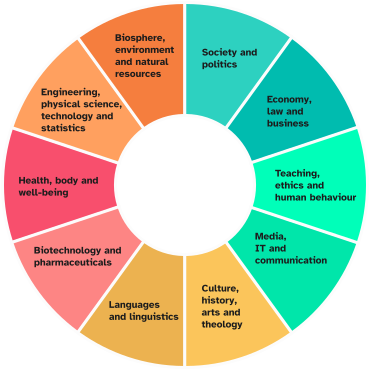
Study wheel

What interests you?

Aurora Cooperation

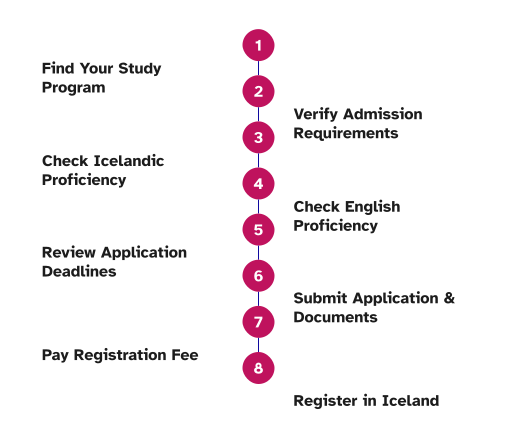
How to apply

Follow the path

Contact us

If you still have questions, feel free to contact us.

School of Social Sciences
Weekdays 9 am - 3 pm
Student and Teaching Service

The School office offers support to students and lecturers, providing guidance, counselling, and assistance with various matters. 

You are welcome to drop by at the office in Gimli or you can book an online meeting in Teams with the staff.

1920_KRI_gimli_200828_001.jpg

Share

Did this help?

Why wasn't this information helpful

Limit to 250 characters.