""
Language skills
required, minimum level of B2
Programme length
One and a half year.
Study mode
Face-to-face learning
Application status
International students:
Students with Icelandic or Nordic citizenship:
Overview

  • Do you want to improve your leadership skills?
  • Do you think it is important that managers are familiar with the latest knowledge in the field of leadership and administration?
  • Would you like an international programme with strong connections to the business community?
  • Would you like to work as a manager?

In the Master’s programme in Management and Strategy, students engage with the core theories, concepts, and research in strategy, corporate governance, leadership, and change management. The programme emphasises understanding how strategy, governance, and change are linked to organisational performance, competitiveness, and sustainable development, and how the external and internal environment, ownership, and organisational structure shape strategy and its implementation. The programme also examines different contexts and approaches across the private, public, and third sectors.

Strong emphasis is placed on critical thinking, data-driven analysis, and practical application. Students learn to apply theoretical models and analytical tools to organisational analysis, develop well-founded options for strategy, governance, and change, and communicate results clearly and professionally in both written and oral form. Methods courses provide targeted preparation for data collection, analysis, and informed decision-making—both in research and in professional practice.

The programme is designed to provide strong preparation for managerial roles that require strategic decision-making in complex, rapidly changing environments. It strengthens students’ independent, critical judgment and prepares them to lead strategy development, strategy implementation, and change management in collaboration with diverse stakeholders.

Programme structure

The programme is made up of:

  • Courses, 60 ECTS
  • Final project, 30 ECTS

Teaching is designed to ensure that students develop both academic depth and practical capability: the ability to analyse strategic challenges using qualitative or quantitative data, present well-reasoned alternatives, and work systematically on the implementation of strategy and organisational change.

Course topics include:

  • Strategic management
  • Corporate governance
  • Leadership and change management
  • Organisational design and structure
  • Innovation
  • Knowledge management
  • Project management
  • Performance management

Organisation of teaching

Students are expected to work independently, manage their time effectively, and meet the deadlines set by the programme.

Teaching follows a modular block system, with each block lasting seven weeks. Two courses are taught in parallel. In general, the final exam takes place in the eighth week.

The programme is taught in Icelandic, but most teaching materials are in English.

Main objectives

The programme aims for students to:

  • build knowledge of strategy, corporate governance, leadership, and change management,
  • develop skills in critical, data-driven analysis and in formulating well-founded strategy,
  • develop the competence to lead strategy development and the implementation of change with professional responsibility, taking into account diversity, inclusion, and social responsibility.

Other

Completing the programme allows you to apply for doctoral studies.

The requirements for admission are a BA, B.Ed or BS degree from university. As a general rule, applicants shall have completed their undergraduate studies with a first-class GPA (7.25 or above). Students are admitted to the programme based on their previous studies and work experience. Students who have not completed at least 36 ECTS in business administration or related field in their undergraduate studies shall, at the beginning of their studies, complete the preparatory course, VIÐ155M Introduction to Microeconomics and Corporate Finance, the course does not count towards degree. Of the 36 ECTS no less than 24 ECTS shall be in the following subjects or comparable: Finance, Introduction to Financial Accounting, Microeconomics, Methodology, Introduction to Human Resource Management, Introduction to Management, Introduction to Project Management, Computer Use and Spreadsheet, Business Law.

90 ECTS credits have to be completed for the qualification including a thesis of 30 ECTS.

The following documents must accompany an application for this programme:
  • CV
  • Statement of purpose
  • Reference 1, Name and email
  • Reference 2, Name and email
  • Certified copies of diplomas and transcripts
  • Proof of English proficiency

Further information on supporting documents can be found here

Programme structure

Check below to see how the programme is structured.

This programme does not offer specialisations.

First year | Fall
Applied Statistics (VIÐ1ADF)
Restricted elective course, conditions apply
7,5 ECTS, credits
Course Description

The goal of this course is to strengthen the statistics and methodology knowledge of the students to enable them to better understand research methods and research findings. State-of-the-art research will be reviewed and the statistics and methodology required to conduct this research will be discussed. Students will also conduct their own research project in preparation for analytical work in their professional life and their Master’s thesis.

Language of instruction: Icelandic
Face-to-face learning
Course taught in period II
First year | Fall
Leadership and Communication (VIÐ182F)
A mandatory (required) course for the programme
7,5 ECTS, credits
Course Description

In the foreground throughout the course is the role of the manager, at all levels of the hierarchy, its nature and its challenges. Human resource issues and communication are the focus area and connected to all of the course topics and assignments. The leadership role of the manager is examined; particularly in relation to general human resource management and the management of employees through reform projects and radical changes. Leadership is also examined in relation to successful teamwork and approaches to managing and solving conflicts and challenging human resource issues.

The main objective of the course is that the students gain knowledge of the meaning of the key concepts and a solid understanding of the theoretical principles, methods, and options that the manager can employ in order to successfully fulfil his/her role. Diverse teaching methods are used to encourage the interest, interaction, and participation of students.

Language of instruction: Icelandic
Face-to-face learning
Prerequisites
Course taught in period I
First year | Fall
Corporate Governance (VIÐ198F)
A mandatory (required) course for the programme
7,5 ECTS, credits
Course Description

The course provides both theoretical and practical understanding of corporate governance and its relationship to firm performance. In the course, students develop the ability to identify, analyze, and interpret complex issues related to governance, assess how governance practices shape the behavior of boards and top executives, and critically evaluate how different governance structures are likely to affect organizational performance and competitive position.

The course introduces key theoretical frameworks and research in the field of corporate governance and emphasizes the analysis of how different governance systems, including varying ownership structures, organizational forms, board practices, legal and institutional environments, as well as managerial incentive and reward systems, can help address agency problems. Connections are made to corporate strategy, change management, and strategy implementation.

Language of instruction: English
Face-to-face learning
Course taught in period II
First year | Fall
Introduction to Microeconomics and Corporate Finance (VIÐ155M)
A mandatory (required) course for the programme
6 ECTS, credits
Course Description

This course provides an introduction at a master's level to the theory and practice of bussines. The aim is to prepare students for a variety of management tasks, both in the private and public sectors.

The course consists of five introductory modules:
Finance
Business law
Accounting
Macro economics
Micro economics 

Organisation

The course is offered twice a year, in August and in January and students should complete the course in the first year of their master studies. Students who start the programme in the autumn should sit the course in August, but can postpone doing so until January. Those beginning in January should preferably take the course in January, but may postpone doing so until August.

The course opens on the 1st of each month and closes on the 31st. All course material will be available on the course website on Canvas on the 1st.

The course cannot be used for credits in the master's programmes.

Language of instruction: Icelandic
Online learning
Prerequisites
First year | Spring 1
Qualitative research methods (VIÐ2A4F)
Restricted elective course, conditions apply
7,5 ECTS, credits
Course Description

The goal of the course is to give students insight into qualitative research methods, and their use in gathering and analysing data on the individual and organizational level. Students will be trained in defining a research problems and presenting them in a research question. Students will further plan and execute data gathering and analysing, as well as presenting the findings in a written report. Students will learn about the strengths and weaknesses of qualitative research so as to be able to choose the best method to study a given problem.

Language of instruction: Icelandic
Face-to-face learning
Prerequisites
Course taught in period III
First year | Spring 1
Change Management and Strategy Execution (VIÐ2A5F)
A mandatory (required) course for the programme
7,5 ECTS, credits
Course Description

In this course, the main aspects of change management are covered, including the implementation of change, employee responses, the main barriers to change, and the restraining and driving forces at work in the change process. The course explores in depth the theories and methods on which change management is based, and discusses the most common solutions and approaches used in managing change. The roles of leaders, managers in general, and middle managers in change and crisis management will be examined. The course also addresses organizational culture and why it is an important factor in the change process. The course examines change management as a key element of strategic management and corporate governance. Emphasis is placed on the principal theories, models, and methods of change management, and on how they relate to strategy formulation, implementation, and follow-up within organizations. Students develop the ability to analyze and evaluate change processes in light of organizational design, execution, and human factors, including employee responses, organizational culture, and the driving and restraining forces that influence the success of change. Particular emphasis is placed on the role of leaders, managers, and boards of directors, and on their responsibility for strategic leadership, good corporate governance, and the credible implementation of change. In the course, students work with real-world examples and case studies, applying recognized change-management tools to translate strategic decisions into practical actions and organizational change. The course also covers crisis management and how to respond to unexpected shocks in a strategic and structured manner. Teaching is based on lectures, discussions, individual and group assignments, and aims to support critical thinking, practical skills, and independent analysis. The course requires active student participation and connects academic concepts to real-world challenges in managing change, with the goal of developing a coherent and practical approach to change management in a complex, constantly evolving operating environment.

Language of instruction: Icelandic
Face-to-face learning
Course taught in period IV
First year | Spring 1
Introduction to Microeconomics and Corporate Finance (VIÐ155M)
A mandatory (required) course for the programme
6 ECTS, credits
Course Description

This course provides an introduction at a master's level to the theory and practice of bussines. The aim is to prepare students for a variety of management tasks, both in the private and public sectors.

The course consists of five introductory modules:
Finance
Business law
Accounting
Macro economics
Micro economics 

Organisation

The course is offered twice a year, in August and in January and students should complete the coure in the first year of their master studies. Students that start the programme in the autumn should sit the course in August, but can postpone doing so until January. Those beginning in January should preferably take the course in January, but may postpone doing so until August.

The course opens on the 1st of each month and closes on the 31st. All course material will be available on the course website on Canvas on the 1st.

The course cannot be used for credits in the master's programmes.

Language of instruction: Icelandic
Online learning
Prerequisites
First year | Spring 1
Strategic Management (VIÐ265F)
A mandatory (required) course for the programme
7,5 ECTS, credits
Course Description

The course is designed, through lectures and discussion of the course material, to enable students to acquire knowledge of strategy and strategic management based on the diverse theoretical foundations that exist within the field. Through work with case studies and Icelandic real‑world examples, students are systematically encouraged to develop their skills and competencies in this area.

The course examines strategic management from several perspectives and across different types of organizations. Considerable attention is given to situational analysis and the assessment of both the external and internal environment, the formulation of strategy, and the practical implementation and progression of strategic work. The course delves into strategy from viewpoints including innovation, mergers, collaboration, power, and stakeholder interests.

The teaching approach reflects the understanding that learning is a process aimed at improving competence, where course content, context, and learning progression interact. All activities in the course are designed to support students in achieving the best possible learning outcomes — although success naturally depends on the student’s engagement and consistent effort.

Language of instruction: Icelandic
Face-to-face learning
Course taught in period III
Second year | Year unspecified
MS-Thesis (SSM431L, SSM431L, SSM431L)
A mandatory (required) course for the programme
0/0/0 ECTS, credits
Course Description

The topic of the master's thesis must be chosen after consulting the thesis advisor(s), who must be full-time faculty at the School of Business.

The thesis amounts to 30 credits and must be presented at a departmental seminar.

The thesis must be submitted online no later than the specified dates that are announced before each graduation. Grades for a master's thesis are awarded by the thesis advisor(s) and an outside reader.

Language of instruction: Icelandic
Second year | Year unspecified
MS-Thesis (SSM431L, SSM431L, SSM431L)
A mandatory (required) course for the programme
0/0/0 ECTS, credits
Course Description

The topic of the master's thesis must be chosen after consulting the thesis advisor(s), who must be full-time faculty at the School of Business.

The thesis amounts to 30 credits and must be presented at a departmental seminar.

The thesis must be submitted online no later than the specified dates that are announced before each graduation. Grades for a master's thesis are awarded by the thesis advisor(s) and an outside reader.

Language of instruction: Icelandic
Second year | Year unspecified
MS-Thesis (SSM431L, SSM431L, SSM431L)
A mandatory (required) course for the programme
0/0/0 ECTS, credits
Course Description

The topic of the master's thesis must be chosen after consulting the thesis advisor(s), who must be full-time faculty at the School of Business.

The thesis amounts to 30 credits and must be presented at a departmental seminar.

The thesis must be submitted online no later than the specified dates that are announced before each graduation. Grades for a master's thesis are awarded by the thesis advisor(s) and an outside reader.

Language of instruction: Icelandic
First year
  • Fall
  • VIÐ1ADF
    Applied Statistics
    Restricted elective course
    7,5
    Restricted elective course, conditions apply
    7,5 ECTS, credits
    Course Description

    The goal of this course is to strengthen the statistics and methodology knowledge of the students to enable them to better understand research methods and research findings. State-of-the-art research will be reviewed and the statistics and methodology required to conduct this research will be discussed. Students will also conduct their own research project in preparation for analytical work in their professional life and their Master’s thesis.

    Face-to-face learning
    Prerequisites
    Course taught in period II
  • VIÐ182F
    Leadership and Communication
    Mandatory (required) course
    7,5
    A mandatory (required) course for the programme
    7,5 ECTS, credits
    Course Description

    In the foreground throughout the course is the role of the manager, at all levels of the hierarchy, its nature and its challenges. Human resource issues and communication are the focus area and connected to all of the course topics and assignments. The leadership role of the manager is examined; particularly in relation to general human resource management and the management of employees through reform projects and radical changes. Leadership is also examined in relation to successful teamwork and approaches to managing and solving conflicts and challenging human resource issues.

    The main objective of the course is that the students gain knowledge of the meaning of the key concepts and a solid understanding of the theoretical principles, methods, and options that the manager can employ in order to successfully fulfil his/her role. Diverse teaching methods are used to encourage the interest, interaction, and participation of students.

    Face-to-face learning
    Prerequisites
    Course taught in period I
  • VIÐ198F
    Corporate Governance
    Mandatory (required) course
    7,5
    A mandatory (required) course for the programme
    7,5 ECTS, credits
    Course Description

    The course provides both theoretical and practical understanding of corporate governance and its relationship to firm performance. In the course, students develop the ability to identify, analyze, and interpret complex issues related to governance, assess how governance practices shape the behavior of boards and top executives, and critically evaluate how different governance structures are likely to affect organizational performance and competitive position.

    The course introduces key theoretical frameworks and research in the field of corporate governance and emphasizes the analysis of how different governance systems, including varying ownership structures, organizational forms, board practices, legal and institutional environments, as well as managerial incentive and reward systems, can help address agency problems. Connections are made to corporate strategy, change management, and strategy implementation.

    Face-to-face learning
    Prerequisites
    Course taught in period II
  • VIÐ155M
    Introduction to Microeconomics and Corporate Finance
    Mandatory (required) course
    6
    A mandatory (required) course for the programme
    6 ECTS, credits
    Course Description

    This course provides an introduction at a master's level to the theory and practice of bussines. The aim is to prepare students for a variety of management tasks, both in the private and public sectors.

    The course consists of five introductory modules:
    Finance
    Business law
    Accounting
    Macro economics
    Micro economics 

    Organisation

    The course is offered twice a year, in August and in January and students should complete the course in the first year of their master studies. Students who start the programme in the autumn should sit the course in August, but can postpone doing so until January. Those beginning in January should preferably take the course in January, but may postpone doing so until August.

    The course opens on the 1st of each month and closes on the 31st. All course material will be available on the course website on Canvas on the 1st.

    The course cannot be used for credits in the master's programmes.

    Online learning
    Prerequisites
  • Spring 2
  • VIÐ2A4F
    Qualitative research methods
    Restricted elective course
    7,5
    Restricted elective course, conditions apply
    7,5 ECTS, credits
    Course Description

    The goal of the course is to give students insight into qualitative research methods, and their use in gathering and analysing data on the individual and organizational level. Students will be trained in defining a research problems and presenting them in a research question. Students will further plan and execute data gathering and analysing, as well as presenting the findings in a written report. Students will learn about the strengths and weaknesses of qualitative research so as to be able to choose the best method to study a given problem.

    Face-to-face learning
    Prerequisites
    Course taught in period III
  • VIÐ2A5F
    Change Management and Strategy Execution
    Mandatory (required) course
    7,5
    A mandatory (required) course for the programme
    7,5 ECTS, credits
    Course Description

    In this course, the main aspects of change management are covered, including the implementation of change, employee responses, the main barriers to change, and the restraining and driving forces at work in the change process. The course explores in depth the theories and methods on which change management is based, and discusses the most common solutions and approaches used in managing change. The roles of leaders, managers in general, and middle managers in change and crisis management will be examined. The course also addresses organizational culture and why it is an important factor in the change process. The course examines change management as a key element of strategic management and corporate governance. Emphasis is placed on the principal theories, models, and methods of change management, and on how they relate to strategy formulation, implementation, and follow-up within organizations. Students develop the ability to analyze and evaluate change processes in light of organizational design, execution, and human factors, including employee responses, organizational culture, and the driving and restraining forces that influence the success of change. Particular emphasis is placed on the role of leaders, managers, and boards of directors, and on their responsibility for strategic leadership, good corporate governance, and the credible implementation of change. In the course, students work with real-world examples and case studies, applying recognized change-management tools to translate strategic decisions into practical actions and organizational change. The course also covers crisis management and how to respond to unexpected shocks in a strategic and structured manner. Teaching is based on lectures, discussions, individual and group assignments, and aims to support critical thinking, practical skills, and independent analysis. The course requires active student participation and connects academic concepts to real-world challenges in managing change, with the goal of developing a coherent and practical approach to change management in a complex, constantly evolving operating environment.

    Face-to-face learning
    Prerequisites
    Course taught in period IV
  • VIÐ155M
    Introduction to Microeconomics and Corporate Finance
    Mandatory (required) course
    6
    A mandatory (required) course for the programme
    6 ECTS, credits
    Course Description

    This course provides an introduction at a master's level to the theory and practice of bussines. The aim is to prepare students for a variety of management tasks, both in the private and public sectors.

    The course consists of five introductory modules:
    Finance
    Business law
    Accounting
    Macro economics
    Micro economics 

    Organisation

    The course is offered twice a year, in August and in January and students should complete the coure in the first year of their master studies. Students that start the programme in the autumn should sit the course in August, but can postpone doing so until January. Those beginning in January should preferably take the course in January, but may postpone doing so until August.

    The course opens on the 1st of each month and closes on the 31st. All course material will be available on the course website on Canvas on the 1st.

    The course cannot be used for credits in the master's programmes.

    Online learning
    Prerequisites
  • VIÐ265F
    Strategic Management
    Mandatory (required) course
    7,5
    A mandatory (required) course for the programme
    7,5 ECTS, credits
    Course Description

    The course is designed, through lectures and discussion of the course material, to enable students to acquire knowledge of strategy and strategic management based on the diverse theoretical foundations that exist within the field. Through work with case studies and Icelandic real‑world examples, students are systematically encouraged to develop their skills and competencies in this area.

    The course examines strategic management from several perspectives and across different types of organizations. Considerable attention is given to situational analysis and the assessment of both the external and internal environment, the formulation of strategy, and the practical implementation and progression of strategic work. The course delves into strategy from viewpoints including innovation, mergers, collaboration, power, and stakeholder interests.

    The teaching approach reflects the understanding that learning is a process aimed at improving competence, where course content, context, and learning progression interact. All activities in the course are designed to support students in achieving the best possible learning outcomes — although success naturally depends on the student’s engagement and consistent effort.

    Face-to-face learning
    Prerequisites
    Course taught in period III
  • Year unspecified
  • SSM431L, SSM431L, SSM431L
    MS-Thesis
    Mandatory (required) course
    0/0/0
    A mandatory (required) course for the programme
    0/0/0 ECTS, credits
    Course Description

    The topic of the master's thesis must be chosen after consulting the thesis advisor(s), who must be full-time faculty at the School of Business.

    The thesis amounts to 30 credits and must be presented at a departmental seminar.

    The thesis must be submitted online no later than the specified dates that are announced before each graduation. Grades for a master's thesis are awarded by the thesis advisor(s) and an outside reader.

    Prerequisites
  • SSM431L, SSM431L, SSM431L
    MS-Thesis
    Mandatory (required) course
    0/0/0
    A mandatory (required) course for the programme
    0/0/0 ECTS, credits
    Course Description

    The topic of the master's thesis must be chosen after consulting the thesis advisor(s), who must be full-time faculty at the School of Business.

    The thesis amounts to 30 credits and must be presented at a departmental seminar.

    The thesis must be submitted online no later than the specified dates that are announced before each graduation. Grades for a master's thesis are awarded by the thesis advisor(s) and an outside reader.

    Prerequisites
  • SSM431L, SSM431L, SSM431L
    MS-Thesis
    Mandatory (required) course
    0/0/0
    A mandatory (required) course for the programme
    0/0/0 ECTS, credits
    Course Description

    The topic of the master's thesis must be chosen after consulting the thesis advisor(s), who must be full-time faculty at the School of Business.

    The thesis amounts to 30 credits and must be presented at a departmental seminar.

    The thesis must be submitted online no later than the specified dates that are announced before each graduation. Grades for a master's thesis are awarded by the thesis advisor(s) and an outside reader.

    Prerequisites
Second year
  • Fall
  • VIÐ1ADF
    Applied Statistics
    Restricted elective course
    7,5
    Restricted elective course, conditions apply
    7,5 ECTS, credits
    Course Description

    The goal of this course is to strengthen the statistics and methodology knowledge of the students to enable them to better understand research methods and research findings. State-of-the-art research will be reviewed and the statistics and methodology required to conduct this research will be discussed. Students will also conduct their own research project in preparation for analytical work in their professional life and their Master’s thesis.

    Face-to-face learning
    Prerequisites
    Course taught in period II
  • VIÐ182F
    Leadership and Communication
    Mandatory (required) course
    7,5
    A mandatory (required) course for the programme
    7,5 ECTS, credits
    Course Description

    In the foreground throughout the course is the role of the manager, at all levels of the hierarchy, its nature and its challenges. Human resource issues and communication are the focus area and connected to all of the course topics and assignments. The leadership role of the manager is examined; particularly in relation to general human resource management and the management of employees through reform projects and radical changes. Leadership is also examined in relation to successful teamwork and approaches to managing and solving conflicts and challenging human resource issues.

    The main objective of the course is that the students gain knowledge of the meaning of the key concepts and a solid understanding of the theoretical principles, methods, and options that the manager can employ in order to successfully fulfil his/her role. Diverse teaching methods are used to encourage the interest, interaction, and participation of students.

    Face-to-face learning
    Prerequisites
    Course taught in period I
  • VIÐ198F
    Corporate Governance
    Mandatory (required) course
    7,5
    A mandatory (required) course for the programme
    7,5 ECTS, credits
    Course Description

    The course provides both theoretical and practical understanding of corporate governance and its relationship to firm performance. In the course, students develop the ability to identify, analyze, and interpret complex issues related to governance, assess how governance practices shape the behavior of boards and top executives, and critically evaluate how different governance structures are likely to affect organizational performance and competitive position.

    The course introduces key theoretical frameworks and research in the field of corporate governance and emphasizes the analysis of how different governance systems, including varying ownership structures, organizational forms, board practices, legal and institutional environments, as well as managerial incentive and reward systems, can help address agency problems. Connections are made to corporate strategy, change management, and strategy implementation.

    Face-to-face learning
    Prerequisites
    Course taught in period II
  • VIÐ155M
    Introduction to Microeconomics and Corporate Finance
    Mandatory (required) course
    6
    A mandatory (required) course for the programme
    6 ECTS, credits
    Course Description

    This course provides an introduction at a master's level to the theory and practice of bussines. The aim is to prepare students for a variety of management tasks, both in the private and public sectors.

    The course consists of five introductory modules:
    Finance
    Business law
    Accounting
    Macro economics
    Micro economics 

    Organisation

    The course is offered twice a year, in August and in January and students should complete the course in the first year of their master studies. Students who start the programme in the autumn should sit the course in August, but can postpone doing so until January. Those beginning in January should preferably take the course in January, but may postpone doing so until August.

    The course opens on the 1st of each month and closes on the 31st. All course material will be available on the course website on Canvas on the 1st.

    The course cannot be used for credits in the master's programmes.

    Online learning
    Prerequisites
  • Spring 2
  • VIÐ2A4F
    Qualitative research methods
    Restricted elective course
    7,5
    Restricted elective course, conditions apply
    7,5 ECTS, credits
    Course Description

    The goal of the course is to give students insight into qualitative research methods, and their use in gathering and analysing data on the individual and organizational level. Students will be trained in defining a research problems and presenting them in a research question. Students will further plan and execute data gathering and analysing, as well as presenting the findings in a written report. Students will learn about the strengths and weaknesses of qualitative research so as to be able to choose the best method to study a given problem.

    Face-to-face learning
    Prerequisites
    Course taught in period III
  • VIÐ2A5F
    Change Management and Strategy Execution
    Mandatory (required) course
    7,5
    A mandatory (required) course for the programme
    7,5 ECTS, credits
    Course Description

    In this course, the main aspects of change management are covered, including the implementation of change, employee responses, the main barriers to change, and the restraining and driving forces at work in the change process. The course explores in depth the theories and methods on which change management is based, and discusses the most common solutions and approaches used in managing change. The roles of leaders, managers in general, and middle managers in change and crisis management will be examined. The course also addresses organizational culture and why it is an important factor in the change process. The course examines change management as a key element of strategic management and corporate governance. Emphasis is placed on the principal theories, models, and methods of change management, and on how they relate to strategy formulation, implementation, and follow-up within organizations. Students develop the ability to analyze and evaluate change processes in light of organizational design, execution, and human factors, including employee responses, organizational culture, and the driving and restraining forces that influence the success of change. Particular emphasis is placed on the role of leaders, managers, and boards of directors, and on their responsibility for strategic leadership, good corporate governance, and the credible implementation of change. In the course, students work with real-world examples and case studies, applying recognized change-management tools to translate strategic decisions into practical actions and organizational change. The course also covers crisis management and how to respond to unexpected shocks in a strategic and structured manner. Teaching is based on lectures, discussions, individual and group assignments, and aims to support critical thinking, practical skills, and independent analysis. The course requires active student participation and connects academic concepts to real-world challenges in managing change, with the goal of developing a coherent and practical approach to change management in a complex, constantly evolving operating environment.

    Face-to-face learning
    Prerequisites
    Course taught in period IV
  • VIÐ155M
    Introduction to Microeconomics and Corporate Finance
    Mandatory (required) course
    6
    A mandatory (required) course for the programme
    6 ECTS, credits
    Course Description

    This course provides an introduction at a master's level to the theory and practice of bussines. The aim is to prepare students for a variety of management tasks, both in the private and public sectors.

    The course consists of five introductory modules:
    Finance
    Business law
    Accounting
    Macro economics
    Micro economics 

    Organisation

    The course is offered twice a year, in August and in January and students should complete the coure in the first year of their master studies. Students that start the programme in the autumn should sit the course in August, but can postpone doing so until January. Those beginning in January should preferably take the course in January, but may postpone doing so until August.

    The course opens on the 1st of each month and closes on the 31st. All course material will be available on the course website on Canvas on the 1st.

    The course cannot be used for credits in the master's programmes.

    Online learning
    Prerequisites
  • VIÐ265F
    Strategic Management
    Mandatory (required) course
    7,5
    A mandatory (required) course for the programme
    7,5 ECTS, credits
    Course Description

    The course is designed, through lectures and discussion of the course material, to enable students to acquire knowledge of strategy and strategic management based on the diverse theoretical foundations that exist within the field. Through work with case studies and Icelandic real‑world examples, students are systematically encouraged to develop their skills and competencies in this area.

    The course examines strategic management from several perspectives and across different types of organizations. Considerable attention is given to situational analysis and the assessment of both the external and internal environment, the formulation of strategy, and the practical implementation and progression of strategic work. The course delves into strategy from viewpoints including innovation, mergers, collaboration, power, and stakeholder interests.

    The teaching approach reflects the understanding that learning is a process aimed at improving competence, where course content, context, and learning progression interact. All activities in the course are designed to support students in achieving the best possible learning outcomes — although success naturally depends on the student’s engagement and consistent effort.

    Face-to-face learning
    Prerequisites
    Course taught in period III
  • Year unspecified
  • SSM431L, SSM431L, SSM431L
    MS-Thesis
    Mandatory (required) course
    0/0/0
    A mandatory (required) course for the programme
    0/0/0 ECTS, credits
    Course Description

    The topic of the master's thesis must be chosen after consulting the thesis advisor(s), who must be full-time faculty at the School of Business.

    The thesis amounts to 30 credits and must be presented at a departmental seminar.

    The thesis must be submitted online no later than the specified dates that are announced before each graduation. Grades for a master's thesis are awarded by the thesis advisor(s) and an outside reader.

    Prerequisites
  • SSM431L, SSM431L, SSM431L
    MS-Thesis
    Mandatory (required) course
    0/0/0
    A mandatory (required) course for the programme
    0/0/0 ECTS, credits
    Course Description

    The topic of the master's thesis must be chosen after consulting the thesis advisor(s), who must be full-time faculty at the School of Business.

    The thesis amounts to 30 credits and must be presented at a departmental seminar.

    The thesis must be submitted online no later than the specified dates that are announced before each graduation. Grades for a master's thesis are awarded by the thesis advisor(s) and an outside reader.

    Prerequisites
  • SSM431L, SSM431L, SSM431L
    MS-Thesis
    Mandatory (required) course
    0/0/0
    A mandatory (required) course for the programme
    0/0/0 ECTS, credits
    Course Description

    The topic of the master's thesis must be chosen after consulting the thesis advisor(s), who must be full-time faculty at the School of Business.

    The thesis amounts to 30 credits and must be presented at a departmental seminar.

    The thesis must be submitted online no later than the specified dates that are announced before each graduation. Grades for a master's thesis are awarded by the thesis advisor(s) and an outside reader.

    Prerequisites

The timetable shown below is for the current academic year and is FOR REFERENCE ONLY.

Changes may occur for the autumn semester in August and September and for the spring semester in December and January. You will find your final timetable in Ugla when the studies start.

Note! This timetable is not suitable for planning your work schedule if you are a part-time employee.


Additional information

The University of Iceland collaborates with over 400 universities worldwide. This provides a unique opportunity to pursue part of your studies at an international university thus gaining added experience and fresh insight into your field of study.

Students generally have the opportunity to join an exchange programme, internship, or summer courses. However, exchanges are always subject to faculty approval.

Students have the opportunity to have courses evaluated as part of their studies at the University of Iceland, so their stay does not have to affect the duration of their studies.

Graduates are equipped to lead strategy formulation and implementation, as well as organisational change, across the private, public, and third sectors.

Graduates may work as:

  • Managers
  • Specialists
  • Leaders
  • Administrators
  • Policy directors
  • Team leaders
  • Consultants

This list is not exhaustive.

  • MAESTRO is the organisation for Master's students at the University of Iceland Faculty of Business Administration and Faculty of Economics.
  • The role and purpose of MAESTRO is to advocate for members' interests and make their time at UI more enjoyable and productive. MAESTRO provides students with useful information, maintains a good working relationship with the University and faculties, as well as encouraging students to socialise together and build connections.
  • MAESTRO page on Facebook

More about the UI student's social life.

Student´s comments
Portrait photo of Jana Katrín Knútsdóttir
I chose the master’s programme at the University of Iceland for its high reputation, diverse and engaging courses, and affordability. The varied and interactive teaching, guest lectures, and practical projects benefited my career. I now work at my dream company as a sales and marketing director in healthcare, using both my business and nursing education.
Portrait photo of Vilborg Einarsdóttir
This programme directly supported my work in building an international ed-tech company. Learning through projects and maintaining connections with peers has been incredibly valuable.
Helpful content
Aurora Cooperation

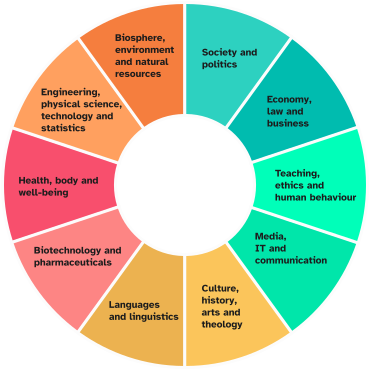
Study wheel

What interests you?

Aurora Cooperation

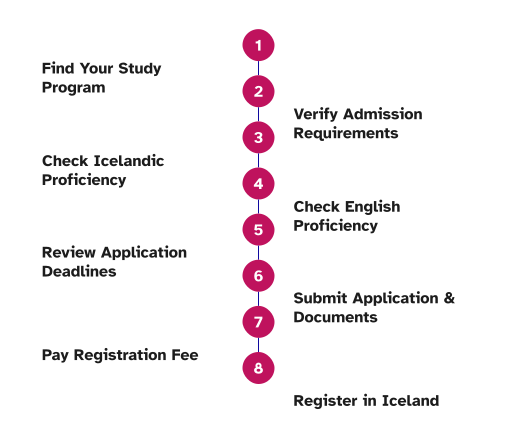
How to apply

Follow the path

Contact us

If you still have questions, feel free to contact us.

School of Social Sciences
Weekdays 9 am - 3 pm
Student and Teaching Service

The School office offers support to students and lecturers, providing guidance, counselling, and assistance with various matters. 

You are welcome to drop by at the office in Gimli or you can book an online meeting in Teams with the staff.

1920_KRI_gimli_200828_001.jpg

Share

Did this help?

Why wasn't this information helpful

Limit to 250 characters.