University of Iceland main building
Language skills
required, minimum level of B2
Programme length
2 years.
Study mode
Face-to-face learning
Application status
International students:
Students with Icelandic or Nordic citizenship:
Overview

  • Are you interested in society?
  • Would you like a programme that combines approaches from the humanities and physical sciences?
  • Do you want a range of elective courses that allow you to tailor your programme to suit your interests?
  • Would you like an individualised programme?
  • Do you want an education that will be an asset in many different careers?

The MA in the History of ideas and Science is designed for students who have completed a BA, BS or BEd degree in any subject.

The programme is organised jointly by the Faculty of History and Philosophy and the Faculty of Physical Sciences and includes mandatory courses from both faculties. The objective of these courses is to introduce students to the methods deployed and most important issues addressed within the field of history of ideas and science, as well as to the ethics of science.

Elective courses are available from different disciplines within the university.

Programme structure

The programme is 120 ECTS and is organised as two years of full-time study.

The programme is made up of:

  • Mandatory courses, 60 ECTS
  • Elective courses, 30 ECTS
  • Master's thesis, 30 ECTS

Main focuses

Course topics include:

  • Political and cultural ideas
  • Human nature, ethics and religion
  • The history of education, science and technology

Organisation of teaching

The programme is taught in Icelandic or English.

Main objectives

Students will receive a thorough overview of the history of ideas and science as well as training in independent working practices and research skills. After completing the programme, students will be well-equipped for doctoral studies and a range of careers.

Other

Students who complete the programme with a first-class grade may apply for doctoral studies

Applicants are required to hold a BA, B.Ed. or BS or similar degree from a recognised university with at least a first class grade (7.25) or equivalent. In addition, the student’s final project for the completion of the degree must have been awarded a first class grade as well.

The program is divided into mandatory courses (40 ECTS) that all students are expected to take, restricted electives (10 ECTS) and electives (40 ECTS). Students write a master's thesis (30 ECTS).

Mandatory courses are intended to introduce students to methods in the history of ideas and science, the ethics of science and some of the main topics in this field of study. There is also a mandatory course in the form of a seminar related to the preparation of students for writing a master's thesis.

The following documents must accompany an application for this programme:
  • CV
  • Statement of purpose
  • Reference 1, Name and email
  • Reference 2, Name and email
  • Certified copies of diplomas and transcripts

Further information on supporting documents can be found here

Programme structure

Check below to see how the programme is structured.

This programme does not offer specialisations.

First year | Fall
Introduction to the Philosophy of Science (HSP715F, HSP716F)
Restricted elective course, conditions apply
5 ECTS, credits
Course Description

In this course we will consider many of the most prominent problems in the philosophy of science of the 20th and 21st century. How are scientific theories confirmed by experiments and observations? What is it for something to be a law of nature? Why should we trust scientific research more than other methods for obtaining knowledge? Is scientific research value-laden? And what is involved in the claim that science is objective?

Language of instruction: Icelandic
Face-to-face learning
First year | Fall
Project in introdution to philosophy of science (HSP715F, HSP716F)
Restricted elective course, conditions apply
5 ECTS, credits
Course Description

This is a project that can be chosen as an addition to HSP715F Introduction to philosophy of science and can only be taken along with that course.

Language of instruction: Icelandic
Face-to-face learning
First year | Fall
Theories in Humanities (FOR709F)
A mandatory (required) course for the programme
10 ECTS, credits
Course Description

The aim of the course is to provide students with a more comprehensive and deeper insight into the different theoretical approaches within the humanities. In the course, the main theories that have influenced theoretical discussion in the humanities over the last decades will be presented and discussed, and the students are taught how to apply them in their own research.

Language of instruction: Icelandic/English
Face-to-face learning
First year | Fall
U.S. Foreign Policy: Hegemony, Ideology, and the International Order, 1945–2026 (SAG511M)
Free elective course within the programme
10 ECTS, credits
Course Description

The course analyzes the formation, articulation, and practice of U.S. foreign policy from World War II to the present. It focuses on the hegemonial position of the United States in the international system, its political values, culture, domestic politics, propaganda, and military power. It also explores representations of the “American Empire” during and after the Cold War and its reception abroad through an analysis of the transmission of American ideologies, unilateralist practices, liberalism, mass culture and consumption patterns, and race and gender images. The history of U.S. foreign policy from the presidency of Franklin D. Roosevelt to that of Donald Trump will be approached by examining how individual presidents shaped America’s global role.  U.S. actions abroad will be analyzed within broader ideological and structural contexts—including the Cold War, capitalism and anti-communism, democracy promotion, imperialism, human rights, international law, and global economic institutions. Special attention will be given to how race, gender, and domestic politics intersect with foreign policy, as well as the evolving role of international organizations and legal norms in shaping American engagement with the world. Attention will be paid to geopolitical and regional approaches, with emphasis on U.S.-European relations, Asia and Africa, and individual states, such as the Soviet Union/Russia, Britain, Germany, France, Vietnam, China, and South Africa during and after the Cold War. Emphasis will also be put on military interventions, including the Korean War, the Vietnam Wars, the wars in the former Yugoslavia, “the war on terror,” and the wars in Afghanistan, Libya, Iraq, Syria, and Ukraine  Finally, ideas about the decline of the “American Empire” will be explored and put within the context of the rise of China. In addition, recent U.S. attempts to challenge the liberal international order it created after World War II and to question the sovereign rights or aspirations (Canada and Greenland) will be analyzed. Various theoretical approaches in History, International Relations, and Cultural Studies, will be used to examine the topic.

Language of instruction: Icelandic
Face-to-face learning
Prerequisites
First year | Fall
Seminar: Mystical medieval philosophy meets process philosophy (HSP549M, HSP550M)
Free elective course within the programme
5 ECTS, credits
Course Description

This course brings together world views and anthropologies that appear very far apart: the thought of classical German mystics like Meister Eckhart and Jakob Boehme, who deeply influenced German philosophy (e.g., Hegel, Schelling), and contemporary process philosophy exemplified by Alfred North Whitehead and Eugene Gendlin. Despite their obvious differences, these philosophies share implications that resonate with and can be interpreted through each other. They address concepts such as co-creation, ethical know-how, and an open-ended ontological understanding of the world. Humans play a decisive role—not as agents pushing agendas, but through their transformative potential. We will study the frameworks of each school of thought: the mystical tradition, using Christian language while radically reinterpreting it, and process philosophy, which embraces and spells out the complexity of an open-ended, interactional world. Engagement with the texts will include close reading, discussion, and philosophical practices derived from these traditions.

Language of instruction: English
Face-to-face learning
Prerequisites
First year | Fall
Direct study in seminar: Mystical medieval philosophy meets process philosophy (HSP549M, HSP550M)
Free elective course within the programme
5 ECTS, credits
Course Description

Direct study in seminar: Mystical medieval philosophy meets process philosophy. Students must finish related seminar to finish the direct study.

Language of instruction: English
Face-to-face learning
Prerequisites
First year | Fall
Seminar: The power of self-affection in the philosophy of Luce Irigaray (HSP551M, HSP552M)
Free elective course within the programme
5 ECTS, credits
Course Description

Through the phenomenology of the body, the aim is to explore the nature of self-affection in the formation of meaning in the philosophy of Irigaray. Self-affection is linked to her concept of sexual difference, embodiment, and action in perception, and how interaction and inter-affection bring forth the knowable world. The aim is to investigate how sexual difference is intrinsically linked to affect, having transcendental, spiritual, and ethical implications based on our desire and how it functions as a political power to transform and overcome dualisms in Western culture. Finally, her works will be assessed and discussed in light of Hegel´s phenomenology of the spirit and Merleau-Ponty´s idea of the flesh of the world, as well as other writers. 

Language of instruction: Icelandic
Prerequisites
First year | Fall
Direct study in seminar: The power of self-affection in the philosophy of Luce Irigaray (HSP551M, HSP552M)
Free elective course within the programme
5 ECTS, credits
Course Description

Direct study in seminar: The power of self-affection in the philosophy of Luce Irigaray. Students must finish related seminar to finish the direct study.

Language of instruction: Icelandic
Prerequisites
First year | Fall
Microhistories about Poverty, Emotion and Disability (SAG512M)
Free elective course within the programme
10 ECTS, credits
Course Description

The course is intended to be, first of all, a very practical overview of the main categories of public sources that are preserved in archives and are accessible in electronic form. All categories have their advantages and disadvantages. The sources were created within some kind of administration and their aim was to gather information about the "population" that is under, preserve it and use the information to strengthen the administration and "create" the facts it needed. to hold to maintain itself. Secondly, the course is an introduction to the development that has taken place in the methodology of solitude in new Icelandic research in history. This is a new perspective on what has been called the unification of history. Thirdly, the course will be an introduction to how the emotions of individuals in the past can be analyzed through public sources and how the ideology of the history of emotions can be used in those analyzes and a new integration of theories about poverty and disability in the past with special emphasis on gender perspectives.

Language of instruction: Icelandic
Face-to-face learning
First year | Fall
Communication channels I, documentaries, texts, images (HMM122F)
Free elective course within the programme
10 ECTS, credits
Course Description

In the courses Communication channels I and Communication channels II, the basics of methods for the dissemination of cultural material in the humanities and social sciences are presented. Communication channels I is in the fall semester, while Communication channels II is in the spring semester. 

In Communication channels I, the students are working with a) text and images in the first half of the semester and b) short documentaries in the second half of the course. Each subject weighs 50% in the course. Concerning a) Students will receive training in article writing and discourse analysis on the one hand and use of images and image analysis on the other.  Concerning b) Students work on making short documentaries. It includes basic training in screenwriting, shooting and editing, and students work in groups on a documentary, according to a specific theme. 

There are no exams in the course. Instead, students work on projects, individual and group projects. They are the following:

  1. Analysis of texts and images
  2. An article with an image on a specific theme for publication, about 800 words.
  3. A group project where students work on a short documentary that is shown at the end of the course. Emphasis is placed on common themes and group work in the course. The course is not taught remotely.
Language of instruction: Icelandic
Face-to-face learning
First year | Fall
Current ethical issues (HSP723M)
Free elective course within the programme
10 ECTS, credits
Course Description

The focus of this course is the application of ethics to pressing problems and debates in contemporary society. Possible methods for solving ethical dilemmas, both on an individual and social basis, are discussed. The selection of topics may change from year to year, but possible topics include free speech, the status of refugees, animal rights, poverty and economic inequality, gender discrimination, racial discrimination, environmental issues, and various issues in health care. The relation between theoretical and applied ethics is discussed. While instruction includes lectures, student participation in discussion is greatly emphasized.

Language of instruction: English
Face-to-face learning
Prerequisites
First year | Fall
Private Archives (SAG103F)
Free elective course within the programme
5 ECTS, credits
Course Description

Preservation of private archives and how they are used as sources of past history. The role of archival institutions in the preservation and collection of private archives will be examined, and how and where private archives are preserved in Iceland. Access to private archives will be examined. Work in the course requires active participation. Lectures will be held and in addition students are expected to complete assignments in group work and independently. Visits are expected to depositories that preserve private archives.

Language of instruction: Icelandic
Distance learning
Course taught first half of the semester
First year | Fall
Public archiving and records management (SAG103M)
Free elective course within the programme
10 ECTS, credits
Course Description

This course covers the role of public archives and archiving and record management in the past and present. The importance of the principle of provenance for archives and history. A summary of the history of administration. The activities and legal environment of public archives in Iceland will be discussed and their role in records management in public administration. What organizations are obliged to transfer their records to public archives. The evolution of archiving and records management in the 20th and 21st centuries will be examined. Methods of records managements, old and new. The sorting and cataloguing of archives.

Language of instruction: Icelandic
Distance learning
Prerequisites
First year | Fall
Project in Ethics of Nature (HSP725M)
Free elective course within the programme
4 ECTS, credits
Course Description

An individual project on the ethics of nature.

Language of instruction: English
Self-study
Prerequisites
First year | Fall
Theory and Writing (ENS231F)
Free elective course within the programme
10 ECTS, credits
Course Description

This seminar engages with theories on culture, narrative, and mediation. Active class participation is required.

Language of instruction: English
Face-to-face learning
First year | Fall
Ethics of nature (HSP722M)
Free elective course within the programme
6 ECTS, credits
Course Description

The course deals with the connection between Man and Nature from the viewpoint of Moral Philosophy. It discusses the main proponents of and theories within Environmental Ethics and describes the roots of differing views of Nature, as well as different ethical orientations, i.e. anthropocentric, ecocentric, and biocentric positions. The course also deals with the integration of environmental and developmental issues, and with the connection between environmentalism and democracy. Amongst central issues discussed are the following: Can Ethics provide guidance in the solution of environmental problems?, What type of beings are worthy of moral considerability?, Can natural phenomena possess intrinsic value?, Do animals have rights?, Is there any fundamental difference in men's and women's relations to Nature? And, what is the ethical basis of sustainable development?

Language of instruction: English
Face-to-face learning
Prerequisites
First year | Fall
The Medieval North (SAG716M)
Free elective course within the programme
10 ECTS, credits
Course Description

Historical and historiographical survey of major topics in the history of the medieval North, with special emphasis on Iceland and Norway from the Viking Age into the fourteenth century. Topics include: Power, kingship and state; law and feud; kinship, gender and social ties; religious and mental outlook(s); conversion, Christianity and church; economic conditions. Prior knowledge of the “factual” narrative (textbook narrative) is helpful but not necessary.

Language of instruction: English
Face-to-face learning
Prerequisites
First year | Spring 1
Episodes from the history of philosophy of science (SAG817M)
A mandatory (required) course for the programme
10 ECTS, credits
Course Description

This course aims to introduce students to the nature and development of science by examining episodes of its history and by disucssing recent theories concerning the nature, aims, and development of science. A special emphasis will be placed on the history of physical science from Aristotle to Newton, including developments in astronomy during the scientific revolution of the 16th and 17th century. We will also specifically examine the history of Darwin’s theory of evolution by natural selection. These episodes and many others will be viewed through the lens of various theories of scientific progress, and through recent views about interactions between science and society at large. The course material may change depending on the students’ interest.

Language of instruction: Icelandic
Face-to-face learning
Prerequisites
First year | Spring 1
Ethics of Science and Research (HSP806F)
A mandatory (required) course for the programme
6 ECTS, credits
Course Description

The course is intended for postgraduate students only. It is adapted to the needs of students from different fields of study. The course is taught over a six-week period.

The course is taught over the first six weeks of spring semester on Fridays from 1:20 pm - 3:40 pm.

Description: 
The topics of the course include: Professionalism and the scientist’s responsibilities. Demands for scientific objectivity and the ethics of research. Issues of equality and standards of good practice. Power and science. Conflicts of interest and misconduct in research. Science, academia and industry. Research ethics and ethical decision making.

Objectives: 
In this course, the student gains knowledge about ethical issues in science and research and is trained in reasoning about ethical controversies relating to science and research in contemporary society.

The instruction takes the form of lectures and discussion. The course is viewed as an academic community where students are actively engaged in a focused dialogue about  the topics. Each student (working as a member of a two-person team) gives a presentation according to a plan designed at the beginning of the course, and other students acquaint themselves with the topic as well for the purpose of participating in a teacher-led discussion.

Language of instruction: English
Face-to-face learning
Course taught first half of the semester
First year | Spring 1
Project in Ethics of Science and Research (HSP048F)
A mandatory (required) course for the programme
4 ECTS, credits
Course Description

This is a project that can be chosen as an addition to HSP806F Ethics of Science and Research and can only be taken along with that course.

Language of instruction: English
Self-study
First year | Spring 1
Bioethics and Ethics of Medicine (HSP823M)
Free elective course within the programme
6 ECTS, credits
Course Description

A discussion of some controversial issues in the field of bioethics, in particular those relating to developments in genetics and their possible effects upon medical services and health care policy.

Language of instruction: Icelandic
Face-to-face learning
Prerequisites
First year | Spring 1
Handicraft, manufacturing and mentality in the 18th and 19th century – fashion, textiles and clothes making in Iceland (SAG417M)
Free elective course within the programme
10 ECTS, credits
Course Description

The objective of the course is to examine the fashion and clothes making of Icelanders in the 18th and 19th century from various angles. Research on handicraft and manufacturing will be examined in light of a variety of sources on handicraft, manufacturing and mentality in Iceland in relation to corresponding phenomena elsewhere in the realm of Denmark-Norway at the time. The reading material will be both scholarly work and primary sources. New research will be combined with primary sources, both from archives and museums. Field trips will be an important part of the course and research and analysis on clothes that are preserved. In recent years access has become better to published primary sources, both printed and online. The students will become capable of reading, finding, using and evaluating archival material from the 18th and 19th century and defining research questions in the field.

Language of instruction: Icelandic
Face-to-face learning
First year | Spring 1
Communication channels II. Oral presentations, exhibitions, digital communication (HMM242F)
Free elective course within the programme
10 ECTS, credits
Course Description

In the course Communication channels II during the spring semester the students work with the following communication methods: a) oral presentation and b) exhibitions of cultural and historical material. Digital communication will be integrated into both aspects.

The students will work with the basics of oral presentation and practice in smaller and larger groups. Basic issues regarding the organization of conferences and seminars and their management will also be reviewed and a conference is held where all students present their projects. Digital communication will also be integrated into this section. Following is a section about exhibitions with connection to digital communication. The basics of exhibitions and different ways of presentation will be discussed.  The basics of digital communication will be covered, what are the main channels, advantages and disadvantages, and what rules apply to the presentation of texts on the web.

There are no exams in the course. Instead, students work on projects, individual and group projects. They are the following:

  1. Lecture at a conference and other projects in that context
  2. Exhibition analysis and a practical project in connection with exhibitions organized by the City History Museum (Borgarsögusafn)
  3. Digital communication will be integrated into both aspects. Emphasis is placed on common themes and group work in the course.

The course is not taught remotely.

Language of instruction: Icelandic
First year | Spring 1
Culture and Dissent (MFR703M)
Free elective course within the programme
10 ECTS, credits
Course Description

The course deals with interconnections between political radicalism, culture, tradition and power. We will focus on contemporary representations of dissent in particular, look at the discourse of democracy and cultural difference, reactions to and criticism of protest in the Western political tradition and dissent in more repressive political systems. The role of intellectuals and writers will be explored as well as the function of artistic expression and design in transforming cultural and social environments. We will also discuss media and social media discourse in connection with an attempt to understand the various and sometimes contradictory objectives of public institutions. A few points of conflict will be discussed that to some extent expose fundamental conflicts in liberal democratic societies such as questions about the wisdom and ignorance of publics, reactions to climate change, inequality and extreme poverty. Finally corruption and power will be discussed as well as social and cultural expression, the possibilities and limitations of freedom of speech, the use and abuse of information, disinformation, secrecy, fake and “fake news”.

Language of instruction: English
Face-to-face learning
Prerequisites
First year | Spring 1
Seminar: Humanity and dehumanization (HSP539M, HSP540M)
Free elective course within the programme
5 ECTS, credits
Course Description

Humans have long been concerned with the notion of humanity, whether we call it human nature, the meaning of being human, or something else. We demand human rights on the basis of our humanity, which suggests that this is a normative or ethically laden notion. On the other hand, dehumanization can have horrendous consequences, when marginalized persons or groups are denied full access to human society, and this used to justify oppression and violent acts. In this seminar we will consider several possible definitions of humanity and dehumanization, theories about them and different approaches to them. While there will be some readings from different periods in the history of philosophy, the main emphasis will be on materials from recent decades, which will be put in context with current events.

Language of instruction: English
Face-to-face learning
Prerequisites
First year | Spring 1
Direct study in seminar: Humanity and dehumanization (HSP539M, HSP540M)
Free elective course within the programme
5 ECTS, credits
Course Description

Direct study in seminar: Humanity and dehumanization. Students must finish related seminar to finish the direct study.

Language of instruction: English
Face-to-face learning
Prerequisites
First year | Spring 1
Visiting Teacher's Seminar: Topics in climate ethics (HSP450M, HSP451M)
Free elective course within the programme
5 ECTS, credits
Course Description

The course will cover some of the philosophical and ethical issues raised by climate change. Some of these concern the choices of private individuals. We will for instance consider what duties climate change imposes on private individuals, and whether greenhouse gas offsetting can be a way of satisfying these duties. Most of the focus will however be on climate policy choice.  We will for instance discuss how to evaluate climate policies in light of the considerable uncertainty involved, and how to navigate the tradeoffs between current and future generations that such choices give rise to. We will also consider in detail some specific policy proposals, such as solar radiation management and a world climate bank. 

Language of instruction: English
Prerequisites
First year | Spring 1
Direct study in Visiting Teacher's Seminar: Topics in climate ethics (HSP450M, HSP451M)
Free elective course within the programme
5 ECTS, credits
Course Description

Direct study in seminar: Topics in climate ethics. Students must finish related seminar to finish the direct study.

Language of instruction: English
Prerequisites
First year | Spring 1
The End of the Cold War? The East-West Ideological and Geopolitical Struggle, 1979-2022 (SAG415M)
Free elective course within the programme
10 ECTS, credits
Course Description

This course examines the development and transformation of ideological and political conflicts between East and West from 1979—when the Cold War took on a new form—until the full-scale Russian invasion of Ukraine in 2022. Students explore how ideology shaped the interactions, conflicts, and cooperation between the superpowers during the final years of the Cold War and after the collapse of the Soviet Union. Special emphasis is placed on the end of the Cold War, the impact of Gorbachev’s reforms, the fall of the Soviet Union, and how ideological tensions have continued in the relations between Russia, the United States, China, and Europe in the 21st century.

Language of instruction: Icelandic
Face-to-face learning
Prerequisites
First year | Spring 1
The Women’s Movement and Feminism in Historical Perspective (SAG416M)
Free elective course within the programme
10 ECTS, credits
Course Description

In today’s society, where there is backlash in human rights, and in some cases women’s previously secured rights have been challenged, it is essential to understand the history of women´s right sand the women’s movement.  This course explores ideas concerning women’s rights from the eighteenth century (and, where relevant, earlier) to the latter half of the twentieth century, examining who articulated these ideas and in what ways. It addresses the struggles of women (and men) for gender equality, the milestones that were achieved, and the obstacles women encountered along the way. Attention will be given to concepts such as feminism, a term that did not emerge until the late nineteenth century, and its various manifestations. The concept, women’s movement, will also be scrutinised. Scholars in the fields of women’s and gender history have increasingly critiqued dominant definitions and questioned which movements deserve recognition within the grand narrative of women’s history. In this context, the usefulness and limitations of the so-called “wave theory” will be discussed, that is, the tendency to liken women’s movements to tidal cycles of ebb and flow: the first wave of feminism/women’s rights, the second wave, and so forth. Although the focus of the course will primarily be on the Western world, efforts will be made to integrate perspectives from other regions, as well as from Iceland, where appropriate.

Language of instruction: Icelandic
Prerequisites
First year | Spring 1
Research and sources in archives (SAG206M)
Free elective course within the programme
10 ECTS, credits
Course Description

Students learn and are trained in the methods of archival research, finding and evaluating sources in archives.  Practical exercises will be assigned.

Language of instruction: Icelandic
Distance learning
Prerequisites
First year | Spring 1
Viking Age Archaeology (FOR102F)
Free elective course within the programme
10 ECTS, credits
Course Description

Overview of the history of the Viking age and history of Viking research. Emphasis is placed on the archaeological evidence, the sites and the objects, and discussing how archaeological data has contributed to our understanding of this period. Particular attention is given to economic patterns, issues of ethnicity and state formation.

Language of instruction: English
Face-to-face learning
First year | Spring 1
New researches in history (SAG201F)
Free elective course within the programme
10 ECTS, credits
Course Description

In the course, well-known historical studies from Western culture will be read that deal with a variety of topics. An attempt will be made to show how historians, both at the end of the twentieth century and at the beginning of the twenty-first century, struggle with different topics in their research. The discussion will be put into an ideological context and emphasis will be placed on showing the different approaches of historians when the subject has been connected to the aforementioned field of study. An attempt was made to select interesting books that are likely to give us an interesting picture of the state of the arts of history today.

Language of instruction: Icelandic
Face-to-face learning
Second year | Fall
Introduction to the Philosophy of Science (HSP715F, HSP716F)
Restricted elective course, conditions apply
5 ECTS, credits
Course Description

In this course we will consider many of the most prominent problems in the philosophy of science of the 20th and 21st century. How are scientific theories confirmed by experiments and observations? What is it for something to be a law of nature? Why should we trust scientific research more than other methods for obtaining knowledge? Is scientific research value-laden? And what is involved in the claim that science is objective?

Language of instruction: Icelandic
Face-to-face learning
Second year | Fall
Project in introdution to philosophy of science (HSP715F, HSP716F)
Restricted elective course, conditions apply
5 ECTS, credits
Course Description

This is a project that can be chosen as an addition to HSP715F Introduction to philosophy of science and can only be taken along with that course.

Language of instruction: Icelandic
Face-to-face learning
Second year | Fall
U.S. Foreign Policy: Hegemony, Ideology, and the International Order, 1945–2026 (SAG511M)
Free elective course within the programme
10 ECTS, credits
Course Description

The course analyzes the formation, articulation, and practice of U.S. foreign policy from World War II to the present. It focuses on the hegemonial position of the United States in the international system, its political values, culture, domestic politics, propaganda, and military power. It also explores representations of the “American Empire” during and after the Cold War and its reception abroad through an analysis of the transmission of American ideologies, unilateralist practices, liberalism, mass culture and consumption patterns, and race and gender images. The history of U.S. foreign policy from the presidency of Franklin D. Roosevelt to that of Donald Trump will be approached by examining how individual presidents shaped America’s global role.  U.S. actions abroad will be analyzed within broader ideological and structural contexts—including the Cold War, capitalism and anti-communism, democracy promotion, imperialism, human rights, international law, and global economic institutions. Special attention will be given to how race, gender, and domestic politics intersect with foreign policy, as well as the evolving role of international organizations and legal norms in shaping American engagement with the world. Attention will be paid to geopolitical and regional approaches, with emphasis on U.S.-European relations, Asia and Africa, and individual states, such as the Soviet Union/Russia, Britain, Germany, France, Vietnam, China, and South Africa during and after the Cold War. Emphasis will also be put on military interventions, including the Korean War, the Vietnam Wars, the wars in the former Yugoslavia, “the war on terror,” and the wars in Afghanistan, Libya, Iraq, Syria, and Ukraine  Finally, ideas about the decline of the “American Empire” will be explored and put within the context of the rise of China. In addition, recent U.S. attempts to challenge the liberal international order it created after World War II and to question the sovereign rights or aspirations (Canada and Greenland) will be analyzed. Various theoretical approaches in History, International Relations, and Cultural Studies, will be used to examine the topic.

Language of instruction: Icelandic
Face-to-face learning
Prerequisites
Second year | Fall
Seminar: Mystical medieval philosophy meets process philosophy (HSP549M, HSP550M)
Free elective course within the programme
5 ECTS, credits
Course Description

This course brings together world views and anthropologies that appear very far apart: the thought of classical German mystics like Meister Eckhart and Jakob Boehme, who deeply influenced German philosophy (e.g., Hegel, Schelling), and contemporary process philosophy exemplified by Alfred North Whitehead and Eugene Gendlin. Despite their obvious differences, these philosophies share implications that resonate with and can be interpreted through each other. They address concepts such as co-creation, ethical know-how, and an open-ended ontological understanding of the world. Humans play a decisive role—not as agents pushing agendas, but through their transformative potential. We will study the frameworks of each school of thought: the mystical tradition, using Christian language while radically reinterpreting it, and process philosophy, which embraces and spells out the complexity of an open-ended, interactional world. Engagement with the texts will include close reading, discussion, and philosophical practices derived from these traditions.

Language of instruction: English
Face-to-face learning
Prerequisites
Second year | Fall
Direct study in seminar: Mystical medieval philosophy meets process philosophy (HSP549M, HSP550M)
Free elective course within the programme
5 ECTS, credits
Course Description

Direct study in seminar: Mystical medieval philosophy meets process philosophy. Students must finish related seminar to finish the direct study.

Language of instruction: English
Face-to-face learning
Prerequisites
Second year | Fall
Seminar: The power of self-affection in the philosophy of Luce Irigaray (HSP551M, HSP552M)
Free elective course within the programme
5 ECTS, credits
Course Description

Through the phenomenology of the body, the aim is to explore the nature of self-affection in the formation of meaning in the philosophy of Irigaray. Self-affection is linked to her concept of sexual difference, embodiment, and action in perception, and how interaction and inter-affection bring forth the knowable world. The aim is to investigate how sexual difference is intrinsically linked to affect, having transcendental, spiritual, and ethical implications based on our desire and how it functions as a political power to transform and overcome dualisms in Western culture. Finally, her works will be assessed and discussed in light of Hegel´s phenomenology of the spirit and Merleau-Ponty´s idea of the flesh of the world, as well as other writers. 

Language of instruction: Icelandic
Prerequisites
Second year | Fall
Direct study in seminar: The power of self-affection in the philosophy of Luce Irigaray (HSP551M, HSP552M)
Free elective course within the programme
5 ECTS, credits
Course Description

Direct study in seminar: The power of self-affection in the philosophy of Luce Irigaray. Students must finish related seminar to finish the direct study.

Language of instruction: Icelandic
Prerequisites
Second year | Fall
Microhistories about Poverty, Emotion and Disability (SAG512M)
Free elective course within the programme
10 ECTS, credits
Course Description

The course is intended to be, first of all, a very practical overview of the main categories of public sources that are preserved in archives and are accessible in electronic form. All categories have their advantages and disadvantages. The sources were created within some kind of administration and their aim was to gather information about the "population" that is under, preserve it and use the information to strengthen the administration and "create" the facts it needed. to hold to maintain itself. Secondly, the course is an introduction to the development that has taken place in the methodology of solitude in new Icelandic research in history. This is a new perspective on what has been called the unification of history. Thirdly, the course will be an introduction to how the emotions of individuals in the past can be analyzed through public sources and how the ideology of the history of emotions can be used in those analyzes and a new integration of theories about poverty and disability in the past with special emphasis on gender perspectives.

Language of instruction: Icelandic
Face-to-face learning
Second year | Fall
Communication channels I, documentaries, texts, images (HMM122F)
Free elective course within the programme
10 ECTS, credits
Course Description

In the courses Communication channels I and Communication channels II, the basics of methods for the dissemination of cultural material in the humanities and social sciences are presented. Communication channels I is in the fall semester, while Communication channels II is in the spring semester. 

In Communication channels I, the students are working with a) text and images in the first half of the semester and b) short documentaries in the second half of the course. Each subject weighs 50% in the course. Concerning a) Students will receive training in article writing and discourse analysis on the one hand and use of images and image analysis on the other.  Concerning b) Students work on making short documentaries. It includes basic training in screenwriting, shooting and editing, and students work in groups on a documentary, according to a specific theme. 

There are no exams in the course. Instead, students work on projects, individual and group projects. They are the following:

  1. Analysis of texts and images
  2. An article with an image on a specific theme for publication, about 800 words.
  3. A group project where students work on a short documentary that is shown at the end of the course. Emphasis is placed on common themes and group work in the course. The course is not taught remotely.
Language of instruction: Icelandic
Face-to-face learning
Second year | Fall
Current ethical issues (HSP723M)
Free elective course within the programme
10 ECTS, credits
Course Description

The focus of this course is the application of ethics to pressing problems and debates in contemporary society. Possible methods for solving ethical dilemmas, both on an individual and social basis, are discussed. The selection of topics may change from year to year, but possible topics include free speech, the status of refugees, animal rights, poverty and economic inequality, gender discrimination, racial discrimination, environmental issues, and various issues in health care. The relation between theoretical and applied ethics is discussed. While instruction includes lectures, student participation in discussion is greatly emphasized.

Language of instruction: English
Face-to-face learning
Prerequisites
Second year | Fall
Private Archives (SAG103F)
Free elective course within the programme
5 ECTS, credits
Course Description

Preservation of private archives and how they are used as sources of past history. The role of archival institutions in the preservation and collection of private archives will be examined, and how and where private archives are preserved in Iceland. Access to private archives will be examined. Work in the course requires active participation. Lectures will be held and in addition students are expected to complete assignments in group work and independently. Visits are expected to depositories that preserve private archives.

Language of instruction: Icelandic
Distance learning
Course taught first half of the semester
Second year | Fall
Public archiving and records management (SAG103M)
Free elective course within the programme
10 ECTS, credits
Course Description

This course covers the role of public archives and archiving and record management in the past and present. The importance of the principle of provenance for archives and history. A summary of the history of administration. The activities and legal environment of public archives in Iceland will be discussed and their role in records management in public administration. What organizations are obliged to transfer their records to public archives. The evolution of archiving and records management in the 20th and 21st centuries will be examined. Methods of records managements, old and new. The sorting and cataloguing of archives.

Language of instruction: Icelandic
Distance learning
Prerequisites
Second year | Fall
Project in Ethics of Nature (HSP725M)
Free elective course within the programme
4 ECTS, credits
Course Description

An individual project on the ethics of nature.

Language of instruction: English
Self-study
Prerequisites
Second year | Fall
Theory and Writing (ENS231F)
Free elective course within the programme
10 ECTS, credits
Course Description

This seminar engages with theories on culture, narrative, and mediation. Active class participation is required.

Language of instruction: English
Face-to-face learning
Second year | Fall
Ethics of nature (HSP722M)
Free elective course within the programme
6 ECTS, credits
Course Description

The course deals with the connection between Man and Nature from the viewpoint of Moral Philosophy. It discusses the main proponents of and theories within Environmental Ethics and describes the roots of differing views of Nature, as well as different ethical orientations, i.e. anthropocentric, ecocentric, and biocentric positions. The course also deals with the integration of environmental and developmental issues, and with the connection between environmentalism and democracy. Amongst central issues discussed are the following: Can Ethics provide guidance in the solution of environmental problems?, What type of beings are worthy of moral considerability?, Can natural phenomena possess intrinsic value?, Do animals have rights?, Is there any fundamental difference in men's and women's relations to Nature? And, what is the ethical basis of sustainable development?

Language of instruction: English
Face-to-face learning
Prerequisites
Second year | Fall
The Medieval North (SAG716M)
Free elective course within the programme
10 ECTS, credits
Course Description

Historical and historiographical survey of major topics in the history of the medieval North, with special emphasis on Iceland and Norway from the Viking Age into the fourteenth century. Topics include: Power, kingship and state; law and feud; kinship, gender and social ties; religious and mental outlook(s); conversion, Christianity and church; economic conditions. Prior knowledge of the “factual” narrative (textbook narrative) is helpful but not necessary.

Language of instruction: English
Face-to-face learning
Prerequisites
Second year | Fall
Research Project in History for MA-thesis (SAG704F)
A mandatory (required) course for the programme
10 ECTS, credits
Course Description

Research Project for MA-thesis in collaboration with supervisor.

Language of instruction: Icelandic
Second year | Spring 1
MA thesis (SAG401L)
A mandatory (required) course for the programme
30 ECTS, credits
Course Description

Final project.

Language of instruction: Icelandic
First year
  • Fall
  • HSP715F, HSP716F
    Introduction to the Philosophy of Science
    Restricted elective course
    5
    Restricted elective course, conditions apply
    5 ECTS, credits
    Course Description

    In this course we will consider many of the most prominent problems in the philosophy of science of the 20th and 21st century. How are scientific theories confirmed by experiments and observations? What is it for something to be a law of nature? Why should we trust scientific research more than other methods for obtaining knowledge? Is scientific research value-laden? And what is involved in the claim that science is objective?

    Face-to-face learning
    Prerequisites
  • HSP715F, HSP716F
    Project in introdution to philosophy of science
    Restricted elective course
    5
    Restricted elective course, conditions apply
    5 ECTS, credits
    Course Description

    This is a project that can be chosen as an addition to HSP715F Introduction to philosophy of science and can only be taken along with that course.

    Face-to-face learning
    Prerequisites
  • FOR709F
    Theories in Humanities
    Mandatory (required) course
    10
    A mandatory (required) course for the programme
    10 ECTS, credits
    Course Description

    The aim of the course is to provide students with a more comprehensive and deeper insight into the different theoretical approaches within the humanities. In the course, the main theories that have influenced theoretical discussion in the humanities over the last decades will be presented and discussed, and the students are taught how to apply them in their own research.

    Face-to-face learning
    Prerequisites
  • SAG511M
    U.S. Foreign Policy: Hegemony, Ideology, and the International Order, 1945–2026
    Elective course
    10
    Free elective course within the programme
    10 ECTS, credits
    Course Description

    The course analyzes the formation, articulation, and practice of U.S. foreign policy from World War II to the present. It focuses on the hegemonial position of the United States in the international system, its political values, culture, domestic politics, propaganda, and military power. It also explores representations of the “American Empire” during and after the Cold War and its reception abroad through an analysis of the transmission of American ideologies, unilateralist practices, liberalism, mass culture and consumption patterns, and race and gender images. The history of U.S. foreign policy from the presidency of Franklin D. Roosevelt to that of Donald Trump will be approached by examining how individual presidents shaped America’s global role.  U.S. actions abroad will be analyzed within broader ideological and structural contexts—including the Cold War, capitalism and anti-communism, democracy promotion, imperialism, human rights, international law, and global economic institutions. Special attention will be given to how race, gender, and domestic politics intersect with foreign policy, as well as the evolving role of international organizations and legal norms in shaping American engagement with the world. Attention will be paid to geopolitical and regional approaches, with emphasis on U.S.-European relations, Asia and Africa, and individual states, such as the Soviet Union/Russia, Britain, Germany, France, Vietnam, China, and South Africa during and after the Cold War. Emphasis will also be put on military interventions, including the Korean War, the Vietnam Wars, the wars in the former Yugoslavia, “the war on terror,” and the wars in Afghanistan, Libya, Iraq, Syria, and Ukraine  Finally, ideas about the decline of the “American Empire” will be explored and put within the context of the rise of China. In addition, recent U.S. attempts to challenge the liberal international order it created after World War II and to question the sovereign rights or aspirations (Canada and Greenland) will be analyzed. Various theoretical approaches in History, International Relations, and Cultural Studies, will be used to examine the topic.

    Face-to-face learning
    Prerequisites
  • HSP549M, HSP550M
    Seminar: Mystical medieval philosophy meets process philosophy
    Elective course
    5
    Free elective course within the programme
    5 ECTS, credits
    Course Description

    This course brings together world views and anthropologies that appear very far apart: the thought of classical German mystics like Meister Eckhart and Jakob Boehme, who deeply influenced German philosophy (e.g., Hegel, Schelling), and contemporary process philosophy exemplified by Alfred North Whitehead and Eugene Gendlin. Despite their obvious differences, these philosophies share implications that resonate with and can be interpreted through each other. They address concepts such as co-creation, ethical know-how, and an open-ended ontological understanding of the world. Humans play a decisive role—not as agents pushing agendas, but through their transformative potential. We will study the frameworks of each school of thought: the mystical tradition, using Christian language while radically reinterpreting it, and process philosophy, which embraces and spells out the complexity of an open-ended, interactional world. Engagement with the texts will include close reading, discussion, and philosophical practices derived from these traditions.

    Face-to-face learning
    Prerequisites
  • HSP549M, HSP550M
    Direct study in seminar: Mystical medieval philosophy meets process philosophy
    Elective course
    5
    Free elective course within the programme
    5 ECTS, credits
    Course Description

    Direct study in seminar: Mystical medieval philosophy meets process philosophy. Students must finish related seminar to finish the direct study.

    Face-to-face learning
    Prerequisites
  • HSP551M, HSP552M
    Seminar: The power of self-affection in the philosophy of Luce Irigaray
    Elective course
    5
    Free elective course within the programme
    5 ECTS, credits
    Course Description

    Through the phenomenology of the body, the aim is to explore the nature of self-affection in the formation of meaning in the philosophy of Irigaray. Self-affection is linked to her concept of sexual difference, embodiment, and action in perception, and how interaction and inter-affection bring forth the knowable world. The aim is to investigate how sexual difference is intrinsically linked to affect, having transcendental, spiritual, and ethical implications based on our desire and how it functions as a political power to transform and overcome dualisms in Western culture. Finally, her works will be assessed and discussed in light of Hegel´s phenomenology of the spirit and Merleau-Ponty´s idea of the flesh of the world, as well as other writers. 

    Prerequisites
  • HSP551M, HSP552M
    Direct study in seminar: The power of self-affection in the philosophy of Luce Irigaray
    Elective course
    5
    Free elective course within the programme
    5 ECTS, credits
    Course Description

    Direct study in seminar: The power of self-affection in the philosophy of Luce Irigaray. Students must finish related seminar to finish the direct study.

    Prerequisites
  • SAG512M
    Microhistories about Poverty, Emotion and Disability
    Elective course
    10
    Free elective course within the programme
    10 ECTS, credits
    Course Description

    The course is intended to be, first of all, a very practical overview of the main categories of public sources that are preserved in archives and are accessible in electronic form. All categories have their advantages and disadvantages. The sources were created within some kind of administration and their aim was to gather information about the "population" that is under, preserve it and use the information to strengthen the administration and "create" the facts it needed. to hold to maintain itself. Secondly, the course is an introduction to the development that has taken place in the methodology of solitude in new Icelandic research in history. This is a new perspective on what has been called the unification of history. Thirdly, the course will be an introduction to how the emotions of individuals in the past can be analyzed through public sources and how the ideology of the history of emotions can be used in those analyzes and a new integration of theories about poverty and disability in the past with special emphasis on gender perspectives.

    Face-to-face learning
    Prerequisites
  • HMM122F
    Communication channels I, documentaries, texts, images
    Elective course
    10
    Free elective course within the programme
    10 ECTS, credits
    Course Description

    In the courses Communication channels I and Communication channels II, the basics of methods for the dissemination of cultural material in the humanities and social sciences are presented. Communication channels I is in the fall semester, while Communication channels II is in the spring semester. 

    In Communication channels I, the students are working with a) text and images in the first half of the semester and b) short documentaries in the second half of the course. Each subject weighs 50% in the course. Concerning a) Students will receive training in article writing and discourse analysis on the one hand and use of images and image analysis on the other.  Concerning b) Students work on making short documentaries. It includes basic training in screenwriting, shooting and editing, and students work in groups on a documentary, according to a specific theme. 

    There are no exams in the course. Instead, students work on projects, individual and group projects. They are the following:

    1. Analysis of texts and images
    2. An article with an image on a specific theme for publication, about 800 words.
    3. A group project where students work on a short documentary that is shown at the end of the course. Emphasis is placed on common themes and group work in the course. The course is not taught remotely.
    Face-to-face learning
    Prerequisites
  • HSP723M
    Current ethical issues
    Elective course
    10
    Free elective course within the programme
    10 ECTS, credits
    Course Description

    The focus of this course is the application of ethics to pressing problems and debates in contemporary society. Possible methods for solving ethical dilemmas, both on an individual and social basis, are discussed. The selection of topics may change from year to year, but possible topics include free speech, the status of refugees, animal rights, poverty and economic inequality, gender discrimination, racial discrimination, environmental issues, and various issues in health care. The relation between theoretical and applied ethics is discussed. While instruction includes lectures, student participation in discussion is greatly emphasized.

    Face-to-face learning
    Prerequisites
  • SAG103F
    Private Archives
    Elective course
    5
    Free elective course within the programme
    5 ECTS, credits
    Course Description

    Preservation of private archives and how they are used as sources of past history. The role of archival institutions in the preservation and collection of private archives will be examined, and how and where private archives are preserved in Iceland. Access to private archives will be examined. Work in the course requires active participation. Lectures will be held and in addition students are expected to complete assignments in group work and independently. Visits are expected to depositories that preserve private archives.

    Distance learning
    Prerequisites
    Course taught first half of the semester
  • SAG103M
    Public archiving and records management
    Elective course
    10
    Free elective course within the programme
    10 ECTS, credits
    Course Description

    This course covers the role of public archives and archiving and record management in the past and present. The importance of the principle of provenance for archives and history. A summary of the history of administration. The activities and legal environment of public archives in Iceland will be discussed and their role in records management in public administration. What organizations are obliged to transfer their records to public archives. The evolution of archiving and records management in the 20th and 21st centuries will be examined. Methods of records managements, old and new. The sorting and cataloguing of archives.

    Distance learning
    Prerequisites
  • HSP725M
    Project in Ethics of Nature
    Elective course
    4
    Free elective course within the programme
    4 ECTS, credits
    Course Description

    An individual project on the ethics of nature.

    Self-study
    Prerequisites
  • ENS231F
    Theory and Writing
    Elective course
    10
    Free elective course within the programme
    10 ECTS, credits
    Course Description

    This seminar engages with theories on culture, narrative, and mediation. Active class participation is required.

    Face-to-face learning
    Prerequisites
  • HSP722M
    Ethics of nature
    Elective course
    6
    Free elective course within the programme
    6 ECTS, credits
    Course Description

    The course deals with the connection between Man and Nature from the viewpoint of Moral Philosophy. It discusses the main proponents of and theories within Environmental Ethics and describes the roots of differing views of Nature, as well as different ethical orientations, i.e. anthropocentric, ecocentric, and biocentric positions. The course also deals with the integration of environmental and developmental issues, and with the connection between environmentalism and democracy. Amongst central issues discussed are the following: Can Ethics provide guidance in the solution of environmental problems?, What type of beings are worthy of moral considerability?, Can natural phenomena possess intrinsic value?, Do animals have rights?, Is there any fundamental difference in men's and women's relations to Nature? And, what is the ethical basis of sustainable development?

    Face-to-face learning
    Prerequisites
  • SAG716M
    The Medieval North
    Elective course
    10
    Free elective course within the programme
    10 ECTS, credits
    Course Description

    Historical and historiographical survey of major topics in the history of the medieval North, with special emphasis on Iceland and Norway from the Viking Age into the fourteenth century. Topics include: Power, kingship and state; law and feud; kinship, gender and social ties; religious and mental outlook(s); conversion, Christianity and church; economic conditions. Prior knowledge of the “factual” narrative (textbook narrative) is helpful but not necessary.

    Face-to-face learning
    Prerequisites
  • Spring 2
  • SAG817M
    Episodes from the history of philosophy of science
    Mandatory (required) course
    10
    A mandatory (required) course for the programme
    10 ECTS, credits
    Course Description

    This course aims to introduce students to the nature and development of science by examining episodes of its history and by disucssing recent theories concerning the nature, aims, and development of science. A special emphasis will be placed on the history of physical science from Aristotle to Newton, including developments in astronomy during the scientific revolution of the 16th and 17th century. We will also specifically examine the history of Darwin’s theory of evolution by natural selection. These episodes and many others will be viewed through the lens of various theories of scientific progress, and through recent views about interactions between science and society at large. The course material may change depending on the students’ interest.

    Face-to-face learning
    Prerequisites
  • HSP806F
    Ethics of Science and Research
    Mandatory (required) course
    6
    A mandatory (required) course for the programme
    6 ECTS, credits
    Course Description

    The course is intended for postgraduate students only. It is adapted to the needs of students from different fields of study. The course is taught over a six-week period.

    The course is taught over the first six weeks of spring semester on Fridays from 1:20 pm - 3:40 pm.

    Description: 
    The topics of the course include: Professionalism and the scientist’s responsibilities. Demands for scientific objectivity and the ethics of research. Issues of equality and standards of good practice. Power and science. Conflicts of interest and misconduct in research. Science, academia and industry. Research ethics and ethical decision making.

    Objectives: 
    In this course, the student gains knowledge about ethical issues in science and research and is trained in reasoning about ethical controversies relating to science and research in contemporary society.

    The instruction takes the form of lectures and discussion. The course is viewed as an academic community where students are actively engaged in a focused dialogue about  the topics. Each student (working as a member of a two-person team) gives a presentation according to a plan designed at the beginning of the course, and other students acquaint themselves with the topic as well for the purpose of participating in a teacher-led discussion.

    Face-to-face learning
    Prerequisites
    Course taught first half of the semester
  • HSP048F
    Project in Ethics of Science and Research
    Mandatory (required) course
    4
    A mandatory (required) course for the programme
    4 ECTS, credits
    Course Description

    This is a project that can be chosen as an addition to HSP806F Ethics of Science and Research and can only be taken along with that course.

    Self-study
    Prerequisites
  • HSP823M
    Bioethics and Ethics of Medicine
    Elective course
    6
    Free elective course within the programme
    6 ECTS, credits
    Course Description

    A discussion of some controversial issues in the field of bioethics, in particular those relating to developments in genetics and their possible effects upon medical services and health care policy.

    Face-to-face learning
    Prerequisites
  • SAG417M
    Handicraft, manufacturing and mentality in the 18th and 19th century – fashion, textiles and clothes making in Iceland
    Elective course
    10
    Free elective course within the programme
    10 ECTS, credits
    Course Description

    The objective of the course is to examine the fashion and clothes making of Icelanders in the 18th and 19th century from various angles. Research on handicraft and manufacturing will be examined in light of a variety of sources on handicraft, manufacturing and mentality in Iceland in relation to corresponding phenomena elsewhere in the realm of Denmark-Norway at the time. The reading material will be both scholarly work and primary sources. New research will be combined with primary sources, both from archives and museums. Field trips will be an important part of the course and research and analysis on clothes that are preserved. In recent years access has become better to published primary sources, both printed and online. The students will become capable of reading, finding, using and evaluating archival material from the 18th and 19th century and defining research questions in the field.

    Face-to-face learning
    Prerequisites
  • HMM242F
    Communication channels II. Oral presentations, exhibitions, digital communication
    Elective course
    10
    Free elective course within the programme
    10 ECTS, credits
    Course Description

    In the course Communication channels II during the spring semester the students work with the following communication methods: a) oral presentation and b) exhibitions of cultural and historical material. Digital communication will be integrated into both aspects.

    The students will work with the basics of oral presentation and practice in smaller and larger groups. Basic issues regarding the organization of conferences and seminars and their management will also be reviewed and a conference is held where all students present their projects. Digital communication will also be integrated into this section. Following is a section about exhibitions with connection to digital communication. The basics of exhibitions and different ways of presentation will be discussed.  The basics of digital communication will be covered, what are the main channels, advantages and disadvantages, and what rules apply to the presentation of texts on the web.

    There are no exams in the course. Instead, students work on projects, individual and group projects. They are the following:

    1. Lecture at a conference and other projects in that context
    2. Exhibition analysis and a practical project in connection with exhibitions organized by the City History Museum (Borgarsögusafn)
    3. Digital communication will be integrated into both aspects. Emphasis is placed on common themes and group work in the course.

    The course is not taught remotely.

    Prerequisites
  • MFR703M
    Culture and Dissent
    Elective course
    10
    Free elective course within the programme
    10 ECTS, credits
    Course Description

    The course deals with interconnections between political radicalism, culture, tradition and power. We will focus on contemporary representations of dissent in particular, look at the discourse of democracy and cultural difference, reactions to and criticism of protest in the Western political tradition and dissent in more repressive political systems. The role of intellectuals and writers will be explored as well as the function of artistic expression and design in transforming cultural and social environments. We will also discuss media and social media discourse in connection with an attempt to understand the various and sometimes contradictory objectives of public institutions. A few points of conflict will be discussed that to some extent expose fundamental conflicts in liberal democratic societies such as questions about the wisdom and ignorance of publics, reactions to climate change, inequality and extreme poverty. Finally corruption and power will be discussed as well as social and cultural expression, the possibilities and limitations of freedom of speech, the use and abuse of information, disinformation, secrecy, fake and “fake news”.

    Face-to-face learning
    Prerequisites
  • HSP539M, HSP540M
    Seminar: Humanity and dehumanization
    Elective course
    5
    Free elective course within the programme
    5 ECTS, credits
    Course Description

    Humans have long been concerned with the notion of humanity, whether we call it human nature, the meaning of being human, or something else. We demand human rights on the basis of our humanity, which suggests that this is a normative or ethically laden notion. On the other hand, dehumanization can have horrendous consequences, when marginalized persons or groups are denied full access to human society, and this used to justify oppression and violent acts. In this seminar we will consider several possible definitions of humanity and dehumanization, theories about them and different approaches to them. While there will be some readings from different periods in the history of philosophy, the main emphasis will be on materials from recent decades, which will be put in context with current events.

    Face-to-face learning
    Prerequisites
  • HSP539M, HSP540M
    Direct study in seminar: Humanity and dehumanization
    Elective course
    5
    Free elective course within the programme
    5 ECTS, credits
    Course Description

    Direct study in seminar: Humanity and dehumanization. Students must finish related seminar to finish the direct study.

    Face-to-face learning
    Prerequisites
  • HSP450M, HSP451M
    Visiting Teacher's Seminar: Topics in climate ethics
    Elective course
    5
    Free elective course within the programme
    5 ECTS, credits
    Course Description

    The course will cover some of the philosophical and ethical issues raised by climate change. Some of these concern the choices of private individuals. We will for instance consider what duties climate change imposes on private individuals, and whether greenhouse gas offsetting can be a way of satisfying these duties. Most of the focus will however be on climate policy choice.  We will for instance discuss how to evaluate climate policies in light of the considerable uncertainty involved, and how to navigate the tradeoffs between current and future generations that such choices give rise to. We will also consider in detail some specific policy proposals, such as solar radiation management and a world climate bank. 

    Prerequisites
  • HSP450M, HSP451M
    Direct study in Visiting Teacher's Seminar: Topics in climate ethics
    Elective course
    5
    Free elective course within the programme
    5 ECTS, credits
    Course Description

    Direct study in seminar: Topics in climate ethics. Students must finish related seminar to finish the direct study.

    Prerequisites
  • SAG415M
    The End of the Cold War? The East-West Ideological and Geopolitical Struggle, 1979-2022
    Elective course
    10
    Free elective course within the programme
    10 ECTS, credits
    Course Description

    This course examines the development and transformation of ideological and political conflicts between East and West from 1979—when the Cold War took on a new form—until the full-scale Russian invasion of Ukraine in 2022. Students explore how ideology shaped the interactions, conflicts, and cooperation between the superpowers during the final years of the Cold War and after the collapse of the Soviet Union. Special emphasis is placed on the end of the Cold War, the impact of Gorbachev’s reforms, the fall of the Soviet Union, and how ideological tensions have continued in the relations between Russia, the United States, China, and Europe in the 21st century.

    Face-to-face learning
    Prerequisites
  • SAG416M
    The Women’s Movement and Feminism in Historical Perspective
    Elective course
    10
    Free elective course within the programme
    10 ECTS, credits
    Course Description

    In today’s society, where there is backlash in human rights, and in some cases women’s previously secured rights have been challenged, it is essential to understand the history of women´s right sand the women’s movement.  This course explores ideas concerning women’s rights from the eighteenth century (and, where relevant, earlier) to the latter half of the twentieth century, examining who articulated these ideas and in what ways. It addresses the struggles of women (and men) for gender equality, the milestones that were achieved, and the obstacles women encountered along the way. Attention will be given to concepts such as feminism, a term that did not emerge until the late nineteenth century, and its various manifestations. The concept, women’s movement, will also be scrutinised. Scholars in the fields of women’s and gender history have increasingly critiqued dominant definitions and questioned which movements deserve recognition within the grand narrative of women’s history. In this context, the usefulness and limitations of the so-called “wave theory” will be discussed, that is, the tendency to liken women’s movements to tidal cycles of ebb and flow: the first wave of feminism/women’s rights, the second wave, and so forth. Although the focus of the course will primarily be on the Western world, efforts will be made to integrate perspectives from other regions, as well as from Iceland, where appropriate.

    Prerequisites
  • SAG206M
    Research and sources in archives
    Elective course
    10
    Free elective course within the programme
    10 ECTS, credits
    Course Description

    Students learn and are trained in the methods of archival research, finding and evaluating sources in archives.  Practical exercises will be assigned.

    Distance learning
    Prerequisites
  • FOR102F
    Viking Age Archaeology
    Elective course
    10
    Free elective course within the programme
    10 ECTS, credits
    Course Description

    Overview of the history of the Viking age and history of Viking research. Emphasis is placed on the archaeological evidence, the sites and the objects, and discussing how archaeological data has contributed to our understanding of this period. Particular attention is given to economic patterns, issues of ethnicity and state formation.

    Face-to-face learning
    Prerequisites
  • SAG201F
    New researches in history
    Elective course
    10
    Free elective course within the programme
    10 ECTS, credits
    Course Description

    In the course, well-known historical studies from Western culture will be read that deal with a variety of topics. An attempt will be made to show how historians, both at the end of the twentieth century and at the beginning of the twenty-first century, struggle with different topics in their research. The discussion will be put into an ideological context and emphasis will be placed on showing the different approaches of historians when the subject has been connected to the aforementioned field of study. An attempt was made to select interesting books that are likely to give us an interesting picture of the state of the arts of history today.

    Face-to-face learning
    Prerequisites
  • Fall
  • HSP715F, HSP716F
    Introduction to the Philosophy of Science
    Restricted elective course
    5
    Restricted elective course, conditions apply
    5 ECTS, credits
    Course Description

    In this course we will consider many of the most prominent problems in the philosophy of science of the 20th and 21st century. How are scientific theories confirmed by experiments and observations? What is it for something to be a law of nature? Why should we trust scientific research more than other methods for obtaining knowledge? Is scientific research value-laden? And what is involved in the claim that science is objective?

    Face-to-face learning
    Prerequisites
  • HSP715F, HSP716F
    Project in introdution to philosophy of science
    Restricted elective course
    5
    Restricted elective course, conditions apply
    5 ECTS, credits
    Course Description

    This is a project that can be chosen as an addition to HSP715F Introduction to philosophy of science and can only be taken along with that course.

    Face-to-face learning
    Prerequisites
  • SAG511M
    U.S. Foreign Policy: Hegemony, Ideology, and the International Order, 1945–2026
    Elective course
    10
    Free elective course within the programme
    10 ECTS, credits
    Course Description

    The course analyzes the formation, articulation, and practice of U.S. foreign policy from World War II to the present. It focuses on the hegemonial position of the United States in the international system, its political values, culture, domestic politics, propaganda, and military power. It also explores representations of the “American Empire” during and after the Cold War and its reception abroad through an analysis of the transmission of American ideologies, unilateralist practices, liberalism, mass culture and consumption patterns, and race and gender images. The history of U.S. foreign policy from the presidency of Franklin D. Roosevelt to that of Donald Trump will be approached by examining how individual presidents shaped America’s global role.  U.S. actions abroad will be analyzed within broader ideological and structural contexts—including the Cold War, capitalism and anti-communism, democracy promotion, imperialism, human rights, international law, and global economic institutions. Special attention will be given to how race, gender, and domestic politics intersect with foreign policy, as well as the evolving role of international organizations and legal norms in shaping American engagement with the world. Attention will be paid to geopolitical and regional approaches, with emphasis on U.S.-European relations, Asia and Africa, and individual states, such as the Soviet Union/Russia, Britain, Germany, France, Vietnam, China, and South Africa during and after the Cold War. Emphasis will also be put on military interventions, including the Korean War, the Vietnam Wars, the wars in the former Yugoslavia, “the war on terror,” and the wars in Afghanistan, Libya, Iraq, Syria, and Ukraine  Finally, ideas about the decline of the “American Empire” will be explored and put within the context of the rise of China. In addition, recent U.S. attempts to challenge the liberal international order it created after World War II and to question the sovereign rights or aspirations (Canada and Greenland) will be analyzed. Various theoretical approaches in History, International Relations, and Cultural Studies, will be used to examine the topic.

    Face-to-face learning
    Prerequisites
  • HSP549M, HSP550M
    Seminar: Mystical medieval philosophy meets process philosophy
    Elective course
    5
    Free elective course within the programme
    5 ECTS, credits
    Course Description

    This course brings together world views and anthropologies that appear very far apart: the thought of classical German mystics like Meister Eckhart and Jakob Boehme, who deeply influenced German philosophy (e.g., Hegel, Schelling), and contemporary process philosophy exemplified by Alfred North Whitehead and Eugene Gendlin. Despite their obvious differences, these philosophies share implications that resonate with and can be interpreted through each other. They address concepts such as co-creation, ethical know-how, and an open-ended ontological understanding of the world. Humans play a decisive role—not as agents pushing agendas, but through their transformative potential. We will study the frameworks of each school of thought: the mystical tradition, using Christian language while radically reinterpreting it, and process philosophy, which embraces and spells out the complexity of an open-ended, interactional world. Engagement with the texts will include close reading, discussion, and philosophical practices derived from these traditions.

    Face-to-face learning
    Prerequisites
  • HSP549M, HSP550M
    Direct study in seminar: Mystical medieval philosophy meets process philosophy
    Elective course
    5
    Free elective course within the programme
    5 ECTS, credits
    Course Description

    Direct study in seminar: Mystical medieval philosophy meets process philosophy. Students must finish related seminar to finish the direct study.

    Face-to-face learning
    Prerequisites
  • HSP551M, HSP552M
    Seminar: The power of self-affection in the philosophy of Luce Irigaray
    Elective course
    5
    Free elective course within the programme
    5 ECTS, credits
    Course Description

    Through the phenomenology of the body, the aim is to explore the nature of self-affection in the formation of meaning in the philosophy of Irigaray. Self-affection is linked to her concept of sexual difference, embodiment, and action in perception, and how interaction and inter-affection bring forth the knowable world. The aim is to investigate how sexual difference is intrinsically linked to affect, having transcendental, spiritual, and ethical implications based on our desire and how it functions as a political power to transform and overcome dualisms in Western culture. Finally, her works will be assessed and discussed in light of Hegel´s phenomenology of the spirit and Merleau-Ponty´s idea of the flesh of the world, as well as other writers. 

    Prerequisites
  • HSP551M, HSP552M
    Direct study in seminar: The power of self-affection in the philosophy of Luce Irigaray
    Elective course
    5
    Free elective course within the programme
    5 ECTS, credits
    Course Description

    Direct study in seminar: The power of self-affection in the philosophy of Luce Irigaray. Students must finish related seminar to finish the direct study.

    Prerequisites
  • SAG512M
    Microhistories about Poverty, Emotion and Disability
    Elective course
    10
    Free elective course within the programme
    10 ECTS, credits
    Course Description

    The course is intended to be, first of all, a very practical overview of the main categories of public sources that are preserved in archives and are accessible in electronic form. All categories have their advantages and disadvantages. The sources were created within some kind of administration and their aim was to gather information about the "population" that is under, preserve it and use the information to strengthen the administration and "create" the facts it needed. to hold to maintain itself. Secondly, the course is an introduction to the development that has taken place in the methodology of solitude in new Icelandic research in history. This is a new perspective on what has been called the unification of history. Thirdly, the course will be an introduction to how the emotions of individuals in the past can be analyzed through public sources and how the ideology of the history of emotions can be used in those analyzes and a new integration of theories about poverty and disability in the past with special emphasis on gender perspectives.

    Face-to-face learning
    Prerequisites
  • HMM122F
    Communication channels I, documentaries, texts, images
    Elective course
    10
    Free elective course within the programme
    10 ECTS, credits
    Course Description

    In the courses Communication channels I and Communication channels II, the basics of methods for the dissemination of cultural material in the humanities and social sciences are presented. Communication channels I is in the fall semester, while Communication channels II is in the spring semester. 

    In Communication channels I, the students are working with a) text and images in the first half of the semester and b) short documentaries in the second half of the course. Each subject weighs 50% in the course. Concerning a) Students will receive training in article writing and discourse analysis on the one hand and use of images and image analysis on the other.  Concerning b) Students work on making short documentaries. It includes basic training in screenwriting, shooting and editing, and students work in groups on a documentary, according to a specific theme. 

    There are no exams in the course. Instead, students work on projects, individual and group projects. They are the following:

    1. Analysis of texts and images
    2. An article with an image on a specific theme for publication, about 800 words.
    3. A group project where students work on a short documentary that is shown at the end of the course. Emphasis is placed on common themes and group work in the course. The course is not taught remotely.
    Face-to-face learning
    Prerequisites
  • HSP723M
    Current ethical issues
    Elective course
    10
    Free elective course within the programme
    10 ECTS, credits
    Course Description

    The focus of this course is the application of ethics to pressing problems and debates in contemporary society. Possible methods for solving ethical dilemmas, both on an individual and social basis, are discussed. The selection of topics may change from year to year, but possible topics include free speech, the status of refugees, animal rights, poverty and economic inequality, gender discrimination, racial discrimination, environmental issues, and various issues in health care. The relation between theoretical and applied ethics is discussed. While instruction includes lectures, student participation in discussion is greatly emphasized.

    Face-to-face learning
    Prerequisites
  • SAG103F
    Private Archives
    Elective course
    5
    Free elective course within the programme
    5 ECTS, credits
    Course Description

    Preservation of private archives and how they are used as sources of past history. The role of archival institutions in the preservation and collection of private archives will be examined, and how and where private archives are preserved in Iceland. Access to private archives will be examined. Work in the course requires active participation. Lectures will be held and in addition students are expected to complete assignments in group work and independently. Visits are expected to depositories that preserve private archives.

    Distance learning
    Prerequisites
    Course taught first half of the semester
  • SAG103M
    Public archiving and records management
    Elective course
    10
    Free elective course within the programme
    10 ECTS, credits
    Course Description

    This course covers the role of public archives and archiving and record management in the past and present. The importance of the principle of provenance for archives and history. A summary of the history of administration. The activities and legal environment of public archives in Iceland will be discussed and their role in records management in public administration. What organizations are obliged to transfer their records to public archives. The evolution of archiving and records management in the 20th and 21st centuries will be examined. Methods of records managements, old and new. The sorting and cataloguing of archives.

    Distance learning
    Prerequisites
  • HSP725M
    Project in Ethics of Nature
    Elective course
    4
    Free elective course within the programme
    4 ECTS, credits
    Course Description

    An individual project on the ethics of nature.

    Self-study
    Prerequisites
  • ENS231F
    Theory and Writing
    Elective course
    10
    Free elective course within the programme
    10 ECTS, credits
    Course Description

    This seminar engages with theories on culture, narrative, and mediation. Active class participation is required.

    Face-to-face learning
    Prerequisites
  • HSP722M
    Ethics of nature
    Elective course
    6
    Free elective course within the programme
    6 ECTS, credits
    Course Description

    The course deals with the connection between Man and Nature from the viewpoint of Moral Philosophy. It discusses the main proponents of and theories within Environmental Ethics and describes the roots of differing views of Nature, as well as different ethical orientations, i.e. anthropocentric, ecocentric, and biocentric positions. The course also deals with the integration of environmental and developmental issues, and with the connection between environmentalism and democracy. Amongst central issues discussed are the following: Can Ethics provide guidance in the solution of environmental problems?, What type of beings are worthy of moral considerability?, Can natural phenomena possess intrinsic value?, Do animals have rights?, Is there any fundamental difference in men's and women's relations to Nature? And, what is the ethical basis of sustainable development?

    Face-to-face learning
    Prerequisites
  • SAG716M
    The Medieval North
    Elective course
    10
    Free elective course within the programme
    10 ECTS, credits
    Course Description

    Historical and historiographical survey of major topics in the history of the medieval North, with special emphasis on Iceland and Norway from the Viking Age into the fourteenth century. Topics include: Power, kingship and state; law and feud; kinship, gender and social ties; religious and mental outlook(s); conversion, Christianity and church; economic conditions. Prior knowledge of the “factual” narrative (textbook narrative) is helpful but not necessary.

    Face-to-face learning
    Prerequisites
  • SAG704F
    Research Project in History for MA-thesis
    Mandatory (required) course
    10
    A mandatory (required) course for the programme
    10 ECTS, credits
    Course Description

    Research Project for MA-thesis in collaboration with supervisor.

    Prerequisites
  • Spring 2
  • SAG401L
    MA thesis
    Mandatory (required) course
    30
    A mandatory (required) course for the programme
    30 ECTS, credits
    Course Description

    Final project.

    Prerequisites
Second year
  • Fall
  • HSP715F, HSP716F
    Introduction to the Philosophy of Science
    Restricted elective course
    5
    Restricted elective course, conditions apply
    5 ECTS, credits
    Course Description

    In this course we will consider many of the most prominent problems in the philosophy of science of the 20th and 21st century. How are scientific theories confirmed by experiments and observations? What is it for something to be a law of nature? Why should we trust scientific research more than other methods for obtaining knowledge? Is scientific research value-laden? And what is involved in the claim that science is objective?

    Face-to-face learning
    Prerequisites
  • HSP715F, HSP716F
    Project in introdution to philosophy of science
    Restricted elective course
    5
    Restricted elective course, conditions apply
    5 ECTS, credits
    Course Description

    This is a project that can be chosen as an addition to HSP715F Introduction to philosophy of science and can only be taken along with that course.

    Face-to-face learning
    Prerequisites
  • FOR709F
    Theories in Humanities
    Mandatory (required) course
    10
    A mandatory (required) course for the programme
    10 ECTS, credits
    Course Description

    The aim of the course is to provide students with a more comprehensive and deeper insight into the different theoretical approaches within the humanities. In the course, the main theories that have influenced theoretical discussion in the humanities over the last decades will be presented and discussed, and the students are taught how to apply them in their own research.

    Face-to-face learning
    Prerequisites
  • SAG511M
    U.S. Foreign Policy: Hegemony, Ideology, and the International Order, 1945–2026
    Elective course
    10
    Free elective course within the programme
    10 ECTS, credits
    Course Description

    The course analyzes the formation, articulation, and practice of U.S. foreign policy from World War II to the present. It focuses on the hegemonial position of the United States in the international system, its political values, culture, domestic politics, propaganda, and military power. It also explores representations of the “American Empire” during and after the Cold War and its reception abroad through an analysis of the transmission of American ideologies, unilateralist practices, liberalism, mass culture and consumption patterns, and race and gender images. The history of U.S. foreign policy from the presidency of Franklin D. Roosevelt to that of Donald Trump will be approached by examining how individual presidents shaped America’s global role.  U.S. actions abroad will be analyzed within broader ideological and structural contexts—including the Cold War, capitalism and anti-communism, democracy promotion, imperialism, human rights, international law, and global economic institutions. Special attention will be given to how race, gender, and domestic politics intersect with foreign policy, as well as the evolving role of international organizations and legal norms in shaping American engagement with the world. Attention will be paid to geopolitical and regional approaches, with emphasis on U.S.-European relations, Asia and Africa, and individual states, such as the Soviet Union/Russia, Britain, Germany, France, Vietnam, China, and South Africa during and after the Cold War. Emphasis will also be put on military interventions, including the Korean War, the Vietnam Wars, the wars in the former Yugoslavia, “the war on terror,” and the wars in Afghanistan, Libya, Iraq, Syria, and Ukraine  Finally, ideas about the decline of the “American Empire” will be explored and put within the context of the rise of China. In addition, recent U.S. attempts to challenge the liberal international order it created after World War II and to question the sovereign rights or aspirations (Canada and Greenland) will be analyzed. Various theoretical approaches in History, International Relations, and Cultural Studies, will be used to examine the topic.

    Face-to-face learning
    Prerequisites
  • HSP549M, HSP550M
    Seminar: Mystical medieval philosophy meets process philosophy
    Elective course
    5
    Free elective course within the programme
    5 ECTS, credits
    Course Description

    This course brings together world views and anthropologies that appear very far apart: the thought of classical German mystics like Meister Eckhart and Jakob Boehme, who deeply influenced German philosophy (e.g., Hegel, Schelling), and contemporary process philosophy exemplified by Alfred North Whitehead and Eugene Gendlin. Despite their obvious differences, these philosophies share implications that resonate with and can be interpreted through each other. They address concepts such as co-creation, ethical know-how, and an open-ended ontological understanding of the world. Humans play a decisive role—not as agents pushing agendas, but through their transformative potential. We will study the frameworks of each school of thought: the mystical tradition, using Christian language while radically reinterpreting it, and process philosophy, which embraces and spells out the complexity of an open-ended, interactional world. Engagement with the texts will include close reading, discussion, and philosophical practices derived from these traditions.

    Face-to-face learning
    Prerequisites
  • HSP549M, HSP550M
    Direct study in seminar: Mystical medieval philosophy meets process philosophy
    Elective course
    5
    Free elective course within the programme
    5 ECTS, credits
    Course Description

    Direct study in seminar: Mystical medieval philosophy meets process philosophy. Students must finish related seminar to finish the direct study.

    Face-to-face learning
    Prerequisites
  • HSP551M, HSP552M
    Seminar: The power of self-affection in the philosophy of Luce Irigaray
    Elective course
    5
    Free elective course within the programme
    5 ECTS, credits
    Course Description

    Through the phenomenology of the body, the aim is to explore the nature of self-affection in the formation of meaning in the philosophy of Irigaray. Self-affection is linked to her concept of sexual difference, embodiment, and action in perception, and how interaction and inter-affection bring forth the knowable world. The aim is to investigate how sexual difference is intrinsically linked to affect, having transcendental, spiritual, and ethical implications based on our desire and how it functions as a political power to transform and overcome dualisms in Western culture. Finally, her works will be assessed and discussed in light of Hegel´s phenomenology of the spirit and Merleau-Ponty´s idea of the flesh of the world, as well as other writers. 

    Prerequisites
  • HSP551M, HSP552M
    Direct study in seminar: The power of self-affection in the philosophy of Luce Irigaray
    Elective course
    5
    Free elective course within the programme
    5 ECTS, credits
    Course Description

    Direct study in seminar: The power of self-affection in the philosophy of Luce Irigaray. Students must finish related seminar to finish the direct study.

    Prerequisites
  • SAG512M
    Microhistories about Poverty, Emotion and Disability
    Elective course
    10
    Free elective course within the programme
    10 ECTS, credits
    Course Description

    The course is intended to be, first of all, a very practical overview of the main categories of public sources that are preserved in archives and are accessible in electronic form. All categories have their advantages and disadvantages. The sources were created within some kind of administration and their aim was to gather information about the "population" that is under, preserve it and use the information to strengthen the administration and "create" the facts it needed. to hold to maintain itself. Secondly, the course is an introduction to the development that has taken place in the methodology of solitude in new Icelandic research in history. This is a new perspective on what has been called the unification of history. Thirdly, the course will be an introduction to how the emotions of individuals in the past can be analyzed through public sources and how the ideology of the history of emotions can be used in those analyzes and a new integration of theories about poverty and disability in the past with special emphasis on gender perspectives.

    Face-to-face learning
    Prerequisites
  • HMM122F
    Communication channels I, documentaries, texts, images
    Elective course
    10
    Free elective course within the programme
    10 ECTS, credits
    Course Description

    In the courses Communication channels I and Communication channels II, the basics of methods for the dissemination of cultural material in the humanities and social sciences are presented. Communication channels I is in the fall semester, while Communication channels II is in the spring semester. 

    In Communication channels I, the students are working with a) text and images in the first half of the semester and b) short documentaries in the second half of the course. Each subject weighs 50% in the course. Concerning a) Students will receive training in article writing and discourse analysis on the one hand and use of images and image analysis on the other.  Concerning b) Students work on making short documentaries. It includes basic training in screenwriting, shooting and editing, and students work in groups on a documentary, according to a specific theme. 

    There are no exams in the course. Instead, students work on projects, individual and group projects. They are the following:

    1. Analysis of texts and images
    2. An article with an image on a specific theme for publication, about 800 words.
    3. A group project where students work on a short documentary that is shown at the end of the course. Emphasis is placed on common themes and group work in the course. The course is not taught remotely.
    Face-to-face learning
    Prerequisites
  • HSP723M
    Current ethical issues
    Elective course
    10
    Free elective course within the programme
    10 ECTS, credits
    Course Description

    The focus of this course is the application of ethics to pressing problems and debates in contemporary society. Possible methods for solving ethical dilemmas, both on an individual and social basis, are discussed. The selection of topics may change from year to year, but possible topics include free speech, the status of refugees, animal rights, poverty and economic inequality, gender discrimination, racial discrimination, environmental issues, and various issues in health care. The relation between theoretical and applied ethics is discussed. While instruction includes lectures, student participation in discussion is greatly emphasized.

    Face-to-face learning
    Prerequisites
  • SAG103F
    Private Archives
    Elective course
    5
    Free elective course within the programme
    5 ECTS, credits
    Course Description

    Preservation of private archives and how they are used as sources of past history. The role of archival institutions in the preservation and collection of private archives will be examined, and how and where private archives are preserved in Iceland. Access to private archives will be examined. Work in the course requires active participation. Lectures will be held and in addition students are expected to complete assignments in group work and independently. Visits are expected to depositories that preserve private archives.

    Distance learning
    Prerequisites
    Course taught first half of the semester
  • SAG103M
    Public archiving and records management
    Elective course
    10
    Free elective course within the programme
    10 ECTS, credits
    Course Description

    This course covers the role of public archives and archiving and record management in the past and present. The importance of the principle of provenance for archives and history. A summary of the history of administration. The activities and legal environment of public archives in Iceland will be discussed and their role in records management in public administration. What organizations are obliged to transfer their records to public archives. The evolution of archiving and records management in the 20th and 21st centuries will be examined. Methods of records managements, old and new. The sorting and cataloguing of archives.

    Distance learning
    Prerequisites
  • HSP725M
    Project in Ethics of Nature
    Elective course
    4
    Free elective course within the programme
    4 ECTS, credits
    Course Description

    An individual project on the ethics of nature.

    Self-study
    Prerequisites
  • ENS231F
    Theory and Writing
    Elective course
    10
    Free elective course within the programme
    10 ECTS, credits
    Course Description

    This seminar engages with theories on culture, narrative, and mediation. Active class participation is required.

    Face-to-face learning
    Prerequisites
  • HSP722M
    Ethics of nature
    Elective course
    6
    Free elective course within the programme
    6 ECTS, credits
    Course Description

    The course deals with the connection between Man and Nature from the viewpoint of Moral Philosophy. It discusses the main proponents of and theories within Environmental Ethics and describes the roots of differing views of Nature, as well as different ethical orientations, i.e. anthropocentric, ecocentric, and biocentric positions. The course also deals with the integration of environmental and developmental issues, and with the connection between environmentalism and democracy. Amongst central issues discussed are the following: Can Ethics provide guidance in the solution of environmental problems?, What type of beings are worthy of moral considerability?, Can natural phenomena possess intrinsic value?, Do animals have rights?, Is there any fundamental difference in men's and women's relations to Nature? And, what is the ethical basis of sustainable development?

    Face-to-face learning
    Prerequisites
  • SAG716M
    The Medieval North
    Elective course
    10
    Free elective course within the programme
    10 ECTS, credits
    Course Description

    Historical and historiographical survey of major topics in the history of the medieval North, with special emphasis on Iceland and Norway from the Viking Age into the fourteenth century. Topics include: Power, kingship and state; law and feud; kinship, gender and social ties; religious and mental outlook(s); conversion, Christianity and church; economic conditions. Prior knowledge of the “factual” narrative (textbook narrative) is helpful but not necessary.

    Face-to-face learning
    Prerequisites
  • Spring 2
  • SAG817M
    Episodes from the history of philosophy of science
    Mandatory (required) course
    10
    A mandatory (required) course for the programme
    10 ECTS, credits
    Course Description

    This course aims to introduce students to the nature and development of science by examining episodes of its history and by disucssing recent theories concerning the nature, aims, and development of science. A special emphasis will be placed on the history of physical science from Aristotle to Newton, including developments in astronomy during the scientific revolution of the 16th and 17th century. We will also specifically examine the history of Darwin’s theory of evolution by natural selection. These episodes and many others will be viewed through the lens of various theories of scientific progress, and through recent views about interactions between science and society at large. The course material may change depending on the students’ interest.

    Face-to-face learning
    Prerequisites
  • HSP806F
    Ethics of Science and Research
    Mandatory (required) course
    6
    A mandatory (required) course for the programme
    6 ECTS, credits
    Course Description

    The course is intended for postgraduate students only. It is adapted to the needs of students from different fields of study. The course is taught over a six-week period.

    The course is taught over the first six weeks of spring semester on Fridays from 1:20 pm - 3:40 pm.

    Description: 
    The topics of the course include: Professionalism and the scientist’s responsibilities. Demands for scientific objectivity and the ethics of research. Issues of equality and standards of good practice. Power and science. Conflicts of interest and misconduct in research. Science, academia and industry. Research ethics and ethical decision making.

    Objectives: 
    In this course, the student gains knowledge about ethical issues in science and research and is trained in reasoning about ethical controversies relating to science and research in contemporary society.

    The instruction takes the form of lectures and discussion. The course is viewed as an academic community where students are actively engaged in a focused dialogue about  the topics. Each student (working as a member of a two-person team) gives a presentation according to a plan designed at the beginning of the course, and other students acquaint themselves with the topic as well for the purpose of participating in a teacher-led discussion.

    Face-to-face learning
    Prerequisites
    Course taught first half of the semester
  • HSP048F
    Project in Ethics of Science and Research
    Mandatory (required) course
    4
    A mandatory (required) course for the programme
    4 ECTS, credits
    Course Description

    This is a project that can be chosen as an addition to HSP806F Ethics of Science and Research and can only be taken along with that course.

    Self-study
    Prerequisites
  • HSP823M
    Bioethics and Ethics of Medicine
    Elective course
    6
    Free elective course within the programme
    6 ECTS, credits
    Course Description

    A discussion of some controversial issues in the field of bioethics, in particular those relating to developments in genetics and their possible effects upon medical services and health care policy.

    Face-to-face learning
    Prerequisites
  • SAG417M
    Handicraft, manufacturing and mentality in the 18th and 19th century – fashion, textiles and clothes making in Iceland
    Elective course
    10
    Free elective course within the programme
    10 ECTS, credits
    Course Description

    The objective of the course is to examine the fashion and clothes making of Icelanders in the 18th and 19th century from various angles. Research on handicraft and manufacturing will be examined in light of a variety of sources on handicraft, manufacturing and mentality in Iceland in relation to corresponding phenomena elsewhere in the realm of Denmark-Norway at the time. The reading material will be both scholarly work and primary sources. New research will be combined with primary sources, both from archives and museums. Field trips will be an important part of the course and research and analysis on clothes that are preserved. In recent years access has become better to published primary sources, both printed and online. The students will become capable of reading, finding, using and evaluating archival material from the 18th and 19th century and defining research questions in the field.

    Face-to-face learning
    Prerequisites
  • HMM242F
    Communication channels II. Oral presentations, exhibitions, digital communication
    Elective course
    10
    Free elective course within the programme
    10 ECTS, credits
    Course Description

    In the course Communication channels II during the spring semester the students work with the following communication methods: a) oral presentation and b) exhibitions of cultural and historical material. Digital communication will be integrated into both aspects.

    The students will work with the basics of oral presentation and practice in smaller and larger groups. Basic issues regarding the organization of conferences and seminars and their management will also be reviewed and a conference is held where all students present their projects. Digital communication will also be integrated into this section. Following is a section about exhibitions with connection to digital communication. The basics of exhibitions and different ways of presentation will be discussed.  The basics of digital communication will be covered, what are the main channels, advantages and disadvantages, and what rules apply to the presentation of texts on the web.

    There are no exams in the course. Instead, students work on projects, individual and group projects. They are the following:

    1. Lecture at a conference and other projects in that context
    2. Exhibition analysis and a practical project in connection with exhibitions organized by the City History Museum (Borgarsögusafn)
    3. Digital communication will be integrated into both aspects. Emphasis is placed on common themes and group work in the course.

    The course is not taught remotely.

    Prerequisites
  • MFR703M
    Culture and Dissent
    Elective course
    10
    Free elective course within the programme
    10 ECTS, credits
    Course Description

    The course deals with interconnections between political radicalism, culture, tradition and power. We will focus on contemporary representations of dissent in particular, look at the discourse of democracy and cultural difference, reactions to and criticism of protest in the Western political tradition and dissent in more repressive political systems. The role of intellectuals and writers will be explored as well as the function of artistic expression and design in transforming cultural and social environments. We will also discuss media and social media discourse in connection with an attempt to understand the various and sometimes contradictory objectives of public institutions. A few points of conflict will be discussed that to some extent expose fundamental conflicts in liberal democratic societies such as questions about the wisdom and ignorance of publics, reactions to climate change, inequality and extreme poverty. Finally corruption and power will be discussed as well as social and cultural expression, the possibilities and limitations of freedom of speech, the use and abuse of information, disinformation, secrecy, fake and “fake news”.

    Face-to-face learning
    Prerequisites
  • HSP539M, HSP540M
    Seminar: Humanity and dehumanization
    Elective course
    5
    Free elective course within the programme
    5 ECTS, credits
    Course Description

    Humans have long been concerned with the notion of humanity, whether we call it human nature, the meaning of being human, or something else. We demand human rights on the basis of our humanity, which suggests that this is a normative or ethically laden notion. On the other hand, dehumanization can have horrendous consequences, when marginalized persons or groups are denied full access to human society, and this used to justify oppression and violent acts. In this seminar we will consider several possible definitions of humanity and dehumanization, theories about them and different approaches to them. While there will be some readings from different periods in the history of philosophy, the main emphasis will be on materials from recent decades, which will be put in context with current events.

    Face-to-face learning
    Prerequisites
  • HSP539M, HSP540M
    Direct study in seminar: Humanity and dehumanization
    Elective course
    5
    Free elective course within the programme
    5 ECTS, credits
    Course Description

    Direct study in seminar: Humanity and dehumanization. Students must finish related seminar to finish the direct study.

    Face-to-face learning
    Prerequisites
  • HSP450M, HSP451M
    Visiting Teacher's Seminar: Topics in climate ethics
    Elective course
    5
    Free elective course within the programme
    5 ECTS, credits
    Course Description

    The course will cover some of the philosophical and ethical issues raised by climate change. Some of these concern the choices of private individuals. We will for instance consider what duties climate change imposes on private individuals, and whether greenhouse gas offsetting can be a way of satisfying these duties. Most of the focus will however be on climate policy choice.  We will for instance discuss how to evaluate climate policies in light of the considerable uncertainty involved, and how to navigate the tradeoffs between current and future generations that such choices give rise to. We will also consider in detail some specific policy proposals, such as solar radiation management and a world climate bank. 

    Prerequisites
  • HSP450M, HSP451M
    Direct study in Visiting Teacher's Seminar: Topics in climate ethics
    Elective course
    5
    Free elective course within the programme
    5 ECTS, credits
    Course Description

    Direct study in seminar: Topics in climate ethics. Students must finish related seminar to finish the direct study.

    Prerequisites
  • SAG415M
    The End of the Cold War? The East-West Ideological and Geopolitical Struggle, 1979-2022
    Elective course
    10
    Free elective course within the programme
    10 ECTS, credits
    Course Description

    This course examines the development and transformation of ideological and political conflicts between East and West from 1979—when the Cold War took on a new form—until the full-scale Russian invasion of Ukraine in 2022. Students explore how ideology shaped the interactions, conflicts, and cooperation between the superpowers during the final years of the Cold War and after the collapse of the Soviet Union. Special emphasis is placed on the end of the Cold War, the impact of Gorbachev’s reforms, the fall of the Soviet Union, and how ideological tensions have continued in the relations between Russia, the United States, China, and Europe in the 21st century.

    Face-to-face learning
    Prerequisites
  • SAG416M
    The Women’s Movement and Feminism in Historical Perspective
    Elective course
    10
    Free elective course within the programme
    10 ECTS, credits
    Course Description

    In today’s society, where there is backlash in human rights, and in some cases women’s previously secured rights have been challenged, it is essential to understand the history of women´s right sand the women’s movement.  This course explores ideas concerning women’s rights from the eighteenth century (and, where relevant, earlier) to the latter half of the twentieth century, examining who articulated these ideas and in what ways. It addresses the struggles of women (and men) for gender equality, the milestones that were achieved, and the obstacles women encountered along the way. Attention will be given to concepts such as feminism, a term that did not emerge until the late nineteenth century, and its various manifestations. The concept, women’s movement, will also be scrutinised. Scholars in the fields of women’s and gender history have increasingly critiqued dominant definitions and questioned which movements deserve recognition within the grand narrative of women’s history. In this context, the usefulness and limitations of the so-called “wave theory” will be discussed, that is, the tendency to liken women’s movements to tidal cycles of ebb and flow: the first wave of feminism/women’s rights, the second wave, and so forth. Although the focus of the course will primarily be on the Western world, efforts will be made to integrate perspectives from other regions, as well as from Iceland, where appropriate.

    Prerequisites
  • SAG206M
    Research and sources in archives
    Elective course
    10
    Free elective course within the programme
    10 ECTS, credits
    Course Description

    Students learn and are trained in the methods of archival research, finding and evaluating sources in archives.  Practical exercises will be assigned.

    Distance learning
    Prerequisites
  • FOR102F
    Viking Age Archaeology
    Elective course
    10
    Free elective course within the programme
    10 ECTS, credits
    Course Description

    Overview of the history of the Viking age and history of Viking research. Emphasis is placed on the archaeological evidence, the sites and the objects, and discussing how archaeological data has contributed to our understanding of this period. Particular attention is given to economic patterns, issues of ethnicity and state formation.

    Face-to-face learning
    Prerequisites
  • SAG201F
    New researches in history
    Elective course
    10
    Free elective course within the programme
    10 ECTS, credits
    Course Description

    In the course, well-known historical studies from Western culture will be read that deal with a variety of topics. An attempt will be made to show how historians, both at the end of the twentieth century and at the beginning of the twenty-first century, struggle with different topics in their research. The discussion will be put into an ideological context and emphasis will be placed on showing the different approaches of historians when the subject has been connected to the aforementioned field of study. An attempt was made to select interesting books that are likely to give us an interesting picture of the state of the arts of history today.

    Face-to-face learning
    Prerequisites
  • Fall
  • HSP715F, HSP716F
    Introduction to the Philosophy of Science
    Restricted elective course
    5
    Restricted elective course, conditions apply
    5 ECTS, credits
    Course Description

    In this course we will consider many of the most prominent problems in the philosophy of science of the 20th and 21st century. How are scientific theories confirmed by experiments and observations? What is it for something to be a law of nature? Why should we trust scientific research more than other methods for obtaining knowledge? Is scientific research value-laden? And what is involved in the claim that science is objective?

    Face-to-face learning
    Prerequisites
  • HSP715F, HSP716F
    Project in introdution to philosophy of science
    Restricted elective course
    5
    Restricted elective course, conditions apply
    5 ECTS, credits
    Course Description

    This is a project that can be chosen as an addition to HSP715F Introduction to philosophy of science and can only be taken along with that course.

    Face-to-face learning
    Prerequisites
  • SAG511M
    U.S. Foreign Policy: Hegemony, Ideology, and the International Order, 1945–2026
    Elective course
    10
    Free elective course within the programme
    10 ECTS, credits
    Course Description

    The course analyzes the formation, articulation, and practice of U.S. foreign policy from World War II to the present. It focuses on the hegemonial position of the United States in the international system, its political values, culture, domestic politics, propaganda, and military power. It also explores representations of the “American Empire” during and after the Cold War and its reception abroad through an analysis of the transmission of American ideologies, unilateralist practices, liberalism, mass culture and consumption patterns, and race and gender images. The history of U.S. foreign policy from the presidency of Franklin D. Roosevelt to that of Donald Trump will be approached by examining how individual presidents shaped America’s global role.  U.S. actions abroad will be analyzed within broader ideological and structural contexts—including the Cold War, capitalism and anti-communism, democracy promotion, imperialism, human rights, international law, and global economic institutions. Special attention will be given to how race, gender, and domestic politics intersect with foreign policy, as well as the evolving role of international organizations and legal norms in shaping American engagement with the world. Attention will be paid to geopolitical and regional approaches, with emphasis on U.S.-European relations, Asia and Africa, and individual states, such as the Soviet Union/Russia, Britain, Germany, France, Vietnam, China, and South Africa during and after the Cold War. Emphasis will also be put on military interventions, including the Korean War, the Vietnam Wars, the wars in the former Yugoslavia, “the war on terror,” and the wars in Afghanistan, Libya, Iraq, Syria, and Ukraine  Finally, ideas about the decline of the “American Empire” will be explored and put within the context of the rise of China. In addition, recent U.S. attempts to challenge the liberal international order it created after World War II and to question the sovereign rights or aspirations (Canada and Greenland) will be analyzed. Various theoretical approaches in History, International Relations, and Cultural Studies, will be used to examine the topic.

    Face-to-face learning
    Prerequisites
  • HSP549M, HSP550M
    Seminar: Mystical medieval philosophy meets process philosophy
    Elective course
    5
    Free elective course within the programme
    5 ECTS, credits
    Course Description

    This course brings together world views and anthropologies that appear very far apart: the thought of classical German mystics like Meister Eckhart and Jakob Boehme, who deeply influenced German philosophy (e.g., Hegel, Schelling), and contemporary process philosophy exemplified by Alfred North Whitehead and Eugene Gendlin. Despite their obvious differences, these philosophies share implications that resonate with and can be interpreted through each other. They address concepts such as co-creation, ethical know-how, and an open-ended ontological understanding of the world. Humans play a decisive role—not as agents pushing agendas, but through their transformative potential. We will study the frameworks of each school of thought: the mystical tradition, using Christian language while radically reinterpreting it, and process philosophy, which embraces and spells out the complexity of an open-ended, interactional world. Engagement with the texts will include close reading, discussion, and philosophical practices derived from these traditions.

    Face-to-face learning
    Prerequisites
  • HSP549M, HSP550M
    Direct study in seminar: Mystical medieval philosophy meets process philosophy
    Elective course
    5
    Free elective course within the programme
    5 ECTS, credits
    Course Description

    Direct study in seminar: Mystical medieval philosophy meets process philosophy. Students must finish related seminar to finish the direct study.

    Face-to-face learning
    Prerequisites
  • HSP551M, HSP552M
    Seminar: The power of self-affection in the philosophy of Luce Irigaray
    Elective course
    5
    Free elective course within the programme
    5 ECTS, credits
    Course Description

    Through the phenomenology of the body, the aim is to explore the nature of self-affection in the formation of meaning in the philosophy of Irigaray. Self-affection is linked to her concept of sexual difference, embodiment, and action in perception, and how interaction and inter-affection bring forth the knowable world. The aim is to investigate how sexual difference is intrinsically linked to affect, having transcendental, spiritual, and ethical implications based on our desire and how it functions as a political power to transform and overcome dualisms in Western culture. Finally, her works will be assessed and discussed in light of Hegel´s phenomenology of the spirit and Merleau-Ponty´s idea of the flesh of the world, as well as other writers. 

    Prerequisites
  • HSP551M, HSP552M
    Direct study in seminar: The power of self-affection in the philosophy of Luce Irigaray
    Elective course
    5
    Free elective course within the programme
    5 ECTS, credits
    Course Description

    Direct study in seminar: The power of self-affection in the philosophy of Luce Irigaray. Students must finish related seminar to finish the direct study.

    Prerequisites
  • SAG512M
    Microhistories about Poverty, Emotion and Disability
    Elective course
    10
    Free elective course within the programme
    10 ECTS, credits
    Course Description

    The course is intended to be, first of all, a very practical overview of the main categories of public sources that are preserved in archives and are accessible in electronic form. All categories have their advantages and disadvantages. The sources were created within some kind of administration and their aim was to gather information about the "population" that is under, preserve it and use the information to strengthen the administration and "create" the facts it needed. to hold to maintain itself. Secondly, the course is an introduction to the development that has taken place in the methodology of solitude in new Icelandic research in history. This is a new perspective on what has been called the unification of history. Thirdly, the course will be an introduction to how the emotions of individuals in the past can be analyzed through public sources and how the ideology of the history of emotions can be used in those analyzes and a new integration of theories about poverty and disability in the past with special emphasis on gender perspectives.

    Face-to-face learning
    Prerequisites
  • HMM122F
    Communication channels I, documentaries, texts, images
    Elective course
    10
    Free elective course within the programme
    10 ECTS, credits
    Course Description

    In the courses Communication channels I and Communication channels II, the basics of methods for the dissemination of cultural material in the humanities and social sciences are presented. Communication channels I is in the fall semester, while Communication channels II is in the spring semester. 

    In Communication channels I, the students are working with a) text and images in the first half of the semester and b) short documentaries in the second half of the course. Each subject weighs 50% in the course. Concerning a) Students will receive training in article writing and discourse analysis on the one hand and use of images and image analysis on the other.  Concerning b) Students work on making short documentaries. It includes basic training in screenwriting, shooting and editing, and students work in groups on a documentary, according to a specific theme. 

    There are no exams in the course. Instead, students work on projects, individual and group projects. They are the following:

    1. Analysis of texts and images
    2. An article with an image on a specific theme for publication, about 800 words.
    3. A group project where students work on a short documentary that is shown at the end of the course. Emphasis is placed on common themes and group work in the course. The course is not taught remotely.
    Face-to-face learning
    Prerequisites
  • HSP723M
    Current ethical issues
    Elective course
    10
    Free elective course within the programme
    10 ECTS, credits
    Course Description

    The focus of this course is the application of ethics to pressing problems and debates in contemporary society. Possible methods for solving ethical dilemmas, both on an individual and social basis, are discussed. The selection of topics may change from year to year, but possible topics include free speech, the status of refugees, animal rights, poverty and economic inequality, gender discrimination, racial discrimination, environmental issues, and various issues in health care. The relation between theoretical and applied ethics is discussed. While instruction includes lectures, student participation in discussion is greatly emphasized.

    Face-to-face learning
    Prerequisites
  • SAG103F
    Private Archives
    Elective course
    5
    Free elective course within the programme
    5 ECTS, credits
    Course Description

    Preservation of private archives and how they are used as sources of past history. The role of archival institutions in the preservation and collection of private archives will be examined, and how and where private archives are preserved in Iceland. Access to private archives will be examined. Work in the course requires active participation. Lectures will be held and in addition students are expected to complete assignments in group work and independently. Visits are expected to depositories that preserve private archives.

    Distance learning
    Prerequisites
    Course taught first half of the semester
  • SAG103M
    Public archiving and records management
    Elective course
    10
    Free elective course within the programme
    10 ECTS, credits
    Course Description

    This course covers the role of public archives and archiving and record management in the past and present. The importance of the principle of provenance for archives and history. A summary of the history of administration. The activities and legal environment of public archives in Iceland will be discussed and their role in records management in public administration. What organizations are obliged to transfer their records to public archives. The evolution of archiving and records management in the 20th and 21st centuries will be examined. Methods of records managements, old and new. The sorting and cataloguing of archives.

    Distance learning
    Prerequisites
  • HSP725M
    Project in Ethics of Nature
    Elective course
    4
    Free elective course within the programme
    4 ECTS, credits
    Course Description

    An individual project on the ethics of nature.

    Self-study
    Prerequisites
  • ENS231F
    Theory and Writing
    Elective course
    10
    Free elective course within the programme
    10 ECTS, credits
    Course Description

    This seminar engages with theories on culture, narrative, and mediation. Active class participation is required.

    Face-to-face learning
    Prerequisites
  • HSP722M
    Ethics of nature
    Elective course
    6
    Free elective course within the programme
    6 ECTS, credits
    Course Description

    The course deals with the connection between Man and Nature from the viewpoint of Moral Philosophy. It discusses the main proponents of and theories within Environmental Ethics and describes the roots of differing views of Nature, as well as different ethical orientations, i.e. anthropocentric, ecocentric, and biocentric positions. The course also deals with the integration of environmental and developmental issues, and with the connection between environmentalism and democracy. Amongst central issues discussed are the following: Can Ethics provide guidance in the solution of environmental problems?, What type of beings are worthy of moral considerability?, Can natural phenomena possess intrinsic value?, Do animals have rights?, Is there any fundamental difference in men's and women's relations to Nature? And, what is the ethical basis of sustainable development?

    Face-to-face learning
    Prerequisites
  • SAG716M
    The Medieval North
    Elective course
    10
    Free elective course within the programme
    10 ECTS, credits
    Course Description

    Historical and historiographical survey of major topics in the history of the medieval North, with special emphasis on Iceland and Norway from the Viking Age into the fourteenth century. Topics include: Power, kingship and state; law and feud; kinship, gender and social ties; religious and mental outlook(s); conversion, Christianity and church; economic conditions. Prior knowledge of the “factual” narrative (textbook narrative) is helpful but not necessary.

    Face-to-face learning
    Prerequisites
  • SAG704F
    Research Project in History for MA-thesis
    Mandatory (required) course
    10
    A mandatory (required) course for the programme
    10 ECTS, credits
    Course Description

    Research Project for MA-thesis in collaboration with supervisor.

    Prerequisites
  • Spring 2
  • SAG401L
    MA thesis
    Mandatory (required) course
    30
    A mandatory (required) course for the programme
    30 ECTS, credits
    Course Description

    Final project.

    Prerequisites

The timetable shown below is for the current academic year and is FOR REFERENCE ONLY.

Changes may occur for the autumn semester in August and September and for the spring semester in December and January. You will find your final timetable in Ugla when the studies start.

Note! This timetable is not suitable for planning your work schedule if you are a part-time employee.

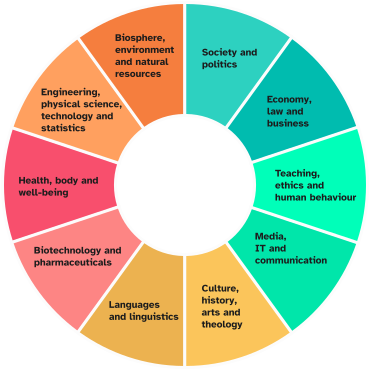
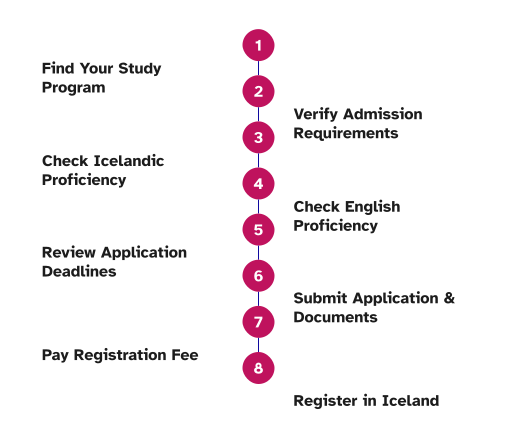

Additional information

The University of Iceland collaborates with over 400 universities worldwide. This provides a unique opportunity to pursue part of your studies at an international university thus gaining added experience and fresh insight into your field of study.

Students generally have the opportunity to join an exchange programme, internship, or summer courses. However, exchanges are always subject to faculty approval.

Students have the opportunity to have courses evaluated as part of their studies at the University of Iceland, so their stay does not have to affect the duration of their studies.

Studying the history of ideas and science provides a good foundation for administrative work in the public and private sectors, as well as careers in teaching, publishing and the media.

An education in this area can open up opportunities in:

  • Teaching
  • Research
  • Public administration
  • Narrative writing
  • Journalism and other media work
  • Historical exhibition work
  • Libraries and archives

This list is not exhaustive.

There is no specific student organisation for this programme, but students can choose to join a student organisation that suits their specific interests.  Students also meet frequently in the Student Cellar.

Students' comments
""
Students appreciate the University of Iceland for its strong academic reputation, modern campus facilities, close-knit community, and affordable tuition.
Helpful content
Aurora Cooperation

Study wheel

What interests you?

Aurora Cooperation

How to apply

Follow the path

Contact us

If you still have questions, feel free to contact us.

School of Humanities
Weekdays: 10-12 am and 1-3 pm
General Service and Social Media

The Service Desk is a point of access for all services. You can drop in at the University Centre or use the WebChat at the bottom right of this page.

Follow the School of Humanities on Instagram,   Youtube
and Facebook

""

Share

Did this help?

Why wasn't this information helpful

Limit to 250 characters.