""
Language skills
required, minimum level of B2
Programme length
2 years.
Study mode
Face-to-face learning
Application status
International students:
Students with Icelandic or Nordic citizenship:
Overview

  • Would you like to acquire a more in-depth knowledge of philosophy?
  • Do you want an education that will be an asset in a wide range of careers?
  • Do you want to work in research?
  • Do you want a graduate programme that is both practical and creative?

The MA in philosophy provides students with broad theoretical training and preparation for academic or specialist careers.

Philosophy is unlike other disciplines in various ways. Philosophy concerns itself with everything: daily life, material reality, the soul, thought, the world around us and higher powers. At its heart, philosophy is about applying reason to a problem in order to better understand the issue at hand.

Programme structure

The programme is 120 ECTS and is organised as two years of full-time study.

The programme is made up of:

  • Mandatory courses, 20 ECTS
  • Elective courses, 40 ECTS
  • Master’s research, 30 ECTS
  • Master's thesis, 30 ECTS

Organisation of teaching

This programme is taught in Icelandic but most textbooks are in English.

Students have the option of taking part of the programme as an exchange student abroad.

Main objectives

The programme aims to prepare students for doctoral studies or an academic career.

Other

Completing the programme allows a student to apply for doctoral studies.

Completing a BA programme with a first class grade, majoring in Philosophy, or an equivalent qualification and have written a final project worth at least 10 ECTS, also awarded a first class grade, is a prerequisite for access to the Master's programme in Philosophy at the University of Iceland. Students who have not completed a final project as part of their BA studies must complete such a project before applying to the Master's programme.

The Master's programme in Philosophy is a two-year programme for 120 ECTS.

1. In the first semester the student takes Theories in Humanities (10 ECTS), which is a joint course for other Master's students at the Faculty of History and Philosophy; MA Research Project 1 and 10 ECTS philosophy courses or seminars in consultation with their supervisor.

2. In the second semester the student takes Ethics of Science and Research (6 ECTS), Project in Ethics of Science and Research (4 ECTS), MA Research Project 2 and 10 ECTS philosophy courses or seminars.

3. In the third semester the student takes MA Research Project 3, and 20 ECTS that can consist of the course HMM101F Cultural mediums (10 ECTS) and/or philosophy courses and seminars.

4. In the fourth semester students shall write an MA thesis, generally evaluated for 30 ECTS.

The following documents must accompany an application for this programme:
  • CV
  • Statement of purpose
  • Reference 1, Name and email
  • Reference 2, Name and email
  • Certified copies of diplomas and transcripts

Further information on supporting documents can be found here

Programme structure

Check below to see how the programme is structured.

This programme does not offer specialisations.

First year | Fall
MA research project 1 (HSP713F)
A mandatory (required) course for the programme
10 ECTS, credits
Course Description

The course is taught in the first semester of the student’s MA programme and marks the start of the work which will culminate with the writing of an MA thesis in the 4th semester. In project 1 the student works under supervision, reviewing literature in the subject of their research project writing a report on the state of the art in that field.

Language of instruction: Icelandic
First year | Fall
Theories in Humanities (FOR709F)
A mandatory (required) course for the programme
10 ECTS, credits
Course Description

The aim of the course is to provide students with a more comprehensive and deeper insight into the different theoretical approaches within the humanities. In the course, the main theories that have influenced theoretical discussion in the humanities over the last decades will be presented and discussed, and the students are taught how to apply them in their own research.

Language of instruction: Icelandic/English
Face-to-face learning
First year | Fall
Theory of Creative AI: Analysing the Impact of AI on Creative Work (MFR715M)
Free elective course within the programme
10 ECTS, credits
Course Description

This course explores the evolving relationship between artificial intelligence and creative practices, focusing on the artistic, philosophical, ethical, and socio-cultural dimensions of AI-driven creativity. Grounded in the humanities, with emphasis on creativity studies, the course will enable students to critically assess how generative AI is reshaping traditional notions of creativity, authorship, and artistic production. Having explored key definitions of creativity itself, the course covers key issues such as the automation of creative work, the implications of AI-generated content for intellectual property and copyright, and the ethical dilemmas surrounding cultural appropriation in the digital age. Students will engage with debates on the tension between industrial AI big-data-driven systems versus small-data approaches, examining the consequences for artistic innovation and originality. Through hands-on exercises and real-world case studies, students will explore a variety of creative works, study production platforms where AI technologies are used, and gain practical experience in the application of AI for creative purposes. The course integrates modern theories of creativity with critical analysis of AI, and it will challenge students to rethink the boundaries of human and machine creativity. Course assessment will be based on creative work diaries that students will keep during the course, active participation in class, as well as an oral presentation of a short, written piece.

Language of instruction: English
Face-to-face learning
Distance learning
Prerequisites
First year | Fall
Seminar: Mystical medieval philosophy meets process philosophy (HSP549M, HSP550M)
Free elective course within the programme
5 ECTS, credits
Course Description

This course brings together world views and anthropologies that appear very far apart: the thought of classical German mystics like Meister Eckhart and Jakob Boehme, who deeply influenced German philosophy (e.g., Hegel, Schelling), and contemporary process philosophy exemplified by Alfred North Whitehead and Eugene Gendlin. Despite their obvious differences, these philosophies share implications that resonate with and can be interpreted through each other. They address concepts such as co-creation, ethical know-how, and an open-ended ontological understanding of the world. Humans play a decisive role—not as agents pushing agendas, but through their transformative potential. We will study the frameworks of each school of thought: the mystical tradition, using Christian language while radically reinterpreting it, and process philosophy, which embraces and spells out the complexity of an open-ended, interactional world. Engagement with the texts will include close reading, discussion, and philosophical practices derived from these traditions.

Language of instruction: English
Face-to-face learning
Prerequisites
First year | Fall
Direct study in seminar: Mystical medieval philosophy meets process philosophy (HSP549M, HSP550M)
Free elective course within the programme
5 ECTS, credits
Course Description

Direct study in seminar: Mystical medieval philosophy meets process philosophy. Students must finish related seminar to finish the direct study.

Language of instruction: English
Face-to-face learning
Prerequisites
First year | Fall
Seminar: The power of self-affection in the philosophy of Luce Irigaray (HSP551M, HSP552M)
Free elective course within the programme
5 ECTS, credits
Course Description

Through the phenomenology of the body, the aim is to explore the nature of self-affection in the formation of meaning in the philosophy of Irigaray. Self-affection is linked to her concept of sexual difference, embodiment, and action in perception, and how interaction and inter-affection bring forth the knowable world. The aim is to investigate how sexual difference is intrinsically linked to affect, having transcendental, spiritual, and ethical implications based on our desire and how it functions as a political power to transform and overcome dualisms in Western culture. Finally, her works will be assessed and discussed in light of Hegel´s phenomenology of the spirit and Merleau-Ponty´s idea of the flesh of the world, as well as other writers. 

Language of instruction: Icelandic
Prerequisites
First year | Fall
Direct study in seminar: The power of self-affection in the philosophy of Luce Irigaray (HSP551M, HSP552M)
Free elective course within the programme
5 ECTS, credits
Course Description

Direct study in seminar: The power of self-affection in the philosophy of Luce Irigaray. Students must finish related seminar to finish the direct study.

Language of instruction: Icelandic
Prerequisites
First year | Fall
Introduction to the Philosophy of Science (HSP715F, HSP716F)
Free elective course within the programme
5 ECTS, credits
Course Description

In this course we will consider many of the most prominent problems in the philosophy of science of the 20th and 21st century. How are scientific theories confirmed by experiments and observations? What is it for something to be a law of nature? Why should we trust scientific research more than other methods for obtaining knowledge? Is scientific research value-laden? And what is involved in the claim that science is objective?

Language of instruction: Icelandic
Face-to-face learning
First year | Fall
Project in introdution to philosophy of science (HSP715F, HSP716F)
Free elective course within the programme
5 ECTS, credits
Course Description

This is a project that can be chosen as an addition to HSP715F Introduction to philosophy of science and can only be taken along with that course.

Language of instruction: Icelandic
Face-to-face learning
First year | Fall
Current ethical issues (HSP723M)
Free elective course within the programme
10 ECTS, credits
Course Description

The focus of this course is the application of ethics to pressing problems and debates in contemporary society. Possible methods for solving ethical dilemmas, both on an individual and social basis, are discussed. The selection of topics may change from year to year, but possible topics include free speech, the status of refugees, animal rights, poverty and economic inequality, gender discrimination, racial discrimination, environmental issues, and various issues in health care. The relation between theoretical and applied ethics is discussed. While instruction includes lectures, student participation in discussion is greatly emphasized.

Language of instruction: English
Face-to-face learning
Prerequisites
First year | Fall
Business Ethics (HSP710F)
Free elective course within the programme
6 ECTS, credits
Course Description

The course addresses ethical challenges in business operations and how they manifest within companies and in their interactions with stakeholders, public authorities, and society at large. Emphasis is placed on students analysing, applying, evaluating, arguing for, and developing ethical solutions to real business issues based on theories in business ethics.
Teaching materials and assignments are based on realistic case studies, academic texts, and collaboration with industry partners. Students work systematically on identifying ethical dilemmas, applying theoretical approaches, evaluating different corporate responses, justifying their own ethical positions, and formulating practical proposals for processes and/or policies within complex societal contexts.
The course also emphasises that students develop a conscious and responsible attitude toward their own role as professionals and managers, in line with the University of Iceland’s values of social responsibility, equality, sustainability, and innovation, guided by sound ethical principles.
Students choose the course scope based on ECTS credits. The course may be taken as 7.5 ECTS, 6 ECTS (students from Philosophy), 3 ECTS, or 1.5 ECTS.
Please note that the course is taught in the first teaching block of the autumn semester, according to the block structure of the Master’s programme at the School of Business.

Language of instruction: Icelandic
Face-to-face learning
Course taught in period I
First year | Fall
Ethics of nature (HSP722M)
Free elective course within the programme
6 ECTS, credits
Course Description

The course deals with the connection between Man and Nature from the viewpoint of Moral Philosophy. It discusses the main proponents of and theories within Environmental Ethics and describes the roots of differing views of Nature, as well as different ethical orientations, i.e. anthropocentric, ecocentric, and biocentric positions. The course also deals with the integration of environmental and developmental issues, and with the connection between environmentalism and democracy. Amongst central issues discussed are the following: Can Ethics provide guidance in the solution of environmental problems?, What type of beings are worthy of moral considerability?, Can natural phenomena possess intrinsic value?, Do animals have rights?, Is there any fundamental difference in men's and women's relations to Nature? And, what is the ethical basis of sustainable development?

Language of instruction: English
Face-to-face learning
Prerequisites
First year | Fall
Project in Ethics of Nature (HSP725M)
Free elective course within the programme
4 ECTS, credits
Course Description

An individual project on the ethics of nature.

Language of instruction: English
Self-study
Prerequisites
First year | Fall
East Asian philosophy of education, educational theory and pedagogy A: Confucianism and Daoism (INT007M)
Free elective course within the programme
5 ECTS, credits
Course Description

This course elucidates foundational ideas in Chinese philosophy of education, pedagogy, educational theory and teaching methods with a particular focus on Confucianism, while some attention will be given to its response from its Daoist critics. We will begin with discussing conceptions of education, pedagogy, educational psychology and personal cultivation in the Confucian Analects (Lunyu 論語), then move to selected parts of other important Confucian writings, such as the Zhongyong (中庸, Doctrine of the Mean / Focusing the Familiar), Daxue (大學, The Great Learning), the Xueji (學記, Records of Learning / On Teaching and Learning), the Mengzi 孟子 and the Xunzi 荀子. Primary notions of the Chinese philosophy of education, pedagogy and educational theory will be introduced and explained, including jiao 教 (teaching), xue 學 (study/emulation), xiuji 修己 and xiushen 修身 (self-cultivation), li 禮 (rituals, customs, norms), xing 性 (natural dispositions), and junzi 君子 (exemplary people), among others. The Confucian importance of role models as pedagogical means for cultivation and descriptions of teaching methods, for instance in the Xueji, will be explored. If time allows, we will look into critical responses to these ideas by Daoist thinkers, notably the authors of the Daodejing 道德經 and the Zhuangzi 莊子. Arguing that the Confucian educational theory is likely to lead to dogmatism and hypocrisy, they suggest a less socially bound and more independent kind of learning or cultivation that takes seriously the “way of the world,” or the general cosmological tendency and how to align with it. In this regard, they suggest “metaphilosophical” ideas of “unlearning” and “reducing the self”. As an alternative to concentrating on learning from classics and others, Daoist texts advocate being more natural, acting in ziran 自然 (self-so) and wuwei 無爲 (non-action, non-coercive action) manners.

Some of the main questions that will be raised (and possibly answered) are: How is education understood in early Chinese culture? What are its pedagogical foundations? What are its primary aims and how should it be conducted? What sort of educational theories does it propose? What social and what “individualist” aspects do education and personal cultivation entail? What role do others play in education? Are role models necessary? What sort of roles do tradition and emulation play as means and methods of learning in Confucianism? What happens when education fails? Can education be bad or dangerous? And, finally, can tradition and emulation be overemphasized? What status does education generally play in Confucian philosophy? Can Daoism be a useful critic of Confucianism? An effort will be made to contextualize the discussion in contemporary philosophies of education.

Approach and readings:
We will mainly focus on selections from the primary texts mentioned in the course description. Students may follow along with any translation (in English or their native language) of these classics. During the class we will likely read directly from the original, students may refer to the website ctext.org for all the abovementioned texts but instructor will in some cases provide other versions. No prior knowledge of Chinese philosophy is expected. A highly recommended supplementary reading is Confucian Philosophy for Contemporary Education by Charlene Tan (Routledge 2020).

Language of instruction: English
Face-to-face learning
First year | Spring 1
MA research project 2 (HSP810F)
A mandatory (required) course for the programme
10 ECTS, credits
Course Description

The course is taught in the second semester and involves on the one hand the development of a research question and on the other hand the writing of a reserch plan that meets general criteria for research grant applications.

Language of instruction: Icelandic
First year | Spring 1
Ethics of Science and Research (HSP806F)
A mandatory (required) course for the programme
6 ECTS, credits
Course Description

The course is intended for postgraduate students only. It is adapted to the needs of students from different fields of study. The course is taught over a six-week period.

The course is taught over the first six weeks of spring semester on Fridays from 1:20 pm - 3:40 pm.

Description: 
The topics of the course include: Professionalism and the scientist’s responsibilities. Demands for scientific objectivity and the ethics of research. Issues of equality and standards of good practice. Power and science. Conflicts of interest and misconduct in research. Science, academia and industry. Research ethics and ethical decision making.

Objectives: 
In this course, the student gains knowledge about ethical issues in science and research and is trained in reasoning about ethical controversies relating to science and research in contemporary society.

The instruction takes the form of lectures and discussion. The course is viewed as an academic community where students are actively engaged in a focused dialogue about  the topics. Each student (working as a member of a two-person team) gives a presentation according to a plan designed at the beginning of the course, and other students acquaint themselves with the topic as well for the purpose of participating in a teacher-led discussion.

Language of instruction: English
Face-to-face learning
Course taught first half of the semester
First year | Spring 1
Project in Ethics of Science and Research (HSP048F)
A mandatory (required) course for the programme
4 ECTS, credits
Course Description

This is a project that can be chosen as an addition to HSP806F Ethics of Science and Research and can only be taken along with that course.

Language of instruction: English
Self-study
First year | Spring 1
Visiting Teacher's Seminar: Topics in climate ethics (HSP450M, HSP451M)
Free elective course within the programme
5 ECTS, credits
Course Description

The course will cover some of the philosophical and ethical issues raised by climate change. Some of these concern the choices of private individuals. We will for instance consider what duties climate change imposes on private individuals, and whether greenhouse gas offsetting can be a way of satisfying these duties. Most of the focus will however be on climate policy choice.  We will for instance discuss how to evaluate climate policies in light of the considerable uncertainty involved, and how to navigate the tradeoffs between current and future generations that such choices give rise to. We will also consider in detail some specific policy proposals, such as solar radiation management and a world climate bank. 

Language of instruction: English
Prerequisites
First year | Spring 1
Direct study in Visiting Teacher's Seminar: Topics in climate ethics (HSP450M, HSP451M)
Free elective course within the programme
5 ECTS, credits
Course Description

Direct study in seminar: Topics in climate ethics. Students must finish related seminar to finish the direct study.

Language of instruction: English
Prerequisites
First year | Spring 1
Seminar: Humanity and dehumanization (HSP539M, HSP540M)
Free elective course within the programme
5 ECTS, credits
Course Description

Humans have long been concerned with the notion of humanity, whether we call it human nature, the meaning of being human, or something else. We demand human rights on the basis of our humanity, which suggests that this is a normative or ethically laden notion. On the other hand, dehumanization can have horrendous consequences, when marginalized persons or groups are denied full access to human society, and this used to justify oppression and violent acts. In this seminar we will consider several possible definitions of humanity and dehumanization, theories about them and different approaches to them. While there will be some readings from different periods in the history of philosophy, the main emphasis will be on materials from recent decades, which will be put in context with current events.

Language of instruction: English
Face-to-face learning
Prerequisites
First year | Spring 1
Direct study in seminar: Humanity and dehumanization (HSP539M, HSP540M)
Free elective course within the programme
5 ECTS, credits
Course Description

Direct study in seminar: Humanity and dehumanization. Students must finish related seminar to finish the direct study.

Language of instruction: English
Face-to-face learning
Prerequisites
First year | Spring 1
Bioethics and Ethics of Medicine (HSP823M)
Free elective course within the programme
6 ECTS, credits
Course Description

A discussion of some controversial issues in the field of bioethics, in particular those relating to developments in genetics and their possible effects upon medical services and health care policy.

Language of instruction: Icelandic
Face-to-face learning
Prerequisites
First year | Spring 1
East Asian philosophy of education, educational theory, and pedagogy B: Buddhism (INT008M)
Free elective course within the programme
5 ECTS, credits
Course Description

This course explores what it means to speak of a Buddhist philosophy of education - or, more precisely, a Buddhist pedagogy of education. While still examining what Buddhism teaches – compassion, wisdom, peace – our primary focus will be on how Buddhism teaches, and how its pedagogical strategies have shifted across cultures, traditions, and historical contexts.

At the heart of this inquiry lies the Buddhist concept of “upaya” or, “skillful means”: the idea that the form of any teaching must be adapted to the capacities, needs, and unique conditions of learners. From the highly structured monastic curriculum of early Theravada to the imaginative parables of Mahayana; from the silence and paradoxes of Zen to the magico-ritual performance of Vajrayana, Buddhism demonstrates a remarkable diversity of educational strategies. Each is less a fixed doctrine than a pedagogical gesture: a way of opening students to the possibility of enormous spiritual transformation.

We will also encourage an experiential engagement with Buddhism. First, through field visits to three different local Buddhist communities: to Wat Thai, to Nátthagi, and to Hugleiðslu og friðarmiðstöðin, which covers Theravada, Zen, and Tibetan Buddhist schools, respectively. Students will be given specific questions to ask their hosts as well as reflection questions concerning the nature of teaching at each center.

Secondly, students are invited to participate in weekly meditation classes taught by José as part of the Hugleiðsluhópur Háskólans group. This is an optional component and not assessed for the course. However, for those seeking additional academic credit, a two ECTS Meditation Practicum involving attendance at eight of ten successive sessions during the course is being applied for. If approved, this would grant students a seven-ECTS total credit immersion in Buddhist studies.

Language of instruction: English
Face-to-face learning
Second year | Fall
Theory of Creative AI: Analysing the Impact of AI on Creative Work (MFR715M)
Free elective course within the programme
10 ECTS, credits
Course Description

This course explores the evolving relationship between artificial intelligence and creative practices, focusing on the artistic, philosophical, ethical, and socio-cultural dimensions of AI-driven creativity. Grounded in the humanities, with emphasis on creativity studies, the course will enable students to critically assess how generative AI is reshaping traditional notions of creativity, authorship, and artistic production. Having explored key definitions of creativity itself, the course covers key issues such as the automation of creative work, the implications of AI-generated content for intellectual property and copyright, and the ethical dilemmas surrounding cultural appropriation in the digital age. Students will engage with debates on the tension between industrial AI big-data-driven systems versus small-data approaches, examining the consequences for artistic innovation and originality. Through hands-on exercises and real-world case studies, students will explore a variety of creative works, study production platforms where AI technologies are used, and gain practical experience in the application of AI for creative purposes. The course integrates modern theories of creativity with critical analysis of AI, and it will challenge students to rethink the boundaries of human and machine creativity. Course assessment will be based on creative work diaries that students will keep during the course, active participation in class, as well as an oral presentation of a short, written piece.

Language of instruction: English
Face-to-face learning
Distance learning
Prerequisites
Second year | Fall
Seminar: Mystical medieval philosophy meets process philosophy (HSP549M, HSP550M)
Free elective course within the programme
5 ECTS, credits
Course Description

This course brings together world views and anthropologies that appear very far apart: the thought of classical German mystics like Meister Eckhart and Jakob Boehme, who deeply influenced German philosophy (e.g., Hegel, Schelling), and contemporary process philosophy exemplified by Alfred North Whitehead and Eugene Gendlin. Despite their obvious differences, these philosophies share implications that resonate with and can be interpreted through each other. They address concepts such as co-creation, ethical know-how, and an open-ended ontological understanding of the world. Humans play a decisive role—not as agents pushing agendas, but through their transformative potential. We will study the frameworks of each school of thought: the mystical tradition, using Christian language while radically reinterpreting it, and process philosophy, which embraces and spells out the complexity of an open-ended, interactional world. Engagement with the texts will include close reading, discussion, and philosophical practices derived from these traditions.

Language of instruction: English
Face-to-face learning
Prerequisites
Second year | Fall
Direct study in seminar: Mystical medieval philosophy meets process philosophy (HSP549M, HSP550M)
Free elective course within the programme
5 ECTS, credits
Course Description

Direct study in seminar: Mystical medieval philosophy meets process philosophy. Students must finish related seminar to finish the direct study.

Language of instruction: English
Face-to-face learning
Prerequisites
Second year | Fall
Seminar: The power of self-affection in the philosophy of Luce Irigaray (HSP551M, HSP552M)
Free elective course within the programme
5 ECTS, credits
Course Description

Through the phenomenology of the body, the aim is to explore the nature of self-affection in the formation of meaning in the philosophy of Irigaray. Self-affection is linked to her concept of sexual difference, embodiment, and action in perception, and how interaction and inter-affection bring forth the knowable world. The aim is to investigate how sexual difference is intrinsically linked to affect, having transcendental, spiritual, and ethical implications based on our desire and how it functions as a political power to transform and overcome dualisms in Western culture. Finally, her works will be assessed and discussed in light of Hegel´s phenomenology of the spirit and Merleau-Ponty´s idea of the flesh of the world, as well as other writers. 

Language of instruction: Icelandic
Prerequisites
Second year | Fall
Direct study in seminar: The power of self-affection in the philosophy of Luce Irigaray (HSP551M, HSP552M)
Free elective course within the programme
5 ECTS, credits
Course Description

Direct study in seminar: The power of self-affection in the philosophy of Luce Irigaray. Students must finish related seminar to finish the direct study.

Language of instruction: Icelandic
Prerequisites
Second year | Fall
Current ethical issues (HSP723M)
Free elective course within the programme
10 ECTS, credits
Course Description

The focus of this course is the application of ethics to pressing problems and debates in contemporary society. Possible methods for solving ethical dilemmas, both on an individual and social basis, are discussed. The selection of topics may change from year to year, but possible topics include free speech, the status of refugees, animal rights, poverty and economic inequality, gender discrimination, racial discrimination, environmental issues, and various issues in health care. The relation between theoretical and applied ethics is discussed. While instruction includes lectures, student participation in discussion is greatly emphasized.

Language of instruction: English
Face-to-face learning
Prerequisites
Second year | Fall
Business Ethics (HSP710F)
Free elective course within the programme
6 ECTS, credits
Course Description

The course addresses ethical challenges in business operations and how they manifest within companies and in their interactions with stakeholders, public authorities, and society at large. Emphasis is placed on students analysing, applying, evaluating, arguing for, and developing ethical solutions to real business issues based on theories in business ethics.
Teaching materials and assignments are based on realistic case studies, academic texts, and collaboration with industry partners. Students work systematically on identifying ethical dilemmas, applying theoretical approaches, evaluating different corporate responses, justifying their own ethical positions, and formulating practical proposals for processes and/or policies within complex societal contexts.
The course also emphasises that students develop a conscious and responsible attitude toward their own role as professionals and managers, in line with the University of Iceland’s values of social responsibility, equality, sustainability, and innovation, guided by sound ethical principles.
Students choose the course scope based on ECTS credits. The course may be taken as 7.5 ECTS, 6 ECTS (students from Philosophy), 3 ECTS, or 1.5 ECTS.
Please note that the course is taught in the first teaching block of the autumn semester, according to the block structure of the Master’s programme at the School of Business.

Language of instruction: Icelandic
Face-to-face learning
Course taught in period I
Second year | Fall
Ethics of nature (HSP722M)
Free elective course within the programme
6 ECTS, credits
Course Description

The course deals with the connection between Man and Nature from the viewpoint of Moral Philosophy. It discusses the main proponents of and theories within Environmental Ethics and describes the roots of differing views of Nature, as well as different ethical orientations, i.e. anthropocentric, ecocentric, and biocentric positions. The course also deals with the integration of environmental and developmental issues, and with the connection between environmentalism and democracy. Amongst central issues discussed are the following: Can Ethics provide guidance in the solution of environmental problems?, What type of beings are worthy of moral considerability?, Can natural phenomena possess intrinsic value?, Do animals have rights?, Is there any fundamental difference in men's and women's relations to Nature? And, what is the ethical basis of sustainable development?

Language of instruction: English
Face-to-face learning
Prerequisites
Second year | Fall
Project in Ethics of Nature (HSP725M)
Free elective course within the programme
4 ECTS, credits
Course Description

An individual project on the ethics of nature.

Language of instruction: English
Self-study
Prerequisites
Second year | Fall
East Asian philosophy of education, educational theory and pedagogy A: Confucianism and Daoism (INT007M)
Free elective course within the programme
5 ECTS, credits
Course Description

This course elucidates foundational ideas in Chinese philosophy of education, pedagogy, educational theory and teaching methods with a particular focus on Confucianism, while some attention will be given to its response from its Daoist critics. We will begin with discussing conceptions of education, pedagogy, educational psychology and personal cultivation in the Confucian Analects (Lunyu 論語), then move to selected parts of other important Confucian writings, such as the Zhongyong (中庸, Doctrine of the Mean / Focusing the Familiar), Daxue (大學, The Great Learning), the Xueji (學記, Records of Learning / On Teaching and Learning), the Mengzi 孟子 and the Xunzi 荀子. Primary notions of the Chinese philosophy of education, pedagogy and educational theory will be introduced and explained, including jiao 教 (teaching), xue 學 (study/emulation), xiuji 修己 and xiushen 修身 (self-cultivation), li 禮 (rituals, customs, norms), xing 性 (natural dispositions), and junzi 君子 (exemplary people), among others. The Confucian importance of role models as pedagogical means for cultivation and descriptions of teaching methods, for instance in the Xueji, will be explored. If time allows, we will look into critical responses to these ideas by Daoist thinkers, notably the authors of the Daodejing 道德經 and the Zhuangzi 莊子. Arguing that the Confucian educational theory is likely to lead to dogmatism and hypocrisy, they suggest a less socially bound and more independent kind of learning or cultivation that takes seriously the “way of the world,” or the general cosmological tendency and how to align with it. In this regard, they suggest “metaphilosophical” ideas of “unlearning” and “reducing the self”. As an alternative to concentrating on learning from classics and others, Daoist texts advocate being more natural, acting in ziran 自然 (self-so) and wuwei 無爲 (non-action, non-coercive action) manners.

Some of the main questions that will be raised (and possibly answered) are: How is education understood in early Chinese culture? What are its pedagogical foundations? What are its primary aims and how should it be conducted? What sort of educational theories does it propose? What social and what “individualist” aspects do education and personal cultivation entail? What role do others play in education? Are role models necessary? What sort of roles do tradition and emulation play as means and methods of learning in Confucianism? What happens when education fails? Can education be bad or dangerous? And, finally, can tradition and emulation be overemphasized? What status does education generally play in Confucian philosophy? Can Daoism be a useful critic of Confucianism? An effort will be made to contextualize the discussion in contemporary philosophies of education.

Approach and readings:
We will mainly focus on selections from the primary texts mentioned in the course description. Students may follow along with any translation (in English or their native language) of these classics. During the class we will likely read directly from the original, students may refer to the website ctext.org for all the abovementioned texts but instructor will in some cases provide other versions. No prior knowledge of Chinese philosophy is expected. A highly recommended supplementary reading is Confucian Philosophy for Contemporary Education by Charlene Tan (Routledge 2020).

Language of instruction: English
Face-to-face learning
Second year | Fall
MA research project 3 (HSP911F)
A mandatory (required) course for the programme
10 ECTS, credits
Course Description

The course is taught in the third semester. The student carries out defined part of the MA research project under supervision. Furthermore the student revises the original research plan in the light of this experience ans should then be ready to independently write an MA thesis.

Language of instruction: Icelandic
Second year | Spring 1
MA-thesis in Philosophy (HSP441L)
A mandatory (required) course for the programme
0 ECTS, credits
Course Description

.

Language of instruction: Icelandic/English
Part of the total project/thesis credits
First year
  • Fall
  • HSP713F
    MA research project 1
    Mandatory (required) course
    10
    A mandatory (required) course for the programme
    10 ECTS, credits
    Course Description

    The course is taught in the first semester of the student’s MA programme and marks the start of the work which will culminate with the writing of an MA thesis in the 4th semester. In project 1 the student works under supervision, reviewing literature in the subject of their research project writing a report on the state of the art in that field.

    Prerequisites
  • FOR709F
    Theories in Humanities
    Mandatory (required) course
    10
    A mandatory (required) course for the programme
    10 ECTS, credits
    Course Description

    The aim of the course is to provide students with a more comprehensive and deeper insight into the different theoretical approaches within the humanities. In the course, the main theories that have influenced theoretical discussion in the humanities over the last decades will be presented and discussed, and the students are taught how to apply them in their own research.

    Face-to-face learning
    Prerequisites
  • MFR715M
    Theory of Creative AI: Analysing the Impact of AI on Creative Work
    Elective course
    10
    Free elective course within the programme
    10 ECTS, credits
    Course Description

    This course explores the evolving relationship between artificial intelligence and creative practices, focusing on the artistic, philosophical, ethical, and socio-cultural dimensions of AI-driven creativity. Grounded in the humanities, with emphasis on creativity studies, the course will enable students to critically assess how generative AI is reshaping traditional notions of creativity, authorship, and artistic production. Having explored key definitions of creativity itself, the course covers key issues such as the automation of creative work, the implications of AI-generated content for intellectual property and copyright, and the ethical dilemmas surrounding cultural appropriation in the digital age. Students will engage with debates on the tension between industrial AI big-data-driven systems versus small-data approaches, examining the consequences for artistic innovation and originality. Through hands-on exercises and real-world case studies, students will explore a variety of creative works, study production platforms where AI technologies are used, and gain practical experience in the application of AI for creative purposes. The course integrates modern theories of creativity with critical analysis of AI, and it will challenge students to rethink the boundaries of human and machine creativity. Course assessment will be based on creative work diaries that students will keep during the course, active participation in class, as well as an oral presentation of a short, written piece.

    Face-to-face learning
    Distance learning
    Prerequisites
  • HSP549M, HSP550M
    Seminar: Mystical medieval philosophy meets process philosophy
    Elective course
    5
    Free elective course within the programme
    5 ECTS, credits
    Course Description

    This course brings together world views and anthropologies that appear very far apart: the thought of classical German mystics like Meister Eckhart and Jakob Boehme, who deeply influenced German philosophy (e.g., Hegel, Schelling), and contemporary process philosophy exemplified by Alfred North Whitehead and Eugene Gendlin. Despite their obvious differences, these philosophies share implications that resonate with and can be interpreted through each other. They address concepts such as co-creation, ethical know-how, and an open-ended ontological understanding of the world. Humans play a decisive role—not as agents pushing agendas, but through their transformative potential. We will study the frameworks of each school of thought: the mystical tradition, using Christian language while radically reinterpreting it, and process philosophy, which embraces and spells out the complexity of an open-ended, interactional world. Engagement with the texts will include close reading, discussion, and philosophical practices derived from these traditions.

    Face-to-face learning
    Prerequisites
  • HSP549M, HSP550M
    Direct study in seminar: Mystical medieval philosophy meets process philosophy
    Elective course
    5
    Free elective course within the programme
    5 ECTS, credits
    Course Description

    Direct study in seminar: Mystical medieval philosophy meets process philosophy. Students must finish related seminar to finish the direct study.

    Face-to-face learning
    Prerequisites
  • HSP551M, HSP552M
    Seminar: The power of self-affection in the philosophy of Luce Irigaray
    Elective course
    5
    Free elective course within the programme
    5 ECTS, credits
    Course Description

    Through the phenomenology of the body, the aim is to explore the nature of self-affection in the formation of meaning in the philosophy of Irigaray. Self-affection is linked to her concept of sexual difference, embodiment, and action in perception, and how interaction and inter-affection bring forth the knowable world. The aim is to investigate how sexual difference is intrinsically linked to affect, having transcendental, spiritual, and ethical implications based on our desire and how it functions as a political power to transform and overcome dualisms in Western culture. Finally, her works will be assessed and discussed in light of Hegel´s phenomenology of the spirit and Merleau-Ponty´s idea of the flesh of the world, as well as other writers. 

    Prerequisites
  • HSP551M, HSP552M
    Direct study in seminar: The power of self-affection in the philosophy of Luce Irigaray
    Elective course
    5
    Free elective course within the programme
    5 ECTS, credits
    Course Description

    Direct study in seminar: The power of self-affection in the philosophy of Luce Irigaray. Students must finish related seminar to finish the direct study.

    Prerequisites
  • HSP715F, HSP716F
    Introduction to the Philosophy of Science
    Elective course
    5
    Free elective course within the programme
    5 ECTS, credits
    Course Description

    In this course we will consider many of the most prominent problems in the philosophy of science of the 20th and 21st century. How are scientific theories confirmed by experiments and observations? What is it for something to be a law of nature? Why should we trust scientific research more than other methods for obtaining knowledge? Is scientific research value-laden? And what is involved in the claim that science is objective?

    Face-to-face learning
    Prerequisites
  • HSP715F, HSP716F
    Project in introdution to philosophy of science
    Elective course
    5
    Free elective course within the programme
    5 ECTS, credits
    Course Description

    This is a project that can be chosen as an addition to HSP715F Introduction to philosophy of science and can only be taken along with that course.

    Face-to-face learning
    Prerequisites
  • HSP723M
    Current ethical issues
    Elective course
    10
    Free elective course within the programme
    10 ECTS, credits
    Course Description

    The focus of this course is the application of ethics to pressing problems and debates in contemporary society. Possible methods for solving ethical dilemmas, both on an individual and social basis, are discussed. The selection of topics may change from year to year, but possible topics include free speech, the status of refugees, animal rights, poverty and economic inequality, gender discrimination, racial discrimination, environmental issues, and various issues in health care. The relation between theoretical and applied ethics is discussed. While instruction includes lectures, student participation in discussion is greatly emphasized.

    Face-to-face learning
    Prerequisites
  • HSP710F
    Business Ethics
    Elective course
    6
    Free elective course within the programme
    6 ECTS, credits
    Course Description

    The course addresses ethical challenges in business operations and how they manifest within companies and in their interactions with stakeholders, public authorities, and society at large. Emphasis is placed on students analysing, applying, evaluating, arguing for, and developing ethical solutions to real business issues based on theories in business ethics.
    Teaching materials and assignments are based on realistic case studies, academic texts, and collaboration with industry partners. Students work systematically on identifying ethical dilemmas, applying theoretical approaches, evaluating different corporate responses, justifying their own ethical positions, and formulating practical proposals for processes and/or policies within complex societal contexts.
    The course also emphasises that students develop a conscious and responsible attitude toward their own role as professionals and managers, in line with the University of Iceland’s values of social responsibility, equality, sustainability, and innovation, guided by sound ethical principles.
    Students choose the course scope based on ECTS credits. The course may be taken as 7.5 ECTS, 6 ECTS (students from Philosophy), 3 ECTS, or 1.5 ECTS.
    Please note that the course is taught in the first teaching block of the autumn semester, according to the block structure of the Master’s programme at the School of Business.

    Face-to-face learning
    Prerequisites
    Course taught in period I
  • HSP722M
    Ethics of nature
    Elective course
    6
    Free elective course within the programme
    6 ECTS, credits
    Course Description

    The course deals with the connection between Man and Nature from the viewpoint of Moral Philosophy. It discusses the main proponents of and theories within Environmental Ethics and describes the roots of differing views of Nature, as well as different ethical orientations, i.e. anthropocentric, ecocentric, and biocentric positions. The course also deals with the integration of environmental and developmental issues, and with the connection between environmentalism and democracy. Amongst central issues discussed are the following: Can Ethics provide guidance in the solution of environmental problems?, What type of beings are worthy of moral considerability?, Can natural phenomena possess intrinsic value?, Do animals have rights?, Is there any fundamental difference in men's and women's relations to Nature? And, what is the ethical basis of sustainable development?

    Face-to-face learning
    Prerequisites
  • HSP725M
    Project in Ethics of Nature
    Elective course
    4
    Free elective course within the programme
    4 ECTS, credits
    Course Description

    An individual project on the ethics of nature.

    Self-study
    Prerequisites
  • INT007M
    East Asian philosophy of education, educational theory and pedagogy A: Confucianism and Daoism
    Elective course
    5
    Free elective course within the programme
    5 ECTS, credits
    Course Description

    This course elucidates foundational ideas in Chinese philosophy of education, pedagogy, educational theory and teaching methods with a particular focus on Confucianism, while some attention will be given to its response from its Daoist critics. We will begin with discussing conceptions of education, pedagogy, educational psychology and personal cultivation in the Confucian Analects (Lunyu 論語), then move to selected parts of other important Confucian writings, such as the Zhongyong (中庸, Doctrine of the Mean / Focusing the Familiar), Daxue (大學, The Great Learning), the Xueji (學記, Records of Learning / On Teaching and Learning), the Mengzi 孟子 and the Xunzi 荀子. Primary notions of the Chinese philosophy of education, pedagogy and educational theory will be introduced and explained, including jiao 教 (teaching), xue 學 (study/emulation), xiuji 修己 and xiushen 修身 (self-cultivation), li 禮 (rituals, customs, norms), xing 性 (natural dispositions), and junzi 君子 (exemplary people), among others. The Confucian importance of role models as pedagogical means for cultivation and descriptions of teaching methods, for instance in the Xueji, will be explored. If time allows, we will look into critical responses to these ideas by Daoist thinkers, notably the authors of the Daodejing 道德經 and the Zhuangzi 莊子. Arguing that the Confucian educational theory is likely to lead to dogmatism and hypocrisy, they suggest a less socially bound and more independent kind of learning or cultivation that takes seriously the “way of the world,” or the general cosmological tendency and how to align with it. In this regard, they suggest “metaphilosophical” ideas of “unlearning” and “reducing the self”. As an alternative to concentrating on learning from classics and others, Daoist texts advocate being more natural, acting in ziran 自然 (self-so) and wuwei 無爲 (non-action, non-coercive action) manners.

    Some of the main questions that will be raised (and possibly answered) are: How is education understood in early Chinese culture? What are its pedagogical foundations? What are its primary aims and how should it be conducted? What sort of educational theories does it propose? What social and what “individualist” aspects do education and personal cultivation entail? What role do others play in education? Are role models necessary? What sort of roles do tradition and emulation play as means and methods of learning in Confucianism? What happens when education fails? Can education be bad or dangerous? And, finally, can tradition and emulation be overemphasized? What status does education generally play in Confucian philosophy? Can Daoism be a useful critic of Confucianism? An effort will be made to contextualize the discussion in contemporary philosophies of education.

    Approach and readings:
    We will mainly focus on selections from the primary texts mentioned in the course description. Students may follow along with any translation (in English or their native language) of these classics. During the class we will likely read directly from the original, students may refer to the website ctext.org for all the abovementioned texts but instructor will in some cases provide other versions. No prior knowledge of Chinese philosophy is expected. A highly recommended supplementary reading is Confucian Philosophy for Contemporary Education by Charlene Tan (Routledge 2020).

    Face-to-face learning
    Prerequisites
  • Spring 2
  • HSP810F
    MA research project 2
    Mandatory (required) course
    10
    A mandatory (required) course for the programme
    10 ECTS, credits
    Course Description

    The course is taught in the second semester and involves on the one hand the development of a research question and on the other hand the writing of a reserch plan that meets general criteria for research grant applications.

    Prerequisites
  • HSP806F
    Ethics of Science and Research
    Mandatory (required) course
    6
    A mandatory (required) course for the programme
    6 ECTS, credits
    Course Description

    The course is intended for postgraduate students only. It is adapted to the needs of students from different fields of study. The course is taught over a six-week period.

    The course is taught over the first six weeks of spring semester on Fridays from 1:20 pm - 3:40 pm.

    Description: 
    The topics of the course include: Professionalism and the scientist’s responsibilities. Demands for scientific objectivity and the ethics of research. Issues of equality and standards of good practice. Power and science. Conflicts of interest and misconduct in research. Science, academia and industry. Research ethics and ethical decision making.

    Objectives: 
    In this course, the student gains knowledge about ethical issues in science and research and is trained in reasoning about ethical controversies relating to science and research in contemporary society.

    The instruction takes the form of lectures and discussion. The course is viewed as an academic community where students are actively engaged in a focused dialogue about  the topics. Each student (working as a member of a two-person team) gives a presentation according to a plan designed at the beginning of the course, and other students acquaint themselves with the topic as well for the purpose of participating in a teacher-led discussion.

    Face-to-face learning
    Prerequisites
    Course taught first half of the semester
  • HSP048F
    Project in Ethics of Science and Research
    Mandatory (required) course
    4
    A mandatory (required) course for the programme
    4 ECTS, credits
    Course Description

    This is a project that can be chosen as an addition to HSP806F Ethics of Science and Research and can only be taken along with that course.

    Self-study
    Prerequisites
  • HSP450M, HSP451M
    Visiting Teacher's Seminar: Topics in climate ethics
    Elective course
    5
    Free elective course within the programme
    5 ECTS, credits
    Course Description

    The course will cover some of the philosophical and ethical issues raised by climate change. Some of these concern the choices of private individuals. We will for instance consider what duties climate change imposes on private individuals, and whether greenhouse gas offsetting can be a way of satisfying these duties. Most of the focus will however be on climate policy choice.  We will for instance discuss how to evaluate climate policies in light of the considerable uncertainty involved, and how to navigate the tradeoffs between current and future generations that such choices give rise to. We will also consider in detail some specific policy proposals, such as solar radiation management and a world climate bank. 

    Prerequisites
  • HSP450M, HSP451M
    Direct study in Visiting Teacher's Seminar: Topics in climate ethics
    Elective course
    5
    Free elective course within the programme
    5 ECTS, credits
    Course Description

    Direct study in seminar: Topics in climate ethics. Students must finish related seminar to finish the direct study.

    Prerequisites
  • HSP539M, HSP540M
    Seminar: Humanity and dehumanization
    Elective course
    5
    Free elective course within the programme
    5 ECTS, credits
    Course Description

    Humans have long been concerned with the notion of humanity, whether we call it human nature, the meaning of being human, or something else. We demand human rights on the basis of our humanity, which suggests that this is a normative or ethically laden notion. On the other hand, dehumanization can have horrendous consequences, when marginalized persons or groups are denied full access to human society, and this used to justify oppression and violent acts. In this seminar we will consider several possible definitions of humanity and dehumanization, theories about them and different approaches to them. While there will be some readings from different periods in the history of philosophy, the main emphasis will be on materials from recent decades, which will be put in context with current events.

    Face-to-face learning
    Prerequisites
  • HSP539M, HSP540M
    Direct study in seminar: Humanity and dehumanization
    Elective course
    5
    Free elective course within the programme
    5 ECTS, credits
    Course Description

    Direct study in seminar: Humanity and dehumanization. Students must finish related seminar to finish the direct study.

    Face-to-face learning
    Prerequisites
  • HSP823M
    Bioethics and Ethics of Medicine
    Elective course
    6
    Free elective course within the programme
    6 ECTS, credits
    Course Description

    A discussion of some controversial issues in the field of bioethics, in particular those relating to developments in genetics and their possible effects upon medical services and health care policy.

    Face-to-face learning
    Prerequisites
  • INT008M
    East Asian philosophy of education, educational theory, and pedagogy B: Buddhism
    Elective course
    5
    Free elective course within the programme
    5 ECTS, credits
    Course Description

    This course explores what it means to speak of a Buddhist philosophy of education - or, more precisely, a Buddhist pedagogy of education. While still examining what Buddhism teaches – compassion, wisdom, peace – our primary focus will be on how Buddhism teaches, and how its pedagogical strategies have shifted across cultures, traditions, and historical contexts.

    At the heart of this inquiry lies the Buddhist concept of “upaya” or, “skillful means”: the idea that the form of any teaching must be adapted to the capacities, needs, and unique conditions of learners. From the highly structured monastic curriculum of early Theravada to the imaginative parables of Mahayana; from the silence and paradoxes of Zen to the magico-ritual performance of Vajrayana, Buddhism demonstrates a remarkable diversity of educational strategies. Each is less a fixed doctrine than a pedagogical gesture: a way of opening students to the possibility of enormous spiritual transformation.

    We will also encourage an experiential engagement with Buddhism. First, through field visits to three different local Buddhist communities: to Wat Thai, to Nátthagi, and to Hugleiðslu og friðarmiðstöðin, which covers Theravada, Zen, and Tibetan Buddhist schools, respectively. Students will be given specific questions to ask their hosts as well as reflection questions concerning the nature of teaching at each center.

    Secondly, students are invited to participate in weekly meditation classes taught by José as part of the Hugleiðsluhópur Háskólans group. This is an optional component and not assessed for the course. However, for those seeking additional academic credit, a two ECTS Meditation Practicum involving attendance at eight of ten successive sessions during the course is being applied for. If approved, this would grant students a seven-ECTS total credit immersion in Buddhist studies.

    Face-to-face learning
    Prerequisites
  • Fall
  • MFR715M
    Theory of Creative AI: Analysing the Impact of AI on Creative Work
    Elective course
    10
    Free elective course within the programme
    10 ECTS, credits
    Course Description

    This course explores the evolving relationship between artificial intelligence and creative practices, focusing on the artistic, philosophical, ethical, and socio-cultural dimensions of AI-driven creativity. Grounded in the humanities, with emphasis on creativity studies, the course will enable students to critically assess how generative AI is reshaping traditional notions of creativity, authorship, and artistic production. Having explored key definitions of creativity itself, the course covers key issues such as the automation of creative work, the implications of AI-generated content for intellectual property and copyright, and the ethical dilemmas surrounding cultural appropriation in the digital age. Students will engage with debates on the tension between industrial AI big-data-driven systems versus small-data approaches, examining the consequences for artistic innovation and originality. Through hands-on exercises and real-world case studies, students will explore a variety of creative works, study production platforms where AI technologies are used, and gain practical experience in the application of AI for creative purposes. The course integrates modern theories of creativity with critical analysis of AI, and it will challenge students to rethink the boundaries of human and machine creativity. Course assessment will be based on creative work diaries that students will keep during the course, active participation in class, as well as an oral presentation of a short, written piece.

    Face-to-face learning
    Distance learning
    Prerequisites
  • HSP549M, HSP550M
    Seminar: Mystical medieval philosophy meets process philosophy
    Elective course
    5
    Free elective course within the programme
    5 ECTS, credits
    Course Description

    This course brings together world views and anthropologies that appear very far apart: the thought of classical German mystics like Meister Eckhart and Jakob Boehme, who deeply influenced German philosophy (e.g., Hegel, Schelling), and contemporary process philosophy exemplified by Alfred North Whitehead and Eugene Gendlin. Despite their obvious differences, these philosophies share implications that resonate with and can be interpreted through each other. They address concepts such as co-creation, ethical know-how, and an open-ended ontological understanding of the world. Humans play a decisive role—not as agents pushing agendas, but through their transformative potential. We will study the frameworks of each school of thought: the mystical tradition, using Christian language while radically reinterpreting it, and process philosophy, which embraces and spells out the complexity of an open-ended, interactional world. Engagement with the texts will include close reading, discussion, and philosophical practices derived from these traditions.

    Face-to-face learning
    Prerequisites
  • HSP549M, HSP550M
    Direct study in seminar: Mystical medieval philosophy meets process philosophy
    Elective course
    5
    Free elective course within the programme
    5 ECTS, credits
    Course Description

    Direct study in seminar: Mystical medieval philosophy meets process philosophy. Students must finish related seminar to finish the direct study.

    Face-to-face learning
    Prerequisites
  • HSP551M, HSP552M
    Seminar: The power of self-affection in the philosophy of Luce Irigaray
    Elective course
    5
    Free elective course within the programme
    5 ECTS, credits
    Course Description

    Through the phenomenology of the body, the aim is to explore the nature of self-affection in the formation of meaning in the philosophy of Irigaray. Self-affection is linked to her concept of sexual difference, embodiment, and action in perception, and how interaction and inter-affection bring forth the knowable world. The aim is to investigate how sexual difference is intrinsically linked to affect, having transcendental, spiritual, and ethical implications based on our desire and how it functions as a political power to transform and overcome dualisms in Western culture. Finally, her works will be assessed and discussed in light of Hegel´s phenomenology of the spirit and Merleau-Ponty´s idea of the flesh of the world, as well as other writers. 

    Prerequisites
  • HSP551M, HSP552M
    Direct study in seminar: The power of self-affection in the philosophy of Luce Irigaray
    Elective course
    5
    Free elective course within the programme
    5 ECTS, credits
    Course Description

    Direct study in seminar: The power of self-affection in the philosophy of Luce Irigaray. Students must finish related seminar to finish the direct study.

    Prerequisites
  • HSP723M
    Current ethical issues
    Elective course
    10
    Free elective course within the programme
    10 ECTS, credits
    Course Description

    The focus of this course is the application of ethics to pressing problems and debates in contemporary society. Possible methods for solving ethical dilemmas, both on an individual and social basis, are discussed. The selection of topics may change from year to year, but possible topics include free speech, the status of refugees, animal rights, poverty and economic inequality, gender discrimination, racial discrimination, environmental issues, and various issues in health care. The relation between theoretical and applied ethics is discussed. While instruction includes lectures, student participation in discussion is greatly emphasized.

    Face-to-face learning
    Prerequisites
  • HSP710F
    Business Ethics
    Elective course
    6
    Free elective course within the programme
    6 ECTS, credits
    Course Description

    The course addresses ethical challenges in business operations and how they manifest within companies and in their interactions with stakeholders, public authorities, and society at large. Emphasis is placed on students analysing, applying, evaluating, arguing for, and developing ethical solutions to real business issues based on theories in business ethics.
    Teaching materials and assignments are based on realistic case studies, academic texts, and collaboration with industry partners. Students work systematically on identifying ethical dilemmas, applying theoretical approaches, evaluating different corporate responses, justifying their own ethical positions, and formulating practical proposals for processes and/or policies within complex societal contexts.
    The course also emphasises that students develop a conscious and responsible attitude toward their own role as professionals and managers, in line with the University of Iceland’s values of social responsibility, equality, sustainability, and innovation, guided by sound ethical principles.
    Students choose the course scope based on ECTS credits. The course may be taken as 7.5 ECTS, 6 ECTS (students from Philosophy), 3 ECTS, or 1.5 ECTS.
    Please note that the course is taught in the first teaching block of the autumn semester, according to the block structure of the Master’s programme at the School of Business.

    Face-to-face learning
    Prerequisites
    Course taught in period I
  • HSP722M
    Ethics of nature
    Elective course
    6
    Free elective course within the programme
    6 ECTS, credits
    Course Description

    The course deals with the connection between Man and Nature from the viewpoint of Moral Philosophy. It discusses the main proponents of and theories within Environmental Ethics and describes the roots of differing views of Nature, as well as different ethical orientations, i.e. anthropocentric, ecocentric, and biocentric positions. The course also deals with the integration of environmental and developmental issues, and with the connection between environmentalism and democracy. Amongst central issues discussed are the following: Can Ethics provide guidance in the solution of environmental problems?, What type of beings are worthy of moral considerability?, Can natural phenomena possess intrinsic value?, Do animals have rights?, Is there any fundamental difference in men's and women's relations to Nature? And, what is the ethical basis of sustainable development?

    Face-to-face learning
    Prerequisites
  • HSP725M
    Project in Ethics of Nature
    Elective course
    4
    Free elective course within the programme
    4 ECTS, credits
    Course Description

    An individual project on the ethics of nature.

    Self-study
    Prerequisites
  • INT007M
    East Asian philosophy of education, educational theory and pedagogy A: Confucianism and Daoism
    Elective course
    5
    Free elective course within the programme
    5 ECTS, credits
    Course Description

    This course elucidates foundational ideas in Chinese philosophy of education, pedagogy, educational theory and teaching methods with a particular focus on Confucianism, while some attention will be given to its response from its Daoist critics. We will begin with discussing conceptions of education, pedagogy, educational psychology and personal cultivation in the Confucian Analects (Lunyu 論語), then move to selected parts of other important Confucian writings, such as the Zhongyong (中庸, Doctrine of the Mean / Focusing the Familiar), Daxue (大學, The Great Learning), the Xueji (學記, Records of Learning / On Teaching and Learning), the Mengzi 孟子 and the Xunzi 荀子. Primary notions of the Chinese philosophy of education, pedagogy and educational theory will be introduced and explained, including jiao 教 (teaching), xue 學 (study/emulation), xiuji 修己 and xiushen 修身 (self-cultivation), li 禮 (rituals, customs, norms), xing 性 (natural dispositions), and junzi 君子 (exemplary people), among others. The Confucian importance of role models as pedagogical means for cultivation and descriptions of teaching methods, for instance in the Xueji, will be explored. If time allows, we will look into critical responses to these ideas by Daoist thinkers, notably the authors of the Daodejing 道德經 and the Zhuangzi 莊子. Arguing that the Confucian educational theory is likely to lead to dogmatism and hypocrisy, they suggest a less socially bound and more independent kind of learning or cultivation that takes seriously the “way of the world,” or the general cosmological tendency and how to align with it. In this regard, they suggest “metaphilosophical” ideas of “unlearning” and “reducing the self”. As an alternative to concentrating on learning from classics and others, Daoist texts advocate being more natural, acting in ziran 自然 (self-so) and wuwei 無爲 (non-action, non-coercive action) manners.

    Some of the main questions that will be raised (and possibly answered) are: How is education understood in early Chinese culture? What are its pedagogical foundations? What are its primary aims and how should it be conducted? What sort of educational theories does it propose? What social and what “individualist” aspects do education and personal cultivation entail? What role do others play in education? Are role models necessary? What sort of roles do tradition and emulation play as means and methods of learning in Confucianism? What happens when education fails? Can education be bad or dangerous? And, finally, can tradition and emulation be overemphasized? What status does education generally play in Confucian philosophy? Can Daoism be a useful critic of Confucianism? An effort will be made to contextualize the discussion in contemporary philosophies of education.

    Approach and readings:
    We will mainly focus on selections from the primary texts mentioned in the course description. Students may follow along with any translation (in English or their native language) of these classics. During the class we will likely read directly from the original, students may refer to the website ctext.org for all the abovementioned texts but instructor will in some cases provide other versions. No prior knowledge of Chinese philosophy is expected. A highly recommended supplementary reading is Confucian Philosophy for Contemporary Education by Charlene Tan (Routledge 2020).

    Face-to-face learning
    Prerequisites
  • HSP911F
    MA research project 3
    Mandatory (required) course
    10
    A mandatory (required) course for the programme
    10 ECTS, credits
    Course Description

    The course is taught in the third semester. The student carries out defined part of the MA research project under supervision. Furthermore the student revises the original research plan in the light of this experience ans should then be ready to independently write an MA thesis.

    Prerequisites
  • Spring 2
  • HSP441L
    MA-thesis in Philosophy
    Mandatory (required) course
    0
    A mandatory (required) course for the programme
    0 ECTS, credits
    Course Description

    .

    Prerequisites
    Part of the total project/thesis credits
Second year
  • Fall
  • HSP713F
    MA research project 1
    Mandatory (required) course
    10
    A mandatory (required) course for the programme
    10 ECTS, credits
    Course Description

    The course is taught in the first semester of the student’s MA programme and marks the start of the work which will culminate with the writing of an MA thesis in the 4th semester. In project 1 the student works under supervision, reviewing literature in the subject of their research project writing a report on the state of the art in that field.

    Prerequisites
  • FOR709F
    Theories in Humanities
    Mandatory (required) course
    10
    A mandatory (required) course for the programme
    10 ECTS, credits
    Course Description

    The aim of the course is to provide students with a more comprehensive and deeper insight into the different theoretical approaches within the humanities. In the course, the main theories that have influenced theoretical discussion in the humanities over the last decades will be presented and discussed, and the students are taught how to apply them in their own research.

    Face-to-face learning
    Prerequisites
  • MFR715M
    Theory of Creative AI: Analysing the Impact of AI on Creative Work
    Elective course
    10
    Free elective course within the programme
    10 ECTS, credits
    Course Description

    This course explores the evolving relationship between artificial intelligence and creative practices, focusing on the artistic, philosophical, ethical, and socio-cultural dimensions of AI-driven creativity. Grounded in the humanities, with emphasis on creativity studies, the course will enable students to critically assess how generative AI is reshaping traditional notions of creativity, authorship, and artistic production. Having explored key definitions of creativity itself, the course covers key issues such as the automation of creative work, the implications of AI-generated content for intellectual property and copyright, and the ethical dilemmas surrounding cultural appropriation in the digital age. Students will engage with debates on the tension between industrial AI big-data-driven systems versus small-data approaches, examining the consequences for artistic innovation and originality. Through hands-on exercises and real-world case studies, students will explore a variety of creative works, study production platforms where AI technologies are used, and gain practical experience in the application of AI for creative purposes. The course integrates modern theories of creativity with critical analysis of AI, and it will challenge students to rethink the boundaries of human and machine creativity. Course assessment will be based on creative work diaries that students will keep during the course, active participation in class, as well as an oral presentation of a short, written piece.

    Face-to-face learning
    Distance learning
    Prerequisites
  • HSP549M, HSP550M
    Seminar: Mystical medieval philosophy meets process philosophy
    Elective course
    5
    Free elective course within the programme
    5 ECTS, credits
    Course Description

    This course brings together world views and anthropologies that appear very far apart: the thought of classical German mystics like Meister Eckhart and Jakob Boehme, who deeply influenced German philosophy (e.g., Hegel, Schelling), and contemporary process philosophy exemplified by Alfred North Whitehead and Eugene Gendlin. Despite their obvious differences, these philosophies share implications that resonate with and can be interpreted through each other. They address concepts such as co-creation, ethical know-how, and an open-ended ontological understanding of the world. Humans play a decisive role—not as agents pushing agendas, but through their transformative potential. We will study the frameworks of each school of thought: the mystical tradition, using Christian language while radically reinterpreting it, and process philosophy, which embraces and spells out the complexity of an open-ended, interactional world. Engagement with the texts will include close reading, discussion, and philosophical practices derived from these traditions.

    Face-to-face learning
    Prerequisites
  • HSP549M, HSP550M
    Direct study in seminar: Mystical medieval philosophy meets process philosophy
    Elective course
    5
    Free elective course within the programme
    5 ECTS, credits
    Course Description

    Direct study in seminar: Mystical medieval philosophy meets process philosophy. Students must finish related seminar to finish the direct study.

    Face-to-face learning
    Prerequisites
  • HSP551M, HSP552M
    Seminar: The power of self-affection in the philosophy of Luce Irigaray
    Elective course
    5
    Free elective course within the programme
    5 ECTS, credits
    Course Description

    Through the phenomenology of the body, the aim is to explore the nature of self-affection in the formation of meaning in the philosophy of Irigaray. Self-affection is linked to her concept of sexual difference, embodiment, and action in perception, and how interaction and inter-affection bring forth the knowable world. The aim is to investigate how sexual difference is intrinsically linked to affect, having transcendental, spiritual, and ethical implications based on our desire and how it functions as a political power to transform and overcome dualisms in Western culture. Finally, her works will be assessed and discussed in light of Hegel´s phenomenology of the spirit and Merleau-Ponty´s idea of the flesh of the world, as well as other writers. 

    Prerequisites
  • HSP551M, HSP552M
    Direct study in seminar: The power of self-affection in the philosophy of Luce Irigaray
    Elective course
    5
    Free elective course within the programme
    5 ECTS, credits
    Course Description

    Direct study in seminar: The power of self-affection in the philosophy of Luce Irigaray. Students must finish related seminar to finish the direct study.

    Prerequisites
  • HSP715F, HSP716F
    Introduction to the Philosophy of Science
    Elective course
    5
    Free elective course within the programme
    5 ECTS, credits
    Course Description

    In this course we will consider many of the most prominent problems in the philosophy of science of the 20th and 21st century. How are scientific theories confirmed by experiments and observations? What is it for something to be a law of nature? Why should we trust scientific research more than other methods for obtaining knowledge? Is scientific research value-laden? And what is involved in the claim that science is objective?

    Face-to-face learning
    Prerequisites
  • HSP715F, HSP716F
    Project in introdution to philosophy of science
    Elective course
    5
    Free elective course within the programme
    5 ECTS, credits
    Course Description

    This is a project that can be chosen as an addition to HSP715F Introduction to philosophy of science and can only be taken along with that course.

    Face-to-face learning
    Prerequisites
  • HSP723M
    Current ethical issues
    Elective course
    10
    Free elective course within the programme
    10 ECTS, credits
    Course Description

    The focus of this course is the application of ethics to pressing problems and debates in contemporary society. Possible methods for solving ethical dilemmas, both on an individual and social basis, are discussed. The selection of topics may change from year to year, but possible topics include free speech, the status of refugees, animal rights, poverty and economic inequality, gender discrimination, racial discrimination, environmental issues, and various issues in health care. The relation between theoretical and applied ethics is discussed. While instruction includes lectures, student participation in discussion is greatly emphasized.

    Face-to-face learning
    Prerequisites
  • HSP710F
    Business Ethics
    Elective course
    6
    Free elective course within the programme
    6 ECTS, credits
    Course Description

    The course addresses ethical challenges in business operations and how they manifest within companies and in their interactions with stakeholders, public authorities, and society at large. Emphasis is placed on students analysing, applying, evaluating, arguing for, and developing ethical solutions to real business issues based on theories in business ethics.
    Teaching materials and assignments are based on realistic case studies, academic texts, and collaboration with industry partners. Students work systematically on identifying ethical dilemmas, applying theoretical approaches, evaluating different corporate responses, justifying their own ethical positions, and formulating practical proposals for processes and/or policies within complex societal contexts.
    The course also emphasises that students develop a conscious and responsible attitude toward their own role as professionals and managers, in line with the University of Iceland’s values of social responsibility, equality, sustainability, and innovation, guided by sound ethical principles.
    Students choose the course scope based on ECTS credits. The course may be taken as 7.5 ECTS, 6 ECTS (students from Philosophy), 3 ECTS, or 1.5 ECTS.
    Please note that the course is taught in the first teaching block of the autumn semester, according to the block structure of the Master’s programme at the School of Business.

    Face-to-face learning
    Prerequisites
    Course taught in period I
  • HSP722M
    Ethics of nature
    Elective course
    6
    Free elective course within the programme
    6 ECTS, credits
    Course Description

    The course deals with the connection between Man and Nature from the viewpoint of Moral Philosophy. It discusses the main proponents of and theories within Environmental Ethics and describes the roots of differing views of Nature, as well as different ethical orientations, i.e. anthropocentric, ecocentric, and biocentric positions. The course also deals with the integration of environmental and developmental issues, and with the connection between environmentalism and democracy. Amongst central issues discussed are the following: Can Ethics provide guidance in the solution of environmental problems?, What type of beings are worthy of moral considerability?, Can natural phenomena possess intrinsic value?, Do animals have rights?, Is there any fundamental difference in men's and women's relations to Nature? And, what is the ethical basis of sustainable development?

    Face-to-face learning
    Prerequisites
  • HSP725M
    Project in Ethics of Nature
    Elective course
    4
    Free elective course within the programme
    4 ECTS, credits
    Course Description

    An individual project on the ethics of nature.

    Self-study
    Prerequisites
  • INT007M
    East Asian philosophy of education, educational theory and pedagogy A: Confucianism and Daoism
    Elective course
    5
    Free elective course within the programme
    5 ECTS, credits
    Course Description

    This course elucidates foundational ideas in Chinese philosophy of education, pedagogy, educational theory and teaching methods with a particular focus on Confucianism, while some attention will be given to its response from its Daoist critics. We will begin with discussing conceptions of education, pedagogy, educational psychology and personal cultivation in the Confucian Analects (Lunyu 論語), then move to selected parts of other important Confucian writings, such as the Zhongyong (中庸, Doctrine of the Mean / Focusing the Familiar), Daxue (大學, The Great Learning), the Xueji (學記, Records of Learning / On Teaching and Learning), the Mengzi 孟子 and the Xunzi 荀子. Primary notions of the Chinese philosophy of education, pedagogy and educational theory will be introduced and explained, including jiao 教 (teaching), xue 學 (study/emulation), xiuji 修己 and xiushen 修身 (self-cultivation), li 禮 (rituals, customs, norms), xing 性 (natural dispositions), and junzi 君子 (exemplary people), among others. The Confucian importance of role models as pedagogical means for cultivation and descriptions of teaching methods, for instance in the Xueji, will be explored. If time allows, we will look into critical responses to these ideas by Daoist thinkers, notably the authors of the Daodejing 道德經 and the Zhuangzi 莊子. Arguing that the Confucian educational theory is likely to lead to dogmatism and hypocrisy, they suggest a less socially bound and more independent kind of learning or cultivation that takes seriously the “way of the world,” or the general cosmological tendency and how to align with it. In this regard, they suggest “metaphilosophical” ideas of “unlearning” and “reducing the self”. As an alternative to concentrating on learning from classics and others, Daoist texts advocate being more natural, acting in ziran 自然 (self-so) and wuwei 無爲 (non-action, non-coercive action) manners.

    Some of the main questions that will be raised (and possibly answered) are: How is education understood in early Chinese culture? What are its pedagogical foundations? What are its primary aims and how should it be conducted? What sort of educational theories does it propose? What social and what “individualist” aspects do education and personal cultivation entail? What role do others play in education? Are role models necessary? What sort of roles do tradition and emulation play as means and methods of learning in Confucianism? What happens when education fails? Can education be bad or dangerous? And, finally, can tradition and emulation be overemphasized? What status does education generally play in Confucian philosophy? Can Daoism be a useful critic of Confucianism? An effort will be made to contextualize the discussion in contemporary philosophies of education.

    Approach and readings:
    We will mainly focus on selections from the primary texts mentioned in the course description. Students may follow along with any translation (in English or their native language) of these classics. During the class we will likely read directly from the original, students may refer to the website ctext.org for all the abovementioned texts but instructor will in some cases provide other versions. No prior knowledge of Chinese philosophy is expected. A highly recommended supplementary reading is Confucian Philosophy for Contemporary Education by Charlene Tan (Routledge 2020).

    Face-to-face learning
    Prerequisites
  • Spring 2
  • HSP810F
    MA research project 2
    Mandatory (required) course
    10
    A mandatory (required) course for the programme
    10 ECTS, credits
    Course Description

    The course is taught in the second semester and involves on the one hand the development of a research question and on the other hand the writing of a reserch plan that meets general criteria for research grant applications.

    Prerequisites
  • HSP806F
    Ethics of Science and Research
    Mandatory (required) course
    6
    A mandatory (required) course for the programme
    6 ECTS, credits
    Course Description

    The course is intended for postgraduate students only. It is adapted to the needs of students from different fields of study. The course is taught over a six-week period.

    The course is taught over the first six weeks of spring semester on Fridays from 1:20 pm - 3:40 pm.

    Description: 
    The topics of the course include: Professionalism and the scientist’s responsibilities. Demands for scientific objectivity and the ethics of research. Issues of equality and standards of good practice. Power and science. Conflicts of interest and misconduct in research. Science, academia and industry. Research ethics and ethical decision making.

    Objectives: 
    In this course, the student gains knowledge about ethical issues in science and research and is trained in reasoning about ethical controversies relating to science and research in contemporary society.

    The instruction takes the form of lectures and discussion. The course is viewed as an academic community where students are actively engaged in a focused dialogue about  the topics. Each student (working as a member of a two-person team) gives a presentation according to a plan designed at the beginning of the course, and other students acquaint themselves with the topic as well for the purpose of participating in a teacher-led discussion.

    Face-to-face learning
    Prerequisites
    Course taught first half of the semester
  • HSP048F
    Project in Ethics of Science and Research
    Mandatory (required) course
    4
    A mandatory (required) course for the programme
    4 ECTS, credits
    Course Description

    This is a project that can be chosen as an addition to HSP806F Ethics of Science and Research and can only be taken along with that course.

    Self-study
    Prerequisites
  • HSP450M, HSP451M
    Visiting Teacher's Seminar: Topics in climate ethics
    Elective course
    5
    Free elective course within the programme
    5 ECTS, credits
    Course Description

    The course will cover some of the philosophical and ethical issues raised by climate change. Some of these concern the choices of private individuals. We will for instance consider what duties climate change imposes on private individuals, and whether greenhouse gas offsetting can be a way of satisfying these duties. Most of the focus will however be on climate policy choice.  We will for instance discuss how to evaluate climate policies in light of the considerable uncertainty involved, and how to navigate the tradeoffs between current and future generations that such choices give rise to. We will also consider in detail some specific policy proposals, such as solar radiation management and a world climate bank. 

    Prerequisites
  • HSP450M, HSP451M
    Direct study in Visiting Teacher's Seminar: Topics in climate ethics
    Elective course
    5
    Free elective course within the programme
    5 ECTS, credits
    Course Description

    Direct study in seminar: Topics in climate ethics. Students must finish related seminar to finish the direct study.

    Prerequisites
  • HSP539M, HSP540M
    Seminar: Humanity and dehumanization
    Elective course
    5
    Free elective course within the programme
    5 ECTS, credits
    Course Description

    Humans have long been concerned with the notion of humanity, whether we call it human nature, the meaning of being human, or something else. We demand human rights on the basis of our humanity, which suggests that this is a normative or ethically laden notion. On the other hand, dehumanization can have horrendous consequences, when marginalized persons or groups are denied full access to human society, and this used to justify oppression and violent acts. In this seminar we will consider several possible definitions of humanity and dehumanization, theories about them and different approaches to them. While there will be some readings from different periods in the history of philosophy, the main emphasis will be on materials from recent decades, which will be put in context with current events.

    Face-to-face learning
    Prerequisites
  • HSP539M, HSP540M
    Direct study in seminar: Humanity and dehumanization
    Elective course
    5
    Free elective course within the programme
    5 ECTS, credits
    Course Description

    Direct study in seminar: Humanity and dehumanization. Students must finish related seminar to finish the direct study.

    Face-to-face learning
    Prerequisites
  • HSP823M
    Bioethics and Ethics of Medicine
    Elective course
    6
    Free elective course within the programme
    6 ECTS, credits
    Course Description

    A discussion of some controversial issues in the field of bioethics, in particular those relating to developments in genetics and their possible effects upon medical services and health care policy.

    Face-to-face learning
    Prerequisites
  • INT008M
    East Asian philosophy of education, educational theory, and pedagogy B: Buddhism
    Elective course
    5
    Free elective course within the programme
    5 ECTS, credits
    Course Description

    This course explores what it means to speak of a Buddhist philosophy of education - or, more precisely, a Buddhist pedagogy of education. While still examining what Buddhism teaches – compassion, wisdom, peace – our primary focus will be on how Buddhism teaches, and how its pedagogical strategies have shifted across cultures, traditions, and historical contexts.

    At the heart of this inquiry lies the Buddhist concept of “upaya” or, “skillful means”: the idea that the form of any teaching must be adapted to the capacities, needs, and unique conditions of learners. From the highly structured monastic curriculum of early Theravada to the imaginative parables of Mahayana; from the silence and paradoxes of Zen to the magico-ritual performance of Vajrayana, Buddhism demonstrates a remarkable diversity of educational strategies. Each is less a fixed doctrine than a pedagogical gesture: a way of opening students to the possibility of enormous spiritual transformation.

    We will also encourage an experiential engagement with Buddhism. First, through field visits to three different local Buddhist communities: to Wat Thai, to Nátthagi, and to Hugleiðslu og friðarmiðstöðin, which covers Theravada, Zen, and Tibetan Buddhist schools, respectively. Students will be given specific questions to ask their hosts as well as reflection questions concerning the nature of teaching at each center.

    Secondly, students are invited to participate in weekly meditation classes taught by José as part of the Hugleiðsluhópur Háskólans group. This is an optional component and not assessed for the course. However, for those seeking additional academic credit, a two ECTS Meditation Practicum involving attendance at eight of ten successive sessions during the course is being applied for. If approved, this would grant students a seven-ECTS total credit immersion in Buddhist studies.

    Face-to-face learning
    Prerequisites
  • Fall
  • MFR715M
    Theory of Creative AI: Analysing the Impact of AI on Creative Work
    Elective course
    10
    Free elective course within the programme
    10 ECTS, credits
    Course Description

    This course explores the evolving relationship between artificial intelligence and creative practices, focusing on the artistic, philosophical, ethical, and socio-cultural dimensions of AI-driven creativity. Grounded in the humanities, with emphasis on creativity studies, the course will enable students to critically assess how generative AI is reshaping traditional notions of creativity, authorship, and artistic production. Having explored key definitions of creativity itself, the course covers key issues such as the automation of creative work, the implications of AI-generated content for intellectual property and copyright, and the ethical dilemmas surrounding cultural appropriation in the digital age. Students will engage with debates on the tension between industrial AI big-data-driven systems versus small-data approaches, examining the consequences for artistic innovation and originality. Through hands-on exercises and real-world case studies, students will explore a variety of creative works, study production platforms where AI technologies are used, and gain practical experience in the application of AI for creative purposes. The course integrates modern theories of creativity with critical analysis of AI, and it will challenge students to rethink the boundaries of human and machine creativity. Course assessment will be based on creative work diaries that students will keep during the course, active participation in class, as well as an oral presentation of a short, written piece.

    Face-to-face learning
    Distance learning
    Prerequisites
  • HSP549M, HSP550M
    Seminar: Mystical medieval philosophy meets process philosophy
    Elective course
    5
    Free elective course within the programme
    5 ECTS, credits
    Course Description

    This course brings together world views and anthropologies that appear very far apart: the thought of classical German mystics like Meister Eckhart and Jakob Boehme, who deeply influenced German philosophy (e.g., Hegel, Schelling), and contemporary process philosophy exemplified by Alfred North Whitehead and Eugene Gendlin. Despite their obvious differences, these philosophies share implications that resonate with and can be interpreted through each other. They address concepts such as co-creation, ethical know-how, and an open-ended ontological understanding of the world. Humans play a decisive role—not as agents pushing agendas, but through their transformative potential. We will study the frameworks of each school of thought: the mystical tradition, using Christian language while radically reinterpreting it, and process philosophy, which embraces and spells out the complexity of an open-ended, interactional world. Engagement with the texts will include close reading, discussion, and philosophical practices derived from these traditions.

    Face-to-face learning
    Prerequisites
  • HSP549M, HSP550M
    Direct study in seminar: Mystical medieval philosophy meets process philosophy
    Elective course
    5
    Free elective course within the programme
    5 ECTS, credits
    Course Description

    Direct study in seminar: Mystical medieval philosophy meets process philosophy. Students must finish related seminar to finish the direct study.

    Face-to-face learning
    Prerequisites
  • HSP551M, HSP552M
    Seminar: The power of self-affection in the philosophy of Luce Irigaray
    Elective course
    5
    Free elective course within the programme
    5 ECTS, credits
    Course Description

    Through the phenomenology of the body, the aim is to explore the nature of self-affection in the formation of meaning in the philosophy of Irigaray. Self-affection is linked to her concept of sexual difference, embodiment, and action in perception, and how interaction and inter-affection bring forth the knowable world. The aim is to investigate how sexual difference is intrinsically linked to affect, having transcendental, spiritual, and ethical implications based on our desire and how it functions as a political power to transform and overcome dualisms in Western culture. Finally, her works will be assessed and discussed in light of Hegel´s phenomenology of the spirit and Merleau-Ponty´s idea of the flesh of the world, as well as other writers. 

    Prerequisites
  • HSP551M, HSP552M
    Direct study in seminar: The power of self-affection in the philosophy of Luce Irigaray
    Elective course
    5
    Free elective course within the programme
    5 ECTS, credits
    Course Description

    Direct study in seminar: The power of self-affection in the philosophy of Luce Irigaray. Students must finish related seminar to finish the direct study.

    Prerequisites
  • HSP723M
    Current ethical issues
    Elective course
    10
    Free elective course within the programme
    10 ECTS, credits
    Course Description

    The focus of this course is the application of ethics to pressing problems and debates in contemporary society. Possible methods for solving ethical dilemmas, both on an individual and social basis, are discussed. The selection of topics may change from year to year, but possible topics include free speech, the status of refugees, animal rights, poverty and economic inequality, gender discrimination, racial discrimination, environmental issues, and various issues in health care. The relation between theoretical and applied ethics is discussed. While instruction includes lectures, student participation in discussion is greatly emphasized.

    Face-to-face learning
    Prerequisites
  • HSP710F
    Business Ethics
    Elective course
    6
    Free elective course within the programme
    6 ECTS, credits
    Course Description

    The course addresses ethical challenges in business operations and how they manifest within companies and in their interactions with stakeholders, public authorities, and society at large. Emphasis is placed on students analysing, applying, evaluating, arguing for, and developing ethical solutions to real business issues based on theories in business ethics.
    Teaching materials and assignments are based on realistic case studies, academic texts, and collaboration with industry partners. Students work systematically on identifying ethical dilemmas, applying theoretical approaches, evaluating different corporate responses, justifying their own ethical positions, and formulating practical proposals for processes and/or policies within complex societal contexts.
    The course also emphasises that students develop a conscious and responsible attitude toward their own role as professionals and managers, in line with the University of Iceland’s values of social responsibility, equality, sustainability, and innovation, guided by sound ethical principles.
    Students choose the course scope based on ECTS credits. The course may be taken as 7.5 ECTS, 6 ECTS (students from Philosophy), 3 ECTS, or 1.5 ECTS.
    Please note that the course is taught in the first teaching block of the autumn semester, according to the block structure of the Master’s programme at the School of Business.

    Face-to-face learning
    Prerequisites
    Course taught in period I
  • HSP722M
    Ethics of nature
    Elective course
    6
    Free elective course within the programme
    6 ECTS, credits
    Course Description

    The course deals with the connection between Man and Nature from the viewpoint of Moral Philosophy. It discusses the main proponents of and theories within Environmental Ethics and describes the roots of differing views of Nature, as well as different ethical orientations, i.e. anthropocentric, ecocentric, and biocentric positions. The course also deals with the integration of environmental and developmental issues, and with the connection between environmentalism and democracy. Amongst central issues discussed are the following: Can Ethics provide guidance in the solution of environmental problems?, What type of beings are worthy of moral considerability?, Can natural phenomena possess intrinsic value?, Do animals have rights?, Is there any fundamental difference in men's and women's relations to Nature? And, what is the ethical basis of sustainable development?

    Face-to-face learning
    Prerequisites
  • HSP725M
    Project in Ethics of Nature
    Elective course
    4
    Free elective course within the programme
    4 ECTS, credits
    Course Description

    An individual project on the ethics of nature.

    Self-study
    Prerequisites
  • INT007M
    East Asian philosophy of education, educational theory and pedagogy A: Confucianism and Daoism
    Elective course
    5
    Free elective course within the programme
    5 ECTS, credits
    Course Description

    This course elucidates foundational ideas in Chinese philosophy of education, pedagogy, educational theory and teaching methods with a particular focus on Confucianism, while some attention will be given to its response from its Daoist critics. We will begin with discussing conceptions of education, pedagogy, educational psychology and personal cultivation in the Confucian Analects (Lunyu 論語), then move to selected parts of other important Confucian writings, such as the Zhongyong (中庸, Doctrine of the Mean / Focusing the Familiar), Daxue (大學, The Great Learning), the Xueji (學記, Records of Learning / On Teaching and Learning), the Mengzi 孟子 and the Xunzi 荀子. Primary notions of the Chinese philosophy of education, pedagogy and educational theory will be introduced and explained, including jiao 教 (teaching), xue 學 (study/emulation), xiuji 修己 and xiushen 修身 (self-cultivation), li 禮 (rituals, customs, norms), xing 性 (natural dispositions), and junzi 君子 (exemplary people), among others. The Confucian importance of role models as pedagogical means for cultivation and descriptions of teaching methods, for instance in the Xueji, will be explored. If time allows, we will look into critical responses to these ideas by Daoist thinkers, notably the authors of the Daodejing 道德經 and the Zhuangzi 莊子. Arguing that the Confucian educational theory is likely to lead to dogmatism and hypocrisy, they suggest a less socially bound and more independent kind of learning or cultivation that takes seriously the “way of the world,” or the general cosmological tendency and how to align with it. In this regard, they suggest “metaphilosophical” ideas of “unlearning” and “reducing the self”. As an alternative to concentrating on learning from classics and others, Daoist texts advocate being more natural, acting in ziran 自然 (self-so) and wuwei 無爲 (non-action, non-coercive action) manners.

    Some of the main questions that will be raised (and possibly answered) are: How is education understood in early Chinese culture? What are its pedagogical foundations? What are its primary aims and how should it be conducted? What sort of educational theories does it propose? What social and what “individualist” aspects do education and personal cultivation entail? What role do others play in education? Are role models necessary? What sort of roles do tradition and emulation play as means and methods of learning in Confucianism? What happens when education fails? Can education be bad or dangerous? And, finally, can tradition and emulation be overemphasized? What status does education generally play in Confucian philosophy? Can Daoism be a useful critic of Confucianism? An effort will be made to contextualize the discussion in contemporary philosophies of education.

    Approach and readings:
    We will mainly focus on selections from the primary texts mentioned in the course description. Students may follow along with any translation (in English or their native language) of these classics. During the class we will likely read directly from the original, students may refer to the website ctext.org for all the abovementioned texts but instructor will in some cases provide other versions. No prior knowledge of Chinese philosophy is expected. A highly recommended supplementary reading is Confucian Philosophy for Contemporary Education by Charlene Tan (Routledge 2020).

    Face-to-face learning
    Prerequisites
  • HSP911F
    MA research project 3
    Mandatory (required) course
    10
    A mandatory (required) course for the programme
    10 ECTS, credits
    Course Description

    The course is taught in the third semester. The student carries out defined part of the MA research project under supervision. Furthermore the student revises the original research plan in the light of this experience ans should then be ready to independently write an MA thesis.

    Prerequisites
  • Spring 2
  • HSP441L
    MA-thesis in Philosophy
    Mandatory (required) course
    0
    A mandatory (required) course for the programme
    0 ECTS, credits
    Course Description

    .

    Prerequisites
    Part of the total project/thesis credits

The timetable shown below is for the current academic year and is FOR REFERENCE ONLY.

Changes may occur for the autumn semester in August and September and for the spring semester in December and January. You will find your final timetable in Ugla when the studies start.

Note! This timetable is not suitable for planning your work schedule if you are a part-time employee.

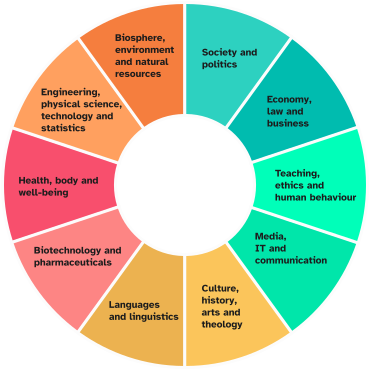
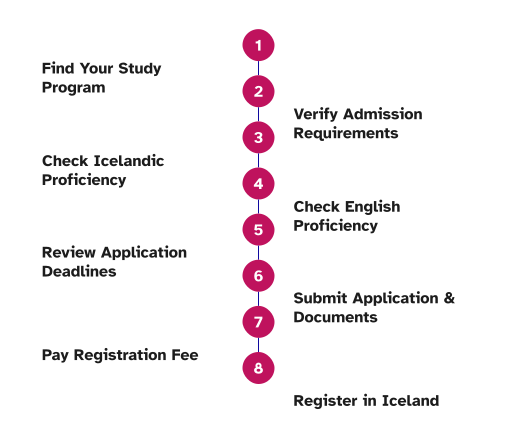

Additional information

The University of Iceland collaborates with over 400 universities worldwide. This provides a unique opportunity to pursue part of your studies at an international university thus gaining added experience and fresh insight into your field of study.

Students generally have the opportunity to join an exchange programme, internship, or summer courses. However, exchanges are always subject to faculty approval.

Students have the opportunity to have courses evaluated as part of their studies at the University of Iceland, so their stay does not have to affect the duration of their studies.

The study of philosophy provides a good foundation for administrative work in the public and private sectors, as well as careers in teaching, publishing and the media.

An education in this area can open up opportunities in:

  • Teaching
  • Research
  • Public administration
  • Administration and consultancy
  • Journalism and other media work
  • Various creative careers

This list is not exhaustive.

Students' comments
""
Students appreciate the University of Iceland for its strong academic reputation, modern campus facilities, close-knit community, and affordable tuition.
Helpful content
Aurora Cooperation

Study wheel

What interests you?

Aurora Cooperation

How to apply

Follow the path

Contact us

If you still have questions, feel free to contact us.

School of Humanities
Weekdays: 10-12 am and 1-3 pm
General Service and Social Media

The Service Desk is a point of access for all services. You can drop in at the University Centre or use the WebChat at the bottom right of this page.

Follow the School of Humanities on Instagram,   Youtube
and Facebook

""

Share

Did this help?

Why wasn't this information helpful

Limit to 250 characters.