""
Language skills
required, minimum level of B2
Programme length
One year.
Study mode
Face-to-face learning Distance learning
Application status
International students:
Students with Icelandic or Nordic citizenship:
Overview

  • Are you interested in disability rights?
  • Do you want to improve your theoretical knowledge and understanding of disability?
  • Do you want a short programme that is both academic and practical?
  • Are you passionate about human rights?

The micro-credential programme in disability studies is designed for people who want to improve their theoretical knowledge of disability and disability rights.

Programme structure

The programme is 30 ECTS and is organised as one year of part-time study.

The programme is made up of:

  • Mandatory courses, 26 - 30 ECTS
  • Restricted electives, 0 - 6 ECTS

Specialisations

Students choose between the following specialisations:

  • Disability studies
  • Disability studies and public administration

Organisation of teaching

This programme is taught in Icelandic but most textbooks are in English.

The programme is taught through distance learning.

Main objectives

After completing the programme, students should, for example:

  • be familiar with the history, development and theoretical foundation of disability studies.
  • be familiar with the main theories and perspectives in disability studies and be able to distinguish between them.
  • be able to distinguish between cultural manifestations of disability and the main challenges that disabled people face in their lifetimes, from the critical perspective of disability studies.

Other

Students who complete the programme with a first-class grade may apply for the Master's programme.

BA, BS, B.Ed degree or equivalent.

Disability studies: 30 ECTS credits have to be completed for the qualification. The micro-credential consists of 30 ECTS credits in core courses in Disability Studies.

Disability studies and public administration: 32 ECTS credits have to be completed.  The micro-credential consists of 26 ECTS credits in core courses and 6 ECTS credits in restrictive elective courses. 

The following documents must accompany an application for this programme:
  • Certified copies of diplomas and transcripts

Further information on supporting documents can be found here


Please note that from 1 July 2026, the Disability Studies programme will move from the School of Social Sciences to the School of Education.

Programme structure

Check below to see how the programme is structured.

Year unspecified | Fall
Theories and Perspectives in Disability Studies (FFR102F)
A mandatory (required) course for the programme
10 ECTS, credits
Course Description

The aim of the course is to provide students with a deep understanding of the development of ideas and theories in disability studies, and to enable them to analyse their influence on policymaking, service provision, and the everyday lives of disabled people. The course is grounded in interdisciplinary and critical perspectives, linking theoretical discussion to activism and international human rights obligations, such as the United Nations Convention on the Rights of Persons with Disabilities (CRPD). The course covers social and cultural perspectives, key theoretical approaches, and recent research in disability studies. Emphasis is placed on active student participation in discussions and assignments that strengthen critical thinking and the ability to apply theory in research and professional practice.

Language of instruction: Icelandic
Face-to-face learning
Distance learning
Year unspecified | Fall
The Life Span, Self and Society (FFR302M)
A mandatory (required) course for the programme
10 ECTS, credits
Course Description

The conditions and experiences of disabled people will be a central focus of this course with emphasis on the lifespan and main areas of everyday life such as family, education, employment and housing/homes. New Icelandic and international disability research will be explored as well as the forces which influence the identity formation of disabled children, youth and adults. Different theoretical approaches will be used to examine policy, law, services, the welfare system and disabled people's status and social situation in contemporary societies.

Language of instruction: Icelandic
Face-to-face learning
Distance learning
Prerequisites
Year unspecified | Spring 1
Disability and Culture (FFR201M)
A mandatory (required) course for the programme
10 ECTS, credits
Course Description

The aim of the course is to provide students with an understanding of the position and representation of disabled people in culture and the arts, and to enable them to analyse cultural expressions of disability in both historical and contemporary contexts. The course examines images and roles of disabled people in popular culture, the media, literature, the arts, and public discourse. Emphasis is placed on the (artistic) culture of disabled people and on how disability is positioned as part of societal diversity. The course also explores external and internal accessibility in relation to culture and the arts, and how accessibility shapes the participation of disabled people.

Language of instruction: Icelandic
Face-to-face learning
Distance learning
Prerequisites
Not taught this semester
Year unspecified | Fall
Local Governance (OSS119F)
Restricted elective course, conditions apply
6 ECTS, credits
Course Description

Local authorities are one of two main branches of Icelandic government. The aim of the course is to give students insights into Icelandic local governments, administration and processes. In the course students will be introduced to Icelandic local governments, their legal and constitutional status in public administration, their tasks and responsibilities according to law. The main political theories on local governments will be introduced and discussed, with emphasis on the relationship between size, effectiveness and democracy. State and local government relations are briefly discussed, including the division of tasks and revenues.

Language of instruction: Icelandic
Distance learning
Prerequisites
Year unspecified | Fall
Theories and Perspectives in Disability Studies (FFR102F)
A mandatory (required) course for the programme
10 ECTS, credits
Course Description

The aim of the course is to provide students with a deep understanding of the development of ideas and theories in disability studies, and to enable them to analyse their influence on policymaking, service provision, and the everyday lives of disabled people. The course is grounded in interdisciplinary and critical perspectives, linking theoretical discussion to activism and international human rights obligations, such as the United Nations Convention on the Rights of Persons with Disabilities (CRPD). The course covers social and cultural perspectives, key theoretical approaches, and recent research in disability studies. Emphasis is placed on active student participation in discussions and assignments that strengthen critical thinking and the ability to apply theory in research and professional practice.

Language of instruction: Icelandic
Face-to-face learning
Distance learning
Year unspecified | Fall
The Life Span, Self and Society (FFR302M)
A mandatory (required) course for the programme
10 ECTS, credits
Course Description

The conditions and experiences of disabled people will be a central focus of this course with emphasis on the lifespan and main areas of everyday life such as family, education, employment and housing/homes. New Icelandic and international disability research will be explored as well as the forces which influence the identity formation of disabled children, youth and adults. Different theoretical approaches will be used to examine policy, law, services, the welfare system and disabled people's status and social situation in contemporary societies.

Language of instruction: Icelandic
Face-to-face learning
Distance learning
Prerequisites
Year unspecified | Spring 1
Public Management (OSS202F)
Restricted elective course, conditions apply
6 ECTS, credits
Course Description

The course reviews the literature on organizational theory and behavior with an emphasis on its application in the public sector. The course includes discussion on leadership, organizational culture, teamwork, organizational structure and change, decision making processes, strategic planning and performance management systems.

Language of instruction: Icelandic
Face-to-face learning
Online learning
Year unspecified | Spring 1
Administrative Law for Public Executives (OSS204F)
A mandatory (required) course for the programme
6 ECTS, credits
Course Description

The course deals with description of Icelandic authorities (the executive), the basic structure of the Icelandic administrative system, main tasks of public authorities, the scope, relevance and rules of the Administrative Act. no 37/1993 and the relevance and rules of the Information Act. no 140/2012. The main emphasis is on the Administrative Act. 

Language of instruction: Icelandic
Face-to-face learning
Online learning
Year unspecified
  • Fall
  • FFR102F
    Theories and Perspectives in Disability Studies
    Mandatory (required) course
    10
    A mandatory (required) course for the programme
    10 ECTS, credits
    Course Description

    The aim of the course is to provide students with a deep understanding of the development of ideas and theories in disability studies, and to enable them to analyse their influence on policymaking, service provision, and the everyday lives of disabled people. The course is grounded in interdisciplinary and critical perspectives, linking theoretical discussion to activism and international human rights obligations, such as the United Nations Convention on the Rights of Persons with Disabilities (CRPD). The course covers social and cultural perspectives, key theoretical approaches, and recent research in disability studies. Emphasis is placed on active student participation in discussions and assignments that strengthen critical thinking and the ability to apply theory in research and professional practice.

    Face-to-face learning
    Distance learning
    Prerequisites
  • FFR302M
    The Life Span, Self and Society
    Mandatory (required) course
    10
    A mandatory (required) course for the programme
    10 ECTS, credits
    Course Description

    The conditions and experiences of disabled people will be a central focus of this course with emphasis on the lifespan and main areas of everyday life such as family, education, employment and housing/homes. New Icelandic and international disability research will be explored as well as the forces which influence the identity formation of disabled children, youth and adults. Different theoretical approaches will be used to examine policy, law, services, the welfare system and disabled people's status and social situation in contemporary societies.

    Face-to-face learning
    Distance learning
    Prerequisites
  • Spring 2
  • FFR201M
    Disability and Culture
    Mandatory (required) course
    10
    A mandatory (required) course for the programme
    10 ECTS, credits
    Course Description

    The aim of the course is to provide students with an understanding of the position and representation of disabled people in culture and the arts, and to enable them to analyse cultural expressions of disability in both historical and contemporary contexts. The course examines images and roles of disabled people in popular culture, the media, literature, the arts, and public discourse. Emphasis is placed on the (artistic) culture of disabled people and on how disability is positioned as part of societal diversity. The course also explores external and internal accessibility in relation to culture and the arts, and how accessibility shapes the participation of disabled people.

    Face-to-face learning
    Distance learning
    Prerequisites
Year unspecified
  • Fall
  • Not taught this semester
    OSS119F
    Local Governance hide
    Restricted elective course
    6
    Restricted elective course, conditions apply
    6 ECTS, credits
    Course Description

    Local authorities are one of two main branches of Icelandic government. The aim of the course is to give students insights into Icelandic local governments, administration and processes. In the course students will be introduced to Icelandic local governments, their legal and constitutional status in public administration, their tasks and responsibilities according to law. The main political theories on local governments will be introduced and discussed, with emphasis on the relationship between size, effectiveness and democracy. State and local government relations are briefly discussed, including the division of tasks and revenues.

    Distance learning
    Prerequisites
  • FFR102F
    Theories and Perspectives in Disability Studies hide
    Mandatory (required) course
    10
    A mandatory (required) course for the programme
    10 ECTS, credits
    Course Description

    The aim of the course is to provide students with a deep understanding of the development of ideas and theories in disability studies, and to enable them to analyse their influence on policymaking, service provision, and the everyday lives of disabled people. The course is grounded in interdisciplinary and critical perspectives, linking theoretical discussion to activism and international human rights obligations, such as the United Nations Convention on the Rights of Persons with Disabilities (CRPD). The course covers social and cultural perspectives, key theoretical approaches, and recent research in disability studies. Emphasis is placed on active student participation in discussions and assignments that strengthen critical thinking and the ability to apply theory in research and professional practice.

    Face-to-face learning
    Distance learning
    Prerequisites
  • FFR302M
    The Life Span, Self and Society hide
    Mandatory (required) course
    10
    A mandatory (required) course for the programme
    10 ECTS, credits
    Course Description

    The conditions and experiences of disabled people will be a central focus of this course with emphasis on the lifespan and main areas of everyday life such as family, education, employment and housing/homes. New Icelandic and international disability research will be explored as well as the forces which influence the identity formation of disabled children, youth and adults. Different theoretical approaches will be used to examine policy, law, services, the welfare system and disabled people's status and social situation in contemporary societies.

    Face-to-face learning
    Distance learning
    Prerequisites
  • Spring 2
  • OSS202F
    Public Management hide
    Restricted elective course
    6
    Restricted elective course, conditions apply
    6 ECTS, credits
    Course Description

    The course reviews the literature on organizational theory and behavior with an emphasis on its application in the public sector. The course includes discussion on leadership, organizational culture, teamwork, organizational structure and change, decision making processes, strategic planning and performance management systems.

    Face-to-face learning
    Online learning
    Prerequisites
  • OSS204F
    Administrative Law for Public Executives hide
    Mandatory (required) course
    6
    A mandatory (required) course for the programme
    6 ECTS, credits
    Course Description

    The course deals with description of Icelandic authorities (the executive), the basic structure of the Icelandic administrative system, main tasks of public authorities, the scope, relevance and rules of the Administrative Act. no 37/1993 and the relevance and rules of the Information Act. no 140/2012. The main emphasis is on the Administrative Act. 

    Face-to-face learning
    Online learning
    Prerequisites
Additional information

The University of Iceland collaborates with over 400 universities worldwide. This provides a unique opportunity to pursue part of your studies at an international university thus gaining added experience and fresh insight into your field of study.

Students generally have the opportunity to join an exchange programme, internship, or summer courses. However, exchanges are always subject to faculty approval.

Students have the opportunity to have courses evaluated as part of their studies at the University of Iceland, so their stay does not have to affect the duration of their studies.

People with degrees in disability studies can be found working in a range of careers within the service and education systems, as disability rights campaigners and other jobs.

An education in this area can open up opportunities in:

  • Rights advocacy
  • Project management
  • Teaching
  • Care work
  • Leadership
  • Policy making
  • Research

This list is not exhaustive.

There is no specific student organisation for this programme, but students meet frequently in the Student Cellar.

Students' comments
""
Students appreciate the University of Iceland for its strong academic reputation, modern campus facilities, close-knit community, and affordable tuition.
Helpful content
Aurora Cooperation

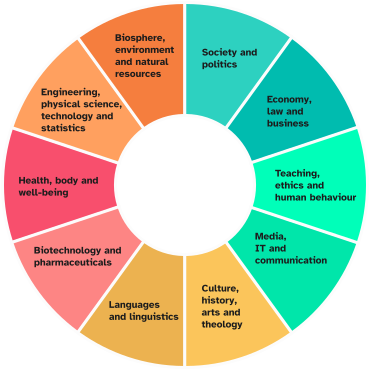
Study wheel

What interests you?

Aurora Cooperation

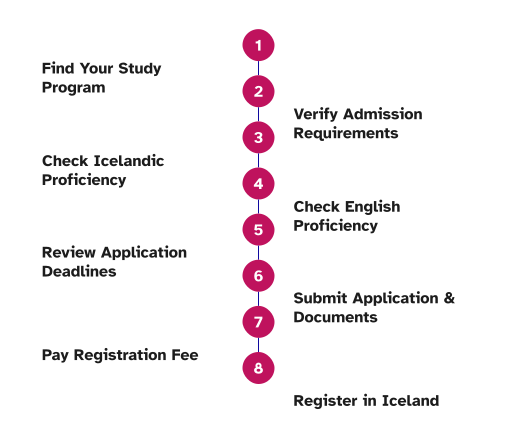
How to apply

Follow the path

Contact us

If you still have questions, feel free to contact us.

School of Social Sciences
Weekdays 9 am - 3 pm
Student and Teaching Service

The School office offers support to students and lecturers, providing guidance, counselling, and assistance with various matters. 

You are welcome to drop by at the office in Gimli or you can book an online meeting in Teams with the staff.

1920_KRI_gimli_200828_001.jpg

Share

Did this help?

Why wasn't this information helpful

Limit to 250 characters.