- Do you work with alcoholics?
- Do you want to acquire theoretical and practical knowledge about the issues affecting people with alcohol and substance use disorders?
- Are you interested in preventative measures and treatments?
- Do you want to learn more about how alcohol and substance use disorders affect other family members and family systems?
The micro-credential programme in alcohol and drug abuse counselling is an independent, interdisciplinary programme open to students who have completed a BA degree or an equivalent university degree.
Students acquire theoretical and practical knowledge about people with substance use disorders and how these issues affect other family members and family systems. Students also acquire a theoretical and practical understanding of prevention, treatments and the factors that influence policy and management of alcohol and drug abuse issues.
The programme is designed for professionals working with people with alcohol and substance use disorders and their families, e.g. social workers, nurses, psychologists, public health experts, occupational therapists, theologians, doctors and physiotherapists.
Programme structure
The programme is 30 ECTS and is organised as one and a half years of part-time study, which can be completed alongside employment.
The program consists of three 10-credit compulsory courses.
Organisation of teaching
Classes are held for three consecutive days each month, Wednesday, Thursday, and Friday, making it easier for students to manage their studies alongside work.
This programme is taught in Icelandic but most textbooks are in English.
Main objectives
The programme aims to meet the demand for specialised knowledge and skills in the field of alcohol and drug abuse counselling.
Other
The micro-credential ends with a certificate. Credits from this programme can be transferred to an MA in Social Work, provided admission requirements are met.
Applicants must have completed a university degree in the field of social-, education- or health sciences (BA, BS or B.Ed) with a 1st class grade (7,25) on average. Professional experience will also be considered when evaluating the applications.
30 ECTS credits have to be completed for the qualification.
- CV
- Statement of purpose
- Reference 1, Name and email
- Reference 2, Name and email
- Certified copies of diplomas and transcripts
Further information on supporting documents can be found here
Programme structure
Check below to see how the programme is structured.
This programme does not offer specialisations.
- First year
- Fall
- Alcohol and substance abuse I: Policy, theories and multi-disciplinary approaches
- Spring 1
- Alcohol and substance abuse II: Treatment programmes, methods and prevention of addiction
- Family interventions in substance abuse
Alcohol and substance abuse I: Policy, theories and multi-disciplinary approaches (FRG119F)
The aim of the course is to provide students with knowledge of the social, psychological, and medical aspects of alcohol and substance use and the development of alcohol and substance use disorders. The course addresses screening, diagnostic models, and symptoms of substance use disorders, and includes a comparison of social and cultural factors related to alcohol and substance use.
Furthermore, the course examines the role of policy-making and legislation in relation to prevention and treatment services, with an emphasis on interdisciplinary collaboration and on how alcohol and substance use disorders may develop differently across various groups.
The course is taught in two three-day intensive sessions. Attendance at the sessions is mandatory.
Alcohol and substance abuse II: Treatment programmes, methods and prevention of addiction (FRG228F)
The course addresses alcohol and substance use as an interdisciplinary field and aims to provide students with knowledge of how evidence-based approaches can be applied in the treatment and support of diverse groups. The course covers key symptoms of substance use disorders, recovery processes, and relapse.
Emphasis is placed on deepening students’ understanding of issues affecting people with substance use disorders and strengthening their ability to collaborate with other professions in promoting the welfare of this group.
The course is taught in two three-day intensive sessions. Attendance at the sessions is mandatory.
Family interventions in substance abuse (FRG231F)
The course examines the impact of alcohol and substance use disorders in individuals on other family members and family systems. It introduces key research, theories, and therapeutic approaches in family-based interventions and in work with individuals and families affected by alcohol and substance use disorders.
Furthermore, the course addresses the relationship between alcohol and substance use and domestic violence, as well as stress-related mental and physical health problems experienced by family members.
The course is taught in two three-day intensive sessions. Attendance at the sessions is mandatory.
- Fall
- FRG119FAlcohol and substance abuse I: Policy, theories and multi-disciplinary approachesMandatory (required) course10A mandatory (required) course for the programme10 ECTS, creditsCourse Description
The aim of the course is to provide students with knowledge of the social, psychological, and medical aspects of alcohol and substance use and the development of alcohol and substance use disorders. The course addresses screening, diagnostic models, and symptoms of substance use disorders, and includes a comparison of social and cultural factors related to alcohol and substance use.
Furthermore, the course examines the role of policy-making and legislation in relation to prevention and treatment services, with an emphasis on interdisciplinary collaboration and on how alcohol and substance use disorders may develop differently across various groups.
The course is taught in two three-day intensive sessions. Attendance at the sessions is mandatory.
Distance learningPrerequisitesAttendance required in class- Spring 2
FRG228FAlcohol and substance abuse II: Treatment programmes, methods and prevention of addictionMandatory (required) course10A mandatory (required) course for the programme10 ECTS, creditsCourse DescriptionThe course addresses alcohol and substance use as an interdisciplinary field and aims to provide students with knowledge of how evidence-based approaches can be applied in the treatment and support of diverse groups. The course covers key symptoms of substance use disorders, recovery processes, and relapse.
Emphasis is placed on deepening students’ understanding of issues affecting people with substance use disorders and strengthening their ability to collaborate with other professions in promoting the welfare of this group.
The course is taught in two three-day intensive sessions. Attendance at the sessions is mandatory.
Face-to-face learningPrerequisitesAttendance required in classCourse taught first half of the semesterFRG231FFamily interventions in substance abuseMandatory (required) course10A mandatory (required) course for the programme10 ECTS, creditsCourse DescriptionThe course examines the impact of alcohol and substance use disorders in individuals on other family members and family systems. It introduces key research, theories, and therapeutic approaches in family-based interventions and in work with individuals and families affected by alcohol and substance use disorders.
Furthermore, the course addresses the relationship between alcohol and substance use and domestic violence, as well as stress-related mental and physical health problems experienced by family members.
The course is taught in two three-day intensive sessions. Attendance at the sessions is mandatory.
Face-to-face learningPrerequisitesAttendance required in class
The University of Iceland collaborates with over 400 universities worldwide. This provides a unique opportunity to pursue part of your studies at an international university thus gaining added experience and fresh insight into your field of study.
Students generally have the opportunity to join an exchange programme, internship, or summer courses. However, exchanges are always subject to faculty approval.
Students have the opportunity to have courses evaluated as part of their studies at the University of Iceland, so their stay does not have to affect the duration of their studies.
An education in this field will benefit professionals working with alcohol and drug abuse issues, including:
- Social workers
- Nurses
- Psychologists
- Public health experts
- Occupational therapists
- Theologians
- Doctors
- Physiotherapists
- Education and prevention experts
This list is not exhaustive
Faró is the organisation for social work students at the University of Iceland.
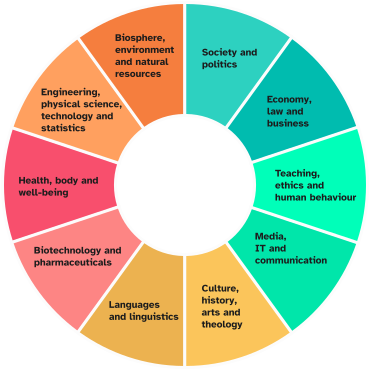
Study wheel
What interests you?
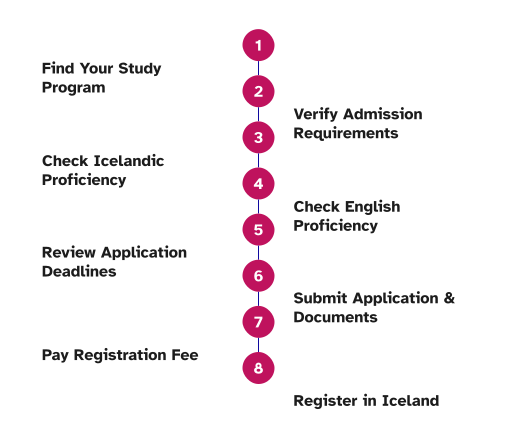
How to apply
Follow the path
If you still have questions, feel free to contact us.
The School office offers support to students and lecturers, providing guidance, counselling, and assistance with various matters.
You are welcome to drop by at the office in Gimli or you can book an online meeting in Teams with the staff.