
""
Language skills
required, minimum level of B2
Programme length
2 years.
Study mode
Face-to-face learning
Application status
International students:
Students with Icelandic or Nordic citizenship:
Overview

  • Are you looking for a programme you can tailor to suit your interests?
  • Do you want a thorough grounding in academic skills which will prepare you for various academic careers?
  • Are you interested in becoming an upper secondary school teacher?
  • Do you want to have the option to pursue doctoral studies?

The MA in general linguistics is a two-year 120 ECTS graduate programme.

Students may take courses in other humanities subjects or as exchange students at a university abroad.

Programme structure

There are no mandatory courses; students tailor the programme to suit their own interests by selecting relevant elective courses.

Students may choose to focus on:

  • Research methodology
  • Modern Icelandic
  • Historical linguistics
  • Psycholinguistics
  • Sociolinguistics
  • Ethnography of communication
  • Language technology

Students must also complete a 30 ECTS thesis.

Organisation of teaching

The programme is taught in Icelandic.

Main objectives

After completing the programme, students should, for example:

  • have developed the knowledge and skills required to tackle new and previously unfamiliar topics.
  • be able to initiate projects in their field, manage them successfully, and assume responsibility for the work of groups and individuals.
  • have learned to identify opportunities for sharing material concerning general linguistics in contemporary society.

Other

Completing an MA at the Faculty of Icelandic and Comparative Cultural Studies allows you to apply for doctoral studies in your chosen subject.

To be eligible for the MA programme an applicant must have completed a BA degree with a first class grade (7.25), with a major in general linguistics, or a BA/BS degree in another subject with a minor in general linguistics. Students from Icelandic and sign language studies programmes may also be admitted to the MA programme in linguistics after completing core courses at the BA level (The Linguistic System – Sounds and Words & Clauses and Context). Students with a BA in English or another language may be admitted to the programme after completing certain courses in consultation with the head of subject. Applicants must have completed a final project worth at least 10 ECTS.

The MA programme in general linguistics is a 120 ECTS programme. The MA thesis shall account for 30 ECTS and courses for 90 ECTS. Students generally complete part of the programme by taking courses in Icelandic linguistics and other subjects at the School of Humanities or as exchange studies at a university abroad. Students must always complete at least 20 ECTS in AMV (general linguistics) courses, not including individual projects. Students may take 30 ECTS in M courses, 20 ECTS in individual projects on general linguistics and 30 ECTS in exchange studies.

The following documents must accompany an application for this programme:
  • Statement of purpose
  • Certified copies of diplomas and transcripts
Programme structure

Check below to see how the programme is structured.

This programme does not offer specialisations.

Year unspecified | Fall
MA-thesis in General Linguistics (AMV441L)
A mandatory (required) course for the programme
0 ECTS, credits
Course Description

MA-thesis in General Linguistics

Language of instruction: Icelandic
Part of the total project/thesis credits
Year unspecified | Fall
Research methods in linguistics (AMV701F)
Free elective course within the programme
10 ECTS, credits
Course Description

The course is designed for MA students in general and Icelandic linguistics and is also useful for other MA students that plan to conduct linguistics research. The course will cover the main research methods in linguistics, both in regards to experimental and natural data. We will discuss the fundamentals of the design of judgment tasks, fill-ins, elicitation tasks, behvioural and neuroimaging experiments and search in corpora such as the Icelandic Gigaword Corpus and IcePaHC. Research methods in diverse domains will be introduced, including syntax, phonology, sociolinguistics, historical linguistics, psycholinguistics, interactional linguistics and more. Finally we will discuss data analysis and interpretation of results, the pros and cons of differerent research methods and ethical considerations in linguistics.

Language of instruction: Icelandic
Face-to-face learning
Year unspecified | Fall
The structure of Icelandic and language technology (MLT301F)
Free elective course within the programme
10 ECTS, credits
Course Description

This course is intended for language technology students who do not have linguistic background. The purpose of the course is to give an overview of the structure of Icelandic, with a special consideration to features which can be problematic for natural language processing. The main topics that will be covered are the sound system of Icelandic and phonetic transcription (IPA and SAMPA); the inflectional and derivational morphology of Icelandic with a special consideration to Part-of-Speech tagging and tagsets; and the syntactic structure of Icelandic with emphasis on both phrase structure and dependency parsing.

Language of instruction: Icelandic
Face-to-face learning
Year unspecified | Fall
Diachronic Syntax (ÍSM801F)
Free elective course within the programme
10 ECTS, credits
Course Description

The main purpose of the course is to give an overview of the syntax of Old Icelandic and to describe and account for the main syntactic changes that the language has undergone up to the present. Among these are changes in word order, verbal constructions, case government, reflexivization, etc. Students will be trained in using the Icelandic Parsed Historical Corpus to search for and analyze examples of various syntactic constructions. In relation to this, current theories on the origin and nature of syntactic change will be examined and tested against Icelandic data.

Language of instruction: Icelandic
Year unspecified | Fall
Psychology of Language, Neurobiology and Genetics (AMV602F)
Free elective course within the programme
10 ECTS, credits
Course Description

This course will introduce the key methods of psycholinguistics and cognitive neuroscience in research on language. We will discuss how the brain processes meaning and syntax, in addition to topics such as bilingualism, speech production, language development and comprehension of indirect language (such as irony). At the end of the course students will get insights into recent research on the genetics of language.

Language of instruction: English
Face-to-face learning
Year unspecified | Fall
Writing and Editing (ÍSL101F)
Free elective course within the programme
10 ECTS, credits
Course Description

Training in various aspects of the writing and editing of scientific texts. Various kinds of texts (non-fiction) examined and evaluated. Training in reviewing and commenting on scientific texts and in other aspects of editorial work. The main emphasis will be on the writing of articles, but other kinds of texts will also be considered, both shorter (conference abstracts, reviews) and longer (theses, books), as well as research proposals. Discussion of guidelines for the preparation of manuscripts. Types of plagiarism and how to avoid them and find them. Texts on different subjects will be used as examples, especially writings in linguistics, literature and history. The book Skrifaðu bæði skýrt og rétt will be used as a textbook (Höskuldur Þráinsson 2015).

This course is open to students of many MA programmes in the School of Humanities, cf. the regulations of the individual subjects. Students in the MA programmes in Icelandic literature, Icelandic linguistics, Icelandic studies and Icelandic teaching can take the course as part of the MA course requirements in Icelandic literature or Icelandic linguistics. Students in the MA programme in Icelandic teaching can, however, not have this course as the only linguistics or literature course in their MA.

Language of instruction: Icelandic
Face-to-face learning
Year unspecified | Fall
Programming in language technology (MLT701F)
Free elective course within the programme
6 ECTS, credits
Course Description

The course is first and foremost organized for students in language technology that have a background in linguistics (or humanities) but are not experienced in computer science. This course is most often taken in the same semester as the course “Computer Science 1a”. If someone with a different background is interested in the course, please contact the teacher for further information.  The course is taught alongside ÍSL333G Programming for the humanities at the BA-level and all students attend the same lectures but MA students get longer assignments than BA students.

The main goal of this course is to support students in taking their first step toward learning programming, help them to knack the basis and train them in solving simple but diverse assignments in language technology using Python. Besides, students will be introduced to a few text processing tools that can be used for natural language processing.

Language of instruction: Icelandic
Face-to-face learning
Year unspecified | Spring 1
MA-thesis in General Linguistics (AMV441L)
A mandatory (required) course for the programme
0 ECTS, credits
Course Description

MA-thesis in General Linguistics

Language of instruction: Icelandic
Part of the total project/thesis credits
Year unspecified | Spring 1
Constructed languages: What can Tolkien's Elvish languages and Esperanto teach us about linguistics? (AMV604M)
Free elective course within the programme
10 ECTS, credits
Course Description

Examples of so-called "constructed languages" can be found as far back as the 7th century, but human ideas about the origin of languages and their structure are probably as old as humanity itself. Constructed languages are created for various purposes, whether it is purely for pleasure, to create a framework for a fictional world, such as Tolkien's Elvish languages and the alien languages of the Star Trek universe, or to facilitate international communication, as the planned languages Esperanto, Solresol and Volapük are intended to do. Whatever the purpose of the constructed language, it is clear that behind it lies an enormous knowledge of the speakers of the language itself and what properties a language can have - and cannot have - in order for it to function as a real language. The course will discuss different types of constructed languages and the ideology behind them. The structure and properties of constructed languages will be discussed and compared to natural languages, as well as other artificial languages, such as gibberish and secret code. Students learn to distinguish different types of constructed languages based on their purpose and field of use. The grammatical structures of constructed languages will be discussed and students will learn to break down and examine the grammatical categories of different languages, guided by the following questions: What do speakers need to know about their own language in order to learn a constructed language, and what can constructed languages teach us about real languages?

Language of instruction: Icelandic
Face-to-face learning
Prerequisites
Year unspecified | Spring 1
Medieval Icelandic Manuscripts (MIS204F)
Free elective course within the programme
10 ECTS, credits
Course Description

This course provides an overview of Icelandic manuscript culture. Students will get practical training in reading Icelandic manuscripts from different periods, from the earliest extant Icelandic vellums dating to the twelfth and thirteenth centuries down to the paper manuscripts of the seventeenth and eighteenth centuries. The origins of the Icelandic script will be discussed as well as its development over time, and students will get practical training in reading different types of script from different periods. The orthography of medieval manuscripts differs considerably from the modern orthography. It includes a system of abbreviations that is partly inherited from a much earlier Latin tradition. Students will get practical training in interpreting these abbreviations. The Icelandic language has also changed over time, and different manifestations of these language changes appear when reading and examining Icelandic texts from different periods. A selection of these changes will be discussed. Changes in script, orthography, and language provide valuable indications of the date of the manuscript, and students will get practical training in dating medieval Icelandic manuscripts based on script, orthography, and language.

Various aspects of medieval book production will be discussed, including the making of parchment and ink, and book binding. Scribes and scribal schools will be discussed as well as probable centres of book production in medieval Iceland. The works of some prolific scribes in the fourteenth century will be examined. What did they write? How did they write? Did they change their practice over a long scribal career? The texts contained by the manuscripts will also be examined and the basics of textual criticism introduced. Njáls saga, for instance, has survived in over sixty manuscripts with considerable textual variation. Which manuscript should then constitute the basis for a printed edition of Njáls saga? Different types of printed editions will be discussed, and students try their hand at editing a medieval text. The electronic editing of pre-modern texts will be introduced, and students will get practical training in mark-up with XML according to the guidelines of the Medieval Nordic Text Archive (MENOTA) and the Medieval Unicode Font Initiative (MUFI).

The course is taught through a combination of lectures and workshops with considerable student engagement. Many of the lectures will be pre-recorded allowing more time in the classroom for discussion and student contributions.

The course is run in cooperation with the Árni Magnússon Institute for Icelandic Studies which has the custody of the largest single collection of Icelandic medieval manuscripts. Students will visit the institute to learn about its collections and facilities and to examine manuscripts.


Course synopsis

Week 1
(1) Introduction
The course: format, readings, requirements and assessment.
The subject matter: Medieval Icelandic manuscripts.

(2) The earliest Icelandic manuscripts
A sketch of the history of the Latin script and the earliest writings in Icelandic. Where did Icelanders learn to use the Latin alphabet? Which orthography did they employ? Some main characteristics of medieval orthography and the use of abbreviations.

Week 2
(3) Electronic editing of medieval texts
How can medieval texts be presented electronically? The XML mark-up language, TEI, MENOTA, MU-FI, and related matters. We will try our hand at electronic editing.

(4) The earliest Icelandic orthography and the First Grammatical Treatise
The use of the Latin alphabet for writing Icelandic: challenges — and the solutions proposed by the author of the First Grammatical Treatise in the middle of the twelfth century.

Week 3
(5) Icelandic script and orthography in the thirteenth century
The difference between Icelandic and Norwegian orthography in the twelfth century. What changed in the course of the thirteenth century?

(6) Different types of print editions: scholarly editions
How accurate should printed editions be? Should every little detail in the manuscript be reproduced? What is “Classical Old Icelandic Normalized Orthography”? What are the needs of the readers? What is the role of the editor?

Week 4
(7) Norwegian influence on script, orthography, and language in Icelandic manuscripts
What is the manifestation of this Norwegian influence? How deep-rooted was it? How long did it last?

(8) The dating of manuscripts: script, orthography, and language
How can medieval Icelandic manuscripts be dated? Features of script, orthography, and language that can be helpful for dating.

Week 5
(9) Icelandic script and orthography in the fourteenth century
Main characteristics and their development.

(10) One scribal hand or many?
Distinguishing different scribal hands: some criteria. The Icelandic Homily Book from around 1200: One scribe or fourteen?

Week 6
(11) Book production: parchment, ink, binding — and conservation
From animal skin to parchment. How was the ink produced? Book design and book binding. The care and conservation of medieval manuscripts.

(12) Book production: parchment, ink, binding — and conservation
A visit to the Árni Magnússon Institute for Icelandic Studies.

— STUDY WEEK —

Week 7
(13) Scribes, scribal milieus, the export of books
On prolific scribes, scribal collaboration, and extensive production of books. Were books produced in Iceland for export in the thirteenth and fourteenth centuries?

(14) Icelandic script and orthography in the fifteenth and sixteenth centuries
Main characteristics and their development.

Week 8
(15) Textual criticism
On the transmission of texts through copying. Textual variation, manuscript classification, and stemmatology.

(16) Textual criticism
Comparing manuscripts and collecting variants.

Week 9
(17) Manuscript illumination
On illuminated manuscripts, historiated initials, artists and their models.

(18) Manuscript catalogues and cataloguing
We will familiarize ourselves with the most important manuscript catalogues and learn about the principles of manuscript cataloguing.

Week 10
(19) Icelandic script and orthography in the seventeenth and eighteenth centuries
Main characteristics and their development.

(20) The transmission of the text: a relic or a living text?
How did the language change when a scribe copied from an old exemplar? Njáls saga is believed to have been written towards the end of the thirteenth century. What is the language of Njáls saga in seventeenth- and eighteenth-century manuscripts?

Week 11
(21) Antiquarianism, manuscript collectors, and copyists
The sixteenth century saw the rise of interest in antiquities, old manuscripts were collected and copied.

(22) Different types of print editions: popular editions
How is a pre-modern text best presented to the modern reader? Should archaic features of language and orthography be retained or should they be updated? On the allegiance to the manuscript and allegiance to the reader.

Week 12
(23) Manuscript collections and manuscript collectors
The life and work of Árni Magnússon.

(24) The manuscript dispute and the return of the manuscripts to Iceland
The search for Codex Scardensis and a nerve-racking auction in London. The custody dispute with Denmark and the return of the manuscripts to Iceland 1971–1997.

— This synopsis may be subject to change. —

Readings

The reading list is on the course website on Canvas. It consists of readings in several languages, including English, Icelandic, Danish, Norwegian, German, and French. The reading list is (often) divided into three main sections:

(a) Required readings: Texts that everyone is required to read. These are all in English.

(b) Optional supplementary readings: These are optional readings for those who want a more in-depth discussion. Most of these readings are in English, but not all.

(c) For those who still want more: A variety of optional readings in several languages, not least in Icelandic, for those who still want more. This section is mostly for reference purposes and as a tool for further research.

Many of the required readings (and some of the optional readings) are found on the Canvas course website. Other reading materials are available in the institute library in the Árni Magnússon Institute in Edda and the University Library (Háskólabókasafn) in the Þjóðarbókhlaða.

Prerequisites
Some skills in Icelandic are essential to fully benefit from the course, as emphasis will be placed on practical training in reading and transcribing text from medieval Icelandic manuscripts. MIS105F Old Icelandic 1 or equivalent study of Old Icelandic is sufficient or some skills in Modern Icelandic. Please, consult the instructor if in doubt.

Course format
The course is taught through a combination of lectures and workshops with considerable student engagement. Many of the lectures will be prerecorded allowing more time in the classroom for discussion and student contributions (flipped classroom).

Working language: This course is open to students with different linguistic backgrounds, and there are two working languages, English and Icelandic. Pre-recorded lectures are in both English and Icelandic (except for guest lecturers who will present in English), written assignments are in both English and Icelandic, and reading materials are in English, Icelandic and the Scandinavian languages, but for those who cannot read Icelandic or the Scan-dinavian languages, all required readings are in English. English is the main working language in the classroom, but questions and contributions to class discussion may also be in Icelandic. — See a separate note on the working languages and the classroom arrangement.

Course requirements and assessment
The final grade for the course will be based on:

(1) Transcription assignments: 30%
(2) Manuscript catalogue assignment: 10%
(3) Manuscript dating assignment: 10%
(4) Presentation: manuscript of the day: 10%
(5) Research paper: 30%
(6) Class participation: 10%

All written assignments will be submitted through Canvas. More detailed instructions and information on deadlines is found on Canvas.

Language of instruction: English
Face-to-face learning
Year unspecified | Spring 1
Language corpora (MLT201F)
Free elective course within the programme
10 ECTS, credits
Course Description

The purpose of this course is to introduce to students the role and utility of language resources (corpora), both for software development and for research on texts and speech. Available language corpora for Icelandic will be presented, and students will also gain insights into the composition of new corpora. The structure of these resources will be analyzed along with the opportunities and limitations associated with them. Students will work with the resources in an original manner and use them to develop new applications or new resources.

Language of instruction: Icelandic
Face-to-face learning
Year unspecified | Spring 1
Constructed languages: What can Tolkien's Elvish languages and Esperanto teach us about linguistics? (AMV604M)
Free elective course within the programme
10 ECTS, credits
Course Description

Examples of so-called "constructed languages" can be found as far back as the 7th century, but human ideas about the origin of languages and their structure are probably as old as humanity itself. Constructed languages are created for various purposes, whether it is purely for pleasure, to create a framework for a fictional world, such as Tolkien's Elvish languages and the alien languages of the Star Trek universe, or to facilitate international communication, as the planned languages Esperanto, Solresol and Volapük are intended to do. Whatever the purpose of the constructed language, it is clear that behind it lies an enormous knowledge of the speakers of the language itself and what properties a language can have - and cannot have - in order for it to function as a real language. The course will discuss different types of constructed languages and the ideology behind them. The structure and properties of constructed languages will be discussed and compared to natural languages, as well as other artificial languages, such as gibberish and secret code. Students learn to distinguish different types of constructed languages based on their purpose and field of use. The grammatical structures of constructed languages will be discussed and students will learn to break down and examine the grammatical categories of different languages, guided by the following questions: What do speakers need to know about their own language in order to learn a constructed language, and what can constructed languages teach us about real languages?

Language of instruction: Icelandic
Face-to-face learning
Prerequisites
Year unspecified | Spring 1
History of the Icelandic Language (MIS803F)
Free elective course within the programme
10 ECTS, credits
Course Description

This course presents an overview of the history of Icelandic language from its earliest attestation to the present. Topics covered include the nature of language change, the sources of evidence for the history of the Icelandic language, the prehistory of Icelandic, selected phonological changes, morphological changes and syntactic changes, the First Grammatical Treatise, Norwegian influence in the 13th and 14th century, the language of the Reformation Era, dialectal variation; nationalism, language, and identi-ty, the standardization of Icelandic in the 19th and 20th century, tradition, legislation and controversy on personal names and family names, the Icelandic Language Council and some current issues in Icelandic language policy.

The course is taught through a combination of lectures and workshops. A fair amount of time will be spent examining texts from different periods in their original orthography, identifying and analyzing indications of language change and developing skills in dating texts based on orthographic and linguistic evidence.

Syllabus for download [pdf]

Course synopsis

Week 1

  • (1) Language change: some basic concepts

How do we acquire language? Who makes the rules? The creative aspect of human language. How does language change? Attitudes toward language change and The Golden Age Principle. The spread of language change. Protolanguages and language families.

  • (2) The prehistory: Proto-Indo-European, Proto-Germanic, and Proto-Norse

A peek into the distant past and the road down to Icelandic: The Germanic Consonant Shift, Grimm’s Law, Verner’s Law, and a glimpse of Gothic. Some linguistic characteristics of the Germanic languages and North Germanic in particular.

Week 2

  • (3) Old Icelandic: the sources of evidence

How can we know something about a language spoken centuries ago? Texts, runes and the Latin alphabet. Medieval orthography vs. modern orthography. Whose lan-guage is reflected in the medieval manuscripts? The limitations of medieval texts as sources of linguistic evidence. How do we access medieval texts? Which editions should we use for linguistic research?

  • (4) The sounds of language: phonemes, allophones

On the production of speech sounds (phonetics) and how they make up a system (phonology). Umlaut, syncope, phonemic split, minimal pairs, complementary distri-bution, and the emergence of the Old Icelandic vowel system.

Week 3

  • (5) Word formation: ablaut, derivation, suffixes

Taking the words apart: What are they made of? Morphemes, roots, and suffixes, derivation and compounding. Root structure, ablaut, and umlaut. Word formation and inflection. What is the longest word in Icelandic?Vaðlaheiðarvegavinnuverkfærageymsluskúrsútidyralyklakippuhringur?

  • (6) The First Grammatical Treatise and the earliest attested Icelandic

Examining a treatise by an anonymous Icelandic author from the middle of the 12th century on Icelandic speech sounds and orthography. The Latin alphabet was a rela-tively new medium, and the main topic is: How to write 12th-century Icelandic with the Latin alphabet? How to find a suitable orthographic representation for a large vowel system?

Week 4

  • (7) Classical Old Icelandic: the phonology around the year 1200

How do we think Icelandic sounded around 1200? What is the orthographic evidence? Examining texts in the orthography from around 1200 will give us some idea. The vowel system was large, it seems. Did Old Icelandic (really) have nasal vowels? Can we reproduce this pronunciation? We will try in class.

  • (8) The emergence of the Modern Icelandic vowel system

The development of the vowel system from Old Icelandic to Modern Icelandic. Phonemic merger and a crumbling vowel system? Diphthongization. The Quantity Shift? “Skewed speech” in modern times. How does this show in the texts? How does it sound? A whistle-stop tour of the history of the Icelandic vowel system from 1200 to 2000.

Week 5

  • (9) Other phonological changes

From at to , ok to og, maðr to maður, and other matters. What happened in Eyjafjallajökull? How do we interpret the orthographic evidence? Does the spelling reflect the pronunciation? What are inverse spellings?

  • (10) Other phonological changes

Changes in pronunciation: From lengi to leingi and langur and lángur, the Westfjords dialect, and other things similar. Breaking news: The modern lengthening of núr skónum or úr skónnum?

Week 6

  • (11) Taking stock: the manuscripts, the phonological changes, and the orthographic evidence

Workshop: examining texts from different periods and dating manuscripts based on linguistic and orthographic evidence.

  • (12) Analogy and the mechanics of morphological change

How do inflectional patterns change? On paradigmatic levelling and analogical exten-sion. Sturtevant’s Paradox and the never-ending tug-of-war between phonological changes and analogical changes.

— S T U D Y   W E E K —

Week 7

  • (13) Morphology: changes in the inflection of substantives

Changes in the inflection of the hirðir type of substantives; ermr and other feminines with nom. sing. -r; randar, randir, rendr and other feminines with multiple plurals.

  • (14) Morphology: changes in the inflection of adjectives

Adjectives with stem-final -j- and -v-: from fölvan to fölan. Adjectives with a disyllabic stem: from göfgan to göfugan. Adjectives with stem-final -l-, -n-, and -s-: from sælli to sællri and back to sælli. Changes in the weak/definite inflection of adjectives: með hægra fæti or hægri fæti?

Week 8

  • (15) Morphology: changes in the inflection of pronouns

The loss of the pronominal dual: vit tvau and við öll. The possessive pronouns okkar, ykkarr, and yðvarr and the end of an inflection: from okkru barni to okkar barni. The long and winding road from nekkverr, nakkvat to nokkur, nokkuð and the many forms of engi. Changes in the demonstrative sjá/þessi: the trilogy sjá saga, þessi saga, and þessur saga.

  • (16) Morphology: changes in the verb conjugation

On strong verbs becoming weak (and weak verbs becoming strong): barg to bjargaði, halp to hjálpaði. Changes in the endings of the indicative and subjunctive: ek em to ek er, ek vil and ég vill; ef ek bæra or bæri. The development of the middle voice: from ek kǫllumk to ég kallast. Preterite participles: bariðr and taliðr vs. barinn and talinn.

Week 9

  • (17) Word order: syntax and syntactic changes

Verb-Second order (V2), Narrative Inversion, and declining variation in the verb phrase (VP). Inflected and uninflected preterite participle with hafa.

  • (18) Word order: syntax and syntactic changes

Oblique subjects and “diseases” known as “Dative Sickness” and “Nominative Sickness.”

Week 10

  • (19) Language contact: Icelandic and other languages

Lexical borrowing: Why do languages borrow words from one another? Norwegian influence on Icelandic. Reformation Era language and Low German influence. Danish influence on Icelandic. Basque-Icelandic glossaries. Icelandic in North America.

  • (20) Dialectal variation

Speaking Northern and speaking Southern; the Westfjords variety and the Eastern speech.

Week 11

  • (21) Nationalism, language, and identity

Debate in the 18th century: Is the Icelandic language a national treasure to be preserved intact for future generations or a barrier to social development that needs to be removed by adopting Danish? Linguistic purism and neologisms. Is it possible to reverse language change? Medieval linguistic ideals and the emergence of a linguistic standard.

  • (22) The 19th and the 20th centuries: the standardization of Icelandic

Establishing an orthographic standard: “ð” the comeback kid and the different fates of “y” and “z”; “langur” and “lángur” revisited.

Week 12

  • (23) Personal names and place names

Personal names, patronymics, matronymics, and family names: Tradition, legislation, and controversy. The most popular personal names. Names from the Norse mythology: Freyr, Freyja, Iðunn, Njör-ður, Óðinn, Sif. Names from the saga literature: Hrappur and Mörður, the decline of Hallgerður and the rise of Bergþóra. Place names, local markedness and the morphological development. Personal names vs. natural features and landforms. The papar place names and the Dímons: What do they tell us?

  • (24) Modern Icelandic language policy

The Icelandic Language Council and its role. The 2009 Language Policy. The challenges faced by a small language community in times of globalization. Digital language contact between Icelandic and English. Why doesn’t Siri speak Icelandic? “Inclusive language” and feminist language reform. The gender-neutral pronoun hán.

Prerequisites

Some skills in Icelandic are necessary to fully benefit from the course. MIS105F Old Icelandic 1 or equivalent study of Old Icelandic is sufficient or some skills in Modern Icelandic (consult the instructor).

Course requirements and evaluation

The final grade for the course will be based on:

  • homework assignments: 30% .
  • linguistic analysis of a text: 30% .
  • research project: 30%.
  • text of the week: student-led discussion: 10%.

See the syllabus for further information on these tasks.

At the University of Iceland, grades are awarded in whole or half numbers on the scale 0–10. The passing grade is 5.0.

Language of instruction: English
Prerequisites
Year unspecified | Spring 1
Icelandic in the educational system (ÍSF801F)
Free elective course within the programme
10 ECTS, credits
Course Description

The main purpose of the course is twofold. First, to shed light on how Icelandic is taught in upper primary and secondary schools. Second, to explore ways of developing Icelandic as a school subject, with respect to practical and theoretical research. What ability should be emphasized in the use and practice of the language? What skills should students have obtained by the end of each school level and how should they be trained? Which aspects of language and literature are most important for the students to know and understand? What are the most used teaching methods? What kind of teaching material is most commonly used in schools and to what extent does it reflect recent knowledge and developments in the fields of language and literature? In the course assignments the students will be trained in defining and implementing their own teaching ideas, with an emphasis on recent knowledge.

Language of instruction: Icelandic
Prerequisites
Year unspecified | Spring 1
Language and Society (ÍSL004M)
Free elective course within the programme
10 ECTS, credits
Course Description

In this course we concern ourselves with how language and society interact by examining sociolinguistic methods and concepts with regard to international and domestic research in the field.

Among the topics discussed are language attitudes, language contact, dialects, language style and language management. We take a look at different manifestations of language use and language variation as well as contemplating on how factors such as environment, context and background of a language user potentially influence language use and choice of style.

We provide an overview of principal research methods, both quantitative and qualitative, discuss recent trends in sociolinguistics and evaluate methods and methodologies with respect to the particular research topic.

Besides presenting research on attitudes towards language and language use, considering both attitudes towards one’s own language and that of others, we consider possible outcomes of unconventional language use. Special emphasis will be put on considering the language use of those who speak Icelandic as a foreign language as well as the status of immigrants in Iceland.


Additionally, we address the current status of the Icelandic language, particularly in relation to English and other languages. Principles of language management are discussed along with people’s ideas and believes about language through time. In that respect, we have a look at Icelandic language policy, language management, language standardization and linguistic purism from different perspectives, e.g. a synchronic and diachronic angle as well as with regard to other speech communities. 

We will discuss language use of particular social groups (e.g. teenagers) in terms of its social meaning for the group on the one hand and for the speech community as a whole on the other hand.

Students are expected to complete group or individual tasks on questions and problems originating from topics and discussions in the class room.

Language of instruction: Icelandic
Prerequisites
Year unspecified | Spring 1
Syntactic structures of Icelandic and other languages (ÍSM703F)
Free elective course within the programme
10 ECTS, credits
Course Description

The goal of this course is to strengthen the studentsʼ understanding of syntax by comparing selected phenomena in the syntactic structure of Icelandic to corrsesponding phenomena in other languages, both related and unrelated. It is assumed that all students have some knowledge of syntax, but a special attempt will be made to accommodate students with different background and expectations, even by splitting the group up into sections according to their previous knowledge of syntax and interest. Thus the course is meant to be suitable to graduate students of Icelandic and general linguistics, who mainly have theoretical interest in syntax, as well as to students of other languages, students in the School of Education and studdents of translation theory, provided that they have some basic knowledge of syntax.

Language of instruction: Icelandic
Face-to-face learning
Year unspecified
  • Fall
  • AMV441L
    MA-thesis in General Linguistics
    Mandatory (required) course
    0
    A mandatory (required) course for the programme
    0 ECTS, credits
    Course Description

    MA-thesis in General Linguistics

    Prerequisites
    Part of the total project/thesis credits
  • AMV701F
    Research methods in linguistics
    Elective course
    10
    Free elective course within the programme
    10 ECTS, credits
    Course Description

    The course is designed for MA students in general and Icelandic linguistics and is also useful for other MA students that plan to conduct linguistics research. The course will cover the main research methods in linguistics, both in regards to experimental and natural data. We will discuss the fundamentals of the design of judgment tasks, fill-ins, elicitation tasks, behvioural and neuroimaging experiments and search in corpora such as the Icelandic Gigaword Corpus and IcePaHC. Research methods in diverse domains will be introduced, including syntax, phonology, sociolinguistics, historical linguistics, psycholinguistics, interactional linguistics and more. Finally we will discuss data analysis and interpretation of results, the pros and cons of differerent research methods and ethical considerations in linguistics.

    Face-to-face learning
    Prerequisites
  • MLT301F
    The structure of Icelandic and language technology
    Elective course
    10
    Free elective course within the programme
    10 ECTS, credits
    Course Description

    This course is intended for language technology students who do not have linguistic background. The purpose of the course is to give an overview of the structure of Icelandic, with a special consideration to features which can be problematic for natural language processing. The main topics that will be covered are the sound system of Icelandic and phonetic transcription (IPA and SAMPA); the inflectional and derivational morphology of Icelandic with a special consideration to Part-of-Speech tagging and tagsets; and the syntactic structure of Icelandic with emphasis on both phrase structure and dependency parsing.

    Face-to-face learning
    Prerequisites
  • ÍSM801F
    Diachronic Syntax
    Elective course
    10
    Free elective course within the programme
    10 ECTS, credits
    Course Description

    The main purpose of the course is to give an overview of the syntax of Old Icelandic and to describe and account for the main syntactic changes that the language has undergone up to the present. Among these are changes in word order, verbal constructions, case government, reflexivization, etc. Students will be trained in using the Icelandic Parsed Historical Corpus to search for and analyze examples of various syntactic constructions. In relation to this, current theories on the origin and nature of syntactic change will be examined and tested against Icelandic data.

    Prerequisites
  • AMV602F
    Psychology of Language, Neurobiology and Genetics
    Elective course
    10
    Free elective course within the programme
    10 ECTS, credits
    Course Description

    This course will introduce the key methods of psycholinguistics and cognitive neuroscience in research on language. We will discuss how the brain processes meaning and syntax, in addition to topics such as bilingualism, speech production, language development and comprehension of indirect language (such as irony). At the end of the course students will get insights into recent research on the genetics of language.

    Face-to-face learning
    Prerequisites
  • ÍSL101F
    Writing and Editing
    Elective course
    10
    Free elective course within the programme
    10 ECTS, credits
    Course Description

    Training in various aspects of the writing and editing of scientific texts. Various kinds of texts (non-fiction) examined and evaluated. Training in reviewing and commenting on scientific texts and in other aspects of editorial work. The main emphasis will be on the writing of articles, but other kinds of texts will also be considered, both shorter (conference abstracts, reviews) and longer (theses, books), as well as research proposals. Discussion of guidelines for the preparation of manuscripts. Types of plagiarism and how to avoid them and find them. Texts on different subjects will be used as examples, especially writings in linguistics, literature and history. The book Skrifaðu bæði skýrt og rétt will be used as a textbook (Höskuldur Þráinsson 2015).

    This course is open to students of many MA programmes in the School of Humanities, cf. the regulations of the individual subjects. Students in the MA programmes in Icelandic literature, Icelandic linguistics, Icelandic studies and Icelandic teaching can take the course as part of the MA course requirements in Icelandic literature or Icelandic linguistics. Students in the MA programme in Icelandic teaching can, however, not have this course as the only linguistics or literature course in their MA.

    Face-to-face learning
    Prerequisites
  • MLT701F
    Programming in language technology
    Elective course
    6
    Free elective course within the programme
    6 ECTS, credits
    Course Description

    The course is first and foremost organized for students in language technology that have a background in linguistics (or humanities) but are not experienced in computer science. This course is most often taken in the same semester as the course “Computer Science 1a”. If someone with a different background is interested in the course, please contact the teacher for further information.  The course is taught alongside ÍSL333G Programming for the humanities at the BA-level and all students attend the same lectures but MA students get longer assignments than BA students.

    The main goal of this course is to support students in taking their first step toward learning programming, help them to knack the basis and train them in solving simple but diverse assignments in language technology using Python. Besides, students will be introduced to a few text processing tools that can be used for natural language processing.

    Face-to-face learning
    Prerequisites
  • Spring 2
  • AMV441L
    MA-thesis in General Linguistics
    Mandatory (required) course
    0
    A mandatory (required) course for the programme
    0 ECTS, credits
    Course Description

    MA-thesis in General Linguistics

    Prerequisites
    Part of the total project/thesis credits
  • AMV604M
    Constructed languages: What can Tolkien's Elvish languages and Esperanto teach us about linguistics?
    Elective course
    10
    Free elective course within the programme
    10 ECTS, credits
    Course Description

    Examples of so-called "constructed languages" can be found as far back as the 7th century, but human ideas about the origin of languages and their structure are probably as old as humanity itself. Constructed languages are created for various purposes, whether it is purely for pleasure, to create a framework for a fictional world, such as Tolkien's Elvish languages and the alien languages of the Star Trek universe, or to facilitate international communication, as the planned languages Esperanto, Solresol and Volapük are intended to do. Whatever the purpose of the constructed language, it is clear that behind it lies an enormous knowledge of the speakers of the language itself and what properties a language can have - and cannot have - in order for it to function as a real language. The course will discuss different types of constructed languages and the ideology behind them. The structure and properties of constructed languages will be discussed and compared to natural languages, as well as other artificial languages, such as gibberish and secret code. Students learn to distinguish different types of constructed languages based on their purpose and field of use. The grammatical structures of constructed languages will be discussed and students will learn to break down and examine the grammatical categories of different languages, guided by the following questions: What do speakers need to know about their own language in order to learn a constructed language, and what can constructed languages teach us about real languages?

    Face-to-face learning
    Prerequisites
  • MIS204F
    Medieval Icelandic Manuscripts
    Elective course
    10
    Free elective course within the programme
    10 ECTS, credits
    Course Description

    This course provides an overview of Icelandic manuscript culture. Students will get practical training in reading Icelandic manuscripts from different periods, from the earliest extant Icelandic vellums dating to the twelfth and thirteenth centuries down to the paper manuscripts of the seventeenth and eighteenth centuries. The origins of the Icelandic script will be discussed as well as its development over time, and students will get practical training in reading different types of script from different periods. The orthography of medieval manuscripts differs considerably from the modern orthography. It includes a system of abbreviations that is partly inherited from a much earlier Latin tradition. Students will get practical training in interpreting these abbreviations. The Icelandic language has also changed over time, and different manifestations of these language changes appear when reading and examining Icelandic texts from different periods. A selection of these changes will be discussed. Changes in script, orthography, and language provide valuable indications of the date of the manuscript, and students will get practical training in dating medieval Icelandic manuscripts based on script, orthography, and language.

    Various aspects of medieval book production will be discussed, including the making of parchment and ink, and book binding. Scribes and scribal schools will be discussed as well as probable centres of book production in medieval Iceland. The works of some prolific scribes in the fourteenth century will be examined. What did they write? How did they write? Did they change their practice over a long scribal career? The texts contained by the manuscripts will also be examined and the basics of textual criticism introduced. Njáls saga, for instance, has survived in over sixty manuscripts with considerable textual variation. Which manuscript should then constitute the basis for a printed edition of Njáls saga? Different types of printed editions will be discussed, and students try their hand at editing a medieval text. The electronic editing of pre-modern texts will be introduced, and students will get practical training in mark-up with XML according to the guidelines of the Medieval Nordic Text Archive (MENOTA) and the Medieval Unicode Font Initiative (MUFI).

    The course is taught through a combination of lectures and workshops with considerable student engagement. Many of the lectures will be pre-recorded allowing more time in the classroom for discussion and student contributions.

    The course is run in cooperation with the Árni Magnússon Institute for Icelandic Studies which has the custody of the largest single collection of Icelandic medieval manuscripts. Students will visit the institute to learn about its collections and facilities and to examine manuscripts.


    Course synopsis

    Week 1
    (1) Introduction
    The course: format, readings, requirements and assessment.
    The subject matter: Medieval Icelandic manuscripts.

    (2) The earliest Icelandic manuscripts
    A sketch of the history of the Latin script and the earliest writings in Icelandic. Where did Icelanders learn to use the Latin alphabet? Which orthography did they employ? Some main characteristics of medieval orthography and the use of abbreviations.

    Week 2
    (3) Electronic editing of medieval texts
    How can medieval texts be presented electronically? The XML mark-up language, TEI, MENOTA, MU-FI, and related matters. We will try our hand at electronic editing.

    (4) The earliest Icelandic orthography and the First Grammatical Treatise
    The use of the Latin alphabet for writing Icelandic: challenges — and the solutions proposed by the author of the First Grammatical Treatise in the middle of the twelfth century.

    Week 3
    (5) Icelandic script and orthography in the thirteenth century
    The difference between Icelandic and Norwegian orthography in the twelfth century. What changed in the course of the thirteenth century?

    (6) Different types of print editions: scholarly editions
    How accurate should printed editions be? Should every little detail in the manuscript be reproduced? What is “Classical Old Icelandic Normalized Orthography”? What are the needs of the readers? What is the role of the editor?

    Week 4
    (7) Norwegian influence on script, orthography, and language in Icelandic manuscripts
    What is the manifestation of this Norwegian influence? How deep-rooted was it? How long did it last?

    (8) The dating of manuscripts: script, orthography, and language
    How can medieval Icelandic manuscripts be dated? Features of script, orthography, and language that can be helpful for dating.

    Week 5
    (9) Icelandic script and orthography in the fourteenth century
    Main characteristics and their development.

    (10) One scribal hand or many?
    Distinguishing different scribal hands: some criteria. The Icelandic Homily Book from around 1200: One scribe or fourteen?

    Week 6
    (11) Book production: parchment, ink, binding — and conservation
    From animal skin to parchment. How was the ink produced? Book design and book binding. The care and conservation of medieval manuscripts.

    (12) Book production: parchment, ink, binding — and conservation
    A visit to the Árni Magnússon Institute for Icelandic Studies.

    — STUDY WEEK —

    Week 7
    (13) Scribes, scribal milieus, the export of books
    On prolific scribes, scribal collaboration, and extensive production of books. Were books produced in Iceland for export in the thirteenth and fourteenth centuries?

    (14) Icelandic script and orthography in the fifteenth and sixteenth centuries
    Main characteristics and their development.

    Week 8
    (15) Textual criticism
    On the transmission of texts through copying. Textual variation, manuscript classification, and stemmatology.

    (16) Textual criticism
    Comparing manuscripts and collecting variants.

    Week 9
    (17) Manuscript illumination
    On illuminated manuscripts, historiated initials, artists and their models.

    (18) Manuscript catalogues and cataloguing
    We will familiarize ourselves with the most important manuscript catalogues and learn about the principles of manuscript cataloguing.

    Week 10
    (19) Icelandic script and orthography in the seventeenth and eighteenth centuries
    Main characteristics and their development.

    (20) The transmission of the text: a relic or a living text?
    How did the language change when a scribe copied from an old exemplar? Njáls saga is believed to have been written towards the end of the thirteenth century. What is the language of Njáls saga in seventeenth- and eighteenth-century manuscripts?

    Week 11
    (21) Antiquarianism, manuscript collectors, and copyists
    The sixteenth century saw the rise of interest in antiquities, old manuscripts were collected and copied.

    (22) Different types of print editions: popular editions
    How is a pre-modern text best presented to the modern reader? Should archaic features of language and orthography be retained or should they be updated? On the allegiance to the manuscript and allegiance to the reader.

    Week 12
    (23) Manuscript collections and manuscript collectors
    The life and work of Árni Magnússon.

    (24) The manuscript dispute and the return of the manuscripts to Iceland
    The search for Codex Scardensis and a nerve-racking auction in London. The custody dispute with Denmark and the return of the manuscripts to Iceland 1971–1997.

    — This synopsis may be subject to change. —

    Readings

    The reading list is on the course website on Canvas. It consists of readings in several languages, including English, Icelandic, Danish, Norwegian, German, and French. The reading list is (often) divided into three main sections:

    (a) Required readings: Texts that everyone is required to read. These are all in English.

    (b) Optional supplementary readings: These are optional readings for those who want a more in-depth discussion. Most of these readings are in English, but not all.

    (c) For those who still want more: A variety of optional readings in several languages, not least in Icelandic, for those who still want more. This section is mostly for reference purposes and as a tool for further research.

    Many of the required readings (and some of the optional readings) are found on the Canvas course website. Other reading materials are available in the institute library in the Árni Magnússon Institute in Edda and the University Library (Háskólabókasafn) in the Þjóðarbókhlaða.

    Prerequisites
    Some skills in Icelandic are essential to fully benefit from the course, as emphasis will be placed on practical training in reading and transcribing text from medieval Icelandic manuscripts. MIS105F Old Icelandic 1 or equivalent study of Old Icelandic is sufficient or some skills in Modern Icelandic. Please, consult the instructor if in doubt.

    Course format
    The course is taught through a combination of lectures and workshops with considerable student engagement. Many of the lectures will be prerecorded allowing more time in the classroom for discussion and student contributions (flipped classroom).

    Working language: This course is open to students with different linguistic backgrounds, and there are two working languages, English and Icelandic. Pre-recorded lectures are in both English and Icelandic (except for guest lecturers who will present in English), written assignments are in both English and Icelandic, and reading materials are in English, Icelandic and the Scandinavian languages, but for those who cannot read Icelandic or the Scan-dinavian languages, all required readings are in English. English is the main working language in the classroom, but questions and contributions to class discussion may also be in Icelandic. — See a separate note on the working languages and the classroom arrangement.

    Course requirements and assessment
    The final grade for the course will be based on:

    (1) Transcription assignments: 30%
    (2) Manuscript catalogue assignment: 10%
    (3) Manuscript dating assignment: 10%
    (4) Presentation: manuscript of the day: 10%
    (5) Research paper: 30%
    (6) Class participation: 10%

    All written assignments will be submitted through Canvas. More detailed instructions and information on deadlines is found on Canvas.

    Face-to-face learning
    Prerequisites
  • MLT201F
    Language corpora
    Elective course
    10
    Free elective course within the programme
    10 ECTS, credits
    Course Description

    The purpose of this course is to introduce to students the role and utility of language resources (corpora), both for software development and for research on texts and speech. Available language corpora for Icelandic will be presented, and students will also gain insights into the composition of new corpora. The structure of these resources will be analyzed along with the opportunities and limitations associated with them. Students will work with the resources in an original manner and use them to develop new applications or new resources.

    Face-to-face learning
    Prerequisites
  • AMV604M
    Constructed languages: What can Tolkien's Elvish languages and Esperanto teach us about linguistics?
    Elective course
    10
    Free elective course within the programme
    10 ECTS, credits
    Course Description

    Examples of so-called "constructed languages" can be found as far back as the 7th century, but human ideas about the origin of languages and their structure are probably as old as humanity itself. Constructed languages are created for various purposes, whether it is purely for pleasure, to create a framework for a fictional world, such as Tolkien's Elvish languages and the alien languages of the Star Trek universe, or to facilitate international communication, as the planned languages Esperanto, Solresol and Volapük are intended to do. Whatever the purpose of the constructed language, it is clear that behind it lies an enormous knowledge of the speakers of the language itself and what properties a language can have - and cannot have - in order for it to function as a real language. The course will discuss different types of constructed languages and the ideology behind them. The structure and properties of constructed languages will be discussed and compared to natural languages, as well as other artificial languages, such as gibberish and secret code. Students learn to distinguish different types of constructed languages based on their purpose and field of use. The grammatical structures of constructed languages will be discussed and students will learn to break down and examine the grammatical categories of different languages, guided by the following questions: What do speakers need to know about their own language in order to learn a constructed language, and what can constructed languages teach us about real languages?

    Face-to-face learning
    Prerequisites
  • MIS803F
    History of the Icelandic Language
    Elective course
    10
    Free elective course within the programme
    10 ECTS, credits
    Course Description

    This course presents an overview of the history of Icelandic language from its earliest attestation to the present. Topics covered include the nature of language change, the sources of evidence for the history of the Icelandic language, the prehistory of Icelandic, selected phonological changes, morphological changes and syntactic changes, the First Grammatical Treatise, Norwegian influence in the 13th and 14th century, the language of the Reformation Era, dialectal variation; nationalism, language, and identi-ty, the standardization of Icelandic in the 19th and 20th century, tradition, legislation and controversy on personal names and family names, the Icelandic Language Council and some current issues in Icelandic language policy.

    The course is taught through a combination of lectures and workshops. A fair amount of time will be spent examining texts from different periods in their original orthography, identifying and analyzing indications of language change and developing skills in dating texts based on orthographic and linguistic evidence.

    Syllabus for download [pdf]

    Course synopsis

    Week 1

    • (1) Language change: some basic concepts

    How do we acquire language? Who makes the rules? The creative aspect of human language. How does language change? Attitudes toward language change and The Golden Age Principle. The spread of language change. Protolanguages and language families.

    • (2) The prehistory: Proto-Indo-European, Proto-Germanic, and Proto-Norse

    A peek into the distant past and the road down to Icelandic: The Germanic Consonant Shift, Grimm’s Law, Verner’s Law, and a glimpse of Gothic. Some linguistic characteristics of the Germanic languages and North Germanic in particular.

    Week 2

    • (3) Old Icelandic: the sources of evidence

    How can we know something about a language spoken centuries ago? Texts, runes and the Latin alphabet. Medieval orthography vs. modern orthography. Whose lan-guage is reflected in the medieval manuscripts? The limitations of medieval texts as sources of linguistic evidence. How do we access medieval texts? Which editions should we use for linguistic research?

    • (4) The sounds of language: phonemes, allophones

    On the production of speech sounds (phonetics) and how they make up a system (phonology). Umlaut, syncope, phonemic split, minimal pairs, complementary distri-bution, and the emergence of the Old Icelandic vowel system.

    Week 3

    • (5) Word formation: ablaut, derivation, suffixes

    Taking the words apart: What are they made of? Morphemes, roots, and suffixes, derivation and compounding. Root structure, ablaut, and umlaut. Word formation and inflection. What is the longest word in Icelandic?Vaðlaheiðarvegavinnuverkfærageymsluskúrsútidyralyklakippuhringur?

    • (6) The First Grammatical Treatise and the earliest attested Icelandic

    Examining a treatise by an anonymous Icelandic author from the middle of the 12th century on Icelandic speech sounds and orthography. The Latin alphabet was a rela-tively new medium, and the main topic is: How to write 12th-century Icelandic with the Latin alphabet? How to find a suitable orthographic representation for a large vowel system?

    Week 4

    • (7) Classical Old Icelandic: the phonology around the year 1200

    How do we think Icelandic sounded around 1200? What is the orthographic evidence? Examining texts in the orthography from around 1200 will give us some idea. The vowel system was large, it seems. Did Old Icelandic (really) have nasal vowels? Can we reproduce this pronunciation? We will try in class.

    • (8) The emergence of the Modern Icelandic vowel system

    The development of the vowel system from Old Icelandic to Modern Icelandic. Phonemic merger and a crumbling vowel system? Diphthongization. The Quantity Shift? “Skewed speech” in modern times. How does this show in the texts? How does it sound? A whistle-stop tour of the history of the Icelandic vowel system from 1200 to 2000.

    Week 5

    • (9) Other phonological changes

    From at to , ok to og, maðr to maður, and other matters. What happened in Eyjafjallajökull? How do we interpret the orthographic evidence? Does the spelling reflect the pronunciation? What are inverse spellings?

    • (10) Other phonological changes

    Changes in pronunciation: From lengi to leingi and langur and lángur, the Westfjords dialect, and other things similar. Breaking news: The modern lengthening of núr skónum or úr skónnum?

    Week 6

    • (11) Taking stock: the manuscripts, the phonological changes, and the orthographic evidence

    Workshop: examining texts from different periods and dating manuscripts based on linguistic and orthographic evidence.

    • (12) Analogy and the mechanics of morphological change

    How do inflectional patterns change? On paradigmatic levelling and analogical exten-sion. Sturtevant’s Paradox and the never-ending tug-of-war between phonological changes and analogical changes.

    — S T U D Y   W E E K —

    Week 7

    • (13) Morphology: changes in the inflection of substantives

    Changes in the inflection of the hirðir type of substantives; ermr and other feminines with nom. sing. -r; randar, randir, rendr and other feminines with multiple plurals.

    • (14) Morphology: changes in the inflection of adjectives

    Adjectives with stem-final -j- and -v-: from fölvan to fölan. Adjectives with a disyllabic stem: from göfgan to göfugan. Adjectives with stem-final -l-, -n-, and -s-: from sælli to sællri and back to sælli. Changes in the weak/definite inflection of adjectives: með hægra fæti or hægri fæti?

    Week 8

    • (15) Morphology: changes in the inflection of pronouns

    The loss of the pronominal dual: vit tvau and við öll. The possessive pronouns okkar, ykkarr, and yðvarr and the end of an inflection: from okkru barni to okkar barni. The long and winding road from nekkverr, nakkvat to nokkur, nokkuð and the many forms of engi. Changes in the demonstrative sjá/þessi: the trilogy sjá saga, þessi saga, and þessur saga.

    • (16) Morphology: changes in the verb conjugation

    On strong verbs becoming weak (and weak verbs becoming strong): barg to bjargaði, halp to hjálpaði. Changes in the endings of the indicative and subjunctive: ek em to ek er, ek vil and ég vill; ef ek bæra or bæri. The development of the middle voice: from ek kǫllumk to ég kallast. Preterite participles: bariðr and taliðr vs. barinn and talinn.

    Week 9

    • (17) Word order: syntax and syntactic changes

    Verb-Second order (V2), Narrative Inversion, and declining variation in the verb phrase (VP). Inflected and uninflected preterite participle with hafa.

    • (18) Word order: syntax and syntactic changes

    Oblique subjects and “diseases” known as “Dative Sickness” and “Nominative Sickness.”

    Week 10

    • (19) Language contact: Icelandic and other languages

    Lexical borrowing: Why do languages borrow words from one another? Norwegian influence on Icelandic. Reformation Era language and Low German influence. Danish influence on Icelandic. Basque-Icelandic glossaries. Icelandic in North America.

    • (20) Dialectal variation

    Speaking Northern and speaking Southern; the Westfjords variety and the Eastern speech.

    Week 11

    • (21) Nationalism, language, and identity

    Debate in the 18th century: Is the Icelandic language a national treasure to be preserved intact for future generations or a barrier to social development that needs to be removed by adopting Danish? Linguistic purism and neologisms. Is it possible to reverse language change? Medieval linguistic ideals and the emergence of a linguistic standard.

    • (22) The 19th and the 20th centuries: the standardization of Icelandic

    Establishing an orthographic standard: “ð” the comeback kid and the different fates of “y” and “z”; “langur” and “lángur” revisited.

    Week 12

    • (23) Personal names and place names

    Personal names, patronymics, matronymics, and family names: Tradition, legislation, and controversy. The most popular personal names. Names from the Norse mythology: Freyr, Freyja, Iðunn, Njör-ður, Óðinn, Sif. Names from the saga literature: Hrappur and Mörður, the decline of Hallgerður and the rise of Bergþóra. Place names, local markedness and the morphological development. Personal names vs. natural features and landforms. The papar place names and the Dímons: What do they tell us?

    • (24) Modern Icelandic language policy

    The Icelandic Language Council and its role. The 2009 Language Policy. The challenges faced by a small language community in times of globalization. Digital language contact between Icelandic and English. Why doesn’t Siri speak Icelandic? “Inclusive language” and feminist language reform. The gender-neutral pronoun hán.

    Prerequisites

    Some skills in Icelandic are necessary to fully benefit from the course. MIS105F Old Icelandic 1 or equivalent study of Old Icelandic is sufficient or some skills in Modern Icelandic (consult the instructor).

    Course requirements and evaluation

    The final grade for the course will be based on:

    • homework assignments: 30% .
    • linguistic analysis of a text: 30% .
    • research project: 30%.
    • text of the week: student-led discussion: 10%.

    See the syllabus for further information on these tasks.

    At the University of Iceland, grades are awarded in whole or half numbers on the scale 0–10. The passing grade is 5.0.

    Prerequisites
  • ÍSF801F
    Icelandic in the educational system
    Elective course
    10
    Free elective course within the programme
    10 ECTS, credits
    Course Description

    The main purpose of the course is twofold. First, to shed light on how Icelandic is taught in upper primary and secondary schools. Second, to explore ways of developing Icelandic as a school subject, with respect to practical and theoretical research. What ability should be emphasized in the use and practice of the language? What skills should students have obtained by the end of each school level and how should they be trained? Which aspects of language and literature are most important for the students to know and understand? What are the most used teaching methods? What kind of teaching material is most commonly used in schools and to what extent does it reflect recent knowledge and developments in the fields of language and literature? In the course assignments the students will be trained in defining and implementing their own teaching ideas, with an emphasis on recent knowledge.

    Prerequisites
  • ÍSL004M
    Language and Society
    Elective course
    10
    Free elective course within the programme
    10 ECTS, credits
    Course Description

    In this course we concern ourselves with how language and society interact by examining sociolinguistic methods and concepts with regard to international and domestic research in the field.

    Among the topics discussed are language attitudes, language contact, dialects, language style and language management. We take a look at different manifestations of language use and language variation as well as contemplating on how factors such as environment, context and background of a language user potentially influence language use and choice of style.

    We provide an overview of principal research methods, both quantitative and qualitative, discuss recent trends in sociolinguistics and evaluate methods and methodologies with respect to the particular research topic.

    Besides presenting research on attitudes towards language and language use, considering both attitudes towards one’s own language and that of others, we consider possible outcomes of unconventional language use. Special emphasis will be put on considering the language use of those who speak Icelandic as a foreign language as well as the status of immigrants in Iceland.


    Additionally, we address the current status of the Icelandic language, particularly in relation to English and other languages. Principles of language management are discussed along with people’s ideas and believes about language through time. In that respect, we have a look at Icelandic language policy, language management, language standardization and linguistic purism from different perspectives, e.g. a synchronic and diachronic angle as well as with regard to other speech communities. 

    We will discuss language use of particular social groups (e.g. teenagers) in terms of its social meaning for the group on the one hand and for the speech community as a whole on the other hand.

    Students are expected to complete group or individual tasks on questions and problems originating from topics and discussions in the class room.

    Prerequisites
  • ÍSM703F
    Syntactic structures of Icelandic and other languages
    Elective course
    10
    Free elective course within the programme
    10 ECTS, credits
    Course Description

    The goal of this course is to strengthen the studentsʼ understanding of syntax by comparing selected phenomena in the syntactic structure of Icelandic to corrsesponding phenomena in other languages, both related and unrelated. It is assumed that all students have some knowledge of syntax, but a special attempt will be made to accommodate students with different background and expectations, even by splitting the group up into sections according to their previous knowledge of syntax and interest. Thus the course is meant to be suitable to graduate students of Icelandic and general linguistics, who mainly have theoretical interest in syntax, as well as to students of other languages, students in the School of Education and studdents of translation theory, provided that they have some basic knowledge of syntax.

    Face-to-face learning
    Prerequisites

The timetable shown below is for the current academic year and is FOR REFERENCE ONLY.

Changes may occur for the autumn semester in August and September and for the spring semester in December and January. You will find your final timetable in Ugla when the studies start.

Note! This timetable is not suitable for planning your work schedule if you are a part-time employee.


Additional information

The University of Iceland collaborates with over 400 universities worldwide. This provides a unique opportunity to pursue part of your studies at an international university thus gaining added experience and fresh insight into your field of study.

Students generally have the opportunity to join an exchange programme, internship, or summer courses. However, exchanges are always subject to faculty approval.

Students have the opportunity to have courses evaluated as part of their studies at the University of Iceland, so their stay does not have to affect the duration of their studies.

This qualification can open up opportunities in:

  • research and consultancy
  • doctoral studies
  • writing
  • media and PR
  • teaching
  • development of AI and technical solutions

This list is not exhaustive.

Mímir is the organisation for students in Icelandic, general linguistics and sign language studies at the University of Iceland.

The role of the organisation is to advocate for equality and student interests, to publish materials and to organise informative meetings, field trips, other trips and educational events.

Students' comments
Helpful content
Aurora Cooperation

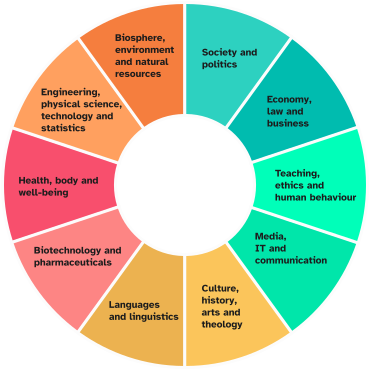
Study wheel

What interests you?

Aurora Cooperation

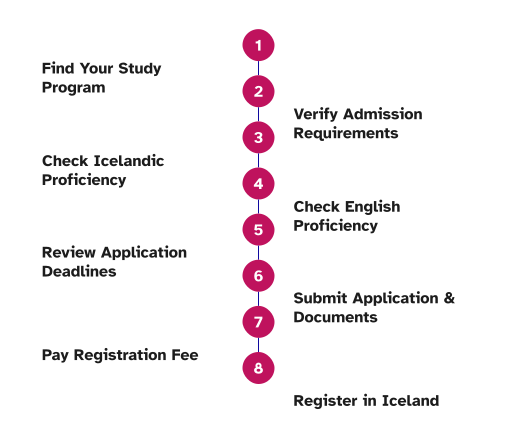
How to apply

Follow the path

Contact us

If you still have questions, feel free to contact us.

School of Humanities
Weekdays: 10-12 am and 1-3 pm
General Service and Social Media

The Service Desk is a point of access for all services. You can drop in at the University Centre or use the WebChat at the bottom right of this page.

Follow the School of Humanities on Instagram,   Youtube
and Facebook

""

Share

Did this help?

Why wasn't this information helpful

Limit to 250 characters.