
Language skills
Programme length
Two years - 120 ECTS
Study mode
Face-to-face learning
Application status
International students:
Students with Icelandic or Nordic citizenship:
- Would you like to understand the most up-to-date knowledge in industrial engineering?
- Would you like to learn about manufacturing and quality control, innovation and product development?
- Are you interested in how companies are run and managed, including financial management?
- Do you want to learn more about operations analysis, statistics, optimisation and decision science?
People are always needed to design new procedures or improve existing procedures; industrial engineers are in high demand for this kind of work.
Students often work on research projects with industry partners and are given the opportunity to conduct independent research under the guidance of a supervisor.
Programme structure
The programme is 120 ECTS and is organised as two years of full-time study.
The programme is made up of:
- Courses, 60 - 90 ECTS
- Research project, 30 - 60 ECTS
Each student's individual study plan is designed in consultation with the administrative supervisor.
Organisation of teaching
This programme is generally taught in English and textbooks are in English.
The Master's thesis may be theoretical or practical; in the latter case, the student will collaborate on the project with industry partners. There are various funding options available.
Main objectives
Students should acquire the knowledge and skills required to analyse and resolve complex problems in various specialist areas of industrial engineering. Students should demonstrate independent and creative thinking in their approach to problems and be able to analyse issues to produce clear conclusions.
Other
After completing the Master's degree in mechanical engineering, students can apply for the right to use the professional title engineer within Iceland. This professional title is legally protected in Iceland.
Completing a Master's degree in industrial engineering allows you to apply for doctoral studies.
- A BSc degree in engineering or equivalent with a minimum average grade of 6.5 on a scale from 1-10. Mandatory courses can change based on applicants previous study.
- All international applicants, whose native language is not English, are required to provide results of the TOEFL (79) or IELTS (6.5) tests as evidence of English proficiency.
- Applicants are asked to submit a letter of motivation, 1 pages, where they should state the reasons they want to pursue graduate work, their academic goals and a suggestion or outline for a final paper.
- Letters of recommendation (2) should be submitted. These should be from faculty members or others who are familiar with your academic work and qualified to evaluate your potential for graduate study. Please ask your referees to send their letters of recommendation directly to the University of Iceland electronically by e-mail (PDF file as attachment) to admission@hi.is
120 ECTS credits have to be completed for the degree. Organised as a two-year programme. The study is 60 ECTS credits in courses and 60 ECTS credits in an individual project.
The following documents must accompany an application for this programme:
- CV
- Statement of purpose
- Reference 1, Name and email
- Reference 2, Name and email
- Supervisor/supervising teacher at the University of Iceland
- Certified copies of diplomas and transcripts
- Proof of English proficiency
Further information on supporting documents can be found here
Programme structure
Check below to see how the programme is structured.
This programme does not offer specialisations.
- Year unspecified
- Fall
- Thesis skills: project management, writing skills and presentation
- Final project
- Operations Research 2
- Design & Innovation of Production systems
- Logistics & Environmental Engineering
- Innovation and venture development
- Not taught this semesterProject in System thinking
- Not taught this semesterProject in Technology Innovation Management
- Not taught this semesterProject in Engineering Management
- Quality Management
- Not taught this semesterComputational Intelligence
- Human Factors in Engineering Design
- Not taught this semesterSpatial Sound Engineering
- Not taught this semesterSustainable Supply chain management
- Supply chain strategies
- Not taught this semesterDesign Optimization
- Spring 1
- Final project
- Planning
- Service System Design
- Not taught this semesterProject in Operation Research
- Not taught this semesterProject in Operation Management
- Technological innovation
- Not taught this semesterField Course in Innovation and Entrepreneurship (II)
- Not taught this semesterInnovation and start-up development
- Not taught this semesterTechnology and innovation
- Performance Management
- Not taught this semesterKnowledge worker Productivity
- Simulation
- Lean Management
- Business Intelligence
Year unspecified | Fall
Thesis skills: project management, writing skills and presentation (VON001F)
A mandatory (required) course for the programme
4 ECTS, credits
Course Description
Introduction to the scientific method. Ethics of science and within the university community.
The role of the student, advisors and external examiner. Effective and honest communications.
Conducting a literature review, using bibliographic databases and reference handling. Thesis structure, formulating research questions, writing and argumentation. How scientific writing differs from general purpose writing. Writing a MS study plan and proposal. Practical skills for presenting tables and figures, layout, fonts and colors. Presentation skills. Project management for a thesis, how to divide a large project into smaller tasks, setting a work plan and following a timeline. Life after graduate school and being employable.
Language of instruction: English
Face-to-face learning
Attendance required in class
Year unspecified | Fall
Final project (IÐN441L)
A mandatory (required) course for the programme
0 ECTS, credits
Course Description
- The topic of the Master's thesis must be chosen under the guidance of the supervisor and the Faculty Coordinator of the student. The thesis represents 30 credits. All Master's student have been assigned to a Faculty Coordinator from the beginning of their studies, who advises the student regarding the organization of the program. If a student does not have a supervisor for the final project, he / she must turn to the Faculty Coordinator for assistance.
- The choice of topic is primarily the responsibility of the student in collaboration with his or her project supervisor. The topic of the project should fall within the student's area of study, i.e. course of study and chosen specialisation.
- The master’s student writes a thesis according to the School’s template and defends it in a master’s defense.
- Final project exam is divided into two parts: Oral examination and open lecture
- Present at the oral exam is the student, supervisor, examiner and members of the Master's committee. The student presents a brief introduction on his / her project. It is important that the objectives and research question(s) are clearly stated, and that main findings and lessons to be drawn from the project are discussed.
- The student delivers a thesis and a project poster.
- According to the rules of the Master's program, all students who intend to graduate from the School of Engineering and Natural Sciences need to give a public lecture on their final project.
- All students graduating from the University of Iceland shall submit an electronic copy of their final Master's thesis to Skemman.is. Skemman is the digital repository for all Icelandic universities and is maintained by the National and University Library.
- According to regulations of University of Iceland all MS thesis should have open access after they have been submitted to Skemman.
Learning Outcomes:
Upon completion of an MS thesis, the student should be able to:
- Formulate engineering design project / research questions
- Use an appropriate theoretical framework to shed light on his / her topic
- Analyze and solve engineering tasks in a specialized field.
- Perform a literature search and a thorough review of the literature.
- Demonstrate initiative and independent creative thinking.
- Use economic methodology to answer a specific research question
- Competently discuss the current knowledge within the field and contribute to it with own research
- Work with results, analyze uncertainties and limitations and interpret results.
- Assess the scope of a research project and plan the work accordingly
- Effectively display results and provide logical reasoning and relate results to the state of knowledge.
Language of instruction: Icelandic/English
Self-study
Part of the total project/thesis credits
Year unspecified | Fall
Operations Research 2 (IÐN508M)
A mandatory (required) course for the programme
6 ECTS, credits
Course Description
This course will introduce the student to decision and optimization models in operations research. On completing the course the student will be able to formulate, analyze, and solve mathematical models, which represent real-world problems, and critically interpret their results. The course will cover integer programming and modeling with stochastic programming. The student will become familiar with building mathematical models using Python.
Language of instruction: Icelandic
Face-to-face learning
Year unspecified | Fall
Design & Innovation of Production systems (IÐN509M)
A mandatory (required) course for the programme
6 ECTS, credits
Course Description
The aim of the course is to prepare students for participation in product development and design of production systems. The product development process and its individual components will be covered, with special emphasis on productivity and design of production systems (flow, outsourcing, material flow and storage). Emphasis is placed on the use of process and system analyzes and calculation models in decision-making.
Language of instruction: Icelandic
Face-to-face learning
Year unspecified | Fall
Logistics & Environmental Engineering (IÐN510M)
A mandatory (required) course for the programme
6 ECTS, credits
Course Description
The course focuses on the principles of logistics and supply management and gives a broad introduction to the field. The course is divided into three topics primarily. It covers purchase operations of services and inventory management. This part is followed by looking into transportation and distribution management. Finally, the environmental impacts of logistics is studies and all the three parts put together into a view of sustainability. The course consists of lectures, exercises, game (the Beer Game) and a management simulation game to give hands on experience on logistics management,
Language of instruction: Icelandic
Face-to-face learning
Year unspecified | Fall
Innovation and venture development (IÐN121F)
Free elective course within the programme
7,5 ECTS, credits
Course Description
In this course, students work on developing startup projects from idea to product. The course emphasises hands-on work on real-world challenges, where students apply user-centred methods, work with business models, and conduct various analyses and planning activities. The course is largely workshop-based and encourages collaboration among students from different academic backgrounds. Emphasis is placed on the critical analysis of opportunities for innovation and entrepreneurship, creative problem solving, and the development of ideas based on user needs. Students gain competence in methods for testing and communicating ideas and solutions, and develop an understanding of the practical and societal impacts of innovation in a broad context. The course is suitable for students who wish to strengthen their entrepreneurial mindset and learn to apply innovation methods, whether within organisations, established companies, or as independent entrepreneurs.
Language of instruction: Icelandic
Face-to-face learning
Course taught second half of the semester
Not taught this semester
Year unspecified | Fall
Project in System thinking (IÐN127F)
Free elective course within the programme
7,5 ECTS, credits
Course Description
The purpose of the course is to give students an oportunity to practice solveing projects in cooperation with industry
Language of instruction: Icelandic
Distance learning
Self-study
Course taught second half of the semester
Not taught this semester
Year unspecified | Fall
Project in Technology Innovation Management (IÐN132F)
Free elective course within the programme
7,5 ECTS, credits
Course Description
The purpose of the course is to give students an oportunity to practice solveing projects in cooperation with industry
Language of instruction: Icelandic
Distance learning
Self-study
Course taught first half of the semester
Not taught this semester
Year unspecified | Fall
Project in Engineering Management (IÐN133F)
Free elective course within the programme
7,5 ECTS, credits
Course Description
The purpose of the course is to give students an oportunity to practice solveing projects in cooperation with industry
Language of instruction: Icelandic
Distance learning
Self-study
Course taught second half of the semester
Year unspecified | Fall
Quality Management (IÐN101M)
Free elective course within the programme
6 ECTS, credits
Course Description
Organization and management systems. The systems approach. Quality management, quality concepts. Historical development of quality management. Quality cost. Quality in manufacturing. x, R, p, c and cusum-chart. Statistical quality control. Tests of hypotheses. Acceptance sampling - OC curves. Inspection planning. Quality systems and quality assurance. Quality handbook and organizing for quality. ISO 9001. Total Quality Management, improvement step by step, motivations theories. Quality tools. Practical assignment: Designing a quality system for a company.
Language of instruction: Icelandic
Face-to-face learning
Not taught this semester
Year unspecified | Fall
Computational Intelligence (IÐN102M)
Free elective course within the programme
6 ECTS, credits
Course Description
In designing intelligent systems, there is a need for autonomous systems that can learn to make good decisions from their own experience. This course introduces students to reinforcement learning—a computational approach in which systems automatically improve their performance through interaction and reward, without explicit instruction. The course covers Markov decision processes, dynamic programming, Monte Carlo methods, policy optimization, planning, search methods, and deep neural networks as function approximators. The curriculum combines theoretical discussion and project work, giving students the opportunity to model, analyze, and solve mathematical models for decision-making problems. Emphasis is also placed on the iterative process and on critical reflection regarding what it means for algorithms to learn and the impact that autonomous computational intelligence might have on science and society.
Language of instruction: Icelandic
Face-to-face learning
The course is taught if the specified conditions are met
Year unspecified | Fall
Human Factors in Engineering Design (IÐN128F)
Free elective course within the programme
7,5 ECTS, credits
Course Description
This course provides an overview of Human Factors Engineering (HFE). The goal of HFE is to design a product, process, system, or environment that minimizes human error and increases productivity while considering the safety, health, and comfort of the human users and operators. To achieve this, HFE makes use of both psychological and physiological principles to determine human characteristics (capabilities, limitations, and behavior) in relation to the design. Topics to be covered include usability testing, psychophysical testing, psychoacoustics, anthropometric measurements, and Physical-, Cognitive and Organizational Ergonomics.
Language of instruction: Icelandic
Distance learning
Self-study
The course is taught if the specified conditions are met
Not taught this semester
Year unspecified | Fall
Spatial Sound Engineering (IÐN129F)
Free elective course within the programme
7,5 ECTS, credits
Course Description
This course provides an overview of virtual acoustics (also known as 3D sound, 3D audio, binaural audio, or spatialized sound). The course pulls from many subdisciplines of acoustics including psychoacoustics, physical acoustics, signal processing, active acoustic control, architectural acoustics, audio engineering, and computational acoustics.
Topics to be covered include Head related transfer functions (HRTFs); elements of psychoacoustics for 3D sound; the "stereo dipole"; auralization (including reverberation effects); virtual acoustic systems; cross talk cancellation; ambisonics; wave field synthesis; multi-channel audio; 3D modelling and applications.
Language of instruction: Icelandic
Self-study
The course is taught if the specified conditions are met
Not taught this semester
Year unspecified | Fall
Sustainable Supply chain management (IÐN130F)
Free elective course within the programme
7,5 ECTS, credits
Course Description
The course emphasizes on acquire knowledge in sustainable supply chain management. Different aspects of logistics will be covered from the perspective of sustainability, from the selection of suppliers, procurement, inventory management, transport and distribution as well as the impact of the circular economy on sustainability, etc. Emphasis is placed on the building deeper knowledge in a specific field of logistcs by choosing a project that is worked on and is determined by the students' interest, which is made possible to work on group projects related to the choosen field. The course is based on lectures, seminars and project work where work is done on realistic projects, often directly related to companies and their activities. Assessment is based on continuous assessment and assignment submission.
Language of instruction: Icelandic
Distance learning
Self-study
The course is taught if the specified conditions are met
Year unspecified | Fall
Supply chain strategies (IÐN131F)
Free elective course within the programme
7,5 ECTS, credits
Course Description
The aim of the course is to give participants comprehensive knowledge on the strategic management of operations and supply chains in different types of industrial firms. In the course a real case is used to analyse the effects of different strategies on the logistics operations. Different tools are used to analyse the situation and future supply chain including the SCOR model, SWOT analysis, value streams, process analysis, etc. This will be done a s group work and includes number of seminars and assignments.After passing the course successfully, the student shall be able to analyze industrial systems as well as design and manage supply chains. Assessment is based on continuous assessment, assignment submissions and seminar outcomes.
Language of instruction: Icelandic
Distance learning
Self-study
The course is taught if the specified conditions are met
Not taught this semester
Year unspecified | Fall
Design Optimization (VÉL113F)
Free elective course within the programme
7,5 ECTS, credits
Course Description
Optimum design concepts. Fundamentals of linear and nonlinear programming, constrained and unconstrained optimum design problems. Simulated annealing and genetic algorithms. Project and applications to realistic engineering design problems.
Language of instruction: English
Face-to-face learning
Year unspecified | Spring 1
Final project (IÐN441L)
A mandatory (required) course for the programme
0 ECTS, credits
Course Description
- The topic of the Master's thesis must be chosen under the guidance of the supervisor and the Faculty Coordinator of the student. The thesis represents 30 credits. All Master's student have been assigned to a Faculty Coordinator from the beginning of their studies, who advises the student regarding the organization of the program. If a student does not have a supervisor for the final project, he / she must turn to the Faculty Coordinator for assistance.
- The choice of topic is primarily the responsibility of the student in collaboration with his or her project supervisor. The topic of the project should fall within the student's area of study, i.e. course of study and chosen specialisation.
- The master’s student writes a thesis according to the School’s template and defends it in a master’s defense.
- Final project exam is divided into two parts: Oral examination and open lecture
- Present at the oral exam is the student, supervisor, examiner and members of the Master's committee. The student presents a brief introduction on his / her project. It is important that the objectives and research question(s) are clearly stated, and that main findings and lessons to be drawn from the project are discussed.
- The student delivers a thesis and a project poster.
- According to the rules of the Master's program, all students who intend to graduate from the School of Engineering and Natural Sciences need to give a public lecture on their final project.
- All students graduating from the University of Iceland shall submit an electronic copy of their final Master's thesis to Skemman.is. Skemman is the digital repository for all Icelandic universities and is maintained by the National and University Library.
- According to regulations of University of Iceland all MS thesis should have open access after they have been submitted to Skemman.
Learning Outcomes:
Upon completion of an MS thesis, the student should be able to:
- Formulate engineering design project / research questions
- Use an appropriate theoretical framework to shed light on his / her topic
- Analyze and solve engineering tasks in a specialized field.
- Perform a literature search and a thorough review of the literature.
- Demonstrate initiative and independent creative thinking.
- Use economic methodology to answer a specific research question
- Competently discuss the current knowledge within the field and contribute to it with own research
- Work with results, analyze uncertainties and limitations and interpret results.
- Assess the scope of a research project and plan the work accordingly
- Effectively display results and provide logical reasoning and relate results to the state of knowledge.
Language of instruction: Icelandic/English
Self-study
Part of the total project/thesis credits
Year unspecified | Spring 1
Planning (IÐN611M)
A mandatory (required) course for the programme
6 ECTS, credits
Course Description
The purpose of this course is to provide students with an understanding of operations planning in both manufacturing and service contexts. Students will gain proficiency in the theoretical foundations and practical methods used in developing operational plans. The manufacturing component covers demand forecasting models, how forecasts drive product and component planning, the allocation of resources through scheduling and sequencing, and the use of operational plans to balance variability. The service component addresses service levels, the use of operational planning in service delivery, shift scheduling, and related topics.
Language of instruction: Icelandic
Face-to-face learning
Year unspecified | Spring 1
Service System Design (IÐN612M)
A mandatory (required) course for the programme
6 ECTS, credits
Course Description
The aim of this course is to prepare students to participate in the design of service systems. The course covers the service design process, defining the framework of service, how to serve people, how service delivery takes place, and how services are designed. Key components of these areas are explored, with particular emphasis on needs analysis and the design of processes and systems to meet customer needs. The course also addresses product–service systems, servitization, and the experience economy. Emphasis is placed on diverse methods for mapping needs (workshops, research), creative approaches, and the use of prototyping and presentations.
Language of instruction: Icelandic
Face-to-face learning
Not taught this semester
Year unspecified | Spring 1
Project in Operation Research (IÐN231F)
Free elective course within the programme
7,5 ECTS, credits
Course Description
The purpose of the course is to give students an oportunity to practice solveing projects in cooperation with industry
Language of instruction: Icelandic
Distance learning
Self-study
Course taught first half of the semester
Not taught this semester
Year unspecified | Spring 1
Project in Operation Management (IÐN232F)
Free elective course within the programme
7,5 ECTS, credits
Course Description
The purpose of the course is to give students an oportunity to practice solveing projects in cooperation with industry
Language of instruction: Icelandic
Distance learning
Self-study
Course taught second half of the semester
Year unspecified | Spring 1
Technological innovation (IÐN202M)
Free elective course within the programme
6 ECTS, credits
Course Description
The aim of the course is to train students to understand and predict the interaction between technological change and innovation. Special emphasis is placed on being able to identify and explain the fundamental aspects of technological innovation and to present a reasoned forecast of opportunities for innovation in an emerging technological field. The learning process takes place primarily with the assistance of artificial intelligence (large language models), where the AI’s outputs are systematically reviewed, among other things with the support of data and with input from the group, the instructor, and experts.
Language of instruction: Icelandic
Face-to-face learning
Prerequisites
Not taught this semester
Year unspecified | Spring 1
Field Course in Innovation and Entrepreneurship (II) (IÐN216F)
Free elective course within the programme
7,5 ECTS, credits
Course Description
The course is a continuation of the course "Field Course in Innovation and Entrepreneurship (I)". This part of the course consists of detailed development of the business model related to a particular business opportunity. This work takes place in groups, where cross-disciplinary collaboration, between individuals with a background in business and individuals with a background in a particular technical or professional field related to the relevant opportunity, is emphasized. Projects can originate in an independent business idea or in collaboration with companies that partner with the course. In both cases, the emphasis will be on product or service development, built on technical or professional expertise, where the business case of the opportunity and its verification is in the foreground.
Language of instruction: Icelandic
Face-to-face learning
Course taught second half of the semester
Not taught this semester
Year unspecified | Spring 1
Innovation and start-up development (IÐN222F)
Free elective course within the programme
7,5 ECTS, credits
Course Description
In this course, students work on developing startup projects from idea to product. The course emphasises hands-on work on real-world challenges, where students apply user-centred methods, work with business models, and conduct various analyses and planning activities. The course is largely workshop-based and encourages collaboration among students from different academic backgrounds. Emphasis is placed on the critical analysis of opportunities for innovation and entrepreneurship, creative problem solving, and the development of ideas based on user needs. Students gain competence in methods for testing and communicating ideas and solutions, and develop an understanding of the practical and societal impacts of innovation in a broad context. The course is suitable for students who wish to strengthen their entrepreneurial mindset and learn to apply innovation methods, whether within organisations, established companies, or as independent entrepreneurs.
Language of instruction: Icelandic
Face-to-face learning
Course taught second half of the semester
Not taught this semester
Year unspecified | Spring 1
Technology and innovation (IÐN227F)
Free elective course within the programme
7,5 ECTS, credits
Course Description
The aim of the course is to give students an insight into research on the interaction between technology and innovation in modern societies. The course will cover key concepts, theories and unresolved questions within the field, recent academic articles will be reviewed, and contemporary issues will be discussed. Special emphasis will be on the use of simulation model when doing research within this field.
Language of instruction: Icelandic
Distance learning
Self-study
The course is taught if the specified conditions are met
Year unspecified | Spring 1
Performance Management (IÐN229F)
Free elective course within the programme
7,5 ECTS, credits
Course Description
The course introduces the various aspects of performance management. There are two main poles in the course: performance management from a business perspective and performance measurement from an operational perspective. In the course the basic ideology of performance management will be covered along with: the implementation process, the main tools, the negative aspects of such systems will be covered and topics like: key metrics (KPIs), systems approach (PMS), productivity, performance measures and measurement design. Students become acquainted with the implementation of performance management in Icelandic companies and institutions and work on realistic projects.
Language of instruction: Icelandic
Distance learning
Self-study
The course is taught if the specified conditions are met
Not taught this semester
Year unspecified | Spring 1
Knowledge worker Productivity (IÐN230F)
Free elective course within the programme
7,5 ECTS, credits
Course Description
The aim of the course is to provide students with insight into research on the Knowledge Worker Productivity. The main concepts, theories and issues in this field will be reviewed, recent academic articles will be reviewed and the issues that are in focus at any given time will be discussed. The productivity of a knowledge worker will be placed in the context of workers' productivity and modern trends of automation.
Language of instruction: Icelandic
Distance learning
Self-study
The course is taught if the specified conditions are met
Year unspecified | Spring 1
Simulation (IÐN403M)
Free elective course within the programme
6 ECTS, credits
Course Description
Simulation techniques and system modelling find application in fields as diverse as physics, chemistry, biology, economics, medicine, computer science, and engineering. The purpose of this course is to introduce fundamental principles and concepts in the general area of systems modelling and simulation. Topics to be covered in this course are discrete event simulation, statistical modelling, and simulation modelling design, experimental design, model testing and interpretation of simulation results. The maximum likelihood estimation of probability distributions base on real data is presented. The course will also introduce the generation of random variates and testing. Fundamental programming of simulation models in C is covered and specialized simulation packages introduced. The students will complete a real world simulation project where the emphasis will be on manufacturing or service systems.
Language of instruction: Icelandic
Face-to-face learning
Year unspecified | Spring 1
Lean Management (IÐN601M)
Free elective course within the programme
6 ECTS, credits
Course Description
In this course the focus is on the methodologies of lean management where the goal is to maximize customer value. The methods used are continuous improvements (Kaizen) on the supply chain, standardized work and leveling out work load on people and machines (Heijunka). Students will learn how to use lean methodologies to maximize quality, minimize lead time while simultaneously lowering cost. Continuous flow (Just in time) can shorten the production and process time while problems in the process are identified immediately when they occur (Jidoka). Students will learn value stream mapping for both production and service process, root cause analysis along with other Lean tools such as, 5S, Kaizen Blitz, A3, visual management, Kanban and SMED. In the cours examples of companies that have gone through Lean transformation will be studied.
Language of instruction: Icelandic
Face-to-face learning
Attendance required in class
Year unspecified | Spring 1
Business Intelligence (IÐN610M)
Free elective course within the programme
6 ECTS, credits
Course Description
Business intelligence are the strategies and technologies companies use to collect, interpret and utilize data for decision support. This course goes beyond reports and dashboards and demonstrates how artificial intelligence can help us gain insights and recommend action. The course is comprised of five learning modules: 1.) regression and classification where data is segmented accoring to predetermined labels. 2.) semi- and un-labelled data where items are grouped based on similarity measures. 3.) Process mining. 4.) Natural language processing, and 5.) Data ethics. Within each learning module students prepare for class and work in teams on a business problem, followed by an individual assessment.
Language of instruction: Icelandic
Face-to-face learning
Year unspecified
- Fall
- VON001FThesis skills: project management, writing skills and presentationMandatory (required) course4A mandatory (required) course for the programme4 ECTS, creditsCourse Description
Introduction to the scientific method. Ethics of science and within the university community.
The role of the student, advisors and external examiner. Effective and honest communications.
Conducting a literature review, using bibliographic databases and reference handling. Thesis structure, formulating research questions, writing and argumentation. How scientific writing differs from general purpose writing. Writing a MS study plan and proposal. Practical skills for presenting tables and figures, layout, fonts and colors. Presentation skills. Project management for a thesis, how to divide a large project into smaller tasks, setting a work plan and following a timeline. Life after graduate school and being employable.Face-to-face learningPrerequisitesAttendance required in classIÐN441LFinal projectMandatory (required) course0A mandatory (required) course for the programme0 ECTS, creditsCourse Description- The topic of the Master's thesis must be chosen under the guidance of the supervisor and the Faculty Coordinator of the student. The thesis represents 30 credits. All Master's student have been assigned to a Faculty Coordinator from the beginning of their studies, who advises the student regarding the organization of the program. If a student does not have a supervisor for the final project, he / she must turn to the Faculty Coordinator for assistance.
- The choice of topic is primarily the responsibility of the student in collaboration with his or her project supervisor. The topic of the project should fall within the student's area of study, i.e. course of study and chosen specialisation.
- The master’s student writes a thesis according to the School’s template and defends it in a master’s defense.
- Final project exam is divided into two parts: Oral examination and open lecture
- Present at the oral exam is the student, supervisor, examiner and members of the Master's committee. The student presents a brief introduction on his / her project. It is important that the objectives and research question(s) are clearly stated, and that main findings and lessons to be drawn from the project are discussed.
- The student delivers a thesis and a project poster.
- According to the rules of the Master's program, all students who intend to graduate from the School of Engineering and Natural Sciences need to give a public lecture on their final project.
- All students graduating from the University of Iceland shall submit an electronic copy of their final Master's thesis to Skemman.is. Skemman is the digital repository for all Icelandic universities and is maintained by the National and University Library.
- According to regulations of University of Iceland all MS thesis should have open access after they have been submitted to Skemman.
Learning Outcomes:
Upon completion of an MS thesis, the student should be able to:
- Formulate engineering design project / research questions
- Use an appropriate theoretical framework to shed light on his / her topic
- Analyze and solve engineering tasks in a specialized field.
- Perform a literature search and a thorough review of the literature.
- Demonstrate initiative and independent creative thinking.
- Use economic methodology to answer a specific research question
- Competently discuss the current knowledge within the field and contribute to it with own research
- Work with results, analyze uncertainties and limitations and interpret results.
- Assess the scope of a research project and plan the work accordingly
- Effectively display results and provide logical reasoning and relate results to the state of knowledge.
Self-studyPrerequisitesPart of the total project/thesis creditsIÐN508MOperations Research 2Mandatory (required) course6A mandatory (required) course for the programme6 ECTS, creditsCourse DescriptionThis course will introduce the student to decision and optimization models in operations research. On completing the course the student will be able to formulate, analyze, and solve mathematical models, which represent real-world problems, and critically interpret their results. The course will cover integer programming and modeling with stochastic programming. The student will become familiar with building mathematical models using Python.
Face-to-face learningPrerequisitesIÐN509MDesign & Innovation of Production systemsMandatory (required) course6A mandatory (required) course for the programme6 ECTS, creditsCourse DescriptionThe aim of the course is to prepare students for participation in product development and design of production systems. The product development process and its individual components will be covered, with special emphasis on productivity and design of production systems (flow, outsourcing, material flow and storage). Emphasis is placed on the use of process and system analyzes and calculation models in decision-making.
Face-to-face learningPrerequisitesIÐN510MLogistics & Environmental EngineeringMandatory (required) course6A mandatory (required) course for the programme6 ECTS, creditsCourse DescriptionThe course focuses on the principles of logistics and supply management and gives a broad introduction to the field. The course is divided into three topics primarily. It covers purchase operations of services and inventory management. This part is followed by looking into transportation and distribution management. Finally, the environmental impacts of logistics is studies and all the three parts put together into a view of sustainability. The course consists of lectures, exercises, game (the Beer Game) and a management simulation game to give hands on experience on logistics management,
Face-to-face learningPrerequisitesIÐN121FInnovation and venture developmentElective course7,5Free elective course within the programme7,5 ECTS, creditsCourse DescriptionIn this course, students work on developing startup projects from idea to product. The course emphasises hands-on work on real-world challenges, where students apply user-centred methods, work with business models, and conduct various analyses and planning activities. The course is largely workshop-based and encourages collaboration among students from different academic backgrounds. Emphasis is placed on the critical analysis of opportunities for innovation and entrepreneurship, creative problem solving, and the development of ideas based on user needs. Students gain competence in methods for testing and communicating ideas and solutions, and develop an understanding of the practical and societal impacts of innovation in a broad context. The course is suitable for students who wish to strengthen their entrepreneurial mindset and learn to apply innovation methods, whether within organisations, established companies, or as independent entrepreneurs.
Face-to-face learningPrerequisitesCourse taught second half of the semesterNot taught this semesterIÐN127FProject in System thinkingElective course7,5Free elective course within the programme7,5 ECTS, creditsCourse DescriptionThe purpose of the course is to give students an oportunity to practice solveing projects in cooperation with industry
Distance learningSelf-studyPrerequisitesCourse taught second half of the semesterNot taught this semesterIÐN132FProject in Technology Innovation ManagementElective course7,5Free elective course within the programme7,5 ECTS, creditsCourse DescriptionThe purpose of the course is to give students an oportunity to practice solveing projects in cooperation with industry
Distance learningSelf-studyPrerequisitesCourse taught first half of the semesterNot taught this semesterIÐN133FProject in Engineering ManagementElective course7,5Free elective course within the programme7,5 ECTS, creditsCourse DescriptionThe purpose of the course is to give students an oportunity to practice solveing projects in cooperation with industry
Distance learningSelf-studyPrerequisitesCourse taught second half of the semesterCourse DescriptionOrganization and management systems. The systems approach. Quality management, quality concepts. Historical development of quality management. Quality cost. Quality in manufacturing. x, R, p, c and cusum-chart. Statistical quality control. Tests of hypotheses. Acceptance sampling - OC curves. Inspection planning. Quality systems and quality assurance. Quality handbook and organizing for quality. ISO 9001. Total Quality Management, improvement step by step, motivations theories. Quality tools. Practical assignment: Designing a quality system for a company.
Face-to-face learningPrerequisitesNot taught this semesterIÐN102MComputational IntelligenceElective course6Free elective course within the programme6 ECTS, creditsCourse DescriptionIn designing intelligent systems, there is a need for autonomous systems that can learn to make good decisions from their own experience. This course introduces students to reinforcement learning—a computational approach in which systems automatically improve their performance through interaction and reward, without explicit instruction. The course covers Markov decision processes, dynamic programming, Monte Carlo methods, policy optimization, planning, search methods, and deep neural networks as function approximators. The curriculum combines theoretical discussion and project work, giving students the opportunity to model, analyze, and solve mathematical models for decision-making problems. Emphasis is also placed on the iterative process and on critical reflection regarding what it means for algorithms to learn and the impact that autonomous computational intelligence might have on science and society.
Face-to-face learningThe course is taught if the specified conditions are metPrerequisitesIÐN128FHuman Factors in Engineering DesignElective course7,5Free elective course within the programme7,5 ECTS, creditsCourse DescriptionThis course provides an overview of Human Factors Engineering (HFE). The goal of HFE is to design a product, process, system, or environment that minimizes human error and increases productivity while considering the safety, health, and comfort of the human users and operators. To achieve this, HFE makes use of both psychological and physiological principles to determine human characteristics (capabilities, limitations, and behavior) in relation to the design. Topics to be covered include usability testing, psychophysical testing, psychoacoustics, anthropometric measurements, and Physical-, Cognitive and Organizational Ergonomics.
Distance learningSelf-studyThe course is taught if the specified conditions are metPrerequisitesNot taught this semesterIÐN129FSpatial Sound EngineeringElective course7,5Free elective course within the programme7,5 ECTS, creditsCourse DescriptionThis course provides an overview of virtual acoustics (also known as 3D sound, 3D audio, binaural audio, or spatialized sound). The course pulls from many subdisciplines of acoustics including psychoacoustics, physical acoustics, signal processing, active acoustic control, architectural acoustics, audio engineering, and computational acoustics.
Topics to be covered include Head related transfer functions (HRTFs); elements of psychoacoustics for 3D sound; the "stereo dipole"; auralization (including reverberation effects); virtual acoustic systems; cross talk cancellation; ambisonics; wave field synthesis; multi-channel audio; 3D modelling and applications.
Self-studyThe course is taught if the specified conditions are metPrerequisitesNot taught this semesterIÐN130FSustainable Supply chain managementElective course7,5Free elective course within the programme7,5 ECTS, creditsCourse DescriptionThe course emphasizes on acquire knowledge in sustainable supply chain management. Different aspects of logistics will be covered from the perspective of sustainability, from the selection of suppliers, procurement, inventory management, transport and distribution as well as the impact of the circular economy on sustainability, etc. Emphasis is placed on the building deeper knowledge in a specific field of logistcs by choosing a project that is worked on and is determined by the students' interest, which is made possible to work on group projects related to the choosen field. The course is based on lectures, seminars and project work where work is done on realistic projects, often directly related to companies and their activities. Assessment is based on continuous assessment and assignment submission.
Distance learningSelf-studyThe course is taught if the specified conditions are metPrerequisitesIÐN131FSupply chain strategiesElective course7,5Free elective course within the programme7,5 ECTS, creditsCourse DescriptionThe aim of the course is to give participants comprehensive knowledge on the strategic management of operations and supply chains in different types of industrial firms. In the course a real case is used to analyse the effects of different strategies on the logistics operations. Different tools are used to analyse the situation and future supply chain including the SCOR model, SWOT analysis, value streams, process analysis, etc. This will be done a s group work and includes number of seminars and assignments.After passing the course successfully, the student shall be able to analyze industrial systems as well as design and manage supply chains. Assessment is based on continuous assessment, assignment submissions and seminar outcomes.
Distance learningSelf-studyThe course is taught if the specified conditions are metPrerequisitesNot taught this semesterVÉL113FDesign OptimizationElective course7,5Free elective course within the programme7,5 ECTS, creditsCourse DescriptionOptimum design concepts. Fundamentals of linear and nonlinear programming, constrained and unconstrained optimum design problems. Simulated annealing and genetic algorithms. Project and applications to realistic engineering design problems.
Face-to-face learningPrerequisites- Spring 2
IÐN441LFinal projectMandatory (required) course0A mandatory (required) course for the programme0 ECTS, creditsCourse Description- The topic of the Master's thesis must be chosen under the guidance of the supervisor and the Faculty Coordinator of the student. The thesis represents 30 credits. All Master's student have been assigned to a Faculty Coordinator from the beginning of their studies, who advises the student regarding the organization of the program. If a student does not have a supervisor for the final project, he / she must turn to the Faculty Coordinator for assistance.
- The choice of topic is primarily the responsibility of the student in collaboration with his or her project supervisor. The topic of the project should fall within the student's area of study, i.e. course of study and chosen specialisation.
- The master’s student writes a thesis according to the School’s template and defends it in a master’s defense.
- Final project exam is divided into two parts: Oral examination and open lecture
- Present at the oral exam is the student, supervisor, examiner and members of the Master's committee. The student presents a brief introduction on his / her project. It is important that the objectives and research question(s) are clearly stated, and that main findings and lessons to be drawn from the project are discussed.
- The student delivers a thesis and a project poster.
- According to the rules of the Master's program, all students who intend to graduate from the School of Engineering and Natural Sciences need to give a public lecture on their final project.
- All students graduating from the University of Iceland shall submit an electronic copy of their final Master's thesis to Skemman.is. Skemman is the digital repository for all Icelandic universities and is maintained by the National and University Library.
- According to regulations of University of Iceland all MS thesis should have open access after they have been submitted to Skemman.
Learning Outcomes:
Upon completion of an MS thesis, the student should be able to:
- Formulate engineering design project / research questions
- Use an appropriate theoretical framework to shed light on his / her topic
- Analyze and solve engineering tasks in a specialized field.
- Perform a literature search and a thorough review of the literature.
- Demonstrate initiative and independent creative thinking.
- Use economic methodology to answer a specific research question
- Competently discuss the current knowledge within the field and contribute to it with own research
- Work with results, analyze uncertainties and limitations and interpret results.
- Assess the scope of a research project and plan the work accordingly
- Effectively display results and provide logical reasoning and relate results to the state of knowledge.
Self-studyPrerequisitesPart of the total project/thesis creditsIÐN611MPlanningMandatory (required) course6A mandatory (required) course for the programme6 ECTS, creditsCourse DescriptionThe purpose of this course is to provide students with an understanding of operations planning in both manufacturing and service contexts. Students will gain proficiency in the theoretical foundations and practical methods used in developing operational plans. The manufacturing component covers demand forecasting models, how forecasts drive product and component planning, the allocation of resources through scheduling and sequencing, and the use of operational plans to balance variability. The service component addresses service levels, the use of operational planning in service delivery, shift scheduling, and related topics.
Face-to-face learningPrerequisitesIÐN612MService System DesignMandatory (required) course6A mandatory (required) course for the programme6 ECTS, creditsCourse DescriptionThe aim of this course is to prepare students to participate in the design of service systems. The course covers the service design process, defining the framework of service, how to serve people, how service delivery takes place, and how services are designed. Key components of these areas are explored, with particular emphasis on needs analysis and the design of processes and systems to meet customer needs. The course also addresses product–service systems, servitization, and the experience economy. Emphasis is placed on diverse methods for mapping needs (workshops, research), creative approaches, and the use of prototyping and presentations.
Face-to-face learningPrerequisitesNot taught this semesterIÐN231FProject in Operation ResearchElective course7,5Free elective course within the programme7,5 ECTS, creditsCourse DescriptionThe purpose of the course is to give students an oportunity to practice solveing projects in cooperation with industry
Distance learningSelf-studyPrerequisitesCourse taught first half of the semesterNot taught this semesterIÐN232FProject in Operation ManagementElective course7,5Free elective course within the programme7,5 ECTS, creditsCourse DescriptionThe purpose of the course is to give students an oportunity to practice solveing projects in cooperation with industry
Distance learningSelf-studyPrerequisitesCourse taught second half of the semesterIÐN202MTechnological innovationElective course6Free elective course within the programme6 ECTS, creditsCourse DescriptionThe aim of the course is to train students to understand and predict the interaction between technological change and innovation. Special emphasis is placed on being able to identify and explain the fundamental aspects of technological innovation and to present a reasoned forecast of opportunities for innovation in an emerging technological field. The learning process takes place primarily with the assistance of artificial intelligence (large language models), where the AI’s outputs are systematically reviewed, among other things with the support of data and with input from the group, the instructor, and experts.
Face-to-face learningPrerequisitesNot taught this semesterIÐN216FField Course in Innovation and Entrepreneurship (II)Elective course7,5Free elective course within the programme7,5 ECTS, creditsCourse DescriptionThe course is a continuation of the course "Field Course in Innovation and Entrepreneurship (I)". This part of the course consists of detailed development of the business model related to a particular business opportunity. This work takes place in groups, where cross-disciplinary collaboration, between individuals with a background in business and individuals with a background in a particular technical or professional field related to the relevant opportunity, is emphasized. Projects can originate in an independent business idea or in collaboration with companies that partner with the course. In both cases, the emphasis will be on product or service development, built on technical or professional expertise, where the business case of the opportunity and its verification is in the foreground.
Face-to-face learningPrerequisitesCourse taught second half of the semesterNot taught this semesterIÐN222FInnovation and start-up developmentElective course7,5Free elective course within the programme7,5 ECTS, creditsCourse DescriptionIn this course, students work on developing startup projects from idea to product. The course emphasises hands-on work on real-world challenges, where students apply user-centred methods, work with business models, and conduct various analyses and planning activities. The course is largely workshop-based and encourages collaboration among students from different academic backgrounds. Emphasis is placed on the critical analysis of opportunities for innovation and entrepreneurship, creative problem solving, and the development of ideas based on user needs. Students gain competence in methods for testing and communicating ideas and solutions, and develop an understanding of the practical and societal impacts of innovation in a broad context. The course is suitable for students who wish to strengthen their entrepreneurial mindset and learn to apply innovation methods, whether within organisations, established companies, or as independent entrepreneurs.
Face-to-face learningPrerequisitesCourse taught second half of the semesterNot taught this semesterIÐN227FTechnology and innovationElective course7,5Free elective course within the programme7,5 ECTS, creditsCourse DescriptionThe aim of the course is to give students an insight into research on the interaction between technology and innovation in modern societies. The course will cover key concepts, theories and unresolved questions within the field, recent academic articles will be reviewed, and contemporary issues will be discussed. Special emphasis will be on the use of simulation model when doing research within this field.
Distance learningSelf-studyThe course is taught if the specified conditions are metPrerequisitesIÐN229FPerformance ManagementElective course7,5Free elective course within the programme7,5 ECTS, creditsCourse DescriptionThe course introduces the various aspects of performance management. There are two main poles in the course: performance management from a business perspective and performance measurement from an operational perspective. In the course the basic ideology of performance management will be covered along with: the implementation process, the main tools, the negative aspects of such systems will be covered and topics like: key metrics (KPIs), systems approach (PMS), productivity, performance measures and measurement design. Students become acquainted with the implementation of performance management in Icelandic companies and institutions and work on realistic projects.
Distance learningSelf-studyThe course is taught if the specified conditions are metPrerequisitesNot taught this semesterIÐN230FKnowledge worker ProductivityElective course7,5Free elective course within the programme7,5 ECTS, creditsCourse DescriptionThe aim of the course is to provide students with insight into research on the Knowledge Worker Productivity. The main concepts, theories and issues in this field will be reviewed, recent academic articles will be reviewed and the issues that are in focus at any given time will be discussed. The productivity of a knowledge worker will be placed in the context of workers' productivity and modern trends of automation.
Distance learningSelf-studyThe course is taught if the specified conditions are metPrerequisitesCourse DescriptionSimulation techniques and system modelling find application in fields as diverse as physics, chemistry, biology, economics, medicine, computer science, and engineering. The purpose of this course is to introduce fundamental principles and concepts in the general area of systems modelling and simulation. Topics to be covered in this course are discrete event simulation, statistical modelling, and simulation modelling design, experimental design, model testing and interpretation of simulation results. The maximum likelihood estimation of probability distributions base on real data is presented. The course will also introduce the generation of random variates and testing. Fundamental programming of simulation models in C is covered and specialized simulation packages introduced. The students will complete a real world simulation project where the emphasis will be on manufacturing or service systems.
Face-to-face learningPrerequisitesCourse DescriptionIn this course the focus is on the methodologies of lean management where the goal is to maximize customer value. The methods used are continuous improvements (Kaizen) on the supply chain, standardized work and leveling out work load on people and machines (Heijunka). Students will learn how to use lean methodologies to maximize quality, minimize lead time while simultaneously lowering cost. Continuous flow (Just in time) can shorten the production and process time while problems in the process are identified immediately when they occur (Jidoka). Students will learn value stream mapping for both production and service process, root cause analysis along with other Lean tools such as, 5S, Kaizen Blitz, A3, visual management, Kanban and SMED. In the cours examples of companies that have gone through Lean transformation will be studied.
Face-to-face learningPrerequisitesAttendance required in classIÐN610MBusiness IntelligenceElective course6Free elective course within the programme6 ECTS, creditsCourse DescriptionBusiness intelligence are the strategies and technologies companies use to collect, interpret and utilize data for decision support. This course goes beyond reports and dashboards and demonstrates how artificial intelligence can help us gain insights and recommend action. The course is comprised of five learning modules: 1.) regression and classification where data is segmented accoring to predetermined labels. 2.) semi- and un-labelled data where items are grouped based on similarity measures. 3.) Process mining. 4.) Natural language processing, and 5.) Data ethics. Within each learning module students prepare for class and work in teams on a business problem, followed by an individual assessment.
Face-to-face learningPrerequisites
Additional information The University of Iceland collaborates with over 400 universities worldwide. This provides a unique opportunity for UI students to pursue a part of their studies abroad, gain valuable international experience, and strengthen their position in the job market.
Opportunities
Study abroad is always subject to faculty approval.
Requirements
Students can only apply for study abroad if their study programme is at least:
- 90 ECTS credits for undergraduate programmes
- 60 ECTS credits for graduate programmes
Recognition
Students can get courses taken abroad recognised towards their degree at UI so the mobility does not have to prolong the studies at UI. Students must agree with their faculty on the recognition of courses before the start of the mobility by signing a learning agreement.
Industrial engineers are in high demand on the labour market. They often have a choice of fields to work in and are generally found in positions of responsibility both in Iceland and abroad.
An education in this area can open up opportunities in:
- Manufacturing
- Services
- Finance
- Innovation
- Administration in various areas
This list is not exhaustive.
- Vélin is the organisation for students in industrial, mechanical and chemical engineering at the University of Iceland.
- Vélin advocates for members and organises social events.
Students' comments  I am studying industrial engineering and decided to take innovation courses as electives, and I couldn't be happier with my choice. The courses complement my engineering studies well and are suitable for anyone interested in creating something new. The classes were truly dynamic and enjoyable, tackling real-world problems chosen by the students. The icing on the cake was getting to know students from other disciplines and having the opportunity to collaborate with them.
Helpful content 
Study wheel
What interests you?

How to apply
Follow the path
Contact us If you still have questions, feel free to contact us.
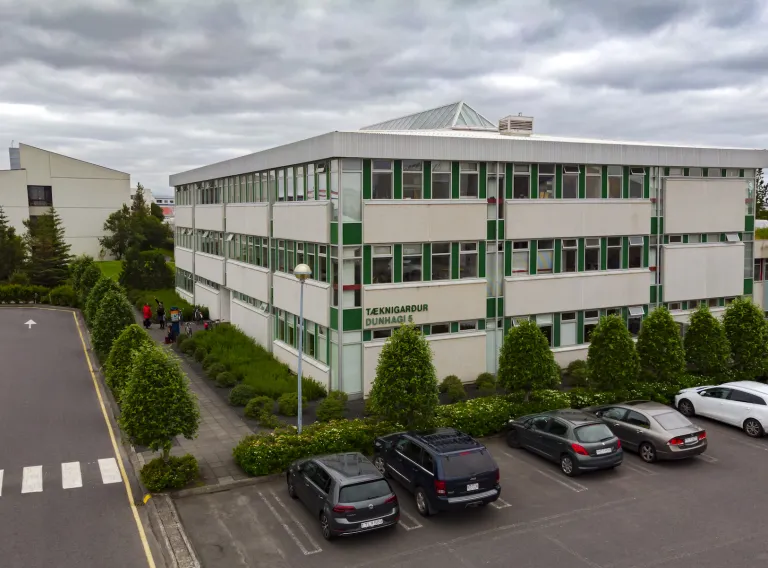
SENS Student ServiceTæknigarður and Askja9 am - 3:30 pmContact- Undergraduate studies: nemvon@hi.is
- Master studies: mssens@hi.is
- Doctoral studies: phdsens@hi.is
- Environment and Natural Resources: umhverfi@hi.is
Share