- Are you interested in the Chinese language?
- Do you enjoy Chinese literature and culture?
- Do you want to study two subjects?
- Are you interested in sociology and business studies?
- Do you want a diverse selection of courses that suit your interests?
- Do you want to open up future opportunities in challenging careers?
This is a 60 ECTS minor which can be taken alongside a 120 ECTS major in another subject. Students must complete 180 ECTS to graduate with a BA degree.
The programme in Chinese studies equips students to understand and express themselves in everyday language and teaches them about Chinese culture and the Chinese written language, which has been evolving for over 3000 years.
Course topics include:
- Chinese history
- Chinese language usage
- Chinese
- Chinese culture and society
- Chinese texts
- Literary translation
- Chinese women's literature
- Translation
Objectives
The programme aims to provide students with a strong foundation in Chinese language, history and society in order to understand this distant and fascinating culture.
Students will acquire:
- skills in academic working practices
- good proficiency in Chinese
- basic knowledge of Chinese linguistics
- knowledge of the historical and philosophical foundations of modern China
- insight into the development, evolution and policies of modern Chinese society
- understanding of major Chinese cultural forms
China is the most populous country on the planet and the second largest economy. It is a superpower that has such great influence over most fields of human endeavour that in the 21st century no country can afford to be without experts capable of understanding China's values, policies and goals.
Other
Chinese is also offered as a:
Matriculation examination.
Students must finish all mandatory courses outlined in the course catalogue and must pick between taking History of China I or History of China II.
Students pick their remaining 8 ECTS of elective courses from the courses belonging to the Chinies Studies programme.
Programme structure
Check below to see how the programme is structured.
This programme does not offer specialisations.
- First year
- Fall
- Modern China: Society, Politics and Economy
- Chinese Language Usage I
- Chinese I
- An Asian Century? The entangled rise of China and India from 1900 to the present day
- Reading the Daodejing – an Exegetical Approach to the Daoist Classic
- Spring 1
- Not taught this semesterHistory of China II: From the Qing Dynasty to the present
- Not taught this semesterHistory of China I: From Mythological Origins to Late Ming
- Chinese II
- Chinese Language Usage II
- Chinese Religion
Modern China: Society, Politics and Economy (KÍN101G)
How does China work? This an overview course of the main factors that influence contemporary Chinese society, politics and economy, with an emphasis on the changes following the implementation of the Open Door Policy in 1978. It is a journey through the major developments of China‘s recent economic history. Politics and changes in the top leadership of the State and the Party will be examined from the perspective of political economy and relations with neighbouring countries in Asia and the Pacific. Certain topics concerning China‘s development will be examined in individual lessons such as energy, environment, demography, arts and international relations. Furthermore, the status of the family, human and gender rights will be examined. Hong Kong, Taiwan and Tibet will also be discussed. Clips from recent Chinese documentaries on various aspects of the transformation of Chinese society will be screened. The course is taught in English.
Chinese Language Usage I (KÍN105G)
This course focuses in particular on Chinese phonology by training pronunciation and tones. It is mainly formed of exercises to enhance listening comprehension and oral expression on the basis of course material used in the course Chinese I. The course is based on HSK level 1.
Chinese I (KÍN107G)
This is a comprehensive elementary course in standard Chinese (mandarin, putonghua). Students will learn basic features and the grammatical as well as tonal structure of Chinese, with an emphasis on practical vocabulary for everyday use.
The pinyin transliteration system will be used initially, but then simplified Chinese characters (jiantizi) is gradually introduced.
The course includes many exercises as well as in-class exams, and students are expected to conduct extensive self-study. Class attendance is compulsory in the course.
An Asian Century? The entangled rise of China and India from 1900 to the present day (KÍN503G)
The course will be taught during the 2nd and 3rd week of the fall semester. Further information about the time and place will be available before the start of the semester.
This intensive course examines the entangled modern histories of China and India from 1900 to the present day. It reframes the twentieth century from an Asian perspective, asking how viewing that era through the lens of China and India's shared and divergent experiences shifts our understanding of modern history. Moving from anti-colonial encounters and Cold War diplomacy to economic reform and contemporary world order, the course places China and India in dialogue to challenge Eurocentric frameworks in international history.
Reading the Daodejing – an Exegetical Approach to the Daoist Classic (KÍN502G)
The philosophical and religious classic Daodejing will be read chapter by chapter with the objective of understanding the text in light of the philosophical and religious teachings of Daoism. The main rendering of the text to be used is the bilingual Icelandic translation by Ragnar Baldursson, Ferlið og dygðin, but other translations, interpretations and discussions will also be consulted. A reading comprehension of Chinese is certainly an advantage but not a condition for participation in the course.
History of China II: From the Qing Dynasty to the present (KÍN108G, KÍN102G)
Teacher: Amy Matthewson, SOAS University of London
This course deals with the rise of ‘modern’ China during the late Qing dynasty (1644-1912) and explores the internal and external forces within China and how events shaped its international standing. It examines the historical processes within China that led to the development of modern China and explores geopolitical conditions to consider the lasting impact transformations in China had on the global community. The course opens with a brief overview of the founding of the Qing dynasty, the last major dynasty in Chinese history. It then explores extraordinary occurrences such as imperialism, massive rebellion, and revolution in China, all of which had powerful influences on China’s international interactions. The course moves on to discuss the establishment of the People's Republic of China, the retreat of the Nationalist government, the policies of Mao Zedong, the Cultural Revolution and the Open Door Policy. The course is taught online through distant learning equipment.
History of China I: From Mythological Origins to Late Ming (KÍN108G, KÍN102G)
This course explores the history of China from the mythical Xia dynasty in the third millenium BCE to the beginning of the nineteenth century. It seeks to illuminate the most important factors in the formation of Chinese culture as well as to explain individual events in the political and social development of the Chinese nation. An overview will be provided of the origin and development of the most important Chinese religious and philosophical streams of thought, notably Confucianism, Daoism and Buddhism. Influential individuals will be introduced. The interaction and mutual influence between non-Chinese groups and the Chinese nation in the course of history will be emphasised.
Chinese II (KÍN202G)
This is a comprehensive elementary course in standard Chinese (mandarin, putonghua), continuing the course Chinese I. The approximate course level is HSK 2-3.
Students deepen their knowledge of Chinese grammar, expand their vocabulary, and consolidate their acquired knowledge of Chinese. Active use of the language will be emphasized and teaching will be increasingly conducted in Chinese instead of English. The course includes many exercises as well as in-class exams, and students are expected to conduct extensive self-study.
Chinese Language Usage II (KÍN204G)
This course continues the phonological training of Chinese Language Usage I in terms of pronunciation and tones. It is mainly formed of exercises to enhance listening comprehension and oral expression on the basis of the course material used in the course Chinese II. The course is based on HSK level 2.
Chinese Religion (KÍN614G)
This course will begin by discussing the unique characteristics of Chinese religions that distinguish them in particular from the Abrahamic religious traditions. Subsequently, the course will move to its principal topic, i.e. the religions that have developed within Chinese culture, in particular Daoism, Chinese Buddhism (e.g. chan 禪, tiantai 天台 and jingtu 淨土) as well as popular Chinese religion influenced by Confucianism. Some basic writings of these religions will be accessed in order to understand their main teachings but the focus will be on their contemporary manifestations, rituals and social status in the People‘s Republic of China, Taiwan, Malaysia, Singapore and elsewhere. Lastly, as much as time allows, the course will discuss some recent syncretic Chinese movements such as Tiandi Jiao 天帝, Falun Gong 法輪功 and Cao Dai in Vietnam, as well as consider non-Chinese religious traditions that have taken firm roots in China such as Islam and Christianity.
- Fall
- KÍN101GModern China: Society, Politics and EconomyMandatory (required) course6A mandatory (required) course for the programme6 ECTS, creditsCourse Description
How does China work? This an overview course of the main factors that influence contemporary Chinese society, politics and economy, with an emphasis on the changes following the implementation of the Open Door Policy in 1978. It is a journey through the major developments of China‘s recent economic history. Politics and changes in the top leadership of the State and the Party will be examined from the perspective of political economy and relations with neighbouring countries in Asia and the Pacific. Certain topics concerning China‘s development will be examined in individual lessons such as energy, environment, demography, arts and international relations. Furthermore, the status of the family, human and gender rights will be examined. Hong Kong, Taiwan and Tibet will also be discussed. Clips from recent Chinese documentaries on various aspects of the transformation of Chinese society will be screened. The course is taught in English.
Face-to-face learningPrerequisitesKÍN105GChinese Language Usage IMandatory (required) course6A mandatory (required) course for the programme6 ECTS, creditsCourse DescriptionThis course focuses in particular on Chinese phonology by training pronunciation and tones. It is mainly formed of exercises to enhance listening comprehension and oral expression on the basis of course material used in the course Chinese I. The course is based on HSK level 1.
Face-to-face learningPrerequisitesAttendance required in classKÍN107GChinese IMandatory (required) course12A mandatory (required) course for the programme12 ECTS, creditsCourse DescriptionThis is a comprehensive elementary course in standard Chinese (mandarin, putonghua). Students will learn basic features and the grammatical as well as tonal structure of Chinese, with an emphasis on practical vocabulary for everyday use.
The pinyin transliteration system will be used initially, but then simplified Chinese characters (jiantizi) is gradually introduced.
The course includes many exercises as well as in-class exams, and students are expected to conduct extensive self-study. Class attendance is compulsory in the course.
Face-to-face learningPrerequisitesAttendance required in classKÍN503GAn Asian Century? The entangled rise of China and India from 1900 to the present dayElective course3Free elective course within the programme3 ECTS, creditsCourse DescriptionThe course will be taught during the 2nd and 3rd week of the fall semester. Further information about the time and place will be available before the start of the semester.
This intensive course examines the entangled modern histories of China and India from 1900 to the present day. It reframes the twentieth century from an Asian perspective, asking how viewing that era through the lens of China and India's shared and divergent experiences shifts our understanding of modern history. Moving from anti-colonial encounters and Cold War diplomacy to economic reform and contemporary world order, the course places China and India in dialogue to challenge Eurocentric frameworks in international history.
Face-to-face learningPrerequisitesCourse taught first half of the semesterKÍN502GReading the Daodejing – an Exegetical Approach to the Daoist ClassicElective course5Free elective course within the programme5 ECTS, creditsCourse DescriptionThe philosophical and religious classic Daodejing will be read chapter by chapter with the objective of understanding the text in light of the philosophical and religious teachings of Daoism. The main rendering of the text to be used is the bilingual Icelandic translation by Ragnar Baldursson, Ferlið og dygðin, but other translations, interpretations and discussions will also be consulted. A reading comprehension of Chinese is certainly an advantage but not a condition for participation in the course.
Prerequisites- Spring 2
Not taught this semesterKÍN108G, KÍN102GHistory of China II: From the Qing Dynasty to the presentRestricted elective course10Restricted elective course, conditions apply10 ECTS, creditsCourse DescriptionTeacher: Amy Matthewson, SOAS University of London
This course deals with the rise of ‘modern’ China during the late Qing dynasty (1644-1912) and explores the internal and external forces within China and how events shaped its international standing. It examines the historical processes within China that led to the development of modern China and explores geopolitical conditions to consider the lasting impact transformations in China had on the global community. The course opens with a brief overview of the founding of the Qing dynasty, the last major dynasty in Chinese history. It then explores extraordinary occurrences such as imperialism, massive rebellion, and revolution in China, all of which had powerful influences on China’s international interactions. The course moves on to discuss the establishment of the People's Republic of China, the retreat of the Nationalist government, the policies of Mao Zedong, the Cultural Revolution and the Open Door Policy. The course is taught online through distant learning equipment.Face-to-face learningPrerequisitesKÍN108G, KÍN102GHistory of China I: From Mythological Origins to Late MingRestricted elective course10Restricted elective course, conditions apply10 ECTS, creditsCourse DescriptionThis course explores the history of China from the mythical Xia dynasty in the third millenium BCE to the beginning of the nineteenth century. It seeks to illuminate the most important factors in the formation of Chinese culture as well as to explain individual events in the political and social development of the Chinese nation. An overview will be provided of the origin and development of the most important Chinese religious and philosophical streams of thought, notably Confucianism, Daoism and Buddhism. Influential individuals will be introduced. The interaction and mutual influence between non-Chinese groups and the Chinese nation in the course of history will be emphasised.
Face-to-face learningPrerequisitesKÍN202GChinese IIMandatory (required) course12A mandatory (required) course for the programme12 ECTS, creditsCourse DescriptionThis is a comprehensive elementary course in standard Chinese (mandarin, putonghua), continuing the course Chinese I. The approximate course level is HSK 2-3.
Students deepen their knowledge of Chinese grammar, expand their vocabulary, and consolidate their acquired knowledge of Chinese. Active use of the language will be emphasized and teaching will be increasingly conducted in Chinese instead of English. The course includes many exercises as well as in-class exams, and students are expected to conduct extensive self-study.
Face-to-face learningPrerequisitesAttendance required in classKÍN204GChinese Language Usage IIMandatory (required) course6A mandatory (required) course for the programme6 ECTS, creditsCourse DescriptionThis course continues the phonological training of Chinese Language Usage I in terms of pronunciation and tones. It is mainly formed of exercises to enhance listening comprehension and oral expression on the basis of the course material used in the course Chinese II. The course is based on HSK level 2.
Face-to-face learningPrerequisitesAttendance required in classCourse DescriptionThis course will begin by discussing the unique characteristics of Chinese religions that distinguish them in particular from the Abrahamic religious traditions. Subsequently, the course will move to its principal topic, i.e. the religions that have developed within Chinese culture, in particular Daoism, Chinese Buddhism (e.g. chan 禪, tiantai 天台 and jingtu 淨土) as well as popular Chinese religion influenced by Confucianism. Some basic writings of these religions will be accessed in order to understand their main teachings but the focus will be on their contemporary manifestations, rituals and social status in the People‘s Republic of China, Taiwan, Malaysia, Singapore and elsewhere. Lastly, as much as time allows, the course will discuss some recent syncretic Chinese movements such as Tiandi Jiao 天帝, Falun Gong 法輪功 and Cao Dai in Vietnam, as well as consider non-Chinese religious traditions that have taken firm roots in China such as Islam and Christianity.
Prerequisites
The University of Iceland collaborates with over 400 universities worldwide. This provides a unique opportunity to pursue part of your studies at an international university thus gaining added experience and fresh insight into your field of study.
Students generally have the opportunity to join an exchange programme, internship, or summer courses. However, exchanges are always subject to faculty approval.
Students have the opportunity to have courses evaluated as part of their studies at the University of Iceland, so their stay does not have to affect the duration of their studies.
Trade with China has expanded significantly over the past decade. The number of Chinese tourists in Iceland has risen dramatically. Chinese international influence is growing.
A degree in Chinese studies can open up opportunities in:
- International trade
- Tourism
- Interpreting and translation
- Institutes
- Academia
- Teaching
- Research
- Energy industry
This list is not exhaustive.
- Linguae is the organisation for language students at the University of Iceland
- Linguae organises social events for students at the Faculty of Languages and Cultures
- Members currently include students of Italian, French, German, Spanish, Danish, Chinese and Russian
- Linguae runs a Facebook group and a Facebook page
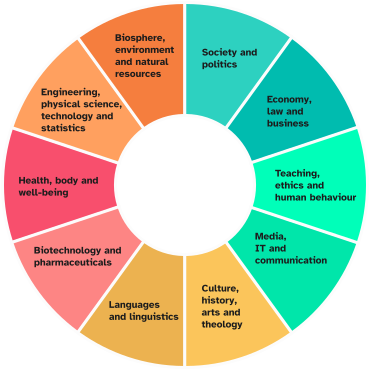
Study wheel
What interests you?
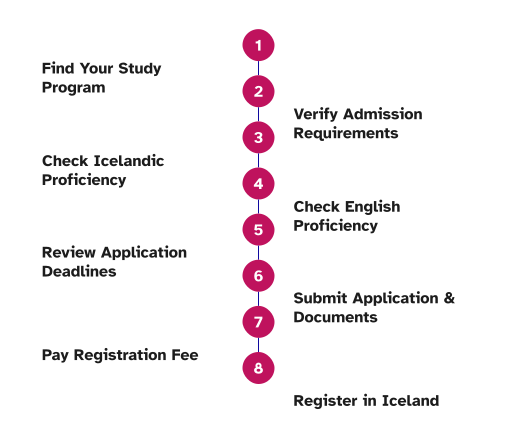
How to apply
Follow the path
If you still have questions, feel free to contact us.
The Service Desk is a point of access for all services. You can drop in at the University Centre or use the WebChat at the bottom right of this page.
Follow the School of Humanities on Instagram, Youtube
and Facebook