- Are you interested in learning more about Korea?
- Do you enjoy exploring new cultures?
- Do you want a short diploma programme?
- Do you want to learn Korean?
- Do you want a programme that can be tailored to suit your interests?
A full-time student can complete this Diploma in Korean in one year, but it is also possible to study part-time and take two years.
Course topics include:
- Korean
- Language usage
- Asian Philosophy
- Individual projects
The programme coordinator supports all students in Korean studies.
Other
If you plan to graduate with a BA degree, you can take Korean studies as a 60 ECTS minor along with a 120 ECTS major in another subject.
Check the rules on majors and minors below under helpful content.
Icelandic matriculation examination (stúdentspróf) or equivalent qualification.
To complete the diploma in Korean Studies, students must complete 50 ECTS in mandatory Korean Studies courses, as specified in the programme structure. In addition, students must take 10 ECTS of elective course(s) during the fall semester. These electives may be chosen from any other programme within the School of Humanities.
Fall semester:
KOR101G Korean I 10 ECTS
KOR102G Conversational Korean I 10 ECTS
Free elective from within the School of Humanities 10 ECTS
Spring semester:
KOR201G Korean II 10 ECTS
KOR202G Conversational Korean II 10 ECTS
KOR204G Korean Society and Culture 10 ECTS
Programme structure
Check below to see how the programme is structured.
This programme does not offer specialisations.
- First year
- Fall
- Korean I
- Conversational Korean I
- Spring 1
- Korean II
- Conversational Korean II
- Korean Society and Culture
Korean I (KOR101G)
This course is an elementary Korean language course designed for those who have no prior knowledge of Korean. The goal of the course is to enable students to develop comprehensive language skills of listening, speaking, reading, and writing in Korean and to master the writing system. This course will focus on both written and spoken languages and cover various topics in Korean culture for a better understanding of the language. Teaching will be conducted in English and Korean.
Conversational Korean I (KOR102G)
This course is an elementary conversational course in Korean language. The goal of the course is to enable students to understand spoken language and to engage in real-life conversations in Korean. The course is based on interactive exercises and tasks, and active participation is key for the best learning outcomes.
While intended for beginners, it is highly recommended that the course be taken along with Korean I, as prior knowledge of the writing system is required. Teaching will be conducted in Korean.
Korean II (KOR201G)
This course is an elementary Korean language course intended for those who have completed Korean I. The goal of the course is to enable students to develop comprehensive language skills of listening, speaking, reading, and writing and to build a solid foundation for further studies in Korean language. This course will focus on both written and spoken languages and cover various topics in Korean culture for a better understanding of the language. Teaching will be conducted in English and Korean.
Conversational Korean II (KOR202G)
This course is an elementary conversational course in Korean language intended for those who completed Conversational Korean I. The goal of the course is to enable students to understand spoken language and to engage in real-life conversations in Korean. The course is based on interactive exercises and tasks, and active participation is key for the best learning outcomes. Teaching will be conducted in Korean.
Korean Society and Culture (KOR204G)
This course explores the dynamic interplay between Korea’s deep historical roots and its rapid emergence as a global technological and cultural influence. Guided by the theme “Rooted in History, Wired for the Future,” students will examine how Korea’s historical legacy, colonial and postwar experiences, and distinctive drive for transformation have shaped its present-day society and culture – including politics, gender and family relations, generational divides, the Korean Wave, and more – within an increasingly globalized world.
- Fall
- KOR101GKorean IMandatory (required) course10A mandatory (required) course for the programme10 ECTS, creditsCourse Description
This course is an elementary Korean language course designed for those who have no prior knowledge of Korean. The goal of the course is to enable students to develop comprehensive language skills of listening, speaking, reading, and writing in Korean and to master the writing system. This course will focus on both written and spoken languages and cover various topics in Korean culture for a better understanding of the language. Teaching will be conducted in English and Korean.
Face-to-face learningPrerequisitesKOR102GConversational Korean IMandatory (required) course10A mandatory (required) course for the programme10 ECTS, creditsCourse DescriptionThis course is an elementary conversational course in Korean language. The goal of the course is to enable students to understand spoken language and to engage in real-life conversations in Korean. The course is based on interactive exercises and tasks, and active participation is key for the best learning outcomes.
While intended for beginners, it is highly recommended that the course be taken along with Korean I, as prior knowledge of the writing system is required. Teaching will be conducted in Korean.
Face-to-face learningPrerequisites- Spring 2
KOR201GKorean IIMandatory (required) course10A mandatory (required) course for the programme10 ECTS, creditsCourse DescriptionThis course is an elementary Korean language course intended for those who have completed Korean I. The goal of the course is to enable students to develop comprehensive language skills of listening, speaking, reading, and writing and to build a solid foundation for further studies in Korean language. This course will focus on both written and spoken languages and cover various topics in Korean culture for a better understanding of the language. Teaching will be conducted in English and Korean.
Face-to-face learningPrerequisitesKOR202GConversational Korean IIMandatory (required) course10A mandatory (required) course for the programme10 ECTS, creditsCourse DescriptionThis course is an elementary conversational course in Korean language intended for those who completed Conversational Korean I. The goal of the course is to enable students to understand spoken language and to engage in real-life conversations in Korean. The course is based on interactive exercises and tasks, and active participation is key for the best learning outcomes. Teaching will be conducted in Korean.
Face-to-face learningPrerequisitesKOR204GKorean Society and CultureMandatory (required) course10A mandatory (required) course for the programme10 ECTS, creditsCourse DescriptionThis course explores the dynamic interplay between Korea’s deep historical roots and its rapid emergence as a global technological and cultural influence. Guided by the theme “Rooted in History, Wired for the Future,” students will examine how Korea’s historical legacy, colonial and postwar experiences, and distinctive drive for transformation have shaped its present-day society and culture – including politics, gender and family relations, generational divides, the Korean Wave, and more – within an increasingly globalized world.
Face-to-face learningPrerequisites
The University of Iceland collaborates with over 400 universities worldwide. This provides a unique opportunity for UI students to pursue a part of their studies abroad, gain valuable international experience, and strengthen their position in the job market.
Opportunities
Study abroad is always subject to faculty approval.
Requirements
Students can only apply for study abroad if their study programme is at least:
- 90 ECTS credits for undergraduate programmes
- 60 ECTS credits for graduate programmes
Recognition
Students can get courses taken abroad recognised towards their degree at UI so the mobility does not have to prolong the studies at UI. Students must agree with their faculty on the recognition of courses before the start of the mobility by signing a learning agreement.
Knowledge of the Korean language and culture is useful for working in business, international affairs and tourism, to name a few examples.
An education in this area can open up opportunities in:
- Tourism
- International affairs
- Tour guiding
- Translation
- Interpretation
- Business
- Imports and exports
This list is not exhaustive.
- Linguae is the organisation for language students at the University of Iceland
- Linguae organises social events for students at the Faculty of Languages and Cultures
- Members currently include students of Italian, French, German, Spanish, Danish, Chinese and Russian
- Linguae runs a Facebook group and a Facebook page
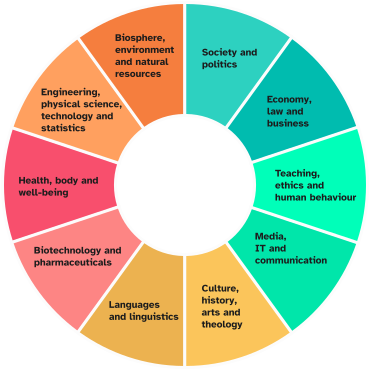
Study wheel
What interests you?
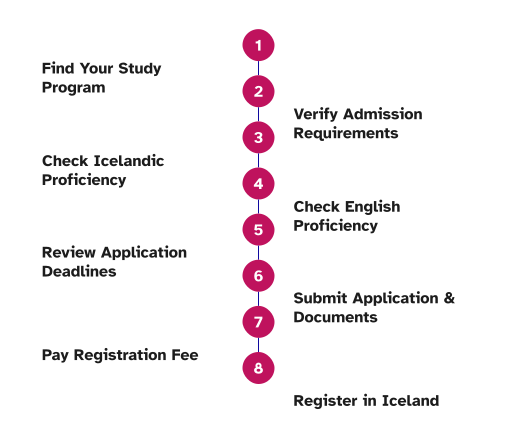
How to apply
Follow the path
If you still have questions, feel free to contact us.
The Service Desk is a point of access for all services. You can drop in at the University Centre or use the WebChat at the bottom right of this page.
Follow the School of Humanities on Instagram, Youtube
and Facebook