Language skills
Programme length
Three years - 180 ECTS
Study mode
Face-to-face learning
Application status
International students:
Students with Icelandic or Nordic citizenship:
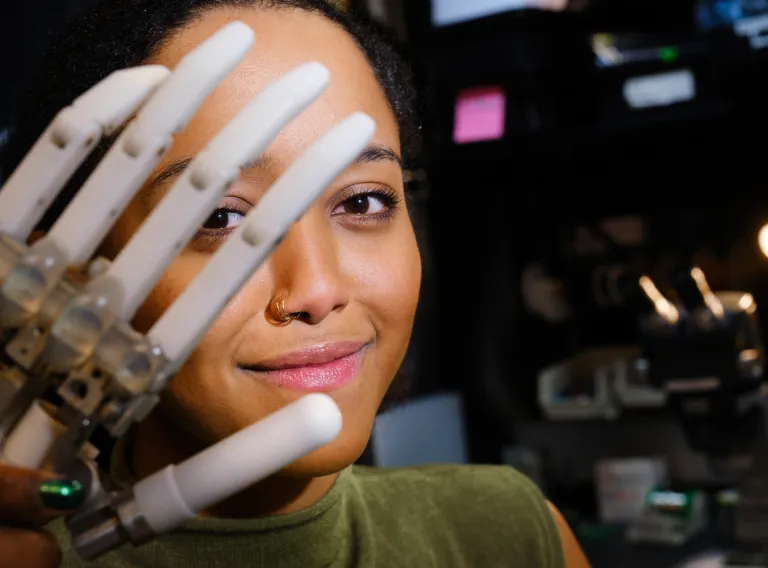
- Would you like to learn more about programming, software and machinery?
- Are you interested in the physical sciences and their practical applications?
- Do you want to learn how we can benefit from combining computers and machines?
- Do you want to learn about artificial intelligence and its uses?
- Do you want to learn about modern techniques for creating automatic machines?
- Do you enjoy solving complex problems?
- Do you want to learn about sustainable energy?
- Do you want to understand which materials are suitable for which products and machines?
- Do you want to understand the processes that play a key role in modern manufacturing?
- Do you want a diverse selection of courses that suit your interests?
- Do you want to tackle diverse projects under the guidance of Iceland's leading experts in mechanical engineering?
Many courses are largely based on project work, in which students complete tasks that are realistic for the industry. There is a focus on innovation, and students are encouraged to think about how engineering and computer technology relate to the environment, markets and society.
The programme aims to provide students with a solid foundation in the fundamentals of mechanical engineering. You will learn to apply design methods to develop systems and system sections, considering function, longevity, security and efficiency.
In order to learn how to apply their knowledge of mechanical engineering, students must have a strong foundation in mathematics and physics. Applicants to the mechanical engineering programme must be well prepared with extensive prior knowledge in the physical sciences. The better prepared you are, the more you will get out of the programme.
Course topics include:
- Structural mechanics and materials science
- Design and construction of automatic machines
- Vibrations and machine components
- Human dynamics and kinematics
- Thermodynamics and fluid dynamics
- Computerised design and analysis
- Controls and instrumentation
- Analysis and presentation of data
- Technical drawing and manufacturing processes
- Programming and uses of software
- Design and construction of racing cars
- Product development and innovation
Icelandic matriculation examination or a comparable qualification. The faculty strongly recommends that students complete at least 40 credits in mathematics, 50 in science of which 10 should be in physics. It is also recommended to have finished a course in programming.
Further information can be found in article 23, regulation on admission requirements for undergraduate study no. 331/2022.
Applicants with qualifications from a school abroad who plan to enrol in an undergraduate programme taught in Icelandic at the faculty must also pass a special entrance exam in Icelandic, in accordance with Article 1.
180 ECTS credits have to be completed for the qualification. Organised as a three year programme. Compulsory courses are 150 ECTS credits, 30 ECTS credits are optional and of these 18 ECTS credits must fall within engineering subjects. 12 ECTS credits may be taken outside the the School of Engineering and Natural Sciences.
Programme structure
Check below to see how the programme is structured.
This programme does not offer specialisations.
- First year
- Fall
- Physics 1 V
- Mathematical Analysis I
- Linear Algebra
- Computer Science 1a
- Engineering Design Processes
- Spring 1
- Physics 2 V
- Probability and Statistics
- Mathematical Analysis II
- Technical Drawing
- Strength of Materials
First year | Fall
Physics 1 V (EÐL102G)
A mandatory (required) course for the programme
6 ECTS, credits
Course Description
Concepts, units, scales and dimensions. Vectors. Kinematics of particles. Particle dynamics, inertia, forces and Newton's laws. Friction. Work and energy, conservation of energy. Momentum, collisions. Systems of particles, center of mass. Rotation of a rigid body. Angular momentum and moment of inertia. Statics. Gravity. Solids and fluids, Bernoulli's equation. Oscillations: Simple, damped and forced. Waves. Sound. Temperature. Ideal gas. Heat and the first law of thermodynamics. Kinetic theory of gases. Entropy and the second law of thermodynamics. Home problems: Once a week the students have to solve homeproblems on the website MasteringPhysics.
Laboratory work: Three exercises, mainly centered on mechanics, where students are trained in handling physical instruments, collecting and inspecting data. Students hand in their lab notebooks for a grade.
Note that the textbook is accessible to students via Canvas free of charge.
Language of instruction: Icelandic
Face-to-face learning
First year | Fall
Mathematical Analysis I (STÆ104G)
A mandatory (required) course for the programme
6 ECTS, credits
Course Description
This is a foundational course in single variable calculus. The prerequisites are high school courses on algebra, trigonometry. derivatives, and integrals. The course aims to create a foundation for understanding of subjects such as natural and physical sciences, engineering, economics, and computer science. Topics of the course include the following:
- Real numbers.
- Limits and continuous functions.
- Differentiable functions, rules for derivatives, derivatives of higher order, applications of differential calculus (extremal value problems, linear approximation).
- Transcendental functions.
- Mean value theorem, theorems of l'Hôpital and Taylor.
- Integration, the definite integral and rules/techniques of integration, primitives, improper integrals.
- Fundamental theorem of calculus.
- Applications of integral calculus: Arc length, area, volume, centroids.
- Ordinary differential equations: First-order separable and homogeneous differential equations, first-order linear equations, second-order linear equations with constant coefficients.
- Sequences and series, convergence tests.
- Power series, Taylor series.
Language of instruction: Icelandic
Face-to-face learning
First year | Fall
Linear Algebra (STÆ107G)
A mandatory (required) course for the programme
6 ECTS, credits
Course Description
Basics of linear algebra over the reals.
Subject matter: Systems of linear equations, matrices, Gauss-Jordan reduction. Vector spaces and their subspaces. Linearly independent sets, bases and dimension. Linear maps, range space and nullk space. The dot product, length and angle measures. Volumes in higher dimension and the cross product in threedimensional space. Flats, parametric descriptions and descriptions by equations. Orthogonal projections and orthonormal bases. Gram-Schmidt orthogonalization. Determinants and inverses of matrices. Eigenvalues, eigenvectors and diagonalization.
Language of instruction: Icelandic
Face-to-face learning
First year | Fall
Computer Science 1a (TÖL105G)
A mandatory (required) course for the programme
6 ECTS, credits
Course Description
Programming in Python (for computations in engineering and science): Main commands and statements (computations, control statements, in- and output), definition and execution of functions, datatypes (numbers, matrices, strings, logical values, records), operations and built-in functions, array and matrix computation, file processing, statistics, graphics. Object-oriented programming: classes, objects, constructors and methods. Concepts associated with design and construction of program systems: Programming environment and practices, design and documentation of function and subroutine libraries, debugging and testing of programmes.
Language of instruction: Icelandic
Face-to-face learning
First year | Fall
Engineering Design Processes (VÉL101G)
A mandatory (required) course for the programme
6 ECTS, credits
Course Description
Background for design and engineering design process. Conceptual design, need analysis, specifications, boundary conditions and evaluation criteria. Embodiment and detailed design. CAD system and development of computer graphics. Wire frame model, surface and solid models. Design for reliability, safety and environmental protection.
Language of instruction: Icelandic
Face-to-face learning
First year | Spring 1
Physics 2 V (EÐL201G)
A mandatory (required) course for the programme
6 ECTS, credits
Course Description
Teaching takes 12 weeks. Charge and electric field. Gauss' law. Electric potential. Capacitors and dielectrics. Electric currents and resistance. Circuits. Magnetic fields. The laws of Ampère and Faraday. Induction. Electric oscillation and alternating currents. Maxwell's equations. Electromagnetic waves. Reflection and refraction. Lenses and mirrors. Wave optics. Four laboratory exercises in optics and electromagnetism.
Language of instruction: English
Face-to-face learning
First year | Spring 1
Probability and Statistics (STÆ203G)
A mandatory (required) course for the programme
6 ECTS, credits
Course Description
Basic concepts in probability and statistics based on univariate calculus.
Topics:
Sample space, events, probability, equal probability, independent events, conditional probability, Bayes rule, random variables, distribution, density, joint distribution, independent random variables, condistional distribution, mean, variance, covariance, correlation, law of large numbers, Bernoulli, binomial, Poisson, uniform, exponential and normal random variables. Central limit theorem. Poisson process. Random sample, statistics, the distribution of the sample mean and the sample variance. Point estimate, maximum likelihood estimator, mean square error, bias. Interval estimates and hypotheses testing form normal, binomial and exponential samples. Simple linear regression. Goodness of fit tests, test of independence.
Language of instruction: Icelandic
Face-to-face learning
First year | Spring 1
Mathematical Analysis II (STÆ205G)
A mandatory (required) course for the programme
6 ECTS, credits
Course Description
Open and closed sets. Mappings, limits and continuity. Differentiable mappings, partial derivatives and the chain rule. Jacobi matrices. Gradients and directional derivatives. Mixed partial derivatives. Curves. Vector fields and flow. Cylindrical and spherical coordinates. Taylor polynomials. Extreme values and the classification of stationary points. Extreme value problems with constraints. Implicit functions and local inverses. Line integrals, primitive functions and exact differential equations. Double integrals. Improper integrals. Green's theorem. Simply connected domains. Change of variables in double integrals. Multiple integrals. Change of variables in multiple integrals. Surface integrals. Integration of vector fields. The theorems of Stokes and Gauss.
Language of instruction: Icelandic
Face-to-face learning
First year | Spring 1
Technical Drawing (VÉL201G)
A mandatory (required) course for the programme
6 ECTS, credits
Course Description
The course introduces basic drafting concepts and methods to students. The aim is to equip the student with the necessary skills needed for creating and reading engineering drawings. Emphasis is placed developing an understanding of 2D representations of 3D geometries. The student is required to learn the drafting methods and be able to perform them by hand in the final exam. AutoCAD is used in the course as a drafting tool and students will learn how to use it. The course is, however, not an AutoCAD course but an engineering drawing course.
Language of instruction: Icelandic
Face-to-face learning
Prerequisites
First year | Spring 1
Strength of Materials (VÉL202G)
A mandatory (required) course for the programme
6 ECTS, credits
Course Description
The objective of the course is to teach the fundamental principles of strength of materials, that is, to enable students to determine the stresses, strains and displacements in structures due to external loading. The course includes topics, such as: tension, compression and shear, torsion, shear forces and bending moments, stresses and deflections in beams, analysis of stress and strain in plane structures, statically inderminate beams.
Language of instruction: Icelandic
Face-to-face learning
- Second year
- Fall
- Mathematical Analysis III
- Engineering Materials
- Thermodynamics and chemical reactions
- Not taught this semesterMeasurements and data analysis
- Fluid Mechanics
- Spring 1
- Numerical Analysis
- Energy Processes
- Dynamics and vibrations
- Mechanical engineering design
- Not taught this semesterComputers and machines
Second year | Fall
Mathematical Analysis III (STÆ302G)
A mandatory (required) course for the programme
6 ECTS, credits
Course Description
Functions of a complex variable. Analytic functions. The exponential function, logarithms and roots. Cauchy's Integral Theorem and Cauchy's Integral Formula. Uniform convergence. Power series. Laurent series. Residue integration method. Application of complex function theory to fluid flows. Ordinary differential equations and systems of ordinary differential equations. Linear differential equations with constant coefficients. Systems of linear differential equations. The matrix exponential function. Various methods for obtaining a particular solution. Green's functions for initial value problems. Flows and the phase plane. Nonlinear systems of ordinary differential equations in the plane, equilibrium points, stability and linear approximations. Series solutions and the method of Frobenius. Use of Laplace transforms in solving differential equations.
Language of instruction: English
Face-to-face learning
Second year | Fall
Engineering Materials (VÉL301G)
A mandatory (required) course for the programme
6 ECTS, credits
Course Description
The objective of the course is to teach the fundamental principles of materials science so the student can better understand material behavior and select appropriate materials for a given application. Theoretical basis is given for the understanding of material behaviour from a microscopic view. The course includes the following topics: crystalline structures, imperfections, diffusion, mechanical properties, deformation and strengthening mechanisms, fracture and fatique, phase diagrams, phase transformations, thermal processing of metal alloys, types of materials (metal alloys, polymers, ceramics, composites), corrosion and degradation of of materials. The course includes homework problems and practical classes in laboratory.
Language of instruction: Icelandic
Face-to-face learning
Second year | Fall
Thermodynamics and chemical reactions (VÉL303G)
A mandatory (required) course for the programme
6 ECTS, credits
Course Description
The objective of the course is to teach the student the basic concepts of thermodynamic systems. The students should also understand different forms of energy, energy transport and conversion from one state to another. The student should be able to calculate the rates of chemical reactions and energy balance.
Language of instruction: Icelandic/English
Face-to-face learning
Not taught this semester
Second year | Fall
Measurements and data analysis (VÉL304G)
A mandatory (required) course for the programme
6 ECTS, credits
Course Description
The objective of the course is to teach the students to design and set up experiments, collect data and analyse it. The students work with different sensors, program central data storage systems and analyse the data.
Language of instruction: Icelandic
Face-to-face learning
Second year | Fall
Fluid Mechanics (VÉL502G)
A mandatory (required) course for the programme
6 ECTS, credits
Course Description
Properties of liquids and gases. Pressure and force fields in liquids at rest, pressure gauges. Equations of motion, continuity, momentum and energy. Bernoulli equation of motion. Dimensional analysis and dynamic similarity. Two dimensional flow, non-viscous fluids, boundary layers theory, laminar and turbulent flow, fluid friction and form drag. Flow of compressible fluids, velocity of sound. Mach number, sound waves, nozzle shape for supersonic speed. Open channel flow. Several experiments are conducted.
Language of instruction: Icelandic
Face-to-face learning
Second year | Spring 1
Numerical Analysis (STÆ405G)
A mandatory (required) course for the programme
6 ECTS, credits
Course Description
Fundamental concepts on approximation and error estimates. Solutions of systems of linear and non-linear equations. PLU decomposition. Interpolating polynomials, spline interpolation and regression. Numerical differentiation and integration. Extrapolation. Numerical solutions of initial value problems of systems of ordinary differential equations. Multistep methods. Numerical solutions to boundary value problems for ordinary differential equations.
Grades are given for programning projects and in total they amount to 30% of the final grade. The student has to receive the minimum grade of 5 for both the projects and the final exam.
Language of instruction: Icelandic
Face-to-face learning
Second year | Spring 1
Energy Processes (VÉL405G)
A mandatory (required) course for the programme
6 ECTS, credits
Course Description
Goal: Enable the students to: 1: Study thermodynamics from the viewpoint of the second law of thermodynamics 2. Understand standard power cycles, and their use for analysis of power plants 3. Understand air conditioning systems and their necessity 4. Understand thermochemistry and be able to estimate heat release through combustion. Content: Work, heat and energy conversion. Exergy and anergy. Energy, energy price and energy quality. Standard power and refrigeration cycles. Steam power cycles, geothermal utilization. Gas mixtures, moist air, ventilation and air purifiers. The Mollier i-x chart. Thermochemistry, combustion and reactions, chemical equilibrium. New energy systems. Exercises, design project.
Language of instruction: Icelandic
Face-to-face learning
Second year | Spring 1
Dynamics and vibrations (VÉL406G)
A mandatory (required) course for the programme
6 ECTS, credits
Course Description
The objectives of the course are to introduce the basic concepts of dynamics of a rigid body and continuous systems.
Topics:
- Newtonian mechanics, free and forced vibrations in linear systems
- Transient vibrations. Fourier series. Vibrations in nonlinear systems.
- Systems with two degrees of freedom.
- Natural frequencies.
- Numerical methods for the solution of systems with multiple degrees of freedom.
- Vibrations in simple continuous systems.
- Measurement and experimental modal analysis.
Language of instruction: Icelandic
Face-to-face learning
Second year | Spring 1
Mechanical engineering design (VÉL407G)
A mandatory (required) course for the programme
6 ECTS, credits
Course Description
The objective of the course is to teach the fundamental principles of machine design that is, to enable students to design determine key design parameters in machine parts. The course includes topics such as fracture and fatigue, connections, both bolted and welded, belt drives, chain drives, gears, gear trains, couplings and brakes, hydrodynamic and rolling bearings.
Language of instruction: Icelandic
Face-to-face learning
Not taught this semester
Second year | Spring 1
Computers and machines (VÉL408G)
A mandatory (required) course for the programme
6 ECTS, credits
Course Description
The students will learn about the design and construction of computer-controlled machines, operation of electrical motors, digital data acquisition, the use of microcontrollers for controlling (Arduino boards) and feedback controls.
Language of instruction: Icelandic
Face-to-face learning
- Third year
- Whole year courses
- Mentor in Sprettur
- Fall
- Engineering Economics
- Computational Structural Mechanics
- Automatic Control Systems
- Production Processes and Technology
- Not taught this semesterInnovation, IP protection, and application
- Design of water utilities – sewerage, potable water and district heating
- Quality Management
- Project Management
- Logistics & Environmental Engineering
- Environmental Engineering G
- Internship for mechanical engineering
- Not taught this semesterSelected Topics in Mechanical Engineering
- Not taught this semesterEnergy Intensive Production Processes
- Corrosion
- Not taught this semesterFish Processing Technology 1
- Design and Building of an Electric Formula Race Car - Part A
- Thesis Project
- Research, innovation and development
- Spring 1
- Heat Transfer
- Modern manufacturing processes
- Innovation and design
- Mathematical Analysis IV
- Mathematical Analysis IV
- Material and Energy Balances
- Software Development
- Technological innovation
- Operations Research
- Simulation
- Design & Experimental Execution
- Introduction to Systems Biology
- Internship for mechanical engineering
- Selected Topics in Mechanical Engineering
- Not taught this semesterEngineering Design Processes
- Mechatronics
- Computer Aided Design
- Not taught this semesterFish Processing Technology 2
- Design and Building of an Electric Formula Race Car - Part B
- Thesis Project
- Research, innovation and development
- Year unspecified
- Not taught this semesterFish Processing Technology 1
Third year | Whole year courses
Mentor in Sprettur (GKY001M)
Free elective course within the programme
5 ECTS, credits
Course Description
In this course, students work as mentors for participants at the upper‑secondary and university levels in the project Sprettur. Mentors play an essential role in supporting and encouraging other students in their studies and social life. Their role is to build constructive relationships with participants, act as positive role models, and take part in joint activities organised within Sprettur. Mentorship is based on relationship‑building and regular meetings and involves a commitment to the students the mentor supports.
Sprettur is a support project for students with a foreign background who seek additional support to improve their academic performance and participation in the university community. Students in the course work as mentors and are paired with participants based on shared interests. Mentors also work together in groups and in consultation with teachers and project coordinators.
Students may choose to enrol in the course in the autumn semester, spring semester, or distribute the workload across both semesters (the full academic year). The course structure accommodates this choice, but all academic requirements remain the same. Mentors plan regular meetings with Sprettur participants and typically spend three hours per month with participants, three hours per month in homework groups, and attend a total of five seminars.
Students submit journal entries on Canvas and design and deliver a learning experience for the participants in Sprettur. Journal entries are based on readings and critical reflections on the mentorship role and on personal experience in the project. The course is taught in Icelandic and English.
Upon completing the course and meeting all requirements, students receive 5 ECTS credits and an official certificate of participation and completion of the project.
Students fill out an electronic application form, and the supervising teacher contacts applicants.
More information about Sprettur can be found here: www.hi.is/sprettur
Language of instruction: Icelandic/English
Face-to-face learning
The course is taught if the specified conditions are met
Attendance required in class
Third year | Fall
Engineering Economics (IÐN502G)
A mandatory (required) course for the programme
6 ECTS, credits
Course Description
The objective of the course is that students get the skills to:
1. Understand the main concepts in accounting, cost theory and investment theory.
2. Be able to use methods of measuring the economic feasibility of technical projects.
3. Be able to develop computer models to assess the profitability of investments, the value of companies and pricing of bonds
Among topics included are accounting, cost theory, cash flow analysis, investment theory, measures of profitability including net present value and internal rate of return, and the building of profitability models. The course ends with a group assignment where the students exercise the development of computer models for feasibility assessment of projects.
Language of instruction: Icelandic
Face-to-face learning
Third year | Fall
Computational Structural Mechanics (VÉL103M)
A mandatory (required) course for the programme
6 ECTS, credits
Course Description
The aim of this course is to give students an exposure to the theoretical basis of the finite element method and its implementation principles. Furthermore, to introduce the use of available finite element application software for solving real-life engineering problems.
The course covers such topics as: stiffness matrices, element stiffness matrix, system stiffness matrix, local and global stiffness, shape functions, isoparametric formulation and numerical integration. Various elements are studied, such as trusses and beams, plane elements, 3D elements, plates and shells. Students mostly solve problems in solid mechanics (stress analysis) but can choose to work on a design project in other areas, such as vibrations or heat transfer.
The course includes class lectures and work sessions where students solve problems, both in Python (can also choose MATLAB) and in the commercial software Ansys, under the supervision of the instructor. There is extensive use of Python (Matlab) and Ansys in solving homework problems and semester projects.
Language of instruction: Icelandic
Face-to-face learning
Third year | Fall
Automatic Control Systems (VÉL504G)
A mandatory (required) course for the programme
6 ECTS, credits
Course Description
Methods of classical automatic control systems. System models represented by transfer functions and state equations, simulation. System time and frequency responses. Properties of feedback control systems, stability, sensitivity, disturbance rejection, error coefficients. Stability analysis, Routh's stability criterion. Analysis and design using root-locus, lead, lag and PID controllers. Analysis and design in the frequency domain, lead, lag and PID compensators. Computer controlled systems, A/D and D/A converters, transformations of continuous controllers to discrete form. Analysis and design of digital control systems.
Language of instruction: Icelandic
Face-to-face learning
Prerequisites
Third year | Fall
Production Processes and Technology (EVF101M)
Free elective course within the programme
6 ECTS, credits
Course Description
In this course, several energy and production processes and their technology in the Icelandic economy will be covered: aluminum production, silicon iron production, gas and composting from organic waste, paint, rock wool, fish oil and methanol production, etc. New and environmentally friendly production processes that can possibly replace older production processes in the future will also be examined.
Language of instruction: Icelandic
Face-to-face learning
Not taught this semester
Third year | Fall
Innovation, IP protection, and application (VON101M)
Free elective course within the programme
3 ECTS, credits
Course Description
Minimum number of students registered for the course to be taught: 10
This course will cover basics in intellectual property rights with emphasis on patents. What is intellectual property and when and how can they best be protected? How does intellectual property rights work (e.g. patents), and how can they be used and applied in innovation and industry. The system‘s organization will be covered, as well as the patent process, making a financial plan relating to patents, and database searches.
Language of instruction: Icelandic
Face-to-face learning
Prerequisites
Third year | Fall
Design of water utilities – sewerage, potable water and district heating (VÉL512M)
Free elective course within the programme
6 ECTS, credits
Course Description
The course is taught by experts from Veitur and Reykjavik Energy. A practical design project is carried out in the Fluidit program, which Veitur and most engineering firms in Iceland use.
In the course, the roles and structure of water, heating, and sewage systems are covered. The equipment used, such as piping materials, valves, pumps, pumping stations, and devices, is discussed. The main causes of leaks and how to prevent them are addressed. Students learn the difference between groundwater and surface water and the main methods for purifying drinking water. Students learn about water tanks, their purpose, and different types. The utilization of geothermal energy in Iceland for district heating is covered. Also, snow melting and infiltration into sewage pipes are discussed. Students learn about the composition of sewage water; rainwater, household, and industrial wastewater, both in terms of composition and quantity. Pollution of sewage in recipients, the treatment systems used, and how to choose treatment facilities are also covered.
Language of instruction: Icelandic
Face-to-face learning
Prerequisites
Third year | Fall
Quality Management (IÐN101M)
Free elective course within the programme
6 ECTS, credits
Course Description
Organization and management systems. The systems approach. Quality management, quality concepts. Historical development of quality management. Quality cost. Quality in manufacturing. x, R, p, c and cusum-chart. Statistical quality control. Tests of hypotheses. Acceptance sampling - OC curves. Inspection planning. Quality systems and quality assurance. Quality handbook and organizing for quality. ISO 9001. Total Quality Management, improvement step by step, motivations theories. Quality tools. Practical assignment: Designing a quality system for a company.
Language of instruction: Icelandic
Face-to-face learning
Third year | Fall
Project Management (IÐN503G)
Free elective course within the programme
6 ECTS, credits
Course Description
The course is an introductory course in project management. It introduces key concepts of project management and covers context and selection of projects, project planning, project monitoring, management of project teams, and project closure. Students create and execute project plans in groups. Special emphasis is on using of project management for managing technological innovation in organizations.
Language of instruction: Icelandic
Face-to-face learning
Third year | Fall
Logistics & Environmental Engineering (IÐN510M)
Free elective course within the programme
6 ECTS, credits
Course Description
The course focuses on the principles of logistics and supply management and gives a broad introduction to the field. The course is divided into three topics primarily. It covers purchase operations of services and inventory management. This part is followed by looking into transportation and distribution management. Finally, the environmental impacts of logistics is studies and all the three parts put together into a view of sustainability. The course consists of lectures, exercises, game (the Beer Game) and a management simulation game to give hands on experience on logistics management,
Language of instruction: Icelandic
Face-to-face learning
Third year | Fall
Environmental Engineering G (UMV302G)
Free elective course within the programme
6 ECTS, credits
Course Description
The class goal is to introduce students to the interdisciplinary field of environmental engineering. The class studies the causes and concerns of environmental problems and provides analytical tools to assess and control them. Topics include: Global and local environmental issues, mass transfer theory, environmental chemistry, risk assessments, water pollution, water and wastewater treatment, air pollution, solid waste management, global warming and united nations sustainable development goals.
Lectures and recitations will be conducted in Icelandic. Written materials (class notes, homeworks and textbook) are in English. Students perform a group research project which involves data collection in the field, oral presentation and report writing.
Language of instruction: Icelandic
Face-to-face learning
Third year | Fall
Internship for mechanical engineering (VÉL064G)
Free elective course within the programme
6 ECTS, credits
Course Description
nternship for undergraduate students in within Icelandic firms/institutions. Available for students at their third year.
Learning Outcomes:
At the end of the internship, the following must be returned to the supervising teacher:
• Student final report (according to the definition in the project description).
• Diary kept by the student during the internship. The diary shall include a weekly overview stating what the tasks of the week were and how much time was spent on individual tasks.
• Confirmation from the supervisor of the student's activities and project work at the end of the internship.
Language of instruction: Icelandic
Self-study
Prerequisites
Not taught this semester
Third year | Fall
Selected Topics in Mechanical Engineering (VÉL072M)
Free elective course within the programme
6 ECTS, credits
Course Description
Lectures on and study of selected topics in current research and recent development in the field of Mechanical engineering. Topics may vary.
Students contact the teacher and the chair of department regarding registration for the course.
Language of instruction: Icelandic
Self-study
Not taught this semester
Third year | Fall
Energy Intensive Production Processes (VÉL102M)
Free elective course within the programme
6 ECTS, credits
Course Description
The aim of the course is:- To give students overview of processes in materials engineering;- To encourage students to think about feasible ways to utilize renewable energy. The course will cover the industrial processes in some of the larger Icelandic companies, including the production of ferro-alloys, aluminium smelting, rockwool production, recycling of steel, algea and diatomitemining, and production of sodium chlorine, fertilizers, cement. The course will also cover some of the larger material engineering processes that are not in practice in Iceland but may be a feasible option for Icelandic industry. Students will get good overview of the processes, required materials, source of power and power consumption, pollution, products etc. Discussions will be held on the financial background for individual processes, covering aspects such as production cost, profit and the influences of market share changes. Grades are based on 2 larger projects the students work on through the semester. Field trips are an important part of the course.
Language of instruction: Icelandic
Face-to-face learning
Third year | Fall
Corrosion (VÉL501M)
Free elective course within the programme
6 ECTS, credits
Course Description
Basic thermodynamic and electrochemical principles that cause corrosion. Procedures of electrochemical measurements used to investigate corrosion behavior. Methods of corrosion protection and prevention, materials selection and design.
The course is taught every other year on even numbered years.
Language of instruction: English
Face-to-face learning
The course is taught if the specified conditions are met
Not taught this semester
Third year | Fall
Fish Processing Technology 1 (VÉL502M)
Free elective course within the programme
6 ECTS, credits
Course Description
The role of the fish industry in the Icelandic economy. Fish as raw material, its composition, physical and chemical properties. Fish stocks, fishing gear, selectivity. Storage methods on board and after landing. Processing methods, production process and processing equipment for cooling, superchilling, freezing, salting, drying, canning and shell process. Energy and mass balance for each step in the process and the whole process.
Language of instruction: English
Face-to-face learning
The course is taught if the specified conditions are met
Third year | Fall
Design and Building of an Electric Formula Race Car - Part A (VÉL503M)
Free elective course within the programme
3 ECTS, credits
Course Description
Objective:
To participate in the international Formula Student project by designing and building an electric race car with the purpose of participating in international competitions amongst universities. Strict requirements must be followed to participate and this will give the students valuable experience in designing and implementing practical solutions to difficult engineering problems, which is the main objective of the project.
Part A is the project preparation, planning and technical design.
Language of instruction: Icelandic
Face-to-face learning
Third year | Fall
Thesis Project (VÉL509G)
Free elective course within the programme
6 ECTS, credits
Course Description
Students choose project topics in consultation with faculty members.
Students contact the teacher and the chair of department regarding registration for the course.
Language of instruction: Icelandic
Face-to-face learning
Third year | Fall
Research, innovation and development (VÉL510G)
Free elective course within the programme
6 ECTS, credits
Course Description
Third-year students are given the opportunity to work on research related to the teaching of mechanical engineering teachers for 8-10 hours per week during the semester.
The project is related to other research and development projects at the faculty and ends with a poster or presentation presented at the annual conference of the Institute of Engineering or with an article at a conference.
It is possible to repeat the course and take a total of 12 ECTS credits.
Students contact the teacher and the chair of department regarding registration for the course.
Language of instruction: Icelandic/English
Face-to-face learning
Third year | Spring 1
Heat Transfer (VÉL601G)
A mandatory (required) course for the programme
6 ECTS, credits
Course Description
Heat conduction, one and two dimensional systems, steady and unsteady heat conduction, numerical analysis of heat conduction systems. Fins and enlarged heat transfer surfaces. Heat transfer by convection, laminar and turbulent flow. Free and forced convection. Evaporation and condensation. Thermal radiation, Stefan-Boltzmann's and Planck's laws. Thermal radiation properties of materials. Shape factors, radiative heat exchange between surfaces, radiation properties of gases. Heat exchangers and their design. Special topics in heat transfer.
Language of instruction: Icelandic
Face-to-face learning
Third year | Spring 1
Modern manufacturing processes (VÉL608G)
A mandatory (required) course for the programme
6 ECTS, credits
Course Description
The objective of this course is to make the students aware of different modern manufacturing processes, help them to choose between different processes. The course covers various production processes of finished goods from raw materials, e.g. moulding, forming, extrusion, machining and cutting processes. A practical assignment connects the course material with real-time projects.
Language of instruction: Icelandic
Face-to-face learning
Third year | Spring 1
Innovation and design (VÉL609G)
A mandatory (required) course for the programme
6 ECTS, credits
Course Description
The course focuses on innovation, model-based design, and optimization, empowering participants to leverage methods in the design of processes, systems, or products. It explores product development and design processes within corporations and underscores the importance of model-based design and optimization. Throughout the course, students will gain proficiency in applying Linear (Simplex), Nonlinear GRG, and Evolutionary optimization methods to solve a diverse range of design and optimization challenges. They will address problems spanning Linear Problems (e.g., Raw Material Selection), Nonlinear Problems, and complex issues such as the Travelling Salesman Problem, Shortest Path, Job Shop Scheduling, Distribution Network Optimization, Snow Plowing and Salting Routing, Power Systems Management, and Multi-Objective Optimization, focusing on reliability and cost efficiency.
Language of instruction: Icelandic
Face-to-face learning
Third year | Spring 1
Mathematical Analysis IV (STÆ401G)
Free elective course within the programme
6 ECTS, credits
Course Description
Aim: To introduce the student to Fourier analysis and partial differential equations and their applications.
Subject matter: Fourier series and orthonormal systems of functions, boundary-value problems for ordinary differential equations, the eigenvalue problem for Sturm-Liouville operators, Fourier transform. The wave equation, diffusion equation and Laplace's equation solved on various domains in one, two and three dimensions by methods based on the first part of the course, separation of variables, fundamental solution, Green's functions and the method of images.
Language of instruction: Icelandic
Face-to-face learning
Third year | Spring 1
Mathematical Analysis IV (STÆ401G)
Free elective course within the programme
6 ECTS, credits
Course Description
Aim: To introduce the student to Fourier analysis and partial differential equations and their applications.
Subject matter: Fourier series and orthonormal systems of functions, boundary-value problems for ordinary differential equations, the eigenvalue problem for Sturm-Liouville operators, Fourier transform. The wave equation, diffusion equation and Laplace's equation solved on various domains in one, two and three dimensions by methods based on the first part of the course, separation of variables, fundamental solution, Green's functions and the method of images.
Language of instruction: Icelandic
Face-to-face learning
Third year | Spring 1
Material and Energy Balances (EVF401G)
Free elective course within the programme
6 ECTS, credits
Course Description
Introduction to processes and material and energy balance calculations applied to industrial processes. Analysis of gas behavior, gas-liquid systems, and phase equilibrium. Material balances, including reaction systems and multiple-unit systems. Energy balances, including reaction systems and multiple-unit systems, and combined energy-material balances.
Language of instruction: Icelandic
Face-to-face learning
Third year | Spring 1
Software Development (HBV401G)
Free elective course within the programme
6 ECTS, credits
Course Description
In this course, software engineers and computer scientists take the step from programming-in-the-small (i.e. individual developers creating compact modules that solve clearly defined problems) to programming-in-the-large (i.e. teams of developers building complex systems that satisfy vague customer requirements). To deal with the complexities of such projects, this course introduces key software engineering concepts such as agile and plan-driven software process models, requirements engineering, effort estimation, object-oriented analysis and design, software architecture and test-driven development. These concepts are immediately applied in practice as students team up to develop and integrate component-based systems using the Java programming language.
Language of instruction: English
Face-to-face learning
Third year | Spring 1
Technological innovation (IÐN202M)
Free elective course within the programme
6 ECTS, credits
Course Description
The aim of the course is to train students to understand and predict the interaction between technological change and innovation. Special emphasis is placed on being able to identify and explain the fundamental aspects of technological innovation and to present a reasoned forecast of opportunities for innovation in an emerging technological field. The learning process takes place primarily with the assistance of artificial intelligence (large language models), where the AI’s outputs are systematically reviewed, among other things with the support of data and with input from the group, the instructor, and experts.
Language of instruction: Icelandic
Face-to-face learning
Prerequisites
Third year | Spring 1
Operations Research (IÐN401G)
Free elective course within the programme
6 ECTS, credits
Course Description
This course will introduce the student to decision and optimization models in operations research. On completing the course the student will be able to formulate, analyze, and solve mathematical models, which represent real-world problems, and critically interpret their results. The course will cover linear programming and the simplex algorithm, as well as related analytical topics. It will also introduce special types of mathematical models, including transportation, assignment, network, and integer programming models. The student will become familiar with a modeling language for linear programming.
Language of instruction: Icelandic
Face-to-face learning
Third year | Spring 1
Simulation (IÐN403M)
Free elective course within the programme
6 ECTS, credits
Course Description
Simulation techniques and system modelling find application in fields as diverse as physics, chemistry, biology, economics, medicine, computer science, and engineering. The purpose of this course is to introduce fundamental principles and concepts in the general area of systems modelling and simulation. Topics to be covered in this course are discrete event simulation, statistical modelling, and simulation modelling design, experimental design, model testing and interpretation of simulation results. The maximum likelihood estimation of probability distributions base on real data is presented. The course will also introduce the generation of random variates and testing. Fundamental programming of simulation models in C is covered and specialized simulation packages introduced. The students will complete a real world simulation project where the emphasis will be on manufacturing or service systems.
Language of instruction: Icelandic
Face-to-face learning
Third year | Spring 1
Design & Experimental Execution (IÐN405G)
Free elective course within the programme
6 ECTS, credits
Course Description
The purpose of the course is to train an engineering approach to experiments and experimental thinking. Experiments are designed, carried out, data collected and processed using statistical methods. Finally, it discussed how conclusions can be drawn from data / information when using experiments in for example product design and the design and operation of production systems.
Course material: Linear and non-linear regression analysis. Analysis of Variances (ANOVA). Design of experiments. Statistical quality control. Non-parametric tests that can be used in data processing. Use of statistical programs when solving tasks.
Language of instruction: Icelandic
Face-to-face learning
Third year | Spring 1
Introduction to Systems Biology (LVF601M)
Free elective course within the programme
6 ECTS, credits
Course Description
Systems biology is an interdisciplinary field that studies the biological phenomena that emerge from multiple interacting biological elements. Understanding how biological systems change across time is a particular focus of systems biology. In this course, we will prioritize aspects of systems biology relevant to human health and disease.
This course provides an introduction to 1) basic principles in modelling molecular networks, both gene regulatory and metabolic networks; 2) cellular phenomena that support homeostasis like tissue morphogenesis and microbiome resilience, and 3) analysis of molecular patterns found in genomics data at population scale relevant to human disease such as patient classification and biomarker discovery. In this manner, the course covers the three major scales in systems biology: molecules, cells and organisms.
The course activities include reading and interpreting scientific papers, implementation of computational algorithms, working on a research project and presentation of scientific results.
Lectures will comprise of both (1) presentations on foundational concepts and (2) hands-on sessions using Python as the programming language. The course will be taught in English.
Language of instruction: Icelandic
Face-to-face learning
Third year | Spring 1
Internship for mechanical engineering (VÉL064G)
Free elective course within the programme
6 ECTS, credits
Course Description
Internship for undergraduate students with Icelandic firms/institutions. Available for students at their third year.
Learning Outcomes:
At the end of the internship, the following must be returned to the supervising teacher:
• Student final report (according to the definition in the project description).
• Diary kept by the student during the internship. The diary shall include a weekly overview stating what the tasks of the week were and how much time was spent on individual tasks.
• Confirmation from the supervisor of the student's activities and project work at the end of the internship.
Language of instruction: Icelandic
Self-study
Prerequisites
Third year | Spring 1
Selected Topics in Mechanical Engineering (VÉL072M)
Free elective course within the programme
6 ECTS, credits
Course Description
Lectures on and study of selected topics in current research and recent development in the field of Mechanical engineering. Topics may vary.
Students contact the teacher and the chair of department regarding registration for the course.
Language of instruction: Icelandic
Self-study
Not taught this semester
Third year | Spring 1
Engineering Design Processes (VÉL203M)
Free elective course within the programme
6 ECTS, credits
Course Description
Background for design and engineering design process. Conceptual design, need analysis, specifications, boundary conditions and evaluation criteria. Embodiment and detailed design. CAD system and development of computer graphics. Wire frame model, surface and solid models. Design for reliability, safety and environmental protection.
Language of instruction: Icelandic
Face-to-face learning
Third year | Spring 1
Mechatronics (VÉL205M)
Free elective course within the programme
6 ECTS, credits
Course Description
Mechanical systems and mechatronics system elements. Mechanism, motors, drives, motion converters, sensors and transducers. Signal processing and microprocessor.
Language of instruction: Icelandic
Face-to-face learning
Third year | Spring 1
Computer Aided Design (VÉL206M)
Free elective course within the programme
6 ECTS, credits
Course Description
In this course students are introduced to the basic concepts and methods for parametric representation of curves such as the Bezier-, Hermite- and NURBS curves. Students will learn about the methods for representing three-dimensional wireframe-, solid- and surface models. The course will cover the use of parameters when developing and creating three-dimensional modeling, the creation of assembly drawings using mating operators and how different engineering software solutions can communicate.
The course provides a good fundamental overview of the available engineering software solutions – their advantages and limitations – and the students will learn about the current trends in their field, e.g. in the analysis, simulation, prototyping and manufacturing. The current trends will be indroduced through guest lectures, company visits and a mini-seminar where the students write articles and present new and exciting research or new techniques (based on peer-review papers).
Concurrently with the lectures, students work on an unstructured engineering project where they will engineer and build a working prototype, write the results in a report and present the results.
Language of instruction: English
Face-to-face learning
Not taught this semester
Third year | Spring 1
Fish Processing Technology 2 (VÉL601M)
Free elective course within the programme
6 ECTS, credits
Course Description
The main goal of the course is to train students to use their knowledge from various fields in mechanical engineering to organize and design fish processing plants and companies. Design requirements and design of production processes for fresh fish, frozen fish, dried fish, fish meal and canning plants. Production management, productivity estimates, quality control, wage structure, etc. for such companies. Heat and mass balances, steady and time dependent heat transfer, utilization of Heisler- and Mollier charts.
Exercises: Fish processing company or certain processes are analyzed and/or redesigned.
Language of instruction: Icelandic
Face-to-face learning
Third year | Spring 1
Design and Building of an Electric Formula Race Car - Part B (VÉL606M)
Free elective course within the programme
3 ECTS, credits
Course Description
To participate in the international Formula Student project by designing and bulding an electric race car with the purpose of participating in international competitions amongst universities. Strict requirement must be followed to participate and this will give the students valuable experience in designing and implementing practical solutions to difficult engineering problems, which is the main objective of the project.
Part B is the construction of the car and preparing of participation in the international student competition.
Language of instruction: Icelandic
Face-to-face learning
Third year | Spring 1
Thesis Project (VÉL607G)
Free elective course within the programme
6 ECTS, credits
Course Description
Students choose project topics in consultation with faculty members.
Students contact the teacher and the chair of department regarding registration for the course.
Language of instruction: Icelandic
Face-to-face learning
Third year | Spring 1
Research, innovation and development (VÉL610G)
Free elective course within the programme
6 ECTS, credits
Course Description
Third-year students are given the opportunity to work on research related to the teaching of mechanical engineering teachers for 8-10 hours per week during the semester.
The project is related to other research and development projects at the faculty and ends with a poster or presentation presented at the annual conference of the Institute of Engineering or with an article at a conference.
It is possible to repeat the course and take a total of 12 ECTS credits.
Students contact the teacher and the chair of department regarding registration for the course.
Language of instruction: Icelandic/English
Face-to-face learning
Not taught this semester
Third year | Year unspecified
Fish Processing Technology 1 (MAT508M)
Free elective course within the programme
6 ECTS, credits
Course Description
The role of the fish industry in the Icelandic economy. Fish as raw material, its composition, physical and chemical properties. Fish stocks, fishing gear, selectivity. Storage methods on board and after landing. Processing methods, production process and processing equipment for cooling, superchilling, freezing, salting, drying, canning and shell process. Energy and mass balance for each step in the process and the whole process.
Language of instruction: Icelandic
Face-to-face learning
First year
- Fall
- EÐL102GPhysics 1 VMandatory (required) course6A mandatory (required) course for the programme6 ECTS, creditsCourse Description
Concepts, units, scales and dimensions. Vectors. Kinematics of particles. Particle dynamics, inertia, forces and Newton's laws. Friction. Work and energy, conservation of energy. Momentum, collisions. Systems of particles, center of mass. Rotation of a rigid body. Angular momentum and moment of inertia. Statics. Gravity. Solids and fluids, Bernoulli's equation. Oscillations: Simple, damped and forced. Waves. Sound. Temperature. Ideal gas. Heat and the first law of thermodynamics. Kinetic theory of gases. Entropy and the second law of thermodynamics. Home problems: Once a week the students have to solve homeproblems on the website MasteringPhysics.
Laboratory work: Three exercises, mainly centered on mechanics, where students are trained in handling physical instruments, collecting and inspecting data. Students hand in their lab notebooks for a grade.
Note that the textbook is accessible to students via Canvas free of charge.
Face-to-face learningPrerequisitesSTÆ104GMathematical Analysis IMandatory (required) course6A mandatory (required) course for the programme6 ECTS, creditsCourse DescriptionThis is a foundational course in single variable calculus. The prerequisites are high school courses on algebra, trigonometry. derivatives, and integrals. The course aims to create a foundation for understanding of subjects such as natural and physical sciences, engineering, economics, and computer science. Topics of the course include the following:
- Real numbers.
- Limits and continuous functions.
- Differentiable functions, rules for derivatives, derivatives of higher order, applications of differential calculus (extremal value problems, linear approximation).
- Transcendental functions.
- Mean value theorem, theorems of l'Hôpital and Taylor.
- Integration, the definite integral and rules/techniques of integration, primitives, improper integrals.
- Fundamental theorem of calculus.
- Applications of integral calculus: Arc length, area, volume, centroids.
- Ordinary differential equations: First-order separable and homogeneous differential equations, first-order linear equations, second-order linear equations with constant coefficients.
- Sequences and series, convergence tests.
- Power series, Taylor series.
Face-to-face learningPrerequisitesSTÆ107GLinear AlgebraMandatory (required) course6A mandatory (required) course for the programme6 ECTS, creditsCourse DescriptionBasics of linear algebra over the reals.
Subject matter: Systems of linear equations, matrices, Gauss-Jordan reduction. Vector spaces and their subspaces. Linearly independent sets, bases and dimension. Linear maps, range space and nullk space. The dot product, length and angle measures. Volumes in higher dimension and the cross product in threedimensional space. Flats, parametric descriptions and descriptions by equations. Orthogonal projections and orthonormal bases. Gram-Schmidt orthogonalization. Determinants and inverses of matrices. Eigenvalues, eigenvectors and diagonalization.Face-to-face learningPrerequisitesTÖL105GComputer Science 1aMandatory (required) course6A mandatory (required) course for the programme6 ECTS, creditsCourse DescriptionProgramming in Python (for computations in engineering and science): Main commands and statements (computations, control statements, in- and output), definition and execution of functions, datatypes (numbers, matrices, strings, logical values, records), operations and built-in functions, array and matrix computation, file processing, statistics, graphics. Object-oriented programming: classes, objects, constructors and methods. Concepts associated with design and construction of program systems: Programming environment and practices, design and documentation of function and subroutine libraries, debugging and testing of programmes.
Face-to-face learningPrerequisitesVÉL101GEngineering Design ProcessesMandatory (required) course6A mandatory (required) course for the programme6 ECTS, creditsCourse DescriptionBackground for design and engineering design process. Conceptual design, need analysis, specifications, boundary conditions and evaluation criteria. Embodiment and detailed design. CAD system and development of computer graphics. Wire frame model, surface and solid models. Design for reliability, safety and environmental protection.
Face-to-face learningPrerequisites- Spring 2
EÐL201GPhysics 2 VMandatory (required) course6A mandatory (required) course for the programme6 ECTS, creditsCourse DescriptionTeaching takes 12 weeks. Charge and electric field. Gauss' law. Electric potential. Capacitors and dielectrics. Electric currents and resistance. Circuits. Magnetic fields. The laws of Ampère and Faraday. Induction. Electric oscillation and alternating currents. Maxwell's equations. Electromagnetic waves. Reflection and refraction. Lenses and mirrors. Wave optics. Four laboratory exercises in optics and electromagnetism.
Face-to-face learningPrerequisitesSTÆ203GProbability and StatisticsMandatory (required) course6A mandatory (required) course for the programme6 ECTS, creditsCourse DescriptionBasic concepts in probability and statistics based on univariate calculus.
Topics:
Sample space, events, probability, equal probability, independent events, conditional probability, Bayes rule, random variables, distribution, density, joint distribution, independent random variables, condistional distribution, mean, variance, covariance, correlation, law of large numbers, Bernoulli, binomial, Poisson, uniform, exponential and normal random variables. Central limit theorem. Poisson process. Random sample, statistics, the distribution of the sample mean and the sample variance. Point estimate, maximum likelihood estimator, mean square error, bias. Interval estimates and hypotheses testing form normal, binomial and exponential samples. Simple linear regression. Goodness of fit tests, test of independence.Face-to-face learningPrerequisitesSTÆ205GMathematical Analysis IIMandatory (required) course6A mandatory (required) course for the programme6 ECTS, creditsCourse DescriptionOpen and closed sets. Mappings, limits and continuity. Differentiable mappings, partial derivatives and the chain rule. Jacobi matrices. Gradients and directional derivatives. Mixed partial derivatives. Curves. Vector fields and flow. Cylindrical and spherical coordinates. Taylor polynomials. Extreme values and the classification of stationary points. Extreme value problems with constraints. Implicit functions and local inverses. Line integrals, primitive functions and exact differential equations. Double integrals. Improper integrals. Green's theorem. Simply connected domains. Change of variables in double integrals. Multiple integrals. Change of variables in multiple integrals. Surface integrals. Integration of vector fields. The theorems of Stokes and Gauss.
Face-to-face learningPrerequisitesVÉL201GTechnical DrawingMandatory (required) course6A mandatory (required) course for the programme6 ECTS, creditsCourse DescriptionThe course introduces basic drafting concepts and methods to students. The aim is to equip the student with the necessary skills needed for creating and reading engineering drawings. Emphasis is placed developing an understanding of 2D representations of 3D geometries. The student is required to learn the drafting methods and be able to perform them by hand in the final exam. AutoCAD is used in the course as a drafting tool and students will learn how to use it. The course is, however, not an AutoCAD course but an engineering drawing course.
Face-to-face learningPrerequisitesVÉL202GStrength of MaterialsMandatory (required) course6A mandatory (required) course for the programme6 ECTS, creditsCourse DescriptionThe objective of the course is to teach the fundamental principles of strength of materials, that is, to enable students to determine the stresses, strains and displacements in structures due to external loading. The course includes topics, such as: tension, compression and shear, torsion, shear forces and bending moments, stresses and deflections in beams, analysis of stress and strain in plane structures, statically inderminate beams.
Face-to-face learningPrerequisites- Fall
- STÆ302GMathematical Analysis IIIMandatory (required) course6A mandatory (required) course for the programme6 ECTS, creditsCourse Description
Functions of a complex variable. Analytic functions. The exponential function, logarithms and roots. Cauchy's Integral Theorem and Cauchy's Integral Formula. Uniform convergence. Power series. Laurent series. Residue integration method. Application of complex function theory to fluid flows. Ordinary differential equations and systems of ordinary differential equations. Linear differential equations with constant coefficients. Systems of linear differential equations. The matrix exponential function. Various methods for obtaining a particular solution. Green's functions for initial value problems. Flows and the phase plane. Nonlinear systems of ordinary differential equations in the plane, equilibrium points, stability and linear approximations. Series solutions and the method of Frobenius. Use of Laplace transforms in solving differential equations.
Face-to-face learningPrerequisitesVÉL301GEngineering MaterialsMandatory (required) course6A mandatory (required) course for the programme6 ECTS, creditsCourse DescriptionThe objective of the course is to teach the fundamental principles of materials science so the student can better understand material behavior and select appropriate materials for a given application. Theoretical basis is given for the understanding of material behaviour from a microscopic view. The course includes the following topics: crystalline structures, imperfections, diffusion, mechanical properties, deformation and strengthening mechanisms, fracture and fatique, phase diagrams, phase transformations, thermal processing of metal alloys, types of materials (metal alloys, polymers, ceramics, composites), corrosion and degradation of of materials. The course includes homework problems and practical classes in laboratory.
Face-to-face learningPrerequisitesVÉL303GThermodynamics and chemical reactionsMandatory (required) course6A mandatory (required) course for the programme6 ECTS, creditsCourse DescriptionThe objective of the course is to teach the student the basic concepts of thermodynamic systems. The students should also understand different forms of energy, energy transport and conversion from one state to another. The student should be able to calculate the rates of chemical reactions and energy balance.
Face-to-face learningPrerequisitesNot taught this semesterVÉL304GMeasurements and data analysisMandatory (required) course6A mandatory (required) course for the programme6 ECTS, creditsCourse DescriptionThe objective of the course is to teach the students to design and set up experiments, collect data and analyse it. The students work with different sensors, program central data storage systems and analyse the data.
Face-to-face learningPrerequisitesVÉL502GFluid MechanicsMandatory (required) course6A mandatory (required) course for the programme6 ECTS, creditsCourse DescriptionProperties of liquids and gases. Pressure and force fields in liquids at rest, pressure gauges. Equations of motion, continuity, momentum and energy. Bernoulli equation of motion. Dimensional analysis and dynamic similarity. Two dimensional flow, non-viscous fluids, boundary layers theory, laminar and turbulent flow, fluid friction and form drag. Flow of compressible fluids, velocity of sound. Mach number, sound waves, nozzle shape for supersonic speed. Open channel flow. Several experiments are conducted.
Face-to-face learningPrerequisites- Spring 2
STÆ405GNumerical AnalysisMandatory (required) course6A mandatory (required) course for the programme6 ECTS, creditsCourse DescriptionFundamental concepts on approximation and error estimates. Solutions of systems of linear and non-linear equations. PLU decomposition. Interpolating polynomials, spline interpolation and regression. Numerical differentiation and integration. Extrapolation. Numerical solutions of initial value problems of systems of ordinary differential equations. Multistep methods. Numerical solutions to boundary value problems for ordinary differential equations.
Grades are given for programning projects and in total they amount to 30% of the final grade. The student has to receive the minimum grade of 5 for both the projects and the final exam.
Face-to-face learningPrerequisitesVÉL405GEnergy ProcessesMandatory (required) course6A mandatory (required) course for the programme6 ECTS, creditsCourse DescriptionGoal: Enable the students to: 1: Study thermodynamics from the viewpoint of the second law of thermodynamics 2. Understand standard power cycles, and their use for analysis of power plants 3. Understand air conditioning systems and their necessity 4. Understand thermochemistry and be able to estimate heat release through combustion. Content: Work, heat and energy conversion. Exergy and anergy. Energy, energy price and energy quality. Standard power and refrigeration cycles. Steam power cycles, geothermal utilization. Gas mixtures, moist air, ventilation and air purifiers. The Mollier i-x chart. Thermochemistry, combustion and reactions, chemical equilibrium. New energy systems. Exercises, design project.
Face-to-face learningPrerequisitesVÉL406GDynamics and vibrationsMandatory (required) course6A mandatory (required) course for the programme6 ECTS, creditsCourse DescriptionThe objectives of the course are to introduce the basic concepts of dynamics of a rigid body and continuous systems.
Topics:
- Newtonian mechanics, free and forced vibrations in linear systems
- Transient vibrations. Fourier series. Vibrations in nonlinear systems.
- Systems with two degrees of freedom.
- Natural frequencies.
- Numerical methods for the solution of systems with multiple degrees of freedom.
- Vibrations in simple continuous systems.
- Measurement and experimental modal analysis.
Face-to-face learningPrerequisitesVÉL407GMechanical engineering designMandatory (required) course6A mandatory (required) course for the programme6 ECTS, creditsCourse DescriptionThe objective of the course is to teach the fundamental principles of machine design that is, to enable students to design determine key design parameters in machine parts. The course includes topics such as fracture and fatigue, connections, both bolted and welded, belt drives, chain drives, gears, gear trains, couplings and brakes, hydrodynamic and rolling bearings.
Face-to-face learningPrerequisitesNot taught this semesterVÉL408GComputers and machinesMandatory (required) course6A mandatory (required) course for the programme6 ECTS, creditsCourse DescriptionThe students will learn about the design and construction of computer-controlled machines, operation of electrical motors, digital data acquisition, the use of microcontrollers for controlling (Arduino boards) and feedback controls.
Face-to-face learningPrerequisites- Whole year courses
- Course Description
In this course, students work as mentors for participants at the upper‑secondary and university levels in the project Sprettur. Mentors play an essential role in supporting and encouraging other students in their studies and social life. Their role is to build constructive relationships with participants, act as positive role models, and take part in joint activities organised within Sprettur. Mentorship is based on relationship‑building and regular meetings and involves a commitment to the students the mentor supports.
Sprettur is a support project for students with a foreign background who seek additional support to improve their academic performance and participation in the university community. Students in the course work as mentors and are paired with participants based on shared interests. Mentors also work together in groups and in consultation with teachers and project coordinators.
Students may choose to enrol in the course in the autumn semester, spring semester, or distribute the workload across both semesters (the full academic year). The course structure accommodates this choice, but all academic requirements remain the same. Mentors plan regular meetings with Sprettur participants and typically spend three hours per month with participants, three hours per month in homework groups, and attend a total of five seminars.
Students submit journal entries on Canvas and design and deliver a learning experience for the participants in Sprettur. Journal entries are based on readings and critical reflections on the mentorship role and on personal experience in the project. The course is taught in Icelandic and English.
Upon completing the course and meeting all requirements, students receive 5 ECTS credits and an official certificate of participation and completion of the project.
Students fill out an electronic application form, and the supervising teacher contacts applicants.
More information about Sprettur can be found here: www.hi.is/sprettur
Face-to-face learningThe course is taught if the specified conditions are metPrerequisitesAttendance required in class- Fall
IÐN502GEngineering EconomicsMandatory (required) course6A mandatory (required) course for the programme6 ECTS, creditsCourse DescriptionThe objective of the course is that students get the skills to:
1. Understand the main concepts in accounting, cost theory and investment theory.
2. Be able to use methods of measuring the economic feasibility of technical projects.
3. Be able to develop computer models to assess the profitability of investments, the value of companies and pricing of bonds
Among topics included are accounting, cost theory, cash flow analysis, investment theory, measures of profitability including net present value and internal rate of return, and the building of profitability models. The course ends with a group assignment where the students exercise the development of computer models for feasibility assessment of projects.
Face-to-face learningPrerequisitesVÉL103MComputational Structural MechanicsMandatory (required) course6A mandatory (required) course for the programme6 ECTS, creditsCourse DescriptionThe aim of this course is to give students an exposure to the theoretical basis of the finite element method and its implementation principles. Furthermore, to introduce the use of available finite element application software for solving real-life engineering problems.
The course covers such topics as: stiffness matrices, element stiffness matrix, system stiffness matrix, local and global stiffness, shape functions, isoparametric formulation and numerical integration. Various elements are studied, such as trusses and beams, plane elements, 3D elements, plates and shells. Students mostly solve problems in solid mechanics (stress analysis) but can choose to work on a design project in other areas, such as vibrations or heat transfer.
The course includes class lectures and work sessions where students solve problems, both in Python (can also choose MATLAB) and in the commercial software Ansys, under the supervision of the instructor. There is extensive use of Python (Matlab) and Ansys in solving homework problems and semester projects.
Face-to-face learningPrerequisitesVÉL504GAutomatic Control SystemsMandatory (required) course6A mandatory (required) course for the programme6 ECTS, creditsCourse DescriptionMethods of classical automatic control systems. System models represented by transfer functions and state equations, simulation. System time and frequency responses. Properties of feedback control systems, stability, sensitivity, disturbance rejection, error coefficients. Stability analysis, Routh's stability criterion. Analysis and design using root-locus, lead, lag and PID controllers. Analysis and design in the frequency domain, lead, lag and PID compensators. Computer controlled systems, A/D and D/A converters, transformations of continuous controllers to discrete form. Analysis and design of digital control systems.
Face-to-face learningPrerequisitesEVF101MProduction Processes and TechnologyElective course6Free elective course within the programme6 ECTS, creditsCourse DescriptionIn this course, several energy and production processes and their technology in the Icelandic economy will be covered: aluminum production, silicon iron production, gas and composting from organic waste, paint, rock wool, fish oil and methanol production, etc. New and environmentally friendly production processes that can possibly replace older production processes in the future will also be examined.
Face-to-face learningPrerequisitesNot taught this semesterVON101MInnovation, IP protection, and applicationElective course3Free elective course within the programme3 ECTS, creditsCourse DescriptionMinimum number of students registered for the course to be taught: 10
This course will cover basics in intellectual property rights with emphasis on patents. What is intellectual property and when and how can they best be protected? How does intellectual property rights work (e.g. patents), and how can they be used and applied in innovation and industry. The system‘s organization will be covered, as well as the patent process, making a financial plan relating to patents, and database searches.
Face-to-face learningPrerequisitesVÉL512MDesign of water utilities – sewerage, potable water and district heatingElective course6Free elective course within the programme6 ECTS, creditsCourse DescriptionThe course is taught by experts from Veitur and Reykjavik Energy. A practical design project is carried out in the Fluidit program, which Veitur and most engineering firms in Iceland use.
In the course, the roles and structure of water, heating, and sewage systems are covered. The equipment used, such as piping materials, valves, pumps, pumping stations, and devices, is discussed. The main causes of leaks and how to prevent them are addressed. Students learn the difference between groundwater and surface water and the main methods for purifying drinking water. Students learn about water tanks, their purpose, and different types. The utilization of geothermal energy in Iceland for district heating is covered. Also, snow melting and infiltration into sewage pipes are discussed. Students learn about the composition of sewage water; rainwater, household, and industrial wastewater, both in terms of composition and quantity. Pollution of sewage in recipients, the treatment systems used, and how to choose treatment facilities are also covered.
Face-to-face learningPrerequisitesCourse DescriptionOrganization and management systems. The systems approach. Quality management, quality concepts. Historical development of quality management. Quality cost. Quality in manufacturing. x, R, p, c and cusum-chart. Statistical quality control. Tests of hypotheses. Acceptance sampling - OC curves. Inspection planning. Quality systems and quality assurance. Quality handbook and organizing for quality. ISO 9001. Total Quality Management, improvement step by step, motivations theories. Quality tools. Practical assignment: Designing a quality system for a company.
Face-to-face learningPrerequisitesCourse DescriptionThe course is an introductory course in project management. It introduces key concepts of project management and covers context and selection of projects, project planning, project monitoring, management of project teams, and project closure. Students create and execute project plans in groups. Special emphasis is on using of project management for managing technological innovation in organizations.
Face-to-face learningPrerequisitesIÐN510MLogistics & Environmental EngineeringElective course6Free elective course within the programme6 ECTS, creditsCourse DescriptionThe course focuses on the principles of logistics and supply management and gives a broad introduction to the field. The course is divided into three topics primarily. It covers purchase operations of services and inventory management. This part is followed by looking into transportation and distribution management. Finally, the environmental impacts of logistics is studies and all the three parts put together into a view of sustainability. The course consists of lectures, exercises, game (the Beer Game) and a management simulation game to give hands on experience on logistics management,
Face-to-face learningPrerequisitesUMV302GEnvironmental Engineering GElective course6Free elective course within the programme6 ECTS, creditsCourse DescriptionThe class goal is to introduce students to the interdisciplinary field of environmental engineering. The class studies the causes and concerns of environmental problems and provides analytical tools to assess and control them. Topics include: Global and local environmental issues, mass transfer theory, environmental chemistry, risk assessments, water pollution, water and wastewater treatment, air pollution, solid waste management, global warming and united nations sustainable development goals.
Lectures and recitations will be conducted in Icelandic. Written materials (class notes, homeworks and textbook) are in English. Students perform a group research project which involves data collection in the field, oral presentation and report writing.
Face-to-face learningPrerequisitesVÉL064GInternship for mechanical engineeringElective course6Free elective course within the programme6 ECTS, creditsCourse Descriptionnternship for undergraduate students in within Icelandic firms/institutions. Available for students at their third year.
Learning Outcomes:
At the end of the internship, the following must be returned to the supervising teacher:
• Student final report (according to the definition in the project description).
• Diary kept by the student during the internship. The diary shall include a weekly overview stating what the tasks of the week were and how much time was spent on individual tasks.
• Confirmation from the supervisor of the student's activities and project work at the end of the internship.
Self-studyPrerequisitesNot taught this semesterVÉL072MSelected Topics in Mechanical EngineeringElective course6Free elective course within the programme6 ECTS, creditsCourse DescriptionLectures on and study of selected topics in current research and recent development in the field of Mechanical engineering. Topics may vary.
Students contact the teacher and the chair of department regarding registration for the course.
Self-studyPrerequisitesNot taught this semesterVÉL102MEnergy Intensive Production ProcessesElective course6Free elective course within the programme6 ECTS, creditsCourse DescriptionThe aim of the course is:- To give students overview of processes in materials engineering;- To encourage students to think about feasible ways to utilize renewable energy. The course will cover the industrial processes in some of the larger Icelandic companies, including the production of ferro-alloys, aluminium smelting, rockwool production, recycling of steel, algea and diatomitemining, and production of sodium chlorine, fertilizers, cement. The course will also cover some of the larger material engineering processes that are not in practice in Iceland but may be a feasible option for Icelandic industry. Students will get good overview of the processes, required materials, source of power and power consumption, pollution, products etc. Discussions will be held on the financial background for individual processes, covering aspects such as production cost, profit and the influences of market share changes. Grades are based on 2 larger projects the students work on through the semester. Field trips are an important part of the course.
Face-to-face learningPrerequisitesCourse DescriptionBasic thermodynamic and electrochemical principles that cause corrosion. Procedures of electrochemical measurements used to investigate corrosion behavior. Methods of corrosion protection and prevention, materials selection and design.
The course is taught every other year on even numbered years.
Face-to-face learningThe course is taught if the specified conditions are metPrerequisitesNot taught this semesterVÉL502MFish Processing Technology 1Elective course6Free elective course within the programme6 ECTS, creditsCourse DescriptionThe role of the fish industry in the Icelandic economy. Fish as raw material, its composition, physical and chemical properties. Fish stocks, fishing gear, selectivity. Storage methods on board and after landing. Processing methods, production process and processing equipment for cooling, superchilling, freezing, salting, drying, canning and shell process. Energy and mass balance for each step in the process and the whole process.
Face-to-face learningThe course is taught if the specified conditions are metPrerequisitesVÉL503MDesign and Building of an Electric Formula Race Car - Part AElective course3Free elective course within the programme3 ECTS, creditsCourse DescriptionObjective:
To participate in the international Formula Student project by designing and building an electric race car with the purpose of participating in international competitions amongst universities. Strict requirements must be followed to participate and this will give the students valuable experience in designing and implementing practical solutions to difficult engineering problems, which is the main objective of the project.Part A is the project preparation, planning and technical design.
Face-to-face learningPrerequisitesCourse DescriptionStudents choose project topics in consultation with faculty members.
Students contact the teacher and the chair of department regarding registration for the course.
Face-to-face learningPrerequisitesVÉL510GResearch, innovation and developmentElective course6Free elective course within the programme6 ECTS, creditsCourse DescriptionThird-year students are given the opportunity to work on research related to the teaching of mechanical engineering teachers for 8-10 hours per week during the semester.
The project is related to other research and development projects at the faculty and ends with a poster or presentation presented at the annual conference of the Institute of Engineering or with an article at a conference.
It is possible to repeat the course and take a total of 12 ECTS credits.
Students contact the teacher and the chair of department regarding registration for the course.
Face-to-face learningPrerequisites- Spring 2
VÉL601GHeat TransferMandatory (required) course6A mandatory (required) course for the programme6 ECTS, creditsCourse DescriptionHeat conduction, one and two dimensional systems, steady and unsteady heat conduction, numerical analysis of heat conduction systems. Fins and enlarged heat transfer surfaces. Heat transfer by convection, laminar and turbulent flow. Free and forced convection. Evaporation and condensation. Thermal radiation, Stefan-Boltzmann's and Planck's laws. Thermal radiation properties of materials. Shape factors, radiative heat exchange between surfaces, radiation properties of gases. Heat exchangers and their design. Special topics in heat transfer.
Face-to-face learningPrerequisitesVÉL608GModern manufacturing processesMandatory (required) course6A mandatory (required) course for the programme6 ECTS, creditsCourse DescriptionThe objective of this course is to make the students aware of different modern manufacturing processes, help them to choose between different processes. The course covers various production processes of finished goods from raw materials, e.g. moulding, forming, extrusion, machining and cutting processes. A practical assignment connects the course material with real-time projects.
Face-to-face learningPrerequisitesVÉL609GInnovation and designMandatory (required) course6A mandatory (required) course for the programme6 ECTS, creditsCourse DescriptionThe course focuses on innovation, model-based design, and optimization, empowering participants to leverage methods in the design of processes, systems, or products. It explores product development and design processes within corporations and underscores the importance of model-based design and optimization. Throughout the course, students will gain proficiency in applying Linear (Simplex), Nonlinear GRG, and Evolutionary optimization methods to solve a diverse range of design and optimization challenges. They will address problems spanning Linear Problems (e.g., Raw Material Selection), Nonlinear Problems, and complex issues such as the Travelling Salesman Problem, Shortest Path, Job Shop Scheduling, Distribution Network Optimization, Snow Plowing and Salting Routing, Power Systems Management, and Multi-Objective Optimization, focusing on reliability and cost efficiency.
Face-to-face learningPrerequisitesSTÆ401GMathematical Analysis IVElective course6Free elective course within the programme6 ECTS, creditsCourse DescriptionAim: To introduce the student to Fourier analysis and partial differential equations and their applications.
Subject matter: Fourier series and orthonormal systems of functions, boundary-value problems for ordinary differential equations, the eigenvalue problem for Sturm-Liouville operators, Fourier transform. The wave equation, diffusion equation and Laplace's equation solved on various domains in one, two and three dimensions by methods based on the first part of the course, separation of variables, fundamental solution, Green's functions and the method of images.Face-to-face learningPrerequisitesSTÆ401GMathematical Analysis IVElective course6Free elective course within the programme6 ECTS, creditsCourse DescriptionAim: To introduce the student to Fourier analysis and partial differential equations and their applications.
Subject matter: Fourier series and orthonormal systems of functions, boundary-value problems for ordinary differential equations, the eigenvalue problem for Sturm-Liouville operators, Fourier transform. The wave equation, diffusion equation and Laplace's equation solved on various domains in one, two and three dimensions by methods based on the first part of the course, separation of variables, fundamental solution, Green's functions and the method of images.Face-to-face learningPrerequisitesEVF401GMaterial and Energy BalancesElective course6Free elective course within the programme6 ECTS, creditsCourse DescriptionIntroduction to processes and material and energy balance calculations applied to industrial processes. Analysis of gas behavior, gas-liquid systems, and phase equilibrium. Material balances, including reaction systems and multiple-unit systems. Energy balances, including reaction systems and multiple-unit systems, and combined energy-material balances.
Face-to-face learningPrerequisitesCourse DescriptionIn this course, software engineers and computer scientists take the step from programming-in-the-small (i.e. individual developers creating compact modules that solve clearly defined problems) to programming-in-the-large (i.e. teams of developers building complex systems that satisfy vague customer requirements). To deal with the complexities of such projects, this course introduces key software engineering concepts such as agile and plan-driven software process models, requirements engineering, effort estimation, object-oriented analysis and design, software architecture and test-driven development. These concepts are immediately applied in practice as students team up to develop and integrate component-based systems using the Java programming language.
Face-to-face learningPrerequisitesIÐN202MTechnological innovationElective course6Free elective course within the programme6 ECTS, creditsCourse DescriptionThe aim of the course is to train students to understand and predict the interaction between technological change and innovation. Special emphasis is placed on being able to identify and explain the fundamental aspects of technological innovation and to present a reasoned forecast of opportunities for innovation in an emerging technological field. The learning process takes place primarily with the assistance of artificial intelligence (large language models), where the AI’s outputs are systematically reviewed, among other things with the support of data and with input from the group, the instructor, and experts.
Face-to-face learningPrerequisitesCourse DescriptionThis course will introduce the student to decision and optimization models in operations research. On completing the course the student will be able to formulate, analyze, and solve mathematical models, which represent real-world problems, and critically interpret their results. The course will cover linear programming and the simplex algorithm, as well as related analytical topics. It will also introduce special types of mathematical models, including transportation, assignment, network, and integer programming models. The student will become familiar with a modeling language for linear programming.
Face-to-face learningPrerequisitesCourse DescriptionSimulation techniques and system modelling find application in fields as diverse as physics, chemistry, biology, economics, medicine, computer science, and engineering. The purpose of this course is to introduce fundamental principles and concepts in the general area of systems modelling and simulation. Topics to be covered in this course are discrete event simulation, statistical modelling, and simulation modelling design, experimental design, model testing and interpretation of simulation results. The maximum likelihood estimation of probability distributions base on real data is presented. The course will also introduce the generation of random variates and testing. Fundamental programming of simulation models in C is covered and specialized simulation packages introduced. The students will complete a real world simulation project where the emphasis will be on manufacturing or service systems.
Face-to-face learningPrerequisitesIÐN405GDesign & Experimental ExecutionElective course6Free elective course within the programme6 ECTS, creditsCourse DescriptionThe purpose of the course is to train an engineering approach to experiments and experimental thinking. Experiments are designed, carried out, data collected and processed using statistical methods. Finally, it discussed how conclusions can be drawn from data / information when using experiments in for example product design and the design and operation of production systems.
Course material: Linear and non-linear regression analysis. Analysis of Variances (ANOVA). Design of experiments. Statistical quality control. Non-parametric tests that can be used in data processing. Use of statistical programs when solving tasks.
Face-to-face learningPrerequisitesLVF601MIntroduction to Systems BiologyElective course6Free elective course within the programme6 ECTS, creditsCourse DescriptionSystems biology is an interdisciplinary field that studies the biological phenomena that emerge from multiple interacting biological elements. Understanding how biological systems change across time is a particular focus of systems biology. In this course, we will prioritize aspects of systems biology relevant to human health and disease.
This course provides an introduction to 1) basic principles in modelling molecular networks, both gene regulatory and metabolic networks; 2) cellular phenomena that support homeostasis like tissue morphogenesis and microbiome resilience, and 3) analysis of molecular patterns found in genomics data at population scale relevant to human disease such as patient classification and biomarker discovery. In this manner, the course covers the three major scales in systems biology: molecules, cells and organisms.
The course activities include reading and interpreting scientific papers, implementation of computational algorithms, working on a research project and presentation of scientific results.
Lectures will comprise of both (1) presentations on foundational concepts and (2) hands-on sessions using Python as the programming language. The course will be taught in English.
Face-to-face learningPrerequisitesVÉL064GInternship for mechanical engineeringElective course6Free elective course within the programme6 ECTS, creditsCourse DescriptionInternship for undergraduate students with Icelandic firms/institutions. Available for students at their third year.
Learning Outcomes:
At the end of the internship, the following must be returned to the supervising teacher:
• Student final report (according to the definition in the project description).
• Diary kept by the student during the internship. The diary shall include a weekly overview stating what the tasks of the week were and how much time was spent on individual tasks.
• Confirmation from the supervisor of the student's activities and project work at the end of the internship.
Self-studyPrerequisitesVÉL072MSelected Topics in Mechanical EngineeringElective course6Free elective course within the programme6 ECTS, creditsCourse DescriptionLectures on and study of selected topics in current research and recent development in the field of Mechanical engineering. Topics may vary.
Students contact the teacher and the chair of department regarding registration for the course.
Self-studyPrerequisitesNot taught this semesterVÉL203MEngineering Design ProcessesElective course6Free elective course within the programme6 ECTS, creditsCourse DescriptionBackground for design and engineering design process. Conceptual design, need analysis, specifications, boundary conditions and evaluation criteria. Embodiment and detailed design. CAD system and development of computer graphics. Wire frame model, surface and solid models. Design for reliability, safety and environmental protection.
Face-to-face learningPrerequisitesCourse DescriptionMechanical systems and mechatronics system elements. Mechanism, motors, drives, motion converters, sensors and transducers. Signal processing and microprocessor.
Face-to-face learningPrerequisitesVÉL206MComputer Aided DesignElective course6Free elective course within the programme6 ECTS, creditsCourse DescriptionIn this course students are introduced to the basic concepts and methods for parametric representation of curves such as the Bezier-, Hermite- and NURBS curves. Students will learn about the methods for representing three-dimensional wireframe-, solid- and surface models. The course will cover the use of parameters when developing and creating three-dimensional modeling, the creation of assembly drawings using mating operators and how different engineering software solutions can communicate.
The course provides a good fundamental overview of the available engineering software solutions – their advantages and limitations – and the students will learn about the current trends in their field, e.g. in the analysis, simulation, prototyping and manufacturing. The current trends will be indroduced through guest lectures, company visits and a mini-seminar where the students write articles and present new and exciting research or new techniques (based on peer-review papers).
Concurrently with the lectures, students work on an unstructured engineering project where they will engineer and build a working prototype, write the results in a report and present the results.
Face-to-face learningPrerequisitesNot taught this semesterVÉL601MFish Processing Technology 2Elective course6Free elective course within the programme6 ECTS, creditsCourse DescriptionThe main goal of the course is to train students to use their knowledge from various fields in mechanical engineering to organize and design fish processing plants and companies. Design requirements and design of production processes for fresh fish, frozen fish, dried fish, fish meal and canning plants. Production management, productivity estimates, quality control, wage structure, etc. for such companies. Heat and mass balances, steady and time dependent heat transfer, utilization of Heisler- and Mollier charts.
Exercises: Fish processing company or certain processes are analyzed and/or redesigned.
Face-to-face learningPrerequisitesVÉL606MDesign and Building of an Electric Formula Race Car - Part BElective course3Free elective course within the programme3 ECTS, creditsCourse DescriptionTo participate in the international Formula Student project by designing and bulding an electric race car with the purpose of participating in international competitions amongst universities. Strict requirement must be followed to participate and this will give the students valuable experience in designing and implementing practical solutions to difficult engineering problems, which is the main objective of the project.
Part B is the construction of the car and preparing of participation in the international student competition.
Face-to-face learningPrerequisitesCourse DescriptionStudents choose project topics in consultation with faculty members.
Students contact the teacher and the chair of department regarding registration for the course.
Face-to-face learningPrerequisitesVÉL610GResearch, innovation and developmentElective course6Free elective course within the programme6 ECTS, creditsCourse DescriptionThird-year students are given the opportunity to work on research related to the teaching of mechanical engineering teachers for 8-10 hours per week during the semester.
The project is related to other research and development projects at the faculty and ends with a poster or presentation presented at the annual conference of the Institute of Engineering or with an article at a conference.
It is possible to repeat the course and take a total of 12 ECTS credits.
Students contact the teacher and the chair of department regarding registration for the course.
Face-to-face learningPrerequisites- Year unspecified
Not taught this semesterMAT508MFish Processing Technology 1Elective course6Free elective course within the programme6 ECTS, creditsCourse DescriptionThe role of the fish industry in the Icelandic economy. Fish as raw material, its composition, physical and chemical properties. Fish stocks, fishing gear, selectivity. Storage methods on board and after landing. Processing methods, production process and processing equipment for cooling, superchilling, freezing, salting, drying, canning and shell process. Energy and mass balance for each step in the process and the whole process.
Face-to-face learningPrerequisitesSecond year- Fall
- EÐL102GPhysics 1 VMandatory (required) course6A mandatory (required) course for the programme6 ECTS, creditsCourse Description
Concepts, units, scales and dimensions. Vectors. Kinematics of particles. Particle dynamics, inertia, forces and Newton's laws. Friction. Work and energy, conservation of energy. Momentum, collisions. Systems of particles, center of mass. Rotation of a rigid body. Angular momentum and moment of inertia. Statics. Gravity. Solids and fluids, Bernoulli's equation. Oscillations: Simple, damped and forced. Waves. Sound. Temperature. Ideal gas. Heat and the first law of thermodynamics. Kinetic theory of gases. Entropy and the second law of thermodynamics. Home problems: Once a week the students have to solve homeproblems on the website MasteringPhysics.
Laboratory work: Three exercises, mainly centered on mechanics, where students are trained in handling physical instruments, collecting and inspecting data. Students hand in their lab notebooks for a grade.
Note that the textbook is accessible to students via Canvas free of charge.
Face-to-face learningPrerequisitesSTÆ104GMathematical Analysis IMandatory (required) course6A mandatory (required) course for the programme6 ECTS, creditsCourse DescriptionThis is a foundational course in single variable calculus. The prerequisites are high school courses on algebra, trigonometry. derivatives, and integrals. The course aims to create a foundation for understanding of subjects such as natural and physical sciences, engineering, economics, and computer science. Topics of the course include the following:
- Real numbers.
- Limits and continuous functions.
- Differentiable functions, rules for derivatives, derivatives of higher order, applications of differential calculus (extremal value problems, linear approximation).
- Transcendental functions.
- Mean value theorem, theorems of l'Hôpital and Taylor.
- Integration, the definite integral and rules/techniques of integration, primitives, improper integrals.
- Fundamental theorem of calculus.
- Applications of integral calculus: Arc length, area, volume, centroids.
- Ordinary differential equations: First-order separable and homogeneous differential equations, first-order linear equations, second-order linear equations with constant coefficients.
- Sequences and series, convergence tests.
- Power series, Taylor series.
Face-to-face learningPrerequisitesSTÆ107GLinear AlgebraMandatory (required) course6A mandatory (required) course for the programme6 ECTS, creditsCourse DescriptionBasics of linear algebra over the reals.
Subject matter: Systems of linear equations, matrices, Gauss-Jordan reduction. Vector spaces and their subspaces. Linearly independent sets, bases and dimension. Linear maps, range space and nullk space. The dot product, length and angle measures. Volumes in higher dimension and the cross product in threedimensional space. Flats, parametric descriptions and descriptions by equations. Orthogonal projections and orthonormal bases. Gram-Schmidt orthogonalization. Determinants and inverses of matrices. Eigenvalues, eigenvectors and diagonalization.Face-to-face learningPrerequisitesTÖL105GComputer Science 1aMandatory (required) course6A mandatory (required) course for the programme6 ECTS, creditsCourse DescriptionProgramming in Python (for computations in engineering and science): Main commands and statements (computations, control statements, in- and output), definition and execution of functions, datatypes (numbers, matrices, strings, logical values, records), operations and built-in functions, array and matrix computation, file processing, statistics, graphics. Object-oriented programming: classes, objects, constructors and methods. Concepts associated with design and construction of program systems: Programming environment and practices, design and documentation of function and subroutine libraries, debugging and testing of programmes.
Face-to-face learningPrerequisitesVÉL101GEngineering Design ProcessesMandatory (required) course6A mandatory (required) course for the programme6 ECTS, creditsCourse DescriptionBackground for design and engineering design process. Conceptual design, need analysis, specifications, boundary conditions and evaluation criteria. Embodiment and detailed design. CAD system and development of computer graphics. Wire frame model, surface and solid models. Design for reliability, safety and environmental protection.
Face-to-face learningPrerequisites- Spring 2
EÐL201GPhysics 2 VMandatory (required) course6A mandatory (required) course for the programme6 ECTS, creditsCourse DescriptionTeaching takes 12 weeks. Charge and electric field. Gauss' law. Electric potential. Capacitors and dielectrics. Electric currents and resistance. Circuits. Magnetic fields. The laws of Ampère and Faraday. Induction. Electric oscillation and alternating currents. Maxwell's equations. Electromagnetic waves. Reflection and refraction. Lenses and mirrors. Wave optics. Four laboratory exercises in optics and electromagnetism.
Face-to-face learningPrerequisitesSTÆ203GProbability and StatisticsMandatory (required) course6A mandatory (required) course for the programme6 ECTS, creditsCourse DescriptionBasic concepts in probability and statistics based on univariate calculus.
Topics:
Sample space, events, probability, equal probability, independent events, conditional probability, Bayes rule, random variables, distribution, density, joint distribution, independent random variables, condistional distribution, mean, variance, covariance, correlation, law of large numbers, Bernoulli, binomial, Poisson, uniform, exponential and normal random variables. Central limit theorem. Poisson process. Random sample, statistics, the distribution of the sample mean and the sample variance. Point estimate, maximum likelihood estimator, mean square error, bias. Interval estimates and hypotheses testing form normal, binomial and exponential samples. Simple linear regression. Goodness of fit tests, test of independence.Face-to-face learningPrerequisitesSTÆ205GMathematical Analysis IIMandatory (required) course6A mandatory (required) course for the programme6 ECTS, creditsCourse DescriptionOpen and closed sets. Mappings, limits and continuity. Differentiable mappings, partial derivatives and the chain rule. Jacobi matrices. Gradients and directional derivatives. Mixed partial derivatives. Curves. Vector fields and flow. Cylindrical and spherical coordinates. Taylor polynomials. Extreme values and the classification of stationary points. Extreme value problems with constraints. Implicit functions and local inverses. Line integrals, primitive functions and exact differential equations. Double integrals. Improper integrals. Green's theorem. Simply connected domains. Change of variables in double integrals. Multiple integrals. Change of variables in multiple integrals. Surface integrals. Integration of vector fields. The theorems of Stokes and Gauss.
Face-to-face learningPrerequisitesVÉL201GTechnical DrawingMandatory (required) course6A mandatory (required) course for the programme6 ECTS, creditsCourse DescriptionThe course introduces basic drafting concepts and methods to students. The aim is to equip the student with the necessary skills needed for creating and reading engineering drawings. Emphasis is placed developing an understanding of 2D representations of 3D geometries. The student is required to learn the drafting methods and be able to perform them by hand in the final exam. AutoCAD is used in the course as a drafting tool and students will learn how to use it. The course is, however, not an AutoCAD course but an engineering drawing course.
Face-to-face learningPrerequisitesVÉL202GStrength of MaterialsMandatory (required) course6A mandatory (required) course for the programme6 ECTS, creditsCourse DescriptionThe objective of the course is to teach the fundamental principles of strength of materials, that is, to enable students to determine the stresses, strains and displacements in structures due to external loading. The course includes topics, such as: tension, compression and shear, torsion, shear forces and bending moments, stresses and deflections in beams, analysis of stress and strain in plane structures, statically inderminate beams.
Face-to-face learningPrerequisites- Fall
- STÆ302GMathematical Analysis IIIMandatory (required) course6A mandatory (required) course for the programme6 ECTS, creditsCourse Description
Functions of a complex variable. Analytic functions. The exponential function, logarithms and roots. Cauchy's Integral Theorem and Cauchy's Integral Formula. Uniform convergence. Power series. Laurent series. Residue integration method. Application of complex function theory to fluid flows. Ordinary differential equations and systems of ordinary differential equations. Linear differential equations with constant coefficients. Systems of linear differential equations. The matrix exponential function. Various methods for obtaining a particular solution. Green's functions for initial value problems. Flows and the phase plane. Nonlinear systems of ordinary differential equations in the plane, equilibrium points, stability and linear approximations. Series solutions and the method of Frobenius. Use of Laplace transforms in solving differential equations.
Face-to-face learningPrerequisitesVÉL301GEngineering MaterialsMandatory (required) course6A mandatory (required) course for the programme6 ECTS, creditsCourse DescriptionThe objective of the course is to teach the fundamental principles of materials science so the student can better understand material behavior and select appropriate materials for a given application. Theoretical basis is given for the understanding of material behaviour from a microscopic view. The course includes the following topics: crystalline structures, imperfections, diffusion, mechanical properties, deformation and strengthening mechanisms, fracture and fatique, phase diagrams, phase transformations, thermal processing of metal alloys, types of materials (metal alloys, polymers, ceramics, composites), corrosion and degradation of of materials. The course includes homework problems and practical classes in laboratory.
Face-to-face learningPrerequisitesVÉL303GThermodynamics and chemical reactionsMandatory (required) course6A mandatory (required) course for the programme6 ECTS, creditsCourse DescriptionThe objective of the course is to teach the student the basic concepts of thermodynamic systems. The students should also understand different forms of energy, energy transport and conversion from one state to another. The student should be able to calculate the rates of chemical reactions and energy balance.
Face-to-face learningPrerequisitesNot taught this semesterVÉL304GMeasurements and data analysisMandatory (required) course6A mandatory (required) course for the programme6 ECTS, creditsCourse DescriptionThe objective of the course is to teach the students to design and set up experiments, collect data and analyse it. The students work with different sensors, program central data storage systems and analyse the data.
Face-to-face learningPrerequisitesVÉL502GFluid MechanicsMandatory (required) course6A mandatory (required) course for the programme6 ECTS, creditsCourse DescriptionProperties of liquids and gases. Pressure and force fields in liquids at rest, pressure gauges. Equations of motion, continuity, momentum and energy. Bernoulli equation of motion. Dimensional analysis and dynamic similarity. Two dimensional flow, non-viscous fluids, boundary layers theory, laminar and turbulent flow, fluid friction and form drag. Flow of compressible fluids, velocity of sound. Mach number, sound waves, nozzle shape for supersonic speed. Open channel flow. Several experiments are conducted.
Face-to-face learningPrerequisites- Spring 2
STÆ405GNumerical AnalysisMandatory (required) course6A mandatory (required) course for the programme6 ECTS, creditsCourse DescriptionFundamental concepts on approximation and error estimates. Solutions of systems of linear and non-linear equations. PLU decomposition. Interpolating polynomials, spline interpolation and regression. Numerical differentiation and integration. Extrapolation. Numerical solutions of initial value problems of systems of ordinary differential equations. Multistep methods. Numerical solutions to boundary value problems for ordinary differential equations.
Grades are given for programning projects and in total they amount to 30% of the final grade. The student has to receive the minimum grade of 5 for both the projects and the final exam.
Face-to-face learningPrerequisitesVÉL405GEnergy ProcessesMandatory (required) course6A mandatory (required) course for the programme6 ECTS, creditsCourse DescriptionGoal: Enable the students to: 1: Study thermodynamics from the viewpoint of the second law of thermodynamics 2. Understand standard power cycles, and their use for analysis of power plants 3. Understand air conditioning systems and their necessity 4. Understand thermochemistry and be able to estimate heat release through combustion. Content: Work, heat and energy conversion. Exergy and anergy. Energy, energy price and energy quality. Standard power and refrigeration cycles. Steam power cycles, geothermal utilization. Gas mixtures, moist air, ventilation and air purifiers. The Mollier i-x chart. Thermochemistry, combustion and reactions, chemical equilibrium. New energy systems. Exercises, design project.
Face-to-face learningPrerequisitesVÉL406GDynamics and vibrationsMandatory (required) course6A mandatory (required) course for the programme6 ECTS, creditsCourse DescriptionThe objectives of the course are to introduce the basic concepts of dynamics of a rigid body and continuous systems.
Topics:
- Newtonian mechanics, free and forced vibrations in linear systems
- Transient vibrations. Fourier series. Vibrations in nonlinear systems.
- Systems with two degrees of freedom.
- Natural frequencies.
- Numerical methods for the solution of systems with multiple degrees of freedom.
- Vibrations in simple continuous systems.
- Measurement and experimental modal analysis.
Face-to-face learningPrerequisitesVÉL407GMechanical engineering designMandatory (required) course6A mandatory (required) course for the programme6 ECTS, creditsCourse DescriptionThe objective of the course is to teach the fundamental principles of machine design that is, to enable students to design determine key design parameters in machine parts. The course includes topics such as fracture and fatigue, connections, both bolted and welded, belt drives, chain drives, gears, gear trains, couplings and brakes, hydrodynamic and rolling bearings.
Face-to-face learningPrerequisitesNot taught this semesterVÉL408GComputers and machinesMandatory (required) course6A mandatory (required) course for the programme6 ECTS, creditsCourse DescriptionThe students will learn about the design and construction of computer-controlled machines, operation of electrical motors, digital data acquisition, the use of microcontrollers for controlling (Arduino boards) and feedback controls.
Face-to-face learningPrerequisites- Whole year courses
- Course Description
In this course, students work as mentors for participants at the upper‑secondary and university levels in the project Sprettur. Mentors play an essential role in supporting and encouraging other students in their studies and social life. Their role is to build constructive relationships with participants, act as positive role models, and take part in joint activities organised within Sprettur. Mentorship is based on relationship‑building and regular meetings and involves a commitment to the students the mentor supports.
Sprettur is a support project for students with a foreign background who seek additional support to improve their academic performance and participation in the university community. Students in the course work as mentors and are paired with participants based on shared interests. Mentors also work together in groups and in consultation with teachers and project coordinators.
Students may choose to enrol in the course in the autumn semester, spring semester, or distribute the workload across both semesters (the full academic year). The course structure accommodates this choice, but all academic requirements remain the same. Mentors plan regular meetings with Sprettur participants and typically spend three hours per month with participants, three hours per month in homework groups, and attend a total of five seminars.
Students submit journal entries on Canvas and design and deliver a learning experience for the participants in Sprettur. Journal entries are based on readings and critical reflections on the mentorship role and on personal experience in the project. The course is taught in Icelandic and English.
Upon completing the course and meeting all requirements, students receive 5 ECTS credits and an official certificate of participation and completion of the project.
Students fill out an electronic application form, and the supervising teacher contacts applicants.
More information about Sprettur can be found here: www.hi.is/sprettur
Face-to-face learningThe course is taught if the specified conditions are metPrerequisitesAttendance required in class- Fall
IÐN502GEngineering EconomicsMandatory (required) course6A mandatory (required) course for the programme6 ECTS, creditsCourse DescriptionThe objective of the course is that students get the skills to:
1. Understand the main concepts in accounting, cost theory and investment theory.
2. Be able to use methods of measuring the economic feasibility of technical projects.
3. Be able to develop computer models to assess the profitability of investments, the value of companies and pricing of bonds
Among topics included are accounting, cost theory, cash flow analysis, investment theory, measures of profitability including net present value and internal rate of return, and the building of profitability models. The course ends with a group assignment where the students exercise the development of computer models for feasibility assessment of projects.
Face-to-face learningPrerequisitesVÉL103MComputational Structural MechanicsMandatory (required) course6A mandatory (required) course for the programme6 ECTS, creditsCourse DescriptionThe aim of this course is to give students an exposure to the theoretical basis of the finite element method and its implementation principles. Furthermore, to introduce the use of available finite element application software for solving real-life engineering problems.
The course covers such topics as: stiffness matrices, element stiffness matrix, system stiffness matrix, local and global stiffness, shape functions, isoparametric formulation and numerical integration. Various elements are studied, such as trusses and beams, plane elements, 3D elements, plates and shells. Students mostly solve problems in solid mechanics (stress analysis) but can choose to work on a design project in other areas, such as vibrations or heat transfer.
The course includes class lectures and work sessions where students solve problems, both in Python (can also choose MATLAB) and in the commercial software Ansys, under the supervision of the instructor. There is extensive use of Python (Matlab) and Ansys in solving homework problems and semester projects.
Face-to-face learningPrerequisitesVÉL504GAutomatic Control SystemsMandatory (required) course6A mandatory (required) course for the programme6 ECTS, creditsCourse DescriptionMethods of classical automatic control systems. System models represented by transfer functions and state equations, simulation. System time and frequency responses. Properties of feedback control systems, stability, sensitivity, disturbance rejection, error coefficients. Stability analysis, Routh's stability criterion. Analysis and design using root-locus, lead, lag and PID controllers. Analysis and design in the frequency domain, lead, lag and PID compensators. Computer controlled systems, A/D and D/A converters, transformations of continuous controllers to discrete form. Analysis and design of digital control systems.
Face-to-face learningPrerequisitesEVF101MProduction Processes and TechnologyElective course6Free elective course within the programme6 ECTS, creditsCourse DescriptionIn this course, several energy and production processes and their technology in the Icelandic economy will be covered: aluminum production, silicon iron production, gas and composting from organic waste, paint, rock wool, fish oil and methanol production, etc. New and environmentally friendly production processes that can possibly replace older production processes in the future will also be examined.
Face-to-face learningPrerequisitesNot taught this semesterVON101MInnovation, IP protection, and applicationElective course3Free elective course within the programme3 ECTS, creditsCourse DescriptionMinimum number of students registered for the course to be taught: 10
This course will cover basics in intellectual property rights with emphasis on patents. What is intellectual property and when and how can they best be protected? How does intellectual property rights work (e.g. patents), and how can they be used and applied in innovation and industry. The system‘s organization will be covered, as well as the patent process, making a financial plan relating to patents, and database searches.
Face-to-face learningPrerequisitesVÉL512MDesign of water utilities – sewerage, potable water and district heatingElective course6Free elective course within the programme6 ECTS, creditsCourse DescriptionThe course is taught by experts from Veitur and Reykjavik Energy. A practical design project is carried out in the Fluidit program, which Veitur and most engineering firms in Iceland use.
In the course, the roles and structure of water, heating, and sewage systems are covered. The equipment used, such as piping materials, valves, pumps, pumping stations, and devices, is discussed. The main causes of leaks and how to prevent them are addressed. Students learn the difference between groundwater and surface water and the main methods for purifying drinking water. Students learn about water tanks, their purpose, and different types. The utilization of geothermal energy in Iceland for district heating is covered. Also, snow melting and infiltration into sewage pipes are discussed. Students learn about the composition of sewage water; rainwater, household, and industrial wastewater, both in terms of composition and quantity. Pollution of sewage in recipients, the treatment systems used, and how to choose treatment facilities are also covered.
Face-to-face learningPrerequisitesCourse DescriptionOrganization and management systems. The systems approach. Quality management, quality concepts. Historical development of quality management. Quality cost. Quality in manufacturing. x, R, p, c and cusum-chart. Statistical quality control. Tests of hypotheses. Acceptance sampling - OC curves. Inspection planning. Quality systems and quality assurance. Quality handbook and organizing for quality. ISO 9001. Total Quality Management, improvement step by step, motivations theories. Quality tools. Practical assignment: Designing a quality system for a company.
Face-to-face learningPrerequisitesCourse DescriptionThe course is an introductory course in project management. It introduces key concepts of project management and covers context and selection of projects, project planning, project monitoring, management of project teams, and project closure. Students create and execute project plans in groups. Special emphasis is on using of project management for managing technological innovation in organizations.
Face-to-face learningPrerequisitesIÐN510MLogistics & Environmental EngineeringElective course6Free elective course within the programme6 ECTS, creditsCourse DescriptionThe course focuses on the principles of logistics and supply management and gives a broad introduction to the field. The course is divided into three topics primarily. It covers purchase operations of services and inventory management. This part is followed by looking into transportation and distribution management. Finally, the environmental impacts of logistics is studies and all the three parts put together into a view of sustainability. The course consists of lectures, exercises, game (the Beer Game) and a management simulation game to give hands on experience on logistics management,
Face-to-face learningPrerequisitesUMV302GEnvironmental Engineering GElective course6Free elective course within the programme6 ECTS, creditsCourse DescriptionThe class goal is to introduce students to the interdisciplinary field of environmental engineering. The class studies the causes and concerns of environmental problems and provides analytical tools to assess and control them. Topics include: Global and local environmental issues, mass transfer theory, environmental chemistry, risk assessments, water pollution, water and wastewater treatment, air pollution, solid waste management, global warming and united nations sustainable development goals.
Lectures and recitations will be conducted in Icelandic. Written materials (class notes, homeworks and textbook) are in English. Students perform a group research project which involves data collection in the field, oral presentation and report writing.
Face-to-face learningPrerequisitesVÉL064GInternship for mechanical engineeringElective course6Free elective course within the programme6 ECTS, creditsCourse Descriptionnternship for undergraduate students in within Icelandic firms/institutions. Available for students at their third year.
Learning Outcomes:
At the end of the internship, the following must be returned to the supervising teacher:
• Student final report (according to the definition in the project description).
• Diary kept by the student during the internship. The diary shall include a weekly overview stating what the tasks of the week were and how much time was spent on individual tasks.
• Confirmation from the supervisor of the student's activities and project work at the end of the internship.
Self-studyPrerequisitesNot taught this semesterVÉL072MSelected Topics in Mechanical EngineeringElective course6Free elective course within the programme6 ECTS, creditsCourse DescriptionLectures on and study of selected topics in current research and recent development in the field of Mechanical engineering. Topics may vary.
Students contact the teacher and the chair of department regarding registration for the course.
Self-studyPrerequisitesNot taught this semesterVÉL102MEnergy Intensive Production ProcessesElective course6Free elective course within the programme6 ECTS, creditsCourse DescriptionThe aim of the course is:- To give students overview of processes in materials engineering;- To encourage students to think about feasible ways to utilize renewable energy. The course will cover the industrial processes in some of the larger Icelandic companies, including the production of ferro-alloys, aluminium smelting, rockwool production, recycling of steel, algea and diatomitemining, and production of sodium chlorine, fertilizers, cement. The course will also cover some of the larger material engineering processes that are not in practice in Iceland but may be a feasible option for Icelandic industry. Students will get good overview of the processes, required materials, source of power and power consumption, pollution, products etc. Discussions will be held on the financial background for individual processes, covering aspects such as production cost, profit and the influences of market share changes. Grades are based on 2 larger projects the students work on through the semester. Field trips are an important part of the course.
Face-to-face learningPrerequisitesCourse DescriptionBasic thermodynamic and electrochemical principles that cause corrosion. Procedures of electrochemical measurements used to investigate corrosion behavior. Methods of corrosion protection and prevention, materials selection and design.
The course is taught every other year on even numbered years.
Face-to-face learningThe course is taught if the specified conditions are metPrerequisitesNot taught this semesterVÉL502MFish Processing Technology 1Elective course6Free elective course within the programme6 ECTS, creditsCourse DescriptionThe role of the fish industry in the Icelandic economy. Fish as raw material, its composition, physical and chemical properties. Fish stocks, fishing gear, selectivity. Storage methods on board and after landing. Processing methods, production process and processing equipment for cooling, superchilling, freezing, salting, drying, canning and shell process. Energy and mass balance for each step in the process and the whole process.
Face-to-face learningThe course is taught if the specified conditions are metPrerequisitesVÉL503MDesign and Building of an Electric Formula Race Car - Part AElective course3Free elective course within the programme3 ECTS, creditsCourse DescriptionObjective:
To participate in the international Formula Student project by designing and building an electric race car with the purpose of participating in international competitions amongst universities. Strict requirements must be followed to participate and this will give the students valuable experience in designing and implementing practical solutions to difficult engineering problems, which is the main objective of the project.Part A is the project preparation, planning and technical design.
Face-to-face learningPrerequisitesCourse DescriptionStudents choose project topics in consultation with faculty members.
Students contact the teacher and the chair of department regarding registration for the course.
Face-to-face learningPrerequisitesVÉL510GResearch, innovation and developmentElective course6Free elective course within the programme6 ECTS, creditsCourse DescriptionThird-year students are given the opportunity to work on research related to the teaching of mechanical engineering teachers for 8-10 hours per week during the semester.
The project is related to other research and development projects at the faculty and ends with a poster or presentation presented at the annual conference of the Institute of Engineering or with an article at a conference.
It is possible to repeat the course and take a total of 12 ECTS credits.
Students contact the teacher and the chair of department regarding registration for the course.
Face-to-face learningPrerequisites- Spring 2
VÉL601GHeat TransferMandatory (required) course6A mandatory (required) course for the programme6 ECTS, creditsCourse DescriptionHeat conduction, one and two dimensional systems, steady and unsteady heat conduction, numerical analysis of heat conduction systems. Fins and enlarged heat transfer surfaces. Heat transfer by convection, laminar and turbulent flow. Free and forced convection. Evaporation and condensation. Thermal radiation, Stefan-Boltzmann's and Planck's laws. Thermal radiation properties of materials. Shape factors, radiative heat exchange between surfaces, radiation properties of gases. Heat exchangers and their design. Special topics in heat transfer.
Face-to-face learningPrerequisitesVÉL608GModern manufacturing processesMandatory (required) course6A mandatory (required) course for the programme6 ECTS, creditsCourse DescriptionThe objective of this course is to make the students aware of different modern manufacturing processes, help them to choose between different processes. The course covers various production processes of finished goods from raw materials, e.g. moulding, forming, extrusion, machining and cutting processes. A practical assignment connects the course material with real-time projects.
Face-to-face learningPrerequisitesVÉL609GInnovation and designMandatory (required) course6A mandatory (required) course for the programme6 ECTS, creditsCourse DescriptionThe course focuses on innovation, model-based design, and optimization, empowering participants to leverage methods in the design of processes, systems, or products. It explores product development and design processes within corporations and underscores the importance of model-based design and optimization. Throughout the course, students will gain proficiency in applying Linear (Simplex), Nonlinear GRG, and Evolutionary optimization methods to solve a diverse range of design and optimization challenges. They will address problems spanning Linear Problems (e.g., Raw Material Selection), Nonlinear Problems, and complex issues such as the Travelling Salesman Problem, Shortest Path, Job Shop Scheduling, Distribution Network Optimization, Snow Plowing and Salting Routing, Power Systems Management, and Multi-Objective Optimization, focusing on reliability and cost efficiency.
Face-to-face learningPrerequisitesSTÆ401GMathematical Analysis IVElective course6Free elective course within the programme6 ECTS, creditsCourse DescriptionAim: To introduce the student to Fourier analysis and partial differential equations and their applications.
Subject matter: Fourier series and orthonormal systems of functions, boundary-value problems for ordinary differential equations, the eigenvalue problem for Sturm-Liouville operators, Fourier transform. The wave equation, diffusion equation and Laplace's equation solved on various domains in one, two and three dimensions by methods based on the first part of the course, separation of variables, fundamental solution, Green's functions and the method of images.Face-to-face learningPrerequisitesSTÆ401GMathematical Analysis IVElective course6Free elective course within the programme6 ECTS, creditsCourse DescriptionAim: To introduce the student to Fourier analysis and partial differential equations and their applications.
Subject matter: Fourier series and orthonormal systems of functions, boundary-value problems for ordinary differential equations, the eigenvalue problem for Sturm-Liouville operators, Fourier transform. The wave equation, diffusion equation and Laplace's equation solved on various domains in one, two and three dimensions by methods based on the first part of the course, separation of variables, fundamental solution, Green's functions and the method of images.Face-to-face learningPrerequisitesEVF401GMaterial and Energy BalancesElective course6Free elective course within the programme6 ECTS, creditsCourse DescriptionIntroduction to processes and material and energy balance calculations applied to industrial processes. Analysis of gas behavior, gas-liquid systems, and phase equilibrium. Material balances, including reaction systems and multiple-unit systems. Energy balances, including reaction systems and multiple-unit systems, and combined energy-material balances.
Face-to-face learningPrerequisitesCourse DescriptionIn this course, software engineers and computer scientists take the step from programming-in-the-small (i.e. individual developers creating compact modules that solve clearly defined problems) to programming-in-the-large (i.e. teams of developers building complex systems that satisfy vague customer requirements). To deal with the complexities of such projects, this course introduces key software engineering concepts such as agile and plan-driven software process models, requirements engineering, effort estimation, object-oriented analysis and design, software architecture and test-driven development. These concepts are immediately applied in practice as students team up to develop and integrate component-based systems using the Java programming language.
Face-to-face learningPrerequisitesIÐN202MTechnological innovationElective course6Free elective course within the programme6 ECTS, creditsCourse DescriptionThe aim of the course is to train students to understand and predict the interaction between technological change and innovation. Special emphasis is placed on being able to identify and explain the fundamental aspects of technological innovation and to present a reasoned forecast of opportunities for innovation in an emerging technological field. The learning process takes place primarily with the assistance of artificial intelligence (large language models), where the AI’s outputs are systematically reviewed, among other things with the support of data and with input from the group, the instructor, and experts.
Face-to-face learningPrerequisitesCourse DescriptionThis course will introduce the student to decision and optimization models in operations research. On completing the course the student will be able to formulate, analyze, and solve mathematical models, which represent real-world problems, and critically interpret their results. The course will cover linear programming and the simplex algorithm, as well as related analytical topics. It will also introduce special types of mathematical models, including transportation, assignment, network, and integer programming models. The student will become familiar with a modeling language for linear programming.
Face-to-face learningPrerequisitesCourse DescriptionSimulation techniques and system modelling find application in fields as diverse as physics, chemistry, biology, economics, medicine, computer science, and engineering. The purpose of this course is to introduce fundamental principles and concepts in the general area of systems modelling and simulation. Topics to be covered in this course are discrete event simulation, statistical modelling, and simulation modelling design, experimental design, model testing and interpretation of simulation results. The maximum likelihood estimation of probability distributions base on real data is presented. The course will also introduce the generation of random variates and testing. Fundamental programming of simulation models in C is covered and specialized simulation packages introduced. The students will complete a real world simulation project where the emphasis will be on manufacturing or service systems.
Face-to-face learningPrerequisitesIÐN405GDesign & Experimental ExecutionElective course6Free elective course within the programme6 ECTS, creditsCourse DescriptionThe purpose of the course is to train an engineering approach to experiments and experimental thinking. Experiments are designed, carried out, data collected and processed using statistical methods. Finally, it discussed how conclusions can be drawn from data / information when using experiments in for example product design and the design and operation of production systems.
Course material: Linear and non-linear regression analysis. Analysis of Variances (ANOVA). Design of experiments. Statistical quality control. Non-parametric tests that can be used in data processing. Use of statistical programs when solving tasks.
Face-to-face learningPrerequisitesLVF601MIntroduction to Systems BiologyElective course6Free elective course within the programme6 ECTS, creditsCourse DescriptionSystems biology is an interdisciplinary field that studies the biological phenomena that emerge from multiple interacting biological elements. Understanding how biological systems change across time is a particular focus of systems biology. In this course, we will prioritize aspects of systems biology relevant to human health and disease.
This course provides an introduction to 1) basic principles in modelling molecular networks, both gene regulatory and metabolic networks; 2) cellular phenomena that support homeostasis like tissue morphogenesis and microbiome resilience, and 3) analysis of molecular patterns found in genomics data at population scale relevant to human disease such as patient classification and biomarker discovery. In this manner, the course covers the three major scales in systems biology: molecules, cells and organisms.
The course activities include reading and interpreting scientific papers, implementation of computational algorithms, working on a research project and presentation of scientific results.
Lectures will comprise of both (1) presentations on foundational concepts and (2) hands-on sessions using Python as the programming language. The course will be taught in English.
Face-to-face learningPrerequisitesVÉL064GInternship for mechanical engineeringElective course6Free elective course within the programme6 ECTS, creditsCourse DescriptionInternship for undergraduate students with Icelandic firms/institutions. Available for students at their third year.
Learning Outcomes:
At the end of the internship, the following must be returned to the supervising teacher:
• Student final report (according to the definition in the project description).
• Diary kept by the student during the internship. The diary shall include a weekly overview stating what the tasks of the week were and how much time was spent on individual tasks.
• Confirmation from the supervisor of the student's activities and project work at the end of the internship.
Self-studyPrerequisitesVÉL072MSelected Topics in Mechanical EngineeringElective course6Free elective course within the programme6 ECTS, creditsCourse Description