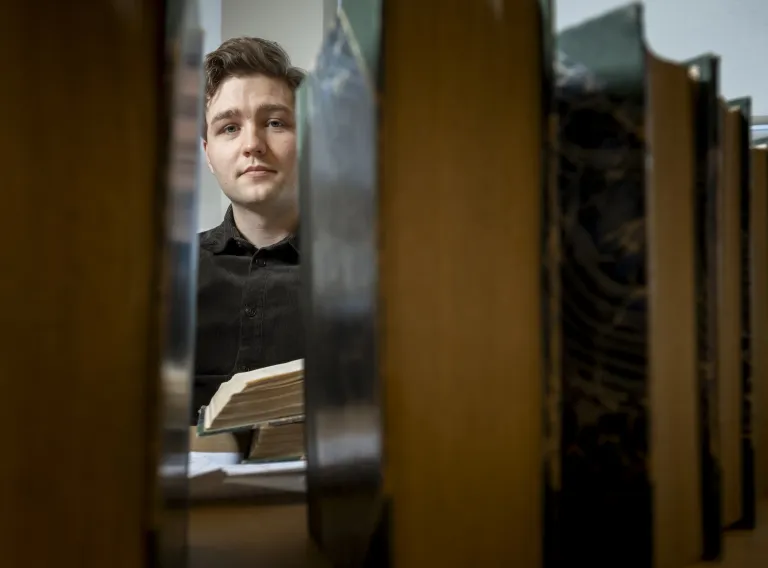
Student sitting behind books
Language skills
required, minimum level of B2
Programme length
Three years.
Study mode
Face-to-face learning
Application status
International students:
Students with Icelandic or Nordic citizenship:
Overview

  • Are you interested in human societies?
  • Do you want to tackle diverse projects under the guidance of Iceland's leading historians?
  • Do you enjoy researching and exploring interesting topics?
  • Are you interested in exploring aspects of the past, such as sex, gender equality, or politics?
  • Do you want a diverse selection of courses that suit your interests?
  • Do you want to develop your academic skills and prepare for challenging future careers?

History is a creative discipline that offers unlimited possible approaches to analysing and interpreting information from the past. History concerns all areas of human society and the programme is designed to reflect that.

Course topics include:

  • Empires and revolutions
  • Power, ideas and modernity
  • Gender and women’s history
  • Archives, reading and records management
  • Historiography and the philosophy of history
  • Concepts and theories
  • Communication in history
  • The history of emotions
  • Culinary history
  • Queer history
  • Misfits and outsiders
  • Culture of poverty
  • Autobiographical writing and egodocuments
  • The Cold War
  • The Arctic in the Middle Ages
  • Islam and Christianity
  • Modern cultural history

History is the study of societies and individuals, their politics and systems of government, freedom and tyranny, industries and economies, and all aspects of life and culture in the broadest possible sense. Historians explore societies as far back in time as the sources allow and often over long periods of time.

They also look at societies as a whole and try to understand how individual aspects are connected, such as political systems, economies and ideologies. Historians are also interested in individuals and unique events and how these relate to broader and more general themes.

Objectives

The programme aims to provide students with a clear understanding of both general and Icelandic history and the skills needed to conduct their own research using a range of historical methods.

Teaching methods

History is taught through lectures, discussions and seminars. It is important to attend class, but students will only benefit if they have read the texts and prepared thoroughly.

Programme options

The BA programme is 180 ECTS and can be completed in three years.

History is also offered as a 120 ECTS major alongside a 60 ECTS minor in another subject.

Students can also take a 60 ECTS minor in history alongside a 120 ECTS major in another subject.

About the subject

History is about exploring and sharing information about human societies, in particular historical societies. Historians need to be skilled at extrapolating from limited source material and yet take care not to misinterpret or read too much into the information available.

They often seek to discover information beyond what the sources were originally intended to say. This demands logical thinking, ingenuity and originality.

Historical writing also demands clarity of thought and excellent communication skills.

Icelandic matriculation examination (stúdentspróf) or equivalent qualification. Further information can be found in article 18, regulation on admission requirements for undergraduate study no. 331/2022.

  1. Mandatory Courses (70 ECTS)
    Students must complete all of the following courses:
    • SAG101G Making History (10e)
    • SAG115G Death and Rebirth - Introduction to Late Medieval Europe - World History I (5e)
    • SAG272G Democracy, Industrial Revolution, Colonialism - Global History III (5e)
    • SAG111G Modernization in the Early Modern Period – World History II (5e)
    • SAG112G Executions and Enlightenment. History of Iceland II (5e)
    • SAG280G Historical and Archaeological Approaches to Icelandic Medieval History (10e)
    • SAG270G Economic and social history of Iceland since 1800 - History of Iceland III (5e)
    • SAG273G Politics and culture — History of Iceland IV (5e)
    • SAG269G Power Politics, Ideological Struggles, and Resistance in the 20th Century: Global History IV (5e)
    • SAG437G Theories and concepts in history (5e)
    • SAG354G Communication and Presentation of History (10e)

  2. Elective courses from History (70-100 ECTS)
    Students must complete at least 70 ECTS in total of elective courses from history. All course with SAG-number and the course KLM204G, except mandatory courses, count as elective courses from history. The courses are marked as restricted elective courses. The selection of courses available varies from year to year.

  3. Elective course from related subjects (0-20 ECTS)
    Students can take maximum 20 ECTS in elective courses from other disciplines. All courses without a SAG-number and the course KLM204G, are considered as elective courses from related subjects. The courses are marked as free elective courses.

  4. BA-thesis in History (10/20 ECTS)
    Students must complete 10 or 20 ECTS BA-thesis in history.
Programme structure

Check below to see how the programme is structured.

This programme does not offer specialisations.

First year | Fall
Making History (SAG101G)
A mandatory (required) course for the programme
10 ECTS, credits
Course Description

This course introduces students to some of the basic skills that they will use in the study of history. The special character of history and its relationship with other fields of study will be discussed. The students will be introduced to the sources and methods used in historical research and the writing and presenting of historical work. - Students must register for the course in the beginning of their history study (first or second semester, depending on whether they start in January or September).

Language of instruction: Icelandic
Face-to-face learning
First year | Fall
Modernization in the Early Modern Period – World History II (SAG111G)
A mandatory (required) course for the programme
5 ECTS, credits
Course Description

This is a core course in the Department of History and the focus will be on modernizing processes during the early modern period. The aim is to give students an overview over the period from the start of the 16th to the end of the 18th century. Topics will include imperialism and global connections, the development of capitalism and slavery, war and state formation, indigenous polities in North America, as well as the start of the Age of Revolutions in the United States, France and Haiti. In other words, the course addresses many aspects related to the shaping of modern society as we know it today.

Language of instruction: Icelandic
Face-to-face learning
Course taught second half of the semester
First year | Fall
Executions and Enlightenment. History of Iceland II (SAG112G)
A mandatory (required) course for the programme
5 ECTS, credits
Course Description

An overview of the history of Iceland in the period 1500-1800, with a focus on selected themes, based on primary sources. A historiographical view on the period and recent changes and trends will be discussed. Social changes following the reformation will be analyzed, followed by emphasis on witchcraft and religious ideas, means of education, literary culture, policies following the enlightenment, commerce, trade and Iceland´s interaction with the outside world. Students will hand in a assignment based on primary sources.

Language of instruction: Icelandic
Face-to-face learning
Course taught second half of the semester
First year | Fall
Death and Rebirth - Introduction to Late Medieval Europe - World History I (SAG115G)
A mandatory (required) course for the programme
5 ECTS, credits
Course Description

Introductory course on the history of late medieval Europe. Taught in Icelandic; please see full course description in Icelandic

Language of instruction: Icelandic
Face-to-face learning
Course taught first half of the semester
First year | Fall
Democracy, Industrial Revolution, Colonialism - Global History III (SAG272G)
A mandatory (required) course for the programme
5 ECTS, credits
Course Description

This introductory course deals with global history from 1815 to the First World War. The connecting theme of the course is the development of democracy in the 19th century, in a wide sense. Three interwoven issues are emphaised: 1)  Women’s rights and the women’s movement in relation with the right to vote (in general), the abolishment of slavery and social welfare. 2) These are discussed in relation with nationalism and the construction of nation states in relation with who is seen as citizen/subject. 3) And finally, a topic that touches upon the two first: the colonialism of European nations, as well as of the United States and Japan, and the its influence on African and Asian societies.

Language of instruction: Icelandic
Face-to-face learning
Course taught first half of the semester
First year | Spring 1
Historical and Archaeological Approaches to Icelandic Medieval History (SAG280G)
A mandatory (required) course for the programme
10 ECTS, credits
Course Description

This course offers a perspective of the history of Iceland from the ninth to the sixteenth century from a historical and archaeological viewpoint. Among themes which will be explored are the Viking Age and research on this period, the settlement of Iceland and its development, the organization of a new society , identities and economic development, Christianization, political conflict and the introduction of executive power in the thirteenth century. In the latter half of the course the focus is on the Church and its economic, political and cultural influence. This will be discussed in view of the general historiography of the period, technical and material developments and the international context. An emphasis is placed on familiarity with primary sources, both written and archeological. Teaching consists of lectures and discussion classes.

Language of instruction: Icelandic
Face-to-face learning
First year | Spring 1
Power Politics, Ideological Struggles, and Resistance in the 20th Century: Global History IV (SAG269G)
A mandatory (required) course for the programme
5 ECTS, credits
Course Description

This introductory course deals with international history in the 20th century with an emphasis on the changes in the international system and international politics.  Special attention wil be devoted to several themes: (1) the new state system after the end of World War I; (2) the impact of political ideologies, notably, communism and Nazism/fascism; (3) The origins and nature of World War II and its effects on decolonization and national liberation struggles in Africa and Asia; (4) the ideology of the Cold War and the power politics exercised by the United States and the Soviet Union; (5) geopolitical shifts in the present, especially with respect to strategic competition between the United States and China.

Language of instruction: Icelandic
Face-to-face learning
Course taught second half of the semester
First year | Spring 1
Economic and social history of Iceland since 1800 - History of Iceland III (SAG270G)
A mandatory (required) course for the programme
5 ECTS, credits
Course Description

This survey course provides a basis for understanding the economic and social development of Iceland since 1800. It seeks to develop both historical and transferable skills building on the course Making History. The main topics are Iceland‘s international relations; rise and decline of the agricultural economy;  causes and consequences of the industrial revolution; class structure and social conditions; women, men and work; demography and family life; effects of two World Wars on economic and social trends, the Great Depression and economic policy; growth and fluctuations; Europeanization and the international economy; rise of welfare society; industries and regions in the post-1945 period; financialization and the economic crisis of 2008.

Language of instruction: Icelandic
Face-to-face learning
Prerequisites
Course taught first half of the semester
First year | Spring 1
Politics and culture — History of Iceland IV (SAG273G)
A mandatory (required) course for the programme
5 ECTS, credits
Course Description

The aim of this course is to give students a critical understanding of the historiography of Icelandic politics and culture from the beginning of the nineteenth century to the present. It focuses on the following topics: (i) the origins of the nation state, (ii) democracy (iii) culture and education, (iv) gender, sexuality and class, (v) political parties and social movements and (vi) transnational- and international relations. Emphasis is placed on looking at the history of Iceland in a Nordic, Western and global context. The course provides students with training in reading and discussing primary and secondary sources, as well as in collecting material on and writing short essays about a clearly defined topic.

Language of instruction: Icelandic
Face-to-face learning
Course taught first half of the semester
First year | Spring 1
Theories and concepts in history (SAG437G)
A mandatory (required) course for the programme
5 ECTS, credits
Course Description

This compulsory course aims at improving knowledge and skill in the understanding and use of the concepts and theories that are used in history and scholarly study and discussion about societies, culture and politics.

Language of instruction: Icelandic
Face-to-face learning
Course taught second half of the semester
Second year | Fall
Medieval Queenship in Northern Europe (SAG359G)
Restricted elective course, conditions apply
10 ECTS, credits
Course Description

The course Medieval Queenship in Northern Europe explores the political, cultural, and religious influence of queens from the early medieval period to the reign of Margarethe I and the Kalmar Union. Although queens often operated in male-dominated systems, their roles in diplomacy, patronage, and governance were critical to the shaping of medieval Northern European societies. This course investigates the ways queens used gender and genealogy to consolidate power, and how their influence extended through religious patronage and cultural leadership. Using a thematic approach, students will examine key figures, analyze primary sources, and engage with historical debates. The course findings underscore the complexity of queenship and its long-term impact on medieval state-building and European politics and make use of both micro- and macro-historical approaches. This contributes to students' understanding of gender dynamics, political structures, and the cultural landscapes of Northern Europe during the Middle Ages.

Language of instruction: Icelandic/English
Face-to-face learning
Second year | Fall
Creative Spaces – The Agency and Practices of Common People in the Long 19th Century (SAG358G)
Restricted elective course, conditions apply
10 ECTS, credits
Course Description

This course aims to explore the cultural and material world of common people in Iceland from 1770 to 1930 through the concept of "creative spaces." The focus will be on analysing the opportunities for ordinary people to shape their own conditions, ideas, and identities within the prevailing social structure often characterized by conservatism, uniformity, and poverty. The starting point of the course is the research of recent decades on literacy culture and practices in Iceland during this period, which have revealed a group of people from earlier times who operated in undefined cultural spaces within society. This group, referred to in the course as the "barefoot historians," will be examined in detail. The course will also compare research on similar groups abroad with local studies and representatives of the Icelandic barefoot historians. The diverse materials left behind by this group will be fundamental to the course and will be thoroughly analysed. The course will address various aspects of folk studies, not limited to written sources but also considering tangible realities. It will discuss what might be termed "created spaces" in the long 19th century.

Language of instruction: Icelandic
Face-to-face learning
Second year | Fall
What is So Special With Microhistory: Seminar on Methods (SAG357G)
Restricted elective course, conditions apply
5 ECTS, credits
Course Description

An attempt is made to answer the question of what the microhistory as a historical method offers. How historians have applied this methodology both in Iceland and abroad will be discussed, and in this connection several well-known books will be read. What they have in common is that they are both entertaining and extremely interesting, as the subjects have usually struggled with some trials in their lives that have attracted a lot of attention. The life of a lesbian nun during the Renaissance in Italy, the special variations of love and marriage in similar parts of the world, murder, cannibalism, and the torture of humans and animals at all times, and child abuse in Vienna, to name a few well-known examples from world history that microhistorians have worked with. In other words, individuals who have misplaced themselves in society have become a popular subject for microhistorians, especially those who have been punished. An attempt will be made to highlight the pros and cons of the microhistory.

Language of instruction: Icelandic
Face-to-face learning
Prerequisites
Course taught first half of the semester
Second year | Fall
Reading documents 1550-1850 (SAG444G)
Restricted elective course, conditions apply
5 ECTS, credits
Course Description

A survey of Icelandic handwriting in the period and of methods of transcription. Students learn to read different kinds of handwriting from the period.

Language of instruction: Icelandic
Face-to-face learning
Second year | Fall
Communication and Presentation of History (SAG354G)
A mandatory (required) course for the programme
10 ECTS, credits
Course Description

The course is intended to enhance the skills of students in writing about historical matters and communicate historical knowledge through various media. Students will gain practical knowledge and training in presenting historical matters, using text, images, podcasts, film, web content and documentaries. Teaching will include lectures, discussions, field trips, and project work.

Language of instruction: Icelandic
Face-to-face learning
Second year | Spring 1
The Battle for Gúttó, Anti-fascists and Stonewall: A Global History of Social Movements and Radicals (SAG451G)
Restricted elective course, conditions apply
5 ECTS, credits
Course Description

The course will explore how social movements have shaped and influenced our contemporary societies. What were the demands put forward by these movements, how were they justified, how did they mobilize and unite people around their demands?

The course is a global history of these social movements, thus historical events in one country are contextualized through transnational and international perspectives. The course will also deal with historiographical aspects, how these movements have been interpreted through theoretical frameworks such as contentious politics and collective memory.

Each week will deal with a different social movement and their history. These are movements that have had important impacts on our societies, such as the labor movement, women’s movement, peace movement, anti-fascists, movements for LGBTIQ and environmentalists.  

Language of instruction: Icelandic/English
Face-to-face learning
Course taught second half of the semester
Second year | Spring 1
Episodes from the history of philosophy of science (SAG448G)
Restricted elective course, conditions apply
6 ECTS, credits
Course Description

This course aims to introduce students to the nature and development of science by examining episodes of its history and by disucssing recent theories concerning the nature, aims, and development of science. A special emphasis will be placed on the history of physical science from Aristotle to Newton, including developments in astronomy during the scientific revolution of the 16th and 17th century. We will also specifically examine the history of Darwin’s theory of evolution by natural selection. These episodes and many others will be viewed through the lens of various theories of scientific progress, and through recent views about interactions between science and society at large. The course material may change depending on the students’ interest.

Language of instruction: Icelandic
Face-to-face learning
Second year | Spring 1
The Icelandic Household in the 18th Century (SAG414M)
Restricted elective course, conditions apply
5 ECTS, credits
Course Description

The course offers an in-depth study of the Icelandic 18th Century household. What different types of households were there and what was the difference between the households of peasants, fishermen, pastors, lodgers or paupers? How did young people move out of their parents’ households and start their own? How did households provide for their members and what additional expenses such as rent, taxes and dues did they need to pay? How did subsistence farming work and did the households engage in any trading? The course introduces the rich sources of the time period to students, which provide us with insights into daily life in the period, from the census of 1703 to travel journals and magazine articles of Enlightment writers of the late 18th century. Among other exercises, students practice methods of digital data entry for quantitative study.

Language of instruction: Icelandic
Face-to-face learning
Prerequisites
Course taught second half of the semester
Second year | Spring 1
The German Weimar-Republic (1919-1933) and the Crisis of Classical Modernity (SAG452G)
Restricted elective course, conditions apply
10 ECTS, credits
Course Description

The course focuses on the society and culture of the Weimar Republic from the end of World War I to the Nazi seizure of power in 1933. The course provides students with an insight into the history of the interwar period in Europe, including the significance and consequences of World War I and the Treaty of Versailles, the cultural ferment of the 1920s, the causes and consequences of the Great Depression, and the rise of extremist movements.

In the course, students are introduced to the main theories and historical views of Germany in the interwar period, including the idea of ​​a German Sonderweg, the dolchstoss myth, as well as the rationalization movement, Fordism, and Americanization. The course focuses on the politics, society, and culture of Weimar, and the contrasts between American mass culture and avant-garde modernism on the one hand and the almost constant economic and political crisis on the other. Although the rise of anti-democratic nationalism and Nazism is never far away in Weimar history, especially in light of the Sonderweg thesis, the subject of the course is not the rise of Nazism, but the society it overthrew.

The course textbooks are Detlev Peukert's classic pioneering work Weimar Republic: The Crisis of Classical Modernity (1993), and Eric Weitz's Weimar Germany: Promise and Tragedy (2007).

Language of instruction: Icelandic
Face-to-face learning
Prerequisites
Second year | Spring 1
Wretched Girls and Virtuous Ladies: Women in Iceland from the late eighteenth century to the twentieth century (SAG412M)
Restricted elective course, conditions apply
10 ECTS, credits
Course Description

This course examines the status of women in Iceland during the long nineteenth century. The aim is to explore sources that shed light on women's circumstances, opportunities, and agency, both in rural areas and villages. The period will be examined both thematically and chronologically, exploring and analysing changes in women's status and agency. The course will explore what legal rights women had – were they autonomous? Could they travel abroad for education or travel at all? Could they marry whom they wanted? Run their own business? What kind of clothes did they wear? What work did they do inside and outside of the home? The status of women in Iceland will be examined in a transnational context, both concerning legal rights and agency, as well as in relation to major theoretical frameworks about women's history in the nineteenth century (e.g., separate spheres). The period spans from the late eighteenth century, from which time sources such as private letters and biographical texts are preserved, to c. 1900 when the struggle for women's rights had begun in Iceland and new times were ahead. The course will delve into memoirs, funeral speeches, and correspondence along with other sources and scholarly works about the period to get as close as possible to women's experiences and attitudes.

Language of instruction: Icelandic
Face-to-face learning
Prerequisites
Not taught this semester
Second year | Spring 1
Arbitration Courts in Iceland 1798-1936 (SAG449G)
Restricted elective course, conditions apply
5 ECTS, credits
Course Description

Students will be introduced to the history of arbitration courts (also known as arbitration committees) in Iceland, from the establishment of these courts in 1798 and until 1936. Emphasis is placed on introducing students to the possible research applications of arbitration court proceedings for historical research. We will discuss the background to the formation of these courts, their perceived purpose and role, and the legal framework under which they operated. We will look at some studies that have made use of arbitration court proceedings in historical analysis and discuss the form of these proceedings, their main features and their possibilities and limitations for historical analysis. The primary focus of this course, however, is to introduce students to the recently created Database of arbitration court proceedings, a searchable online database of all proceedings from the period 1798 to 1936 which also provides direct access to the sources themselves, and to learn to master its use in historical research. Students will perform a series of home assignments based on the database in addition to completing one independent study based on that material, which will be presented in a workshop at the end of the course.

Language of instruction: Icelandic
Distance learning
Prerequisites
Course taught first half of the semester
Second year | Spring 1
Echoes of a Global Medieval Ages in Contemporary History (SAG413M)
Restricted elective course, conditions apply
5 ECTS, credits
Course Description

"Echoes of a Global Medieval Ages in Contemporary History" is a course that explores the intersection of medieval and contemporary eras, considering how memories, symbols, and narratives from the medieval world continue to shape current ideologies, identities, and global perspectives. Through a thematic, regional examination, the course analyzes how different societies today reinterpret and reconstruct their medieval pasts, addressing legacies of imperialism, nationalism, and cultural exchange. Key topics include the influence of medieval governance, cultural symbols, trade networks, and ideological conflicts on contemporary issues.

Language of instruction: English
Face-to-face learning
Prerequisites
Course taught first half of the semester
Not taught this semester
Second year | Spring 1
Family History in the 19th and 20th Century (SAG450G)
Restricted elective course, conditions apply
10 ECTS, credits
Course Description

This course looks at the development of the family and family life in Iceland in the 19th and 20th century. Economic and demographic factors will also be considered, such as industrialization, urbanization, marriage, fertility and death rate. The course will also cover the home as a unit; work in the home and the unclear boundaries between work and leisure. Finally, the subject of the family will be studied in an international context, including a focus on gender, race, and ethnicity.

Language of instruction: Icelandic
Face-to-face learning
Second year | Spring 1
Research and sources in archives (SAG206M)
Restricted elective course, conditions apply
5 ECTS, credits
Course Description

Students learn and are trained in the methods of archival research, finding and evaluating sources in archives.  Practical exercises will be assigned.

Language of instruction: Icelandic
Distance learning
Prerequisites
Second year | Spring 1
The History of Rome (SAG271G)
Restricted elective course, conditions apply
10 ECTS, credits
Course Description

Introductory course on the history of Rome. Taught in Icelandic; please see full course description in Icelandic.

Language of instruction: Icelandic
Third year | Fall
Medieval Queenship in Northern Europe (SAG359G)
Restricted elective course, conditions apply
10 ECTS, credits
Course Description

The course Medieval Queenship in Northern Europe explores the political, cultural, and religious influence of queens from the early medieval period to the reign of Margarethe I and the Kalmar Union. Although queens often operated in male-dominated systems, their roles in diplomacy, patronage, and governance were critical to the shaping of medieval Northern European societies. This course investigates the ways queens used gender and genealogy to consolidate power, and how their influence extended through religious patronage and cultural leadership. Using a thematic approach, students will examine key figures, analyze primary sources, and engage with historical debates. The course findings underscore the complexity of queenship and its long-term impact on medieval state-building and European politics and make use of both micro- and macro-historical approaches. This contributes to students' understanding of gender dynamics, political structures, and the cultural landscapes of Northern Europe during the Middle Ages.

Language of instruction: Icelandic/English
Face-to-face learning
Third year | Fall
Creative Spaces – The Agency and Practices of Common People in the Long 19th Century (SAG358G)
Restricted elective course, conditions apply
10 ECTS, credits
Course Description

This course aims to explore the cultural and material world of common people in Iceland from 1770 to 1930 through the concept of "creative spaces." The focus will be on analysing the opportunities for ordinary people to shape their own conditions, ideas, and identities within the prevailing social structure often characterized by conservatism, uniformity, and poverty. The starting point of the course is the research of recent decades on literacy culture and practices in Iceland during this period, which have revealed a group of people from earlier times who operated in undefined cultural spaces within society. This group, referred to in the course as the "barefoot historians," will be examined in detail. The course will also compare research on similar groups abroad with local studies and representatives of the Icelandic barefoot historians. The diverse materials left behind by this group will be fundamental to the course and will be thoroughly analysed. The course will address various aspects of folk studies, not limited to written sources but also considering tangible realities. It will discuss what might be termed "created spaces" in the long 19th century.

Language of instruction: Icelandic
Face-to-face learning
Third year | Fall
What is So Special With Microhistory: Seminar on Methods (SAG357G)
Restricted elective course, conditions apply
5 ECTS, credits
Course Description

An attempt is made to answer the question of what the microhistory as a historical method offers. How historians have applied this methodology both in Iceland and abroad will be discussed, and in this connection several well-known books will be read. What they have in common is that they are both entertaining and extremely interesting, as the subjects have usually struggled with some trials in their lives that have attracted a lot of attention. The life of a lesbian nun during the Renaissance in Italy, the special variations of love and marriage in similar parts of the world, murder, cannibalism, and the torture of humans and animals at all times, and child abuse in Vienna, to name a few well-known examples from world history that microhistorians have worked with. In other words, individuals who have misplaced themselves in society have become a popular subject for microhistorians, especially those who have been punished. An attempt will be made to highlight the pros and cons of the microhistory.

Language of instruction: Icelandic
Face-to-face learning
Prerequisites
Course taught first half of the semester
Third year | Fall
Reading documents 1550-1850 (SAG444G)
Restricted elective course, conditions apply
5 ECTS, credits
Course Description

A survey of Icelandic handwriting in the period and of methods of transcription. Students learn to read different kinds of handwriting from the period.

Language of instruction: Icelandic
Face-to-face learning
Third year | Fall
Women's Day Off 1975: Myths and communication (SAG510M)
Restricted elective course, conditions apply
10 ECTS, credits
Course Description

"The struggle does not end today," was written on a banner held by one of the 25,000 women who rallied in downtown Reykjavík on the 24th of October 1975. The Women's Day Off, as the organizers ironically called it, was essentially a strike to protest gender-based discrimination and wage differentials. The banner mentioned above is only one example of many of how the women communicated their views and demands through different media such as music, print, public speeches, and mass media. The Women's Day Off was the result of a collective agency of Icelandic actors, but their initiative should still be regarded in an international context as the women were urged to unite under the theme of the International Women's Year: "EQUALITY - DEVELOPMENT - PEACE. "

The course is built around the Women's Day Off in 1975, but as teachers and students research its historical legacy in Icelandic and international context, they will explore and implement new ways of communicating history with younger generations. The course is organized in collaboration with Rúv and The Women's History Archives, which will celebrate its 50th anniversary with an exhibition at the National Library.

Language of instruction: Icelandic
Face-to-face learning
Prerequisites
Third year | Fall
Public archiving and records management (SAG103M)
Restricted elective course, conditions apply
10 ECTS, credits
Course Description

This course covers the role of public archives and archiving and record management in the past and present. The importance of the principle of provenance for archives and history. A summary of the history of administration. The activities and legal environment of public archives in Iceland will be discussed and their role in records management in public administration. What organizations are obliged to transfer their records to public archives. The evolution of archiving and records management in the 20th and 21st centuries will be examined. Methods of records managements, old and new. The sorting and cataloguing of archives.

Language of instruction: Icelandic
Distance learning
Prerequisites
Third year | Fall
From Fascism to Populism: Democratic Crises, Radical Nationalism, and Authoritarian Regimes in the 20th and 21st Centuries (SAG604M)
Restricted elective course, conditions apply
10 ECTS, credits
Course Description

The current surge of nationalist, populist right-wing parties and authoritarian regimes not only poses a challenge to traditional political elites and to the functioning of liberal-democratic systems. It also invites comparisons with historical fascism and authoritarian rule in the interwar period, raising the question of how to define, classify, and position these parties, regimes, and ideologies on the political spectrum. The course deals with crises of the liberal order and the effects of ultra-nationalism in Europe in the 20th and 21st centuries by focusing on historical fascism and Nazism as well as contemporary populist and authoritarian formations. While the focus will be on Europe, ultra-nationalist and anti-liberal ideologies in other parts of the world will also be considered. The emphasis will be on historiographical and theoretical problems relating to the ideologies of fascism, authoritarianism, and populism; the effects of economic and political crises on the rise of radical nationalist movements; the roles of race, ethnicity, and gender; ideas about modernization, culture, welfare and racism, and foreign policy platforms. Populist and authoritarian regimes in the present will be put in a historical context, their programs and policies explored, and an attempt will be made to explain what has been termed “populist authoritarianism.”

Language of instruction: Icelandic
Face-to-face learning
Prerequisites
Third year | Fall
The Medieval North (SAG716M)
Restricted elective course, conditions apply
10 ECTS, credits
Course Description

Historical and historiographical survey of major topics in the history of the medieval North, with special emphasis on Iceland and Norway from the Viking Age into the fourteenth century. Topics include: Power, kingship and state; law and feud; kinship, gender and social ties; religious and mental outlook(s); conversion, Christianity and church; economic conditions. Prior knowledge of the “factual” narrative (textbook narrative) is helpful but not necessary.

Language of instruction: English
Face-to-face learning
Prerequisites
Third year | Spring 1
The Battle for Gúttó, Anti-fascists and Stonewall: A Global History of Social Movements and Radicals (SAG451G)
Restricted elective course, conditions apply
5 ECTS, credits
Course Description

The course will explore how social movements have shaped and influenced our contemporary societies. What were the demands put forward by these movements, how were they justified, how did they mobilize and unite people around their demands?

The course is a global history of these social movements, thus historical events in one country are contextualized through transnational and international perspectives. The course will also deal with historiographical aspects, how these movements have been interpreted through theoretical frameworks such as contentious politics and collective memory.

Each week will deal with a different social movement and their history. These are movements that have had important impacts on our societies, such as the labor movement, women’s movement, peace movement, anti-fascists, movements for LGBTIQ and environmentalists.  

Language of instruction: Icelandic/English
Face-to-face learning
Course taught second half of the semester
Third year | Spring 1
Episodes from the history of philosophy of science (SAG448G)
Restricted elective course, conditions apply
6 ECTS, credits
Course Description

This course aims to introduce students to the nature and development of science by examining episodes of its history and by disucssing recent theories concerning the nature, aims, and development of science. A special emphasis will be placed on the history of physical science from Aristotle to Newton, including developments in astronomy during the scientific revolution of the 16th and 17th century. We will also specifically examine the history of Darwin’s theory of evolution by natural selection. These episodes and many others will be viewed through the lens of various theories of scientific progress, and through recent views about interactions between science and society at large. The course material may change depending on the students’ interest.

Language of instruction: Icelandic
Face-to-face learning
Third year | Spring 1
The Icelandic Household in the 18th Century (SAG414M)
Restricted elective course, conditions apply
5 ECTS, credits
Course Description

The course offers an in-depth study of the Icelandic 18th Century household. What different types of households were there and what was the difference between the households of peasants, fishermen, pastors, lodgers or paupers? How did young people move out of their parents’ households and start their own? How did households provide for their members and what additional expenses such as rent, taxes and dues did they need to pay? How did subsistence farming work and did the households engage in any trading? The course introduces the rich sources of the time period to students, which provide us with insights into daily life in the period, from the census of 1703 to travel journals and magazine articles of Enlightment writers of the late 18th century. Among other exercises, students practice methods of digital data entry for quantitative study.

Language of instruction: Icelandic
Face-to-face learning
Prerequisites
Course taught second half of the semester
Third year | Spring 1
The German Weimar-Republic (1919-1933) and the Crisis of Classical Modernity (SAG452G)
Restricted elective course, conditions apply
10 ECTS, credits
Course Description

The course focuses on the society and culture of the Weimar Republic from the end of World War I to the Nazi seizure of power in 1933. The course provides students with an insight into the history of the interwar period in Europe, including the significance and consequences of World War I and the Treaty of Versailles, the cultural ferment of the 1920s, the causes and consequences of the Great Depression, and the rise of extremist movements.

In the course, students are introduced to the main theories and historical views of Germany in the interwar period, including the idea of ​​a German Sonderweg, the dolchstoss myth, as well as the rationalization movement, Fordism, and Americanization. The course focuses on the politics, society, and culture of Weimar, and the contrasts between American mass culture and avant-garde modernism on the one hand and the almost constant economic and political crisis on the other. Although the rise of anti-democratic nationalism and Nazism is never far away in Weimar history, especially in light of the Sonderweg thesis, the subject of the course is not the rise of Nazism, but the society it overthrew.

The course textbooks are Detlev Peukert's classic pioneering work Weimar Republic: The Crisis of Classical Modernity (1993), and Eric Weitz's Weimar Germany: Promise and Tragedy (2007).

Language of instruction: Icelandic
Face-to-face learning
Prerequisites
Third year | Spring 1
Wretched Girls and Virtuous Ladies: Women in Iceland from the late eighteenth century to the twentieth century (SAG412M)
Restricted elective course, conditions apply
10 ECTS, credits
Course Description

This course examines the status of women in Iceland during the long nineteenth century. The aim is to explore sources that shed light on women's circumstances, opportunities, and agency, both in rural areas and villages. The period will be examined both thematically and chronologically, exploring and analysing changes in women's status and agency. The course will explore what legal rights women had – were they autonomous? Could they travel abroad for education or travel at all? Could they marry whom they wanted? Run their own business? What kind of clothes did they wear? What work did they do inside and outside of the home? The status of women in Iceland will be examined in a transnational context, both concerning legal rights and agency, as well as in relation to major theoretical frameworks about women's history in the nineteenth century (e.g., separate spheres). The period spans from the late eighteenth century, from which time sources such as private letters and biographical texts are preserved, to c. 1900 when the struggle for women's rights had begun in Iceland and new times were ahead. The course will delve into memoirs, funeral speeches, and correspondence along with other sources and scholarly works about the period to get as close as possible to women's experiences and attitudes.

Language of instruction: Icelandic
Face-to-face learning
Prerequisites
Not taught this semester
Third year | Spring 1
Arbitration Courts in Iceland 1798-1936 (SAG449G)
Restricted elective course, conditions apply
5 ECTS, credits
Course Description

Students will be introduced to the history of arbitration courts (also known as arbitration committees) in Iceland, from the establishment of these courts in 1798 and until 1936. Emphasis is placed on introducing students to the possible research applications of arbitration court proceedings for historical research. We will discuss the background to the formation of these courts, their perceived purpose and role, and the legal framework under which they operated. We will look at some studies that have made use of arbitration court proceedings in historical analysis and discuss the form of these proceedings, their main features and their possibilities and limitations for historical analysis. The primary focus of this course, however, is to introduce students to the recently created Database of arbitration court proceedings, a searchable online database of all proceedings from the period 1798 to 1936 which also provides direct access to the sources themselves, and to learn to master its use in historical research. Students will perform a series of home assignments based on the database in addition to completing one independent study based on that material, which will be presented in a workshop at the end of the course.

Language of instruction: Icelandic
Distance learning
Prerequisites
Course taught first half of the semester
Third year | Spring 1
Echoes of a Global Medieval Ages in Contemporary History (SAG413M)
Restricted elective course, conditions apply
5 ECTS, credits
Course Description

"Echoes of a Global Medieval Ages in Contemporary History" is a course that explores the intersection of medieval and contemporary eras, considering how memories, symbols, and narratives from the medieval world continue to shape current ideologies, identities, and global perspectives. Through a thematic, regional examination, the course analyzes how different societies today reinterpret and reconstruct their medieval pasts, addressing legacies of imperialism, nationalism, and cultural exchange. Key topics include the influence of medieval governance, cultural symbols, trade networks, and ideological conflicts on contemporary issues.

Language of instruction: English
Face-to-face learning
Prerequisites
Course taught first half of the semester
Not taught this semester
Third year | Spring 1
Family History in the 19th and 20th Century (SAG450G)
Restricted elective course, conditions apply
10 ECTS, credits
Course Description

This course looks at the development of the family and family life in Iceland in the 19th and 20th century. Economic and demographic factors will also be considered, such as industrialization, urbanization, marriage, fertility and death rate. The course will also cover the home as a unit; work in the home and the unclear boundaries between work and leisure. Finally, the subject of the family will be studied in an international context, including a focus on gender, race, and ethnicity.

Language of instruction: Icelandic
Face-to-face learning
Third year | Spring 1
Research and sources in archives (SAG206M)
Restricted elective course, conditions apply
5 ECTS, credits
Course Description

Students learn and are trained in the methods of archival research, finding and evaluating sources in archives.  Practical exercises will be assigned.

Language of instruction: Icelandic
Distance learning
Prerequisites
Third year | Spring 1
The History of Rome (SAG271G)
Restricted elective course, conditions apply
10 ECTS, credits
Course Description

Introductory course on the history of Rome. Taught in Icelandic; please see full course description in Icelandic.

Language of instruction: Icelandic
Third year | Year unspecified
BA thesis in History (SAG261L, SAG261L, SAG261L)
A mandatory (required) course for the programme
0/0/0 ECTS, credits
Course Description

Students write a BA thesis on a subject of their own choice, with the guidance of their supervisor. The final thesis is intended to establish the student's ability to work in an independent and organised manner, analysing and compiling scientific data using scholarly methods and aids. For further information see guidelines for essays in history.

Language of instruction: Icelandic
Part of the total project/thesis credits
Third year | Year unspecified
BA thesis in History (SAG261L, SAG261L, SAG261L)
A mandatory (required) course for the programme
0/0/0 ECTS, credits
Course Description

Students write a BA thesis on a subject of their own choice, with the guidance of their supervisor. The final thesis is intended to establish the student's ability to work in an independent and organised manner, analysing and compiling scientific data using scholarly methods and aids. For further information see guidelines for essays in history.

Language of instruction: Icelandic
Part of the total project/thesis credits
Third year | Year unspecified
BA thesis in History (SAG261L, SAG261L, SAG261L)
A mandatory (required) course for the programme
0/0/0 ECTS, credits
Course Description

Students write a BA thesis on a subject of their own choice, with the guidance of their supervisor. The final thesis is intended to establish the student's ability to work in an independent and organised manner, analysing and compiling scientific data using scholarly methods and aids. For further information see guidelines for essays in history.

Language of instruction: Icelandic
Part of the total project/thesis credits
Year unspecified | Fall
Contemporary Folkloristics: Elves, Immigrants and Terrorists (ÞJÓ328G)
Free elective course within the programme
10 ECTS, credits
Course Description

In this course we will examine the role of folkloristic material in modern western society, examining in particular its presence in the media, films and the internet, as well as in the oral and practical tradition. Among other things, an examination will be made of modern migratory legends and the modern role of fairy tales, belief and prejudice, games and festivals, graffiti and jokes, and all sort of other modern customs and traditions. The aim is to increase our understanding of the popular basis of modern culture and extend our conciousness of all the "trivial" which has such a central role to play in shaping our attitudes within society and our views with regard to our fellow people. Reference will be made to recent and modern research work that has been undertaken in folkloristics, cultural studies and related subjects.

Language of instruction: Icelandic
Face-to-face learning
Distance learning
Online learning
Year unspecified | Fall
Place attachment: Homes, churchyards and cafés (ÞJÓ342G)
Free elective course within the programme
10 ECTS, credits
Course Description

In this course, we examine how places in cities, rural areas, and the wilderness acquire meaning for individuals and groups. We explore how both personal memories and cultural memory shape perceptions and understanding of the landscape. We consider how place names, stories, and legends—such as those about elf churches, cursed spots, and past events—influence the value and meaning of places, as well as how emplaced experiences and memories tend to stick to locations. Why do some places become sacred sites, while others remain merely spaces people pass through on their way elsewhere? Why do people feel at ease in some places but experience discomfort or fear in others? How do individuals form connections to places during short visits or longer stays? Does it matter whether one is a newcomer or a native? What does it mean to feel a sense of belonging or to consider a particular place home? How refugees and other immigrants form attachment to the places where they settle and how they maintain or sever ties with the places they leave behind. What does it mean for people to have been forced to leave their homes due to wars or natural disasters, facing uncertainty about whether they can return? Attention will be given to how discourse and social dynamics shape people-place relationships, as well as the role of experience, perception, memories, aesthetics, and diverse narratives in giving meaning to place, forming place attachment, and defining who can lay claim to a place—and how.

Language of instruction: Icelandic
Face-to-face learning
Distance learning
Year unspecified | Fall
Writing skills: Academic Writing (ÍSR301G)
Free elective course within the programme
10 ECTS, credits
Course Description

This is a basic composition course. Writing skills will be honed through regular assignments, lectures, class discussions and workshops.Approaches to writing research papers will be addressed, such as choosing and narrowing a topic, structure, and sources. Register, style, spelling, punctuation, and resources for writers will be discussed. Students write essays and papers of various kinds and get regular feedback from peers and teachers. Course assessment is based on written assignments and class participation. The course can only be passed if all assignments are turned in.

Language of instruction: Icelandic
Face-to-face learning
Online learning
Year unspecified | Fall
Introduction to Archaeology (FOR103G)
Free elective course within the programme
10 ECTS, credits
Course Description

Overview and introduction to the aims and methods of archaeology. What is archaeology? The history of the discipline is discussed, its ideological base and its relationship with other disciplines. How are material remains used to shed light on social structure, the environment, economy and trade, religion and ideology, development and change?

Language of instruction: Icelandic
Face-to-face learning
Year unspecified | Fall
Theoretical Archaeology (FOR408G)
Free elective course within the programme
5 ECTS, credits
Course Description

The aim of this course is to provide a general background to theoretical archaeology in Europe and North America. The course will look at how theory is involved in all aspects of archaeological work and explore the key themes and major schools of social theory which have been influential in archaeology as well as theories of contemporary relevance today.

Language of instruction: English
Face-to-face learning
Year unspecified | Fall
Macroeconomics I (HAG103G)
Free elective course within the programme
6 ECTS, credits
Course Description

The course aims to give the students an insight into the main theories, concepts, topics, and principles of macroeconomics and macroeconomic activity. The course stresses both the analytical content and applied usefulness of the topics covered and how they relate to various current economic issues at home and abroad. A sound knowledge of macroeconomics prepares students for various other economics courses, and for life.

Language of instruction: Icelandic
Face-to-face learning
Year unspecified | Fall
Ancient Philosophy (HSP104G)
Free elective course within the programme
10 ECTS, credits
Course Description

A survey of ancient philosophy, based upon a close reading of primary texts from the works of the Presocratics, Plato and Aristotle, and their Hellenistic successors. The primary aim is to offer an overview of the development of ancient philosophy. A secondary aim is to offer an insight into the importance of the history of philosophy for philosophy, and deepen the students' competence in reading philosophical works from the ancient world. At the completion of the course, the students should be acquainted with the main periods and individual thinkers of ancient philosophy, their views and arguments. They should be able to give an account of these views, support it with references to the primary sources, and compare the views of different philosophers. Further, they should have gained an insight into the importance of the history of philosophy for philosophy and the historical origins of classical philosophical problems.

Language of instruction: Icelandic
Face-to-face learning
Year unspecified | Fall
Critical Thinking (HSP105G)
Free elective course within the programme
5 ECTS, credits
Course Description

The aim of this course is to show students the importance of critical thinking by introducing its main concepts and methods as well as different understandings of the notion. Furthermore, the aim is to train students in critical thinking and argumentation, both in a philosophical and an everyday context. Special emphasis will be placed on analysing arguments. The relationship between critical thinking and ethics will be thoroughly examined.

The teaching involves both lectures and discussion sessions. Assignments will primarily be aimed at practical tasks relevant to everyday experiences.

Language of instruction: Icelandic
Face-to-face learning
Course taught first half of the semester
Year unspecified | Fall
Politics and Society (HSP107G)
Free elective course within the programme
5 ECTS, credits
Course Description

In this course, we discuss a few selected contemporary issues in the field of social and political philosophy. We will discuss and analyse key concepts of relevance for a good society, such as liberty, equality, justice and democracy with a special reference to Icelandic society. 

Language of instruction: Icelandic
Face-to-face learning
Course taught second half of the semester
Year unspecified | Fall
19th & 20th Century History of Ideas (HSP321G)
Free elective course within the programme
10 ECTS, credits
Course Description

In this course, 19th and 20th century ideas that had fundamental effects on Western philosophy and intellectual history, will be examined. These are socially transformative ideas such as freedom, secularism, equality, resistance, the relation between the individual and society, ideas concerning existence and the soul, oppression, injustice, the national state and capitalism. Perhaps last but not least ideas about history, time and evolution of humanity and the planet. 


Each week a new thinker or idea that transformed Western intellectual history is introduced and engaged with. Thinkers such as G.W.F. Hegel, Karl Marx, Sigmund Freud, Rosa Luxembourg and Emma Goldman are analysed and influential isms such as phenomenology, neoliberalism or postructuralism. The aim is to read these thinkers and isms in accordance with the zeitgeist of the historical period they belong to (to the extent that we, people in the 21st century can “read” zeitgeists of older periods). At the same time the aim is to dig deep into original texts and to acquire multi-dimensional understanding of the ideas. Important part of the course is also to look at these themes in relation to the present times and the issues happening at the moment in Western societies and all around the globe. 

Language of instruction: Icelandic
Face-to-face learning
Not taught this semester
Year unspecified | Fall
Melting Clocks and Filmstock: Surrealism in Narrative Cinema (KVI313G)
Free elective course within the programme
10 ECTS, credits
Course Description

Surrealism developed in the existential vacuum of the 1920s as a reaction to the destruction of World War I. As a defiance to “reason” and “rationality” that led to such violence and chaos, surrealists defied reason and sought to reunite the conscious and unconscious, or rather the everyday reality with the dream world. Drawing from Freud and other forms of experimental psychology, spiritualism and meditation in the pursuit of access to an untapped well of creativity, surrealism of the European avant-garde has evolved throughout the continued history of film, reaching the contemporary Hollywood of today. From André Breton and Salvador Dalí to David Lynch and Lady Gaga, this course aims to analyze the surrealist approach through the lens of different artists and auteurs over time, tracing the history of surrealism and its influence on narrative cinema. Directors and artists featured in this class include: Luis Buñuel, Jean Cocteau, Maya Derren, Federico Felini, Jan Svankmajer, the Quay Brothers, Alejandro Jodorowsy, David Lynch, Michel Gondry, Charlie Kaufman and more.

Language of instruction: Icelandic
Face-to-face learning
Year unspecified | Fall
Western art from 1348–1848 (LIS004G)
Free elective course within the programme
10 ECTS, credits
Course Description

In the course the main works of Western art from the early renaissance to the early 19. century. Geographically, the focus is on works of art from Italy and Spain, France, the Netherlands, Germany and England. Main methods and schools, academies and manifestations of art in religious, political and social contexts will be discussed. Painting, sculpture, architecture, the artisanal works and printmaking will be discussed. Efforts will be made to examine the extent to which art reflects society, how imagery reflects the life and worldview of people in different periods. Different approaches to time and space at any given time will be discussed, changes in the symbolic image of the body, the status and social role of the artist, and the interactions of art and institutions of power. In connection with these issues, key works of each period will be taken for detailed interpretation and their distribution history discussed.

Language of instruction: Icelandic
Face-to-face learning
Year unspecified | Fall
Icelandic Visual Art 1870-1970 (LIS102G)
Free elective course within the programme
10 ECTS, credits
Course Description

A survey of Icelandic art from 1860 to 1970. The course will look at the origins of Icelandic modern art, selected Icelandic artists and factors influencing the Icelandic art scene, influence from foreign art ideas and movements, attempts at definging "national" Icelandic art, government support and influence on the development of visual art, the tension between proponents of "national" art and "non-national" art as well as between "expressive"art and " conceptual" forms of art presentation, local art education and the characteristics of art critic as it appeared in the printed media. An attempt will be made to evaluate characteristics of Icelandic visual art in relation to foreign developments and changes in Icelandic society and history.

Language of instruction: Icelandic
Face-to-face learning
Year unspecified | Fall
Legal Theory, Statutory Interpretation and Brief Overview of Icelandic Legal History (LÖG103G)
Free elective course within the programme
18 ECTS, credits
Course Description

A general course in the field of legal theory and statutory interpretation which also provides for a brief account of chosen topics in  Icelandic legal history. The first part of the course deals with the concept of law, origins and sources of legal rules and their interrelationship, as well as general principles of the rule of law. Major developments of the Icelandic legal system from the settlement of Iceland in the ninth century to the present are briefly discussed. The second part consists of a comprehensive elaboration of the general principles and ideas forming part of the theory of statutory interpretation as well as providing for a detailed overview of generally accepted methods in interpretation of legal texts. The aim of the course is to provide an account of the doctrine of the sources of law and legal methods in the Icelandic legal system.

Language of instruction: Icelandic
Face-to-face learning
Year unspecified | Fall
History of the Middle East I (MAF101G)
Free elective course within the programme
10 ECTS, credits
Course Description

This course surveys the history of the Middle East from ancient times to the medieval period. Topics include the emergence of Egypt and Sumerians and other peoples of the so-called 'cradle of civilization'. Special emphasis will be on the emergence of Islam in the seventh century, and ascent of the Islamic empire in the following centuries. Among the subjects discussed are the prophet Muhammad and his successors, the creation of the Quran, the Caliphates of the Ummayyads and the Abassids and the 'golden age' of Islam. Teaching language is Icelandic but reading materials are mostly in English.

Language of instruction: Icelandic
Face-to-face learning
Year unspecified | Fall
The Viking Age (MIS704M)
Free elective course within the programme
5 ECTS, credits
Course Description

This class surveys the history, society and archaeology of Viking Age Iceland. We will read parts of medieval Icelandic sagas, the Eddas and Skaldic poetry, and modern historical, anthropological and literary studies will be discussed. We will explore the ways in which Icelandic society evolved throughout the Viking Age (ca. 790–1100 AD) in its interrelation with different cultural spheres, and dive into aspects of everyday life, politics, belief systems, ship building and traveling.

A regular focus of this class will be on saga literature (Fornaldarsögur, Íslendingasögur, Konungasögur), as this literature is our main source for interpreting archaeological findings, on the one hand, for exploring later medieval ideas of the Viking Age, on the other hand. With that said, the source value of written artifacts for Viking Age Iceland will be discussed, and this even includes a closer look at modern popular and academic reception, where different sources are regularly mingled without any distinct source criticism. Last but not least, we will discuss the so-called Vikings and their so-called age in the light of recent populist movements, and scholarly reactions to it.

Language of instruction: English
Face-to-face learning
Prerequisites
Year unspecified | Fall
Russia: History and Culture A (RÚS106G)
Free elective course within the programme
5 ECTS, credits
Course Description

This course gives an overview of Russia's history, from the old Kyivan State to the Bolshevik Revolution of 1917. It will discuss how geographical and natural conditions, Russian Orthodoxy, autocratic tsars, and serfdom influenced the country's and its people's history and development. The course will also focus on the status of social institutions and different groups within the country, the history of ideas, and the conditions that led to the fertile ground for the Bolshevik revolution in 1917.

This course is taught during the first half of the semester.

The course will be taught in English if non-Icelandic speaking students are registered.

Language of instruction: English
Face-to-face learning
Course taught first half of the semester
Year unspecified | Fall
Introduction to Politics: The Icelandic Political System (STJ101G)
Free elective course within the programme
8 ECTS, credits
Course Description

The course starts with a general introduction to political science, covering different analytical approaches (e.g. systems approach, functional approach, power approach), decision-making and policy formation (e.g. Simon, Lindblom, Richardson, et al.), comparative government (e.g. the nation state, cleavages, forms of government), political socialization and political culture. The latter part of the course concentrates more heavily on the Icelandic political system, covering the main features of the development of the political system in the 19th and 20th centuries (e.g. nationalism, cleavages, major periods of the politics of independence and modern politics), the constitution, political parties and elections (e.g. development of the franchise and electoral system, participation, party system, organization, voting behaviour), the legislature (Althingi), and the executive (e.g. president, government and the coalition system, the bureaucracy, relations to interest organizations, policy-making and local government).

Language of instruction: Icelandic
Face-to-face learning
Year unspecified | Fall
Introduction to International Politics (STJ102G)
Free elective course within the programme
8 ECTS, credits
Course Description

The course is intended to introduce students to different theories and subjects within international politics, with a particular emphasis on the changing nature of international politics after the end of the Cold War. The course begins by addressing the nature of the international system, the state and its role within the system. The basic theories of international politics are introduced, as are the main branches within the field, such as international political economy and international security. International organizations, such as the United Nations, and their role are discussed. The latter part of the course is dedicated to the issues of international politics and covers among other things the environment, the role of non-governmental organizations, human rights, and more.

In the course, students are:
1) introduced to the basic theories of international politics, providing them with the basis for understanding contemporary political events
2) trained in analyzing critically concepts and theories relating to globalizations
3) introduced to the relationship between international events and theories of international politics

Language of instruction: Icelandic
Face-to-face learning
Year unspecified | Fall
Politics of the Past (STJ106G)
Free elective course within the programme
6 ECTS, credits
Course Description

This class introduces students to political issues and developments in the 20th century that helped shape present day politics. Issues covered in the class include negotiations that resulted in a sovereign statehood for Iceland in 1918; the development of the Icelandic party system; the electoral system and conflicts relating to it; the establishment of a republic in 1944; the Cod Wars and conflicts over the management of the fisheries; key conflicts on foreign policy including membership in NATO and EEA; factors influencing the formation and termination of coalition governments. Students are also introduced to the main characteristics of the Icelandic economy and the key macroeconomic tools used by governments in the past.

Language of instruction: Icelandic
Face-to-face learning
Year unspecified | Fall
The Arctic Circle (UAU018M)
Free elective course within the programme
4 ECTS, credits
Course Description

The Arctic is expected to become more important in the coming decades as climate change makes natural resources and transport routes more accessible creating threats to fragile ecosystems and societies as well as economic opportunities. Satellite data collected since 1979 shows that both the thickness of the ice in the Arctic and range of sea ice have decreased substantially, especially during the summer months. The melting of the ice facilitates natural resource exploration in the high north. U.S. Geological Survey estimates from 2008 suggest that 13 percent of the world's undiscovered oil and 30 percent of undiscovered natural gas reserves are located in the Arctic Circle. Moreover, the retreating and thinning of the ice opens up new trade routes.

The Arctic Circle Assembly is designed to increase participation in Arctic dialogue and strengthen the international focus on the future of the Arctic. The Arctic Circle Assembly will contain sessions on a wide variety of topics, such as:

  • Sea ice melt and extreme weather
  • Polar law: treaties and agreements
  • The role and rights of indigenous peoples
  • Security in the Arctic
  • Shipping and transportation infrastructure
  • The prospects and risks of oil and gas drilling
  • Clean energy achievements and sustainable development
  • Arctic resources
  • Human rights and gender equality
  • Business cooperation in the Arctic
  • The role of Asian and European countries in the Arctic
  • Greenland in the new Arctic
  • Fisheries and ecosystem management
  • The science of ice: global research cooperation
  • Arctic tourism
  • Arctic identity and cultures
  • The ice-dependent world: the Arctic and the Himalayas
  • Politics in the Arctic

This course enables and relies on the participation of UoI graduate and advanced undergraduate students in the Arctic Circle Assembly conference in Harpa, Reykjavik. Students are required to attend the Arctic Circle Assembly. Students have to attend one class shortly before the Assembly and one class shortly after the Assembly.

Arctic Circle Assembly,  October 16 - 18th 2025 in Harpa, Reykjavík.  Attendance at the Assembly is mandatory as well as attendance in one pre (14th October), and one post Assembly session. 

Students need to pay the student registration fee to the conference, but receive a discount. 

Language of instruction: English
Face-to-face learning
Prerequisites
Attendance required in class
Year unspecified | Fall
Climate Change (UAU107M)
Free elective course within the programme
6 ECTS, credits
Course Description

Climate change is a global issue and one of the more challenging environmental problems of the present and near future. Since 1992, there have been many meetings and agreements under the auspices of the United Nations.

This course will cover the topic of climate change from several angles. Starting with the basic evidence and science behind climate change and modeling of future scenarios, then through impacts and vulnerability to efforts to mitigate and adapt to climate change. Issues such as climate refugees, gender aspects and negotiations are addressed.

Grading is based on writing assignments, short quizzes, course participation and presentations, in addition to group assignments where mitigation, future scenarios and basic processes are examined further. Students taking this course generally have very different backgrounds, and you will have a chance to learn about climate change from different viewpoints.

Language of instruction: English
Face-to-face learning
Prerequisites
Not taught this semester
Year unspecified | Fall
Legends, Wonder Tales and Storytellers: The Study of Folk Narrative (ÞJÓ104G)
Free elective course within the programme
10 ECTS, credits
Course Description

This course provides an introduction to the study of folk narrative as a particular genre within the overall field of folkloristics. Students will be introduced to the main theories concerning the origins, features and distribution of folk tales, their role in society, their collection, methods of classification and means of preservation. Among others, students will be introduced to the work of Antti Aarne, Inger M. Boberg, Bruno Bettleheim, Linda Dégh, Stith Thompson, Timothy Tangherlini and Alan Dundes. Particular attention will be laid to the main forms of oral narrative, particular attention being paid to the form and analysis of legends and fairy tales from the viewpoint of the main arguments concerning these aspects of study, among others the work of Algirdas Greimas, Bengt Holbek, Max Lüthi, Axel Olrik and Vladimir Propp.

Language of instruction: English
Face-to-face learning
Prerequisites
Not taught this semester
Year unspecified | Fall
Body and culture: Appearance, conduct, healthiness (ÞJÓ325G)
Free elective course within the programme
10 ECTS, credits
Course Description

The course explores the human body from an ethnological and cultural historical perspective. Different attitudes to the body are studied as they appear in ideas about the relations between mind and body, attitudes towards cleanliness and body care, physical appearance, moral conduct etc. To what extent are ideas on physical beauty and health determined by society? How has emerging knowledge and practice in life and health sciences influenced the ways in which the body is perceived? How is bodily conduct dependant on rules and norms of society? Special emphasis is placed on exploring the human body as a cultural phenomenon in context of Icelandic society form the nineteenth century till the present.

Questions are asked on how differing trends in physical training has bearings on people’s bodily experience; how meaning is read into physical appearance and personal conduct; how sense of decency and customs delimit physical behaviour; and how the relation between body and culture is expressed in e.g. national costumes and swimsuits, food diets and table manners, sanitary regulations and bathing habits, eugenics and beauty contests or pacemakers and breast implants.

Language of instruction: Icelandic
Not taught this semester
Year unspecified | Fall
Ethnology of Music: Musical Traditions, Musical Resistance and Musical Industries (ÞJÓ337G)
Free elective course within the programme
10 ECTS, credits
Course Description

In this course, students become familiar with contemporary music, explore its origins and roles in society throughout the centuries: Folk and popular music that through cultural transmission has transformed into the “higher” music of religion or elites, and music of marginal groups that has exploded into the mainstream. The cultural role of music as entertainment, as industry, as catalyst for revolt and as a unifying force will be brought to the fore. The history of music collection, processing and publishing will be discussed, as well as stories and legends of the musical world and the material culture of music. Ideas surrounding creativity and the nature of the “creative act” itself will be examined, with regards to copyright and recycling of music.

Rhythm, blues, rap, grindcore, classical, hip-hop, jazz, pop, punk masses, breakbeat, opera and deathmetal.

Language of instruction: Icelandic
Not taught this semester
Year unspecified | Fall
Icelandic Legends, Folk Belief and Experience: Legend Tradition, Hidden Beings and The Creation of National Identity (ÞJÓ340G)
Free elective course within the programme
10 ECTS, credits
Course Description

The legend tradition will be examined in detail in this course, in the light of both earlier and more recent academic theory concerning this subject. The concentration will be placed on Icelandic legends, how they have come about, been passed from person to person, living and developing in the oral tradition. Particular attention will be paid to what these legends tell us about folk belief in Iceland. From this viewpoint, particular attention will be paid to memorats, their source value, and the degree to which the narrative tradition shapes new narratives. Close attention will also be paid to Icelandic migratory legends, their means of transmission, their distribution, and they way in which they have been shaped and influenced by local narrative traditions and beliefs. In this context, attention will also be drawn to individual legendary motifs, and research that has been undertaken into them. 

Language of instruction: Icelandic
Face-to-face learning
Distance learning
Online learning
Not taught this semester
Year unspecified | Fall
Cultural Heritage (ÞJÓ506M)
Free elective course within the programme
10 ECTS, credits
Course Description

What is cultural heritage and what purpose does it serve? Why does it always seem to be endangered? How does it tie together the past and the present? What's it got to do with the nation and the state? Historical consciousness? Globalization? Capitalism? Politics? The course will seek to answer these questions with reference to new research in folklore, ethnology, anthropology, art history, sociology, museology, history and archaeology and with a view to understanding what is going on in this expanding field of study.

Language of instruction: Icelandic
Face-to-face learning
Distance learning
Online learning
Not taught this semester
Year unspecified | Spring 1
Soviet History 1 (RÚS206G)
Free elective course within the programme
5 ECTS, credits
Course Description

This course delves into the transformative events of early 20th-century Russia, beginning with the collapse of the tsarist regime and the revolution of 1917. It examines the creation of a new society after the devastation of the Civil War (1918–1921) and traces the evolving political landscape of the 1920s. Key topics include the Bolshevik regime’s efforts to control industry and food production, debates over the revolution’s direction, and the emergence of “new people” as a result of revolutionary changes. The course also explores the global impact of Communism, including the role of the Communist International, before turning to Stalin’s rise to power. Students will look at Stalin’s totalitarian rule, the changes caused by industrialization and collectivization in the early 1930s, and their profound consequences. Finally, the course investigates Stalin’s reign of terror, focusing on the Great Purges and the extensive prison camp system (the Gulag).

Language of instruction: Icelandic
Face-to-face learning
Distance learning
Online learning
Year unspecified | Spring 1
The war in Soviet film (RÚS214G)
Free elective course within the programme
5 ECTS, credits
Course Description

The course focuses on Soviet war films which deal with the every day reality of war in during the invasion of the Soviet Union in the second world war. 6 film makers of different origins will be discussed (one Georgian, three Ukrainian and two Russian). The Soviet Union was, during the first decades of the twentieth century, a true laboratory of this new form of art. Soviet directors such as Dzhiga Vertov, Sergei Eisenstein and Aleksandr Dovzhenko were internationally recognized and admired. In the fifties and sixties more Soviet directors gained international recognition and admiration, including Andrei Tarkovsky, Larisa Shepitko, some of which became well known for their approach to human suffering in the war. Course discussion will deal with the war as the subject of film with reference also to current events.

The following movies will be watched and discussed in the course:

  1. Mikhail Kalatozov: The Cranes are flying (1957)
  2. Grigorii Shukhray: Ballad of a Soldier (1959)
  3. Andrei Tarkovsky: Ivan's Childhood (1961)
  4. Larisa Shepitko: Ascent (1978)
  5. Elem Klimov: Come and See (1987)
  6. Sergei Loznitsa: In the fog (2012)
Language of instruction: English
Face-to-face learning
Course taught second half of the semester
Year unspecified | Spring 1
Ukraine and Russia (RÚS215G)
Free elective course within the programme
5 ECTS, credits
Course Description

The course explores Ukraine and its position after the Russian invasion of 2014 which led to the Russian annexation of Crimea, and the full-scale invasion in 2022. A historical overview will be offered first with a discussion of the medieval state in Kyiv and its connections to Constantinople in the south and Scandinavia in the north. Students will learn about national awakening in the nineteenth century, Ukraine's short-lived independence during and after the Russian revolutions of 1917 and the Bolshevik takeover in 1918. Ukraine's Soviet period will be examined as well as its social and political development after the collapse of the Soviet Union. Russian encroachment of Ukrainian lands culminating in the 2022 will be the main focus of course discussion, and attempts to use historical and cultural arguments to justify military action and occupation.

Language of instruction: English
Face-to-face learning
Course taught first half of the semester
Year unspecified | Spring 1
Everyday life in pre-industrial Iceland (ÞJÓ212G)
Free elective course within the programme
5 ECTS, credits
Course Description

The course addresses everyday life in pre-industrial Iceland. Emphasis is on the personal and the local environment; the material culture of the turf-house, the personal and social life of farmers and servants, the chores within the farm and household, and everyday consumption. Students will be introduced to research methodologies used to study ways of life in the old Icelandic rural community and the life circle of individuals. In the course the students will be engaging with historical primary sources.

Language of instruction: Icelandic
Face-to-face learning
Distance learning
Prerequisites
Course taught first half of the semester
Year unspecified | Spring 1
World Literary History (ABF210G)
Free elective course within the programme
10 ECTS, credits
Course Description

The aim of this survey course is to sample the literary history of the last four millennia by reading a number of world masterpieces from Africa, Asia and Europe. All texts will be read in Icelandic translations. 

Language of instruction: Icelandic
Face-to-face learning
Year unspecified | Spring 1
Prehistory (FOR204G)
Free elective course within the programme
10 ECTS, credits
Course Description

Prehistory deals with the cultural history of humankind from the persepctive of material culture, from the first tools of around 2,5 million years ago up to the end of the Iron Age (c. 0-800 AD), i.e. the period for which there are no written sources. This course will cover the basic aspects of prehistory, including chronology and definitions of prehistoric society. In addition, the course will look at different aspects of prehistoric social life such as subsistence patterns, burial customs, craft and technology, trade and livelihood. Emphasis will be placed on human evolution in a global context and on later prehistoric Europe (c. 10.000 BC-800 AD). By the end of the course, the students will be expected to have collated a glossary of terms for prehistoric archaeology and understand the main outlines of prehistoric chronology and European prehistory.

Language of instruction: English
Face-to-face learning
Year unspecified | Spring 1
Postmedieval archaeology (FOR702M)
Free elective course within the programme
5 ECTS, credits
Course Description

Living in the contemporary world it is easy to think of the past as something remote and separate from everyday life - whether it is a trip to a museum or even studying archaeology at university, history seems to always be placed at one remove from our everyday life. Something we encounter for fun or interest. The aim of this course is to look at our modern world through an archaeological and historical lens: how are the patterns of our lives today the product of things that happened in the past? This course will show how the past is alive in the present – not as a heritage site or archaeology textbook but as something which still shapes our daily routines and the material world around us. Although the roots of this go back to our biological evolution, arguably most of these effects emerged in the last 500 years.

Language of instruction: English
Face-to-face learning
Prerequisites
Year unspecified | Spring 1
Early Modern Philosophy (HSP203G)
Free elective course within the programme
10 ECTS, credits
Course Description

Description
A survey of Western philosophy in the 17th and 18th Centuries, with emphasis on selected topics in the epistemology and metaphysics of the period, based upon a close reading and comparison of primary texts. Descartes, Hume and Kant are the principal authors discussed.

Teaching
The teaching involves both lectures and discussions. Lectures will give an exposition of the subject and/or of its main topics. Discussions will address more specific topics or questions.

Language of instruction: Icelandic
Face-to-face learning
Year unspecified | Spring 1
Icelandic Literary History (ÍSL205G)
Free elective course within the programme
10 ECTS, credits
Course Description

An overview of Icelandic literary history from the beginning to the end of the 19th century. Novelties and changes in Icelandic literature will be placed in context with contemporary currents in European literature.

Language of instruction: Icelandic
Face-to-face learning
Not taught this semester
Year unspecified | Spring 1
History of China I: From Mythological Origins to Late Ming (KÍN102G)
Free elective course within the programme
10 ECTS, credits
Course Description

This course explores the history of China from the mythical Xia dynasty in the third millenium BCE to the beginning of the nineteenth century. It seeks to illuminate the most important factors in the formation of Chinese culture as well as to explain individual events in the political and social development of the Chinese nation. An overview will be provided of the origin and development of the most important Chinese religious and philosophical streams of thought, notably Confucianism, Daoism and Buddhism. Influential individuals will be introduced. The interaction and mutual influence between non-Chinese groups and the Chinese nation in the course of history will be emphasised.

Language of instruction: English
Face-to-face learning
Year unspecified | Spring 1
History of China II: From the Qing Dynasty to the present (KÍN108G)
Free elective course within the programme
10 ECTS, credits
Course Description

Teacher: Amy Matthewson, SOAS University of London

This course deals with the rise of ‘modern’ China during the late Qing dynasty (1644-1912) and explores the internal and external forces within China and how events shaped its international standing.  It examines the historical processes within China that led to the development of modern China and explores geopolitical conditions to consider the lasting impact transformations in China had on the global community. The course opens with a brief overview of the founding of the Qing dynasty, the last major dynasty in Chinese history.  It then explores extraordinary occurrences such as imperialism, massive rebellion, and revolution in China, all of which had powerful influences on China’s international interactions.  The course moves on to discuss the establishment of the People's Republic of China, the retreat of the Nationalist government, the policies of Mao Zedong, the Cultural Revolution and the Open Door Policy. The course is taught online through distant learning equipment.

Language of instruction: English
Face-to-face learning
Year unspecified | Spring 1
History of Ideas in the Classical World (KLM105G)
Free elective course within the programme
10 ECTS, credits
Course Description

This course will focus on several select themes in the history of ideas in antiquity, including love and friendship, freedom and servitude, happiness, the divine, justice and society, death and the afterlife. Ideas of both Greeks and Romans from the archaic to the classical period will be discussed. Texts will include ancient literature in translation. Knowledge of the classical languages is not required.

Language of instruction: Icelandic
Not taught this semester
Year unspecified | Spring 1
The World of Rome: History and Society (KLM216G)
Free elective course within the programme
10 ECTS, credits
Course Description

The course introduces students to Roman social history. The period from 201 BCE to 180 CE will be emphasized. The main points of Roman history will be briefly discussed, as well as Roman institutions, the Roman social fabric,family life and gender roles, slavery, education, culture, religion, entertainment and daily life. In addition to secondary reading material, some ancient sources will be read in translation (English or Icelandic). No knowledge of Latin is assumed or required.

Language of instruction: Icelandic
Face-to-face learning
Year unspecified | Spring 1
History of Film (KVI201G)
Free elective course within the programme
10 ECTS, credits
Course Description

A historical overview of cinema from its emergence in the late 19th century to it contemporary role. The course will introduce students to influential film movements and styles from around the world, including Soviet Montage, French Impressionism, German Expressionism, classical Hollywood cinema, Italian Neorealism, Japanese Minimalism, the French New Wave, New German cinema, Third cinema, and Hong Kong action cinema. Diverse readings will provide a comprehensive overview supplementing screenings of key films. Particular emphasis will be placed on the aesthetic development of the film medium and its social and cultural relevance.

Language of instruction: Icelandic
Face-to-face learning
Year unspecified | Spring 1
Icelandic Contemporary Art (LIS201G)
Free elective course within the programme
5 ECTS, credits
Course Description

The main characteristics and historical development of Icelandic art in the last decades of the 20th century and the first decade of the 21st century will be examined in the light of Icelandic society and the context of foreign art development. Topics include SÚM's legacy in the seventies, the establishment of Gallerí Suðurgata 7 and the Living Art Museum, the characteristics of the Icelandic conceptual art and developmeent of contemporary media, such as photography, installation art, and performance art, the establishment of the Sculptors' Association in Reykjavík and the rise of three-dimensional art, media and more recently the overlap of art, film, and music. Emphasis will be made on approach of emerging artists to visual arts heritage at any given time, e.g. to natural heritage and “national” representation in art. The characteristics of critical art discussion, art education, participation in the Venice Biennale, the operation of galleries, and the establishment of contemporary exhibition groups will also be reviewed

Language of instruction: Icelandic
Face-to-face learning
Year unspecified | Spring 1
International Modern Art History from 1850 to 1960 (LIS243G)
Free elective course within the programme
10 ECTS, credits
Course Description

A survey of the development of visual art from the upheaval of Modernism at the beginning of the 20th Century and through the major 20th century progressive movements up to 1960. The main principles, politics and characteristics of Modern art and its impact on later times will be clarified. The relationship between art and politics, philosophy, and societal development will be discussed and thought will be given to the radical reevaluation of the concept of aesthetics in art of the 20th century. How are changed perceptions of time and space reflected in art? How do the above-mentioned art movements disturb the people's general perceptions of the environment and reality? What is "inner" reality? Must art be visible? What is the deifference between visual language, the language we speak, and other forms of sign languege? 

Language of instruction: Icelandic
Face-to-face learning
Year unspecified | Spring 1
History of the Middle East II (MAF203G)
Free elective course within the programme
10 ECTS, credits
Course Description

This course is a continuation of the course History of the Middle East I, which is however not a prerequisite for this course. It is possible to take both courses or either one. Here we will address the development of the Middle East since 1300, especially its relationship with the West. Among subjects discussed will be the rise of the Ottomans and the Safavids, European colonialism and its effects on Middle Eastern culture and politics, the rise of nationalism and the emergence of modern states, and several conflicts that have shaped and continue shaping the region until this day. Teaching language is Icelandic but reading materials are mostly in English.

Language of instruction: Icelandic
Not taught this semester
Year unspecified | Spring 1
Gender and Folklore (ÞJÓ021M)
Free elective course within the programme
5 ECTS, credits
Course Description

The field of Folklore, emerging out of the phenomena collectively referred to as  Modernity, has a complicated and problematic relationship with gender, both in the material that circulates and the subsequent academic treatment of that material. This seminar combines theoretical perspectives from Gender Studies and Folkloristics to better understand the interconnectedness of popular cultural forms, analyses, and the operations of power, specifically gender relations. Beginning with a feminist critique of Folkloristics from within (a historical reference point), we will examine more recent work on the relationship between gender and genre, between the empowering acts of ordinary rituals (so-called women‘s genres), and how the old, debunked Nature/Culture divide, in which women‘s genres were debased and denigrated, may, looked at from a different perspective, suggest alternate approaches to some contemporary global issues.

Teacher of the course: JoAnn Conrad

Language of instruction: Icelandic
Not taught this semester
Year unspecified | Spring 1
Material Culture and Society: Objects, homes and bodies (ÞJÓ205G)
Free elective course within the programme
10 ECTS, credits
Course Description

This course is an introduction to the study of the material culture of everyday life. Students will be get a good glimpse of this multidisciplinary field, with examples drawn from the past as well as the present, and with equal emphasis on the material culture of Iceland and that of other countries. The topics of study will range from clothes and fashion to foodways, from the objects in our daily surroundings to trash and hygiene, from crafts and consumer goods to houses, gardens and the home, and from urban landscapes to museums and exhibits. Along the way, students will gain familiarity with various theoretical concepts and approaches emphasizing for example the human body, gender, consumption, place and space.

Language of instruction: Icelandic
Year unspecified | Spring 1
Old Nordic Religion and Belief (ÞJÓ437G)
Free elective course within the programme
10 ECTS, credits
Course Description

An examination will be made of the religious beliefs and practices of people in Scandinavia from the earliest of times until the conversion, material ranging from burial practices to rock carvings, to the written evidence given in the works of Tacitus, Adam of Bremen and Saxo Grammaticus, as well as in early Icelandic works like the Eddic poems and the Kings' sagas. Alongside this discussion of the development and key features of Old Norse religion, some attention will be paid to the concepts of seid and shamanism, especially in connection to their role in early religions. Finally, an examination will be made of the conversion of Scandinavia and how Christian concepts and practices both fitted and contrasted with the previously dominant Old Norse worldview.

Teaching form:
The teaching takes place in the form of lectures and discussion on the material of the lectures.

Language of instruction: English
Face-to-face learning
Online learning
Not taught this semester
Year unspecified | Spring 1
Imagined Communities and Folk Culture: Nations, Images and Traditions (ÞJÓ439G)
Free elective course within the programme
10 ECTS, credits
Course Description

The course looks at how identities and images of Icelanders and other nations have been shaped and they use traditions in each case. We examine Icelandic experiences and images in relation to neighbouring countries and how narratives, traditions and material culture shape nations, from national museums to midwinter festivals in London, from a wee dram of whiskey (in Scotland) to Viking sagas (in Scandinavia), with a quick stop at Up Helly Aa (in the Shetland Islands) and Olavsvaka (in the Faroe Islands); we look at a fashion show in Nuuk Center (Greenland), Nordic settlements in the New World and then we’ll post it all on social media.

We explore films and music, festivals, games and political spectacles. In particular we will analyse how national images unite and divide different groups of people. In that context we look at men and women, rural and urban communities, mobile people, racism and gender. We’ll study these images as dynamics and ideals, resources and matters of dispute, that are used for various purposes by different people in different places, by demagogues and greens, government institutions and banks, scholars and students.

Language of instruction: Icelandic
Face-to-face learning
Distance learning
Online learning
Not taught this semester
Year unspecified | Spring 1
Cultural menace: From porcelain dogs to punks and hoodlums (ÞJÓ445G)
Free elective course within the programme
10 ECTS, credits
Course Description

The course will focus on various cases from the nineteenth century onwards of cultural elements that have been considered adversary to culture and civilisation in Iceland. Ideas, behaviour and artefacts that have been seen to be threats to Icelandic culture or a menace to a sound and healthy cultural life (such as jazz, popular fiction, avant-garde art) will be reflected upon, and the nature of the assumed dangers explored. As part of the discussion, the interconnection between social power and culture will be taken into careful consideration and questions about who defines cultural menace, by what means and for what purpose will be asked. Do such threats have aspects in common and in what ways have definitions been influenced by interests, ideals and moral standards that are subject to change? To what extent have ideas about cultural menace played a role in fashioning and defining Icelandic culture?

To what extent has Icelandic culture been formed through normative ideas about cultivated behaviour and civilisation? To what extent has Icelandic culture been shaped through resistance to foreign mass culture that has been seen to present itself in the Icelandic community in the guise of, for example, Danish dress fashion and American soap-operas?

Language of instruction: Icelandic
Face-to-face learning
Distance learning
Online learning
Not taught this semester
Year unspecified | Spring 1
Dwellings, Disneylands and Deserts: Ethnology of Place (ÞJÓ446M)
Free elective course within the programme
5 ECTS, credits
Course Description

The objective of the course is to explore how people relate to places in different ways. A variety of places - from private homes to airports, from city-centres to wastelands, form summer resorts to places of worship - will be explored in terms of affect and meaning, accumulated by passing though and dwelling as well as socio-political constructions. What creates and maintains place attachment? How do people relate differently to a place of their youth and place of destination? What constitutes a sense of belonging to a place? How do refugees, migrant workers and other migrants relate to new places and new landscapes and how do they maintain or sever ties to their place of origin. What role does experience, affect, memory, aesthetics, identification and sense of history play in who can claim a place and how? How do social structures, political objectives and conceptual understandings of place condition the meaning and sense of place for individuals and communities?

Language of instruction: Icelandic
Face-to-face learning
Distance learning
Online learning
Not taught this semester
Year unspecified | Spring 1
Lice Combs, Chamber Pots and Sex: Customs, Traditions and Daily Life in the Earlier Rural Society of Iceland (ÞJÓ447G)
Free elective course within the programme
10 ECTS, credits
Course Description

This course deals with customs and daily life that existed in the rural society of Iceland in earlier centuries (both in the countryside and by the sea). Discussion is made of research methodologies used at home and abroad with regard to material culture and folk customs. Students will come into contact with a wide range of ethnological research, and learn to assess the strengths and weaknesses of different types of source material. Emphasis is placed on assessing the mind set behind popular culture, as students examine the course of life of those individuals who grew up within this society. At the same time, attention will be paid to which methods serve best as a means of researching the customs of these people. Among other things, students will work with unpublished personal sources such as answers to ethnological questionnaires, and diaries.

Language of instruction: Icelandic
Face-to-face learning
Distance learning
Online learning
First year
  • Fall
  • SAG101G
    Making History
    Mandatory (required) course
    10
    A mandatory (required) course for the programme
    10 ECTS, credits
    Course Description

    This course introduces students to some of the basic skills that they will use in the study of history. The special character of history and its relationship with other fields of study will be discussed. The students will be introduced to the sources and methods used in historical research and the writing and presenting of historical work. - Students must register for the course in the beginning of their history study (first or second semester, depending on whether they start in January or September).

    Face-to-face learning
    Prerequisites
  • SAG111G
    Modernization in the Early Modern Period – World History II
    Mandatory (required) course
    5
    A mandatory (required) course for the programme
    5 ECTS, credits
    Course Description

    This is a core course in the Department of History and the focus will be on modernizing processes during the early modern period. The aim is to give students an overview over the period from the start of the 16th to the end of the 18th century. Topics will include imperialism and global connections, the development of capitalism and slavery, war and state formation, indigenous polities in North America, as well as the start of the Age of Revolutions in the United States, France and Haiti. In other words, the course addresses many aspects related to the shaping of modern society as we know it today.

    Face-to-face learning
    Prerequisites
    Course taught second half of the semester
  • SAG112G
    Executions and Enlightenment. History of Iceland II
    Mandatory (required) course
    5
    A mandatory (required) course for the programme
    5 ECTS, credits
    Course Description

    An overview of the history of Iceland in the period 1500-1800, with a focus on selected themes, based on primary sources. A historiographical view on the period and recent changes and trends will be discussed. Social changes following the reformation will be analyzed, followed by emphasis on witchcraft and religious ideas, means of education, literary culture, policies following the enlightenment, commerce, trade and Iceland´s interaction with the outside world. Students will hand in a assignment based on primary sources.

    Face-to-face learning
    Prerequisites
    Course taught second half of the semester
  • SAG115G
    Death and Rebirth - Introduction to Late Medieval Europe - World History I
    Mandatory (required) course
    5
    A mandatory (required) course for the programme
    5 ECTS, credits
    Course Description

    Introductory course on the history of late medieval Europe. Taught in Icelandic; please see full course description in Icelandic

    Face-to-face learning
    Prerequisites
    Course taught first half of the semester
  • SAG272G
    Democracy, Industrial Revolution, Colonialism - Global History III
    Mandatory (required) course
    5
    A mandatory (required) course for the programme
    5 ECTS, credits
    Course Description

    This introductory course deals with global history from 1815 to the First World War. The connecting theme of the course is the development of democracy in the 19th century, in a wide sense. Three interwoven issues are emphaised: 1)  Women’s rights and the women’s movement in relation with the right to vote (in general), the abolishment of slavery and social welfare. 2) These are discussed in relation with nationalism and the construction of nation states in relation with who is seen as citizen/subject. 3) And finally, a topic that touches upon the two first: the colonialism of European nations, as well as of the United States and Japan, and the its influence on African and Asian societies.

    Face-to-face learning
    Prerequisites
    Course taught first half of the semester
  • Spring 2
  • SAG280G
    Historical and Archaeological Approaches to Icelandic Medieval History
    Mandatory (required) course
    10
    A mandatory (required) course for the programme
    10 ECTS, credits
    Course Description

    This course offers a perspective of the history of Iceland from the ninth to the sixteenth century from a historical and archaeological viewpoint. Among themes which will be explored are the Viking Age and research on this period, the settlement of Iceland and its development, the organization of a new society , identities and economic development, Christianization, political conflict and the introduction of executive power in the thirteenth century. In the latter half of the course the focus is on the Church and its economic, political and cultural influence. This will be discussed in view of the general historiography of the period, technical and material developments and the international context. An emphasis is placed on familiarity with primary sources, both written and archeological. Teaching consists of lectures and discussion classes.

    Face-to-face learning
    Prerequisites
  • SAG269G
    Power Politics, Ideological Struggles, and Resistance in the 20th Century: Global History IV
    Mandatory (required) course
    5
    A mandatory (required) course for the programme
    5 ECTS, credits
    Course Description

    This introductory course deals with international history in the 20th century with an emphasis on the changes in the international system and international politics.  Special attention wil be devoted to several themes: (1) the new state system after the end of World War I; (2) the impact of political ideologies, notably, communism and Nazism/fascism; (3) The origins and nature of World War II and its effects on decolonization and national liberation struggles in Africa and Asia; (4) the ideology of the Cold War and the power politics exercised by the United States and the Soviet Union; (5) geopolitical shifts in the present, especially with respect to strategic competition between the United States and China.

    Face-to-face learning
    Prerequisites
    Course taught second half of the semester
  • SAG270G
    Economic and social history of Iceland since 1800 - History of Iceland III
    Mandatory (required) course
    5
    A mandatory (required) course for the programme
    5 ECTS, credits
    Course Description

    This survey course provides a basis for understanding the economic and social development of Iceland since 1800. It seeks to develop both historical and transferable skills building on the course Making History. The main topics are Iceland‘s international relations; rise and decline of the agricultural economy;  causes and consequences of the industrial revolution; class structure and social conditions; women, men and work; demography and family life; effects of two World Wars on economic and social trends, the Great Depression and economic policy; growth and fluctuations; Europeanization and the international economy; rise of welfare society; industries and regions in the post-1945 period; financialization and the economic crisis of 2008.

    Face-to-face learning
    Prerequisites
    Course taught first half of the semester
  • SAG273G
    Politics and culture — History of Iceland IV
    Mandatory (required) course
    5
    A mandatory (required) course for the programme
    5 ECTS, credits
    Course Description

    The aim of this course is to give students a critical understanding of the historiography of Icelandic politics and culture from the beginning of the nineteenth century to the present. It focuses on the following topics: (i) the origins of the nation state, (ii) democracy (iii) culture and education, (iv) gender, sexuality and class, (v) political parties and social movements and (vi) transnational- and international relations. Emphasis is placed on looking at the history of Iceland in a Nordic, Western and global context. The course provides students with training in reading and discussing primary and secondary sources, as well as in collecting material on and writing short essays about a clearly defined topic.

    Face-to-face learning
    Prerequisites
    Course taught first half of the semester
  • SAG437G
    Theories and concepts in history
    Mandatory (required) course
    5
    A mandatory (required) course for the programme
    5 ECTS, credits
    Course Description

    This compulsory course aims at improving knowledge and skill in the understanding and use of the concepts and theories that are used in history and scholarly study and discussion about societies, culture and politics.

    Face-to-face learning
    Prerequisites
    Course taught second half of the semester
  • Fall
  • SAG359G
    Medieval Queenship in Northern Europe
    Restricted elective course
    10
    Restricted elective course, conditions apply
    10 ECTS, credits
    Course Description

    The course Medieval Queenship in Northern Europe explores the political, cultural, and religious influence of queens from the early medieval period to the reign of Margarethe I and the Kalmar Union. Although queens often operated in male-dominated systems, their roles in diplomacy, patronage, and governance were critical to the shaping of medieval Northern European societies. This course investigates the ways queens used gender and genealogy to consolidate power, and how their influence extended through religious patronage and cultural leadership. Using a thematic approach, students will examine key figures, analyze primary sources, and engage with historical debates. The course findings underscore the complexity of queenship and its long-term impact on medieval state-building and European politics and make use of both micro- and macro-historical approaches. This contributes to students' understanding of gender dynamics, political structures, and the cultural landscapes of Northern Europe during the Middle Ages.

    Face-to-face learning
    Prerequisites
  • SAG358G
    Creative Spaces – The Agency and Practices of Common People in the Long 19th Century
    Restricted elective course
    10
    Restricted elective course, conditions apply
    10 ECTS, credits
    Course Description

    This course aims to explore the cultural and material world of common people in Iceland from 1770 to 1930 through the concept of "creative spaces." The focus will be on analysing the opportunities for ordinary people to shape their own conditions, ideas, and identities within the prevailing social structure often characterized by conservatism, uniformity, and poverty. The starting point of the course is the research of recent decades on literacy culture and practices in Iceland during this period, which have revealed a group of people from earlier times who operated in undefined cultural spaces within society. This group, referred to in the course as the "barefoot historians," will be examined in detail. The course will also compare research on similar groups abroad with local studies and representatives of the Icelandic barefoot historians. The diverse materials left behind by this group will be fundamental to the course and will be thoroughly analysed. The course will address various aspects of folk studies, not limited to written sources but also considering tangible realities. It will discuss what might be termed "created spaces" in the long 19th century.

    Face-to-face learning
    Prerequisites
  • SAG357G
    What is So Special With Microhistory: Seminar on Methods
    Restricted elective course
    5
    Restricted elective course, conditions apply
    5 ECTS, credits
    Course Description

    An attempt is made to answer the question of what the microhistory as a historical method offers. How historians have applied this methodology both in Iceland and abroad will be discussed, and in this connection several well-known books will be read. What they have in common is that they are both entertaining and extremely interesting, as the subjects have usually struggled with some trials in their lives that have attracted a lot of attention. The life of a lesbian nun during the Renaissance in Italy, the special variations of love and marriage in similar parts of the world, murder, cannibalism, and the torture of humans and animals at all times, and child abuse in Vienna, to name a few well-known examples from world history that microhistorians have worked with. In other words, individuals who have misplaced themselves in society have become a popular subject for microhistorians, especially those who have been punished. An attempt will be made to highlight the pros and cons of the microhistory.

    Face-to-face learning
    Prerequisites
    Course taught first half of the semester
  • SAG444G
    Reading documents 1550-1850
    Restricted elective course
    5
    Restricted elective course, conditions apply
    5 ECTS, credits
    Course Description

    A survey of Icelandic handwriting in the period and of methods of transcription. Students learn to read different kinds of handwriting from the period.

    Face-to-face learning
    Prerequisites
  • SAG354G
    Communication and Presentation of History
    Mandatory (required) course
    10
    A mandatory (required) course for the programme
    10 ECTS, credits
    Course Description

    The course is intended to enhance the skills of students in writing about historical matters and communicate historical knowledge through various media. Students will gain practical knowledge and training in presenting historical matters, using text, images, podcasts, film, web content and documentaries. Teaching will include lectures, discussions, field trips, and project work.

    Face-to-face learning
    Prerequisites
  • Spring 2
  • SAG451G
    The Battle for Gúttó, Anti-fascists and Stonewall: A Global History of Social Movements and Radicals
    Restricted elective course
    5
    Restricted elective course, conditions apply
    5 ECTS, credits
    Course Description

    The course will explore how social movements have shaped and influenced our contemporary societies. What were the demands put forward by these movements, how were they justified, how did they mobilize and unite people around their demands?

    The course is a global history of these social movements, thus historical events in one country are contextualized through transnational and international perspectives. The course will also deal with historiographical aspects, how these movements have been interpreted through theoretical frameworks such as contentious politics and collective memory.

    Each week will deal with a different social movement and their history. These are movements that have had important impacts on our societies, such as the labor movement, women’s movement, peace movement, anti-fascists, movements for LGBTIQ and environmentalists.  

    Face-to-face learning
    Prerequisites
    Course taught second half of the semester
  • SAG448G
    Episodes from the history of philosophy of science
    Restricted elective course
    6
    Restricted elective course, conditions apply
    6 ECTS, credits
    Course Description

    This course aims to introduce students to the nature and development of science by examining episodes of its history and by disucssing recent theories concerning the nature, aims, and development of science. A special emphasis will be placed on the history of physical science from Aristotle to Newton, including developments in astronomy during the scientific revolution of the 16th and 17th century. We will also specifically examine the history of Darwin’s theory of evolution by natural selection. These episodes and many others will be viewed through the lens of various theories of scientific progress, and through recent views about interactions between science and society at large. The course material may change depending on the students’ interest.

    Face-to-face learning
    Prerequisites
  • SAG414M
    The Icelandic Household in the 18th Century
    Restricted elective course
    5
    Restricted elective course, conditions apply
    5 ECTS, credits
    Course Description

    The course offers an in-depth study of the Icelandic 18th Century household. What different types of households were there and what was the difference between the households of peasants, fishermen, pastors, lodgers or paupers? How did young people move out of their parents’ households and start their own? How did households provide for their members and what additional expenses such as rent, taxes and dues did they need to pay? How did subsistence farming work and did the households engage in any trading? The course introduces the rich sources of the time period to students, which provide us with insights into daily life in the period, from the census of 1703 to travel journals and magazine articles of Enlightment writers of the late 18th century. Among other exercises, students practice methods of digital data entry for quantitative study.

    Face-to-face learning
    Prerequisites
    Course taught second half of the semester
  • SAG452G
    The German Weimar-Republic (1919-1933) and the Crisis of Classical Modernity
    Restricted elective course
    10
    Restricted elective course, conditions apply
    10 ECTS, credits
    Course Description

    The course focuses on the society and culture of the Weimar Republic from the end of World War I to the Nazi seizure of power in 1933. The course provides students with an insight into the history of the interwar period in Europe, including the significance and consequences of World War I and the Treaty of Versailles, the cultural ferment of the 1920s, the causes and consequences of the Great Depression, and the rise of extremist movements.

    In the course, students are introduced to the main theories and historical views of Germany in the interwar period, including the idea of ​​a German Sonderweg, the dolchstoss myth, as well as the rationalization movement, Fordism, and Americanization. The course focuses on the politics, society, and culture of Weimar, and the contrasts between American mass culture and avant-garde modernism on the one hand and the almost constant economic and political crisis on the other. Although the rise of anti-democratic nationalism and Nazism is never far away in Weimar history, especially in light of the Sonderweg thesis, the subject of the course is not the rise of Nazism, but the society it overthrew.

    The course textbooks are Detlev Peukert's classic pioneering work Weimar Republic: The Crisis of Classical Modernity (1993), and Eric Weitz's Weimar Germany: Promise and Tragedy (2007).

    Face-to-face learning
    Prerequisites
  • SAG412M
    Wretched Girls and Virtuous Ladies: Women in Iceland from the late eighteenth century to the twentieth century
    Restricted elective course
    10
    Restricted elective course, conditions apply
    10 ECTS, credits
    Course Description

    This course examines the status of women in Iceland during the long nineteenth century. The aim is to explore sources that shed light on women's circumstances, opportunities, and agency, both in rural areas and villages. The period will be examined both thematically and chronologically, exploring and analysing changes in women's status and agency. The course will explore what legal rights women had – were they autonomous? Could they travel abroad for education or travel at all? Could they marry whom they wanted? Run their own business? What kind of clothes did they wear? What work did they do inside and outside of the home? The status of women in Iceland will be examined in a transnational context, both concerning legal rights and agency, as well as in relation to major theoretical frameworks about women's history in the nineteenth century (e.g., separate spheres). The period spans from the late eighteenth century, from which time sources such as private letters and biographical texts are preserved, to c. 1900 when the struggle for women's rights had begun in Iceland and new times were ahead. The course will delve into memoirs, funeral speeches, and correspondence along with other sources and scholarly works about the period to get as close as possible to women's experiences and attitudes.

    Face-to-face learning
    Prerequisites
  • Not taught this semester
    SAG449G
    Arbitration Courts in Iceland 1798-1936
    Restricted elective course
    5
    Restricted elective course, conditions apply
    5 ECTS, credits
    Course Description

    Students will be introduced to the history of arbitration courts (also known as arbitration committees) in Iceland, from the establishment of these courts in 1798 and until 1936. Emphasis is placed on introducing students to the possible research applications of arbitration court proceedings for historical research. We will discuss the background to the formation of these courts, their perceived purpose and role, and the legal framework under which they operated. We will look at some studies that have made use of arbitration court proceedings in historical analysis and discuss the form of these proceedings, their main features and their possibilities and limitations for historical analysis. The primary focus of this course, however, is to introduce students to the recently created Database of arbitration court proceedings, a searchable online database of all proceedings from the period 1798 to 1936 which also provides direct access to the sources themselves, and to learn to master its use in historical research. Students will perform a series of home assignments based on the database in addition to completing one independent study based on that material, which will be presented in a workshop at the end of the course.

    Distance learning
    Prerequisites
    Course taught first half of the semester
  • SAG413M
    Echoes of a Global Medieval Ages in Contemporary History
    Restricted elective course
    5
    Restricted elective course, conditions apply
    5 ECTS, credits
    Course Description

    "Echoes of a Global Medieval Ages in Contemporary History" is a course that explores the intersection of medieval and contemporary eras, considering how memories, symbols, and narratives from the medieval world continue to shape current ideologies, identities, and global perspectives. Through a thematic, regional examination, the course analyzes how different societies today reinterpret and reconstruct their medieval pasts, addressing legacies of imperialism, nationalism, and cultural exchange. Key topics include the influence of medieval governance, cultural symbols, trade networks, and ideological conflicts on contemporary issues.

    Face-to-face learning
    Prerequisites
    Course taught first half of the semester
  • Not taught this semester
    SAG450G
    Family History in the 19th and 20th Century
    Restricted elective course
    10
    Restricted elective course, conditions apply
    10 ECTS, credits
    Course Description

    This course looks at the development of the family and family life in Iceland in the 19th and 20th century. Economic and demographic factors will also be considered, such as industrialization, urbanization, marriage, fertility and death rate. The course will also cover the home as a unit; work in the home and the unclear boundaries between work and leisure. Finally, the subject of the family will be studied in an international context, including a focus on gender, race, and ethnicity.

    Face-to-face learning
    Prerequisites
  • SAG206M
    Research and sources in archives
    Restricted elective course
    5
    Restricted elective course, conditions apply
    5 ECTS, credits
    Course Description

    Students learn and are trained in the methods of archival research, finding and evaluating sources in archives.  Practical exercises will be assigned.

    Distance learning
    Prerequisites
  • SAG271G
    The History of Rome
    Restricted elective course
    10
    Restricted elective course, conditions apply
    10 ECTS, credits
    Course Description

    Introductory course on the history of Rome. Taught in Icelandic; please see full course description in Icelandic.

    Prerequisites
  • Fall
  • SAG359G
    Medieval Queenship in Northern Europe
    Restricted elective course
    10
    Restricted elective course, conditions apply
    10 ECTS, credits
    Course Description

    The course Medieval Queenship in Northern Europe explores the political, cultural, and religious influence of queens from the early medieval period to the reign of Margarethe I and the Kalmar Union. Although queens often operated in male-dominated systems, their roles in diplomacy, patronage, and governance were critical to the shaping of medieval Northern European societies. This course investigates the ways queens used gender and genealogy to consolidate power, and how their influence extended through religious patronage and cultural leadership. Using a thematic approach, students will examine key figures, analyze primary sources, and engage with historical debates. The course findings underscore the complexity of queenship and its long-term impact on medieval state-building and European politics and make use of both micro- and macro-historical approaches. This contributes to students' understanding of gender dynamics, political structures, and the cultural landscapes of Northern Europe during the Middle Ages.

    Face-to-face learning
    Prerequisites
  • SAG358G
    Creative Spaces – The Agency and Practices of Common People in the Long 19th Century
    Restricted elective course
    10
    Restricted elective course, conditions apply
    10 ECTS, credits
    Course Description

    This course aims to explore the cultural and material world of common people in Iceland from 1770 to 1930 through the concept of "creative spaces." The focus will be on analysing the opportunities for ordinary people to shape their own conditions, ideas, and identities within the prevailing social structure often characterized by conservatism, uniformity, and poverty. The starting point of the course is the research of recent decades on literacy culture and practices in Iceland during this period, which have revealed a group of people from earlier times who operated in undefined cultural spaces within society. This group, referred to in the course as the "barefoot historians," will be examined in detail. The course will also compare research on similar groups abroad with local studies and representatives of the Icelandic barefoot historians. The diverse materials left behind by this group will be fundamental to the course and will be thoroughly analysed. The course will address various aspects of folk studies, not limited to written sources but also considering tangible realities. It will discuss what might be termed "created spaces" in the long 19th century.

    Face-to-face learning
    Prerequisites
  • SAG357G
    What is So Special With Microhistory: Seminar on Methods
    Restricted elective course
    5
    Restricted elective course, conditions apply
    5 ECTS, credits
    Course Description

    An attempt is made to answer the question of what the microhistory as a historical method offers. How historians have applied this methodology both in Iceland and abroad will be discussed, and in this connection several well-known books will be read. What they have in common is that they are both entertaining and extremely interesting, as the subjects have usually struggled with some trials in their lives that have attracted a lot of attention. The life of a lesbian nun during the Renaissance in Italy, the special variations of love and marriage in similar parts of the world, murder, cannibalism, and the torture of humans and animals at all times, and child abuse in Vienna, to name a few well-known examples from world history that microhistorians have worked with. In other words, individuals who have misplaced themselves in society have become a popular subject for microhistorians, especially those who have been punished. An attempt will be made to highlight the pros and cons of the microhistory.

    Face-to-face learning
    Prerequisites
    Course taught first half of the semester
  • SAG444G
    Reading documents 1550-1850
    Restricted elective course
    5
    Restricted elective course, conditions apply
    5 ECTS, credits
    Course Description

    A survey of Icelandic handwriting in the period and of methods of transcription. Students learn to read different kinds of handwriting from the period.

    Face-to-face learning
    Prerequisites
  • SAG510M
    Women's Day Off 1975: Myths and communication
    Restricted elective course
    10
    Restricted elective course, conditions apply
    10 ECTS, credits
    Course Description

    "The struggle does not end today," was written on a banner held by one of the 25,000 women who rallied in downtown Reykjavík on the 24th of October 1975. The Women's Day Off, as the organizers ironically called it, was essentially a strike to protest gender-based discrimination and wage differentials. The banner mentioned above is only one example of many of how the women communicated their views and demands through different media such as music, print, public speeches, and mass media. The Women's Day Off was the result of a collective agency of Icelandic actors, but their initiative should still be regarded in an international context as the women were urged to unite under the theme of the International Women's Year: "EQUALITY - DEVELOPMENT - PEACE. "

    The course is built around the Women's Day Off in 1975, but as teachers and students research its historical legacy in Icelandic and international context, they will explore and implement new ways of communicating history with younger generations. The course is organized in collaboration with Rúv and The Women's History Archives, which will celebrate its 50th anniversary with an exhibition at the National Library.

    Face-to-face learning
    Prerequisites
  • SAG103M
    Public archiving and records management
    Restricted elective course
    10
    Restricted elective course, conditions apply
    10 ECTS, credits
    Course Description

    This course covers the role of public archives and archiving and record management in the past and present. The importance of the principle of provenance for archives and history. A summary of the history of administration. The activities and legal environment of public archives in Iceland will be discussed and their role in records management in public administration. What organizations are obliged to transfer their records to public archives. The evolution of archiving and records management in the 20th and 21st centuries will be examined. Methods of records managements, old and new. The sorting and cataloguing of archives.

    Distance learning
    Prerequisites
  • SAG604M
    From Fascism to Populism: Democratic Crises, Radical Nationalism, and Authoritarian Regimes in the 20th and 21st Centuries
    Restricted elective course
    10
    Restricted elective course, conditions apply
    10 ECTS, credits
    Course Description

    The current surge of nationalist, populist right-wing parties and authoritarian regimes not only poses a challenge to traditional political elites and to the functioning of liberal-democratic systems. It also invites comparisons with historical fascism and authoritarian rule in the interwar period, raising the question of how to define, classify, and position these parties, regimes, and ideologies on the political spectrum. The course deals with crises of the liberal order and the effects of ultra-nationalism in Europe in the 20th and 21st centuries by focusing on historical fascism and Nazism as well as contemporary populist and authoritarian formations. While the focus will be on Europe, ultra-nationalist and anti-liberal ideologies in other parts of the world will also be considered. The emphasis will be on historiographical and theoretical problems relating to the ideologies of fascism, authoritarianism, and populism; the effects of economic and political crises on the rise of radical nationalist movements; the roles of race, ethnicity, and gender; ideas about modernization, culture, welfare and racism, and foreign policy platforms. Populist and authoritarian regimes in the present will be put in a historical context, their programs and policies explored, and an attempt will be made to explain what has been termed “populist authoritarianism.”

    Face-to-face learning
    Prerequisites
  • SAG716M
    The Medieval North
    Restricted elective course
    10
    Restricted elective course, conditions apply
    10 ECTS, credits
    Course Description

    Historical and historiographical survey of major topics in the history of the medieval North, with special emphasis on Iceland and Norway from the Viking Age into the fourteenth century. Topics include: Power, kingship and state; law and feud; kinship, gender and social ties; religious and mental outlook(s); conversion, Christianity and church; economic conditions. Prior knowledge of the “factual” narrative (textbook narrative) is helpful but not necessary.

    Face-to-face learning
    Prerequisites
  • Spring 2
  • SAG451G
    The Battle for Gúttó, Anti-fascists and Stonewall: A Global History of Social Movements and Radicals
    Restricted elective course
    5
    Restricted elective course, conditions apply
    5 ECTS, credits
    Course Description

    The course will explore how social movements have shaped and influenced our contemporary societies. What were the demands put forward by these movements, how were they justified, how did they mobilize and unite people around their demands?

    The course is a global history of these social movements, thus historical events in one country are contextualized through transnational and international perspectives. The course will also deal with historiographical aspects, how these movements have been interpreted through theoretical frameworks such as contentious politics and collective memory.

    Each week will deal with a different social movement and their history. These are movements that have had important impacts on our societies, such as the labor movement, women’s movement, peace movement, anti-fascists, movements for LGBTIQ and environmentalists.  

    Face-to-face learning
    Prerequisites
    Course taught second half of the semester
  • SAG448G
    Episodes from the history of philosophy of science
    Restricted elective course
    6
    Restricted elective course, conditions apply
    6 ECTS, credits
    Course Description

    This course aims to introduce students to the nature and development of science by examining episodes of its history and by disucssing recent theories concerning the nature, aims, and development of science. A special emphasis will be placed on the history of physical science from Aristotle to Newton, including developments in astronomy during the scientific revolution of the 16th and 17th century. We will also specifically examine the history of Darwin’s theory of evolution by natural selection. These episodes and many others will be viewed through the lens of various theories of scientific progress, and through recent views about interactions between science and society at large. The course material may change depending on the students’ interest.

    Face-to-face learning
    Prerequisites
  • SAG414M
    The Icelandic Household in the 18th Century
    Restricted elective course
    5
    Restricted elective course, conditions apply
    5 ECTS, credits
    Course Description

    The course offers an in-depth study of the Icelandic 18th Century household. What different types of households were there and what was the difference between the households of peasants, fishermen, pastors, lodgers or paupers? How did young people move out of their parents’ households and start their own? How did households provide for their members and what additional expenses such as rent, taxes and dues did they need to pay? How did subsistence farming work and did the households engage in any trading? The course introduces the rich sources of the time period to students, which provide us with insights into daily life in the period, from the census of 1703 to travel journals and magazine articles of Enlightment writers of the late 18th century. Among other exercises, students practice methods of digital data entry for quantitative study.

    Face-to-face learning
    Prerequisites
    Course taught second half of the semester
  • SAG452G
    The German Weimar-Republic (1919-1933) and the Crisis of Classical Modernity
    Restricted elective course
    10
    Restricted elective course, conditions apply
    10 ECTS, credits
    Course Description

    The course focuses on the society and culture of the Weimar Republic from the end of World War I to the Nazi seizure of power in 1933. The course provides students with an insight into the history of the interwar period in Europe, including the significance and consequences of World War I and the Treaty of Versailles, the cultural ferment of the 1920s, the causes and consequences of the Great Depression, and the rise of extremist movements.

    In the course, students are introduced to the main theories and historical views of Germany in the interwar period, including the idea of ​​a German Sonderweg, the dolchstoss myth, as well as the rationalization movement, Fordism, and Americanization. The course focuses on the politics, society, and culture of Weimar, and the contrasts between American mass culture and avant-garde modernism on the one hand and the almost constant economic and political crisis on the other. Although the rise of anti-democratic nationalism and Nazism is never far away in Weimar history, especially in light of the Sonderweg thesis, the subject of the course is not the rise of Nazism, but the society it overthrew.

    The course textbooks are Detlev Peukert's classic pioneering work Weimar Republic: The Crisis of Classical Modernity (1993), and Eric Weitz's Weimar Germany: Promise and Tragedy (2007).

    Face-to-face learning
    Prerequisites
  • SAG412M
    Wretched Girls and Virtuous Ladies: Women in Iceland from the late eighteenth century to the twentieth century
    Restricted elective course
    10
    Restricted elective course, conditions apply
    10 ECTS, credits
    Course Description

    This course examines the status of women in Iceland during the long nineteenth century. The aim is to explore sources that shed light on women's circumstances, opportunities, and agency, both in rural areas and villages. The period will be examined both thematically and chronologically, exploring and analysing changes in women's status and agency. The course will explore what legal rights women had – were they autonomous? Could they travel abroad for education or travel at all? Could they marry whom they wanted? Run their own business? What kind of clothes did they wear? What work did they do inside and outside of the home? The status of women in Iceland will be examined in a transnational context, both concerning legal rights and agency, as well as in relation to major theoretical frameworks about women's history in the nineteenth century (e.g., separate spheres). The period spans from the late eighteenth century, from which time sources such as private letters and biographical texts are preserved, to c. 1900 when the struggle for women's rights had begun in Iceland and new times were ahead. The course will delve into memoirs, funeral speeches, and correspondence along with other sources and scholarly works about the period to get as close as possible to women's experiences and attitudes.

    Face-to-face learning
    Prerequisites
  • Not taught this semester
    SAG449G
    Arbitration Courts in Iceland 1798-1936
    Restricted elective course
    5
    Restricted elective course, conditions apply
    5 ECTS, credits
    Course Description

    Students will be introduced to the history of arbitration courts (also known as arbitration committees) in Iceland, from the establishment of these courts in 1798 and until 1936. Emphasis is placed on introducing students to the possible research applications of arbitration court proceedings for historical research. We will discuss the background to the formation of these courts, their perceived purpose and role, and the legal framework under which they operated. We will look at some studies that have made use of arbitration court proceedings in historical analysis and discuss the form of these proceedings, their main features and their possibilities and limitations for historical analysis. The primary focus of this course, however, is to introduce students to the recently created Database of arbitration court proceedings, a searchable online database of all proceedings from the period 1798 to 1936 which also provides direct access to the sources themselves, and to learn to master its use in historical research. Students will perform a series of home assignments based on the database in addition to completing one independent study based on that material, which will be presented in a workshop at the end of the course.

    Distance learning
    Prerequisites
    Course taught first half of the semester
  • SAG413M
    Echoes of a Global Medieval Ages in Contemporary History
    Restricted elective course
    5
    Restricted elective course, conditions apply
    5 ECTS, credits
    Course Description

    "Echoes of a Global Medieval Ages in Contemporary History" is a course that explores the intersection of medieval and contemporary eras, considering how memories, symbols, and narratives from the medieval world continue to shape current ideologies, identities, and global perspectives. Through a thematic, regional examination, the course analyzes how different societies today reinterpret and reconstruct their medieval pasts, addressing legacies of imperialism, nationalism, and cultural exchange. Key topics include the influence of medieval governance, cultural symbols, trade networks, and ideological conflicts on contemporary issues.

    Face-to-face learning
    Prerequisites
    Course taught first half of the semester
  • Not taught this semester
    SAG450G
    Family History in the 19th and 20th Century
    Restricted elective course
    10
    Restricted elective course, conditions apply
    10 ECTS, credits
    Course Description

    This course looks at the development of the family and family life in Iceland in the 19th and 20th century. Economic and demographic factors will also be considered, such as industrialization, urbanization, marriage, fertility and death rate. The course will also cover the home as a unit; work in the home and the unclear boundaries between work and leisure. Finally, the subject of the family will be studied in an international context, including a focus on gender, race, and ethnicity.

    Face-to-face learning
    Prerequisites
  • SAG206M
    Research and sources in archives
    Restricted elective course
    5
    Restricted elective course, conditions apply
    5 ECTS, credits
    Course Description

    Students learn and are trained in the methods of archival research, finding and evaluating sources in archives.  Practical exercises will be assigned.

    Distance learning
    Prerequisites
  • SAG271G
    The History of Rome
    Restricted elective course
    10
    Restricted elective course, conditions apply
    10 ECTS, credits
    Course Description

    Introductory course on the history of Rome. Taught in Icelandic; please see full course description in Icelandic.

    Prerequisites
  • Year unspecified
  • SAG261L, SAG261L, SAG261L
    BA thesis in History
    Mandatory (required) course
    0/0/0
    A mandatory (required) course for the programme
    0/0/0 ECTS, credits
    Course Description

    Students write a BA thesis on a subject of their own choice, with the guidance of their supervisor. The final thesis is intended to establish the student's ability to work in an independent and organised manner, analysing and compiling scientific data using scholarly methods and aids. For further information see guidelines for essays in history.

    Prerequisites
    Part of the total project/thesis credits
  • SAG261L, SAG261L, SAG261L
    BA thesis in History
    Mandatory (required) course
    0/0/0
    A mandatory (required) course for the programme
    0/0/0 ECTS, credits
    Course Description

    Students write a BA thesis on a subject of their own choice, with the guidance of their supervisor. The final thesis is intended to establish the student's ability to work in an independent and organised manner, analysing and compiling scientific data using scholarly methods and aids. For further information see guidelines for essays in history.

    Prerequisites
    Part of the total project/thesis credits
  • SAG261L, SAG261L, SAG261L
    BA thesis in History
    Mandatory (required) course
    0/0/0
    A mandatory (required) course for the programme
    0/0/0 ECTS, credits
    Course Description

    Students write a BA thesis on a subject of their own choice, with the guidance of their supervisor. The final thesis is intended to establish the student's ability to work in an independent and organised manner, analysing and compiling scientific data using scholarly methods and aids. For further information see guidelines for essays in history.

    Prerequisites
    Part of the total project/thesis credits
  • Fall
  • ÞJÓ328G
    Contemporary Folkloristics: Elves, Immigrants and Terrorists
    Elective course
    10
    Free elective course within the programme
    10 ECTS, credits
    Course Description

    In this course we will examine the role of folkloristic material in modern western society, examining in particular its presence in the media, films and the internet, as well as in the oral and practical tradition. Among other things, an examination will be made of modern migratory legends and the modern role of fairy tales, belief and prejudice, games and festivals, graffiti and jokes, and all sort of other modern customs and traditions. The aim is to increase our understanding of the popular basis of modern culture and extend our conciousness of all the "trivial" which has such a central role to play in shaping our attitudes within society and our views with regard to our fellow people. Reference will be made to recent and modern research work that has been undertaken in folkloristics, cultural studies and related subjects.

    Face-to-face learning
    Distance learning
    Online learning
    Prerequisites
  • ÞJÓ342G
    Place attachment: Homes, churchyards and cafés
    Elective course
    10
    Free elective course within the programme
    10 ECTS, credits
    Course Description

    In this course, we examine how places in cities, rural areas, and the wilderness acquire meaning for individuals and groups. We explore how both personal memories and cultural memory shape perceptions and understanding of the landscape. We consider how place names, stories, and legends—such as those about elf churches, cursed spots, and past events—influence the value and meaning of places, as well as how emplaced experiences and memories tend to stick to locations. Why do some places become sacred sites, while others remain merely spaces people pass through on their way elsewhere? Why do people feel at ease in some places but experience discomfort or fear in others? How do individuals form connections to places during short visits or longer stays? Does it matter whether one is a newcomer or a native? What does it mean to feel a sense of belonging or to consider a particular place home? How refugees and other immigrants form attachment to the places where they settle and how they maintain or sever ties with the places they leave behind. What does it mean for people to have been forced to leave their homes due to wars or natural disasters, facing uncertainty about whether they can return? Attention will be given to how discourse and social dynamics shape people-place relationships, as well as the role of experience, perception, memories, aesthetics, and diverse narratives in giving meaning to place, forming place attachment, and defining who can lay claim to a place—and how.

    Face-to-face learning
    Distance learning
    Prerequisites
  • ÍSR301G
    Writing skills: Academic Writing
    Elective course
    10
    Free elective course within the programme
    10 ECTS, credits
    Course Description

    This is a basic composition course. Writing skills will be honed through regular assignments, lectures, class discussions and workshops.Approaches to writing research papers will be addressed, such as choosing and narrowing a topic, structure, and sources. Register, style, spelling, punctuation, and resources for writers will be discussed. Students write essays and papers of various kinds and get regular feedback from peers and teachers. Course assessment is based on written assignments and class participation. The course can only be passed if all assignments are turned in.

    Face-to-face learning
    Online learning
    Prerequisites
  • FOR103G
    Introduction to Archaeology
    Elective course
    10
    Free elective course within the programme
    10 ECTS, credits
    Course Description

    Overview and introduction to the aims and methods of archaeology. What is archaeology? The history of the discipline is discussed, its ideological base and its relationship with other disciplines. How are material remains used to shed light on social structure, the environment, economy and trade, religion and ideology, development and change?

    Face-to-face learning
    Prerequisites
  • FOR408G
    Theoretical Archaeology
    Elective course
    5
    Free elective course within the programme
    5 ECTS, credits
    Course Description

    The aim of this course is to provide a general background to theoretical archaeology in Europe and North America. The course will look at how theory is involved in all aspects of archaeological work and explore the key themes and major schools of social theory which have been influential in archaeology as well as theories of contemporary relevance today.

    Face-to-face learning
    Prerequisites
  • HAG103G
    Macroeconomics I
    Elective course
    6
    Free elective course within the programme
    6 ECTS, credits
    Course Description

    The course aims to give the students an insight into the main theories, concepts, topics, and principles of macroeconomics and macroeconomic activity. The course stresses both the analytical content and applied usefulness of the topics covered and how they relate to various current economic issues at home and abroad. A sound knowledge of macroeconomics prepares students for various other economics courses, and for life.

    Face-to-face learning
    Prerequisites
  • HSP104G
    Ancient Philosophy
    Elective course
    10
    Free elective course within the programme
    10 ECTS, credits
    Course Description

    A survey of ancient philosophy, based upon a close reading of primary texts from the works of the Presocratics, Plato and Aristotle, and their Hellenistic successors. The primary aim is to offer an overview of the development of ancient philosophy. A secondary aim is to offer an insight into the importance of the history of philosophy for philosophy, and deepen the students' competence in reading philosophical works from the ancient world. At the completion of the course, the students should be acquainted with the main periods and individual thinkers of ancient philosophy, their views and arguments. They should be able to give an account of these views, support it with references to the primary sources, and compare the views of different philosophers. Further, they should have gained an insight into the importance of the history of philosophy for philosophy and the historical origins of classical philosophical problems.

    Face-to-face learning
    Prerequisites
  • HSP105G
    Critical Thinking
    Elective course
    5
    Free elective course within the programme
    5 ECTS, credits
    Course Description

    The aim of this course is to show students the importance of critical thinking by introducing its main concepts and methods as well as different understandings of the notion. Furthermore, the aim is to train students in critical thinking and argumentation, both in a philosophical and an everyday context. Special emphasis will be placed on analysing arguments. The relationship between critical thinking and ethics will be thoroughly examined.

    The teaching involves both lectures and discussion sessions. Assignments will primarily be aimed at practical tasks relevant to everyday experiences.

    Face-to-face learning
    Prerequisites
    Course taught first half of the semester
  • HSP107G
    Politics and Society
    Elective course
    5
    Free elective course within the programme
    5 ECTS, credits
    Course Description

    In this course, we discuss a few selected contemporary issues in the field of social and political philosophy. We will discuss and analyse key concepts of relevance for a good society, such as liberty, equality, justice and democracy with a special reference to Icelandic society. 

    Face-to-face learning
    Prerequisites
    Course taught second half of the semester
  • HSP321G
    19th & 20th Century History of Ideas
    Elective course
    10
    Free elective course within the programme
    10 ECTS, credits
    Course Description

    In this course, 19th and 20th century ideas that had fundamental effects on Western philosophy and intellectual history, will be examined. These are socially transformative ideas such as freedom, secularism, equality, resistance, the relation between the individual and society, ideas concerning existence and the soul, oppression, injustice, the national state and capitalism. Perhaps last but not least ideas about history, time and evolution of humanity and the planet. 


    Each week a new thinker or idea that transformed Western intellectual history is introduced and engaged with. Thinkers such as G.W.F. Hegel, Karl Marx, Sigmund Freud, Rosa Luxembourg and Emma Goldman are analysed and influential isms such as phenomenology, neoliberalism or postructuralism. The aim is to read these thinkers and isms in accordance with the zeitgeist of the historical period they belong to (to the extent that we, people in the 21st century can “read” zeitgeists of older periods). At the same time the aim is to dig deep into original texts and to acquire multi-dimensional understanding of the ideas. Important part of the course is also to look at these themes in relation to the present times and the issues happening at the moment in Western societies and all around the globe. 

    Face-to-face learning
    Prerequisites
  • Not taught this semester
    KVI313G
    Melting Clocks and Filmstock: Surrealism in Narrative Cinema
    Elective course
    10
    Free elective course within the programme
    10 ECTS, credits
    Course Description

    Surrealism developed in the existential vacuum of the 1920s as a reaction to the destruction of World War I. As a defiance to “reason” and “rationality” that led to such violence and chaos, surrealists defied reason and sought to reunite the conscious and unconscious, or rather the everyday reality with the dream world. Drawing from Freud and other forms of experimental psychology, spiritualism and meditation in the pursuit of access to an untapped well of creativity, surrealism of the European avant-garde has evolved throughout the continued history of film, reaching the contemporary Hollywood of today. From André Breton and Salvador Dalí to David Lynch and Lady Gaga, this course aims to analyze the surrealist approach through the lens of different artists and auteurs over time, tracing the history of surrealism and its influence on narrative cinema. Directors and artists featured in this class include: Luis Buñuel, Jean Cocteau, Maya Derren, Federico Felini, Jan Svankmajer, the Quay Brothers, Alejandro Jodorowsy, David Lynch, Michel Gondry, Charlie Kaufman and more.

    Face-to-face learning
    Prerequisites
  • LIS004G
    Western art from 1348–1848
    Elective course
    10
    Free elective course within the programme
    10 ECTS, credits
    Course Description

    In the course the main works of Western art from the early renaissance to the early 19. century. Geographically, the focus is on works of art from Italy and Spain, France, the Netherlands, Germany and England. Main methods and schools, academies and manifestations of art in religious, political and social contexts will be discussed. Painting, sculpture, architecture, the artisanal works and printmaking will be discussed. Efforts will be made to examine the extent to which art reflects society, how imagery reflects the life and worldview of people in different periods. Different approaches to time and space at any given time will be discussed, changes in the symbolic image of the body, the status and social role of the artist, and the interactions of art and institutions of power. In connection with these issues, key works of each period will be taken for detailed interpretation and their distribution history discussed.

    Face-to-face learning
    Prerequisites
  • LIS102G
    Icelandic Visual Art 1870-1970
    Elective course
    10
    Free elective course within the programme
    10 ECTS, credits
    Course Description

    A survey of Icelandic art from 1860 to 1970. The course will look at the origins of Icelandic modern art, selected Icelandic artists and factors influencing the Icelandic art scene, influence from foreign art ideas and movements, attempts at definging "national" Icelandic art, government support and influence on the development of visual art, the tension between proponents of "national" art and "non-national" art as well as between "expressive"art and " conceptual" forms of art presentation, local art education and the characteristics of art critic as it appeared in the printed media. An attempt will be made to evaluate characteristics of Icelandic visual art in relation to foreign developments and changes in Icelandic society and history.

    Face-to-face learning
    Prerequisites
  • LÖG103G
    Legal Theory, Statutory Interpretation and Brief Overview of Icelandic Legal History
    Elective course
    18
    Free elective course within the programme
    18 ECTS, credits
    Course Description

    A general course in the field of legal theory and statutory interpretation which also provides for a brief account of chosen topics in  Icelandic legal history. The first part of the course deals with the concept of law, origins and sources of legal rules and their interrelationship, as well as general principles of the rule of law. Major developments of the Icelandic legal system from the settlement of Iceland in the ninth century to the present are briefly discussed. The second part consists of a comprehensive elaboration of the general principles and ideas forming part of the theory of statutory interpretation as well as providing for a detailed overview of generally accepted methods in interpretation of legal texts. The aim of the course is to provide an account of the doctrine of the sources of law and legal methods in the Icelandic legal system.

    Face-to-face learning
    Prerequisites
  • MAF101G
    History of the Middle East I
    Elective course
    10
    Free elective course within the programme
    10 ECTS, credits
    Course Description

    This course surveys the history of the Middle East from ancient times to the medieval period. Topics include the emergence of Egypt and Sumerians and other peoples of the so-called 'cradle of civilization'. Special emphasis will be on the emergence of Islam in the seventh century, and ascent of the Islamic empire in the following centuries. Among the subjects discussed are the prophet Muhammad and his successors, the creation of the Quran, the Caliphates of the Ummayyads and the Abassids and the 'golden age' of Islam. Teaching language is Icelandic but reading materials are mostly in English.

    Face-to-face learning
    Prerequisites
  • MIS704M
    The Viking Age
    Elective course
    5
    Free elective course within the programme
    5 ECTS, credits
    Course Description

    This class surveys the history, society and archaeology of Viking Age Iceland. We will read parts of medieval Icelandic sagas, the Eddas and Skaldic poetry, and modern historical, anthropological and literary studies will be discussed. We will explore the ways in which Icelandic society evolved throughout the Viking Age (ca. 790–1100 AD) in its interrelation with different cultural spheres, and dive into aspects of everyday life, politics, belief systems, ship building and traveling.

    A regular focus of this class will be on saga literature (Fornaldarsögur, Íslendingasögur, Konungasögur), as this literature is our main source for interpreting archaeological findings, on the one hand, for exploring later medieval ideas of the Viking Age, on the other hand. With that said, the source value of written artifacts for Viking Age Iceland will be discussed, and this even includes a closer look at modern popular and academic reception, where different sources are regularly mingled without any distinct source criticism. Last but not least, we will discuss the so-called Vikings and their so-called age in the light of recent populist movements, and scholarly reactions to it.

    Face-to-face learning
    Prerequisites
  • RÚS106G
    Russia: History and Culture A
    Elective course
    5
    Free elective course within the programme
    5 ECTS, credits
    Course Description

    This course gives an overview of Russia's history, from the old Kyivan State to the Bolshevik Revolution of 1917. It will discuss how geographical and natural conditions, Russian Orthodoxy, autocratic tsars, and serfdom influenced the country's and its people's history and development. The course will also focus on the status of social institutions and different groups within the country, the history of ideas, and the conditions that led to the fertile ground for the Bolshevik revolution in 1917.

    This course is taught during the first half of the semester.

    The course will be taught in English if non-Icelandic speaking students are registered.

    Face-to-face learning
    Prerequisites
    Course taught first half of the semester
  • STJ101G
    Introduction to Politics: The Icelandic Political System
    Elective course
    8
    Free elective course within the programme
    8 ECTS, credits
    Course Description

    The course starts with a general introduction to political science, covering different analytical approaches (e.g. systems approach, functional approach, power approach), decision-making and policy formation (e.g. Simon, Lindblom, Richardson, et al.), comparative government (e.g. the nation state, cleavages, forms of government), political socialization and political culture. The latter part of the course concentrates more heavily on the Icelandic political system, covering the main features of the development of the political system in the 19th and 20th centuries (e.g. nationalism, cleavages, major periods of the politics of independence and modern politics), the constitution, political parties and elections (e.g. development of the franchise and electoral system, participation, party system, organization, voting behaviour), the legislature (Althingi), and the executive (e.g. president, government and the coalition system, the bureaucracy, relations to interest organizations, policy-making and local government).

    Face-to-face learning
    Prerequisites
  • STJ102G
    Introduction to International Politics
    Elective course
    8
    Free elective course within the programme
    8 ECTS, credits
    Course Description

    The course is intended to introduce students to different theories and subjects within international politics, with a particular emphasis on the changing nature of international politics after the end of the Cold War. The course begins by addressing the nature of the international system, the state and its role within the system. The basic theories of international politics are introduced, as are the main branches within the field, such as international political economy and international security. International organizations, such as the United Nations, and their role are discussed. The latter part of the course is dedicated to the issues of international politics and covers among other things the environment, the role of non-governmental organizations, human rights, and more.

    In the course, students are:
    1) introduced to the basic theories of international politics, providing them with the basis for understanding contemporary political events
    2) trained in analyzing critically concepts and theories relating to globalizations
    3) introduced to the relationship between international events and theories of international politics

    Face-to-face learning
    Prerequisites
  • STJ106G
    Politics of the Past
    Elective course
    6
    Free elective course within the programme
    6 ECTS, credits
    Course Description

    This class introduces students to political issues and developments in the 20th century that helped shape present day politics. Issues covered in the class include negotiations that resulted in a sovereign statehood for Iceland in 1918; the development of the Icelandic party system; the electoral system and conflicts relating to it; the establishment of a republic in 1944; the Cod Wars and conflicts over the management of the fisheries; key conflicts on foreign policy including membership in NATO and EEA; factors influencing the formation and termination of coalition governments. Students are also introduced to the main characteristics of the Icelandic economy and the key macroeconomic tools used by governments in the past.

    Face-to-face learning
    Prerequisites
  • UAU018M
    The Arctic Circle
    Elective course
    4
    Free elective course within the programme
    4 ECTS, credits
    Course Description

    The Arctic is expected to become more important in the coming decades as climate change makes natural resources and transport routes more accessible creating threats to fragile ecosystems and societies as well as economic opportunities. Satellite data collected since 1979 shows that both the thickness of the ice in the Arctic and range of sea ice have decreased substantially, especially during the summer months. The melting of the ice facilitates natural resource exploration in the high north. U.S. Geological Survey estimates from 2008 suggest that 13 percent of the world's undiscovered oil and 30 percent of undiscovered natural gas reserves are located in the Arctic Circle. Moreover, the retreating and thinning of the ice opens up new trade routes.

    The Arctic Circle Assembly is designed to increase participation in Arctic dialogue and strengthen the international focus on the future of the Arctic. The Arctic Circle Assembly will contain sessions on a wide variety of topics, such as:

    • Sea ice melt and extreme weather
    • Polar law: treaties and agreements
    • The role and rights of indigenous peoples
    • Security in the Arctic
    • Shipping and transportation infrastructure
    • The prospects and risks of oil and gas drilling
    • Clean energy achievements and sustainable development
    • Arctic resources
    • Human rights and gender equality
    • Business cooperation in the Arctic
    • The role of Asian and European countries in the Arctic
    • Greenland in the new Arctic
    • Fisheries and ecosystem management
    • The science of ice: global research cooperation
    • Arctic tourism
    • Arctic identity and cultures
    • The ice-dependent world: the Arctic and the Himalayas
    • Politics in the Arctic

    This course enables and relies on the participation of UoI graduate and advanced undergraduate students in the Arctic Circle Assembly conference in Harpa, Reykjavik. Students are required to attend the Arctic Circle Assembly. Students have to attend one class shortly before the Assembly and one class shortly after the Assembly.

    Arctic Circle Assembly,  October 16 - 18th 2025 in Harpa, Reykjavík.  Attendance at the Assembly is mandatory as well as attendance in one pre (14th October), and one post Assembly session. 

    Students need to pay the student registration fee to the conference, but receive a discount. 

    Face-to-face learning
    Prerequisites
    Attendance required in class
  • UAU107M
    Climate Change
    Elective course
    6
    Free elective course within the programme
    6 ECTS, credits
    Course Description

    Climate change is a global issue and one of the more challenging environmental problems of the present and near future. Since 1992, there have been many meetings and agreements under the auspices of the United Nations.

    This course will cover the topic of climate change from several angles. Starting with the basic evidence and science behind climate change and modeling of future scenarios, then through impacts and vulnerability to efforts to mitigate and adapt to climate change. Issues such as climate refugees, gender aspects and negotiations are addressed.

    Grading is based on writing assignments, short quizzes, course participation and presentations, in addition to group assignments where mitigation, future scenarios and basic processes are examined further. Students taking this course generally have very different backgrounds, and you will have a chance to learn about climate change from different viewpoints.

    Face-to-face learning
    Prerequisites
  • Not taught this semester
    ÞJÓ104G
    Legends, Wonder Tales and Storytellers: The Study of Folk Narrative
    Elective course
    10
    Free elective course within the programme
    10 ECTS, credits
    Course Description

    This course provides an introduction to the study of folk narrative as a particular genre within the overall field of folkloristics. Students will be introduced to the main theories concerning the origins, features and distribution of folk tales, their role in society, their collection, methods of classification and means of preservation. Among others, students will be introduced to the work of Antti Aarne, Inger M. Boberg, Bruno Bettleheim, Linda Dégh, Stith Thompson, Timothy Tangherlini and Alan Dundes. Particular attention will be laid to the main forms of oral narrative, particular attention being paid to the form and analysis of legends and fairy tales from the viewpoint of the main arguments concerning these aspects of study, among others the work of Algirdas Greimas, Bengt Holbek, Max Lüthi, Axel Olrik and Vladimir Propp.

    Face-to-face learning
    Prerequisites
  • Not taught this semester
    ÞJÓ325G
    Body and culture: Appearance, conduct, healthiness
    Elective course
    10
    Free elective course within the programme
    10 ECTS, credits
    Course Description

    The course explores the human body from an ethnological and cultural historical perspective. Different attitudes to the body are studied as they appear in ideas about the relations between mind and body, attitudes towards cleanliness and body care, physical appearance, moral conduct etc. To what extent are ideas on physical beauty and health determined by society? How has emerging knowledge and practice in life and health sciences influenced the ways in which the body is perceived? How is bodily conduct dependant on rules and norms of society? Special emphasis is placed on exploring the human body as a cultural phenomenon in context of Icelandic society form the nineteenth century till the present.

    Questions are asked on how differing trends in physical training has bearings on people’s bodily experience; how meaning is read into physical appearance and personal conduct; how sense of decency and customs delimit physical behaviour; and how the relation between body and culture is expressed in e.g. national costumes and swimsuits, food diets and table manners, sanitary regulations and bathing habits, eugenics and beauty contests or pacemakers and breast implants.

    Prerequisites
  • Not taught this semester
    ÞJÓ337G
    Ethnology of Music: Musical Traditions, Musical Resistance and Musical Industries
    Elective course
    10
    Free elective course within the programme
    10 ECTS, credits
    Course Description

    In this course, students become familiar with contemporary music, explore its origins and roles in society throughout the centuries: Folk and popular music that through cultural transmission has transformed into the “higher” music of religion or elites, and music of marginal groups that has exploded into the mainstream. The cultural role of music as entertainment, as industry, as catalyst for revolt and as a unifying force will be brought to the fore. The history of music collection, processing and publishing will be discussed, as well as stories and legends of the musical world and the material culture of music. Ideas surrounding creativity and the nature of the “creative act” itself will be examined, with regards to copyright and recycling of music.

    Rhythm, blues, rap, grindcore, classical, hip-hop, jazz, pop, punk masses, breakbeat, opera and deathmetal.

    Prerequisites
  • Not taught this semester
    ÞJÓ340G
    Icelandic Legends, Folk Belief and Experience: Legend Tradition, Hidden Beings and The Creation of National Identity
    Elective course
    10
    Free elective course within the programme
    10 ECTS, credits
    Course Description

    The legend tradition will be examined in detail in this course, in the light of both earlier and more recent academic theory concerning this subject. The concentration will be placed on Icelandic legends, how they have come about, been passed from person to person, living and developing in the oral tradition. Particular attention will be paid to what these legends tell us about folk belief in Iceland. From this viewpoint, particular attention will be paid to memorats, their source value, and the degree to which the narrative tradition shapes new narratives. Close attention will also be paid to Icelandic migratory legends, their means of transmission, their distribution, and they way in which they have been shaped and influenced by local narrative traditions and beliefs. In this context, attention will also be drawn to individual legendary motifs, and research that has been undertaken into them. 

    Face-to-face learning
    Distance learning
    Online learning
    Prerequisites
  • Not taught this semester
    ÞJÓ506M
    Cultural Heritage
    Elective course
    10
    Free elective course within the programme
    10 ECTS, credits
    Course Description

    What is cultural heritage and what purpose does it serve? Why does it always seem to be endangered? How does it tie together the past and the present? What's it got to do with the nation and the state? Historical consciousness? Globalization? Capitalism? Politics? The course will seek to answer these questions with reference to new research in folklore, ethnology, anthropology, art history, sociology, museology, history and archaeology and with a view to understanding what is going on in this expanding field of study.

    Face-to-face learning
    Distance learning
    Online learning
    Prerequisites
  • Spring 2
  • Not taught this semester
    RÚS206G
    Soviet History 1
    Elective course
    5
    Free elective course within the programme
    5 ECTS, credits
    Course Description

    This course delves into the transformative events of early 20th-century Russia, beginning with the collapse of the tsarist regime and the revolution of 1917. It examines the creation of a new society after the devastation of the Civil War (1918–1921) and traces the evolving political landscape of the 1920s. Key topics include the Bolshevik regime’s efforts to control industry and food production, debates over the revolution’s direction, and the emergence of “new people” as a result of revolutionary changes. The course also explores the global impact of Communism, including the role of the Communist International, before turning to Stalin’s rise to power. Students will look at Stalin’s totalitarian rule, the changes caused by industrialization and collectivization in the early 1930s, and their profound consequences. Finally, the course investigates Stalin’s reign of terror, focusing on the Great Purges and the extensive prison camp system (the Gulag).

    Face-to-face learning
    Distance learning
    Online learning
    Prerequisites
  • RÚS214G
    The war in Soviet film
    Elective course
    5
    Free elective course within the programme
    5 ECTS, credits
    Course Description

    The course focuses on Soviet war films which deal with the every day reality of war in during the invasion of the Soviet Union in the second world war. 6 film makers of different origins will be discussed (one Georgian, three Ukrainian and two Russian). The Soviet Union was, during the first decades of the twentieth century, a true laboratory of this new form of art. Soviet directors such as Dzhiga Vertov, Sergei Eisenstein and Aleksandr Dovzhenko were internationally recognized and admired. In the fifties and sixties more Soviet directors gained international recognition and admiration, including Andrei Tarkovsky, Larisa Shepitko, some of which became well known for their approach to human suffering in the war. Course discussion will deal with the war as the subject of film with reference also to current events.

    The following movies will be watched and discussed in the course:

    1. Mikhail Kalatozov: The Cranes are flying (1957)
    2. Grigorii Shukhray: Ballad of a Soldier (1959)
    3. Andrei Tarkovsky: Ivan's Childhood (1961)
    4. Larisa Shepitko: Ascent (1978)
    5. Elem Klimov: Come and See (1987)
    6. Sergei Loznitsa: In the fog (2012)
    Face-to-face learning
    Prerequisites
    Course taught second half of the semester
  • RÚS215G
    Ukraine and Russia
    Elective course
    5
    Free elective course within the programme
    5 ECTS, credits
    Course Description

    The course explores Ukraine and its position after the Russian invasion of 2014 which led to the Russian annexation of Crimea, and the full-scale invasion in 2022. A historical overview will be offered first with a discussion of the medieval state in Kyiv and its connections to Constantinople in the south and Scandinavia in the north. Students will learn about national awakening in the nineteenth century, Ukraine's short-lived independence during and after the Russian revolutions of 1917 and the Bolshevik takeover in 1918. Ukraine's Soviet period will be examined as well as its social and political development after the collapse of the Soviet Union. Russian encroachment of Ukrainian lands culminating in the 2022 will be the main focus of course discussion, and attempts to use historical and cultural arguments to justify military action and occupation.

    Face-to-face learning
    Prerequisites
    Course taught first half of the semester
  • ÞJÓ212G
    Everyday life in pre-industrial Iceland
    Elective course
    5
    Free elective course within the programme
    5 ECTS, credits
    Course Description

    The course addresses everyday life in pre-industrial Iceland. Emphasis is on the personal and the local environment; the material culture of the turf-house, the personal and social life of farmers and servants, the chores within the farm and household, and everyday consumption. Students will be introduced to research methodologies used to study ways of life in the old Icelandic rural community and the life circle of individuals. In the course the students will be engaging with historical primary sources.

    Face-to-face learning
    Distance learning
    Prerequisites
    Course taught first half of the semester
  • ABF210G
    World Literary History
    Elective course
    10
    Free elective course within the programme
    10 ECTS, credits
    Course Description

    The aim of this survey course is to sample the literary history of the last four millennia by reading a number of world masterpieces from Africa, Asia and Europe. All texts will be read in Icelandic translations. 

    Face-to-face learning
    Prerequisites
  • FOR204G
    Prehistory
    Elective course
    10
    Free elective course within the programme
    10 ECTS, credits
    Course Description

    Prehistory deals with the cultural history of humankind from the persepctive of material culture, from the first tools of around 2,5 million years ago up to the end of the Iron Age (c. 0-800 AD), i.e. the period for which there are no written sources. This course will cover the basic aspects of prehistory, including chronology and definitions of prehistoric society. In addition, the course will look at different aspects of prehistoric social life such as subsistence patterns, burial customs, craft and technology, trade and livelihood. Emphasis will be placed on human evolution in a global context and on later prehistoric Europe (c. 10.000 BC-800 AD). By the end of the course, the students will be expected to have collated a glossary of terms for prehistoric archaeology and understand the main outlines of prehistoric chronology and European prehistory.

    Face-to-face learning
    Prerequisites
  • FOR702M
    Postmedieval archaeology
    Elective course
    5
    Free elective course within the programme
    5 ECTS, credits
    Course Description

    Living in the contemporary world it is easy to think of the past as something remote and separate from everyday life - whether it is a trip to a museum or even studying archaeology at university, history seems to always be placed at one remove from our everyday life. Something we encounter for fun or interest. The aim of this course is to look at our modern world through an archaeological and historical lens: how are the patterns of our lives today the product of things that happened in the past? This course will show how the past is alive in the present – not as a heritage site or archaeology textbook but as something which still shapes our daily routines and the material world around us. Although the roots of this go back to our biological evolution, arguably most of these effects emerged in the last 500 years.

    Face-to-face learning
    Prerequisites
  • HSP203G
    Early Modern Philosophy
    Elective course
    10
    Free elective course within the programme
    10 ECTS, credits
    Course Description

    Description
    A survey of Western philosophy in the 17th and 18th Centuries, with emphasis on selected topics in the epistemology and metaphysics of the period, based upon a close reading and comparison of primary texts. Descartes, Hume and Kant are the principal authors discussed.

    Teaching
    The teaching involves both lectures and discussions. Lectures will give an exposition of the subject and/or of its main topics. Discussions will address more specific topics or questions.

    Face-to-face learning
    Prerequisites
  • ÍSL205G
    Icelandic Literary History
    Elective course
    10
    Free elective course within the programme
    10 ECTS, credits
    Course Description

    An overview of Icelandic literary history from the beginning to the end of the 19th century. Novelties and changes in Icelandic literature will be placed in context with contemporary currents in European literature.

    Face-to-face learning
    Prerequisites
  • Not taught this semester
    KÍN102G
    History of China I: From Mythological Origins to Late Ming
    Elective course
    10
    Free elective course within the programme
    10 ECTS, credits
    Course Description

    This course explores the history of China from the mythical Xia dynasty in the third millenium BCE to the beginning of the nineteenth century. It seeks to illuminate the most important factors in the formation of Chinese culture as well as to explain individual events in the political and social development of the Chinese nation. An overview will be provided of the origin and development of the most important Chinese religious and philosophical streams of thought, notably Confucianism, Daoism and Buddhism. Influential individuals will be introduced. The interaction and mutual influence between non-Chinese groups and the Chinese nation in the course of history will be emphasised.

    Face-to-face learning
    Prerequisites
  • KÍN108G
    History of China II: From the Qing Dynasty to the present
    Elective course
    10
    Free elective course within the programme
    10 ECTS, credits
    Course Description

    Teacher: Amy Matthewson, SOAS University of London

    This course deals with the rise of ‘modern’ China during the late Qing dynasty (1644-1912) and explores the internal and external forces within China and how events shaped its international standing.  It examines the historical processes within China that led to the development of modern China and explores geopolitical conditions to consider the lasting impact transformations in China had on the global community. The course opens with a brief overview of the founding of the Qing dynasty, the last major dynasty in Chinese history.  It then explores extraordinary occurrences such as imperialism, massive rebellion, and revolution in China, all of which had powerful influences on China’s international interactions.  The course moves on to discuss the establishment of the People's Republic of China, the retreat of the Nationalist government, the policies of Mao Zedong, the Cultural Revolution and the Open Door Policy. The course is taught online through distant learning equipment.

    Face-to-face learning
    Prerequisites
  • KLM105G
    History of Ideas in the Classical World
    Elective course
    10
    Free elective course within the programme
    10 ECTS, credits
    Course Description

    This course will focus on several select themes in the history of ideas in antiquity, including love and friendship, freedom and servitude, happiness, the divine, justice and society, death and the afterlife. Ideas of both Greeks and Romans from the archaic to the classical period will be discussed. Texts will include ancient literature in translation. Knowledge of the classical languages is not required.

    Prerequisites
  • Not taught this semester
    KLM216G
    The World of Rome: History and Society
    Elective course
    10
    Free elective course within the programme
    10 ECTS, credits
    Course Description

    The course introduces students to Roman social history. The period from 201 BCE to 180 CE will be emphasized. The main points of Roman history will be briefly discussed, as well as Roman institutions, the Roman social fabric,family life and gender roles, slavery, education, culture, religion, entertainment and daily life. In addition to secondary reading material, some ancient sources will be read in translation (English or Icelandic). No knowledge of Latin is assumed or required.

    Face-to-face learning
    Prerequisites
  • KVI201G
    History of Film
    Elective course
    10
    Free elective course within the programme
    10 ECTS, credits
    Course Description

    A historical overview of cinema from its emergence in the late 19th century to it contemporary role. The course will introduce students to influential film movements and styles from around the world, including Soviet Montage, French Impressionism, German Expressionism, classical Hollywood cinema, Italian Neorealism, Japanese Minimalism, the French New Wave, New German cinema, Third cinema, and Hong Kong action cinema. Diverse readings will provide a comprehensive overview supplementing screenings of key films. Particular emphasis will be placed on the aesthetic development of the film medium and its social and cultural relevance.

    Face-to-face learning
    Prerequisites
  • LIS201G
    Icelandic Contemporary Art
    Elective course
    5
    Free elective course within the programme
    5 ECTS, credits
    Course Description

    The main characteristics and historical development of Icelandic art in the last decades of the 20th century and the first decade of the 21st century will be examined in the light of Icelandic society and the context of foreign art development. Topics include SÚM's legacy in the seventies, the establishment of Gallerí Suðurgata 7 and the Living Art Museum, the characteristics of the Icelandic conceptual art and developmeent of contemporary media, such as photography, installation art, and performance art, the establishment of the Sculptors' Association in Reykjavík and the rise of three-dimensional art, media and more recently the overlap of art, film, and music. Emphasis will be made on approach of emerging artists to visual arts heritage at any given time, e.g. to natural heritage and “national” representation in art. The characteristics of critical art discussion, art education, participation in the Venice Biennale, the operation of galleries, and the establishment of contemporary exhibition groups will also be reviewed

    Face-to-face learning
    Prerequisites
  • LIS243G
    International Modern Art History from 1850 to 1960
    Elective course
    10
    Free elective course within the programme
    10 ECTS, credits
    Course Description

    A survey of the development of visual art from the upheaval of Modernism at the beginning of the 20th Century and through the major 20th century progressive movements up to 1960. The main principles, politics and characteristics of Modern art and its impact on later times will be clarified. The relationship between art and politics, philosophy, and societal development will be discussed and thought will be given to the radical reevaluation of the concept of aesthetics in art of the 20th century. How are changed perceptions of time and space reflected in art? How do the above-mentioned art movements disturb the people's general perceptions of the environment and reality? What is "inner" reality? Must art be visible? What is the deifference between visual language, the language we speak, and other forms of sign languege? 

    Face-to-face learning
    Prerequisites
  • MAF203G
    History of the Middle East II
    Elective course
    10
    Free elective course within the programme
    10 ECTS, credits
    Course Description

    This course is a continuation of the course History of the Middle East I, which is however not a prerequisite for this course. It is possible to take both courses or either one. Here we will address the development of the Middle East since 1300, especially its relationship with the West. Among subjects discussed will be the rise of the Ottomans and the Safavids, European colonialism and its effects on Middle Eastern culture and politics, the rise of nationalism and the emergence of modern states, and several conflicts that have shaped and continue shaping the region until this day. Teaching language is Icelandic but reading materials are mostly in English.

    Prerequisites
  • Not taught this semester
    ÞJÓ021M
    Gender and Folklore
    Elective course
    5
    Free elective course within the programme
    5 ECTS, credits
    Course Description

    The field of Folklore, emerging out of the phenomena collectively referred to as  Modernity, has a complicated and problematic relationship with gender, both in the material that circulates and the subsequent academic treatment of that material. This seminar combines theoretical perspectives from Gender Studies and Folkloristics to better understand the interconnectedness of popular cultural forms, analyses, and the operations of power, specifically gender relations. Beginning with a feminist critique of Folkloristics from within (a historical reference point), we will examine more recent work on the relationship between gender and genre, between the empowering acts of ordinary rituals (so-called women‘s genres), and how the old, debunked Nature/Culture divide, in which women‘s genres were debased and denigrated, may, looked at from a different perspective, suggest alternate approaches to some contemporary global issues.

    Teacher of the course: JoAnn Conrad

    Prerequisites
  • Not taught this semester
    ÞJÓ205G
    Material Culture and Society: Objects, homes and bodies
    Elective course
    10
    Free elective course within the programme
    10 ECTS, credits
    Course Description

    This course is an introduction to the study of the material culture of everyday life. Students will be get a good glimpse of this multidisciplinary field, with examples drawn from the past as well as the present, and with equal emphasis on the material culture of Iceland and that of other countries. The topics of study will range from clothes and fashion to foodways, from the objects in our daily surroundings to trash and hygiene, from crafts and consumer goods to houses, gardens and the home, and from urban landscapes to museums and exhibits. Along the way, students will gain familiarity with various theoretical concepts and approaches emphasizing for example the human body, gender, consumption, place and space.

    Prerequisites
  • ÞJÓ437G
    Old Nordic Religion and Belief
    Elective course
    10
    Free elective course within the programme
    10 ECTS, credits
    Course Description

    An examination will be made of the religious beliefs and practices of people in Scandinavia from the earliest of times until the conversion, material ranging from burial practices to rock carvings, to the written evidence given in the works of Tacitus, Adam of Bremen and Saxo Grammaticus, as well as in early Icelandic works like the Eddic poems and the Kings' sagas. Alongside this discussion of the development and key features of Old Norse religion, some attention will be paid to the concepts of seid and shamanism, especially in connection to their role in early religions. Finally, an examination will be made of the conversion of Scandinavia and how Christian concepts and practices both fitted and contrasted with the previously dominant Old Norse worldview.

    Teaching form:
    The teaching takes place in the form of lectures and discussion on the material of the lectures.

    Face-to-face learning
    Online learning
    Prerequisites
  • Not taught this semester
    ÞJÓ439G
    Imagined Communities and Folk Culture: Nations, Images and Traditions
    Elective course
    10
    Free elective course within the programme
    10 ECTS, credits
    Course Description

    The course looks at how identities and images of Icelanders and other nations have been shaped and they use traditions in each case. We examine Icelandic experiences and images in relation to neighbouring countries and how narratives, traditions and material culture shape nations, from national museums to midwinter festivals in London, from a wee dram of whiskey (in Scotland) to Viking sagas (in Scandinavia), with a quick stop at Up Helly Aa (in the Shetland Islands) and Olavsvaka (in the Faroe Islands); we look at a fashion show in Nuuk Center (Greenland), Nordic settlements in the New World and then we’ll post it all on social media.

    We explore films and music, festivals, games and political spectacles. In particular we will analyse how national images unite and divide different groups of people. In that context we look at men and women, rural and urban communities, mobile people, racism and gender. We’ll study these images as dynamics and ideals, resources and matters of dispute, that are used for various purposes by different people in different places, by demagogues and greens, government institutions and banks, scholars and students.

    Face-to-face learning
    Distance learning
    Online learning
    Prerequisites
  • Not taught this semester
    ÞJÓ445G
    Cultural menace: From porcelain dogs to punks and hoodlums
    Elective course
    10
    Free elective course within the programme
    10 ECTS, credits
    Course Description

    The course will focus on various cases from the nineteenth century onwards of cultural elements that have been considered adversary to culture and civilisation in Iceland. Ideas, behaviour and artefacts that have been seen to be threats to Icelandic culture or a menace to a sound and healthy cultural life (such as jazz, popular fiction, avant-garde art) will be reflected upon, and the nature of the assumed dangers explored. As part of the discussion, the interconnection between social power and culture will be taken into careful consideration and questions about who defines cultural menace, by what means and for what purpose will be asked. Do such threats have aspects in common and in what ways have definitions been influenced by interests, ideals and moral standards that are subject to change? To what extent have ideas about cultural menace played a role in fashioning and defining Icelandic culture?

    To what extent has Icelandic culture been formed through normative ideas about cultivated behaviour and civilisation? To what extent has Icelandic culture been shaped through resistance to foreign mass culture that has been seen to present itself in the Icelandic community in the guise of, for example, Danish dress fashion and American soap-operas?

    Face-to-face learning
    Distance learning
    Online learning
    Prerequisites
  • Not taught this semester
    ÞJÓ446M
    Dwellings, Disneylands and Deserts: Ethnology of Place
    Elective course
    5
    Free elective course within the programme
    5 ECTS, credits
    Course Description

    The objective of the course is to explore how people relate to places in different ways. A variety of places - from private homes to airports, from city-centres to wastelands, form summer resorts to places of worship - will be explored in terms of affect and meaning, accumulated by passing though and dwelling as well as socio-political constructions. What creates and maintains place attachment? How do people relate differently to a place of their youth and place of destination? What constitutes a sense of belonging to a place? How do refugees, migrant workers and other migrants relate to new places and new landscapes and how do they maintain or sever ties to their place of origin. What role does experience, affect, memory, aesthetics, identification and sense of history play in who can claim a place and how? How do social structures, political objectives and conceptual understandings of place condition the meaning and sense of place for individuals and communities?

    Face-to-face learning
    Distance learning
    Online learning
    Prerequisites
  • Not taught this semester
    ÞJÓ447G
    Lice Combs, Chamber Pots and Sex: Customs, Traditions and Daily Life in the Earlier Rural Society of Iceland
    Elective course
    10
    Free elective course within the programme
    10 ECTS, credits
    Course Description

    This course deals with customs and daily life that existed in the rural society of Iceland in earlier centuries (both in the countryside and by the sea). Discussion is made of research methodologies used at home and abroad with regard to material culture and folk customs. Students will come into contact with a wide range of ethnological research, and learn to assess the strengths and weaknesses of different types of source material. Emphasis is placed on assessing the mind set behind popular culture, as students examine the course of life of those individuals who grew up within this society. At the same time, attention will be paid to which methods serve best as a means of researching the customs of these people. Among other things, students will work with unpublished personal sources such as answers to ethnological questionnaires, and diaries.

    Face-to-face learning
    Distance learning
    Online learning
    Prerequisites
Second year
  • Fall
  • SAG101G
    Making History
    Mandatory (required) course
    10
    A mandatory (required) course for the programme
    10 ECTS, credits
    Course Description

    This course introduces students to some of the basic skills that they will use in the study of history. The special character of history and its relationship with other fields of study will be discussed. The students will be introduced to the sources and methods used in historical research and the writing and presenting of historical work. - Students must register for the course in the beginning of their history study (first or second semester, depending on whether they start in January or September).

    Face-to-face learning
    Prerequisites
  • SAG111G
    Modernization in the Early Modern Period – World History II
    Mandatory (required) course
    5
    A mandatory (required) course for the programme
    5 ECTS, credits
    Course Description

    This is a core course in the Department of History and the focus will be on modernizing processes during the early modern period. The aim is to give students an overview over the period from the start of the 16th to the end of the 18th century. Topics will include imperialism and global connections, the development of capitalism and slavery, war and state formation, indigenous polities in North America, as well as the start of the Age of Revolutions in the United States, France and Haiti. In other words, the course addresses many aspects related to the shaping of modern society as we know it today.

    Face-to-face learning
    Prerequisites
    Course taught second half of the semester
  • SAG112G
    Executions and Enlightenment. History of Iceland II
    Mandatory (required) course
    5
    A mandatory (required) course for the programme
    5 ECTS, credits
    Course Description

    An overview of the history of Iceland in the period 1500-1800, with a focus on selected themes, based on primary sources. A historiographical view on the period and recent changes and trends will be discussed. Social changes following the reformation will be analyzed, followed by emphasis on witchcraft and religious ideas, means of education, literary culture, policies following the enlightenment, commerce, trade and Iceland´s interaction with the outside world. Students will hand in a assignment based on primary sources.

    Face-to-face learning
    Prerequisites
    Course taught second half of the semester
  • SAG115G
    Death and Rebirth - Introduction to Late Medieval Europe - World History I
    Mandatory (required) course
    5
    A mandatory (required) course for the programme
    5 ECTS, credits
    Course Description

    Introductory course on the history of late medieval Europe. Taught in Icelandic; please see full course description in Icelandic

    Face-to-face learning
    Prerequisites
    Course taught first half of the semester
  • SAG272G
    Democracy, Industrial Revolution, Colonialism - Global History III
    Mandatory (required) course
    5
    A mandatory (required) course for the programme
    5 ECTS, credits
    Course Description

    This introductory course deals with global history from 1815 to the First World War. The connecting theme of the course is the development of democracy in the 19th century, in a wide sense. Three interwoven issues are emphaised: 1)  Women’s rights and the women’s movement in relation with the right to vote (in general), the abolishment of slavery and social welfare. 2) These are discussed in relation with nationalism and the construction of nation states in relation with who is seen as citizen/subject. 3) And finally, a topic that touches upon the two first: the colonialism of European nations, as well as of the United States and Japan, and the its influence on African and Asian societies.

    Face-to-face learning
    Prerequisites
    Course taught first half of the semester
  • Spring 2
  • SAG280G
    Historical and Archaeological Approaches to Icelandic Medieval History
    Mandatory (required) course
    10
    A mandatory (required) course for the programme
    10 ECTS, credits
    Course Description

    This course offers a perspective of the history of Iceland from the ninth to the sixteenth century from a historical and archaeological viewpoint. Among themes which will be explored are the Viking Age and research on this period, the settlement of Iceland and its development, the organization of a new society , identities and economic development, Christianization, political conflict and the introduction of executive power in the thirteenth century. In the latter half of the course the focus is on the Church and its economic, political and cultural influence. This will be discussed in view of the general historiography of the period, technical and material developments and the international context. An emphasis is placed on familiarity with primary sources, both written and archeological. Teaching consists of lectures and discussion classes.

    Face-to-face learning
    Prerequisites
  • SAG269G
    Power Politics, Ideological Struggles, and Resistance in the 20th Century: Global History IV
    Mandatory (required) course
    5
    A mandatory (required) course for the programme
    5 ECTS, credits
    Course Description

    This introductory course deals with international history in the 20th century with an emphasis on the changes in the international system and international politics.  Special attention wil be devoted to several themes: (1) the new state system after the end of World War I; (2) the impact of political ideologies, notably, communism and Nazism/fascism; (3) The origins and nature of World War II and its effects on decolonization and national liberation struggles in Africa and Asia; (4) the ideology of the Cold War and the power politics exercised by the United States and the Soviet Union; (5) geopolitical shifts in the present, especially with respect to strategic competition between the United States and China.

    Face-to-face learning
    Prerequisites
    Course taught second half of the semester
  • SAG270G
    Economic and social history of Iceland since 1800 - History of Iceland III
    Mandatory (required) course
    5
    A mandatory (required) course for the programme
    5 ECTS, credits
    Course Description

    This survey course provides a basis for understanding the economic and social development of Iceland since 1800. It seeks to develop both historical and transferable skills building on the course Making History. The main topics are Iceland‘s international relations; rise and decline of the agricultural economy;  causes and consequences of the industrial revolution; class structure and social conditions; women, men and work; demography and family life; effects of two World Wars on economic and social trends, the Great Depression and economic policy; growth and fluctuations; Europeanization and the international economy; rise of welfare society; industries and regions in the post-1945 period; financialization and the economic crisis of 2008.

    Face-to-face learning
    Prerequisites
    Course taught first half of the semester
  • SAG273G
    Politics and culture — History of Iceland IV
    Mandatory (required) course
    5
    A mandatory (required) course for the programme
    5 ECTS, credits
    Course Description

    The aim of this course is to give students a critical understanding of the historiography of Icelandic politics and culture from the beginning of the nineteenth century to the present. It focuses on the following topics: (i) the origins of the nation state, (ii) democracy (iii) culture and education, (iv) gender, sexuality and class, (v) political parties and social movements and (vi) transnational- and international relations. Emphasis is placed on looking at the history of Iceland in a Nordic, Western and global context. The course provides students with training in reading and discussing primary and secondary sources, as well as in collecting material on and writing short essays about a clearly defined topic.

    Face-to-face learning
    Prerequisites
    Course taught first half of the semester
  • SAG437G
    Theories and concepts in history
    Mandatory (required) course
    5
    A mandatory (required) course for the programme
    5 ECTS, credits
    Course Description

    This compulsory course aims at improving knowledge and skill in the understanding and use of the concepts and theories that are used in history and scholarly study and discussion about societies, culture and politics.

    Face-to-face learning
    Prerequisites
    Course taught second half of the semester
  • Fall
  • SAG359G
    Medieval Queenship in Northern Europe
    Restricted elective course
    10
    Restricted elective course, conditions apply
    10 ECTS, credits
    Course Description

    The course Medieval Queenship in Northern Europe explores the political, cultural, and religious influence of queens from the early medieval period to the reign of Margarethe I and the Kalmar Union. Although queens often operated in male-dominated systems, their roles in diplomacy, patronage, and governance were critical to the shaping of medieval Northern European societies. This course investigates the ways queens used gender and genealogy to consolidate power, and how their influence extended through religious patronage and cultural leadership. Using a thematic approach, students will examine key figures, analyze primary sources, and engage with historical debates. The course findings underscore the complexity of queenship and its long-term impact on medieval state-building and European politics and make use of both micro- and macro-historical approaches. This contributes to students' understanding of gender dynamics, political structures, and the cultural landscapes of Northern Europe during the Middle Ages.

    Face-to-face learning
    Prerequisites
  • SAG358G
    Creative Spaces – The Agency and Practices of Common People in the Long 19th Century
    Restricted elective course
    10
    Restricted elective course, conditions apply
    10 ECTS, credits
    Course Description

    This course aims to explore the cultural and material world of common people in Iceland from 1770 to 1930 through the concept of "creative spaces." The focus will be on analysing the opportunities for ordinary people to shape their own conditions, ideas, and identities within the prevailing social structure often characterized by conservatism, uniformity, and poverty. The starting point of the course is the research of recent decades on literacy culture and practices in Iceland during this period, which have revealed a group of people from earlier times who operated in undefined cultural spaces within society. This group, referred to in the course as the "barefoot historians," will be examined in detail. The course will also compare research on similar groups abroad with local studies and representatives of the Icelandic barefoot historians. The diverse materials left behind by this group will be fundamental to the course and will be thoroughly analysed. The course will address various aspects of folk studies, not limited to written sources but also considering tangible realities. It will discuss what might be termed "created spaces" in the long 19th century.

    Face-to-face learning
    Prerequisites
  • SAG357G
    What is So Special With Microhistory: Seminar on Methods
    Restricted elective course
    5
    Restricted elective course, conditions apply
    5 ECTS, credits
    Course Description

    An attempt is made to answer the question of what the microhistory as a historical method offers. How historians have applied this methodology both in Iceland and abroad will be discussed, and in this connection several well-known books will be read. What they have in common is that they are both entertaining and extremely interesting, as the subjects have usually struggled with some trials in their lives that have attracted a lot of attention. The life of a lesbian nun during the Renaissance in Italy, the special variations of love and marriage in similar parts of the world, murder, cannibalism, and the torture of humans and animals at all times, and child abuse in Vienna, to name a few well-known examples from world history that microhistorians have worked with. In other words, individuals who have misplaced themselves in society have become a popular subject for microhistorians, especially those who have been punished. An attempt will be made to highlight the pros and cons of the microhistory.

    Face-to-face learning
    Prerequisites
    Course taught first half of the semester
  • SAG444G
    Reading documents 1550-1850
    Restricted elective course
    5
    Restricted elective course, conditions apply
    5 ECTS, credits
    Course Description

    A survey of Icelandic handwriting in the period and of methods of transcription. Students learn to read different kinds of handwriting from the period.

    Face-to-face learning
    Prerequisites
  • SAG354G
    Communication and Presentation of History
    Mandatory (required) course
    10
    A mandatory (required) course for the programme
    10 ECTS, credits
    Course Description

    The course is intended to enhance the skills of students in writing about historical matters and communicate historical knowledge through various media. Students will gain practical knowledge and training in presenting historical matters, using text, images, podcasts, film, web content and documentaries. Teaching will include lectures, discussions, field trips, and project work.

    Face-to-face learning
    Prerequisites
  • Spring 2
  • SAG451G
    The Battle for Gúttó, Anti-fascists and Stonewall: A Global History of Social Movements and Radicals
    Restricted elective course
    5
    Restricted elective course, conditions apply
    5 ECTS, credits
    Course Description

    The course will explore how social movements have shaped and influenced our contemporary societies. What were the demands put forward by these movements, how were they justified, how did they mobilize and unite people around their demands?

    The course is a global history of these social movements, thus historical events in one country are contextualized through transnational and international perspectives. The course will also deal with historiographical aspects, how these movements have been interpreted through theoretical frameworks such as contentious politics and collective memory.

    Each week will deal with a different social movement and their history. These are movements that have had important impacts on our societies, such as the labor movement, women’s movement, peace movement, anti-fascists, movements for LGBTIQ and environmentalists.  

    Face-to-face learning
    Prerequisites
    Course taught second half of the semester
  • SAG448G
    Episodes from the history of philosophy of science
    Restricted elective course
    6
    Restricted elective course, conditions apply
    6 ECTS, credits
    Course Description

    This course aims to introduce students to the nature and development of science by examining episodes of its history and by disucssing recent theories concerning the nature, aims, and development of science. A special emphasis will be placed on the history of physical science from Aristotle to Newton, including developments in astronomy during the scientific revolution of the 16th and 17th century. We will also specifically examine the history of Darwin’s theory of evolution by natural selection. These episodes and many others will be viewed through the lens of various theories of scientific progress, and through recent views about interactions between science and society at large. The course material may change depending on the students’ interest.

    Face-to-face learning
    Prerequisites
  • SAG414M
    The Icelandic Household in the 18th Century
    Restricted elective course
    5
    Restricted elective course, conditions apply
    5 ECTS, credits
    Course Description

    The course offers an in-depth study of the Icelandic 18th Century household. What different types of households were there and what was the difference between the households of peasants, fishermen, pastors, lodgers or paupers? How did young people move out of their parents’ households and start their own? How did households provide for their members and what additional expenses such as rent, taxes and dues did they need to pay? How did subsistence farming work and did the households engage in any trading? The course introduces the rich sources of the time period to students, which provide us with insights into daily life in the period, from the census of 1703 to travel journals and magazine articles of Enlightment writers of the late 18th century. Among other exercises, students practice methods of digital data entry for quantitative study.

    Face-to-face learning
    Prerequisites
    Course taught second half of the semester
  • SAG452G
    The German Weimar-Republic (1919-1933) and the Crisis of Classical Modernity
    Restricted elective course
    10
    Restricted elective course, conditions apply
    10 ECTS, credits
    Course Description

    The course focuses on the society and culture of the Weimar Republic from the end of World War I to the Nazi seizure of power in 1933. The course provides students with an insight into the history of the interwar period in Europe, including the significance and consequences of World War I and the Treaty of Versailles, the cultural ferment of the 1920s, the causes and consequences of the Great Depression, and the rise of extremist movements.

    In the course, students are introduced to the main theories and historical views of Germany in the interwar period, including the idea of ​​a German Sonderweg, the dolchstoss myth, as well as the rationalization movement, Fordism, and Americanization. The course focuses on the politics, society, and culture of Weimar, and the contrasts between American mass culture and avant-garde modernism on the one hand and the almost constant economic and political crisis on the other. Although the rise of anti-democratic nationalism and Nazism is never far away in Weimar history, especially in light of the Sonderweg thesis, the subject of the course is not the rise of Nazism, but the society it overthrew.

    The course textbooks are Detlev Peukert's classic pioneering work Weimar Republic: The Crisis of Classical Modernity (1993), and Eric Weitz's Weimar Germany: Promise and Tragedy (2007).

    Face-to-face learning
    Prerequisites
  • SAG412M
    Wretched Girls and Virtuous Ladies: Women in Iceland from the late eighteenth century to the twentieth century
    Restricted elective course
    10
    Restricted elective course, conditions apply
    10 ECTS, credits
    Course Description

    This course examines the status of women in Iceland during the long nineteenth century. The aim is to explore sources that shed light on women's circumstances, opportunities, and agency, both in rural areas and villages. The period will be examined both thematically and chronologically, exploring and analysing changes in women's status and agency. The course will explore what legal rights women had – were they autonomous? Could they travel abroad for education or travel at all? Could they marry whom they wanted? Run their own business? What kind of clothes did they wear? What work did they do inside and outside of the home? The status of women in Iceland will be examined in a transnational context, both concerning legal rights and agency, as well as in relation to major theoretical frameworks about women's history in the nineteenth century (e.g., separate spheres). The period spans from the late eighteenth century, from which time sources such as private letters and biographical texts are preserved, to c. 1900 when the struggle for women's rights had begun in Iceland and new times were ahead. The course will delve into memoirs, funeral speeches, and correspondence along with other sources and scholarly works about the period to get as close as possible to women's experiences and attitudes.

    Face-to-face learning
    Prerequisites
  • Not taught this semester
    SAG449G
    Arbitration Courts in Iceland 1798-1936
    Restricted elective course
    5
    Restricted elective course, conditions apply
    5 ECTS, credits
    Course Description

    Students will be introduced to the history of arbitration courts (also known as arbitration committees) in Iceland, from the establishment of these courts in 1798 and until 1936. Emphasis is placed on introducing students to the possible research applications of arbitration court proceedings for historical research. We will discuss the background to the formation of these courts, their perceived purpose and role, and the legal framework under which they operated. We will look at some studies that have made use of arbitration court proceedings in historical analysis and discuss the form of these proceedings, their main features and their possibilities and limitations for historical analysis. The primary focus of this course, however, is to introduce students to the recently created Database of arbitration court proceedings, a searchable online database of all proceedings from the period 1798 to 1936 which also provides direct access to the sources themselves, and to learn to master its use in historical research. Students will perform a series of home assignments based on the database in addition to completing one independent study based on that material, which will be presented in a workshop at the end of the course.

    Distance learning
    Prerequisites
    Course taught first half of the semester
  • SAG413M
    Echoes of a Global Medieval Ages in Contemporary History
    Restricted elective course
    5
    Restricted elective course, conditions apply
    5 ECTS, credits
    Course Description

    "Echoes of a Global Medieval Ages in Contemporary History" is a course that explores the intersection of medieval and contemporary eras, considering how memories, symbols, and narratives from the medieval world continue to shape current ideologies, identities, and global perspectives. Through a thematic, regional examination, the course analyzes how different societies today reinterpret and reconstruct their medieval pasts, addressing legacies of imperialism, nationalism, and cultural exchange. Key topics include the influence of medieval governance, cultural symbols, trade networks, and ideological conflicts on contemporary issues.

    Face-to-face learning
    Prerequisites
    Course taught first half of the semester
  • Not taught this semester
    SAG450G
    Family History in the 19th and 20th Century
    Restricted elective course
    10
    Restricted elective course, conditions apply
    10 ECTS, credits
    Course Description

    This course looks at the development of the family and family life in Iceland in the 19th and 20th century. Economic and demographic factors will also be considered, such as industrialization, urbanization, marriage, fertility and death rate. The course will also cover the home as a unit; work in the home and the unclear boundaries between work and leisure. Finally, the subject of the family will be studied in an international context, including a focus on gender, race, and ethnicity.

    Face-to-face learning
    Prerequisites
  • SAG206M
    Research and sources in archives
    Restricted elective course
    5
    Restricted elective course, conditions apply
    5 ECTS, credits
    Course Description

    Students learn and are trained in the methods of archival research, finding and evaluating sources in archives.  Practical exercises will be assigned.

    Distance learning
    Prerequisites
  • SAG271G
    The History of Rome
    Restricted elective course
    10
    Restricted elective course, conditions apply
    10 ECTS, credits
    Course Description

    Introductory course on the history of Rome. Taught in Icelandic; please see full course description in Icelandic.

    Prerequisites
  • Fall
  • SAG359G
    Medieval Queenship in Northern Europe
    Restricted elective course
    10
    Restricted elective course, conditions apply
    10 ECTS, credits
    Course Description

    The course Medieval Queenship in Northern Europe explores the political, cultural, and religious influence of queens from the early medieval period to the reign of Margarethe I and the Kalmar Union. Although queens often operated in male-dominated systems, their roles in diplomacy, patronage, and governance were critical to the shaping of medieval Northern European societies. This course investigates the ways queens used gender and genealogy to consolidate power, and how their influence extended through religious patronage and cultural leadership. Using a thematic approach, students will examine key figures, analyze primary sources, and engage with historical debates. The course findings underscore the complexity of queenship and its long-term impact on medieval state-building and European politics and make use of both micro- and macro-historical approaches. This contributes to students' understanding of gender dynamics, political structures, and the cultural landscapes of Northern Europe during the Middle Ages.

    Face-to-face learning
    Prerequisites
  • SAG358G
    Creative Spaces – The Agency and Practices of Common People in the Long 19th Century
    Restricted elective course
    10
    Restricted elective course, conditions apply
    10 ECTS, credits
    Course Description

    This course aims to explore the cultural and material world of common people in Iceland from 1770 to 1930 through the concept of "creative spaces." The focus will be on analysing the opportunities for ordinary people to shape their own conditions, ideas, and identities within the prevailing social structure often characterized by conservatism, uniformity, and poverty. The starting point of the course is the research of recent decades on literacy culture and practices in Iceland during this period, which have revealed a group of people from earlier times who operated in undefined cultural spaces within society. This group, referred to in the course as the "barefoot historians," will be examined in detail. The course will also compare research on similar groups abroad with local studies and representatives of the Icelandic barefoot historians. The diverse materials left behind by this group will be fundamental to the course and will be thoroughly analysed. The course will address various aspects of folk studies, not limited to written sources but also considering tangible realities. It will discuss what might be termed "created spaces" in the long 19th century.

    Face-to-face learning
    Prerequisites
  • SAG357G
    What is So Special With Microhistory: Seminar on Methods
    Restricted elective course
    5
    Restricted elective course, conditions apply
    5 ECTS, credits
    Course Description

    An attempt is made to answer the question of what the microhistory as a historical method offers. How historians have applied this methodology both in Iceland and abroad will be discussed, and in this connection several well-known books will be read. What they have in common is that they are both entertaining and extremely interesting, as the subjects have usually struggled with some trials in their lives that have attracted a lot of attention. The life of a lesbian nun during the Renaissance in Italy, the special variations of love and marriage in similar parts of the world, murder, cannibalism, and the torture of humans and animals at all times, and child abuse in Vienna, to name a few well-known examples from world history that microhistorians have worked with. In other words, individuals who have misplaced themselves in society have become a popular subject for microhistorians, especially those who have been punished. An attempt will be made to highlight the pros and cons of the microhistory.

    Face-to-face learning
    Prerequisites
    Course taught first half of the semester
  • SAG444G
    Reading documents 1550-1850
    Restricted elective course
    5
    Restricted elective course, conditions apply
    5 ECTS, credits
    Course Description

    A survey of Icelandic handwriting in the period and of methods of transcription. Students learn to read different kinds of handwriting from the period.

    Face-to-face learning
    Prerequisites
  • SAG510M
    Women's Day Off 1975: Myths and communication
    Restricted elective course
    10
    Restricted elective course, conditions apply
    10 ECTS, credits
    Course Description

    "The struggle does not end today," was written on a banner held by one of the 25,000 women who rallied in downtown Reykjavík on the 24th of October 1975. The Women's Day Off, as the organizers ironically called it, was essentially a strike to protest gender-based discrimination and wage differentials. The banner mentioned above is only one example of many of how the women communicated their views and demands through different media such as music, print, public speeches, and mass media. The Women's Day Off was the result of a collective agency of Icelandic actors, but their initiative should still be regarded in an international context as the women were urged to unite under the theme of the International Women's Year: "EQUALITY - DEVELOPMENT - PEACE. "

    The course is built around the Women's Day Off in 1975, but as teachers and students research its historical legacy in Icelandic and international context, they will explore and implement new ways of communicating history with younger generations. The course is organized in collaboration with Rúv and The Women's History Archives, which will celebrate its 50th anniversary with an exhibition at the National Library.

    Face-to-face learning
    Prerequisites
  • SAG103M
    Public archiving and records management
    Restricted elective course
    10
    Restricted elective course, conditions apply
    10 ECTS, credits
    Course Description

    This course covers the role of public archives and archiving and record management in the past and present. The importance of the principle of provenance for archives and history. A summary of the history of administration. The activities and legal environment of public archives in Iceland will be discussed and their role in records management in public administration. What organizations are obliged to transfer their records to public archives. The evolution of archiving and records management in the 20th and 21st centuries will be examined. Methods of records managements, old and new. The sorting and cataloguing of archives.

    Distance learning
    Prerequisites
  • SAG604M
    From Fascism to Populism: Democratic Crises, Radical Nationalism, and Authoritarian Regimes in the 20th and 21st Centuries
    Restricted elective course
    10
    Restricted elective course, conditions apply
    10 ECTS, credits
    Course Description

    The current surge of nationalist, populist right-wing parties and authoritarian regimes not only poses a challenge to traditional political elites and to the functioning of liberal-democratic systems. It also invites comparisons with historical fascism and authoritarian rule in the interwar period, raising the question of how to define, classify, and position these parties, regimes, and ideologies on the political spectrum. The course deals with crises of the liberal order and the effects of ultra-nationalism in Europe in the 20th and 21st centuries by focusing on historical fascism and Nazism as well as contemporary populist and authoritarian formations. While the focus will be on Europe, ultra-nationalist and anti-liberal ideologies in other parts of the world will also be considered. The emphasis will be on historiographical and theoretical problems relating to the ideologies of fascism, authoritarianism, and populism; the effects of economic and political crises on the rise of radical nationalist movements; the roles of race, ethnicity, and gender; ideas about modernization, culture, welfare and racism, and foreign policy platforms. Populist and authoritarian regimes in the present will be put in a historical context, their programs and policies explored, and an attempt will be made to explain what has been termed “populist authoritarianism.”

    Face-to-face learning
    Prerequisites
  • SAG716M
    The Medieval North
    Restricted elective course
    10
    Restricted elective course, conditions apply
    10 ECTS, credits
    Course Description

    Historical and historiographical survey of major topics in the history of the medieval North, with special emphasis on Iceland and Norway from the Viking Age into the fourteenth century. Topics include: Power, kingship and state; law and feud; kinship, gender and social ties; religious and mental outlook(s); conversion, Christianity and church; economic conditions. Prior knowledge of the “factual” narrative (textbook narrative) is helpful but not necessary.

    Face-to-face learning
    Prerequisites
  • Spring 2
  • SAG451G
    The Battle for Gúttó, Anti-fascists and Stonewall: A Global History of Social Movements and Radicals
    Restricted elective course
    5
    Restricted elective course, conditions apply
    5 ECTS, credits
    Course Description

    The course will explore how social movements have shaped and influenced our contemporary societies. What were the demands put forward by these movements, how were they justified, how did they mobilize and unite people around their demands?

    The course is a global history of these social movements, thus historical events in one country are contextualized through transnational and international perspectives. The course will also deal with historiographical aspects, how these movements have been interpreted through theoretical frameworks such as contentious politics and collective memory.

    Each week will deal with a different social movement and their history. These are movements that have had important impacts on our societies, such as the labor movement, women’s movement, peace movement, anti-fascists, movements for LGBTIQ and environmentalists.  

    Face-to-face learning
    Prerequisites
    Course taught second half of the semester
  • SAG448G
    Episodes from the history of philosophy of science
    Restricted elective course
    6
    Restricted elective course, conditions apply
    6 ECTS, credits
    Course Description

    This course aims to introduce students to the nature and development of science by examining episodes of its history and by disucssing recent theories concerning the nature, aims, and development of science. A special emphasis will be placed on the history of physical science from Aristotle to Newton, including developments in astronomy during the scientific revolution of the 16th and 17th century. We will also specifically examine the history of Darwin’s theory of evolution by natural selection. These episodes and many others will be viewed through the lens of various theories of scientific progress, and through recent views about interactions between science and society at large. The course material may change depending on the students’ interest.

    Face-to-face learning
    Prerequisites
  • SAG414M
    The Icelandic Household in the 18th Century
    Restricted elective course
    5
    Restricted elective course, conditions apply
    5 ECTS, credits
    Course Description

    The course offers an in-depth study of the Icelandic 18th Century household. What different types of households were there and what was the difference between the households of peasants, fishermen, pastors, lodgers or paupers? How did young people move out of their parents’ households and start their own? How did households provide for their members and what additional expenses such as rent, taxes and dues did they need to pay? How did subsistence farming work and did the households engage in any trading? The course introduces the rich sources of the time period to students, which provide us with insights into daily life in the period, from the census of 1703 to travel journals and magazine articles of Enlightment writers of the late 18th century. Among other exercises, students practice methods of digital data entry for quantitative study.

    Face-to-face learning
    Prerequisites
    Course taught second half of the semester
  • SAG452G
    The German Weimar-Republic (1919-1933) and the Crisis of Classical Modernity
    Restricted elective course
    10
    Restricted elective course, conditions apply
    10 ECTS, credits
    Course Description

    The course focuses on the society and culture of the Weimar Republic from the end of World War I to the Nazi seizure of power in 1933. The course provides students with an insight into the history of the interwar period in Europe, including the significance and consequences of World War I and the Treaty of Versailles, the cultural ferment of the 1920s, the causes and consequences of the Great Depression, and the rise of extremist movements.

    In the course, students are introduced to the main theories and historical views of Germany in the interwar period, including the idea of ​​a German Sonderweg, the dolchstoss myth, as well as the rationalization movement, Fordism, and Americanization. The course focuses on the politics, society, and culture of Weimar, and the contrasts between American mass culture and avant-garde modernism on the one hand and the almost constant economic and political crisis on the other. Although the rise of anti-democratic nationalism and Nazism is never far away in Weimar history, especially in light of the Sonderweg thesis, the subject of the course is not the rise of Nazism, but the society it overthrew.

    The course textbooks are Detlev Peukert's classic pioneering work Weimar Republic: The Crisis of Classical Modernity (1993), and Eric Weitz's Weimar Germany: Promise and Tragedy (2007).

    Face-to-face learning
    Prerequisites
  • SAG412M
    Wretched Girls and Virtuous Ladies: Women in Iceland from the late eighteenth century to the twentieth century
    Restricted elective course
    10
    Restricted elective course, conditions apply
    10 ECTS, credits
    Course Description

    This course examines the status of women in Iceland during the long nineteenth century. The aim is to explore sources that shed light on women's circumstances, opportunities, and agency, both in rural areas and villages. The period will be examined both thematically and chronologically, exploring and analysing changes in women's status and agency. The course will explore what legal rights women had – were they autonomous? Could they travel abroad for education or travel at all? Could they marry whom they wanted? Run their own business? What kind of clothes did they wear? What work did they do inside and outside of the home? The status of women in Iceland will be examined in a transnational context, both concerning legal rights and agency, as well as in relation to major theoretical frameworks about women's history in the nineteenth century (e.g., separate spheres). The period spans from the late eighteenth century, from which time sources such as private letters and biographical texts are preserved, to c. 1900 when the struggle for women's rights had begun in Iceland and new times were ahead. The course will delve into memoirs, funeral speeches, and correspondence along with other sources and scholarly works about the period to get as close as possible to women's experiences and attitudes.

    Face-to-face learning
    Prerequisites
  • Not taught this semester
    SAG449G
    Arbitration Courts in Iceland 1798-1936
    Restricted elective course
    5
    Restricted elective course, conditions apply
    5 ECTS, credits
    Course Description

    Students will be introduced to the history of arbitration courts (also known as arbitration committees) in Iceland, from the establishment of these courts in 1798 and until 1936. Emphasis is placed on introducing students to the possible research applications of arbitration court proceedings for historical research. We will discuss the background to the formation of these courts, their perceived purpose and role, and the legal framework under which they operated. We will look at some studies that have made use of arbitration court proceedings in historical analysis and discuss the form of these proceedings, their main features and their possibilities and limitations for historical analysis. The primary focus of this course, however, is to introduce students to the recently created Database of arbitration court proceedings, a searchable online database of all proceedings from the period 1798 to 1936 which also provides direct access to the sources themselves, and to learn to master its use in historical research. Students will perform a series of home assignments based on the database in addition to completing one independent study based on that material, which will be presented in a workshop at the end of the course.

    Distance learning
    Prerequisites
    Course taught first half of the semester
  • SAG413M
    Echoes of a Global Medieval Ages in Contemporary History
    Restricted elective course
    5
    Restricted elective course, conditions apply
    5 ECTS, credits
    Course Description

    "Echoes of a Global Medieval Ages in Contemporary History" is a course that explores the intersection of medieval and contemporary eras, considering how memories, symbols, and narratives from the medieval world continue to shape current ideologies, identities, and global perspectives. Through a thematic, regional examination, the course analyzes how different societies today reinterpret and reconstruct their medieval pasts, addressing legacies of imperialism, nationalism, and cultural exchange. Key topics include the influence of medieval governance, cultural symbols, trade networks, and ideological conflicts on contemporary issues.

    Face-to-face learning
    Prerequisites
    Course taught first half of the semester
  • Not taught this semester
    SAG450G
    Family History in the 19th and 20th Century
    Restricted elective course
    10
    Restricted elective course, conditions apply
    10 ECTS, credits
    Course Description

    This course looks at the development of the family and family life in Iceland in the 19th and 20th century. Economic and demographic factors will also be considered, such as industrialization, urbanization, marriage, fertility and death rate. The course will also cover the home as a unit; work in the home and the unclear boundaries between work and leisure. Finally, the subject of the family will be studied in an international context, including a focus on gender, race, and ethnicity.

    Face-to-face learning
    Prerequisites
  • SAG206M
    Research and sources in archives
    Restricted elective course
    5
    Restricted elective course, conditions apply
    5 ECTS, credits
    Course Description

    Students learn and are trained in the methods of archival research, finding and evaluating sources in archives.  Practical exercises will be assigned.

    Distance learning
    Prerequisites
  • SAG271G
    The History of Rome
    Restricted elective course
    10
    Restricted elective course, conditions apply
    10 ECTS, credits
    Course Description

    Introductory course on the history of Rome. Taught in Icelandic; please see full course description in Icelandic.

    Prerequisites
  • Year unspecified
  • SAG261L, SAG261L, SAG261L
    BA thesis in History
    Mandatory (required) course
    0/0/0
    A mandatory (required) course for the programme
    0/0/0 ECTS, credits
    Course Description

    Students write a BA thesis on a subject of their own choice, with the guidance of their supervisor. The final thesis is intended to establish the student's ability to work in an independent and organised manner, analysing and compiling scientific data using scholarly methods and aids. For further information see guidelines for essays in history.

    Prerequisites
    Part of the total project/thesis credits
  • SAG261L, SAG261L, SAG261L
    BA thesis in History
    Mandatory (required) course
    0/0/0
    A mandatory (required) course for the programme
    0/0/0 ECTS, credits
    Course Description

    Students write a BA thesis on a subject of their own choice, with the guidance of their supervisor. The final thesis is intended to establish the student's ability to work in an independent and organised manner, analysing and compiling scientific data using scholarly methods and aids. For further information see guidelines for essays in history.

    Prerequisites
    Part of the total project/thesis credits
  • SAG261L, SAG261L, SAG261L
    BA thesis in History
    Mandatory (required) course
    0/0/0
    A mandatory (required) course for the programme
    0/0/0 ECTS, credits
    Course Description

    Students write a BA thesis on a subject of their own choice, with the guidance of their supervisor. The final thesis is intended to establish the student's ability to work in an independent and organised manner, analysing and compiling scientific data using scholarly methods and aids. For further information see guidelines for essays in history.

    Prerequisites
    Part of the total project/thesis credits
  • Fall
  • ÞJÓ328G
    Contemporary Folkloristics: Elves, Immigrants and Terrorists
    Elective course
    10
    Free elective course within the programme
    10 ECTS, credits
    Course Description

    In this course we will examine the role of folkloristic material in modern western society, examining in particular its presence in the media, films and the internet, as well as in the oral and practical tradition. Among other things, an examination will be made of modern migratory legends and the modern role of fairy tales, belief and prejudice, games and festivals, graffiti and jokes, and all sort of other modern customs and traditions. The aim is to increase our understanding of the popular basis of modern culture and extend our conciousness of all the "trivial" which has such a central role to play in shaping our attitudes within society and our views with regard to our fellow people. Reference will be made to recent and modern research work that has been undertaken in folkloristics, cultural studies and related subjects.

    Face-to-face learning
    Distance learning
    Online learning
    Prerequisites
  • ÞJÓ342G
    Place attachment: Homes, churchyards and cafés
    Elective course
    10
    Free elective course within the programme
    10 ECTS, credits
    Course Description

    In this course, we examine how places in cities, rural areas, and the wilderness acquire meaning for individuals and groups. We explore how both personal memories and cultural memory shape perceptions and understanding of the landscape. We consider how place names, stories, and legends—such as those about elf churches, cursed spots, and past events—influence the value and meaning of places, as well as how emplaced experiences and memories tend to stick to locations. Why do some places become sacred sites, while others remain merely spaces people pass through on their way elsewhere? Why do people feel at ease in some places but experience discomfort or fear in others? How do individuals form connections to places during short visits or longer stays? Does it matter whether one is a newcomer or a native? What does it mean to feel a sense of belonging or to consider a particular place home? How refugees and other immigrants form attachment to the places where they settle and how they maintain or sever ties with the places they leave behind. What does it mean for people to have been forced to leave their homes due to wars or natural disasters, facing uncertainty about whether they can return? Attention will be given to how discourse and social dynamics shape people-place relationships, as well as the role of experience, perception, memories, aesthetics, and diverse narratives in giving meaning to place, forming place attachment, and defining who can lay claim to a place—and how.

    Face-to-face learning
    Distance learning
    Prerequisites
  • ÍSR301G
    Writing skills: Academic Writing
    Elective course
    10
    Free elective course within the programme
    10 ECTS, credits
    Course Description

    This is a basic composition course. Writing skills will be honed through regular assignments, lectures, class discussions and workshops.Approaches to writing research papers will be addressed, such as choosing and narrowing a topic, structure, and sources. Register, style, spelling, punctuation, and resources for writers will be discussed. Students write essays and papers of various kinds and get regular feedback from peers and teachers. Course assessment is based on written assignments and class participation. The course can only be passed if all assignments are turned in.

    Face-to-face learning
    Online learning
    Prerequisites
  • FOR103G
    Introduction to Archaeology
    Elective course
    10
    Free elective course within the programme
    10 ECTS, credits
    Course Description

    Overview and introduction to the aims and methods of archaeology. What is archaeology? The history of the discipline is discussed, its ideological base and its relationship with other disciplines. How are material remains used to shed light on social structure, the environment, economy and trade, religion and ideology, development and change?

    Face-to-face learning
    Prerequisites
  • FOR408G
    Theoretical Archaeology
    Elective course
    5
    Free elective course within the programme
    5 ECTS, credits
    Course Description

    The aim of this course is to provide a general background to theoretical archaeology in Europe and North America. The course will look at how theory is involved in all aspects of archaeological work and explore the key themes and major schools of social theory which have been influential in archaeology as well as theories of contemporary relevance today.

    Face-to-face learning
    Prerequisites
  • HAG103G
    Macroeconomics I
    Elective course
    6
    Free elective course within the programme
    6 ECTS, credits
    Course Description

    The course aims to give the students an insight into the main theories, concepts, topics, and principles of macroeconomics and macroeconomic activity. The course stresses both the analytical content and applied usefulness of the topics covered and how they relate to various current economic issues at home and abroad. A sound knowledge of macroeconomics prepares students for various other economics courses, and for life.

    Face-to-face learning
    Prerequisites
  • HSP104G
    Ancient Philosophy
    Elective course
    10
    Free elective course within the programme
    10 ECTS, credits
    Course Description

    A survey of ancient philosophy, based upon a close reading of primary texts from the works of the Presocratics, Plato and Aristotle, and their Hellenistic successors. The primary aim is to offer an overview of the development of ancient philosophy. A secondary aim is to offer an insight into the importance of the history of philosophy for philosophy, and deepen the students' competence in reading philosophical works from the ancient world. At the completion of the course, the students should be acquainted with the main periods and individual thinkers of ancient philosophy, their views and arguments. They should be able to give an account of these views, support it with references to the primary sources, and compare the views of different philosophers. Further, they should have gained an insight into the importance of the history of philosophy for philosophy and the historical origins of classical philosophical problems.

    Face-to-face learning
    Prerequisites
  • HSP105G
    Critical Thinking
    Elective course
    5
    Free elective course within the programme
    5 ECTS, credits
    Course Description

    The aim of this course is to show students the importance of critical thinking by introducing its main concepts and methods as well as different understandings of the notion. Furthermore, the aim is to train students in critical thinking and argumentation, both in a philosophical and an everyday context. Special emphasis will be placed on analysing arguments. The relationship between critical thinking and ethics will be thoroughly examined.

    The teaching involves both lectures and discussion sessions. Assignments will primarily be aimed at practical tasks relevant to everyday experiences.

    Face-to-face learning
    Prerequisites
    Course taught first half of the semester
  • HSP107G
    Politics and Society
    Elective course
    5
    Free elective course within the programme
    5 ECTS, credits
    Course Description

    In this course, we discuss a few selected contemporary issues in the field of social and political philosophy. We will discuss and analyse key concepts of relevance for a good society, such as liberty, equality, justice and democracy with a special reference to Icelandic society. 

    Face-to-face learning
    Prerequisites
    Course taught second half of the semester
  • HSP321G
    19th & 20th Century History of Ideas
    Elective course
    10
    Free elective course within the programme
    10 ECTS, credits
    Course Description

    In this course, 19th and 20th century ideas that had fundamental effects on Western philosophy and intellectual history, will be examined. These are socially transformative ideas such as freedom, secularism, equality, resistance, the relation between the individual and society, ideas concerning existence and the soul, oppression, injustice, the national state and capitalism. Perhaps last but not least ideas about history, time and evolution of humanity and the planet. 


    Each week a new thinker or idea that transformed Western intellectual history is introduced and engaged with. Thinkers such as G.W.F. Hegel, Karl Marx, Sigmund Freud, Rosa Luxembourg and Emma Goldman are analysed and influential isms such as phenomenology, neoliberalism or postructuralism. The aim is to read these thinkers and isms in accordance with the zeitgeist of the historical period they belong to (to the extent that we, people in the 21st century can “read” zeitgeists of older periods). At the same time the aim is to dig deep into original texts and to acquire multi-dimensional understanding of the ideas. Important part of the course is also to look at these themes in relation to the present times and the issues happening at the moment in Western societies and all around the globe. 

    Face-to-face learning
    Prerequisites
  • Not taught this semester
    KVI313G
    Melting Clocks and Filmstock: Surrealism in Narrative Cinema
    Elective course
    10
    Free elective course within the programme
    10 ECTS, credits
    Course Description

    Surrealism developed in the existential vacuum of the 1920s as a reaction to the destruction of World War I. As a defiance to “reason” and “rationality” that led to such violence and chaos, surrealists defied reason and sought to reunite the conscious and unconscious, or rather the everyday reality with the dream world. Drawing from Freud and other forms of experimental psychology, spiritualism and meditation in the pursuit of access to an untapped well of creativity, surrealism of the European avant-garde has evolved throughout the continued history of film, reaching the contemporary Hollywood of today. From André Breton and Salvador Dalí to David Lynch and Lady Gaga, this course aims to analyze the surrealist approach through the lens of different artists and auteurs over time, tracing the history of surrealism and its influence on narrative cinema. Directors and artists featured in this class include: Luis Buñuel, Jean Cocteau, Maya Derren, Federico Felini, Jan Svankmajer, the Quay Brothers, Alejandro Jodorowsy, David Lynch, Michel Gondry, Charlie Kaufman and more.

    Face-to-face learning
    Prerequisites
  • LIS004G
    Western art from 1348–1848
    Elective course
    10
    Free elective course within the programme
    10 ECTS, credits
    Course Description

    In the course the main works of Western art from the early renaissance to the early 19. century. Geographically, the focus is on works of art from Italy and Spain, France, the Netherlands, Germany and England. Main methods and schools, academies and manifestations of art in religious, political and social contexts will be discussed. Painting, sculpture, architecture, the artisanal works and printmaking will be discussed. Efforts will be made to examine the extent to which art reflects society, how imagery reflects the life and worldview of people in different periods. Different approaches to time and space at any given time will be discussed, changes in the symbolic image of the body, the status and social role of the artist, and the interactions of art and institutions of power. In connection with these issues, key works of each period will be taken for detailed interpretation and their distribution history discussed.

    Face-to-face learning
    Prerequisites
  • LIS102G
    Icelandic Visual Art 1870-1970
    Elective course
    10
    Free elective course within the programme
    10 ECTS, credits
    Course Description

    A survey of Icelandic art from 1860 to 1970. The course will look at the origins of Icelandic modern art, selected Icelandic artists and factors influencing the Icelandic art scene, influence from foreign art ideas and movements, attempts at definging "national" Icelandic art, government support and influence on the development of visual art, the tension between proponents of "national" art and "non-national" art as well as between "expressive"art and " conceptual" forms of art presentation, local art education and the characteristics of art critic as it appeared in the printed media. An attempt will be made to evaluate characteristics of Icelandic visual art in relation to foreign developments and changes in Icelandic society and history.

    Face-to-face learning
    Prerequisites
  • LÖG103G
    Legal Theory, Statutory Interpretation and Brief Overview of Icelandic Legal History
    Elective course
    18
    Free elective course within the programme
    18 ECTS, credits
    Course Description

    A general course in the field of legal theory and statutory interpretation which also provides for a brief account of chosen topics in  Icelandic legal history. The first part of the course deals with the concept of law, origins and sources of legal rules and their interrelationship, as well as general principles of the rule of law. Major developments of the Icelandic legal system from the settlement of Iceland in the ninth century to the present are briefly discussed. The second part consists of a comprehensive elaboration of the general principles and ideas forming part of the theory of statutory interpretation as well as providing for a detailed overview of generally accepted methods in interpretation of legal texts. The aim of the course is to provide an account of the doctrine of the sources of law and legal methods in the Icelandic legal system.

    Face-to-face learning
    Prerequisites
  • MAF101G
    History of the Middle East I
    Elective course
    10
    Free elective course within the programme
    10 ECTS, credits
    Course Description

    This course surveys the history of the Middle East from ancient times to the medieval period. Topics include the emergence of Egypt and Sumerians and other peoples of the so-called 'cradle of civilization'. Special emphasis will be on the emergence of Islam in the seventh century, and ascent of the Islamic empire in the following centuries. Among the subjects discussed are the prophet Muhammad and his successors, the creation of the Quran, the Caliphates of the Ummayyads and the Abassids and the 'golden age' of Islam. Teaching language is Icelandic but reading materials are mostly in English.

    Face-to-face learning
    Prerequisites
  • MIS704M
    The Viking Age
    Elective course
    5
    Free elective course within the programme
    5 ECTS, credits
    Course Description

    This class surveys the history, society and archaeology of Viking Age Iceland. We will read parts of medieval Icelandic sagas, the Eddas and Skaldic poetry, and modern historical, anthropological and literary studies will be discussed. We will explore the ways in which Icelandic society evolved throughout the Viking Age (ca. 790–1100 AD) in its interrelation with different cultural spheres, and dive into aspects of everyday life, politics, belief systems, ship building and traveling.

    A regular focus of this class will be on saga literature (Fornaldarsögur, Íslendingasögur, Konungasögur), as this literature is our main source for interpreting archaeological findings, on the one hand, for exploring later medieval ideas of the Viking Age, on the other hand. With that said, the source value of written artifacts for Viking Age Iceland will be discussed, and this even includes a closer look at modern popular and academic reception, where different sources are regularly mingled without any distinct source criticism. Last but not least, we will discuss the so-called Vikings and their so-called age in the light of recent populist movements, and scholarly reactions to it.

    Face-to-face learning
    Prerequisites
  • RÚS106G
    Russia: History and Culture A
    Elective course
    5
    Free elective course within the programme
    5 ECTS, credits
    Course Description

    This course gives an overview of Russia's history, from the old Kyivan State to the Bolshevik Revolution of 1917. It will discuss how geographical and natural conditions, Russian Orthodoxy, autocratic tsars, and serfdom influenced the country's and its people's history and development. The course will also focus on the status of social institutions and different groups within the country, the history of ideas, and the conditions that led to the fertile ground for the Bolshevik revolution in 1917.

    This course is taught during the first half of the semester.

    The course will be taught in English if non-Icelandic speaking students are registered.

    Face-to-face learning
    Prerequisites
    Course taught first half of the semester
  • STJ101G
    Introduction to Politics: The Icelandic Political System
    Elective course
    8
    Free elective course within the programme
    8 ECTS, credits
    Course Description

    The course starts with a general introduction to political science, covering different analytical approaches (e.g. systems approach, functional approach, power approach), decision-making and policy formation (e.g. Simon, Lindblom, Richardson, et al.), comparative government (e.g. the nation state, cleavages, forms of government), political socialization and political culture. The latter part of the course concentrates more heavily on the Icelandic political system, covering the main features of the development of the political system in the 19th and 20th centuries (e.g. nationalism, cleavages, major periods of the politics of independence and modern politics), the constitution, political parties and elections (e.g. development of the franchise and electoral system, participation, party system, organization, voting behaviour), the legislature (Althingi), and the executive (e.g. president, government and the coalition system, the bureaucracy, relations to interest organizations, policy-making and local government).

    Face-to-face learning
    Prerequisites
  • STJ102G
    Introduction to International Politics
    Elective course
    8
    Free elective course within the programme
    8 ECTS, credits
    Course Description

    The course is intended to introduce students to different theories and subjects within international politics, with a particular emphasis on the changing nature of international politics after the end of the Cold War. The course begins by addressing the nature of the international system, the state and its role within the system. The basic theories of international politics are introduced, as are the main branches within the field, such as international political economy and international security. International organizations, such as the United Nations, and their role are discussed. The latter part of the course is dedicated to the issues of international politics and covers among other things the environment, the role of non-governmental organizations, human rights, and more.

    In the course, students are:
    1) introduced to the basic theories of international politics, providing them with the basis for understanding contemporary political events
    2) trained in analyzing critically concepts and theories relating to globalizations
    3) introduced to the relationship between international events and theories of international politics

    Face-to-face learning
    Prerequisites
  • STJ106G
    Politics of the Past
    Elective course
    6
    Free elective course within the programme
    6 ECTS, credits
    Course Description

    This class introduces students to political issues and developments in the 20th century that helped shape present day politics. Issues covered in the class include negotiations that resulted in a sovereign statehood for Iceland in 1918; the development of the Icelandic party system; the electoral system and conflicts relating to it; the establishment of a republic in 1944; the Cod Wars and conflicts over the management of the fisheries; key conflicts on foreign policy including membership in NATO and EEA; factors influencing the formation and termination of coalition governments. Students are also introduced to the main characteristics of the Icelandic economy and the key macroeconomic tools used by governments in the past.

    Face-to-face learning
    Prerequisites
  • UAU018M
    The Arctic Circle
    Elective course
    4
    Free elective course within the programme
    4 ECTS, credits
    Course Description

    The Arctic is expected to become more important in the coming decades as climate change makes natural resources and transport routes more accessible creating threats to fragile ecosystems and societies as well as economic opportunities. Satellite data collected since 1979 shows that both the thickness of the ice in the Arctic and range of sea ice have decreased substantially, especially during the summer months. The melting of the ice facilitates natural resource exploration in the high north. U.S. Geological Survey estimates from 2008 suggest that 13 percent of the world's undiscovered oil and 30 percent of undiscovered natural gas reserves are located in the Arctic Circle. Moreover, the retreating and thinning of the ice opens up new trade routes.

    The Arctic Circle Assembly is designed to increase participation in Arctic dialogue and strengthen the international focus on the future of the Arctic. The Arctic Circle Assembly will contain sessions on a wide variety of topics, such as:

    • Sea ice melt and extreme weather
    • Polar law: treaties and agreements
    • The role and rights of indigenous peoples
    • Security in the Arctic
    • Shipping and transportation infrastructure
    • The prospects and risks of oil and gas drilling
    • Clean energy achievements and sustainable development
    • Arctic resources
    • Human rights and gender equality
    • Business cooperation in the Arctic
    • The role of Asian and European countries in the Arctic
    • Greenland in the new Arctic
    • Fisheries and ecosystem management
    • The science of ice: global research cooperation
    • Arctic tourism
    • Arctic identity and cultures
    • The ice-dependent world: the Arctic and the Himalayas
    • Politics in the Arctic

    This course enables and relies on the participation of UoI graduate and advanced undergraduate students in the Arctic Circle Assembly conference in Harpa, Reykjavik. Students are required to attend the Arctic Circle Assembly. Students have to attend one class shortly before the Assembly and one class shortly after the Assembly.

    Arctic Circle Assembly,  October 16 - 18th 2025 in Harpa, Reykjavík.  Attendance at the Assembly is mandatory as well as attendance in one pre (14th October), and one post Assembly session. 

    Students need to pay the student registration fee to the conference, but receive a discount. 

    Face-to-face learning
    Prerequisites
    Attendance required in class
  • UAU107M
    Climate Change
    Elective course
    6
    Free elective course within the programme
    6 ECTS, credits
    Course Description

    Climate change is a global issue and one of the more challenging environmental problems of the present and near future. Since 1992, there have been many meetings and agreements under the auspices of the United Nations.

    This course will cover the topic of climate change from several angles. Starting with the basic evidence and science behind climate change and modeling of future scenarios, then through impacts and vulnerability to efforts to mitigate and adapt to climate change. Issues such as climate refugees, gender aspects and negotiations are addressed.

    Grading is based on writing assignments, short quizzes, course participation and presentations, in addition to group assignments where mitigation, future scenarios and basic processes are examined further. Students taking this course generally have very different backgrounds, and you will have a chance to learn about climate change from different viewpoints.

    Face-to-face learning
    Prerequisites
  • Not taught this semester
    ÞJÓ104G
    Legends, Wonder Tales and Storytellers: The Study of Folk Narrative
    Elective course
    10
    Free elective course within the programme
    10 ECTS, credits
    Course Description

    This course provides an introduction to the study of folk narrative as a particular genre within the overall field of folkloristics. Students will be introduced to the main theories concerning the origins, features and distribution of folk tales, their role in society, their collection, methods of classification and means of preservation. Among others, students will be introduced to the work of Antti Aarne, Inger M. Boberg, Bruno Bettleheim, Linda Dégh, Stith Thompson, Timothy Tangherlini and Alan Dundes. Particular attention will be laid to the main forms of oral narrative, particular attention being paid to the form and analysis of legends and fairy tales from the viewpoint of the main arguments concerning these aspects of study, among others the work of Algirdas Greimas, Bengt Holbek, Max Lüthi, Axel Olrik and Vladimir Propp.

    Face-to-face learning
    Prerequisites
  • Not taught this semester
    ÞJÓ325G
    Body and culture: Appearance, conduct, healthiness
    Elective course
    10
    Free elective course within the programme
    10 ECTS, credits
    Course Description

    The course explores the human body from an ethnological and cultural historical perspective. Different attitudes to the body are studied as they appear in ideas about the relations between mind and body, attitudes towards cleanliness and body care, physical appearance, moral conduct etc. To what extent are ideas on physical beauty and health determined by society? How has emerging knowledge and practice in life and health sciences influenced the ways in which the body is perceived? How is bodily conduct dependant on rules and norms of society? Special emphasis is placed on exploring the human body as a cultural phenomenon in context of Icelandic society form the nineteenth century till the present.

    Questions are asked on how differing trends in physical training has bearings on people’s bodily experience; how meaning is read into physical appearance and personal conduct; how sense of decency and customs delimit physical behaviour; and how the relation between body and culture is expressed in e.g. national costumes and swimsuits, food diets and table manners, sanitary regulations and bathing habits, eugenics and beauty contests or pacemakers and breast implants.

    Prerequisites
  • Not taught this semester
    ÞJÓ337G
    Ethnology of Music: Musical Traditions, Musical Resistance and Musical Industries
    Elective course
    10
    Free elective course within the programme
    10 ECTS, credits
    Course Description

    In this course, students become familiar with contemporary music, explore its origins and roles in society throughout the centuries: Folk and popular music that through cultural transmission has transformed into the “higher” music of religion or elites, and music of marginal groups that has exploded into the mainstream. The cultural role of music as entertainment, as industry, as catalyst for revolt and as a unifying force will be brought to the fore. The history of music collection, processing and publishing will be discussed, as well as stories and legends of the musical world and the material culture of music. Ideas surrounding creativity and the nature of the “creative act” itself will be examined, with regards to copyright and recycling of music.

    Rhythm, blues, rap, grindcore, classical, hip-hop, jazz, pop, punk masses, breakbeat, opera and deathmetal.

    Prerequisites
  • Not taught this semester
    ÞJÓ340G
    Icelandic Legends, Folk Belief and Experience: Legend Tradition, Hidden Beings and The Creation of National Identity
    Elective course
    10
    Free elective course within the programme
    10 ECTS, credits
    Course Description

    The legend tradition will be examined in detail in this course, in the light of both earlier and more recent academic theory concerning this subject. The concentration will be placed on Icelandic legends, how they have come about, been passed from person to person, living and developing in the oral tradition. Particular attention will be paid to what these legends tell us about folk belief in Iceland. From this viewpoint, particular attention will be paid to memorats, their source value, and the degree to which the narrative tradition shapes new narratives. Close attention will also be paid to Icelandic migratory legends, their means of transmission, their distribution, and they way in which they have been shaped and influenced by local narrative traditions and beliefs. In this context, attention will also be drawn to individual legendary motifs, and research that has been undertaken into them. 

    Face-to-face learning
    Distance learning
    Online learning
    Prerequisites
  • Not taught this semester
    ÞJÓ506M
    Cultural Heritage
    Elective course
    10
    Free elective course within the programme
    10 ECTS, credits
    Course Description

    What is cultural heritage and what purpose does it serve? Why does it always seem to be endangered? How does it tie together the past and the present? What's it got to do with the nation and the state? Historical consciousness? Globalization? Capitalism? Politics? The course will seek to answer these questions with reference to new research in folklore, ethnology, anthropology, art history, sociology, museology, history and archaeology and with a view to understanding what is going on in this expanding field of study.

    Face-to-face learning
    Distance learning
    Online learning
    Prerequisites
  • Spring 2
  • Not taught this semester
    RÚS206G
    Soviet History 1
    Elective course
    5
    Free elective course within the programme
    5 ECTS, credits
    Course Description

    This course delves into the transformative events of early 20th-century Russia, beginning with the collapse of the tsarist regime and the revolution of 1917. It examines the creation of a new society after the devastation of the Civil War (1918–1921) and traces the evolving political landscape of the 1920s. Key topics include the Bolshevik regime’s efforts to control industry and food production, debates over the revolution’s direction, and the emergence of “new people” as a result of revolutionary changes. The course also explores the global impact of Communism, including the role of the Communist International, before turning to Stalin’s rise to power. Students will look at Stalin’s totalitarian rule, the changes caused by industrialization and collectivization in the early 1930s, and their profound consequences. Finally, the course investigates Stalin’s reign of terror, focusing on the Great Purges and the extensive prison camp system (the Gulag).

    Face-to-face learning
    Distance learning
    Online learning
    Prerequisites
  • RÚS214G
    The war in Soviet film
    Elective course
    5
    Free elective course within the programme
    5 ECTS, credits
    Course Description

    The course focuses on Soviet war films which deal with the every day reality of war in during the invasion of the Soviet Union in the second world war. 6 film makers of different origins will be discussed (one Georgian, three Ukrainian and two Russian). The Soviet Union was, during the first decades of the twentieth century, a true laboratory of this new form of art. Soviet directors such as Dzhiga Vertov, Sergei Eisenstein and Aleksandr Dovzhenko were internationally recognized and admired. In the fifties and sixties more Soviet directors gained international recognition and admiration, including Andrei Tarkovsky, Larisa Shepitko, some of which became well known for their approach to human suffering in the war. Course discussion will deal with the war as the subject of film with reference also to current events.

    The following movies will be watched and discussed in the course:

    1. Mikhail Kalatozov: The Cranes are flying (1957)
    2. Grigorii Shukhray: Ballad of a Soldier (1959)
    3. Andrei Tarkovsky: Ivan's Childhood (1961)
    4. Larisa Shepitko: Ascent (1978)
    5. Elem Klimov: Come and See (1987)
    6. Sergei Loznitsa: In the fog (2012)
    Face-to-face learning
    Prerequisites
    Course taught second half of the semester
  • RÚS215G
    Ukraine and Russia
    Elective course
    5
    Free elective course within the programme
    5 ECTS, credits
    Course Description

    The course explores Ukraine and its position after the Russian invasion of 2014 which led to the Russian annexation of Crimea, and the full-scale invasion in 2022. A historical overview will be offered first with a discussion of the medieval state in Kyiv and its connections to Constantinople in the south and Scandinavia in the north. Students will learn about national awakening in the nineteenth century, Ukraine's short-lived independence during and after the Russian revolutions of 1917 and the Bolshevik takeover in 1918. Ukraine's Soviet period will be examined as well as its social and political development after the collapse of the Soviet Union. Russian encroachment of Ukrainian lands culminating in the 2022 will be the main focus of course discussion, and attempts to use historical and cultural arguments to justify military action and occupation.

    Face-to-face learning
    Prerequisites
    Course taught first half of the semester
  • ÞJÓ212G
    Everyday life in pre-industrial Iceland
    Elective course
    5
    Free elective course within the programme
    5 ECTS, credits
    Course Description

    The course addresses everyday life in pre-industrial Iceland. Emphasis is on the personal and the local environment; the material culture of the turf-house, the personal and social life of farmers and servants, the chores within the farm and household, and everyday consumption. Students will be introduced to research methodologies used to study ways of life in the old Icelandic rural community and the life circle of individuals. In the course the students will be engaging with historical primary sources.

    Face-to-face learning
    Distance learning
    Prerequisites
    Course taught first half of the semester
  • ABF210G
    World Literary History
    Elective course
    10
    Free elective course within the programme
    10 ECTS, credits
    Course Description

    The aim of this survey course is to sample the literary history of the last four millennia by reading a number of world masterpieces from Africa, Asia and Europe. All texts will be read in Icelandic translations. 

    Face-to-face learning
    Prerequisites
  • FOR204G
    Prehistory
    Elective course
    10
    Free elective course within the programme
    10 ECTS, credits
    Course Description

    Prehistory deals with the cultural history of humankind from the persepctive of material culture, from the first tools of around 2,5 million years ago up to the end of the Iron Age (c. 0-800 AD), i.e. the period for which there are no written sources. This course will cover the basic aspects of prehistory, including chronology and definitions of prehistoric society. In addition, the course will look at different aspects of prehistoric social life such as subsistence patterns, burial customs, craft and technology, trade and livelihood. Emphasis will be placed on human evolution in a global context and on later prehistoric Europe (c. 10.000 BC-800 AD). By the end of the course, the students will be expected to have collated a glossary of terms for prehistoric archaeology and understand the main outlines of prehistoric chronology and European prehistory.

    Face-to-face learning
    Prerequisites
  • FOR702M
    Postmedieval archaeology
    Elective course
    5
    Free elective course within the programme
    5 ECTS, credits
    Course Description

    Living in the contemporary world it is easy to think of the past as something remote and separate from everyday life - whether it is a trip to a museum or even studying archaeology at university, history seems to always be placed at one remove from our everyday life. Something we encounter for fun or interest. The aim of this course is to look at our modern world through an archaeological and historical lens: how are the patterns of our lives today the product of things that happened in the past? This course will show how the past is alive in the present – not as a heritage site or archaeology textbook but as something which still shapes our daily routines and the material world around us. Although the roots of this go back to our biological evolution, arguably most of these effects emerged in the last 500 years.

    Face-to-face learning
    Prerequisites
  • HSP203G
    Early Modern Philosophy
    Elective course
    10
    Free elective course within the programme
    10 ECTS, credits
    Course Description

    Description
    A survey of Western philosophy in the 17th and 18th Centuries, with emphasis on selected topics in the epistemology and metaphysics of the period, based upon a close reading and comparison of primary texts. Descartes, Hume and Kant are the principal authors discussed.

    Teaching
    The teaching involves both lectures and discussions. Lectures will give an exposition of the subject and/or of its main topics. Discussions will address more specific topics or questions.

    Face-to-face learning
    Prerequisites
  • ÍSL205G
    Icelandic Literary History
    Elective course
    10
    Free elective course within the programme
    10 ECTS, credits
    Course Description

    An overview of Icelandic literary history from the beginning to the end of the 19th century. Novelties and changes in Icelandic literature will be placed in context with contemporary currents in European literature.

    Face-to-face learning
    Prerequisites
  • Not taught this semester
    KÍN102G
    History of China I: From Mythological Origins to Late Ming
    Elective course
    10
    Free elective course within the programme
    10 ECTS, credits
    Course Description

    This course explores the history of China from the mythical Xia dynasty in the third millenium BCE to the beginning of the nineteenth century. It seeks to illuminate the most important factors in the formation of Chinese culture as well as to explain individual events in the political and social development of the Chinese nation. An overview will be provided of the origin and development of the most important Chinese religious and philosophical streams of thought, notably Confucianism, Daoism and Buddhism. Influential individuals will be introduced. The interaction and mutual influence between non-Chinese groups and the Chinese nation in the course of history will be emphasised.

    Face-to-face learning
    Prerequisites
  • KÍN108G
    History of China II: From the Qing Dynasty to the present
    Elective course
    10
    Free elective course within the programme
    10 ECTS, credits
    Course Description

    Teacher: Amy Matthewson, SOAS University of London

    This course deals with the rise of ‘modern’ China during the late Qing dynasty (1644-1912) and explores the internal and external forces within China and how events shaped its international standing.  It examines the historical processes within China that led to the development of modern China and explores geopolitical conditions to consider the lasting impact transformations in China had on the global community. The course opens with a brief overview of the founding of the Qing dynasty, the last major dynasty in Chinese history.  It then explores extraordinary occurrences such as imperialism, massive rebellion, and revolution in China, all of which had powerful influences on China’s international interactions.  The course moves on to discuss the establishment of the People's Republic of China, the retreat of the Nationalist government, the policies of Mao Zedong, the Cultural Revolution and the Open Door Policy. The course is taught online through distant learning equipment.

    Face-to-face learning
    Prerequisites
  • KLM105G
    History of Ideas in the Classical World
    Elective course
    10
    Free elective course within the programme
    10 ECTS, credits
    Course Description

    This course will focus on several select themes in the history of ideas in antiquity, including love and friendship, freedom and servitude, happiness, the divine, justice and society, death and the afterlife. Ideas of both Greeks and Romans from the archaic to the classical period will be discussed. Texts will include ancient literature in translation. Knowledge of the classical languages is not required.

    Prerequisites
  • Not taught this semester
    KLM216G
    The World of Rome: History and Society
    Elective course
    10
    Free elective course within the programme
    10 ECTS, credits
    Course Description

    The course introduces students to Roman social history. The period from 201 BCE to 180 CE will be emphasized. The main points of Roman history will be briefly discussed, as well as Roman institutions, the Roman social fabric,family life and gender roles, slavery, education, culture, religion, entertainment and daily life. In addition to secondary reading material, some ancient sources will be read in translation (English or Icelandic). No knowledge of Latin is assumed or required.

    Face-to-face learning
    Prerequisites
  • KVI201G
    History of Film
    Elective course
    10
    Free elective course within the programme
    10 ECTS, credits
    Course Description

    A historical overview of cinema from its emergence in the late 19th century to it contemporary role. The course will introduce students to influential film movements and styles from around the world, including Soviet Montage, French Impressionism, German Expressionism, classical Hollywood cinema, Italian Neorealism, Japanese Minimalism, the French New Wave, New German cinema, Third cinema, and Hong Kong action cinema. Diverse readings will provide a comprehensive overview supplementing screenings of key films. Particular emphasis will be placed on the aesthetic development of the film medium and its social and cultural relevance.

    Face-to-face learning
    Prerequisites
  • LIS201G
    Icelandic Contemporary Art
    Elective course
    5
    Free elective course within the programme
    5 ECTS, credits
    Course Description

    The main characteristics and historical development of Icelandic art in the last decades of the 20th century and the first decade of the 21st century will be examined in the light of Icelandic society and the context of foreign art development. Topics include SÚM's legacy in the seventies, the establishment of Gallerí Suðurgata 7 and the Living Art Museum, the characteristics of the Icelandic conceptual art and developmeent of contemporary media, such as photography, installation art, and performance art, the establishment of the Sculptors' Association in Reykjavík and the rise of three-dimensional art, media and more recently the overlap of art, film, and music. Emphasis will be made on approach of emerging artists to visual arts heritage at any given time, e.g. to natural heritage and “national” representation in art. The characteristics of critical art discussion, art education, participation in the Venice Biennale, the operation of galleries, and the establishment of contemporary exhibition groups will also be reviewed

    Face-to-face learning
    Prerequisites
  • LIS243G
    International Modern Art History from 1850 to 1960
    Elective course
    10
    Free elective course within the programme
    10 ECTS, credits
    Course Description

    A survey of the development of visual art from the upheaval of Modernism at the beginning of the 20th Century and through the major 20th century progressive movements up to 1960. The main principles, politics and characteristics of Modern art and its impact on later times will be clarified. The relationship between art and politics, philosophy, and societal development will be discussed and thought will be given to the radical reevaluation of the concept of aesthetics in art of the 20th century. How are changed perceptions of time and space reflected in art? How do the above-mentioned art movements disturb the people's general perceptions of the environment and reality? What is "inner" reality? Must art be visible? What is the deifference between visual language, the language we speak, and other forms of sign languege? 

    Face-to-face learning
    Prerequisites
  • MAF203G
    History of the Middle East II
    Elective course
    10
    Free elective course within the programme
    10 ECTS, credits
    Course Description

    This course is a continuation of the course History of the Middle East I, which is however not a prerequisite for this course. It is possible to take both courses or either one. Here we will address the development of the Middle East since 1300, especially its relationship with the West. Among subjects discussed will be the rise of the Ottomans and the Safavids, European colonialism and its effects on Middle Eastern culture and politics, the rise of nationalism and the emergence of modern states, and several conflicts that have shaped and continue shaping the region until this day. Teaching language is Icelandic but reading materials are mostly in English.

    Prerequisites
  • Not taught this semester
    ÞJÓ021M
    Gender and Folklore
    Elective course
    5
    Free elective course within the programme
    5 ECTS, credits
    Course Description

    The field of Folklore, emerging out of the phenomena collectively referred to as  Modernity, has a complicated and problematic relationship with gender, both in the material that circulates and the subsequent academic treatment of that material. This seminar combines theoretical perspectives from Gender Studies and Folkloristics to better understand the interconnectedness of popular cultural forms, analyses, and the operations of power, specifically gender relations. Beginning with a feminist critique of Folkloristics from within (a historical reference point), we will examine more recent work on the relationship between gender and genre, between the empowering acts of ordinary rituals (so-called women‘s genres), and how the old, debunked Nature/Culture divide, in which women‘s genres were debased and denigrated, may, looked at from a different perspective, suggest alternate approaches to some contemporary global issues.

    Teacher of the course: JoAnn Conrad

    Prerequisites
  • Not taught this semester
    ÞJÓ205G
    Material Culture and Society: Objects, homes and bodies
    Elective course
    10
    Free elective course within the programme
    10 ECTS, credits
    Course Description

    This course is an introduction to the study of the material culture of everyday life. Students will be get a good glimpse of this multidisciplinary field, with examples drawn from the past as well as the present, and with equal emphasis on the material culture of Iceland and that of other countries. The topics of study will range from clothes and fashion to foodways, from the objects in our daily surroundings to trash and hygiene, from crafts and consumer goods to houses, gardens and the home, and from urban landscapes to museums and exhibits. Along the way, students will gain familiarity with various theoretical concepts and approaches emphasizing for example the human body, gender, consumption, place and space.

    Prerequisites
  • ÞJÓ437G
    Old Nordic Religion and Belief
    Elective course
    10
    Free elective course within the programme
    10 ECTS, credits
    Course Description

    An examination will be made of the religious beliefs and practices of people in Scandinavia from the earliest of times until the conversion, material ranging from burial practices to rock carvings, to the written evidence given in the works of Tacitus, Adam of Bremen and Saxo Grammaticus, as well as in early Icelandic works like the Eddic poems and the Kings' sagas. Alongside this discussion of the development and key features of Old Norse religion, some attention will be paid to the concepts of seid and shamanism, especially in connection to their role in early religions. Finally, an examination will be made of the conversion of Scandinavia and how Christian concepts and practices both fitted and contrasted with the previously dominant Old Norse worldview.

    Teaching form:
    The teaching takes place in the form of lectures and discussion on the material of the lectures.

    Face-to-face learning
    Online learning
    Prerequisites
  • Not taught this semester
    ÞJÓ439G
    Imagined Communities and Folk Culture: Nations, Images and Traditions
    Elective course
    10
    Free elective course within the programme
    10 ECTS, credits
    Course Description

    The course looks at how identities and images of Icelanders and other nations have been shaped and they use traditions in each case. We examine Icelandic experiences and images in relation to neighbouring countries and how narratives, traditions and material culture shape nations, from national museums to midwinter festivals in London, from a wee dram of whiskey (in Scotland) to Viking sagas (in Scandinavia), with a quick stop at Up Helly Aa (in the Shetland Islands) and Olavsvaka (in the Faroe Islands); we look at a fashion show in Nuuk Center (Greenland), Nordic settlements in the New World and then we’ll post it all on social media.

    We explore films and music, festivals, games and political spectacles. In particular we will analyse how national images unite and divide different groups of people. In that context we look at men and women, rural and urban communities, mobile people, racism and gender. We’ll study these images as dynamics and ideals, resources and matters of dispute, that are used for various purposes by different people in different places, by demagogues and greens, government institutions and banks, scholars and students.

    Face-to-face learning
    Distance learning
    Online learning
    Prerequisites
  • Not taught this semester
    ÞJÓ445G
    Cultural menace: From porcelain dogs to punks and hoodlums
    Elective course
    10
    Free elective course within the programme
    10 ECTS, credits
    Course Description

    The course will focus on various cases from the nineteenth century onwards of cultural elements that have been considered adversary to culture and civilisation in Iceland. Ideas, behaviour and artefacts that have been seen to be threats to Icelandic culture or a menace to a sound and healthy cultural life (such as jazz, popular fiction, avant-garde art) will be reflected upon, and the nature of the assumed dangers explored. As part of the discussion, the interconnection between social power and culture will be taken into careful consideration and questions about who defines cultural menace, by what means and for what purpose will be asked. Do such threats have aspects in common and in what ways have definitions been influenced by interests, ideals and moral standards that are subject to change? To what extent have ideas about cultural menace played a role in fashioning and defining Icelandic culture?

    To what extent has Icelandic culture been formed through normative ideas about cultivated behaviour and civilisation? To what extent has Icelandic culture been shaped through resistance to foreign mass culture that has been seen to present itself in the Icelandic community in the guise of, for example, Danish dress fashion and American soap-operas?

    Face-to-face learning
    Distance learning
    Online learning
    Prerequisites
  • Not taught this semester
    ÞJÓ446M
    Dwellings, Disneylands and Deserts: Ethnology of Place
    Elective course
    5
    Free elective course within the programme
    5 ECTS, credits
    Course Description

    The objective of the course is to explore how people relate to places in different ways. A variety of places - from private homes to airports, from city-centres to wastelands, form summer resorts to places of worship - will be explored in terms of affect and meaning, accumulated by passing though and dwelling as well as socio-political constructions. What creates and maintains place attachment? How do people relate differently to a place of their youth and place of destination? What constitutes a sense of belonging to a place? How do refugees, migrant workers and other migrants relate to new places and new landscapes and how do they maintain or sever ties to their place of origin. What role does experience, affect, memory, aesthetics, identification and sense of history play in who can claim a place and how? How do social structures, political objectives and conceptual understandings of place condition the meaning and sense of place for individuals and communities?

    Face-to-face learning
    Distance learning
    Online learning
    Prerequisites
  • Not taught this semester
    ÞJÓ447G
    Lice Combs, Chamber Pots and Sex: Customs, Traditions and Daily Life in the Earlier Rural Society of Iceland
    Elective course
    10
    Free elective course within the programme
    10 ECTS, credits
    Course Description

    This course deals with customs and daily life that existed in the rural society of Iceland in earlier centuries (both in the countryside and by the sea). Discussion is made of research methodologies used at home and abroad with regard to material culture and folk customs. Students will come into contact with a wide range of ethnological research, and learn to assess the strengths and weaknesses of different types of source material. Emphasis is placed on assessing the mind set behind popular culture, as students examine the course of life of those individuals who grew up within this society. At the same time, attention will be paid to which methods serve best as a means of researching the customs of these people. Among other things, students will work with unpublished personal sources such as answers to ethnological questionnaires, and diaries.

    Face-to-face learning
    Distance learning
    Online learning
    Prerequisites
Third year
  • Fall
  • SAG101G
    Making History
    Mandatory (required) course
    10
    A mandatory (required) course for the programme
    10 ECTS, credits
    Course Description

    This course introduces students to some of the basic skills that they will use in the study of history. The special character of history and its relationship with other fields of study will be discussed. The students will be introduced to the sources and methods used in historical research and the writing and presenting of historical work. - Students must register for the course in the beginning of their history study (first or second semester, depending on whether they start in January or September).

    Face-to-face learning
    Prerequisites
  • SAG111G
    Modernization in the Early Modern Period – World History II
    Mandatory (required) course
    5
    A mandatory (required) course for the programme
    5 ECTS, credits
    Course Description

    This is a core course in the Department of History and the focus will be on modernizing processes during the early modern period. The aim is to give students an overview over the period from the start of the 16th to the end of the 18th century. Topics will include imperialism and global connections, the development of capitalism and slavery, war and state formation, indigenous polities in North America, as well as the start of the Age of Revolutions in the United States, France and Haiti. In other words, the course addresses many aspects related to the shaping of modern society as we know it today.

    Face-to-face learning
    Prerequisites
    Course taught second half of the semester
  • SAG112G
    Executions and Enlightenment. History of Iceland II
    Mandatory (required) course
    5
    A mandatory (required) course for the programme
    5 ECTS, credits
    Course Description

    An overview of the history of Iceland in the period 1500-1800, with a focus on selected themes, based on primary sources. A historiographical view on the period and recent changes and trends will be discussed. Social changes following the reformation will be analyzed, followed by emphasis on witchcraft and religious ideas, means of education, literary culture, policies following the enlightenment, commerce, trade and Iceland´s interaction with the outside world. Students will hand in a assignment based on primary sources.

    Face-to-face learning
    Prerequisites
    Course taught second half of the semester
  • SAG115G
    Death and Rebirth - Introduction to Late Medieval Europe - World History I
    Mandatory (required) course
    5
    A mandatory (required) course for the programme
    5 ECTS, credits
    Course Description

    Introductory course on the history of late medieval Europe. Taught in Icelandic; please see full course description in Icelandic

    Face-to-face learning
    Prerequisites
    Course taught first half of the semester
  • SAG272G
    Democracy, Industrial Revolution, Colonialism - Global History III
    Mandatory (required) course
    5
    A mandatory (required) course for the programme
    5 ECTS, credits
    Course Description

    This introductory course deals with global history from 1815 to the First World War. The connecting theme of the course is the development of democracy in the 19th century, in a wide sense. Three interwoven issues are emphaised: 1)  Women’s rights and the women’s movement in relation with the right to vote (in general), the abolishment of slavery and social welfare. 2) These are discussed in relation with nationalism and the construction of nation states in relation with who is seen as citizen/subject. 3) And finally, a topic that touches upon the two first: the colonialism of European nations, as well as of the United States and Japan, and the its influence on African and Asian societies.

    Face-to-face learning
    Prerequisites
    Course taught first half of the semester
  • Spring 2
  • SAG280G
    Historical and Archaeological Approaches to Icelandic Medieval History
    Mandatory (required) course
    10
    A mandatory (required) course for the programme
    10 ECTS, credits
    Course Description

    This course offers a perspective of the history of Iceland from the ninth to the sixteenth century from a historical and archaeological viewpoint. Among themes which will be explored are the Viking Age and research on this period, the settlement of Iceland and its development, the organization of a new society , identities and economic development, Christianization, political conflict and the introduction of executive power in the thirteenth century. In the latter half of the course the focus is on the Church and its economic, political and cultural influence. This will be discussed in view of the general historiography of the period, technical and material developments and the international context. An emphasis is placed on familiarity with primary sources, both written and archeological. Teaching consists of lectures and discussion classes.

    Face-to-face learning
    Prerequisites
  • SAG269G
    Power Politics, Ideological Struggles, and Resistance in the 20th Century: Global History IV
    Mandatory (required) course
    5
    A mandatory (required) course for the programme
    5 ECTS, credits
    Course Description

    This introductory course deals with international history in the 20th century with an emphasis on the changes in the international system and international politics.  Special attention wil be devoted to several themes: (1) the new state system after the end of World War I; (2) the impact of political ideologies, notably, communism and Nazism/fascism; (3) The origins and nature of World War II and its effects on decolonization and national liberation struggles in Africa and Asia; (4) the ideology of the Cold War and the power politics exercised by the United States and the Soviet Union; (5) geopolitical shifts in the present, especially with respect to strategic competition between the United States and China.

    Face-to-face learning
    Prerequisites
    Course taught second half of the semester
  • SAG270G
    Economic and social history of Iceland since 1800 - History of Iceland III
    Mandatory (required) course
    5
    A mandatory (required) course for the programme
    5 ECTS, credits
    Course Description

    This survey course provides a basis for understanding the economic and social development of Iceland since 1800. It seeks to develop both historical and transferable skills building on the course Making History. The main topics are Iceland‘s international relations; rise and decline of the agricultural economy;  causes and consequences of the industrial revolution; class structure and social conditions; women, men and work; demography and family life; effects of two World Wars on economic and social trends, the Great Depression and economic policy; growth and fluctuations; Europeanization and the international economy; rise of welfare society; industries and regions in the post-1945 period; financialization and the economic crisis of 2008.

    Face-to-face learning
    Prerequisites
    Course taught first half of the semester
  • SAG273G
    Politics and culture — History of Iceland IV
    Mandatory (required) course
    5
    A mandatory (required) course for the programme
    5 ECTS, credits
    Course Description

    The aim of this course is to give students a critical understanding of the historiography of Icelandic politics and culture from the beginning of the nineteenth century to the present. It focuses on the following topics: (i) the origins of the nation state, (ii) democracy (iii) culture and education, (iv) gender, sexuality and class, (v) political parties and social movements and (vi) transnational- and international relations. Emphasis is placed on looking at the history of Iceland in a Nordic, Western and global context. The course provides students with training in reading and discussing primary and secondary sources, as well as in collecting material on and writing short essays about a clearly defined topic.

    Face-to-face learning
    Prerequisites
    Course taught first half of the semester
  • SAG437G
    Theories and concepts in history
    Mandatory (required) course
    5
    A mandatory (required) course for the programme
    5 ECTS, credits
    Course Description

    This compulsory course aims at improving knowledge and skill in the understanding and use of the concepts and theories that are used in history and scholarly study and discussion about societies, culture and politics.

    Face-to-face learning
    Prerequisites
    Course taught second half of the semester
  • Fall
  • SAG359G
    Medieval Queenship in Northern Europe
    Restricted elective course
    10
    Restricted elective course, conditions apply
    10 ECTS, credits
    Course Description

    The course Medieval Queenship in Northern Europe explores the political, cultural, and religious influence of queens from the early medieval period to the reign of Margarethe I and the Kalmar Union. Although queens often operated in male-dominated systems, their roles in diplomacy, patronage, and governance were critical to the shaping of medieval Northern European societies. This course investigates the ways queens used gender and genealogy to consolidate power, and how their influence extended through religious patronage and cultural leadership. Using a thematic approach, students will examine key figures, analyze primary sources, and engage with historical debates. The course findings underscore the complexity of queenship and its long-term impact on medieval state-building and European politics and make use of both micro- and macro-historical approaches. This contributes to students' understanding of gender dynamics, political structures, and the cultural landscapes of Northern Europe during the Middle Ages.

    Face-to-face learning
    Prerequisites
  • SAG358G
    Creative Spaces – The Agency and Practices of Common People in the Long 19th Century
    Restricted elective course
    10
    Restricted elective course, conditions apply
    10 ECTS, credits
    Course Description

    This course aims to explore the cultural and material world of common people in Iceland from 1770 to 1930 through the concept of "creative spaces." The focus will be on analysing the opportunities for ordinary people to shape their own conditions, ideas, and identities within the prevailing social structure often characterized by conservatism, uniformity, and poverty. The starting point of the course is the research of recent decades on literacy culture and practices in Iceland during this period, which have revealed a group of people from earlier times who operated in undefined cultural spaces within society. This group, referred to in the course as the "barefoot historians," will be examined in detail. The course will also compare research on similar groups abroad with local studies and representatives of the Icelandic barefoot historians. The diverse materials left behind by this group will be fundamental to the course and will be thoroughly analysed. The course will address various aspects of folk studies, not limited to written sources but also considering tangible realities. It will discuss what might be termed "created spaces" in the long 19th century.

    Face-to-face learning
    Prerequisites
  • SAG357G
    What is So Special With Microhistory: Seminar on Methods
    Restricted elective course
    5
    Restricted elective course, conditions apply
    5 ECTS, credits
    Course Description

    An attempt is made to answer the question of what the microhistory as a historical method offers. How historians have applied this methodology both in Iceland and abroad will be discussed, and in this connection several well-known books will be read. What they have in common is that they are both entertaining and extremely interesting, as the subjects have usually struggled with some trials in their lives that have attracted a lot of attention. The life of a lesbian nun during the Renaissance in Italy, the special variations of love and marriage in similar parts of the world, murder, cannibalism, and the torture of humans and animals at all times, and child abuse in Vienna, to name a few well-known examples from world history that microhistorians have worked with. In other words, individuals who have misplaced themselves in society have become a popular subject for microhistorians, especially those who have been punished. An attempt will be made to highlight the pros and cons of the microhistory.

    Face-to-face learning
    Prerequisites
    Course taught first half of the semester
  • SAG444G
    Reading documents 1550-1850
    Restricted elective course
    5
    Restricted elective course, conditions apply
    5 ECTS, credits
    Course Description

    A survey of Icelandic handwriting in the period and of methods of transcription. Students learn to read different kinds of handwriting from the period.

    Face-to-face learning
    Prerequisites
  • SAG354G
    Communication and Presentation of History
    Mandatory (required) course
    10
    A mandatory (required) course for the programme
    10 ECTS, credits
    Course Description

    The course is intended to enhance the skills of students in writing about historical matters and communicate historical knowledge through various media. Students will gain practical knowledge and training in presenting historical matters, using text, images, podcasts, film, web content and documentaries. Teaching will include lectures, discussions, field trips, and project work.

    Face-to-face learning
    Prerequisites
  • Spring 2
  • SAG451G
    The Battle for Gúttó, Anti-fascists and Stonewall: A Global History of Social Movements and Radicals
    Restricted elective course
    5
    Restricted elective course, conditions apply
    5 ECTS, credits
    Course Description

    The course will explore how social movements have shaped and influenced our contemporary societies. What were the demands put forward by these movements, how were they justified, how did they mobilize and unite people around their demands?

    The course is a global history of these social movements, thus historical events in one country are contextualized through transnational and international perspectives. The course will also deal with historiographical aspects, how these movements have been interpreted through theoretical frameworks such as contentious politics and collective memory.

    Each week will deal with a different social movement and their history. These are movements that have had important impacts on our societies, such as the labor movement, women’s movement, peace movement, anti-fascists, movements for LGBTIQ and environmentalists.  

    Face-to-face learning
    Prerequisites
    Course taught second half of the semester
  • SAG448G
    Episodes from the history of philosophy of science
    Restricted elective course
    6
    Restricted elective course, conditions apply
    6 ECTS, credits
    Course Description

    This course aims to introduce students to the nature and development of science by examining episodes of its history and by disucssing recent theories concerning the nature, aims, and development of science. A special emphasis will be placed on the history of physical science from Aristotle to Newton, including developments in astronomy during the scientific revolution of the 16th and 17th century. We will also specifically examine the history of Darwin’s theory of evolution by natural selection. These episodes and many others will be viewed through the lens of various theories of scientific progress, and through recent views about interactions between science and society at large. The course material may change depending on the students’ interest.

    Face-to-face learning
    Prerequisites
  • SAG414M
    The Icelandic Household in the 18th Century
    Restricted elective course
    5
    Restricted elective course, conditions apply
    5 ECTS, credits
    Course Description

    The course offers an in-depth study of the Icelandic 18th Century household. What different types of households were there and what was the difference between the households of peasants, fishermen, pastors, lodgers or paupers? How did young people move out of their parents’ households and start their own? How did households provide for their members and what additional expenses such as rent, taxes and dues did they need to pay? How did subsistence farming work and did the households engage in any trading? The course introduces the rich sources of the time period to students, which provide us with insights into daily life in the period, from the census of 1703 to travel journals and magazine articles of Enlightment writers of the late 18th century. Among other exercises, students practice methods of digital data entry for quantitative study.

    Face-to-face learning
    Prerequisites
    Course taught second half of the semester
  • SAG452G
    The German Weimar-Republic (1919-1933) and the Crisis of Classical Modernity
    Restricted elective course
    10
    Restricted elective course, conditions apply
    10 ECTS, credits
    Course Description

    The course focuses on the society and culture of the Weimar Republic from the end of World War I to the Nazi seizure of power in 1933. The course provides students with an insight into the history of the interwar period in Europe, including the significance and consequences of World War I and the Treaty of Versailles, the cultural ferment of the 1920s, the causes and consequences of the Great Depression, and the rise of extremist movements.

    In the course, students are introduced to the main theories and historical views of Germany in the interwar period, including the idea of ​​a German Sonderweg, the dolchstoss myth, as well as the rationalization movement, Fordism, and Americanization. The course focuses on the politics, society, and culture of Weimar, and the contrasts between American mass culture and avant-garde modernism on the one hand and the almost constant economic and political crisis on the other. Although the rise of anti-democratic nationalism and Nazism is never far away in Weimar history, especially in light of the Sonderweg thesis, the subject of the course is not the rise of Nazism, but the society it overthrew.

    The course textbooks are Detlev Peukert's classic pioneering work Weimar Republic: The Crisis of Classical Modernity (1993), and Eric Weitz's Weimar Germany: Promise and Tragedy (2007).

    Face-to-face learning
    Prerequisites
  • SAG412M
    Wretched Girls and Virtuous Ladies: Women in Iceland from the late eighteenth century to the twentieth century
    Restricted elective course
    10
    Restricted elective course, conditions apply
    10 ECTS, credits
    Course Description

    This course examines the status of women in Iceland during the long nineteenth century. The aim is to explore sources that shed light on women's circumstances, opportunities, and agency, both in rural areas and villages. The period will be examined both thematically and chronologically, exploring and analysing changes in women's status and agency. The course will explore what legal rights women had – were they autonomous? Could they travel abroad for education or travel at all? Could they marry whom they wanted? Run their own business? What kind of clothes did they wear? What work did they do inside and outside of the home? The status of women in Iceland will be examined in a transnational context, both concerning legal rights and agency, as well as in relation to major theoretical frameworks about women's history in the nineteenth century (e.g., separate spheres). The period spans from the late eighteenth century, from which time sources such as private letters and biographical texts are preserved, to c. 1900 when the struggle for women's rights had begun in Iceland and new times were ahead. The course will delve into memoirs, funeral speeches, and correspondence along with other sources and scholarly works about the period to get as close as possible to women's experiences and attitudes.

    Face-to-face learning
    Prerequisites
  • Not taught this semester
    SAG449G
    Arbitration Courts in Iceland 1798-1936
    Restricted elective course
    5
    Restricted elective course, conditions apply
    5 ECTS, credits
    Course Description

    Students will be introduced to the history of arbitration courts (also known as arbitration committees) in Iceland, from the establishment of these courts in 1798 and until 1936. Emphasis is placed on introducing students to the possible research applications of arbitration court proceedings for historical research. We will discuss the background to the formation of these courts, their perceived purpose and role, and the legal framework under which they operated. We will look at some studies that have made use of arbitration court proceedings in historical analysis and discuss the form of these proceedings, their main features and their possibilities and limitations for historical analysis. The primary focus of this course, however, is to introduce students to the recently created Database of arbitration court proceedings, a searchable online database of all proceedings from the period 1798 to 1936 which also provides direct access to the sources themselves, and to learn to master its use in historical research. Students will perform a series of home assignments based on the database in addition to completing one independent study based on that material, which will be presented in a workshop at the end of the course.

    Distance learning
    Prerequisites
    Course taught first half of the semester
  • SAG413M
    Echoes of a Global Medieval Ages in Contemporary History
    Restricted elective course
    5
    Restricted elective course, conditions apply
    5 ECTS, credits
    Course Description

    "Echoes of a Global Medieval Ages in Contemporary History" is a course that explores the intersection of medieval and contemporary eras, considering how memories, symbols, and narratives from the medieval world continue to shape current ideologies, identities, and global perspectives. Through a thematic, regional examination, the course analyzes how different societies today reinterpret and reconstruct their medieval pasts, addressing legacies of imperialism, nationalism, and cultural exchange. Key topics include the influence of medieval governance, cultural symbols, trade networks, and ideological conflicts on contemporary issues.

    Face-to-face learning
    Prerequisites
    Course taught first half of the semester
  • Not taught this semester
    SAG450G
    Family History in the 19th and 20th Century
    Restricted elective course
    10
    Restricted elective course, conditions apply
    10 ECTS, credits
    Course Description

    This course looks at the development of the family and family life in Iceland in the 19th and 20th century. Economic and demographic factors will also be considered, such as industrialization, urbanization, marriage, fertility and death rate. The course will also cover the home as a unit; work in the home and the unclear boundaries between work and leisure. Finally, the subject of the family will be studied in an international context, including a focus on gender, race, and ethnicity.

    Face-to-face learning
    Prerequisites
  • SAG206M
    Research and sources in archives
    Restricted elective course
    5
    Restricted elective course, conditions apply
    5 ECTS, credits
    Course Description

    Students learn and are trained in the methods of archival research, finding and evaluating sources in archives.  Practical exercises will be assigned.

    Distance learning
    Prerequisites
  • SAG271G
    The History of Rome
    Restricted elective course
    10
    Restricted elective course, conditions apply
    10 ECTS, credits
    Course Description

    Introductory course on the history of Rome. Taught in Icelandic; please see full course description in Icelandic.

    Prerequisites
  • Fall
  • SAG359G
    Medieval Queenship in Northern Europe
    Restricted elective course
    10
    Restricted elective course, conditions apply
    10 ECTS, credits
    Course Description

    The course Medieval Queenship in Northern Europe explores the political, cultural, and religious influence of queens from the early medieval period to the reign of Margarethe I and the Kalmar Union. Although queens often operated in male-dominated systems, their roles in diplomacy, patronage, and governance were critical to the shaping of medieval Northern European societies. This course investigates the ways queens used gender and genealogy to consolidate power, and how their influence extended through religious patronage and cultural leadership. Using a thematic approach, students will examine key figures, analyze primary sources, and engage with historical debates. The course findings underscore the complexity of queenship and its long-term impact on medieval state-building and European politics and make use of both micro- and macro-historical approaches. This contributes to students' understanding of gender dynamics, political structures, and the cultural landscapes of Northern Europe during the Middle Ages.

    Face-to-face learning
    Prerequisites
  • SAG358G
    Creative Spaces – The Agency and Practices of Common People in the Long 19th Century
    Restricted elective course
    10
    Restricted elective course, conditions apply
    10 ECTS, credits
    Course Description

    This course aims to explore the cultural and material world of common people in Iceland from 1770 to 1930 through the concept of "creative spaces." The focus will be on analysing the opportunities for ordinary people to shape their own conditions, ideas, and identities within the prevailing social structure often characterized by conservatism, uniformity, and poverty. The starting point of the course is the research of recent decades on literacy culture and practices in Iceland during this period, which have revealed a group of people from earlier times who operated in undefined cultural spaces within society. This group, referred to in the course as the "barefoot historians," will be examined in detail. The course will also compare research on similar groups abroad with local studies and representatives of the Icelandic barefoot historians. The diverse materials left behind by this group will be fundamental to the course and will be thoroughly analysed. The course will address various aspects of folk studies, not limited to written sources but also considering tangible realities. It will discuss what might be termed "created spaces" in the long 19th century.

    Face-to-face learning
    Prerequisites
  • SAG357G
    What is So Special With Microhistory: Seminar on Methods
    Restricted elective course
    5
    Restricted elective course, conditions apply
    5 ECTS, credits
    Course Description

    An attempt is made to answer the question of what the microhistory as a historical method offers. How historians have applied this methodology both in Iceland and abroad will be discussed, and in this connection several well-known books will be read. What they have in common is that they are both entertaining and extremely interesting, as the subjects have usually struggled with some trials in their lives that have attracted a lot of attention. The life of a lesbian nun during the Renaissance in Italy, the special variations of love and marriage in similar parts of the world, murder, cannibalism, and the torture of humans and animals at all times, and child abuse in Vienna, to name a few well-known examples from world history that microhistorians have worked with. In other words, individuals who have misplaced themselves in society have become a popular subject for microhistorians, especially those who have been punished. An attempt will be made to highlight the pros and cons of the microhistory.

    Face-to-face learning
    Prerequisites
    Course taught first half of the semester
  • SAG444G
    Reading documents 1550-1850
    Restricted elective course
    5
    Restricted elective course, conditions apply
    5 ECTS, credits
    Course Description

    A survey of Icelandic handwriting in the period and of methods of transcription. Students learn to read different kinds of handwriting from the period.

    Face-to-face learning
    Prerequisites
  • SAG510M
    Women's Day Off 1975: Myths and communication
    Restricted elective course
    10
    Restricted elective course, conditions apply
    10 ECTS, credits
    Course Description

    "The struggle does not end today," was written on a banner held by one of the 25,000 women who rallied in downtown Reykjavík on the 24th of October 1975. The Women's Day Off, as the organizers ironically called it, was essentially a strike to protest gender-based discrimination and wage differentials. The banner mentioned above is only one example of many of how the women communicated their views and demands through different media such as music, print, public speeches, and mass media. The Women's Day Off was the result of a collective agency of Icelandic actors, but their initiative should still be regarded in an international context as the women were urged to unite under the theme of the International Women's Year: "EQUALITY - DEVELOPMENT - PEACE. "

    The course is built around the Women's Day Off in 1975, but as teachers and students research its historical legacy in Icelandic and international context, they will explore and implement new ways of communicating history with younger generations. The course is organized in collaboration with Rúv and The Women's History Archives, which will celebrate its 50th anniversary with an exhibition at the National Library.

    Face-to-face learning
    Prerequisites
  • SAG103M
    Public archiving and records management
    Restricted elective course
    10
    Restricted elective course, conditions apply
    10 ECTS, credits
    Course Description

    This course covers the role of public archives and archiving and record management in the past and present. The importance of the principle of provenance for archives and history. A summary of the history of administration. The activities and legal environment of public archives in Iceland will be discussed and their role in records management in public administration. What organizations are obliged to transfer their records to public archives. The evolution of archiving and records management in the 20th and 21st centuries will be examined. Methods of records managements, old and new. The sorting and cataloguing of archives.

    Distance learning
    Prerequisites
  • SAG604M
    From Fascism to Populism: Democratic Crises, Radical Nationalism, and Authoritarian Regimes in the 20th and 21st Centuries
    Restricted elective course
    10
    Restricted elective course, conditions apply
    10 ECTS, credits
    Course Description

    The current surge of nationalist, populist right-wing parties and authoritarian regimes not only poses a challenge to traditional political elites and to the functioning of liberal-democratic systems. It also invites comparisons with historical fascism and authoritarian rule in the interwar period, raising the question of how to define, classify, and position these parties, regimes, and ideologies on the political spectrum. The course deals with crises of the liberal order and the effects of ultra-nationalism in Europe in the 20th and 21st centuries by focusing on historical fascism and Nazism as well as contemporary populist and authoritarian formations. While the focus will be on Europe, ultra-nationalist and anti-liberal ideologies in other parts of the world will also be considered. The emphasis will be on historiographical and theoretical problems relating to the ideologies of fascism, authoritarianism, and populism; the effects of economic and political crises on the rise of radical nationalist movements; the roles of race, ethnicity, and gender; ideas about modernization, culture, welfare and racism, and foreign policy platforms. Populist and authoritarian regimes in the present will be put in a historical context, their programs and policies explored, and an attempt will be made to explain what has been termed “populist authoritarianism.”

    Face-to-face learning
    Prerequisites
  • SAG716M
    The Medieval North
    Restricted elective course
    10
    Restricted elective course, conditions apply
    10 ECTS, credits
    Course Description

    Historical and historiographical survey of major topics in the history of the medieval North, with special emphasis on Iceland and Norway from the Viking Age into the fourteenth century. Topics include: Power, kingship and state; law and feud; kinship, gender and social ties; religious and mental outlook(s); conversion, Christianity and church; economic conditions. Prior knowledge of the “factual” narrative (textbook narrative) is helpful but not necessary.

    Face-to-face learning
    Prerequisites
  • Spring 2
  • SAG451G
    The Battle for Gúttó, Anti-fascists and Stonewall: A Global History of Social Movements and Radicals
    Restricted elective course
    5
    Restricted elective course, conditions apply
    5 ECTS, credits
    Course Description

    The course will explore how social movements have shaped and influenced our contemporary societies. What were the demands put forward by these movements, how were they justified, how did they mobilize and unite people around their demands?

    The course is a global history of these social movements, thus historical events in one country are contextualized through transnational and international perspectives. The course will also deal with historiographical aspects, how these movements have been interpreted through theoretical frameworks such as contentious politics and collective memory.

    Each week will deal with a different social movement and their history. These are movements that have had important impacts on our societies, such as the labor movement, women’s movement, peace movement, anti-fascists, movements for LGBTIQ and environmentalists.  

    Face-to-face learning
    Prerequisites
    Course taught second half of the semester
  • SAG448G
    Episodes from the history of philosophy of science
    Restricted elective course
    6
    Restricted elective course, conditions apply
    6 ECTS, credits
    Course Description

    This course aims to introduce students to the nature and development of science by examining episodes of its history and by disucssing recent theories concerning the nature, aims, and development of science. A special emphasis will be placed on the history of physical science from Aristotle to Newton, including developments in astronomy during the scientific revolution of the 16th and 17th century. We will also specifically examine the history of Darwin’s theory of evolution by natural selection. These episodes and many others will be viewed through the lens of various theories of scientific progress, and through recent views about interactions between science and society at large. The course material may change depending on the students’ interest.

    Face-to-face learning
    Prerequisites
  • SAG414M
    The Icelandic Household in the 18th Century
    Restricted elective course
    5
    Restricted elective course, conditions apply
    5 ECTS, credits
    Course Description

    The course offers an in-depth study of the Icelandic 18th Century household. What different types of households were there and what was the difference between the households of peasants, fishermen, pastors, lodgers or paupers? How did young people move out of their parents’ households and start their own? How did households provide for their members and what additional expenses such as rent, taxes and dues did they need to pay? How did subsistence farming work and did the households engage in any trading? The course introduces the rich sources of the time period to students, which provide us with insights into daily life in the period, from the census of 1703 to travel journals and magazine articles of Enlightment writers of the late 18th century. Among other exercises, students practice methods of digital data entry for quantitative study.

    Face-to-face learning
    Prerequisites
    Course taught second half of the semester
  • SAG452G
    The German Weimar-Republic (1919-1933) and the Crisis of Classical Modernity
    Restricted elective course
    10
    Restricted elective course, conditions apply
    10 ECTS, credits
    Course Description

    The course focuses on the society and culture of the Weimar Republic from the end of World War I to the Nazi seizure of power in 1933. The course provides students with an insight into the history of the interwar period in Europe, including the significance and consequences of World War I and the Treaty of Versailles, the cultural ferment of the 1920s, the causes and consequences of the Great Depression, and the rise of extremist movements.

    In the course, students are introduced to the main theories and historical views of Germany in the interwar period, including the idea of ​​a German Sonderweg, the dolchstoss myth, as well as the rationalization movement, Fordism, and Americanization. The course focuses on the politics, society, and culture of Weimar, and the contrasts between American mass culture and avant-garde modernism on the one hand and the almost constant economic and political crisis on the other. Although the rise of anti-democratic nationalism and Nazism is never far away in Weimar history, especially in light of the Sonderweg thesis, the subject of the course is not the rise of Nazism, but the society it overthrew.

    The course textbooks are Detlev Peukert's classic pioneering work Weimar Republic: The Crisis of Classical Modernity (1993), and Eric Weitz's Weimar Germany: Promise and Tragedy (2007).

    Face-to-face learning
    Prerequisites
  • SAG412M
    Wretched Girls and Virtuous Ladies: Women in Iceland from the late eighteenth century to the twentieth century
    Restricted elective course
    10
    Restricted elective course, conditions apply
    10 ECTS, credits
    Course Description

    This course examines the status of women in Iceland during the long nineteenth century. The aim is to explore sources that shed light on women's circumstances, opportunities, and agency, both in rural areas and villages. The period will be examined both thematically and chronologically, exploring and analysing changes in women's status and agency. The course will explore what legal rights women had – were they autonomous? Could they travel abroad for education or travel at all? Could they marry whom they wanted? Run their own business? What kind of clothes did they wear? What work did they do inside and outside of the home? The status of women in Iceland will be examined in a transnational context, both concerning legal rights and agency, as well as in relation to major theoretical frameworks about women's history in the nineteenth century (e.g., separate spheres). The period spans from the late eighteenth century, from which time sources such as private letters and biographical texts are preserved, to c. 1900 when the struggle for women's rights had begun in Iceland and new times were ahead. The course will delve into memoirs, funeral speeches, and correspondence along with other sources and scholarly works about the period to get as close as possible to women's experiences and attitudes.

    Face-to-face learning
    Prerequisites
  • Not taught this semester
    SAG449G
    Arbitration Courts in Iceland 1798-1936
    Restricted elective course
    5
    Restricted elective course, conditions apply
    5 ECTS, credits
    Course Description

    Students will be introduced to the history of arbitration courts (also known as arbitration committees) in Iceland, from the establishment of these courts in 1798 and until 1936. Emphasis is placed on introducing students to the possible research applications of arbitration court proceedings for historical research. We will discuss the background to the formation of these courts, their perceived purpose and role, and the legal framework under which they operated. We will look at some studies that have made use of arbitration court proceedings in historical analysis and discuss the form of these proceedings, their main features and their possibilities and limitations for historical analysis. The primary focus of this course, however, is to introduce students to the recently created Database of arbitration court proceedings, a searchable online database of all proceedings from the period 1798 to 1936 which also provides direct access to the sources themselves, and to learn to master its use in historical research. Students will perform a series of home assignments based on the database in addition to completing one independent study based on that material, which will be presented in a workshop at the end of the course.

    Distance learning
    Prerequisites
    Course taught first half of the semester
  • SAG413M
    Echoes of a Global Medieval Ages in Contemporary History
    Restricted elective course
    5
    Restricted elective course, conditions apply
    5 ECTS, credits
    Course Description

    "Echoes of a Global Medieval Ages in Contemporary History" is a course that explores the intersection of medieval and contemporary eras, considering how memories, symbols, and narratives from the medieval world continue to shape current ideologies, identities, and global perspectives. Through a thematic, regional examination, the course analyzes how different societies today reinterpret and reconstruct their medieval pasts, addressing legacies of imperialism, nationalism, and cultural exchange. Key topics include the influence of medieval governance, cultural symbols, trade networks, and ideological conflicts on contemporary issues.

    Face-to-face learning
    Prerequisites
    Course taught first half of the semester
  • Not taught this semester
    SAG450G
    Family History in the 19th and 20th Century
    Restricted elective course
    10
    Restricted elective course, conditions apply
    10 ECTS, credits
    Course Description

    This course looks at the development of the family and family life in Iceland in the 19th and 20th century. Economic and demographic factors will also be considered, such as industrialization, urbanization, marriage, fertility and death rate. The course will also cover the home as a unit; work in the home and the unclear boundaries between work and leisure. Finally, the subject of the family will be studied in an international context, including a focus on gender, race, and ethnicity.

    Face-to-face learning
    Prerequisites
  • SAG206M
    Research and sources in archives
    Restricted elective course
    5
    Restricted elective course, conditions apply
    5 ECTS, credits
    Course Description

    Students learn and are trained in the methods of archival research, finding and evaluating sources in archives.  Practical exercises will be assigned.

    Distance learning
    Prerequisites
  • SAG271G
    The History of Rome
    Restricted elective course
    10
    Restricted elective course, conditions apply
    10 ECTS, credits
    Course Description

    Introductory course on the history of Rome. Taught in Icelandic; please see full course description in Icelandic.

    Prerequisites
  • Year unspecified
  • SAG261L, SAG261L, SAG261L
    BA thesis in History
    Mandatory (required) course
    0/0/0
    A mandatory (required) course for the programme
    0/0/0 ECTS, credits
    Course Description

    Students write a BA thesis on a subject of their own choice, with the guidance of their supervisor. The final thesis is intended to establish the student's ability to work in an independent and organised manner, analysing and compiling scientific data using scholarly methods and aids. For further information see guidelines for essays in history.

    Prerequisites
    Part of the total project/thesis credits
  • SAG261L, SAG261L, SAG261L
    BA thesis in History
    Mandatory (required) course
    0/0/0
    A mandatory (required) course for the programme
    0/0/0 ECTS, credits
    Course Description

    Students write a BA thesis on a subject of their own choice, with the guidance of their supervisor. The final thesis is intended to establish the student's ability to work in an independent and organised manner, analysing and compiling scientific data using scholarly methods and aids. For further information see guidelines for essays in history.

    Prerequisites
    Part of the total project/thesis credits
  • SAG261L, SAG261L, SAG261L
    BA thesis in History
    Mandatory (required) course
    0/0/0
    A mandatory (required) course for the programme
    0/0/0 ECTS, credits
    Course Description

    Students write a BA thesis on a subject of their own choice, with the guidance of their supervisor. The final thesis is intended to establish the student's ability to work in an independent and organised manner, analysing and compiling scientific data using scholarly methods and aids. For further information see guidelines for essays in history.

    Prerequisites
    Part of the total project/thesis credits
  • Fall
  • ÞJÓ328G
    Contemporary Folkloristics: Elves, Immigrants and Terrorists
    Elective course
    10
    Free elective course within the programme
    10 ECTS, credits
    Course Description

    In this course we will examine the role of folkloristic material in modern western society, examining in particular its presence in the media, films and the internet, as well as in the oral and practical tradition. Among other things, an examination will be made of modern migratory legends and the modern role of fairy tales, belief and prejudice, games and festivals, graffiti and jokes, and all sort of other modern customs and traditions. The aim is to increase our understanding of the popular basis of modern culture and extend our conciousness of all the "trivial" which has such a central role to play in shaping our attitudes within society and our views with regard to our fellow people. Reference will be made to recent and modern research work that has been undertaken in folkloristics, cultural studies and related subjects.

    Face-to-face learning
    Distance learning
    Online learning
    Prerequisites
  • ÞJÓ342G
    Place attachment: Homes, churchyards and cafés
    Elective course
    10
    Free elective course within the programme
    10 ECTS, credits
    Course Description

    In this course, we examine how places in cities, rural areas, and the wilderness acquire meaning for individuals and groups. We explore how both personal memories and cultural memory shape perceptions and understanding of the landscape. We consider how place names, stories, and legends—such as those about elf churches, cursed spots, and past events—influence the value and meaning of places, as well as how emplaced experiences and memories tend to stick to locations. Why do some places become sacred sites, while others remain merely spaces people pass through on their way elsewhere? Why do people feel at ease in some places but experience discomfort or fear in others? How do individuals form connections to places during short visits or longer stays? Does it matter whether one is a newcomer or a native? What does it mean to feel a sense of belonging or to consider a particular place home? How refugees and other immigrants form attachment to the places where they settle and how they maintain or sever ties with the places they leave behind. What does it mean for people to have been forced to leave their homes due to wars or natural disasters, facing uncertainty about whether they can return? Attention will be given to how discourse and social dynamics shape people-place relationships, as well as the role of experience, perception, memories, aesthetics, and diverse narratives in giving meaning to place, forming place attachment, and defining who can lay claim to a place—and how.

    Face-to-face learning
    Distance learning
    Prerequisites
  • ÍSR301G
    Writing skills: Academic Writing
    Elective course
    10
    Free elective course within the programme
    10 ECTS, credits
    Course Description

    This is a basic composition course. Writing skills will be honed through regular assignments, lectures, class discussions and workshops.Approaches to writing research papers will be addressed, such as choosing and narrowing a topic, structure, and sources. Register, style, spelling, punctuation, and resources for writers will be discussed. Students write essays and papers of various kinds and get regular feedback from peers and teachers. Course assessment is based on written assignments and class participation. The course can only be passed if all assignments are turned in.

    Face-to-face learning
    Online learning
    Prerequisites
  • FOR103G
    Introduction to Archaeology
    Elective course
    10
    Free elective course within the programme
    10 ECTS, credits
    Course Description

    Overview and introduction to the aims and methods of archaeology. What is archaeology? The history of the discipline is discussed, its ideological base and its relationship with other disciplines. How are material remains used to shed light on social structure, the environment, economy and trade, religion and ideology, development and change?

    Face-to-face learning
    Prerequisites
  • FOR408G
    Theoretical Archaeology
    Elective course
    5
    Free elective course within the programme
    5 ECTS, credits
    Course Description

    The aim of this course is to provide a general background to theoretical archaeology in Europe and North America. The course will look at how theory is involved in all aspects of archaeological work and explore the key themes and major schools of social theory which have been influential in archaeology as well as theories of contemporary relevance today.

    Face-to-face learning
    Prerequisites
  • HAG103G
    Macroeconomics I
    Elective course
    6
    Free elective course within the programme
    6 ECTS, credits
    Course Description

    The course aims to give the students an insight into the main theories, concepts, topics, and principles of macroeconomics and macroeconomic activity. The course stresses both the analytical content and applied usefulness of the topics covered and how they relate to various current economic issues at home and abroad. A sound knowledge of macroeconomics prepares students for various other economics courses, and for life.

    Face-to-face learning
    Prerequisites
  • HSP104G
    Ancient Philosophy
    Elective course
    10
    Free elective course within the programme
    10 ECTS, credits
    Course Description

    A survey of ancient philosophy, based upon a close reading of primary texts from the works of the Presocratics, Plato and Aristotle, and their Hellenistic successors. The primary aim is to offer an overview of the development of ancient philosophy. A secondary aim is to offer an insight into the importance of the history of philosophy for philosophy, and deepen the students' competence in reading philosophical works from the ancient world. At the completion of the course, the students should be acquainted with the main periods and individual thinkers of ancient philosophy, their views and arguments. They should be able to give an account of these views, support it with references to the primary sources, and compare the views of different philosophers. Further, they should have gained an insight into the importance of the history of philosophy for philosophy and the historical origins of classical philosophical problems.

    Face-to-face learning
    Prerequisites
  • HSP105G
    Critical Thinking
    Elective course
    5
    Free elective course within the programme
    5 ECTS, credits
    Course Description

    The aim of this course is to show students the importance of critical thinking by introducing its main concepts and methods as well as different understandings of the notion. Furthermore, the aim is to train students in critical thinking and argumentation, both in a philosophical and an everyday context. Special emphasis will be placed on analysing arguments. The relationship between critical thinking and ethics will be thoroughly examined.

    The teaching involves both lectures and discussion sessions. Assignments will primarily be aimed at practical tasks relevant to everyday experiences.

    Face-to-face learning
    Prerequisites
    Course taught first half of the semester
  • HSP107G
    Politics and Society
    Elective course
    5
    Free elective course within the programme
    5 ECTS, credits
    Course Description

    In this course, we discuss a few selected contemporary issues in the field of social and political philosophy. We will discuss and analyse key concepts of relevance for a good society, such as liberty, equality, justice and democracy with a special reference to Icelandic society. 

    Face-to-face learning
    Prerequisites
    Course taught second half of the semester
  • HSP321G
    19th & 20th Century History of Ideas
    Elective course
    10
    Free elective course within the programme
    10 ECTS, credits
    Course Description

    In this course, 19th and 20th century ideas that had fundamental effects on Western philosophy and intellectual history, will be examined. These are socially transformative ideas such as freedom, secularism, equality, resistance, the relation between the individual and society, ideas concerning existence and the soul, oppression, injustice, the national state and capitalism. Perhaps last but not least ideas about history, time and evolution of humanity and the planet. 


    Each week a new thinker or idea that transformed Western intellectual history is introduced and engaged with. Thinkers such as G.W.F. Hegel, Karl Marx, Sigmund Freud, Rosa Luxembourg and Emma Goldman are analysed and influential isms such as phenomenology, neoliberalism or postructuralism. The aim is to read these thinkers and isms in accordance with the zeitgeist of the historical period they belong to (to the extent that we, people in the 21st century can “read” zeitgeists of older periods). At the same time the aim is to dig deep into original texts and to acquire multi-dimensional understanding of the ideas. Important part of the course is also to look at these themes in relation to the present times and the issues happening at the moment in Western societies and all around the globe. 

    Face-to-face learning
    Prerequisites
  • Not taught this semester
    KVI313G
    Melting Clocks and Filmstock: Surrealism in Narrative Cinema
    Elective course
    10
    Free elective course within the programme
    10 ECTS, credits
    Course Description

    Surrealism developed in the existential vacuum of the 1920s as a reaction to the destruction of World War I. As a defiance to “reason” and “rationality” that led to such violence and chaos, surrealists defied reason and sought to reunite the conscious and unconscious, or rather the everyday reality with the dream world. Drawing from Freud and other forms of experimental psychology, spiritualism and meditation in the pursuit of access to an untapped well of creativity, surrealism of the European avant-garde has evolved throughout the continued history of film, reaching the contemporary Hollywood of today. From André Breton and Salvador Dalí to David Lynch and Lady Gaga, this course aims to analyze the surrealist approach through the lens of different artists and auteurs over time, tracing the history of surrealism and its influence on narrative cinema. Directors and artists featured in this class include: Luis Buñuel, Jean Cocteau, Maya Derren, Federico Felini, Jan Svankmajer, the Quay Brothers, Alejandro Jodorowsy, David Lynch, Michel Gondry, Charlie Kaufman and more.

    Face-to-face learning
    Prerequisites
  • LIS004G
    Western art from 1348–1848
    Elective course
    10
    Free elective course within the programme
    10 ECTS, credits
    Course Description

    In the course the main works of Western art from the early renaissance to the early 19. century. Geographically, the focus is on works of art from Italy and Spain, France, the Netherlands, Germany and England. Main methods and schools, academies and manifestations of art in religious, political and social contexts will be discussed. Painting, sculpture, architecture, the artisanal works and printmaking will be discussed. Efforts will be made to examine the extent to which art reflects society, how imagery reflects the life and worldview of people in different periods. Different approaches to time and space at any given time will be discussed, changes in the symbolic image of the body, the status and social role of the artist, and the interactions of art and institutions of power. In connection with these issues, key works of each period will be taken for detailed interpretation and their distribution history discussed.

    Face-to-face learning
    Prerequisites
  • LIS102G
    Icelandic Visual Art 1870-1970
    Elective course
    10
    Free elective course within the programme
    10 ECTS, credits
    Course Description

    A survey of Icelandic art from 1860 to 1970. The course will look at the origins of Icelandic modern art, selected Icelandic artists and factors influencing the Icelandic art scene, influence from foreign art ideas and movements, attempts at definging "national" Icelandic art, government support and influence on the development of visual art, the tension between proponents of "national" art and "non-national" art as well as between "expressive"art and " conceptual" forms of art presentation, local art education and the characteristics of art critic as it appeared in the printed media. An attempt will be made to evaluate characteristics of Icelandic visual art in relation to foreign developments and changes in Icelandic society and history.

    Face-to-face learning
    Prerequisites
  • LÖG103G
    Legal Theory, Statutory Interpretation and Brief Overview of Icelandic Legal History
    Elective course
    18
    Free elective course within the programme
    18 ECTS, credits
    Course Description

    A general course in the field of legal theory and statutory interpretation which also provides for a brief account of chosen topics in  Icelandic legal history. The first part of the course deals with the concept of law, origins and sources of legal rules and their interrelationship, as well as general principles of the rule of law. Major developments of the Icelandic legal system from the settlement of Iceland in the ninth century to the present are briefly discussed. The second part consists of a comprehensive elaboration of the general principles and ideas forming part of the theory of statutory interpretation as well as providing for a detailed overview of generally accepted methods in interpretation of legal texts. The aim of the course is to provide an account of the doctrine of the sources of law and legal methods in the Icelandic legal system.

    Face-to-face learning
    Prerequisites
  • MAF101G
    History of the Middle East I
    Elective course
    10
    Free elective course within the programme
    10 ECTS, credits
    Course Description

    This course surveys the history of the Middle East from ancient times to the medieval period. Topics include the emergence of Egypt and Sumerians and other peoples of the so-called 'cradle of civilization'. Special emphasis will be on the emergence of Islam in the seventh century, and ascent of the Islamic empire in the following centuries. Among the subjects discussed are the prophet Muhammad and his successors, the creation of the Quran, the Caliphates of the Ummayyads and the Abassids and the 'golden age' of Islam. Teaching language is Icelandic but reading materials are mostly in English.

    Face-to-face learning
    Prerequisites
  • MIS704M
    The Viking Age
    Elective course
    5
    Free elective course within the programme
    5 ECTS, credits
    Course Description

    This class surveys the history, society and archaeology of Viking Age Iceland. We will read parts of medieval Icelandic sagas, the Eddas and Skaldic poetry, and modern historical, anthropological and literary studies will be discussed. We will explore the ways in which Icelandic society evolved throughout the Viking Age (ca. 790–1100 AD) in its interrelation with different cultural spheres, and dive into aspects of everyday life, politics, belief systems, ship building and traveling.

    A regular focus of this class will be on saga literature (Fornaldarsögur, Íslendingasögur, Konungasögur), as this literature is our main source for interpreting archaeological findings, on the one hand, for exploring later medieval ideas of the Viking Age, on the other hand. With that said, the source value of written artifacts for Viking Age Iceland will be discussed, and this even includes a closer look at modern popular and academic reception, where different sources are regularly mingled without any distinct source criticism. Last but not least, we will discuss the so-called Vikings and their so-called age in the light of recent populist movements, and scholarly reactions to it.

    Face-to-face learning
    Prerequisites
  • RÚS106G
    Russia: History and Culture A
    Elective course
    5
    Free elective course within the programme
    5 ECTS, credits
    Course Description

    This course gives an overview of Russia's history, from the old Kyivan State to the Bolshevik Revolution of 1917. It will discuss how geographical and natural conditions, Russian Orthodoxy, autocratic tsars, and serfdom influenced the country's and its people's history and development. The course will also focus on the status of social institutions and different groups within the country, the history of ideas, and the conditions that led to the fertile ground for the Bolshevik revolution in 1917.

    This course is taught during the first half of the semester.

    The course will be taught in English if non-Icelandic speaking students are registered.

    Face-to-face learning
    Prerequisites
    Course taught first half of the semester
  • STJ101G
    Introduction to Politics: The Icelandic Political System
    Elective course
    8
    Free elective course within the programme
    8 ECTS, credits
    Course Description

    The course starts with a general introduction to political science, covering different analytical approaches (e.g. systems approach, functional approach, power approach), decision-making and policy formation (e.g. Simon, Lindblom, Richardson, et al.), comparative government (e.g. the nation state, cleavages, forms of government), political socialization and political culture. The latter part of the course concentrates more heavily on the Icelandic political system, covering the main features of the development of the political system in the 19th and 20th centuries (e.g. nationalism, cleavages, major periods of the politics of independence and modern politics), the constitution, political parties and elections (e.g. development of the franchise and electoral system, participation, party system, organization, voting behaviour), the legislature (Althingi), and the executive (e.g. president, government and the coalition system, the bureaucracy, relations to interest organizations, policy-making and local government).

    Face-to-face learning
    Prerequisites
  • STJ102G
    Introduction to International Politics
    Elective course
    8
    Free elective course within the programme
    8 ECTS, credits
    Course Description

    The course is intended to introduce students to different theories and subjects within international politics, with a particular emphasis on the changing nature of international politics after the end of the Cold War. The course begins by addressing the nature of the international system, the state and its role within the system. The basic theories of international politics are introduced, as are the main branches within the field, such as international political economy and international security. International organizations, such as the United Nations, and their role are discussed. The latter part of the course is dedicated to the issues of international politics and covers among other things the environment, the role of non-governmental organizations, human rights, and more.

    In the course, students are:
    1) introduced to the basic theories of international politics, providing them with the basis for understanding contemporary political events
    2) trained in analyzing critically concepts and theories relating to globalizations
    3) introduced to the relationship between international events and theories of international politics

    Face-to-face learning
    Prerequisites
  • STJ106G
    Politics of the Past
    Elective course
    6
    Free elective course within the programme
    6 ECTS, credits
    Course Description

    This class introduces students to political issues and developments in the 20th century that helped shape present day politics. Issues covered in the class include negotiations that resulted in a sovereign statehood for Iceland in 1918; the development of the Icelandic party system; the electoral system and conflicts relating to it; the establishment of a republic in 1944; the Cod Wars and conflicts over the management of the fisheries; key conflicts on foreign policy including membership in NATO and EEA; factors influencing the formation and termination of coalition governments. Students are also introduced to the main characteristics of the Icelandic economy and the key macroeconomic tools used by governments in the past.

    Face-to-face learning
    Prerequisites
  • UAU018M
    The Arctic Circle
    Elective course
    4
    Free elective course within the programme
    4 ECTS, credits
    Course Description

    The Arctic is expected to become more important in the coming decades as climate change makes natural resources and transport routes more accessible creating threats to fragile ecosystems and societies as well as economic opportunities. Satellite data collected since 1979 shows that both the thickness of the ice in the Arctic and range of sea ice have decreased substantially, especially during the summer months. The melting of the ice facilitates natural resource exploration in the high north. U.S. Geological Survey estimates from 2008 suggest that 13 percent of the world's undiscovered oil and 30 percent of undiscovered natural gas reserves are located in the Arctic Circle. Moreover, the retreating and thinning of the ice opens up new trade routes.

    The Arctic Circle Assembly is designed to increase participation in Arctic dialogue and strengthen the international focus on the future of the Arctic. The Arctic Circle Assembly will contain sessions on a wide variety of topics, such as:

    • Sea ice melt and extreme weather
    • Polar law: treaties and agreements
    • The role and rights of indigenous peoples
    • Security in the Arctic
    • Shipping and transportation infrastructure
    • The prospects and risks of oil and gas drilling
    • Clean energy achievements and sustainable development
    • Arctic resources
    • Human rights and gender equality
    • Business cooperation in the Arctic
    • The role of Asian and European countries in the Arctic
    • Greenland in the new Arctic
    • Fisheries and ecosystem management
    • The science of ice: global research cooperation
    • Arctic tourism
    • Arctic identity and cultures
    • The ice-dependent world: the Arctic and the Himalayas
    • Politics in the Arctic

    This course enables and relies on the participation of UoI graduate and advanced undergraduate students in the Arctic Circle Assembly conference in Harpa, Reykjavik. Students are required to attend the Arctic Circle Assembly. Students have to attend one class shortly before the Assembly and one class shortly after the Assembly.

    Arctic Circle Assembly,  October 16 - 18th 2025 in Harpa, Reykjavík.  Attendance at the Assembly is mandatory as well as attendance in one pre (14th October), and one post Assembly session. 

    Students need to pay the student registration fee to the conference, but receive a discount. 

    Face-to-face learning
    Prerequisites
    Attendance required in class
  • UAU107M
    Climate Change
    Elective course
    6
    Free elective course within the programme
    6 ECTS, credits
    Course Description

    Climate change is a global issue and one of the more challenging environmental problems of the present and near future. Since 1992, there have been many meetings and agreements under the auspices of the United Nations.

    This course will cover the topic of climate change from several angles. Starting with the basic evidence and science behind climate change and modeling of future scenarios, then through impacts and vulnerability to efforts to mitigate and adapt to climate change. Issues such as climate refugees, gender aspects and negotiations are addressed.

    Grading is based on writing assignments, short quizzes, course participation and presentations, in addition to group assignments where mitigation, future scenarios and basic processes are examined further. Students taking this course generally have very different backgrounds, and you will have a chance to learn about climate change from different viewpoints.

    Face-to-face learning
    Prerequisites
  • Not taught this semester
    ÞJÓ104G
    Legends, Wonder Tales and Storytellers: The Study of Folk Narrative
    Elective course
    10
    Free elective course within the programme
    10 ECTS, credits
    Course Description

    This course provides an introduction to the study of folk narrative as a particular genre within the overall field of folkloristics. Students will be introduced to the main theories concerning the origins, features and distribution of folk tales, their role in society, their collection, methods of classification and means of preservation. Among others, students will be introduced to the work of Antti Aarne, Inger M. Boberg, Bruno Bettleheim, Linda Dégh, Stith Thompson, Timothy Tangherlini and Alan Dundes. Particular attention will be laid to the main forms of oral narrative, particular attention being paid to the form and analysis of legends and fairy tales from the viewpoint of the main arguments concerning these aspects of study, among others the work of Algirdas Greimas, Bengt Holbek, Max Lüthi, Axel Olrik and Vladimir Propp.

    Face-to-face learning
    Prerequisites
  • Not taught this semester
    ÞJÓ325G
    Body and culture: Appearance, conduct, healthiness
    Elective course
    10
    Free elective course within the programme
    10 ECTS, credits
    Course Description

    The course explores the human body from an ethnological and cultural historical perspective. Different attitudes to the body are studied as they appear in ideas about the relations between mind and body, attitudes towards cleanliness and body care, physical appearance, moral conduct etc. To what extent are ideas on physical beauty and health determined by society? How has emerging knowledge and practice in life and health sciences influenced the ways in which the body is perceived? How is bodily conduct dependant on rules and norms of society? Special emphasis is placed on exploring the human body as a cultural phenomenon in context of Icelandic society form the nineteenth century till the present.

    Questions are asked on how differing trends in physical training has bearings on people’s bodily experience; how meaning is read into physical appearance and personal conduct; how sense of decency and customs delimit physical behaviour; and how the relation between body and culture is expressed in e.g. national costumes and swimsuits, food diets and table manners, sanitary regulations and bathing habits, eugenics and beauty contests or pacemakers and breast implants.

    Prerequisites
  • Not taught this semester
    ÞJÓ337G
    Ethnology of Music: Musical Traditions, Musical Resistance and Musical Industries
    Elective course
    10
    Free elective course within the programme
    10 ECTS, credits
    Course Description

    In this course, students become familiar with contemporary music, explore its origins and roles in society throughout the centuries: Folk and popular music that through cultural transmission has transformed into the “higher” music of religion or elites, and music of marginal groups that has exploded into the mainstream. The cultural role of music as entertainment, as industry, as catalyst for revolt and as a unifying force will be brought to the fore. The history of music collection, processing and publishing will be discussed, as well as stories and legends of the musical world and the material culture of music. Ideas surrounding creativity and the nature of the “creative act” itself will be examined, with regards to copyright and recycling of music.

    Rhythm, blues, rap, grindcore, classical, hip-hop, jazz, pop, punk masses, breakbeat, opera and deathmetal.

    Prerequisites
  • Not taught this semester
    ÞJÓ340G
    Icelandic Legends, Folk Belief and Experience: Legend Tradition, Hidden Beings and The Creation of National Identity
    Elective course
    10
    Free elective course within the programme
    10 ECTS, credits
    Course Description

    The legend tradition will be examined in detail in this course, in the light of both earlier and more recent academic theory concerning this subject. The concentration will be placed on Icelandic legends, how they have come about, been passed from person to person, living and developing in the oral tradition. Particular attention will be paid to what these legends tell us about folk belief in Iceland. From this viewpoint, particular attention will be paid to memorats, their source value, and the degree to which the narrative tradition shapes new narratives. Close attention will also be paid to Icelandic migratory legends, their means of transmission, their distribution, and they way in which they have been shaped and influenced by local narrative traditions and beliefs. In this context, attention will also be drawn to individual legendary motifs, and research that has been undertaken into them. 

    Face-to-face learning
    Distance learning
    Online learning
    Prerequisites
  • Not taught this semester
    ÞJÓ506M
    Cultural Heritage
    Elective course
    10
    Free elective course within the programme
    10 ECTS, credits
    Course Description

    What is cultural heritage and what purpose does it serve? Why does it always seem to be endangered? How does it tie together the past and the present? What's it got to do with the nation and the state? Historical consciousness? Globalization? Capitalism? Politics? The course will seek to answer these questions with reference to new research in folklore, ethnology, anthropology, art history, sociology, museology, history and archaeology and with a view to understanding what is going on in this expanding field of study.

    Face-to-face learning
    Distance learning
    Online learning
    Prerequisites
  • Spring 2
  • Not taught this semester
    RÚS206G
    Soviet History 1
    Elective course
    5
    Free elective course within the programme
    5 ECTS, credits
    Course Description

    This course delves into the transformative events of early 20th-century Russia, beginning with the collapse of the tsarist regime and the revolution of 1917. It examines the creation of a new society after the devastation of the Civil War (1918–1921) and traces the evolving political landscape of the 1920s. Key topics include the Bolshevik regime’s efforts to control industry and food production, debates over the revolution’s direction, and the emergence of “new people” as a result of revolutionary changes. The course also explores the global impact of Communism, including the role of the Communist International, before turning to Stalin’s rise to power. Students will look at Stalin’s totalitarian rule, the changes caused by industrialization and collectivization in the early 1930s, and their profound consequences. Finally, the course investigates Stalin’s reign of terror, focusing on the Great Purges and the extensive prison camp system (the Gulag).

    Face-to-face learning
    Distance learning
    Online learning
    Prerequisites
  • RÚS214G
    The war in Soviet film
    Elective course
    5
    Free elective course within the programme
    5 ECTS, credits
    Course Description

    The course focuses on Soviet war films which deal with the every day reality of war in during the invasion of the Soviet Union in the second world war. 6 film makers of different origins will be discussed (one Georgian, three Ukrainian and two Russian). The Soviet Union was, during the first decades of the twentieth century, a true laboratory of this new form of art. Soviet directors such as Dzhiga Vertov, Sergei Eisenstein and Aleksandr Dovzhenko were internationally recognized and admired. In the fifties and sixties more Soviet directors gained international recognition and admiration, including Andrei Tarkovsky, Larisa Shepitko, some of which became well known for their approach to human suffering in the war. Course discussion will deal with the war as the subject of film with reference also to current events.

    The following movies will be watched and discussed in the course:

    1. Mikhail Kalatozov: The Cranes are flying (1957)
    2. Grigorii Shukhray: Ballad of a Soldier (1959)
    3. Andrei Tarkovsky: Ivan's Childhood (1961)
    4. Larisa Shepitko: Ascent (1978)
    5. Elem Klimov: Come and See (1987)
    6. Sergei Loznitsa: In the fog (2012)
    Face-to-face learning
    Prerequisites
    Course taught second half of the semester
  • RÚS215G
    Ukraine and Russia
    Elective course
    5
    Free elective course within the programme
    5 ECTS, credits
    Course Description

    The course explores Ukraine and its position after the Russian invasion of 2014 which led to the Russian annexation of Crimea, and the full-scale invasion in 2022. A historical overview will be offered first with a discussion of the medieval state in Kyiv and its connections to Constantinople in the south and Scandinavia in the north. Students will learn about national awakening in the nineteenth century, Ukraine's short-lived independence during and after the Russian revolutions of 1917 and the Bolshevik takeover in 1918. Ukraine's Soviet period will be examined as well as its social and political development after the collapse of the Soviet Union. Russian encroachment of Ukrainian lands culminating in the 2022 will be the main focus of course discussion, and attempts to use historical and cultural arguments to justify military action and occupation.

    Face-to-face learning
    Prerequisites
    Course taught first half of the semester
  • ÞJÓ212G
    Everyday life in pre-industrial Iceland
    Elective course
    5
    Free elective course within the programme
    5 ECTS, credits
    Course Description

    The course addresses everyday life in pre-industrial Iceland. Emphasis is on the personal and the local environment; the material culture of the turf-house, the personal and social life of farmers and servants, the chores within the farm and household, and everyday consumption. Students will be introduced to research methodologies used to study ways of life in the old Icelandic rural community and the life circle of individuals. In the course the students will be engaging with historical primary sources.

    Face-to-face learning
    Distance learning
    Prerequisites
    Course taught first half of the semester
  • ABF210G
    World Literary History
    Elective course
    10
    Free elective course within the programme
    10 ECTS, credits
    Course Description

    The aim of this survey course is to sample the literary history of the last four millennia by reading a number of world masterpieces from Africa, Asia and Europe. All texts will be read in Icelandic translations. 

    Face-to-face learning
    Prerequisites
  • FOR204G
    Prehistory
    Elective course
    10
    Free elective course within the programme
    10 ECTS, credits
    Course Description

    Prehistory deals with the cultural history of humankind from the persepctive of material culture, from the first tools of around 2,5 million years ago up to the end of the Iron Age (c. 0-800 AD), i.e. the period for which there are no written sources. This course will cover the basic aspects of prehistory, including chronology and definitions of prehistoric society. In addition, the course will look at different aspects of prehistoric social life such as subsistence patterns, burial customs, craft and technology, trade and livelihood. Emphasis will be placed on human evolution in a global context and on later prehistoric Europe (c. 10.000 BC-800 AD). By the end of the course, the students will be expected to have collated a glossary of terms for prehistoric archaeology and understand the main outlines of prehistoric chronology and European prehistory.

    Face-to-face learning
    Prerequisites
  • FOR702M
    Postmedieval archaeology
    Elective course
    5
    Free elective course within the programme
    5 ECTS, credits
    Course Description

    Living in the contemporary world it is easy to think of the past as something remote and separate from everyday life - whether it is a trip to a museum or even studying archaeology at university, history seems to always be placed at one remove from our everyday life. Something we encounter for fun or interest. The aim of this course is to look at our modern world through an archaeological and historical lens: how are the patterns of our lives today the product of things that happened in the past? This course will show how the past is alive in the present – not as a heritage site or archaeology textbook but as something which still shapes our daily routines and the material world around us. Although the roots of this go back to our biological evolution, arguably most of these effects emerged in the last 500 years.

    Face-to-face learning
    Prerequisites
  • HSP203G
    Early Modern Philosophy
    Elective course
    10
    Free elective course within the programme
    10 ECTS, credits
    Course Description

    Description
    A survey of Western philosophy in the 17th and 18th Centuries, with emphasis on selected topics in the epistemology and metaphysics of the period, based upon a close reading and comparison of primary texts. Descartes, Hume and Kant are the principal authors discussed.

    Teaching
    The teaching involves both lectures and discussions. Lectures will give an exposition of the subject and/or of its main topics. Discussions will address more specific topics or questions.

    Face-to-face learning
    Prerequisites
  • ÍSL205G
    Icelandic Literary History
    Elective course
    10
    Free elective course within the programme
    10 ECTS, credits
    Course Description

    An overview of Icelandic literary history from the beginning to the end of the 19th century. Novelties and changes in Icelandic literature will be placed in context with contemporary currents in European literature.

    Face-to-face learning
    Prerequisites
  • Not taught this semester
    KÍN102G
    History of China I: From Mythological Origins to Late Ming
    Elective course
    10
    Free elective course within the programme
    10 ECTS, credits
    Course Description

    This course explores the history of China from the mythical Xia dynasty in the third millenium BCE to the beginning of the nineteenth century. It seeks to illuminate the most important factors in the formation of Chinese culture as well as to explain individual events in the political and social development of the Chinese nation. An overview will be provided of the origin and development of the most important Chinese religious and philosophical streams of thought, notably Confucianism, Daoism and Buddhism. Influential individuals will be introduced. The interaction and mutual influence between non-Chinese groups and the Chinese nation in the course of history will be emphasised.

    Face-to-face learning
    Prerequisites
  • KÍN108G
    History of China II: From the Qing Dynasty to the present
    Elective course
    10
    Free elective course within the programme
    10 ECTS, credits
    Course Description

    Teacher: Amy Matthewson, SOAS University of London

    This course deals with the rise of ‘modern’ China during the late Qing dynasty (1644-1912) and explores the internal and external forces within China and how events shaped its international standing.  It examines the historical processes within China that led to the development of modern China and explores geopolitical conditions to consider the lasting impact transformations in China had on the global community. The course opens with a brief overview of the founding of the Qing dynasty, the last major dynasty in Chinese history.  It then explores extraordinary occurrences such as imperialism, massive rebellion, and revolution in China, all of which had powerful influences on China’s international interactions.  The course moves on to discuss the establishment of the People's Republic of China, the retreat of the Nationalist government, the policies of Mao Zedong, the Cultural Revolution and the Open Door Policy. The course is taught online through distant learning equipment.

    Face-to-face learning
    Prerequisites
  • KLM105G
    History of Ideas in the Classical World
    Elective course
    10
    Free elective course within the programme
    10 ECTS, credits
    Course Description

    This course will focus on several select themes in the history of ideas in antiquity, including love and friendship, freedom and servitude, happiness, the divine, justice and society, death and the afterlife. Ideas of both Greeks and Romans from the archaic to the classical period will be discussed. Texts will include ancient literature in translation. Knowledge of the classical languages is not required.

    Prerequisites
  • Not taught this semester
    KLM216G
    The World of Rome: History and Society
    Elective course
    10
    Free elective course within the programme
    10 ECTS, credits
    Course Description

    The course introduces students to Roman social history. The period from 201 BCE to 180 CE will be emphasized. The main points of Roman history will be briefly discussed, as well as Roman institutions, the Roman social fabric,family life and gender roles, slavery, education, culture, religion, entertainment and daily life. In addition to secondary reading material, some ancient sources will be read in translation (English or Icelandic). No knowledge of Latin is assumed or required.

    Face-to-face learning
    Prerequisites
  • KVI201G
    History of Film
    Elective course
    10
    Free elective course within the programme
    10 ECTS, credits
    Course Description

    A historical overview of cinema from its emergence in the late 19th century to it contemporary role. The course will introduce students to influential film movements and styles from around the world, including Soviet Montage, French Impressionism, German Expressionism, classical Hollywood cinema, Italian Neorealism, Japanese Minimalism, the French New Wave, New German cinema, Third cinema, and Hong Kong action cinema. Diverse readings will provide a comprehensive overview supplementing screenings of key films. Particular emphasis will be placed on the aesthetic development of the film medium and its social and cultural relevance.

    Face-to-face learning
    Prerequisites
  • LIS201G
    Icelandic Contemporary Art
    Elective course
    5
    Free elective course within the programme
    5 ECTS, credits
    Course Description

    The main characteristics and historical development of Icelandic art in the last decades of the 20th century and the first decade of the 21st century will be examined in the light of Icelandic society and the context of foreign art development. Topics include SÚM's legacy in the seventies, the establishment of Gallerí Suðurgata 7 and the Living Art Museum, the characteristics of the Icelandic conceptual art and developmeent of contemporary media, such as photography, installation art, and performance art, the establishment of the Sculptors' Association in Reykjavík and the rise of three-dimensional art, media and more recently the overlap of art, film, and music. Emphasis will be made on approach of emerging artists to visual arts heritage at any given time, e.g. to natural heritage and “national” representation in art. The characteristics of critical art discussion, art education, participation in the Venice Biennale, the operation of galleries, and the establishment of contemporary exhibition groups will also be reviewed

    Face-to-face learning
    Prerequisites
  • LIS243G
    International Modern Art History from 1850 to 1960
    Elective course
    10
    Free elective course within the programme
    10 ECTS, credits
    Course Description

    A survey of the development of visual art from the upheaval of Modernism at the beginning of the 20th Century and through the major 20th century progressive movements up to 1960. The main principles, politics and characteristics of Modern art and its impact on later times will be clarified. The relationship between art and politics, philosophy, and societal development will be discussed and thought will be given to the radical reevaluation of the concept of aesthetics in art of the 20th century. How are changed perceptions of time and space reflected in art? How do the above-mentioned art movements disturb the people's general perceptions of the environment and reality? What is "inner" reality? Must art be visible? What is the deifference between visual language, the language we speak, and other forms of sign languege? 

    Face-to-face learning
    Prerequisites
  • MAF203G
    History of the Middle East II
    Elective course
    10
    Free elective course within the programme
    10 ECTS, credits
    Course Description

    This course is a continuation of the course History of the Middle East I, which is however not a prerequisite for this course. It is possible to take both courses or either one. Here we will address the development of the Middle East since 1300, especially its relationship with the West. Among subjects discussed will be the rise of the Ottomans and the Safavids, European colonialism and its effects on Middle Eastern culture and politics, the rise of nationalism and the emergence of modern states, and several conflicts that have shaped and continue shaping the region until this day. Teaching language is Icelandic but reading materials are mostly in English.

    Prerequisites
  • Not taught this semester
    ÞJÓ021M
    Gender and Folklore
    Elective course
    5
    Free elective course within the programme
    5 ECTS, credits
    Course Description

    The field of Folklore, emerging out of the phenomena collectively referred to as  Modernity, has a complicated and problematic relationship with gender, both in the material that circulates and the subsequent academic treatment of that material. This seminar combines theoretical perspectives from Gender Studies and Folkloristics to better understand the interconnectedness of popular cultural forms, analyses, and the operations of power, specifically gender relations. Beginning with a feminist critique of Folkloristics from within (a historical reference point), we will examine more recent work on the relationship between gender and genre, between the empowering acts of ordinary rituals (so-called women‘s genres), and how the old, debunked Nature/Culture divide, in which women‘s genres were debased and denigrated, may, looked at from a different perspective, suggest alternate approaches to some contemporary global issues.

    Teacher of the course: JoAnn Conrad

    Prerequisites
  • Not taught this semester
    ÞJÓ205G
    Material Culture and Society: Objects, homes and bodies
    Elective course
    10
    Free elective course within the programme
    10 ECTS, credits
    Course Description

    This course is an introduction to the study of the material culture of everyday life. Students will be get a good glimpse of this multidisciplinary field, with examples drawn from the past as well as the present, and with equal emphasis on the material culture of Iceland and that of other countries. The topics of study will range from clothes and fashion to foodways, from the objects in our daily surroundings to trash and hygiene, from crafts and consumer goods to houses, gardens and the home, and from urban landscapes to museums and exhibits. Along the way, students will gain familiarity with various theoretical concepts and approaches emphasizing for example the human body, gender, consumption, place and space.

    Prerequisites
  • ÞJÓ437G
    Old Nordic Religion and Belief
    Elective course
    10
    Free elective course within the programme
    10 ECTS, credits
    Course Description

    An examination will be made of the religious beliefs and practices of people in Scandinavia from the earliest of times until the conversion, material ranging from burial practices to rock carvings, to the written evidence given in the works of Tacitus, Adam of Bremen and Saxo Grammaticus, as well as in early Icelandic works like the Eddic poems and the Kings' sagas. Alongside this discussion of the development and key features of Old Norse religion, some attention will be paid to the concepts of seid and shamanism, especially in connection to their role in early religions. Finally, an examination will be made of the conversion of Scandinavia and how Christian concepts and practices both fitted and contrasted with the previously dominant Old Norse worldview.

    Teaching form:
    The teaching takes place in the form of lectures and discussion on the material of the lectures.

    Face-to-face learning
    Online learning
    Prerequisites
  • Not taught this semester
    ÞJÓ439G
    Imagined Communities and Folk Culture: Nations, Images and Traditions
    Elective course
    10
    Free elective course within the programme
    10 ECTS, credits
    Course Description

    The course looks at how identities and images of Icelanders and other nations have been shaped and they use traditions in each case. We examine Icelandic experiences and images in relation to neighbouring countries and how narratives, traditions and material culture shape nations, from national museums to midwinter festivals in London, from a wee dram of whiskey (in Scotland) to Viking sagas (in Scandinavia), with a quick stop at Up Helly Aa (in the Shetland Islands) and Olavsvaka (in the Faroe Islands); we look at a fashion show in Nuuk Center (Greenland), Nordic settlements in the New World and then we’ll post it all on social media.

    We explore films and music, festivals, games and political spectacles. In particular we will analyse how national images unite and divide different groups of people. In that context we look at men and women, rural and urban communities, mobile people, racism and gender. We’ll study these images as dynamics and ideals, resources and matters of dispute, that are used for various purposes by different people in different places, by demagogues and greens, government institutions and banks, scholars and students.

    Face-to-face learning
    Distance learning
    Online learning
    Prerequisites
  • Not taught this semester
    ÞJÓ445G
    Cultural menace: From porcelain dogs to punks and hoodlums
    Elective course
    10
    Free elective course within the programme
    10 ECTS, credits
    Course Description

    The course will focus on various cases from the nineteenth century onwards of cultural elements that have been considered adversary to culture and civilisation in Iceland. Ideas, behaviour and artefacts that have been seen to be threats to Icelandic culture or a menace to a sound and healthy cultural life (such as jazz, popular fiction, avant-garde art) will be reflected upon, and the nature of the assumed dangers explored. As part of the discussion, the interconnection between social power and culture will be taken into careful consideration and questions about who defines cultural menace, by what means and for what purpose will be asked. Do such threats have aspects in common and in what ways have definitions been influenced by interests, ideals and moral standards that are subject to change? To what extent have ideas about cultural menace played a role in fashioning and defining Icelandic culture?

    To what extent has Icelandic culture been formed through normative ideas about cultivated behaviour and civilisation? To what extent has Icelandic culture been shaped through resistance to foreign mass culture that has been seen to present itself in the Icelandic community in the guise of, for example, Danish dress fashion and American soap-operas?

    Face-to-face learning
    Distance learning
    Online learning
    Prerequisites
  • Not taught this semester
    ÞJÓ446M
    Dwellings, Disneylands and Deserts: Ethnology of Place
    Elective course
    5
    Free elective course within the programme
    5 ECTS, credits
    Course Description

    The objective of the course is to explore how people relate to places in different ways. A variety of places - from private homes to airports, from city-centres to wastelands, form summer resorts to places of worship - will be explored in terms of affect and meaning, accumulated by passing though and dwelling as well as socio-political constructions. What creates and maintains place attachment? How do people relate differently to a place of their youth and place of destination? What constitutes a sense of belonging to a place? How do refugees, migrant workers and other migrants relate to new places and new landscapes and how do they maintain or sever ties to their place of origin. What role does experience, affect, memory, aesthetics, identification and sense of history play in who can claim a place and how? How do social structures, political objectives and conceptual understandings of place condition the meaning and sense of place for individuals and communities?

    Face-to-face learning
    Distance learning
    Online learning
    Prerequisites
  • Not taught this semester
    ÞJÓ447G
    Lice Combs, Chamber Pots and Sex: Customs, Traditions and Daily Life in the Earlier Rural Society of Iceland
    Elective course
    10
    Free elective course within the programme
    10 ECTS, credits
    Course Description

    This course deals with customs and daily life that existed in the rural society of Iceland in earlier centuries (both in the countryside and by the sea). Discussion is made of research methodologies used at home and abroad with regard to material culture and folk customs. Students will come into contact with a wide range of ethnological research, and learn to assess the strengths and weaknesses of different types of source material. Emphasis is placed on assessing the mind set behind popular culture, as students examine the course of life of those individuals who grew up within this society. At the same time, attention will be paid to which methods serve best as a means of researching the customs of these people. Among other things, students will work with unpublished personal sources such as answers to ethnological questionnaires, and diaries.

    Face-to-face learning
    Distance learning
    Online learning
    Prerequisites
Year unspecified
  • Fall
  • SAG101G
    Making History
    Mandatory (required) course
    10
    A mandatory (required) course for the programme
    10 ECTS, credits
    Course Description

    This course introduces students to some of the basic skills that they will use in the study of history. The special character of history and its relationship with other fields of study will be discussed. The students will be introduced to the sources and methods used in historical research and the writing and presenting of historical work. - Students must register for the course in the beginning of their history study (first or second semester, depending on whether they start in January or September).

    Face-to-face learning
    Prerequisites
  • SAG111G
    Modernization in the Early Modern Period – World History II
    Mandatory (required) course
    5
    A mandatory (required) course for the programme
    5 ECTS, credits
    Course Description

    This is a core course in the Department of History and the focus will be on modernizing processes during the early modern period. The aim is to give students an overview over the period from the start of the 16th to the end of the 18th century. Topics will include imperialism and global connections, the development of capitalism and slavery, war and state formation, indigenous polities in North America, as well as the start of the Age of Revolutions in the United States, France and Haiti. In other words, the course addresses many aspects related to the shaping of modern society as we know it today.

    Face-to-face learning
    Prerequisites
    Course taught second half of the semester
  • SAG112G
    Executions and Enlightenment. History of Iceland II
    Mandatory (required) course
    5
    A mandatory (required) course for the programme
    5 ECTS, credits
    Course Description

    An overview of the history of Iceland in the period 1500-1800, with a focus on selected themes, based on primary sources. A historiographical view on the period and recent changes and trends will be discussed. Social changes following the reformation will be analyzed, followed by emphasis on witchcraft and religious ideas, means of education, literary culture, policies following the enlightenment, commerce, trade and Iceland´s interaction with the outside world. Students will hand in a assignment based on primary sources.

    Face-to-face learning
    Prerequisites
    Course taught second half of the semester
  • SAG115G
    Death and Rebirth - Introduction to Late Medieval Europe - World History I
    Mandatory (required) course
    5
    A mandatory (required) course for the programme
    5 ECTS, credits
    Course Description

    Introductory course on the history of late medieval Europe. Taught in Icelandic; please see full course description in Icelandic

    Face-to-face learning
    Prerequisites
    Course taught first half of the semester
  • SAG272G
    Democracy, Industrial Revolution, Colonialism - Global History III
    Mandatory (required) course
    5
    A mandatory (required) course for the programme
    5 ECTS, credits
    Course Description

    This introductory course deals with global history from 1815 to the First World War. The connecting theme of the course is the development of democracy in the 19th century, in a wide sense. Three interwoven issues are emphaised: 1)  Women’s rights and the women’s movement in relation with the right to vote (in general), the abolishment of slavery and social welfare. 2) These are discussed in relation with nationalism and the construction of nation states in relation with who is seen as citizen/subject. 3) And finally, a topic that touches upon the two first: the colonialism of European nations, as well as of the United States and Japan, and the its influence on African and Asian societies.

    Face-to-face learning
    Prerequisites
    Course taught first half of the semester
  • Spring 2
  • SAG280G
    Historical and Archaeological Approaches to Icelandic Medieval History
    Mandatory (required) course
    10
    A mandatory (required) course for the programme
    10 ECTS, credits
    Course Description

    This course offers a perspective of the history of Iceland from the ninth to the sixteenth century from a historical and archaeological viewpoint. Among themes which will be explored are the Viking Age and research on this period, the settlement of Iceland and its development, the organization of a new society , identities and economic development, Christianization, political conflict and the introduction of executive power in the thirteenth century. In the latter half of the course the focus is on the Church and its economic, political and cultural influence. This will be discussed in view of the general historiography of the period, technical and material developments and the international context. An emphasis is placed on familiarity with primary sources, both written and archeological. Teaching consists of lectures and discussion classes.

    Face-to-face learning
    Prerequisites
  • SAG269G
    Power Politics, Ideological Struggles, and Resistance in the 20th Century: Global History IV
    Mandatory (required) course
    5
    A mandatory (required) course for the programme
    5 ECTS, credits
    Course Description

    This introductory course deals with international history in the 20th century with an emphasis on the changes in the international system and international politics.  Special attention wil be devoted to several themes: (1) the new state system after the end of World War I; (2) the impact of political ideologies, notably, communism and Nazism/fascism; (3) The origins and nature of World War II and its effects on decolonization and national liberation struggles in Africa and Asia; (4) the ideology of the Cold War and the power politics exercised by the United States and the Soviet Union; (5) geopolitical shifts in the present, especially with respect to strategic competition between the United States and China.

    Face-to-face learning
    Prerequisites
    Course taught second half of the semester
  • SAG270G
    Economic and social history of Iceland since 1800 - History of Iceland III
    Mandatory (required) course
    5
    A mandatory (required) course for the programme
    5 ECTS, credits
    Course Description

    This survey course provides a basis for understanding the economic and social development of Iceland since 1800. It seeks to develop both historical and transferable skills building on the course Making History. The main topics are Iceland‘s international relations; rise and decline of the agricultural economy;  causes and consequences of the industrial revolution; class structure and social conditions; women, men and work; demography and family life; effects of two World Wars on economic and social trends, the Great Depression and economic policy; growth and fluctuations; Europeanization and the international economy; rise of welfare society; industries and regions in the post-1945 period; financialization and the economic crisis of 2008.

    Face-to-face learning
    Prerequisites
    Course taught first half of the semester
  • SAG273G
    Politics and culture — History of Iceland IV
    Mandatory (required) course
    5
    A mandatory (required) course for the programme
    5 ECTS, credits
    Course Description

    The aim of this course is to give students a critical understanding of the historiography of Icelandic politics and culture from the beginning of the nineteenth century to the present. It focuses on the following topics: (i) the origins of the nation state, (ii) democracy (iii) culture and education, (iv) gender, sexuality and class, (v) political parties and social movements and (vi) transnational- and international relations. Emphasis is placed on looking at the history of Iceland in a Nordic, Western and global context. The course provides students with training in reading and discussing primary and secondary sources, as well as in collecting material on and writing short essays about a clearly defined topic.

    Face-to-face learning
    Prerequisites
    Course taught first half of the semester
  • SAG437G
    Theories and concepts in history
    Mandatory (required) course
    5
    A mandatory (required) course for the programme
    5 ECTS, credits
    Course Description

    This compulsory course aims at improving knowledge and skill in the understanding and use of the concepts and theories that are used in history and scholarly study and discussion about societies, culture and politics.

    Face-to-face learning
    Prerequisites
    Course taught second half of the semester
  • Fall
  • SAG359G
    Medieval Queenship in Northern Europe
    Restricted elective course
    10
    Restricted elective course, conditions apply
    10 ECTS, credits
    Course Description

    The course Medieval Queenship in Northern Europe explores the political, cultural, and religious influence of queens from the early medieval period to the reign of Margarethe I and the Kalmar Union. Although queens often operated in male-dominated systems, their roles in diplomacy, patronage, and governance were critical to the shaping of medieval Northern European societies. This course investigates the ways queens used gender and genealogy to consolidate power, and how their influence extended through religious patronage and cultural leadership. Using a thematic approach, students will examine key figures, analyze primary sources, and engage with historical debates. The course findings underscore the complexity of queenship and its long-term impact on medieval state-building and European politics and make use of both micro- and macro-historical approaches. This contributes to students' understanding of gender dynamics, political structures, and the cultural landscapes of Northern Europe during the Middle Ages.

    Face-to-face learning
    Prerequisites
  • SAG358G
    Creative Spaces – The Agency and Practices of Common People in the Long 19th Century
    Restricted elective course
    10
    Restricted elective course, conditions apply
    10 ECTS, credits
    Course Description

    This course aims to explore the cultural and material world of common people in Iceland from 1770 to 1930 through the concept of "creative spaces." The focus will be on analysing the opportunities for ordinary people to shape their own conditions, ideas, and identities within the prevailing social structure often characterized by conservatism, uniformity, and poverty. The starting point of the course is the research of recent decades on literacy culture and practices in Iceland during this period, which have revealed a group of people from earlier times who operated in undefined cultural spaces within society. This group, referred to in the course as the "barefoot historians," will be examined in detail. The course will also compare research on similar groups abroad with local studies and representatives of the Icelandic barefoot historians. The diverse materials left behind by this group will be fundamental to the course and will be thoroughly analysed. The course will address various aspects of folk studies, not limited to written sources but also considering tangible realities. It will discuss what might be termed "created spaces" in the long 19th century.

    Face-to-face learning
    Prerequisites
  • SAG357G
    What is So Special With Microhistory: Seminar on Methods
    Restricted elective course
    5
    Restricted elective course, conditions apply
    5 ECTS, credits
    Course Description

    An attempt is made to answer the question of what the microhistory as a historical method offers. How historians have applied this methodology both in Iceland and abroad will be discussed, and in this connection several well-known books will be read. What they have in common is that they are both entertaining and extremely interesting, as the subjects have usually struggled with some trials in their lives that have attracted a lot of attention. The life of a lesbian nun during the Renaissance in Italy, the special variations of love and marriage in similar parts of the world, murder, cannibalism, and the torture of humans and animals at all times, and child abuse in Vienna, to name a few well-known examples from world history that microhistorians have worked with. In other words, individuals who have misplaced themselves in society have become a popular subject for microhistorians, especially those who have been punished. An attempt will be made to highlight the pros and cons of the microhistory.

    Face-to-face learning
    Prerequisites
    Course taught first half of the semester
  • SAG444G
    Reading documents 1550-1850
    Restricted elective course
    5
    Restricted elective course, conditions apply
    5 ECTS, credits
    Course Description

    A survey of Icelandic handwriting in the period and of methods of transcription. Students learn to read different kinds of handwriting from the period.

    Face-to-face learning
    Prerequisites
  • SAG354G
    Communication and Presentation of History
    Mandatory (required) course
    10
    A mandatory (required) course for the programme
    10 ECTS, credits
    Course Description

    The course is intended to enhance the skills of students in writing about historical matters and communicate historical knowledge through various media. Students will gain practical knowledge and training in presenting historical matters, using text, images, podcasts, film, web content and documentaries. Teaching will include lectures, discussions, field trips, and project work.

    Face-to-face learning
    Prerequisites
  • Spring 2
  • SAG451G
    The Battle for Gúttó, Anti-fascists and Stonewall: A Global History of Social Movements and Radicals
    Restricted elective course
    5
    Restricted elective course, conditions apply
    5 ECTS, credits
    Course Description

    The course will explore how social movements have shaped and influenced our contemporary societies. What were the demands put forward by these movements, how were they justified, how did they mobilize and unite people around their demands?

    The course is a global history of these social movements, thus historical events in one country are contextualized through transnational and international perspectives. The course will also deal with historiographical aspects, how these movements have been interpreted through theoretical frameworks such as contentious politics and collective memory.

    Each week will deal with a different social movement and their history. These are movements that have had important impacts on our societies, such as the labor movement, women’s movement, peace movement, anti-fascists, movements for LGBTIQ and environmentalists.  

    Face-to-face learning
    Prerequisites
    Course taught second half of the semester
  • SAG448G
    Episodes from the history of philosophy of science
    Restricted elective course
    6
    Restricted elective course, conditions apply
    6 ECTS, credits
    Course Description

    This course aims to introduce students to the nature and development of science by examining episodes of its history and by disucssing recent theories concerning the nature, aims, and development of science. A special emphasis will be placed on the history of physical science from Aristotle to Newton, including developments in astronomy during the scientific revolution of the 16th and 17th century. We will also specifically examine the history of Darwin’s theory of evolution by natural selection. These episodes and many others will be viewed through the lens of various theories of scientific progress, and through recent views about interactions between science and society at large. The course material may change depending on the students’ interest.

    Face-to-face learning
    Prerequisites
  • SAG414M
    The Icelandic Household in the 18th Century
    Restricted elective course
    5
    Restricted elective course, conditions apply
    5 ECTS, credits
    Course Description

    The course offers an in-depth study of the Icelandic 18th Century household. What different types of households were there and what was the difference between the households of peasants, fishermen, pastors, lodgers or paupers? How did young people move out of their parents’ households and start their own? How did households provide for their members and what additional expenses such as rent, taxes and dues did they need to pay? How did subsistence farming work and did the households engage in any trading? The course introduces the rich sources of the time period to students, which provide us with insights into daily life in the period, from the census of 1703 to travel journals and magazine articles of Enlightment writers of the late 18th century. Among other exercises, students practice methods of digital data entry for quantitative study.

    Face-to-face learning
    Prerequisites
    Course taught second half of the semester
  • SAG452G
    The German Weimar-Republic (1919-1933) and the Crisis of Classical Modernity
    Restricted elective course
    10
    Restricted elective course, conditions apply
    10 ECTS, credits
    Course Description

    The course focuses on the society and culture of the Weimar Republic from the end of World War I to the Nazi seizure of power in 1933. The course provides students with an insight into the history of the interwar period in Europe, including the significance and consequences of World War I and the Treaty of Versailles, the cultural ferment of the 1920s, the causes and consequences of the Great Depression, and the rise of extremist movements.

    In the course, students are introduced to the main theories and historical views of Germany in the interwar period, including the idea of ​​a German Sonderweg, the dolchstoss myth, as well as the rationalization movement, Fordism, and Americanization. The course focuses on the politics, society, and culture of Weimar, and the contrasts between American mass culture and avant-garde modernism on the one hand and the almost constant economic and political crisis on the other. Although the rise of anti-democratic nationalism and Nazism is never far away in Weimar history, especially in light of the Sonderweg thesis, the subject of the course is not the rise of Nazism, but the society it overthrew.

    The course textbooks are Detlev Peukert's classic pioneering work Weimar Republic: The Crisis of Classical Modernity (1993), and Eric Weitz's Weimar Germany: Promise and Tragedy (2007).

    Face-to-face learning
    Prerequisites
  • SAG412M
    Wretched Girls and Virtuous Ladies: Women in Iceland from the late eighteenth century to the twentieth century
    Restricted elective course
    10
    Restricted elective course, conditions apply
    10 ECTS, credits
    Course Description

    This course examines the status of women in Iceland during the long nineteenth century. The aim is to explore sources that shed light on women's circumstances, opportunities, and agency, both in rural areas and villages. The period will be examined both thematically and chronologically, exploring and analysing changes in women's status and agency. The course will explore what legal rights women had – were they autonomous? Could they travel abroad for education or travel at all? Could they marry whom they wanted? Run their own business? What kind of clothes did they wear? What work did they do inside and outside of the home? The status of women in Iceland will be examined in a transnational context, both concerning legal rights and agency, as well as in relation to major theoretical frameworks about women's history in the nineteenth century (e.g., separate spheres). The period spans from the late eighteenth century, from which time sources such as private letters and biographical texts are preserved, to c. 1900 when the struggle for women's rights had begun in Iceland and new times were ahead. The course will delve into memoirs, funeral speeches, and correspondence along with other sources and scholarly works about the period to get as close as possible to women's experiences and attitudes.

    Face-to-face learning
    Prerequisites
  • Not taught this semester
    SAG449G
    Arbitration Courts in Iceland 1798-1936
    Restricted elective course
    5
    Restricted elective course, conditions apply
    5 ECTS, credits
    Course Description

    Students will be introduced to the history of arbitration courts (also known as arbitration committees) in Iceland, from the establishment of these courts in 1798 and until 1936. Emphasis is placed on introducing students to the possible research applications of arbitration court proceedings for historical research. We will discuss the background to the formation of these courts, their perceived purpose and role, and the legal framework under which they operated. We will look at some studies that have made use of arbitration court proceedings in historical analysis and discuss the form of these proceedings, their main features and their possibilities and limitations for historical analysis. The primary focus of this course, however, is to introduce students to the recently created Database of arbitration court proceedings, a searchable online database of all proceedings from the period 1798 to 1936 which also provides direct access to the sources themselves, and to learn to master its use in historical research. Students will perform a series of home assignments based on the database in addition to completing one independent study based on that material, which will be presented in a workshop at the end of the course.

    Distance learning
    Prerequisites
    Course taught first half of the semester
  • SAG413M
    Echoes of a Global Medieval Ages in Contemporary History
    Restricted elective course
    5
    Restricted elective course, conditions apply
    5 ECTS, credits
    Course Description

    "Echoes of a Global Medieval Ages in Contemporary History" is a course that explores the intersection of medieval and contemporary eras, considering how memories, symbols, and narratives from the medieval world continue to shape current ideologies, identities, and global perspectives. Through a thematic, regional examination, the course analyzes how different societies today reinterpret and reconstruct their medieval pasts, addressing legacies of imperialism, nationalism, and cultural exchange. Key topics include the influence of medieval governance, cultural symbols, trade networks, and ideological conflicts on contemporary issues.

    Face-to-face learning
    Prerequisites
    Course taught first half of the semester
  • Not taught this semester
    SAG450G
    Family History in the 19th and 20th Century
    Restricted elective course
    10
    Restricted elective course, conditions apply
    10 ECTS, credits
    Course Description

    This course looks at the development of the family and family life in Iceland in the 19th and 20th century. Economic and demographic factors will also be considered, such as industrialization, urbanization, marriage, fertility and death rate. The course will also cover the home as a unit; work in the home and the unclear boundaries between work and leisure. Finally, the subject of the family will be studied in an international context, including a focus on gender, race, and ethnicity.

    Face-to-face learning
    Prerequisites
  • SAG206M
    Research and sources in archives
    Restricted elective course
    5
    Restricted elective course, conditions apply
    5 ECTS, credits
    Course Description

    Students learn and are trained in the methods of archival research, finding and evaluating sources in archives.  Practical exercises will be assigned.

    Distance learning
    Prerequisites
  • SAG271G
    The History of Rome
    Restricted elective course
    10
    Restricted elective course, conditions apply
    10 ECTS, credits
    Course Description

    Introductory course on the history of Rome. Taught in Icelandic; please see full course description in Icelandic.

    Prerequisites
  • Fall
  • SAG359G
    Medieval Queenship in Northern Europe
    Restricted elective course
    10
    Restricted elective course, conditions apply
    10 ECTS, credits
    Course Description

    The course Medieval Queenship in Northern Europe explores the political, cultural, and religious influence of queens from the early medieval period to the reign of Margarethe I and the Kalmar Union. Although queens often operated in male-dominated systems, their roles in diplomacy, patronage, and governance were critical to the shaping of medieval Northern European societies. This course investigates the ways queens used gender and genealogy to consolidate power, and how their influence extended through religious patronage and cultural leadership. Using a thematic approach, students will examine key figures, analyze primary sources, and engage with historical debates. The course findings underscore the complexity of queenship and its long-term impact on medieval state-building and European politics and make use of both micro- and macro-historical approaches. This contributes to students' understanding of gender dynamics, political structures, and the cultural landscapes of Northern Europe during the Middle Ages.

    Face-to-face learning
    Prerequisites
  • SAG358G
    Creative Spaces – The Agency and Practices of Common People in the Long 19th Century
    Restricted elective course
    10
    Restricted elective course, conditions apply
    10 ECTS, credits
    Course Description

    This course aims to explore the cultural and material world of common people in Iceland from 1770 to 1930 through the concept of "creative spaces." The focus will be on analysing the opportunities for ordinary people to shape their own conditions, ideas, and identities within the prevailing social structure often characterized by conservatism, uniformity, and poverty. The starting point of the course is the research of recent decades on literacy culture and practices in Iceland during this period, which have revealed a group of people from earlier times who operated in undefined cultural spaces within society. This group, referred to in the course as the "barefoot historians," will be examined in detail. The course will also compare research on similar groups abroad with local studies and representatives of the Icelandic barefoot historians. The diverse materials left behind by this group will be fundamental to the course and will be thoroughly analysed. The course will address various aspects of folk studies, not limited to written sources but also considering tangible realities. It will discuss what might be termed "created spaces" in the long 19th century.

    Face-to-face learning
    Prerequisites
  • SAG357G
    What is So Special With Microhistory: Seminar on Methods
    Restricted elective course
    5
    Restricted elective course, conditions apply
    5 ECTS, credits
    Course Description

    An attempt is made to answer the question of what the microhistory as a historical method offers. How historians have applied this methodology both in Iceland and abroad will be discussed, and in this connection several well-known books will be read. What they have in common is that they are both entertaining and extremely interesting, as the subjects have usually struggled with some trials in their lives that have attracted a lot of attention. The life of a lesbian nun during the Renaissance in Italy, the special variations of love and marriage in similar parts of the world, murder, cannibalism, and the torture of humans and animals at all times, and child abuse in Vienna, to name a few well-known examples from world history that microhistorians have worked with. In other words, individuals who have misplaced themselves in society have become a popular subject for microhistorians, especially those who have been punished. An attempt will be made to highlight the pros and cons of the microhistory.

    Face-to-face learning
    Prerequisites
    Course taught first half of the semester
  • SAG444G
    Reading documents 1550-1850
    Restricted elective course
    5
    Restricted elective course, conditions apply
    5 ECTS, credits
    Course Description

    A survey of Icelandic handwriting in the period and of methods of transcription. Students learn to read different kinds of handwriting from the period.

    Face-to-face learning
    Prerequisites
  • SAG510M
    Women's Day Off 1975: Myths and communication
    Restricted elective course
    10
    Restricted elective course, conditions apply
    10 ECTS, credits
    Course Description

    "The struggle does not end today," was written on a banner held by one of the 25,000 women who rallied in downtown Reykjavík on the 24th of October 1975. The Women's Day Off, as the organizers ironically called it, was essentially a strike to protest gender-based discrimination and wage differentials. The banner mentioned above is only one example of many of how the women communicated their views and demands through different media such as music, print, public speeches, and mass media. The Women's Day Off was the result of a collective agency of Icelandic actors, but their initiative should still be regarded in an international context as the women were urged to unite under the theme of the International Women's Year: "EQUALITY - DEVELOPMENT - PEACE. "

    The course is built around the Women's Day Off in 1975, but as teachers and students research its historical legacy in Icelandic and international context, they will explore and implement new ways of communicating history with younger generations. The course is organized in collaboration with Rúv and The Women's History Archives, which will celebrate its 50th anniversary with an exhibition at the National Library.

    Face-to-face learning
    Prerequisites
  • SAG103M
    Public archiving and records management
    Restricted elective course
    10
    Restricted elective course, conditions apply
    10 ECTS, credits
    Course Description

    This course covers the role of public archives and archiving and record management in the past and present. The importance of the principle of provenance for archives and history. A summary of the history of administration. The activities and legal environment of public archives in Iceland will be discussed and their role in records management in public administration. What organizations are obliged to transfer their records to public archives. The evolution of archiving and records management in the 20th and 21st centuries will be examined. Methods of records managements, old and new. The sorting and cataloguing of archives.

    Distance learning
    Prerequisites
  • SAG604M
    From Fascism to Populism: Democratic Crises, Radical Nationalism, and Authoritarian Regimes in the 20th and 21st Centuries
    Restricted elective course
    10
    Restricted elective course, conditions apply
    10 ECTS, credits
    Course Description

    The current surge of nationalist, populist right-wing parties and authoritarian regimes not only poses a challenge to traditional political elites and to the functioning of liberal-democratic systems. It also invites comparisons with historical fascism and authoritarian rule in the interwar period, raising the question of how to define, classify, and position these parties, regimes, and ideologies on the political spectrum. The course deals with crises of the liberal order and the effects of ultra-nationalism in Europe in the 20th and 21st centuries by focusing on historical fascism and Nazism as well as contemporary populist and authoritarian formations. While the focus will be on Europe, ultra-nationalist and anti-liberal ideologies in other parts of the world will also be considered. The emphasis will be on historiographical and theoretical problems relating to the ideologies of fascism, authoritarianism, and populism; the effects of economic and political crises on the rise of radical nationalist movements; the roles of race, ethnicity, and gender; ideas about modernization, culture, welfare and racism, and foreign policy platforms. Populist and authoritarian regimes in the present will be put in a historical context, their programs and policies explored, and an attempt will be made to explain what has been termed “populist authoritarianism.”

    Face-to-face learning
    Prerequisites
  • SAG716M
    The Medieval North
    Restricted elective course
    10
    Restricted elective course, conditions apply
    10 ECTS, credits
    Course Description

    Historical and historiographical survey of major topics in the history of the medieval North, with special emphasis on Iceland and Norway from the Viking Age into the fourteenth century. Topics include: Power, kingship and state; law and feud; kinship, gender and social ties; religious and mental outlook(s); conversion, Christianity and church; economic conditions. Prior knowledge of the “factual” narrative (textbook narrative) is helpful but not necessary.

    Face-to-face learning
    Prerequisites
  • Spring 2
  • SAG451G
    The Battle for Gúttó, Anti-fascists and Stonewall: A Global History of Social Movements and Radicals
    Restricted elective course
    5
    Restricted elective course, conditions apply
    5 ECTS, credits
    Course Description

    The course will explore how social movements have shaped and influenced our contemporary societies. What were the demands put forward by these movements, how were they justified, how did they mobilize and unite people around their demands?

    The course is a global history of these social movements, thus historical events in one country are contextualized through transnational and international perspectives. The course will also deal with historiographical aspects, how these movements have been interpreted through theoretical frameworks such as contentious politics and collective memory.

    Each week will deal with a different social movement and their history. These are movements that have had important impacts on our societies, such as the labor movement, women’s movement, peace movement, anti-fascists, movements for LGBTIQ and environmentalists.  

    Face-to-face learning
    Prerequisites
    Course taught second half of the semester
  • SAG448G
    Episodes from the history of philosophy of science
    Restricted elective course
    6
    Restricted elective course, conditions apply
    6 ECTS, credits
    Course Description

    This course aims to introduce students to the nature and development of science by examining episodes of its history and by disucssing recent theories concerning the nature, aims, and development of science. A special emphasis will be placed on the history of physical science from Aristotle to Newton, including developments in astronomy during the scientific revolution of the 16th and 17th century. We will also specifically examine the history of Darwin’s theory of evolution by natural selection. These episodes and many others will be viewed through the lens of various theories of scientific progress, and through recent views about interactions between science and society at large. The course material may change depending on the students’ interest.

    Face-to-face learning
    Prerequisites
  • SAG414M
    The Icelandic Household in the 18th Century
    Restricted elective course
    5
    Restricted elective course, conditions apply
    5 ECTS, credits
    Course Description

    The course offers an in-depth study of the Icelandic 18th Century household. What different types of households were there and what was the difference between the households of peasants, fishermen, pastors, lodgers or paupers? How did young people move out of their parents’ households and start their own? How did households provide for their members and what additional expenses such as rent, taxes and dues did they need to pay? How did subsistence farming work and did the households engage in any trading? The course introduces the rich sources of the time period to students, which provide us with insights into daily life in the period, from the census of 1703 to travel journals and magazine articles of Enlightment writers of the late 18th century. Among other exercises, students practice methods of digital data entry for quantitative study.

    Face-to-face learning
    Prerequisites
    Course taught second half of the semester
  • SAG452G
    The German Weimar-Republic (1919-1933) and the Crisis of Classical Modernity
    Restricted elective course
    10
    Restricted elective course, conditions apply
    10 ECTS, credits
    Course Description

    The course focuses on the society and culture of the Weimar Republic from the end of World War I to the Nazi seizure of power in 1933. The course provides students with an insight into the history of the interwar period in Europe, including the significance and consequences of World War I and the Treaty of Versailles, the cultural ferment of the 1920s, the causes and consequences of the Great Depression, and the rise of extremist movements.

    In the course, students are introduced to the main theories and historical views of Germany in the interwar period, including the idea of ​​a German Sonderweg, the dolchstoss myth, as well as the rationalization movement, Fordism, and Americanization. The course focuses on the politics, society, and culture of Weimar, and the contrasts between American mass culture and avant-garde modernism on the one hand and the almost constant economic and political crisis on the other. Although the rise of anti-democratic nationalism and Nazism is never far away in Weimar history, especially in light of the Sonderweg thesis, the subject of the course is not the rise of Nazism, but the society it overthrew.

    The course textbooks are Detlev Peukert's classic pioneering work Weimar Republic: The Crisis of Classical Modernity (1993), and Eric Weitz's Weimar Germany: Promise and Tragedy (2007).

    Face-to-face learning
    Prerequisites
  • SAG412M
    Wretched Girls and Virtuous Ladies: Women in Iceland from the late eighteenth century to the twentieth century
    Restricted elective course
    10
    Restricted elective course, conditions apply
    10 ECTS, credits
    Course Description

    This course examines the status of women in Iceland during the long nineteenth century. The aim is to explore sources that shed light on women's circumstances, opportunities, and agency, both in rural areas and villages. The period will be examined both thematically and chronologically, exploring and analysing changes in women's status and agency. The course will explore what legal rights women had – were they autonomous? Could they travel abroad for education or travel at all? Could they marry whom they wanted? Run their own business? What kind of clothes did they wear? What work did they do inside and outside of the home? The status of women in Iceland will be examined in a transnational context, both concerning legal rights and agency, as well as in relation to major theoretical frameworks about women's history in the nineteenth century (e.g., separate spheres). The period spans from the late eighteenth century, from which time sources such as private letters and biographical texts are preserved, to c. 1900 when the struggle for women's rights had begun in Iceland and new times were ahead. The course will delve into memoirs, funeral speeches, and correspondence along with other sources and scholarly works about the period to get as close as possible to women's experiences and attitudes.

    Face-to-face learning
    Prerequisites
  • Not taught this semester
    SAG449G
    Arbitration Courts in Iceland 1798-1936
    Restricted elective course
    5
    Restricted elective course, conditions apply
    5 ECTS, credits
    Course Description

    Students will be introduced to the history of arbitration courts (also known as arbitration committees) in Iceland, from the establishment of these courts in 1798 and until 1936. Emphasis is placed on introducing students to the possible research applications of arbitration court proceedings for historical research. We will discuss the background to the formation of these courts, their perceived purpose and role, and the legal framework under which they operated. We will look at some studies that have made use of arbitration court proceedings in historical analysis and discuss the form of these proceedings, their main features and their possibilities and limitations for historical analysis. The primary focus of this course, however, is to introduce students to the recently created Database of arbitration court proceedings, a searchable online database of all proceedings from the period 1798 to 1936 which also provides direct access to the sources themselves, and to learn to master its use in historical research. Students will perform a series of home assignments based on the database in addition to completing one independent study based on that material, which will be presented in a workshop at the end of the course.

    Distance learning
    Prerequisites
    Course taught first half of the semester
  • SAG413M
    Echoes of a Global Medieval Ages in Contemporary History
    Restricted elective course
    5
    Restricted elective course, conditions apply
    5 ECTS, credits
    Course Description

    "Echoes of a Global Medieval Ages in Contemporary History" is a course that explores the intersection of medieval and contemporary eras, considering how memories, symbols, and narratives from the medieval world continue to shape current ideologies, identities, and global perspectives. Through a thematic, regional examination, the course analyzes how different societies today reinterpret and reconstruct their medieval pasts, addressing legacies of imperialism, nationalism, and cultural exchange. Key topics include the influence of medieval governance, cultural symbols, trade networks, and ideological conflicts on contemporary issues.

    Face-to-face learning
    Prerequisites
    Course taught first half of the semester
  • Not taught this semester
    SAG450G
    Family History in the 19th and 20th Century
    Restricted elective course
    10
    Restricted elective course, conditions apply
    10 ECTS, credits
    Course Description

    This course looks at the development of the family and family life in Iceland in the 19th and 20th century. Economic and demographic factors will also be considered, such as industrialization, urbanization, marriage, fertility and death rate. The course will also cover the home as a unit; work in the home and the unclear boundaries between work and leisure. Finally, the subject of the family will be studied in an international context, including a focus on gender, race, and ethnicity.

    Face-to-face learning
    Prerequisites
  • SAG206M
    Research and sources in archives
    Restricted elective course
    5
    Restricted elective course, conditions apply
    5 ECTS, credits
    Course Description

    Students learn and are trained in the methods of archival research, finding and evaluating sources in archives.  Practical exercises will be assigned.

    Distance learning
    Prerequisites
  • SAG271G
    The History of Rome
    Restricted elective course
    10
    Restricted elective course, conditions apply
    10 ECTS, credits
    Course Description

    Introductory course on the history of Rome. Taught in Icelandic; please see full course description in Icelandic.

    Prerequisites
  • Year unspecified
  • SAG261L, SAG261L, SAG261L
    BA thesis in History
    Mandatory (required) course
    0/0/0
    A mandatory (required) course for the programme
    0/0/0 ECTS, credits
    Course Description

    Students write a BA thesis on a subject of their own choice, with the guidance of their supervisor. The final thesis is intended to establish the student's ability to work in an independent and organised manner, analysing and compiling scientific data using scholarly methods and aids. For further information see guidelines for essays in history.

    Prerequisites
    Part of the total project/thesis credits
  • SAG261L, SAG261L, SAG261L
    BA thesis in History
    Mandatory (required) course
    0/0/0
    A mandatory (required) course for the programme
    0/0/0 ECTS, credits
    Course Description

    Students write a BA thesis on a subject of their own choice, with the guidance of their supervisor. The final thesis is intended to establish the student's ability to work in an independent and organised manner, analysing and compiling scientific data using scholarly methods and aids. For further information see guidelines for essays in history.

    Prerequisites
    Part of the total project/thesis credits
  • SAG261L, SAG261L, SAG261L
    BA thesis in History
    Mandatory (required) course
    0/0/0
    A mandatory (required) course for the programme
    0/0/0 ECTS, credits
    Course Description

    Students write a BA thesis on a subject of their own choice, with the guidance of their supervisor. The final thesis is intended to establish the student's ability to work in an independent and organised manner, analysing and compiling scientific data using scholarly methods and aids. For further information see guidelines for essays in history.

    Prerequisites
    Part of the total project/thesis credits
  • Fall
  • ÞJÓ328G
    Contemporary Folkloristics: Elves, Immigrants and Terrorists
    Elective course
    10
    Free elective course within the programme
    10 ECTS, credits
    Course Description

    In this course we will examine the role of folkloristic material in modern western society, examining in particular its presence in the media, films and the internet, as well as in the oral and practical tradition. Among other things, an examination will be made of modern migratory legends and the modern role of fairy tales, belief and prejudice, games and festivals, graffiti and jokes, and all sort of other modern customs and traditions. The aim is to increase our understanding of the popular basis of modern culture and extend our conciousness of all the "trivial" which has such a central role to play in shaping our attitudes within society and our views with regard to our fellow people. Reference will be made to recent and modern research work that has been undertaken in folkloristics, cultural studies and related subjects.

    Face-to-face learning
    Distance learning
    Online learning
    Prerequisites
  • ÞJÓ342G
    Place attachment: Homes, churchyards and cafés
    Elective course
    10
    Free elective course within the programme
    10 ECTS, credits
    Course Description

    In this course, we examine how places in cities, rural areas, and the wilderness acquire meaning for individuals and groups. We explore how both personal memories and cultural memory shape perceptions and understanding of the landscape. We consider how place names, stories, and legends—such as those about elf churches, cursed spots, and past events—influence the value and meaning of places, as well as how emplaced experiences and memories tend to stick to locations. Why do some places become sacred sites, while others remain merely spaces people pass through on their way elsewhere? Why do people feel at ease in some places but experience discomfort or fear in others? How do individuals form connections to places during short visits or longer stays? Does it matter whether one is a newcomer or a native? What does it mean to feel a sense of belonging or to consider a particular place home? How refugees and other immigrants form attachment to the places where they settle and how they maintain or sever ties with the places they leave behind. What does it mean for people to have been forced to leave their homes due to wars or natural disasters, facing uncertainty about whether they can return? Attention will be given to how discourse and social dynamics shape people-place relationships, as well as the role of experience, perception, memories, aesthetics, and diverse narratives in giving meaning to place, forming place attachment, and defining who can lay claim to a place—and how.

    Face-to-face learning
    Distance learning
    Prerequisites
  • ÍSR301G
    Writing skills: Academic Writing
    Elective course
    10
    Free elective course within the programme
    10 ECTS, credits
    Course Description

    This is a basic composition course. Writing skills will be honed through regular assignments, lectures, class discussions and workshops.Approaches to writing research papers will be addressed, such as choosing and narrowing a topic, structure, and sources. Register, style, spelling, punctuation, and resources for writers will be discussed. Students write essays and papers of various kinds and get regular feedback from peers and teachers. Course assessment is based on written assignments and class participation. The course can only be passed if all assignments are turned in.

    Face-to-face learning
    Online learning
    Prerequisites
  • FOR103G
    Introduction to Archaeology
    Elective course
    10
    Free elective course within the programme
    10 ECTS, credits
    Course Description

    Overview and introduction to the aims and methods of archaeology. What is archaeology? The history of the discipline is discussed, its ideological base and its relationship with other disciplines. How are material remains used to shed light on social structure, the environment, economy and trade, religion and ideology, development and change?

    Face-to-face learning
    Prerequisites
  • FOR408G
    Theoretical Archaeology
    Elective course
    5
    Free elective course within the programme
    5 ECTS, credits
    Course Description

    The aim of this course is to provide a general background to theoretical archaeology in Europe and North America. The course will look at how theory is involved in all aspects of archaeological work and explore the key themes and major schools of social theory which have been influential in archaeology as well as theories of contemporary relevance today.

    Face-to-face learning
    Prerequisites
  • HAG103G
    Macroeconomics I
    Elective course
    6
    Free elective course within the programme
    6 ECTS, credits
    Course Description

    The course aims to give the students an insight into the main theories, concepts, topics, and principles of macroeconomics and macroeconomic activity. The course stresses both the analytical content and applied usefulness of the topics covered and how they relate to various current economic issues at home and abroad. A sound knowledge of macroeconomics prepares students for various other economics courses, and for life.

    Face-to-face learning
    Prerequisites
  • HSP104G
    Ancient Philosophy
    Elective course
    10
    Free elective course within the programme
    10 ECTS, credits
    Course Description

    A survey of ancient philosophy, based upon a close reading of primary texts from the works of the Presocratics, Plato and Aristotle, and their Hellenistic successors. The primary aim is to offer an overview of the development of ancient philosophy. A secondary aim is to offer an insight into the importance of the history of philosophy for philosophy, and deepen the students' competence in reading philosophical works from the ancient world. At the completion of the course, the students should be acquainted with the main periods and individual thinkers of ancient philosophy, their views and arguments. They should be able to give an account of these views, support it with references to the primary sources, and compare the views of different philosophers. Further, they should have gained an insight into the importance of the history of philosophy for philosophy and the historical origins of classical philosophical problems.

    Face-to-face learning
    Prerequisites
  • HSP105G
    Critical Thinking
    Elective course
    5
    Free elective course within the programme
    5 ECTS, credits
    Course Description

    The aim of this course is to show students the importance of critical thinking by introducing its main concepts and methods as well as different understandings of the notion. Furthermore, the aim is to train students in critical thinking and argumentation, both in a philosophical and an everyday context. Special emphasis will be placed on analysing arguments. The relationship between critical thinking and ethics will be thoroughly examined.

    The teaching involves both lectures and discussion sessions. Assignments will primarily be aimed at practical tasks relevant to everyday experiences.

    Face-to-face learning
    Prerequisites
    Course taught first half of the semester
  • HSP107G
    Politics and Society
    Elective course
    5
    Free elective course within the programme
    5 ECTS, credits
    Course Description

    In this course, we discuss a few selected contemporary issues in the field of social and political philosophy. We will discuss and analyse key concepts of relevance for a good society, such as liberty, equality, justice and democracy with a special reference to Icelandic society. 

    Face-to-face learning
    Prerequisites
    Course taught second half of the semester
  • HSP321G
    19th & 20th Century History of Ideas
    Elective course
    10
    Free elective course within the programme
    10 ECTS, credits
    Course Description

    In this course, 19th and 20th century ideas that had fundamental effects on Western philosophy and intellectual history, will be examined. These are socially transformative ideas such as freedom, secularism, equality, resistance, the relation between the individual and society, ideas concerning existence and the soul, oppression, injustice, the national state and capitalism. Perhaps last but not least ideas about history, time and evolution of humanity and the planet. 


    Each week a new thinker or idea that transformed Western intellectual history is introduced and engaged with. Thinkers such as G.W.F. Hegel, Karl Marx, Sigmund Freud, Rosa Luxembourg and Emma Goldman are analysed and influential isms such as phenomenology, neoliberalism or postructuralism. The aim is to read these thinkers and isms in accordance with the zeitgeist of the historical period they belong to (to the extent that we, people in the 21st century can “read” zeitgeists of older periods). At the same time the aim is to dig deep into original texts and to acquire multi-dimensional understanding of the ideas. Important part of the course is also to look at these themes in relation to the present times and the issues happening at the moment in Western societies and all around the globe. 

    Face-to-face learning
    Prerequisites
  • Not taught this semester
    KVI313G
    Melting Clocks and Filmstock: Surrealism in Narrative Cinema
    Elective course
    10
    Free elective course within the programme
    10 ECTS, credits
    Course Description

    Surrealism developed in the existential vacuum of the 1920s as a reaction to the destruction of World War I. As a defiance to “reason” and “rationality” that led to such violence and chaos, surrealists defied reason and sought to reunite the conscious and unconscious, or rather the everyday reality with the dream world. Drawing from Freud and other forms of experimental psychology, spiritualism and meditation in the pursuit of access to an untapped well of creativity, surrealism of the European avant-garde has evolved throughout the continued history of film, reaching the contemporary Hollywood of today. From André Breton and Salvador Dalí to David Lynch and Lady Gaga, this course aims to analyze the surrealist approach through the lens of different artists and auteurs over time, tracing the history of surrealism and its influence on narrative cinema. Directors and artists featured in this class include: Luis Buñuel, Jean Cocteau, Maya Derren, Federico Felini, Jan Svankmajer, the Quay Brothers, Alejandro Jodorowsy, David Lynch, Michel Gondry, Charlie Kaufman and more.

    Face-to-face learning
    Prerequisites
  • LIS004G
    Western art from 1348–1848
    Elective course
    10
    Free elective course within the programme
    10 ECTS, credits
    Course Description

    In the course the main works of Western art from the early renaissance to the early 19. century. Geographically, the focus is on works of art from Italy and Spain, France, the Netherlands, Germany and England. Main methods and schools, academies and manifestations of art in religious, political and social contexts will be discussed. Painting, sculpture, architecture, the artisanal works and printmaking will be discussed. Efforts will be made to examine the extent to which art reflects society, how imagery reflects the life and worldview of people in different periods. Different approaches to time and space at any given time will be discussed, changes in the symbolic image of the body, the status and social role of the artist, and the interactions of art and institutions of power. In connection with these issues, key works of each period will be taken for detailed interpretation and their distribution history discussed.

    Face-to-face learning
    Prerequisites
  • LIS102G
    Icelandic Visual Art 1870-1970
    Elective course
    10
    Free elective course within the programme
    10 ECTS, credits
    Course Description

    A survey of Icelandic art from 1860 to 1970. The course will look at the origins of Icelandic modern art, selected Icelandic artists and factors influencing the Icelandic art scene, influence from foreign art ideas and movements, attempts at definging "national" Icelandic art, government support and influence on the development of visual art, the tension between proponents of "national" art and "non-national" art as well as between "expressive"art and " conceptual" forms of art presentation, local art education and the characteristics of art critic as it appeared in the printed media. An attempt will be made to evaluate characteristics of Icelandic visual art in relation to foreign developments and changes in Icelandic society and history.

    Face-to-face learning
    Prerequisites
  • LÖG103G
    Legal Theory, Statutory Interpretation and Brief Overview of Icelandic Legal History
    Elective course
    18
    Free elective course within the programme
    18 ECTS, credits
    Course Description

    A general course in the field of legal theory and statutory interpretation which also provides for a brief account of chosen topics in  Icelandic legal history. The first part of the course deals with the concept of law, origins and sources of legal rules and their interrelationship, as well as general principles of the rule of law. Major developments of the Icelandic legal system from the settlement of Iceland in the ninth century to the present are briefly discussed. The second part consists of a comprehensive elaboration of the general principles and ideas forming part of the theory of statutory interpretation as well as providing for a detailed overview of generally accepted methods in interpretation of legal texts. The aim of the course is to provide an account of the doctrine of the sources of law and legal methods in the Icelandic legal system.

    Face-to-face learning
    Prerequisites
  • MAF101G
    History of the Middle East I
    Elective course
    10
    Free elective course within the programme
    10 ECTS, credits
    Course Description

    This course surveys the history of the Middle East from ancient times to the medieval period. Topics include the emergence of Egypt and Sumerians and other peoples of the so-called 'cradle of civilization'. Special emphasis will be on the emergence of Islam in the seventh century, and ascent of the Islamic empire in the following centuries. Among the subjects discussed are the prophet Muhammad and his successors, the creation of the Quran, the Caliphates of the Ummayyads and the Abassids and the 'golden age' of Islam. Teaching language is Icelandic but reading materials are mostly in English.

    Face-to-face learning
    Prerequisites
  • MIS704M
    The Viking Age
    Elective course
    5
    Free elective course within the programme
    5 ECTS, credits
    Course Description

    This class surveys the history, society and archaeology of Viking Age Iceland. We will read parts of medieval Icelandic sagas, the Eddas and Skaldic poetry, and modern historical, anthropological and literary studies will be discussed. We will explore the ways in which Icelandic society evolved throughout the Viking Age (ca. 790–1100 AD) in its interrelation with different cultural spheres, and dive into aspects of everyday life, politics, belief systems, ship building and traveling.

    A regular focus of this class will be on saga literature (Fornaldarsögur, Íslendingasögur, Konungasögur), as this literature is our main source for interpreting archaeological findings, on the one hand, for exploring later medieval ideas of the Viking Age, on the other hand. With that said, the source value of written artifacts for Viking Age Iceland will be discussed, and this even includes a closer look at modern popular and academic reception, where different sources are regularly mingled without any distinct source criticism. Last but not least, we will discuss the so-called Vikings and their so-called age in the light of recent populist movements, and scholarly reactions to it.

    Face-to-face learning
    Prerequisites
  • RÚS106G
    Russia: History and Culture A
    Elective course
    5
    Free elective course within the programme
    5 ECTS, credits
    Course Description

    This course gives an overview of Russia's history, from the old Kyivan State to the Bolshevik Revolution of 1917. It will discuss how geographical and natural conditions, Russian Orthodoxy, autocratic tsars, and serfdom influenced the country's and its people's history and development. The course will also focus on the status of social institutions and different groups within the country, the history of ideas, and the conditions that led to the fertile ground for the Bolshevik revolution in 1917.

    This course is taught during the first half of the semester.

    The course will be taught in English if non-Icelandic speaking students are registered.

    Face-to-face learning
    Prerequisites
    Course taught first half of the semester
  • STJ101G
    Introduction to Politics: The Icelandic Political System
    Elective course
    8
    Free elective course within the programme
    8 ECTS, credits
    Course Description

    The course starts with a general introduction to political science, covering different analytical approaches (e.g. systems approach, functional approach, power approach), decision-making and policy formation (e.g. Simon, Lindblom, Richardson, et al.), comparative government (e.g. the nation state, cleavages, forms of government), political socialization and political culture. The latter part of the course concentrates more heavily on the Icelandic political system, covering the main features of the development of the political system in the 19th and 20th centuries (e.g. nationalism, cleavages, major periods of the politics of independence and modern politics), the constitution, political parties and elections (e.g. development of the franchise and electoral system, participation, party system, organization, voting behaviour), the legislature (Althingi), and the executive (e.g. president, government and the coalition system, the bureaucracy, relations to interest organizations, policy-making and local government).

    Face-to-face learning
    Prerequisites
  • STJ102G
    Introduction to International Politics
    Elective course
    8
    Free elective course within the programme
    8 ECTS, credits
    Course Description

    The course is intended to introduce students to different theories and subjects within international politics, with a particular emphasis on the changing nature of international politics after the end of the Cold War. The course begins by addressing the nature of the international system, the state and its role within the system. The basic theories of international politics are introduced, as are the main branches within the field, such as international political economy and international security. International organizations, such as the United Nations, and their role are discussed. The latter part of the course is dedicated to the issues of international politics and covers among other things the environment, the role of non-governmental organizations, human rights, and more.

    In the course, students are:
    1) introduced to the basic theories of international politics, providing them with the basis for understanding contemporary political events
    2) trained in analyzing critically concepts and theories relating to globalizations
    3) introduced to the relationship between international events and theories of international politics

    Face-to-face learning
    Prerequisites
  • STJ106G
    Politics of the Past
    Elective course
    6
    Free elective course within the programme
    6 ECTS, credits
    Course Description

    This class introduces students to political issues and developments in the 20th century that helped shape present day politics. Issues covered in the class include negotiations that resulted in a sovereign statehood for Iceland in 1918; the development of the Icelandic party system; the electoral system and conflicts relating to it; the establishment of a republic in 1944; the Cod Wars and conflicts over the management of the fisheries; key conflicts on foreign policy including membership in NATO and EEA; factors influencing the formation and termination of coalition governments. Students are also introduced to the main characteristics of the Icelandic economy and the key macroeconomic tools used by governments in the past.

    Face-to-face learning
    Prerequisites
  • UAU018M
    The Arctic Circle
    Elective course
    4
    Free elective course within the programme
    4 ECTS, credits
    Course Description

    The Arctic is expected to become more important in the coming decades as climate change makes natural resources and transport routes more accessible creating threats to fragile ecosystems and societies as well as economic opportunities. Satellite data collected since 1979 shows that both the thickness of the ice in the Arctic and range of sea ice have decreased substantially, especially during the summer months. The melting of the ice facilitates natural resource exploration in the high north. U.S. Geological Survey estimates from 2008 suggest that 13 percent of the world's undiscovered oil and 30 percent of undiscovered natural gas reserves are located in the Arctic Circle. Moreover, the retreating and thinning of the ice opens up new trade routes.

    The Arctic Circle Assembly is designed to increase participation in Arctic dialogue and strengthen the international focus on the future of the Arctic. The Arctic Circle Assembly will contain sessions on a wide variety of topics, such as:

    • Sea ice melt and extreme weather
    • Polar law: treaties and agreements
    • The role and rights of indigenous peoples
    • Security in the Arctic
    • Shipping and transportation infrastructure
    • The prospects and risks of oil and gas drilling
    • Clean energy achievements and sustainable development
    • Arctic resources
    • Human rights and gender equality
    • Business cooperation in the Arctic
    • The role of Asian and European countries in the Arctic
    • Greenland in the new Arctic
    • Fisheries and ecosystem management
    • The science of ice: global research cooperation
    • Arctic tourism
    • Arctic identity and cultures
    • The ice-dependent world: the Arctic and the Himalayas
    • Politics in the Arctic

    This course enables and relies on the participation of UoI graduate and advanced undergraduate students in the Arctic Circle Assembly conference in Harpa, Reykjavik. Students are required to attend the Arctic Circle Assembly. Students have to attend one class shortly before the Assembly and one class shortly after the Assembly.

    Arctic Circle Assembly,  October 16 - 18th 2025 in Harpa, Reykjavík.  Attendance at the Assembly is mandatory as well as attendance in one pre (14th October), and one post Assembly session. 

    Students need to pay the student registration fee to the conference, but receive a discount. 

    Face-to-face learning
    Prerequisites
    Attendance required in class
  • UAU107M
    Climate Change
    Elective course
    6
    Free elective course within the programme
    6 ECTS, credits
    Course Description

    Climate change is a global issue and one of the more challenging environmental problems of the present and near future. Since 1992, there have been many meetings and agreements under the auspices of the United Nations.

    This course will cover the topic of climate change from several angles. Starting with the basic evidence and science behind climate change and modeling of future scenarios, then through impacts and vulnerability to efforts to mitigate and adapt to climate change. Issues such as climate refugees, gender aspects and negotiations are addressed.

    Grading is based on writing assignments, short quizzes, course participation and presentations, in addition to group assignments where mitigation, future scenarios and basic processes are examined further. Students taking this course generally have very different backgrounds, and you will have a chance to learn about climate change from different viewpoints.

    Face-to-face learning
    Prerequisites
  • Not taught this semester
    ÞJÓ104G
    Legends, Wonder Tales and Storytellers: The Study of Folk Narrative
    Elective course
    10
    Free elective course within the programme
    10 ECTS, credits
    Course Description

    This course provides an introduction to the study of folk narrative as a particular genre within the overall field of folkloristics. Students will be introduced to the main theories concerning the origins, features and distribution of folk tales, their role in society, their collection, methods of classification and means of preservation. Among others, students will be introduced to the work of Antti Aarne, Inger M. Boberg, Bruno Bettleheim, Linda Dégh, Stith Thompson, Timothy Tangherlini and Alan Dundes. Particular attention will be laid to the main forms of oral narrative, particular attention being paid to the form and analysis of legends and fairy tales from the viewpoint of the main arguments concerning these aspects of study, among others the work of Algirdas Greimas, Bengt Holbek, Max Lüthi, Axel Olrik and Vladimir Propp.

    Face-to-face learning
    Prerequisites
  • Not taught this semester
    ÞJÓ325G
    Body and culture: Appearance, conduct, healthiness
    Elective course
    10
    Free elective course within the programme
    10 ECTS, credits
    Course Description

    The course explores the human body from an ethnological and cultural historical perspective. Different attitudes to the body are studied as they appear in ideas about the relations between mind and body, attitudes towards cleanliness and body care, physical appearance, moral conduct etc. To what extent are ideas on physical beauty and health determined by society? How has emerging knowledge and practice in life and health sciences influenced the ways in which the body is perceived? How is bodily conduct dependant on rules and norms of society? Special emphasis is placed on exploring the human body as a cultural phenomenon in context of Icelandic society form the nineteenth century till the present.

    Questions are asked on how differing trends in physical training has bearings on people’s bodily experience; how meaning is read into physical appearance and personal conduct; how sense of decency and customs delimit physical behaviour; and how the relation between body and culture is expressed in e.g. national costumes and swimsuits, food diets and table manners, sanitary regulations and bathing habits, eugenics and beauty contests or pacemakers and breast implants.

    Prerequisites
  • Not taught this semester
    ÞJÓ337G
    Ethnology of Music: Musical Traditions, Musical Resistance and Musical Industries
    Elective course
    10
    Free elective course within the programme
    10 ECTS, credits
    Course Description

    In this course, students become familiar with contemporary music, explore its origins and roles in society throughout the centuries: Folk and popular music that through cultural transmission has transformed into the “higher” music of religion or elites, and music of marginal groups that has exploded into the mainstream. The cultural role of music as entertainment, as industry, as catalyst for revolt and as a unifying force will be brought to the fore. The history of music collection, processing and publishing will be discussed, as well as stories and legends of the musical world and the material culture of music. Ideas surrounding creativity and the nature of the “creative act” itself will be examined, with regards to copyright and recycling of music.

    Rhythm, blues, rap, grindcore, classical, hip-hop, jazz, pop, punk masses, breakbeat, opera and deathmetal.

    Prerequisites
  • Not taught this semester
    ÞJÓ340G
    Icelandic Legends, Folk Belief and Experience: Legend Tradition, Hidden Beings and The Creation of National Identity
    Elective course
    10
    Free elective course within the programme
    10 ECTS, credits
    Course Description

    The legend tradition will be examined in detail in this course, in the light of both earlier and more recent academic theory concerning this subject. The concentration will be placed on Icelandic legends, how they have come about, been passed from person to person, living and developing in the oral tradition. Particular attention will be paid to what these legends tell us about folk belief in Iceland. From this viewpoint, particular attention will be paid to memorats, their source value, and the degree to which the narrative tradition shapes new narratives. Close attention will also be paid to Icelandic migratory legends, their means of transmission, their distribution, and they way in which they have been shaped and influenced by local narrative traditions and beliefs. In this context, attention will also be drawn to individual legendary motifs, and research that has been undertaken into them. 

    Face-to-face learning
    Distance learning
    Online learning
    Prerequisites
  • Not taught this semester
    ÞJÓ506M
    Cultural Heritage
    Elective course
    10
    Free elective course within the programme
    10 ECTS, credits
    Course Description

    What is cultural heritage and what purpose does it serve? Why does it always seem to be endangered? How does it tie together the past and the present? What's it got to do with the nation and the state? Historical consciousness? Globalization? Capitalism? Politics? The course will seek to answer these questions with reference to new research in folklore, ethnology, anthropology, art history, sociology, museology, history and archaeology and with a view to understanding what is going on in this expanding field of study.

    Face-to-face learning
    Distance learning
    Online learning
    Prerequisites
  • Spring 2
  • Not taught this semester
    RÚS206G
    Soviet History 1
    Elective course
    5
    Free elective course within the programme
    5 ECTS, credits
    Course Description

    This course delves into the transformative events of early 20th-century Russia, beginning with the collapse of the tsarist regime and the revolution of 1917. It examines the creation of a new society after the devastation of the Civil War (1918–1921) and traces the evolving political landscape of the 1920s. Key topics include the Bolshevik regime’s efforts to control industry and food production, debates over the revolution’s direction, and the emergence of “new people” as a result of revolutionary changes. The course also explores the global impact of Communism, including the role of the Communist International, before turning to Stalin’s rise to power. Students will look at Stalin’s totalitarian rule, the changes caused by industrialization and collectivization in the early 1930s, and their profound consequences. Finally, the course investigates Stalin’s reign of terror, focusing on the Great Purges and the extensive prison camp system (the Gulag).

    Face-to-face learning
    Distance learning
    Online learning
    Prerequisites
  • RÚS214G
    The war in Soviet film
    Elective course
    5
    Free elective course within the programme
    5 ECTS, credits
    Course Description

    The course focuses on Soviet war films which deal with the every day reality of war in during the invasion of the Soviet Union in the second world war. 6 film makers of different origins will be discussed (one Georgian, three Ukrainian and two Russian). The Soviet Union was, during the first decades of the twentieth century, a true laboratory of this new form of art. Soviet directors such as Dzhiga Vertov, Sergei Eisenstein and Aleksandr Dovzhenko were internationally recognized and admired. In the fifties and sixties more Soviet directors gained international recognition and admiration, including Andrei Tarkovsky, Larisa Shepitko, some of which became well known for their approach to human suffering in the war. Course discussion will deal with the war as the subject of film with reference also to current events.

    The following movies will be watched and discussed in the course:

    1. Mikhail Kalatozov: The Cranes are flying (1957)
    2. Grigorii Shukhray: Ballad of a Soldier (1959)
    3. Andrei Tarkovsky: Ivan's Childhood (1961)
    4. Larisa Shepitko: Ascent (1978)
    5. Elem Klimov: Come and See (1987)
    6. Sergei Loznitsa: In the fog (2012)
    Face-to-face learning
    Prerequisites
    Course taught second half of the semester
  • RÚS215G
    Ukraine and Russia
    Elective course
    5
    Free elective course within the programme
    5 ECTS, credits
    Course Description

    The course explores Ukraine and its position after the Russian invasion of 2014 which led to the Russian annexation of Crimea, and the full-scale invasion in 2022. A historical overview will be offered first with a discussion of the medieval state in Kyiv and its connections to Constantinople in the south and Scandinavia in the north. Students will learn about national awakening in the nineteenth century, Ukraine's short-lived independence during and after the Russian revolutions of 1917 and the Bolshevik takeover in 1918. Ukraine's Soviet period will be examined as well as its social and political development after the collapse of the Soviet Union. Russian encroachment of Ukrainian lands culminating in the 2022 will be the main focus of course discussion, and attempts to use historical and cultural arguments to justify military action and occupation.

    Face-to-face learning
    Prerequisites
    Course taught first half of the semester
  • ÞJÓ212G
    Everyday life in pre-industrial Iceland
    Elective course
    5
    Free elective course within the programme
    5 ECTS, credits
    Course Description

    The course addresses everyday life in pre-industrial Iceland. Emphasis is on the personal and the local environment; the material culture of the turf-house, the personal and social life of farmers and servants, the chores within the farm and household, and everyday consumption. Students will be introduced to research methodologies used to study ways of life in the old Icelandic rural community and the life circle of individuals. In the course the students will be engaging with historical primary sources.

    Face-to-face learning
    Distance learning
    Prerequisites
    Course taught first half of the semester
  • ABF210G
    World Literary History
    Elective course
    10
    Free elective course within the programme
    10 ECTS, credits
    Course Description

    The aim of this survey course is to sample the literary history of the last four millennia by reading a number of world masterpieces from Africa, Asia and Europe. All texts will be read in Icelandic translations. 

    Face-to-face learning
    Prerequisites
  • FOR204G
    Prehistory
    Elective course
    10
    Free elective course within the programme
    10 ECTS, credits
    Course Description

    Prehistory deals with the cultural history of humankind from the persepctive of material culture, from the first tools of around 2,5 million years ago up to the end of the Iron Age (c. 0-800 AD), i.e. the period for which there are no written sources. This course will cover the basic aspects of prehistory, including chronology and definitions of prehistoric society. In addition, the course will look at different aspects of prehistoric social life such as subsistence patterns, burial customs, craft and technology, trade and livelihood. Emphasis will be placed on human evolution in a global context and on later prehistoric Europe (c. 10.000 BC-800 AD). By the end of the course, the students will be expected to have collated a glossary of terms for prehistoric archaeology and understand the main outlines of prehistoric chronology and European prehistory.

    Face-to-face learning
    Prerequisites
  • FOR702M
    Postmedieval archaeology
    Elective course
    5
    Free elective course within the programme
    5 ECTS, credits
    Course Description

    Living in the contemporary world it is easy to think of the past as something remote and separate from everyday life - whether it is a trip to a museum or even studying archaeology at university, history seems to always be placed at one remove from our everyday life. Something we encounter for fun or interest. The aim of this course is to look at our modern world through an archaeological and historical lens: how are the patterns of our lives today the product of things that happened in the past? This course will show how the past is alive in the present – not as a heritage site or archaeology textbook but as something which still shapes our daily routines and the material world around us. Although the roots of this go back to our biological evolution, arguably most of these effects emerged in the last 500 years.

    Face-to-face learning
    Prerequisites
  • HSP203G
    Early Modern Philosophy
    Elective course
    10
    Free elective course within the programme
    10 ECTS, credits
    Course Description

    Description
    A survey of Western philosophy in the 17th and 18th Centuries, with emphasis on selected topics in the epistemology and metaphysics of the period, based upon a close reading and comparison of primary texts. Descartes, Hume and Kant are the principal authors discussed.

    Teaching
    The teaching involves both lectures and discussions. Lectures will give an exposition of the subject and/or of its main topics. Discussions will address more specific topics or questions.

    Face-to-face learning
    Prerequisites
  • ÍSL205G
    Icelandic Literary History
    Elective course
    10
    Free elective course within the programme
    10 ECTS, credits
    Course Description

    An overview of Icelandic literary history from the beginning to the end of the 19th century. Novelties and changes in Icelandic literature will be placed in context with contemporary currents in European literature.

    Face-to-face learning
    Prerequisites
  • Not taught this semester
    KÍN102G
    History of China I: From Mythological Origins to Late Ming
    Elective course
    10
    Free elective course within the programme
    10 ECTS, credits
    Course Description

    This course explores the history of China from the mythical Xia dynasty in the third millenium BCE to the beginning of the nineteenth century. It seeks to illuminate the most important factors in the formation of Chinese culture as well as to explain individual events in the political and social development of the Chinese nation. An overview will be provided of the origin and development of the most important Chinese religious and philosophical streams of thought, notably Confucianism, Daoism and Buddhism. Influential individuals will be introduced. The interaction and mutual influence between non-Chinese groups and the Chinese nation in the course of history will be emphasised.

    Face-to-face learning
    Prerequisites
  • KÍN108G
    History of China II: From the Qing Dynasty to the present
    Elective course
    10
    Free elective course within the programme
    10 ECTS, credits
    Course Description

    Teacher: Amy Matthewson, SOAS University of London

    This course deals with the rise of ‘modern’ China during the late Qing dynasty (1644-1912) and explores the internal and external forces within China and how events shaped its international standing.  It examines the historical processes within China that led to the development of modern China and explores geopolitical conditions to consider the lasting impact transformations in China had on the global community. The course opens with a brief overview of the founding of the Qing dynasty, the last major dynasty in Chinese history.  It then explores extraordinary occurrences such as imperialism, massive rebellion, and revolution in China, all of which had powerful influences on China’s international interactions.  The course moves on to discuss the establishment of the People's Republic of China, the retreat of the Nationalist government, the policies of Mao Zedong, the Cultural Revolution and the Open Door Policy. The course is taught online through distant learning equipment.

    Face-to-face learning
    Prerequisites
  • KLM105G
    History of Ideas in the Classical World
    Elective course
    10
    Free elective course within the programme
    10 ECTS, credits
    Course Description

    This course will focus on several select themes in the history of ideas in antiquity, including love and friendship, freedom and servitude, happiness, the divine, justice and society, death and the afterlife. Ideas of both Greeks and Romans from the archaic to the classical period will be discussed. Texts will include ancient literature in translation. Knowledge of the classical languages is not required.

    Prerequisites
  • Not taught this semester
    KLM216G
    The World of Rome: History and Society
    Elective course
    10
    Free elective course within the programme
    10 ECTS, credits
    Course Description

    The course introduces students to Roman social history. The period from 201 BCE to 180 CE will be emphasized. The main points of Roman history will be briefly discussed, as well as Roman institutions, the Roman social fabric,family life and gender roles, slavery, education, culture, religion, entertainment and daily life. In addition to secondary reading material, some ancient sources will be read in translation (English or Icelandic). No knowledge of Latin is assumed or required.

    Face-to-face learning
    Prerequisites
  • KVI201G
    History of Film
    Elective course
    10
    Free elective course within the programme
    10 ECTS, credits
    Course Description

    A historical overview of cinema from its emergence in the late 19th century to it contemporary role. The course will introduce students to influential film movements and styles from around the world, including Soviet Montage, French Impressionism, German Expressionism, classical Hollywood cinema, Italian Neorealism, Japanese Minimalism, the French New Wave, New German cinema, Third cinema, and Hong Kong action cinema. Diverse readings will provide a comprehensive overview supplementing screenings of key films. Particular emphasis will be placed on the aesthetic development of the film medium and its social and cultural relevance.

    Face-to-face learning
    Prerequisites
  • LIS201G
    Icelandic Contemporary Art
    Elective course
    5
    Free elective course within the programme
    5 ECTS, credits
    Course Description

    The main characteristics and historical development of Icelandic art in the last decades of the 20th century and the first decade of the 21st century will be examined in the light of Icelandic society and the context of foreign art development. Topics include SÚM's legacy in the seventies, the establishment of Gallerí Suðurgata 7 and the Living Art Museum, the characteristics of the Icelandic conceptual art and developmeent of contemporary media, such as photography, installation art, and performance art, the establishment of the Sculptors' Association in Reykjavík and the rise of three-dimensional art, media and more recently the overlap of art, film, and music. Emphasis will be made on approach of emerging artists to visual arts heritage at any given time, e.g. to natural heritage and “national” representation in art. The characteristics of critical art discussion, art education, participation in the Venice Biennale, the operation of galleries, and the establishment of contemporary exhibition groups will also be reviewed

    Face-to-face learning
    Prerequisites
  • LIS243G
    International Modern Art History from 1850 to 1960
    Elective course
    10
    Free elective course within the programme
    10 ECTS, credits
    Course Description

    A survey of the development of visual art from the upheaval of Modernism at the beginning of the 20th Century and through the major 20th century progressive movements up to 1960. The main principles, politics and characteristics of Modern art and its impact on later times will be clarified. The relationship between art and politics, philosophy, and societal development will be discussed and thought will be given to the radical reevaluation of the concept of aesthetics in art of the 20th century. How are changed perceptions of time and space reflected in art? How do the above-mentioned art movements disturb the people's general perceptions of the environment and reality? What is "inner" reality? Must art be visible? What is the deifference between visual language, the language we speak, and other forms of sign languege? 

    Face-to-face learning
    Prerequisites
  • MAF203G
    History of the Middle East II
    Elective course
    10
    Free elective course within the programme
    10 ECTS, credits
    Course Description

    This course is a continuation of the course History of the Middle East I, which is however not a prerequisite for this course. It is possible to take both courses or either one. Here we will address the development of the Middle East since 1300, especially its relationship with the West. Among subjects discussed will be the rise of the Ottomans and the Safavids, European colonialism and its effects on Middle Eastern culture and politics, the rise of nationalism and the emergence of modern states, and several conflicts that have shaped and continue shaping the region until this day. Teaching language is Icelandic but reading materials are mostly in English.

    Prerequisites
  • Not taught this semester
    ÞJÓ021M
    Gender and Folklore
    Elective course
    5
    Free elective course within the programme
    5 ECTS, credits
    Course Description

    The field of Folklore, emerging out of the phenomena collectively referred to as  Modernity, has a complicated and problematic relationship with gender, both in the material that circulates and the subsequent academic treatment of that material. This seminar combines theoretical perspectives from Gender Studies and Folkloristics to better understand the interconnectedness of popular cultural forms, analyses, and the operations of power, specifically gender relations. Beginning with a feminist critique of Folkloristics from within (a historical reference point), we will examine more recent work on the relationship between gender and genre, between the empowering acts of ordinary rituals (so-called women‘s genres), and how the old, debunked Nature/Culture divide, in which women‘s genres were debased and denigrated, may, looked at from a different perspective, suggest alternate approaches to some contemporary global issues.

    Teacher of the course: JoAnn Conrad

    Prerequisites
  • Not taught this semester
    ÞJÓ205G
    Material Culture and Society: Objects, homes and bodies
    Elective course
    10
    Free elective course within the programme
    10 ECTS, credits
    Course Description

    This course is an introduction to the study of the material culture of everyday life. Students will be get a good glimpse of this multidisciplinary field, with examples drawn from the past as well as the present, and with equal emphasis on the material culture of Iceland and that of other countries. The topics of study will range from clothes and fashion to foodways, from the objects in our daily surroundings to trash and hygiene, from crafts and consumer goods to houses, gardens and the home, and from urban landscapes to museums and exhibits. Along the way, students will gain familiarity with various theoretical concepts and approaches emphasizing for example the human body, gender, consumption, place and space.

    Prerequisites
  • ÞJÓ437G
    Old Nordic Religion and Belief
    Elective course
    10
    Free elective course within the programme
    10 ECTS, credits
    Course Description

    An examination will be made of the religious beliefs and practices of people in Scandinavia from the earliest of times until the conversion, material ranging from burial practices to rock carvings, to the written evidence given in the works of Tacitus, Adam of Bremen and Saxo Grammaticus, as well as in early Icelandic works like the Eddic poems and the Kings' sagas. Alongside this discussion of the development and key features of Old Norse religion, some attention will be paid to the concepts of seid and shamanism, especially in connection to their role in early religions. Finally, an examination will be made of the conversion of Scandinavia and how Christian concepts and practices both fitted and contrasted with the previously dominant Old Norse worldview.

    Teaching form:
    The teaching takes place in the form of lectures and discussion on the material of the lectures.

    Face-to-face learning
    Online learning
    Prerequisites
  • Not taught this semester
    ÞJÓ439G
    Imagined Communities and Folk Culture: Nations, Images and Traditions
    Elective course
    10
    Free elective course within the programme
    10 ECTS, credits
    Course Description

    The course looks at how identities and images of Icelanders and other nations have been shaped and they use traditions in each case. We examine Icelandic experiences and images in relation to neighbouring countries and how narratives, traditions and material culture shape nations, from national museums to midwinter festivals in London, from a wee dram of whiskey (in Scotland) to Viking sagas (in Scandinavia), with a quick stop at Up Helly Aa (in the Shetland Islands) and Olavsvaka (in the Faroe Islands); we look at a fashion show in Nuuk Center (Greenland), Nordic settlements in the New World and then we’ll post it all on social media.

    We explore films and music, festivals, games and political spectacles. In particular we will analyse how national images unite and divide different groups of people. In that context we look at men and women, rural and urban communities, mobile people, racism and gender. We’ll study these images as dynamics and ideals, resources and matters of dispute, that are used for various purposes by different people in different places, by demagogues and greens, government institutions and banks, scholars and students.

    Face-to-face learning
    Distance learning
    Online learning
    Prerequisites
  • Not taught this semester
    ÞJÓ445G
    Cultural menace: From porcelain dogs to punks and hoodlums
    Elective course
    10
    Free elective course within the programme
    10 ECTS, credits
    Course Description

    The course will focus on various cases from the nineteenth century onwards of cultural elements that have been considered adversary to culture and civilisation in Iceland. Ideas, behaviour and artefacts that have been seen to be threats to Icelandic culture or a menace to a sound and healthy cultural life (such as jazz, popular fiction, avant-garde art) will be reflected upon, and the nature of the assumed dangers explored. As part of the discussion, the interconnection between social power and culture will be taken into careful consideration and questions about who defines cultural menace, by what means and for what purpose will be asked. Do such threats have aspects in common and in what ways have definitions been influenced by interests, ideals and moral standards that are subject to change? To what extent have ideas about cultural menace played a role in fashioning and defining Icelandic culture?

    To what extent has Icelandic culture been formed through normative ideas about cultivated behaviour and civilisation? To what extent has Icelandic culture been shaped through resistance to foreign mass culture that has been seen to present itself in the Icelandic community in the guise of, for example, Danish dress fashion and American soap-operas?

    Face-to-face learning
    Distance learning
    Online learning
    Prerequisites
  • Not taught this semester
    ÞJÓ446M
    Dwellings, Disneylands and Deserts: Ethnology of Place
    Elective course
    5
    Free elective course within the programme
    5 ECTS, credits
    Course Description

    The objective of the course is to explore how people relate to places in different ways. A variety of places - from private homes to airports, from city-centres to wastelands, form summer resorts to places of worship - will be explored in terms of affect and meaning, accumulated by passing though and dwelling as well as socio-political constructions. What creates and maintains place attachment? How do people relate differently to a place of their youth and place of destination? What constitutes a sense of belonging to a place? How do refugees, migrant workers and other migrants relate to new places and new landscapes and how do they maintain or sever ties to their place of origin. What role does experience, affect, memory, aesthetics, identification and sense of history play in who can claim a place and how? How do social structures, political objectives and conceptual understandings of place condition the meaning and sense of place for individuals and communities?

    Face-to-face learning
    Distance learning
    Online learning
    Prerequisites
  • Not taught this semester
    ÞJÓ447G
    Lice Combs, Chamber Pots and Sex: Customs, Traditions and Daily Life in the Earlier Rural Society of Iceland
    Elective course
    10
    Free elective course within the programme
    10 ECTS, credits
    Course Description

    This course deals with customs and daily life that existed in the rural society of Iceland in earlier centuries (both in the countryside and by the sea). Discussion is made of research methodologies used at home and abroad with regard to material culture and folk customs. Students will come into contact with a wide range of ethnological research, and learn to assess the strengths and weaknesses of different types of source material. Emphasis is placed on assessing the mind set behind popular culture, as students examine the course of life of those individuals who grew up within this society. At the same time, attention will be paid to which methods serve best as a means of researching the customs of these people. Among other things, students will work with unpublished personal sources such as answers to ethnological questionnaires, and diaries.

    Face-to-face learning
    Distance learning
    Online learning
    Prerequisites

The timetable shown below is for the current academic year and is FOR REFERENCE ONLY.

Changes may occur for the autumn semester in August and September and for the spring semester in December and January. You will find your final timetable in Ugla when the studies start.

Note! This timetable is not suitable for planning your work schedule if you are a part-time employee.


Additional information

The University of Iceland collaborates with over 400 universities worldwide. This provides a unique opportunity to pursue part of your studies at an international university thus gaining added experience and fresh insight into your field of study.

Students generally have the opportunity to join an exchange programme, internship, or summer courses. However, exchanges are always subject to faculty approval.

Students have the opportunity to have courses evaluated as part of their studies at the University of Iceland, so their stay does not have to affect the duration of their studies.

The study of history has both a general educational value and is also beneficial in a range of careers. Historians can be found in a range of jobs.

The study of history provides a good foundation for administrative work in the public and private sectors, as well as careers in teaching, publishing and the media.

People with history degrees can be found working in fields such as:

  • Administration in the public and private sectors
  • Teaching
  • Publishing and media
  • Government
  • Libraries and archives

This list is not exhaustive.

  • The organisation for history students is called Fróði.
  • Fróði is a long-established organisation that runs the journal Sagnir as well as planning social events for history students.

More about the UI student's social life.

Students' comments
Portrait photo of Gunndís Eva Baldursdóttir
Studying history at UI focuses on social history research. The programme offers diverse electives and excellent guidance, helping students cultivate their interests. I've learned valuable skills like adaptability and critical thinking, which have enhanced my curiosity and research abilities.
Helpful content
Aurora Cooperation

Study wheel

What interests you?

Aurora Cooperation

How to apply

Follow the path

Contact us

If you still have questions, feel free to contact us.

School of Humanities
Weekdays: 10-12 am and 1-3 pm
General Service and Social Media

The Service Desk is a point of access for all services. You can drop in at the University Centre or use the WebChat at the bottom right of this page.

Follow the School of Humanities on Instagram,   Youtube
and Facebook

""

Share

Did this help?

Why wasn't this information helpful

Limit to 250 characters.