
Language skills
Programme length
One year - 30 ECTS
Study mode
Blended learning
Application status
International students:
Students with Icelandic or Nordic citizenship:
- Do you want to acquire the practical skills needed to prepare self-reviews within educational institutions and learn how to connect them with improvement projects?
- Are you interested in learning more about different educational strategies in different countries?
- Do you want to learn how to organise, shape and lead development projects and professional growth opportunities?
Students develop the ability to think critically and analyse the main strategies and trends that shape educational strategy and practice.
Programme structure
The programme is 30 ECTS and is organised as one year of part-time study
The programme is made up of:
- Mandatory courses, 20 ECTS
- Restricted electives, 10 ECTS
Organisation of teaching
The programme is taught in Icelandic
Other
Credits from the programme can be transferred to Education policy, assessment and improvement, MEd, 120 ECTS
Applicants must have completed an undergraduate degree with a first-class grade (7.25). Work experience in the field of education or educational systems is an advantage.
30 ECTS must be completed
The following documents must accompany an application for this programme:
- CV
- Certified copies of diplomas and transcripts
- License
Further information on supporting documents can be found here
Programme structure
Check below to see how the programme is structured.
This programme does not offer specialisations.
- First year
- Fall
- Evaluation within the field of education
- Curriculum Studies: Context and the Role of Leaders
- Educational Development and Professional Growth
- Spring 1
- Education and education policies in a local and global context
First year | Fall
Evaluation within the field of education (STM106F, STM034F)
Restricted elective course, conditions apply
10 ECTS, credits
Course Description
The main objectives of evaluation will be discussed, various approaches self- evaluation will be introduced, as well as evaluation standards. Data collection, data analysis and presentation of data will be discussed. Emphasis will be on the relevance of evaluation for developmental purposes in educational settings. Ethical issues pertinent to evaluation will be discussed. Research on program evaluation will be explored.
Emphasis will be on practical assignments concerning students' interests. The course is organised in on-campus sessions and discussions on Zoom. Participants discuss selected topics and literature, work on assignments and organise self-evaluation projects within the field of their own choice. Classes are online (using Zoom), obligatory to attend 2-3 on-campus sessions (decided in consultations with students).
Language of instruction: Icelandic
Distance learning
Prerequisites
Attendance required in class
First year | Fall
Curriculum Studies: Context and the Role of Leaders (STM106F, STM034F)
Restricted elective course, conditions apply
10 ECTS, credits
Course Description
The main aim of the course is for the participants to gain knowledge and competencies in curriculum studies and to be able to apply their knowledge in the field of education. Key concepts of curriculum studies will be discussed. The historical development of the curriculum development in Iceland will be reviewed and it will be placed in the context of international trends. Leadership styles that actively engage practitioners (teachers, school leaders, and other stakeholders), students, and parents in curriculum development and curriculum implementation will be examined. There will be a critical discussion of curriculum development concerning the implementation and enactment of national policy. Possible effects on different student groups will also be considered. Participants will be able to design and implement school curricula based on current policies, trends, and local context. In that regard, they need to be able to analyse and work with curricula from different perspectives based on critical theory and research. The course will also discuss the assumptions, purpose, and methods when evaluating school curricula and the discussion will be related to the prevailing evaluation policies, international influence, and discussion about the aim and purpose of education.
The course is organized in sessions, real-time presence online and on-site.
The course is structured around lectures, discussions, group work, reading, and project work. Participants work on diverse and practical projects that are useful to them in their work.
Language of instruction: Icelandic
Distance learning
Prerequisites
Attendance required in class
First year | Fall
Educational Development and Professional Growth (STM110F)
A mandatory (required) course for the programme
10 ECTS, credits
Course Description
The purpose of this course is to assist students in understanding some major concepts, theories, and models of development in educational settings with a focus on the enhancment of cultural conditions in order to encourage improvement. Students are expected to become competent in organising, planning and leading institutional development projects. The course is based on theories about schools and other related institutions as learning communities.
Ways of working
The course is structured in eight parts in distance learning. Two days are on campus during the term. Beside that students read and discuss online. They are also invited to participate in workshops on campus. Assignments are practical and linked with daily work. Student collaboration and discussions is emphases.
Language of instruction: Icelandic
Distance learning
Prerequisites
Attendance required in class
First year | Spring 1
Education and education policies in a local and global context (STM207F)
A mandatory (required) course for the programme
10 ECTS, credits
Course Description
The main aim of the course is to enable students to recognize the importance of current global social, political and economic changes to gain understanding of contemporary education policies. The aim is to explore, from different angles based on critical theories, the complex relationships between developments in policy at global, national, local and institutional levels. The emphasis is on the understanding of different forms of marketization in education, both externally through private sector participation in education and internally through the changes of the education system and governance towards business models.
Subject:
Education systems and –policies and their relationship with the social context in society and institutions will be discussed with the intersecting lenses of students‘ gender, social class, residence, (dis-)ability, and ethnicity. Important concepts as quality, choices, effectiveness and governance will be of discussion.
Work process:
Lectures and discussions in weekly-sessions. Students co-operate to put theories and concepts into practice for particular issues. Student assessment comprices of written assignments and a shorter research projects. Further details and guidance will be available during the course.
Language of instruction: Icelandic
Distance learning
Attendance required in class
First year
- Fall
- STM106F, STM034FEvaluation within the field of educationRestricted elective course10Restricted elective course, conditions apply10 ECTS, creditsCourse Description
The main objectives of evaluation will be discussed, various approaches self- evaluation will be introduced, as well as evaluation standards. Data collection, data analysis and presentation of data will be discussed. Emphasis will be on the relevance of evaluation for developmental purposes in educational settings. Ethical issues pertinent to evaluation will be discussed. Research on program evaluation will be explored.
Emphasis will be on practical assignments concerning students' interests. The course is organised in on-campus sessions and discussions on Zoom. Participants discuss selected topics and literature, work on assignments and organise self-evaluation projects within the field of their own choice. Classes are online (using Zoom), obligatory to attend 2-3 on-campus sessions (decided in consultations with students).
Distance learningPrerequisitesAttendance required in classNot taught this semesterSTM106F, STM034FCurriculum Studies: Context and the Role of LeadersRestricted elective course10Restricted elective course, conditions apply10 ECTS, creditsCourse DescriptionThe main aim of the course is for the participants to gain knowledge and competencies in curriculum studies and to be able to apply their knowledge in the field of education. Key concepts of curriculum studies will be discussed. The historical development of the curriculum development in Iceland will be reviewed and it will be placed in the context of international trends. Leadership styles that actively engage practitioners (teachers, school leaders, and other stakeholders), students, and parents in curriculum development and curriculum implementation will be examined. There will be a critical discussion of curriculum development concerning the implementation and enactment of national policy. Possible effects on different student groups will also be considered. Participants will be able to design and implement school curricula based on current policies, trends, and local context. In that regard, they need to be able to analyse and work with curricula from different perspectives based on critical theory and research. The course will also discuss the assumptions, purpose, and methods when evaluating school curricula and the discussion will be related to the prevailing evaluation policies, international influence, and discussion about the aim and purpose of education.
The course is organized in sessions, real-time presence online and on-site.
The course is structured around lectures, discussions, group work, reading, and project work. Participants work on diverse and practical projects that are useful to them in their work.
Distance learningPrerequisitesAttendance required in classSTM110FEducational Development and Professional GrowthMandatory (required) course10A mandatory (required) course for the programme10 ECTS, creditsCourse DescriptionThe purpose of this course is to assist students in understanding some major concepts, theories, and models of development in educational settings with a focus on the enhancment of cultural conditions in order to encourage improvement. Students are expected to become competent in organising, planning and leading institutional development projects. The course is based on theories about schools and other related institutions as learning communities.
Ways of working
The course is structured in eight parts in distance learning. Two days are on campus during the term. Beside that students read and discuss online. They are also invited to participate in workshops on campus. Assignments are practical and linked with daily work. Student collaboration and discussions is emphases.Distance learningPrerequisitesAttendance required in class- Spring 2
STM207FEducation and education policies in a local and global contextMandatory (required) course10A mandatory (required) course for the programme10 ECTS, creditsCourse DescriptionThe main aim of the course is to enable students to recognize the importance of current global social, political and economic changes to gain understanding of contemporary education policies. The aim is to explore, from different angles based on critical theories, the complex relationships between developments in policy at global, national, local and institutional levels. The emphasis is on the understanding of different forms of marketization in education, both externally through private sector participation in education and internally through the changes of the education system and governance towards business models.
Subject:
Education systems and –policies and their relationship with the social context in society and institutions will be discussed with the intersecting lenses of students‘ gender, social class, residence, (dis-)ability, and ethnicity. Important concepts as quality, choices, effectiveness and governance will be of discussion.Work process:
Lectures and discussions in weekly-sessions. Students co-operate to put theories and concepts into practice for particular issues. Student assessment comprices of written assignments and a shorter research projects. Further details and guidance will be available during the course.Distance learningPrerequisitesAttendance required in class
The University of Iceland collaborates with over 400 universities worldwide. This provides a unique opportunity for UI students to pursue a part of their studies abroad, gain valuable international experience, and strengthen their position in the job market.
Opportunities
Study abroad is always subject to faculty approval.
Requirements
Students can only apply for study abroad if their study programme is at least:
- 90 ECTS credits for undergraduate programmes
- 60 ECTS credits for graduate programmes
Recognition
Students can get courses taken abroad recognised towards their degree at UI so the mobility does not have to prolong the studies at UI. Students must agree with their faculty on the recognition of courses before the start of the mobility by signing a learning agreement.
People with this background often work in:
- Management
- Consulting
- Education
- Project Management
- Policy Making
This list is not exhaustive.
Kennó is the organisation for student teachers at the University of Iceland. Kennó organises events such as socials for new students, annual galas and workplace tours. Kennó has also organised the Come and Teach project, which is aimed at publicising teaching degrees.
- Follow Come and Teach on Facebook and Instagram.
- More about the UI student's social life.

Students appreciate the University of Iceland for its strong academic reputation, modern campus facilities, close-knit community, and affordable tuition.
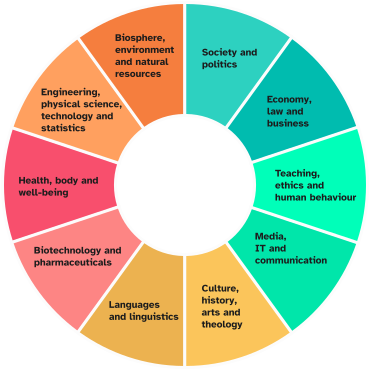
Study wheel
What interests you?
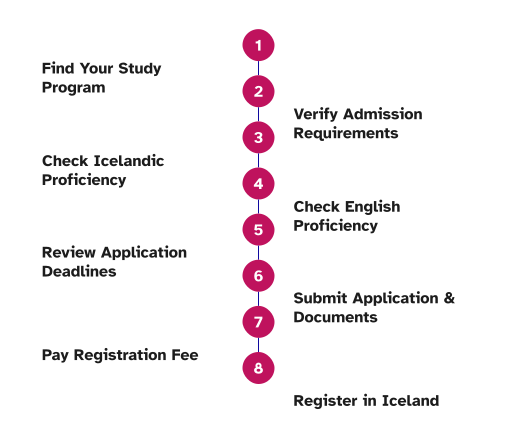
How to apply
Follow the path
If you still have questions, feel free to contact us.
Skrifstofa
Sæmundargata 2
12:00 - 16:00
Starfsmenn titill
Starfsmaður