
Language skills
Programme length
One year - 25 ECTS
Study mode
Face-to-face learning
Application status
International students:
Students with Icelandic or Nordic citizenship:
- Do you want to learn more about East European and Eurasian studies?
- Do you want an insight into the history, culture and literature of Russia and Ukraine?
- Do you want a better understanding of the culture and history of this region?
- Are you interested in further studies or careers related to the Slavic world?
This micro-credential in East European and Eurasian studies gives students the opportunity to deepen their understanding of the culture and history of a region that has been at the forefront of international developments in recent years.
Students will gain an insight into the history, culture and literature of Russia and Ukraine, as well as training in academic practices and the skills to work independently and with others.
The programme will prepare students for further studies in the humanities, make them more attractive to employers, and improve their basic knowledge of East European and Eurasian studies. It also serves as a humanities-based foundation for anyone interested in engaging further with the Slavic world – whether through research, education, or professional work.
Programme structure
The programme is 25 ECTS and is organised as one year of part-time study.
Organisation of teaching
- The programme is taught in Icelandic and English.
- Course topics include:
- The Cold War
- The Second World War
- Socialist society
- The Soviet Union
- Communism
- Russian literature
- Stalin’s reign of terror
- The annexation of Crimea
Icelandic matriculation examination (stúdentspróf) or equivalent qualification. Further information can be found in article 15, regulation on admission requirements for undergraduate study no. 331/2022.
To finish the micro credential programme in East European and Eurasian Studies students must finish all mandatory courses listed in the course catalogue:
- RÚS111G Soviet history 1: From revolution to terror
- RÚS112G Soviet history 2: The Cold war and Socialist society
- RÚS201G Russian literature 1: The rise of the novel
- RÚS213G Russian literature 2: Upheaval and dissent
They must also pick one of these two courses to finish the programme:
- RÚS413G A spiritual journey: Ukrainian and Russian Philosophy
- Aurora námskeið í samvinnu við Háskólann í Innsbruck: Byrjendanámskeið í úkraínsku
Programme structure
Check below to see how the programme is structured.
This programme does not offer specialisations.
- First year
- Fall
- Soviet history 1: From revolution to terror
- Soviet history 2: The Cold war and Socialist society
- Spring 1
- A spiritual journey: Ukrainian and Russian Philosophy
- Russian Literature 1: The rise of the novel
- Russian literature 2: Upheaval and dissent
First year | Fall
Soviet history 1: From revolution to terror (RÚS111G)
A mandatory (required) course for the programme
5 ECTS, credits
Course Description
This course delves into the transformative events of early 20th-century Russia, beginning with the collapse of the tsarist regime and the revolution of 1917. It examines the creation of a new society after the devastation of the Civil War (1918–1921) and traces the evolving political landscape of the 1920s. Key topics include the Bolshevik regime’s efforts to control industry and food production, debates over the revolution’s direction, and the emergence of “new people” as a result of revolutionary changes. The course also explores the global impact of Communism, including the role of the Communist International, before turning to Stalin’s rise to power. Students will look at Stalin’s totalitarian rule, the changes caused by industrialization and collectivization in the early 1930s, and their profound consequences. Finally, the course investigates Stalin’s reign of terror, focusing on the Great Purges and the extensive prison camp system (the Gulag).
Language of instruction: English
Face-to-face learning
Course taught first half of the semester
First year | Fall
Soviet history 2: The Cold war and Socialist society (RÚS112G)
A mandatory (required) course for the programme
5 ECTS, credits
Course Description
This course examines events and transformations in Soviet history from the late 1930s to the collapse of the Soviet Union. It begins with an exploration of World War II and the victory over Nazi Germany, focusing on its profound impact on the Soviet Union, and the USSR’s shifting international and domestic position after the war. The origins and key causes of the Cold War are analyzed, alongside the establishment of Communist regimes in Eastern Europe, social developments, and Stalinist governance. The course then investigates the Khrushchev and Brezhnev eras, highlighting political changes and social tensions following Stalin’s death. Gorbachev’s reforms under perestroika are studied carefully, culminating in an analysis of the Soviet Union’s dissolution. Finally, students will explore the post-Soviet landscape, with a brief discussion of the former Soviet republics and Russia’s policies toward them, focusing on the invasion of Ukraine, the annexation of Crimea and recent signs of aggression against Georgia and Moldova.
Language of instruction: English
Face-to-face learning
Course taught second half of the semester
First year | Spring 1
A spiritual journey: Ukrainian and Russian Philosophy (RÚS413G)
Restricted elective course, conditions apply
5 ECTS, credits
Course Description
The philosophical and religious tradition of the Eastern Church is distinct from the Roman Catholic tradition, which developed through scholarly activity in monasteries and universities during the Middle Ages and was closely connected to the intellectual currents that later led to major social changes in Western Europe. Within the Orthodox Churches, Neoplatonism always had a strong influence and directed religious thought more toward experience and expression than metaphysical analysis. However, the leading philosophers of the Orthodox Church in the Russian Empire in the nineteenth century were well-educated in Western philosophy, which resulted in the emergence, at the end of that century and the beginning of the twentieth, of a unique philosophical tradition grounded both in the spiritual emphasis of the Eastern Church and the rationalism of the West. This course offers a broad overview of this history of ideas and its most prominent thinkers, Ukrainian and Russian alike.
Language of instruction: English
Face-to-face learning
Course taught second half of the semester
First year | Spring 1
Russian Literature 1: The rise of the novel (RÚS201G)
A mandatory (required) course for the programme
5 ECTS, credits
Course Description
In the 19th century, a body of literature emerged in Russia that not only came to shape public discourse and the nation’s self-image, but also left a profound mark on world literature and influenced how other cultures perceived Russia and Russian culture. This course examines the development of Russian literature throughout the 19th 12
century and the rise of the “great novel”. We will explore the major literary movements and trends of the period, the social context in which they arose, and how particular literary types, themes, and broader societal issues are reflected in the works of several authors. The course will also consider how these works were received in Russia in their own time and the place they hold today—both in Russia and in smaller literary systems such as Iceland.
Language of instruction: English
Face-to-face learning
Course taught first half of the semester
First year | Spring 1
Russian literature 2: Upheaval and dissent (RÚS213G)
A mandatory (required) course for the programme
5 ECTS, credits
Course Description
The examination of the great novel will continue, and we will explore its fate at the turn of the century. Upheavals and revolutions shook Russian society at the beginning of a new century, and at the same time, a remarkable cultural and artistic flourishing took place in the country. Changing circumstances and growing uncertainty called for new forms, sharper approaches, and more serious and pressing artistic and political challenges. Russian literature underwent a test of endurance amidst the upheavals of revolution, civil war and during the reign of terror in the Soviet Union. Through poems, short stories and novels, we will explore the social and political challenges faced by literature in 20th-century Russia/Soviet Union.
Language of instruction: English
Face-to-face learning
Course taught second half of the semester
First year
- Fall
- RÚS111GSoviet history 1: From revolution to terrorMandatory (required) course5A mandatory (required) course for the programme5 ECTS, creditsCourse Description
This course delves into the transformative events of early 20th-century Russia, beginning with the collapse of the tsarist regime and the revolution of 1917. It examines the creation of a new society after the devastation of the Civil War (1918–1921) and traces the evolving political landscape of the 1920s. Key topics include the Bolshevik regime’s efforts to control industry and food production, debates over the revolution’s direction, and the emergence of “new people” as a result of revolutionary changes. The course also explores the global impact of Communism, including the role of the Communist International, before turning to Stalin’s rise to power. Students will look at Stalin’s totalitarian rule, the changes caused by industrialization and collectivization in the early 1930s, and their profound consequences. Finally, the course investigates Stalin’s reign of terror, focusing on the Great Purges and the extensive prison camp system (the Gulag).
Face-to-face learningPrerequisitesCourse taught first half of the semesterRÚS112GSoviet history 2: The Cold war and Socialist societyMandatory (required) course5A mandatory (required) course for the programme5 ECTS, creditsCourse DescriptionThis course examines events and transformations in Soviet history from the late 1930s to the collapse of the Soviet Union. It begins with an exploration of World War II and the victory over Nazi Germany, focusing on its profound impact on the Soviet Union, and the USSR’s shifting international and domestic position after the war. The origins and key causes of the Cold War are analyzed, alongside the establishment of Communist regimes in Eastern Europe, social developments, and Stalinist governance. The course then investigates the Khrushchev and Brezhnev eras, highlighting political changes and social tensions following Stalin’s death. Gorbachev’s reforms under perestroika are studied carefully, culminating in an analysis of the Soviet Union’s dissolution. Finally, students will explore the post-Soviet landscape, with a brief discussion of the former Soviet republics and Russia’s policies toward them, focusing on the invasion of Ukraine, the annexation of Crimea and recent signs of aggression against Georgia and Moldova.
Face-to-face learningPrerequisitesCourse taught second half of the semester- Spring 2
RÚS413GA spiritual journey: Ukrainian and Russian PhilosophyRestricted elective course5Restricted elective course, conditions apply5 ECTS, creditsCourse DescriptionThe philosophical and religious tradition of the Eastern Church is distinct from the Roman Catholic tradition, which developed through scholarly activity in monasteries and universities during the Middle Ages and was closely connected to the intellectual currents that later led to major social changes in Western Europe. Within the Orthodox Churches, Neoplatonism always had a strong influence and directed religious thought more toward experience and expression than metaphysical analysis. However, the leading philosophers of the Orthodox Church in the Russian Empire in the nineteenth century were well-educated in Western philosophy, which resulted in the emergence, at the end of that century and the beginning of the twentieth, of a unique philosophical tradition grounded both in the spiritual emphasis of the Eastern Church and the rationalism of the West. This course offers a broad overview of this history of ideas and its most prominent thinkers, Ukrainian and Russian alike.
Face-to-face learningPrerequisitesCourse taught second half of the semesterRÚS201GRussian Literature 1: The rise of the novelMandatory (required) course5A mandatory (required) course for the programme5 ECTS, creditsCourse DescriptionIn the 19th century, a body of literature emerged in Russia that not only came to shape public discourse and the nation’s self-image, but also left a profound mark on world literature and influenced how other cultures perceived Russia and Russian culture. This course examines the development of Russian literature throughout the 19th 12
century and the rise of the “great novel”. We will explore the major literary movements and trends of the period, the social context in which they arose, and how particular literary types, themes, and broader societal issues are reflected in the works of several authors. The course will also consider how these works were received in Russia in their own time and the place they hold today—both in Russia and in smaller literary systems such as Iceland.Face-to-face learningPrerequisitesCourse taught first half of the semesterRÚS213GRussian literature 2: Upheaval and dissentMandatory (required) course5A mandatory (required) course for the programme5 ECTS, creditsCourse DescriptionThe examination of the great novel will continue, and we will explore its fate at the turn of the century. Upheavals and revolutions shook Russian society at the beginning of a new century, and at the same time, a remarkable cultural and artistic flourishing took place in the country. Changing circumstances and growing uncertainty called for new forms, sharper approaches, and more serious and pressing artistic and political challenges. Russian literature underwent a test of endurance amidst the upheavals of revolution, civil war and during the reign of terror in the Soviet Union. Through poems, short stories and novels, we will explore the social and political challenges faced by literature in 20th-century Russia/Soviet Union.
Face-to-face learningPrerequisitesCourse taught second half of the semester
The University of Iceland collaborates with over 400 universities worldwide. This provides a unique opportunity for UI students to pursue a part of their studies abroad, gain valuable international experience, and strengthen their position in the job market.
Opportunities
Study abroad is always subject to faculty approval.
Requirements
Students can only apply for study abroad if their study programme is at least:
- 90 ECTS credits for undergraduate programmes
- 60 ECTS credits for graduate programmes
Recognition
Students can get courses taken abroad recognised towards their degree at UI so the mobility does not have to prolong the studies at UI. Students must agree with their faculty on the recognition of courses before the start of the mobility by signing a learning agreement.
An education in this area can open up opportunities in:
- Media
- International affairs
- Tourism
- Translation
This list is not exhaustive.
- Linguae is the organisation for language students at the University of Iceland.
- Linguae organises social events for students at the Faculty of Languages and Cultures.
- Members currently include students of Italian, French, German, Spanish, Danish, Chinese and Russian.
- Linguae runs a Facebook group and a Facebook page.
Students appreciate the University of Iceland for its strong academic reputation, modern campus facilities, close-knit community, and affordable tuition.
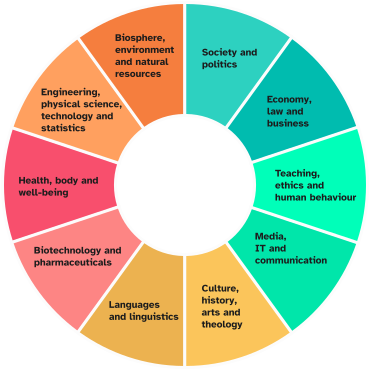
Study wheel
What interests you?
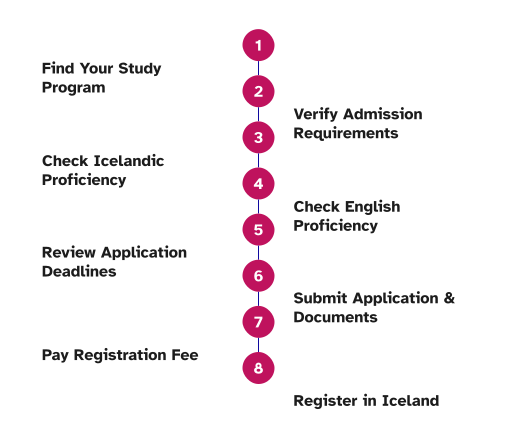
How to apply
Follow the path
If you still have questions, feel free to contact us.
School of Humanities
Weekdays: 10-12 am and 1-3 pm
General Service and Social Media
The Service Desk is a point of access for all services. You can drop in at the University Centre or use the WebChat at the bottom right of this page.
Follow the School of Humanities on Instagram, Youtube
and Facebook
