
""
Language skills
required
Programme length
Two years.
Study mode
Face-to-face learning
Application status
International students:
Students with Icelandic or Nordic citizenship:
Overview

  • Do you have basic proficiency in Danish?
  • Do you want to better understand the multifaceted relationship between language and culture?
  • Are you interested in Danish history, literature, politics, institutions, society and/or the Danish people?
  • Do you want to improve your skills in written Danish?
  • Are you aiming at a career in tourism, interpreting, translation or other forms of communication to Danish-speaking target groups?

The MA in Danish is generally a two-year programme, tailored to suit the individual student, which aims to provide students with specialised knowledge and academic skills. Master's students will gain first-hand research experience.

Programme structure

The programme is 120 ECTS and is organised as two years of full-time study.

The programme is made up of:

  • Mandatory courses, 20 ECTS
  • Elective courses, 70 ECTS
  • Final project, 30 ECTS

Students must take part of the programme at a university in Denmark.

Organisation of teaching

The programme is taught in Danish.

Main objectives

Students will learn the skills required to take on jobs that call for specialised knowledge of Danish language, literature and culture.

Other

Completing an MA in Danish allows you to apply for a doctoral programme in Danish.

A BA-degree in Danish, with a grade average of at least 7.25 (first class) and a final thesis gives access to second cycle of higher education.

The program is a two-year 120 ECTS program.

Students take 30 ECTS in mandatory courses which are marked on the course catalogue. Students must also write a thesis of a minimum 30 ECTS. Elective courses on the course catalogue count towards the MA in Danish, students are aditionally allowed to take at maximum 20 ECTS from other programmes within the Universtiy of Iceland. 

Students can take a part of their studies at a university in Denmark.

The following documents must accompany an application for this programme:
  • Statement of purpose
  • Certified copies of diplomas and transcripts
  • Proof of English proficiency

Further information on supporting documents can be found here

Programme structure

Check below to see how the programme is structured.

This programme does not offer specialisations.

Not taught this semester
Year unspecified | Fall
Scandinavian Literature (DAN502F)
Restricted elective course, conditions apply
10 ECTS, credits
Course Description

A Nordic literature canon will be presented and discussed form a critical perspective and the canon concept will be in focus. An important Nordic literature selection will be presented, read and studied. There will be a literature seminar in connection with this course with participation from critics and authors from the Nordic countries.

Language of instruction: Danish
Face-to-face learning
Year unspecified | Fall
Nordic Modernism and Avant-Garde - From Edith Södergran to Anarchy on the Internet (DAN501F)
Restricted elective course, conditions apply
10 ECTS, credits
Course Description

The course will explore the history of modernism and of the avant-garde in the Nordic countries through key texts of Nordic modernism. Avant-garde movements such as expressionism and surrealism and their effects on Nordic literature in the years between the World wars will be studied. The course will also focus on groups of writers and other artists that operated under the banner of modernism in the Nordic countries in the post war period, ranging from the publishers of the magazines Heretica in Denmark and Birtíngur in Iceland in the post war period to diverse groups and forums of artists and writers operating today on the internet.

The course will also deal with fundamental questions such as the reaction of modernism to the "grand narratives of modernity and whether modernism itself has become such a "grand narrative" of literary history and culture.

Language of instruction: Danish
Face-to-face learning
Year unspecified | Fall
MA-thesis in Danish (DAN441L)
A mandatory (required) course for the programme
0 ECTS, credits
Course Description

MA thesis in Danish.

Language of instruction: Danish
Part of the total project/thesis credits
Year unspecified | Fall
Language Usage and Expression: Danish (DAN703F)
A mandatory (required) course for the programme
5 ECTS, credits
Course Description

This course is theoretical as well as practical. Students refresh important rules in Danish language, language use and stylistics. They analyse how different types of texts have different purpose of communication. Emphasis will be on the students' writing skills in Danish language and their training in use of theoretical as well as practical aids.

Language of instruction: Danish
Distance learning
Online learning
Year unspecified | Fall
Languages and Culture I (MOM301F)
A mandatory (required) course for the programme
10 ECTS, credits
Course Description

This course concerns the diverse connections between culture and language, as seen from the perspective of cultural history, social sciences and linguistics. Ancient and modern world languages will be introduced and their origins, influence and effects investigated. Written and spoken language will be discussed: what sorts of things are written, why and how? Rules and alternate perspectives on the nature of language will be considered, raising the question of how we understand man with respect to thought and language.

Language of instruction: English
Year unspecified | Fall
The Viking Age (MIS704M)
Free elective course within the programme
5 ECTS, credits
Course Description

This class surveys the history, society and archaeology of Viking Age Iceland. We will read parts of medieval Icelandic sagas, the Eddas and Skaldic poetry, and modern historical, anthropological and literary studies will be discussed. We will explore the ways in which Icelandic society evolved throughout the Viking Age (ca. 790–1100 AD) in its interrelation with different cultural spheres, and dive into aspects of everyday life, politics, belief systems, ship building and traveling.

A regular focus of this class will be on saga literature (Fornaldarsögur, Íslendingasögur, Konungasögur), as this literature is our main source for interpreting archaeological findings, on the one hand, for exploring later medieval ideas of the Viking Age, on the other hand. With that said, the source value of written artifacts for Viking Age Iceland will be discussed, and this even includes a closer look at modern popular and academic reception, where different sources are regularly mingled without any distinct source criticism. Last but not least, we will discuss the so-called Vikings and their so-called age in the light of recent populist movements, and scholarly reactions to it.

Language of instruction: English
Face-to-face learning
Prerequisites
Not taught this semester
Year unspecified | Fall
Vernacular Culture and the Aesthetics of Everyday Life (ÞJÓ212F)
Free elective course within the programme
15 ECTS, credits
Course Description

The course examines the folkloristic/ethnological perspective on culture and society with an emphasis on everyday life - the prose of the world. The history of the discipline is engaged with in a critical fashion in the context of neighboring fields and together students and teacher will examine where the field is headed in the 21st century. Central concepts will be investigated, including cultural difference and diversity, nationality, gender, the popular, tradition, group, authorship, globalization, pluralism, the eleventh hour, hegemony, heritage, and cultural ownership.

The goal is to understand how people create their everyday lives and how they invest their daily environs with meaning, how people make their own history under circumstances not of their own choosing, whether in the peasant society of previous centuries or in contemporary urban society. This course is for graduate students, but it is also open to advanced undergraduates in their last year of study.

Language of instruction: English
Face-to-face learning
Prerequisites
Year unspecified | Fall
Literature Translations (DAN702F)
Free elective course within the programme
5 ECTS, credits
Course Description

This course deals with literary translation between Icelandic and Danish. Students get a summary of the history of the Danish-Icelandic literary translation tradition and practice translation critic by analysing different translations from different periods. Students will face the challenges in translation as well as which strategies and methods they have to consider while finding solutions.

Language of instruction: Danish
Year unspecified | Fall
Individual Project (DAN805F)
Free elective course within the programme
5 ECTS, credits
Course Description

Individual project.

Language of instruction: Danish
Year unspecified | Fall
Individual Project (DAN901F)
Free elective course within the programme
10 ECTS, credits
Course Description

Individual project.

Language of instruction: Danish
Year unspecified | Spring 1
MA-thesis in Danish (DAN441L)
A mandatory (required) course for the programme
0 ECTS, credits
Course Description

MA thesis in Danish.

Language of instruction: Danish
Part of the total project/thesis credits
Year unspecified | Spring 1
Danish System of Governance, History and Culture (DAN802F)
A mandatory (required) course for the programme
5 ECTS, credits
Course Description

The aim of this course is to give students a good overview of the historical, political and cultural development in Danish governance through the 20. century till now – from absolutism to representative democracy. The course will among other things be devoted to the Danish welfare model and the democratic safety net in light of the state finances, geography, demography and religion, the Danish labour market, the political system, the healthcare and educational system, Denmark’s international relations and general tendencies in Danish society. Students will make presentations during the semester and the course is closed with a written home assignment.

Language of instruction: Danish
Year unspecified | Spring 1
New researches in history (SAG201F)
Free elective course within the programme
10 ECTS, credits
Course Description

In the course, well-known historical studies from Western culture will be read that deal with a variety of topics. An attempt will be made to show how historians, both at the end of the twentieth century and at the beginning of the twenty-first century, struggle with different topics in their research. The discussion will be put into an ideological context and emphasis will be placed on showing the different approaches of historians when the subject has been connected to the aforementioned field of study. An attempt was made to select interesting books that are likely to give us an interesting picture of the state of the arts of history today.

Language of instruction: Icelandic
Face-to-face learning
Year unspecified | Spring 1
Sustainable Tourism Development in Northern Environment (FER214F)
Free elective course within the programme
10 ECTS, credits
Course Description

The course Sustainable Tourism Development in Northern Environment is offered as an online course from University of OULU in Finland. This course is an offering from the Thematic Network on Northern Tourism.

Announcement about access to the course is sent out at the end of each year. Students need to apply for access and registration through SENS' student service, MS-SENS (mssesns@hi.is)

The number of students able to register is limited.

The course will address tourism in the circumpolar north from a societal perspective. It will present different views on the phenomenon and its dimensions, resources and implications for nature, places and cultures involved. The place of northern tourism in times of globalization and emergent global issues like climate changes will be explored, together with the relevant governance aspects.

Language of instruction: English
Distance learning
Year unspecified | Spring 1
Multicultural society and migration (MAN017F)
Free elective course within the programme
10 ECTS, credits
Course Description

Human mobility and multicultural societies are often seen as the main characteristics of the contemporary world. In the course, we look at main theories approaching mobility and multicultural society, critically addressing them and analyzing their utility. The concept of multiculturalism and related concepts such as culture, assimilation and integration are critically evaluated, as well as mobility in the past and the relationship between mobility and multiculturalism. Different approaches in the social sciences are introduced and main research themes in anthropology in particular and social sciences in general will be examined.

The teaching methods are lectures and discussions.

Language of instruction: Icelandic/English
Face-to-face learning
Distance learning
Year unspecified | Spring 1
Vernacular Culture and the Aesthetics of Everyday Life (ÞJÓ212F)
Free elective course within the programme
15 ECTS, credits
Course Description

The course examines the folkloristic/ethnological perspective on culture and society with an emphasis on everyday life - the prose of the world. The history of the discipline is engaged with in a critical fashion in the context of neighboring fields and together students and teacher will examine where the field is headed in the 21st century. Central concepts will be investigated, including cultural difference and diversity, nationality, gender, the popular, tradition, group, authorship, globalization, pluralism, the eleventh hour, hegemony, heritage, and cultural ownership.

The goal is to understand how people create their everyday lives and how they invest their daily environs with meaning, how people make their own history under circumstances not of their own choosing, whether in the peasant society of previous centuries or in contemporary urban society. This course is for graduate students, but it is also open to advanced undergraduates in their last year of study.

Language of instruction: Icelandic
Face-to-face learning
Distance learning
Year unspecified | Spring 1
Individual Project (DAN803F)
Free elective course within the programme
10 ECTS, credits
Course Description

Individual project.

Language of instruction: Danish
Year unspecified | Spring 1
Individual Project (DAN804F)
Free elective course within the programme
5 ECTS, credits
Course Description

Individual project.

Language of instruction: Danish
Year unspecified | Spring 1
Languages and Culture II: The European Intellectual Tradition (MOM402M)
Free elective course within the programme
5 ECTS, credits
Course Description

The European intellectual tradition is characterized by the strong links between academia and society. Many of the most important European thinkers of the 19th and 20th Centuries worked outside of the universities – and many of those who did pursue an ordinary academic career also were public commentators frequently intervening in political discussion of the day and in some cases gaining considerable influence. In this course we present a selection of European thinkers who have been important both as scholars and as public intellectuals. We read and discuss samples of their work and look at critical discussion of their ideas. We also reflect on the time and place of the "European" – to what extent their work is quinessentially Eurocentric and to what extent awareness of cultural contingency emerges.

Language of instruction: English
Face-to-face learning
Distance learning
Year unspecified
  • Fall
  • Not taught this semester
    DAN502F
    Scandinavian Literature
    Restricted elective course
    10
    Restricted elective course, conditions apply
    10 ECTS, credits
    Course Description

    A Nordic literature canon will be presented and discussed form a critical perspective and the canon concept will be in focus. An important Nordic literature selection will be presented, read and studied. There will be a literature seminar in connection with this course with participation from critics and authors from the Nordic countries.

    Face-to-face learning
    Prerequisites
  • DAN501F
    Nordic Modernism and Avant-Garde - From Edith Södergran to Anarchy on the Internet
    Restricted elective course
    10
    Restricted elective course, conditions apply
    10 ECTS, credits
    Course Description

    The course will explore the history of modernism and of the avant-garde in the Nordic countries through key texts of Nordic modernism. Avant-garde movements such as expressionism and surrealism and their effects on Nordic literature in the years between the World wars will be studied. The course will also focus on groups of writers and other artists that operated under the banner of modernism in the Nordic countries in the post war period, ranging from the publishers of the magazines Heretica in Denmark and Birtíngur in Iceland in the post war period to diverse groups and forums of artists and writers operating today on the internet.

    The course will also deal with fundamental questions such as the reaction of modernism to the "grand narratives of modernity and whether modernism itself has become such a "grand narrative" of literary history and culture.

    Face-to-face learning
    Prerequisites
  • DAN441L
    MA-thesis in Danish
    Mandatory (required) course
    0
    A mandatory (required) course for the programme
    0 ECTS, credits
    Course Description

    MA thesis in Danish.

    Prerequisites
    Part of the total project/thesis credits
  • DAN703F
    Language Usage and Expression: Danish
    Mandatory (required) course
    5
    A mandatory (required) course for the programme
    5 ECTS, credits
    Course Description

    This course is theoretical as well as practical. Students refresh important rules in Danish language, language use and stylistics. They analyse how different types of texts have different purpose of communication. Emphasis will be on the students' writing skills in Danish language and their training in use of theoretical as well as practical aids.

    Distance learning
    Online learning
    Prerequisites
  • MOM301F
    Languages and Culture I
    Mandatory (required) course
    10
    A mandatory (required) course for the programme
    10 ECTS, credits
    Course Description

    This course concerns the diverse connections between culture and language, as seen from the perspective of cultural history, social sciences and linguistics. Ancient and modern world languages will be introduced and their origins, influence and effects investigated. Written and spoken language will be discussed: what sorts of things are written, why and how? Rules and alternate perspectives on the nature of language will be considered, raising the question of how we understand man with respect to thought and language.

    Prerequisites
  • MIS704M
    The Viking Age
    Elective course
    5
    Free elective course within the programme
    5 ECTS, credits
    Course Description

    This class surveys the history, society and archaeology of Viking Age Iceland. We will read parts of medieval Icelandic sagas, the Eddas and Skaldic poetry, and modern historical, anthropological and literary studies will be discussed. We will explore the ways in which Icelandic society evolved throughout the Viking Age (ca. 790–1100 AD) in its interrelation with different cultural spheres, and dive into aspects of everyday life, politics, belief systems, ship building and traveling.

    A regular focus of this class will be on saga literature (Fornaldarsögur, Íslendingasögur, Konungasögur), as this literature is our main source for interpreting archaeological findings, on the one hand, for exploring later medieval ideas of the Viking Age, on the other hand. With that said, the source value of written artifacts for Viking Age Iceland will be discussed, and this even includes a closer look at modern popular and academic reception, where different sources are regularly mingled without any distinct source criticism. Last but not least, we will discuss the so-called Vikings and their so-called age in the light of recent populist movements, and scholarly reactions to it.

    Face-to-face learning
    Prerequisites
  • Not taught this semester
    ÞJÓ212F
    Vernacular Culture and the Aesthetics of Everyday Life
    Elective course
    15
    Free elective course within the programme
    15 ECTS, credits
    Course Description

    The course examines the folkloristic/ethnological perspective on culture and society with an emphasis on everyday life - the prose of the world. The history of the discipline is engaged with in a critical fashion in the context of neighboring fields and together students and teacher will examine where the field is headed in the 21st century. Central concepts will be investigated, including cultural difference and diversity, nationality, gender, the popular, tradition, group, authorship, globalization, pluralism, the eleventh hour, hegemony, heritage, and cultural ownership.

    The goal is to understand how people create their everyday lives and how they invest their daily environs with meaning, how people make their own history under circumstances not of their own choosing, whether in the peasant society of previous centuries or in contemporary urban society. This course is for graduate students, but it is also open to advanced undergraduates in their last year of study.

    Face-to-face learning
    Prerequisites
  • DAN702F
    Literature Translations
    Elective course
    5
    Free elective course within the programme
    5 ECTS, credits
    Course Description

    This course deals with literary translation between Icelandic and Danish. Students get a summary of the history of the Danish-Icelandic literary translation tradition and practice translation critic by analysing different translations from different periods. Students will face the challenges in translation as well as which strategies and methods they have to consider while finding solutions.

    Prerequisites
  • DAN805F
    Individual Project
    Elective course
    5
    Free elective course within the programme
    5 ECTS, credits
    Course Description

    Individual project.

    Prerequisites
  • DAN901F
    Individual Project
    Elective course
    10
    Free elective course within the programme
    10 ECTS, credits
    Course Description

    Individual project.

    Prerequisites
  • Spring 2
  • DAN441L
    MA-thesis in Danish
    Mandatory (required) course
    0
    A mandatory (required) course for the programme
    0 ECTS, credits
    Course Description

    MA thesis in Danish.

    Prerequisites
    Part of the total project/thesis credits
  • DAN802F
    Danish System of Governance, History and Culture
    Mandatory (required) course
    5
    A mandatory (required) course for the programme
    5 ECTS, credits
    Course Description

    The aim of this course is to give students a good overview of the historical, political and cultural development in Danish governance through the 20. century till now – from absolutism to representative democracy. The course will among other things be devoted to the Danish welfare model and the democratic safety net in light of the state finances, geography, demography and religion, the Danish labour market, the political system, the healthcare and educational system, Denmark’s international relations and general tendencies in Danish society. Students will make presentations during the semester and the course is closed with a written home assignment.

    Prerequisites
  • SAG201F
    New researches in history
    Elective course
    10
    Free elective course within the programme
    10 ECTS, credits
    Course Description

    In the course, well-known historical studies from Western culture will be read that deal with a variety of topics. An attempt will be made to show how historians, both at the end of the twentieth century and at the beginning of the twenty-first century, struggle with different topics in their research. The discussion will be put into an ideological context and emphasis will be placed on showing the different approaches of historians when the subject has been connected to the aforementioned field of study. An attempt was made to select interesting books that are likely to give us an interesting picture of the state of the arts of history today.

    Face-to-face learning
    Prerequisites
  • FER214F
    Sustainable Tourism Development in Northern Environment
    Elective course
    10
    Free elective course within the programme
    10 ECTS, credits
    Course Description

    The course Sustainable Tourism Development in Northern Environment is offered as an online course from University of OULU in Finland. This course is an offering from the Thematic Network on Northern Tourism.

    Announcement about access to the course is sent out at the end of each year. Students need to apply for access and registration through SENS' student service, MS-SENS (mssesns@hi.is)

    The number of students able to register is limited.

    The course will address tourism in the circumpolar north from a societal perspective. It will present different views on the phenomenon and its dimensions, resources and implications for nature, places and cultures involved. The place of northern tourism in times of globalization and emergent global issues like climate changes will be explored, together with the relevant governance aspects.

    Distance learning
    Prerequisites
  • MAN017F
    Multicultural society and migration
    Elective course
    10
    Free elective course within the programme
    10 ECTS, credits
    Course Description

    Human mobility and multicultural societies are often seen as the main characteristics of the contemporary world. In the course, we look at main theories approaching mobility and multicultural society, critically addressing them and analyzing their utility. The concept of multiculturalism and related concepts such as culture, assimilation and integration are critically evaluated, as well as mobility in the past and the relationship between mobility and multiculturalism. Different approaches in the social sciences are introduced and main research themes in anthropology in particular and social sciences in general will be examined.

    The teaching methods are lectures and discussions.

    Face-to-face learning
    Distance learning
    Prerequisites
  • ÞJÓ212F
    Vernacular Culture and the Aesthetics of Everyday Life
    Elective course
    15
    Free elective course within the programme
    15 ECTS, credits
    Course Description

    The course examines the folkloristic/ethnological perspective on culture and society with an emphasis on everyday life - the prose of the world. The history of the discipline is engaged with in a critical fashion in the context of neighboring fields and together students and teacher will examine where the field is headed in the 21st century. Central concepts will be investigated, including cultural difference and diversity, nationality, gender, the popular, tradition, group, authorship, globalization, pluralism, the eleventh hour, hegemony, heritage, and cultural ownership.

    The goal is to understand how people create their everyday lives and how they invest their daily environs with meaning, how people make their own history under circumstances not of their own choosing, whether in the peasant society of previous centuries or in contemporary urban society. This course is for graduate students, but it is also open to advanced undergraduates in their last year of study.

    Face-to-face learning
    Distance learning
    Prerequisites
  • DAN803F
    Individual Project
    Elective course
    10
    Free elective course within the programme
    10 ECTS, credits
    Course Description

    Individual project.

    Prerequisites
  • DAN804F
    Individual Project
    Elective course
    5
    Free elective course within the programme
    5 ECTS, credits
    Course Description

    Individual project.

    Prerequisites
  • MOM402M
    Languages and Culture II: The European Intellectual Tradition
    Elective course
    5
    Free elective course within the programme
    5 ECTS, credits
    Course Description

    The European intellectual tradition is characterized by the strong links between academia and society. Many of the most important European thinkers of the 19th and 20th Centuries worked outside of the universities – and many of those who did pursue an ordinary academic career also were public commentators frequently intervening in political discussion of the day and in some cases gaining considerable influence. In this course we present a selection of European thinkers who have been important both as scholars and as public intellectuals. We read and discuss samples of their work and look at critical discussion of their ideas. We also reflect on the time and place of the "European" – to what extent their work is quinessentially Eurocentric and to what extent awareness of cultural contingency emerges.

    Face-to-face learning
    Distance learning
    Prerequisites

The timetable shown below is for the current academic year and is FOR REFERENCE ONLY.

Changes may occur for the autumn semester in August and September and for the spring semester in December and January. You will find your final timetable in Ugla when the studies start.

Note! This timetable is not suitable for planning your work schedule if you are a part-time employee.


Additional information

The University of Iceland collaborates with over 400 universities worldwide. This provides a unique opportunity to pursue part of your studies at an international university thus gaining added experience and fresh insight into your field of study.

Students generally have the opportunity to join an exchange programme, internship, or summer courses. However, exchanges are always subject to faculty approval.

Students have the opportunity to have courses evaluated as part of their studies at the University of Iceland, so their stay does not have to affect the duration of their studies.

This qualification can open up opportunities in

  • Tourism
  • Culture and communication
  • Trade and business
  • International affairs
  • Translation
  • Teaching

This list is not exhaustive.

  • Linguae is the organisation for language students at the University of Iceland 
  • Linguae organises social events for students at the Faculty of Languages and Cultures 
  • Members currently include students of Italian, French, German, Spanish, Danish, Chinese and Russian 
  • Linguae runs a Facebook group and a Facebook page

More about the UI student's social life

Student´s comments
""
Students appreciate the University of Iceland for its strong academic reputation, modern campus facilities, close-knit community, and affordable tuition.
Helpful content
Aurora Cooperation

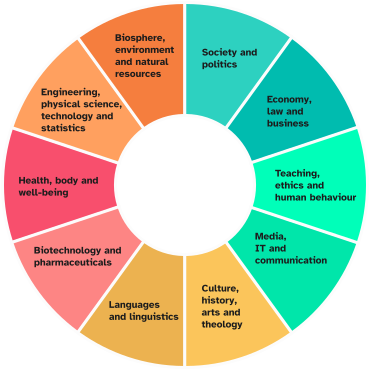
Study wheel

What interests you?

Aurora Cooperation

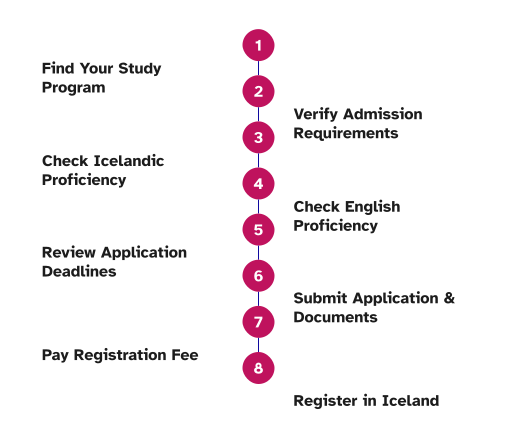
How to apply

Follow the path

Contact us

If you still have questions, feel free to contact us.

School of Humanities
Weekdays: 10-12 am and 1-3 pm
General Service and Social Media

The Service Desk is a point of access for all services. You can drop in at the University Centre or use the WebChat at the bottom right of this page.

Follow the School of Humanities on Instagram,   Youtube
and Facebook

""

Share

Did this help?

Why wasn't this information helpful

Limit to 250 characters.