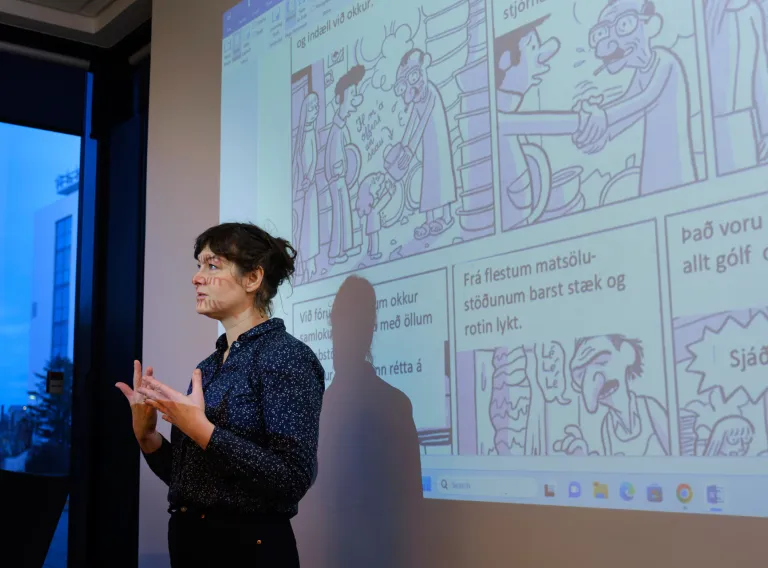
Random people
Language skills
required, minimum level of B2
Programme length
2 years.
Study mode
Face-to-face learning
Application status
International students:
Students with Icelandic or Nordic citizenship:
Overview

  • Do you have a passion for literature?
  • Do you want a thorough grounding in academic skills which will prepare you for various academic careers?
  • Would you like to teach in an upper secondary school?
  • Do you want to have the option to pursue doctoral studies?

The MA in comparative literature is particularly valuable as a general education for students who want to expand their knowledge and understanding of human relationships and artistic expression, as well as developing skills in academic working practices.

Students are able to tailor the programme to suit their own interests through elective courses, including the option of taking courses in other humanities subjects or at a university abroad. Students plan the programme in consultation with the academic supervisor.

Students must complete one mandatory course and a 30 ECTS Master's thesis.

Programme structure

The programme is 120 ECTS and is organised as two years of full-time study.

The programme is made up of:

  • Mandatory courses, 10 ECTS
  • Elective courses, 50 - 80 ECTS
  • Final thesis, 30 - 60 ECTS

Organisation of teaching

This programme is taught in Icelandic but most textbooks are in English.

The programme is taught through lectures, discussion periods and seminars and students are expected to do a significant amount of independent study, mainly reading and considering literary texts and other reading material.

Main objectives

After completing the programme, students should, for example:

  • have developed the knowledge and skills required to tackle new and previously unfamiliar topics.
  • be able to initiate projects in their field, manage them successfully, and assume responsibility for the work of groups and individuals.
  • have learned to identify opportunities for sharing material concerning general linguistics in contemporary society.

Other

Completing an MA at the Faculty of Icelandic and Comparative Cultural Studies allows you to apply for doctoral studies in your chosen subject.

A student who has completed a BA degree in comparative literature as a major or a BA degree in another humanities subject with comparative literature as a minor and at least a 10-credit thesis can apply for admission to a master's program in comparative literature.

Applicants for master's studies must have completed a BA degree or equivalent from a recognized university, with a first class grade (7.25), and a final thesis must be at least a 10 ECTS and have received at least a first class grade. A student who intends to start a master's program immediately after completing a BA degree  can apply before the BA studies is completed. However, no one can formally start a master's program until the admission requirements have been fully met.


An MA degree requires at least 120 ECTS. Students organise their study in consultation with the head of program or another tenured instructor within the programme. A Master's thesis may be 30-60 ECTS. Students in the Master's programme in comparative literature must complete at least 90 ECTS within the subject (in courses and research projects marked ABF), including the MA thesis. Students may take up to 30 ECTS outside the subject, either in courses offered as part of the course catalogue, or courses in other programmes, which requires the permission of the head of program. Courses taken abroad as part of a student exchange programme are exempt from these rules, subject to the approval of the head of program.

The following documents must accompany an application for this programme:
  • Statement of purpose
  • Certified copies of diplomas and transcripts

Further information on supporting documents can be found here

Programme structure

Check below to see how the programme is structured.

This programme does not offer specialisations.

First year | Fall
Fiction on the borders (ABF715F)
Free elective course within the programme
10 ECTS, credits
Course Description

The course will focus on fiction from the last 50 years or so that in one way or another straddles the borders of different literary genres, such as the novel and autobiography, historiography, journalism, etc. The students will read historical novels, photographic essays, autobiographical works, fakes and more. The course will introduce theories on literary genres, history of ideas and relationship with trends in literature and literary studies.

Language of instruction: Icelandic
First year | Fall
Writing with the land: Feminist Environments in 20th-century literature (ABF737F)
Free elective course within the programme
10 ECTS, credits
Course Description

Long before contemporary analyses of human-induced environmental degradation, Indigenous and feminist authors wrote stories that resisted hierarchies of the human over other lifeworlds. This course will use the themes, "feminism" and "environment" to study the works of women writers such as Leslie Marmon Silko, bell hooks, Willa Cather, Maria Lugones and Muriel Rukeyser whose writings deepen and problematize both terms.  
 
Together we will ask, how have colonial histories impacted which authors are seen as "environmental" or "feminist"?  How does environmental protection materialize in the works of these authors? Further, what does environmental literature mean and how could debates in feminist theory help us answer such questions?

Language of instruction: Icelandic
Face-to-face learning
First year | Fall
Modern Theatre (ABF502M)
Free elective course within the programme
10 ECTS, credits
Course Description

The course will be dealing with pioneering theatre artists and playwrights in Europe and the US starting with the rise of naturalism and realism in the nineteentch century. Then symbolism, surrealism and dada in the early years of the twentieth century will be introduced, the theatre of the absurd in the 1950s and 60s will be explained, and thereafter the discussion will be taken to contemporary postmodern theatre. The ideas of Constantine Stanislavsky, Vsevolod Meyerhold, Bertolt Brecht, Antonin Artaud, Eugene Ionesco, Jerzy Grotowski and Peter Brook will be taught in some detail - as well as the the theatre of Samuel Beckett, Tadeusz Kantor and Robert Wilson. It will be discovered how the works of playwrights from certain periods are in direct interrelation with a changing view on the art of the theatre and certain plays will be selected for reading in order to explain this further.

Language of instruction: Icelandic
First year | Fall
Research seminar B: Marriage, Madness and Massacre (MFR716M)
Free elective course within the programme
5 ECTS, credits
Course Description

The nineteenth century saw the highpoint of colonial expansion around the globe. A handful of European countries owned almost every available inch of the planet´s landmass as well much of its waters. While the European industrial revolutions brought wealth and prosperity to sagging economies, they were founded on the backs of colonial loot and forced market. Many of these dichotomies of wealth and extractionism, burgeoning democracies and impositions of colonial/imperial rule, technological advancement and poverty ridden backwardness, indicate the schizophrenic nature of imperial Europe and the hidden massacres and brutally put down rebellions in its colonies. European nationalism can be read through the crisis of identity as each nation confronts its colonial other and struggles to establish its own self in the wake of its colonial anxieties of race, religion, gender, and body.

This course will follow these themes as they are reflected in the nineteenth century Realist novel in Europe and the newly established US. Through this literature we will follow the trope of marriage as an analogy for the nation, analysing the nature of its heroines, their several suitors, the shadow of colonial rebellions, the constant absent-presence of the ´oriental´ other. Close reading and analysis of the literary texts will be accompanied by critical and theoretical material covering postcolonial and decolonial approaches, theories of violence, and social and cultural contextualisations, all converging on the multiple anxieties that resulted in the invention of ´Europe´.

Students are expected to participate fully in class discussion and will be required to make short presentations and write a final paper.

Language of instruction: English
Face-to-face learning
Distance learning
Prerequisites
Course taught second half of the semester
First year | Fall
Directed Study in Comparative Literature A (ABF020F)
Free elective course within the programme
10 ECTS, credits
Course Description

A project is selected in consultation with a teacher, and that teacher must approve the student's research plans before she or he is permitted to register for a study of this kind.

Language of instruction: Icelandic
First year | Fall
Directed Study in Comparative Literature B (ABF024F)
Free elective course within the programme
10 ECTS, credits
Course Description

A project is selected in consultation with a teacher, and that teacher must approve the student's research plans before she or he is permitted to register for a study of this kind.

Language of instruction: Icelandic
First year | Spring 1
Self-help in literature and films (ABF845F)
Free elective course within the programme
10 ECTS, credits
Course Description

We will explore several corners of self-help culture and analyze them through the lens of literature and film. We will look at some of the leading influencers who have shaped the discourse surrounding self-help and self-improvement. Authors, leaders, and gurus such as Montaigne, Emerson, Joseph Campbell, Ram Dass, Eckhart Tolle, Walt Whitman, Oprah Winfrey, and Jane Austen will be introduced. Selected literary works and films will be examined in light of this path of improvement, as a route to discipline, and as a means to grow and to learn about oneself. We will read stories that engage with the transformative power and the value of narrative for a person’s spiritual journey or for working through difficult life experiences. Assessment will take place in the form of an in-class lecture and written assignments.  Among fictional writing are: Eat, Pray, Love, The Doors of Perception, Leaves of Grass, Hamlet, A Jane Austen Education. Among films are: Ben–Hur, 101 Reykjavík, Forrest Gump, Emma, Little Women, Barbie.

Language of instruction: Icelandic
Face-to-face learning
First year | Spring 1
Narrative, cinema and culture in Sjón’s fiction (ABF846F)
Free elective course within the programme
10 ECTS, credits
Course Description

The course focuses on the fiction of Sjón, with emphasis on novels, poetry and cinema, based on the study Sjónsbók: Ævintýrið um höfundinn, súrrealisma og sýnir (2016) by Úlfhildur Dagsdóttir, and the essay collection Critical Approaches to Sjón : North of the Sun (2025). Theories of surrealism and the avant garde, narrative and cultural studies will be discussed.

Language of instruction: Icelandic
Face-to-face learning
First year | Spring 1
Anger in Literature and Arts (ABF814M)
Free elective course within the programme
10 ECTS, credits
Course Description

Anger is a prominent driving force and theme in literature and the arts from the very beginning of the Western cultural tradition. Anger is intertwined with the very nature of storytelling. In this course, we examine various examples of anger and place them in the context of theories from the study of emotions—ranging from the anger of Achilles to that of Donald Duck. Who is allowed to be angry? Why are they so angry, and what purpose does their anger serve in a cultural-historical context? A selection of works and scholarly texts dealing with anger, and with anger as a phenomenon, will be read.

Language of instruction: Icelandic
First year | Spring 1
Nature stories: the (super)natural in legends and literature (ÍSB814M)
Free elective course within the programme
10 ECTS, credits
Course Description

By focusing on folk tales, literature and other relevant sources, the course discusses the manifestations of nature and the supernatural in Icelandic narrative culture throughout the centuries. Students will learn about the significance, interface, and unclear boundaries of these phenomena and how they have shaped society and the environment as well. Students will thus get to know different ideas about the position of people and (other) animals within, above or "outside" of nature. Through diverse lectures and assignments, topics such as humanity vs. animality, the known world vs. other worlds, and the materiality vs. the supernatural, will be discussed from critical points of view. The roles and forms of landscape, organisms, bodies, weather, and natural phenomena in the narrative culture will be explored. The latest research in this broad field will be presented, such as on the representation of earthquakes and celestial bodies, bears, whales, seals, and domestic animals, and on the supernatural creatures of nature and other mythological creatures such as fairies, ghosts, trolls, and berserks. Students will learn how story worlds and folklore have left their mark on the perception of nature, folk traditions, folk customs, and social spaces such as enchanted spots, sacred places and hunted places. We also ask how these narratives appear in folk art and visual art, from previous centuries to the present. Finally, we will explore the significance of nature narratives and the supernatural in the context of the Anthropocene, human perspectives, climate change, and the different status of social groups and species.

Language of instruction: Icelandic
Face-to-face learning
Distance learning
Prerequisites
First year | Spring 1
Research seminar C: The Oriental Renaissance (MFR804M)
Free elective course within the programme
5 ECTS, credits
Course Description

The period from the end of the 17th century to the late 19th century has been described in terms of an Oriental Renaissance, a revolution importance  of equal to the Renaissance following the end of the Middle Ages. The research seminar will explore the extensive translations and scholarly publications of the period, thus shedding light on how publications of the narrative, poetic and religious literature of the East by European scholars came to shape the modern concept of literature during the era of Romanticism. Students will deal with translations of works such as Bhagavad-Gītā, Śakuntalā, Zend-Avesta, The Arabian Nights and Tao Te Ching, focusing on their reception history. Students will furthermore read recent writings of scholars as well as shorter texts and textual fragments by authors such as Goethe, Schlegel, Schopenhauer, Novalis, Chateaubriand, Max Müller, Abraham Anquetil and William Jones..

Language of instruction: Icelandic/English
Face-to-face learning
Distance learning
Prerequisites
Course taught first half of the semester
First year | Spring 1
French theatre and dramaturgy (FRA604M)
Free elective course within the programme
6 ECTS, credits
Course Description

In this course, students will become acquainted with some of the masterpieces of French dramatic literature from the Renaissance to the present day. The return of tragedy in relation to war and civil conflict will be examined, as will the social relevance of comedy over time. Trends and movements in theatre will be examined, from the experimental theatre of the Renaissance, neoclassicism, revolutionary ideas in eighteenth and nineteenth-century theatre, and the avant-garde theatre of the twentieth century to the devised and/or research-based dramaturgy of today. Emphasis will be placed on the aesthetics and dramaturgy of plays, including the specificity of drama in verse. Entire plays or excerpts from works will be read in Icelandic or English translations by Garnier, Corneille, Molière, Racine, Marivaux, Musset, Beaumarchais, Hugo, Dumas, Feydeau, Anouilh, Sartre, Genet, Cixous, Koltès, Mouawad.

The course will be taught in Icelandic, but some of the course material will be in English. For students of French, an additional weekly class (40 min.) will be offered in French.

Language of instruction: Icelandic
Face-to-face learning
Prerequisites
First year | Spring 1
Directed Study in Comparative Literature A (ABF020F)
Free elective course within the programme
10 ECTS, credits
Course Description

A project is selected in consultation with a teacher, and that teacher must approve the student's research plans before she or he is permitted to register for a study of this kind.

Language of instruction: Icelandic
First year | Spring 1
Directed Study in Comparative Literature B (ABF024F)
Free elective course within the programme
10 ECTS, credits
Course Description

A project is selected in consultation with a teacher, and that teacher must approve the student's research plans before she or he is permitted to register for a study of this kind.

Language of instruction: Icelandic
Second year | Fall
Fiction on the borders (ABF715F)
Free elective course within the programme
10 ECTS, credits
Course Description

The course will focus on fiction from the last 50 years or so that in one way or another straddles the borders of different literary genres, such as the novel and autobiography, historiography, journalism, etc. The students will read historical novels, photographic essays, autobiographical works, fakes and more. The course will introduce theories on literary genres, history of ideas and relationship with trends in literature and literary studies.

Language of instruction: Icelandic
Second year | Fall
Writing with the land: Feminist Environments in 20th-century literature (ABF737F)
Free elective course within the programme
10 ECTS, credits
Course Description

Long before contemporary analyses of human-induced environmental degradation, Indigenous and feminist authors wrote stories that resisted hierarchies of the human over other lifeworlds. This course will use the themes, "feminism" and "environment" to study the works of women writers such as Leslie Marmon Silko, bell hooks, Willa Cather, Maria Lugones and Muriel Rukeyser whose writings deepen and problematize both terms.  
 
Together we will ask, how have colonial histories impacted which authors are seen as "environmental" or "feminist"?  How does environmental protection materialize in the works of these authors? Further, what does environmental literature mean and how could debates in feminist theory help us answer such questions?

Language of instruction: Icelandic
Face-to-face learning
Second year | Fall
Modern Theatre (ABF502M)
Free elective course within the programme
10 ECTS, credits
Course Description

The course will be dealing with pioneering theatre artists and playwrights in Europe and the US starting with the rise of naturalism and realism in the nineteentch century. Then symbolism, surrealism and dada in the early years of the twentieth century will be introduced, the theatre of the absurd in the 1950s and 60s will be explained, and thereafter the discussion will be taken to contemporary postmodern theatre. The ideas of Constantine Stanislavsky, Vsevolod Meyerhold, Bertolt Brecht, Antonin Artaud, Eugene Ionesco, Jerzy Grotowski and Peter Brook will be taught in some detail - as well as the the theatre of Samuel Beckett, Tadeusz Kantor and Robert Wilson. It will be discovered how the works of playwrights from certain periods are in direct interrelation with a changing view on the art of the theatre and certain plays will be selected for reading in order to explain this further.

Language of instruction: Icelandic
Second year | Fall
Research seminar B: Marriage, Madness and Massacre (MFR716M)
Free elective course within the programme
5 ECTS, credits
Course Description

The nineteenth century saw the highpoint of colonial expansion around the globe. A handful of European countries owned almost every available inch of the planet´s landmass as well much of its waters. While the European industrial revolutions brought wealth and prosperity to sagging economies, they were founded on the backs of colonial loot and forced market. Many of these dichotomies of wealth and extractionism, burgeoning democracies and impositions of colonial/imperial rule, technological advancement and poverty ridden backwardness, indicate the schizophrenic nature of imperial Europe and the hidden massacres and brutally put down rebellions in its colonies. European nationalism can be read through the crisis of identity as each nation confronts its colonial other and struggles to establish its own self in the wake of its colonial anxieties of race, religion, gender, and body.

This course will follow these themes as they are reflected in the nineteenth century Realist novel in Europe and the newly established US. Through this literature we will follow the trope of marriage as an analogy for the nation, analysing the nature of its heroines, their several suitors, the shadow of colonial rebellions, the constant absent-presence of the ´oriental´ other. Close reading and analysis of the literary texts will be accompanied by critical and theoretical material covering postcolonial and decolonial approaches, theories of violence, and social and cultural contextualisations, all converging on the multiple anxieties that resulted in the invention of ´Europe´.

Students are expected to participate fully in class discussion and will be required to make short presentations and write a final paper.

Language of instruction: English
Face-to-face learning
Distance learning
Prerequisites
Course taught second half of the semester
Second year | Fall
Directed Study in Comparative Literature A (ABF020F)
Free elective course within the programme
10 ECTS, credits
Course Description

A project is selected in consultation with a teacher, and that teacher must approve the student's research plans before she or he is permitted to register for a study of this kind.

Language of instruction: Icelandic
Second year | Fall
Directed Study in Comparative Literature B (ABF024F)
Free elective course within the programme
10 ECTS, credits
Course Description

A project is selected in consultation with a teacher, and that teacher must approve the student's research plans before she or he is permitted to register for a study of this kind.

Language of instruction: Icelandic
Second year | Fall
MA-thesis in Comparative Literature (ABF441L)
A mandatory (required) course for the programme
0 ECTS, credits
Course Description

MA-thesis in Comparative Literature

Language of instruction: Icelandic
Part of the total project/thesis credits
Second year | Fall
Academic Studies and Research (ABF902F)
A mandatory (required) course for the programme
10 ECTS, credits
Course Description

In this course, MA students in Comparative literature, Cultural studies and Film studies prepare for their final thesis. The group meets every two weeks during the semester. In the first half of the semester, the focus is on selecting a thesis topic, determining and searching primary sources, formulating a research question and other questions about getting started with a final thesis. Students then turn their attention to the theoretical background for their work and its theoretical basis. This work also involves critical reflection on search methods and approaches to texts. The third part of the course is dedicated to student presentations and discussion, where students and instructors come together to discuss research proposals, give feedback and get constructive criticism. The final product of the course is a report with a research proposal, partial bibliography and commentary on thesis aims, theory and methods. Students are also required to write a working diary describing their preparation process and readings and explaining the relation of different texts to their work. Course evaluation is based on this working diary (20%), class presentation (25%) and final paper (55%).

Language of instruction: Icelandic/English
Face-to-face learning
Second year | Spring 1
Self-help in literature and films (ABF845F)
Free elective course within the programme
10 ECTS, credits
Course Description

We will explore several corners of self-help culture and analyze them through the lens of literature and film. We will look at some of the leading influencers who have shaped the discourse surrounding self-help and self-improvement. Authors, leaders, and gurus such as Montaigne, Emerson, Joseph Campbell, Ram Dass, Eckhart Tolle, Walt Whitman, Oprah Winfrey, and Jane Austen will be introduced. Selected literary works and films will be examined in light of this path of improvement, as a route to discipline, and as a means to grow and to learn about oneself. We will read stories that engage with the transformative power and the value of narrative for a person’s spiritual journey or for working through difficult life experiences. Assessment will take place in the form of an in-class lecture and written assignments.  Among fictional writing are: Eat, Pray, Love, The Doors of Perception, Leaves of Grass, Hamlet, A Jane Austen Education. Among films are: Ben–Hur, 101 Reykjavík, Forrest Gump, Emma, Little Women, Barbie.

Language of instruction: Icelandic
Face-to-face learning
Second year | Spring 1
Narrative, cinema and culture in Sjón’s fiction (ABF846F)
Free elective course within the programme
10 ECTS, credits
Course Description

The course focuses on the fiction of Sjón, with emphasis on novels, poetry and cinema, based on the study Sjónsbók: Ævintýrið um höfundinn, súrrealisma og sýnir (2016) by Úlfhildur Dagsdóttir, and the essay collection Critical Approaches to Sjón : North of the Sun (2025). Theories of surrealism and the avant garde, narrative and cultural studies will be discussed.

Language of instruction: Icelandic
Face-to-face learning
Second year | Spring 1
Anger in Literature and Arts (ABF814M)
Free elective course within the programme
10 ECTS, credits
Course Description

Anger is a prominent driving force and theme in literature and the arts from the very beginning of the Western cultural tradition. Anger is intertwined with the very nature of storytelling. In this course, we examine various examples of anger and place them in the context of theories from the study of emotions—ranging from the anger of Achilles to that of Donald Duck. Who is allowed to be angry? Why are they so angry, and what purpose does their anger serve in a cultural-historical context? A selection of works and scholarly texts dealing with anger, and with anger as a phenomenon, will be read.

Language of instruction: Icelandic
Second year | Spring 1
Nature stories: the (super)natural in legends and literature (ÍSB814M)
Free elective course within the programme
10 ECTS, credits
Course Description

By focusing on folk tales, literature and other relevant sources, the course discusses the manifestations of nature and the supernatural in Icelandic narrative culture throughout the centuries. Students will learn about the significance, interface, and unclear boundaries of these phenomena and how they have shaped society and the environment as well. Students will thus get to know different ideas about the position of people and (other) animals within, above or "outside" of nature. Through diverse lectures and assignments, topics such as humanity vs. animality, the known world vs. other worlds, and the materiality vs. the supernatural, will be discussed from critical points of view. The roles and forms of landscape, organisms, bodies, weather, and natural phenomena in the narrative culture will be explored. The latest research in this broad field will be presented, such as on the representation of earthquakes and celestial bodies, bears, whales, seals, and domestic animals, and on the supernatural creatures of nature and other mythological creatures such as fairies, ghosts, trolls, and berserks. Students will learn how story worlds and folklore have left their mark on the perception of nature, folk traditions, folk customs, and social spaces such as enchanted spots, sacred places and hunted places. We also ask how these narratives appear in folk art and visual art, from previous centuries to the present. Finally, we will explore the significance of nature narratives and the supernatural in the context of the Anthropocene, human perspectives, climate change, and the different status of social groups and species.

Language of instruction: Icelandic
Face-to-face learning
Distance learning
Prerequisites
Second year | Spring 1
Research seminar C: The Oriental Renaissance (MFR804M)
Free elective course within the programme
5 ECTS, credits
Course Description

The period from the end of the 17th century to the late 19th century has been described in terms of an Oriental Renaissance, a revolution importance  of equal to the Renaissance following the end of the Middle Ages. The research seminar will explore the extensive translations and scholarly publications of the period, thus shedding light on how publications of the narrative, poetic and religious literature of the East by European scholars came to shape the modern concept of literature during the era of Romanticism. Students will deal with translations of works such as Bhagavad-Gītā, Śakuntalā, Zend-Avesta, The Arabian Nights and Tao Te Ching, focusing on their reception history. Students will furthermore read recent writings of scholars as well as shorter texts and textual fragments by authors such as Goethe, Schlegel, Schopenhauer, Novalis, Chateaubriand, Max Müller, Abraham Anquetil and William Jones..

Language of instruction: Icelandic/English
Face-to-face learning
Distance learning
Prerequisites
Course taught first half of the semester
Second year | Spring 1
French theatre and dramaturgy (FRA604M)
Free elective course within the programme
6 ECTS, credits
Course Description

In this course, students will become acquainted with some of the masterpieces of French dramatic literature from the Renaissance to the present day. The return of tragedy in relation to war and civil conflict will be examined, as will the social relevance of comedy over time. Trends and movements in theatre will be examined, from the experimental theatre of the Renaissance, neoclassicism, revolutionary ideas in eighteenth and nineteenth-century theatre, and the avant-garde theatre of the twentieth century to the devised and/or research-based dramaturgy of today. Emphasis will be placed on the aesthetics and dramaturgy of plays, including the specificity of drama in verse. Entire plays or excerpts from works will be read in Icelandic or English translations by Garnier, Corneille, Molière, Racine, Marivaux, Musset, Beaumarchais, Hugo, Dumas, Feydeau, Anouilh, Sartre, Genet, Cixous, Koltès, Mouawad.

The course will be taught in Icelandic, but some of the course material will be in English. For students of French, an additional weekly class (40 min.) will be offered in French.

Language of instruction: Icelandic
Face-to-face learning
Prerequisites
Second year | Spring 1
Directed Study in Comparative Literature A (ABF020F)
Free elective course within the programme
10 ECTS, credits
Course Description

A project is selected in consultation with a teacher, and that teacher must approve the student's research plans before she or he is permitted to register for a study of this kind.

Language of instruction: Icelandic
Second year | Spring 1
Directed Study in Comparative Literature B (ABF024F)
Free elective course within the programme
10 ECTS, credits
Course Description

A project is selected in consultation with a teacher, and that teacher must approve the student's research plans before she or he is permitted to register for a study of this kind.

Language of instruction: Icelandic
Second year | Spring 1
MA-thesis in Comparative Literature (ABF441L)
A mandatory (required) course for the programme
0 ECTS, credits
Course Description

MA-thesis in Comparative Literature

Language of instruction: Icelandic
Part of the total project/thesis credits
First year
  • Fall
  • ABF715F
    Fiction on the borders
    Elective course
    10
    Free elective course within the programme
    10 ECTS, credits
    Course Description

    The course will focus on fiction from the last 50 years or so that in one way or another straddles the borders of different literary genres, such as the novel and autobiography, historiography, journalism, etc. The students will read historical novels, photographic essays, autobiographical works, fakes and more. The course will introduce theories on literary genres, history of ideas and relationship with trends in literature and literary studies.

    Prerequisites
  • ABF737F
    Writing with the land: Feminist Environments in 20th-century literature
    Elective course
    10
    Free elective course within the programme
    10 ECTS, credits
    Course Description

    Long before contemporary analyses of human-induced environmental degradation, Indigenous and feminist authors wrote stories that resisted hierarchies of the human over other lifeworlds. This course will use the themes, "feminism" and "environment" to study the works of women writers such as Leslie Marmon Silko, bell hooks, Willa Cather, Maria Lugones and Muriel Rukeyser whose writings deepen and problematize both terms.  
     
    Together we will ask, how have colonial histories impacted which authors are seen as "environmental" or "feminist"?  How does environmental protection materialize in the works of these authors? Further, what does environmental literature mean and how could debates in feminist theory help us answer such questions?

    Face-to-face learning
    Prerequisites
  • ABF502M
    Modern Theatre
    Elective course
    10
    Free elective course within the programme
    10 ECTS, credits
    Course Description

    The course will be dealing with pioneering theatre artists and playwrights in Europe and the US starting with the rise of naturalism and realism in the nineteentch century. Then symbolism, surrealism and dada in the early years of the twentieth century will be introduced, the theatre of the absurd in the 1950s and 60s will be explained, and thereafter the discussion will be taken to contemporary postmodern theatre. The ideas of Constantine Stanislavsky, Vsevolod Meyerhold, Bertolt Brecht, Antonin Artaud, Eugene Ionesco, Jerzy Grotowski and Peter Brook will be taught in some detail - as well as the the theatre of Samuel Beckett, Tadeusz Kantor and Robert Wilson. It will be discovered how the works of playwrights from certain periods are in direct interrelation with a changing view on the art of the theatre and certain plays will be selected for reading in order to explain this further.

    Prerequisites
  • MFR716M
    Research seminar B: Marriage, Madness and Massacre
    Elective course
    5
    Free elective course within the programme
    5 ECTS, credits
    Course Description

    The nineteenth century saw the highpoint of colonial expansion around the globe. A handful of European countries owned almost every available inch of the planet´s landmass as well much of its waters. While the European industrial revolutions brought wealth and prosperity to sagging economies, they were founded on the backs of colonial loot and forced market. Many of these dichotomies of wealth and extractionism, burgeoning democracies and impositions of colonial/imperial rule, technological advancement and poverty ridden backwardness, indicate the schizophrenic nature of imperial Europe and the hidden massacres and brutally put down rebellions in its colonies. European nationalism can be read through the crisis of identity as each nation confronts its colonial other and struggles to establish its own self in the wake of its colonial anxieties of race, religion, gender, and body.

    This course will follow these themes as they are reflected in the nineteenth century Realist novel in Europe and the newly established US. Through this literature we will follow the trope of marriage as an analogy for the nation, analysing the nature of its heroines, their several suitors, the shadow of colonial rebellions, the constant absent-presence of the ´oriental´ other. Close reading and analysis of the literary texts will be accompanied by critical and theoretical material covering postcolonial and decolonial approaches, theories of violence, and social and cultural contextualisations, all converging on the multiple anxieties that resulted in the invention of ´Europe´.

    Students are expected to participate fully in class discussion and will be required to make short presentations and write a final paper.

    Face-to-face learning
    Distance learning
    Prerequisites
    Course taught second half of the semester
  • ABF020F
    Directed Study in Comparative Literature A
    Elective course
    10
    Free elective course within the programme
    10 ECTS, credits
    Course Description

    A project is selected in consultation with a teacher, and that teacher must approve the student's research plans before she or he is permitted to register for a study of this kind.

    Prerequisites
  • ABF024F
    Directed Study in Comparative Literature B
    Elective course
    10
    Free elective course within the programme
    10 ECTS, credits
    Course Description

    A project is selected in consultation with a teacher, and that teacher must approve the student's research plans before she or he is permitted to register for a study of this kind.

    Prerequisites
  • Spring 2
  • ABF845F
    Self-help in literature and films
    Elective course
    10
    Free elective course within the programme
    10 ECTS, credits
    Course Description

    We will explore several corners of self-help culture and analyze them through the lens of literature and film. We will look at some of the leading influencers who have shaped the discourse surrounding self-help and self-improvement. Authors, leaders, and gurus such as Montaigne, Emerson, Joseph Campbell, Ram Dass, Eckhart Tolle, Walt Whitman, Oprah Winfrey, and Jane Austen will be introduced. Selected literary works and films will be examined in light of this path of improvement, as a route to discipline, and as a means to grow and to learn about oneself. We will read stories that engage with the transformative power and the value of narrative for a person’s spiritual journey or for working through difficult life experiences. Assessment will take place in the form of an in-class lecture and written assignments.  Among fictional writing are: Eat, Pray, Love, The Doors of Perception, Leaves of Grass, Hamlet, A Jane Austen Education. Among films are: Ben–Hur, 101 Reykjavík, Forrest Gump, Emma, Little Women, Barbie.

    Face-to-face learning
    Prerequisites
  • ABF846F
    Narrative, cinema and culture in Sjón’s fiction
    Elective course
    10
    Free elective course within the programme
    10 ECTS, credits
    Course Description

    The course focuses on the fiction of Sjón, with emphasis on novels, poetry and cinema, based on the study Sjónsbók: Ævintýrið um höfundinn, súrrealisma og sýnir (2016) by Úlfhildur Dagsdóttir, and the essay collection Critical Approaches to Sjón : North of the Sun (2025). Theories of surrealism and the avant garde, narrative and cultural studies will be discussed.

    Face-to-face learning
    Prerequisites
  • ABF814M
    Anger in Literature and Arts
    Elective course
    10
    Free elective course within the programme
    10 ECTS, credits
    Course Description

    Anger is a prominent driving force and theme in literature and the arts from the very beginning of the Western cultural tradition. Anger is intertwined with the very nature of storytelling. In this course, we examine various examples of anger and place them in the context of theories from the study of emotions—ranging from the anger of Achilles to that of Donald Duck. Who is allowed to be angry? Why are they so angry, and what purpose does their anger serve in a cultural-historical context? A selection of works and scholarly texts dealing with anger, and with anger as a phenomenon, will be read.

    Prerequisites
  • ÍSB814M
    Nature stories: the (super)natural in legends and literature
    Elective course
    10
    Free elective course within the programme
    10 ECTS, credits
    Course Description

    By focusing on folk tales, literature and other relevant sources, the course discusses the manifestations of nature and the supernatural in Icelandic narrative culture throughout the centuries. Students will learn about the significance, interface, and unclear boundaries of these phenomena and how they have shaped society and the environment as well. Students will thus get to know different ideas about the position of people and (other) animals within, above or "outside" of nature. Through diverse lectures and assignments, topics such as humanity vs. animality, the known world vs. other worlds, and the materiality vs. the supernatural, will be discussed from critical points of view. The roles and forms of landscape, organisms, bodies, weather, and natural phenomena in the narrative culture will be explored. The latest research in this broad field will be presented, such as on the representation of earthquakes and celestial bodies, bears, whales, seals, and domestic animals, and on the supernatural creatures of nature and other mythological creatures such as fairies, ghosts, trolls, and berserks. Students will learn how story worlds and folklore have left their mark on the perception of nature, folk traditions, folk customs, and social spaces such as enchanted spots, sacred places and hunted places. We also ask how these narratives appear in folk art and visual art, from previous centuries to the present. Finally, we will explore the significance of nature narratives and the supernatural in the context of the Anthropocene, human perspectives, climate change, and the different status of social groups and species.

    Face-to-face learning
    Distance learning
    Prerequisites
  • MFR804M
    Research seminar C: The Oriental Renaissance
    Elective course
    5
    Free elective course within the programme
    5 ECTS, credits
    Course Description

    The period from the end of the 17th century to the late 19th century has been described in terms of an Oriental Renaissance, a revolution importance  of equal to the Renaissance following the end of the Middle Ages. The research seminar will explore the extensive translations and scholarly publications of the period, thus shedding light on how publications of the narrative, poetic and religious literature of the East by European scholars came to shape the modern concept of literature during the era of Romanticism. Students will deal with translations of works such as Bhagavad-Gītā, Śakuntalā, Zend-Avesta, The Arabian Nights and Tao Te Ching, focusing on their reception history. Students will furthermore read recent writings of scholars as well as shorter texts and textual fragments by authors such as Goethe, Schlegel, Schopenhauer, Novalis, Chateaubriand, Max Müller, Abraham Anquetil and William Jones..

    Face-to-face learning
    Distance learning
    Prerequisites
    Course taught first half of the semester
  • FRA604M
    French theatre and dramaturgy
    Elective course
    6
    Free elective course within the programme
    6 ECTS, credits
    Course Description

    In this course, students will become acquainted with some of the masterpieces of French dramatic literature from the Renaissance to the present day. The return of tragedy in relation to war and civil conflict will be examined, as will the social relevance of comedy over time. Trends and movements in theatre will be examined, from the experimental theatre of the Renaissance, neoclassicism, revolutionary ideas in eighteenth and nineteenth-century theatre, and the avant-garde theatre of the twentieth century to the devised and/or research-based dramaturgy of today. Emphasis will be placed on the aesthetics and dramaturgy of plays, including the specificity of drama in verse. Entire plays or excerpts from works will be read in Icelandic or English translations by Garnier, Corneille, Molière, Racine, Marivaux, Musset, Beaumarchais, Hugo, Dumas, Feydeau, Anouilh, Sartre, Genet, Cixous, Koltès, Mouawad.

    The course will be taught in Icelandic, but some of the course material will be in English. For students of French, an additional weekly class (40 min.) will be offered in French.

    Face-to-face learning
    Prerequisites
  • ABF020F
    Directed Study in Comparative Literature A
    Elective course
    10
    Free elective course within the programme
    10 ECTS, credits
    Course Description

    A project is selected in consultation with a teacher, and that teacher must approve the student's research plans before she or he is permitted to register for a study of this kind.

    Prerequisites
  • ABF024F
    Directed Study in Comparative Literature B
    Elective course
    10
    Free elective course within the programme
    10 ECTS, credits
    Course Description

    A project is selected in consultation with a teacher, and that teacher must approve the student's research plans before she or he is permitted to register for a study of this kind.

    Prerequisites
  • Fall
  • ABF715F
    Fiction on the borders
    Elective course
    10
    Free elective course within the programme
    10 ECTS, credits
    Course Description

    The course will focus on fiction from the last 50 years or so that in one way or another straddles the borders of different literary genres, such as the novel and autobiography, historiography, journalism, etc. The students will read historical novels, photographic essays, autobiographical works, fakes and more. The course will introduce theories on literary genres, history of ideas and relationship with trends in literature and literary studies.

    Prerequisites
  • ABF737F
    Writing with the land: Feminist Environments in 20th-century literature
    Elective course
    10
    Free elective course within the programme
    10 ECTS, credits
    Course Description

    Long before contemporary analyses of human-induced environmental degradation, Indigenous and feminist authors wrote stories that resisted hierarchies of the human over other lifeworlds. This course will use the themes, "feminism" and "environment" to study the works of women writers such as Leslie Marmon Silko, bell hooks, Willa Cather, Maria Lugones and Muriel Rukeyser whose writings deepen and problematize both terms.  
     
    Together we will ask, how have colonial histories impacted which authors are seen as "environmental" or "feminist"?  How does environmental protection materialize in the works of these authors? Further, what does environmental literature mean and how could debates in feminist theory help us answer such questions?

    Face-to-face learning
    Prerequisites
  • ABF502M
    Modern Theatre
    Elective course
    10
    Free elective course within the programme
    10 ECTS, credits
    Course Description

    The course will be dealing with pioneering theatre artists and playwrights in Europe and the US starting with the rise of naturalism and realism in the nineteentch century. Then symbolism, surrealism and dada in the early years of the twentieth century will be introduced, the theatre of the absurd in the 1950s and 60s will be explained, and thereafter the discussion will be taken to contemporary postmodern theatre. The ideas of Constantine Stanislavsky, Vsevolod Meyerhold, Bertolt Brecht, Antonin Artaud, Eugene Ionesco, Jerzy Grotowski and Peter Brook will be taught in some detail - as well as the the theatre of Samuel Beckett, Tadeusz Kantor and Robert Wilson. It will be discovered how the works of playwrights from certain periods are in direct interrelation with a changing view on the art of the theatre and certain plays will be selected for reading in order to explain this further.

    Prerequisites
  • MFR716M
    Research seminar B: Marriage, Madness and Massacre
    Elective course
    5
    Free elective course within the programme
    5 ECTS, credits
    Course Description

    The nineteenth century saw the highpoint of colonial expansion around the globe. A handful of European countries owned almost every available inch of the planet´s landmass as well much of its waters. While the European industrial revolutions brought wealth and prosperity to sagging economies, they were founded on the backs of colonial loot and forced market. Many of these dichotomies of wealth and extractionism, burgeoning democracies and impositions of colonial/imperial rule, technological advancement and poverty ridden backwardness, indicate the schizophrenic nature of imperial Europe and the hidden massacres and brutally put down rebellions in its colonies. European nationalism can be read through the crisis of identity as each nation confronts its colonial other and struggles to establish its own self in the wake of its colonial anxieties of race, religion, gender, and body.

    This course will follow these themes as they are reflected in the nineteenth century Realist novel in Europe and the newly established US. Through this literature we will follow the trope of marriage as an analogy for the nation, analysing the nature of its heroines, their several suitors, the shadow of colonial rebellions, the constant absent-presence of the ´oriental´ other. Close reading and analysis of the literary texts will be accompanied by critical and theoretical material covering postcolonial and decolonial approaches, theories of violence, and social and cultural contextualisations, all converging on the multiple anxieties that resulted in the invention of ´Europe´.

    Students are expected to participate fully in class discussion and will be required to make short presentations and write a final paper.

    Face-to-face learning
    Distance learning
    Prerequisites
    Course taught second half of the semester
  • ABF020F
    Directed Study in Comparative Literature A
    Elective course
    10
    Free elective course within the programme
    10 ECTS, credits
    Course Description

    A project is selected in consultation with a teacher, and that teacher must approve the student's research plans before she or he is permitted to register for a study of this kind.

    Prerequisites
  • ABF024F
    Directed Study in Comparative Literature B
    Elective course
    10
    Free elective course within the programme
    10 ECTS, credits
    Course Description

    A project is selected in consultation with a teacher, and that teacher must approve the student's research plans before she or he is permitted to register for a study of this kind.

    Prerequisites
  • ABF441L
    MA-thesis in Comparative Literature
    Mandatory (required) course
    0
    A mandatory (required) course for the programme
    0 ECTS, credits
    Course Description

    MA-thesis in Comparative Literature

    Prerequisites
    Part of the total project/thesis credits
  • ABF902F
    Academic Studies and Research
    Mandatory (required) course
    10
    A mandatory (required) course for the programme
    10 ECTS, credits
    Course Description

    In this course, MA students in Comparative literature, Cultural studies and Film studies prepare for their final thesis. The group meets every two weeks during the semester. In the first half of the semester, the focus is on selecting a thesis topic, determining and searching primary sources, formulating a research question and other questions about getting started with a final thesis. Students then turn their attention to the theoretical background for their work and its theoretical basis. This work also involves critical reflection on search methods and approaches to texts. The third part of the course is dedicated to student presentations and discussion, where students and instructors come together to discuss research proposals, give feedback and get constructive criticism. The final product of the course is a report with a research proposal, partial bibliography and commentary on thesis aims, theory and methods. Students are also required to write a working diary describing their preparation process and readings and explaining the relation of different texts to their work. Course evaluation is based on this working diary (20%), class presentation (25%) and final paper (55%).

    Face-to-face learning
    Prerequisites
  • Spring 2
  • ABF845F
    Self-help in literature and films
    Elective course
    10
    Free elective course within the programme
    10 ECTS, credits
    Course Description

    We will explore several corners of self-help culture and analyze them through the lens of literature and film. We will look at some of the leading influencers who have shaped the discourse surrounding self-help and self-improvement. Authors, leaders, and gurus such as Montaigne, Emerson, Joseph Campbell, Ram Dass, Eckhart Tolle, Walt Whitman, Oprah Winfrey, and Jane Austen will be introduced. Selected literary works and films will be examined in light of this path of improvement, as a route to discipline, and as a means to grow and to learn about oneself. We will read stories that engage with the transformative power and the value of narrative for a person’s spiritual journey or for working through difficult life experiences. Assessment will take place in the form of an in-class lecture and written assignments.  Among fictional writing are: Eat, Pray, Love, The Doors of Perception, Leaves of Grass, Hamlet, A Jane Austen Education. Among films are: Ben–Hur, 101 Reykjavík, Forrest Gump, Emma, Little Women, Barbie.

    Face-to-face learning
    Prerequisites
  • ABF846F
    Narrative, cinema and culture in Sjón’s fiction
    Elective course
    10
    Free elective course within the programme
    10 ECTS, credits
    Course Description

    The course focuses on the fiction of Sjón, with emphasis on novels, poetry and cinema, based on the study Sjónsbók: Ævintýrið um höfundinn, súrrealisma og sýnir (2016) by Úlfhildur Dagsdóttir, and the essay collection Critical Approaches to Sjón : North of the Sun (2025). Theories of surrealism and the avant garde, narrative and cultural studies will be discussed.

    Face-to-face learning
    Prerequisites
  • ABF814M
    Anger in Literature and Arts
    Elective course
    10
    Free elective course within the programme
    10 ECTS, credits
    Course Description

    Anger is a prominent driving force and theme in literature and the arts from the very beginning of the Western cultural tradition. Anger is intertwined with the very nature of storytelling. In this course, we examine various examples of anger and place them in the context of theories from the study of emotions—ranging from the anger of Achilles to that of Donald Duck. Who is allowed to be angry? Why are they so angry, and what purpose does their anger serve in a cultural-historical context? A selection of works and scholarly texts dealing with anger, and with anger as a phenomenon, will be read.

    Prerequisites
  • ÍSB814M
    Nature stories: the (super)natural in legends and literature
    Elective course
    10
    Free elective course within the programme
    10 ECTS, credits
    Course Description

    By focusing on folk tales, literature and other relevant sources, the course discusses the manifestations of nature and the supernatural in Icelandic narrative culture throughout the centuries. Students will learn about the significance, interface, and unclear boundaries of these phenomena and how they have shaped society and the environment as well. Students will thus get to know different ideas about the position of people and (other) animals within, above or "outside" of nature. Through diverse lectures and assignments, topics such as humanity vs. animality, the known world vs. other worlds, and the materiality vs. the supernatural, will be discussed from critical points of view. The roles and forms of landscape, organisms, bodies, weather, and natural phenomena in the narrative culture will be explored. The latest research in this broad field will be presented, such as on the representation of earthquakes and celestial bodies, bears, whales, seals, and domestic animals, and on the supernatural creatures of nature and other mythological creatures such as fairies, ghosts, trolls, and berserks. Students will learn how story worlds and folklore have left their mark on the perception of nature, folk traditions, folk customs, and social spaces such as enchanted spots, sacred places and hunted places. We also ask how these narratives appear in folk art and visual art, from previous centuries to the present. Finally, we will explore the significance of nature narratives and the supernatural in the context of the Anthropocene, human perspectives, climate change, and the different status of social groups and species.

    Face-to-face learning
    Distance learning
    Prerequisites
  • MFR804M
    Research seminar C: The Oriental Renaissance
    Elective course
    5
    Free elective course within the programme
    5 ECTS, credits
    Course Description

    The period from the end of the 17th century to the late 19th century has been described in terms of an Oriental Renaissance, a revolution importance  of equal to the Renaissance following the end of the Middle Ages. The research seminar will explore the extensive translations and scholarly publications of the period, thus shedding light on how publications of the narrative, poetic and religious literature of the East by European scholars came to shape the modern concept of literature during the era of Romanticism. Students will deal with translations of works such as Bhagavad-Gītā, Śakuntalā, Zend-Avesta, The Arabian Nights and Tao Te Ching, focusing on their reception history. Students will furthermore read recent writings of scholars as well as shorter texts and textual fragments by authors such as Goethe, Schlegel, Schopenhauer, Novalis, Chateaubriand, Max Müller, Abraham Anquetil and William Jones..

    Face-to-face learning
    Distance learning
    Prerequisites
    Course taught first half of the semester
  • FRA604M
    French theatre and dramaturgy
    Elective course
    6
    Free elective course within the programme
    6 ECTS, credits
    Course Description

    In this course, students will become acquainted with some of the masterpieces of French dramatic literature from the Renaissance to the present day. The return of tragedy in relation to war and civil conflict will be examined, as will the social relevance of comedy over time. Trends and movements in theatre will be examined, from the experimental theatre of the Renaissance, neoclassicism, revolutionary ideas in eighteenth and nineteenth-century theatre, and the avant-garde theatre of the twentieth century to the devised and/or research-based dramaturgy of today. Emphasis will be placed on the aesthetics and dramaturgy of plays, including the specificity of drama in verse. Entire plays or excerpts from works will be read in Icelandic or English translations by Garnier, Corneille, Molière, Racine, Marivaux, Musset, Beaumarchais, Hugo, Dumas, Feydeau, Anouilh, Sartre, Genet, Cixous, Koltès, Mouawad.

    The course will be taught in Icelandic, but some of the course material will be in English. For students of French, an additional weekly class (40 min.) will be offered in French.

    Face-to-face learning
    Prerequisites
  • ABF020F
    Directed Study in Comparative Literature A
    Elective course
    10
    Free elective course within the programme
    10 ECTS, credits
    Course Description

    A project is selected in consultation with a teacher, and that teacher must approve the student's research plans before she or he is permitted to register for a study of this kind.

    Prerequisites
  • ABF024F
    Directed Study in Comparative Literature B
    Elective course
    10
    Free elective course within the programme
    10 ECTS, credits
    Course Description

    A project is selected in consultation with a teacher, and that teacher must approve the student's research plans before she or he is permitted to register for a study of this kind.

    Prerequisites
  • ABF441L
    MA-thesis in Comparative Literature
    Mandatory (required) course
    0
    A mandatory (required) course for the programme
    0 ECTS, credits
    Course Description

    MA-thesis in Comparative Literature

    Prerequisites
    Part of the total project/thesis credits
Second year
  • Fall
  • ABF715F
    Fiction on the borders
    Elective course
    10
    Free elective course within the programme
    10 ECTS, credits
    Course Description

    The course will focus on fiction from the last 50 years or so that in one way or another straddles the borders of different literary genres, such as the novel and autobiography, historiography, journalism, etc. The students will read historical novels, photographic essays, autobiographical works, fakes and more. The course will introduce theories on literary genres, history of ideas and relationship with trends in literature and literary studies.

    Prerequisites
  • ABF737F
    Writing with the land: Feminist Environments in 20th-century literature
    Elective course
    10
    Free elective course within the programme
    10 ECTS, credits
    Course Description

    Long before contemporary analyses of human-induced environmental degradation, Indigenous and feminist authors wrote stories that resisted hierarchies of the human over other lifeworlds. This course will use the themes, "feminism" and "environment" to study the works of women writers such as Leslie Marmon Silko, bell hooks, Willa Cather, Maria Lugones and Muriel Rukeyser whose writings deepen and problematize both terms.  
     
    Together we will ask, how have colonial histories impacted which authors are seen as "environmental" or "feminist"?  How does environmental protection materialize in the works of these authors? Further, what does environmental literature mean and how could debates in feminist theory help us answer such questions?

    Face-to-face learning
    Prerequisites
  • ABF502M
    Modern Theatre
    Elective course
    10
    Free elective course within the programme
    10 ECTS, credits
    Course Description

    The course will be dealing with pioneering theatre artists and playwrights in Europe and the US starting with the rise of naturalism and realism in the nineteentch century. Then symbolism, surrealism and dada in the early years of the twentieth century will be introduced, the theatre of the absurd in the 1950s and 60s will be explained, and thereafter the discussion will be taken to contemporary postmodern theatre. The ideas of Constantine Stanislavsky, Vsevolod Meyerhold, Bertolt Brecht, Antonin Artaud, Eugene Ionesco, Jerzy Grotowski and Peter Brook will be taught in some detail - as well as the the theatre of Samuel Beckett, Tadeusz Kantor and Robert Wilson. It will be discovered how the works of playwrights from certain periods are in direct interrelation with a changing view on the art of the theatre and certain plays will be selected for reading in order to explain this further.

    Prerequisites
  • MFR716M
    Research seminar B: Marriage, Madness and Massacre
    Elective course
    5
    Free elective course within the programme
    5 ECTS, credits
    Course Description

    The nineteenth century saw the highpoint of colonial expansion around the globe. A handful of European countries owned almost every available inch of the planet´s landmass as well much of its waters. While the European industrial revolutions brought wealth and prosperity to sagging economies, they were founded on the backs of colonial loot and forced market. Many of these dichotomies of wealth and extractionism, burgeoning democracies and impositions of colonial/imperial rule, technological advancement and poverty ridden backwardness, indicate the schizophrenic nature of imperial Europe and the hidden massacres and brutally put down rebellions in its colonies. European nationalism can be read through the crisis of identity as each nation confronts its colonial other and struggles to establish its own self in the wake of its colonial anxieties of race, religion, gender, and body.

    This course will follow these themes as they are reflected in the nineteenth century Realist novel in Europe and the newly established US. Through this literature we will follow the trope of marriage as an analogy for the nation, analysing the nature of its heroines, their several suitors, the shadow of colonial rebellions, the constant absent-presence of the ´oriental´ other. Close reading and analysis of the literary texts will be accompanied by critical and theoretical material covering postcolonial and decolonial approaches, theories of violence, and social and cultural contextualisations, all converging on the multiple anxieties that resulted in the invention of ´Europe´.

    Students are expected to participate fully in class discussion and will be required to make short presentations and write a final paper.

    Face-to-face learning
    Distance learning
    Prerequisites
    Course taught second half of the semester
  • ABF020F
    Directed Study in Comparative Literature A
    Elective course
    10
    Free elective course within the programme
    10 ECTS, credits
    Course Description

    A project is selected in consultation with a teacher, and that teacher must approve the student's research plans before she or he is permitted to register for a study of this kind.

    Prerequisites
  • ABF024F
    Directed Study in Comparative Literature B
    Elective course
    10
    Free elective course within the programme
    10 ECTS, credits
    Course Description

    A project is selected in consultation with a teacher, and that teacher must approve the student's research plans before she or he is permitted to register for a study of this kind.

    Prerequisites
  • Spring 2
  • ABF845F
    Self-help in literature and films
    Elective course
    10
    Free elective course within the programme
    10 ECTS, credits
    Course Description

    We will explore several corners of self-help culture and analyze them through the lens of literature and film. We will look at some of the leading influencers who have shaped the discourse surrounding self-help and self-improvement. Authors, leaders, and gurus such as Montaigne, Emerson, Joseph Campbell, Ram Dass, Eckhart Tolle, Walt Whitman, Oprah Winfrey, and Jane Austen will be introduced. Selected literary works and films will be examined in light of this path of improvement, as a route to discipline, and as a means to grow and to learn about oneself. We will read stories that engage with the transformative power and the value of narrative for a person’s spiritual journey or for working through difficult life experiences. Assessment will take place in the form of an in-class lecture and written assignments.  Among fictional writing are: Eat, Pray, Love, The Doors of Perception, Leaves of Grass, Hamlet, A Jane Austen Education. Among films are: Ben–Hur, 101 Reykjavík, Forrest Gump, Emma, Little Women, Barbie.

    Face-to-face learning
    Prerequisites
  • ABF846F
    Narrative, cinema and culture in Sjón’s fiction
    Elective course
    10
    Free elective course within the programme
    10 ECTS, credits
    Course Description

    The course focuses on the fiction of Sjón, with emphasis on novels, poetry and cinema, based on the study Sjónsbók: Ævintýrið um höfundinn, súrrealisma og sýnir (2016) by Úlfhildur Dagsdóttir, and the essay collection Critical Approaches to Sjón : North of the Sun (2025). Theories of surrealism and the avant garde, narrative and cultural studies will be discussed.

    Face-to-face learning
    Prerequisites
  • ABF814M
    Anger in Literature and Arts
    Elective course
    10
    Free elective course within the programme
    10 ECTS, credits
    Course Description

    Anger is a prominent driving force and theme in literature and the arts from the very beginning of the Western cultural tradition. Anger is intertwined with the very nature of storytelling. In this course, we examine various examples of anger and place them in the context of theories from the study of emotions—ranging from the anger of Achilles to that of Donald Duck. Who is allowed to be angry? Why are they so angry, and what purpose does their anger serve in a cultural-historical context? A selection of works and scholarly texts dealing with anger, and with anger as a phenomenon, will be read.

    Prerequisites
  • ÍSB814M
    Nature stories: the (super)natural in legends and literature
    Elective course
    10
    Free elective course within the programme
    10 ECTS, credits
    Course Description

    By focusing on folk tales, literature and other relevant sources, the course discusses the manifestations of nature and the supernatural in Icelandic narrative culture throughout the centuries. Students will learn about the significance, interface, and unclear boundaries of these phenomena and how they have shaped society and the environment as well. Students will thus get to know different ideas about the position of people and (other) animals within, above or "outside" of nature. Through diverse lectures and assignments, topics such as humanity vs. animality, the known world vs. other worlds, and the materiality vs. the supernatural, will be discussed from critical points of view. The roles and forms of landscape, organisms, bodies, weather, and natural phenomena in the narrative culture will be explored. The latest research in this broad field will be presented, such as on the representation of earthquakes and celestial bodies, bears, whales, seals, and domestic animals, and on the supernatural creatures of nature and other mythological creatures such as fairies, ghosts, trolls, and berserks. Students will learn how story worlds and folklore have left their mark on the perception of nature, folk traditions, folk customs, and social spaces such as enchanted spots, sacred places and hunted places. We also ask how these narratives appear in folk art and visual art, from previous centuries to the present. Finally, we will explore the significance of nature narratives and the supernatural in the context of the Anthropocene, human perspectives, climate change, and the different status of social groups and species.

    Face-to-face learning
    Distance learning
    Prerequisites
  • MFR804M
    Research seminar C: The Oriental Renaissance
    Elective course
    5
    Free elective course within the programme
    5 ECTS, credits
    Course Description

    The period from the end of the 17th century to the late 19th century has been described in terms of an Oriental Renaissance, a revolution importance  of equal to the Renaissance following the end of the Middle Ages. The research seminar will explore the extensive translations and scholarly publications of the period, thus shedding light on how publications of the narrative, poetic and religious literature of the East by European scholars came to shape the modern concept of literature during the era of Romanticism. Students will deal with translations of works such as Bhagavad-Gītā, Śakuntalā, Zend-Avesta, The Arabian Nights and Tao Te Ching, focusing on their reception history. Students will furthermore read recent writings of scholars as well as shorter texts and textual fragments by authors such as Goethe, Schlegel, Schopenhauer, Novalis, Chateaubriand, Max Müller, Abraham Anquetil and William Jones..

    Face-to-face learning
    Distance learning
    Prerequisites
    Course taught first half of the semester
  • FRA604M
    French theatre and dramaturgy
    Elective course
    6
    Free elective course within the programme
    6 ECTS, credits
    Course Description

    In this course, students will become acquainted with some of the masterpieces of French dramatic literature from the Renaissance to the present day. The return of tragedy in relation to war and civil conflict will be examined, as will the social relevance of comedy over time. Trends and movements in theatre will be examined, from the experimental theatre of the Renaissance, neoclassicism, revolutionary ideas in eighteenth and nineteenth-century theatre, and the avant-garde theatre of the twentieth century to the devised and/or research-based dramaturgy of today. Emphasis will be placed on the aesthetics and dramaturgy of plays, including the specificity of drama in verse. Entire plays or excerpts from works will be read in Icelandic or English translations by Garnier, Corneille, Molière, Racine, Marivaux, Musset, Beaumarchais, Hugo, Dumas, Feydeau, Anouilh, Sartre, Genet, Cixous, Koltès, Mouawad.

    The course will be taught in Icelandic, but some of the course material will be in English. For students of French, an additional weekly class (40 min.) will be offered in French.

    Face-to-face learning
    Prerequisites
  • ABF020F
    Directed Study in Comparative Literature A
    Elective course
    10
    Free elective course within the programme
    10 ECTS, credits
    Course Description

    A project is selected in consultation with a teacher, and that teacher must approve the student's research plans before she or he is permitted to register for a study of this kind.

    Prerequisites
  • ABF024F
    Directed Study in Comparative Literature B
    Elective course
    10
    Free elective course within the programme
    10 ECTS, credits
    Course Description

    A project is selected in consultation with a teacher, and that teacher must approve the student's research plans before she or he is permitted to register for a study of this kind.

    Prerequisites
  • Fall
  • ABF715F
    Fiction on the borders
    Elective course
    10
    Free elective course within the programme
    10 ECTS, credits
    Course Description

    The course will focus on fiction from the last 50 years or so that in one way or another straddles the borders of different literary genres, such as the novel and autobiography, historiography, journalism, etc. The students will read historical novels, photographic essays, autobiographical works, fakes and more. The course will introduce theories on literary genres, history of ideas and relationship with trends in literature and literary studies.

    Prerequisites
  • ABF737F
    Writing with the land: Feminist Environments in 20th-century literature
    Elective course
    10
    Free elective course within the programme
    10 ECTS, credits
    Course Description

    Long before contemporary analyses of human-induced environmental degradation, Indigenous and feminist authors wrote stories that resisted hierarchies of the human over other lifeworlds. This course will use the themes, "feminism" and "environment" to study the works of women writers such as Leslie Marmon Silko, bell hooks, Willa Cather, Maria Lugones and Muriel Rukeyser whose writings deepen and problematize both terms.  
     
    Together we will ask, how have colonial histories impacted which authors are seen as "environmental" or "feminist"?  How does environmental protection materialize in the works of these authors? Further, what does environmental literature mean and how could debates in feminist theory help us answer such questions?

    Face-to-face learning
    Prerequisites
  • ABF502M
    Modern Theatre
    Elective course
    10
    Free elective course within the programme
    10 ECTS, credits
    Course Description

    The course will be dealing with pioneering theatre artists and playwrights in Europe and the US starting with the rise of naturalism and realism in the nineteentch century. Then symbolism, surrealism and dada in the early years of the twentieth century will be introduced, the theatre of the absurd in the 1950s and 60s will be explained, and thereafter the discussion will be taken to contemporary postmodern theatre. The ideas of Constantine Stanislavsky, Vsevolod Meyerhold, Bertolt Brecht, Antonin Artaud, Eugene Ionesco, Jerzy Grotowski and Peter Brook will be taught in some detail - as well as the the theatre of Samuel Beckett, Tadeusz Kantor and Robert Wilson. It will be discovered how the works of playwrights from certain periods are in direct interrelation with a changing view on the art of the theatre and certain plays will be selected for reading in order to explain this further.

    Prerequisites
  • MFR716M
    Research seminar B: Marriage, Madness and Massacre
    Elective course
    5
    Free elective course within the programme
    5 ECTS, credits
    Course Description

    The nineteenth century saw the highpoint of colonial expansion around the globe. A handful of European countries owned almost every available inch of the planet´s landmass as well much of its waters. While the European industrial revolutions brought wealth and prosperity to sagging economies, they were founded on the backs of colonial loot and forced market. Many of these dichotomies of wealth and extractionism, burgeoning democracies and impositions of colonial/imperial rule, technological advancement and poverty ridden backwardness, indicate the schizophrenic nature of imperial Europe and the hidden massacres and brutally put down rebellions in its colonies. European nationalism can be read through the crisis of identity as each nation confronts its colonial other and struggles to establish its own self in the wake of its colonial anxieties of race, religion, gender, and body.

    This course will follow these themes as they are reflected in the nineteenth century Realist novel in Europe and the newly established US. Through this literature we will follow the trope of marriage as an analogy for the nation, analysing the nature of its heroines, their several suitors, the shadow of colonial rebellions, the constant absent-presence of the ´oriental´ other. Close reading and analysis of the literary texts will be accompanied by critical and theoretical material covering postcolonial and decolonial approaches, theories of violence, and social and cultural contextualisations, all converging on the multiple anxieties that resulted in the invention of ´Europe´.

    Students are expected to participate fully in class discussion and will be required to make short presentations and write a final paper.

    Face-to-face learning
    Distance learning
    Prerequisites
    Course taught second half of the semester
  • ABF020F
    Directed Study in Comparative Literature A
    Elective course
    10
    Free elective course within the programme
    10 ECTS, credits
    Course Description

    A project is selected in consultation with a teacher, and that teacher must approve the student's research plans before she or he is permitted to register for a study of this kind.

    Prerequisites
  • ABF024F
    Directed Study in Comparative Literature B
    Elective course
    10
    Free elective course within the programme
    10 ECTS, credits
    Course Description

    A project is selected in consultation with a teacher, and that teacher must approve the student's research plans before she or he is permitted to register for a study of this kind.

    Prerequisites
  • ABF441L
    MA-thesis in Comparative Literature
    Mandatory (required) course
    0
    A mandatory (required) course for the programme
    0 ECTS, credits
    Course Description

    MA-thesis in Comparative Literature

    Prerequisites
    Part of the total project/thesis credits
  • ABF902F
    Academic Studies and Research
    Mandatory (required) course
    10
    A mandatory (required) course for the programme
    10 ECTS, credits
    Course Description

    In this course, MA students in Comparative literature, Cultural studies and Film studies prepare for their final thesis. The group meets every two weeks during the semester. In the first half of the semester, the focus is on selecting a thesis topic, determining and searching primary sources, formulating a research question and other questions about getting started with a final thesis. Students then turn their attention to the theoretical background for their work and its theoretical basis. This work also involves critical reflection on search methods and approaches to texts. The third part of the course is dedicated to student presentations and discussion, where students and instructors come together to discuss research proposals, give feedback and get constructive criticism. The final product of the course is a report with a research proposal, partial bibliography and commentary on thesis aims, theory and methods. Students are also required to write a working diary describing their preparation process and readings and explaining the relation of different texts to their work. Course evaluation is based on this working diary (20%), class presentation (25%) and final paper (55%).

    Face-to-face learning
    Prerequisites
  • Spring 2
  • ABF845F
    Self-help in literature and films
    Elective course
    10
    Free elective course within the programme
    10 ECTS, credits
    Course Description

    We will explore several corners of self-help culture and analyze them through the lens of literature and film. We will look at some of the leading influencers who have shaped the discourse surrounding self-help and self-improvement. Authors, leaders, and gurus such as Montaigne, Emerson, Joseph Campbell, Ram Dass, Eckhart Tolle, Walt Whitman, Oprah Winfrey, and Jane Austen will be introduced. Selected literary works and films will be examined in light of this path of improvement, as a route to discipline, and as a means to grow and to learn about oneself. We will read stories that engage with the transformative power and the value of narrative for a person’s spiritual journey or for working through difficult life experiences. Assessment will take place in the form of an in-class lecture and written assignments.  Among fictional writing are: Eat, Pray, Love, The Doors of Perception, Leaves of Grass, Hamlet, A Jane Austen Education. Among films are: Ben–Hur, 101 Reykjavík, Forrest Gump, Emma, Little Women, Barbie.

    Face-to-face learning
    Prerequisites
  • ABF846F
    Narrative, cinema and culture in Sjón’s fiction
    Elective course
    10
    Free elective course within the programme
    10 ECTS, credits
    Course Description

    The course focuses on the fiction of Sjón, with emphasis on novels, poetry and cinema, based on the study Sjónsbók: Ævintýrið um höfundinn, súrrealisma og sýnir (2016) by Úlfhildur Dagsdóttir, and the essay collection Critical Approaches to Sjón : North of the Sun (2025). Theories of surrealism and the avant garde, narrative and cultural studies will be discussed.

    Face-to-face learning
    Prerequisites
  • ABF814M
    Anger in Literature and Arts
    Elective course
    10
    Free elective course within the programme
    10 ECTS, credits
    Course Description

    Anger is a prominent driving force and theme in literature and the arts from the very beginning of the Western cultural tradition. Anger is intertwined with the very nature of storytelling. In this course, we examine various examples of anger and place them in the context of theories from the study of emotions—ranging from the anger of Achilles to that of Donald Duck. Who is allowed to be angry? Why are they so angry, and what purpose does their anger serve in a cultural-historical context? A selection of works and scholarly texts dealing with anger, and with anger as a phenomenon, will be read.

    Prerequisites
  • ÍSB814M
    Nature stories: the (super)natural in legends and literature
    Elective course
    10
    Free elective course within the programme
    10 ECTS, credits
    Course Description

    By focusing on folk tales, literature and other relevant sources, the course discusses the manifestations of nature and the supernatural in Icelandic narrative culture throughout the centuries. Students will learn about the significance, interface, and unclear boundaries of these phenomena and how they have shaped society and the environment as well. Students will thus get to know different ideas about the position of people and (other) animals within, above or "outside" of nature. Through diverse lectures and assignments, topics such as humanity vs. animality, the known world vs. other worlds, and the materiality vs. the supernatural, will be discussed from critical points of view. The roles and forms of landscape, organisms, bodies, weather, and natural phenomena in the narrative culture will be explored. The latest research in this broad field will be presented, such as on the representation of earthquakes and celestial bodies, bears, whales, seals, and domestic animals, and on the supernatural creatures of nature and other mythological creatures such as fairies, ghosts, trolls, and berserks. Students will learn how story worlds and folklore have left their mark on the perception of nature, folk traditions, folk customs, and social spaces such as enchanted spots, sacred places and hunted places. We also ask how these narratives appear in folk art and visual art, from previous centuries to the present. Finally, we will explore the significance of nature narratives and the supernatural in the context of the Anthropocene, human perspectives, climate change, and the different status of social groups and species.

    Face-to-face learning
    Distance learning
    Prerequisites
  • MFR804M
    Research seminar C: The Oriental Renaissance
    Elective course
    5
    Free elective course within the programme
    5 ECTS, credits
    Course Description

    The period from the end of the 17th century to the late 19th century has been described in terms of an Oriental Renaissance, a revolution importance  of equal to the Renaissance following the end of the Middle Ages. The research seminar will explore the extensive translations and scholarly publications of the period, thus shedding light on how publications of the narrative, poetic and religious literature of the East by European scholars came to shape the modern concept of literature during the era of Romanticism. Students will deal with translations of works such as Bhagavad-Gītā, Śakuntalā, Zend-Avesta, The Arabian Nights and Tao Te Ching, focusing on their reception history. Students will furthermore read recent writings of scholars as well as shorter texts and textual fragments by authors such as Goethe, Schlegel, Schopenhauer, Novalis, Chateaubriand, Max Müller, Abraham Anquetil and William Jones..

    Face-to-face learning
    Distance learning
    Prerequisites
    Course taught first half of the semester
  • FRA604M
    French theatre and dramaturgy
    Elective course
    6
    Free elective course within the programme
    6 ECTS, credits
    Course Description

    In this course, students will become acquainted with some of the masterpieces of French dramatic literature from the Renaissance to the present day. The return of tragedy in relation to war and civil conflict will be examined, as will the social relevance of comedy over time. Trends and movements in theatre will be examined, from the experimental theatre of the Renaissance, neoclassicism, revolutionary ideas in eighteenth and nineteenth-century theatre, and the avant-garde theatre of the twentieth century to the devised and/or research-based dramaturgy of today. Emphasis will be placed on the aesthetics and dramaturgy of plays, including the specificity of drama in verse. Entire plays or excerpts from works will be read in Icelandic or English translations by Garnier, Corneille, Molière, Racine, Marivaux, Musset, Beaumarchais, Hugo, Dumas, Feydeau, Anouilh, Sartre, Genet, Cixous, Koltès, Mouawad.

    The course will be taught in Icelandic, but some of the course material will be in English. For students of French, an additional weekly class (40 min.) will be offered in French.

    Face-to-face learning
    Prerequisites
  • ABF020F
    Directed Study in Comparative Literature A
    Elective course
    10
    Free elective course within the programme
    10 ECTS, credits
    Course Description

    A project is selected in consultation with a teacher, and that teacher must approve the student's research plans before she or he is permitted to register for a study of this kind.

    Prerequisites
  • ABF024F
    Directed Study in Comparative Literature B
    Elective course
    10
    Free elective course within the programme
    10 ECTS, credits
    Course Description

    A project is selected in consultation with a teacher, and that teacher must approve the student's research plans before she or he is permitted to register for a study of this kind.

    Prerequisites
  • ABF441L
    MA-thesis in Comparative Literature
    Mandatory (required) course
    0
    A mandatory (required) course for the programme
    0 ECTS, credits
    Course Description

    MA-thesis in Comparative Literature

    Prerequisites
    Part of the total project/thesis credits

The timetable shown below is for the current academic year and is FOR REFERENCE ONLY.

Changes may occur for the autumn semester in August and September and for the spring semester in December and January. You will find your final timetable in Ugla when the studies start.

Note! This timetable is not suitable for planning your work schedule if you are a part-time employee.

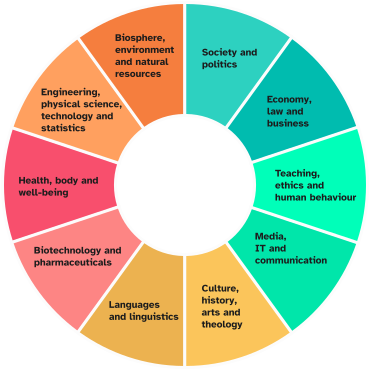
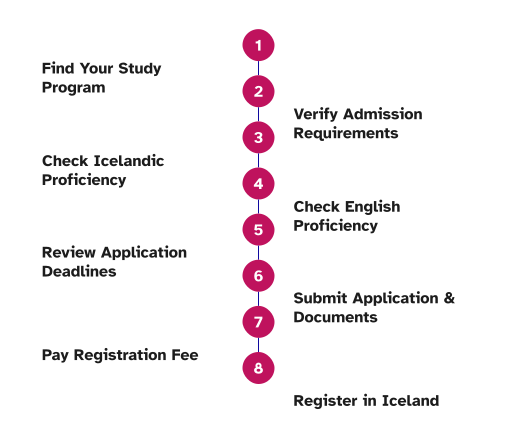

Additional information

The University of Iceland collaborates with over 400 universities worldwide. This provides a unique opportunity to pursue part of your studies at an international university thus gaining added experience and fresh insight into your field of study.

Students generally have the opportunity to join an exchange programme, internship, or summer courses. However, exchanges are always subject to faculty approval.

Students have the opportunity to have courses evaluated as part of their studies at the University of Iceland, so their stay does not have to affect the duration of their studies.

This degree can open opportunities in:

  • Publishing
  • Media
  • Advertising and PR
  • Cultural activities

This list is not exhaustive.

  • Torfhildur is the organisation for literature students at the University of Iceland.
  • The organisation aims to foster a strong student community, both within the subject and across the University, as well as advocating for student interests. Torfhildur also organises various events throughout the academic year, such as workplace tours, theatre performances, a Halloween party, an annual gala, a Christmas party, new student socials and poetry evenings.
  • Torfhildur page on Facebook

More about the UI student's social life

Students' comments
""
Starting in comparative literature, I initially thought it would be about reading literary classics daily, but it expanded my skills to interpret texts critically and understand literary analysis tools, applicable beyond literature.
Helpful content
Aurora Cooperation

Study wheel

What interests you?

Aurora Cooperation

How to apply

Follow the path

Contact us

If you still have questions, feel free to contact us.

School of Humanities
Weekdays: 10-12 am and 1-3 pm
General Service and Social Media

The Service Desk is a point of access for all services. You can drop in at the University Centre or use the WebChat at the bottom right of this page.

Follow the School of Humanities on Instagram,   Youtube
and Facebook

""

Share

Did this help?

Why wasn't this information helpful

Limit to 250 characters.