- Do you want a programme that is both theoretical and practical?
- Do you want a programme that builds on an interdisciplinary foundation in psychology, education studies, sociology and economics?
- Are you interested in helping people achieve their goals?
- Do you want to help people learn about their professional and educational options?
Students acquire theoretical and practical knowledge and after graduation will be able to apply for the legally protected protected title of career counsellor.
Career counselling and guidance refers to services aimed at helping people of all ages make decisions about their education and careers. The importance of career counselling has grown as careers and academic options have become more complex and the ever-changing modern labour market makes increasing demands for continuing education. Everyone needs the skills to plan the future of their education and career.
Most courses are taught through face-to-face learning, but students living outside the capital area can apply to attend classes remotely in real time. Some courses are taught through distance learning. There are two face-to-face blocks per semester with mandatory attendance. For further details see the arrangements for each course.
Programme structure
The programme is 120 ECTS and is organised as two years of full-time study or a longer period of part-time study.
The programme is made up of:
- Mandatory courses, 72 ECTS
- Restricted electives, 10 ECTS
- Free electives, 8 ECTS (generally completed in the first semester).
- Final project, 30 ECTS
Please note! The course Quantitative methodology is a prerequisite for students who have completed fewer than 10 ECTS in quantitative methodology at the undergraduate level. It can be taken as an elective course. Students who have already completed at least 10 ECTS in quantitative methodology at the undergraduate level can take other elective courses for 8-10 ECTS.
Students who have completed a diploma in career counselling and guidance can transfer 60 ECTS to the Master's programme.
Course topics include:
- Counselling of groups and individuals
- Multiculturalism and social rights
- IT and communications technology in counselling
- Theories about professional development
- Career and study guidance
- Personal and social challenges
Organisation of teaching
This programme is taught in Icelandic but most textbooks are in English.
Due to restrictions on the number of students, only 40 students will be admitted to the programme.
Main objectives
The programme aims to prepare students to work as career counsellors in diverse settings.
Other
Completing the programme allows you to apply for doctoral studies.
BA, B.Ed or BS degree or equivalent with first class grades. Applicants who have completed studies that are not in one of the following fields of knowledge: Psychology, education and the education system, the relationship between the individual and society or have not completed at least 10 ECTS credits in quantitative methodology, may require one to three courses (maximum 30 ECTS) in the aforementioned areas. If a student needs to add courses, it must take place in parallel with the study. It is not considered part of the actual master's program. Exception: FMÞ001F Quantitative methodology can be used as an elective.
120 ECTS credits have to be completed for the qualification. The programme is organised as a full-time study for two years, but it is possbile to finish the program over a longer period of time.
Mandatory courses are 72 credits (students who have completed less than 10 credits in quantitative methodology from undergraduate studies complete 82 credits in mandatory courses).
Restricted electives are 10 credits in methodology.
Electives are 8 credits.
The program ends with a 30 credits master's project.
Students complete their studies with a MA thesis of 30 ECTS. Students holding a Diploma in Career Counselling and Guidance can have 60 ECTS credits accepted as part of the MA studies.
- CV
- Statement of purpose
- Reference 1, Name and email
- Reference 2, Name and email
- Certified copies of diplomas and transcripts
- Proof of English proficiency
Further information on supporting documents can be found here
Programme structure
Check below to see how the programme is structured.
This programme does not offer specialisations.
- First year
- Fall
- Introduction to quantitative research
- Counselling Theories
- Career development, intervention and programme evaluation
- Practical training I: Introduction
- Elective Course
- Spring 1
- Personal and Social Problems
- Practical Training II: Communication
- Career Developement Theories
- Seminar I
- MA Thesis in Career Counselling and Guidance
Introduction to quantitative research (FMÞ001F)
The main subject of the course is quantitative methods and statistics used in social sciences. The focus will be on research design, sample methods and designing questionnaires. The statistical part will cover descriptive and inferential statistics. Special emphasis will be on factorial ANOVA and multiple regression. Students will get practical training in data analysis using jamovi. Students can use their own data.
Counselling Theories (NSR108F)
The focus of this course is on counselling theories and their effective use in analysing counselling relationships and in planning interventions. Students also analyse their own counselling style. Special emphasis is on the development of counselling theories from psychoanalysis to postmodern counselling theories as well as the influences of cultural diversity and gender on the development of theories and counselling. Historical and ideological foundations of school and career counselling will be presented. Finally, a briew overview will be given over the history of school and career counselling in Iceland.
Career development, intervention and programme evaluation (NSR109F)
The focus is on the development of the Icelandic educational system and its theoretical premises. Research and theories on students' educational progress and school dropout are discussed with emphasis on diversity. Also, students learn about recent trends in career guidance in the neighbouring countries as well as methods in evaluating career counselling outcomes. The course will provide an overview of the Icelandic labour market and main trends.
Practical training I: Introduction (NSR107F)
Students are introduced to the roles of career counsellors working in various settings in a multicultural society. Institutional functions and relations with other professionals along with legal frameworks and policies are also introduced. They get to know the main roles and processes faced by career counsellors, organization of services, ethical guidelines and get insight into their practices. Students need to explore their values, experiences, cultural background and assumptions. This provides the groundwork for a personal theory of career counselling and professional development of students.
Elective Course (NSR035F)
Students choose master’s level courses in their specialization, for example, in the Faculty of Social Sciences, the Faculty of Education, the Faculty of Humanities, or in other faculties of the school.
Personal and Social Problems (NSR203F)
The main subjects of the course are personal and social difficulties of children and youth and developmental courses. Definitions and prevalence of behavioral, emotional and learning difficulties are reviewed, both theoretically and according to international classification systems. Also, youth risk taking is discussed with emphasis on theories on resilience and preventions. The diversity of different groups is stressed. Students get acquainted with evidenced based resources.
Practical Training II: Communication (NSR210F)
Students continue exploring the roles of career counsellors, organization of their work and practical approaches. Key features of the digital society are introduced and how they play out in the exploration of careers and counseling methods. Theories of motivation, self- regulation, self- efficacy and how to support students’ study habits are introduced. Interviewing skills, with focus on of active listening are practiced. Counseling communication models and the client-counseling relationship are addressed. The role of career counselors in multicultural society is integrated into all topics.
Career Developement Theories (NSR212F)
Theories of career development and construction are at the core of this course, with emphasis on the latest theoretical contributions in the field. The scientific foundations of career development theories are thoroughly discussed. Application of theories in career counseling and guidance is emphasized, methods and tools. Research based on career development theories and their application are introduced and evaluated. Current theoretical concerns and disputes are discussed.
Seminar I (NSR213F)
Seminar
MA Thesis in Career Counselling and Guidance (NSR441L)
MA Thesis
- Second year
- Fall
- Quantitative Methods I
- Introduction to Qualitative Research
- Seminar II
- MA Thesis in Career Counselling and Guidance
- Spring 1
- MA Thesis in Career Counselling and Guidance
- Practical Training III: Society
- Practical training: Guidance
- Summer
- MA Thesis in Career Counselling and Guidance
Quantitative Methods I (MVS302F)
Objective
Students should understand and be able to apply the most common statistical methods for data analysis and be capable of evaluating statistical results. The student should possess the skills and knowledge to analyze and communicate numerical information according to the APA-7 publication standard (e.g., in a scientific journal article or thesis) and be able to take initiative in statistical data processing. Additionally, students will be introduced to the main research designs in quantitative methodology.
Content and Topics
The course will cover quantitative research methods and various research designs. In the statistics portion, the main emphasis will be on the structure and interpretation of the general linear model, which encompasses a range of classical statistical methods such as correlation, regression analysis, and analysis of variance (ANOVA). Students will also learn to apply exploratory and confirmatory factor analysis methods. Finally, students will be introduced to single-case designs, the basic principles of Bayesian statistics, and total survey error assessment. Students will learn to perform analyses using statistical software. Strong emphasis will be placed on clear interpretation and communication of quantitative results according to the APA-7 publication standard.
Teaching Method
The course is taught weekly via online meetings, except for two in-person sessions (see weekly schedule), where students and instructors are expected to attend physically. Students may apply for an exemption from attending in person if they live very far away (e.g., residing abroad). Such students will participate in the in-person sessions via remote connection. Students must have the latest stable version of Jamovi (see jamovi.org) installed on their laptops, which they should bring to class.
Introduction to Qualitative Research (FMÞ103F)
The course’s objective is to introduce students to the diverse, academic criteria of qualitative research in social sciences and secondly that student’s gain experience in using qualitative methods. Furthermore, the course is practical in nature where each student works on an independent research assignment, which consists of designing and preparing a research project, collecting and analyzing data, and writing the main findings with guidance from the teacher. Research preparation, the creation of a research plan, data collection and analysis along with academic writing will be extensively covered during the course.
Seminar II (NSR308F)
Seminar
MA Thesis in Career Counselling and Guidance (NSR441L)
MA Thesis
MA Thesis in Career Counselling and Guidance (NSR441L)
MA Thesis
Practical Training III: Society (NSR411F)
Focus is on counseling communication with clients and interview stages. Models and concepts applied in counseling interviews are thoroughly discussed and practiced along with multicultural communication. Discussion on counseling process is continued and students tought to evaluate own communication style and approached in client and other relations. Diverse methods to evaluate client stories and problems and common goal settings in counseling addressed. Group counseling approaches and counseling in digital communities are introduced and practiced. Emphasis on reflective practice and professional development of students as career and guidance counselor is continued. Ethical issues are addressed through the course.
Practical training: Guidance (NSR412F)
The major aim of the course is to connect theories, methods and practice in career counselling. Special focus is also on group work and systems in counselling, use of assessment instruments and ethical issues. The institutional and social barriers people experience in their career development path will also be discussed. Additionally, attention will be paid to the professional development of the student as a career counsellor in a multicultural society. Students work under the supervision of experienced career counsellors for 200 hours in their practicum placements (elementary/high school, comprehensive school/gymnasium, University, job-market/adult education).
MA Thesis in Career Counselling and Guidance (NSR441L)
MA Thesis
- Fall
- FMÞ001FIntroduction to quantitative researchRestricted elective course10Restricted elective course, conditions apply10 ECTS, creditsCourse Description
The main subject of the course is quantitative methods and statistics used in social sciences. The focus will be on research design, sample methods and designing questionnaires. The statistical part will cover descriptive and inferential statistics. Special emphasis will be on factorial ANOVA and multiple regression. Students will get practical training in data analysis using jamovi. Students can use their own data.
Face-to-face learningPrerequisitesNSR108FCounselling TheoriesMandatory (required) course10A mandatory (required) course for the programme10 ECTS, creditsCourse DescriptionThe focus of this course is on counselling theories and their effective use in analysing counselling relationships and in planning interventions. Students also analyse their own counselling style. Special emphasis is on the development of counselling theories from psychoanalysis to postmodern counselling theories as well as the influences of cultural diversity and gender on the development of theories and counselling. Historical and ideological foundations of school and career counselling will be presented. Finally, a briew overview will be given over the history of school and career counselling in Iceland.
Face-to-face learningPrerequisitesNSR109FCareer development, intervention and programme evaluationMandatory (required) course10A mandatory (required) course for the programme10 ECTS, creditsCourse DescriptionThe focus is on the development of the Icelandic educational system and its theoretical premises. Research and theories on students' educational progress and school dropout are discussed with emphasis on diversity. Also, students learn about recent trends in career guidance in the neighbouring countries as well as methods in evaluating career counselling outcomes. The course will provide an overview of the Icelandic labour market and main trends.
Face-to-face learningPrerequisitesNSR107FPractical training I: IntroductionMandatory (required) course2A mandatory (required) course for the programme2 ECTS, creditsCourse DescriptionStudents are introduced to the roles of career counsellors working in various settings in a multicultural society. Institutional functions and relations with other professionals along with legal frameworks and policies are also introduced. They get to know the main roles and processes faced by career counsellors, organization of services, ethical guidelines and get insight into their practices. Students need to explore their values, experiences, cultural background and assumptions. This provides the groundwork for a personal theory of career counselling and professional development of students.
Face-to-face learningPrerequisitesAttendance required in classCourse taught first half of the semesterCourse DescriptionStudents choose master’s level courses in their specialization, for example, in the Faculty of Social Sciences, the Faculty of Education, the Faculty of Humanities, or in other faculties of the school.
Prerequisites- Spring 2
NSR203FPersonal and Social ProblemsMandatory (required) course10A mandatory (required) course for the programme10 ECTS, creditsCourse DescriptionThe main subjects of the course are personal and social difficulties of children and youth and developmental courses. Definitions and prevalence of behavioral, emotional and learning difficulties are reviewed, both theoretically and according to international classification systems. Also, youth risk taking is discussed with emphasis on theories on resilience and preventions. The diversity of different groups is stressed. Students get acquainted with evidenced based resources.
Face-to-face learningPrerequisitesNSR210FPractical Training II: CommunicationMandatory (required) course6A mandatory (required) course for the programme6 ECTS, creditsCourse DescriptionStudents continue exploring the roles of career counsellors, organization of their work and practical approaches. Key features of the digital society are introduced and how they play out in the exploration of careers and counseling methods. Theories of motivation, self- regulation, self- efficacy and how to support students’ study habits are introduced. Interviewing skills, with focus on of active listening are practiced. Counseling communication models and the client-counseling relationship are addressed. The role of career counselors in multicultural society is integrated into all topics.
Face-to-face learningDistance learningPrerequisitesCourse taught first half of the semesterNSR212FCareer Developement TheoriesMandatory (required) course10A mandatory (required) course for the programme10 ECTS, creditsCourse DescriptionTheories of career development and construction are at the core of this course, with emphasis on the latest theoretical contributions in the field. The scientific foundations of career development theories are thoroughly discussed. Application of theories in career counseling and guidance is emphasized, methods and tools. Research based on career development theories and their application are introduced and evaluated. Current theoretical concerns and disputes are discussed.
Face-to-face learningDistance learningPrerequisitesNSR213FSeminar IMandatory (required) course0A mandatory (required) course for the programme0 ECTS, creditsCourse DescriptionSeminar
Face-to-face learningPrerequisitesNSR441LMA Thesis in Career Counselling and GuidanceMandatory (required) course0A mandatory (required) course for the programme0 ECTS, creditsCourse DescriptionMA Thesis
Self-studyPrerequisitesPart of the total project/thesis credits- Fall
- MVS302FQuantitative Methods IRestricted elective course10Restricted elective course, conditions apply10 ECTS, creditsCourse Description
Objective
Students should understand and be able to apply the most common statistical methods for data analysis and be capable of evaluating statistical results. The student should possess the skills and knowledge to analyze and communicate numerical information according to the APA-7 publication standard (e.g., in a scientific journal article or thesis) and be able to take initiative in statistical data processing. Additionally, students will be introduced to the main research designs in quantitative methodology.
Content and Topics
The course will cover quantitative research methods and various research designs. In the statistics portion, the main emphasis will be on the structure and interpretation of the general linear model, which encompasses a range of classical statistical methods such as correlation, regression analysis, and analysis of variance (ANOVA). Students will also learn to apply exploratory and confirmatory factor analysis methods. Finally, students will be introduced to single-case designs, the basic principles of Bayesian statistics, and total survey error assessment. Students will learn to perform analyses using statistical software. Strong emphasis will be placed on clear interpretation and communication of quantitative results according to the APA-7 publication standard.
Teaching Method
The course is taught weekly via online meetings, except for two in-person sessions (see weekly schedule), where students and instructors are expected to attend physically. Students may apply for an exemption from attending in person if they live very far away (e.g., residing abroad). Such students will participate in the in-person sessions via remote connection. Students must have the latest stable version of Jamovi (see jamovi.org) installed on their laptops, which they should bring to class.
Distance learningPrerequisitesAttendance required in classFMÞ103FIntroduction to Qualitative ResearchRestricted elective course10Restricted elective course, conditions apply10 ECTS, creditsCourse DescriptionThe course’s objective is to introduce students to the diverse, academic criteria of qualitative research in social sciences and secondly that student’s gain experience in using qualitative methods. Furthermore, the course is practical in nature where each student works on an independent research assignment, which consists of designing and preparing a research project, collecting and analyzing data, and writing the main findings with guidance from the teacher. Research preparation, the creation of a research plan, data collection and analysis along with academic writing will be extensively covered during the course.
Face-to-face learningDistance learningPrerequisitesNSR308FSeminar IIMandatory (required) course0A mandatory (required) course for the programme0 ECTS, creditsCourse DescriptionSeminar
Face-to-face learningPrerequisitesNSR441LMA Thesis in Career Counselling and GuidanceMandatory (required) course0A mandatory (required) course for the programme0 ECTS, creditsCourse DescriptionMA Thesis
Self-studyPrerequisitesPart of the total project/thesis credits- Spring 2
NSR441LMA Thesis in Career Counselling and GuidanceMandatory (required) course0A mandatory (required) course for the programme0 ECTS, creditsCourse DescriptionMA Thesis
Self-studyPrerequisitesPart of the total project/thesis creditsNSR411FPractical Training III: SocietyMandatory (required) course8A mandatory (required) course for the programme8 ECTS, creditsCourse DescriptionFocus is on counseling communication with clients and interview stages. Models and concepts applied in counseling interviews are thoroughly discussed and practiced along with multicultural communication. Discussion on counseling process is continued and students tought to evaluate own communication style and approached in client and other relations. Diverse methods to evaluate client stories and problems and common goal settings in counseling addressed. Group counseling approaches and counseling in digital communities are introduced and practiced. Emphasis on reflective practice and professional development of students as career and guidance counselor is continued. Ethical issues are addressed through the course.
Face-to-face learningDistance learningPrerequisitesAttendance required in classCourse taught first half of the semesterNSR412FPractical training: GuidanceMandatory (required) course16A mandatory (required) course for the programme16 ECTS, creditsCourse DescriptionThe major aim of the course is to connect theories, methods and practice in career counselling. Special focus is also on group work and systems in counselling, use of assessment instruments and ethical issues. The institutional and social barriers people experience in their career development path will also be discussed. Additionally, attention will be paid to the professional development of the student as a career counsellor in a multicultural society. Students work under the supervision of experienced career counsellors for 200 hours in their practicum placements (elementary/high school, comprehensive school/gymnasium, University, job-market/adult education).
Face-to-face learningPrerequisitesAttendance required in class- Summer
NSR441LMA Thesis in Career Counselling and GuidanceMandatory (required) course0A mandatory (required) course for the programme0 ECTS, creditsCourse DescriptionMA Thesis
Face-to-face learningPrerequisitesAttendance required in classSecond year- Fall
- FMÞ001FIntroduction to quantitative researchRestricted elective course10Restricted elective course, conditions apply10 ECTS, creditsCourse Description
The main subject of the course is quantitative methods and statistics used in social sciences. The focus will be on research design, sample methods and designing questionnaires. The statistical part will cover descriptive and inferential statistics. Special emphasis will be on factorial ANOVA and multiple regression. Students will get practical training in data analysis using jamovi. Students can use their own data.
Face-to-face learningPrerequisitesNSR108FCounselling TheoriesMandatory (required) course10A mandatory (required) course for the programme10 ECTS, creditsCourse DescriptionThe focus of this course is on counselling theories and their effective use in analysing counselling relationships and in planning interventions. Students also analyse their own counselling style. Special emphasis is on the development of counselling theories from psychoanalysis to postmodern counselling theories as well as the influences of cultural diversity and gender on the development of theories and counselling. Historical and ideological foundations of school and career counselling will be presented. Finally, a briew overview will be given over the history of school and career counselling in Iceland.
Face-to-face learningPrerequisitesNSR109FCareer development, intervention and programme evaluationMandatory (required) course10A mandatory (required) course for the programme10 ECTS, creditsCourse DescriptionThe focus is on the development of the Icelandic educational system and its theoretical premises. Research and theories on students' educational progress and school dropout are discussed with emphasis on diversity. Also, students learn about recent trends in career guidance in the neighbouring countries as well as methods in evaluating career counselling outcomes. The course will provide an overview of the Icelandic labour market and main trends.
Face-to-face learningPrerequisitesNSR107FPractical training I: IntroductionMandatory (required) course2A mandatory (required) course for the programme2 ECTS, creditsCourse DescriptionStudents are introduced to the roles of career counsellors working in various settings in a multicultural society. Institutional functions and relations with other professionals along with legal frameworks and policies are also introduced. They get to know the main roles and processes faced by career counsellors, organization of services, ethical guidelines and get insight into their practices. Students need to explore their values, experiences, cultural background and assumptions. This provides the groundwork for a personal theory of career counselling and professional development of students.
Face-to-face learningPrerequisitesAttendance required in classCourse taught first half of the semesterCourse DescriptionStudents choose master’s level courses in their specialization, for example, in the Faculty of Social Sciences, the Faculty of Education, the Faculty of Humanities, or in other faculties of the school.
Prerequisites- Spring 2
NSR203FPersonal and Social ProblemsMandatory (required) course10A mandatory (required) course for the programme10 ECTS, creditsCourse DescriptionThe main subjects of the course are personal and social difficulties of children and youth and developmental courses. Definitions and prevalence of behavioral, emotional and learning difficulties are reviewed, both theoretically and according to international classification systems. Also, youth risk taking is discussed with emphasis on theories on resilience and preventions. The diversity of different groups is stressed. Students get acquainted with evidenced based resources.
Face-to-face learningPrerequisitesNSR210FPractical Training II: CommunicationMandatory (required) course6A mandatory (required) course for the programme6 ECTS, creditsCourse DescriptionStudents continue exploring the roles of career counsellors, organization of their work and practical approaches. Key features of the digital society are introduced and how they play out in the exploration of careers and counseling methods. Theories of motivation, self- regulation, self- efficacy and how to support students’ study habits are introduced. Interviewing skills, with focus on of active listening are practiced. Counseling communication models and the client-counseling relationship are addressed. The role of career counselors in multicultural society is integrated into all topics.
Face-to-face learningDistance learningPrerequisitesCourse taught first half of the semesterNSR212FCareer Developement TheoriesMandatory (required) course10A mandatory (required) course for the programme10 ECTS, creditsCourse DescriptionTheories of career development and construction are at the core of this course, with emphasis on the latest theoretical contributions in the field. The scientific foundations of career development theories are thoroughly discussed. Application of theories in career counseling and guidance is emphasized, methods and tools. Research based on career development theories and their application are introduced and evaluated. Current theoretical concerns and disputes are discussed.
Face-to-face learningDistance learningPrerequisitesNSR213FSeminar IMandatory (required) course0A mandatory (required) course for the programme0 ECTS, creditsCourse DescriptionSeminar
Face-to-face learningPrerequisitesNSR441LMA Thesis in Career Counselling and GuidanceMandatory (required) course0A mandatory (required) course for the programme0 ECTS, creditsCourse DescriptionMA Thesis
Self-studyPrerequisitesPart of the total project/thesis credits- Fall
- MVS302FQuantitative Methods IRestricted elective course10Restricted elective course, conditions apply10 ECTS, creditsCourse Description
Objective
Students should understand and be able to apply the most common statistical methods for data analysis and be capable of evaluating statistical results. The student should possess the skills and knowledge to analyze and communicate numerical information according to the APA-7 publication standard (e.g., in a scientific journal article or thesis) and be able to take initiative in statistical data processing. Additionally, students will be introduced to the main research designs in quantitative methodology.
Content and Topics
The course will cover quantitative research methods and various research designs. In the statistics portion, the main emphasis will be on the structure and interpretation of the general linear model, which encompasses a range of classical statistical methods such as correlation, regression analysis, and analysis of variance (ANOVA). Students will also learn to apply exploratory and confirmatory factor analysis methods. Finally, students will be introduced to single-case designs, the basic principles of Bayesian statistics, and total survey error assessment. Students will learn to perform analyses using statistical software. Strong emphasis will be placed on clear interpretation and communication of quantitative results according to the APA-7 publication standard.
Teaching Method
The course is taught weekly via online meetings, except for two in-person sessions (see weekly schedule), where students and instructors are expected to attend physically. Students may apply for an exemption from attending in person if they live very far away (e.g., residing abroad). Such students will participate in the in-person sessions via remote connection. Students must have the latest stable version of Jamovi (see jamovi.org) installed on their laptops, which they should bring to class.
Distance learningPrerequisitesAttendance required in classFMÞ103FIntroduction to Qualitative ResearchRestricted elective course10Restricted elective course, conditions apply10 ECTS, creditsCourse DescriptionThe course’s objective is to introduce students to the diverse, academic criteria of qualitative research in social sciences and secondly that student’s gain experience in using qualitative methods. Furthermore, the course is practical in nature where each student works on an independent research assignment, which consists of designing and preparing a research project, collecting and analyzing data, and writing the main findings with guidance from the teacher. Research preparation, the creation of a research plan, data collection and analysis along with academic writing will be extensively covered during the course.
Face-to-face learningDistance learningPrerequisitesNSR308FSeminar IIMandatory (required) course0A mandatory (required) course for the programme0 ECTS, creditsCourse DescriptionSeminar
Face-to-face learningPrerequisitesNSR441LMA Thesis in Career Counselling and GuidanceMandatory (required) course0A mandatory (required) course for the programme0 ECTS, creditsCourse DescriptionMA Thesis
Self-studyPrerequisitesPart of the total project/thesis credits- Spring 2
NSR441LMA Thesis in Career Counselling and GuidanceMandatory (required) course0A mandatory (required) course for the programme0 ECTS, creditsCourse DescriptionMA Thesis
Self-studyPrerequisitesPart of the total project/thesis creditsNSR411FPractical Training III: SocietyMandatory (required) course8A mandatory (required) course for the programme8 ECTS, creditsCourse DescriptionFocus is on counseling communication with clients and interview stages. Models and concepts applied in counseling interviews are thoroughly discussed and practiced along with multicultural communication. Discussion on counseling process is continued and students tought to evaluate own communication style and approached in client and other relations. Diverse methods to evaluate client stories and problems and common goal settings in counseling addressed. Group counseling approaches and counseling in digital communities are introduced and practiced. Emphasis on reflective practice and professional development of students as career and guidance counselor is continued. Ethical issues are addressed through the course.
Face-to-face learningDistance learningPrerequisitesAttendance required in classCourse taught first half of the semesterNSR412FPractical training: GuidanceMandatory (required) course16A mandatory (required) course for the programme16 ECTS, creditsCourse DescriptionThe major aim of the course is to connect theories, methods and practice in career counselling. Special focus is also on group work and systems in counselling, use of assessment instruments and ethical issues. The institutional and social barriers people experience in their career development path will also be discussed. Additionally, attention will be paid to the professional development of the student as a career counsellor in a multicultural society. Students work under the supervision of experienced career counsellors for 200 hours in their practicum placements (elementary/high school, comprehensive school/gymnasium, University, job-market/adult education).
Face-to-face learningPrerequisitesAttendance required in class- Summer
NSR441LMA Thesis in Career Counselling and GuidanceMandatory (required) course0A mandatory (required) course for the programme0 ECTS, creditsCourse DescriptionMA Thesis
Face-to-face learningPrerequisitesAttendance required in class
Additional information The University of Iceland collaborates with over 400 universities worldwide. This provides a unique opportunity to pursue part of your studies at an international university thus gaining added experience and fresh insight into your field of study.
Students generally have the opportunity to join an exchange programme, internship, or summer courses. However, exchanges are always subject to faculty approval.
Students have the opportunity to have courses evaluated as part of their studies at the University of Iceland, so their stay does not have to affect the duration of their studies.
- The Student Counselling and Career Centre
- The education system
- Lifelong learning centres
- Employment agencies
- Businesses
- The public sector
This list is not exhaustive
The organisation for career counselling and guidance students is called Filia. Filia plans social events for students, protects their interests and represents them within and outside the University.
Student´s comments
Graduating in 2008, I primarily assist people in job searching and career development. The programme provided excellent preparation for understanding career paths and overcoming common job search obstacles. I love my job and feel privileged to support individuals during significant life transitions.
Career Counselling and Guidance is essential in both school and professional life, aligning with our work in vocational guidance for individuals aged 18 to 70, where expertise is crucial.
This challenging yet engaging programme blends theory and practical training. It was crucial for my diverse work with university students, aiding their academic and career decisions. The programme is versatile, benefiting various career paths.
Studying Career Counselling and Guidance was both enjoyable and challenging, preparing me well for professionalism in my current role. The programme broadened my knowledge extensively, both academically and personally, supported by dedicated teachers and peers. The mix of classroom learning and field experience was immensely valuable, fostering lifelong friendships and professional networking.
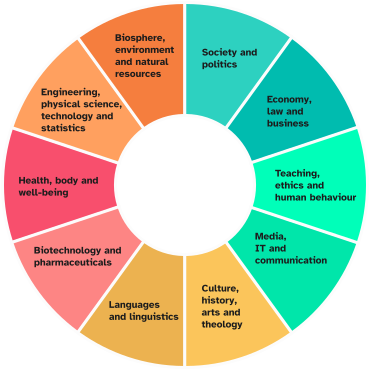
The programme is enjoyable and interesting with excellent teaching and support. Field experience and diverse career opportunities make it a promising and exciting field.Helpful content Study wheel
What interests you?
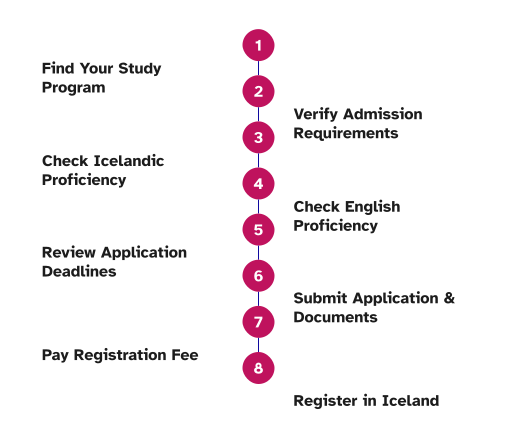
How to apply
Follow the path
Contact us If you still have questions, feel free to contact us.
School of Social SciencesWeekdays 9 am - 3 pmStudent and Teaching ServiceThe School office offers support to students and lecturers, providing guidance, counselling, and assistance with various matters.
You are welcome to drop by at the office in Gimli or you can book an online meeting in Teams with the staff.
Share