Random people
Language skills
required, minimum level of B2
Programme length
2 years.
Study mode
Face-to-face learning
Application status
International students:
Students with Icelandic or Nordic citizenship:
Overview

  • Do you enjoy viewing and analysing works of art?
  • Do you want a programme that involves travelling abroad to major art events?
  • Do you want a more in-depth knowledge of art history and theory?
  • Do you want to develop the expertise required to evaluate, analyse and collect data on modern art?
  • Are you looking for a stimulating graduate programme?

The MA in art history and theory is a two-year graduate programme, combining academic working practices, research and theoretical study.

The programme is based on epistemological and research-based courses, as well as independent research projects, with particular emphasis placed on subjects related to Icelandic art history in an international academic context. Students are expected to actively collaborate with museums in Iceland for individual courses, giving them the opportunity to get to know the professional environment and conduct research in art history from the middle ages to the present day.

Programme structure

The programme is 120 ECTS and is organised as two years of full-time study.

The programme is made up of:

  • Mandatory courses, 20 ECTS
  • Restricted electives, 30 ECTS
  • Free electives, 40 ECTS
  • Master's thesis, 30 ECTS

Organisation of teaching

The programme is taught in Icelandic. Most textbooks are in English or other foreign languages.

Students organise their study in consultation with a tenured instructor in the subject.

Main objectives

After completing the programme, students should, for example:

  • have improved their academic skills and acquired a more in-depth knowledge of art theory.
  • have acquired an understanding of the latest knowledge in their field.
  • be aware of the main opportunities for disseminating information about art in contemporary society.
  • have acquired the independent working practices necessary to be able to take on doctoral studies.

Other

The programme confers an MA degree in art history and theory.

Completing an MA at the Faculty of Icelandic and Comparative Cultural Studies allows you to apply for doctoral studies in your chosen subject.

Completing a BA with a first class grade, including a final project for at least 10 ECTS, grants a student access to the second cycle of higher education.

The Master's programme in art history and theory is a two-year (four-semester) 120 ECTS postgraduate programme, combining academic working practices, research and theoretical study. The programme confers an MA degree in art history and theory. Students organise their study in consultation with a tenured instructor in the subject. There are two components to the programme. Courses account for a total of 90 ECTS, including research projects, in addition to a 30 ECTS MA thesis. Students may take a maximum of 30 ECTS in M-courses. Courses are divided into core courses in art history and theory (20 ECTS), restricted electives within the subject (30 ECTS) and elective courses shared with other Master's programmes at UI.

The following documents must accompany an application for this programme:
  • Statement of purpose
  • Certified copies of diplomas and transcripts

Further information on supporting documents can be found here

Programme structure

Check below to see how the programme is structured.

This programme does not offer specialisations.

First year | Fall
Art and History: The formation of Artworlds (LIS709F)
A mandatory (required) course for the programme
10 ECTS, credits
Course Description

In recent decades, theoretical contexts of art historiography and art criticism have been thoroughly reexamined. New theories, new data and digital technologies have led to a drastic change in research questions and approaches. Critical concepts such as intersectionality, inclusion, sustainability, social activism, and environment have led to new methodologies and different perspectives. In this course, these approaches will be discussed though reading the latest research in the field of art and cultural history. Ideas about the global artworlds and its cultural and political connections will be examined in detail, a variety of topics will be discussed and dissected in writing.

Language of instruction: Icelandic
Face-to-face learning
Not taught this semester
First year | Fall
Contemporary art and society (LIS701F)
A mandatory (required) course for the programme
10 ECTS, credits
Course Description

In a historical context art has been the facet of society where innovation and progressive thinking has been of most value. This forward-looking aspect of art has non-the-less always depended upon its historical precedents—previous art practice. It is in this context that contemporary artists are constantly renewing their previous premises. At the same time contemporary art worlds are by nature complex structures—an increasing mix of different media and influences, where artists of necessity are informed by theoretical, social, political, and economic premises. In accord with that, contemporary cultural premises are in constant flux, dependent upon changes in technology, urbanisation, globalisation, and climate, in addition to a more volatile political field. It is in response to these issues that the nature of artistic practice is constantly changing. For these reasons it is adamant to constantly re-conceptualise the analysis of art and its function in society, where novel ideas and definitions, such as the 'Anthropocene' and the 'posthuman', can be utilised to understand better the situation of art in human society. In this course we re-examine the theoretical premises of contemporary art practice via research of the field of art—historical and contemporary—through research based on the interplay of art with diverse fields of study: history, philosophy, literature, media and film studies, anthropology, political theory, geography, sociology.

Language of instruction: Icelandic/English
Face-to-face learning
First year | Spring 1
Art Criticism and Curation (LIS805F)
A mandatory (required) course for the programme
10 ECTS, credits
Course Description

The course lays the foundation for the active work of curators for practical work in the field of art and museums. We work in an interdisciplinary and critical way with concepts and theories that relate to the work of curators in the field of contemporary art. Students work in teams and set up an exhibition in collaboration with art students or artists. Students will apply knowledge and methods to practical issues, work on preparation, design, text writing and preparation of promotional material in connection with an exhibition. The course is partly run in collaboration with the Master's program in art at the University of Iceland, and students will have the opportunity to collaborate with the University of Iceland Art Museum and other recognised art museums.

Language of instruction: Icelandic/English
Face-to-face learning
Second year | Fall
Art and History: The formation of Artworlds (LIS709F)
A mandatory (required) course for the programme
10 ECTS, credits
Course Description

In recent decades, theoretical contexts of art historiography and art criticism have been thoroughly reexamined. New theories, new data and digital technologies have led to a drastic change in research questions and approaches. Critical concepts such as intersectionality, inclusion, sustainability, social activism, and environment have led to new methodologies and different perspectives. In this course, these approaches will be discussed though reading the latest research in the field of art and cultural history. Ideas about the global artworlds and its cultural and political connections will be examined in detail, a variety of topics will be discussed and dissected in writing.

Language of instruction: Icelandic
Face-to-face learning
Second year | Fall
Final project (LIS441L)
A mandatory (required) course for the programme
0 ECTS, credits
Course Description

MA-thesis 

Language of instruction: Icelandic
Part of the total project/thesis credits
Second year | Spring 1
Final project (LIS441L)
A mandatory (required) course for the programme
0 ECTS, credits
Course Description

MA-thesis 

Language of instruction: Icelandic
Part of the total project/thesis credits
Year unspecified | Fall
The Cold War: Art, culture and literature (LIS710F)
Restricted elective course, conditions apply
10 ECTS, credits
Course Description

The course explores the relationship between political and aesthetic discourse in Iceland during the era of the cultural Cold War, a global ideological struggle waged by the two superpowers, the United States and the Soviet Union, for the hearts and minds of populations around the world in the latter half of the 20th century. The course draws on interdisciplinary research on the Cold War, with a focus on the interplay between global influences and local conditions. This glocal approach allows for an examination of Icelandic agents in the Cold War not only as representatives of the two empires, the United States and the Soviet Union, but also based on their own cultural values and interests. A mixed methodology will be employed, incorporating theories and methods from the social sciences, as well as from art history, literary studies, and historiography. Special emphasis will be placed on the analysis of literary texts and artworks, while attention will also be given to the participation of Icelandic intellectuals and artists in international cultural activities. Students will explore how the Cold War has been addressed in recent years, both in academic contexts and in public dissemination through exhibitions, podcasts, and graphic novels.

Language of instruction: Icelandic
Year unspecified | Fall
On the esoteric and occult in modern art (LIS512M)
Restricted elective course, conditions apply
5 ECTS, credits
Course Description

Contemporary academic and artist discourses are today bringing forth new narratives about the role that the esoteric, the spiritual, and the occult have played in the history of modern art and culture. What was once disavowed and pushed to the margins or dismissed as the “irrational” folly of dreamers and fools, esoteric ideas, beliefs, practices, and symbols have played an integral part in aesthetic modernism and modern culture in the 19th and 20th centuries, leading into the contemporary moment.  The aim of this course is to provide an introduction to several core esoteric traditions and practices – such as theosophy, magic, alchemy, spiritism, new age spirituality, occulture, etc. - and examine how they interact and impact upon modern art theory and practice. As such, we will explore how art in this regard is not only a medium for the representation and expression of esoteric concepts, it also operates as a site for ritual and experiential occult praxis. Through key works, movements, and artists, the course will look at cultural history with an interdisciplinary gaze that allows for the presence of other art forms such as dance, music, and film.

Language of instruction: English
Face-to-face learning
Prerequisites
Year unspecified | Fall
Theories in Humanities (FOR709F)
Restricted elective course, conditions apply
10 ECTS, credits
Course Description

The aim of the course is to provide students with a more comprehensive and deeper insight into the different theoretical approaches within the humanities. In the course, the main theories that have influenced theoretical discussion in the humanities over the last decades will be presented and discussed, and the students are taught how to apply them in their own research.

Language of instruction: Icelandic/English
Face-to-face learning
Year unspecified | Fall
Writing and Editing (ÍSL101F)
Restricted elective course, conditions apply
10 ECTS, credits
Course Description

Training in various aspects of the writing and editing of scientific texts. Various kinds of texts (non-fiction) examined and evaluated. Training in reviewing and commenting on scientific texts and in other aspects of editorial work. The main emphasis will be on the writing of articles, but other kinds of texts will also be considered, both shorter (conference abstracts, reviews) and longer (theses, books), as well as research proposals. Discussion of guidelines for the preparation of manuscripts. Types of plagiarism and how to avoid them and find them. Texts on different subjects will be used as examples, especially writings in linguistics, literature and history. The book Skrifaðu bæði skýrt og rétt will be used as a textbook (Höskuldur Þráinsson 2015).

This course is open to students of many MA programmes in the School of Humanities, cf. the regulations of the individual subjects. Students in the MA programmes in Icelandic literature, Icelandic linguistics, Icelandic studies and Icelandic teaching can take the course as part of the MA course requirements in Icelandic literature or Icelandic linguistics. Students in the MA programme in Icelandic teaching can, however, not have this course as the only linguistics or literature course in their MA.

Language of instruction: Icelandic
Face-to-face learning
Year unspecified | Fall
Experimental Film and Fine Art (LIS508M)
Restricted elective course, conditions apply
5 ECTS, credits
Course Description

The course provides an introduction to experimental film and film theory within the context of fine art. Various epochs and the critical responses that they provoked are defined and analysed. We look at different theoretical frameworks, such as Modernism, Humanism, Structuralism, Postmodernism, and the Anti-Aesthetic and make use of works by authors such as Kant, Nietzsche, Marx, Lacan, Bazin, Baudrillard, McLuhan and Jameson in order to analyse these. This theoretical framework provides a lens to interpret avant-garde cinema and fine art movements beginning with the emergence of expressionism. The course seeks to interpret the role of individualism via mass media as we explore various artists and filmmakers whose works are relevant in the context of this theoretical framework. Emphasis is placed on the viewing of time-based media that illustrate the various theories presented during the course, with a focus being on artists and filmmakers who have embraced these ideologies within their practice.

Language of instruction: English
Face-to-face learning
Prerequisites
Year unspecified | Fall
Performances, Nature and the Environment: Definitions and Effect of Performance in the Age of the Anthropocene (LIS509M)
Restricted elective course, conditions apply
5 ECTS, credits
Course Description

This course will consider performance art in light of global warming and the contemporary threat to the natural environment. What impact can performance art make in this context? How have artists considered and reacted to the consequences of human activities on the Earth and its ecosystem? The intertwinement of performance art and Land art in the sixties and seventies will be highlighted, and the link between art and political environmental movements discussed. We will examine how contemporary artists around the globe have used performance to shed light on the complex relation of human beings to the environment, the boundaries of human-made and natural environments and the impact of global warming on human societies, on animals and the Earth‘s ecosystem. The environmental movement‘s connections to feminist critiques and indigenous struggle around the globe will be discussed. The definition of performance will be examined and organic processes and nonhuman activities within art will be considered in light of contemporary radical philosophies.

Language of instruction: Icelandic
Prerequisites
Year unspecified | Fall
Practice based fieldwork I (LIS601F)
Restricted elective course, conditions apply
5 ECTS, credits
Course Description

The the aim of the individual practice based research work is to become familiar with reserch and mediation in a museum, a gallery or other art institution, such as the University of Iceland Art Collection. It can also be carried out within an art institution abroad.

Language of instruction: Icelandic
Year unspecified | Fall
Artists' books and networks (LIS604M)
Restricted elective course, conditions apply
5 ECTS, credits
Course Description

Artists’ books by Icelandic and foreign artists from the 1960s until the present are the subject of this course. Some sixty years ago a movement of artists who focused on the production of books as artworks took form. They exchanged books by mail and in doing so created a transnational network to foster radical new ideas on art, society and culture. Some Icelandic artists were quick to embrace this new art form, thus laying the groundwork for a tradition that later generations of artists have used to disseminate their art and nurture communication with progressive artists around the world. In the course we will examine this important aspect of contemporary Icelandic art, and try to reveal the important role that artists’ books played in ending the isolation of Icelandic artists and allowing them to become active participants in the international avant-garde. Emphasis will also be placed on identifying the uniqueness of artists´ books, as well as the context of diverse media used by artists and the overlap with other art forms: poetry, music, the performing arts, etc. We will focus on researching the interplay of visual elements and text in artists´ books and the shift in perception that occurs when different art forms are placed together in a book. We work with various artists´ books, artists´ writing about their own work as well as theoretical context. Emphasis is placed on independent student practice, artistic creation and new research on artists’ books.

Language of instruction: English
Prerequisites
Year unspecified | Fall
Practice based fieldwork II (LIS708F)
Restricted elective course, conditions apply
5 ECTS, credits
Course Description

The the aim of the individual practice based research work is to become familiar with reserch and mediation in a museum, a gallery or other art institution, such as the University of Iceland Art Collection. It can also be carried out within an art institution abroad.

Language of instruction: Icelandic
Year unspecified | Fall
Museums as a learning environment (SAF016F)
Free elective course within the programme
10 ECTS, credits
Course Description

One of the main purposes of Icelandic museums is to preserve the country's cultural and natural heritage for future generations. Furthermore, to encourage increased knowledge of this heritage and understanding of its connections to the outside world. According to Icelandic museum laws, museums are expected to "enhance people's quality of life" by fostering an understanding of the development and status of culture, art, nature, and/or science. Therefore, museums and museum education can impact society, groups, and individuals. Museology plays a key role in this context and is the main subject of this course.

Students will be introduced to theoretical approaches aimed at supporting diverse and impactful educational practices related to archaeology, art, natural sciences, cultural heritage, and other museum subjects. Attention will be given to the different target audiences of museum education, the role of visitors within museums, spatial considerations, text production, multimedia, interactivity, and more.

This is a distance-learning course divided into three modules. Each module includes short lectures by the instructor reflecting on the course material, guest lectures (delivered digitally), and supplementary materials. Over the semester, three in-person and/or Zoom sessions will be held, where students will receive lectures from museum professionals and work on an educational project in collaboration with a museum in Reykjavík. The project will be developed based on students’ academic interests, under the supervision of the instructor and with support from museum staff.

Language of instruction: Icelandic
Distance learning
Year unspecified | Fall
Radio production and podcasting (HMM235F)
Free elective course within the programme
10 ECTS, credits
Course Description

The course is run in cooperation with the state radio station: RÚV - Rás 1. Discussion will take place into the presentation of radio/audio material, various examples being examined. Attention will be given to the nature of audio communication and the possibilities of audio communication in the present media environment. Attention is also paid to concept development, interview techniques, recording techniques, dramaturgy and editing, accentuating sustainability and self-reliance. All students will complete a final project involving the making of radio programmes.

Language of instruction: Icelandic
Face-to-face learning
Year unspecified | Fall
Cultural Studies and Social Critique (MFR701F)
Free elective course within the programme
10 ECTS, credits
Course Description

The course reviews cultural studies on the whole and focuses on its value as a radical form of social and cultural criticism. Texts of key authors from the 19th Century and until recent years are discussed with the very concept of culture as a central issue and the question of its meaning for critical reflexion on society, history and contemporaneity. The interpellation of cultural criticism and the study of culture is scrutinized and the way in which this relationship is central for cultural studies. This conflict, which can be felt in older and recent texts has for the last decades been a fertile ground for the humanities in general and characterizes their connection to cultural politics. Concepts such as ideology, power, hegemony, gender and discourse play a central role in the discussion.

Language of instruction: English
Face-to-face learning
Year unspecified | Fall
Fundamentals in Web Communications (RÚT704F)
Free elective course within the programme
10 ECTS, credits
Course Description

Constant technological development and emphasis on digital solutions has brought about frequent and numerous changes in the role of the webmaster. In this course, Efforts will be made to provide students with good insight into the main aspects of the webmaster's work. The writings of experts and scholars will be examined, and students will be introduced to the necessary tools and equipment. Professionals in the field will visit and share their experience with students.

The job of a web editor is often integrated with general web management. Students get a good insight into web editing and writing for digital media. The main aspects that a webmaster / web editor needs to be able to master will be discussed, such as information architecture, writing for the web, presentation of images, fundamentals in web design, accessibility, usability, security, analytics, content management systems (CMS), and basic web interface technology.

Students set up their own websites and use a CMS of their choice, e.g., WordPress or Wix, which are both available in free versions, and some of the assignments are submitted on there. In this way, students gain training in setting up a simple website. Particular attention is drawn to the fact that instruction in the use of the CMS is not part of the course. Those who have no or limited experience, in the use of CMS, are advised that YouTube has numerous videos where you can learn about the systems, from the basics to much more complex aspects that are expected in this course.

Language of instruction: Icelandic
Face-to-face learning
Not taught this semester
Year unspecified | Fall
Performance Studies (ÞJÓ107F)
Free elective course within the programme
10 ECTS, credits
Course Description

Performance Studies is the study of how humans create meaning and identity through shared activities ranging from traditional ritual and religion to storytelling and the arts as well as sports, stand-up comedy, festivals, masking traditions, civic ceremonies, political action and protest, dinner parties, and the virtual world. The course introduces students to theories about the wide range of semiotics involved in performance, from spoken text, to costume and appearance, expression and gesture, gender, social contexts, timing and use of space, as well as audience reception.

Language of instruction: English
Face-to-face learning
Distance learning
Not taught this semester
Year unspecified | Fall
Cultural Heritage (ÞJÓ506M)
Free elective course within the programme
10 ECTS, credits
Course Description

What is cultural heritage and what purpose does it serve? Why does it always seem to be endangered? How does it tie together the past and the present? What's it got to do with the nation and the state? Historical consciousness? Globalization? Capitalism? Politics? The course will seek to answer these questions with reference to new research in folklore, ethnology, anthropology, art history, sociology, museology, history and archaeology and with a view to understanding what is going on in this expanding field of study.

Language of instruction: Icelandic
Face-to-face learning
Distance learning
Prerequisites
Year unspecified | Spring 1
Practicing the Future: Diverging the colonical present (LIS612M)
Restricted elective course, conditions apply
5 ECTS, credits
Course Description

This course examines how contemporary artists respond to and reimagine futures shaped by white supremacy, the colonial legacy, and capitalist systems of power. Rather than treating the future as abstract or technological, we approach it as a site of struggle, a space where dominant power systems extend themselves, and where others imagine, rehearse, and refuse.  Drawing from Co-futurism, Radical Futurism and decolonial thought, students engage with artistic practices that break from linear time and extractive logics. These include speculative aesthetics, science-fictional imaginaries and counter-archives. The course also approaches future-making as a healing and collective act, a practice of care, resistance, and relation. We will ask questions such as what futures are being designed for us? What aesthetic and political gestures might help us diverge from those scripts?  Through readings, screenings, and studio practice, students will build their own research-based or practice-led projects. Emphasis will be placed on situated knowledge, unlearning, and creative experimentation.  Students will critically engage with theories of the colonial present, temporality, and futurity, situating their own perspectives within both local and global contexts. Through artistic research and speculative practice, students will explore alternative world-making and aesthetic strategies that resist and reimagine dominant power structures. Students will develop and articulate their own artistic positions with critical awareness, openness, and social responsibility. 

Language of instruction: English
Face-to-face learning
Prerequisites
Year unspecified | Spring 1
The Art Object: Life and Material (LIS808M)
Restricted elective course, conditions apply
5 ECTS, credits
Course Description

Interdisciplinary reseach on material culture has expanded considerably in the last decades. Although art historians have, in some sense, always studied materiality, material culture, collecting and provenance, art history as a field has had limited part in academic discourse within material culture studies on human relationships to objects. In this course students are afforded a valuable opportunity to consider deeply art objects and their „lives“ within and outside of institutions: their manufacture, use, exchange, exhibition, conservation, classification and definition, as well as the values and ideas attached to them. Each week students are presented with one object  of study and receive training in various methods of researching, analyzing and interpreting art, through visual analysis, analysis of the material and make of objects, their categorization within the classification systems of museums and examination of provenance and exhibition history. Alongside this students will be introduced to theories of material culture studies and their intersection with the subjects and theories art history, such as insititutional critique and provenance. The course is run in collaboration with museums in the capital region of Iceland and is suitable for students of art history, visual art, history, archaeology, folkloristics and museum studies.

Language of instruction: Icelandic
Face-to-face learning
Year unspecified | Spring 1
Theories in Gender Studies (KYN211F)
Restricted elective course, conditions apply
10 ECTS, credits
Course Description

The course discusses the philosophical and theoretical foundations of gender studies, and the critical and interdisciplinary content of the field. The representation and meaning of sex and gender in language, culture, history, science, and society is explored. The analytical perspective of the field is presented, as is its relationship with methodology. Students are trained in applying theoretical concepts and methods independently and critically.

Language of instruction: Icelandic
Face-to-face learning
Online learning
Year unspecified | Spring 1
Gender Trouble in the Arts (LIS429M)
Restricted elective course, conditions apply
5 ECTS, credits
Course Description

This course explores artworks in the context of gender and discusses the theoretical basis of gender studies and its trans-disciplinary nature. It seeks to explore how ideas on gender influence artistic practice and discussion and writing on the fine arts. The representations and meanings of gender in language, society and culture are also analyzed with an emphasis on stereotypes and/or their deconstruction in the positions artists take in their work. The approach taken by feminists and queer theory is used to explore the role of gender in the works of artists who bend stereotypical images of femininity and masculinity and create upheaval in the dominant discourse and gender systems of the Western world. Studies on gender inequality and its diverse representations in the contemporary art world are introduced and discussed.

Language of instruction: Icelandic
Prerequisites
Year unspecified | Spring 1
Editing and design of printing tools (RÚT803F)
Restricted elective course, conditions apply
10 ECTS, credits
Course Description

An introduction to the collaboration and division of work between an editor and a graphic designer in the creation of printed work with emphasis on the importance of typography. Students will gain insight into the basis of typography and preparation for print as well as learning about the graphic designer's tools in context with principal kinds of print. The course will include readings and discourse on the influence of graphic design on legibility and understanding, as well as discourse on quality, usefulness, aesthetics and practicality in graphic design.

The student will present and hand in a written analysis on a printed good of their own choice and are also encouraged to actively participate in discussions in class. The final project consists of creating your own publishing project and communicating ideas on its editing graphically and in writing.

Language of instruction: Icelandic
Face-to-face learning
Distance learning
Year unspecified | Spring 1
Research and sources in archives (SAG206M)
Restricted elective course, conditions apply
10 ECTS, credits
Course Description

Students learn and are trained in the methods of archival research, finding and evaluating sources in archives.  Practical exercises will be assigned.

Language of instruction: Icelandic
Distance learning
Prerequisites
Year unspecified | Spring 1
Practice based fieldwork I (LIS601F)
Restricted elective course, conditions apply
5 ECTS, credits
Course Description

The the aim of the individual practice based research work is to become familiar with reserch and mediation in a museum, a gallery or other art institution, such as the University of Iceland Art Collection. It can also be carried out within an art institution abroad.

Language of instruction: Icelandic
Year unspecified | Spring 1
Practice based fieldwork II (LIS708F)
Restricted elective course, conditions apply
5 ECTS, credits
Course Description

The the aim of the individual practice based research work is to become familiar with reserch and mediation in a museum, a gallery or other art institution, such as the University of Iceland Art Collection. It can also be carried out within an art institution abroad.

Language of instruction: Icelandic
Year unspecified | Spring 1
Cultural and Digital Innovation (HMM241F)
Free elective course within the programme
10 ECTS, credits
Course Description

The course explores diverse manifestations of cultural innovation within the fields of culture and mediation, with a special emphasis on the impact and potential of digital technologies. Attention is given to the management and operation of organizations working in the cultural and creative sectors, and to how innovation can support cultural value, sustainability, and the development of new modes of mediation.

Students are introduced to key theories and methods related to cultural management, creative thinking, and entrepreneurship in cultural contexts. The course examines the interrelations between culture, economy, and technology, and how cultural innovation can foster participation, new business models, and emerging forms of cultural communication and experience.

Language of instruction: Icelandic
Face-to-face learning
Year unspecified | Spring 1
Culture and Dissent (MFR703M)
Free elective course within the programme
10 ECTS, credits
Course Description

The course deals with interconnections between political radicalism, culture, tradition and power. We will focus on contemporary representations of dissent in particular, look at the discourse of democracy and cultural difference, reactions to and criticism of protest in the Western political tradition and dissent in more repressive political systems. The role of intellectuals and writers will be explored as well as the function of artistic expression and design in transforming cultural and social environments. We will also discuss media and social media discourse in connection with an attempt to understand the various and sometimes contradictory objectives of public institutions. A few points of conflict will be discussed that to some extent expose fundamental conflicts in liberal democratic societies such as questions about the wisdom and ignorance of publics, reactions to climate change, inequality and extreme poverty. Finally corruption and power will be discussed as well as social and cultural expression, the possibilities and limitations of freedom of speech, the use and abuse of information, disinformation, secrecy, fake and “fake news”.

Language of instruction: English
Face-to-face learning
Prerequisites
Not taught this semester
Year unspecified | Spring 1
Nature stories: the (super)natural in legends and literature (ÞJÓ614M)
Free elective course within the programme
10 ECTS, credits
Course Description

By focusing on folk tales, literature and other relevant sources, the course discusses the manifestations of nature and the supernatural in Icelandic narrative culture throughout the centuries. Students will learn about the significance, interface, and unclear boundaries of these phenomena and how they have shaped society and the environment as well. Students will thus get to know different ideas about the position of people and (other) animals within, above or "outside" of nature. Through diverse lectures and assignments, topics such as humanity vs. animality, the known world vs. other worlds, and materiality vs. the supernatural, will be discussed from critical points of view. The roles and forms of landscape, organisms, bodies, weather, and natural phenomena in the narrative culture will be explored. The latest research in this broad field will be presented, such as on the representation of earthquakes and celestial bodies, bears, whales, seals, and domestic animals, and on the supernatural creatures of nature and other mythological creatures such as fairies, ghosts, trolls, and berserks. Students will learn how story worlds and folklore have left their mark on the perception of nature, folk traditions, folk customs, and social spaces such as enchanted spots, sacred places and hunted places. We also ask how these narratives appear in folk art and visual art, from previous centuries to the present. Finally, we will explore the significance of nature narratives and the supernatural in the context of the Anthropocene, human perspectives, climate change, and the different statuses of social groups and species

Language of instruction: English
Face-to-face learning
Prerequisites
Year unspecified | Spring 1
Creative Documentary (HMM220F)
Free elective course within the programme
10 ECTS, credits
Course Description

The basic types of documentaries will be discussed as well as methods of documentary making, editing and cinematography. Emphasis will be put on practical projects and students will be required to make at least one documentary during the course.

Language of instruction: Icelandic
Face-to-face learning
Not taught this semester
Year unspecified | Spring 1
Data collection and statistical analysis in the humanities and language technology (ÍSL612M)
Free elective course within the programme
10 ECTS, credits
Course Description

Recent years have seen an increased focus on data collection and statistical analysis within the humanities. This is particularly apparent in growing branches such as psycholinguistics, cognitive literary studies and experimental philosophy, to name a few. The push towards quantitative methods occurs at a time where the validity and reliability of well-established statistical methods are called into question in other fields, with increased demands of replicability and open access as well as data protection and responsibility. In this course, students explore the value of quantitative methods in their field while getting training in the collection and analysis of data. A diverse set of research methods will be introduced, ranging from surveys to corpus analysis and experiments in which participants’ response to stimuli (such as words, texts or audio-visual materials) is quantified. Basic concepts in statistics will be reviewed, enabling students to know the difference between descriptive and inferential statistics, understand statistical significance and interpret visual representations of data in graphs. The course will be largely practical and students are expected to apply their knowledge of data collection and analysis under the instructor’s guidance. Students will work on a project within their own discipline but will also explore the possibility of cross-disciplinary work. Open source tools such as R Studio will be used for all assignments but no prior knowledge of the software or statistics in general is required. The course is suitable for all students within the humanities who want to collect quantitative data to answer interesting questions and could therefore be a useful preparation for a BA or MA project.

Language of instruction: Icelandic
Prerequisites
Year unspecified | Spring 1
Culture and Dissent (MFR703M)
Free elective course within the programme
10 ECTS, credits
Course Description

The course deals with interconnections between political radicalism, culture, tradition and power. We will focus on contemporary representations of dissent in particular, look at the discourse of democracy and cultural difference, reactions to and criticism of protest in the Western political tradition and dissent in more repressive political systems. The role of intellectuals and writers will be explored as well as the function of artistic expression and design in transforming cultural and social environments. We will also discuss media and social media discourse in connection with an attempt to understand the various and sometimes contradictory objectives of public institutions. A few points of conflict will be discussed that to some extent expose fundamental conflicts in liberal democratic societies such as questions about the wisdom and ignorance of publics, reactions to climate change, inequality and extreme poverty. Finally corruption and power will be discussed as well as social and cultural expression, the possibilities and limitations of freedom of speech, the use and abuse of information, disinformation, secrecy, fake and “fake news”.

Language of instruction: English
Face-to-face learning
Prerequisites
Not taught this semester
Year unspecified | Spring 1
Professional works: Case study analysis (SAF011F)
Free elective course within the programme
10 ECTS, credits
Course Description

This course examines professionalism, using case studies from museum work in Iceland, from a broad, interdisciplinary theoretical perspectives and debates. This course should therefore appeal to students from a variety of disciplines, including museology, archaeology, art studies, cultural studies, anthropology and folklore. The case studies are related to the variable works of museums, including management, organisation, collection, conservation, research and communication.

Furthermore, methods of assessment will be considered, both from the angle of the museum visitor as well as self-appraisals of the museums themselves (approaches to - and processing of information). The subject of the case studies are variable, including administration, gender considerations, accessibility, conservation of archaeological artefacts, research into visual cultural heritage, freedom of expression, housing and building affairs, gifts to museums and more.

In this course, experts and specialists (from Iceland and abroad), working in museum sector will give talks, sharing their knowledge and their experience. Students will choose one day over the semester, for a one day career day at a museum in Reykjavík, where a member of staff will tell them about the museum‘s main activities and demonstrate basic entry input in their electronic database. Students will work with the staff for the remainder of the day.

The course is taught distance learning, with short, online lectures by teachers and guest-lecturers. It also includes three full day on-campus (or Zoom, should that be needed) lecture days, where students will visit museums around Reykjavík and listen to lectures from a variety of people. Attendance is required during the three day on-campus and Zoom days.

Final grade is based on completing written assignments during the semester, attendance for full-day on-campus/zoom days and the career day.

Language of instruction: English
Face-to-face learning
Prerequisites
Not taught this semester
Year unspecified | Spring 1
Museums and Society: The Circus of Death? (SAF603M)
Free elective course within the programme
10 ECTS, credits
Course Description

The societal role of museums will be discussed from several angles: economic, political, cultural, social and last but not least in an international context. Examples of topics that will be discussed in the course are the role of museums in building the concept of the nation; the legal environment of museums; how museums are run; the status and role of the main museums; museums owned and run by local authorities and other museums; the financing of museums, and the policies of authorities regarding museums. Both national and foreign examples will be taken. 

Work format

Teaching will take the form of lectures and discussions.

Language of instruction: English
Face-to-face learning
Prerequisites
First year
  • Fall
  • LIS709F
    Art and History: The formation of Artworlds
    Mandatory (required) course
    10
    A mandatory (required) course for the programme
    10 ECTS, credits
    Course Description

    In recent decades, theoretical contexts of art historiography and art criticism have been thoroughly reexamined. New theories, new data and digital technologies have led to a drastic change in research questions and approaches. Critical concepts such as intersectionality, inclusion, sustainability, social activism, and environment have led to new methodologies and different perspectives. In this course, these approaches will be discussed though reading the latest research in the field of art and cultural history. Ideas about the global artworlds and its cultural and political connections will be examined in detail, a variety of topics will be discussed and dissected in writing.

    Face-to-face learning
    Prerequisites
  • Not taught this semester
    LIS701F
    Contemporary art and society
    Mandatory (required) course
    10
    A mandatory (required) course for the programme
    10 ECTS, credits
    Course Description

    In a historical context art has been the facet of society where innovation and progressive thinking has been of most value. This forward-looking aspect of art has non-the-less always depended upon its historical precedents—previous art practice. It is in this context that contemporary artists are constantly renewing their previous premises. At the same time contemporary art worlds are by nature complex structures—an increasing mix of different media and influences, where artists of necessity are informed by theoretical, social, political, and economic premises. In accord with that, contemporary cultural premises are in constant flux, dependent upon changes in technology, urbanisation, globalisation, and climate, in addition to a more volatile political field. It is in response to these issues that the nature of artistic practice is constantly changing. For these reasons it is adamant to constantly re-conceptualise the analysis of art and its function in society, where novel ideas and definitions, such as the 'Anthropocene' and the 'posthuman', can be utilised to understand better the situation of art in human society. In this course we re-examine the theoretical premises of contemporary art practice via research of the field of art—historical and contemporary—through research based on the interplay of art with diverse fields of study: history, philosophy, literature, media and film studies, anthropology, political theory, geography, sociology.

    Face-to-face learning
    Prerequisites
  • Spring 2
  • LIS805F
    Art Criticism and Curation
    Mandatory (required) course
    10
    A mandatory (required) course for the programme
    10 ECTS, credits
    Course Description

    The course lays the foundation for the active work of curators for practical work in the field of art and museums. We work in an interdisciplinary and critical way with concepts and theories that relate to the work of curators in the field of contemporary art. Students work in teams and set up an exhibition in collaboration with art students or artists. Students will apply knowledge and methods to practical issues, work on preparation, design, text writing and preparation of promotional material in connection with an exhibition. The course is partly run in collaboration with the Master's program in art at the University of Iceland, and students will have the opportunity to collaborate with the University of Iceland Art Museum and other recognised art museums.

    Face-to-face learning
    Prerequisites
  • Fall
  • LIS709F
    Art and History: The formation of Artworlds
    Mandatory (required) course
    10
    A mandatory (required) course for the programme
    10 ECTS, credits
    Course Description

    In recent decades, theoretical contexts of art historiography and art criticism have been thoroughly reexamined. New theories, new data and digital technologies have led to a drastic change in research questions and approaches. Critical concepts such as intersectionality, inclusion, sustainability, social activism, and environment have led to new methodologies and different perspectives. In this course, these approaches will be discussed though reading the latest research in the field of art and cultural history. Ideas about the global artworlds and its cultural and political connections will be examined in detail, a variety of topics will be discussed and dissected in writing.

    Face-to-face learning
    Prerequisites
  • LIS441L
    Final project
    Mandatory (required) course
    0
    A mandatory (required) course for the programme
    0 ECTS, credits
    Course Description

    MA-thesis 

    Prerequisites
    Part of the total project/thesis credits
  • Spring 2
  • LIS441L
    Final project
    Mandatory (required) course
    0
    A mandatory (required) course for the programme
    0 ECTS, credits
    Course Description

    MA-thesis 

    Prerequisites
    Part of the total project/thesis credits
  • Fall
  • LIS710F
    The Cold War: Art, culture and literature
    Restricted elective course
    10
    Restricted elective course, conditions apply
    10 ECTS, credits
    Course Description

    The course explores the relationship between political and aesthetic discourse in Iceland during the era of the cultural Cold War, a global ideological struggle waged by the two superpowers, the United States and the Soviet Union, for the hearts and minds of populations around the world in the latter half of the 20th century. The course draws on interdisciplinary research on the Cold War, with a focus on the interplay between global influences and local conditions. This glocal approach allows for an examination of Icelandic agents in the Cold War not only as representatives of the two empires, the United States and the Soviet Union, but also based on their own cultural values and interests. A mixed methodology will be employed, incorporating theories and methods from the social sciences, as well as from art history, literary studies, and historiography. Special emphasis will be placed on the analysis of literary texts and artworks, while attention will also be given to the participation of Icelandic intellectuals and artists in international cultural activities. Students will explore how the Cold War has been addressed in recent years, both in academic contexts and in public dissemination through exhibitions, podcasts, and graphic novels.

    Prerequisites
  • LIS512M
    On the esoteric and occult in modern art
    Restricted elective course
    5
    Restricted elective course, conditions apply
    5 ECTS, credits
    Course Description

    Contemporary academic and artist discourses are today bringing forth new narratives about the role that the esoteric, the spiritual, and the occult have played in the history of modern art and culture. What was once disavowed and pushed to the margins or dismissed as the “irrational” folly of dreamers and fools, esoteric ideas, beliefs, practices, and symbols have played an integral part in aesthetic modernism and modern culture in the 19th and 20th centuries, leading into the contemporary moment.  The aim of this course is to provide an introduction to several core esoteric traditions and practices – such as theosophy, magic, alchemy, spiritism, new age spirituality, occulture, etc. - and examine how they interact and impact upon modern art theory and practice. As such, we will explore how art in this regard is not only a medium for the representation and expression of esoteric concepts, it also operates as a site for ritual and experiential occult praxis. Through key works, movements, and artists, the course will look at cultural history with an interdisciplinary gaze that allows for the presence of other art forms such as dance, music, and film.

    Face-to-face learning
    Prerequisites
  • FOR709F
    Theories in Humanities
    Restricted elective course
    10
    Restricted elective course, conditions apply
    10 ECTS, credits
    Course Description

    The aim of the course is to provide students with a more comprehensive and deeper insight into the different theoretical approaches within the humanities. In the course, the main theories that have influenced theoretical discussion in the humanities over the last decades will be presented and discussed, and the students are taught how to apply them in their own research.

    Face-to-face learning
    Prerequisites
  • ÍSL101F
    Writing and Editing
    Restricted elective course
    10
    Restricted elective course, conditions apply
    10 ECTS, credits
    Course Description

    Training in various aspects of the writing and editing of scientific texts. Various kinds of texts (non-fiction) examined and evaluated. Training in reviewing and commenting on scientific texts and in other aspects of editorial work. The main emphasis will be on the writing of articles, but other kinds of texts will also be considered, both shorter (conference abstracts, reviews) and longer (theses, books), as well as research proposals. Discussion of guidelines for the preparation of manuscripts. Types of plagiarism and how to avoid them and find them. Texts on different subjects will be used as examples, especially writings in linguistics, literature and history. The book Skrifaðu bæði skýrt og rétt will be used as a textbook (Höskuldur Þráinsson 2015).

    This course is open to students of many MA programmes in the School of Humanities, cf. the regulations of the individual subjects. Students in the MA programmes in Icelandic literature, Icelandic linguistics, Icelandic studies and Icelandic teaching can take the course as part of the MA course requirements in Icelandic literature or Icelandic linguistics. Students in the MA programme in Icelandic teaching can, however, not have this course as the only linguistics or literature course in their MA.

    Face-to-face learning
    Prerequisites
  • LIS508M
    Experimental Film and Fine Art
    Restricted elective course
    5
    Restricted elective course, conditions apply
    5 ECTS, credits
    Course Description

    The course provides an introduction to experimental film and film theory within the context of fine art. Various epochs and the critical responses that they provoked are defined and analysed. We look at different theoretical frameworks, such as Modernism, Humanism, Structuralism, Postmodernism, and the Anti-Aesthetic and make use of works by authors such as Kant, Nietzsche, Marx, Lacan, Bazin, Baudrillard, McLuhan and Jameson in order to analyse these. This theoretical framework provides a lens to interpret avant-garde cinema and fine art movements beginning with the emergence of expressionism. The course seeks to interpret the role of individualism via mass media as we explore various artists and filmmakers whose works are relevant in the context of this theoretical framework. Emphasis is placed on the viewing of time-based media that illustrate the various theories presented during the course, with a focus being on artists and filmmakers who have embraced these ideologies within their practice.

    Face-to-face learning
    Prerequisites
  • LIS509M
    Performances, Nature and the Environment: Definitions and Effect of Performance in the Age of the Anthropocene
    Restricted elective course
    5
    Restricted elective course, conditions apply
    5 ECTS, credits
    Course Description

    This course will consider performance art in light of global warming and the contemporary threat to the natural environment. What impact can performance art make in this context? How have artists considered and reacted to the consequences of human activities on the Earth and its ecosystem? The intertwinement of performance art and Land art in the sixties and seventies will be highlighted, and the link between art and political environmental movements discussed. We will examine how contemporary artists around the globe have used performance to shed light on the complex relation of human beings to the environment, the boundaries of human-made and natural environments and the impact of global warming on human societies, on animals and the Earth‘s ecosystem. The environmental movement‘s connections to feminist critiques and indigenous struggle around the globe will be discussed. The definition of performance will be examined and organic processes and nonhuman activities within art will be considered in light of contemporary radical philosophies.

    Prerequisites
  • LIS601F
    Practice based fieldwork I
    Restricted elective course
    5
    Restricted elective course, conditions apply
    5 ECTS, credits
    Course Description

    The the aim of the individual practice based research work is to become familiar with reserch and mediation in a museum, a gallery or other art institution, such as the University of Iceland Art Collection. It can also be carried out within an art institution abroad.

    Prerequisites
  • LIS604M
    Artists' books and networks
    Restricted elective course
    5
    Restricted elective course, conditions apply
    5 ECTS, credits
    Course Description

    Artists’ books by Icelandic and foreign artists from the 1960s until the present are the subject of this course. Some sixty years ago a movement of artists who focused on the production of books as artworks took form. They exchanged books by mail and in doing so created a transnational network to foster radical new ideas on art, society and culture. Some Icelandic artists were quick to embrace this new art form, thus laying the groundwork for a tradition that later generations of artists have used to disseminate their art and nurture communication with progressive artists around the world. In the course we will examine this important aspect of contemporary Icelandic art, and try to reveal the important role that artists’ books played in ending the isolation of Icelandic artists and allowing them to become active participants in the international avant-garde. Emphasis will also be placed on identifying the uniqueness of artists´ books, as well as the context of diverse media used by artists and the overlap with other art forms: poetry, music, the performing arts, etc. We will focus on researching the interplay of visual elements and text in artists´ books and the shift in perception that occurs when different art forms are placed together in a book. We work with various artists´ books, artists´ writing about their own work as well as theoretical context. Emphasis is placed on independent student practice, artistic creation and new research on artists’ books.

    Prerequisites
  • LIS708F
    Practice based fieldwork II
    Restricted elective course
    5
    Restricted elective course, conditions apply
    5 ECTS, credits
    Course Description

    The the aim of the individual practice based research work is to become familiar with reserch and mediation in a museum, a gallery or other art institution, such as the University of Iceland Art Collection. It can also be carried out within an art institution abroad.

    Prerequisites
  • SAF016F
    Museums as a learning environment
    Elective course
    10
    Free elective course within the programme
    10 ECTS, credits
    Course Description

    One of the main purposes of Icelandic museums is to preserve the country's cultural and natural heritage for future generations. Furthermore, to encourage increased knowledge of this heritage and understanding of its connections to the outside world. According to Icelandic museum laws, museums are expected to "enhance people's quality of life" by fostering an understanding of the development and status of culture, art, nature, and/or science. Therefore, museums and museum education can impact society, groups, and individuals. Museology plays a key role in this context and is the main subject of this course.

    Students will be introduced to theoretical approaches aimed at supporting diverse and impactful educational practices related to archaeology, art, natural sciences, cultural heritage, and other museum subjects. Attention will be given to the different target audiences of museum education, the role of visitors within museums, spatial considerations, text production, multimedia, interactivity, and more.

    This is a distance-learning course divided into three modules. Each module includes short lectures by the instructor reflecting on the course material, guest lectures (delivered digitally), and supplementary materials. Over the semester, three in-person and/or Zoom sessions will be held, where students will receive lectures from museum professionals and work on an educational project in collaboration with a museum in Reykjavík. The project will be developed based on students’ academic interests, under the supervision of the instructor and with support from museum staff.

    Distance learning
    Prerequisites
  • HMM235F
    Radio production and podcasting
    Elective course
    10
    Free elective course within the programme
    10 ECTS, credits
    Course Description

    The course is run in cooperation with the state radio station: RÚV - Rás 1. Discussion will take place into the presentation of radio/audio material, various examples being examined. Attention will be given to the nature of audio communication and the possibilities of audio communication in the present media environment. Attention is also paid to concept development, interview techniques, recording techniques, dramaturgy and editing, accentuating sustainability and self-reliance. All students will complete a final project involving the making of radio programmes.

    Face-to-face learning
    Prerequisites
  • MFR701F
    Cultural Studies and Social Critique
    Elective course
    10
    Free elective course within the programme
    10 ECTS, credits
    Course Description

    The course reviews cultural studies on the whole and focuses on its value as a radical form of social and cultural criticism. Texts of key authors from the 19th Century and until recent years are discussed with the very concept of culture as a central issue and the question of its meaning for critical reflexion on society, history and contemporaneity. The interpellation of cultural criticism and the study of culture is scrutinized and the way in which this relationship is central for cultural studies. This conflict, which can be felt in older and recent texts has for the last decades been a fertile ground for the humanities in general and characterizes their connection to cultural politics. Concepts such as ideology, power, hegemony, gender and discourse play a central role in the discussion.

    Face-to-face learning
    Prerequisites
  • RÚT704F
    Fundamentals in Web Communications
    Elective course
    10
    Free elective course within the programme
    10 ECTS, credits
    Course Description

    Constant technological development and emphasis on digital solutions has brought about frequent and numerous changes in the role of the webmaster. In this course, Efforts will be made to provide students with good insight into the main aspects of the webmaster's work. The writings of experts and scholars will be examined, and students will be introduced to the necessary tools and equipment. Professionals in the field will visit and share their experience with students.

    The job of a web editor is often integrated with general web management. Students get a good insight into web editing and writing for digital media. The main aspects that a webmaster / web editor needs to be able to master will be discussed, such as information architecture, writing for the web, presentation of images, fundamentals in web design, accessibility, usability, security, analytics, content management systems (CMS), and basic web interface technology.

    Students set up their own websites and use a CMS of their choice, e.g., WordPress or Wix, which are both available in free versions, and some of the assignments are submitted on there. In this way, students gain training in setting up a simple website. Particular attention is drawn to the fact that instruction in the use of the CMS is not part of the course. Those who have no or limited experience, in the use of CMS, are advised that YouTube has numerous videos where you can learn about the systems, from the basics to much more complex aspects that are expected in this course.

    Face-to-face learning
    Prerequisites
  • Not taught this semester
    ÞJÓ107F
    Performance Studies
    Elective course
    10
    Free elective course within the programme
    10 ECTS, credits
    Course Description

    Performance Studies is the study of how humans create meaning and identity through shared activities ranging from traditional ritual and religion to storytelling and the arts as well as sports, stand-up comedy, festivals, masking traditions, civic ceremonies, political action and protest, dinner parties, and the virtual world. The course introduces students to theories about the wide range of semiotics involved in performance, from spoken text, to costume and appearance, expression and gesture, gender, social contexts, timing and use of space, as well as audience reception.

    Face-to-face learning
    Distance learning
    Prerequisites
  • Not taught this semester
    ÞJÓ506M
    Cultural Heritage
    Elective course
    10
    Free elective course within the programme
    10 ECTS, credits
    Course Description

    What is cultural heritage and what purpose does it serve? Why does it always seem to be endangered? How does it tie together the past and the present? What's it got to do with the nation and the state? Historical consciousness? Globalization? Capitalism? Politics? The course will seek to answer these questions with reference to new research in folklore, ethnology, anthropology, art history, sociology, museology, history and archaeology and with a view to understanding what is going on in this expanding field of study.

    Face-to-face learning
    Distance learning
    Prerequisites
  • Spring 2
  • LIS612M
    Practicing the Future: Diverging the colonical present
    Restricted elective course
    5
    Restricted elective course, conditions apply
    5 ECTS, credits
    Course Description

    This course examines how contemporary artists respond to and reimagine futures shaped by white supremacy, the colonial legacy, and capitalist systems of power. Rather than treating the future as abstract or technological, we approach it as a site of struggle, a space where dominant power systems extend themselves, and where others imagine, rehearse, and refuse.  Drawing from Co-futurism, Radical Futurism and decolonial thought, students engage with artistic practices that break from linear time and extractive logics. These include speculative aesthetics, science-fictional imaginaries and counter-archives. The course also approaches future-making as a healing and collective act, a practice of care, resistance, and relation. We will ask questions such as what futures are being designed for us? What aesthetic and political gestures might help us diverge from those scripts?  Through readings, screenings, and studio practice, students will build their own research-based or practice-led projects. Emphasis will be placed on situated knowledge, unlearning, and creative experimentation.  Students will critically engage with theories of the colonial present, temporality, and futurity, situating their own perspectives within both local and global contexts. Through artistic research and speculative practice, students will explore alternative world-making and aesthetic strategies that resist and reimagine dominant power structures. Students will develop and articulate their own artistic positions with critical awareness, openness, and social responsibility. 

    Face-to-face learning
    Prerequisites
  • LIS808M
    The Art Object: Life and Material
    Restricted elective course
    5
    Restricted elective course, conditions apply
    5 ECTS, credits
    Course Description

    Interdisciplinary reseach on material culture has expanded considerably in the last decades. Although art historians have, in some sense, always studied materiality, material culture, collecting and provenance, art history as a field has had limited part in academic discourse within material culture studies on human relationships to objects. In this course students are afforded a valuable opportunity to consider deeply art objects and their „lives“ within and outside of institutions: their manufacture, use, exchange, exhibition, conservation, classification and definition, as well as the values and ideas attached to them. Each week students are presented with one object  of study and receive training in various methods of researching, analyzing and interpreting art, through visual analysis, analysis of the material and make of objects, their categorization within the classification systems of museums and examination of provenance and exhibition history. Alongside this students will be introduced to theories of material culture studies and their intersection with the subjects and theories art history, such as insititutional critique and provenance. The course is run in collaboration with museums in the capital region of Iceland and is suitable for students of art history, visual art, history, archaeology, folkloristics and museum studies.

    Face-to-face learning
    Prerequisites
  • KYN211F
    Theories in Gender Studies
    Restricted elective course
    10
    Restricted elective course, conditions apply
    10 ECTS, credits
    Course Description

    The course discusses the philosophical and theoretical foundations of gender studies, and the critical and interdisciplinary content of the field. The representation and meaning of sex and gender in language, culture, history, science, and society is explored. The analytical perspective of the field is presented, as is its relationship with methodology. Students are trained in applying theoretical concepts and methods independently and critically.

    Face-to-face learning
    Online learning
    Prerequisites
  • LIS429M
    Gender Trouble in the Arts
    Restricted elective course
    5
    Restricted elective course, conditions apply
    5 ECTS, credits
    Course Description

    This course explores artworks in the context of gender and discusses the theoretical basis of gender studies and its trans-disciplinary nature. It seeks to explore how ideas on gender influence artistic practice and discussion and writing on the fine arts. The representations and meanings of gender in language, society and culture are also analyzed with an emphasis on stereotypes and/or their deconstruction in the positions artists take in their work. The approach taken by feminists and queer theory is used to explore the role of gender in the works of artists who bend stereotypical images of femininity and masculinity and create upheaval in the dominant discourse and gender systems of the Western world. Studies on gender inequality and its diverse representations in the contemporary art world are introduced and discussed.

    Prerequisites
  • RÚT803F
    Editing and design of printing tools
    Restricted elective course
    10
    Restricted elective course, conditions apply
    10 ECTS, credits
    Course Description

    An introduction to the collaboration and division of work between an editor and a graphic designer in the creation of printed work with emphasis on the importance of typography. Students will gain insight into the basis of typography and preparation for print as well as learning about the graphic designer's tools in context with principal kinds of print. The course will include readings and discourse on the influence of graphic design on legibility and understanding, as well as discourse on quality, usefulness, aesthetics and practicality in graphic design.

    The student will present and hand in a written analysis on a printed good of their own choice and are also encouraged to actively participate in discussions in class. The final project consists of creating your own publishing project and communicating ideas on its editing graphically and in writing.

    Face-to-face learning
    Distance learning
    Prerequisites
  • SAG206M
    Research and sources in archives
    Restricted elective course
    10
    Restricted elective course, conditions apply
    10 ECTS, credits
    Course Description

    Students learn and are trained in the methods of archival research, finding and evaluating sources in archives.  Practical exercises will be assigned.

    Distance learning
    Prerequisites
  • LIS601F
    Practice based fieldwork I
    Restricted elective course
    5
    Restricted elective course, conditions apply
    5 ECTS, credits
    Course Description

    The the aim of the individual practice based research work is to become familiar with reserch and mediation in a museum, a gallery or other art institution, such as the University of Iceland Art Collection. It can also be carried out within an art institution abroad.

    Prerequisites
  • LIS708F
    Practice based fieldwork II
    Restricted elective course
    5
    Restricted elective course, conditions apply
    5 ECTS, credits
    Course Description

    The the aim of the individual practice based research work is to become familiar with reserch and mediation in a museum, a gallery or other art institution, such as the University of Iceland Art Collection. It can also be carried out within an art institution abroad.

    Prerequisites
  • HMM241F
    Cultural and Digital Innovation
    Elective course
    10
    Free elective course within the programme
    10 ECTS, credits
    Course Description

    The course explores diverse manifestations of cultural innovation within the fields of culture and mediation, with a special emphasis on the impact and potential of digital technologies. Attention is given to the management and operation of organizations working in the cultural and creative sectors, and to how innovation can support cultural value, sustainability, and the development of new modes of mediation.

    Students are introduced to key theories and methods related to cultural management, creative thinking, and entrepreneurship in cultural contexts. The course examines the interrelations between culture, economy, and technology, and how cultural innovation can foster participation, new business models, and emerging forms of cultural communication and experience.

    Face-to-face learning
    Prerequisites
  • MFR703M
    Culture and Dissent
    Elective course
    10
    Free elective course within the programme
    10 ECTS, credits
    Course Description

    The course deals with interconnections between political radicalism, culture, tradition and power. We will focus on contemporary representations of dissent in particular, look at the discourse of democracy and cultural difference, reactions to and criticism of protest in the Western political tradition and dissent in more repressive political systems. The role of intellectuals and writers will be explored as well as the function of artistic expression and design in transforming cultural and social environments. We will also discuss media and social media discourse in connection with an attempt to understand the various and sometimes contradictory objectives of public institutions. A few points of conflict will be discussed that to some extent expose fundamental conflicts in liberal democratic societies such as questions about the wisdom and ignorance of publics, reactions to climate change, inequality and extreme poverty. Finally corruption and power will be discussed as well as social and cultural expression, the possibilities and limitations of freedom of speech, the use and abuse of information, disinformation, secrecy, fake and “fake news”.

    Face-to-face learning
    Prerequisites
  • Not taught this semester
    ÞJÓ614M
    Nature stories: the (super)natural in legends and literature
    Elective course
    10
    Free elective course within the programme
    10 ECTS, credits
    Course Description

    By focusing on folk tales, literature and other relevant sources, the course discusses the manifestations of nature and the supernatural in Icelandic narrative culture throughout the centuries. Students will learn about the significance, interface, and unclear boundaries of these phenomena and how they have shaped society and the environment as well. Students will thus get to know different ideas about the position of people and (other) animals within, above or "outside" of nature. Through diverse lectures and assignments, topics such as humanity vs. animality, the known world vs. other worlds, and materiality vs. the supernatural, will be discussed from critical points of view. The roles and forms of landscape, organisms, bodies, weather, and natural phenomena in the narrative culture will be explored. The latest research in this broad field will be presented, such as on the representation of earthquakes and celestial bodies, bears, whales, seals, and domestic animals, and on the supernatural creatures of nature and other mythological creatures such as fairies, ghosts, trolls, and berserks. Students will learn how story worlds and folklore have left their mark on the perception of nature, folk traditions, folk customs, and social spaces such as enchanted spots, sacred places and hunted places. We also ask how these narratives appear in folk art and visual art, from previous centuries to the present. Finally, we will explore the significance of nature narratives and the supernatural in the context of the Anthropocene, human perspectives, climate change, and the different statuses of social groups and species

    Face-to-face learning
    Prerequisites
  • HMM220F
    Creative Documentary
    Elective course
    10
    Free elective course within the programme
    10 ECTS, credits
    Course Description

    The basic types of documentaries will be discussed as well as methods of documentary making, editing and cinematography. Emphasis will be put on practical projects and students will be required to make at least one documentary during the course.

    Face-to-face learning
    Prerequisites
  • Not taught this semester
    ÍSL612M
    Data collection and statistical analysis in the humanities and language technology
    Elective course
    10
    Free elective course within the programme
    10 ECTS, credits
    Course Description

    Recent years have seen an increased focus on data collection and statistical analysis within the humanities. This is particularly apparent in growing branches such as psycholinguistics, cognitive literary studies and experimental philosophy, to name a few. The push towards quantitative methods occurs at a time where the validity and reliability of well-established statistical methods are called into question in other fields, with increased demands of replicability and open access as well as data protection and responsibility. In this course, students explore the value of quantitative methods in their field while getting training in the collection and analysis of data. A diverse set of research methods will be introduced, ranging from surveys to corpus analysis and experiments in which participants’ response to stimuli (such as words, texts or audio-visual materials) is quantified. Basic concepts in statistics will be reviewed, enabling students to know the difference between descriptive and inferential statistics, understand statistical significance and interpret visual representations of data in graphs. The course will be largely practical and students are expected to apply their knowledge of data collection and analysis under the instructor’s guidance. Students will work on a project within their own discipline but will also explore the possibility of cross-disciplinary work. Open source tools such as R Studio will be used for all assignments but no prior knowledge of the software or statistics in general is required. The course is suitable for all students within the humanities who want to collect quantitative data to answer interesting questions and could therefore be a useful preparation for a BA or MA project.

    Prerequisites
  • MFR703M
    Culture and Dissent
    Elective course
    10
    Free elective course within the programme
    10 ECTS, credits
    Course Description

    The course deals with interconnections between political radicalism, culture, tradition and power. We will focus on contemporary representations of dissent in particular, look at the discourse of democracy and cultural difference, reactions to and criticism of protest in the Western political tradition and dissent in more repressive political systems. The role of intellectuals and writers will be explored as well as the function of artistic expression and design in transforming cultural and social environments. We will also discuss media and social media discourse in connection with an attempt to understand the various and sometimes contradictory objectives of public institutions. A few points of conflict will be discussed that to some extent expose fundamental conflicts in liberal democratic societies such as questions about the wisdom and ignorance of publics, reactions to climate change, inequality and extreme poverty. Finally corruption and power will be discussed as well as social and cultural expression, the possibilities and limitations of freedom of speech, the use and abuse of information, disinformation, secrecy, fake and “fake news”.

    Face-to-face learning
    Prerequisites
  • Not taught this semester
    SAF011F
    Professional works: Case study analysis
    Elective course
    10
    Free elective course within the programme
    10 ECTS, credits
    Course Description

    This course examines professionalism, using case studies from museum work in Iceland, from a broad, interdisciplinary theoretical perspectives and debates. This course should therefore appeal to students from a variety of disciplines, including museology, archaeology, art studies, cultural studies, anthropology and folklore. The case studies are related to the variable works of museums, including management, organisation, collection, conservation, research and communication.

    Furthermore, methods of assessment will be considered, both from the angle of the museum visitor as well as self-appraisals of the museums themselves (approaches to - and processing of information). The subject of the case studies are variable, including administration, gender considerations, accessibility, conservation of archaeological artefacts, research into visual cultural heritage, freedom of expression, housing and building affairs, gifts to museums and more.

    In this course, experts and specialists (from Iceland and abroad), working in museum sector will give talks, sharing their knowledge and their experience. Students will choose one day over the semester, for a one day career day at a museum in Reykjavík, where a member of staff will tell them about the museum‘s main activities and demonstrate basic entry input in their electronic database. Students will work with the staff for the remainder of the day.

    The course is taught distance learning, with short, online lectures by teachers and guest-lecturers. It also includes three full day on-campus (or Zoom, should that be needed) lecture days, where students will visit museums around Reykjavík and listen to lectures from a variety of people. Attendance is required during the three day on-campus and Zoom days.

    Final grade is based on completing written assignments during the semester, attendance for full-day on-campus/zoom days and the career day.

    Face-to-face learning
    Prerequisites
  • Not taught this semester
    SAF603M
    Museums and Society: The Circus of Death?
    Elective course
    10
    Free elective course within the programme
    10 ECTS, credits
    Course Description

    The societal role of museums will be discussed from several angles: economic, political, cultural, social and last but not least in an international context. Examples of topics that will be discussed in the course are the role of museums in building the concept of the nation; the legal environment of museums; how museums are run; the status and role of the main museums; museums owned and run by local authorities and other museums; the financing of museums, and the policies of authorities regarding museums. Both national and foreign examples will be taken. 

    Work format

    Teaching will take the form of lectures and discussions.

    Face-to-face learning
    Prerequisites
Second year
  • Fall
  • LIS709F
    Art and History: The formation of Artworlds
    Mandatory (required) course
    10
    A mandatory (required) course for the programme
    10 ECTS, credits
    Course Description

    In recent decades, theoretical contexts of art historiography and art criticism have been thoroughly reexamined. New theories, new data and digital technologies have led to a drastic change in research questions and approaches. Critical concepts such as intersectionality, inclusion, sustainability, social activism, and environment have led to new methodologies and different perspectives. In this course, these approaches will be discussed though reading the latest research in the field of art and cultural history. Ideas about the global artworlds and its cultural and political connections will be examined in detail, a variety of topics will be discussed and dissected in writing.

    Face-to-face learning
    Prerequisites
  • Not taught this semester
    LIS701F
    Contemporary art and society
    Mandatory (required) course
    10
    A mandatory (required) course for the programme
    10 ECTS, credits
    Course Description

    In a historical context art has been the facet of society where innovation and progressive thinking has been of most value. This forward-looking aspect of art has non-the-less always depended upon its historical precedents—previous art practice. It is in this context that contemporary artists are constantly renewing their previous premises. At the same time contemporary art worlds are by nature complex structures—an increasing mix of different media and influences, where artists of necessity are informed by theoretical, social, political, and economic premises. In accord with that, contemporary cultural premises are in constant flux, dependent upon changes in technology, urbanisation, globalisation, and climate, in addition to a more volatile political field. It is in response to these issues that the nature of artistic practice is constantly changing. For these reasons it is adamant to constantly re-conceptualise the analysis of art and its function in society, where novel ideas and definitions, such as the 'Anthropocene' and the 'posthuman', can be utilised to understand better the situation of art in human society. In this course we re-examine the theoretical premises of contemporary art practice via research of the field of art—historical and contemporary—through research based on the interplay of art with diverse fields of study: history, philosophy, literature, media and film studies, anthropology, political theory, geography, sociology.

    Face-to-face learning
    Prerequisites
  • Spring 2
  • LIS805F
    Art Criticism and Curation
    Mandatory (required) course
    10
    A mandatory (required) course for the programme
    10 ECTS, credits
    Course Description

    The course lays the foundation for the active work of curators for practical work in the field of art and museums. We work in an interdisciplinary and critical way with concepts and theories that relate to the work of curators in the field of contemporary art. Students work in teams and set up an exhibition in collaboration with art students or artists. Students will apply knowledge and methods to practical issues, work on preparation, design, text writing and preparation of promotional material in connection with an exhibition. The course is partly run in collaboration with the Master's program in art at the University of Iceland, and students will have the opportunity to collaborate with the University of Iceland Art Museum and other recognised art museums.

    Face-to-face learning
    Prerequisites
  • Fall
  • LIS709F
    Art and History: The formation of Artworlds
    Mandatory (required) course
    10
    A mandatory (required) course for the programme
    10 ECTS, credits
    Course Description

    In recent decades, theoretical contexts of art historiography and art criticism have been thoroughly reexamined. New theories, new data and digital technologies have led to a drastic change in research questions and approaches. Critical concepts such as intersectionality, inclusion, sustainability, social activism, and environment have led to new methodologies and different perspectives. In this course, these approaches will be discussed though reading the latest research in the field of art and cultural history. Ideas about the global artworlds and its cultural and political connections will be examined in detail, a variety of topics will be discussed and dissected in writing.

    Face-to-face learning
    Prerequisites
  • LIS441L
    Final project
    Mandatory (required) course
    0
    A mandatory (required) course for the programme
    0 ECTS, credits
    Course Description

    MA-thesis 

    Prerequisites
    Part of the total project/thesis credits
  • Spring 2
  • LIS441L
    Final project
    Mandatory (required) course
    0
    A mandatory (required) course for the programme
    0 ECTS, credits
    Course Description

    MA-thesis 

    Prerequisites
    Part of the total project/thesis credits
  • Fall
  • LIS710F
    The Cold War: Art, culture and literature
    Restricted elective course
    10
    Restricted elective course, conditions apply
    10 ECTS, credits
    Course Description

    The course explores the relationship between political and aesthetic discourse in Iceland during the era of the cultural Cold War, a global ideological struggle waged by the two superpowers, the United States and the Soviet Union, for the hearts and minds of populations around the world in the latter half of the 20th century. The course draws on interdisciplinary research on the Cold War, with a focus on the interplay between global influences and local conditions. This glocal approach allows for an examination of Icelandic agents in the Cold War not only as representatives of the two empires, the United States and the Soviet Union, but also based on their own cultural values and interests. A mixed methodology will be employed, incorporating theories and methods from the social sciences, as well as from art history, literary studies, and historiography. Special emphasis will be placed on the analysis of literary texts and artworks, while attention will also be given to the participation of Icelandic intellectuals and artists in international cultural activities. Students will explore how the Cold War has been addressed in recent years, both in academic contexts and in public dissemination through exhibitions, podcasts, and graphic novels.

    Prerequisites
  • LIS512M
    On the esoteric and occult in modern art
    Restricted elective course
    5
    Restricted elective course, conditions apply
    5 ECTS, credits
    Course Description

    Contemporary academic and artist discourses are today bringing forth new narratives about the role that the esoteric, the spiritual, and the occult have played in the history of modern art and culture. What was once disavowed and pushed to the margins or dismissed as the “irrational” folly of dreamers and fools, esoteric ideas, beliefs, practices, and symbols have played an integral part in aesthetic modernism and modern culture in the 19th and 20th centuries, leading into the contemporary moment.  The aim of this course is to provide an introduction to several core esoteric traditions and practices – such as theosophy, magic, alchemy, spiritism, new age spirituality, occulture, etc. - and examine how they interact and impact upon modern art theory and practice. As such, we will explore how art in this regard is not only a medium for the representation and expression of esoteric concepts, it also operates as a site for ritual and experiential occult praxis. Through key works, movements, and artists, the course will look at cultural history with an interdisciplinary gaze that allows for the presence of other art forms such as dance, music, and film.

    Face-to-face learning
    Prerequisites
  • FOR709F
    Theories in Humanities
    Restricted elective course
    10
    Restricted elective course, conditions apply
    10 ECTS, credits
    Course Description

    The aim of the course is to provide students with a more comprehensive and deeper insight into the different theoretical approaches within the humanities. In the course, the main theories that have influenced theoretical discussion in the humanities over the last decades will be presented and discussed, and the students are taught how to apply them in their own research.

    Face-to-face learning
    Prerequisites
  • ÍSL101F
    Writing and Editing
    Restricted elective course
    10
    Restricted elective course, conditions apply
    10 ECTS, credits
    Course Description

    Training in various aspects of the writing and editing of scientific texts. Various kinds of texts (non-fiction) examined and evaluated. Training in reviewing and commenting on scientific texts and in other aspects of editorial work. The main emphasis will be on the writing of articles, but other kinds of texts will also be considered, both shorter (conference abstracts, reviews) and longer (theses, books), as well as research proposals. Discussion of guidelines for the preparation of manuscripts. Types of plagiarism and how to avoid them and find them. Texts on different subjects will be used as examples, especially writings in linguistics, literature and history. The book Skrifaðu bæði skýrt og rétt will be used as a textbook (Höskuldur Þráinsson 2015).

    This course is open to students of many MA programmes in the School of Humanities, cf. the regulations of the individual subjects. Students in the MA programmes in Icelandic literature, Icelandic linguistics, Icelandic studies and Icelandic teaching can take the course as part of the MA course requirements in Icelandic literature or Icelandic linguistics. Students in the MA programme in Icelandic teaching can, however, not have this course as the only linguistics or literature course in their MA.

    Face-to-face learning
    Prerequisites
  • LIS508M
    Experimental Film and Fine Art
    Restricted elective course
    5
    Restricted elective course, conditions apply
    5 ECTS, credits
    Course Description

    The course provides an introduction to experimental film and film theory within the context of fine art. Various epochs and the critical responses that they provoked are defined and analysed. We look at different theoretical frameworks, such as Modernism, Humanism, Structuralism, Postmodernism, and the Anti-Aesthetic and make use of works by authors such as Kant, Nietzsche, Marx, Lacan, Bazin, Baudrillard, McLuhan and Jameson in order to analyse these. This theoretical framework provides a lens to interpret avant-garde cinema and fine art movements beginning with the emergence of expressionism. The course seeks to interpret the role of individualism via mass media as we explore various artists and filmmakers whose works are relevant in the context of this theoretical framework. Emphasis is placed on the viewing of time-based media that illustrate the various theories presented during the course, with a focus being on artists and filmmakers who have embraced these ideologies within their practice.

    Face-to-face learning
    Prerequisites
  • LIS509M
    Performances, Nature and the Environment: Definitions and Effect of Performance in the Age of the Anthropocene
    Restricted elective course
    5
    Restricted elective course, conditions apply
    5 ECTS, credits
    Course Description

    This course will consider performance art in light of global warming and the contemporary threat to the natural environment. What impact can performance art make in this context? How have artists considered and reacted to the consequences of human activities on the Earth and its ecosystem? The intertwinement of performance art and Land art in the sixties and seventies will be highlighted, and the link between art and political environmental movements discussed. We will examine how contemporary artists around the globe have used performance to shed light on the complex relation of human beings to the environment, the boundaries of human-made and natural environments and the impact of global warming on human societies, on animals and the Earth‘s ecosystem. The environmental movement‘s connections to feminist critiques and indigenous struggle around the globe will be discussed. The definition of performance will be examined and organic processes and nonhuman activities within art will be considered in light of contemporary radical philosophies.

    Prerequisites
  • LIS601F
    Practice based fieldwork I
    Restricted elective course
    5
    Restricted elective course, conditions apply
    5 ECTS, credits
    Course Description

    The the aim of the individual practice based research work is to become familiar with reserch and mediation in a museum, a gallery or other art institution, such as the University of Iceland Art Collection. It can also be carried out within an art institution abroad.

    Prerequisites
  • LIS604M
    Artists' books and networks
    Restricted elective course
    5
    Restricted elective course, conditions apply
    5 ECTS, credits
    Course Description

    Artists’ books by Icelandic and foreign artists from the 1960s until the present are the subject of this course. Some sixty years ago a movement of artists who focused on the production of books as artworks took form. They exchanged books by mail and in doing so created a transnational network to foster radical new ideas on art, society and culture. Some Icelandic artists were quick to embrace this new art form, thus laying the groundwork for a tradition that later generations of artists have used to disseminate their art and nurture communication with progressive artists around the world. In the course we will examine this important aspect of contemporary Icelandic art, and try to reveal the important role that artists’ books played in ending the isolation of Icelandic artists and allowing them to become active participants in the international avant-garde. Emphasis will also be placed on identifying the uniqueness of artists´ books, as well as the context of diverse media used by artists and the overlap with other art forms: poetry, music, the performing arts, etc. We will focus on researching the interplay of visual elements and text in artists´ books and the shift in perception that occurs when different art forms are placed together in a book. We work with various artists´ books, artists´ writing about their own work as well as theoretical context. Emphasis is placed on independent student practice, artistic creation and new research on artists’ books.

    Prerequisites
  • LIS708F
    Practice based fieldwork II
    Restricted elective course
    5
    Restricted elective course, conditions apply
    5 ECTS, credits
    Course Description

    The the aim of the individual practice based research work is to become familiar with reserch and mediation in a museum, a gallery or other art institution, such as the University of Iceland Art Collection. It can also be carried out within an art institution abroad.

    Prerequisites
  • SAF016F
    Museums as a learning environment
    Elective course
    10
    Free elective course within the programme
    10 ECTS, credits
    Course Description

    One of the main purposes of Icelandic museums is to preserve the country's cultural and natural heritage for future generations. Furthermore, to encourage increased knowledge of this heritage and understanding of its connections to the outside world. According to Icelandic museum laws, museums are expected to "enhance people's quality of life" by fostering an understanding of the development and status of culture, art, nature, and/or science. Therefore, museums and museum education can impact society, groups, and individuals. Museology plays a key role in this context and is the main subject of this course.

    Students will be introduced to theoretical approaches aimed at supporting diverse and impactful educational practices related to archaeology, art, natural sciences, cultural heritage, and other museum subjects. Attention will be given to the different target audiences of museum education, the role of visitors within museums, spatial considerations, text production, multimedia, interactivity, and more.

    This is a distance-learning course divided into three modules. Each module includes short lectures by the instructor reflecting on the course material, guest lectures (delivered digitally), and supplementary materials. Over the semester, three in-person and/or Zoom sessions will be held, where students will receive lectures from museum professionals and work on an educational project in collaboration with a museum in Reykjavík. The project will be developed based on students’ academic interests, under the supervision of the instructor and with support from museum staff.

    Distance learning
    Prerequisites
  • HMM235F
    Radio production and podcasting
    Elective course
    10
    Free elective course within the programme
    10 ECTS, credits
    Course Description

    The course is run in cooperation with the state radio station: RÚV - Rás 1. Discussion will take place into the presentation of radio/audio material, various examples being examined. Attention will be given to the nature of audio communication and the possibilities of audio communication in the present media environment. Attention is also paid to concept development, interview techniques, recording techniques, dramaturgy and editing, accentuating sustainability and self-reliance. All students will complete a final project involving the making of radio programmes.

    Face-to-face learning
    Prerequisites
  • MFR701F
    Cultural Studies and Social Critique
    Elective course
    10
    Free elective course within the programme
    10 ECTS, credits
    Course Description

    The course reviews cultural studies on the whole and focuses on its value as a radical form of social and cultural criticism. Texts of key authors from the 19th Century and until recent years are discussed with the very concept of culture as a central issue and the question of its meaning for critical reflexion on society, history and contemporaneity. The interpellation of cultural criticism and the study of culture is scrutinized and the way in which this relationship is central for cultural studies. This conflict, which can be felt in older and recent texts has for the last decades been a fertile ground for the humanities in general and characterizes their connection to cultural politics. Concepts such as ideology, power, hegemony, gender and discourse play a central role in the discussion.

    Face-to-face learning
    Prerequisites
  • RÚT704F
    Fundamentals in Web Communications
    Elective course
    10
    Free elective course within the programme
    10 ECTS, credits
    Course Description

    Constant technological development and emphasis on digital solutions has brought about frequent and numerous changes in the role of the webmaster. In this course, Efforts will be made to provide students with good insight into the main aspects of the webmaster's work. The writings of experts and scholars will be examined, and students will be introduced to the necessary tools and equipment. Professionals in the field will visit and share their experience with students.

    The job of a web editor is often integrated with general web management. Students get a good insight into web editing and writing for digital media. The main aspects that a webmaster / web editor needs to be able to master will be discussed, such as information architecture, writing for the web, presentation of images, fundamentals in web design, accessibility, usability, security, analytics, content management systems (CMS), and basic web interface technology.

    Students set up their own websites and use a CMS of their choice, e.g., WordPress or Wix, which are both available in free versions, and some of the assignments are submitted on there. In this way, students gain training in setting up a simple website. Particular attention is drawn to the fact that instruction in the use of the CMS is not part of the course. Those who have no or limited experience, in the use of CMS, are advised that YouTube has numerous videos where you can learn about the systems, from the basics to much more complex aspects that are expected in this course.

    Face-to-face learning
    Prerequisites
  • Not taught this semester
    ÞJÓ107F
    Performance Studies
    Elective course
    10
    Free elective course within the programme
    10 ECTS, credits
    Course Description

    Performance Studies is the study of how humans create meaning and identity through shared activities ranging from traditional ritual and religion to storytelling and the arts as well as sports, stand-up comedy, festivals, masking traditions, civic ceremonies, political action and protest, dinner parties, and the virtual world. The course introduces students to theories about the wide range of semiotics involved in performance, from spoken text, to costume and appearance, expression and gesture, gender, social contexts, timing and use of space, as well as audience reception.

    Face-to-face learning
    Distance learning
    Prerequisites
  • Not taught this semester
    ÞJÓ506M
    Cultural Heritage
    Elective course
    10
    Free elective course within the programme
    10 ECTS, credits
    Course Description

    What is cultural heritage and what purpose does it serve? Why does it always seem to be endangered? How does it tie together the past and the present? What's it got to do with the nation and the state? Historical consciousness? Globalization? Capitalism? Politics? The course will seek to answer these questions with reference to new research in folklore, ethnology, anthropology, art history, sociology, museology, history and archaeology and with a view to understanding what is going on in this expanding field of study.

    Face-to-face learning
    Distance learning
    Prerequisites
  • Spring 2
  • LIS612M
    Practicing the Future: Diverging the colonical present
    Restricted elective course
    5
    Restricted elective course, conditions apply
    5 ECTS, credits
    Course Description

    This course examines how contemporary artists respond to and reimagine futures shaped by white supremacy, the colonial legacy, and capitalist systems of power. Rather than treating the future as abstract or technological, we approach it as a site of struggle, a space where dominant power systems extend themselves, and where others imagine, rehearse, and refuse.  Drawing from Co-futurism, Radical Futurism and decolonial thought, students engage with artistic practices that break from linear time and extractive logics. These include speculative aesthetics, science-fictional imaginaries and counter-archives. The course also approaches future-making as a healing and collective act, a practice of care, resistance, and relation. We will ask questions such as what futures are being designed for us? What aesthetic and political gestures might help us diverge from those scripts?  Through readings, screenings, and studio practice, students will build their own research-based or practice-led projects. Emphasis will be placed on situated knowledge, unlearning, and creative experimentation.  Students will critically engage with theories of the colonial present, temporality, and futurity, situating their own perspectives within both local and global contexts. Through artistic research and speculative practice, students will explore alternative world-making and aesthetic strategies that resist and reimagine dominant power structures. Students will develop and articulate their own artistic positions with critical awareness, openness, and social responsibility. 

    Face-to-face learning
    Prerequisites
  • LIS808M
    The Art Object: Life and Material
    Restricted elective course
    5
    Restricted elective course, conditions apply
    5 ECTS, credits
    Course Description

    Interdisciplinary reseach on material culture has expanded considerably in the last decades. Although art historians have, in some sense, always studied materiality, material culture, collecting and provenance, art history as a field has had limited part in academic discourse within material culture studies on human relationships to objects. In this course students are afforded a valuable opportunity to consider deeply art objects and their „lives“ within and outside of institutions: their manufacture, use, exchange, exhibition, conservation, classification and definition, as well as the values and ideas attached to them. Each week students are presented with one object  of study and receive training in various methods of researching, analyzing and interpreting art, through visual analysis, analysis of the material and make of objects, their categorization within the classification systems of museums and examination of provenance and exhibition history. Alongside this students will be introduced to theories of material culture studies and their intersection with the subjects and theories art history, such as insititutional critique and provenance. The course is run in collaboration with museums in the capital region of Iceland and is suitable for students of art history, visual art, history, archaeology, folkloristics and museum studies.

    Face-to-face learning
    Prerequisites
  • KYN211F
    Theories in Gender Studies
    Restricted elective course
    10
    Restricted elective course, conditions apply
    10 ECTS, credits
    Course Description

    The course discusses the philosophical and theoretical foundations of gender studies, and the critical and interdisciplinary content of the field. The representation and meaning of sex and gender in language, culture, history, science, and society is explored. The analytical perspective of the field is presented, as is its relationship with methodology. Students are trained in applying theoretical concepts and methods independently and critically.

    Face-to-face learning
    Online learning
    Prerequisites
  • LIS429M
    Gender Trouble in the Arts
    Restricted elective course
    5
    Restricted elective course, conditions apply
    5 ECTS, credits
    Course Description

    This course explores artworks in the context of gender and discusses the theoretical basis of gender studies and its trans-disciplinary nature. It seeks to explore how ideas on gender influence artistic practice and discussion and writing on the fine arts. The representations and meanings of gender in language, society and culture are also analyzed with an emphasis on stereotypes and/or their deconstruction in the positions artists take in their work. The approach taken by feminists and queer theory is used to explore the role of gender in the works of artists who bend stereotypical images of femininity and masculinity and create upheaval in the dominant discourse and gender systems of the Western world. Studies on gender inequality and its diverse representations in the contemporary art world are introduced and discussed.

    Prerequisites
  • RÚT803F
    Editing and design of printing tools
    Restricted elective course
    10
    Restricted elective course, conditions apply
    10 ECTS, credits
    Course Description

    An introduction to the collaboration and division of work between an editor and a graphic designer in the creation of printed work with emphasis on the importance of typography. Students will gain insight into the basis of typography and preparation for print as well as learning about the graphic designer's tools in context with principal kinds of print. The course will include readings and discourse on the influence of graphic design on legibility and understanding, as well as discourse on quality, usefulness, aesthetics and practicality in graphic design.

    The student will present and hand in a written analysis on a printed good of their own choice and are also encouraged to actively participate in discussions in class. The final project consists of creating your own publishing project and communicating ideas on its editing graphically and in writing.

    Face-to-face learning
    Distance learning
    Prerequisites
  • SAG206M
    Research and sources in archives
    Restricted elective course
    10
    Restricted elective course, conditions apply
    10 ECTS, credits
    Course Description

    Students learn and are trained in the methods of archival research, finding and evaluating sources in archives.  Practical exercises will be assigned.

    Distance learning
    Prerequisites
  • LIS601F
    Practice based fieldwork I
    Restricted elective course
    5
    Restricted elective course, conditions apply
    5 ECTS, credits
    Course Description

    The the aim of the individual practice based research work is to become familiar with reserch and mediation in a museum, a gallery or other art institution, such as the University of Iceland Art Collection. It can also be carried out within an art institution abroad.

    Prerequisites
  • LIS708F
    Practice based fieldwork II
    Restricted elective course
    5
    Restricted elective course, conditions apply
    5 ECTS, credits
    Course Description

    The the aim of the individual practice based research work is to become familiar with reserch and mediation in a museum, a gallery or other art institution, such as the University of Iceland Art Collection. It can also be carried out within an art institution abroad.

    Prerequisites
  • HMM241F
    Cultural and Digital Innovation
    Elective course
    10
    Free elective course within the programme
    10 ECTS, credits
    Course Description

    The course explores diverse manifestations of cultural innovation within the fields of culture and mediation, with a special emphasis on the impact and potential of digital technologies. Attention is given to the management and operation of organizations working in the cultural and creative sectors, and to how innovation can support cultural value, sustainability, and the development of new modes of mediation.

    Students are introduced to key theories and methods related to cultural management, creative thinking, and entrepreneurship in cultural contexts. The course examines the interrelations between culture, economy, and technology, and how cultural innovation can foster participation, new business models, and emerging forms of cultural communication and experience.

    Face-to-face learning
    Prerequisites
  • MFR703M
    Culture and Dissent
    Elective course
    10
    Free elective course within the programme
    10 ECTS, credits
    Course Description

    The course deals with interconnections between political radicalism, culture, tradition and power. We will focus on contemporary representations of dissent in particular, look at the discourse of democracy and cultural difference, reactions to and criticism of protest in the Western political tradition and dissent in more repressive political systems. The role of intellectuals and writers will be explored as well as the function of artistic expression and design in transforming cultural and social environments. We will also discuss media and social media discourse in connection with an attempt to understand the various and sometimes contradictory objectives of public institutions. A few points of conflict will be discussed that to some extent expose fundamental conflicts in liberal democratic societies such as questions about the wisdom and ignorance of publics, reactions to climate change, inequality and extreme poverty. Finally corruption and power will be discussed as well as social and cultural expression, the possibilities and limitations of freedom of speech, the use and abuse of information, disinformation, secrecy, fake and “fake news”.

    Face-to-face learning
    Prerequisites
  • Not taught this semester
    ÞJÓ614M
    Nature stories: the (super)natural in legends and literature
    Elective course
    10
    Free elective course within the programme
    10 ECTS, credits
    Course Description

    By focusing on folk tales, literature and other relevant sources, the course discusses the manifestations of nature and the supernatural in Icelandic narrative culture throughout the centuries. Students will learn about the significance, interface, and unclear boundaries of these phenomena and how they have shaped society and the environment as well. Students will thus get to know different ideas about the position of people and (other) animals within, above or "outside" of nature. Through diverse lectures and assignments, topics such as humanity vs. animality, the known world vs. other worlds, and materiality vs. the supernatural, will be discussed from critical points of view. The roles and forms of landscape, organisms, bodies, weather, and natural phenomena in the narrative culture will be explored. The latest research in this broad field will be presented, such as on the representation of earthquakes and celestial bodies, bears, whales, seals, and domestic animals, and on the supernatural creatures of nature and other mythological creatures such as fairies, ghosts, trolls, and berserks. Students will learn how story worlds and folklore have left their mark on the perception of nature, folk traditions, folk customs, and social spaces such as enchanted spots, sacred places and hunted places. We also ask how these narratives appear in folk art and visual art, from previous centuries to the present. Finally, we will explore the significance of nature narratives and the supernatural in the context of the Anthropocene, human perspectives, climate change, and the different statuses of social groups and species

    Face-to-face learning
    Prerequisites
  • HMM220F
    Creative Documentary
    Elective course
    10
    Free elective course within the programme
    10 ECTS, credits
    Course Description

    The basic types of documentaries will be discussed as well as methods of documentary making, editing and cinematography. Emphasis will be put on practical projects and students will be required to make at least one documentary during the course.

    Face-to-face learning
    Prerequisites
  • Not taught this semester
    ÍSL612M
    Data collection and statistical analysis in the humanities and language technology
    Elective course
    10
    Free elective course within the programme
    10 ECTS, credits
    Course Description

    Recent years have seen an increased focus on data collection and statistical analysis within the humanities. This is particularly apparent in growing branches such as psycholinguistics, cognitive literary studies and experimental philosophy, to name a few. The push towards quantitative methods occurs at a time where the validity and reliability of well-established statistical methods are called into question in other fields, with increased demands of replicability and open access as well as data protection and responsibility. In this course, students explore the value of quantitative methods in their field while getting training in the collection and analysis of data. A diverse set of research methods will be introduced, ranging from surveys to corpus analysis and experiments in which participants’ response to stimuli (such as words, texts or audio-visual materials) is quantified. Basic concepts in statistics will be reviewed, enabling students to know the difference between descriptive and inferential statistics, understand statistical significance and interpret visual representations of data in graphs. The course will be largely practical and students are expected to apply their knowledge of data collection and analysis under the instructor’s guidance. Students will work on a project within their own discipline but will also explore the possibility of cross-disciplinary work. Open source tools such as R Studio will be used for all assignments but no prior knowledge of the software or statistics in general is required. The course is suitable for all students within the humanities who want to collect quantitative data to answer interesting questions and could therefore be a useful preparation for a BA or MA project.

    Prerequisites
  • MFR703M
    Culture and Dissent
    Elective course
    10
    Free elective course within the programme
    10 ECTS, credits
    Course Description

    The course deals with interconnections between political radicalism, culture, tradition and power. We will focus on contemporary representations of dissent in particular, look at the discourse of democracy and cultural difference, reactions to and criticism of protest in the Western political tradition and dissent in more repressive political systems. The role of intellectuals and writers will be explored as well as the function of artistic expression and design in transforming cultural and social environments. We will also discuss media and social media discourse in connection with an attempt to understand the various and sometimes contradictory objectives of public institutions. A few points of conflict will be discussed that to some extent expose fundamental conflicts in liberal democratic societies such as questions about the wisdom and ignorance of publics, reactions to climate change, inequality and extreme poverty. Finally corruption and power will be discussed as well as social and cultural expression, the possibilities and limitations of freedom of speech, the use and abuse of information, disinformation, secrecy, fake and “fake news”.

    Face-to-face learning
    Prerequisites
  • Not taught this semester
    SAF011F
    Professional works: Case study analysis
    Elective course
    10
    Free elective course within the programme
    10 ECTS, credits
    Course Description

    This course examines professionalism, using case studies from museum work in Iceland, from a broad, interdisciplinary theoretical perspectives and debates. This course should therefore appeal to students from a variety of disciplines, including museology, archaeology, art studies, cultural studies, anthropology and folklore. The case studies are related to the variable works of museums, including management, organisation, collection, conservation, research and communication.

    Furthermore, methods of assessment will be considered, both from the angle of the museum visitor as well as self-appraisals of the museums themselves (approaches to - and processing of information). The subject of the case studies are variable, including administration, gender considerations, accessibility, conservation of archaeological artefacts, research into visual cultural heritage, freedom of expression, housing and building affairs, gifts to museums and more.

    In this course, experts and specialists (from Iceland and abroad), working in museum sector will give talks, sharing their knowledge and their experience. Students will choose one day over the semester, for a one day career day at a museum in Reykjavík, where a member of staff will tell them about the museum‘s main activities and demonstrate basic entry input in their electronic database. Students will work with the staff for the remainder of the day.

    The course is taught distance learning, with short, online lectures by teachers and guest-lecturers. It also includes three full day on-campus (or Zoom, should that be needed) lecture days, where students will visit museums around Reykjavík and listen to lectures from a variety of people. Attendance is required during the three day on-campus and Zoom days.

    Final grade is based on completing written assignments during the semester, attendance for full-day on-campus/zoom days and the career day.

    Face-to-face learning
    Prerequisites
  • Not taught this semester
    SAF603M
    Museums and Society: The Circus of Death?
    Elective course
    10
    Free elective course within the programme
    10 ECTS, credits
    Course Description

    The societal role of museums will be discussed from several angles: economic, political, cultural, social and last but not least in an international context. Examples of topics that will be discussed in the course are the role of museums in building the concept of the nation; the legal environment of museums; how museums are run; the status and role of the main museums; museums owned and run by local authorities and other museums; the financing of museums, and the policies of authorities regarding museums. Both national and foreign examples will be taken. 

    Work format

    Teaching will take the form of lectures and discussions.

    Face-to-face learning
    Prerequisites
Year unspecified
  • Fall
  • LIS709F
    Art and History: The formation of Artworlds
    Mandatory (required) course
    10
    A mandatory (required) course for the programme
    10 ECTS, credits
    Course Description

    In recent decades, theoretical contexts of art historiography and art criticism have been thoroughly reexamined. New theories, new data and digital technologies have led to a drastic change in research questions and approaches. Critical concepts such as intersectionality, inclusion, sustainability, social activism, and environment have led to new methodologies and different perspectives. In this course, these approaches will be discussed though reading the latest research in the field of art and cultural history. Ideas about the global artworlds and its cultural and political connections will be examined in detail, a variety of topics will be discussed and dissected in writing.

    Face-to-face learning
    Prerequisites
  • Not taught this semester
    LIS701F
    Contemporary art and society
    Mandatory (required) course
    10
    A mandatory (required) course for the programme
    10 ECTS, credits
    Course Description

    In a historical context art has been the facet of society where innovation and progressive thinking has been of most value. This forward-looking aspect of art has non-the-less always depended upon its historical precedents—previous art practice. It is in this context that contemporary artists are constantly renewing their previous premises. At the same time contemporary art worlds are by nature complex structures—an increasing mix of different media and influences, where artists of necessity are informed by theoretical, social, political, and economic premises. In accord with that, contemporary cultural premises are in constant flux, dependent upon changes in technology, urbanisation, globalisation, and climate, in addition to a more volatile political field. It is in response to these issues that the nature of artistic practice is constantly changing. For these reasons it is adamant to constantly re-conceptualise the analysis of art and its function in society, where novel ideas and definitions, such as the 'Anthropocene' and the 'posthuman', can be utilised to understand better the situation of art in human society. In this course we re-examine the theoretical premises of contemporary art practice via research of the field of art—historical and contemporary—through research based on the interplay of art with diverse fields of study: history, philosophy, literature, media and film studies, anthropology, political theory, geography, sociology.

    Face-to-face learning
    Prerequisites
  • Spring 2
  • LIS805F
    Art Criticism and Curation
    Mandatory (required) course
    10
    A mandatory (required) course for the programme
    10 ECTS, credits
    Course Description

    The course lays the foundation for the active work of curators for practical work in the field of art and museums. We work in an interdisciplinary and critical way with concepts and theories that relate to the work of curators in the field of contemporary art. Students work in teams and set up an exhibition in collaboration with art students or artists. Students will apply knowledge and methods to practical issues, work on preparation, design, text writing and preparation of promotional material in connection with an exhibition. The course is partly run in collaboration with the Master's program in art at the University of Iceland, and students will have the opportunity to collaborate with the University of Iceland Art Museum and other recognised art museums.

    Face-to-face learning
    Prerequisites
  • Fall
  • LIS709F
    Art and History: The formation of Artworlds
    Mandatory (required) course
    10
    A mandatory (required) course for the programme
    10 ECTS, credits
    Course Description

    In recent decades, theoretical contexts of art historiography and art criticism have been thoroughly reexamined. New theories, new data and digital technologies have led to a drastic change in research questions and approaches. Critical concepts such as intersectionality, inclusion, sustainability, social activism, and environment have led to new methodologies and different perspectives. In this course, these approaches will be discussed though reading the latest research in the field of art and cultural history. Ideas about the global artworlds and its cultural and political connections will be examined in detail, a variety of topics will be discussed and dissected in writing.

    Face-to-face learning
    Prerequisites
  • LIS441L
    Final project
    Mandatory (required) course
    0
    A mandatory (required) course for the programme
    0 ECTS, credits
    Course Description

    MA-thesis 

    Prerequisites
    Part of the total project/thesis credits
  • Spring 2
  • LIS441L
    Final project
    Mandatory (required) course
    0
    A mandatory (required) course for the programme
    0 ECTS, credits
    Course Description

    MA-thesis 

    Prerequisites
    Part of the total project/thesis credits
  • Fall
  • LIS710F
    The Cold War: Art, culture and literature
    Restricted elective course
    10
    Restricted elective course, conditions apply
    10 ECTS, credits
    Course Description

    The course explores the relationship between political and aesthetic discourse in Iceland during the era of the cultural Cold War, a global ideological struggle waged by the two superpowers, the United States and the Soviet Union, for the hearts and minds of populations around the world in the latter half of the 20th century. The course draws on interdisciplinary research on the Cold War, with a focus on the interplay between global influences and local conditions. This glocal approach allows for an examination of Icelandic agents in the Cold War not only as representatives of the two empires, the United States and the Soviet Union, but also based on their own cultural values and interests. A mixed methodology will be employed, incorporating theories and methods from the social sciences, as well as from art history, literary studies, and historiography. Special emphasis will be placed on the analysis of literary texts and artworks, while attention will also be given to the participation of Icelandic intellectuals and artists in international cultural activities. Students will explore how the Cold War has been addressed in recent years, both in academic contexts and in public dissemination through exhibitions, podcasts, and graphic novels.

    Prerequisites
  • LIS512M
    On the esoteric and occult in modern art
    Restricted elective course
    5
    Restricted elective course, conditions apply
    5 ECTS, credits
    Course Description

    Contemporary academic and artist discourses are today bringing forth new narratives about the role that the esoteric, the spiritual, and the occult have played in the history of modern art and culture. What was once disavowed and pushed to the margins or dismissed as the “irrational” folly of dreamers and fools, esoteric ideas, beliefs, practices, and symbols have played an integral part in aesthetic modernism and modern culture in the 19th and 20th centuries, leading into the contemporary moment.  The aim of this course is to provide an introduction to several core esoteric traditions and practices – such as theosophy, magic, alchemy, spiritism, new age spirituality, occulture, etc. - and examine how they interact and impact upon modern art theory and practice. As such, we will explore how art in this regard is not only a medium for the representation and expression of esoteric concepts, it also operates as a site for ritual and experiential occult praxis. Through key works, movements, and artists, the course will look at cultural history with an interdisciplinary gaze that allows for the presence of other art forms such as dance, music, and film.

    Face-to-face learning
    Prerequisites
  • FOR709F
    Theories in Humanities
    Restricted elective course
    10
    Restricted elective course, conditions apply
    10 ECTS, credits
    Course Description

    The aim of the course is to provide students with a more comprehensive and deeper insight into the different theoretical approaches within the humanities. In the course, the main theories that have influenced theoretical discussion in the humanities over the last decades will be presented and discussed, and the students are taught how to apply them in their own research.

    Face-to-face learning
    Prerequisites
  • ÍSL101F
    Writing and Editing
    Restricted elective course
    10
    Restricted elective course, conditions apply
    10 ECTS, credits
    Course Description

    Training in various aspects of the writing and editing of scientific texts. Various kinds of texts (non-fiction) examined and evaluated. Training in reviewing and commenting on scientific texts and in other aspects of editorial work. The main emphasis will be on the writing of articles, but other kinds of texts will also be considered, both shorter (conference abstracts, reviews) and longer (theses, books), as well as research proposals. Discussion of guidelines for the preparation of manuscripts. Types of plagiarism and how to avoid them and find them. Texts on different subjects will be used as examples, especially writings in linguistics, literature and history. The book Skrifaðu bæði skýrt og rétt will be used as a textbook (Höskuldur Þráinsson 2015).

    This course is open to students of many MA programmes in the School of Humanities, cf. the regulations of the individual subjects. Students in the MA programmes in Icelandic literature, Icelandic linguistics, Icelandic studies and Icelandic teaching can take the course as part of the MA course requirements in Icelandic literature or Icelandic linguistics. Students in the MA programme in Icelandic teaching can, however, not have this course as the only linguistics or literature course in their MA.

    Face-to-face learning
    Prerequisites
  • LIS508M
    Experimental Film and Fine Art
    Restricted elective course
    5
    Restricted elective course, conditions apply
    5 ECTS, credits
    Course Description

    The course provides an introduction to experimental film and film theory within the context of fine art. Various epochs and the critical responses that they provoked are defined and analysed. We look at different theoretical frameworks, such as Modernism, Humanism, Structuralism, Postmodernism, and the Anti-Aesthetic and make use of works by authors such as Kant, Nietzsche, Marx, Lacan, Bazin, Baudrillard, McLuhan and Jameson in order to analyse these. This theoretical framework provides a lens to interpret avant-garde cinema and fine art movements beginning with the emergence of expressionism. The course seeks to interpret the role of individualism via mass media as we explore various artists and filmmakers whose works are relevant in the context of this theoretical framework. Emphasis is placed on the viewing of time-based media that illustrate the various theories presented during the course, with a focus being on artists and filmmakers who have embraced these ideologies within their practice.

    Face-to-face learning
    Prerequisites
  • LIS509M
    Performances, Nature and the Environment: Definitions and Effect of Performance in the Age of the Anthropocene
    Restricted elective course
    5
    Restricted elective course, conditions apply
    5 ECTS, credits
    Course Description

    This course will consider performance art in light of global warming and the contemporary threat to the natural environment. What impact can performance art make in this context? How have artists considered and reacted to the consequences of human activities on the Earth and its ecosystem? The intertwinement of performance art and Land art in the sixties and seventies will be highlighted, and the link between art and political environmental movements discussed. We will examine how contemporary artists around the globe have used performance to shed light on the complex relation of human beings to the environment, the boundaries of human-made and natural environments and the impact of global warming on human societies, on animals and the Earth‘s ecosystem. The environmental movement‘s connections to feminist critiques and indigenous struggle around the globe will be discussed. The definition of performance will be examined and organic processes and nonhuman activities within art will be considered in light of contemporary radical philosophies.

    Prerequisites
  • LIS601F
    Practice based fieldwork I
    Restricted elective course
    5
    Restricted elective course, conditions apply
    5 ECTS, credits
    Course Description

    The the aim of the individual practice based research work is to become familiar with reserch and mediation in a museum, a gallery or other art institution, such as the University of Iceland Art Collection. It can also be carried out within an art institution abroad.

    Prerequisites
  • LIS604M
    Artists' books and networks
    Restricted elective course
    5
    Restricted elective course, conditions apply
    5 ECTS, credits
    Course Description

    Artists’ books by Icelandic and foreign artists from the 1960s until the present are the subject of this course. Some sixty years ago a movement of artists who focused on the production of books as artworks took form. They exchanged books by mail and in doing so created a transnational network to foster radical new ideas on art, society and culture. Some Icelandic artists were quick to embrace this new art form, thus laying the groundwork for a tradition that later generations of artists have used to disseminate their art and nurture communication with progressive artists around the world. In the course we will examine this important aspect of contemporary Icelandic art, and try to reveal the important role that artists’ books played in ending the isolation of Icelandic artists and allowing them to become active participants in the international avant-garde. Emphasis will also be placed on identifying the uniqueness of artists´ books, as well as the context of diverse media used by artists and the overlap with other art forms: poetry, music, the performing arts, etc. We will focus on researching the interplay of visual elements and text in artists´ books and the shift in perception that occurs when different art forms are placed together in a book. We work with various artists´ books, artists´ writing about their own work as well as theoretical context. Emphasis is placed on independent student practice, artistic creation and new research on artists’ books.

    Prerequisites
  • LIS708F
    Practice based fieldwork II
    Restricted elective course
    5
    Restricted elective course, conditions apply
    5 ECTS, credits
    Course Description

    The the aim of the individual practice based research work is to become familiar with reserch and mediation in a museum, a gallery or other art institution, such as the University of Iceland Art Collection. It can also be carried out within an art institution abroad.

    Prerequisites
  • SAF016F
    Museums as a learning environment
    Elective course
    10
    Free elective course within the programme
    10 ECTS, credits
    Course Description

    One of the main purposes of Icelandic museums is to preserve the country's cultural and natural heritage for future generations. Furthermore, to encourage increased knowledge of this heritage and understanding of its connections to the outside world. According to Icelandic museum laws, museums are expected to "enhance people's quality of life" by fostering an understanding of the development and status of culture, art, nature, and/or science. Therefore, museums and museum education can impact society, groups, and individuals. Museology plays a key role in this context and is the main subject of this course.

    Students will be introduced to theoretical approaches aimed at supporting diverse and impactful educational practices related to archaeology, art, natural sciences, cultural heritage, and other museum subjects. Attention will be given to the different target audiences of museum education, the role of visitors within museums, spatial considerations, text production, multimedia, interactivity, and more.

    This is a distance-learning course divided into three modules. Each module includes short lectures by the instructor reflecting on the course material, guest lectures (delivered digitally), and supplementary materials. Over the semester, three in-person and/or Zoom sessions will be held, where students will receive lectures from museum professionals and work on an educational project in collaboration with a museum in Reykjavík. The project will be developed based on students’ academic interests, under the supervision of the instructor and with support from museum staff.

    Distance learning
    Prerequisites
  • HMM235F
    Radio production and podcasting
    Elective course
    10
    Free elective course within the programme
    10 ECTS, credits
    Course Description

    The course is run in cooperation with the state radio station: RÚV - Rás 1. Discussion will take place into the presentation of radio/audio material, various examples being examined. Attention will be given to the nature of audio communication and the possibilities of audio communication in the present media environment. Attention is also paid to concept development, interview techniques, recording techniques, dramaturgy and editing, accentuating sustainability and self-reliance. All students will complete a final project involving the making of radio programmes.

    Face-to-face learning
    Prerequisites
  • MFR701F
    Cultural Studies and Social Critique
    Elective course
    10
    Free elective course within the programme
    10 ECTS, credits
    Course Description

    The course reviews cultural studies on the whole and focuses on its value as a radical form of social and cultural criticism. Texts of key authors from the 19th Century and until recent years are discussed with the very concept of culture as a central issue and the question of its meaning for critical reflexion on society, history and contemporaneity. The interpellation of cultural criticism and the study of culture is scrutinized and the way in which this relationship is central for cultural studies. This conflict, which can be felt in older and recent texts has for the last decades been a fertile ground for the humanities in general and characterizes their connection to cultural politics. Concepts such as ideology, power, hegemony, gender and discourse play a central role in the discussion.

    Face-to-face learning
    Prerequisites
  • RÚT704F
    Fundamentals in Web Communications
    Elective course
    10
    Free elective course within the programme
    10 ECTS, credits
    Course Description

    Constant technological development and emphasis on digital solutions has brought about frequent and numerous changes in the role of the webmaster. In this course, Efforts will be made to provide students with good insight into the main aspects of the webmaster's work. The writings of experts and scholars will be examined, and students will be introduced to the necessary tools and equipment. Professionals in the field will visit and share their experience with students.

    The job of a web editor is often integrated with general web management. Students get a good insight into web editing and writing for digital media. The main aspects that a webmaster / web editor needs to be able to master will be discussed, such as information architecture, writing for the web, presentation of images, fundamentals in web design, accessibility, usability, security, analytics, content management systems (CMS), and basic web interface technology.

    Students set up their own websites and use a CMS of their choice, e.g., WordPress or Wix, which are both available in free versions, and some of the assignments are submitted on there. In this way, students gain training in setting up a simple website. Particular attention is drawn to the fact that instruction in the use of the CMS is not part of the course. Those who have no or limited experience, in the use of CMS, are advised that YouTube has numerous videos where you can learn about the systems, from the basics to much more complex aspects that are expected in this course.

    Face-to-face learning
    Prerequisites
  • Not taught this semester
    ÞJÓ107F
    Performance Studies
    Elective course
    10
    Free elective course within the programme
    10 ECTS, credits
    Course Description

    Performance Studies is the study of how humans create meaning and identity through shared activities ranging from traditional ritual and religion to storytelling and the arts as well as sports, stand-up comedy, festivals, masking traditions, civic ceremonies, political action and protest, dinner parties, and the virtual world. The course introduces students to theories about the wide range of semiotics involved in performance, from spoken text, to costume and appearance, expression and gesture, gender, social contexts, timing and use of space, as well as audience reception.

    Face-to-face learning
    Distance learning
    Prerequisites
  • Not taught this semester
    ÞJÓ506M
    Cultural Heritage
    Elective course
    10
    Free elective course within the programme
    10 ECTS, credits
    Course Description

    What is cultural heritage and what purpose does it serve? Why does it always seem to be endangered? How does it tie together the past and the present? What's it got to do with the nation and the state? Historical consciousness? Globalization? Capitalism? Politics? The course will seek to answer these questions with reference to new research in folklore, ethnology, anthropology, art history, sociology, museology, history and archaeology and with a view to understanding what is going on in this expanding field of study.

    Face-to-face learning
    Distance learning
    Prerequisites
  • Spring 2
  • LIS612M
    Practicing the Future: Diverging the colonical present
    Restricted elective course
    5
    Restricted elective course, conditions apply
    5 ECTS, credits
    Course Description

    This course examines how contemporary artists respond to and reimagine futures shaped by white supremacy, the colonial legacy, and capitalist systems of power. Rather than treating the future as abstract or technological, we approach it as a site of struggle, a space where dominant power systems extend themselves, and where others imagine, rehearse, and refuse.  Drawing from Co-futurism, Radical Futurism and decolonial thought, students engage with artistic practices that break from linear time and extractive logics. These include speculative aesthetics, science-fictional imaginaries and counter-archives. The course also approaches future-making as a healing and collective act, a practice of care, resistance, and relation. We will ask questions such as what futures are being designed for us? What aesthetic and political gestures might help us diverge from those scripts?  Through readings, screenings, and studio practice, students will build their own research-based or practice-led projects. Emphasis will be placed on situated knowledge, unlearning, and creative experimentation.  Students will critically engage with theories of the colonial present, temporality, and futurity, situating their own perspectives within both local and global contexts. Through artistic research and speculative practice, students will explore alternative world-making and aesthetic strategies that resist and reimagine dominant power structures. Students will develop and articulate their own artistic positions with critical awareness, openness, and social responsibility. 

    Face-to-face learning
    Prerequisites
  • LIS808M
    The Art Object: Life and Material
    Restricted elective course
    5
    Restricted elective course, conditions apply
    5 ECTS, credits
    Course Description

    Interdisciplinary reseach on material culture has expanded considerably in the last decades. Although art historians have, in some sense, always studied materiality, material culture, collecting and provenance, art history as a field has had limited part in academic discourse within material culture studies on human relationships to objects. In this course students are afforded a valuable opportunity to consider deeply art objects and their „lives“ within and outside of institutions: their manufacture, use, exchange, exhibition, conservation, classification and definition, as well as the values and ideas attached to them. Each week students are presented with one object  of study and receive training in various methods of researching, analyzing and interpreting art, through visual analysis, analysis of the material and make of objects, their categorization within the classification systems of museums and examination of provenance and exhibition history. Alongside this students will be introduced to theories of material culture studies and their intersection with the subjects and theories art history, such as insititutional critique and provenance. The course is run in collaboration with museums in the capital region of Iceland and is suitable for students of art history, visual art, history, archaeology, folkloristics and museum studies.

    Face-to-face learning
    Prerequisites
  • KYN211F
    Theories in Gender Studies
    Restricted elective course
    10
    Restricted elective course, conditions apply
    10 ECTS, credits
    Course Description

    The course discusses the philosophical and theoretical foundations of gender studies, and the critical and interdisciplinary content of the field. The representation and meaning of sex and gender in language, culture, history, science, and society is explored. The analytical perspective of the field is presented, as is its relationship with methodology. Students are trained in applying theoretical concepts and methods independently and critically.

    Face-to-face learning
    Online learning
    Prerequisites
  • LIS429M
    Gender Trouble in the Arts
    Restricted elective course
    5
    Restricted elective course, conditions apply
    5 ECTS, credits
    Course Description

    This course explores artworks in the context of gender and discusses the theoretical basis of gender studies and its trans-disciplinary nature. It seeks to explore how ideas on gender influence artistic practice and discussion and writing on the fine arts. The representations and meanings of gender in language, society and culture are also analyzed with an emphasis on stereotypes and/or their deconstruction in the positions artists take in their work. The approach taken by feminists and queer theory is used to explore the role of gender in the works of artists who bend stereotypical images of femininity and masculinity and create upheaval in the dominant discourse and gender systems of the Western world. Studies on gender inequality and its diverse representations in the contemporary art world are introduced and discussed.

    Prerequisites
  • RÚT803F
    Editing and design of printing tools
    Restricted elective course
    10
    Restricted elective course, conditions apply
    10 ECTS, credits
    Course Description

    An introduction to the collaboration and division of work between an editor and a graphic designer in the creation of printed work with emphasis on the importance of typography. Students will gain insight into the basis of typography and preparation for print as well as learning about the graphic designer's tools in context with principal kinds of print. The course will include readings and discourse on the influence of graphic design on legibility and understanding, as well as discourse on quality, usefulness, aesthetics and practicality in graphic design.

    The student will present and hand in a written analysis on a printed good of their own choice and are also encouraged to actively participate in discussions in class. The final project consists of creating your own publishing project and communicating ideas on its editing graphically and in writing.

    Face-to-face learning
    Distance learning
    Prerequisites
  • SAG206M
    Research and sources in archives
    Restricted elective course
    10
    Restricted elective course, conditions apply
    10 ECTS, credits
    Course Description

    Students learn and are trained in the methods of archival research, finding and evaluating sources in archives.  Practical exercises will be assigned.

    Distance learning
    Prerequisites
  • LIS601F
    Practice based fieldwork I
    Restricted elective course
    5
    Restricted elective course, conditions apply
    5 ECTS, credits
    Course Description

    The the aim of the individual practice based research work is to become familiar with reserch and mediation in a museum, a gallery or other art institution, such as the University of Iceland Art Collection. It can also be carried out within an art institution abroad.

    Prerequisites
  • LIS708F
    Practice based fieldwork II
    Restricted elective course
    5
    Restricted elective course, conditions apply
    5 ECTS, credits
    Course Description

    The the aim of the individual practice based research work is to become familiar with reserch and mediation in a museum, a gallery or other art institution, such as the University of Iceland Art Collection. It can also be carried out within an art institution abroad.

    Prerequisites
  • HMM241F
    Cultural and Digital Innovation
    Elective course
    10
    Free elective course within the programme
    10 ECTS, credits
    Course Description

    The course explores diverse manifestations of cultural innovation within the fields of culture and mediation, with a special emphasis on the impact and potential of digital technologies. Attention is given to the management and operation of organizations working in the cultural and creative sectors, and to how innovation can support cultural value, sustainability, and the development of new modes of mediation.

    Students are introduced to key theories and methods related to cultural management, creative thinking, and entrepreneurship in cultural contexts. The course examines the interrelations between culture, economy, and technology, and how cultural innovation can foster participation, new business models, and emerging forms of cultural communication and experience.

    Face-to-face learning
    Prerequisites
  • MFR703M
    Culture and Dissent
    Elective course
    10
    Free elective course within the programme
    10 ECTS, credits
    Course Description

    The course deals with interconnections between political radicalism, culture, tradition and power. We will focus on contemporary representations of dissent in particular, look at the discourse of democracy and cultural difference, reactions to and criticism of protest in the Western political tradition and dissent in more repressive political systems. The role of intellectuals and writers will be explored as well as the function of artistic expression and design in transforming cultural and social environments. We will also discuss media and social media discourse in connection with an attempt to understand the various and sometimes contradictory objectives of public institutions. A few points of conflict will be discussed that to some extent expose fundamental conflicts in liberal democratic societies such as questions about the wisdom and ignorance of publics, reactions to climate change, inequality and extreme poverty. Finally corruption and power will be discussed as well as social and cultural expression, the possibilities and limitations of freedom of speech, the use and abuse of information, disinformation, secrecy, fake and “fake news”.

    Face-to-face learning
    Prerequisites
  • Not taught this semester
    ÞJÓ614M
    Nature stories: the (super)natural in legends and literature
    Elective course
    10
    Free elective course within the programme
    10 ECTS, credits
    Course Description

    By focusing on folk tales, literature and other relevant sources, the course discusses the manifestations of nature and the supernatural in Icelandic narrative culture throughout the centuries. Students will learn about the significance, interface, and unclear boundaries of these phenomena and how they have shaped society and the environment as well. Students will thus get to know different ideas about the position of people and (other) animals within, above or "outside" of nature. Through diverse lectures and assignments, topics such as humanity vs. animality, the known world vs. other worlds, and materiality vs. the supernatural, will be discussed from critical points of view. The roles and forms of landscape, organisms, bodies, weather, and natural phenomena in the narrative culture will be explored. The latest research in this broad field will be presented, such as on the representation of earthquakes and celestial bodies, bears, whales, seals, and domestic animals, and on the supernatural creatures of nature and other mythological creatures such as fairies, ghosts, trolls, and berserks. Students will learn how story worlds and folklore have left their mark on the perception of nature, folk traditions, folk customs, and social spaces such as enchanted spots, sacred places and hunted places. We also ask how these narratives appear in folk art and visual art, from previous centuries to the present. Finally, we will explore the significance of nature narratives and the supernatural in the context of the Anthropocene, human perspectives, climate change, and the different statuses of social groups and species

    Face-to-face learning
    Prerequisites
  • HMM220F
    Creative Documentary
    Elective course
    10
    Free elective course within the programme
    10 ECTS, credits
    Course Description

    The basic types of documentaries will be discussed as well as methods of documentary making, editing and cinematography. Emphasis will be put on practical projects and students will be required to make at least one documentary during the course.

    Face-to-face learning
    Prerequisites
  • Not taught this semester
    ÍSL612M
    Data collection and statistical analysis in the humanities and language technology
    Elective course
    10
    Free elective course within the programme
    10 ECTS, credits
    Course Description

    Recent years have seen an increased focus on data collection and statistical analysis within the humanities. This is particularly apparent in growing branches such as psycholinguistics, cognitive literary studies and experimental philosophy, to name a few. The push towards quantitative methods occurs at a time where the validity and reliability of well-established statistical methods are called into question in other fields, with increased demands of replicability and open access as well as data protection and responsibility. In this course, students explore the value of quantitative methods in their field while getting training in the collection and analysis of data. A diverse set of research methods will be introduced, ranging from surveys to corpus analysis and experiments in which participants’ response to stimuli (such as words, texts or audio-visual materials) is quantified. Basic concepts in statistics will be reviewed, enabling students to know the difference between descriptive and inferential statistics, understand statistical significance and interpret visual representations of data in graphs. The course will be largely practical and students are expected to apply their knowledge of data collection and analysis under the instructor’s guidance. Students will work on a project within their own discipline but will also explore the possibility of cross-disciplinary work. Open source tools such as R Studio will be used for all assignments but no prior knowledge of the software or statistics in general is required. The course is suitable for all students within the humanities who want to collect quantitative data to answer interesting questions and could therefore be a useful preparation for a BA or MA project.

    Prerequisites
  • MFR703M
    Culture and Dissent
    Elective course
    10
    Free elective course within the programme
    10 ECTS, credits
    Course Description

    The course deals with interconnections between political radicalism, culture, tradition and power. We will focus on contemporary representations of dissent in particular, look at the discourse of democracy and cultural difference, reactions to and criticism of protest in the Western political tradition and dissent in more repressive political systems. The role of intellectuals and writers will be explored as well as the function of artistic expression and design in transforming cultural and social environments. We will also discuss media and social media discourse in connection with an attempt to understand the various and sometimes contradictory objectives of public institutions. A few points of conflict will be discussed that to some extent expose fundamental conflicts in liberal democratic societies such as questions about the wisdom and ignorance of publics, reactions to climate change, inequality and extreme poverty. Finally corruption and power will be discussed as well as social and cultural expression, the possibilities and limitations of freedom of speech, the use and abuse of information, disinformation, secrecy, fake and “fake news”.

    Face-to-face learning
    Prerequisites
  • Not taught this semester
    SAF011F
    Professional works: Case study analysis
    Elective course
    10
    Free elective course within the programme
    10 ECTS, credits
    Course Description

    This course examines professionalism, using case studies from museum work in Iceland, from a broad, interdisciplinary theoretical perspectives and debates. This course should therefore appeal to students from a variety of disciplines, including museology, archaeology, art studies, cultural studies, anthropology and folklore. The case studies are related to the variable works of museums, including management, organisation, collection, conservation, research and communication.

    Furthermore, methods of assessment will be considered, both from the angle of the museum visitor as well as self-appraisals of the museums themselves (approaches to - and processing of information). The subject of the case studies are variable, including administration, gender considerations, accessibility, conservation of archaeological artefacts, research into visual cultural heritage, freedom of expression, housing and building affairs, gifts to museums and more.

    In this course, experts and specialists (from Iceland and abroad), working in museum sector will give talks, sharing their knowledge and their experience. Students will choose one day over the semester, for a one day career day at a museum in Reykjavík, where a member of staff will tell them about the museum‘s main activities and demonstrate basic entry input in their electronic database. Students will work with the staff for the remainder of the day.

    The course is taught distance learning, with short, online lectures by teachers and guest-lecturers. It also includes three full day on-campus (or Zoom, should that be needed) lecture days, where students will visit museums around Reykjavík and listen to lectures from a variety of people. Attendance is required during the three day on-campus and Zoom days.

    Final grade is based on completing written assignments during the semester, attendance for full-day on-campus/zoom days and the career day.

    Face-to-face learning
    Prerequisites
  • Not taught this semester
    SAF603M
    Museums and Society: The Circus of Death?
    Elective course
    10
    Free elective course within the programme
    10 ECTS, credits
    Course Description

    The societal role of museums will be discussed from several angles: economic, political, cultural, social and last but not least in an international context. Examples of topics that will be discussed in the course are the role of museums in building the concept of the nation; the legal environment of museums; how museums are run; the status and role of the main museums; museums owned and run by local authorities and other museums; the financing of museums, and the policies of authorities regarding museums. Both national and foreign examples will be taken. 

    Work format

    Teaching will take the form of lectures and discussions.

    Face-to-face learning
    Prerequisites

The timetable shown below is for the current academic year and is FOR REFERENCE ONLY.

Changes may occur for the autumn semester in August and September and for the spring semester in December and January. You will find your final timetable in Ugla when the studies start.

Note! This timetable is not suitable for planning your work schedule if you are a part-time employee.
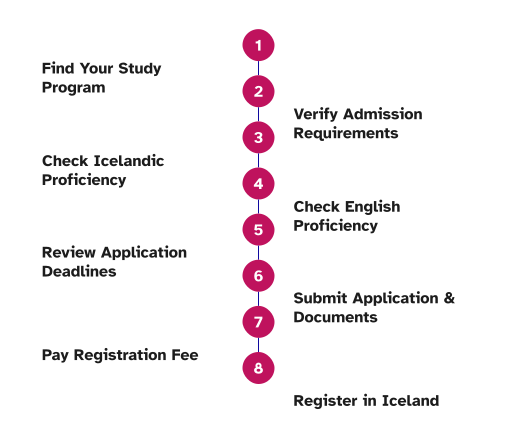
Additional information

The University of Iceland collaborates with over 400 universities worldwide. This provides a unique opportunity to pursue part of your studies at an international university thus gaining added experience and fresh insight into your field of study.

Students generally have the opportunity to join an exchange programme, internship, or summer courses. However, exchanges are always subject to faculty approval.

Students have the opportunity to have courses evaluated as part of their studies at the University of Iceland, so their stay does not have to affect the duration of their studies.

This qualification can open up opportunities in:

  • Art collections
  • Museums
  • Cultural collaboration
  • Work in the cultural sector
  • Writing and research about modern art
  • Independent research

This list is not exhaustive.

There is no specific student organisation for this programme, but students meet frequently in the Student Cellar.

Students' comments
Aldís Arnardóttir
My master's degree in art history from the University of Iceland has been highly beneficial for various projects, including curating exhibitions, teaching, writing exhibition texts for artists, and publishing critiques in newspapers.
Edda Halldórsdóttir
In my role, knowledge of art history is crucial to understanding contemporary art. My studies in art history have given me this knowledge, covering both Icelandic and international art and cultural heritage.
Helpful content
Aurora Cooperation

Study wheel

What interests you?

Aurora Cooperation

How to apply

Follow the path

Contact us

If you still have questions, feel free to contact us.

School of Humanities
Weekdays: 10-12 am and 1-3 pm
General Service and Social Media

The Service Desk is a point of access for all services. You can drop in at the University Centre or use the WebChat at the bottom right of this page.

Follow the School of Humanities on Instagram,   Youtube
and Facebook

""

Share

Did this help?

Why wasn't this information helpful

Limit to 250 characters.