Language skills
required
Programme length
One year.
Study mode
Face-to-face learning Distance learning Online learning
Application status
International students:
Students with Icelandic or Nordic citizenship:
Overview

  • Are you interested in the Swedish language? 
  • Do you enjoy Swedish culture? 
  • Do you want to work in the arts and cultural sector? 
  • Do you want to improve your skills in a Nordic language? 
  • Do you have some basic ability in written and spoken Swedish and want to improve? 

The undergraduate diploma in Swedish is a one-year practical programme designed to help students rapidly achieve good proficiency in Swedish, develop reading comprehension, build vocabulary and practise speaking the language. 

The main objective of the programme is to provide students with strong skills in written and spoken Swedish, academic knowledge of the language and daily life in Sweden, as well as knowledge of Swedish literature and culture. 

Students also learn academic working practices and acquire a foundation for further study. The programme is taught online through distance learning. Online learning enables you to watch lectures outside normal working hours.  

Course topics include

  • Swedish grammar 
  • Swedish language use 
  • Phonetics and Swedish pronunciation 
  • Vocabulary and morphology 
  • Translation

Other

  • Those interested in finishing a BA degree can take Swedish as a 60 ECTS minor along with 120 ECTS major in another field, a total of 180 ECTS.

Icelandic matriculation examination or equivalent qualification.

This programme is not suitable for beginners in Swedish. Admission requirements is a final exam from secondary school or equivalent knowledge of Swedish, Danish or Norwegian, at the B2 level in the Common European Framework of Reference for Languages.

Students must finish all mandatory courses listed on the course catalogue to finish the diploma. 

These courses are mandatory:
- SÆN101G Swedish Language I
- SÆN102G Swedish Literature since 1980
- SÆN105G Ingmar Bergman - Rebelling against the Father Image
- SÆN106G Swedish Grammar I
- SÆN111G Vocabulary and Word Formation
- SÆN112G Practical Swedish
- SÆN109G Sweden in Music - from Gubben Noak to ABBA
- SÆN201G Swedish Language II
- SÆN203G Sociolinguistics and Swedish Dialects
- SÆN205G Translation (Swedish)
- SÆN206G Swedish Grammar II
- SÆN211G History of the Swedish Language in 13 Texts

Students are expected to finish their 60 ECTS in one year. For those who are not a full-time student there is a possibility to graduate after two years. Otherwise an exception must be agreed with the Swedish lecturer.

Programme structure

Check below to see how the programme is structured.

This programme does not offer specialisations.

Year unspecified | Fall
Swedish Language I (SÆN101G)
A mandatory (required) course for the programme
5 ECTS, credits
Course Description

Emphasis will be placed on spoken language, vocabulary, plus competence in speaking fluent Swedish. The objective is to have students acquire a good command of Swedish for communication. Reading, spoken language, oral exercises in modern Swedish. Evaluation: Oral exercises and oral examination. The students should have at least basic knowledge of Swedish to enroll.

Language of instruction: Swedish
Face-to-face learning
Distance learning
Online learning
Year unspecified | Fall
Swedish Literature from Social Realism to Our Days (SÆN102G)
A mandatory (required) course for the programme
5 ECTS, credits
Course Description

The course is an introduction to Swedish literature from the heyday of working-class literature in Sweden around 1930 to the present day.

Each week, students receive so-called study letters where certain trends in Swedish literary history are discussed, such as crime fiction, postmodernism, and children's literature. These study letters are accompanied by questions that prepare the students for the final exam.

The course begins with writers who began to be active before and after World War II, such as Ivar Lo-Johansson, Moa Martinson, Astrid Lindgren, and Nobel Prize winner Tomas Tranströmmer. From there, the course will move on to the social criticism of the 1960s, postmodernism of the 1980s, and the fictional biographies of our time.

The mid-term assignment is an oral presentation of a short story that students read during the project week.

The final exam is a written one, and is conducted in such a way that students are given four questions and choose three of them to write about. Students are expected to review texts and put them in context, for example, by choosing which trends these texts belong to and by discussing the style in them.

Language of instruction: Swedish
Face-to-face learning
Distance learning
Online learning
Year unspecified | Fall
Impressions of Swedish society (SÆN105G)
A mandatory (required) course for the programme
5 ECTS, credits
Course Description

This course offers an overview of key events and influential figures in Swedish society, highlighting their pivotal roles in shaping the nation’s cultural and political identity. From the melancholic allure of actress Greta Garbo to the cherished tradition of fika, and the profound impact of Prime Minister Olof Palme’s assassination in 1986, the course provides insight into the Swedish collective ethos and way of life.

Language of instruction: Swedish
Face-to-face learning
Distance learning
Online learning
Year unspecified | Fall
Swedish Grammar I (SÆN106G)
A mandatory (required) course for the programme
5 ECTS, credits
Course Description

The course covers the basics of Swedish grammar.

Language of instruction: Swedish
Face-to-face learning
Distance learning
Online learning
Year unspecified | Fall
Vocabulary and Word Formation (SÆN111G)
A mandatory (required) course for the programme
5 ECTS, credits
Course Description

The objective of the course is to increase students’ vocabulary. The course is divided between semantic and morphological studies. Phenomena such as meaning, homonyms, synonyms and abbreviations will be discussed. The latter part of the course will focus on morphology, neologisms and loan words.

Language of instruction: Swedish
Face-to-face learning
Distance learning
Online learning
Year unspecified | Fall
Practical Swedish (SÆN112G)
A mandatory (required) course for the programme
5 ECTS, credits
Course Description

The course is aimed at students who want a basic knowledge of the Swedish language that can be used in a practical way, either in studies or for work in Sweden. The program includes weekly exercises in Canvas in written form, but also exercises that are done in class or at home, where students get to practice pronunciation and expression in Swedish. Students learn the main words and phrases used in everyday speech, and also get to practice practical grammar, where the focus is on usage and not theory.

Language of instruction: Swedish
Face-to-face learning
Distance learning
Online learning
Prerequisites
Year unspecified | Spring 1
Sweden in Music - from Gubben Noak to ABBA (SÆN109G)
A mandatory (required) course for the programme
5 ECTS, credits
Course Description

This is an introductory module to known Swedish music and musicians, Swedish musical history with a special emphasis on ABBA and their influence, and music in social context. Students are encouraged to listen to Swedish music and to analyse it. 

Language of instruction: Swedish
Face-to-face learning
Distance learning
Online learning
Year unspecified | Spring 1
Swedish Language II (SÆN201G)
A mandatory (required) course for the programme
5 ECTS, credits
Course Description

Emphasis will be placed on spoken and written language. The objective is to have students acquire a good command of Swedish for communication. Spoken and written language, oral and written exercises in modern Swedish.

Language of instruction: Swedish
Face-to-face learning
Distance learning
Online learning
Year unspecified | Spring 1
Sociolinguistics and Swedish Dialects (SÆN203G)
A mandatory (required) course for the programme
5 ECTS, credits
Course Description

Main topics in sociolinguistics introduced.

Language of instruction: Swedish
Face-to-face learning
Distance learning
Online learning
Year unspecified | Spring 1
Translation (Swedish) (SÆN205G)
A mandatory (required) course for the programme
5 ECTS, credits
Course Description

The course deals mainly with translation from Swedish to the mother tongue of the student.

The students work with different types of texts and documents such as newspapers, brochures and web pages. Special focus is on literary texts.During the course the students themselves translate short texts followed up by discussion seminars. It includes an introduction with basic knowledge in the art of translation and short research essays in the field of translation will also be presented.

Language of instruction: Swedish
Face-to-face learning
Distance learning
Online learning
Year unspecified | Spring 1
Swedish Grammar II (SÆN206G)
A mandatory (required) course for the programme
5 ECTS, credits
Course Description

The course is a continuation of Swedish Grammar I, where Swedish morphology was discussed. Select points in morphological studies will be dealt with, especially concerning nominals and verbs. Within syntax, sentences and phrases will be discussed and analysis of sentence elements explained. Word order and how new information is presented will also be covered.

Language of instruction: Swedish
Face-to-face learning
Distance learning
Online learning
Year unspecified | Spring 1
Swedish Literature from the Viking Age to Modernism (SÆN211G)
A mandatory (required) course for the programme
5 ECTS, credits
Course Description

The course is an introduction to Swedish literature from the runes of the Viking Age to the golden age of Swedish modernism. Each week, students are given short texts from important works and books in Swedish language, and are then given questions about these texts. The questions prepare students for the final exam.

The course begins with the Rökstenen runestone from around 800 and then moves forward in time each week. Topics such as grammar, spelling, word formation, and cultural content will be covered. Towards the end of the course, students will be introduced to famous writers such as August Strindberg, Selma Lagerlöf and Hjalmar Söderberg.

In the midterm assignment, students are expected to create a short presentation on a topic that the teacher gives them during the assignment week. Students can present the presentation in class, or via video if they work in distance learning or online learning.

The final exam is written and is conducted so that students are given four questions, and choose three of them to write about. The questions may be about old grammar, writers and their lives, and about the content of specific works.

Language of instruction: Swedish
Face-to-face learning
Distance learning
Online learning
Year unspecified
  • Fall
  • SÆN101G
    Swedish Language I
    Mandatory (required) course
    5
    A mandatory (required) course for the programme
    5 ECTS, credits
    Course Description

    Emphasis will be placed on spoken language, vocabulary, plus competence in speaking fluent Swedish. The objective is to have students acquire a good command of Swedish for communication. Reading, spoken language, oral exercises in modern Swedish. Evaluation: Oral exercises and oral examination. The students should have at least basic knowledge of Swedish to enroll.

    Face-to-face learning
    Distance learning
    Online learning
    Prerequisites
  • SÆN102G
    Swedish Literature from Social Realism to Our Days
    Mandatory (required) course
    5
    A mandatory (required) course for the programme
    5 ECTS, credits
    Course Description

    The course is an introduction to Swedish literature from the heyday of working-class literature in Sweden around 1930 to the present day.

    Each week, students receive so-called study letters where certain trends in Swedish literary history are discussed, such as crime fiction, postmodernism, and children's literature. These study letters are accompanied by questions that prepare the students for the final exam.

    The course begins with writers who began to be active before and after World War II, such as Ivar Lo-Johansson, Moa Martinson, Astrid Lindgren, and Nobel Prize winner Tomas Tranströmmer. From there, the course will move on to the social criticism of the 1960s, postmodernism of the 1980s, and the fictional biographies of our time.

    The mid-term assignment is an oral presentation of a short story that students read during the project week.

    The final exam is a written one, and is conducted in such a way that students are given four questions and choose three of them to write about. Students are expected to review texts and put them in context, for example, by choosing which trends these texts belong to and by discussing the style in them.

    Face-to-face learning
    Distance learning
    Online learning
    Prerequisites
  • SÆN105G
    Impressions of Swedish society
    Mandatory (required) course
    5
    A mandatory (required) course for the programme
    5 ECTS, credits
    Course Description

    This course offers an overview of key events and influential figures in Swedish society, highlighting their pivotal roles in shaping the nation’s cultural and political identity. From the melancholic allure of actress Greta Garbo to the cherished tradition of fika, and the profound impact of Prime Minister Olof Palme’s assassination in 1986, the course provides insight into the Swedish collective ethos and way of life.

    Face-to-face learning
    Distance learning
    Online learning
    Prerequisites
  • SÆN106G
    Swedish Grammar I
    Mandatory (required) course
    5
    A mandatory (required) course for the programme
    5 ECTS, credits
    Course Description

    The course covers the basics of Swedish grammar.

    Face-to-face learning
    Distance learning
    Online learning
    Prerequisites
  • SÆN111G
    Vocabulary and Word Formation
    Mandatory (required) course
    5
    A mandatory (required) course for the programme
    5 ECTS, credits
    Course Description

    The objective of the course is to increase students’ vocabulary. The course is divided between semantic and morphological studies. Phenomena such as meaning, homonyms, synonyms and abbreviations will be discussed. The latter part of the course will focus on morphology, neologisms and loan words.

    Face-to-face learning
    Distance learning
    Online learning
    Prerequisites
  • SÆN112G
    Practical Swedish
    Mandatory (required) course
    5
    A mandatory (required) course for the programme
    5 ECTS, credits
    Course Description

    The course is aimed at students who want a basic knowledge of the Swedish language that can be used in a practical way, either in studies or for work in Sweden. The program includes weekly exercises in Canvas in written form, but also exercises that are done in class or at home, where students get to practice pronunciation and expression in Swedish. Students learn the main words and phrases used in everyday speech, and also get to practice practical grammar, where the focus is on usage and not theory.

    Face-to-face learning
    Distance learning
    Online learning
    Prerequisites
  • Spring 2
  • SÆN109G
    Sweden in Music - from Gubben Noak to ABBA
    Mandatory (required) course
    5
    A mandatory (required) course for the programme
    5 ECTS, credits
    Course Description

    This is an introductory module to known Swedish music and musicians, Swedish musical history with a special emphasis on ABBA and their influence, and music in social context. Students are encouraged to listen to Swedish music and to analyse it. 

    Face-to-face learning
    Distance learning
    Online learning
    Prerequisites
  • SÆN201G
    Swedish Language II
    Mandatory (required) course
    5
    A mandatory (required) course for the programme
    5 ECTS, credits
    Course Description

    Emphasis will be placed on spoken and written language. The objective is to have students acquire a good command of Swedish for communication. Spoken and written language, oral and written exercises in modern Swedish.

    Face-to-face learning
    Distance learning
    Online learning
    Prerequisites
  • SÆN203G
    Sociolinguistics and Swedish Dialects
    Mandatory (required) course
    5
    A mandatory (required) course for the programme
    5 ECTS, credits
    Course Description

    Main topics in sociolinguistics introduced.

    Face-to-face learning
    Distance learning
    Online learning
    Prerequisites
  • SÆN205G
    Translation (Swedish)
    Mandatory (required) course
    5
    A mandatory (required) course for the programme
    5 ECTS, credits
    Course Description

    The course deals mainly with translation from Swedish to the mother tongue of the student.

    The students work with different types of texts and documents such as newspapers, brochures and web pages. Special focus is on literary texts.During the course the students themselves translate short texts followed up by discussion seminars. It includes an introduction with basic knowledge in the art of translation and short research essays in the field of translation will also be presented.

    Face-to-face learning
    Distance learning
    Online learning
    Prerequisites
  • SÆN206G
    Swedish Grammar II
    Mandatory (required) course
    5
    A mandatory (required) course for the programme
    5 ECTS, credits
    Course Description

    The course is a continuation of Swedish Grammar I, where Swedish morphology was discussed. Select points in morphological studies will be dealt with, especially concerning nominals and verbs. Within syntax, sentences and phrases will be discussed and analysis of sentence elements explained. Word order and how new information is presented will also be covered.

    Face-to-face learning
    Distance learning
    Online learning
    Prerequisites
  • SÆN211G
    Swedish Literature from the Viking Age to Modernism
    Mandatory (required) course
    5
    A mandatory (required) course for the programme
    5 ECTS, credits
    Course Description

    The course is an introduction to Swedish literature from the runes of the Viking Age to the golden age of Swedish modernism. Each week, students are given short texts from important works and books in Swedish language, and are then given questions about these texts. The questions prepare students for the final exam.

    The course begins with the Rökstenen runestone from around 800 and then moves forward in time each week. Topics such as grammar, spelling, word formation, and cultural content will be covered. Towards the end of the course, students will be introduced to famous writers such as August Strindberg, Selma Lagerlöf and Hjalmar Söderberg.

    In the midterm assignment, students are expected to create a short presentation on a topic that the teacher gives them during the assignment week. Students can present the presentation in class, or via video if they work in distance learning or online learning.

    The final exam is written and is conducted so that students are given four questions, and choose three of them to write about. The questions may be about old grammar, writers and their lives, and about the content of specific works.

    Face-to-face learning
    Distance learning
    Online learning
    Prerequisites

The timetable shown below is for the current academic year and is FOR REFERENCE ONLY.

Changes may occur for the autumn semester in August and September and for the spring semester in December and January. You will find your final timetable in Ugla when the studies start.

Note! This timetable is not suitable for planning your work schedule if you are a part-time employee.

Additional information

The University of Iceland collaborates with over 400 universities worldwide. This provides a unique opportunity to pursue part of your studies at an international university thus gaining added experience and fresh insight into your field of study.

Students generally have the opportunity to join an exchange programme, internship, or summer courses. However, exchanges are always subject to faculty approval.

Students have the opportunity to have courses evaluated as part of their studies at the University of Iceland, so their stay does not have to affect the duration of their studies.

This diploma is good preparation for further university studies abroad. It does not confer any specific professional recognition, but the skills acquired are an asset in many careers. 

An education in this area can open up opportunities in: 

  • Tourism 
  • Marketing 
  • Import and export 
  • Translation and interpreting 

This list is not exhaustive.

  • Linguae is the organisation for language students at the University of Iceland 
  • Linguae organises social events for students at the Faculty of Languages and Cultures 
  • Members currently include students of Italian, French, German, Spanish, Danish, Chinese and Russian 
  • Linguae runs a Facebook group and a Facebook page

More about the UI student's social life.

Students' comments
""
When I started studying writing at the University of Iceland, I was able to choose a course in the Swedish department. To begin with, I chose Swedish literature and translations from Swedish, but I was interested in learning more. So when I finished writing, I decided to continue studying Swedish and finishing my diploma. I both found that it improved my Swedish and strengthened my grammar skills, in addition to a number of interesting courses that I wanted to take, including Swedish music and movies. The teachers are enthusiastic and ambitious. The groups are small and it is possible to take distance learning courses that suited me well. By completing an exam in Swedish, my chances of getting a translation and teaching project that I have as my main job increase.
Helpful content
Aurora Cooperation

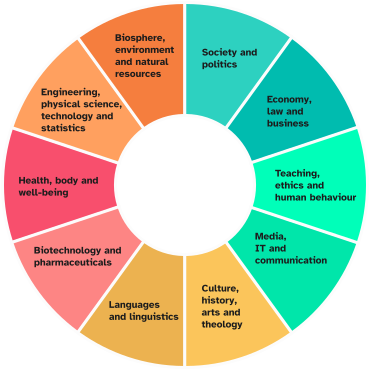
Study wheel

What interests you?

Aurora Cooperation

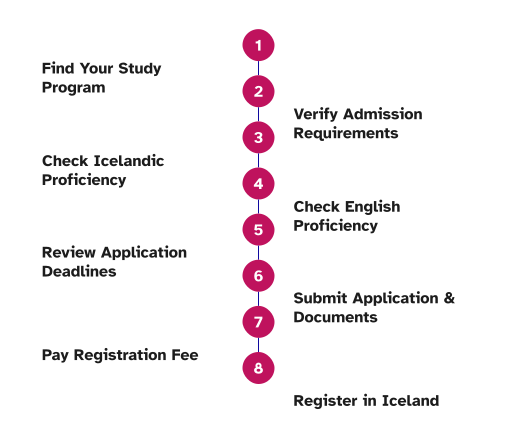
How to apply

Follow the path

Contact us

If you still have questions, feel free to contact us.

School of Humanities
Weekdays: 10-12 am and 1-3 pm
General Service and Social Media

The Service Desk is a point of access for all services. You can drop in at the University Centre or use the WebChat at the bottom right of this page.

Follow the School of Humanities on Instagram,   Youtube
and Facebook

""

Share

Did this help?

Why wasn't this information helpful

Limit to 250 characters.