
""
Language skills
required
Programme length
1 years.
Study mode
Face-to-face learning
Application status
International students:
Students with Icelandic or Nordic citizenship:
Overview

  • Are you interested in the Spanish language?
  • Would you like to study two different subjects?
  • Do you enjoy Spanish literature and culture?
  • Do you want a wide range of career options?
  • Do you have basic Spanish skills that you would like to build on?
  • Do you want to open up future opportunities in challenging careers?

You will explore the cultures of Spain and Latin America: the literature, cinema, society and intellectual history.

At the start of the programme, you will learn to write and speak Spanish, with a focus on independent academic methods. You will also gain insight into the world of translation and learn about the history and evolution of the language.

The Faculty endeavours to make the programme as lively as possible. Significant emphasis is placed on building connections to Spanish-speaking countries, e.g. through media and the internet, networks of international students at UI, and exchange studies abroad.

Course topics include:

  • Spoken and written communication
  • Spanish grammar
  • The culture, society and history of Spain
  • Spanish for tourism and business
  • Latin America
  • Spanish literature
  • Cinema
  • History of the Spanish language
  • Translation

See the course catalogue for more information about the Spanish programme.

Other

UI also offers Spanish as:

See more about majors and minors under ‘Helpful information’ at the bottom of this page.

Icelandic matriculation examination (stúdentspróf: school leaving examination from secondary school) or equivalent qualification.

Students should be able to show competency at an A2 level in Spanish according to the Common European Framework of Reference for Languages.

To complete a minor in Spanish students must complete 60 ECTS credits. These credits are all the mandatory courses (50 credits) in this programme plus 10 credits in elective courses from the 180-credit programme.

Programme structure

Check below to see how the programme is structured.

This programme does not offer specialisations.

Year unspecified | Fall
Conversation I (SPÆ102G)
A mandatory (required) course for the programme
5 ECTS, credits
Course Description

The emphasis of this course relies on practicing the following skills: oral interaction and oral production. The acquisition of vocabulary, the practice of grammatical structures and the presentation of socio-cultural contents are also part of the course. News, short films, literature and other cultural expressions of the target language and culture are used as teaching material.

Language of instruction: Spanish
Face-to-face learning
Prerequisites
Attendance required in class
Year unspecified | Fall
Spanish Grammar I (SPÆ105G)
A mandatory (required) course for the programme
5 ECTS, credits
Course Description

A survey course in Spanish grammar at A2 level (CEFR/MCER. See: https://europa.eu/europass/is/common-european-framework-reference). Special emphasis will be put on the use of verbal tenses, determiners, pronouns and connectors. The course includes theoretical explanations of main grammar concepts as well as actual practice.

Language of instruction: Spanish
Face-to-face learning
Year unspecified | Fall
Spanish Culture, Civilization and History (SPÆ107G)
A mandatory (required) course for the programme
10 ECTS, credits
Course Description

The aim of this course is to give students a good overview of historical, social and political background of contemporary Spanish society. In the process of doing this we will examine patterns of Spanish culture, political and social institutions, etc.

The student is adviced to take the course MOM101G (also taught in English) coinciding with this course.

Language of instruction: Spanish
Face-to-face learning
Year unspecified | Fall
Composition I (SPÆ110G)
A mandatory (required) course for the programme
5 ECTS, credits
Course Description

Students receive training in the structuring and writing of both short and long texts in Spanish. They receive training in the use of dictionaries and guidance in spelling in Spanish. Rules that apply to citations and the use of sources will also be addressed. Students work with different types of text, listening and retelling, and visual material.

Language of instruction: Spanish
Face-to-face learning
Prerequisites
Year unspecified | Fall
Self-Directed Study in Spanish I (online) (SPÆ003G)
Free elective course within the programme
6 ECTS, credits
Course Description

Self-directed study in Spanish I is intended for those learners who have basic knowledge of Spanish language, A2 or above. Learners are partly or completely in charge of all the main aspects of the learning process such as objectives, strategies, selection of resources and assessment. Learners work closely with the instructor through interviews to set up an individualized instructional plan and to assess their progress. They participate in weekly workshops in small groups to practice oral and written production. The assessment covers all four language skills: writing, reading, oral comprehension and oral expression. Each skill is assessed in accordance with the learner's objectives. Learners can also choose how many credits they achieve (2, 4 or 6) and the assessment is completed in accordance with the number of credits.

Language of instruction: Spanish
Distance learning
Prerequisites
Year unspecified | Spring 1
Composition II (SPÆ201G)
A mandatory (required) course for the programme
5 ECTS, credits
Course Description

The aim of this course is to train students to write correct Spanish. There will be a particular emphasis put on orthography, punctuation and accentuation.

The classes are both lectures and exercise sessions.

Language of instruction: Spanish
Face-to-face learning
Year unspecified | Spring 1
Spanish Grammar II (SPÆ204G)
A mandatory (required) course for the programme
5 ECTS, credits
Course Description

This course is a continuation of Spanish Grammar I. New topics: subjunctive and imperative moods and subordinate clauses

Language of instruction: Spanish
Face-to-face learning
Year unspecified | Spring 1
Latin American Culture, Civilization and History (SPÆ205G)
A mandatory (required) course for the programme
10 ECTS, credits
Course Description

The aim of this course is to give students a good overview of historical, social and political background of contemporary Latin American societies. In the process of doing this we will examine patterns of culture, political and social institutions, ethnic groups and minorities, etc.

Language of instruction: Spanish
Face-to-face learning
Year unspecified | Spring 1
Conversation II (SPÆ267G)
A mandatory (required) course for the programme
5 ECTS, credits
Course Description

The main goal of this course is to practice oral skills (production and interaction). Acquisition of vocabulary, practice of speech connectors and socio-cultural aspects are also part of the course.

News, short films, literature and other cultural expressions of the target language and culture are used as teaching material. The course includes a project and online collaboration project with the University of Barcelona where the Icelandic students will have the chance to  practice the language with other Spanish speakers  through different tasks using digital applications.

Language of instruction: Spanish
Face-to-face learning
Attendance required in class
Year unspecified | Spring 1
Self-Directed Study in Spanish II (SPÆ004G)
Free elective course within the programme
6 ECTS, credits
Course Description

Self-directed studies in Spanish II is a learner-centred distance course where the learner is in charge of all of the main aspects of the learning process such as objectives, strategies, selection of resources and evaluation. This course is a continuation of Self-directed studies in Spanish I but as the objectives are determined on an individual basis depending on each participant's needs, it is also open to new learners. Learners meet with the instructor to set up an individualized instructional plan based on prior evaluation and participate in weekly workshops in small groups to practice oral and written expression. The evaluation covers all four language skills: writing, reading, oral comprehension and oral expression. Each skill is evaluated in accordance with the objectives of the learner. Learners can also choose how many credits they achieve (2, 4 or 6) and the assessment is completed in accordance with the number of credits.

Language of instruction: Spanish
Distance learning
Prerequisites
Year unspecified | Spring 1
Spanish for Tourism and Business (SPÆ104G)
Free elective course within the programme
6 ECTS, credits
Course Description

En este curso los alumnos aprenden a organizar viajes a distintos países (por ejemplo, Islandia, España, Perú, México, etc) y de diversa índole (excursiones, viajes de trabajo, de ocio, etc.). Aprenden asimismo sobre la recepción de turistas en estos países. También se tratan varios temas relacionados con el mundo de los negocios. Se pondrá especial énfasis en el léxico del turismo y de los negocios.

Language of instruction: Spanish
Face-to-face learning
Year unspecified
  • Fall
  • SPÆ102G
    Conversation I
    Mandatory (required) course
    5
    A mandatory (required) course for the programme
    5 ECTS, credits
    Course Description

    The emphasis of this course relies on practicing the following skills: oral interaction and oral production. The acquisition of vocabulary, the practice of grammatical structures and the presentation of socio-cultural contents are also part of the course. News, short films, literature and other cultural expressions of the target language and culture are used as teaching material.

    Face-to-face learning
    Prerequisites
    Attendance required in class
  • SPÆ105G
    Spanish Grammar I
    Mandatory (required) course
    5
    A mandatory (required) course for the programme
    5 ECTS, credits
    Course Description

    A survey course in Spanish grammar at A2 level (CEFR/MCER. See: https://europa.eu/europass/is/common-european-framework-reference). Special emphasis will be put on the use of verbal tenses, determiners, pronouns and connectors. The course includes theoretical explanations of main grammar concepts as well as actual practice.

    Face-to-face learning
    Prerequisites
  • SPÆ107G
    Spanish Culture, Civilization and History
    Mandatory (required) course
    10
    A mandatory (required) course for the programme
    10 ECTS, credits
    Course Description

    The aim of this course is to give students a good overview of historical, social and political background of contemporary Spanish society. In the process of doing this we will examine patterns of Spanish culture, political and social institutions, etc.

    The student is adviced to take the course MOM101G (also taught in English) coinciding with this course.

    Face-to-face learning
    Prerequisites
  • SPÆ110G
    Composition I
    Mandatory (required) course
    5
    A mandatory (required) course for the programme
    5 ECTS, credits
    Course Description

    Students receive training in the structuring and writing of both short and long texts in Spanish. They receive training in the use of dictionaries and guidance in spelling in Spanish. Rules that apply to citations and the use of sources will also be addressed. Students work with different types of text, listening and retelling, and visual material.

    Face-to-face learning
    Prerequisites
  • SPÆ003G
    Self-Directed Study in Spanish I (online)
    Elective course
    6
    Free elective course within the programme
    6 ECTS, credits
    Course Description

    Self-directed study in Spanish I is intended for those learners who have basic knowledge of Spanish language, A2 or above. Learners are partly or completely in charge of all the main aspects of the learning process such as objectives, strategies, selection of resources and assessment. Learners work closely with the instructor through interviews to set up an individualized instructional plan and to assess their progress. They participate in weekly workshops in small groups to practice oral and written production. The assessment covers all four language skills: writing, reading, oral comprehension and oral expression. Each skill is assessed in accordance with the learner's objectives. Learners can also choose how many credits they achieve (2, 4 or 6) and the assessment is completed in accordance with the number of credits.

    Distance learning
    Prerequisites
  • Spring 2
  • SPÆ201G
    Composition II
    Mandatory (required) course
    5
    A mandatory (required) course for the programme
    5 ECTS, credits
    Course Description

    The aim of this course is to train students to write correct Spanish. There will be a particular emphasis put on orthography, punctuation and accentuation.

    The classes are both lectures and exercise sessions.

    Face-to-face learning
    Prerequisites
  • SPÆ204G
    Spanish Grammar II
    Mandatory (required) course
    5
    A mandatory (required) course for the programme
    5 ECTS, credits
    Course Description

    This course is a continuation of Spanish Grammar I. New topics: subjunctive and imperative moods and subordinate clauses

    Face-to-face learning
    Prerequisites
  • SPÆ205G
    Latin American Culture, Civilization and History
    Mandatory (required) course
    10
    A mandatory (required) course for the programme
    10 ECTS, credits
    Course Description

    The aim of this course is to give students a good overview of historical, social and political background of contemporary Latin American societies. In the process of doing this we will examine patterns of culture, political and social institutions, ethnic groups and minorities, etc.

    Face-to-face learning
    Prerequisites
  • SPÆ267G
    Conversation II
    Mandatory (required) course
    5
    A mandatory (required) course for the programme
    5 ECTS, credits
    Course Description

    The main goal of this course is to practice oral skills (production and interaction). Acquisition of vocabulary, practice of speech connectors and socio-cultural aspects are also part of the course.

    News, short films, literature and other cultural expressions of the target language and culture are used as teaching material. The course includes a project and online collaboration project with the University of Barcelona where the Icelandic students will have the chance to  practice the language with other Spanish speakers  through different tasks using digital applications.

    Face-to-face learning
    Prerequisites
    Attendance required in class
  • SPÆ004G
    Self-Directed Study in Spanish II
    Elective course
    6
    Free elective course within the programme
    6 ECTS, credits
    Course Description

    Self-directed studies in Spanish II is a learner-centred distance course where the learner is in charge of all of the main aspects of the learning process such as objectives, strategies, selection of resources and evaluation. This course is a continuation of Self-directed studies in Spanish I but as the objectives are determined on an individual basis depending on each participant's needs, it is also open to new learners. Learners meet with the instructor to set up an individualized instructional plan based on prior evaluation and participate in weekly workshops in small groups to practice oral and written expression. The evaluation covers all four language skills: writing, reading, oral comprehension and oral expression. Each skill is evaluated in accordance with the objectives of the learner. Learners can also choose how many credits they achieve (2, 4 or 6) and the assessment is completed in accordance with the number of credits.

    Distance learning
    Prerequisites
  • SPÆ104G
    Spanish for Tourism and Business
    Elective course
    6
    Free elective course within the programme
    6 ECTS, credits
    Course Description

    En este curso los alumnos aprenden a organizar viajes a distintos países (por ejemplo, Islandia, España, Perú, México, etc) y de diversa índole (excursiones, viajes de trabajo, de ocio, etc.). Aprenden asimismo sobre la recepción de turistas en estos países. También se tratan varios temas relacionados con el mundo de los negocios. Se pondrá especial énfasis en el léxico del turismo y de los negocios.

    Face-to-face learning
    Prerequisites

The timetable shown below is for the current academic year and is FOR REFERENCE ONLY.

Changes may occur for the autumn semester in August and September and for the spring semester in December and January. You will find your final timetable in Ugla when the studies start.

Note! This timetable is not suitable for planning your work schedule if you are a part-time employee.


Additional information

The University of Iceland collaborates with over 400 universities worldwide. This provides a unique opportunity to pursue part of your studies at an international university thus gaining added experience and fresh insight into your field of study.

Students generally have the opportunity to join an exchange programme, internship, or summer courses. However, exchanges are always subject to faculty approval.

Students have the opportunity to have courses evaluated as part of their studies at the University of Iceland, so their stay does not have to affect the duration of their studies.

Good language skills can be an asset in many different fields and are highly sought after in our globalised society.

A minor in Spanish can be the key to an exciting future career, not least because of how easy it is to combine Spanish with another subject.

A Spanish degree can open up opportunities in:

  • Media
  • Tourism
  • International affairs
  • Politics
  • Business
  • Translation
  • Academia
  • Teaching

This list is not exhaustive.

  • Linguae is the organisation for language students at the University of Iceland
  • Linguae organises social events for students at the Faculty of Languages and Cultures
  • Members currently include students of Italian, French, German, Spanish, Danish, Chinese and Russian
  • Linguae runs a Facebook group and a Facebook page

More about the UI student's social life.

Students' comments
""
I went to a high school in Denmark when I was 17 and when I graduated from MH I moved to Granada in Andalusia, Spain. I was there for one semester in a Spanish teaching school, but now I have moved back to Iceland and am studying a degree in Spanish (BA). I find it very fun as I love the language and find the study programme very interesting and I am excited about the exchange study programme!
Helpful content
Aurora Cooperation

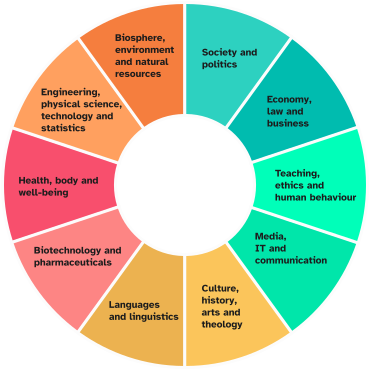
Study wheel

What interests you?

Aurora Cooperation

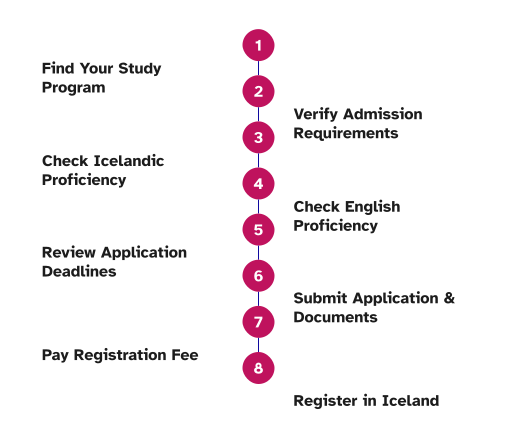
How to apply

Follow the path

Contact us

If you still have questions, feel free to contact us.

School of Humanities
Weekdays: 10-12 am and 1-3 pm
General Service and Social Media

The Service Desk is a point of access for all services. You can drop in at the University Centre or use the WebChat at the bottom right of this page.

Follow the School of Humanities on Instagram,   Youtube
and Facebook

""

Share

Did this help?

Why wasn't this information helpful

Limit to 250 characters.