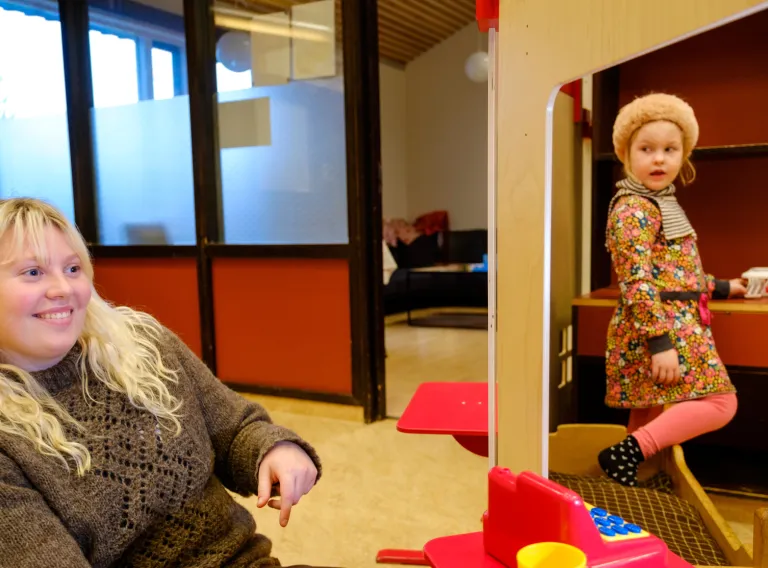
""
Language skills
required, minimum level of B2
Programme length
One year.
Study mode
Face-to-face learning Distance learning
Application status
You must apply for a major before you can apply for a minor.
Overview

  • Do you want to support and improve the social engagement of disabled people?
  • Do you want to advocate for disability rights and the rights of others who use the services of social educators?
  • Do you want to take part in research that can ultimately improve quality of life?

This is a 60 ECTS minor that can be taken alongside a 120 ECTS major in another subject. You must complete 180 ECTS to graduate with a BA degree.

The programme is based on the social model of disability, diversity and the enduring worth of every human being.

Students will acquire a thorough insight into Icelandic and international research, as well as focuses in housing, employment, school and family issues. There is also a strong emphasis on the legal rights of disabled people and the human rights conventions that shape the services.

Topics include:

  • Social education
  • Disability studies
  • Developmental psychology
  • Ethics
  • Diverse communication methods
  • Professional competence
  • Families and cooperation
  • Leadership and holistic services
  • Human rights

Matriculation (Icel. stúdentspróf) or equivalent

Applicants with qualifications from a school abroad who plan to enrol in an undergraduate programme taught in Icelandic at the faculty must also pass a special entrance exam in Icelandic, in accordance with Article 1, regulation on admission requirements for undergraduate study at the University of Iceland, no. 331/2022 | University of Iceland

The minor requires 60 ECTS.  40 ECTS in mandatory courses and 20 ECTS in restricted elective courses. In addition, a 120 ECTS major must be completed, for a total of 180 ECTS, for the bachelor's degree.

Programme structure

Check below to see how the programme is structured.

This programme does not offer specialisations.

First year | Fall
Ethics and professionalism (ÞRS312G)
Restricted elective course, conditions apply
10 ECTS, credits
Course Description

This course is about moral philosophy with emphasis on consequentialist and deontological theories, human rights and ethical concepts, e.g. autonomy, welfare, right to privacy, and human dignity. It also deals with the relationship between ethics and professionalism.

Special emphasis is on relating the theoretical knowledge with issues and dilemmas in the work of professionals who work with diverse groups in the society

Language of instruction: Icelandic
Face-to-face learning
Distance learning
Attendance required in class
First year | Fall
Disability, health and functioning (ÞRS308G)
Restricted elective course, conditions apply
10 ECTS, credits
Course Description

Subject: The course material is based on three threads: Firstly, etiology of different impairments of disabled people. Secondly, health and health risks related to people with disabilities. Thirdly, we look at  how environments can influence health with special emphasis on people with disability. The focus is on both medical models of health as well as social models of health and disability.

The course is taught partly in a flipped classroom format and partly as on-site teaching with recordings.

Attendance is mandatory. See the course syllabus for further details. To pass the course, a minimum grade of 5.0 must be attained in all assessment components.

Language of instruction: Icelandic
Face-to-face learning
Distance learning
Attendance required in class
First year | Fall
Diverse communication methods (ÞRS310G)
Restricted elective course, conditions apply
10 ECTS, credits
Course Description

The course addresses Alternative and augmentative communication (AAC) for individuals with speech and communication difficulties of various kinds. Students are introduced to diverse communication approaches that may be suitable for different age groups and varying needs. Instruction is provided in the use of the communication app TD Snap, and various strategies for engaging in conversation with individuals who are unable to rely on spoken language for communication are presented. Emphasis is placed on what it means to be a good communication partner, and students learn to create materials related to different communication methods. The course also reflects on the impact of autism and atypical sensory processing on communication, as well as the circumstances of individuals who use informal or subtle communication signals. In addition, tools related to visual structure and visual supports are introduced. Strong emphasis is placed on the practical application of AAC and course assignments are designed to develop students’ skills in this area.

Language of instruction: Icelandic
Distance learning
Attendance required in class
First year | Fall
History and disability (ÞRS119G)
A mandatory (required) course for the programme
10 ECTS, credits
Course Description

The main goal of this course is to shed light on the historical development of theories and perspectives on disability and how they have influenced and shaped the lives and circumstances of disabled people. An emphasis will be placed on the period from the beginning of the twentieth century to today. A particular focus will be placed on topics such as institutionalization, de-institutionalization, disability and eugenics, the medical understanding of disability, the ideology of normalization and disabled people‘s rights to education and parenting. In addition, the disability rights movement and the UN Convention on the Rights of Persons with Disabilities will be discussed. The course draws on the social understanding of disability and highlights the interconnection of the various social and cultural factors that impact and influence how disability is understood and interpreted. The course places a special emphasis on connecting historical ideas and theories with the daily lives and experiences of disabled people.

Language of instruction: Icelandic
Face-to-face learning
Distance learning
Attendance required in class
First year | Fall
Introduction to social education (ÞRS118G)
A mandatory (required) course for the programme
10 ECTS, credits
Course Description

This course provides a foundation for studies in Social Education (Þroskaþjálfafræði) and offers an overview of the professional field and role of the social educator (þroskaþjálfi). Emphasis is placed on human rights perspectives and the importance of professional support for social participation and advocacy of the rights of disabled people and others who use social educator services.

The course covers the following topics:

  • Key concepts in the field of Social Education

  • Competencies and roles of the social educator

  • Teamwork and group collaboration

  • History and development of the social educator profession in Iceland

  • Human rights and international human rights conventions

  • Laws and regulations relevant to the profession

  • Ethical guidelines and professional values of social educators

  • Service models and professional approaches

  • The role of social educators in a diverse and inclusive society

  • Recent research in the field

Students will also become familiar with professional practices and service models in the field. 

Teaching Methods
The course uses a flipped classroom approach and collaborative learning. Lectures and study materials are accessible on Canvas. Students are expected to come well prepared to weekly teaching sessions and intensive in-person sessions (so-called staðlotur), whether these take place in the classroom or live online. The schedule is available on the course website.

Collaboration in student workgroups and active participation in discussions and assignments during class are important components of the course.

Attendance and participation are mandatory. Attendance and active participation account for 20% of the final grade. Students must achieve a minimum grade of 5 (out of 10) in this part of the course assessment to pass the course (further details are provided in the course syllabus).

On-site teaching (Staðkennsla): On-site students attend weekly classes and intensive sessions in the classroom.
Distance learning (Fjarkennsla): Distance students attend weekly live online classes and intensive sessions. 

There are two intensive sessions (staðlotur) during the semester.

Language of instruction: Icelandic
Face-to-face learning
Distance learning
Attendance required in class
First year | Spring 1
Lifespan Development (ÞRS215G)
Restricted elective course, conditions apply
10 ECTS, credits
Course Description

This course provides students an overview of human development across the lifespan. Major theories in the field will be introduced, including theories of cognitive, emotional, moral, and social development.

The impact of social and cultural factors on human development will be emphasized. The characteristics of different phases of life will be discussed, as well as developmental changes throughout the lifespan. 

Course format: presentations/lectures (visual and audio recordings accessible via Canvas) and group discussions/assignments either in class or online (synchronous).

Language of instruction: Icelandic
Face-to-face learning
Distance learning
First year | Spring 1
Effective communication and teamwork (ÞRS412G)
Restricted elective course, conditions apply
10 ECTS, credits
Course Description

The course prepares students for ÞRS401G Field Practice in the 4th semester of the BA programme in Social Education.

The course covers well-being and support services and the developments that have taken place in recent years. The roles of support providers in collaboration with families will be examined, as well as the characteristics of high-quality support. Trauma-informed approaches and universal design for support will also be introduced.

Fundamental aspects of communication will be addressed, and students will receive practical instruction in conversation techniques, providing a foundation for effective communication in collaborative and team-based work. The course explores the importance of cooperation and teamwork in relation to well-being and support services, as well as within person-centred approaches. Attention will also be given to professionalism and boundaries in practice.

Language of instruction: Icelandic
Face-to-face learning
Distance learning
Attendance required in class
Course taught first half of the semester
First year | Spring 1
Power and marginalisation: utilisation of sociological theories (ÞRS214G)
A mandatory (required) course for the programme
10 ECTS, credits
Course Description

The aim of the course is that students learn to know and use different sociological theories related to physical and mental attainment. Concept related to power, such as stigma, power, microaggression, and ableism, will be explored and students can use to analyse how norms are maintained and how societal definitions of norms come about. The theories that will be taught should be useful to students to understand how the marginalization of groups is maintained in the community and how discipline of the body takes place.

Language of instruction: Icelandic
Face-to-face learning
Distance learning
Attendance required in class
First year | Spring 1
Disability and the life course (ÞRS212G)
A mandatory (required) course for the programme
10 ECTS, credits
Course Description

In this course, the lived experience of disabled people throughout the life course, from childhood to old age, will be explored, along with the societal and structural barriers that they face along the way. Critical theories on the life course will be employed to discuss the multiple and intersecting forms of discrimination and biases that disabled people experience in different stages of their lives, and how they undermine their ability to fully participate in society, including in education, employment, culture, recreation, politics and family life. A special focus will be directed at the criticism voiced by representative organizations of disabled people with regard to the first and final stages of the life course, i.e. fetal ultrasounds and assisted suicide. In addition, the course will examine the teenage years as a distinct life stage, and access of disabled people to the digital world, in the context of the right to full and active participation in adulthood. The course will also discuss how the prevailing discourse around the different stages of the life course, that is childhood, teenage years, adulthood and senior year, can be both be oppressive and liberating for disabled people and the development of their self-identity. Policymaking in matters pertaining to disabled people and international human rights treaties will be examined from the perspective of the human rights approach to disability.

Methods of work: Lectures, working in groups and class discussion. An emphasis will be placed on active participation of students in discussions and that they follow public coverage of disability in the media and politics with the life course in mind. Students will need to adopt academic methods of work in their writing and documentation.

Language of instruction: Icelandic
Face-to-face learning
Distance learning
Attendance required in class
First year
  • Fall
  • ÞRS312G
    Ethics and professionalism
    Restricted elective course
    10
    Restricted elective course, conditions apply
    10 ECTS, credits
    Course Description

    This course is about moral philosophy with emphasis on consequentialist and deontological theories, human rights and ethical concepts, e.g. autonomy, welfare, right to privacy, and human dignity. It also deals with the relationship between ethics and professionalism.

    Special emphasis is on relating the theoretical knowledge with issues and dilemmas in the work of professionals who work with diverse groups in the society

    Face-to-face learning
    Distance learning
    Prerequisites
    Attendance required in class
  • ÞRS308G
    Disability, health and functioning
    Restricted elective course
    10
    Restricted elective course, conditions apply
    10 ECTS, credits
    Course Description

    Subject: The course material is based on three threads: Firstly, etiology of different impairments of disabled people. Secondly, health and health risks related to people with disabilities. Thirdly, we look at  how environments can influence health with special emphasis on people with disability. The focus is on both medical models of health as well as social models of health and disability.

    The course is taught partly in a flipped classroom format and partly as on-site teaching with recordings.

    Attendance is mandatory. See the course syllabus for further details. To pass the course, a minimum grade of 5.0 must be attained in all assessment components.

    Face-to-face learning
    Distance learning
    Prerequisites
    Attendance required in class
  • ÞRS310G
    Diverse communication methods
    Restricted elective course
    10
    Restricted elective course, conditions apply
    10 ECTS, credits
    Course Description

    The course addresses Alternative and augmentative communication (AAC) for individuals with speech and communication difficulties of various kinds. Students are introduced to diverse communication approaches that may be suitable for different age groups and varying needs. Instruction is provided in the use of the communication app TD Snap, and various strategies for engaging in conversation with individuals who are unable to rely on spoken language for communication are presented. Emphasis is placed on what it means to be a good communication partner, and students learn to create materials related to different communication methods. The course also reflects on the impact of autism and atypical sensory processing on communication, as well as the circumstances of individuals who use informal or subtle communication signals. In addition, tools related to visual structure and visual supports are introduced. Strong emphasis is placed on the practical application of AAC and course assignments are designed to develop students’ skills in this area.

    Distance learning
    Prerequisites
    Attendance required in class
  • ÞRS119G
    History and disability
    Mandatory (required) course
    10
    A mandatory (required) course for the programme
    10 ECTS, credits
    Course Description

    The main goal of this course is to shed light on the historical development of theories and perspectives on disability and how they have influenced and shaped the lives and circumstances of disabled people. An emphasis will be placed on the period from the beginning of the twentieth century to today. A particular focus will be placed on topics such as institutionalization, de-institutionalization, disability and eugenics, the medical understanding of disability, the ideology of normalization and disabled people‘s rights to education and parenting. In addition, the disability rights movement and the UN Convention on the Rights of Persons with Disabilities will be discussed. The course draws on the social understanding of disability and highlights the interconnection of the various social and cultural factors that impact and influence how disability is understood and interpreted. The course places a special emphasis on connecting historical ideas and theories with the daily lives and experiences of disabled people.

    Face-to-face learning
    Distance learning
    Prerequisites
    Attendance required in class
  • ÞRS118G
    Introduction to social education
    Mandatory (required) course
    10
    A mandatory (required) course for the programme
    10 ECTS, credits
    Course Description

    This course provides a foundation for studies in Social Education (Þroskaþjálfafræði) and offers an overview of the professional field and role of the social educator (þroskaþjálfi). Emphasis is placed on human rights perspectives and the importance of professional support for social participation and advocacy of the rights of disabled people and others who use social educator services.

    The course covers the following topics:

    • Key concepts in the field of Social Education

    • Competencies and roles of the social educator

    • Teamwork and group collaboration

    • History and development of the social educator profession in Iceland

    • Human rights and international human rights conventions

    • Laws and regulations relevant to the profession

    • Ethical guidelines and professional values of social educators

    • Service models and professional approaches

    • The role of social educators in a diverse and inclusive society

    • Recent research in the field

    Students will also become familiar with professional practices and service models in the field. 

    Teaching Methods
    The course uses a flipped classroom approach and collaborative learning. Lectures and study materials are accessible on Canvas. Students are expected to come well prepared to weekly teaching sessions and intensive in-person sessions (so-called staðlotur), whether these take place in the classroom or live online. The schedule is available on the course website.

    Collaboration in student workgroups and active participation in discussions and assignments during class are important components of the course.

    Attendance and participation are mandatory. Attendance and active participation account for 20% of the final grade. Students must achieve a minimum grade of 5 (out of 10) in this part of the course assessment to pass the course (further details are provided in the course syllabus).

    On-site teaching (Staðkennsla): On-site students attend weekly classes and intensive sessions in the classroom.
    Distance learning (Fjarkennsla): Distance students attend weekly live online classes and intensive sessions. 

    There are two intensive sessions (staðlotur) during the semester.

    Face-to-face learning
    Distance learning
    Prerequisites
    Attendance required in class
  • Spring 2
  • ÞRS215G
    Lifespan Development
    Restricted elective course
    10
    Restricted elective course, conditions apply
    10 ECTS, credits
    Course Description

    This course provides students an overview of human development across the lifespan. Major theories in the field will be introduced, including theories of cognitive, emotional, moral, and social development.

    The impact of social and cultural factors on human development will be emphasized. The characteristics of different phases of life will be discussed, as well as developmental changes throughout the lifespan. 

    Course format: presentations/lectures (visual and audio recordings accessible via Canvas) and group discussions/assignments either in class or online (synchronous).

    Face-to-face learning
    Distance learning
    Prerequisites
  • ÞRS412G
    Effective communication and teamwork
    Restricted elective course
    10
    Restricted elective course, conditions apply
    10 ECTS, credits
    Course Description

    The course prepares students for ÞRS401G Field Practice in the 4th semester of the BA programme in Social Education.

    The course covers well-being and support services and the developments that have taken place in recent years. The roles of support providers in collaboration with families will be examined, as well as the characteristics of high-quality support. Trauma-informed approaches and universal design for support will also be introduced.

    Fundamental aspects of communication will be addressed, and students will receive practical instruction in conversation techniques, providing a foundation for effective communication in collaborative and team-based work. The course explores the importance of cooperation and teamwork in relation to well-being and support services, as well as within person-centred approaches. Attention will also be given to professionalism and boundaries in practice.

    Face-to-face learning
    Distance learning
    Prerequisites
    Attendance required in class
    Course taught first half of the semester
  • ÞRS214G
    Power and marginalisation: utilisation of sociological theories
    Mandatory (required) course
    10
    A mandatory (required) course for the programme
    10 ECTS, credits
    Course Description

    The aim of the course is that students learn to know and use different sociological theories related to physical and mental attainment. Concept related to power, such as stigma, power, microaggression, and ableism, will be explored and students can use to analyse how norms are maintained and how societal definitions of norms come about. The theories that will be taught should be useful to students to understand how the marginalization of groups is maintained in the community and how discipline of the body takes place.

    Face-to-face learning
    Distance learning
    Prerequisites
    Attendance required in class
  • ÞRS212G
    Disability and the life course
    Mandatory (required) course
    10
    A mandatory (required) course for the programme
    10 ECTS, credits
    Course Description

    In this course, the lived experience of disabled people throughout the life course, from childhood to old age, will be explored, along with the societal and structural barriers that they face along the way. Critical theories on the life course will be employed to discuss the multiple and intersecting forms of discrimination and biases that disabled people experience in different stages of their lives, and how they undermine their ability to fully participate in society, including in education, employment, culture, recreation, politics and family life. A special focus will be directed at the criticism voiced by representative organizations of disabled people with regard to the first and final stages of the life course, i.e. fetal ultrasounds and assisted suicide. In addition, the course will examine the teenage years as a distinct life stage, and access of disabled people to the digital world, in the context of the right to full and active participation in adulthood. The course will also discuss how the prevailing discourse around the different stages of the life course, that is childhood, teenage years, adulthood and senior year, can be both be oppressive and liberating for disabled people and the development of their self-identity. Policymaking in matters pertaining to disabled people and international human rights treaties will be examined from the perspective of the human rights approach to disability.

    Methods of work: Lectures, working in groups and class discussion. An emphasis will be placed on active participation of students in discussions and that they follow public coverage of disability in the media and politics with the life course in mind. Students will need to adopt academic methods of work in their writing and documentation.

    Face-to-face learning
    Distance learning
    Prerequisites
    Attendance required in class

The timetable shown below is for the current academic year and is FOR REFERENCE ONLY.

Changes may occur for the autumn semester in August and September and for the spring semester in December and January. You will find your final timetable in Ugla when the studies start.

Note! This timetable is not suitable for planning your work schedule if you are a part-time employee.


Additional information

The University of Iceland collaborates with over 400 universities worldwide. This provides a unique opportunity to pursue part of your studies at an international university thus gaining added experience and fresh insight into your field of study.

Students generally have the opportunity to join an exchange programme, internship, or summer courses. However, exchanges are always subject to faculty approval.

Students have the opportunity to have courses evaluated as part of their studies at the University of Iceland, so their stay does not have to affect the duration of their studies.

Social educators work in all areas of life with the goal of supporting and improving the social engagement of disabled people and advocating for disability rights.

After completing the programme, students should be confident professionals able to base their work on an up-to-date theoretical foundation.

Social educators are in high demand across Iceland in a wide variety of professional settings. A BA degree and a 60 ECTS Master’s level certificate in social education qualifies you to apply to the Directorate of Health for a licence to work as a social educator.

After completing this programme, you could work in:

  • Preschools, compulsory schools and upper secondary schools
  • Homes and workplaces of disabled people
  • Therapy clinics
  • Services and counselling for disabled people

This list is not exhaustive.

  • TUMI is the organisation for UI students in leisure studies, social education, education studies and the vocational diploma for people with developmental disabilities.
  • TUMI organises events such as parties for new students, annual galas and workplace tours.

Follow TUMI on social media

Students' comments
Portrait photo of Tinna Kristjánsdóttir
Choosing social education was one of the best decisions I’ve ever made. The programme is engaging and challenging, providing a deep understanding of disability issues and advocacy. It has profoundly improved my perspective.
Portrait photo of Helena Gunnarsdóttir
My studies in social education have enriched my knowledge base and provided invaluable hands-on experience through research opportunities.
Portrait photo of Hlöðver Sigurðsson
My studies in social education have expanded my role as a disability assistant, highlighting the broad and important field of developmental training.
Helpful content
Aurora Cooperation

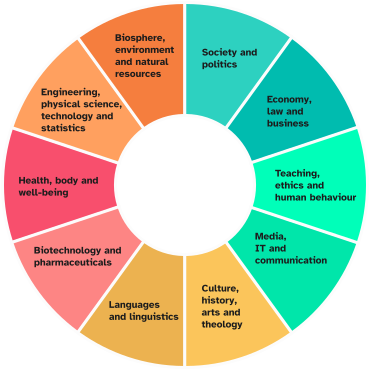
Study wheel

What interests you?

Aurora Cooperation

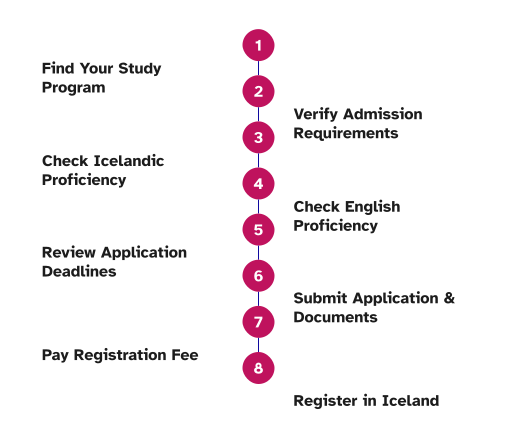
How to apply

Follow the path

Contact us

If you still have questions, feel free to contact us.

School of Education
9:00 am - 3:00 pm
General Service and social media

The Service Desk is a point of access for all services. You can drop in at the University Centre or use the WebChat at the bottom right of this page.

Follow the School of Education on Instagram,   Youtube
and Facebook

University of Iceland, Saga (Building)

Share

Did this help?

Why wasn't this information helpful

Limit to 250 characters.