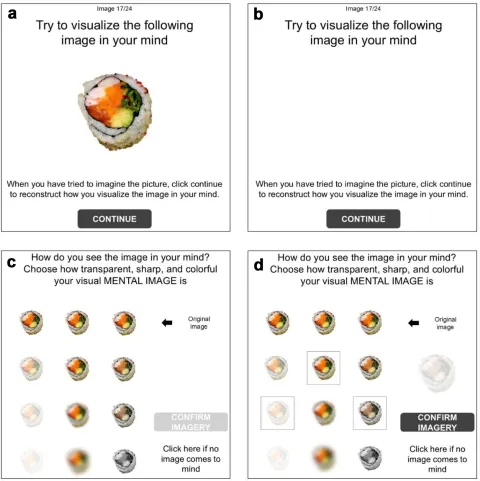
Imagine an apple. How clearly does it appear in your mind? Do you see a bright red, clearly defined apple, almost as though it were right in front of you, or is the image vague and colourless? Perhaps you do not see anything at all? Or maybe the apple is green? People vary considerably in how vividly they can generate such mental images. In a new study, researchers at the University of Iceland and the University of Akureyri introduce a new method designed to shed clearer light on these individual differences.
People vary considerably in their ability to form mental images. “Some people seem to be able to generate mental images that are so vivid they could almost be real, while others do not see anything at all; they simply know that they are thinking about what is being described. People in the first group are said to have hyperphantasia, while those in the latter group are considered to have aphantasia. Many people, however, seem to fall somewhere in between; visual imagery most likely exists along a broad spectrum,” says Heiða María Sigurðardóttir, PhD in neuroscience and Professor at the University of Iceland’s Faculty of Psychology.
She is one of the authors of the study, The Visual Imagery Visually Anchored Scale (VIVAS) reveals dissociable perceptual dimensions and category-specific structure, recently published in the scientific journal Cortex. The other authors are Árni Gunnar Ásgeirsson, Associate Professor at the University of Akureyri’s Department of Psychology; Vaka Vésteinsdóttir, Associate Professor at the University of Iceland’s Faculty of Psychology; Dagur Árnason, a master’s student in clinical psychology at the University of Iceland; and Marelle Mäekalle, who holds an MSc in psychology from the University of Iceland.
But why is it important to study visual imagery? Our ability to visualise may play a role in various cognitive processes, including learning and memory. Mental imagery can also influence emotions and may play a role in mental health difficulties. Intrusive thoughts associated with a range of mental disorders, for example, are often experienced as mental images, and such imagery can have a greater emotional impact than verbal thoughts. “This raises the question of whether therapeutic techniques based on visual imagery are equally effective for individuals who differ in their capacity to generate mental imagery,” the researchers write. They point to recent research suggesting that people with aphantasia are more likely than those with vivid imagery to perceive imagery-based therapy as less helpful.
A new test for assessing visual imagery
Until now, individual differences in visual imagery have primarily been studied using questionnaires in which people rate the vividness of their own mental imagery. The best known of these is the Vividness of Visual Imagery Questionnaire (VVIQ), in which people are asked to imagine particular objects or scenes and rate, on a scale from 1 to 5, how vividly they appear in their mind’s eye. The researchers behind the Cortex study point out, however, that one limitation of this approach is that what one person rates as a 2 on the scale might be rated as a 4 by someone else.
“Researchers encounter the same problem whenever they try to compare people’s subjective experiences more generally: Is my experience of the colour red the same as yours? Could it be that you experience red in the way that I experience green? Is there any way to compare the experiences of two individuals when those experiences are, by their very nature, entirely subjective and locked inside each person’s mind?” asks Heiða.
The researchers note that no measurement tool can give us direct access to another person’s mental imagery. The question, therefore, is not whether it is possible to develop a tool that precisely captures each individual’s experience, but rather whether such a tool can measure that experience in a reliable and interpretable way and complement other methods.
In their Cortex article, Heiða María and her colleagues describe a new test they have developed called the Visual Imagery Visually Anchored Scale (VIVAS). Rather than relying solely on verbal descriptions, VIVAS allows people to rate their mental imagery using visual examples. The aim is to capture aspects of mental imagery that may not be adequately captured by conventional questionnaires.