
Luna Polinelli, doctoral student in archaeology in the School of Humanities at the University of Iceland.

Chances are, when you think of the Vikings - Scandinavian pirates who ruled the seas between the 8th and 11th centuries AD - you’ll imagine dozens of burly men rowing a longship on their way to raiding and pillaging monasteries and villages around Europe.

Sailing was obviously rich in meaning within Nordic culture during the Viking Age. This is evident by their custom of burying people in boats. These burials are called either boat or ship burials, depending on the size of the vessels, and this mortuary custom was varied and widespread, with many boat burials found throughout mainland Scandinavia, Iceland, the British Isles, and the Baltic.

Boat burials reflect the worldviews and mentalities that gave the period its specific character. Scholars have debated whether they served to transport the dead to the afterlife or to signal prestige for the community. Likely, both are true, but although they may not have been as prevalent as popular culture would have us believe, and we may not know exactly what they looked like, they’ve become deeply embedded in our collective imagination.

Very few ships excavated from the ground have been found with most of their wooden structure intact, such as the famous Oseberg longship in Norway. If we want to understand this iconic custom and speculate about its meaning, we need to ask ourselves: how common were boat burials during the Viking Age, and what did they actually look like?

Using nails to identify boat burials

Luna Polinelli, a doctoral student in archaeology in the School of Humanities at the University of Iceland, is currently conducting research on boat burials from the Viking Age. Boats can be found as grave goods in Viking Age burials and have been the subject of much scholarly debate.

Luna points out that boat burials can vary greatly, and that most boats and ships are identified primarily by nails found during archaeological excavation. “At some sites, nails are found in their original location and can provide clear evidence of the presence of a boat; at others, disturbances and scattered nails make such identification less certain. As such, the nails need to be studied systematically to support this assumption.”

Boat burials are key to understanding Viking Age culture in general, including people’s religious beliefs, social hierarchies, gender and identity, and international trade and connections. However, their study has been hampered by the difficulty of determining whether a particular grave contained a boat.

“A more robust methodology is needed to reassess the frequency and distribution of boat burials to place future debates about the custom’s significance and meaning on a sounder footing,” says Luna.
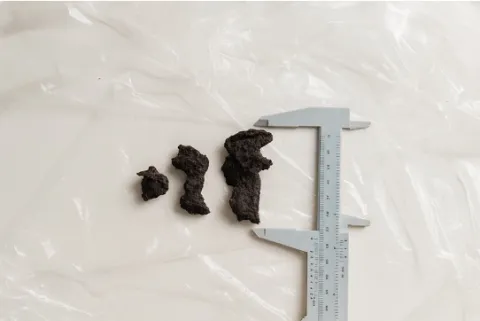
Measuring nails from a Viking Age burial.
Nails serve as vital clues to the possible presence of a boat and can be categorised by both length and function.

Boat profiles created based on length of nails

The main goal of the research project is to create a so-called “boat profile”, by establishing what a fastener assemblage, or a collection of nails, from a boat looks like, long after the boat timbers have rotted away. Therefore, nails serve as vital clues to the possible presence of a boat.

“The main criterion for creating a boat profile is the length of nails found during excavation. Clinker-built boats, the technical term for the ones built during the Viking Age, employ a variety of different nails, and those nails can be categorised by both length and function,” explains Luna.

The boat profile is built on analysis of nails from confirmed boat burials, then tested against confirmed yet heavily disturbed burials, and finally applied to debated archaeological sites that may include a boat.

Fascination with the Sagas led to boat burials

The research is part of Luna’s doctoral project in archaeology at the University of Iceland. Luna’s supervisors are Orri Vésteinsson, professor of archaeology at the Faculty of Philosophy, History and Archaeology at UI, Jan Bill, professor and curator of the Viking Ship collection at the Museum of Cultural History of Oslo, Norway, and Vibeke Bischoff, researcher at the Viking Ship Museum in Roskilde, Denmark.

Among Luna’s main interests are maritime culture during the Viking Age and its impact on every aspect of life, from small-scale local networks to large-scale oceanic travel spanning North America to the Middle East. However, she did not always plan on researching Viking Age boat burials.

“I have a bachelor’s degree in English and Nordic languages and literature, and as part of that degree, I studied the Icelandic sagas and the Eddas. I became so fascinated by these texts that I decided to pursue a master’s degree here in Iceland in Viking and Medieval Norse studies,” says Luna.

With her background, Luna was positive that she would go on to study manuscripts. However, as the degree is an interdisciplinary programme, she had the opportunity to explore different subjects and realised that archaeology was the field she enjoyed most.

“I am fascinated by burial customs, and there is truly nothing more iconic than boat burials when it comes to the Viking Age. This is why I started studying it in the first place, and from there, I developed an in-depth interest in everything related to maritime connectivity and culture.”

A project that will aid research and strengthen future debate

When asked about results, Luna says preliminary testing indicates it is possible to reassess the likelihood of boat inclusion by applying this new boat profile.

“Viking Age boats are especially significant in the collective imagination, even among people outside the field,” says Luna and continues: “This research will help us understand how frequently they occurred and what they looked like. It will also aid in updating current research, in gaining a clearer overall understanding of the boat burial custom, and in providing a stronger foundation for future debate.”

Share

Tags
Did this help?

Why wasn't this information helpful

Limit to 250 characters.