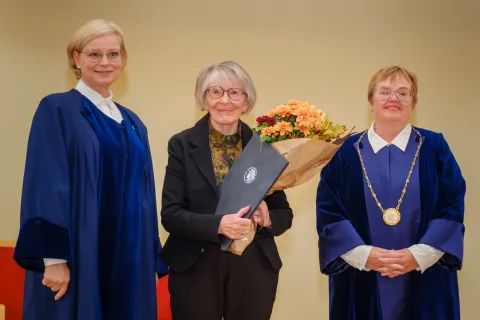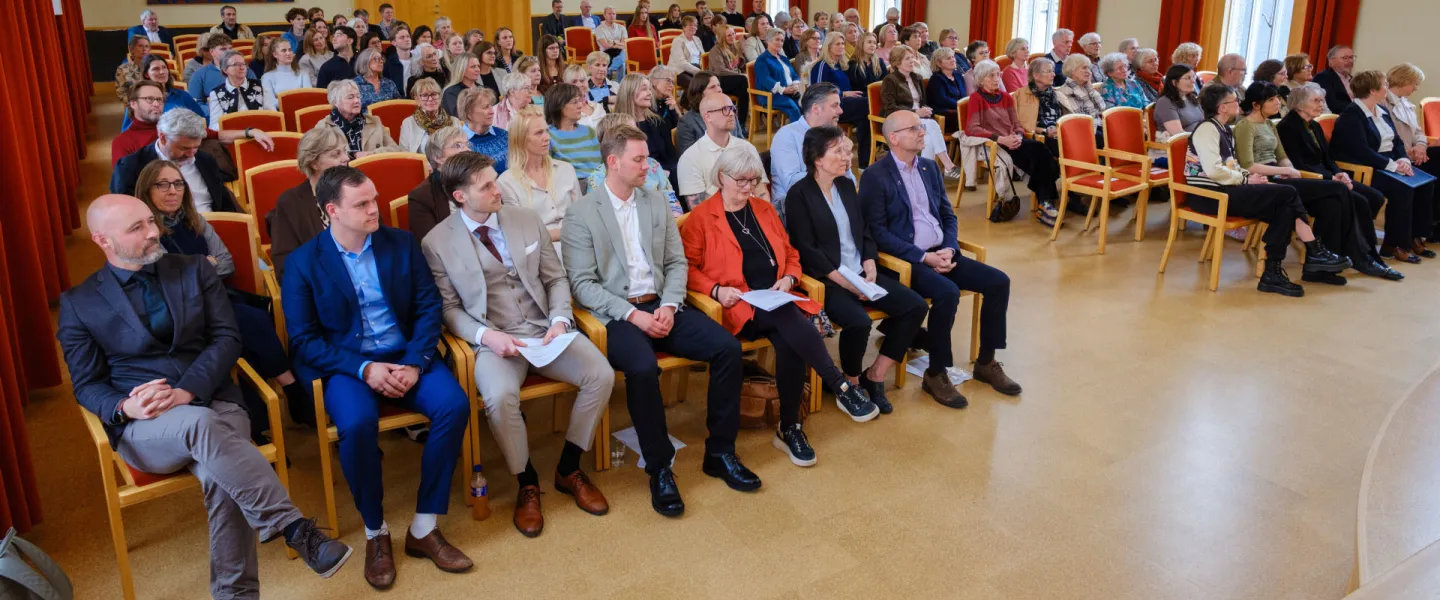
The Physiotherapy Programme at the University of Iceland celebrated its 50th anniversary on 18 September, marking five decades since physiotherapy education was first introduced there. The anniversary was commemorated with a special event in the University’s Ceremonial Hall, which also included the conferral of an honorary doctorate in Physiotherapy. Former and current staff and students gathered to celebrate this important milestone in the programme's history.
Five Decades of Growth and Development
In his address, Atli Ágústsson, Chair of the Physiotherapy Programme, described the history of physiotherapy at the University of Iceland as a story of growth, ambition and determination. Above all, he noted, it is the story of the individuals who recognised the importance of educating physiotherapists in Iceland and worked tirelessly to make that vision a reality. “Today, we take it for granted that physiotherapy is a five-year university degree, that academic staff combine teaching and research, and that the programme is part of an international academic and research community. Fifty years ago, however, none of this could be assumed. As the number of physiotherapists grew and their role within the healthcare system expanded, the need for domestic university-level education became increasingly clear.” Atli reflected on the five years leading up to 1976, during which extensive preparations were undertaken to establish physiotherapy education at the university level. Many individuals and organisations contributed to this pioneering effort.
“Autumn 1976 marked a major milestone when formal physiotherapy education began at the University of Iceland. The first members of staff were Ella Kolbrún and Professor Marjorie B. Spence from the University of Manitoba. Ella Kolbrún became the programme’s first chair, while María Ragnarsdóttir joined as the third lecturer and was soon followed by María Þorsteinsdóttir. Over the years, a strong team of physiotherapists joined the programme, either as permanent academic staff or part-time lecturers.” One of the most significant changes in the programme’s history took place in 2014, when it adopted a 3+2 structure. Students now complete a three-year BSc in Physiotherapy Science followed by a two-year MSc in Physiotherapy, which leads to professional licensure as a physiotherapist.
A Strong Research Environment
According to Atli, perhaps the most important development over the past fifty years has been the transformation of physiotherapy from a primarily professional qualification into a strong academic discipline.
“Research activity was challenging in the early years. The teaching staff was small, workloads were heavy, and research opportunities were limited. The research culture within Icelandic physiotherapy was still in its infancy. As late as the year 2000, only one Icelandic physiotherapist had completed a doctoral degree. “In 1993, the programme appointed the young physiologist Þórarinn Sveinsson, who had recently completed his PhD at the University of Manitoba. He played a key role in building the programme’s research profile while also making major contributions to teaching and academic leadership. Þórarinn remained with the programme until mid-2024 and continues to be affiliated with it as Professor Emeritus at the University of Iceland.
“Today, 22 Icelandic physiotherapists have completed doctoral studies, with two more nearing completion. Since the turn of the century, research activity has expanded considerably, and the links between research and teaching have grown ever stronger.” Atli also highlighted how dramatically the programme has evolved over the past five decades. “In 1976, 18 students began a four-year degree programme taught by two members of staff in premises on Lindargata. Today, the Physiotherapy Programme offers a five-year university education delivered by a diverse academic staff, supported by strong partnerships with healthcare institutions in clinical teaching and research, and extensive international collaboration. “The quality of the programme also received important international recognition this summer, and an international accreditation process conducted by World Physiotherapy is currently underway.