A child looking through a magnifying glass.

Would you like to look at insects up close and see what‘s hiding in the undergrowth, in the streams, the river and the grass in Elliðaárdalur? Then you should join the annual bugwatching event hosted by the University of Iceland and the Iceland Touring Association (Ferðafélag Íslands) at the old power station in Elliðaárdalur on Tuesday, June 9 at 18.00.

The event is part of the ever-popular Hiking Trips with Science Tips series, a collaborative project between the University of Iceland and the Children’s Touring Association, which has been among the unmissable outdoor activities for families in the capital area for years. The Children’s Touring Association is a subdivision of the Iceland Touring Association, and the project, Hiking Trips with Science Tips, received the Icelandic Centre for Research Award for Scientific Outreach in 2023.

The bugwatching event has been popular with children for a long time, who show up year after year with giant magnifying glasses, jars, and boundless curiosity. The bugwatching trip merges science, nature and the Icelandic summer in the noble practice of staring at tiny little creatures with great interest.

During the trip, participants can examine insects under microscopes, learn about life underwater and in the undergrowth. Guests can also chat with scientists and biology students from UI who will be on hand to help hikers identify species and answer all kinds of questions.
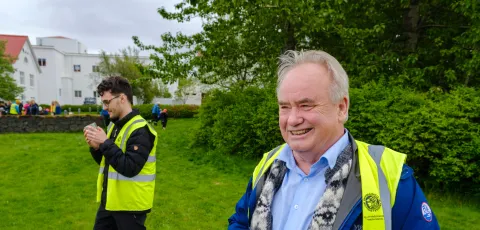
Gísli Már Gíslason, professor emeritus in biology at the University of Iceland.
Gísli Már Gíslason, professor emeritus in biology at the University of Iceland. IMAGE/Kristinn Ingvarsson

Gísli Már Gíslason, professor emeritus in biology at the University of Iceland and one of Iceland’s leading experts in limnology, and Ólafur Patrick Ólafsson, university lecturer in biology at the university, will lead the hike along with the group of biology students. Guides from the Children’s Touring Sociation will also join.

Are there mosquitoes in the Elliðaá river?

Every year, it’s exciting to see whether new settlers will be found in Elliðaárdalur, but Gísli Már says that one day, a mosquito is bound to be found in the area. In the last few decades, hundreds of new insect species have entered the Icelandic fauna, according to him, alongside a warming climate and increased international travel.
“Species that could not survive here before can now settle here more easily,” says Gísli Már and mentions among other species, wasps, bumblebees, new species of beetles and the infamous biting midges.

Insects are beautiful

Something incredible happens when a child realises that even the tiniest creature in the grass can reveal an entire magical world – a world that opens up when insects are examined under a microscope. “People and insects have a common ancestor that can be traced back 550 million years, so we’re not really closely related,” says Gísli Már and laughs. He says that insects are among the most interesting animals on Earth.

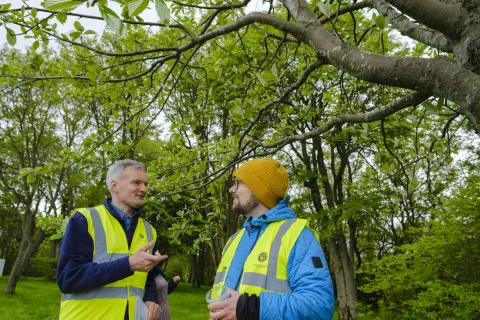
Ólafur Patrick Ólafsson, university lecturer in biology and a biology student.
Ólafur Patrick Ólafsson, university lecturer in biology at the University of Iceland, will lead the walk along with Gísli and a group of biology students. IMAGE/Kristinn Ingvarsson

“Off the top of my head, I can mention their anatomy, the evolution of flight, their ability to live on dry land and their incredible diversity that enables them to survive almost anywhere.”

Major discoveries in science often start with a child screaming, “Eeeeeew”… but then they want to examine the bug a lot more closely.

Gísli Már says that many insects are not at all ugly, even though many people are repulsed by them. He says they are very beautiful if people take the time to examine them carefully, and the hike on June 9 will definitely offer an opportunity. “Before, people used to collect colourful insects and frame them for display. When you look at them through a microscope, a completely new world opens up.”

Although many view insects primarily as a nuisance, scientists remind us that without them, life on Earth as we know it wouldn’t exist. “Insects are incredibly important for nature. They pollinate plants, break down biodegradable matter and play a key role in the world’s ecosystems,” says Gísli Már.

An important collaboration says Salvör Nordal

The collaboration between the University of Iceland and the Iceland Touring Association began in 2011, as part of UI’s centenary celebrations, and has continued ever since due to popular demand. In recent years, the emphasis has been on walks for children and families that intertwine nature, science, and curiosity. During a trip to the beach at the end of April, nearly 500 people showed up — and before you knew it, both children and adults were busy peering down into the tide pools.

“It’s a pleasure to see the Iceland Touring Association working with the University of Iceland and reaching out to children in particular, teaching them to enjoy nature in the peace and quiet,” says Salvör Nordal, the Ombudsman for Children, about this rewarding collaboration between the University and the Touring Association. Salvör also serves on the Iceland Touring Association’s board and is a professor at the University of Iceland.

Salvör Nordal
Salvör Nordal, Ombudsman for Children, a member of the board of the Iceland Touring Association, and a professor at the University of Iceland. IMAGE/Kristinn Ingvarsson

“Weaving together sustainability education and outdoor activities is one of the best ways to indulge one’s interest in environmental protection, understanding the importance of treating nature with respect and travelling on foot,” says Salvör.

Participants are encouraged to bring magnifying glasses if they’ve got them – waders or high rubber boots are also recommended for anyone intending to explore life in the streams and puddles up close. Please note that care should be taken when wading in the river below the old power station.

No registration is needed for this trip. Just bring your curiosity. Participation is free, and parking is available in the area.

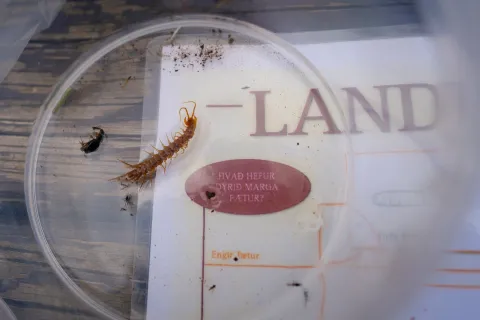
An insect in a container.
The University of Iceland and the Iceland Touring Association's annual bugwatching walk takes place on June 9 at 18.00 at the old power station in Elliðaárdalur. IMAGE/Kristinn Ingvarsson

Share

Tags
Did this help?

Why wasn't this information helpful

Limit to 250 characters.