Over the past few semesters, a team of researchers at the University of Iceland have been working to apply the ‘Building Thinking Classrooms’ approach in the course Mathematical Analysis I at the School of Engineering and Natural Sciences, with the aim of improving the performance of students who had previously failed the course. The methods have proven effective and have now been adopted in other courses across the University.
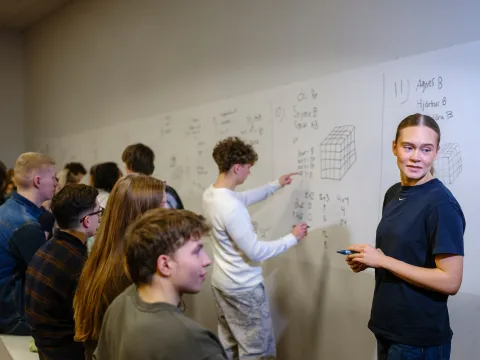
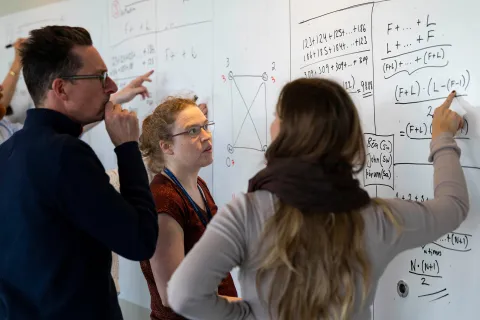
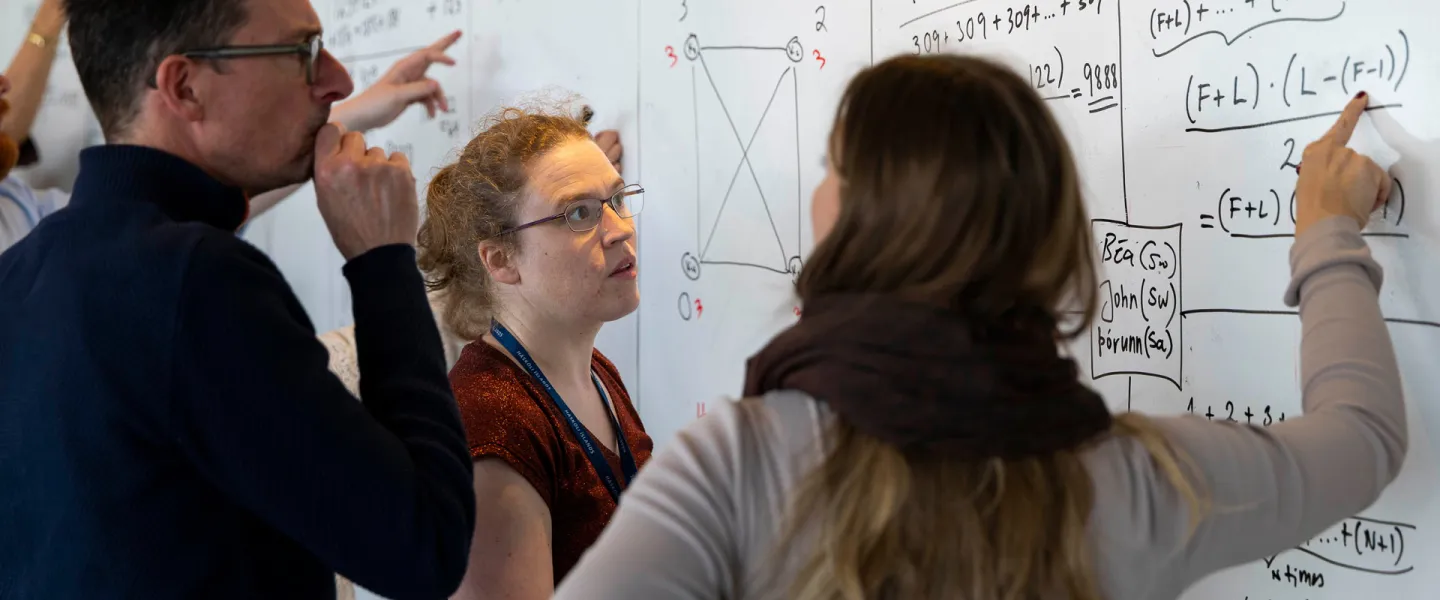
Building a Thinking Classroom involves shifting teaching practices from a traditional, teacher-centred approach to a student-centred model, in which students are active participants in their own learning. Instead of passively receiving information and taking notes in lectures, students collaborate in small groups and apply critical and creative thinking in their work.
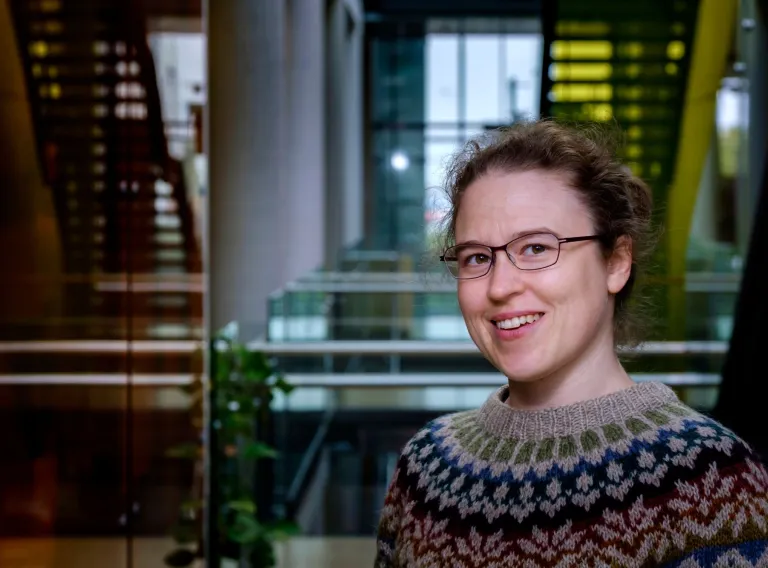
The Building Thinking Classrooms approach was originally developed for mathematics teaching in primary and secondary schools by Peter Liljedahl, professor of mathematics education at Simon Fraser University in Canada, in collaboration with school teachers. The research team, which also includes researchers from other institutions, is now exploring how Building Thinking Classrooms practices can be applied in demanding higher education courses. “We are investigating whether and how it is possible to disrupt the traditional university lecture format in order to deepen students’ understanding in STEM fields – science, technology, engineering and mathematics,” says Bjarnheiður Kristinsdóttir, lecturer at the School of Education’s Faculty of Subject Teacher Education.
The main aim of the study is to explore whether this approach can improve academic performance and perseverance, particularly in mixed-ability groups. “Instead of requiring students who failed Mathematical Analysis I to wait until the following fall and retake the same course, we designed a new course called Boot Camp for Mathematical Analysis I using the Building Thinking Classrooms approach, which we trialled in spring 2025,” she says.
Traditional lectures were ineffective
The study is rooted in a growing demand for active teaching methods in STEM subjects, with the aim of improving student performance and reducing dropout rates. Research has shown that although university students often believe they learn better in lectures, they actually achieve better academic results when active learning methods are used.
“This mismatch between perception and performance is what made us interested in systematically testing the Thinking Classroom approach at the university level. Ingólfur Gíslason, assistant professor in mathematical education at the School of Education, and I had read about Peter Liljedahl’s research on Building Thinking Classrooms and had experimented with its practices in upper secondary school teaching. Ingólfur began introducing pre-service teachers to these methods in 2016 and worked with Flötur – the Icelandic Association of Mathematics Teachers – to bring Liljedahl to Iceland in the summer of 2019.
Anna Helga Jónsdóttir and Sigrún Helga Lund, professors of statistics at the School of Engineering and Natural Sciences, pioneered the basic methods of the Building Thinking Classrooms approach in statistics and probability theory tutorials after attending a presentation by Ingólfur, but the approach has never been applied to a whole course before.
When 115 students failed Mathematical Analysis I in fall 2024, an opportunity presented itself to go beyond the basic elements of the Building Thinking Classrooms approach and offer a novel intervention in spring 2025. “Rather than repeating the traditional lectures, which had not been effective for these students, we decided to use Building Thinking Classroom practices to improve their perseverance and understanding. We were directly motivated by the need to find ways to support students struggling with their undergraduate studies,” says Bjarnheiður.
Interests lie at the intersection of mathematics and pedagogy
Bjarnheiður is passionate about this subject, with her main research interests lying at the intersection of mathematics and pedagogy, particularly active teaching methods, task design and how digital technology can be used to support mathematics learning.
“I enjoy exploring different ways of working with complex learning content to make it accessible to students, so they are able to gain an in-depth understanding. In order to achieve this, the instructor usually needs to step out of the spotlight and into more of a guiding role. As with Building Thinking Classrooms, most of these practices focus on encouraging collaboration and dialogue in the classroom, thereby improving the learning environment itself, both in terms of conditions for learning and the relationships between the students,” says Bjarnheiður, who has previously taken part in developing innovative mathematics teaching materials for compulsory, upper secondary and university levels.