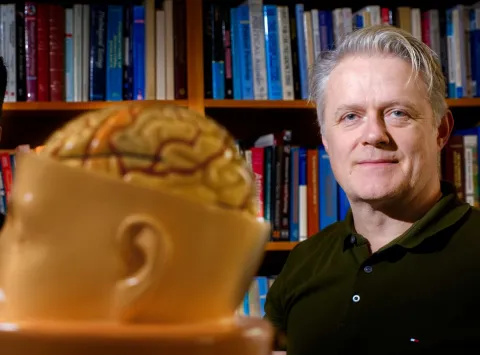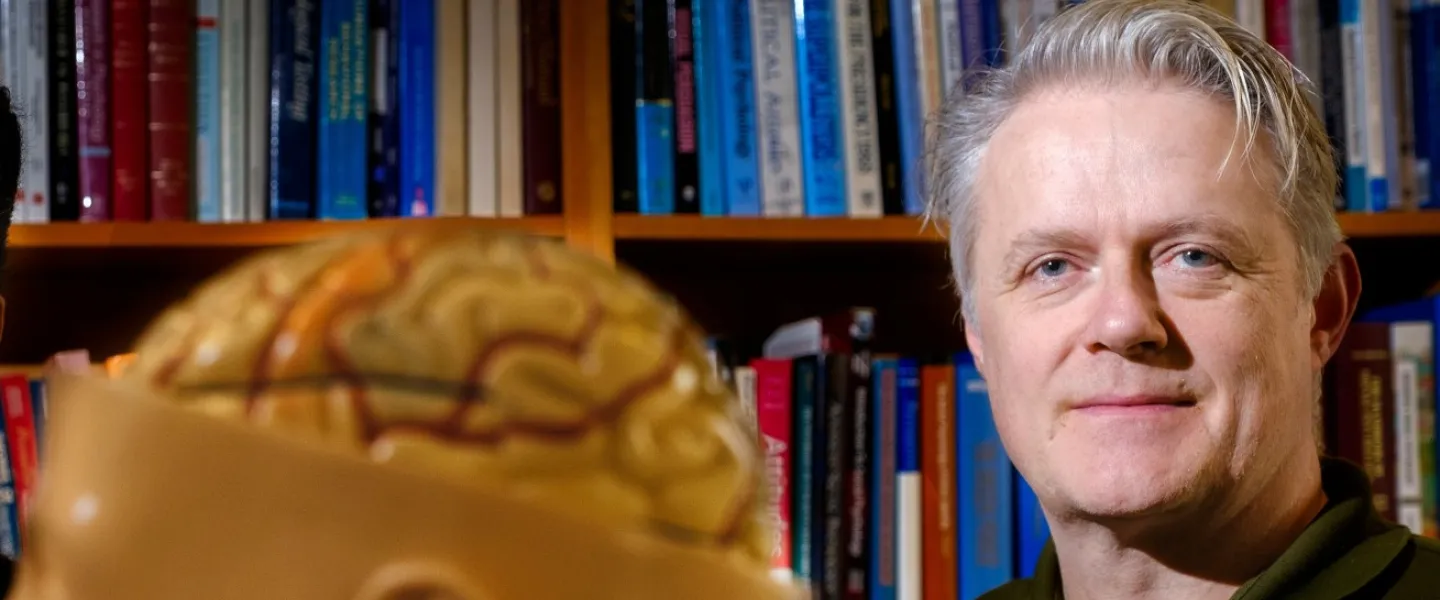
Árni Kristjánsson, professor at the Faculty of Psychology.

Our awareness of the perceptual world is shaped by spatial and temporal context.

Human perception has, for a long time, been investigated as if it were a collection of static photographs. As if the mind takes a picture, analyses it, puts it away, then takes the next, and then adds them together.

A new article in the high-impact journal Nature Review Psychology calls for a fundamental change in how we should think about perception and cognition — and how scientists should research these processes. The authors, Árni Kristjánsson, professor of psychology at the University of Iceland, and David Pascucci, assistant professor at the University of Lausanne, argue that perception is not a series of isolated snapshots, like individual photographs later arranged into sequence, but rather a continuous, interwoven process.

According to this approach, our internal model of the perceptual world does not involve individual snapshots, but a film — and our interpretation at each given moment depends on what we have seen and experienced before, as well as on our predictions about what will happen.

Surprising similarities to a song by Magnús Eiríksson

“In space and time, I trickle like a drop of water, in the murky river of all that is,” wrote the guitarist and songwriter Magnús Eiríksson on the band Mannakorn’s first album.

Of course, Magnús Eiríksson wasn’t writing about neuroscience, but he did describe the same fundamental position the scientists emphasise in their new research: We do not stand outside reality and measure it from there, but rather inside it. We are part of a flow we can never see in full.
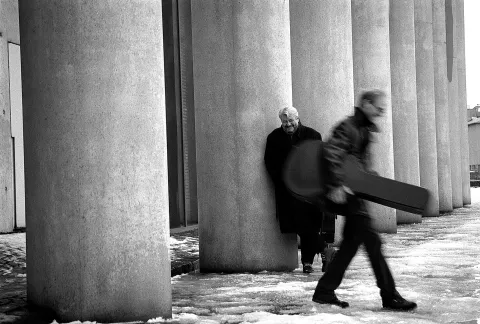
A black-and-white picture of the musicians Maggi Eiríks and KK.
The musicians Maggi Eiríks and KK.

If we analyse Magnús Eiríksson’s lyric, we can discern a certain perspective: Even though the world unfolds before us and flows onward in space and time, at any given moment we see only a fragmentary pattern of the whole we ourselves belong to. This is akin to what Árni and Pascucci’s theory suggests.

Reality isn’t measured like a drop of water on a scale. We do not perceive the world in single drops but rather in a flow — spatially, temporally, and in context to everything else. Our perception flows forward, like a murky river.
If we are small drops in murky water, we’re not measuring the river. We are the river.

New theoretical framework around perception and cognition

In the article in Nature Reviews Psychology, Árni and Pascucci introduce the concept of spatiotemporal routines — which could also be called spatially and temporally dependent perceptual functions. The concept describes how the brain uses experience, patterns in the environment, and regularity and predictability in time and space to interpret what we see and hear, and combines this with predictions about what is likely to happen in the future.

The authors criticise dominant research methods in psychology and neuroscience, in which stimuli are often isolated and presented in short, random sequences without spatial or temporal context. The goal of that kind of research is to isolate single parts of the sensory process. This approach leads to what they call “the vacuum problem” — where perception is examined in a vacuum, so to speak, with the context, which is the prerequisite for authentic perception, effectively removed.

“We argue for a new framework for how the brain processes information and how perception and cognition are formed — not as isolated moments, but rather as an ongoing process,” says Árni.

“Instead of viewing perception as a series of isolated stimuli, we propose that it is an interwoven, living process based on context, experience, and constant prediction of what will happen. The theory not only includes new ideas about perception and cognition, but also about how these processes can be disrupted.”

By drawing on converging evidence from vision, attention, memory and decision-making, Pascucci and Árni demonstrate that the brain continuously processes statistical patterns in the environment, both across time and space. It learns to predict what is likely and what changes quickly or slowly, and uses this knowledge to interpret new stimuli and construct an image of the world. The same applies to objects in space, events in time or more complex scenarios where information that comes later can even change our perception of what happened before.

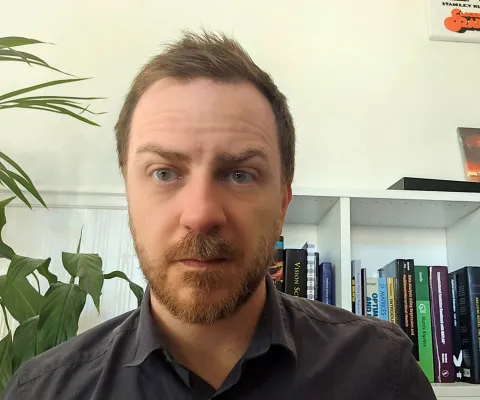
David Pascucci, assistant professor at the University of Lausanne.

From perception to psychosis: when context is lacking

According to Árni, he and Pascucci believe that this theoretical framework could shed new light on mental disorders, including psychosis, where delusions and distorted interpretations of reality play a part. “The perspective we’re putting forward is partly in opposition to conventional ideas of mental disorders and may call for a reassessment of how we approach these phenomena,” he says.

He says the ideology has wide-ranging effects and is related to new trends in neuroscience, artificial intelligence, virtual reality, and research on behaviour, where the emphasis shifts from isolated experiments to a real and living context.

Important to have the article published in Nature Review Psychology

Árni, who is among the University of Iceland’s more prolific scientists, says it is extremely important for scientists to have their articles published in journals as prestigious as Nature Review Psychology. “This is the most influential psychology journal in the world today which emphasises the international significance of the theory. Although the theory is challenging, we’ve done our best to make it as accessible as possible. David and I have worked together before on communicating complex ideas in a clear and effective way, and I do think we’ve managed to present a complex subject matter so that it reaches both the academic community and a broader group.”

Árni and Dr Pascucci’s article serves as an important contribution towards the re-evaluation of one of science’s fundamental questions: how we perceive, understand and interpret the world. According to it, we are not, as previously mentioned, looking at static pictures, but at a continuous entity, a film, and our interpretation at any given time depends on what we have seen and tried before, and also on what we expect to happen.

Perhaps it is exactly this vision the new theory evokes: We do not perceive the world from the outside, but from within it, in constant flow. We flow forward through time and space, perhaps like a drop of water in the murky river of all that is.

Árni Kristjánsson, professor at the Faculty of Psychology.
“This is the most influential psychology journal in the world today which emphasises the international significance of the theory, says Árni Kristjánsson, professor of psychology at the University of Iceland. IMAGE/Kristinn Ingvarsson

Share

Tags
Did this help?

Why wasn't this information helpful

Limit to 250 characters.